Skip to content
  • Home
  • Subscribe / donate
  • Events calendar
  • Business Directory
  • FAQ
  • News
    • Local
    • National
    • Israel
    • World
    • עניין בחדשות
      A roundup of news in Canada and further afield, in Hebrew.
  • Opinion
    • From the JI
    • Op-Ed
  • Arts & Culture
    • Performing Arts
    • Music
    • Books
    • Visual Arts
    • TV & Film
  • Life
    • Celebrating the Holidays
    • Travel
    • The Daily Snooze
      Cartoons by Jacob Samuel
    • Mystery Photo
      Help the JI and JMABC fill in the gaps in our archives.
  • Community Links
    • Organizations, Etc.
    • Other News Sources & Blogs
  • JI Chai Celebration
  • JI@88! video

Recent Posts

  • Federation now across BC
  • Israel fighting for its existence
  • Deal strengthens Iran
  • Patriotic belonging diminishes
  • A campaign to engage
  • Upstanders’ first live event
  • Responding to Carney
  • Having your own home
  • Music a family tradition
  • Musical to warm heart
  • Community milestones … June 2026
  • Sharing her passion for Israel
  • Or Shalom reopens its doors
  • JFS from past to future
  • Need holistic approach
  • Sharing stories, advice
  • Journalist shares fears
  • Skills to live together
  • Road to independence
  • Cutting grass with scissors
  • Zionism as a solution
  • Deceit, desire & the divine
  • Reclaiming sacredness
  • Creative project ideas
  • Summer squares and cobbler
  • Thou shalt … summer commandments
  • Legal help for students
  • Revisiting myth of Lilith
  • Wrong person rebuked
  • Canada’s mixed messages
  • Questions for museum
  • Symposium on antizionism
  • Making soccer political
  • CJPAC lauds Pulver’s impact
  • City recognizes Vrba’s legacy  
  • Organ donation saves lives

Archives

Follow @JewishIndie
image - CJN box ad Rockowers 2026

Category: From the JI

Beneath burkini

Beneath burkini

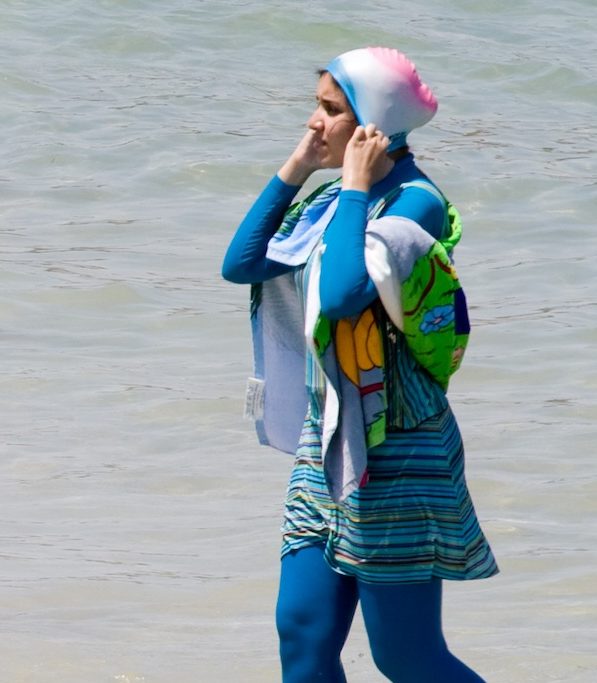
The burkini fiasco, if it has had any positive effects, should have opened some eyes to how silly human beings can behave when we become enmeshed in a fabricated social panic. The issue, for those who have not seen the image of French police standing over a woman at a beach, requiring her to remove articles of clothing, is the idea that Muslim women in modest beach wear are a threat to Western civilization.

About 30 coastal towns in France banned the “burkini,” swimwear that generally covers all but a woman’s face, hands and feet. Even after a French court ruled the ban illegal, most of the mayors insisted they would continue enforcing the dress code.

The irony is jarring. Ostensibly based on the idea that Islam or Islamism – the motivation and the perceived threat are blurry – oppresses women by forcing them into extensive body-covering clothing, police in a democratic Western country force a woman to disrobe. (It was inevitable, also, that photos would soon go viral depicting nuns frolicking in the ocean in full Christian religious regalia, unmolested by authorities.)

France’s Prime Minister Manuel Valls has called the burkini a “provocation” and “an expression of a political project, a counter-society, based notably on the enslavement of women,” an “archaic vision” in which women are “immodest, impure and that they should be totally covered. That is not compatible with the values of France and the Republic.”

We can leave to the French what is compatible with the values of France and the Republic, yet surely a nation founded on the pillars of liberty and equality must find something amiss when its police devote their time and resources to enforcing swimwear rules.

France is singular among European countries for its stated commitment to laïcité, the prohibition against religious involvement in government affairs in service of a secular ideal. Similar issues have been addressed in Quebec, where overtly religious Christian symbols, including the crucifix, were deemed part of the province’s cultural heritage and thereby conveniently exempted from the ban on religious imagery. But, in France, as elsewhere in Europe, more is at play than ideas of secularism. In fact, the imperfect heritage of secularism is being manipulated as an excuse to target a particular group.

On the one hand, let us not pretend that there are not legitimate concerns and issues raised by the increasing population of Muslims in Europe. Among this population, both among immigrants and those born in Europe, are a small number who have become radicalized and are a genuine threat to society. A larger number holds ideas that challenge the European consensus on the role of women in society, pluralism and the rights of people to live free from religious coercion. These are legitimate concerns that require addressing through long-range integration strategies and societal accommodation between traditions – as does the rise in Europe of nationalism, xenophobia and racism.

But the burkini is, at best, a side issue; a symptom of a few things, none of them healthy. Regardless, the “solution” to any social coercion around women’s clothing is certainly not legal proscription, at least it should not be in a Western democracy. Burkini-banning has more in common with religious extremism – modesty “police” exist in various communities around the world – than the Western freedoms the burkini-bashers claim to defend.

Format ImagePosted on September 2, 2016August 31, 2016Author The Editorial BoardCategories From the JITags burkini, France, Islamism, racism, secularism, Valls

Tempest in coffee pot

The BDS movement – which seeks to boycott, divest from and sanction the state of Israel – is having an impact. Though maybe not exactly as they’d hoped.

There was a tempest in a coffee pot recently when an East Vancouver café waded into the topic, angering some customers and, we surmise, perhaps some of the establishment’s own employees and investors.

As we addressed in this space last week, Elizabeth May, leader of the Green Party of Canada, was dismayed by the vote by her party in convention to support the BDS movement. She pondered resigning her position but this week announced that she would remain at the helm and seek to revisit the issue with her party.

A social media feed for Bows & Arrows Coffee, on Fraser Street, declared that May’s lack of support for BDS meant that she “got cowardly” on the issue and “caved.” One online commentator responded that the café’s coffee “tastes a little too antisemitic for my liking.”

After some social media back and forth, the co-owner of the café, which is headquartered in Victoria and only recently opened the Fraser Street location, published a statement acknowledging that he had “tweeted without consultation with staff and business partners.” Seemingly surprised that a simplistic #BDS hashtag and name-calling would elicit strong and equally simplistic reactions, he says that he blocked other posters and deleted tweets. He did these things, he claims, because he “wanted to address real arguments, not stand in a storm of accusers that would not engage or address my criticism of a state.”

Hopefully, he has learned that Twitter is not designed for intelligent and in-depth debate or discussion. More hopefully, perhaps he will now consider the possibility that BDS is not necessarily about “solidarity with oppressed peoples everywhere.”

While BDS supporters, including the one involved in this instance, reject the idea that the movement has any antisemitic elements and insist it targets “Netanyahu’s administration and policies of expansion in the territories,” plenty of evidence exists to suggest that BDS aims to end the existence of a Jewish state and, some would argue, this is perforce antisemitic.

Nonetheless, at least one member of the Jewish community went beyond Twitter and invited the B&A co-owner to discuss the issues surrounding BDS. In his email, the community member included a link to an article by Alan Dershowitz that was published by Haaretz, called “Ten reasons why BDS is immoral and hinders peace.” It can be found on the Centre for Israel and Jewish Affairs’ website.

While the brewmaster may contend, as he implies in his statement, that he was a victim of “[t]he silencing that occurs daily via the repetition of the dominant narrative,” what he really experienced was disagreement with his beliefs and a resulting effect on his business. He was not silenced. He voluntarily chose to exit a discussion he started.

In Canada, thankfully, the freedom to speak one’s mind comes with the freedom of others to criticize the views that come from that mind. Such discussions are healthy and can even be enjoyable – especially over a nice cup of coffee.


Posted on August 26, 2016August 25, 2016Author The Editorial BoardCategories From the JITags anti-Israel, antisemitism, BDS, Bows & Arrows, boycott, coffee, Fraserhood

BDS infiltrates Greens

In a turn of events that party regulars and, really, no Canadians anticipated, Elizabeth May is spending her vacation this week considering whether to resign as leader of the Green Party of Canada.

The impetus, apparently, is her party’s decision at its recent convention to adopt a resolution that attacks Israel and calls for boycotting, divesting from and sanctioning the Jewish state. It’s all part of a movement (shorthanded BDS) that hides behind the language of human rights to separate Israel from the community of nations, while ignoring not just the atrocities perpetrated by the Palestinian governments of Hamas and Fatah but also the most serious human rights abuses in the world.

May made it clear before the convention that she opposed the resolution, though most delegates probably did not realize it was a stay-or-quit litmus for the leader. After the vote, May complained that the issue was not subjected to a fulsome debate at the convention and that she did not have the opportunity to explain why she opposed the policy and why delegates should join her in rejecting BDS. Still, most delegates would surely have known how their leader – who earlier this year was endorsed in a leadership review with a whopping 93% – stood on the issue, given extensive media coverage.

There was something odd even in some of the remarks by opponents of the BDS policy, which emphasized the electoral albatross BDS would hang around the party’s neck, rather than the inherent immorality and hypocrisy of BDS. Critics seemed to assume BDS is a vote-loser, but is this assumption based on the fact that informed Canadians would oppose the movement? Or on the stereotype-founded idea that messing with the “Zionist lobby” is a no-win proposition? This may be unfair criticism if we assume rational people equate immoral, hypocritical policies with electoral failure.

May has spent a decade attempting to put the Green Party of Canada on the political map and succeeded, in 2011, in becoming the first Green MP elected to Canada’s House of Commons. She was reelected in 2015. She is almost certainly the only Green party public figure most Canadians can identify. Without her at the helm, the party would lose its sole recognizable face.

After the convention vote, May said there were plenty of issues she was happy to defend going into the next federal election, but BDS is not one of them. The anti-Israel movement has put her in this spot and it is an object lesson for Canadian politics more broadly.

BDS is a parasitic movement, attempting to infiltrate vulnerable hosts like the Green party and other well-intentioned trade unions, academic groups and social justice movements with an ideology that is not progressive at all, but anti-democratic and anti-intellectual.

BDS, and the anti-Israel movement more broadly, has attempted and in many cases succeeded in convincing progressive Canadians that they share values and ideals. Had the Green party engaged in the fulsome debate May says she wishes had happened, there would have been an opportunity to point out that BDS presents a one-sided, unbalanced interpretation of events that does not advance peace, that demonizes Israel and that makes common cause with the world’s most misogynist, homophobic and illiberal forces.

It was when the New Democratic Party of Canada was at its lowest ebb, in the 1990s and early 2000s, that the party’s policy was co-opted by extremists who used the language of human rights to advance an anti-Israel agenda that was anything but rights-oriented. Since then, the anti-Israel movement (because, as we have reiterated here, “pro-Palestinian” does not do justice to the injustices the movement excuses) has tried to graft itself onto any emerging cause.

It began, most visibly, with the eccentric Queers Against Israeli Apartheid – who privilege official Palestinian oppression of LGBTQ people over the reality that Israel is (at the very least) an oasis of freedom for gay people in a desert of sexual repression – and has spread to other movements, including Black Lives Matter.

Black Lives Matter, a desperately necessary effort to confront police violence and systemic discrimination against African-Americans, recently adopted a manifesto rife with boilerplate loathing of Israel and attestations of support for the national cause of Palestinians. Black Lives Matter has no foreign policy, except inasmuch as smearing Israel constitutes a worldview.

Why? Because the anti-Israel movement is adept at playing on the guilt of progressive people and movements to advance an agenda that is, at root, backward, violence-justifying and ignorant of history.

The BDS movement succeeded in co-opting the Green party into adopting its regressive position and now, depending on May’s decision on her future, may have done irreparable harm to the party, as BDS continues to harm the prospect of peace in the Middle East and a better life for Palestinians, the ostensible beneficiaries of the movement.

Posted on August 19, 2016August 18, 2016Author The Editorial BoardCategories From the JITags anti-Israel, BDS, boycott, Elizabeth May, Green party
A chance to educate

A chance to educate

Monika Schaefer is a violin instructor in the Alberta mountain town of Jasper. She was also a candidate for the Green Party of Canada in the federal elections of 2006, 2008 and 2011. Last week, a video went viral of Schaefer declaring that, after “a great deal of time researching this topic,” she has concluded that what Canadians have been taught about the Holocaust is rife with “inaccuracies.”

“When I started to look at the evidence, and I researched, and I researched and I researched, and the lies are coming apart,” she told the CBC. “This house of cards is crumbling, and that is why there is this very fierce reaction against what I’m saying, because this lie, this public myth, has shaped our world.”

She calls the Holocaust “the six million lie” and “the biggest and most pernicious and persistent lie in all of history.”

With all the things happening in the world today, the misguided ramblings of a soundly defeated candidate for Parliament is far from the most crucial issue we face as a civilization. Yet, the incident deserves consideration.

Despite that the Green party is being rightly condemned for anti-Israel resolutions set for debate at its upcoming national convention, let’s not attribute to an entire group the poison of one of its (soon-to-be-former) members. Holocaust denial and antisemitism have been expressed across the political spectrum and no party has a monopoly on that. Green party leader Elizabeth May responded immediately and appropriately, condemning Schaefer’s comments and moving to have her membership in the party revoked. That is one positive outcome.

The most generous assessment of the video is that Schaefer herself, who is of German heritage, is a victim of the collective trauma of Nazism. As the director of community relations and communications for the Jewish Federation of Edmonton, Tal Toubiana, told the CBC: “I find it curious that a woman who allegedly faced bullying based on her country of origin would rather continue a cycle of irreflexive hate than reflect deeply on the wounded history and trauma the Holocaust did create.… The Holocaust is a historical event that is not only undeniable in regards to the facts and documentation of its existence, but in the collective trauma it created. Ms. Schaefer is a product of the very trauma she claims does not exist.”

This is a very insightful analysis. It is easy to dismiss the people who conjure such fabrications as irredeemably wicked, but to adopt a more humane response in the face of inhumane statements would invite us to wonder what personal circumstance would lead an individual to such a distorted and easily disprovable worldview.

This appears to be the first public utterance Schaefer has made on the subject and perhaps it will open the door for her to be confronted with facts and have the sources upon which her deeply flawed conclusions rest debunked. Whatever happens in this instance, little is to be gained by demonizing the individual even though we rightly demonize her words.

Each time such an incident occurs is an opportunity to return to the basics and realize that we still have work to do. We need continued vigilance and we must educate all people, especially young people, about history.

Googling Schaefer’s name confirms this. Her ideas attract some breadth of support in the dusty extremities of the internet, where she is lauded as a “truth revealer and free speech advocate.” It is, of course, impossible to tell whether the hordes of online comments coming to her defence represent a sizable cohort or a tiny but prolific cluster of keyboard pounders. What they certainly represent is an unadulterated reminder that shockingly inhumane ideas retain sway among some of our fellow citizens.

There are now human rights complaints lodged against Schaefer in the Alberta and Canadian human rights commissions and already Schaefer is positioning herself as a martyr.

“Right now, the issue for me is freedom of speech,” she told a Jasper news outlet. “Last I checked, I thought we had freedom of speech in Canada and suddenly I’m the criminal.”

Wrong again. By law, Schaefer is innocent until proven guilty, so she is not “suddenly” a criminal. Moreover, her research fails her once more. Canada has freedom of speech, but not without limitations. To become the criminal Schaefer contends she already is would require proof that she intended to incite hatred against an identifiable group. This is a very difficult motivation to prove.

Whatever happens in the quasi-judicial processes Schaefer faces, we should be heartened by the response of many of Schaefer’s fellow residents of Jasper and we should take the opportunity to recommit ourselves to sharing the truth.

Format ImagePosted on July 22, 2016July 19, 2016Author The Editorial BoardCategories From the JITags antisemitism, Green party, Holocaust, Holocaust denial, human rights, Schaefer

Reacting to others’ suffering

Gun violence in America is an intractable, apparently unsolvable crisis. This month, it has intersected catastrophically with other tenacious American ailments: race and police violence. These issues have been inextricable in many ways for decades, of course, but the pervasiveness of video-recording and social media have helped turn what was once a matter of competing testimonies into irrefutable proof of police overreach, including murder.

The police killings of black civilians in Louisiana and Minnesota last week, followed by the revenge killing of five police officers in Texas, created a climate of crisis in the United States. Such times are, sometimes, opportunities for progress. The Civil Rights movement of the 1950s and ’60s was advanced by the widespread awareness among Americans of all races of injustices being perpetrated against black Americans. However, anything involving guns in America seems somehow impervious to reason.

Race is a unique flashpoint in American life and approaches to it have very often split directly along color lines. This may be changing, with more white Americans recognizing the injustices experienced by their fellow citizens of color. Like sexual orientation equality, issues of racial justice seem to be advancing because of a wider appreciation that transcends personal identity and relies on human empathy for those who are different from ourselves.

Still, Americans – and Canadians in somewhat different contexts, and all peoples – struggle to find balance and moral approaches to confounding issues. In response to the Black Lives Matter movement, a counter-campaign declares “All Lives Matter.” After the police killings in Dallas, “Blue Lives Matter” became a slogan. While the veracity of these statements cannot be refuted, they are nonetheless unhelpful and dismissive. Responding to Black Lives Matter with an appropriated variation is disrespectful. It is akin to the complaints by members of the majority when gay pride events occur and the question arises, “When do we celebrate straight pride day?” The answer, as empathetic people know, is that straight people (or white people) don’t need special days to celebrate their situation in society.

The insensitivity of such approaches has been slyly critiqued in social media recently, with one cartoon showing a house on fire while firefighters douse the house next door in water, declaring “All houses matter.” Similarly, a man in the doctor’s office with a broken arm is told, “All bones matter.”

The message should be clear: the perennial problems America has around race are particularly enflamed right now and attempting to dilute these through banal attempts to universalize what is a very particular problem effectively exacerbates the issue. Just last week in this space we noted that the specious way some people respond to any mention of the Holocaust is to note that Jews aren’t the only people to have suffered. Replying to the suffering of one group by an erroneous universalizing of race-particular situations is not a healthy response.

Another development seen recently is the attempt by “pro-Palestinian” activists in the United States to co-opt the Black Lives Matter movement and the recent catastrophes to their own narrow ends. Students for Justice in Palestine at New York University declared that those responsible for the “genocide” of Palestinians are likewise responsible for the “genocide” of African-Americans, a circle they attempt to square with the fact that a small number of U.S. police have received anti-terrorism training from the Israel Defence Forces.

There are plenty of issues competing for the attention of people of goodwill. There are injustices everywhere, God knows. There is racism, homophobia, antisemitism, Islamophobia and every range and permutation of human misery that deserve attention. Yet, when something as systemic and pernicious as the murder of African-Americans by those entrusted to protect American citizens becomes epidemic, this is not the time to elbow one group out of the way or try to co-opt their tragedies.

Posted on July 15, 2016July 13, 2016Author The Editorial BoardCategories From the JITags Black Lives Matter, empathy, equality, guns, racism
We must keep trying

We must keep trying

No reasonable people contend that the Holocaust did not occur. However, a great many assert that it has been considered enough, that it is time to put the past behind and effectively close the book on that era. Similarly, discussion today about the Holocaust is likely to elicit a sort of comparative or competitive response: “The Jews are not the only people who have suffered,” or something similar. While such assertions are almost tautological in their obviousness, they betray a different sort of exceptionalism around the Holocaust: the Jewish people are not the only group in history to have suffered, but they are the only ones today being told to buck up and shut up about it.

Somewhere between these two responses – outright denial and exasperated acknowledgement – is a large swath of indifference. A great many people in Canada and elsewhere are aware of the history of the Holocaust, express appropriate responses to it and may utter rote pieties about preventing history from repeating itself. As a civilization, though, all of these responses have so far led to an unsatisfactory status quo.

photo in Jewish Independent - Elie WieselElie Wiesel, who died Saturday, believed that understanding the Holocaust is key to the crucial need to understand human capabilities for evil and possibly to provide its antidote. If Wiesel’s formula is correct, the briefest glance at the headlines today is all the proof necessary to show we have thus far failed to consider and understand that terrible history.

For decades, Wiesel was not only a global voice for survivors, but a sort of moral compass for a world that has not learned the overarching lesson of the Shoah. Speaking out again and again on issues of contemporary injustice and genocide – though some advocates for Palestinians have contended that he wasn’t as vocal on that issue – Wiesel at the same time expressed regret that his interventions should be necessary.

In an interview with the Independent in 2012, Wiesel lamented that all his efforts and those of other survivors have failed to create the ideal world free of hatred and genocide.

“Maybe, deep down, all of us who have survived have had a feeling, if we told the story, the world would change, and the world hasn’t changed,” he said. “Does it mean that we did not tell the story? Or not well enough? Simply, we did not find the words to tell the story? Had we told the story well enough, maybe it would have changed the world? It hasn’t changed the world.”

The outpouring of grief over the passing of Wiesel is the appropriate response to the loss of a great individual. But it also reflects a larger lament; it is a reminder that the generation of eyewitnesses is diminishing. For many of us – and for the world – Wiesel was the face of the survivor, the voice of the Holocaust experience. His unflinching writing on the subject defined the discipline of the eyewitness Holocaust narrative. Not only was Wiesel able to articulate and validate the experiences of survivors who could not express themselves for various reasons, more importantly, as he himself acknowledged, he had an obligation to those who did not survive.

It is this same sense of obligation that motivates survivors to regularly make the emotionally exhausting effort to share their experiences with audiences, particularly young people. As Wiesel acknowledged, the world has not responded adequately. But, in the same interview, he said failure would have been to not try.

When Wiesel was recognized in 1986 with a Nobel Prize in literature, it was a recognition of his contribution, certainly, but it was also an affirmation for all survivors – indeed, for all of those whose identities attracted the Nazis’ genocidal hatred – that their experiences were valid, legitimate and incontestable.

When Wiesel’s book Night was published in English in 1960, it was at the start of a global conversation of the Holocaust and its meaning for humankind. Wiesel rightly hoped, but perhaps should not have expected, that a catastrophe of this magnitude would be adequately understood or its lessons assimilated in the comparatively short span of a human lifetime. He was correct that understanding the Holocaust is a key to humanity’s future. By their actions, Wiesel and all the survivors who share their lived experiences have helped to lay a foundation for a world in which the key to peace and a better future can emerge. As the eyewitness survivors pass that responsibility along to the rest of us, it is our ambitious mission to build on that foundation and to extend their calls of compassion, humanity and reflection to a world in great need of perfecting.

Format ImagePosted on July 8, 2016July 6, 2016Author The Editorial BoardCategories From the JITags Holocaust, survivors, tikkun olam, Wiesel

Greens’ true colors?

Voters in the United Kingdom – well, in England and Wales, at least – have decided to quit the European Union. The referendum last week turned British politics, and world economic markets, upside down.

The potential for a Scottish withdrawal from the United Kingdom is again front and centre. More than this, politicians and commentators worldwide are extrapolating the vote’s meaning across Europe and North America to try to comprehend the potential impacts of a coalescence of disgruntled, anti-elitist, populist, nativist and xenophobic tendencies. Already, the result seems to have given licence to some people to act out on xenophobic hatred, with numerous incidents of verbal and physical assaults against visible minorities reported across Britain in just the couple of days following the referendum.

Among those who supported the losing “Remain” campaign are some who threaten to move to Canada. This is a default for Americans and now, apparently, Brits who dislike the democratic outcomes in their own countries. The Canada strategy is much talked about but rarely executed. Ironically, people from countries that move toward exclusionary practices and tightened immigration policies assume that Canada is an uncategorically welcoming place that would greet them with open arms. On Canada Day, of all times, we should take it as a compliment that our reputation is one of haven and acceptance.

And yet … while Europe may be aflame with xenophobia and demagoguery, Canada is not immune to strains of something nasty. The current example comes from none other than Canada’s Green party.

For a movement that ostensibly subscribes to the precept of thinking globally and acting locally, the policy resolutions for the party’s August convention are starkly parochial. Only two items proposed for consideration approach foreign affairs issues – and both attack Israel.

One resolution calls for the party to join the BDS movement to boycott, divest from and sanction the Jewish state. More hypocritically still, the Green party is seeking to have the Jewish National Fund of Canada’s charitable status revoked. That a Green party would target one of the world’s oldest and most successful environmental organizations is symptomatic of something irrational in the mindset of those who promulgated the resolution. Whether it advances to the convention floor – and what happens then – will tell us a great deal about the kind of people who make up the Green Party of Canada.

In a world where human-made and natural catastrophes seem unlimited, from the entire population of Green party members across Canada, only two statements of international concern bubble to the surface – and both are broadsides against the Jewish people.

Elizabeth May, the party’s leader and sole MP, said she opposes both resolutions but, since the determination of policy is made on the basis of one member one vote, there is a limited amount she can do. She met last week with Rafael Barak, Israel’s ambassador to Canada, and said the Green party’s support for Israel’s right to exist is “immovable.”

We’ll see.

Posted on July 1, 2016June 29, 2016Author The Editorial BoardCategories From the JITags anti-Israel, antisemitism, BDS, boycott, Elizabeth May, environment, Green party, Jewish National Fund, JNF, politics

It’s OK to boycott BDS

The Anti-Defamation League, one of North America’s most prominent Jewish advocacy agencies, has taken a stand that is at odds with the consensus position of almost all other local, national and international Jewish and Zionist organizations.

Responding to the BDS movement, which strives to boycott, divest from and sanction Israel, and which is condemned by some as being founded on antisemitic premises, most Jewish organizations have stood emphatically in opposition to the movement.

Governments have also come out against BDS. The government of Canada passed a motion in Parliament in February, condemning “any and all attempts by Canadian organizations, groups or individuals to promote the BDS movement, both here at home and abroad.” Just in the last year, nine U.S. states have enacted anti-BDS laws, which generally prevent state government departments and agencies from doing business with organizations that support BDS. Similar legislation may come to the U.S. Congress.

The ADL’s position, which has been slammed by the Zionist Organization of America, is that the issue comes down to free speech.

“A decision by a private body to boycott Israel, as despicable as it may be, is protected by our Constitution,” wrote Abraham Foxman last year, when he was the national director of the ADL. “Perhaps in Europe, where hate speech laws exist and are acceptable within their own legal frameworks, such bills could be sustained. But not here in America.”

There is no question that the American political tradition falls very heavily on individual rights and free expression. Canadian and European approaches tend to balance individual and group rights. Free speech, sacrosanct in American constitutionalism, is limited by law in some cases in Canada and other democracies if it is seen to possibly incite hatred against individuals or groups.

The United States has its unique constitutional history and relationship with free expression and the Jewish organizations in that country can be left to argue these issues among themselves. As Canadians, we would contend that, in fact, countering the BDS boycotters by boycotting them is not an infringement on free expression, but rather an entirely logical extension of it.

When the House of Commons passed the anti-BDS motion last winter, it was an expression by members of the House that the movement was founded on ideas that are selective, misguided and potentially discriminatory. The motion did nothing whatsoever to legally forbid those ideas and their promulgation. They merely condemned them.

The idea that state or other governments would forbid their departments and agencies from investing in or doing business with organizations that promote BDS may seem heavy-handed. A government is not the same thing as a business or a church. People can quit a church or disagree with the policies of the business by voting with their dollars. A government represents all of its people. But governments also, by definition, must take stands on the issues of the day. By rejecting the BDS movement, governments are doing precisely that. Voters will have the opportunity to endorse or repudiate those positions at the time of the next election.

Boycotting the boycotters, which is effectively what nine U.S. states have chosen to do, is fair game. We have made the case before in this space that one person’s free speech does not erase that of another person. When an individual or group expresses an ugly idea, in a democracy, it does not abrogate their rights if another individual or group speaks up to condemn the ugly idea.

Whether legislation against BDS is the most effective means of combating BDS is open to debate.

Foxman argued that education, lobbying or persuasion may be the more effective long-term strategy. In our view, legislation and education need not be mutually exclusive.

Posted on June 24, 2016June 22, 2016Author The Editorial BoardCategories From the JITags ADL, BDS, boycott, Foxman, Zionist, ZOA
Particular and universal

Particular and universal

Vigils, like this one in Minneapolis, were held across North America to express grief and solidarity with the victims of the shooting in Orlando. (photo by Fibonacci Blue)

Still reeling from the latest gun attack in Tel Aviv, which killed four people last week, we awoke Sunday to the horrific news from Florida that a gunman had murdered 49 people in a gay nightclub in Orlando.

We whose job it is to put feelings into words struggle, though it seems nobody on social media lacks an opinion on gun control and the Second Amendment, homophobia or Islamic extremism, to which the murderer professed allegiance.

Immediately began the familiar cycle of Facebook solidarity, official condemnations and vigil-holding. President Barack Obama, who on the last such occasion of mass death declared, “Enough!,” had to conjure something original to say in this instance.

It is a peculiarity of the American political and cultural system that such tragedies are, it seems, accepted as a sad but unavoidable fact of life. Vested interests in the gun industry, which fund the powerful National Rifle Association, control members of Congress and have a not-insignificant base of grassroots Americans.

The murderer had been on the radar of intelligence authorities, yet he was able in the last two weeks to legally purchase a Glock pistol and a long gun, as was apparently his right as an American citizen.

When, in 2012, a gunman killed 20 children in Sandy Hook elementary school in Connecticut, some thought that would be the turning point, the moment some sense of sanity would be applied to guns in the United States. Nothing of substance changed and, if not then, it probably never will. Indeed, gun sales increase after such incidents, as the Wild West of American founding lore finds new life in the 21st century – self-preservation through firepower.

There are perhaps few who can as readily empathize with the LGBTQ community as members of the Jewish community. Jewish individuals and institutions are routinely targeted in Europe. Such incidents are far fewer but not non-existent in Canada and the United States. The ghosts of the 1994 Jewish community centre bombing in Argentina haunt us still. And Israelis are routinely attacked and killed by terrorists.

Though thousands of kilometres away from Orlando, the gay community and allies in Vancouver came together for a vigil Sunday night, as they did across North America. When an attack like this takes place against a small minority, it has particular resonance for members of that group even if they have no immediate connection with the victims. As a newspaper, we join with Jewish institutions and individuals in Canada in expressing grief and solidarity with the victims, the survivors and their loved ones, as well as with the entirety of the LGBTQ community here and everywhere.

After such tragedies, it sometimes seems that the particularity of the victims is downplayed to glean a universal lesson for humanity. We hear phrases like “injustice for one is injustice for all.” In his remarks Sunday morning, Obama said: “This is a devastating attack on all Americans.”

This is a necessary and true statement, but we shouldn’t only universalize our solidarity. The shooting was a deliberate, targeted attack on gay people and Obama’s remarks included articulate expressions of solidarity with the LGBTQ community. He did not, for example, make the same mistake he did during the Paris attacks, when he referred to Jewish victims as “a bunch of folks in a deli.” The Jewish particularity of the victims in Paris and the particularity of the Orlando victims’ sexual orientations must be recognized in order to confront the prejudices that underlie them.

Format ImagePosted on June 17, 2016June 16, 2016Author The Editorial BoardCategories From the JITags guns, homophobia, homosexuality, LGBTQ, Orlando, prejudice, terrorism
Check out JI calendar

Check out JI calendar

It is not even officially summer yet but, because we like to stay ahead of the curve, welcome to our annual Summer Celebration issue (June 10)!

Also ahead of the curve is the weather, which has seemed like summer throughout much of the spring. This has been a glorious boon to we who enjoy the innumerable outdoor activities this region has to offer – even if your choice of outdoor activity is simply relaxing on a patio with a hot or cold beverage.

The mostly warm and dry weather, of course, brings challenges. The danger of wildfires has been horrifically demonstrated by the tragedy of Fort McMurray. We also each have a responsibility to do our part in preserving water resources. A brown lawn, nowadays, is a sign of pride and respect for the environment.

That aside, this summer’s calendar – June, July, August, even September – is choc-a-bloc with ideas for individuals and families of every age to enjoy.

Being the Jewish newspaper, as we are, we emphasize events and activities oriented specifically toward Jewish British Columbians or that are in some way connected with our community. There is a vast array of opportunities and we hope that you will keep jewishindependent.ca bookmarked for at least the next months so the first time a kid or teenager complains of boredom – or when it seems like they have spent time enough on electronic devices – the plethora of activities highlighted here will inspire a fun day. Or a welcome night out sans children.

Last week in this space, we discussed the challenges created by transportation and real estate prices in this region. Throughout the year, in these pages, in other media and in everyday conversations, Vancouverites have a habit of kvetching, particularly during those long wet, grey autumn and winter days. But summer is what really brings out the best in this city and province.

Take some time to put aside the daily worries and woes and throw yourself into some of the superb offerings the city and the region has. Let the Independent inspire you!

Format ImagePosted on June 10, 2016June 8, 2016Author The Editorial BoardCategories From the JITags calendar, events, summer

Posts pagination

Previous page Page 1 … Page 34 Page 35 Page 36 … Page 48 Next page
Proudly powered by WordPress