Skip to content
  • Home
  • Subscribe / donate
  • Events calendar
  • Business Directory
  • FAQ
  • News
    • Local
    • National
    • Israel
    • World
    • עניין בחדשות
      A roundup of news in Canada and further afield, in Hebrew.
  • Opinion
    • From the JI
    • Op-Ed
  • Arts & Culture
    • Performing Arts
    • Music
    • Books
    • Visual Arts
    • TV & Film
  • Life
    • Celebrating the Holidays
    • Travel
    • The Daily Snooze
      Cartoons by Jacob Samuel
    • Mystery Photo
      Help the JI and JMABC fill in the gaps in our archives.
  • Community Links
    • Organizations, Etc.
    • Other News Sources & Blogs
  • JI Chai Celebration
  • JI@88! video

Recent Posts

  • Or Shalom reopens its doors
  • JFS from past to future
  • Need holistic approach
  • Sharing stories, advice
  • Journalist shares fears
  • Skills to live together
  • Road to independence
  • Cutting grass with scissors
  • Zionism as a solution
  • Deceit, desire & the divine
  • Reclaiming sacredness
  • Creative project ideas
  • Summer squares and cobbler
  • Thou shalt … summer commandments
  • Legal help for students
  • Revisiting myth of Lilith
  • Wrong person rebuked
  • Canada’s mixed messages
  • Questions for museum
  • Symposium on antizionism
  • Making soccer political
  • CJPAC lauds Pulver’s impact
  • City recognizes Vrba’s legacy  
  • Organ donation saves lives
  • Theodore’s March premiere
  • A healing Shabbaton
  • Supplying healthy food
  • A chime of metal tags
  • Yellowknife seder a first
  • Ishai energizes, unifies
  • A Lag b’Omer to remember
  • Expanding the healing
  • Hannah Senesh – a unique hero
  • Community milestones … May 2026
  • Деньги до зарплаты на карту Займ до зп онлайн за 5 минут 2026
  • Микрокредит онлайн в Казахстане Микрозайм в Акшамат

Archives

Follow @JewishIndie
image - The CJN - Visit Us Banner - 300x600 - 101625

Category: World

Upcoming geniza exhibit

Upcoming geniza exhibit

A letter of introduction, written and signed by the Rambam (Maimonides) in the 12th century, which is part of the Discarded History exhibition that will be opening in April 2017 at Cambridge University. Visitors will be able to see a small fraction of the more than 300,000 manuscripts and fragments that were originally found in the geniza, or storeroom, of Ben Ezra Synagogue in Fustat, or Old Cairo, in Egypt. Some of the items are more than 1,000 years old and, among them, are accounting records and parts of responsa and observations by some of the greatest Jewish theological minds, such as the Rambam, Isaac Luria and Joseph Caro. (photo by Edgar Asher with permission of the Syndics of Cambridge University Library)


Format ImagePosted on November 4, 2016November 3, 2016Author Edgar AsherCategories WorldTags Egypt, history, Maimonides, Rambam
Oberlin’s Jewish problem

Oberlin’s Jewish problem

Protesters at Oberlin College. (photo by Pteranadons via Wikimedia Commons)

(This is Part 1 of a two-part series. The second article examines the student-as-customer approach at universities and its relation to identity politics on campus.)

New York Times columnist Frank Bruni wrote in a June article that “Oberlin College would certainly be in the running” if he picked one campus “that has been roiled the most by struggles over political correctness.”

While university president Marvin Krislov has acknowledged upheaval, he wrote – in the same Times section – that Oberlin’s “faculty and staff … maintain high academic standards and rigor.”

Since I attended the 50th reunion of my class, I realize I do care about the calamity that Oberlin College now exemplifies.

Every town in northern Ohio has history built around either its bar or its liberal arts college. Oberlin was a “dry” town, founded in 1833, the same year as Oberlin College. Then, in 1893, Oberlin became the birthplace of the Anti-Saloon League, the political movement behind the U.S. Constitution’s 18th amendment: prohibition, which took effect in 1920. That social experiment was a disaster, and the 21st amendment repealed the 18th in 1933. Oberlin College finally eased its ban on beer decades later, yet zealotry still haunts the campus.

Bruni scorns “the demand for a so-called trigger warning to students who might be upset reading Antigone,” and he seems bemused by “complaints about the ethnic integrity of the sushi in a campus dining hall.” But it was not funny when, in September 2013, a Latina Jewish student helped plan a Shabbat dinner where Latin American food would be served – and another Oberlin Latina student denounced the event’s “cultural appropriation.” As one Jewish student recalled in a Tablet article this past May, posters for a previous Asian Fusion Shabbat were “defaced with graffiti about appropriation and orientalism. Comfort food Shabbat was also ill received, with comments about appropriating black cooking.

“There is a common belief at Oberlin that all Jews are white and rich” – so a Jew cannot be Latin American, cannot be a “person of color,” etc. – and, therefore, all Jews on campus should eat “white” food. Of course, such dogma defies both fact and logic, harms individuals and undermines the college’s stated “diversity” goals.

In the same Tablet article, it was noted that, in 2013, the Oberlin Student Cooperative Association revoked affiliation of one dining hall, “the Kosher-Halal Coop (used predominantly by Jews).”

Timothy Elgren became Oberlin’s dean of arts and sciences in July 2014. In February 2016, Oberlin’s online news site posted the transcript of conversation in which Elgren told Krislov that “changes to the way we run our faculty searches have been very important.”

One such search for an assistant professor led to the appointment of Joy Karega. By March, Karega had received worldwide attention for her social media postings of anti-Jewish hatred and conspiracy theories. Karega has neither denied nor disavowed her connection to these items.

In November 2015, for example, Karega wrote that “ISIS is not a jihadist, Islamic terrorist organization. It’s a CIA and Mossad operation….” In other online postings, Karega asserted that Israel and/or Jews also were responsible for bringing down the Twin Towers of New York’s World Trade Centre on Sept. 11, 2001; for murders at the Charlie Hebdo office in Paris in January 2015; for the massacres of 130 people in Paris in November 2015; for shooting down a Malaysian passenger jet over Ukraine; and for “weaponizing the weather” to inflict the damage of Hurricane Sandy in New York City.

Karega’s illustrated postings also have claimed that the Rothschild family is “worth 500 trillion dollars,” owns “nearly every central bank in the world” and owns “the media, your oil, and your government.” Abraham Socher, an Oberlin associate professor of religion, noted in the student newspaper, the Oberlin Review, that such notions harked back to the infamous antisemitic fabrication The Protocols of the Elders of Zion. He reminded his readers that a U.S. government definition of antisemitism specifically includes: “Making mendacious, dehumanizing, demonizing or stereotypical allegations about Jews as such or the power of Jews as a collective – especially but not exclusively, the myth about a world Jewish conspiracy or of Jews controlling the media, economy, government or other societal institutions.”

While Karega posted anti-Jewish bigotry and conspiracy theories online, she also taught “social justice writing” to Oberlin students. When I spoke with Krislov on April 6, he could not identify any actual research or publication by Karega at Oberlin. Yet, Karega retained her professorial position there.

Starting in March, publicity about Karega and Oberlin spread among online news sites and print newspapers in the United States, then to papers in England and Israel. Articles about controversy at Oberlin had appeared months earlier in The Atlantic and Vanity Fair, as well as a New Yorker feature that followed in May.

As I learned about Karega, I found that broad anti-Jewish manifestations at Oberlin predated her – and that other campuses in the United States and Canada may have similar cultures, in which it is acceptable to denounce, mock, bully or intimidate any student who is perceived to be Jewish. Perhaps only “fringe” individuals on campus indulge in bigoted behavior, but the community as a whole may ignore or appease the fringe – as part of “free speech” and “academic freedom” or to avoid personal reprisals?

Some of the fringers, however, restrict free speech. They disrupt presentations that they disdain and they have invaded Hillel meetings or other Jewish activities, according to one unnamed “longtime Oberlin professor,” quoted in the same Tablet article as the student cited previously.

Hadas Binyamini, a 2014 Oberlin graduate and co-founder of the college’s J Street U chapter, wrote in the Forward in March this year: “I was uncomfortable publicly identifying as a Zionist” but, even more importantly, “What I didn’t find at Oberlin were spaces to engage with prevalent forms of antisemitism that have nothing to do with Israel. No tools were offered for students to critically examine American Jewish identity and to deconstruct antisemitic motifs….” And, Binyamini continued, “the Multicultural Resource Centre … remains silent on antisemitism. Similarly, the department of comparative American studies, which trains students to ‘investigate power, inequality and agency through the analysis of … race … class … and citizenship,’ [seems] unable to engage students with these same issues when it comes to American Jews.”

Marc Blecher, an Oberlin professor of politics and East Asian studies, agreed: “our Multicultural Resource Centre has been silent on antisemitism.” It is worth noting that, this year, Oberlin celebrates the 20th anniversary of its MRC, which “strives to advance … multicultural understanding among all campus communities.”

Isabel Sherrell, another Jewish graduate of Oberlin – who, according to the Forward, attempted some dialogue with Karega – compiled a list of anti-Jewish incidents and attitudes on the campus. She permitted the use of her name when a Washington Post blog publicized her observations this past February. For instance, Item #6 on her list is anti-Zionist advocacy in the classroom of an African studies professor. Item #18 includes, “Being told I was simply European and Judaism is a religion not an ethnicity,” although the latter view logically contradicts the (false) campus dogma that a person cannot be both Jewish and a “person of color.”

Item #10 on Sherrell’s list begins, “The fact that so many Jewish students are bullied into silence….” Unlike Sherrell, I have zero personal knowledge of “cyber-bullying” or “trolling” or “doxing” via “social media” and I have no idea how a target on campus should respond to such abuse. But Jonathan Weisman – who is not a student, but rather is an editor at the Washington bureau of the New York Times – announced in June that he felt obliged to quit Twitter altogether, because, “For weeks, I had been barraged on Twitter by rank antisemitic comments, Nazi iconography of hooknosed Jews stabbing lovely Christians in the back, the gates of Auschwitz, and trails of dollar bills leading to ovens.” (Weisman believes that the tweets he received came mostly from right-wing white supremacists, not from left-wing campus “social justice” warriors.)

By mid-April, Oberlin’s board of trustees and a majority of faculty members had publicly criticized Karega. Also, some sort of investigative process was announced. But at least three members of the Africana studies department individually voiced some support for Karega. One concern was that

Karega might be a scapegoat, burdened with blame for an anti-Jewish climate that pervaded the campus before she arrived.

I have found no record of public comment by Krislov regarding Karega or related issues until after her story went viral. Then, he issued a statement, which the Oberlin news site posted on March 1, about “The Mission of Liberal Arts Education”: “At Oberlin, we are deeply committed to … ensuring our students a diverse, inclusive and equitable educational experience. We demand intellectual rigor….”

In his mission statement – as in his Times essay and elsewhere for months – Krislov minimized campus problems, promulgated platitudes and did not mention Karega by name.

Oberlin has an Office of Equity, Diversity and Inclusion, and it released on May 19 a “Campus Climate Report,” which also did not include Karega’s name in its Jewish section.

During the first week of August 2016 – five months after the earliest Times article about Karega, and fast approaching the start of the 2016-2017 academic year – Oberlin finally announced that “Dr. Karega has been placed on paid [emphasis added] leave and will not teach at Oberlin” until “the faculty governance process … plays out.” Karega’s attorney accused Oberlin of “pandering to the dictates of a handful of vocal and wealthy religious zealots.”

The Atlantic, back in 1941, invited and published an article on “The Jewish Problem in America,” in which the journalist (formerly an Episcopal priest) Alfred Jay Nock wrote: “The problem, stated in the fewest words, is that of maintaining a modus vivendi between the American Jew and his fellow citizens which is strong enough to stand any shocks … such as may occur in the years ahead.”

From New York City, he observed with alarm: “… in the late summer of 1939 … anti-Jewish street demonstrations … were going on in Brooklyn, Jackson Heights, the Bronx and Yorkville at the rate of 50 or 60 a week. “These were assaults, baitings, intimidations, picketings, soapbox speeches, incitements to boycott, and the like.

“I think it is not impossible that I shall live to see the Nürnberg laws reenacted in this country and enforced with vigor.”

The Nürnberg – or Nuremberg – laws, which were announced by Nazi Germany in 1935, stripped Jews of citizenship and institutionalized their persecution. Happily, Nock lived to see Hitler and Nazism defeated in 1945.

In 2014, the Nuremberg city council adopted a one-page resolution stating: “We are decisively opposed to every form of antisemitism…. Jewish life in Nuremberg enjoys our very special protection and our care [and] demonstrations in the context of the Israeli-Palestine conflict must be prevented from being misused as political manifestations of antisemitism.”

Oberlin’s official online optimism outshines Pollyanna, Pangloss and Pinocchio. But the actual campus – the college on the ground in Ohio, about 35 miles southwest of Cleveland – does have a Jewish problem in 2016.

Ned Glick lives in Vancouver. His baccalaureate is from Oberlin College and his PhD is from Stanford. After teaching at the University of Chicago, he had University of British Columbia appointments in mathematics, in statistics and in the faculty of medicine. He retired to emeritus faculty status in 1992.

Format ImagePosted on October 7, 2016October 13, 2016Author Ned GlickCategories WorldTags antisemitism, Oberlin College, racism
Ukrainian Jews to Israel

Ukrainian Jews to Israel

The Hon. Stockwell Day, right, and International Fellowship of Christians and Jews of Canada senior vice-president Rabbi Yael Eckstein with a Ukrainian Jewish family who were among the 220 that the Fellowship brought to Israel on Sept. 29. (photo from the Fellowship)

The Hon. Stockwell Day, chair of the International Fellowship of Christians and Jews’ board of directors in Canada, and his wife Valorie gathered with the immigrants as they boarded two flights from Kiev bound for Tel Aviv to begin their new lives in Israel, thanks to support from the Fellowship’s donors in Canada. The flights are the latest in the Fellowship’s ongoing campaign to help Jews in need living in Ukraine and other communities around the world facing economic challenges and antisemitism. Not counting these latest flights, the Fellowship’s global partners have brought 3,532 Jews on 29 flights from Ukraine to Israel.

Format ImagePosted on October 7, 2016October 5, 2016Author International Fellowship of Christians and JewsCategories WorldTags aliyah, tikkun olam
Donating his wish to others

Donating his wish to others

Matthew Boroditsky with some of the children he met at Project Somos. (photo Matthew Boroditsky)

In life, we all face hurdles – and how we react to these trials can come to define us. This story exemplifies that.

Three years ago, Matthew Boroditsky was told he had Hodgkin’s lymphoma, a relatively rare form of cancer, accounting for about 0.5% of all cancers and 15% of all lymphoma cancers diagnosed. Approximately 900 people are diagnosed with Hodgkin’s lymphoma in Canada each year, and it is more frequently found in males than in females, and in people between the ages of 15-39 and older than 55.

Boroditsky was born in Chicago, moving to Vancouver with his family at four months old. At age 17 – on Oct. 13, 2013 – he was diagnosed. After completing high school at St. George’s and once the disease was under control, he moved to Hamilton, Ont., to study at McMaster toward a bachelor of health sciences degree.

Thinking back, Boroditsky recalled, “I had just returned to school for my Grade 12 year after playing in a hockey tournament over the summer months, when things quickly changed for me. All of a sudden, my life was put on hold, as the only focus became on fighting this disease over the next eight months of my life. During this time, I never truly understood the magnitude of influence this experience would have on my life.”

The importance of health and how much we take our good health for granted was something that especially struck Boroditsky during this time. Just as he and his family began settling into the treatment schedule, they were approached with the opportunity to be granted a wish by the Children’s Wish Foundation.

“This was a unique and intriguing opportunity, one that I did not take lightly,” said Boroditsky. “It was quite overwhelming when I first fully realized the vast possibilities associated with this wish. After several days of thought, I felt sure I wanted this wish to be one I could look back upon many years later. I wanted to make a wish that could serve as a constant reminder to not only me, but to the greater community, about the importance of gratitude, hopefully sharing a small bit of what I learned through my experience. Thus, I came to the conclusion that I would like my wish to be a giving wish.”

Before his diagnosis, in March 2013, Boroditsky and several classmates visited Project Somos, which is located in a southern Guatemalan community as part of a service-learning experience. An eco-sustainable alternative community for at-risk mothers and children, it arose, among many other factors, because of rising poverty and poor access to education and medical care in the region.

photo - A plan for the clinic designed by Project Somos
A plan for the clinic designed by Project Somos. (image from Matthew Boroditsky)

In line with Project Somos’ commitment to environmental sustainability, a 960-square-foot medical clinic is in the planning stages. It is to be built with earthquake resistance in mind and will feature solar hot water and electrical power.

“The people in rural areas, such as Chivarabal – where Project Somos is located – often don’t have the money to cover transportation to a medical clinic,” said Boroditsky. “If they do manage to get to a free clinic, they might not be able to afford the medication prescribed…. Even generic drugs are prohibitively expensive. There aren’t many systems in place for long-term health conditions and preventative care is completely lacking.

“Realizing the limitations and the precarious situations people find themselves in, the tragic lack of what we, at home, would consider basic simple care, sparked the idea of constructing a medical clinic on site.”

When the idea was first conceived, Boroditsky was not fully aware of how this could be done. But, when he went to Children’s Wish and started discussing with them how he wanted to use his wish, they helped translate his dream into a reality.

“I wanted my wish to make a difference in this world and to continue to help the people of Guatemala for many years to come, trying to parallel the philosophy of Project Somos in its recognition of the importance of sustainability,” said Boroditsky. “The people at Children’s Wish have been, from the very beginning, extremely supportive surrounding the initiative and did everything they could to help make it become a reality. Children’s Wish is truly a remarkable organization that I’m proud to have been able to work with.”

And so, nearing the end of his treatment, in partnership with Children’s Wish, Boroditsky has directed the initial funds into the medical clinic for Project Somos.

But, the planning of a medical clinic and neighborhood house at the Project Somos site has been challenging and Boroditsky, friends and family are continuing to fundraise. In that vein, they will be holding an event next month – on Oct. 13 at St. George’s School.

“We are planning to celebrate the continued progress and success of the project that we hope will make a big difference in the lives of others who are less fortunate,” said Boroditsky. “The event will be centred on learning more about how this project came to be and hearing from a few inspirational speakers who have personally moved me into action.

“Life has a funny way of evolving,” he added. “I never would have even imagined I’d be involved in a project like this so far from home. I feel we have an obligation as a global community to help each other, and I know that many of you reading this feel the same way.

“I feel optimistic and excited to make a difference in the lives of so many. With the help of Children’s Wish and many supporters … we’re getting closer to seeing this wish become a reality.

“Never underestimate the power you hold in helping to make good things happen,” he said. “Please help us by donating directly to the medical clinic project or by coming to our event to help make this giving wish come true.”

To read more about Boroditsky’s story, see “Letter from Matthew Boroditsky: A Giving Wish” at projectsomos.org. For more information on the project and fundraiser, visit facebook.com/helpingadreamcometrue. (A tax receipt for donations will be issued by the Compassionate Fruit Society, a nonprofit for Project Somos.) To buy tickets to the Oct. 13 event, which takes place 7-8:30 p.m., at St. George’s School, 4175 West 29th Ave., visit matthews-wish.eventbrite.ca.

Rebeca Kuropatwa is a Winnipeg freelance writer.

Format ImagePosted on September 30, 2016September 28, 2016Author Rebeca KuropatwaCategories WorldTags Children’s Wish Foundation, Project Somos, tikkun olam
EU’s split personality

EU’s split personality

The European Parliament. (photo by Treehill via Wikimedia Commons)

Dr. Sharon Pardo is a member of the department of politics and government at Ben-Gurion University of the Negev and the director of the Centre for the Study of European Politics and Society. He has been awarded the Ad personam Jean Monnet Chair – and was the first Israeli scholar to receive it. He also was elected to join the advisory council of Konrad-Adenauer-Stiftung, a think tank funded by the German government, another singular accomplishment for an Israeli scholar. Pardo was in Vancouver last month, where he gave a lecture at the Jewish Community Centre of Greater Vancouver.

A major theme of Pardo’s research is the disjunction between the public stance the European Union has taken on Israeli policies – its “normative position” – and the economic and trade relationships between individual member countries and Israel. Contrary to the common perception that the EU is anti-Israel, Pardo argues that the reality is much more complicated.

“The truth is that trade relations proceed with no regard to the normative position,” explained Pardo to the Jewish Independent in an interview at the Fairmont Hotel Vancouver on Aug. 21. “That is, in fact, the very thing that allows the EU to speak with one voice – the fact that individual member countries know that their own trade relations with Israel will not be affected by the normative position of the EU.”

The professor explained that there are two different voices, “the normative voice on the supranational level and the economic voice on the trade-relations level, on the realpolitik level of the individual member countries. We could say that Europe has a split personality.”

photo - Dr. Sharon Pardo of Ben-Gurion University of the Negev spoke in Vancouver in August
Dr. Sharon Pardo of Ben-Gurion University of the Negev spoke in Vancouver in August. (photo by Dani Machlis, BGU)

The facts on the ground are that Israel and the EU have such extensive relations that, for most practical purposes, Israel is already a member of the EU, said Pardo. EU members have well-developed trade relations with Israel, and the EU and its members fund research and development and other initiatives in Israel. The EU accounts for 35% of Israeli trade, said Pardo, and perhaps 41% of Israelis are would-be citizens of the EU.

Pardo contends that the critical position of the EU towards Israel on issues related to the occupation and Israel’s wars are not intended for external consumption at all, but are actually directed inwards as a means to establish an integrated European identity.

“These normative positions are being used to shape the new European identity through asserting shared values,” he said. “They are for internal consumption. The EU has striven to unite 508 million citizens around a set of values – the rule of law, human rights, etc. – which are perceived as European values. Since 1957, Europe has been asking the question, ‘Who are we? How do we define ourselves?’ One way to define ourselves is against the other. Israel is the ultimate other: Israel is part of us, but Israel is what we are not.”

Citing as an example of the emptiness of many of the EU’s statements, Pardo pointed to the 2012 EU guidelines for the territories occupied by Israel.

“We call these ‘guidelines for nothing,’” said the professor. “There are a total of five research institutions in the territories, none of them were ever supported by the EU. There was one institution, Ahava, a private project which received some funding. The reason it is so easy for the EU to author those guidelines is that there is no trade there. A total of 0.6% of Israeli trade with the EU comes from the territories.”

As an expert on the EU, Pardo can also speak to Brexit. He calls it “an accident, both at the U.K. and EU levels. Brexit was not meant to issue in a real British exit,” he said. “Little Britain surprised David Cameron – the amount of euro-skepticism was underestimated.”

Pardo worries that there will be dire consequences for Britain, and potential negative fallout for Israel as well.

“This is going to be a nightmare for the British economy and the city of London,” he said. “The EU has no choice but to crush the city of London because it will be unregulated in its competition against other European capitals. The EU cannot offer them a good deal – they can only be offered the worst deal possible, and they will be offered the worst deal possible. Theresa May is stuck with this strange decision, which is a result of PR companies manipulating the British public. Just imagine having now having to negotiate 192 new trade agreements with the rest of the world!”

While Pardo is optimistic about the relationship between Israel and the Jewish people and the British leadership, he is concerned about the effects of Brexit on Israel as a country.

“David Cameron was one of the friendliest European leaders to Israel, and Theresa May will also be friendly. She has been a friend to the Jewish people and an enemy of antisemitism,” he said.

But, he added, “Brexit can weaken the European integration project and have major implications for Israel.”

Pardo said it is essential for Israel to adopt a more explicit “grand strategy” with regards to the EU.

“Israel needs the EU,” he said, “and we need to be clearer about what we want from our relationship and how we plan to conduct it. We will not serve our own interests with the kind of anti-EU rhetoric that some Israeli politicians employ simply to get votes from an Israeli public that resents the normative positions of the EU.”

Matthew Gindin is a Vancouver freelance writer and journalist. He blogs on spirituality and social justice at seeking her voice (hashkata.com) and has been published in the Forward, Tikkun, Elephant Journal and elsewhere.

Format ImagePosted on September 23, 2016September 21, 2016Author Matthew GindinCategories WorldTags Ben-Gurion University, BGU, Brexit, EU, European Union, geopolitics, Pardo
Planting seeds of wellness

Planting seeds of wellness

Young community members in Harlem participate in the painting of a shipping container inside of which fresh produce is grown. (photo by Nick Smith)

Seed Street, a hydroponic farming venture and food-justice initiative that grows fresh produce inside shipping containers, arrived in Harlem in the summer of 2015. It was brought there by Leigh Ofer and Hannah Bronfman.

The idea came from an environmental justice class Ofer took in college, as well as Bronfman’s deep ties to the Harlem community and her advocacy for healthy living and positive body image.

“Even with time and less financial stress than a family, it was still expensive and challenging to eat and live healthy with so much misinformation out there … I was confused and searching for sustainable ways to live and eat healthfully while living in a big city,” said Ofer. “Women, in particular, in our modern-day society, can be so disconnected from our bodies. I felt a tremendous sense of disillusionment with the current food system and anger at how deep-seated interests have infused our system with toxic Franken-foods.”

Ofer believes this issue is at the heart of America’s health crisis. “It’s really impossible to eat well, to feed your mind, body and soul,” she told the Independent. “Growing up in Israel, in an agricultural society, eating healthy was a by-product of living. You don’t think about it. But, in the U.S., it takes jumping through hoops just to eat healthy – a total polar opposite on the spectrum.

“This was having a profound effect on me. I felt it in everything – my skin, my well-being, my energy, but I count myself as one of the lucky ones. If I was having a hard time eating and living well, how was a young family managing? I felt a deep sense of obligation to do something about this.”

When Ofer was searching for solutions, she came across a new development in agriculture. Cutting-edge farmers and technology geeks were building hydroponic farms inside shipping containers. The idea immediately resonated with Ofer, partially because of her family background in shipping.

photo - Leigh Ofer checks out the Seed Street hydroponic farm in Harlem
Leigh Ofer checks out the Seed Street hydroponic farm in Harlem. (photo from Seed Street)

“It was a no-brainer to transform freight containers into highly productive urban farms using the latest technologies and minimal resources to reconnect urban communities to fresh food,” she said. “It made perfect sense, harnessing the power of new technology to revitalize urban neighborhoods, introduce farming jobs and reeducate a community about where food comes from.”

When Ofer met Bronfman a couple of years after having come across this idea, the two decided to take a leap of faith together and go for it. With limited resources, they kicked things off with one container. It landed at their community partner’s yard – the Children’s Aid Society – in July 2015, and they have been growing tomatoes, leafy greens, herbs, peas and cucumbers ever since.

“We are retrofitting freight containers with hydroponic growing technology and bringing the farm back to the city,” said Ofer. “You can put these farms almost anywhere. Each farm container has a very high yield, equal to about an acre of traditional farming and using 90% less water and 75% less fertilizer. All you need is an electrical outlet to hook up to and a water supply. We had a plethora of tasty, healthy veggies in our last harvest.

“We got started by partnering with the Children’s Aid Society at their central Harlem location,” she explained. “We piloted our grow farm in their backyard playground a little over a year ago. In January, we launched the volunteer-run youth development urban farming program, serving 60 youth from central and east Harlem. Our proprietary Grow, Move and Create program engaged the youth three days a week in healthy activities, such as yoga, hydroponic farming and entrepreneurship.”

The program was successful and involved the community and especially kids, who learned by doing how foods grow and the different ways food can be eaten and enjoyed. Community members participated in planting, harvesting, managing the farm stand and creating recipes for the fresh produce they brought home, not to mention yoga. At the end of the modules, the kids shared a presentation with the parents – a business plan, a recipe book or yoga stretches, depending on their group’s focus.

Heading into 2016, Ofer said there were three pillars she and her team wanted to address with the program: accessibility of fresh, healthy food; sustainability; and the sharing of knowledge and information.

“Most importantly, in order for us to be successful, we needed to address the issue of economic security,” she said. “We believe you can fill lettuce bags all day long, but if people don’t have access to good food, a base sense of financial security and practical knowledge about food and health, it’s going to be useless.”

For the second phase of the Seed Street urban farming initiative, the focus was shifted to economic development as a more effective way of empowering community members and improving food justice, by providing food education and nutrition information.

“Basically, what we’re doing is increasing opportunity for a community to have economic independence and helping them to take ownership of their health and nutrition,” said Ofer. “We want to ensure our model is not just another organization out there that does community gardening. We want it to be one that addresses the inequities and is also functional, taking needs of the community into account and including community stakeholders in the planning, growing and harvesting of foods and ideas.”

Seed Street is currently evaluating technology suppliers and sites for the commercialization of five to six container farms in Harlem. They are strengthening their partnerships and learning, through collaboration, the best ways to partner with other local youth development, food-justice, employment, and health and wellness advocacy programs.

The container farms operate year-round, allowing continuity in education and providing ongoing employment for the operator, unlike an outdoor garden that closes for winter.

“When I started the project, my dream was to build farms in Israel and Palestine, because I could visually see that it would be a beautiful way to bridge two sides and actually grow produce together and work on a shared initiative together,” said Ofer. “My dream continues to evolve, but I clearly envision us creating a model for collaboration and conflict resolution.”

Rebeca Kuropatwa is a Winnipeg freelance writer.

Format ImagePosted on September 23, 2016September 21, 2016Author Rebeca KuropatwaCategories WorldTags food justice, Harlem, hydroponics, Seed Street, tikkun olam, urban farming
Jewish tourists in Romania

Jewish tourists in Romania

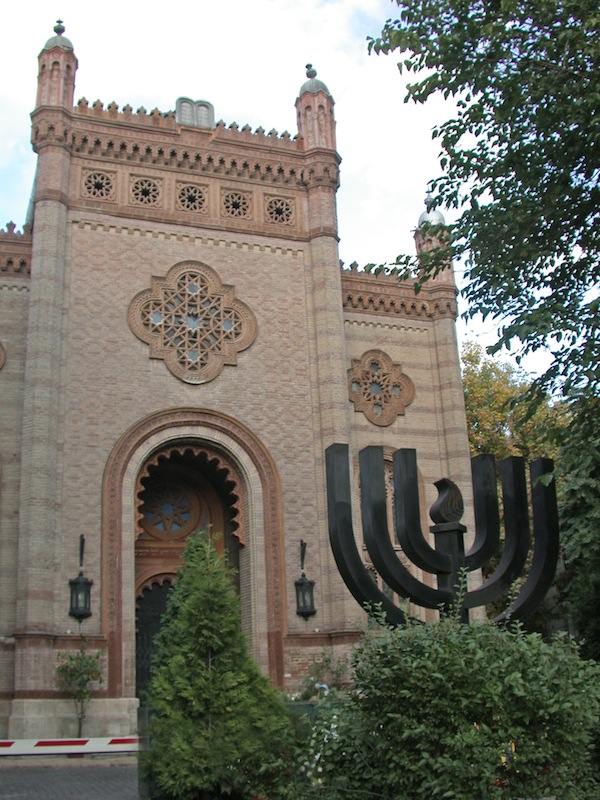
The Choral Temple in Bucharest. (photo from Wikimedia Commons)

We spent two weeks in Romania in the late summer of 2015, also visiting Bulgaria. We took this trip partly because it was an area of vibrant Jewish life from Roman days until the late 1930s. Romania also served as a commercial link between Europe and Asia, and was known for its café life. Its capital, Bucharest, was called the “Paris of the East.” Then came the Nazis and, after them, the Soviets. We wanted to see what remains in these two countries, primarily for Jews but also for the rest of the population.

We arranged a private tour with a knowledgeable guide that generally followed an itinerary designed as a Jewish heritage tour, supplemented by Ruth Ellen Gruber’s Jewish Heritage Travel: A Guide to Eastern Europe (2007). Local information on Jewish sites is surprisingly scant, nothing like what one finds in Lithuania and Latvia. However, the tour company had prearranged talks with people in the larger synagogues, museums and cemeteries, which helped to augment our own observations. There is a monthly Jewish newspaper in Romania, Realistatea Evreiasca, with one page in English and one in Hebrew. As mentioned, our tour in Romania was followed by a visit to Bulgaria, but space limitations permit only scattered references to our time in that country.

Romania and Bulgaria form the southern and eastern parts of the Balkan peninsula in Europe. Romania lies immediately to the north of Bulgaria, with the Danube River forming much of the border between the two before flowing into the Black Sea. Northern and central Romania is dominated by the Carpathian chain of mountains, and southern Romania by the plain of the Danube. Further south lie Greece and Turkey; to the west, various countries that used to be Yugoslavia; and to the east, Ukraine and the always menacing Russia.

Romania was a monarchy until the end of the Second World War. Supported by local antisemites, it fit rather comfortably under Hitler’s leadership and, then, under Nicolae Ceausescu, became one of the most harsh of all Soviet satellites. Today, Romania is best described by a guide at one synagogue who cautiously called it a “developing democracy.” (More on politics later.)

In contrast to the rest of Eastern Europe, Romanians speak a Romance language, which helps make many signs understandable to Anglos. Despite some bumps along the way, the economy in this proto-capitalist country seems to be improving year by year and, in 2007, it became a member of the European Union.

Almost everywhere one looks in Romania, there is an Orthodox church at the street corner. There are some Roman Catholic churches and a few mosques. The Jewish population is now only a few percent and heavily concentrated in Bucharest. Before the Second World War, large numbers of Jews lived in the northern and western parts of the country.

Romanian synagogues tend to have the plain exteriors but elaborate interiors that are common elsewhere in Eastern Europe and in Muslim countries. Romania was more Sephardi than Ashkenazi, but most synagogues now have the bimah at the eastern end rather than in the middle. In some cases, markings on the floor indicate that the bimah had been moved forward in the recent past. With some exceptions, the old Jewish quarter has been destroyed to make way for large, monotonous apartment buildings that are dubbed “Soviet Gothic.”

Restaurant food and wine was great everywhere we went, and available at modest prices – in contrast to what one hears, the white wine is just as good as the red (well, almost as good). Pork is the main meat, but chicken and veal are widely available, as are dairy products. The country is slowly returning to the café culture that was once so famous. The spirit is enhanced by wide avenues for pedestrians complete with street performers.

Some synagogues and Jewish community centres serve kosher meals, but otherwise we saw no kosher restaurants. And then there is rakija, or plum brandy, typically 60% alcohol; our advice is to sip slowly. David was delighted to see a few moderate-sized wind farms and some large solar electric farms. Less happily, there is a lot of smoking by people of all ages and in almost all places.

Our time in Romania began with a couple of days in Bucharest and then went from city to city elsewhere in Romania. Bucharest has two active congregations, one Chabad and the other in a 160-year-old Orthodox synagogue known as the Choral Temple. The adjective “choral” means that there is, or was, a choir. As with other synagogues that we visited, services are generally limited to Shabbat and holidays, though Chabad meets daily. Because of the small Jewish populations and the effects of assimilation, services are typically held in prayer rooms rather than in the large sanctuary. Unhappily, from our perspective, they all retain traditional restrictions on participation by women who, if they appear at all, are kept behind nearly opaque curtains. Synagogues in many of the larger cities are today undergoing renovations, thanks to Romanian, Israeli and European Union money, plus contributions from the Romanian diaspora. In contrast, with scattered exceptions, smaller cities today show little more than deteriorating synagogue buildings and ill-kept cemeteries.

When we visited the Choral Temple, we found that the exterior renovations had been completed but the interior ones were ongoing. About half of the visitors were Romanian, and the rest mostly from the United States or from Israel. As we ended our visit, about six of us were making our way out of the gate, which faces onto a busy street, and saw two local men watching us. One greeted us in French. He wanted to know, in a friendly way, why tourists came to Bucharest. He and David spoke together for awhile in French. The other man was large, probably in his 50s, and stood stock still, forcing us to walk around him to exit the gate. Toby remembers that she had never seen such glaring eyes and such a set jaw. She was transfixed by the unrelenting contempt pouring from this man’s face. She had no language in which to greet or to question him. Was he contemptuous of tourists, of Western tourists, or of synagogues? Toby retains a memory of these two men as two faces of Romania: the one open and friendly; the other full of animosity that may have been antisemitic.

A high point in David’s trip was attending Shabbat services in the last wooden synagogue in Romania. It is located in Piatra Neamt in north-central Romania, and its sanctuary is built below street level to meet some old restriction about not being higher than any church. The building’s formerly wooden base has now been replaced by concrete to protect the wood from deterioration. Everything above the base is the original wood, as is most of the elaborately decorated interior, with many locally created crafts, carvings and paintings.

photo - The wooden synagogue in Piatra Neamt
The wooden synagogue in Piatra Neamt. (photo from romania-insights.com)

David entered the building on Shabbat when, clearly, tourists were not welcome. Even though wearing a kippah, he was eyed suspiciously. Was this just a Jewish tourist sneaking a look inside the building at a time when it was closed to tourism? The regulars relaxed a bit when he put on a tallit, and more when, out of a corner of their eyes, they saw him saying the brachah before putting it on. Later, the gabbai gave him an aliyah, and invited him to the kiddush, which was fun, not so much for the bun and wine as for the unlabeled bottle that emerged afterwards and, not surprisingly, turned out to be rakija.

Sighit is located in northwestern Romania, which is the part closest to Hungary, and perhaps for that reason has a long history of antisemitism. The large Jewish cemetery there is remarkable for the practice of adding the names of Jews who died in the Holocaust to the tombstones of family members who had died in the 1930s. The city is the birthplace of Elie Wiesel, and home to a museum dedicated to his works. This is also the area where the Ba’al Shem Tov, the founder of modern Chassidism, lived, and we heard half a dozen (conflicting) statements as to where he taught, studied or served as rabbi.

Tourists to rural Romania will also see a number of Orthodox churches that are densely painted on every surface, and also some monasteries built entirely of wood without the use of nails. And, of course, tourism entrepreneurs have built on the Dracula legend to encourage visits to castles within easy reach of Bucharest. They may be fun, and there is apparently a nugget of truth in the story of Vlad the Impaler. Instead, we wandered in the old city of Bucharest, which is just beyond the city’s modern centre, where one finds the presidential palace, the art museum and other sites of national importance. Within walking distance of the centre is the Peasant Museum, which not only has the usual displays of clothing and tools from different parts of the country, but also entire water mills (for grinding flour) and pressing mills (to make felt) with their roofs removed so they can be viewed from an elevated platform. The museum shop was the best place we found to purchase gifts.

According to the Anti-Defamation League, antisemitic acts are now at a low level in Romania, but the country has not yet emerged from quiet denial of what happened to Jews during first the Nazi era and then the communist era. (For more information, see the recently translated book entitled The Jews of Timisoara by Tibor Schatteles, which details Jewish life in one western Romanian city from Roman times through the present.) We found occasional plaques to commemorate the loss of Jews during the Holocaust, but they were erected by local Jewish groups, not by civil authorities.

Romania did send a lot of its Jewish citizens to their deaths in concentration camps. In some Romanian cities, pogroms were initiated by local antisemites. Statistics from Maramuresh province in the north, which at one time had 52 synagogues, are telling: 35,000 Jews in 1930, 3,100 in 1948 and 48 in 1992. On the other hand, during both Nazi and communist periods, the Romanian government allowed Jews to buy their freedom on ships that would dock at Black Sea ports and pass through the Bosporus en route to Israel or other safe havens.

During the communist era, Jewish communities and institutions suffered mainly from near-total neglect. A 7.2-level earthquake in March 1977 took a heavy toll on Jewish buildings, but only the most serious repairs were undertaken.

What about the future for Romanian Jewish communities? Almost everywhere we were told that most marriages today are mixed, and only a few involve conversion of the non-Jewish partner. The large and relatively active synagogue in Sibiu had only one bar mitzvah child that year. Adjacent to some synagogues are buildings that were formerly Jewish schools, but today most teaching takes place in extra rooms in the synagogue.

While the future for Romania – and for individual Jews who live there – seems distinctly positive, the future for Romania’s Jewish population as a viable minority seems much less assured.

David Brooks is environmental economist who works with a number of organizations in Canada and Toby Brooks works with organizations fighting abuse of women. They live in Ottawa.

Format ImagePosted on September 23, 2016September 21, 2016Author David and Toby BrooksCategories Travel, WorldTags antisemitism, Budapest, history, Holocaust, Romania
Consider an African safari

Consider an African safari

In Livingstone, Zambia, visitors on the Jewish tour will see a church that used to be a synagogue. The Jewish population peaked in the late 1950s, to some 1,000 community members. (photo by Rebecca Shapiro)

“This guy came to stay, and asked to see the Jewish parts of town,” recounted Peter Jones, owner of the luxury Zambian hotel, the River Club. “I asked him to wait until the next day, then spent all evening swotting up on the area’s Jewish history.”

photo - The Jewish cemetery is on the Livingstone tour
The Jewish cemetery is on the Livingstone tour. (photo by Rebecca Shapiro)

Thus began Jones’ first Jewish tour of Livingstone, an historic town close to the mighty Victoria Falls. He led the guest around the country’s first synagogue (now a church), a small museum and the Jewish cemetery.

“He really took his time walking round,” Jones recalled. “I later found out he was a Holocaust survivor.”

That was 13 years ago, and Jones reckons he’s led about 100 Jewish tours since.

On a recent trip to the region, I was lucky enough to experience a tour for myself. Knowledgeable about all manner of local signs and monuments, Jones pointed out evidence of the town’s rich Jewish heritage that you’d never notice yourself – the faint outline of a Magen David beneath the old synagogue’s paintwork, the marks on a doorway where a mezuzah used to hang.

It seems appropriate, therefore, that his stunning riverside lodge is home to the first custom-built kosher kitchen in Livingstone’s tourism industry. The newly built facilities offer separate dishes for meat and milk, kosher food and customized meals for Orthodox guests. Jones pointed to an upsurge of Jewish tourists, particularly from North America, to explain why he sought mashgiach-approved status.

He’s not alone in noting the increased Jewish interest in the region: companies such as Sikeleli Africa Safaris have responded to it by creating luxury and bespoke “Jewish-friendly” itineraries.

This move made sense for the West Vancouver-based, family-run safari company, thanks to their longstanding Jewish ties to Southern Africa. I had the pleasure of spending time with the daughter, Danni, a Zimbabwean local whose Jewish grandfather held the esteemed position of mayor of Harare, the capital. She now works with many properties that cater to kosher tourists, including Zambia’s River Club, South African beachside hotel Prana Lodge and safari camp Makweti. These properties not only offer authentic safari experiences, but truly showcase the luxury available in all parts of Southern Africa.

For those who don’t keep kosher, the company’s options are, as you’d expect, more varied. This is partly because the safaris are fully customizable, but also because locations on offer include so much more than just South Africa’s renowned Kruger National Park.

photo - The sun sets on a safari in Zimbabwe’s Hwange National Park
The sun sets on a safari in Zimbabwe’s Hwange National Park. (photo by Rebecca Shapiro)

Safaris in Namibia can be unique. Very much off the beaten track, the arid country is home to two great deserts, the world’s tallest sand dunes and a fascinating multicultural character. A whole host of luxe camps have popped up there in recent years, and they’re the perfect place to both spot the black rhino on foot, and explore a country to which very few people venture.

So, why the increased Jewish interest in Zambia and Zimbabwe? After all, it’s obviously easier to be a Jewish traveler in South Africa than in the surrounding countries. Johannesburg boasts the largest Jewish population in the country, while Cape Town has an impressive range of kosher facilities. There are also Jewish communities to be explored in Durban, East London, Plettenberg Bay and Port Elizabeth. The Chabad presence throughout the area is as useful as it is widespread, but the cultural sights themselves form a real highlight. Don’t visit the country without visiting the Jewish Museum in Cape Town (it’s close to South Africa’s oldest, grandest synagogue), and do leave time for visiting Kleine Draken, the only winery in South Africa dedicated exclusively to kosher and mevushal wines.

From a personal and Jewish perspective, however, I found traveling to lesser-known countries to be infinitely more satisfying. This was thanks to the Jewish scene’s intimate feel there. Jews originally settled in Zambia and Zimbabwe from the late 1800s, as a result of pogroms in Russia, and later to flee persecution in Nazi Germany and antisemitism in South Africa. Numbers peaked in the late 1950s in Zambia and Zimbabwe, at 1,000 and 7,000, respectively. Since then, despite mass immigration to Israel and the West, Jewish life hearteningly continues. In Zimbabwe, for instance, Harare contains both a Sephardi and an Ashkenazi synagogue, but because the city now has fewer than 100 congregants, the prayers alternate between the two.

But, traveling in countries such as these is also more feel-good because of tourism’s boost to the economy. Many Zimbabwean camps have fantastic initiatives. Staying at a Wilderness Safari camp, for example, helps support nutrition programs for primary school children. At Miombo, a personal favorite, you can visit the Iganyana Arts Centre, where local artisans create gorgeous crafts out of recycled materials. Likewise, a trip to the River Club provides opportunities to contribute to social development projects in the village, including renovating water supplies and building libraries, as well as to take stunning river cruises, with hippo or crocodile sightings likely.

I should stress, however, that visiting Zambia or Zimbabwe doesn’t just benefit others – it provides you with the most exclusive, unparalleled safari experience. The game is abundant – Cecil the Lion’s pride strolled past my tent in Davison’s Camp – the scenery is phenomenal and the drivers are incredibly knowledgeable. There’s also a wealth of interesting attractions nearby, such as Great Zimbabwe, a former city that houses the largest collection of ruins in Africa south of the Sahara. Oh, and according to Sikeleli, a safari in Zimbabwe costs just one-sixth of the price of one in neighboring Botswana.

photo - A lion relaxes in Zimbabwe’s Hwange National Park
A lion relaxes in Zimbabwe’s Hwange National Park. (photo by Rebecca Shapiro)

On top of that, the countries offer such sincere hospitality that you can’t fail to be impressed – luxurious Linkwasha Camp provides kosher food on request in the middle of the bush, while Vintage, a back-to-basics Zimbabwean camp with no running water, still manages to cater to everything from vegan to gluten-free.

And did I mention that Victoria Falls, the waterfall that separates the two countries, is a UNESCO World Heritage Site and natural wonder of the world? You have to see its beauty and hear its roar to really understand just how magical it is. But, until then, just trust me that, from any perspective, but particularly a Jewish one, venturing to Zimbabwe or Zambia on a safari is unforgettable.

Sikeleli Safaris runs Jewish safaris for families, couples and congregations alike. Though fully customizable, accommodation tends to be in luxury lodges and hotels in Zambia and South Africa. Prices start from approximately $6,000, excluding commercial flights and dependent on season and group size. The itinerary can be amended and can start in either Lusaka, Zambia or Cape Town, South Africa. Danni at Sikeleli Safaris can be contacted at [email protected] or by phone at 26-378-279-9697.

Rebecca Shapiro is associate editor of vivalifestyleandtravel.com, a travel blogger at thethoughtfultraveller.com and a freelance journalist published in Elle Canada, the Guardian, the Huffington Post and more. A Londoner by birth, she’s lived in Shanghai and Toronto, but is currently (and happily) settled in Vancouver.

Format ImagePosted on September 23, 2016September 21, 2016Author Rebecca ShapiroCategories Travel, WorldTags Africa, safari, Zambia, Zimbabwe
Museums adapt using tech

Museums adapt using tech

Museloop’s app that it created for Israel Museum. (photo from Museloop via Times of Israel)

How do museums and other purveyors of history attract visitors and make the past relevant, especially as people come to expect more and more digital experiences?

Perhaps surprisingly, Werner W. Pommerehne and Bruno S. Frey recognized the problem more than 36 years ago. In their article “The museum from an economic perspective,” which was published in the International Social Science Journal in 1980, they stated:

“Museum exhibitions are generally poorly presented didactically. The history and nature of the artists’ work is rarely well explained, and little is offered to help the average, uninitiated viewer (i.e., the majority of actual and potential viewers) to understand and differentiate what is being presented, and why it has been singled out. Accompanying information sheets are often written in a language incomprehensible to those who are not already familiar with the subject. There is no clear guidance offered to the collections, and little or no effort is made to relate the exhibits to what the average viewer already knows about the history, political conditions, culture, famous people, etc., of the period in which the work of art was produced.”

Keren Berler, chief executive officer of Israeli start-up Museloop recently put the problem into current perspective. Younger visitors, she noted in an Israeli radio interview this past June, find museum visits passive and boring. She said, especially when seeing museum art exhibits, young people need something more to draw them into what they are seeing. So, her company has designed a museum-based application for iPhone and Android use. The application includes games, such as find-the-difference puzzles, plus information about the artist, all of which will hopefully make the visitor better remember the art and some facts about it.

Interestingly, in describing the games, two of the attributes she mentioned were competitiveness and the ability to take “selfies.” Children as young as 8 or 9 years old can use the app on their own, but younger children would need an adult to assist them.

Right now, the Museloop app focuses on Israel Museum’s under-appreciated (read: under-visited) permanent art collection. This exhibit includes the works of a number of “heavies,” such as Marc Chagall, Claude Monet, Pierre-Auguste Renoir, Paul Cézanne and Paul Gauguin. The goal is to make the experience so appealing that young visitors will then want to visit other museums. Since Israel Museum is paying the start-up for the development and use of the app, visitors benefit by having free use of it.

In contrast, Tower of David Museum has its own in-house digital department. This department has developed its own applications for heightened exhibit viewing.

photo - Virtual reality in the actual reality of Tower of David Museum
Virtual reality in the actual reality of Tower of David Museum. (photo from Tower of David Museum)

According to Eynat Sharon, the head of digital media, her department takes into consideration the visitor’s total museum experience. This experience consists of three overlapping circles: the pre-visit, in which a person visits either the museum’s website or mobile site; the actual physical visit; and the post-visit, in which the person digitally shares with friends and family on Facebook, Instagram and other social media what they encountered at the museum. The museum’s technical equipment and apps may be rented by museum visitors for a small fee.

Are these new applications then to be applauded? Some people still need convincing. Last year, art critic Ben Davis reflected on news.artnet.com, “For many, many viewers, interfacing with an artwork through their phone trumped reflecting on its themes. In effect, now every art show is by default a multimedia experience for a great portion of the audience, because interaction via phone is a default part of the way people look at the world.”

Dan Reich, who is the curator and director of education for the St. Louis Holocaust Museum and Learning Centre, said, “Personally, I am not big on technology. You end up with lots of button-pushing but not necessarily a lot of education. As a museum, we are pretty low-tech. We have an audio tour of the permanent exhibit, several stops in the museum where you can press buttons and hear testimony, an interactive map and – more recently – added an interactive screen entitled ‘Change Begins With Me,’ which deals with more recent or contemporary examples of hate crimes and genocide. We have been digitizing our collection of survivors’ testimonies. We have testimonies edited to different lengths. Generally, survivors like to be recorded, knowing their words are being preserved.”

And recent comments on TripAdvisor show that museums don’t necessarily have to be high-tech to succeed in their mission.

Visitors, for example, gave the St. Louis Holocaust Centre high marks.

Other Holocaust learning centres, however, have started taking current technology through uncharted waters. The USC Shoah Foundation now uses holographic oral history. According to Dr. Stephen Smith, the foundation’s executive director: “In the Dimensions in Testimony project, the content must be natural language video conversations rendered in true holographic display, without the 3-D glasses. What makes this so different is the nonlinear nature of the content. We have grown used to hearing life histories as a flow of consciousness in which the interviewee is in control of the narrative and the interviewer guides the interviewee through the stages of his or her story. [Now] with the … methodology, the interviewee is subject to a series of questions gleaned from students, teachers and public who have universal questions that could apply to any witness, or specific questions about the witness’ personal history. They are asked in sets around subject matter, each a slightly different spin on a related topic.” One educator confided that, while the technology is “creepy,” the public apparently likes it.

So, how do museums cope with the possibility that the medium in and of itself becomes the message? In other words, how do museums keep their audiences from being distracted by the technology? At the same time, how can museums survive financially if they follow goals that differ substantially from those of visitors, funders and other supporters?

A few months ago, Canadian entrepreneur Evan Carmichael offered guidelines at an Online Computer Library Centre conference. His suggestions seem applicable to museum administrators as well: express yourself, answer their questions, offer guidance, involve the crowd, “use your audience to create something amazing … create an emotional connection, get personal, and hold trending conversations, go to where things are happening, be there.

Time will tell whether the advent of museum-related high-tech will realize Don McLean’s 1971 tribute to Vincent Van Gogh’s art: “They would not listen, they did not know how. Perhaps they’ll listen now.”

Deborah Rubin Fields is an Israel-based features writer. She is also the author of Take a Peek Inside: A Child’s Guide to Radiology Exams, published in English, Hebrew and Arabic.

Format ImagePosted on September 23, 2016September 21, 2016Author Deborah Rubin FieldsCategories WorldTags art, history, Holocaust, museums, technology
Another planet earth?

Another planet earth?

An artist’s impression of the newly discovered planet, Proxima Centauri b. (photo from ESO/M. Kornmesser)

An international team announced recently that a planet with a mass similar to that of earth has been observed orbiting the star Proxima Centauri – the closest star to our sun, just over four light years (about 40 trillion kilometres) away.

The collaboration of scientists from nine countries, known as the “Pale Red Dot” and led by Dr. Guillem Anglada-Escudé of Queen Mary University of London, included Weizmann Institute of Science’s Dr. Aviv Ofir, who is in the group of Prof. Oded Aharonson of the earth and planetary sciences department.

Proxima Centauri is a red dwarf – a star with a diameter about one seventh that of our sun and far dimmer: it gives off only 1/600 the light of our sun. The team’s calculations show that the planet, known as Proxima Centauri b, has a mass of at least 1.3 times that of earth and its year – the time it takes to orbit its sun – is a little over 11 days. It orbits quite close to its sun – only five percent of the distance from earth to our sun; but, since its sun is so dim, the temperature on Proxima Centauri b may be relatively balmy and liquid water could theoretically exist on its surface.

The range of distances where the planet’s temperature permits liquid water is often referred to as “the habitable zone.” Although conditions on the planet’s surface are as yet unclear, the scientific team hopes to learn more about this planet in further research. Ofir said it is not at all clear whether life as we know it could have evolved on the planet, and the subject is already the focus of intense debate.

The planet was discovered through measurements of the radial velocity of the star. Such measurements rely on the Doppler effect, the shift in wavelength as an object moves closer to or away from the viewer. The star, according to the team’s highly accurate measurements, is moving at a speed of about a metre a second (or 3.6 kilometres an hour) towards and away from us.

Ofir explained that, when we speak of a planet orbiting a star, in reality they are both orbiting a shared centre of gravity. Since the mass of the star is naturally much greater than that of its planets, that centre of gravity is usually close to the centre of the star, and planets make the star’s motion appear as a “wobble.” And that wobble can be detected by today’s instruments: in the case of Proxima Centauri, the scientists observed periodic changes in the star’s velocity, the result of another body tugging at it. That body, according to the measurements, is a planet with a relatively small mass, just over that of earth.

Ofir pointed out that Proxima Centauri has been studied for the past century, but only now have observations – designed for this very purpose – become sensitive enough to decisively detect the presence of this small planet. He is continuing to work on this and other projects to identify and study planets around Proxima Centauri.

“We discovered the planet with an observatory in Chile. We can’t see Proxima Centauri from our observatories in Israel,” he explained. “It is well below the southern horizon, so it is unobservable from Israel all year round.”

For more information about Weizmann Institute research, visit wis-wander.weizmann.ac.il.

Format ImagePosted on September 23, 2016September 21, 2016Author Weizmann InstituteCategories WorldTags astronomy, earth-like planets, Proxima Centauri, science

Posts pagination

Previous page Page 1 … Page 20 Page 21 Page 22 … Page 33 Next page
Proudly powered by WordPress