Skip to content
  • Home
  • Subscribe / donate
  • Events calendar
  • News
    • Local
    • National
    • Israel
    • World
    • עניין בחדשות
      A roundup of news in Canada and further afield, in Hebrew.
  • Opinion
    • From the JI
    • Op-Ed
  • Arts & Culture
    • Performing Arts
    • Music
    • Books
    • Visual Arts
    • TV & Film
  • Life
    • Celebrating the Holidays
    • Travel
    • The Daily Snooze
      Cartoons by Jacob Samuel
    • Mystery Photo
      Help the JI and JMABC fill in the gaps in our archives.
  • Community Links
    • Organizations, Etc.
    • Other News Sources & Blogs
    • Business Directory
  • FAQ
  • JI Chai Celebration
  • JI@88! video

Recent Posts

  • Zionism wins big in Vegas
  • Different but connected
  • Survival not passive
  • Musical celebration of Israel
  • Shoppe celebrates 25 years
  • Human “book” event
  • Reclaiming Jewish stories
  • Bema presents Perseverance
  • CSS honours Bellas z”l
  • Sheba Promise here May 7
  • Reflections from Be’eri
  • New law a desecration
  • Resilient joy in tough times
  • Rescue dog brings joy
  • Art chosen for new museum
  • Reminder of hope, resilience
  • The national food of Israel?
  • Story of Israel’s north
  • Sheltering in train stations
  • Teach critical thinking
  • Learning to bridge divides
  • Supporting Iranian community
  • Art dismantles systems
  • Beth Tikvah celebrates 50th
  • What is Jewish music?
  • Celebrate joy of music
  • Women share experiences 
  • Raising funds for Survivors
  • Call for digital literacy
  • The hidden hand of hate
  • Tarot as spiritual ritual
  • Students create fancy meal
  • Encouraging young voices
  • Rose’s Angels delivers
  • Living life to its fullest
  • Drawing on his roots

Archives

Follow @JewishIndie
image - The CJN - Visit Us Banner - 300x600 - 101625

Category: News

‎נפתרה תעלומת

‎נפתרה תעלומת

‎פרידריך ואנד מאירהופר ובנם אריק. (צילום: corporate.bclc.com)

‎נפתרה תעלומת החמישים מיליון דולר: פנסיונר המתין עשרים ואחד חודשים כדי לקחת את הזכייה הגדולה בלוטו

‎נפתרה התעלומה הגדולה ביותר בתולדות הגרלות הלוטו בקנדה. לאחר עשרים ואחד חודשים תמימים נזכר אחד מאזרחי בריטיש קולומביה לבוא ולקחת את אחד הפרסים הגדולים ביותר אי פעם. פנסיונר מהעיר לאנגלי שבמטרו ונקובר בשם פרידריך מאירהופר (67), זכה בחמישים מיליון דולר בהגרלת לוטו ‘מקס’ שנערכה במרץ שנה שעברה. ומדוע אדון מאירהופר המתין קרוב לשנתיים כדי לקחת את הפרס הגדול? לדבריו בגלל החשש לבוא למשרדי בריטיש קולומביה לוטו קורפוריישן ולקחת את הצ’ק, כי הוא “ביישן ואוהב לשמור על פרטיות”, ורצה להישאר בעילום שם “מתוך דאגה שלא יהיה מסוגל להתמודד עם פרס כזה עצום”.

‎לפי תקנות הלוטו ניתן לדרוש את הזכייה בפרסים עד שנה מתום ההגרלה, ושמם של הזוכים יפורסם. 739 איש לא התביישו וטענו שהם זכו בפרס הגדול וכולם נדחו כאחד. מאירהופר שכר עורך דין והקים נאמנות בכוונה שהזכייה תעבור אליה ושמו לא ייחשף. עורך הדין התייצב במשרדי הלוטו יום לפני תום השנה מהזכייה בהגרלה, ופתח בהתדיינות משפטית עם ההנהלה כדי להעביר הפרס לנאמנות. לאחר חודשים של דיונים הקורפורשיין דחה את בקשתו, בטענה שהפרס ימסר רק למי שיציג תעודה מזהה ושמו יפורסם. מאירהופר הבין שאין לא ברירה אלא לצאת מהארון בלאנגלי, ולקחת את החמישים מיליון דולר מול התקשורת. וכך הוא נעמד מול המצלמות ובקול חלש הסביר את חששו לקחת את הפרס. מאירהופר מתכוון להמשיך ולגור עם אשתו בבית הישן בו הם גרים כבר שלושים ושש שנים, אך אשתו רוצה להחליף את הריהוט. אין להם תוכניות מה לעשות עם הכסף מלבד לעזור לשלושת הילדים ולנכדים. מאירהופר מתכוון להמשיך ולרכוש כרטיסי לוטו גם בעתיד. יועץ פיננסי מציין כי מאירהופר הפסיד כבר כחצי מיליון דולר של ריבית כיוון שלקח את הכסף באיחור כה רב.

‎לא לכל אחד את יש המזל של מאירהופר. הומלס מוונקובר זכה בעשרים וחמישה אלף דולר בהגרלת בינגו, אך הוא אינו יכול לקבל את הכסף כיוון שאין לו תעודה מזהה ואילו לו כתובת מגורים.

‎נפתרה תעלומת המאה ושמונים אלף: זוכה בהגרלה נתבשר כי שלא זכה ולאחר מכן התברר שכן זכה

‎את פרשת זכייתו במאה ושמונים אלף אלף דולר לא ישכח לעולם צ’ארלס רישוט מוויניפג. רישוט השתתף בהגרלה שנערכה בין רוכשי כרטיסי גמר הפוטבול הקנדי “הגריי קאפ”, שנערך בעיר. בסיום המשחק הקריא הכרוז את מספר הכרטיס שזכה בהגרלה, שהופיע גם על המסך הדיגיטלי הגדול באצטדיון. רישוט נדהם שהוא מחזיק בכרטיס היקר ורץ לביתו כדי לבשר לאשתו על שזכו במאה ושמונים אלף דולר. בערב הוא החליט להציץ באתר האינטרנט של מועדון הפוטבול המקומי, ולא האמין למראה עיניו, כיוון שפורסם בו שכרטיס אחר זכה בהגרלה. רישוט התעצב והתעצבן וזרק את הכרטיס שלו הישר לפח הזבל. לאחר שהתעשת החליט להוציא את הכרטיס מהזבל כדי שיוכל להראותו לשלושת נכדיו, ולספר להם איך “כמעט” וזכה במאה ושמונים אלף דולר. בבוקר הוא החליט שוב להסתכל באתר כדי לראות מי הזוכה המאושר ושוב נדהם, כיוון שמספר הכרטיס הזוכה שונה ובמקומו פורסם הכרטיס שלו. רישוט לא ידע נפשו מרוב אושר שבסופו של דבר הוא זה שזכה במאה ושמונים אלף דולר.

‎רשות ההימורים והאלכוהול של מחוז מניטובה פתחה בחקירה כדי להבין את הפרשה המוזרה הזו, אך את רישוט זה כבר לא מעניין.

Format ImagePosted on December 22, 2015December 21, 2015Author Roni RachmaniCategories עניין בחדשותTags Charles Ritchot, Friedrich Mayrhofer, Grey Cup, lottery, הגריי קאפ, לוטו, פרידריך מאירהופר, צ'ארלס רישוט
Teaching about Shoah

Teaching about Shoah

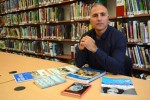
Eyal Daniel (photo from Eyal Daniel)

Three Vancouver-area teachers who traveled to Israel last summer for an intensive three-week symposium on teaching about the Holocaust now plan to share their knowledge with other educators throughout the region.

The three were chosen to study at Yad Vashem, the Holocaust Martyrs’ and Heroes’ Remembrance Authority, with many of the world’s foremost scholars on the Shoah. The focus was on how to educate students of diverse cultures and faiths about the Holocaust and to leverage that knowledge as a framework for teaching about human values, responsible citizenship and social justice.

Eyal Daniel, former head of school at Vancouver Talmud Torah elementary and high school, the latter of which became King David High School, now teaches at Buckingham elementary in Burnaby. As a Jewish person and a native of Israel, Daniel said his experience was somewhat different from most of the other participants from across Canada, but he tried to go into the process ready to absorb everything presented.

“The symposium was three weeks, from 8:30 to 5:30 every day,” he said. “It included lectures about all the different facets connected to the Holocaust by really top lecturers.”

The group also visited different parts of Israel, including Kibbutz Lohamei Haghetaot, the Ghetto Fighters’ Kibbutz, formed by survivors of the Warsaw Ghetto. In addition to teachers, participants included Christian clergy, researchers and some people from the U.S. Holocaust Memorial Museum in Washington, D.C. The Canadian teachers were sponsored by the Canadian Society for Yad Vashem.

Among the most impactful aspects, said Daniel, was meeting and hearing from people with perspectives on well-known aspects of the Shoah.

“One of them was Anne Frank’s childhood friend, a woman at the age of 94, who knew her personally because she met her before [Frank] died in Bergen-Belsen concentration camp,” he said. “The second one was a couple that was on Schindler’s list, people that worked in Schindler’s factory and knew him personally.” Hearing firsthand accounts leaves a deep impact, he said. “You’re part of this history.”

He was also impressed to see how many non-Jewish people are touched and moved by the Holocaust and how committed they are to teach people from different cultures, he said.

The provincial education ministry curriculum does not require educators at any grade level to teach the Holocaust, although it usually comes up when studying the Second World War. It falls to the individual teacher to determine what to emphasize. Daniel has incorporated the topic into social studies, language arts and art. His students, for example, wrote poems about the Holocaust and Daniel sent the seven best to a competition for young writers by the Poetry Institute of Canada. All seven were published in an anthology.

He also incorporates books like The Boy in the Striped Pyjamas, The Old Brown Suitcase (by Vancouver writer Lillian Boraks-Nemetz) or Anne Frank’s diary, and films like the documentaries Paper Clips and Freedom Writers.

“The Holocaust is a one-time event, but it is also connected to racism and prejudice and stereotypes and genocide,” he said. The multicultural students of Metro Vancouver can often personally relate to the historical or contemporary manifestations of these topics.

“The idea is to show that, first of all, you need to learn about this kind of an event because even though it’s an exceptional event, it can happen – or may not happen – because of you,” he said.

Delta high school teacher Stephanie Henderson participated in the program, as well. She too tries to weave the topic into the curriculum when appropriate. When studying the history of Venice, for example, she will note the history of the Venice ghetto, the original Jewish ghetto but not the last.

“The Holocaust is getting to be far away,” she said. “Slowly, people are forgetting about it. This is giving us the ability to keep talking about it.”

The third local teacher on the program was Surrey high school teacher Mark Figueira. “Having been there, it’s something that I think about every day now, whereas before I had been to Israel, it was a topic that I covered in my class, but now it’s become much more than that,” he said. “When I teach about the Holocaust now, it’s so much more rich. It’s stories about people that we met. Just having been there gave me such a really good context for it now.”

The three have created a presentation they will share with other teachers during professional development days, beginning in Delta next February. They will offer advice and approaches on educating about the Holocaust for teachers at every level of knowledge and experience.

In the last decade, the Canadian Society for Yad Vashem has sent more than 200 teachers to attend the summer seminar, where they acquire pedagogical tools for teaching about the Holocaust to Canada’s multicultural students.

Format ImagePosted on December 18, 2015December 16, 2015Author Pat JohnsonCategories LocalTags Eyal Daniel, Holocaust, Mark Figueira, Stephanie Henderson, Yad Vashem

Helping businesses expand

In August, the Jewish Independent connected with Gary Brownstone about a Winnipeg tech incubator he was working on called Eureka. In the short time since then, the entrepreneur has already moved on to his next adventure.

photo - Gary Brownstone
Gary Brownstone (photo from Gary Brownstone)

“Most of my career has been characterized by taking on multiyear projects,” said Brownstone. “In many cases, I’d be involved with or invest in small companies needing help growing to the next level. I’d grow them to the next level and then I would exit. But, generally, the projects I get involved in have a Point A and a Point B, and my mission is to take them from A to B.

“When I went to the Eureka Project, which was an incubator in Winnipeg that a group of individuals together with government and the U of M [University of Manitoba] had tried to launch, for all intents and purposes, [it] had failed. They hadn’t achieved what they’d set out to.”

Brownstone was brought onto the Eureka team to try to save it. They needed answers to three questions. Was there enough world-class talent in Winnipeg to make a venture like this worthwhile? Could the incubator help advance their causes and spin off commercial enterprises? And could Brownstone help make the operation sustainable?

“A big challenge with incubation is that early- stage companies can’t always afford to pay market rates for help, but governments don’t want to pick up the costs forever,” said Brownstone. “When I got to the project, the Manitoba government was covering about 90% of the operating budget.

“The first two [questions] we solved in a relatively short period of time. But, the sustainability issue was longer and … this year, we saw a third of those solved with the signing of a multiyear funding agreement with the province – with them only needing to cover about 30% of our operating budget.”

Seeing that a service like the one he was providing in Manitoba was needed everywhere in Canada, Brownstone move on to create a small practice under the name of LucraTech. He soon had several clients across Canada, the largest one situated in Vancouver, where he now spends about 60% of his time. The other clients are located in Manitoba, Ontario and Nova Scotia.

“I’ve got some associates that I bring into jobs as needed,” said Brownstone. “We are building up our business across Canada and have been for about six months now with some pretty decent success.”

The Vancouver-based company with which Brownstone is working is Canada’s largest technology incubation platform, Istuary Innovation Group. “This is a group of Chinese Canadians who see an opportunity to invest in or acquire Canadian technology for which there could be a market in China,” said Brownstone. “Their expertise is taking Canadian-developed world-class technology into China, where there’s a big market and hunger for this technology … so, these guys are trying to bridge the gap.

“Let’s say that you are an engineer and you have some unique approach to internet security, and they know that, today, in China, on an industrial level, there’s a huge demand for internet security. If they feel that your technology is suitable for that market, they will offer to do a deal with you, and they are very flexible about how they do that. They may offer you employment in one of their innovation labs or, if you had an existing company and were looking for investors, they would invest in you and help you access that market, or they could represent you on an agency basis.”

According to Brownstone, any Canadian technology looking for a home in the Chinese market can likely be aided by Istuary. He believes that Canada is in a unique position and has an advantage over other countries, due to the quality of its schools for engineering, computer programming and related fields, like clean technology and light sciences.

“There is also very strong R&D support in Canada, both federally and provincially,” said Brownstone. “The government will often match every dollar I invest. There is also a very strong tax-credit program, [and] rebates offered will sometimes offset the big costs of R&D.” As well, he added, Canada is an attractive place for developing technology at the moment with the low Canadian dollar compared to that of the United States.

LucraTech aims to take on a series of projects with each client and create a support team to work with that client, beginning by identifying a starting point and an end point.

“Typically, the companies we start working with are small,” said Brownstone. “They have some customers, they have some revenue, but they are trying to grow to the next level. Maybe you have a company that is doing $300,000 a year in revenue and you want to grow that to $3 million in the next couple of years. We create a road map and a plan that will get you from $300,000 to $3 million, and work with you to achieve that.

“By the time you are at $3 million, you’re probably at a size where you can get and manage the support talent in-house and you can now afford more full-time employees, so maybe we aren’t needed anymore at that level of expertise.”

LucraTech offers other services, as well, such as turnaround, wherein they take on medium-sized companies that, for one reason or another, have encountered some trouble and need help. In this scenario, LucraTech goes in and tries to fix the problem and make the company healthy again. Their typical timeline with clients can be anywhere from one to four years.

“If we believe in a company and the entrepreneur and we can add value to the whole equation, we are very flexible on how we work with companies and usually give them two or three choices. We know we will only get paid if the project goes ahead,” said Brownstone.

“Sometimes, we work just for success fees, where we set out to raise money for a company … sort of a finder’s fee. If we are successful, we get paid. If not, we don’t. Sometimes, we will work for a piece of the business or a small number of shares in the business. We’re really flexible. Once we believe in the concept and the entrepreneur, we will find a way to make it work, whether they have a lot or a little money.”

Rebeca Kuropatwa is a Winnipeg freelance writer.

Posted on December 18, 2015December 16, 2015Author Rebeca KuropatwaCategories WorldTags China, entrepreneurship, Eureka Project, Gary Brownstone, investment, LucraTech

Emanu-El to sponsor refugee family

The board of Congregation Emanu-El of Victoria has unanimously approved a motion to proceed with sponsorship of a Syrian refugee family. They believe that this is a moment to step forward as Jews and “welcome the stranger.”

Many in Victoria’s Jewish community trace their families’ arrival in Canada from the time they fled brutal pogroms in the Russian empire, and some came as the surviving remnant of European Jews after the Holocaust. Others landed here because they were expelled from their countries throughout the Middle East and North Africa after the creation of the state of Israel in 1948.

“As we cannot forget our oppression and persecution over millennia, we also count our blessings for living in freedom and comfort in Canada. Jewish ethics enjoin us to reach out to others to help end their suffering. The concept of tikkun, or repair, is central to Jewish belief, in that it is our duty to try and fix what is broken in this world,” said Congregation Emanu-El’s Rabbi Harry Brechner.

The synagogue welcomes all who wish to join in the fund-raising efforts. Office hours (1-250-382-0615) are Tuesday to Thursday, 9:30 a.m.-2:30 p.m., to make credit card donations, or cheques can be sent to 1461 Blanshard St., Victoria, B.C., V8W 2J3. Tax receipts will be issued for all donations.

For more information, contact Jean Dragushan, chair of the refugee sponsorship steering committee, at [email protected] or 1-250-818-4132.

Posted on December 18, 2015December 16, 2015Author Congregation Emanu-ElCategories LocalTags Emanu-El, Harry Brechner, refugees, Syria
Rehab centre fills gap

Rehab centre fills gap

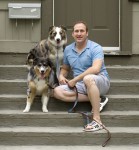
Ian Rabb with his dogs Samson and Ariel. (photo from Ian Rabb)

After falling prey to the habit himself, being rescued by his family and brought back home to Winnipeg for recovery, Ian Rabb began giving back – not just to his supporting family and the Jewish community, but to the greater community of Manitoba.

Rabb knew how the system worked from personal experience, had learned its flaws and, after recovery, set about to fix it.

“What I noticed then was a broken system in Manitoba, where there was no continuity of care,” said Rabb. “People didn’t have the ability to have extended stays in any kind of stable environment and, as I started doing my research and working in the program, I was appointed to the board of directors of the Addictions Foundation of Manitoba.”

With help from his brother, Jeff, Rabb determined that the biggest problem was the lack of a safe house where recovering addicts could take their time and realign their lives after completing their residential treatment program, which comprises a couple of weeks of rehabilitation. He opened Two Ten Recovery, a men’s house of recovery, as well as Destiny House for women. Today, there are three homes with a total of 33 beds.

“Our aim is to help people stabilize their lives and get them back to being fully self-supporting citizens, having a better prognosis or outcome when they leave,” said Rabb. “We allow them up to two years in our homes, where they have to be working and self-supporting within three months. Our success rate is at about 83%. What we’ve learned over the last number of years is the longer we can stay connected to someone post-treatment, coming out of a treatment centre, the better our success rates will be.”

It was six years ago that Rabb began hatching a plan to open a 24-hour, full-service drug and alcohol rehab centre. Once the Addictions Foundation closed their detox clinic, it became clear that a detox centre was also needed. Aurora Recovery Centre was established.

“I realized one thing very early on – that there was desperate need for a medical detox program where anyone could access medical services at any time, for any substance, and be provided with a service that would help them get off that substance, ultimately moving to the next step, addiction treatment,” he said.

Another thing that was critical in Rabb’s mind was to eliminate the wait time. “You don’t have time to wait when it comes to addiction treatment,” he said. “When someone’s ready for treatment, they need to be able to access a treatment facility. That doesn’t exist here. There’s months-long wait.

“All across Canada, because of the epidemic of addiction, even private centres are having severe wait times. So, ultimately we’re scrambling for places to send people when they need immediate help.

“The best centre in the world is just south of us, in Minnesota.

It was the first one ever started. Our model (at Aurora) is replicating the Hazelden model of addiction treatment.”

Aurora Recovery Centre is located on 28 acres of land along Lake Winnipeg, just north of Gimli. It will start as a 76-bed primary care centre, with 16 beds devoted to medical detox and emergency situations.

“We will be able to handle the ongoing problems here in Manitoba and hopefully will be busy enough to expand,” said Rabb. “We have lots of acreage there. We’re opening smaller with the plan of creating a full campus.”

To manage the centre, Rabb hired Peter Connelly, a Manitoba-born and -raised clinical director who has worked at the Minnesota Hazelden recovery centre for the past 13 years.

“I really believe that more services are needed, not only in Manitoba, but also in Canada,” said Connelly. “It’s an exciting project. It’s going to provide people who obviously need help with programs, so that’s really my reason for coming back. I certainly have a passion for recovery.”

Apart from the detox unit, which Connelly views as critical, his focus will be on the continuum of care, as he believes that after-care is of vital importance – the available services once clients have completed their in-patient treatment.

“The reality is that in-patient treatment is very difficult,” said Connelly. “It’s about people making a change, about people learning the tools of recovery and taking these tools into the outside world and using them to deal with life, on life’s terms.

“Addicts, alcoholics, need structure. They need to take responsibility and be accountable. Once they finish in-patient treatment, those are the challenges they face, so after-care is critical.”

This is an area that Aurora aims to focus on, with a number of programs that aid patients, including the option of extended-care programming, sober-housing on site, and continued follow-up with clients after they leave the centre.

“We will be developing an extensive out-patient program, so those who’ve been through the program can continue having group sessions and individual counseling after they leave,” said Connelly. “Through a number of programs that we’re developing and have developed, we’ll have clients come back yearly for an annual reunion.”

The facility is privately funded; participants and/or their family members will need to pay for their treatment. But, the cost is all-inclusive, with no added fees. “At the end of your stay, you certainly won’t be getting a bill for additional charges,” said Connelly. The cost is determined on a case-by-case basis, dependent on treatment and other factors.

At Aurora, the aim will be to have no wait time. “This is critical,” said Connelly. “We all have a tendency to procrastinate and the addict/alcoholic has a tendency to change their mind. When someone finally makes a decision they need to go, or a family member helped them with that decision, we need to get them into treatment as quickly as possible.

“As we move forward, I think people will see that the programming we offer is certainly needed. We’ll see what kind of relationships develop from there.”

Aurora began accepting patients on Oct.16. For more information, visit aurorarecovery.com.

Rebeca Kuropatwa is a Winnipeg freelance writer.

Posted on December 18, 2015December 16, 2015Author Rebeca KuropatwaCategories NationalTags addiction, alcoholism, Aurora, Ian Rabb, recovery, rehab
New Olympic Museum

New Olympic Museum

Try your hand at ski jumping in one of ROX’s five simulators. (photo from ROX)

There’s no question the 2010 Winter Olympics in Vancouver changed the region considerably, but some of those changes are as recent as November 2015. That’s when the Richmond Olympic Experience, or ROX, opened at the Richmond Olympic Oval, the massive structure built on the banks of the Fraser River to accommodate the Olympics’ speed-skating competitions.

A $10 million museum, ROX is all about hands-on experience and is filled with interactive exhibits and activities that engage visitors. Take the five sport simulators, for example, three of them designed and manufactured specifically for ROX. On the ski-jump simulator, you experience the thrill of ski jumping on one of Whistler’s world-class runs, while on the bobsleigh you feel the rush of speed on the same track traveled by Canadian Olympic bobsledder Chris Spring. There’s a race-car simulator, a kayak and a sit-ski simulator, too. While the simulators are the most exciting of the interactive exhibits (and the highest in demand), there are many others. Visitors are encouraged to learn how high and how far they can jump, to measure their hand-eye and foot-eye reaction times, to score goals in soccer and hockey and to compare their results to those of Olympic athletes.

There are also lots of interesting artifacts, including a display of Olympic torches that date back to 1936, when the torch relay was introduced to the Games by Adolf Hitler’s Nazi party. One case displays sports equipment including tennis rackets, showing how they have evolved over the years. Another showcases Olympic medals, which have also changed considerably in size and design over time. For those who want to spend time researching the participation of a specific country in the Olympic Games, or the performance of one or more athletes, ROX has a data lounge where a wealth of information is digitally archived and easily accessible.

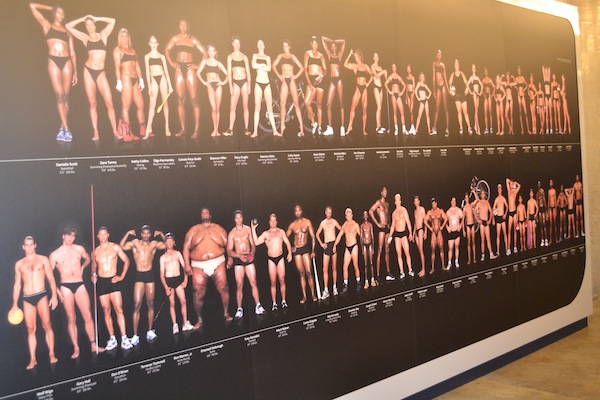
There are many images at ROX. One of my personal favorites is a massive photograph of athletes who have competed, all wearing black bikinis or swimsuits. Since they’re scantily clad you can get a sense of the many different body types and how a specific sport has shaped individual bodies. The photographic collage delivers a powerful message about the beauty of the human body and the many reflections of that beauty, big and small.

photo - Olympic athletes
(photo from ROX)

While most of the displays are not specific to the 2010 Winter Olympics in Vancouver but cover the Games in general, there is one wall that pays tribute to the 2010 Games with statistics on how many medals Canada won that year (26), how many viewers watched on TV (1.8 billion!) and how many media representatives were present (a mere 10,000). A large screen in the vicinity replays the most memorable moments from the Games and another encourages visitors to try their hand at being a TV announcer.

One wall pays a noticeably teensy tribute to tragic Olympic events. It’s here that the 1972 massacre of Israeli Olympic athletes in Munich is mentioned in two short lines.

Of the plethora of museums about the Olympics worldwide, only 21 are accredited members of the IOC Olympic Museums Network. ROX is the only member of this network in North America and that membership allowed the City of Richmond to expand its budget from the humble $575,000 initially allocated for the museum to $10 million, by opening the door to a robust sponsorship drive. It also enabled loans of Olympic resources like the torches. Ted Townsend, spokesperson for the City of Richmond, said the most priceless exhibit at ROX is that of the medals and torches.

While you’re at ROX take a peek at the Olympic Oval. After the dismantling of the speed-skating rinks, it now includes two hockey rinks, facilities for pilates and yoga, courts for badminton, baseball, basketball, soccer, table tennis, tennis and volleyball, a wall for climbing, and areas for golf, gymnastics and rowing. And don’t forget to look up at the wood panels of the Oval’s roof. Created from pine beetle-damaged wood, it contains the signatures of 8,000 Richmond residents who inscribed their names in the early construction stages.

For more information, visit therox.ca or call 778-296-1400.

Lauren Kramer, an award-winning writer and editor, lives in Richmond. To read her work online, visit laurenkramer.net.


Format ImagePosted on December 18, 2015December 16, 2015Author Lauren KramerCategories LocalTags Olympics, Richmond Oval, ROX
Young Lamplighters 2015, and other December milestones

Young Lamplighters 2015, and other December milestones

Surrey Mayor Linda Hepner, left, White Rock Mayor Wayne Baldwin and Simie Schtroks of the Centre for Judaism present the 2015 Young Lamplighters Award to Sarah and Amy Aginsky on Dec. 13. (photo from Lauren Kramer)

Sarah and Amy Aginsky, 12-year-old identical twins from Richmond, are this year’s recipients of the Centre for Judaism of the Lower Fraser Valley’s Young Lamplighters Award. With this annual award, the Centre for Judaism honors individuals between the ages of 5 and 18 who have performed outstanding community service.

In March 2015, Sarah and Amy, Grade 7 students at Homma Elementary in Richmond, hosted a Street Store for the homeless and impoverished. The Street Store concept was founded in Cape Town, South Africa, in January 2014 to help the homeless. Based on retail shopping, it involves collecting clothes and other items, organizing a pop-up, one-day store and giving shoppers the opportunity to select apparel and shoes without the exchange of money. The Street Store provides people located all over the world with an infrastructure, support and inspiration to host their own such stores.

The twins’ parents were born in Cape Town and their grandparents and relatives live there to this day. They saw how the Street Store had helped the homeless in cities including Sao Paulo (Brazil), Kentucky, Brussels, Tepic (Mexico), Grande Prairie (Alberta), Tucuman (Argentina), Oslo (Norway) and Vancouver, among others, and were inspired to host a Street Store of their own.

Between January and March, Sarah and Amy collected truckloads of donated clothing and footwear, distributing them to the needy on March 6 at the Lighthouse Mission in Bellingham, Wash.

“It was humbling to see how much people were prepared to give and how eagerly they wanted to help us help others,” said Amy. “Seeing the appreciative faces of our Street Store shoppers was heartwarming and beautiful. Many of them have very little and are living difficult lives. It felt great to know we were helping others and that, as a result of our mitzvah project, their lives might get a little bit easier.”

Rabbi Falik and Rebbetzin Simie Schtroks, directors of the Centre for Judaism, with Surrey Mayor Linda Hepner and White Mayor Wayne Baldwin, presented the Lamplighters Award to Sarah and Amy at a public menorah lighting at the Semiahmoo Shopping Centre in White Rock on Dec. 13.

“Chanukah celebrates the victory of light over darkness and goodness over evil,” said Simie Schtroks. “This is a most appropriate opportunity to motivate and inspire young people to make this world a brighter and better place. By filling the world with goodness and kindness, that light can dispel all sorts of darkness.”

***

photo - Elizabeth Wolak and her daughter-in-law Anna Wolak
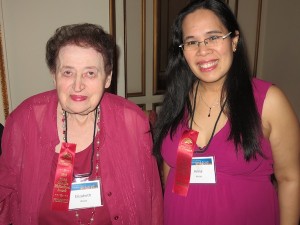
Elizabeth Wolak and her daughter-in-law Anna Wolak (photo from Arthur Wolak)

Elizabeth Wolak and her daughter-in-law Dr. Anna Wolak were both nominated for the 2015 British Columbia Multicultural Awards. As nominees, they were honored to attend the official awards gala evening, together with representatives from the provincial and federal governments, which took place at the Fairmont Hotel Vancouver in November.

The B.C. Multicultural Awards is an annual event hosted by the provincial government and the Multicultural Advisory Council to recognize and honor the multicultural accomplishments of individuals, organizations and businesses throughout the province. Elizabeth Wolak was nominated for her decades of multicultural work bringing the beauty of Jewish choral music to the attention of diverse ethnic communities through her numerous annual concerts. Dr. Anna Wolak was nominated for her health-care work, treating and educating patients and medical practitioners in British Columbia’s multicultural setting.

***

Leila Getz has been selected by Musical America Worldwide as a 2015 Influencer and is profiled in its MA 30 Professionals of the Year: The Influencers special report, released this month, which lists 30 honorees. The report’s editors, “recently asked the MA community to nominate 30 people who are making a difference in our business, either by virtue of their position, their creativity and/or their dedication – folks about whom you could say, ‘When they speak, we listen.’”

“Leila Getz looms large as one of the primary driving forces on the classical music scene in Vancouver, B.C.,” reads her profile in the report. “In 1980, at the age of 40, this South African native founded the Vancouver Recital Society, a presenting organization that has consistently aimed high and brought many of the world’s leading artists to a relatively isolated region.

“It seemed like a foolhardy project at first, especially since there was an economic recession in Canada in the early 1980s…. But the series gradually expanded from five events at the beginning to 20 in 2015….

“Most striking is Getz’s knack for finding major artists before they become widely known. She presented the Canadian debuts of mezzo-soprano Cecilia Bartoli, who reportedly stopped the first rehearsal cold after she sang her first note (the baton flew out of the amazed conductor’s hand), and pianist Lang Lang, who was all of 15 at the time. Other Canadian debuts on this series include those of violinists Joshua Bell and Maxim Vengerov, Anne Sofie von Otter and, one of Getz’s earliest discoveries, pianist András Schiff.”

For the full profile, visit musicalamerica.com/specialreports.

***

The Jewish Community Centre of Greater Vancouver has announced that Sharon Dwek has joined the centre as director of development.

photo - Sharon Dwek has joined the Jewish Community Centre of Greater Vancouver as director of development
Sharon Dwek has joined the Jewish Community Centre of Greater Vancouver as director of development. (photo from JCCGV)

Dwek comes with more than a decade of experience in development, fundraising, community service and marketing, in Vancouver, Israel and the United States. She most recently worked as the director of development at King David High School.

Eldad Goldfarb, JCCGV executive director, said the appointment of Dwek to this new position was a positive step for the centre. “Sharon’s wealth of experience and knowledge has already made her a key addition to the JCC family,” he said. “We view her appointment as a sign of our commitment to being a leading communal organization in our Jewish community.”

Goldfarb suggested the hiring was as much about the centre’s future as it was about its current success. “Our growing programs and our evolving vision for the future led us to look for an addition to our team who will fit in with our values and exceptional service,” he said. “It is very fortunate that we were able to find someone of Sharon’s calibre to fulfil this role.”

For Dwek, coming to work at the centre was a natural fit. “Five years ago, my family and I relocated to Vancouver and we turned to the JCC and immediately felt at home and connected,” she said. “As a place of connecting, care-giving and learning, the JCC has truly become our second home and I am honored to help usher the JCC into the next stage of its future growth and development.”

For more information on JCCGV programming or staff, visit jccgv.com.

***

The 613th mitzvah of the Torah is the obligation for every Jew to write a Torah scroll. In the words of the verse: “And now, write for yourselves this song, and teach it to the Children of Israel. Place it into their mouths, in order that this song will be for Me as a witness for the Children of Israel.” (Deuteronomy 31:19)

Congregation Beth Israel has been blessed to receive a generous gift of a new sefer Torah with the opportunity for its members to complete it by scribing the last 100 letters. As space is limited, participation is by lottery. For more information on the project, visit bethisraelvan.ca/asitiswritten. The deadline for entry into the lottery is Jan. 18, 2016.

Under the guidance of sofer Rabbi Moshe Druin of Florida, families will participate in scribing and other activities for all ages Feb. 19-21. The following weekend, Feb. 26-27, the dedication of the congregation’s new sefer Torah will take place, as will a celebration of Debby Fenson’s 10th anniversary as BI’s ba’alat tefillah.

There are 304,805 letters in the Torah and, if any is missing, the whole Torah scroll must be wrapped up and put away until it is repaired. Every letter in a Torah is vitally important. Now imagine all the Jewish people as one Torah scroll. Each person, big or small, rich or poor, a pious scholar or just a simple Jew, is one letter; all of us as important as each other.

Format ImagePosted on December 18, 2015December 16, 2015Author Community members/organizationsCategories LocalTags Aginsky, Beth Israel, Centre for Judaism, JCCGV, Jewish Community Centre of Greater Vancouver, Lamplighter Award, Leila Getz, Moshe Druin, multicultural, Schtroks, Sharon Dwek, Street Store, tikkun olam, Vancouver Recital Society, Wolak

Engaged through camp

Since 2006, Foundation for Jewish Camp has partnered with communities across North America on the One Happy Camper (OHC) program to grow enrolment and increase awareness. Tens of thousands of campers have experienced Jewish overnight camp as a result of OHC, which offers grants of up to $1,000 to first-time overnight Jewish campers who will attend a nonprofit Jewish overnight camp. The latest study evaluating the program’s impact looks at 2013 data.

The 2013 OHC program was implemented by 65 partner organizations (local Jewish federations, foundations and camps) throughout North America. That summer, 7,300 children received first-time OHC grants.

The analysis of the year’s program was based on survey research among 3,457 recipient families, or 62% of invited OHC recipients. The research was once again supplemented, where appropriate, with data from the 2013 Camper Satisfaction Insights study (CSI), which included a total of 8,180 families from 64 North American Jewish camps and 2012 JData camp research. The CSI study was also conducted by outside evaluators at Summation Research Group, Inc.

The findings indicate that OHC has been highly successful in (1) bringing thousands of children to overnight Jewish camp, (2) creating engagement and connections between camp families and sponsoring organizations and (3) generating a “trial” first-time Jewish overnight camp experience, creating “happy campers” who are highly satisfied, which is leading to high levels of retention.

Based on the 2010 study by the Foundation for Jewish Camp, Camp Works: The Long Term Impact of Jewish Overnight Camp, there is compelling evidence that overnight Jewish camp is a proven means of building Jewish identity, community and leadership. For example, adults who attended overnight Jewish camp are 30% more likely to donate to a Jewish federation, 37% more likely to light candles regularly for Shabbat, 45% more likely to attend synagogue at least once per month and 55% more likely to feel very emotionally attached to Israel. Moreover, CSI research among current campers’ families since 2006 has shown high levels of satisfaction with, and endorsement of, the Jewish camp experience.

In 2013, 7,300 children attended camp for the first time using an OHC incentive. However, some families would have sent their child to camp with or without the incentive. To account for this, recipients were segmented into three groups based on their reported likelihood of sending their child to camp had OHC been unavailable. Based on this segmentation, it is believed that 50% (or 3,650) of recipients may not otherwise have attended overnight Jewish camp. And, for many, OHC incentives helped influence their decision to provide their child with a Jewish summer experience: the research showed that, from an array of summertime alternatives, 60% of all OHC recipients were considering only secular, non-Jewish activities or programs, including 30% who would have simply stayed home. Twenty-six percent of all OHC recipients were the first in their family (parent and/or sibling) to ever attend an overnight Jewish summer camp.

For many campers, year-round connections are being made where none may have previously existed. And, for many families, OHC incentives provide sponsoring organizations with an opportunity to engage them programmatically, philanthropically and emotionally. Whereas 60% of OHC recipients are not currently members and/or donors of their sponsoring organizations, 64% of OHC recipients believed the incentive “very positively” affected their family’s connection to the sponsoring organization, 62% believed the incentive “very positively” affected their family’s connection to the overall Jewish community and 73% of OHC recipients were more likely to support the sponsoring organization.

Finally, CSI results show no meaningful differences between OHC and non-OHC families with respect to overall satisfaction and camp advocacy. While there are a few individual camp exceptions, the findings in all regions are, and have been, consistently outstanding, with 95% of campers satisfied with their experience. As well, the vast majority of parents of OHC and non-OHC campers believe that camp, overall, creates ambiance and atmosphere where their child is proud to be Jewish, and increases awareness of their child’s Jewish identity and/or their activity/participation in synagogue or in their local Jewish community.

For additional findings, visit jewishcamp.org/research.

Format ImagePosted on December 18, 2015December 16, 2015Author Foundation for Jewish CampCategories WorldTags identity issues, OHC, One Happy Camper, overnight camp
Meet at camp, get married?

Meet at camp, get married?

Dan and Jen Silber met at Camp Moshava. (photo from Silber family via jns.org)

Eighteen-year-old Bernie Kozlovsky spent from sundown to sunrise on a boat with 16-year-old Sonia Rosenbaum in the summer of 1972.

“We talked until dawn,” Kozlovsky recalls about that summer at the Orthodox Jewish NCSY overnight camp in northeastern Maryland. Kozlovsky worked in the camp kitchen. Rosenbaum was a camper. From that summer forward, neither dated another individual. Forty-three years later – including 39 years of marriage, six children and seven grandchildren – Kozlovsky attributes his successful relationship to the spark that formed during his summertime experience.

Not much has changed.

Today, the (camp) fire is still burning at Jewish summer camp. Dating and marriage are byproducts of summers spent banging on the table during Birkat Hamazon (Grace after Meals), engaging in loud and intense games of color war, and celebrating Jewish culture with Hebrew plays and folk-music campfire sing-alongs.

No one is pushed to date at Jewish summer camp, said Lauren Ben-Shoshan, who met her Israeli husband, Alon, as a counselor at URJ (Union for Reform Judaism) Camp Harlam in Kunkletown, Penn., in 2004. The couple now lives in Israel.

“Camp is a positive place for Jewish learning, physical activity and connecting with the outdoors. No one wants campers to feel bad because they didn’t find their spouse when they were 15, 19 or 22. But there is a covert understanding that [marriage is] a nice byproduct of Jewish summer camp, when it happens,” said Ben-Shoshan, who is also a Jewish educator.

It occurs more often than many realize. According to Camp Works, a report released in 2012 by Foundation for Jewish Camp, Jewish adults who attend Jewish overnight camp are on average 10% more likely to marry within the Jewish faith than their peers. The 2000-01 National Jewish Population Study found that number to be higher, with 78% of individuals who attended Jewish summer camp in-married, as opposed to 62% of their non-camper peers.

What’s the secret sauce? Is it that romantic Shabbat at sunset by the lake or in the secluded woods? That’s part of it, but it is more likely a result of the “intensity” of the camp experience, Ben-Shoshan believes.

“The days last forever, but camp feels like it only lasts a minute, so even if camp is only two months, these are two very intense months,” she said. “You see the campers and counselors in stressful situations, how they interact with peers and with the kids, the meals, how they interact with co-workers. It is all these things that happen in life, that could take several months in the ‘real world,’ you see within a week at camp.”

Jewish summer camp focuses heavily on community-building, noted Aaron Bogage, who attended the BBYO International Leadership Training Conference for several summers and now works at the overnight BBYO Chapter LTC. He said there are always “quite a few couples per session,” explaining that these relationships form because everyone is “extremely open” with each other and open to meeting new people. “Everyone is genuinely excited to get to know the rest of the teens.… There is a sense of community that comes from camp,” he said.

One can start to pinpoint new couples, according to Bogage, by looking at who sits where during meals and what campers do during free time. Bogage has not met his significant other through camp, but his good friend met a girl last summer from another state. They are still together despite the physical distance between them.

Jen Silber, executive director of Habonim Dror Camp Moshava in Street, Md., said there is a focus at camp on building healthy peer relationships. “We want [campers] to learn about communication, how to express their needs in relationships, feel confident being themselves and develop trust,” she said.

Silber, who met her own husband as a camper and then staffer at Moshava, argues that friendships and romantic relationships that people form at summer camp tend to be “deeper” and more authentic than those forged at school or in other environments. Campers and counselors feel accepted for who they are, she said.

Read more at jns.org.

Maayan Jaffe is former editor-in-chief of the Baltimore Jewish Times and a Kansas-based freelance writer. Reach her at [email protected] or follow her on Twitter, @MaayanJaffe.


Format ImagePosted on December 18, 2015December 16, 2015Author Maayan Jaffe JNS.ORGCategories WorldTags BBYO, Bogage, Camp Harlam, Camp Moshav, Habonim Dror, Jewish camp, Kozlovsky, URJ
אייר קנדה ממשיכה לגדול

אייר קנדה ממשיכה לגדול

אייר קנדה שחגגה בחודש יוני עשרים שנות פעילות בישראל, עומדת להפעיל את מטוס הדרימליינר החדש שלה בטיסות העמוסות של הקו בין טורונטו לתל אביב. (צילום: Raimond Spekking© via Wikimedia)

אייר קנדה ממשיכה לגדול: החברה רשמה גידול בהיקף הנוסעים בנובמבר בשיעור של כ-11 אחוז לעומת אשתקד

חברת התעופה הלאומית של קנדה אייר קנדה ממשיכה לגדול ולהרחיב את פעילותה ברחבי העולם. אייר קנדה מדווחת על גידול בהיקף הנוסעים בחודש נובמבר האחרון בשיעור של 10.8 אחוז, לעומת החודש המקביל אשתקד. הגידול בהיקף הנוסעים נובע בעיקר בקווים הבינלאומיים של החברה בהם הטיסות בין קנדה לישראל, וכן בקווים בין קנדה לארצות הברית.

בסך בחודש נובמבר השנה נרשמו אחוזי תפוסה גבוהים באייר קנדה שעמדו על 78.6 אחוז, לעומת 77.7 אחוז אשתקד. מדובר על גידול בשיעור של 9.5 אחוזים. לדברי נשיא ומנכ”ל אייר קנדה, קיילין רובינסקו, הגידול באחוזי התפוסה נובע מהתייעלות החברה, פריסה נכונה של הרשת הגלובלית שלה תוך הרחבת הקווים הבינלאומיים, וכן לאור פעילות חברת-בת של טיסות מוזלות ליעדי נופש אייר קנדה רוז’.

אייר קנדה נחשבת לאחת מעשרים חברות התעופה הגדולות בעולם (מועסקים בה כ-28 אלף עובדים) והיא טסה ליותר ממאתיים יעדים ברחבי העולם. החברה מקיימת טיסות סדירות לשישים ושלושה שדות תעופה בקנדה, חמישים ושניים שדות תעופה בארה”ב ועוד שמונים ושישה שדות תעופה בשאר רחבי העולם. חברת-הבת אייר קנדה רוז’ (שפועלת מאז יולי 2013) טסה לשישים ושישה יעדים בקנדה וברחבי העולם. אשתקד קבוצת אייר קנדה הטיסה למעלה משלושים ושמונה מיליון נוסעים.

אייר קנדה שחגגה בחודש יוני עשרים שנות פעילות בישראל, עומדת להפעיל את מטוס הדרימליינר החדש שלה בטיסות העמוסות של הקו בין טורונטו לתל אביב. החל מיוני שנה הבאה יפעל בקו הדרימליינר החדש מסוג בואינג 787-9 שיחליף את הדרימליינר מסוג בואינג 787-8. במטוס החדש 21 מושבים במחלקה הראשונה, שלושים מושבים במחלקת העסקים ו-247 מושבים במחלקת התיירים. הדרימליינר החדש ארוך בשישה מטר יותר מהדגם הקודם, והוא מצויד במערכות תאורה ובידור משוכללות ביותר.

לדברי אנליסטים אייר קנדה הצליחה להציג רווחים קלים במאזנים ברבעון הקודם השנה, לאור הירידה החדה במחירי הדלק שנרשמה השנה. האנליסטים מציינים כי למרות ההאטה בשוק המקומי אייר קנדה הגדילה את הקיבולת שלה שלא נוצלה במלואה. חברה העדיפה להחנות מטוסים ריקים במקום להחזיר אותם בחזרה למשכירים. האנליסטים מוספים עוד כי אם הכלכלה הקנדית לא תקח תפנית לטובה במהירות, מגזר התעופה המקומי צפוי עוד להמשיך ולהיפגע.

למי שייך בקבוק מ-1890: צולל מצא את החפץ העתיק וממשלת נובה סקוטיה טוענת כי הוא שייך לה

ג’ון קראוס מהעיר הליפקס שבמזרח היה מאושר בימים האחרונים. זאת כיוון שבצלילה האחרונה שלו הוא מצא על ריצפת האוקיינוס האטלנטי, בקבוק בירה חצי מלא שנראה עתיק במיוחד. לאחר שהבקבוק והפקק נבדקו, התברר שהבירה נוצרה על ידי יצרנית הבירה הקנדית מהוותיקות ביותר בצפון אמריקה – אלכנסדר קית’, שפועלת בהפליקס מאז 1820. באלכסנדר קית’ אישרו כי אכן מדובר בבקבוק בירה עתיק מלפני למעלה מ-125 שנים, כיוון שהזכוכית של הבקבוק יוצרה באנגליה בין שנים 1872-1890. מכל מקום בחברה לא המליצו לקראוס לשתות את הבירה העתיקה.

למנגינת ליבו של קראוס שמחתו לא החזיקה מעמד, כיוון שממשלת מחוז נובה סקוטיה הודיעה לו חד משמעית כי בקבוק הבירה שייך לה. זאת כיוון שמדובר בחפץ ארכיאולוגי בעל ערך היסטורי. קראוס מצידו לא מעוניין לפתוח במאבק משפטי נגד הממשלה, אך הוא היה רוצה שבקבוק הבירה יוצג באחד המוזיאונים המקומיים, כדי גם שהציבור הרחב יהנה ממנו. עדיין לא ברור מה הממשלה מתכוונת לעשות עם הבקבוק שקראוס מצא במעמקי הים.

Format ImagePosted on December 16, 2015December 16, 2015Author Roni RachmaniCategories עניין בחדשותTags Air Canada, Alexander Keith, beer bottle, Calin Rovinescu, Jon Crouse, Nova Scotia, אייר קנדה, אלכסנדר קית', בקבוק הבירה, ג'ון קראוס, נובה סקוטיה, קיילין רובינסקו

Posts pagination

Previous page Page 1 … Page 269 Page 270 Page 271 … Page 323 Next page
Proudly powered by WordPress