Skip to content
  • Home
  • Subscribe / donate
  • Events calendar
  • News
    • Local
    • National
    • Israel
    • World
    • עניין בחדשות
      A roundup of news in Canada and further afield, in Hebrew.
  • Opinion
    • From the JI
    • Op-Ed
  • Arts & Culture
    • Performing Arts
    • Music
    • Books
    • Visual Arts
    • TV & Film
  • Life
    • Celebrating the Holidays
    • Travel
    • The Daily Snooze
      Cartoons by Jacob Samuel
    • Mystery Photo
      Help the JI and JMABC fill in the gaps in our archives.
  • Community Links
    • Organizations, Etc.
    • Other News Sources & Blogs
    • Business Directory
  • FAQ
  • JI Chai Celebration
  • JI@88! video

Recent Posts

  • Story of Israel’s north
  • Sheltering in train stations
  • Teach critical thinking
  • Learning to bridge divides
  • Supporting Iranian community
  • Art dismantles systems
  • Beth Tikvah celebrates 50th
  • What is Jewish music?
  • Celebrate joy of music
  • Women share experiences 
  • Raising funds for Survivors
  • Call for digital literacy
  • The hidden hand of hate
  • Tarot as spiritual ritual
  • Students create fancy meal
  • Encouraging young voices
  • Rose’s Angels delivers
  • Living life to its fullest
  • Drawing on his roots
  • Panama City welcoming
  • Pesach cleaning
  • On the wings of griffon vultures
  • Vast recipe & story collection
  • A word, please …
  • מארק קרני לא ממתין לטראמפ
  • On war and antisemitism
  • Jews shine in Canucks colours
  • Moment of opportunity
  • Shooting response
  • BC budget fails seniors
  • Ritual is what makes life holy
  • Dogs help war veterans live again
  • Remain vital and outspoken
  • An urgent play to see
  • Pop-up exhibit popular
  • An invite to join JWest

Archives

Follow @JewishIndie
image - The CJN - Visit Us Banner - 300x600 - 101625

Category: News

Oakridge reenvisioned

Oakridge reenvisioned

The goal is to start construction of the new Oakridge Centre and surrounding area in 2017. (photo from oakridge2025.ca)

At a public hearing in March 2014, Vancouver City Council approved Ivanhoé Cambridge’s proposal for a mixed-use redevelopment of the Oakridge Centre site at 41st Avenue and Cambie Street in Vancouver. The project would urbanize a 1950s-era shopping centre on a significantly underused transit-served site and deliver on a number of objectives for the neighborhood identified by the City of Vancouver and also contained in its larger policy objectives.

Since the public hearing, the project team has continued to refine the design of the redevelopment, while determining the best way to phase its construction. The focus of these efforts has always been to ensure uninterrupted operation of Oakridge Centre as the social and economic hub of the Oakridge neighborhood, and to minimize impacts on the retail tenants and the 2,500 full- and part-time employees who work at the site. There has also been an objective to reduce the length of the construction schedule.

The team was also tasked with finding efficiencies in the design of the parkade that could reduce the depth of excavation in order to minimize intrusions into the large aquifer beneath the site. Working within the aquifer would entail costly and unconventional construction techniques that the project team recommended be avoided. Finally, the design team was challenged to continue to improve the functionality and accessibility of the proposed nine-acre rooftop park and to look at optimizing the location of the 70,000-square-foot Oakridge civic centre on the site.

The project team concluded that maintaining uninterrupted operation of most of the shopping centre throughout construction would require a longer construction schedule. It further determined that minimizing intrusions into the aquifer would require a reduction in the parking supply for the project and, therefore, a decrease in density. Taken together, these conclusions suggested that a modification of the original plan would produce a better result.

While this work was underway, Target, one of the centre’s anchor tenants, announced its departure from Canada. The retail component of the project was designed around a two-level mall with several two-level anchor tenants. Therefore, with only one two-level anchor tenant remaining in the project, the centre’s merchandising plan and layout needed to be reworked.

As a result, Ivanhoé Cambridge is now proceeding with modifications to the plan that would produce a slightly smaller project completed over a shorter time and with reduced impact on tenants, employees, the community and the environment.

To facilitate this process, Ivanhoé Cambridge has retained architectural firm Benoy (benoy.com), based in London, England, to be its lead design architect. Despite the reduced project size, there will be no change to the public-benefits strategy previously agreed to with the city, and the site’s potential for significant residential density at a major transit hub will be realized.

Ivanhoé Cambridge recently began discussions with the City of Vancouver planning department to look at options for modifications to the approved plan that will meet and exceed the design and planning objectives that were achieved in the 2014 rezoning. The nature of the refinements will likely require amendments to the 2014 rezoning, which Ivanhoé Cambridge will pursue in 2016 with a goal of starting construction in 2017.

Ivanhoé Cambridge and its residential partner Westbank remain committed to creating a mixed-use, transit-oriented, amenity-rich project that will establish a new development standard in Vancouver.

 

Format ImagePosted on March 25, 2016March 24, 2016Author Ivanhoé CambridgeCategories LocalTags Benoy, Ivanhoé Cambridge, Oakridge, Westbank
Researching Oakridge

Researching Oakridge

The Jewish Museum and Archives of British Columbia is currently researching an exhibit on the Jewish community in the Oakridge area. (photo from Gail Dodek Wenner)

Oakridge was for many years the heart of the Vancouver Jewish community. First opened for development in the 1940s, the new residential neighborhood was attractive to young families seeking suburban living only a short drive from downtown.

Many Jewish families had previously made their homes in Strathcona, Mount Pleasant and Fairview. With the economic boom of the postwar era, many achieved financial success and, with it, the opportunity to move to the comfort of Oakridge. Jewish community institutions followed, most notably with the construction of the new Jewish Community Centre, which opened in 1962.

photo - Growing up in Oakridge
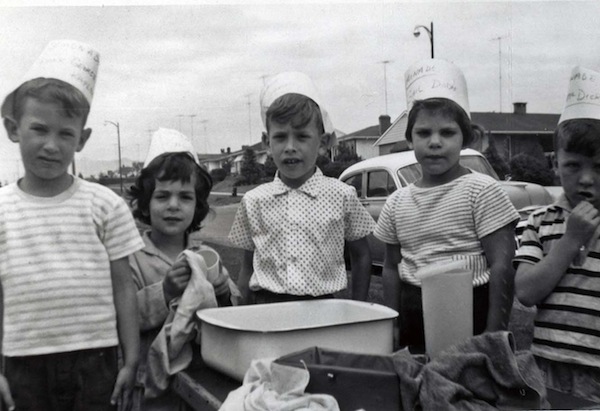
Growing up in Oakridge. (photo from Gail Dodek Wenner)

Today, the neighborhood still holds a warm place in the hearts of many. For this reason, the Jewish Museum and Archives of British Columbia has been working to develop an online exhibit celebrating the heyday of Jewish Oakridge. Making use of numerous oral history interviews, this exhibit will share the recollections of community members, and aim to provide a comprehensive picture of this era in our community’s history. A new series of interviews are currently underway, filling in gaps in previous research.

Under the supervision of the JMABC’s exhibition development team, made up of coordinator of programs and development Michael Schwartz and archivist Alysa Routtenberg, two volunteers are undertaking this series of interviews.

Junie Chow has volunteered for the JMABC for almost a year now, and recently produced the online exhibit Letters Home. Drawing upon the Seidelman Family fonds, the exhibit shares the letters written by Pte. Joseph Seidelman to his family at home in Vancouver as he fought on the frontlines of Vimy Ridge and Passchendaele during the First World War.

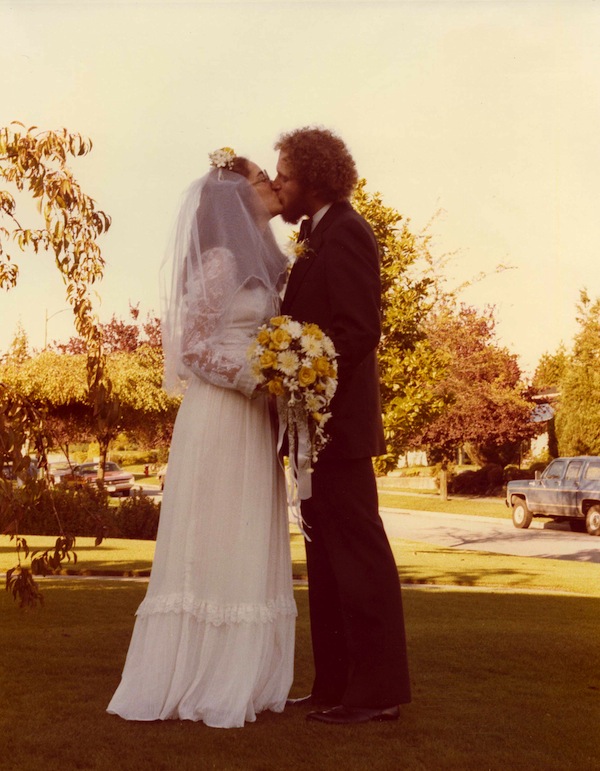
photo - The wedding of Sandy Belogus and Mark Rogen
The wedding of Sandy Belogus and Mark Rogen. (photo from Sandy Rogen)

The second volunteer, Josh Friedman, brings to the project his training as a recent alumnus of Indiana University graduating with a BA in Jewish studies and political science. New to Vancouver, Friedman is excited about discovering how the Jewish community in Oakridge reflected similar and different perspectives to trends in North American Jewry during the 1940s-1960s.

Listening to earlier rounds of interviews, essential themes have appeared. These include the initial motivations for moving to Oakridge, the overwhelming sense of community among residents, and even the eventual reasons for moving out of the neighborhood. However, through this process, new questions have also emerged and are guiding the ongoing research. For instance, how did the local community react and respond to world events affecting Israel and international Jewry? Acknowledging that Oakridge is a multi-ethnic neighborhood, the team is seeking insight into the types of relationships that existed between non-Jewish and Jewish neighbors. All of the results will be shared in the forthcoming exhibit.

Currently online are the exhibits Letters Home and New Ways of Living: Jewish Architects in Vancouver, 1955 to 1975 (see jewishindependent.ca/the-west-coast-style). As well, the JMABC has launched On These Shores: Jewish Pioneers of Early Victoria, which traces the early foundation of the Victoria

Jewish community from their arrival in 1858 to the establishment of Congregation Emanu-El in 1863, and Sacred Sites: Dishonor and Healing, which reflects on Victoria citizens’ response to the desecration of the Jewish cemetery there in 2011, and places this incident in context among other similar events elsewhere. Sacred Sites was produced through a partnership between the JMABC and the University of Victoria.

To visit all the online exhibits, go to jewishmuseum.ca/exhibit.

Format ImagePosted on March 25, 2016March 24, 2016Author Jewish Museum and Archives of British ColumbiaCategories LocalTags archives, Dodek Wenner, JMABC, Oakridge, Rogen, Seidelman
The move from 11th to 41st

The move from 11th to 41st

The Jewish Community Centre at 41st Avenue and Oak Street, November 1962. (photo from JWB fonds, JMABC L.11512)

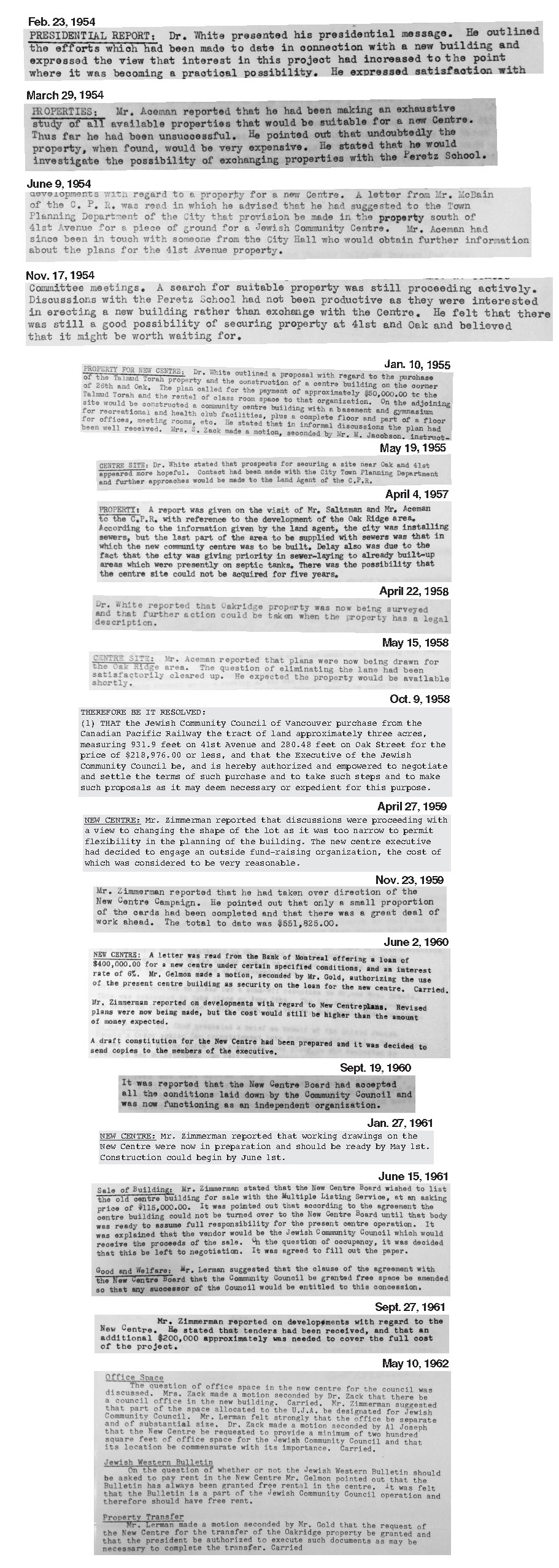
It’s hard to believe that, in the 1950s, the Oakridge area was considered a ways out of town. In going through the minutes of the Jewish Community Council of Vancouver from 1954, one can see the initial attempts by the council to find a new Jewish community centre building – which at the time was on Oak Street at 11th Avenue – that would be as conveniently located. They considered exchanging space with the Peretz School, which was on Broadway, and buying the land on which Vancouver Talmud Torah stood, on Oak at 26th. However, they soon started examining the prospect of buying land from Canadian Pacific Railway, south of 41st. The following snippets of meeting minutes from 1954-1962 allow readers to fast forward through the development process and the establishment of the JCC where it is currently located.

image - Jewish Community Council minutes 1954-62 re: move of JCC from 11th to 41st

Format ImagePosted on March 25, 2016March 24, 2016Author Cynthia RamsayCategories LocalTags history, JCCGV, Jewish Community Centre, Oakridge
נדל”ן לעשירים

נדל”ן לעשירים

ונקובר היא העיר הראשונה וטורונטו במקום השניים עשר בעולם מבחינת עליית מחירי הנדל“ן היוקרתי בשנת 2015. (צילום: Cynthia Ramsay)

נדל”ן לעשירים: ונקובר ראשונה בעולם בעליית מחירים הנדל”ן היוקרתי, טורונטו במקום השניים עשר

ונקובר היא העיר הראשונה וטורונטו במקום השניים עשר בעולם מבחינת עליית מחירי הנדל”ן היוקרתי בשנת 2015. תל אביב נמצאת במקום העשרים ושמונה והמכובד, לפני ניו יורק, לונדון, מוסקבה וטוקיו. הנתונים של “דוח העושר” מתפרסמים בימים אלה על ידי חברת הייעוץ הבריטית ‘נייט פרנק’. לפי ‘נייט פרנק’ חלקו של הנדל”ן היוקרתי מגיע ל-5% בממוצע מסך ערכו של כל שוק הנדל”ן.

את רשימת עליית מחירי הנדל”ן היוקרתי מובילה כאמור ונקובר עם עלייה של 24.5% אשתקד. הרחק מאחוריה במקום השני סידני (14.8%), שלישית – שנחאי (14.1%), רביעית – איסנטבול (13%), חמישית – מינכן (12%), שישית – מלבורן (11.9%), שביעית – סן פרנסיסקו (10.9%), שמינית אוקלנד מניו זינלנד (10.2%), תשיעית – אמסטרדם (10%), עשירית- מונקו (10%), במקום האחד עשר – ברלין (9%) ובמקום השניים עשר טורונטו (8%). תל אביב במקום העשרים ושמונה (3.7%), ניו יורק נמצאת רק במקום השלושים ותשעה (2.4%), מוסקבה אחריה במקום הארבעים (2.3%), לונדון רק במקום החמישים וארבעה (1%) ואילו טוקיו במקום החמישים ותשעה (0.8%).

דוח ‘נייט פרנק’ מתייחס גם למספר העשירים בעולם כיום עם הערכות ל-2025. בקנדה יש כיום: כ-292 אלף מיליונרים ומספרם צפוי לגדול לכ-394 אלף, כ-10,000 מיליונרים (שהונם נאמד ב-10 מיליון דולר+) והוא צפוי לגדול לכ-13,000, כ-3,500 מיליונרים (30 מיליון דולר+) והוא צפוי לגדול לכ-4,800, כ-420 מיליונרים (100 מיליון דולר+) והוא צפוי לגדול לכ-570 ו-35 מיליארדרים והוא צפוי לגדול ל-47. בישראל יש כיום: כ-72 אלף מיליונרים ומספרם צפוי לגדול לכ-111 אלף, כ-4,000 מיליונרים (שהונם נאמד ב-10 מיליון דולר+) והוא צפוי לגדול לכ-6,000, כ-1,500 מיליונרים (30 מיליון דולר+) והוא צפוי לגדול לכ-2,300, כ-180 מיליונרים (100 מיליון דולר+) והוא צפוי לגדול לכ-280 ו-17 מיליארדרים והוא צפוי לגדול ל-26.

נדל”ן לסטודנטים: יו.בי.סי בונה דירות מיניאטורות בשטח 13 מ”ר

ונקובר נחשבת לכידוע אחת הערים היקרות בעולם כיום ומחירי הנדל”ן ממשיכים לעלות ולשבור שיאים ללא הפסק. על פי דיווחים אחרונים מתברר שבמדד הערים היקרות בעולם שרכישת נדל”ן בהן נחשבת מעבר להישג יד עבור התושבים המקומיים, ונקובר תופסת את המקום השלישי והלא מכובד.

באוניברסיטת בריטיש קולומביה לומדים כיום כחמישים אלף סטודנטים ומתוכם למעלה מששת אלפים סטודנטים, ממתינים ברשימה הארוכה למצוא דיור בקאמפוס. הנהלת האוניברסיטה החליטה להקים מרכז מגורים חדש לסטודנטים (ליד מרכז אגודת הסטודנטים) בעלות של שבעים מיליון דולר. לאור המציאות הקשה למציאת דיור הולם לסטודנטים, המרכז יכלול פרוייקט נסיוני של דירות מיניאטורות עבורם, שהעבודות להקמתן יסתיימו ב-2019. בשלב ראשון מתוכננות שבעים דירות קטנות ואם הפרוייקט יצליח, לא מן הנמנע שיוחלט בסופו של דבר לבנות דירות נוספות, כאמור עקב הביקוש הרב לגור בקאמפוס. הדירות הקטנות מכונות “ננו סטודיוס” ושטח כל אחת מהן שלושה עשר מ”ר בסך הכל (בדומה לספוט חנייה של רכב). כל יחידת דיור כזו שתרוהט תכלול: מטבח (עם כיור, מקרר קטן ותנור), מקלחת, שירותים, מיטה שהופכת לשולחן עבודה, ארון ללא דלתות וכמובן חיבור לאינטרנט מהיר. האוניברסיטה תגבה שכר דירה בגובה 675$-695$ עבור המגורים החדשים.

הנהלת המוסד החליטה להעמיד דגם של ‘הננו סטודיוס’ במרכז הסטודנט כדי לאפשר לסטודנטים לבדוק מקרוב את המגורים המיניאטורים המצפים להם. חלק מתגובות הסטודנטים לפרוייקט החדש אוהדות וחלק פושרות ביותר. הסטודנטים מבינים שאם ברצונם לגור בקאמפוס עליהם להסתפק בדירות קטנות ביותר.

Format ImagePosted on March 23, 2016March 23, 2016Author Roni RachmaniCategories עניין בחדשותTags campus housing, Knight Frank, nano studio, real estate, University of British Columbia, אוניברסיטת בריטיש קולומביה, דיור בקאמפוס, נדל"ן, נייט פרנק, ננו סטודיוס
Blue Jays CEO wants to win

Blue Jays CEO wants to win

Toronto Blue Jays new president and chief executive officer Mark Shapiro. (photo from Toronto Blue Jays)

The Toronto Blue Jays almost made it to the World Series in 2015. With spring training having just started, we’re crossing our proverbial fingers (in the most Jewish way possible) that we’ll see that same Blue Jay magic – and more – in the months to come. Eyes will particularly be on the new leader at the helm, Mark Shapiro, who officially joined the Jays as president and chief executive officer last fall.

Shapiro has arrived at a pivotal time for the franchise, which celebrates its 40th anniversary this season. Many are eager to find out in what direction he’ll take the team, but one thing is certain: he wants to win.

“Clearly, winning has to be the primary area of focus,” Shapiro told the Independent. “A relentless, obsessive commitment to building a winning team.

“Building a team isn’t just collecting talent,” he continued. “It’s about players that are committed, that are willing to take risks and commit to something bigger than themselves.”

He also said he wants to integrate more sports psychology into the team’s routine, and “build a business organization that obsesses about fan experience at every interaction and every touch point.”

Next on his list is Rogers Centre, which is in dire need of a renovation, one that may cost upwards of $400 million.

Shapiro, like anyone else who has experienced the dome, has been a fan of the awe-inspiring structure since his first Jays game, which was in 1989, soon after he completed his history degree at Princeton. “My memory is seeing this building and just being blown away at what an incredible engineering marvel it is,” he said.

Rogers Centre isn’t the only spot that needs an upgrade. The team’s spring training facility in Dunedin, Fla., is widely considered to be the worst in Major League Baseball. Shapiro has to choose between renovating or moving the Jays to a new facility when the team’s lease expires in 2017.

To make matters more difficult, team cornerstones José Bautista and Edwin Encarnación become free agents at the end of this year and the Jays’ stock of minor league prospects was depleted by last year’s trade deadline frenzy. Still, there’s every reason to believe Shapiro will hit it out of the park, given that he’s spent an entire lifetime surrounded by the game, its players, its strategy and its details.

Shapiro invested nearly a quarter-century with the Cleveland Indians, having worked his way up from player development to team president. It was there that the Sporting News named Shapiro Executive of the Year in 2005 and 2007.

His managerial style hasn’t changed all that much, he maintains. “If you have a moral compass and a set of well-defined values, those are going to be the determinacy of how you lead,” he said.

But baseball and Shapiro go farther back than Cleveland. Son of Baltimore attorney and sports agent Ronald M. Shapiro, the game was ingrained at a very early age.

“Baseball was a part of the fabric of my childhood growing up. It was a connection and a bond for me with my dad,” said Shapiro. “It’s hard to separate out baseball from my childhood, whether it was stickball, wiffleball, Little League or playing catch in the street. Maybe it was the fact that my dad, at some point in my adolescence, started representing Major League players and they started being part of my life. Baseball, informally or formally, was always a part of my life.”

Among his baseball heroes growing up was Baltimore Orioles’ Brooks Robinson, for “consistency, the way he treated people and his artistic style of play,” said Shapiro. Jewish ball player Al Rosen, aka “the Hebrew Hammer,” who played for the Cleveland Indians from 1947 to 1956, was also a role model.

The Hebrew Hammer wasn’t his only source of Yiddishkeit growing up. Shapiro said he was reared with a “strong Jewish identity,” associating most with the “education, culture, understanding of history, and the values intertwined in that history.” They include, he said, “work ethics, commitment to community, compassion and tolerance,” which, he said, were “defining attributes and values that were a part of my childhood.”

Shapiro and his wife Lissa Bockrath-Shapiro try to instil those same values in their children, son Caden, 13, and daughter Sierra, 11.

Even though today’s Jewish players are few and far between, every now and again Shapiro will run into a fellow Jew and shmooze.

“It’s obviously a rarity and, obviously, there’s a lot more front office guys, like Mike Chernoff [Cleveland Indians general manager]. When we saw a Jewish player, we’d always chuckle with pride at that player succeeding. It was a topic of conversation,” said Shapiro.

Cleveland player Jesse Levis and Shapiro used to kibbitz about being MOTs, members of the tribe. Since he began work in Toronto after the ball season was over, Shapiro has not yet met lone Jewish Jay Kevin Pillar.

Meanwhile, one item needs clarification. There’s been no shortage of times that Shapiro has been asked why he pronounces his name Sha-pie-roh instead of the usual Sha-peer-oh. For the record – and he wants to set the record straight – his name has always been that way.

“People say, ‘Are you trying to hide the fact that you’re Jewish?’ If I did, wouldn’t I call myself Smith?” he said with a laugh. “Come on, really, there’s got to be a better way to do that.”

The story is familiar to many: as immigrants coming through Ellis Island, there was a name change and a mispronunciation that stuck. Philadelphia and Cherry Hill, N.J., lay claim as the “only places in the world you’ll hear ShapIro spelled Shapiro, and you’ll hear Shapiro spelled Schapiro,” he explained.

To be sure, fans are less concerned about the name than they are about the game. And, if he could impart one message, it would be that he’s here to win.

“My favorite Blue Jays stories are waiting to be written,” he said.

Dave Gordon is a Toronto-based freelance writer whose work can be found in more than a hundred publications globally. He is managing editor of landmarkreport.com.

Format ImagePosted on March 18, 2016March 17, 2016Author Dave GordonCategories NationalTags baseball, Blue Jays, Mark Shapiro
Kashua talks at U of W event

Kashua talks at U of W event

Sayed Kashua spoke in Winnipeg as part of the University of Winnipeg’s annual Middle East Week. (photo by Rebeca Kuropatwa)

On Feb. 25, as part of the University of Winnipeg’s annual Middle East Week, about 75 people came out to hear what guest speaker Sayed Kashua had to say on the topic The Arabs in Israel: The Inaudible Cry for Full Citizenship.

Born and raised in Tira, Israel, Kashua is an author and journalist. His three novels – Dancing Arabs, Let it Be Morning and Second Person Singular – have been translated into English, with the stories of his first and third novels being combined to become the film Dancing Arabs. Among other things, he is the creator of the Israeli TV show Arab Labor and the subject of the documentary Forever Scared. His 2013 talk in Vancouver sold out.

At the recent Winnipeg event, Global College executive director Dean Peachey and U of W president Dr. Annette Trimbee welcomed Kashua and the audience to the U of W’s Eckhardt-Gramatté Hall.

Kashua moved with his family to Champaign, Ill., a year and a half ago, finding the “noise” in Israel too distracting.

“When we arrived,” he said, “I taught my kids two things: that people here stand in line and that, if you’re asked where you’re from, just say you’re from Jerusalem … and, according to their response, you’ll decide if it’s east or west.”

When Kashua enrolled his kids at school, he found himself stumped by the forms when he came to the question about race, as Arab was not listed.

“I almost checked off ‘other,’ but I was so worried about losing my visa within three days of landing in the States…. I almost signed my kids as Asians, because I can easily prove that Jerusalem is part of Asia…. I didn’t know what to do. I raised my hand and the nice lady asked how she could help. I said I don’t know what my race is. She asked where I was from. I said Jerusalem. So, she said that I’m from the Middle East … so, I’m ‘white.’ That was the point that I knew I loved Champaign.”

For the first time, Kashua was part of the majority.

It was not until he went to the United States that he was asked about Islamophobia. As a secular Muslim, he had to think about the question, and he decided that the more important aspect to him was his nationality.

However, he recently found out at a parent-teacher meeting that his son was going to prayer. Kashua asked the teacher which religion or faith his son was following.

“The teacher said, ‘What do you mean? [He prays] with the Muslims. You are Muslims?’

“I said, ‘Yes, but I had no idea that my son prays.’ It was shocking for us, how the majority defines you, and how my son who is only 10 already realized he belongs to the group of Muslim kids in their school.”

Kashua then spoke of his greatest influence in becoming a writer – his illiterate grandmother who had lost her husband in the Israeli War of Independence.

“She was illiterate, but she was intelligent and sharp,” said Kashua. “She always told me bedtime stories. Maybe writing for me is just [a way] to keep telling myself bedtime stories. She told me wonderful stories, sometimes fairy tales. A huge part of her stories were about the war.”

According to Kashua, most Palestinians who became citizens of Israel after the war – farmers and those who remained in their villages – were or are illiterate.

“In 1948, most Palestinian villages, especially on the shore, were demolished,” he said. His grandmother had stories about her husband, “who was shot in the war, killed in 1948.” Kashua’s father was born in 1947, “so he was less than 1-year-old when his father was killed.

“She told stories about how she was trying to protect her son, sometimes running in the wheat fields, trying to cover him, when the bullets were whistling around her … escaping to the mountains,” said Kashua. These were, he added, “my childhood stories, and, to me, it’s history. It was never part of our education system, we belong to the Israeli education system. We are Palestinians, but also Israelis … became Israelis after the war of 1948. The war is never mentioned in our history books.”

It was not until after the war that Kashua’s grandmother learned that she no longer had land. To his family, he said, that was a bigger loss than losing their house.

“My grandmother, who used to have a lot of land, became a worker, picking fruit for Jewish bosses, sometimes in her own private land, picking fruit in fields she planted herself,” said Kashua. “That’s a very strong feeling I received as a boy, about being a refugee.”

When Tira became part of Israel people received Israeli citizenship. They lived under a military regime he said, until 1966, just a few months before what he described as “the occupation of the West Bank,” noting that “the military regime meant you couldn’t leave your village without permission from the military officer in charge.

“My father was telling us [that] only on Israeli Independence Day, you didn’t need a permit. Kids would jump onto trucks to go to another town, just to see, for a chance to go out. Of course, they were forced in their schools to celebrate Independence Day with Israeli flags.”

Even today, according to Kashua, conditions are different in east Jerusalem than in west Jerusalem. He said that Palestinian Israelis do not have equal rights, and are discriminated against in all aspects of life.

With Tira’s population at 25,000 now – growing from 1,500 in 1948 – Kashua said that poverty and crime there is hard to control.

“Maybe, at the beginning, people wanted to defend our identity, language, culture and tradition, but that’s no longer the case. We are trying to escape the ghetto, but there are so many laws that forbid us to do so. That’s the situation, you are completely segregated.”

Kashua described Israel as an “ethnocracy.”

“It’s democratic only if you’re Jewish,” he said. “If democracy is judged by how it treats minorities, Israeli democracy is facing a very big problem with the Arab minority…. We are still considered a national threat, a demographic problem.

“If you look at the history, you will see that, since 1948 until now, it was very rare that Arab citizens of Israel were activist against or being a real threat to the security of Israel. All Israelis know that reality and they know we are completely discriminated against when it comes to all aspects you can think of – land, the ability to move from your village. The sad thing is, sometimes the slave feels like he needs the master more than the master needs the slave. You have no idea how strong of a feeling it is when you don’t have even the ability to dream.”

Kashua was fortunate to find a Jew willing to sell him an apartment in west Jerusalem. They were the only Arab family living there and this was one of the reasons they moved to the United States.

Kashua believes that Palestinians want to be citizens of Israel and that they do not want to destroy the state, but they do want equal rights, as well as acknowledgement for the suffering they feel they have endured since 1948. This is something Kashua does not see as possible with the current leadership in Israel.

Rebeca Kuropatwa is a Winnipeg freelance writer.

Format ImagePosted on March 18, 2016March 16, 2016Author Rebeca KuropatwaCategories IsraelTags Israel, Israeli-Palestinian conflict, Middle East Week, peace, Sayed Kashua, University of Winnipeg
טייס הבריח סמים

טייס הבריח סמים

ברוס סימון (צילום: Vancouver Sun-Facebook)

טייס הבריח סמים כדי לעזור כביכול לישוב שלו. השופט לא קנה את הסיפור ושלח אותו לכלא

איש עסקים וטייס שהבריח סמים מקנדה לארצות הברית בטענה שהוא רצה לעזור לישוב הקטן בו הוא גר, לא שכנע את השופט האמריקני, ג’ונס ריצ’רד, שהטיס אותו לכלא. ברוס סימון בן החמישים ואחד נכלא לאחרונה לתקופה של ארבע שנים וחצי שנים, בכלא בסיאטל שבמדינת וושינגטון.

סימון עבר מהעיר לאנגלי לישוב קטן בשם ברלורן לפני עשר שנים. ברלורן נמצא בהרים בדרום מערב מחוז בריטיש קולומביה, מערבה מהעיירה לילואט (וכשעתיים נסיעה מעיירת הסקי ויסטלר). ברלורן מוכר באזור כיוון ששימש בעבר הרחוק קהילה של כורי זהב. הישוב ברובו נטוש וגרים בו כיום בסך הכל שישים תושבים עם עשרים ותשעה כלבים. במהלך 2011 נפתח שוב מכרה הזהב. הישוב נמכר בשנת 2014 ליזם סיני תמורת מיליון דולר בסך הכל.

סימון שמחזיק ברשיון טיס טען במשפטו שהתנהל בבית המשפט האזורי של סיאטל, כי הוא הבעלים של מינס הוטל וסליס פאב בברלורן, ושני עסקים אלה נחשבים למקומות התעסוקה הכמעט יחידים בישוב הקטן. המצב הכלכלי של העסקים היה לא טוב ולכן הוא החליט להבריח סמים (מסוג מריחואנה וכדורי אקסטזי) במסוק לוושינגטון, בסוף חודש יולי אשתקד. סימון הנחית את המסוק ליד אגם בייקר שבוושינגטון, שקרוב לגבול הקנדי. הוא העמיס את הסמים במשקל עשרים וחמישה קילו על ארבעה תיקים שחורים גדולים, והעבירם לרכב שטח. סוכני משטרת הגבולות האמריקנית שידעו מראש על המבצע של סימון, עקבו אחריו ועצרו אותו בטרם התניע את הרכב. הסוכנים האמריקנים התקשרו למשטרה הפדרלית הקנדית (האר.סי.אם.פי) שדיווחה להם, כי חודש קודם לכן (ביוני) סימון ניסה לחצות את הגבול מאבוטספורד לארה”ב עם מסוק שהתרסק. המשטרה הקנדית ציינה עוד כי המסוק התרסק באזור שידוע כנתיב להברחת סמים בין שתי המדינות. עוד התברר שלסימון עבר פלילי והוא לא יכול להיכנס באופן חוקי לארה”ב. במכתב שהועבר לשופט ריצ’רד באמצעות עורך דינו האמריקני, טען סימון כי הוא לא מכור לסמים והוא לא החליט להבריח את הסמים מתוך פחד, או מסיבות אחרות. לדבריו הברחת הסמים לא הייתה למטרות רווח אלה לנסות ולהציל את שני העסקים שלו, שהקהילה הקטנה של ברלורן תלויה בהם. עוד כתב סימון במכתבו: “אני הבעלים של הפאב והמלון היחידים בישוב ואלו העסקים היחידים שפועלים במקום, מלבד המכרה”. עם מעצרו של סימון סליס פאס נסגר (המלון ממשיך לפעול בשלב זה) ומסוקו הוחרם. השופט סירב לשחרר אותו על תנאי וכאמור שלח אותו לכלא האמריקני למספר שנים טובות.

מורה ששלחה עשרות הודעות טקסט לתלמיד פוטרה

מורה צעירה מאזור קימברלי וגולדן בבריטיש קולומביה קיבלה שיעור מאלף על התנהגותה החסרת אחריות. לאחר שהתברר למנהל בית ספרה כי היא שלחה עשרות הודעות טקסט (אס. אם. אסים) לאחד מתלמידיה בכיתה יא’, היא פוטרה מעבודתה ואיבדה את רישיון ההוראה שלה.

דפני ניל כך התאהבה באחד מהתלמידים והחלה לשלוח לו כחמישים אס. אם. אסים מדי יום. בהודעות ציינה כי היא נמשכת אליו. לאחר שהפרשה נחשפה ניל הודיעה לתלמיד שהיא יכולה להסתבך ולאבד את עבודתה וזה בדיוק מה שקרה. ההנהלה האזורית של בתי הספר הציבוריים ערכה ברור עם ניל שהודתה כי שלחה את הודעות הטקסט לתלמיד הצעיר, אך להגנתה טענה כי עשתה זאת בזמן שהייתה שיכורה. לאחר השימוע הוחלט לפטרה לאלתר וכאמור היא לא תוכל לשמש עוד כמורה.


Format ImagePosted on March 16, 2016Author Roni RachmaniCategories עניין בחדשותTags Bruce Simon, Daphne Neal, drugs, teacher, ברוס סימון, דפני ניל, מורה, סמים
Hundreds scribe new Torah

Hundreds scribe new Torah

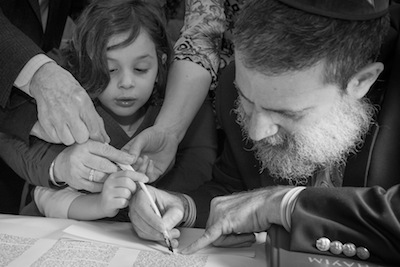
Nomi Fenson, left, and Debby Fenson help complete Congregation Beth Israel’s new sefer Torah with sofer Rabbi Moshe Druin. (Adele Lewin Photography)

Hundreds of people participated in a moving mitzvah over two recent weekends at Congregation Beth Israel. The congregation, still kvelling over its architecturally lauded new building, celebrated the arrival of a new Torah scroll, which was completed by members of the congregation with the help of a sofer, a Torah scribe.

It is one of the 613 mitzvot for each individual to scribe a Torah scroll: “And now, write for yourselves this song, and teach it to the Children of Israel. Place it into their mouths, in order that this song will be for Me as a witness for the Children of Israel.” (Deuteronomy 31:19)

The new sefer Torah was scribed in Israel, with the final 100 letters to be completed. A lottery was originally planned by the congregation to allocate the honor of scribing a letter, but a compromise was found to give the opportunity to everyone who wanted to participate.

“We asked if people would mind partnering with other families,” said Beth Israel’s Rabbi Jonathan Infeld. “And, despite the fact that we had 150 families or individuals who asked to participate, we had enough people who said they were willing to partner that everyone who asked to participate was able to do so.” In the end, about 600 people had a part in the process.

photo - Alexis with Rabbi Moshe Druin
Alexis with Rabbi Moshe Druin. (Adele Lewin Photography)

Participants had the opportunity to scribe with the guidance of Rabbi Moshe Druin, one of several “traveling sofrim” associated with a Florida-based enterprise called Sofer On Site, which facilitates events just like the one Beth Israel chose to undertake. Druin also helped complete a Torah scroll for Temple Sholom last year.

Each participant at Beth Israel proceeded through a variety of meaningful activity stations leading up to the scribing. Led by a volunteer guide, participants learned from teachers on a subject from the Torah. They then proceeded to a different area where they could decorate the new Torah binder, write a wish for the wishing tree, listen to storytelling or peruse the book corner. After handwashing, they prepared for the scribing, which they did with Druin. The sofer shared a teaching on the significance of each Hebrew letter and he filled in the letter as participants placed their hands on his hand or on the quill.

“The joy was palpable,” Infeld said of the event, which went all day Friday, Feb. 19, until Shabbat, then continued on Saturday night after Havdalah and again on Sunday. “The feeling of community was extremely strong.… Some people said this was one of the most meaningful experiences of their life and it was fantastic to see families of multiple generations participating in the activity.”

“It really is a once-in-a-lifetime experience,” said Audrey Moss, a congregation member who served as project chair for the Torah scribing and dedication. “The whole idea was that [participants] go through a spiritual journey. You prepare yourself spiritually and mentally before you go into the sanctuary for your one moment with Rabbi Druin…. I think Rabbi Druin really, really made the event.”

After the scribing, the Torah was dedicated on Shabbat the following weekend, when the congregation also celebrated the 10th anniversary of Debby Fenson’s role as ba’alat tefillah, Torah reader.

Fenson carried the Torah into the sanctuary and a music-filled procession welcomed the new scroll.

“We sang and walked the Torah around the entire shul so that everybody could see it and kiss it,” said Fenson, who admits that the dedication and surrounding ceremonies had a powerful effect on her.

“The whole morning was pretty emotional for me,” she said. “A lot of people came up to see me, and the dedication of the Torah was a special event.”

The Torah dedication was a first for both Fenson and Infeld. All of the synagogue’s existing Torah scrolls are more than 100 years old, said Fenson, so this was the first time a sefer Torah had been created specifically for the congregation. When the new synagogue was completed in 2014, the Torahs were carried into the ark, but this was different, Fenson said.

“People were very emotional and I was feeling that as well,” she said. “It was very exciting.”

Format ImagePosted on March 11, 2016March 10, 2016Author Pat JohnsonCategories LocalTags Beth Israel, Debby Fenson, Moshe Druin, sofer, Torah
Examining the cosmos

Examining the cosmos

Prof. Victoria Kaspi, winner of the 2016 Gerhard Herzberg Canada Gold Medal for Science and Engineering. (photo from McGill University)

McGill University Prof. Victoria Kaspi – the first woman to win the Gerhard Herzberg Canada Gold Medal for Science and Engineering – says that her Jewish background and her parents’ support have had a lot to do with how much she has accomplished.

“Questioning is so inherently Jewish,” she told the Independent. “I think this builds personality, skill, and derived pleasure from talking and thinking. Jews are very studious, loving the books. For some people, it’s the Torah; for others, it’s different types of books … just really enjoying the process of studying, thinking and analyzing. I think that’s what my Jewish background has brought to my work.”

Neither of her parents were scientists. “I just really like it,” she said. “I grew up loving math. My parents were pretty hands off and they certainly never discouraged me. I was sort of an oblivious kind of kid, so if there were cultural signals that I shouldn’t go into science, I must have missed them.

“I think my parents built up my confidence. They never questioned my decisions. When I said I want to go into science, they never asked why I’d want to do that. They used to buy me lots of math toys and puzzles as a kid. Probably my mom encouraged me. She used to play lots of games with me.

“I’m sure I had encouragement from teachers along the way and family as well,” she added. Describing science as “always a great love,” she said it was neither forced on her or strongly encouraged as a study or career path. But Kaspi is aware of the societal pressures on women to not go into science, especially now, with her own daughters.

“They are sometimes subtle and pointing them out can be petty, but when you notice them as an overall trend – where there’s lots of little, tiny subtle signals that, in the end, register very large – I think that needs some work,” said Kaspi of the pressures. “Why I didn’t suffer from that? I’m not sure. I’m hoping that this will improve with time.”

Kaspi uses radio and X-ray telescopes to examine the behavior of neutron stars, using the cosmos as a lab to study the nature of matter in extreme environments.

“The sort of work I’ve done has involved different types of neutron stars,” said Kaspi. “One, in particular, that I’ve done is magnetars, which are neutron stars with very high magnetic fields. They sometimes explode randomly and are just really interesting to study. But there are other things, too.”

photo - A satellite picture of the island of Montreal with an illustration of a neutron star for comparison. While relatively small, neutron stars are so dense that just one teaspoon would weigh about a billion tons
A satellite picture of the island of Montreal with an illustration of a neutron star for comparison. While relatively small, neutron stars are so dense that just one teaspoon would weigh about a billion tons. (photo from NASA)

Neutron stars are stars that have collapsed and are very dense. A black hole is a star that has collapsed onto itself, due to gravity being so strong that nothing can escape from the surface, not even light; hence, the name, black hole. Neutrons are close cousins of black holes, but some light does escape from them.

“The typical neutron star has as much matter in it as half a million planet earths, but is crushed down to the size of a city,” said Kaspi. “We think a typical diameter of a neutron star is something like 20 kilometres.

“If you’ve crushed all that matter into the size of a small city, you have matter that is extremely dense. If you went up to a neutron star with a teaspoon and you took a teaspoon of the matter, it would weigh something like a billion tons.”

Kaspi said, “We don’t understand the physics of it very well, and that’s one of the things we are hoping to learn by studying them. When studying these objects, we use very powerful computers and algorithms, digital signal processing, there’s a lot of hard work and managing of big data.

“People who study pulsars are snapped up by software companies, because they are really good at developing algorithms, thinking out of the box and finding creative solutions to big data problems.”

Pulsars are rapidly spinning neutron stars and emit a bright beam of light. They are observed through their flashes. If you wanted to go flying around the galaxy and needed a useful, simple way to know where you are, you could use a pulsar. “They all pulse very regularly,” said Kaspi. “You can use that to know where you are in the galaxy and which direction you want to go.”

Kaspi’s research group has used neutron stars to confirm Albert Einstein’s theory of general relativity.

“As scientists, we don’t believe just because a theory is beautiful, it has to be right,” she said. “You have to test it with experiments. These neutron stars allow you to do phenomenal tests of general relativity. Was Einstein right or not? There are other theories of gravity and we can test those, too.”

One of the biggest projects Kaspi is currently working on in Canada is the building of the Chime Telescope in Penticton. She is also looking into “fast radio bursts.”

Of this phenomenon, Kaspi said, “It’s something that’s a big mystery right now that we don’t understand. Astronomers are pretty puzzled over these things. They are very short, a few milliseconds, bursts of radio waves, little blips in the sky that go off randomly but frequently. We think a few thousand go off across the whole sky every day. The first one was discovered a decade ago. Until now, only about 20 have been recorded.”

Kaspi has earned international recognition and numerous awards for her work over the years. As for receiving the Herzberg medal, she said she feels honored, and added, “I may be the first [woman] for this prize, but I won’t be the last. There will be many more women in the future.”

Rebeca Kuropatwa is a Winnipeg freelance writer.

Format ImagePosted on March 11, 2016March 10, 2016Author Rebeca KuropatwaCategories NationalTags astronomy, Einstein, Herzberg medal, Kaspi, McGill, neutron star
A record $8.3 million raised

A record $8.3 million raised

At FEDtalks, the campaign opening event, left to right: Ezra Shanken, Jewish Federation of Greater Vancouver chief executive officer; Neil Pollock, general chair, 2015 Federation annual campaign; Lisa Pullan, chair, women’s philanthropy, 2015 campaign; Stephen Gaerber, Federation board chair; Alex Cristall, co-chair, major gifts, 2015 campaign; and Andrew Merkur, co-chair, major gifts, 2015 campaign. (photo from Jewish Federation of Greater Vancouver)

For the second year in a row, the Jewish Federation of Greater Vancouver annual campaign has closed with a record achievement, this time totaling $8.3 million. This represents an increase of approximately $300,000 from the previous year. Funds will support programs and services on which thousands of community members rely.

“The true power of this record result goes well beyond the impressive numbers. We can make incredible changes in this world when we give from our hearts, and that’s just what our thousands of donors and hundreds of volunteer canvassers have done. I am truly moved by their incredible acts of chesed (kindness) and tzedakah (justice, charity),” said general chair of the campaign Neil Pollock.

“I have witnessed firsthand the challenges in our community and the profound reach of the Federation annual campaign,” said Stephen Gaerber, Federation’s board chair. “The high cost of living in Vancouver has made it difficult for many community members to connect with Jewish life, either because they cannot afford to live centrally or because they cannot afford to participate. The Federation annual campaign addresses issues like these, builds connections between our community and our partnership region in Israel, and helps Jews in need around the world. This record campaign result will provide the support we and our partners need to touch more lives than ever before.”

The face-to-face incentive was one of the keys to this year’s success. It encouraged donors to meet in person with their volunteer canvassers. The 608 face-to-face meetings that took place were an opportunity to have meaningful conversations about shared values and commitment to community.

Federation welcomed 75 new volunteer canvassers as well as 225 new donors to the campaign this year. And Federation chief executive officer Ezra Shanken listed several other statistics in his weekly email message Feb. 19:

  • 1,007 donors increased their gifts
  • 292 volunteer canvassers
  • 1,459 community members attended campaign events
  • 409 campaign volunteers
  • 64 local programs and services supported
  • 17 Israel and overseas programs and services supported
  • 37 partner agencies supported
Format ImagePosted on March 11, 2016March 10, 2016Author Jewish Federation of Greater VancouverCategories LocalTags campaign, Federation, Shanken, tzedakah

Posts pagination

Previous page Page 1 … Page 260 Page 261 Page 262 … Page 322 Next page
Proudly powered by WordPress