Skip to content

  • Home
  • Subscribe / donate
  • Events calendar
  • News
    • Local
    • National
    • Israel
    • World
    • עניין בחדשות
      A roundup of news in Canada and further afield, in Hebrew.
  • Opinion
    • From the JI
    • Op-Ed
  • Arts & Culture
    • Performing Arts
    • Music
    • Books
    • Visual Arts
    • TV & Film
  • Life
    • Celebrating the Holidays
    • Travel
    • The Daily Snooze
      Cartoons by Jacob Samuel
    • Mystery Photo
      Help the JI and JMABC fill in the gaps in our archives.
  • Community Links
    • Organizations, Etc.
    • Other News Sources & Blogs
    • Business Directory
  • FAQ
  • JI Chai Celebration
  • JI@88! video
image - Weizmann Canada Physics Tournament 2025
image - The CJN - Visit Us Banner - 300x600 - 101625

Recent Posts

  • היהירות היא אחד האויבים הגדולים ביותר של ישראל
  • Vrba monument is unveiled
  • Music to build bridges
  • A better future possible
  • Anne Frank exhibit on now
  • Human rights in sport
  • Telling the story of an icon
  • Crawl bigger than ever
  • JCC Maccabi in Toronto
  • A way to meet fellow Jews
  • Time to include
  • Add Jewish joy to the mix
  • Reminder of humanity’s light
  • From the archives … editorials
  • Year-round holiday recipes
  • מדוע עזבתי את ישראל ואינני חושב לחזור ארצה
  • OJC hosts Oct. 7 memorial
  • A journey beyond self
  • Antisemitism a problem
  • Young man is missed
  • Orr action sparks complaint
  • Prison sentence for hate
  • Etgar Keret comes to Vancouver
  • New fall lecture series
  • Series explores music
  • Doc on Zapiro screens Nov. 6
  • Joy of shared existence
  • Community milestones … October 2025
  • MAID vs Jewish values
  • Cheshvan a great month, too
  • Bull, bear or bubble?
  • From the archives … a coin, etc.
  • מדוע האנטישמיות הולכת וגואה בעולם
  • New bio gives Vrba his due
  • Joy brighter than ever
  • When approaches differ

Archives

Follow @JewishIndie

Category: Arts & Culture

Barrable-Segal brings printmaking to life

Barrable-Segal brings printmaking to life

Jocelyn Barrable-Segal (photo by Olga Livshin)

Jocelyn Barrable-Segal was raised by parents with two vastly different professional backgrounds: her mother was an architect and her father was a pilot. Following her own path, Barrable-Segal managed to combine the two in her own career. For 35 years, she has been a flight attendant with Air Canada. Several days each month, she flies around the world. The days she is not in the air, she is an artist, and you can find her at Malaspina Printmakers, a printmakers’ workshop on Granville Island, where she creates unique lithographs.

“Malaspina is an artist-run centre,” Barrable-Segal told the Jewish Independent on a recent visit. “It started in the early ’70s with three or four artists. Now there are about 60 of us.” She went on to explain that Malaspina is equipped for a dozen different systems used in printmaking, but she uses only one process, the ancient technique of stone lithography. “I love to draw,” she said, “and lithography is the only technique that requires drawing.”

Barrable-Segal does that drawing on stone. The technicalities of embedding an image into stone and later transferring it from stone to paper are not for this short article, but it’s important to point out that each image can have many layers, each layer introducing one additional color plus whatever details the artist wants to add or alter. The process is time consuming and labor intensive, but Barrable-Segal said she doesn’t conceive of working in any other art form.

“With lithographs, you can change the image if you change your mind, have layers of drawing and colors,” she said, “while in painting, as soon as you’re done, that’s it.” She also likes to be able to have several copies of the same print, although she never mass-produces them. “I make limited editions, no more than seven copies of one print.”

Her prints are mostly flowers or landscapes but they are never life-like. They hover between abstract and impressionism. “I’m attracted to metaphors,” she said. She uses multiple sources for her pictures, including photographs from her travels, but she transforms the imagery through the creative filter of her imagination, enriches reality with emotional and esthetic folds. Her artistic touch converts memory into art.

That’s why she keeps flying, to bring back more visual mementos, more nutrients for her lithographs, she explained. “I see different countries, and each happy place finds its way into my images. Of course, no photocopies.”

Frequently, she draws flowers and floral compositions. “I buy live flowers at the public market and look at them,” she said. “That’s how it starts.” Flowers are the predominant theme for her work in the In Wait show that recently opened at Burnaby Art Gallery.

“In Wait is a collaborative project of the Full Circle Art Collective,” she said. “There are seven of us in the collective, seven women: Heather Aston, Hannamari Jalovaara, Julie McIntyre, Milos Jones, Wendy Morosoff Smith, Rina Pita and me. We all met at Malaspina, but then some of us drifted apart. We reunited for this show.”

The inspiration for the show came from the story of Penelope, the wife of Odysseus, she said, and it took the artists three years from the idea to the vernissage.

“Penelope was waiting for her husband to return, but her suitors were insistent that he was dead and she should choose one of them. She said she would weave a shroud before she married again. All day long she wove and then, in the night, her ladies-in-wait would unweave what she had done. The shroud was never completed. She waited. We all wait for something in our lives. It’s a universal theme for women.”

For her, another sad theme overlaid the waiting – the theme of grief. Her parents passed away recently, and working on the show helped her deal with her sadness. “For me, grief associated with poppies. I needed to find solace. I drew lots of poppies for the show.”

Women friends and their collaboration and support were another aspect of the show that came from the story of Penelope and her faithful maids. “Each one of us would make a piece and pass it on to the others. The others would add something, change. They would say: what does it need? Perhaps this detail or line or color should be added.”

Sometimes three or four people would contribute to the image before it returned to the original artist. “When you get your image back with someone else’s input, you think: what do I do now? It’s different. How to keep the integrity of the image? How to bring our combined visions together? This way, you’re always creating.”

Art making is ingrained in Barrable-Segal’s life. “I started flying because I didn’t want to be a full-time artist. It’s not realistic, even though I have a master’s degree in fine arts. But I would never abandon art. I do it for myself. I would continue even if I didn’t sell anything. I always have my sketchbook with me. When I play golf with my husband, I’m not interested in the ball. I look at my shadow on the grass and think how it would look in a lithograph.”

In Wait is at Burnaby Art Gallery until Nov. 9. For more on Barrable-Segal, visit jmbs.ca.

Olga Livshin is a Vancouver freelance writer. She can be reached at [email protected].

Format ImagePosted on October 10, 2014October 9, 2014Author Olga LivshinCategories Visual ArtsTags BAG, Burnaby Art Gallery, Full Circle Art Collective, Jocelyn Barrable-Segal, lithography, Malaspina Printmakers
Orkestars at Vogue

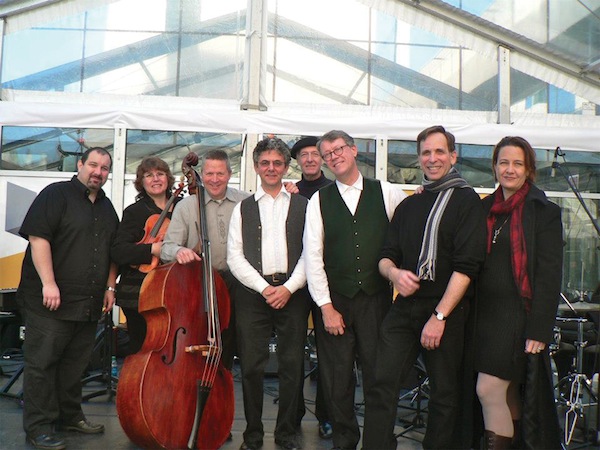
Orkestars at Vogue

Members of Orkestar Slivovica include Susan Gerofsky, fourth from the left. (photo from Caravan World Rhythms)

Caravan World Rhythms presents Boban & Marko Markovic Orkestar on Oct. 18 at Vogue Theatre. Opening for Boban & Marko is a collaboration between local bands Orkestar Slivovica and Jack Garton’s Demon Squadron. The main level of the Vogue will be turned into an open dance floor for the whole evening. There will also be reserved seating available for those who prefer to sit and watch.

Boban & Marko, the quintessential Balkan brass band, comes back to Vancouver after again being crowned “Leading Band in Serbia,” a title to which they have been named multiple times since the late 1980s. Their music, performed by a 13-piece strong orchestra, is defined by their gypsy lineage, while giving a nod towards other musical and cultural backgrounds related to Romani traditions. Aside from their numerous awards, the group has performed and been featured in films.

Vancouver’s homegrown Balkan brass band, Orkestar Slivovica, includes Jewish community member Susan Gerofsky. The eight-12-piece brass ensemble plays and sings a diverse repertoire, from insanely fast dance tunes to heart-wrenching songs, often in crooked rhythms and exotic scales. Gerofsky plays tenor horn and accordion and contributes vocals, but she also plays baritone horn and other brass instruments, pennywhistle and piano, and has dabbled with banjo, fiddle and ukulele.

Gerofsky has been involved with folk music and dance for many years, starting with youthful experiences doing Israeli and international folk dancing and working as a volunteer at the Mariposa Folk Festival in Toronto.

When not playing with the band, Gerofsky is a tenured assistant professor in the department of curriculum and pedagogy in the faculty of education at the University of British Columbia. She holds degrees in languages and linguistics as well as mathematics education, and worked for 12 years in film production, eight years in adult education (including workplace and labor education) and eight years as a high school teacher with the Vancouver School Board. Gerofsky has been involved in interdisciplinary research and teaching involving embodied, multisensory mathematics education, garden-based learning, applied linguistics and film. She has studied, researched and taught in England, Brazil, Italy and Cuba. She speaks several languages.

Collaborating with Orkestar Slivovica are special guests Demon Squadron, spearheaded by the musician, songwriter and showman Jack Garton of Maria in the Shower. Their sound is rooted in reggae, funk and folk, and includes the backbone trio of Amrit Basi on drum set, Michael Alleyne on bass and Garton on accordion, trumpet and voice. The trio welcomes frequent collaborators on saxophone, trombone, organ and backup vocals.

The Oct. 18 show starts at 8 p.m. Tickets, $42 (general admission)/$52 (reserved seats), are available in person at Highlife Records, Banyen Books or Boemma Deli; online at caravanbc.com; or by phone, 1-855-551-9747. For music and more, visit bobanimarko.com, orkestarslivovica.org or jackgarton.com/demonsquadron.

Format ImagePosted on October 10, 2014October 9, 2014Author Caravan World RhythmsCategories MusicTags Caravan World Rhythms, Demon Squadron, Jack Garton, Markovic Orkestar, Orkestar Slivovica, Susan Gerofsky, Vogue Theatre
Memoir more than family history

Memoir more than family history

Alison Pick (photo by Emma-Lee Photography)

Award-winning author and poet Alison Pick comes to Vancouver later this month to participate in two panels at the Vancouver Writers Fest, one of which is already sold out.

As a teenager, Pick discovered that her father’s parents were Jewish. As she tells a rabbi in the first chapter of her memoir, Between Gods (Doubleday Canada), “My grandparents escaped Czechoslovakia in 1939. They bribed a Nazi for visas, came to Canada and renounced their Judaism. They spent their lives posing as Christians…. As a kid I was forbidden from discussing it. But now I’m going back and asking questions.”

In her 30s, struggling with depression, about to be married, and writing the novel that would become Far to Go, Between Gods is about Pick’s life during this period in which she lays claim to her Jewish identity. She spoke with the Jewish Independent via email.

JI: The title of the book is Between Gods. With what vision of God did you begin your spiritual/cultural journey, and how now do you grapple with or appreciate God/Source? Did your concepts/beliefs change when you had a child?

AP: Between Gods tells the story of my conversion from Christianity to Judaism. That said, the conversion was mostly cultural for me – an attempt to reclaim my family’s hidden Judaism. My personal concept of God, ironically, is probably most Buddhist in nature: the idea that there is a presence larger than us; that is it benign or even loving. It seems to me there is something akin to an energy field, and that we can choose to ignore it or to engage with it, and that, in engaging with it, we foster our relationship with it. I like the image of two hands. One is moving, grasping, reaching, touching – that hand is the ego, or the personality. The other hand remains still – it is the witness, both personal and theological.

These concepts didn’t change when I had a child, although I am very conscious of fostering a sense of the divine for and with her. The most important part of our week is Friday evening, when we have Shabbat dinner – seeing her take that for granted (in the best kind of way) is hugely gratifying.

JI: In the acknowledgements, you note that you’ve taken artistic liberty with some of the details, but still, it must have been difficult to write about family, friends. From where came the desire to write such a book at this point in your life?

AP: It didn’t really feel like a choice. Between Gods began as a set of notes I was taking at the same time as I was writing Far to Go. At first I thought the two projects were the same book – then it became clear that they were different. By the time I had finished writing Far to Go, I had converted to Judaism. I just knew that Between Gods was the next book I had to write. As a writer, you have to trust where the artistic energy lays, and so my practice is comprised at least partially of listening to what wants to be written as opposed to what my ego wants to write.

JI: Reading the memoir, your frustration with the conversion “policy” is completely understandable. With the distance of time, how do you feel about it?

AP: I had difficulty converting to Reform Judaism in Toronto because my fiancé was not Jewish. At the time, it was hard to not take this personally, to not feel rejected. It still, in retrospect, seems odd to me that I was already half Jewish and yet encountered many more obstacles than the other women in my class who were engaged to Jewish men. That said, I do see the very clear benefits that having an entirely Jewish nuclear family offers, not just individually, of course, but collectively. My experience made me more compassionate towards others, in that way that our personal suffering always shines a light on the suffering of the world, and has influenced my decisions around how to practise Judaism with my daughter – we are involved in communities that are inclusive and progressive while at the same time honoring tradition.

JI: Why did you choose, in a memoir mainly about your becoming Jewish, to also write so openly about your struggle with depression?

AP: It seemed to me that the two were intimately related. The more I learned about my family background the more I began to think that my depression was something inherited and that, in some ways, it was the result of the legacy of the Holocaust. I’m not saying that the relationship was directly causal, but that the two things fed off each other, culminating in an existential darkness.

JI: The absence of your mother and sister in the memoir is felt, even though they are mentioned, you share that they were supportive and you address why they don’t figure more prominently. The rabbi was concerned with creating an interfaith nuclear family, but extending this concern, how has your family’s being Jewish fit in/worked with your larger family (and even friends)?

AP: It was a conscious decision to not include very much of my mother, although you’re not the first person to say they would have liked more of her. She was generally extremely supportive, as was my sister. I have heard many other conversion stories in which at least one member of the potential convert’s family was upset, or at least in which the family dynamic was fraught. I experienced none of that. My mother, my sister, and my extended family and friends have really been behind me. Of course, I had many in-depth conversations along the way, but all of them had positive outcomes.

At the Writers Fest, which takes place Oct. 21-26 on Granville Island, Alison Pick participates in two panels about writing based on personal experience, one of which – Writing Back to the Self on Oct. 24 – still had tickets for sale at press time. In addition to Pick, Jewish community members participating in the festival include Cory Doctorow, Esther Freud, Herman Koch, Christopher Levenson, Daniel Leviton and Tom Rachman. For tickets: vancouvertix.com, 604-629-8849 or the box office at 1398 Cartwright St.

Format ImagePosted on October 3, 2014October 1, 2014Author Cynthia RamsayCategories BooksTags Alison Pick, Between Gods, Writers Fest
Asper vision spurred action

Asper vision spurred action

(photo by Rebeca Kuropatwa)

Miracle at the Forks: The Museum that Dares Make a Difference, which chronicles the 14-year journey to plan, build and open the Canadian Museum of Human Rights (CMHR), was launched on Sept. 22 at the museum with Gail Asper, Moe Levi, Stuart Murray, and co-authors Peter C. Newman and Allan Levine. The 200-page book, released by Figure 1 Publishing, officially hit the bookstands on Sept. 23.

In her remarks at the launch, Asper said that she was pleased with the volume’s title. “I love it because it is miraculous … being inside this museum we’ve talked about for 14 years … this is a really great time for Winnipeg, Manitoba and the world.”

She continued, “We started on this journey to find a way to educate our youth about our human rights violations that occurred in our history and to inspire people to take action. This has been a long, often challenging, and many times miraculous journey from dream to reality. That’s why we’re thrilled that non-fiction writers Peter C. Newman and Allan Levine are here and have written a compelling book, recounting the story from the day Dad – Israel (Izzy) Asper – dreamed of a centre for human rights and gave Moe Levi the mandate to make it happen, to the completion of the building this year.

“During the dark days after my dad’s passing, it was Moe’s support, his ridiculous optimism and resolve, that kept us going…. And, of course, thank you to the federal government under the leadership of Stephen Harper, this maverick person whose courageous decision to make this a national museum ensured our going forward. Also, thanks to our 8,200 donors who’ve made this day possible.”

Newman described the book’s overarching purpose. “Canada was built on dreams as well as appetites. This country was founded by waves of immigrants with big ideas and big dreams. The [Canadian] Museum of Human Rights will dramatically alter Winnipeg’s skyline. But its name is a misnomer; museum is too limiting a description. That’s a venue people visit to remind one another of past lives … memories that can light up a rainy Sunday afternoon.

“This museum is to make a difference. This book is about how this idea, which seemed far too risky to be Canadian, actually came about. Its purpose is more significant than its contents…. If you consider this notion, it really defines what this is all about. Its existence will turn focus on its mission. The key to this great achievement is the image you get of a long time ago.”

Co-author Levine said, “I was fortunate to spend a lot of time with Izzy Asper and listen to him talk…. He told me often, one of the secrets of success came down to perseverance. He just never gave up on anything he did.

“The CMHR project gave new meanings to that. As Peter and I were researching and writing the book, I was struck by the amazing perseverance of Gail and Moe, and other members of the Asper family and foundation. They refused to quit, and are standing in the museum today.”

Levine read aloud excerpts from the book’s section “A Magnificent Conception,” about the delay in getting the museum off the ground.

“You see, Asper was not a journey-to-the-destination type of person. He was a just-get-to-the-destination kind of guy. So, if you’d told him in 2003, prior to his death, that more than a decade later the Museum for Human Rights would not be open, he would have been appalled.

“Back in 2000, once the initial idea of the Museum of Tolerance, as it was first referred to, began to germinate, and after Asper had found a spot at the Forks where he wanted to build it, plans advanced methodically and purposefully.

“Asper’s vision, although not clearly articulated initially, was to establish a museum that would teach the lessons of the Holocaust as well as examine human rights in a Canadian context against the backdrop of the Charter of Rights and Freedoms. There was a part of Canada’s history that had never been told, and he spoke really with as much passion about the Holocaust as he did about the Japanese, Chinese and Aboriginal societies, in particular.

“The project Asper envisioned was unique for several other reasons, factors that would prove a stumbling block difficult to hurdle, the grandeur of the museum Asper had in mind was akin to the Guggenheim Museum in Spain.

“One misconception that stands out is how people believe that he intended this to be a private museum … the opposite is true. Right from the beginning, he stated that he only wanted to spearhead this project, not run it or control the agenda.

“In the early years, Asper had underestimated the opposition he was to face from just about every corner – skeptical politicians who questioned the need for such a mammoth and expensive museum, academics and journalists who did not believe the museum of human rights could be done properly, or whether it was even necessary.

“Ottawa bureaucrats protested loudly about placing a national rights museum anywhere but in Ottawa, and a collection of naysayers who questioned the use of the Asper Foundation’s use of tax-payer money as part of an alleged scheme to advance so-called Jewish interests.

“Yet, even if he had known of the obstacles that stood in his path, Izzy would never have quit. Always he had persevered. As Gail recalls about her father, there’s a great quote that comes ‘Do it: do or do not. There is no try. Let’s just get the job done.’

“At the same time, there had been times when he had tried and tried and tried, and he failed. But the bottom line is, if you keep trying, the perseverance will pay off somewhere.”

When finished reading the first book excerpt, Levine shared, “Izzy, by the way, dictated things. Gail was instructed by her father that she was to dedicate half her day, every day, to the museum.

“So this, I quote, from Izzy’s letter to his daughter: ‘You must get up and end every day and ask yourself, what did I achieve in finding 60 million needed from the private sector for the museum? You are not to take any calls, answer any letters, or have any meetings with people who are seeking donations from the Asper Foundation. That is Moe’s job, and not to be duplicated.

‘I’m spelling all of this out because this is your opportunity to prove that you can act like a senior executive, and not to be distracted by everything that happens to go by. I hope you can exercise for us and discipline the outlined above.

‘This is the way I’ve operated all my life and, in my opinion, the only way you can accomplish things that everyone thinks can’t be done.’” Levine added, “And Gail obviously followed that [instruction].”

“Working with Allan and Peter has been one of the joys of putting this whole project together,” Levi added in his remarks. “It made me reminisce with Gail, and many times we laughed and cried thinking back [on] this incredible journey. I think it’s a great book. The key thing here is all the proceeds of this book go to the Friends [of the CMHR]. Anytime you buy it, you’re helping a child come to visit the museum in Winnipeg.”

Rebeca Kuropatwa is a Winnipeg freelance writer.

Format ImagePosted on October 3, 2014October 1, 2014Author Rebeca KuropatwaCategories BooksTags Allan Levine, Canadian Museum of Human Rights, CMHR, Gail Asper, Izzy Asper, Miracle at the Forks, Moe Levi, Peter C. Newman, Stuart Murray
My Rabbi – about us, not others

My Rabbi – about us, not others

Joel Bernbaum and Kayvon Kelly are good friends who’ve drifted apart in My Rabbi. (photo by Derek Ford)

Religion, family, even something as innocuous as a book club or a sports team – any group to which we belong creates an “us” and a “them.” Conversely, for most of us, not belonging anywhere, with anyone, leads to feelings of isolation, desperation. Finding space for “the other,” being secure in oneself, these basic building blocks of healthy relationships, are at the core of My Rabbi.

When interviewed last month by the Jewish Independent (jewishindependent.ca/at-foundation-of-my-rabbi-is-friendship) co-creators Kayvon Kelly and Joel Bernbaum expressed the hope that their two-man play would raise more questions than it answers. It certainly does.

The opening scene shows both men praying, Arya (played by Kelly) on his knees to Allah, Jacob (Bernbaum) adorned in tallit and tefillin to Hashem. Arya and Jacob are not religious extremists, however. Both have turned to religion in part because of the relationship they had with their respective fathers, they are both seeking meaning, but both still live in Canada, by choice – in Toronto no less, one of Canada’s most multicultural cities – Jacob a Conservative rabbi, Arya still searching. They have drifted apart by the time the play begins and, when they happen to bump into each other again, the timing could not be worse – a synagogue in Toronto has just been bombed.

This awkward reintroduction leads to a reunion over coffee and flashbacks to earlier, happier days of their friendship. Frat-boy humor offers breathing room in this intense 60-minute play, as, in addition to the current-day tensions, we see Arya and Jacob interacting with their fathers (each played by the other actor) in some emotional, identity-defining scenes. We witness how/why Jacob becomes a rabbi with a strong sense of religious affiliation and Arya becomes more of a lost soul, his sense of identity not as clear.

There is little female presence in this play. We find out that, while Arya’s father was Muslim, his mother was Catholic, but other than sexist jokes at the pub about bar conquests, and catching up on the latest girlfriend status, women don’t play a large role in these men’s lives.

The easiest assumption to make between this play and the larger world is that it is a commentary on the Israeli-Palestinian conflict or the larger “clash of civilizations” between extremist Islam and the rest of Islam and the West. However, these characters could belong to any group (religious or not) that leans to the insular.

And, it’s not really about this group versus that group, but about human beings in general, how a question asked at the wrong moment can end a years-long friendship, how selfish we can be in our own fear. It’s about how we relate to each other, our susceptibility to outside forces, our evaluation of our self-worth.

While based on Kelly and Bernbaum’s own cultural backgrounds, it almost would have been nice if they had chosen characters that didn’t already come with so much baggage. As the discussion after a Victoria show proved, we come to the play – as we come to anything else – with our own preconceptions, and even though the play is intended to elicit openness, some will find it hard to empathize with Jacob (i.e. Jews) or Arya (i.e. Muslims). There is such a strong human tendency, it seems, to lay blame.

The title of the play doesn’t help in this regard, as it sets viewers’ expectations higher for the rabbi. And, it’s misleading, as the play is not more about Jacob than Arya, Judaism over Islam. It’s about two friends, any two friends, and it would be a shame if the play were considered relevant only to the Middle East conflict or how Jews and Muslims as groups may interact. Kelly and Bernbaum are asking us to consider our own personal motivations, actions and reactions, and are asking us to put ourselves not only in Jacob and Arya’s places and consider what we would have done, but what we – not someone else – should have done.

My Rabbi is at Firehall Arts Centre from Oct. 7-18.

Format ImagePosted on October 3, 2014October 1, 2014Author Cynthia RamsayCategories Performing ArtsTags Firehall Arts Centre, Joel Bernbaum, Kayvon Kelly, My Rabbi
Israel Horovitz calls “action!”

Israel Horovitz calls “action!”

Kevin Kline and Maggie Smith in Israel Horovitz’s My Old Lady. (photo from Cohen Media Group)

Arobust 75, the award-winning playwright, theatre director and screenwriter Israel Horovitz isn’t in the market for a new career. Too bad, for his moving debut as a filmmaker, My Old Lady, is a rewarding, beautifully acted story of adults overcoming loneliness and bitterness.

“[The late, great Jewish director] Sidney Lumet once said to me about directing, ‘Get the best actors you can on the face of the earth and then get out of their way,’” Horovitz said. “And that was, in a sense, a directing style for me.”

Adapted by Horovitz from his stage play, My Old Lady begins with a rather unlikable New York Jew named Mathias Gold (Kevin Kline) primed to claim the Paris apartment left him by his perpetually despised and recently deceased father. Mathias thinks his luck has finally turned, and that he’s landed on Easy Street after a lifelong stretch of failed marriages and unpublished novels.

Alas, the apartment is a viager, which means the elderly Englishwoman (Maggie Smith) residing there with her unmarried daughter (the always-great Kristin Scott Thomas) retains tenancy until her death. Mathias’ actual inheritance, in the meantime, is the monthly payment contractually owed to the old lady. You don’t need to imagine his frustration and anger, for Mathias makes no effort to hide it.

photo - On set with director Israel Horovitz (yellow jacket)
On set with director Israel Horovitz (yellow jacket). (photo from Cohen Media Group)

My Old Lady, which screened at the Toronto International Film Festival last month and is in wide release this month, spills many poignant secrets that expose the characters’ long-concealed connection, and the scars from the past that they still bear. It makes for powerful drama, even though Horovitz excised a chunk of the original play dealing with the treatment of Jews during the Nazi occupation.

“I found that I had to boil the whole thing down into a kind of ‘guy walks into a bar’ story,” Horovitz said, “then write a film as though I had never written [the] stage play. In the first draft of the film, which was enormously too long, all of the talk about the Nazi occupation of Paris was in. As I boiled it down to what I thought the real theme of the film was, the real spine, it wasn’t that. It was about Mathias, his relationship with his father, and his ultimate forgiveness of his father. [Mathias] doesn’t renounce being Jewish, he doesn’t hide being Jewish. It’s just not what the movie’s about.”

Horovitz is the author of more than 70 produced plays, including such Jewish-themed works as Park Your Car in Harvard Yard and Lebensraum. He also penned the screenplay for Sunshine, István Szabó’s epic 1999 film about a Hungarian Jewish family spanning the 20th century.

“Being Jewish is part of my life, but it’s not my only subject,” Horovitz said.

The writer has garnered several shelves’ worth of awards, including two Obies, France’s Commandeur de l’Ordre des Arts et des Lettres and a lifetime achievement award from B’nai B’rith. The writer is as famous and respected in France as he is in the United States, which allows him a unique perspective on the increase in French antisemitism.

“I have some Jewish friends [in Paris], some of them in high places, who are grievously alarmed, and some Jewish friends who are kind of in denial,” Horovitz said. “And then I have me, in my own skin, and when I’m in Paris I’m, quite frankly, a very highly regarded playwright, so I may not get the same kind of experience or the same kind of antisemitism [as] some French Jew going to synagogue in a [small] town. You couldn’t have a more Jewish name than mine unless your name was Israel Jew, so there’s no question in anybody’s mind when they meet me that I’m Jewish. Do I personally experience a lot of antisemitism? Almost none; almost none that I see.”

However, Horovitz can’t say the same about growing up in Wakefield, Mass., a town about 12 miles north of Boston, in the 1940s and ’50s.

“Did I as a kid experience antisemitism? On a daily basis. The overriding sentiment in my town was, ‘Why did we go to war and lose all of these American boys? We just should have given Hitler his Jews.’ Now that wasn’t everybody, but it was some people, and they were quite vocal about it. I can’t, in my wildest imagination, think that all of France or all of Paris is antisemitic, but the people who go out in the street with their fists in the air and do Hitler salutes are certainly visible.”

For his next film project, Horovitz is working on a screenplay based on Park Your Car in Harvard Yard, his play about an old Jewish man (and retired high school teacher) and his younger housekeeper (and former student).

“I have had offers to direct other films,” Horovitz confided. “That doesn’t interest me. Really, I’m not trying to build a hot career. But I think I’ve got a couple more movies in me and I’d like to make a record of what I consider to be my best work onstage.”

Michael Fox is a writer and film critic living in San Francisco.

Format ImagePosted on October 3, 2014October 1, 2014Author Michael FoxCategories TV & FilmTags Israel Horovitz, Kevin Kline, Kristin Scott Thomas, Maggie Smith, TIFF

Storytellers excel at Fringe

Sold out. That pretty much describes every show the Jewish Independent saw during the Vancouver Fringe Festival last month – two even made the Pick of the Fringe, which ran the week after the festival.

There were at least five shows in which a member of the Jewish community was involved. Kerry Sandomirsky directed and Lynna Goldhar Smith was the production manager for Beverley Elliott’s … didn’t see that coming, which made the Fringe Picks, along with Goldhar Smith-directed Dirty Old Woman. Both of these shows featured confident, funny older women in the lead.

Elliott’s was a one-woman show, but pianist Bill Costin added well-played and well-timed musical (and other sound) accompaniment, as well as being funny in his own right, and he provided some lovely harmonies in the vocal arena. The performance moved along quickly, with Elliott sharing both humorous and touching stories of her life, from her lack of success with internet dating – “47 coffee dates and I’m going broke” – to a longtime friend committing suicide, to a New Year’s Eve show at Vancouver’s Royal Hotel, hot yoga and more. Interspersed with the stories were many songs, several of which were original numbers, and they, too, ranged from the silly to the sentimental. It was a standing-ovation-garnering performance.

photo - Charlie Varon
Storytellers Charlie Varon (photo from Tangeret via Charlie Varon) and Naomi Steinberg (photo from Naomi Steinberg) were among the highlights of this year’s Vancouver Fringe Festival.

While the audience remained seated after Dirty Old Woman, they certainly whooped it up during the show, the actors having to pause more than once before the laughter subsided so that their next lines could be heard. The “dirty old woman” was played with impeccable comedic timing by Susinn McFarlen, who also made Nina a character with whom the audience empathized and for whom they rooted. She was surrounded by the excellent cast of Robert Salvador as Gerry, the much-younger and very handsome man with whom Nina strikes up a relationship; Emmelia Gordon as Liza, Nina’s daughter, who is somewhat jealous and completely unsupportive of her mother’s new relationship; and Alison Kelly as Diane, Nina’s best friend, whose marriage is “fine,” until it’s not. Written by Loretta Seto, the play didn’t feel scripted, but rather like watching snippets of real life.

Another writer who seemed to bring real people to the stage at this year’s Fringe was Charlie Varon, with Feisty Old Jew. Varon actually performed in front of the stage, a glass of water and a music stand the only props or set. As he enacted 83-year-old Bernie’s encounter with three 20-something surfers with whom he’s hitchhiked a ride back to his retirement home, Varon became each character.

Sharing not only what is said aloud between the people in the car, but what is going on in Bernie’s head, Feisty Old Jew is very funny and it is obvious that this production, these stories, are, as Varon told the audience, “a love letter” to his parents and that generation of Jews. Varon also shared a couple of short stories about another retirement-home resident, Selma, and, when he was finished, it was as if we’d met her. Varon said he has completed eight of 12 stories that he plans to publish as a collection in the next couple of years – it’ll be a fantastic read.

At the other end of the age range was Trey Parker’s Cannibal: The Musical, presented by Awkward Stage Productions, which provides young actors and crew the opportunity to learn theatre by doing. Young, of course, doesn’t mean inexperienced and the cast and crew of this Fringe show did an excellent job from start to finish – especially considering that there is no official script for Cannibal, which includes cartoons and animated backdrops, songs, dancing and dialogue. A lot goes on in this story, “loosely based” (to say the least) on that of Alferd Packer, “the first American to ever be convicted of cannibalism.” Not nearly as gross as it sounds, except for the short opening cartoon, this show was funny throughout and extremely well-executed.

photo - Naomi Steinberg
Naomi Steinberg

Rounding out the entertaining Fringe fare enjoyed by the Independent this year was Naomi Steinberg’s Goosefeather, which was quirky, thought-provoking, innovative and mesmerizing. In 2011, Steinberg interviewed her grandfather at his Paris apartment. She asked him 100 questions – about his youth, his first job, how he helped her grandmother survive the war, why he finds measurement so fascinating, why she, Naomi, is so stubborn. “You were born like that,” he responds in what turns out to be characteristically brusque fashion.

But this isn’t straight narrative. An experienced storyteller, Steinberg intersperses what she knows and learns about her grandfather with observations about the concept of measurement, of time and space. What do we measure? Our waists, our burdens? What are our favorite measuring tools? A yardstick, the position of the sun? There is no such thing as an exact measurement, she notes – scientists always allow for a margin of error.

Steinberg adds goose honks and other sounds, ticks of time passing, packaging tape unrolling; she responds to questions and reactions from the audience; she hugs a plastic blow-up globe, hangs a pocket watch on the wall; she is dressed in a corset made from her grandfather’s ties. The presentation as a whole is much more than the sum of its parts.

Currently traveling the world, “crossing longitudes and latitudes, carrying [her] own prime meridian” and making a map, Steinberg told the Independent in an email that she is “working on shows in California, Australia, China, Japan, England, Switzerland, France, Israel and then returning through NYC and across Canada.” When Goosefeather lands again in Vancouver, take the time to see it.

Posted on October 3, 2014May 5, 2025Author Cynthia RamsayCategories Performing ArtsTags Beverley Elliott, Charlie Varon, Kerry Sandomirsky, Lynna Goldhar Smith, Naomi Steinberg, Susinn McFarlen

Shalom Sesame for Chanukah

Available Oct. 14, SISU is re-releasing the 12 episodes of the 2010-11 season of Shalom Sesame in a new six-DVD thin-pack gift box. Included in the re-release is a bonus DVD featuring two episodes from the classic Shalom Sesame series, “Jerusalem” and “People of Israel” (originally released in the early 1990s). In addition, the DVD set includes a free 30-day trial download of the first episode.

image - Shalom Sesame DVD

Join lovable, furry Grover and celebrity host Anneliese van der Pol (That’s So Raven, Broadway’s Beauty and the Beast) as they travel to Israel in this 12-part award-winning series co-produced by Sesame Workshop, the nonprofit organization behind Sesame Street, and Israel’s Channel HOP! Designed to help bring the vitality of Jewish culture and tradition, as well as the diversity of Israeli life, to American children and their families, each 30-minute, live-action and animated DVD focuses on storylines drawn from Jewish cultural traditions, highlighting lessons on Hebrew letters and words, unique sites in Israel and Jewish values.

In addition to van der Pol, the series features guest appearances by top name talent, including Jake Gyllenhaal, Debra Messing, Matisyahu, Eva Longoria, Christina Applegate, Greg Kinnear, Debi Mazar and others. The programs’ chronological order mirrors the Jewish calendar, beginning with an introduction to Israel and Hebrew, and ending with a program on mitzvot and a concluding trip to Israel.

Each title in the set contains two episodes and includes extra video segments. Shalom Sesame has been awarded a CINE Golden Eagle Award (2011), a Hugo Television Award Certificate of Merit (2011) and a Dr. Toy Best Pick Award (2010). Learn more about Shalom Sesame at shalomsesame.org, view previews and clips on youtube.com/shalomsesame and visit facebook.com/ShalomSesame. To order DVDs, visit sisuent.com.

Posted on October 3, 2014October 1, 2014Author Shalom SesameCategories TV & FilmTags Anneliese van der Pol, Christina Applegate, Debi Mazar, Debra Messing, Eva Longoria, Greg Kinnear, Grover, Jake Gyllenhaal, Matisyahu, Shalom Sesame
Butt Kapinski – not your children’s clown

Butt Kapinski – not your children’s clown

Deanna Fleysher as private eye Butt Kapinski. (photo from Deanna Fleysher)

Think you’re going to go sit and watch Butt Kapinski at the Cultch next month? Think again. You’re going to be an integral part of the show.

An award-winning hit at last year’s Vancouver Fringe Festival, Deanna Fleysher is returning to Vancouver with her alter ego, Elmer Fudd-meets-Philip Marlowe private eye Butt Kapinski. It is funny, raunchy, unpredictable humor that involves the audience. In her expert hands, they become a crime boss, a femme fatale, a prostitute, all participating in the telling of a unique-every-time murder mystery.

photo - Deanna Fleysher
Deanna Fleysher (photo from Deanna Fleysher)

“We humans crave that feeling of spontaneity, of witnessing and being part of something that has never happened quite this way before and will never happen quite this way again,” Fleysher told the Independent about her preferred type of performance.

“I am convinced that theatre will become increasingly interactive, as theatre practitioners realize that the best way to entice people to put on pants and leave their homes is to include them in the experience somehow. We can’t let flat screens and underwear win the war!”

Fleysher is on the front lines, so to speak, having made interactive theatre a focus of her career. In addition to performing as a clown, in improv and in other capacities, Fleysher is a teacher, writer and director. Among the interactive and clown/bouffon shows she has created or co-created is the erotic production Foreplay, which ran for a year at the People’s Improv Theatre in New York City, as well as at the Chicago Improv Festival, and she created, produced and performed in Kill Me Loudly: A Clown Noir, and directed and co-wrote Red Bastard. She started the Naked Comedy Lab, in which participants learn how to perform interactive comedy and clown/bouffon, and she teaches labs in Los Angeles and around North America.

“My parents are both creative people, although they did not pursue the arts specifically,” shared Fleysher about her background. “Nonetheless, I was in theatre classes from probably 6 years old onwards. My sister is also a performing artist and teacher, specializing in Middle Eastern dance. So, two nice Jewish people ended up with a belly dancer and a clown for children. So it goes.”

Butt Kapinski, however, is not for children. The character is described as a “noir-loving, gender-troubled little fellow-gal who wears a trench coat and a streetlight strapped to his/her back and goes into crowds and solves mysteries.” He/she has appeared in previous Fleysher creations.

“I found Butt Kapinski on a street corner in the East Village, but also, Butt has been with me my whole life,” explained Fleysher about his/her origins. “I used to have many speech impediments as a child, so speaking that way is very natural for me. Also, I am a huge film noir buff, a lover of Raymond Chandler novels and spontaneous poetry and trench coats. Butt is just me without my ‘Normal Disguise.’

“I used to wear a nose, partly because I was worried about being too ‘pretty’ or ‘normal’ (or, hell, ‘feminine’) without it. But Butt is quite different than the me everyone sees, and losing the nose [that Butt used to sport] was the best choice I could have made.

“The streetlight that I wear came into the act once I decided to go solo. What I wanted was a true interactive experience with the audience, but I do not like when performers bring people up on stage. My light lets me take the show right into the audience, where everyone can stay comfortable, and still be a part of things.”

Asked about what attracts her to Kapinski, to the private-eye genre in general, Fleysher responded, “I have always delighted in the dark side. Butt allows me to share that delight with others, to make a community ritual out of a usually private kind of fetish for the sicker shit in life.”

In a 2012 interview with LAFF! (Ladies Are Funny Festival), Fleysher is quoted as saying she once heard Fran Lebowitz say, “Every Jewish woman wants to be a private eye.” About that comment, Fleysher explained to the Independent, “My mother found the first guy I ever slow danced with on JDate. How did she even remember his name? I went steady with him at sleep-away camp for about a week, and she found out all about who he is now … you know … just in case. That is a kind of sleuthing I tip my hat to.

“Fran Lebowitz was introducing some mystery/crime fiction writers at a reading in N.Y. many years ago, when she said, ‘Every Jewish woman wants to be a private eye.’ In that moment, my mother’s passionate curiosity was united with my noir world.”

Fleysher has always been a writer/actor at heart. “I was always more interested in creating my own theatre rather than reading/interpreting someone else’s words,” she said. “It’s not my thing to sell hand soap or be Battered Wife #3 in a cop drama. All of this means that I’d much rather be poor and creatively empowered than poor and at the mercy of casting agents.”

As for her interest in physical comedy/theatre versus more “serious” fare, Fleysher said, “My first theatre teacher was a clown, and I think I always had a strong bent toward comedy. Of course, the root of comedy is despair – so you get two for the price of one!”

Butt Kapinski is at the Cultch from Sept. 30-Oct. 11. For tickets, visit tickets.thecultch.com.

Posted on September 26, 2014September 25, 2014Author Cynthia RamsayCategories Performing ArtsTags Butt Kapinski, Cultch, Deanna Fleysher, Fran Lebowitz, LAFF!
Amy Herzog’s 4000 Miles offers 4,000 laughs

Amy Herzog’s 4000 Miles offers 4,000 laughs

Nathan Barrett and Nicola Cavendish in Amy Herzog’s 4000 Miles. (photo by David Cooper)

I can be quite nervous going to see a play that relies on only one or two main actors to carry the production, particularly when those one or two have most of the dialogue, and the action takes place in only one room for the entire performance.

But my concern is never that great when Nicola Cavendish is one of the two involved because I know I will laugh out loud, stifle tears and otherwise experience a full, rich range of emotions. I was not disappointed when I caught Cavendish in Amy Herzog’s 4000 Miles.

In this starring role, Cavendish plays 91-year-old Vera whose grandson Leo (Nathan Barrett) comes to stay with her after a cross-continent bike trip during which his best friend died.

Leo has come to stay with his grandmother due to lack of cash, being estranged from his mother and in an uncertain position with his girlfriend.

At first Leo appears to be the clichéd lost soul – not entirely the self-absorbed persona you expect to find in a 21-year-old – who brings to Vera a companionship the older woman is missing. The reunion is filled with laughs right off the top as Vera’s hearing problems cause havoc in the communication.

Vera herself is savvy, but tough, and pulls no punches when giving her opinion.

“You smell terrible and I wouldn’t be surprised if you have lice,” she says to Leo in one of the first lines of the play.

The relationship starts with Leo showing warmth to an uncomfortable Vera, who’s more used to complaining all the time than accepting someone’s love; and it’s quickly revealed that

Vera really only wants what’s best for her grandson, like a good night’s sleep.

Vera shows interest in Leo’s recent trip as well, albeit on the weird side, asking Leo if he ever met a sexual crackpot wanting favors in exchange for giving Leo a place to stay.

The two soon start talking about family, and Vera admits she also has a dysfunctional relationship with Leo’s mother: “I always end up telling her what a disappointment she was to her father,” Vera sighs. “I don’t mean to, but I do.”

It’s not long before Leo’s “one-day visit” turns into a lengthy stay and the well-meaning free spirit starts acting like a freeloader, even bringing one-night stands over to the apartment.

Vera, for her part, turns into a crotchety micro-manager who’s defensive and fearful. She starts to lecture Leo on responsibility, and doesn’t hesitate to show an angry frustrated side when she feels her space is being infringed upon.

In one brilliantly funny scene, Leo’s girlfriend comes over and drops her bag in the middle of the living room. Walking by the bag, Vera nonchalantly gives it a kick and, with surprising results, sends it flying a good 10 feet back to the front door – eliciting laughs and applause from the audience.

Vera’s progressive loss of memory, while a bane for her (“I hate not being able to find the right words”), is also a source for comedic enjoyment in the play, especially when she and Leo smoke pot together.

“Your father never did anything for me in bed,” she says, mistakenly referencing her daughter. “Neither of my husbands did.”

“Were my parents in love?”

Leo asks during this baring of stoned souls.

“Which ones were your parents?” Vera dopily responds.

While this play is not likely to offer deep insights that will turn your world around and cause you to run out to reconcile with every estranged member of your family, it is a warm, wonderfully written snapshot of two somewhat lost people who come together with love and humor.

4000 Miles ran Off-Broadway in 2011 and again in 2012, and was a finalist for the 2013 Pulitzer Prize for drama. It shows at the Arts Club Stanley Theatre until Oct. 12. Visit artsclub.com.

Baila Lazarus is a Vancouver-based writer, painter and photographer. Her work can be seen at orchiddesigns.net.

Format ImagePosted on September 26, 2014September 25, 2014Author Baila LazarusCategories Performing ArtsTags Amy Herzog, Arts Club, Nathan Barrett, Nicola Cavendish

Posts pagination

Previous page Page 1 … Page 147 Page 148 Page 149 … Page 159 Next page
Proudly powered by WordPress