Kahane and Andres at PuSh

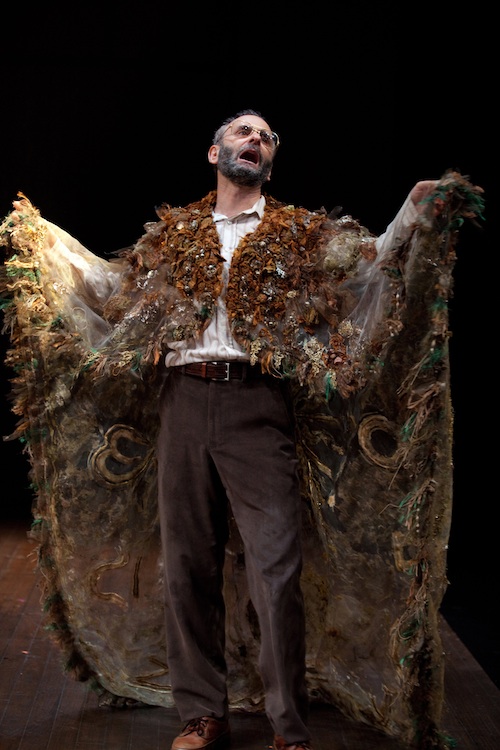
Brooklyn-based Gabriel Kahane will be in Vancouver for the PuSh International Performing Arts Festival, with pianist and composer Timo Andres, for Mixtape, a “live playlist” of eclectic and dynamic music appreciation. (photo by Josh Goleman)

Gabriel Kahane describes himself as a “songwriter, singer, pianist, composer, devoted amateur cook, guitarist and occasional banjo player.” With the release of his sophomore album Where are the Arms in 2011, the New York Times called him a “highbrow polymath,” an apt description considering he dips his toes into multiple genres, plays several instruments and seems equally comfortable composing a pop song, a musical theatre work or a piece for chamber ensemble.

The Brooklyn-based Kahane will be in Vancouver for the PuSh International Performing Arts Festival, with pianist and composer Timo Andres, for Mixtape, a “live playlist” of eclectic and dynamic music appreciation: “Bach cantatas played alongside folk songs, pieces by their friends and colleagues, music by classical giants Schubert and Schumann, and songs and solo piano works by Kahane and Andres themselves.”

Kahane spoke with the Independent ahead of the Jan. 27 and 28 concerts, part of the festival’s Music on Main program.

Growing up with pianist and conductor Jeffrey Kahane as a father meant early music immersion, but, even then, his interests were diverse.

“I began formal musical training at around the age of 4 on the violin, but switched to piano at age 7, in no small part because I wanted to be like my father, who was and is a concert pianist,” Kahane said. “I also sang from a young age in choruses, and found myself, through curious circumstances, singing in a handful of operas as a boy. My childhood was culturally peripatetic – I went from dusting off my parents’ attic-consigned guitars one week to acting in plays the next, learning jazz standards on the piano for a time, all while doing the national junior chess circuit. I realize this makes me sound like a kid out of some Wes Anderson film, but it wasn’t actually that bizarre…. In college, after transferring from conservatory where I’d been studying jazz piano, I found myself writing a musical with a classmate of mine, which exposed me to the pleasure of permanence, as opposed to the more ephemeral arts I’d been engaged in previously: improvisation, acting. When I finished college and moved to New York, I began both to study piano seriously for the first time (I had been a miserable student as a child) as well as to write songs – pop songs – if you will.

“When I was 25,” he continued, “I had an idea to make a found-text song cycle with ads from Craigslist as lyrics, which caught the attention of some folks in the classical music world, which opened some unexpected doors toward my writing concert works. A few years later, I released my self-titled album of chamber-pop songs, which again had the inadvertent effect of getting me noticed by classical institutions like the L.A. Phil[harmonic], Kronos Quartet, etc. All of this is to say that my path to being a ‘composer’ really began with my efforts as a songwriter, which is where I am most at home.”

Kahane plays guitar and banjo in addition to piano, but is “most at home singing while playing the piano and, in a sense, I think of that compound as my instrument.”

That versatility has led to a prolific output. Aside from two albums, Kahane saw the release of the cast recording from the 2012 musical February House. His music and lyrics for this Public Theatre-commissioned musical “move from mournful to antic,” wrote the New York Times in their review, which also referred to Kahane and his former classmate Seth Bockley, who wrote the book, as an “imposing team.” His biography recounts a partial list of his recent accomplishments without fanfare: “Kahane has been commissioned by, among others, Carnegie Hall, the Los Angeles Philharmonic, American Composers Orchestra, Kronos Quartet, the Caramoor Festival, and Orpheus Chamber Orchestra…. Other appearances … include performances of his orchestral song cycle Crane Palimpsest with the Alabama and Waterloo-Cedar Falls Symphonies, a recital with Timo Andres at the Library of Congress, and a two-night stand at Ann Arbor’s UMS with the new music ensemble yMusic.”

Effectively managing priorities is key for such a kinetic career. “I’ve been very lucky to have a lot of different opportunities at a relatively young age,” he explained, “and it can be overwhelming. The period of 2011-2013 was tricky for me, and I got pretty overworked in those years, during which time my second album, Where are the Arms, was released; my musical February House premièred at the Public Theatre; and I wrote and premièred three fairly large works for orchestra and voice, along with a smattering of chamber music and various tours. It was just too much. So this last year, when Sony approached me about making some records for them, I made a decision to turn down a lot of work and just focus on that project, which I’m just wrapping up now. I feel much more sane doing one thing at a time, though I’m again starting to feel the itch of wanting more projects at once. I do have two other large projects in the pipeline, but I am, for the moment, committed to doing them one at a time.”

Each project encompasses its own terrain, and is intellectually and psychologically distinct, he noted.

“Writing for oneself as a musician is maybe not dissimilar from how auteurs in the film world operate – they’re writing the thing that they will then (sometimes) shoot and direct. There’s a kind of internal, unspoken conversation going on about how the thing is going to be interpreted, and that often means that one uses a kind of shorthand. (A great example of this in music is Mozart’s Coronation Concerto, where the left-hand part doesn’t exist, because Mozart was just going to make it up. Incidentally, a radical completion of this piece is on Timo’s latest album, and I think it’s stunningly brilliant.)

“When you write for someone else, you invariably have to put more on the page in order to communicate the totality of what you want expressed, and you’re most likely less familiar with their instrument, whether it’s a voice or a violin, and you have to invest in familiarizing yourself to the point where you close that gap.”

Kahane is forging his place in the American songwriting tradition and his libretto Gabriel’s Guide to the 48 States, for example, makes clear the reason. It’s his ability to seamlessly shift between the American tradition and the Western classical tradition that affirms his seat at the vanguard of American new music.

“I certainly think of myself as coming out of the American songwriting tradition, but there are also Germanic roots in what I do, both genetically – my grandmother fled Germany in 1939 – and also musically. I think a lot of my concert music traffics in an attempt to reconcile the populism of the American Songbook with the modernist tradition of 20th-century Europe. And there’s also a connection between the American Songbook and the 19th-century German lied tradition, a connection that Timo and I are, I think, attempting to tease out in our program for PuSh.”

Mixtape is an eclectic and energetic collaboration and is a manifestation of the exploration of the intersections and (receding) boundaries between the American folk and the Western classical tradition. 

In fact, Mixtape is an eclectic and energetic collaboration and is a manifestation of the exploration of the intersections and (receding) boundaries between the American folk and the Western classical tradition. Andres and Kahane have a similar sensibility and sense of creative adventure.

“Timo and I were really friends before we were collaborators. I think it’s a pretty effortless collaboration in that 1) Timo is a brilliant pianist, 2) brings no ego to the table [and] 3) we have similar priorities as musicians, which is basically to play the stuff that we love and to organize it somewhat obsessively. I think the audience will find the evening surprisingly approachable, kind of like that first time you had sea urchin on pasta and were like, ‘OMG, this is delicious,’ even though you thought you hated uni.”

Defying categorization in a world of hyper-classification has its benefits, but it also proves complicated when it comes to marketing.

“Yes, there absolutely are challenges,” he said about his body of work. “First and foremost, it’s much easier to cultivate an audience that already exists, as opposed to one you have to cull from many corners. Creatively, I can’t imagine my life any other way, but there is certainly a struggle in finding the audience that is interested in all these little dribs and drabs from various esthetic spaces.”

“As I mentioned earlier, my grandmother, and all of her immediate family, fled the Nazis in 1939 and settled in Los Angeles. The story of her flight by boat was the impulse for my piece Orinoco Sketches, which I wrote for the L.A. Philharmonic, using my grandmother’s diaries as a basis for my own text. Inasmuch as Judaism is about a rejection of intellectual dogma, I definitely feel that my creative life is informed by being Jewish – constant renewal of ideas and spirit in pursuit of something newer and truer.”

Kahane’s Jewish identity informs this esthetic, as well. “I definitely identify as Jewish, maybe more culturally and philosophically than religiously,” he said. “As I mentioned earlier, my grandmother, and all of her immediate family, fled the Nazis in 1939 and settled in Los Angeles. The story of her flight by boat was the impulse for my piece Orinoco Sketches, which I wrote for the L.A. Philharmonic, using my grandmother’s diaries as a basis for my own text. Inasmuch as Judaism is about a rejection of intellectual dogma, I definitely feel that my creative life is informed by being Jewish – constant renewal of ideas and spirit in pursuit of something newer and truer.”

Kahane spends his downtime in the kitchen. “I absolutely love to cook, as does Timo, though I’ve gotten too serious about it for it to be strictly enjoyable, i.e., I’m nearly as critical of myself as a cook as I am as a musician. I tend toward the Italianate in that realm. I’m also a pretty voracious reader, though more and more, I’m doing these research-based projects that demand a lot of reading, which cuts down on pleasure reading.”

Mixtape, with Gabriel Kahane and Timo Andres, is on Jan. 27 -28, 8 p.m., at Heritage Hall. Visit pushfestival.ca.

New York shows Marc Chagall

Seeing the Chagall show at the Jewish Museum in New York made me recall the year when Marc Chagall (1887-1985) was 90 and I decided it was high time that he, my favorite Jewish artist, and I meet. But first let me tell you about the current Chagall exhibit.

Until Feb. 2, lovers of Chagall’s works can see a fine selection of his paintings that were done between the early 1930s and 1948. Titled Love, War and Exile, the exhibit of 31 paintings, 22 works on paper and assorted photos and letters have been drawn from various public and private collections.

For me, Chagall was the ultimate Jewish artist of the 20th century. He combined artistic intelligence, vivid imagination, sensitivity to and awareness of Jewish history, and deep-rooted Jewish knowledge, based on his early education and the ambience of his Chassidic family in Vitebsk, Russia. Moreover, his knowledge of Yiddish and Yiddish lore expressed itself in many of his works.

Chagall’s colorful and fantastic paintings, with lovers in the air, suspended candelabras, a disembodied painter’s palette, roosters, flower-bedecked cows and snow-covered villages are seen in plenitude. In this show, there are also many crucifixion scenes, for Chagall saw the Jesus figure as representative of the martyrdom of the Jewish people during the 1940s. He himself, his beloved wife, Bella, who figures in so many of his paintings, and his daughter, Ida, were fortunate enough to escape from France and come to the United States in June 1941. The war in Europe was raging and it was just several months before the United States entered the battle in December 1941.

Chagall’s depictions of Jesus invariably have him wearing either a tallis or a tallis-like loincloth, thereby accenting his Jewishness. Although some viewers conclude that it is only during the l940s that Chagall began to paint Jesus on the cross, Chagall painted Jesus as early as 1908, when he was in his late twenties.

To understand Chagall’s works, especially those that are related to thoroughly Jewish themes, a deep understanding of the Yiddish language and Jewish culture are needed. Alas, even museums, which supposedly have knowledgeable staff, err in their interpretation because of ignorance.

To understand Chagall’s works, especially those that are related to thoroughly Jewish themes, a deep understanding of the Yiddish language and Jewish culture are needed. Alas, even museums, which supposedly have knowledgeable staff, err in their interpretation because of ignorance.

A classic example is his painting “Over Vitebsk” (not in this show), which depicts a village and its rooftops, and over the houses floats a bearded figure, with cap and cane, holding a stuffed sack. I remember visiting a museum once with my father, Yakov, and seeing this famous Chagall painting. The curator went to great lengths describing the scene. Reading this banal description, my father laughed and said, “They don’t understand this painting because they don’t know Yiddish and they don’t know Yiddish folk expressions. What Chagall is doing here is visualizing a Yiddish phrase: ‘geyen iber dee hizer’ – ‘going over the houses’ – an expression that actually means ‘going from house to house begging.’”

So, then, without a knowledge of Yiddish lore, Chagall’s brilliant rendering of this scene is misunderstood. What was mistaken as a typical Chagall “floating” scene is actually a rendering of a Jewish beggar going from house to house, as Jewish beggars did all over Eastern Europe, trying to collect food to put in their sacks.

In this show, too, we have one of Chagall’s crucifixion scenes in a shtetl, where there is a huge fire on the left side of the painting. The description on the little card says that it is a kind of crossing of the Red Sea. However, in reality, it is Chagall’s depiction of the Holocaust, a visual rendering of the Yiddish expression “mayn shteytl brent” – “my town is burning.”

I don’t know if the Jewish Museum’s administration is aware of the coincidence, but in the room that shows many of the artist’s crucifixion canvases there is a rather large cross-shaped blue sofa where visitors can sit and view the paintings.

One of the most fascinating parts of the show for me was the Yiddish letter that Chagall wrote to the mayor of Tel Aviv, accepting an invitation to visit. His calligraphy is clear and beautiful, showing the early schooling he had in writing the Hebrew letters, and his Yiddish is fluent and evocative. After all, he is a native Yiddish speaker. On view too is a letter to Hermann Struck, to whom Chagall writes that he hopes his visit will be beneficial to his art. Struck is identified merely as a “printer.” Missing from the description is the fact that Struck himself was a noted artist, who wrote a definitive book on etching. Moreover, Struck was a former teacher of Chagall.

Accompanying this show is a comprehensive catalogue, co-published by Yale University Press, entitled Chagall: Love, War and Exile. In addition to the paintings on view, the book also has many other related paintings, an English translation of some of Chagall’s Yiddish poems, and photographs. One particularly engaging photo is one of Chagall sitting in front of his painting of Bella, right next to Bella herself, who poses wearing a black dress with lace collar and holding a white lace fan.

Now I’ll return to getting to see Chagall in St-Paul-de-Vence, a small town not too far from Nice, in the Provence region of southern France. To see a very private artist, whose visitors were controlled by his managerial second wife, Vava, was not easy. For such an attempt one needs, as the Israeli expression has it: proteksia – or “pull.” I knew the then president of Hadassah, Miriam Freund, who had worked closely with Chagall when that organization commissioned Chagall to make the stained glass windows for the famous Hadassah Hospital synagogue in Jerusalem.

I explained my wish to Miriam, who gladly said she would try to be helpful. She gave me Chagall’s phone number and preceded it with a call to Chagall, telling him that an American writer would like to visit him. She told him that I knew Yiddish, and stemmed from a family whose origins were in Russia. And then she told him one more crucial fact that I had told her might clinch the acquiescence. I knew that Chagall’s first wife, Bella Rosenfeld, stemmed from a family named Levant, which was Bella’s mother’s maiden name. I asked Miriam to accent the fact that our family name, Leviant, might very well be connected to Bella’s family. Miriam also mentioned that I would be in Switzerland during the summer.

In short, Miriam was told that when I was in Europe I should call Chagall’s house. I couldn’t wait. Soon as I arrived in a little town in Switzerland, I dialed the number that Miriam had given me. A woman answered the phone, probably Chagall’s wife, Vava. I introduced myself, told her I had gotten the phone number from Miriam Freund of Hadassah, and hoped I could make the visit to see Chagall, since in a couple of weeks we would be in Nice, and would actually be in the town of St-Paul-de-Vence.

The reply was a very brief message in French: “The master [le maître] is not accepting visitors.”

And, so, that was the end of my Chagall adventure. In person, but not on museum walls.

The final irony of Chagall’s long and productive life is that the Jewish painter – who throughout his long life encapsulated Jewish themes, Jewish imagery, Jewish expressions and Jewish religiosity – was buried by his second wife, Vava (herself a Jew, from a noted Russian Jewish family), in the local Catholic cemetery in St-Paul-de-Vence.

Curt Leviant’s most recent book is the short-story collection Zix Zexy Ztories.