Skip to content
  • Home
  • Subscribe / donate
  • Events calendar
  • News
    • Local
    • National
    • Israel
    • World
    • עניין בחדשות
      A roundup of news in Canada and further afield, in Hebrew.
  • Opinion
    • From the JI
    • Op-Ed
  • Arts & Culture
    • Performing Arts
    • Music
    • Books
    • Visual Arts
    • TV & Film
  • Life
    • Celebrating the Holidays
    • Travel
    • The Daily Snooze
      Cartoons by Jacob Samuel
    • Mystery Photo
      Help the JI and JMABC fill in the gaps in our archives.
  • Community Links
    • Organizations, Etc.
    • Other News Sources & Blogs
    • Business Directory
  • FAQ
  • JI Chai Celebration
  • JI@88! video

Recent Posts

  • Sharing her testimony
  • Fall fight takes leap forward
  • The balancing of rights
  • Multiple Tony n’ Tina roles
  • Stories of trauma, resilience
  • Celebrate our culture
  • A responsibility to help
  • What wellness means at JCC
  • Together in mourning
  • Downhill after Trump?
  • Birth control even easier now
  • Eco-Sisters mentorship
  • Unexpected discoveries
  • Study’s results hopeful
  • Bad behaviour affects us all
  • Thankful for the police
  • UBC needs a wake-up call
  • Recalling a shining star
  • Sleep well …
  • BGU fosters startup culture
  • Photography and glass
  • Is it the end of an era?
  • Taking life a step at a time
  • Nakba exhibit biased
  • Film festival starts next week
  • Musical with heart and soul
  • Rabbi marks 13 years
  • Keeper of VTT’s history
  • Gala fêtes Infeld’s 20th
  • Building JWest together
  • Challah Mom comes to Vancouver
  • What to do about media bias
  • Education offers hope
  • Remembrance – a moral act
  • What makes us human
  • המלחמות של נתניהו וטראמפ

Archives

Follow @JewishIndie
image - The CJN - Visit Us Banner - 300x600 - 101625

Byline: The Editorial Board

Favourable position

British Columbians, like others in much of the world, are stepping gingerly into what may be a post-pandemic period – or an “inter-pandemic” phase, if the predicted second wave bears out. Our daily briefings from Dr. Bonnie Henry, the provincial health officer, and Health Minister Adrian Dix are cautiously optimistic, tempered with the reality that some people, given an inch, will take a mile. Confusion around, or contempt for, changing social distancing guidelines has meant numerous instances of inappropriate gatherings.

All in all, though, British Columbians have so far experienced among the lowest proportions of COVID-related illnesses and deaths than almost any jurisdiction in the developed world. Each death is a tragedy, yet we should be grateful for those who have recovered and the fact that so many of us have remained healthy so far. Thanks should go to all those who have helped others make it through, including first responders, healthcare professionals and also those irreplaceable workers we used to take for granted: retail and service employees and others who have allowed most of us to live through this with comparatively minimal disruptions.

In our Jewish community, so many individuals and institutions have done so much, from delivering challah to providing emergency financial and other supports for those affected by the economic impacts of the pandemic.

Canadians, in general, seem to be making it through this time as well as can be expected. Polls indicate that Canadians are overwhelmingly supportive of the actions our governments have taken during the coronavirus pandemic. How the federal and provincial governments manage the continuing economic repercussions and the potential resurgence of infections in coming months will determine long-term consequences both for us and for their popularity.

In signs that things are returning to something akin to pre-pandemic normal, Binyamin Netanyahu, Israel’s once-and-still-prime minister, is complaining about a “left-wing coup” and asserting that “the entire right” is on trial. In fact, it is not an entire wing of the Israeli political spectrum that is on trial, but Netanyahu himself, for bribery, breach of trust and fraud. He is accused of exchanging favours to friends and allies in return for hundreds of thousands of dollars in trinkets like cigars and champagne, and favourable coverage in media. Whatever strategy his team has for inside the courtroom, his PR strategy is pure deflection: blame the media, the court system, political opponents. He’s fighting two trials: the one in the justice system and the one in the court of public opinion. Netanyahu has managed to save his political hide thus far, through three successive elections and a year of coalition-building and horse trading. Predicting what might happen next is a popular but fruitless pastime.

More signs that things are not so different came from U.S. President Donald Trump on the weekend. As the death toll in the United States approached 100,000, Trump took time off from golfing to deliver Twitter rants, including retweets calling Hillary Clinton a “skank” and smearing other female Democrats for their appearance. Trump also insinuated that MSNBC TV host Joe Scarborough is a murderer.

Sitting (mostly) comfortably in our homes watching such things from afar, it’s no wonder Canadians are feeling good about the way our various governments – federal and provincial, of all political stripes – are behaving these days.


Posted on May 29, 2020May 28, 2020Author The Editorial BoardCategories From the JITags British Columbia, Canada, coronavirus, COVID-19, Israel, Netanyahu, politics, Trump, United States

Thank you to all who contributed to the May 29/20 issue!!!

image - contributors to the May 29/20 issue
contributors to the May 29/20 issue
Posted on May 29, 2020May 28, 2020Author The Editorial BoardCategories From the JITags JI, journalism, philanthropy

Using past to improve future

Without interpretation, the world’s greatest art is little more than a lot of pretty pictures. Similarly, absent interpretation and thoughtful reflection, history is not much more than a litany of names and dates.

This month, we are marking many anniversaries. The end of the Second World War in Europe. The liberation of the last Nazi concentration camps. The beginning of Soviet-versus-Western tensions and proxy wars that lasted decades.

In some ways, we cannot begin to comprehend the Holocaust, or the world’s reaction to it, without reflecting on a different anniversary we mark this month. It was 60 years ago this week – May 11, 1960 – that Mossad operatives captured Adolf Eichmann, a prime architect of the Holocaust. The astonishing operation, which amazes observers even today with its bizarre twists and chutzpah on an international scale, stands out as a turning point in the way the world – Jews especially – view Holocaust history.

Holocaust survivors themselves understood the particularity of the Holocaust, while much of the world perceived the millions of Jewish lives lost as a part of the larger war casualties, not qualitatively different from the deaths of citizens of Dresden or Coventry or Stalingrad. It should need not be said that every human life lost is a tragedy. But, from the perspective of historical meaning, the murder of Jews, Roma, people with disabilities, homosexuals and others targeted for identities unrelated to the national conflicts, must be understood apart from the tragic consequences of war.

This is the consensus position today – that the Holocaust paralleled the Second World War but was substantively and morally different from broader contemporary events. This consensus emerged to a great extent from the Eichmann capture and trial.

Eichmann was living in Argentina, so confident in his security that, in retrospect, his subterfuge was minimal. Once tipped off, the Mossad had little trouble locating him.

Eichmann’s legendary defence, that he was merely following orders, was dismissed by the Israeli court. Whatever moral or military defence that argument posited was defied by the facts. Eichmann, according to eyewitnesses and documentary evidence, did far more than follow orders. He enthusiastically fulfilled directives beyond the letter or spirit of the command.

When the trial began, in 1961, it was said that one could walk through Tel Aviv and hear the proceedings on radio through every open window. The implications of the Eichmann trial for the world’s understanding of this history, and for Israeli and Jewish consciousness, was revolutionary.

Even among families that included survivors, or who had lost entire branches of the family tree, the historical context of the Holocaust was nebulous until this time. The small amount of survivor testimony that had emerged immediately after the war had largely dissipated, in part because the public did not want to face the most grotesque evidence of human depravity and because, in many cases, the survivors chose to sublimate their experiences and attempt to rebuild and move on with their lives.

It was only in the minutiae of the evidence at trial, the mind-boggling precision, industrial-style execution of diabolical plans and indescribable sadism of the Nazi war against Jews that people began to understand both the quantitative and the qualitative nature of the Shoah.

In addition to gaining insights into what their parents or other survivors might have experienced, younger Jews and Israelis intuited from the evidence a larger realization about their people. According to some historians, an idea persisted in the years after 1945 that the Jews of Europe had gone silently – “like sheep,” in the dehumanizing terminology too often employed – to their deaths.

Gaining an understanding of the inescapable precision and indefatigable determination of the Nazis to identify and murder every single Jew in their realm, younger Jews and Israelis came to know that their lost civilization did not go willingly. Indeed, among the earliest memorializations of the Holocaust – including here in Vancouver – were commemorations of the bravery and resistance of the Warsaw Ghetto uprising. The nuances of the historical record were enriched by this knowledge, with implications for the self-identity of Jews everywhere. The extent of the cataclysm was a result of the homicidal tenacity of the Nazis and their collaborators, not of the responses of their victims.

The Eichmann trial opened a floodgate. The contemporary era of Holocaust history, including survivor memoirs and public discussion of that time, really began then. A decade later, this new understanding led to a backlash of Holocaust denial and revisionism which, in turn, inspired yet more survivors to speak out to correct and add to the record.

Today, we struggle to keep this history alive and to challenge its diminishment and misuse. Even among well-intentioned people who would never mean to belittle this history, there is a tendency to invoke it in situations that by no measure are comparable.

Additionally, especially in Europe, public opinion polls reveal that there is a fatigue around the subject. In many countries, pluralities or even majorities say that too much attention is paid to the Holocaust. Incongruously, the same polls indicate that it is in countries where ignorance of this history is most pronounced that citizens contend there is too much focus on it. Try to square those results.

We always view the past through the changing lens of the present. We have seen transformations in the understanding of and responses to Holocaust history for 75 years now. One of the challenges of our generation and successive ones is to be active in addressing these changing perceptions and interpretations. Our desire to continue to delve into this difficult experience and our people’s enduring trauma cannot depend on other people’s ignorance or assessment of what’s considered “too much” or “too in the past.” Our obligation, as carriers of this knowledge and witnesses to the survivors, is to glean the lessons of the past that improve the future and help strengthen our community and our societies. We will continue to do this work and to honour our ancestors. And we will continue to share what we know to be true, as we search for ways to make “Never again” a reality.

Posted on May 15, 2020May 14, 2020Author The Editorial BoardCategories From the JITags education antisemitism, Holocaust, remembrance, resistance, survivors

Thank you to all who contributed to the May 15/20 issue!!!

image - Thank you to all who contributed to the May 15/20 issue!!!

Posted on May 15, 2020May 28, 2020Author The Editorial BoardCategories From the JITags JI, journalism, philanthropy

Yom Hashoah online

Like everything else in this time of pandemic, Yom Hashoah, which took place this week, was not normal.

On Monday, at 10 a.m. Pacific time, viewers worldwide, including here in British Columbia, tuned in online to watch the state ceremony marking the start of Holocaust Martyrs’ and Heroes’ Remembrance Day, taking place in Israel at Yad Vashem. Later that day, a cross-Canada commemoration took place, presented by a number of national bodies and with the Vancouver Holocaust Education Centre as a contributing organization.

The eerily vacant hall at Yad Vashem was interspersed with video recordings of remarks from Israel’s president, prime minister and chief rabbis, as well as six survivors, who shared their stories of loss and survival. The Canadian commemoration a few hours later was similarly moving, with video interspersed with thoughtful reflections from a member of the third generation who served as host and a message from the prime minister, stories of survivors, and candlelighting by families across the country. (See coverage next issue.)

No doubt the organizers of these events would have preferred to hold them in person. The proximity of family, friends and community strengthens survivors and the successive generations. Being in proximity provides crucial emotional, psychological and intellectual means of conveying the historical importance of that time and its lessons for social justice and human rights today.

The use of digital technology to mark Yom Hashoah was perhaps a little less startlingly odd, given that Jewish people worldwide recently experienced an unprecedented Passover, engaging in “zeders” – virtual seders on Zoom or other videoconferencing platforms – to get together with family over the holidays. The contortions some of our family members went through to make these celebrations happen was cause for some laughs, as well as some tsuris, and Passover 5780 will not be soon forgotten.

This was hardly an ideal way of celebrating – and many in the Orthodox community couldn’t even do this much – but it was necessary given the social isolation required of us during this pandemic.

Yet, while it is important to come together for happy occasions, this time is particularly difficult for those experiencing grief and loss. Having to up-end the ancient Jewish rituals that serve to sustain and strengthen mourners, those who have lost loved ones are left with minimal funeral attendees and shivahs conducted by telephone and computer; hugs only from those who share a household, none of the important reinforcement – and comfort – that comes from the physical proximity of a broader community. Even this sad situation fulfils a mitzvah, though. As painful as it is to be remote from our loved ones in times of grief, it is pikuach nefesh, an act of saving a life, the highest Jewish value and one that overrides almost every other law. During a pandemic, we remain apart from our loved ones because we love them.

Yom Hashoah commemorations often take a sombre tone and include some of the rituals we perform at a funeral, which made viewing the events in seclusion especially isolating. Yet, conversely, there was something uniquely appropriate about this alternative form of marking Yom Hashoah.

While we were fortunate to have survivors participate via video in these and other online commemorations of the day, the undeniable reality is that this was among the last such commemorative days where successive generations will be able to hear firsthand from the mouths of survivors their stories of loss, resistance and survival. Finding ways beyond first-person witness testimonies is the unavoidable way forward for Holocaust education and remembrance. Organizations dedicated to this mission have recognized this reality and have been developing impactful ways to augment and, eventually, replace in-person survivor testimony.

Remembering and, using that memory as motivation, ensuring that the promise of “Never again” is taken up by the next generations is also a Jewish value. It took an admirable mobilization of our local, national and international communal organizations to ensure that the pandemic did not cause us to ignore Yom Hashoah this year. It was precisely the sort of flexible, responsive action that will be required to meet the demands of Holocaust remembrance and education in the decades to come.

Necessity is the mother of invention and the unusual yet deeply moving commemorations this week should encourage us that, whatever challenges and changes the future holds, we remain determined to memorialize and educate about the Holocaust in ways appropriate to the times in which we live.


Posted on April 24, 2020April 24, 2020Author The Editorial BoardCategories From the JITags commemoration, Holocaust, memorial, Yom Hashoah
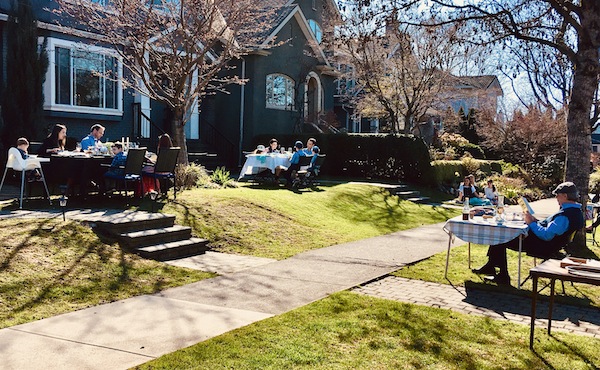
Sidewalk Seder

Sidewalk Seder

(photo by Avi Dolgin)

Families on 23rd Avenue in Vancouver found an innovative way to celebrate Passover. Each family brought their own meal and, while there was no sharing of dishes, everyone participated in reciting the blessings, reading from the Haggadah and singing together. The gathering was organized by Talia and Josh Bender, top left with their children, and Elana and Brian Jacobson, top right with their children.


Format ImagePosted on April 24, 2020April 24, 2020Author The Editorial BoardCategories Celebrating the HolidaysTags COVID-19, Passover

Thank you to all our Israel issue advertisers!

image - Save On Foods ad April 24 issue

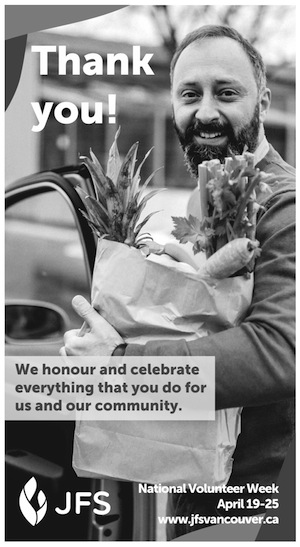
image - JFS ad April 24 issue
image - ZLC ad April 24 issue
image - Dexter - Liebernab & Robertson ad April 24 issue
image - Shay Keil ad April 24 issue
image - Nesters ad April 24 issue
image - Weinberg ad April 24 issue
image - Latham's ad April 24 issue
image - Dexter ad April 24 issue
image - JMABC and JBN ads April 24 issue
image - Campbell Saunders ad April 24 issue
image - Transworld ad April 24 issue
image - Web exPress ad April 24 issue
image - Imperial Paddock ad April 24 issue
image - Sar-El ad April 24 issue
image - JNF ad April 24 issue
image - Admiral Insurance ad April 24 issue
image - Glotman Simpson ad April 24 issue
image - Temple Sholom ad April 24 issue
image - Famous Foods ad April 24 issue
image - Kahn Zack Ehrlich Lithwick ad April 24 issue
image - Kierszenblat ad April 24 issue
image - CCW ad April 24 issue
image - Nancy Stern ad April 24 issue
image - United Elevator ad April 24 issue


Posted on April 24, 2020May 28, 2020Author The Editorial BoardCategories From the JITags JI, journalism, philanthropy

Thank you to frontline

There are many new routines in this unusual time. Social media feeds suggest baking has become the comforting go-to for many of us. Binge-watching shows and finally getting to the books we’ve been meaning to read is another. Cleaning those closets that were filled with mismatched sheets sets and nearly empty rolls of birthday wrapping paper was a long-overdue task.

But, at 7 p.m. each night now for a couple of weeks, another, less solitary routine has emerged. Metro Vancouverites – and people further afield – take a step outside, onto their balconies or into their driveways, and make like it’s New Year’s Eve. Clanging pots and pans, applauding, shouting cheers and generally making as much noise as possible for a minute, the behaviour is not merely burning off steam by a people holed up and stir crazy. It is a heartfelt act of solidarity and gratitude for the frontline healthcare workers, first responders and others whose responsibilities to protect the public require them to remain at their posts. It is also a way for us to say hello to our neighbours, and to receive reassurance that, while the streets and stores may be almost empty, humanity has not been wiped out, just relegated to our homes.

The nightly event was given steam by Rory Richards, a member of the Jewish community who understands the meaning of the power of one. Several years ago, at the height of the refugee crisis in the Mediterranean, she traveled to Greece and helped welcome those fleeing their homelands, while mobilizing support for the effort back home via social media. In this time of need, she saw what others were doing in the world to express themselves, while staying in quarantine, and brought the practice to her West End neighbourhood. And it has resonated with many – so many that the Vancouver Park Board has decided to change the firing time of Stanley Park’s Nine O’Clock Gun to 7 p.m. until the end of April.

The noisemaking trend is still relatively new, but already we hear of the emotional impact it is having on exhausted and anxious frontline workers. As is the solidarity at 7 p.m. nightly of their fellow emergency workers – fire trucks, police cars and ambulances driving the streets around their local hospitals, flashing their lights and sounding their sirens.

Mostly unsung are other frontline workers, those whose jobs, until this crisis, were not considered dangerous or irreplaceable: grocery store workers, cashiers, fruit and vegetable store operators, bakers, letter carriers, parcel delivery personnel, bank tellers, people maintaining the internet, bus drivers, garbage and recycling collectors, city workers who are making sure the traffic lights and other essential services remain operational, employment insurance office staff and other bureaucrats who are rushing to put aid programs into place. The list goes on. These people are continuing their work of keeping the world functioning at the level it must, without the luxury of sheltering in place.

In the Jewish community, agencies and individuals are stepping up. Jewish Family Services continues to deliver its vital programs, knowing that the physical, emotional and economic toll this crisis is taking is not yet at its peak. Jewish Federation of Greater Vancouver has launched a fund to help the community address the crisis, with specific emphasis on food security, housing support and subsidies to ensure that the economic impacts of the pandemic do not prevent individuals and families from participating to the greatest extent possible in Jewish communal activities. The Centre for Israel and Jewish Affairs has mobilized, creating a COVID-19 resource guide that is a clearinghouse for related information nationally and in each province. And organizations such as the Canadian Council for Reform Judaism and Reform Rabbis – which sent a letter to the federal government last week – are working to ensure that relief efforts centre on the most vulnerable, “including those who are homeless or housing insecure, migrants or refugees, living in underserved indigenous communities, being held in detention facilities or at risk of domestic violence.”

Locally and internationally, synagogues, day schools and community organizations have turned on a dime to use online platforms as an alternative meeting space for virtual services and gatherings. Some senior Sephardi rabbis in Israel are releasing opinions that would allow observant Jews to leave Zoom running for Passover seders, so that separated families can join together to celebrate our Festival of Freedom.

How many of us, three weeks ago, had heard of Zoom? An old long-distance telephone ad declared, “It’s the next best thing to being there,” which is true of this new technology, but we can’t deny that the shmoozing before and after (and during) services and events isn’t quite the same. Humans are likely to take for granted anything we receive almost as soon as we have it, so it is worth taking a moment to consider the incredible good fortune that allows us to have technology that we could barely dream about 30 years ago to keep us virtually together when we are, most of us, actually apart.

There’s no question that the emotional toll of our separateness will be keenly felt next week as the seders that, for our entire lifetimes, have meant the coming together of extended families and close friends, will be massively different than in the past. There will be a seat at the table for Eliyahu, but many others also will be there only virtually, and they will be missed.

When we participate in the 7 p.m. clangfest, or even if we just watch it from our homes, let’s consider the clapping, hollering and pan-banging as a testament to our admiration for medical and other frontline personnel, including the people who never imagined that they would be so crucial a part of maintaining our society’s functioning but who are, irreplaceably, ensuring that many of us are able to shelter in place in relative privilege and comfort.

Posted on April 3, 2020April 1, 2020Author The Editorial BoardCategories From the JITags coronavirus, COVID-19, frontline workers, gratitude

Emergency services available in community

The Jewish Federation of Greater Vancouver has released $400,000 to address the immediate needs of its local partner agencies over the next month. The funds will address needs in the key areas of food security, to increase the capacity of the food bank and other food distribution programs in our community; housing support, subsidies for community members unable to make their rent payments; seniors services, to help them stay safe, healthy and connected to community while they are self-isolating in their homes; tuition support so that families with children in Jewish day schools can keep their children enrolled; subsidies for Jewish programs, daycare, summer camps and part-time educational programs; and support so that Jewish supplementary schools can provide alternatives to classroom learning and maintain uninterrupted delivery of Judaic studies to the children and families they serve.

For more on Federation’s response to the COVID-19 crisis, as well as what other community organizations are doing at this time, visit jewishvancouver.com/covid-19-updates.

***

With the support of Jewish Federation, Jewish Family Services (JFS) has launched the JFS Community Care Hotline as an emergency response resource. It is available from 9 a.m.-9 p.m., seven days a week and staffed by JFS to provide emergency essential services. Priority services include meal or food bank grocery delivery; counseling/emotional support; and friendly phone “visiting.”

There are three ways to contact JFS for help: call 604-558-5719, email [email protected] or complete the form at jfsvancouver.ca/jfs-cares.

If you know anyone who needs to lean on JFS at this time, please share this information via your social media networks and other forms of communication. JFS also has a volunteer registration page, as many people have offered to help.


Posted on April 3, 2020April 1, 2020Author The Editorial BoardCategories LocalTags coronav, coronavirus, COVID-19, Jewish Federation, JFS

We must continue to ask

Probably every action or event has unintended consequences. The more significant the initial act, the more dramatic the consequences, for better or worse.

Significant historical events illustrate a few of these. Income tax, for example, was an outcome of the First World War, which was, like all wars of course, cataclysmic to individuals and countries.

The Depression resulted, again among many other things, in public acceptance of vast government interventions into the economy through programs like the New Deal in the United States, and similar initiatives in Canada and elsewhere.

The Second World War, one of the worst human catastrophes ever known, was accompanied by a universe of social and economic changes, including the effective nationalization of critical industries to support the war effort. That period of social upheaval – during which personnel of all races served side by side and women entered the workforce in large numbers to fill the places of men at war – contained the seeds of social revolutions to follow, including the civil rights movement and the transformation of the role of women in society. The war was also a direct antecedent to formal decolonization in the developing world.

In other words, some terrible events can result in transformative consequences. This is not to play the ethics game and ask, if we could reverse history and prevent this act, would we do so, knowing that some positive byproducts would likewise be erased. It is merely to draw attention to the consequential moment in which we find ourselves.

The terror attacks of Sept. 11, 2001, are perhaps the freshest parallel for most of the current generation. On that day, we understood that everything had changed but we could only imagine in what ways. Wars would soon begin that continue to this day and, closer to home, social schisms between groups, including the rise of Islamophobia, emerged.

Political debates shifted dramatically to erstwhile largely dormant issues like government surveillance, balancing collective security with individual rights, the use of enhanced interrogation – torture, that is – and the thing that affects most of us most obviously: massive changes in airport security processes.

Since then, we have seen the rise of social and economic inequality and the attendant antisemitism and xenophobia it has engendered. Such shocks to the system produce reverberating impacts, often felt by more vulnerable and marginalized groups, Jews included, and we know that the consequences of any one shock can compound the waves of others in ways expected and unexpected.

We have plenty to worry about right now, with the immediacy of the pandemic. But we should also make time to consider potential unintended outcomes from this experience.

We have seen already, as we mentioned here a very long week ago, a vast outpouring of social unity. On social media, Vancouverites are coming together in mutual support. At 7 p.m. each night, for example, many are joining together to cheer frontline healthcare workers in a small but meaningful act of solidarity and hope. Most people, with notable exceptions that are being rightly called out, are responding appropriately to the advice of experts.

But consider the small, perhaps less obvious ways this experience could impact us. When it’s all over, will we be more reticent to shake hands, to hug? Will we be more attuned to the reality that we are each a part of an inseparable collective humanity, regardless of human-created boundaries?

More substantively, might we see the early reports of decreased air pollution due to this situation continue for the weeks or months this endures and realize that substantive progress on climate change is possible if we recognize the difference between essential and non-essential carbon-consuming activities? Could the once-unimaginable international coordination we are witnessing rekindle our collective hope in unified action for any number of good causes? If we can come together against a threat to us all, could world peace be less remote a dream than we might think?

Conversely, we should be cognizant, as well, that the vast power of the state – our state, every state – to effectively shut down entire societies and economies represents a unique global event. It is done in this case, of course, for the right reasons. But could a less-than-benevolent leader, tasting this level of control, envision ways to use it for their own purposes and against the common good? Might one use coronavirus as justification to delay or cancel elections?

There are a great number of question marks in this week’s editorial. The point here is not to play Nostradamus but to remind ourselves to question. At Passover, in whatever virtual or altered form we celebrate this year, we will ask questions for which we know the answers, and have been pondering for millennia. As this unprecedented time of humankind proceeds, we should remember to continue asking. How will this experience change us? What good might come of it? How can we ameliorate the terrible things that seem to be nearing their peak? Who might be trying to exploit this situation for ill and who is modeling the best of human kindness?

For more information and updates from the B.C. Centre for Disease Control and Canada’s public health authorities, visit covid-19.bccdc.ca and canada.ca/en/public-health/services/diseases/2019-novel-coronavirus-infection/prevention-risks.html, respectively.

Posted on March 27, 2020March 26, 2020Author The Editorial BoardCategories From the JITags coronavirus, COVID-19, liefstyle, Passover

Posts pagination

Previous page Page 1 … Page 16 Page 17 Page 18 … Page 49 Next page
Proudly powered by WordPress