Making a life in Israel

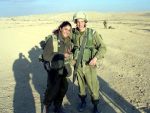
Emily Rose and Aviv Eisenstat in the Israel Defence Forces’ officer’s training school in 2008. (photo from Emily Rose)

When Emily Rose, 28, moved to Israel almost 10 years ago, her plan was to serve in the Israel Defence Forces and then return to Winnipeg. It didn’t happen quite as planned.

Rose was born in Odessa, Tex., and grew up in Winnipeg. Taking a similar road as many Jewish kids in the city, Rose studied at Gray Academy of Jewish Education (GAJE).

“The Winnipeg Jewish community is truly saturated with role models for social justice and it had a major impact on me growing up,” said Rose. “I grew up watching my aunt, Faye Rosenberg, who works for our Jewish community, help bring hundreds of Jews to Winnipeg from Argentina, where they suffered from antisemitism, and watching my best friend’s dad work tirelessly in court to help victims of residential schools receive compensation from the government.

“Winnipeg is an incredibly Zionist and supportive community,” she added. “The longer I am away, the more I appreciate what a wonderful community it really is.”

When Rose was 14, she went to Israel on a Jewish Federation of Winnipeg Partnership 2000 (or Gesher Chai) trip, which sent 10 high school students from GAJE to their sister school, Danziger, in Kiryat Shmona.

She fell in love with the city and the people. “My host family had three sisters and I was thrilled because, up until then, I only had big brothers. And, I remember writing to my mom, ‘Now I have three sisters!’ on the first night. I realized at that point that all my new friends in Israel would be going to the army soon and I remember thinking I had the responsibility to do that as well.”

This is what led Rose to move to Israel at the age of 18, starting with a mechina (a pre-military program) in her first year there.

She lived in Sde Boker in southern Israel and volunteered as an English teacher’s aide in an unrecognized Bedouin village. “Can you think of anything more polar opposite to a very cold Winnipeg, Man., than the middle of the Negev Desert?” she quipped.

“Your first year in Israel is always the most challenging, I think. There were a lot of tears. I was the only foreigner in the program, so I had to learn Hebrew very quickly. But, the program itself was also very intense, because we had classes every day and political tours and hikes every month.”

Something Rose was especially thrilled about in Israel was getting to sleep outside. As a child, she eagerly anticipated going to summer camp for canoe trips and sleeping under the stars.

“When you see the stars in the Negev, you really think it’s got to be the best seat in the house,” said Rose. “And, that first year, my roommate used to wonder why I’d always drag my sleeping bag out of our room to sleep outside.”

The next year, Rose joined the IDF as a lone soldier and served as a combat fitness officer. She recalled that some of her trainees used to call her “M&M,” as she was “hard on the outside, but sweet on the inside (and very small).”

She added, “My first job was training infantry soldiers on a combat training base where I worked with a unique battalion of Druze soldiers. The soldiers I worked with spoke Arabic. This really sparked my interest in the language, which is why I studied Modern Standard Arabic (MSA) in school.”

Today, Rose serves in reserve duty in Jerusalem’s Homefront Command. Her job is to communicate with the civilian population in Jerusalem during times of emergency.

A few years after her IDF service, Rose volunteered at the Michael Levin Centre for Lone Soldiers, which helps soldiers before, during and after their service. At the centre, the first thing she was asked to do was to tell those thinking about joining the IDF “don’t.”

Rose explained, “If we couldn’t convince them not to, then we’d help them as much as we possibly could. Nobody told me not to join the IDF, but also no one would have been able to convince me not to. And, the day I joined, I remember I wasn’t nervous – I just knew it was the right decision.

“I also didn’t plan on staying. I thought I’d serve for two years and then return to Canada. Here I am, almost 10 years later.”

After the army, Rose took Middle Eastern studies (along with MSA) at Hebrew University of Jerusalem. She still lives in Jerusalem, where she recently started writing for the Times of Israel.

Just prior to that, she was an editor at Israel National News, where, she said, she mostly wrote the breaking news but also covered longer form stories. “A few weeks ago,” she said, “I broke a story with exclusive footage of a former Australian minister who got caught in a firefight clash between Kurdish forces and ISIS in Iraq.

“The plight of the Kurdish people is an issue that is very close to my heart. I jumped at the chance to write about it. I’m also so proud to say I come from Winnipeg, [as] our Jewish community sponsors Operation Ezra, bringing Yazidi refugees safely to Canada.”

When on leave from the army a few years back, Rose returned to GAJE to speak to the students. When she visited Winnipeg this past summer, some community women stopped to say hello to her and her mom. “One of them told me that her grandson was going to be a lone solider, an IDF paratrooper, this fall … and she said that I’d spoken to him when he was in high school,” said Rose. “That was very nice, like coming full circle.”

Currently, Rose is working on a short story collection, a novel and three plays.

Her first play was presented at the JCC Berney Theatre in Winnipeg in 2006, the year she graduated high school. Called Radyo, it is about a group of high school kids in Kiryat Shmona who run their local high school radio station during the Second Intifada.

“The second play is a children’s musical I wrote called Don’t Touch the Glutch, which was performed as a part of the Next Wave of Musicals Festival in Montreal and then at the Centaur Theatre children’s series in 2013. It’s about a boy who gets lost in the zoo on a school field trip and discovers that the zoo has a whole host of strange creatures that only come out at night. My brother wrote the music and lyrics and I wrote the book. The show has an anti-bullying theme, because it’s a topic we both feel very strongly about.”

When asked about her feelings about Israel, Rose quoted Rabbi Abraham Isaac Kook: “The truly righteous do not complain about evil, but rather add justice; they do not complain about heresy, but rather add faith; they do not complain about ignorance, but rather add wisdom.”

She added, “Israel is in everything I write, in some form or another, and, though I may not always succeed, I try my best to contribute justice, faith and wisdom with my words.

“For now, I love reporting the news as it happens. Israelis, and those who care about Israel, want to stay informed and I feel privileged to be working with a team that is very committed to keeping our readers updated at all times.”

Rebeca Kuropatwa is a Winnipeg freelance writer.

Unique rabbinical road

Sandra Lawson is studying at Reconstructionist Rabbinical College. (photo from Sandra Lawson)

Sandra Lawson, an African-American lesbian who converted to Judaism after being raised in a secular home, is now studying to be a rabbi at Reconstructionist Rabbinical College, in Wyncote, Penn.

Born in St. Louis, Mo., Lawson’s dad was in the military, so the family moved around a lot, though mainly stayed in the Midwest. Her dad was a military recruiter and career counselor.

“My dad was raised a Christian, but I really had no religious upbringing when I was a child,” Lawson told the Independent. “I knew about Jesus, and we would occasionally get invited to church, but there really was no religion in our house.

“On my mom’s side, we had a back story of an ancestor who was Jewish. Like folklore, it really meant very little to me until I started on this Jewish path myself.”

This path began when Lawson was an undergraduate student and needed another class to graduate. The only course available at the time was one on the Hebrew Bible, which Christians refer to as the Old Testament. The teacher was a Christian academic from Kenya.

“When I got to the class, the teacher told everyone they needed to get a Bible for the class,” said Lawson. “But, he said to not get a King James version, as, he said, it’s a bad translation.

“This class opened my mind a little bit to the Bible as a piece of literature. He made the Bible acceptable for me. It wasn’t a book to be feared. Years later, I have a Jewish girlfriend and her sister invites me for Shabbat dinner. I thought, I like this. It’s really cool. I shared with my girlfriend at the time that an early ancestor was Jewish, but that I know nothing about Judaism.”

From that first Shabbat dinner, Lawson went to her girlfriend’s family home every Friday night.

“They weren’t Orthodox,” said Lawson. “They were just a modern family that would stop everything for Shabbat. It was really cool. I loved the ritual. I loved how open the family was. I loved how they accepted and treated me.”

Around this time, Lawson met Rabbi Joshua Lesser of the Reconstructionist Congregation Bet Haverim in Atlanta. Lesser hired Lawson as his personal trainer and, over the course of the two or three years she worked in that capacity, their friendship evolved and he invited her to his shul.

“I was hesitant,” admitted Lawson. “I shared with him the story of my great-grandfather. Eventually, I did go and I fell in love with the community – not necessarily Judaism, at the time – but I loved the community. That’s how I got interested.

“I started going to services regularly. The community has straight people, gay people and kids but, mostly, it is a space where I felt like I could be myself – something I’d never experienced before in a religious community.”

Lawson went on to learn more about Judaism and, in 2003, she told Lesser she was thinking about converting. In the conversion classes she took, the teacher helped her see a broader view of Judaism.

“I loved the class,” said Lawson. “I loved learning about the Jewish calendar and reading the Bible again, as a piece of literature. I loved learning about Jewish history.”

After about a year of studies, the class was over. And, on Oct. 13, 2006 – the day before her 35th birthday – she converted to Judaism.

Lesser asked Lawson to be a congregational representative on the board for the gay members of the synagogue. A year later, when gay marriage was a hot topic in the presidential election debate, Lawson took her stance a bit further.

“It was sort of funny, because I didn’t know anyone in my gay life who was even thinking about trying to change marriage laws,” she said. “We were all just happy that we could be legally gay. Josh [Lesser] asked if I wanted to join the gay and lesbian task force, as they were coming to Atlanta to do some training. I was like, sure. And he’s like, the good thing about it is, they need more diversity. They need more black and brown voices on these issues.”

Lawson later joined a clergy-based group working on the issue. This group, according to Lawson, was all over the map as far as sexual orientation and most everything. But, what they did agree on was that the state had no business legislating what you did behind your own closed doors.

“The more I started to do volunteer work, the more I realized I wanted to have a more powerful effect, more ability to effect change … that I would need the title of rabbi … and here we are today, as I work on becoming one,” said Lawson.

“Obviously, I’m different. There aren’t a lot of rabbis that look like me. I think being on the edge of the fringes of Judaism allows me to be more flexible or more creative in the things I do.”

One of the required classes that Lawson took last year was on entrepreneurship and thinking outside of the box. During that time, she was approached by the Jewish owner of a local vegan café she went to often, asking if she would be willing to lead services at the café on Friday evenings.

“I went back to class and told my teacher about it,” said Lawson. “I wrote it up as a grant … so I had the grant to lead services at this Lansdale café (outside Philadelphia).”

They have been running services at the café for months now. Every Friday, Lawson shows up with two vegan challot and grape juice. Arnold (the café owner) sets up the place and invites friends and customers to stay for the service.

“Every time, we’ve had at least a minyan,” said Lawson. “It’s been a lot of fun. People can show up as they are, with their sandals, their shorts. We sing. We do a little Torah and welcome the Shabbat.

“People come because they want to see what’s happening in the café … I think it was last week, Arnold had a flautist there, and people came to hear this guy play the flute. Also, I think, in May, there was a couple there who were not Jewish, but they had been taking a Christian class on Judaism. The class was finished, they saw this service and came to learn more about Judaism.”

Next on Lawson’s mind is leading services outside. “I don’t know how I’m going to pull it off yet,” she said. “Right now, I’m in this stage of trying to get a lot of buzz around different ways that people can do Shabbat.

“My dream, I don’t know when it will happen, is to have a Shabbat morning service in the future, in a park. I’m someone who, I see God in nature a lot. To be running in the woods, when the sun is coming up, is the best way for me to pray in the morning. I know a lot of people could connect their Judaism to nature. I haven’t quite figured it out yet, but I hope to.”

Lawson is set to graduate rabbinical school in 2018.

Rebeca Kuropatwa is a Winnipeg freelance writer.

Feeling at home in Ecuador

The Jewish Community Centre of Quito is a magnificent building containing two synagogues, its architecture reminiscent of Old Jerusalem. (photo by Lauren Kramer)

It was Friday night in Quito, Ecuador, and, as dusk fell, my husband and I approached the Jewish Community Centre, a magnificent one-hectare complex whose light stone walls and graceful architectural arches are reminiscent of Jerusalem. We joined the community for Kabbalat Shabbat, singing the same Ashkenazi tunes we knew so well from Vancouver as an impassioned, young Brazilian rabbi led the service. With us was Pedro Steiner, a member of the Ecuadorian Jewish community who’d graciously offered to pick us up from our hotel and drive us to and from the synagogue that night.

I admit, it had felt odd sending out an email requesting hospitality over Shabbat a few weeks prior. But, as the melody of L’Cha Dodi washed over the large synagogue, its domed roof meticulously hand-painted and inscribed with the words of the Shema, I figured it was well worth it. We were 4,000 miles from home, but we felt very much closer in the warm embrace of Quito’s Jewish centre.

Our host was a first-generation Ecuadorian whose Czech and Austrian parents had arrived in the country just before the Second World War. They were among 4,000 European Jews who found refuge from the Holocaust in Ecuador, granted entry permits on the proviso that they work in agriculture. Most of those Jews had been merchants, industrialists and businessmen and, while they were grateful to escape the war, most had no interest in pursuing an agrarian lifestyle. After the rich culture they knew in Europe, Ecuador seemed small and culturally impoverished. Perhaps that’s why at least half of those new immigrants left by 1950 for lives in Israel, America, Argentina and Chile.

Steiner’s parents opted to stay. “My dad bought a book on agronomy and read it while on the ship to Ecuador,” he recalled. “After arriving, he found work on a farm south of the city and, by 1955, he’d established a small dairy factory in Quito.” Years later, he sent his son to college in the United States and Pedro spent a decade there with his wife before the two returned to Quito to raise their children.

There are some 600 Jewish families remaining in the city. “I realized that, in coming back to Quito in the 1970s, we were delaying the decision to move for another generation,” Steiner reflected.

Until the early 1970s, most Jews in Quito sent their children to American School, a liberal institution created by Galo Plaza Lasso, one of the country’s past presidents. Then a student at the school won a prize for his review of Mein Kampf and the Jewish community, insulted this could happen, determined it was time to establish a new school. In 1973, Collegio Alberto Einstein was founded with “an atmosphere of Jewishness.” The K-12 school, ranked among the top educational institutions in Ecuador, offers classes in Jewish studies but “it’s not a religious school,” Steiner emphasized. Of the 700 students at Alberto Einstein, only 10% are Jewish.

That’s where Steiner’s kids were educated. And, firmly committed to building Jewish life in Quito, Steiner helped obtain the funding and donations necessary to build the Jewish Community Centre in 2000. He proudly toured us around the impressive site. With a ballroom, conference rooms, two synagogues, a kosher kitchen, a swimming pool, large sports grounds and rooms for Jewish youth movements and Hebrew classes, the JCC is an enviable facility. “But it’s underutilized,” Steiner said, his voice tinged with regret.

Days before Steiner picked us up from our Quito hotel, we had spent time in the Ecuadorian highlands two hours north, at Hacienda Zuleta, the family home of the late Lasso. Built in the 1600s, the expansive property is set in a bucolic valley surrounded by the Andes Mountains. Cows bellowed gently outside our bedroom window, a fireplace lit the 17th-century paintings on the ancient stone walls at night and hot soups with traditional Ecuadorian dishes warmed our bellies at meal times.

photo - Fernando Polanco, grandson of the late Ecuadorian president Galo Plaza Lasso, holds a Tanach given to his grandfather on a diplomatic visit to Israel in the 1970s
Fernando Polanco, grandson of the late Ecuadorian president Galo Plaza Lasso, holds a Tanach given to his grandfather on a diplomatic visit to Israel in the 1970s. (photo by Lauren Kramer)

The Lasso family library contains more than 1,000 books but, minutes after arriving, we’d extracted the only one of Jewish significance: a Tanach inscribed and given to Galo by a chief rabbi when he visited Israel in the 1970s. In another book documenting his political legacy, we found a photograph of Golda Meir welcoming him to the country. “My grandfather was loved by the Jewish community of Ecuador because he helped Jews relocate to Latin America,” said Fernando Polanco, Galo’s grandson, who now runs the Lasso family home.

Hacienda Zuleta hosts visitors for overnight stays, horseback rides into the mountains and bike excursions on its cobbled roads. During our stay, we explored the organic vegetable garden, toured the cheese factory, cycled past the dairy farm with its herd of 500 cows and marveled at the size of caged condors at a rehabilitation project to help protect this critically endangered bird. Most of these are initiatives Galo put into place.

In the ornate Lasso hacienda, we perused portraits of a family that helped shape Ecuador, marveling at Galo’s generosity of spirit. This was a man who helped shape the policies that welcomed Jews to the country, and who divided up his own 50,000-acre fertile estate, giving parcels to the Zuleta locals who lived and worked there.

“My grandfather’s clear vision, environmental responsibility and social consciousness back in the 1940s made him one of Ecuador’s best presidents,” said Fernando, beaming with pride. “Zuleta was his trial and error, his conscience.”

If you go: Adventure Life, a company specializing in travel in Ecuador, coordinates itineraries throughout the country, including Quito city tours, highland hacienda adventures, Galapagos island cruises and visits to the jungle (adventure-life.com or 1-800-344-6118).

Lauren Kramer, an award-winning writer and editor, lives in Richmond. To read her work online, visit laurenkramer.net. This article was originally published in Canadian Jewish News.

Mystery photo … Nov. 11/16

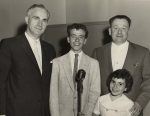
B’nai B’rith, 1960. (photo from JWB fonds, JMABC L.12160)

If you know someone in this photo, please help the JI fill the gaps of its predecessor’s (the Jewish Western Bulletin’s) collection at the Jewish Museum and Archives of B.C. by contacting archives@jewishmuseum.ca or 604-257-5199. To find out who has been identified in the photos, visit jewishmuseum.ca/blog.

Ancient coins found

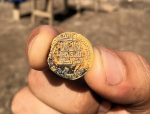
A 1,200-year-old gold coin fonud at Kfar Kama. (photo by Israel Antiquities Authority via Ashernet)

Two teenage students from the lower Galilee, Dor Yogev and Ella Dicks, who were participating in an Israel Antiquities Authority dig in nearby Kfar Kama, found some ancient coins. Included in the find was a 1,200-year-old gold coin inscribed in Arabic and mentioning the name of Muhammad and monotheism. The find shows that the people who lived at the location were there at the early Islamic period in the 7th and 8th centuries. The location of the dig, Kfar Kama, is the home of the Circassian community. The Circassians are a Sunni Muslim community closely allied with Israel; they participate fully in Israeli life, including their young men serving in the Israel Defence Forces.

Silver linings, anyone?

By Michael Vadon - from Wikipedia
Photo by Michael Vadon – from Wikipedia

As the majority of the world sits in shock that a reality TV star was actually voted in to be the next President of the United States (happy or not, y’all have to admit only Michael Moore expected this result!), many awoke Wednesday morning trying to make some sense of it all.

It’s usually around this time that the desperately positive side of me seeks some kind of solace or acceptance by trying to find a silver lining in a seemingly poor situation – that same part of me that has allowed me to be a Vancouver Canucks fan for so many years.
It is with that train of thought that I consider what possible positive outcome might eventually come from the fact that more than 50 million Americans submitted their vote for a man with no international political experience, the temperament of a bully, sexist tendencies and an undeniable ability to look someone in the eye and lie if it suited him in that moment.
There was an intense sense of panic across the country leading up to this election. There was panic from those who feared their country was already falling apart and looked to Trump as their only option for change. There was also panic from those who opposed Trump and feared the type of change he could bring.
It became clear, however, that very few Americans felt that their country was going to be just fine no matter what happened Nov 8.
Perhaps the shocking election of Donald J. Trump was the wake-up call or the shake up the country needed to become more focused on what it needs to do in order to actually become whole again.
If Trump is as ridiculous, ignorant and unprepared as President as he showed to be during his campaign it’s going to become painfully obvious rather fast. In which case the need for dramatic reform could kick the country into high gear, unite leaders in unprecedented ways and refocus the entire country.
Or perhaps Trump becomes humbled by the responsibility of leading the free world, learns on the job quickly and becomes the new type of leader millions of Americans are hoping for. If that happened it would also completely change the way American politics function moving forward.
Of course it’s also possible he leads the country into civil war, alienates millions and sets of world-wide fires that can’t be easily extinguished while the US of A becomes a joke, sending Western society into grave danger. But let’s stay on the possible silver lining track here for a minute!
It is clear that something had to give. Much like when mother nature sets off natural disasters in order to renew herself for the longevity of the planet, perhaps this disaster of an election will do the same for the longevity of the USA.
Perhaps this is the political version of the story of Noah and the flood and America can come out of this disaster ready for a more positive future.
Unfortunately, as many Americans learned while crashing the Canadian immigration website last night, Canada is not the Ark!
Happy silver linings, everyone!

מגפת הפנטניל

מגפת הפנטניל: חמש מאות חמישים וחמישה תושבים מתו בבריטיש קולומביה בתשעה חודשים. (צילום: Crohnie via Wikimedia Commons)

מצב חירום הוכרז במערכת הבריאות של מחוז בריטיש קולומביה לאור מגפת הפנטניל, הסם הקטלני שהורג מדי יום בממוצע שני מכורים במחוז. מספר המתים בבריטיש קולומביה מהסם, בתשעת החודשים הראשונים של השנה הגיע כבר לחמש מאות חמישים וחמישה. לעומת זאת בכל שנת 2015 מתו מהסם בסך הכל חמש מאות ושמונה איש. כוחות ההצלה והמשטרה מסתובבים באזורים בהם מרוכזים נרקומנים שברובם הומלסים, ובידיהם ערכות חירום להציל ממוות משתמשי יתר בפנטניל. להדגמת חומרת המצב: ביום אחד באחד החודשים האחרונים, בתוך כעשרים דקות הגיעו לחדר המיון באותו בית חולים באזור העיר דלתה, שמונה מכורים במצב קריטי ביותר כתוצאה מהשימוש בסם.

הפנטניל שנחשב לזול ונגיש הרבה יותר מהרואין והוא אף חזק פי חמישים ממנו, התחיל להגיע לשוק בקנדה ובארצות הברית לפני כארבע שנים. הוא מיוצר בעיקר בסין ומשם מגיע למעבדות בבתים פרטיים ברחבי בריטיש קולומביה. הסם מורכב ממשכך הכאבים החזק פנטניל (שהוא אופיואיד סינתטי) בתוספת חומרים שטבעם עדיין לא ידוע. ישנן שתי סיבות עיקרתיות לסכנת המוות מהשימוש בפנטניל. הראשונה – סוחרי הסמים מוכרים אותו כהירואין והמשתמשים מזריקים חומר רב כהרגלם (כי הם כאמור חושבים שמדובר בהירואין) ופשוט מתים ממנת יתר. השנייה – הסם מעורבב בחומרים רעילים והדרך על המות קצרה מצד המשתמש.

כידוע הזמר האמריקני פרינס מת משימוש בפנטניל. כעת המשטרה מנהלת חקירה מורכבת כדי לבדוק האם פרינס ידע מראש באיזה כדורים נגד כאבים הוא השתמש. או שהודבקה תווית לא נכונה על הבקבוק שהשתמש בו שהיה מלא בפנטניל.

מדד התיירות הרפואית: קנדה במקום הראשון ואילו ישראל במוקם השלישי והמכובד

קנדה ממומקמת במקום הראשון ואילו ישראל נמצאת לא הרחק אחריה במקום השלישי והמכובד, במדד התיירות הרפואית לשנת 2016, המתפרסם על ידי המרכז הבינלאומי למחקר רפואי (איי.איץ’.אר.סיי) שמושבו בפלורידה. המדד שמורכב משלושים וארבעה קריטריונים שונים כולל ארבעים ואחת מדינות.

עשר הראשונות במדד התירות הרפואית העולמי: ראשונה כאמור קנדה, שנייה בריטניה, שלישית כאמור ישראל, רביעית סינגפור, חמישית הודו, שישית גרמניה, שביעית צרפת, שמינית דרום קוריאה, תשיעית איטליה ועשירית למרבית הפלא קולומביה.

בחלוקה לפי אזורים: חמש עשרה מדינות מהמזרח התיכון ואפריקה (מהוות כשלושים ושבעה אחוז מסך התיירות הרפואית בעולם), תשע מדינות מאירופה (מהוות עשרים ושלושה אחוז מסך התיירות הרפואית בעולם), תשע מדינות מצפון ודרום אמריקה (מהוות עשרים ושניים אחוז מסך התיירות הרפואית בעולם) ושמונה מדינות באסיה (מהוות למעלה משמונה עשר אחוז מסך התיירות הרפואית בעולם).

המרכז הבינלאומי למחקר רפואי מצא עוד נתונים מעניינים לגבי התיירות הרפואית בעולם. חמישים ואחד אחוז הם נשים ואילו ארבעים ותשעה אחוז גברים. למעלה מחמישים ושניים אחוז הם נשואים, כשלושים ושניים אחוז רווקים ואילו כשישה עשר אחוז גרושים. למעלה משישים ושישה אחוז לבנים, כארבעה עשר אחוז שחורים, כשניים עשר אחוז לטינים וכשבעה אחוז אינדיאנים.

גם בשנתיים הקודמות (2014 ו-2015) ישראל מוקמה במקום השלישי. לישראל מגיעים כיום למעלה משלושים אלף תיירים בשנה לקבלת טיפולים רפואיים (שכוללים ניתוחים מוסבכים וטיפולים מורכבים). ובנוסף מגיעים לארץ למעלה משישים אלף תיירים להחלמה ומנוחה (בעיקר לאזור המרחצאות של ים המלח).

בהתאם לנתוני המרכז הבינלאומי למחקר רפואי, מדי שנה גדל מספר החולים שנוסעים לקבל טיפולים רפואיים במדינות אחרות ברחבי העולם. עם זאת אין מספרים מדוייקים של התופעה בקרב המדינות השונות והמדד מתבסס בעיקר על נתונים סטטיסטיים.

The aftermath of war

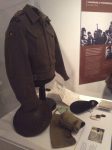
One of the displays in the exhibit Canada Responds to the Holocaust, 1944-1945, at the Vancouver Holocaust Education Centre until March 31. (photo by Cynthia Ramsay)

Canada Responds to the Holocaust, 1944-1945, opened on Oct. 16. The exhibit, said Nina Krieger, executive director of the Vancouver Holocaust Education Centre, at the event, “is the first major project of its kind, examining the encounters between Canadians and survivors of the Holocaust and the evidence of Nazi crimes at the end of the Second World War and its immediate aftermath.”

The VHEC commissioned the original research and writing under the direction of Prof. Richard Menkis and Ronnie Tessler, which includes a companion school program. “Students and other visitors will engage with a number of media elements in the exhibit,” said Krieger, giving the example of a tablet with survivor testimony, various interviews and other audio and video material.

The centre also commissioned a comic book by Colin Upton to accompany the exhibition, called Kicking at the Darkness, which will be given to every student participating in the school program, and is available to others for a suggested donation of $5.

Krieger thanked contributors and funders of the exhibition. She then introduced Menkis, an associate professor in the department of history at the University of British Columbia, and Tessler, a documentary photographer and a project consultant and editor for cultural arts groups, who also happened to be the first executive director of the VHEC, in 1990.

“Canada Responds to the Holocaust is a challenging exhibition,” began Menkis. “And it’s challenging, I think, for two reasons. First of all, because liberation is a complex phenomenon. Superficially, one might think, with liberation, of being free and being happy but, in fact, in the words of one of the Dutch survivors, it was, ‘not an undiluted joy’; to be free but then to be trying to look for family and the like. This exhibition very much tries to convey how complex liberation is.

“It is a complex phenomenon for three reasons,” he said. It is complex because, as the liberators (the soldiers) were in Europe, they were moving through new locations and coming up with new experiences. As well, liberation is the interaction between groups, each with their own assumptions and lived realties. And, finally, liberation is complex because of the disbelief at what had happened, and the difficulty in communicating what had been witnessed.

In addition to the voices of some of the survivors, the exhibit follows a number of different Canadians across Europe, including army chaplains, notably Samuel Cass. It also follows the First Canadian Army.

“Only three of the Western Allies had field armies on D-Day: the Americans, the British and the Canadians,” said Menkis. “The First Canadian Army was comprised of two corps,” he explained, but, also, “within the Canadian Army, as was the case with other armies, there were a variety of groups, such as Polish units as part of the Canadian Army, and there were Canadian units who were in, for example, the British army, which is why they are going to figure in Bergen-Belsen.”

The exhibit follows journalists, especially Matthew Halton, but also other CBC and Radio Canada journalists. “Moreover, we look at and follow the reactions of official war artists, official photographers and film crews and, finally, for the postwar period, we look at international agencies, such as the United Nations relief organization and the American Joint Distribution Committee,” said Menkis.

Using maps, archival photographs, news footage and video clips of interviews, Menkis touched on the highlights of the exhibit. He spoke of survivors coming out of hiding, of Canadians’ arrival at Vught, in the Netherlands, a camp that had been abandoned – the cover of Upton’s comic book is of this encounter – and Canadians’ reactions at Westerbork transit camp, also in the Netherlands. While outwardly appearing more well than other survivors, the 900 prisoners at Westerbork had experienced continual fear of being on one of the weekly deportations to an extermination camp.

A number of Canadian soldiers had been at Bergen-Belsen before they arrived at Westerbork, explained Menkis. “The effect of Bergen-Belsen was searing, and it affected, in some complicated ways, how the soldiers and others would view Westerbork,” he said, before sharing a quote from survivors Walter and Sara Lenz: “Shortly after the Canadians arrived it became clear that something was bothering them. They asked a number of questions that made little sense to us at the time, Why were we so well fed? Why were we not sickly, on the verge of death?

“In fact, as cruel as it may sound now, I had the feeling that our liberators were in a sense let down, for as we soon learned, they had steeled themselves for … another Bergen-Belsen.”

Noting that this was not just a view expressed years later, Menkis presented an excerpt of a letter Cass wrote to his wife on April 24, 1945: “I spent a good part of the day with our people [Canadians] at Camp Westerbork.… Everything looks so good on the surface…. With the papers full of the cannibalism of Belsen, it is almost a shock to find a camp where the survivors are all well and the physical surroundings good. But you can’t see the fear that people lived through every moment of their existence, nor can you see the 110,000 Jews who were herded like cattle on the transports.…”

While some people believed that things could return to the way they were before the war, that was not possible. A number of Jews felt they could not stay in Europe; they saw it as a graveyard, with no future. Many Jews looked to Palestine, but not everyone agreed with that. Menkis gave the example of Vancouver aid worker Lottie Levinson, who saw nationalism as the cause of what had happened and couldn’t understand why others would see Zionism as the resolution of the issue. “So, different approaches to what Jewish life would be,” said Menkis.

In the last part of his presentation, Menkis screened a video clip from an interview with war artist Alex Colville, which included some of the images he had drawn at Bergen-Belsen. Menkis also played an audio clip of an interview with Maj.-Gen. Georges Vanier, who went to Buchenwald shortly after its liberation with a group of U.S. congressmen. In his remarks, Vanier – one of the few Canadians who advocated for the acceptance of refugees before the war broke out – specifically referenced Jews as being victims, whereas most reports did not.

Rather than simplify this complex story, Menkis said that he and Tessler “chose to keep as many voices and perspectives as possible. Some of them may be uncomfortable to hear or see, but we wanted to do justice to the bewildering and poignant encounters of the time.”

When Tessler took to the podium, she explained, “The inspiration for Canada Responds to the Holocaust, 1944-1945, dates back to 2005, the 60th anniversary year of V-E Day, Victory in Europe Day. For that commemoration, Richard and I developed a CD for the Vancouver Holocaust Education Centre that teachers could use in one classroom session. Compact and tightly constructed, the themes were presented in short, crisp slides characteristic of PowerPoint presentations.

“The CD was a multi-media production – which the exhibition has retained. Along with text in point form, we included photographs, excerpts of articles, newsreels, eyewitness testimonies and art by Canada’s official war artists. Since that time, the 70th anniversary of the Second World War has passed and new research has been published, allowing us to expand and enrich the information that was in the PowerPoint.”

Many steps were required to “keep this complex story coherent,” said Tessler.

“The exhibition began with a year of research in archives across Canada, the Netherlands, Israel, the United States and Britain, and with locating the support material,” she said. “We were fortunate in this phase to have a good working relationship with several researchers and archives in the Netherlands. On the home front, we had access to the VHEC collections, and the assistance of a student intern.

“The next step was to arrange this mass of material into an easily readable and chronological narrative. In whittling down the accumulated information, it was essential not to lose sight of the historical overview. By including testimonies and other media, we could add individual, and sometimes opposing, perspectives on the events being portrayed. By adding photographs, the viewer gains a sense of place and time.

“The exhibition format also allowed us to display material objects,” she said. “For example, the Shalom Branch of the Royal Canadian Legion loaned the V-E Day edition of the Maple Leaf, a newspaper printed for the Canadian Forces, with the word ‘Kaput’ covering the front page. Dr. E.J. Sheppard of Victoria, one of the first soldiers through the gates of Westerbork transit camp in the Netherlands, loaned his battle uniform, pocket diary and a topographical map he carried in his tank that day.

“One of the most symbolic and touching objects in the exhibition is the yellow Jood star a newly liberated Jewish prisoner insisted on giving Sheppard in gratitude.

Another moment that gives pause is witnessing the large number of letters reproduced on a pillar in the gallery. Written by individuals and organizations seeking friends and relatives, they are but a smattering of the letters existing in just one archive in Montreal.”

The exhibit also includes “an antisemitic pamphlet printed in the Netherlands, and a 1943 poster ordering those with Jewish blood where, and when, to register with the authorities in The Hague … one of the most haunting objects in the exhibition is a facsimile notebook containing the weekly lists of deportees from Westerbork in the Netherlands to extermination camps in Poland: 100,657 people between July 1942 and September 1944 were, in most cases, sent to their deaths.”

Tessler thanked the many people who helped bring the exhibition to fruition, including Upton, who created the 24-page Kicking at the Darkness with the input of students in Menkis’ UBC course on Jewish identities in graphic narratives, and Canadian war historian Mark Celinscak, on whose research the section on the liberation of Bergen-Belsen concentration camp was based. She also thanked all the VHEC staff and Public, the design studio that designed the exhibition.

Canada Responds to the Holocaust, 1944-45, is at the VHEC until March 31.

Printmaker comes to city

Ian Kochberg at work. (photo from Ian Kochberg)

Next week, at the Circle Craft Winter Market, local community members will have a rare opportunity to meet Ontario artist Ian Kochberg and buy some of his work.

Kochberg has been a professional printmaker for 39 years. His studio is located in Richmond Hill, part of the Greater Toronto area. As a child, he didn’t dream of being a printmaker. In fact, he has a degree in animated film, but “to the chagrin” of his professors at the time, said Kochberg in an email interview with the Independent, “I had decided during my final year that film was not something I could pursue.”

He cited several reasons for his decision. One of them was his aversion to computers. “Although computer animation was in its infancy,” he said, “I knew that, in due course, computers would take over the animation industry. I have always had little interest in computers. Both professors and fellow students thought me insane.”

Another reason to opt out of a film career was his realization that he didn’t compromise easily. “I never worked well with others,” he said. “In college, the final year’s work was a group film. I was the only one who decided to go solo. I went in the first day to get the assignment parameters and came back the last with a finished film. Later, the college entered my film in numerous film festivals. It won a number of awards, but that was not how the industry works. Film requires a collaborative effort – printmaking does not.”

Fortunately, he stumbled into printmaking while still in college, and it was love at first sight. “I worked my way through college and university, hiring out as a freelance artist for ad agencies. I did everything: from illustration, to fabric design, to designing seat covers and bulkheads for a new fleet of Air Canada jets,” he said.

Among those agencies was a company that sold framed art to people in the legal profession. “They hired me to create a set of legal-themed illustrations, which they printed and framed,” explained Kochberg. “I received payment for each drawing, along with royalties on each sale. Life was good! The owner of the company, in an attempt to maintain control, told me ‘how expensive’ it was to print up those reproductions. Shortly thereafter, I discovered his lie. It was actually cheap to make copies of art.”

He decided to strike out on his own. His first foray into the life of an independent artist was a set of three drawings of old Ontario houses. “I had them printed up on a very high-quality paper, meticulously hand-painted each copy and then signed and numbered each as a limited edition. Being young, naïve, and not knowing any better, I brought these pieces into a real art gallery. The owner was highly knowledgeable and very gracious. He unashamedly heaped praise upon my work and my talent, employing an imaginative mélange of artsy adjectives.”

But, when Kochberg attempted to close the sale, the gallery owner gave him a lecture on the difference between original prints and reproductions. “I felt the proverbial light bulb go on over my head,” Kochberg recalled.

The gallery owner did purchase the prints that day, however. “He didn’t sell copies in his gallery, but he told me they were going to hang in his own house,” said Kochberg. “Whatever his motives, whether he actually liked them that much or it was simply a ‘pity sale’ matters not. Unbeknownst to him, he had forever altered the course of my life. The very next day found me in the library, where I researched printmaking techniques. Before I had even set foot into a printmaking studio, I had taught myself everything I needed to know to get started.”

He also got some exciting ideas of his own and took a 10-week course to get access to printmaking equipment. “When I finished the course, I purchased my first etching press,” he said.

Once he became involved in printmaking, Kochberg never looked back. For him, printmaking is a fascinating combination of research and intuition, design and fine art, creativity and technology.

“It is a cerebral, controlled process,” he said. “It is also unforgiving. Sometimes, I’ve spent up to 180 hours working on a single screen for a single color, with no way to make a correction if I made a mistake…. At one point, I actually counted how many times I had to pick up each and every piece of paper in an edition, do something to it, and put it down. As I recall, the number was around 120.”

According to his records, large pieces typically take him six to eight months, working full-time, to complete an edition. “The longest I’ve spent creating an edition has been 13 months,” he said.

Kochberg’s limited editions usually range from 100 to 300 original prints, all signed and numbered, and the source plates and screens are always destroyed after the edition is finished.

photo - Ian Kochberg’s “House Blessing”
Ian Kochberg’s “House Blessing.” (photo from Ian Kochberg)

Despite the demanding, labor-intensive technical process, every stage of printmaking still makes him feel “like a child in a toy store,” he said. “When these things no longer generate that kind of wonder and awe, it will be time to move on to something else.”

So far, after four decades of printmaking, it hasn’t happened yet. New ideas still swirl in the artist’s head, and his fans continue to admire his imagination and work. Some of his fans are celebrities. One of his prints even hangs in the Vatican. “I don’t recall the details – I have a horrible memory – but it was purchased for some special occasion involving the last pope. It was interesting shipping out a package to the Vatican,” he said.

“There have been countless warm stories and anecdotes about where my work hangs, for whom it was purchased and what individual pieces have meant to patrons,” he continued. “These are humbling and keep me grounded. The incident that stands out most clearly in my mind is that of a young lady who came to us at a show some years back, along with her baby daughter in a stroller. She told us that, when she was her daughter’s age, her mother similarly brought her to us in a stroller and purchased one of my works for her – to start her daughter’s collection. Now, all grown up, the young lady was doing the same for her own daughter – buying her child’s first ‘Kochberg.’ I felt quite honored, but it did make me feel old.”

Many of his pieces sport his signature combination of funky drawings, music notation, Judaic themes and a Celtic pattern. “Aside from my name, Ian, I have no Celtic or Irish connections,” he admitted. “One of my earlier Judaic pieces had an interlaced border. I copied the structure of the design from a Havdalah candle. People assumed it was a Celtic design. I don’t like arguing.”

The infusion of musical notes echoes his love of music, though he downplays his own talent in this realm. “I have no formal music training,” he explained. “I have played piano, but am not a pianist. I enjoy playing guitar and have written a number of songs, but am not a guitarist. I sing and, if you heard me sing, you’d know I am not a vocalist. I also play recorder, banjo and upright bass. In any event, I definitely do not consider myself a real musician.”

His family is musical though. His wife and children have all had formal musical training, and musical activities often feature as their family pastime. “About a year ago,” he said, “I started playing upright bass and joined the nonprofit community orchestra in which my wife, Arlene, plays a violin and our daughter, Toni, plays cello and bass.”

He finds both inspiration for his work and a relief from it in his family and in his various recreational pursuits. For many years, one of those was ballroom dancing, a hobby and part-time job.

“My wife and I taught social ballroom dancing for the local continuing board of education,” he explained. “This was not so much for extra income but to get us out of the studio and away from our work. When you have your own business, it never ends. We enjoyed our teaching very much. We taught for a full 20 years, until we realized that we just weren’t enjoying our classes as much. It was time to move on.”

Another of his lifelong interests is dogs. “We’ve had dogs for about 40 years,” he said. “Currently, we have a 10-year-old Black Russian terrier. I’m actually the ‘go-to dog guy’ in the neighborhood. Whenever people have questions or problems about their pooches or need information on specific breeds, they come to me. Friends of ours know that I enjoy talking dogs much more than art. Art is usually about me, while dogs are ‘just’ dogs.”

His affection for dogs in general, and his terrier in particular, has spilled into his writing. Kochberg’s hilarious true story about his dog was published in one of the Chicken Soup for the Soul series, The Dog Did What?: 101 Amazing Stories of Magical Moments, Miracles and … Mayhem (2014).

The Circle Craft market runs Nov. 9-13, and Kochberg will be located in booth #318.

Olga Livshin is a Vancouver freelance writer. She can be reached at olgagodim@gmail.com.