
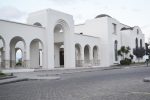
The Jewish Community Centre of Quito is a magnificent building containing two synagogues, its architecture reminiscent of Old Jerusalem. (photo by Lauren Kramer)
It was Friday night in Quito, Ecuador, and, as dusk fell, my husband and I approached the Jewish Community Centre, a magnificent one-hectare complex whose light stone walls and graceful architectural arches are reminiscent of Jerusalem. We joined the community for Kabbalat Shabbat, singing the same Ashkenazi tunes we knew so well from Vancouver as an impassioned, young Brazilian rabbi led the service. With us was Pedro Steiner, a member of the Ecuadorian Jewish community who’d graciously offered to pick us up from our hotel and drive us to and from the synagogue that night.
I admit, it had felt odd sending out an email requesting hospitality over Shabbat a few weeks prior. But, as the melody of L’Cha Dodi washed over the large synagogue, its domed roof meticulously hand-painted and inscribed with the words of the Shema, I figured it was well worth it. We were 4,000 miles from home, but we felt very much closer in the warm embrace of Quito’s Jewish centre.
Our host was a first-generation Ecuadorian whose Czech and Austrian parents had arrived in the country just before the Second World War. They were among 4,000 European Jews who found refuge from the Holocaust in Ecuador, granted entry permits on the proviso that they work in agriculture. Most of those Jews had been merchants, industrialists and businessmen and, while they were grateful to escape the war, most had no interest in pursuing an agrarian lifestyle. After the rich culture they knew in Europe, Ecuador seemed small and culturally impoverished. Perhaps that’s why at least half of those new immigrants left by 1950 for lives in Israel, America, Argentina and Chile.
Steiner’s parents opted to stay. “My dad bought a book on agronomy and read it while on the ship to Ecuador,” he recalled. “After arriving, he found work on a farm south of the city and, by 1955, he’d established a small dairy factory in Quito.” Years later, he sent his son to college in the United States and Pedro spent a decade there with his wife before the two returned to Quito to raise their children.
There are some 600 Jewish families remaining in the city. “I realized that, in coming back to Quito in the 1970s, we were delaying the decision to move for another generation,” Steiner reflected.
Until the early 1970s, most Jews in Quito sent their children to American School, a liberal institution created by Galo Plaza Lasso, one of the country’s past presidents. Then a student at the school won a prize for his review of Mein Kampf and the Jewish community, insulted this could happen, determined it was time to establish a new school. In 1973, Collegio Alberto Einstein was founded with “an atmosphere of Jewishness.” The K-12 school, ranked among the top educational institutions in Ecuador, offers classes in Jewish studies but “it’s not a religious school,” Steiner emphasized. Of the 700 students at Alberto Einstein, only 10% are Jewish.
That’s where Steiner’s kids were educated. And, firmly committed to building Jewish life in Quito, Steiner helped obtain the funding and donations necessary to build the Jewish Community Centre in 2000. He proudly toured us around the impressive site. With a ballroom, conference rooms, two synagogues, a kosher kitchen, a swimming pool, large sports grounds and rooms for Jewish youth movements and Hebrew classes, the JCC is an enviable facility. “But it’s underutilized,” Steiner said, his voice tinged with regret.
Days before Steiner picked us up from our Quito hotel, we had spent time in the Ecuadorian highlands two hours north, at Hacienda Zuleta, the family home of the late Lasso. Built in the 1600s, the expansive property is set in a bucolic valley surrounded by the Andes Mountains. Cows bellowed gently outside our bedroom window, a fireplace lit the 17th-century paintings on the ancient stone walls at night and hot soups with traditional Ecuadorian dishes warmed our bellies at meal times.

The Lasso family library contains more than 1,000 books but, minutes after arriving, we’d extracted the only one of Jewish significance: a Tanach inscribed and given to Galo by a chief rabbi when he visited Israel in the 1970s. In another book documenting his political legacy, we found a photograph of Golda Meir welcoming him to the country. “My grandfather was loved by the Jewish community of Ecuador because he helped Jews relocate to Latin America,” said Fernando Polanco, Galo’s grandson, who now runs the Lasso family home.
Hacienda Zuleta hosts visitors for overnight stays, horseback rides into the mountains and bike excursions on its cobbled roads. During our stay, we explored the organic vegetable garden, toured the cheese factory, cycled past the dairy farm with its herd of 500 cows and marveled at the size of caged condors at a rehabilitation project to help protect this critically endangered bird. Most of these are initiatives Galo put into place.
In the ornate Lasso hacienda, we perused portraits of a family that helped shape Ecuador, marveling at Galo’s generosity of spirit. This was a man who helped shape the policies that welcomed Jews to the country, and who divided up his own 50,000-acre fertile estate, giving parcels to the Zuleta locals who lived and worked there.
“My grandfather’s clear vision, environmental responsibility and social consciousness back in the 1940s made him one of Ecuador’s best presidents,” said Fernando, beaming with pride. “Zuleta was his trial and error, his conscience.”
If you go: Adventure Life, a company specializing in travel in Ecuador, coordinates itineraries throughout the country, including Quito city tours, highland hacienda adventures, Galapagos island cruises and visits to the jungle (adventure-life.com or 1-800-344-6118).
Lauren Kramer, an award-winning writer and editor, lives in Richmond. To read her work online, visit laurenkramer.net. This article was originally published in Canadian Jewish News.