Skip to content
  • Home
  • Subscribe / donate
  • Events calendar
  • News
    • Local
    • National
    • Israel
    • World
    • עניין בחדשות
      A roundup of news in Canada and further afield, in Hebrew.
  • Opinion
    • From the JI
    • Op-Ed
  • Arts & Culture
    • Performing Arts
    • Music
    • Books
    • Visual Arts
    • TV & Film
  • Life
    • Celebrating the Holidays
    • Travel
    • The Daily Snooze
      Cartoons by Jacob Samuel
    • Mystery Photo
      Help the JI and JMABC fill in the gaps in our archives.
  • Community Links
    • Organizations, Etc.
    • Other News Sources & Blogs
    • Business Directory
  • FAQ
  • JI Chai Celebration
  • JI@88! video

Recent Posts

  • Story of Israel’s north
  • Sheltering in train stations
  • Teach critical thinking
  • Learning to bridge divides
  • Supporting Iranian community
  • Art dismantles systems
  • Beth Tikvah celebrates 50th
  • What is Jewish music?
  • Celebrate joy of music
  • Women share experiences 
  • Raising funds for Survivors
  • Call for digital literacy
  • The hidden hand of hate
  • Tarot as spiritual ritual
  • Students create fancy meal
  • Encouraging young voices
  • Rose’s Angels delivers
  • Living life to its fullest
  • Drawing on his roots
  • Panama City welcoming
  • Pesach cleaning
  • On the wings of griffon vultures
  • Vast recipe & story collection
  • A word, please …
  • מארק קרני לא ממתין לטראמפ
  • On war and antisemitism
  • Jews shine in Canucks colours
  • Moment of opportunity
  • Shooting response
  • BC budget fails seniors
  • Ritual is what makes life holy
  • Dogs help war veterans live again
  • Remain vital and outspoken
  • An urgent play to see
  • Pop-up exhibit popular
  • An invite to join JWest

Archives

Follow @JewishIndie
image - The CJN - Visit Us Banner - 300x600 - 101625

Images

Vazana at Chutzpah! Fest

Vazana at Chutzpah! Fest

Nani Noam Vazana performs at the Rothstein Theatre Nov. 11 as part of this year’s Chutzpah! Festival. (photo from NaniMusic.com/ProLadino)

Gracing the cover of this year’s Chutzpah! Festival guide and posters is Nani Noam Vazana. The Amsterdam-based musician is one of the only artists in the world writing and performing new songs in Ladino, or Judeo-Spanish. The JI spoke with her when she last came to Vancouver, in 2017, and did so again, ahead of her Nov. 11 Chutzpah! show at the Rothstein Theatre.

“The concert in Vancouver is a part of my international Ke Haber tour that will take me through 15 countries,” said Vazana. One of the highlights of the tour will be a concert at the Library of Congress in Washington, DC, she said, “where I’ll have the honour of documenting my new Ladino songs for libraries and universities all over the world and make them available for Ladino research.”

The tour features mostly songs from Ke Haber but will also include “some traditional Sephardic songs and surprise covers – different to each show!” she said.

Ke Haber incorporates a millennial’s perspective – hers – into the writing of songs “in an old, almost extinct language,” she said, explaining that “Ladino is a language of the Sephardic Jews who were expelled from the Iberian Peninsula in the Middle Ages (Spain and Portugal of our days). My grandmother has roots in Portugal and she and her family sailed to Morocco from Porto in the 1400s. That’s where she grew up and where my parents were also born.

“In the ’50s, both my parents’ families immigrated to Israel and my father wanted to leave the past behind so he actually forbade us to speak Ladino at home,” she continued. “The only times I had contact with the language was when I was left alone with my grandmother. It was the language of witchcraft and mystery because she would only use it to speak to me in secret and tell me magical fairy tales that I actually thought she made up herself, because nobody else knew them. We sang songs in the kitchen while cooking, and it was all seeping in through the senses, very inviting and very curious.”

Vazana’s grandmother passed away when she was 12 years old.

“One of my first memories is of me and my Nona (Grandma) sitting at the kitchen table, peeling beans and singing ‘Los Guisados De La Berendjena,’ a song about seven recipes for eggplants. She hardly spoke Hebrew and my father forbade us to speak Ladino…. But, it seems, you carry this love subconsciously in you wherever you go, because, 15 years after my Nona passed away, I visited Morocco for the first time and heard people on the street singing the same lullaby she used to sing to me when I was a little girl. All of a sudden, those forgotten kitchen songs came alive and I started a long journey searching for songs and melodies that led me to release my traditional Ladino album Andalusian Brew. Sometimes, all it takes is just a sound or a scent and you’re transported to a life you’ve forgotten.”

After performing traditional repertoire for a few years, Vazana felt a yearning to write her own songs, and she dove into an exploration of the language. “I visited a scholar in Leiden, who showed me a lot of texts at an ancient Jewish library, but I wanted more,” she said. “So, I dug deep into medieval poetry and started learning the rhythm of the stanzas. Based on existing rhythmical formations, I started writing my own lyrics in Ladino, concerning questions we ask ourselves today, and, I must admit, I found a lot of correlation between where we are now and the medieval Iberian population.”

Vazani described Ke Haber as “an album of new songs that sound old, or maybe the other way around.”

“There are songs in the album that speak about female empowerment, like my song ‘No Kero Madre,’ a mother-daughter dialogue about the will to break free from the arranged marriage tradition and marry out of love,” she explained. “What a lot of people don’t know about Ladino is that it is a matriarchal language, so the relationship between mother and daughter is put on a pedestal, as the highest form of love in existence.

“In my song ‘Sin Dingun Hijo Varon,’ I describe the transformation of a transgender teenage girl who wants to be recognized as a boy. The father tries to kick her out of the house but the mother steps up and accepts her child as a boy.

“My song ‘Una Segunda Piel’ is about a Sephardic retirement ritual where your family and friends sow around you the shroud of the dead! You lie down in a cocoon, meditate and think about the troubles you want to leave behind. When the cloth is done [with], it goes into the cupboard, symbolizing all your troubles, and you emerge from it as if shedding your skin. That’s why the title is ‘Una Segunda Piel,’ which means ‘A Second Skin.’

“For my song ‘El Gacela,’” she said, “I composed music to an ancient text by Shmuel Hanagid, which is a love poem between two men. When the song was published, some people claimed that I was ‘outing’ the Jewish saint, but I think if he already published this work, he was out in the first place.”

The recording of Ke Haber, which started in London, England, in 2020, was complicated by COVID.

“I had to figure out a creative way to finalize the project, so we started recording remotely,” she said. “That’s really hard, because programs like Zoom have latency, so you can’t really record with other musicians simultaneously. We had to overdub – can you imagine playing music when the band is not in the same room? We all came to the studio whenever we were able to travel from Columbia, Chile, the Canary Islands, Bosnia, Israel, India, the Netherlands and Poland! That’s why the album is also a colourful tapestry of musical traditions and cultural aspiration from all over the world.”

While COVID was a quiet time touring-wise, “it was also a turmoil of creativity,” said Vazani, “because I just couldn’t sit still at home and wait for the world to pass by. So, I broadcasted house concerts every week, learned to edit video and record sound, which led to facilitating multicam broadcasts for other artists, such as the West East Orchestra.

“I also started doing voiceover gigs, overdubbing cartoon characters for animation and narration for documentaries and commercials. I also dabbled in emceeing when hosting online events and I hosted my own weekly podcast, interviewing [professionals] from the music industry about tips for emerging musicians.”

She received offers from music colleges and music industry conventions worldwide and hosted masterclasses and panel discussions for more than 30 institutions. “Eventually,” she said, “I was commissioned by the Dutch national TV broadcast NPO to create and host my own television series that will start airing in 2024.”

In addition to all that, Vazani teaches at the London Performing Academy of Music and the Jerusalem Music Academy, and is chair of the Amsterdam Artist Collective. She is also a guest lecturer at Codarts University, Rotterdam.

She enjoys being active – “for the mind and the soul to stay agile, we gotta train them,” she said. “This is my mental gym.”

And she’s not that interested in achievements, she said, though she has garnered several awards. “I am interested in being on the road as much as possible with my music,” she said. “This translates in my mind into happiness, and that’s not a fleeting experience, it’s a state of existence.”

To support Vazani’s music and receive content in return – all the music she has released, for example, and exclusive meet-and-greet sessions – readers can join her music family at nanimusic.com/family. For tickets to her performance at Chutzpah! and the whole festival lineup, visit chutzpahfestival.com. The festival runs Nov. 2-23.

Format ImagePosted on September 22, 2023September 21, 2023Author Cynthia RamsayCategories MusicTags Chutzpah!, Judeo-Spanish, Ke Haber, Ladino, Nani, Nani Noam Vazana
VIFF films explore humanity

VIFF films explore humanity

Filmmaker Sam Green will narrate live his documentary 32 Sounds, which is part of the Vancouver International Film Festival. (photo by Catalina Kulczar)

“There’s a thing in documentary filmmaking where, after you’ve done an interview with someone, you need to get what’s called room tone,” shares director, writer and editor Sam Green in his film 32 Sounds. “Room tone,” he explains, “is basically just sitting still for about 30 seconds or so and recording the sound of the room; this can help out a lot with editing later. I’ve been making films, which is kind of just marveling at people in the world, for 25 years now, and there’s always something odd and wonderful about this moment. An interview takes a person to other times and places and, now, they’re just here in the present, sitting with the sound of the room.”

Watching some of his interviewees, as they struggle or embrace sitting in silence for a few seconds, is one of the many highlights of Green’s latest documentary, 32 Sounds, which screens Oct. 5, 7 p.m., at the Vancouver Playhouse, as part of the Vancouver International Film Festival’s specialty program VIFF Live. New York-based Green will be in town to narrate the screening in-person, and audience members will be given headphones to wear, to help make the experience as immersive as possible.

The film premièred in January 2022 at the Sundance Film Festival. It exists in three forms: one as described above, but sometimes also with live music by composer JD Samson, who wrote original music for the film; another designed for an immersive at-home experience; and a theatre version without the in-person performance aspect. Watching the film at home without headphones was not ideal, but it was still enjoyable and mind-opening. There are parts where it would have added understanding and had greater impact to have heard something in only the left ear or only the right one.

32 Sounds is not just auditorily stunning but a visual pleasure, and intellectually stimulating, as well. Though there are explanations of how humans hear and how sound affects our bodies, the documentary is more philosophical than scientific. It presents concepts like the idea that all the sounds that have been made in the world should still be out there somewhere, “tiny ripples vibrating,” as contemplated by mathematician Charles Babbage, who is credited with having invented the computer, in the 1800s. If we had the right device, mused Babbage, we should be able to listen again to every joke, declaration of love or angry word ever uttered, narrates Green. “The air itself is one vast library, on whose pages are forever written all that man has ever said or woman whispered,” wrote Babbage in 1837.

In 2022, Green wrote: “I’ve made many documentary films over the years, and each one has changed me in some way, but none as much as the film I just recently finished called 32 Sounds. The film weaves together 32 different recordings as well as images, music by JD Samson, and voice-over to create a meditation on sound. Or, put a different way, the film uses sound to consider some of the basic features of our experience of being alive: time and time passing, loss, memory, connection with others, and the ephemeral beauty of the present moment.”

From the sound of a womb, to a cat purring, to fog horns, to a man who captures the sound of bombs landing nearby as he’s recording his music, Green masterfully takes viewers (listeners) on an emotional journey. We get to see how movie sound magic is made by foley artists like Joanna Fang. We meet sound and visual artist Christine Sun Kim, who talks about the deaf community, as well as hearing people’s perceptions of her work. Edgar Choueriri, professor of physics at Princeton, plays part of a tape he made for his future self when he was 11 years old. And we get to know a bit about composer and academic Annea Lockwood, 81 at the time of filming, who had been recording things like the sound of rivers for more than 50 years. Lockwood fundamentally changed how Green thinks about sound, especially a point she makes in the film: “There’s something I started writing about a year ago: listening with, as opposed to listening to,” she shares. “And it’s my sense that, if I’m standing here, I’m just one of many organisms that are listening with one another within this environment … we’re within it and we’re all listening together, as it were.”

32 Sounds has much to recommend it, including the chance to get up and dance, if you choose, when Green pumps up the volume on Sampson’s music, so you can “feel the sounds in your whole body.”

Accepting oneself

image - William Bartolo as Daniel, left, and Daniel Gabriel as his secret lover, Isaac, in a still from Cut, which is part of VIFF’s International Shorts: Nothing Comes Easy program
William Bartolo as Daniel, left, and Daniel Gabriel as his secret lover, Isaac, in a still from Cut, which is part of VIFF’s International Shorts: Nothing Comes Easy program. (image from VIFF)

Sound that you can feel in your whole body plays an important part in the short film Cut by Samuel Lucas Allen. In what may – or may not – be semi-autobiographical, Cut tells the story of Daniel, a high school student who tries to hide his Jewishness and his queerness. At key moments, the original score created by Sam Weiss thrums with tension, underscoring Daniel’s inner conflict.

Despite being somewhat heavy-handed – there is nothing subtle in this film, perhaps because it is only 19 minutes long – Cut is interesting, well-acted and put together. It opens with a Chassidic man holding a rooster, then shows Daniel cutting his hair, which falls onto a copy of Merchant of Venice, from which the teen will eventually have to perform, by memory, Shylock’s “If you prick us, do we not bleed?” speech. Daniel’s room has drawn images of men on his walls, in various poses, apparently his own work.

The film defines its three main elements: kapparot, as a “Jewish ritual where a chicken is blessed and slaughtered in the place of a person, to atone for their sins”; tefillin as a “pair of leather boxes containing portions of the Torah, worn by Jewish men in their morning prayers”; and cut, “a slang term for circumcision, the surgical removal of the foreskin, usually performed for religious reasons.”

It is mainly the Jewish aspect that Allen deals with in this work. Daniel is able to walk away from a gay slur, but not an antisemitic one, and, in the end, he is reconciled to himself and his Orthodox father by the mystical Chassidic man’s performing kapparot over him. We witness Daniel’s acceptance of being Jewish, but are left to wonder if he comes to accept his queerness, an aspect of his being that conflicts with Orthodox Judaism, though his soul would still be considered divine in religious circles, even if he engages in homosexual acts, which are prohibited by the Torah.

Cut is featured in VIFF’s International Shorts: Nothing Comes Easy, a program for viewers aged 18+, in which the films’ “protagonists discover that sorting out their lives can be much more difficult to achieve than they realized.” It screens Oct. 5, 6:45 p.m., and Oct. 7, 12:15 p.m., at International Village 8.

The Vancouver International Film Festival runs Sept. 28-Oct. 8. For the full schedule and tickets, visit viff.org.

Format ImagePosted on September 22, 2023September 21, 2023Author Cynthia RamsayCategories TV & FilmTags identity, Judaism, LGBTQ2S+, Sam Green, Samuel Lucas Allen, sound, Vancouver International Film Festival, VIFF
VIFF 2023 ticket giveaway

VIFF 2023 ticket giveaway

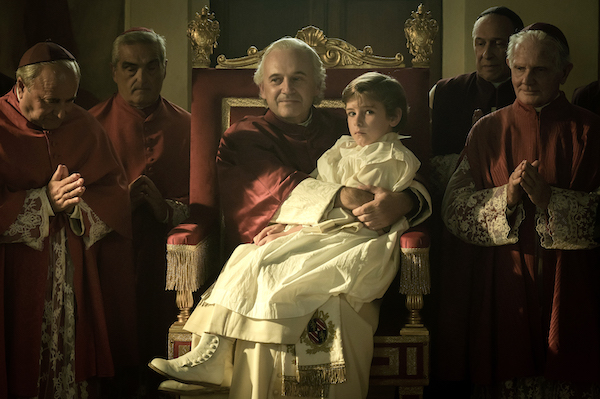
A still from the film Kidnapped, which is set in 19th-century Italy. In it, a 6-year-old Jewish child is abducted by papal soldiers who inform his parents that the boy was secretly baptized by a maid. If they want him back, they must convert to Catholicism. In the meantime, the boy will be educated in the Vatican at the feet of Pope Pius IX (Paolo Pierobon). There’s an international outcry, but even as the Church loses political ground with the emergence of an Italian state, the Pope remains adamant: the child has been saved.

Marco Bellocchio (The Traitor, Dormant Beauty and Exterior Night) seizes on this true story to mount a fierce denunciation of antisemitism and the excesses of the Catholic Church, as well as to chronicle a pivotal chapter in Italian history.

Email [email protected] by Sept. 27 for a chance to win two vouchers to see the Jewish Independent-sponsored film Kidnapped at the Vancouver International Film Festival Sept. 28, Oct. 3 or Oct. 6.

Format ImagePosted on September 22, 2023September 21, 2023Author The Editorial BoardCategories TV & FilmTags giveaway, Marco Bellocchio, Vancouver International Film Festival, VIFF
A land of contradictions

A land of contradictions

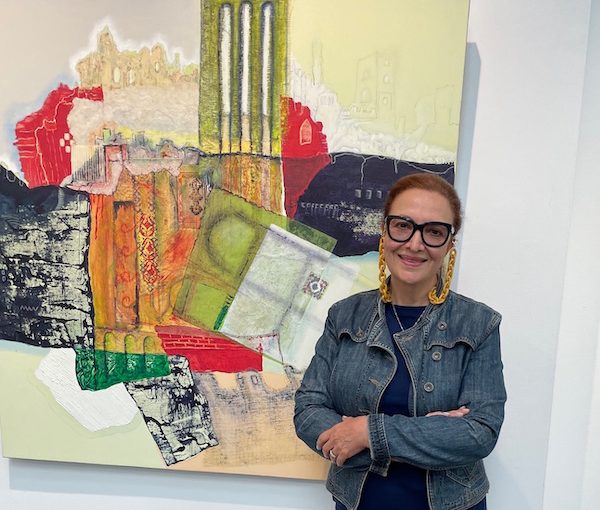
Sorour Abdollahi’s solo exhibit Intersecting Landscapes is now at Zack Gallery. (photo by Olga Livshin)

Over the years, Iranian-Canadian artist Sorour Abdollahi has participated in several group shows at Zack Gallery, but the current exhibition, Intersecting Landscapes, which opened on Sept. 7, is her first solo show here.

“Sorour is definitely not the first non-Jewish artist with a solo show at the Zack,” said gallery director Hope Forstenzer. For years, the mission of the Zack Gallery, which is in the Jewish Community Centre of Greater Vancouver, has been to showcase Jewish artists and art dedicated to Jewish themes, she said. Non-Jewish artists were not excluded, but they usually appeared in group shows.

“The big difference in the past few years,” said Forstenzer, “has been an expansion of the definition of a Jewish theme to include a wider variety of human universal experiences that reflect on Jewish cultural history and traditions.… Sorour’s work, while not as overtly Jewish as some, addresses the concept of diaspora and its impact on culture and memory. When we made the decision to show her work, it was based on the concept of a cultural nostalgia for home as an inherently Jewish theme. And the response to it, so far, has borne that out – it has had a very strong emotional impact on the community here at the JCC and has already engendered discussion of the Jewish diaspora.”

Abdollahi has been a professional artist all her life. “I’ve always painted, since I was a child,” she told the Independent.

She received her art education in Iran, and her first solo art show happened there in 1987. A successful artist, working in mixed media and acrylics, she regularly exhibited in Iran, participating in multiple group and solo shows in various cities, including Tehran and Isfahan. The only big gap in her exhibiting schedule occurred when she immigrated to Canada. “We came here in 2000,” she said. “We did it for the children.”

Like all immigrants, she struggled with the new language and new culture. “It was several years later, when my children grew older, that I enrolled in Emily Carr [University of Art + Design] part time,” she recalled. “I wanted to become familiar with the local art scene, with the educators and the artists. I wanted to become a part of the local artistic community. And it worked beautifully. My friendships with wonderful Vancouver artists Devora and Sidi Schaffer stem from those days.”

Five years after her immigration, Abdollahi felt immersed enough in the British Columbia art vista to open her own studio and gallery in Yaletown.

“People would pass my gallery on the street, and some would come in,” she said. “They asked questions. I felt that my art connected.”

That connection gave her the courage to join the Eastside Culture Crawl – the biggest visual art festival in Vancouver – 10 years ago.

Abdollahi’s current show at the Zack represents the scope of her art perfectly. It consists of old and new paintings from several different series. A blend of abstract and figurative art, her paintings are airy and bright. Most of them have vague architectural connotations and employ a predominantly blue and green palette reminiscent of spring and rebirth. The abstract forms, sometimes utterly modern, often reveal faint outlines of ruins, shimmering in the mist, in the background.

“I grew up in the land of contradictions, where a traditional way of living juxtaposed a modern, Western lifestyle,” she said. “Those contradictions manifested in the landscape surrounding me, the historical against the contemporary, with layers of change and transformation.”

Immigration to a new country profoundly impacts her imagery.

“In my paintings, I examine the relationship between memories and the external landscape,” she said. “My Iranian background and my Canadian experience have had an enormous influence on my works. They inspired a negotiation between the modern and the ancient, the old and the new, the West and the East. Ancient ruins and Persian architecture play a pivotal role, too. They have enabled me to express the conflict and the negotiation process that often exists between two different cultures or societies. While the ruins speak of a mysterious, pure and mystical past, they also illustrate the corrosive effect of time and modernity, the constant reconfiguration of a country’s landscape, architecture and culture. The dripping paint in many of my pictures also illuminates the process of renewal. The old slides down, while the new grows over it. My paintings attempt to form a bridge between the past and the present.”

Two of the paintings particularly stand out. “The Magical Carpet” is a collage, full of the whimsical patterns, warm hues and bright shapes of a traditional eastern bazaar, with the artist’s customary ruins in the background.

Another painting, “Letters from Beyond”, with its strong punch of red paint, uses fragments of writing that are wholly imaginary. “The language and the letters in that writing don’t belong to any nation,” Abdollahi said. “I created it because I believe that we are all the same people. We should have no borders and no different languages separating us. That’s why I wanted to have a show here, at the Jewish Community Centre. I feel like my art is a link that connects us all.”

Abdollahi’s works can be found in private collections in Canada, the United States, the United Kingdom, France, Australia, Saudi Arabia and Iran.

Intersecting Landscapes runs until Oct. 12. For more information, visit sorourart.wordpress.com.

Olga Livshin is a Vancouver freelance writer. She can be reached at [email protected].

Format ImagePosted on September 22, 2023September 21, 2023Author Olga LivshinCategories Visual ArtsTags exhibits, Hope Forstenzer, landscapes, painting, Sorour Abdollahi, Zak Gallery
Love and relationships

Love and relationships

Hosted by Chabad Richmond, Aleeza Ben Shalom, star of the Netflix series Jewish Matchmaking, will take centre stage in-person for a one-night-only event on Nov. 27 at the River Rock Show Theatre. (photo from Chabad Richmond)

Remember the famous song from Fiddler on the Roof: “Matchmaker, matchmaker, make me a match, find me a find, catch me a catch”?  Well, fast forward a century, and things haven’t really changed that much. Jewish singles are still searching for their bashert, except they’re getting tired of swiping right or left to find their soulmate, so they’re turning to the ages-old tradition of matchmaking. Enter the world’s most famous Jewish matchmaker – Aleeza Ben Shalom.

Hosted by Chabad Richmond, Ben Shalom, star of the Netflix series Jewish Matchmaking, will take centre stage in-person for a one-night-only event on Nov. 27 at the River Rock Show Theatre.

Attendees will get an exclusive behind-the-scenes look at this hit TV reality show (signed for another year), discover secrets to successful relationships, and explore the intricate art of finding the perfect match. Ben Shalom – a self-described “marriage-minded mentor,” matchmaker and dating coach – will share her passion and insights into love, relationships and the basic Jewish values that inspire her to transform Jewish singles into Jewish couples.

“The time-honoured tradition of matchmaking, going back to the beginning of our people, has been central to bringing together Jewish couples and building Jewish homes. Focusing on core values that guide Jewish life, matchmaking ensures the continuity of our people for generations to come,” said Rabbi Yechiel Baitelman, director of Chabad Richmond. “In a world where everyone has spent the last three years getting very comfortable in isolation, the hurdles and opportunities for people to connect have been challenging. Never have I had so many people of all ages reach out to me asking me to make a match!”

Baitelman joked that matchmaking wasn’t covered in rabbinical school, but he views matchmaking as an emerging growth area in our community.

Ben Shalom, who has ushered at least 200 couples to the chuppah (wedding canopy) during her 15 years as a matchmaker, guides individuals of all ages on their quest for love and companionship. With her unique blend of warmth, humour and wisdom, she is committed to the matchmaking process. She adapts the model of formal Orthodox matchmaking (known as “shidduch dating”) to Jewish singles from all religious backgrounds, including secular, Reform, Conservative and Orthodox, from across Israel, Australia, the United Kingdom, the United States and Canada. She’s out to show the world that Jewish matchmaking is not some antiquated practice, but rather a relevant and successful process for lots of singles. She admits that it’s no easy task, but believes it’s worth the effort.

Born and raised in suburban Philadelphia in a secular Jewish home, Ben Shalom has been happily living in an Orthodox Jewish marriage for more than 20 years. She and her husband, Gershon, moved to Israel in 2021. They have five children and Ben Shalom entered the world of matchmaking in her 20s, when she was looking for a job that would give her a flexible schedule around childcare.

Tickets to hear Ben Shalom are $54 for general seating and $90 for preferred seating. Also, consider a VIP sponsorship opportunity at chai ($1,800), double chai ($3,600), triple chai ($5,400), $10,000 or $18,000. This inNludes a personal meet and greet with Ben Shalom over cocktails, forshpeis (appetizers) and conversation.

For more information, call 604-277-6427. Register for this exclusive event at chabadrichmond.com/matchmaker.

– Courtesy Chabad Richmond

Format ImagePosted on September 22, 2023September 21, 2023Author Chabad RichmondCategories LocalTags Aleeza Ben Shalom, Chabad Richmond, fundraising, Judaism, matchmaking, Netflix
Elana Wenner joins museum

Elana Wenner joins museum

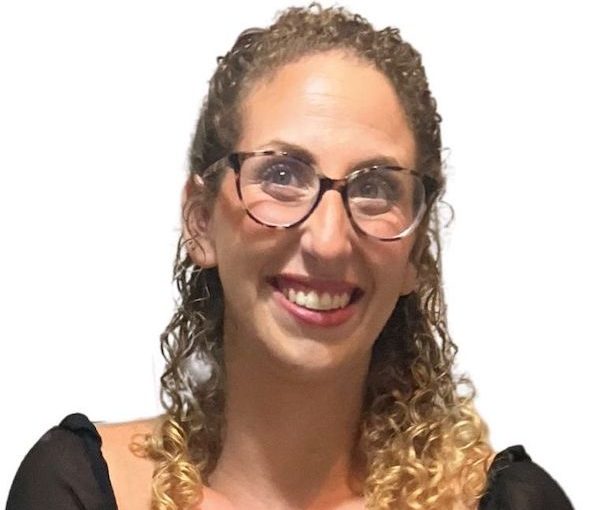
Elana Wenner (photo from LinkedIn)

Elana Wenner, who became the director of programming and development at the Jewish Museum and Archives of BC (JMABC) on Aug. 1, brings an enthusiasm and desire to make the stories of the local Jewish community better known and more meaningful.

Born and raised in Vancouver, one of Wenner’s aims is to stress the stories of Jewish people in British Columbia and how all can benefit from, and are connected to, those first Jews who came to the province.

“The story is not just history, it is an ongoing, living story that we are all part of,” she said. “It is something that includes every single Jewish person in BC. We are preserving, maintaining and sharing the stories, but I would also add … we are helping to create new ones.”

Before working at JMABC, Wenner, who obtained a bachelor’s and a master’s in Jewish studies from McGill and Concordia, respectively, taught at King David High School and Vancouver Talmud Torah, schools she herself attended growing up here.

“Coming into this job combines my two-dimensional interest in history and my interest in education, and bringing stories to life to not just children but anyone who is interested,” she said.

Another of Wenner’s goals at the museum is to make exhibits not merely interesting but accessible and enjoyable, believing people will remember things when they feel a strong emotional connection with it.

“My philosophy of education is always about interactive, experiential education – things that people can actually be a part of and interact with instead of just being part of an audience,” she explained. “The idea is people will come, interact and engage with the story and be able to walk away with a piece of it that is a part of them.”

Wenner’s experience as a teacher will help in dealing with any possible challenges the new position may bring, she said. “I have discovered that teaching is a great place to figure out things because it includes the skills one needs for any other job.”

Since starting in August, Wenner has been busy researching places and venues, interacting with current donors, making sure that members are keeping up with their annual contribution and seeking donors elsewhere, as well as handling grant applications and marketing. She is also managing the JMABC social media accounts and providing informational fliers about the museum to synagogues during the High Holiday season.

“I am trying to get awareness of who we are, as many people did not know there is a Jewish museum in Vancouver and I would like the word out there that we exist because we have a lot to share,” she said.

“The history of Jewish Vancouver is such a good story and it deserves to be told [but] so many people just don’t know about it,” she added. “I am lucky to be one of the few who has spent some time digging deeper into this story.”

Wenner herself descends from a family that has been in Canada a long time by local Jewish standards – her ancestors arrived in Saskatchewan in 1888 – and that, she said, helped spark her interest in history and, specifically, Jewish history.

“My ancestors took photos of everything on a Brownie camera,” she recalled. “They developed their own film and it’s almost as if some of them are selfies. They were taking photos of casual life. It is rare to find non-formal photos of that period. You see what life was like, you see how people dressed.”

Daniella Givon, president of JMABC, said of Wenner’s arrival at the museum, “The board of JMABC is very excited to welcome Elana. Elana is full of energy and has a vision for the organization and her role in it. She has been familiar with JMABC since a young age, and has always cared about the organization. We feel fortunate to have her aboard.”

JMABC has several events scheduled for the coming year. On Nov. 21, the museum will hold its annual general meeting, which will feature the launch of Land of Hope: Documents on the Canadian Jewish Experience (1627-1923), edited by Richard Menkis and Pierre Anctil.

Later this fall, in partnership with Jewish Family Services, JMABC will put together the Supper Club, a series of dinners designed to share food and stories that reflect the diversity of the Jewish community in the province. Past menus have included Sephardi meatballs, namoura (orange cake) and Syrian-Argentinian fusion.

For the spring, Wenner is planning a pop-up exhibit that will showcase the original JMABC collection, when it used to be situated at the Jewish Community Centre of Greater Vancouver.  “We are hoping to revamp the exhibit and connect the story to where the Jewish community in Vancouver is today,” she said.

During warmer periods of the year, JMABC will continue to offer historic walking tours of Mountain View Cemetery and the Oakridge, Strathcona and Gastown neighbourhoods.

To find out more and to view current online exhibits, visit jewishmuseum.ca.

Sam Margolis has written for the Globe and Mail, the National Post, UPI and MSNBC.

Format ImagePosted on September 22, 2023September 21, 2023Author Sam MargolisCategories LocalTags Daniella Givon, Elana Wenner, Jewish museum, JMABC
New librarian at Waldman

New librarian at Waldman

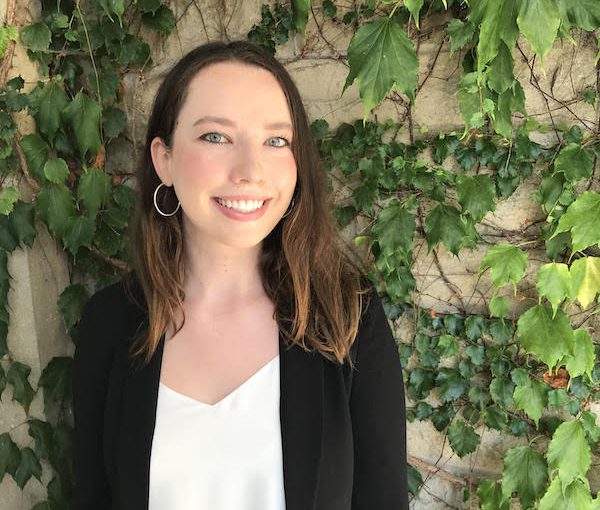
Jill Pineau (photo from Waldman Library)

The Isaac Waldman Jewish Public Library welcomed Jill Pineau as its new head librarian in August. She takes over the position from Maiya Letourneau, who is now a teacher/librarian at King David High School.

“It’s been a lot of fast-paced learning. Maiya has helped to make the transition as seamless as possible and I really admire the way she ran the library for the last two years,” Pineau said in a recent interview with theIndependent.

“The library’s staff, Megan Rodgers and Anita Brown, our dedicated volunteers and all of the staff at the Jewish Community Centre of Greater Vancouver (JCCGV) have also been very supportive,” said Pineau. “The Waldman Library is well-loved and well-used by community members and managing it is a big role for anyone to take on, but I’m so happy to be in a role that I know will challenge me to learn something new every day, and I’m really enjoying the work so far.”

As she settles in, Pineau will be drafting a strategic plan to work on priorities for the next year. Fundraising, she noted, remains a continual project for the library, as it relies on donors to provide resources and services to the community. Each year, the library runs a telethon in August and a book sale in February. To this, Pineau hopes to add a third fundraiser in an effort to sustain a steady stream of donations.

Further, she intends to offer compelling programs and services that meet the needs of library patrons. She would like to expand the library’s collection with titles by Indigenous and LGBTQ2S+ authors, along with more children’s books for the library’s storytime programming.

“I also want to focus on marketing and outreach efforts geared towards the wider public to attract new users into the library,” said Pineau, who is currently arranging to have a few fall events up and running. “Waldman Library could be a great resource for non-Jewish Vancouverites to learn about Jewish history and topics, and I’d love to see it used that way a little bit more in the future.”

Born in Alberta, Pineau grew up in Mattawa, a small town in northeastern Ontario. She moved to Kingston, where she studied at Queen’s University before moving to Vancouver in 2021 to attend the University of British Columbia.

“I was attracted to UBC’s Master of Library and Information Studies (MLIS) program because I was looking for a way to get into the information field, and I really wanted to try out life in BC. I love research, project management, connecting with people and having autonomy in my day-to-day work, and the program was very in line with these interests,” she said.

Though still early in her career, Pineau brings a range of skills and experience to the job. She has held research assistant positions for various nonprofit organizations and the City of Kingston. While pursuing her MLIS degree, she worked in two special libraries, spending a year managing projects at the Ministry of Municipal Affairs Library in Victoria and completing a practicum credit at Lululemon’s Raw Materials Library, a library of fabric and related items.

“Special libraries are unique because they serve a specific user group or purpose, often through a special collection,” Pineau explained. “That focus allows for interesting projects and interactions.

“I love Waldman Library, and I would classify it as a special library because about 90% of its holdings are by Jewish authors or relate to Jewish history and topics. We also have a large collection of Hebrew books. But the library is still very much a public library, open to all and aiming to serve its community thoughtfully. In this way, it’s a very dynamic and exciting place to work for me.”

Pineau also has spent time as a journalist, first with the community paper in Mattawa, then with Queen’s Journal while in university. When the pandemic started in 2020, she freelanced for the Kingston Local and the Kingstonist.

“I loved the autonomy that type of work afforded me, but I had a mind to continue developing and focusing my career and that’s what ultimately brought me to graduate school,” she said.

Established in 1994, the Waldman Library is located on the second floor of the Vancouver JCC and is open Sunday from 10 a.m. to 2 p.m. and Monday to Thursday from 10 a.m. to 6 p.m. The library maintains six computers, which are open to users.

In the past 12 months, more than 4,500 visitors came to the library to read, study, work, play and socialize, said Pineau. During this period, close to 3,600 books, DVDs and other materials were checked out, and the library added 475 titles to its collection. Overall, the library has more than 15,000 titles in its collection.

In acknowledging the support of the community, Pineau said, “I want to say thank you to all of the library’s patrons, who have been so kind and welcoming over the last few weeks. It’s been lovely connecting with a new community – I’m very happy to be here.”

Sam Margolis has written for the Globe and Mail, the National Post, UPI and MSNBC.

Format ImagePosted on September 22, 2023September 21, 2023Author Sam MargolisCategories LocalTags Jill Pineau, Waldman Library
A heartwarming gathering

A heartwarming gathering

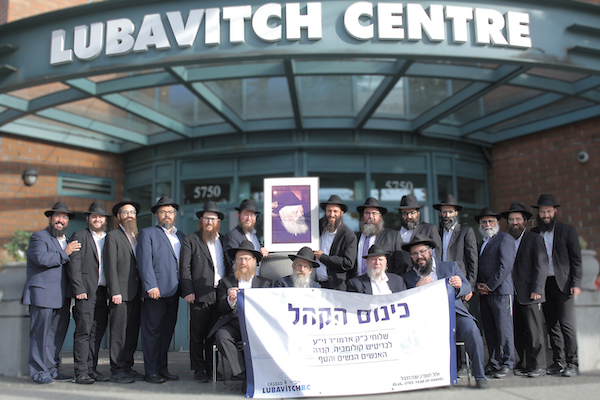
Aug. 29-30, 17 families – each serving as Chabad shluchim (emissaries) – came together for an event known as a Kinus Hakhel. (photo from Chabad Lubavitch BC)

In a display of unity and camaraderie, 17 families – each serving the Jewish population across British Columbia as Chabad shluchim (emissaries) – came together Aug. 29 and 30 (12 and 13 of Elul) for an event known as a Kinus Hakhel. It was a celebration of shared purpose and a recommitment to serving the community.

Representatives from Chabad in Victoria, Nanaimo, Richmond, Surrey, Coquitlam, the University of British Columbia, Downtown Vancouver, Kitsilano and Kelowna joined the central Chabad Lubavitch BC in this heartwarming event. The theme of “sheves achim gam yachad” (“dwelling together in unity”) permeated the atmosphere with feelings of support for one another. It served as a reminder of the strength that arises from collaboration and left a mark on all those present.

Chabad today is the largest Jewish organization in British Columbia, with a presence in 10 cities across the province, 11 synagogues, 17 permanent rabbis and rebbetzins, three mikvahs, eight supplementary Hebrew schools, four Camp Gan Israel summer camps, dozens of weekly Torah classes, private counseling and social services.

Rabbi Yitzchok Wineberg, the head shaliach of British Columbia, reflected on the past 50 years of Chabad’s presence here. He congratulated all the shluchim for their dedication and hard work, acknowledging the efforts they have invested in reaching out to every Jew, no matter their affiliation or background, and establishing communities all over the province.

Rabbi Avraham Feigelstock, av beis din (the rabbi presiding over the religious court), director of BCK and one of the senior shluchim in British Columbia, took the opportunity to encourage the establishment of a vaad hapo’el, a permanent action committee, to take the inspiration from the Kinus and use it as a positive force for expansion.

The Kinus also featured an all-night farbrengen (spiritual gathering) led by Rabbi Sholom B. Levitin, regional director of Chabad-Lubavitch in the Pacific Northwest, lasting from 9 p.m. until 6 a.m., where participants engaged in discussions and spiritual connection.

In the spirit of this Hakhel year (an assembly that takes place every seven years), with the call of uniting men, women and children, a children’s program ran throughout the entire two days with more than 60 young shluchim participating. A special thanks goes to Tamara Feigelstock, who ensured that the youngest members of the shluchim had an enriching experience.

The Kinus wrapped up with a banquet. Featured speakers were Rabbi Yechiel Baitelman (Chabad Richmond) and Rabbi Shmuly Hecht (Chabad of the Okanagan Valley), plus a special Zoom address by Rabbi Moshe Kotlarsky, vice-chair of Merkos L’Inyonei Chinuch, the educational arm of Chabad Lubavitch worldwide.

An unexpected, moving moment came at the banquet when Arnold Silber, Chabad’s first friend and supporter in British Columbia, took the stage. With emotion, he shared his deep connection to Chabad and to the Jewish community. He announced, “Don’t worry about paying for this gathering; I will cover the entire bill.” His generosity underscored the sense of unity and support that defined the event.

Silber also reflected on the past 50 years and expressed pride on his association with Chabad. He spoke metaphorically about how he had planted a tree a half-century ago and now sees a thriving forest. The growth and impact of Chabad in British Columbia fills him with joy and nachas (pride), he said. He pledged to continue and expand his support and partnership with Chabad’s “army of light and kindness” in the province. And he shared his vision of building an even stronger, more vibrant Jewish community in the future.

The Kinus Hakhel took place thanks to the dedicated efforts of Rabbi Dovid and Chaya Rosenfeld, co-directors of the central Chabad in BC, and the various planning committees. For the men’s program, that was Rabbi Meir Kaplan (Chabad of Vancouver Island), Rabbi Benzi Shemtov (Chabad of Nanaimo) and Rabbi Mottel Gurevitz (Chabad of Coquitlam). For the women’s events, Blumie Shemtov (Chabad of Nanaimo) and Rivki Yeshayahu (Kitsilano) coordinated the program, and the youth program was planned by Esti Loeub (Chabad of UBC) and Rivky Varnai (Richmond). Special thanks to Henia Wineberg (Lubavitch BC) and Chanie Baitelman (Chabad Richmond) for the beautiful setup.

As the shluchim of British Columbia left the gathering, they carried with them not only a renewed sense of unity but also a strengthened commitment to their shared mission. This gathering in Vancouver wasn’t just an event; it was a celebration of community, purpose and the enduring spirit of Chabad.

– Courtesy Chabad Lubavitch BC

Format ImagePosted on September 22, 2023September 21, 2023Author Chabad Lubavitch BCCategories LocalTags Chabad, emissaries, Kinus Hakhel, shluchim
Six weeks of fun

Six weeks of fun

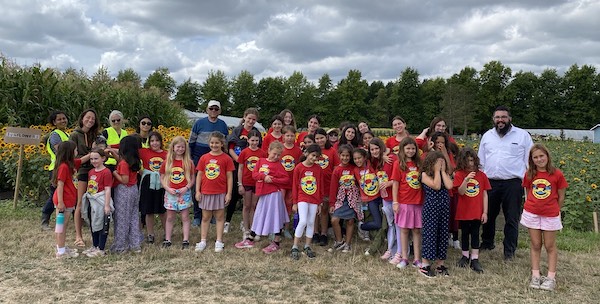
More than 200 kids went to Camp Gan Israel this summer. (photo from Camp Gan Israel)

More than 200 children attended Camp Gan Israel this summer. They had a varied schedule, with baking, crafts, skateboarding, swimming, sports and field trips to such places as Stable Harvest Farm, Wild Play Adventure Park, Playland, Science World and Sasamat Lake. A special highlight was the camp’s theme song and dance, which was picked up by almost 400 Camp Gan Israel’s around the globe.

“Camp shows children that Judaism is fun, joyful and alive,” said camp director Chaya Rosenfeld. “The staff set an amazing example of being proud and enthusiastic about their Judaism and there is no substitute for a camp experience.”

Seventeen staff members were flown in from California, New Jersey, Florida, Ohio, New York, Montreal and Toronto.

Rabbi Dovid Rosenfeld of Lubavitch BC added, “The cost-of-living crisis is really hitting families hard. Almost 90% of the campers received a discount to attend camp, with a percentage receiving a full scholarship. No one is turned away for financial reasons and we are really grateful to our supporters for giving the children the opportunity to experience the summer of a lifetime.”

– Courtesy Camp Gan Israel

Format ImagePosted on September 22, 2023September 21, 2023Author Camp Gan IsraelCategories LocalTags camp, Chabad, Chaya Rosenfeld, Dovid Rosenfeld, summer
Resilience in facing fire

Resilience in facing fire

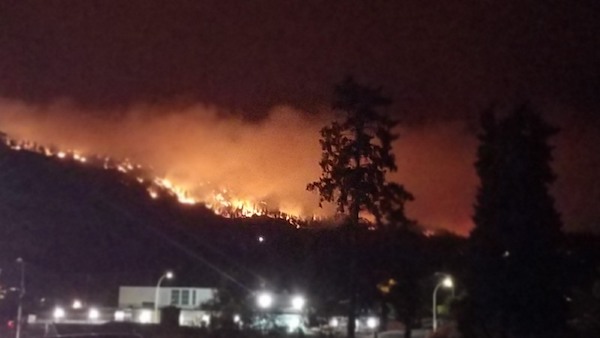
This photo was taken from about a block away from the Okanagan JCC just after the evacuation. (photo by Anne Zazuliak)

On Aug. 17, the McDougall Creek Fire, which began 10 kilometres northwest of West Kelowna, descended upon the community and brought an evacuation order to those on the west side of Okanagan Lake. By that evening, winds pushed flames across the lake to Kelowna, sparking more fires and bringing about further evacuation orders.

Aug. 18 and 19 saw the conflagrations at their most dangerous, according to members of the Okanagan Jewish community who spoke to the Independent before it went to press. On Aug. 18, Kelowna International Airport suspended all flights coming in and out of the city. Later in the day, the province issued a state of emergency for the area.

By Aug. 21, the situation was under more control, with the airport opening for a few hours and an evacuation order around the University of British Columbia campus in Kelowna downgraded to an evacuation alert. Garbage pickup and other services also resumed.

photo - The OJC is situated in an area that was ordered to evacuate. Community members told the Independent that the constant police presence around the centre made them feel comfortable that the building was safe and secure
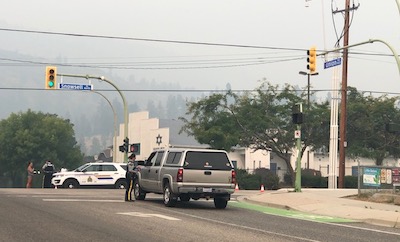
The OJC is situated in an area that was ordered to evacuate. Community members told the Independent that the constant police presence around the centre made them feel comfortable that the building was safe and secure. (photo by Steven Finkleman)

Okanagan Jewish Community (OJC) board members said several families within safer zones were able to house evacuees. Before the evacuation orders, the OJC had messaged members requesting accommodations, support and contact information so that, when the orders came, it had a list in place to make sure everyone evacuated would be assisted.

Meanwhile, Rabbi Shmuly Hecht of Okanagan Chabad House spent a few frantic days, along with members of his family, checking in on people, collecting food and supplies, baking hundreds of loaves of bread and ensuring that people in the community would have shelter. During the worst of the wildfires, Hecht’s office was turned into temporary accommodation for an elderly West Kelowna couple.

“As soon as it started, we were thinking we have to help,” said Hecht. “Anyone in a position to help should be honoured and privileged to do so. In our upbringing, this is why we are alive, this is why we are here – to serve, especially in times of need.

“I feel that everybody – even if you yourself are running and in a time of need – can begin the process of healing when your first thoughts are, how can I help someone else who may have even less than me? There is always someone who has less, and we can be of support to them. It reminds us of what life is all about.”

Hecht told the Independent he had met with one member of the community who had lost their home.

photo - Okanagan Chabad House helped in many ways, including collecting food and supplies
Okanagan Chabad House helped in many ways, including collecting food and supplies. (photo from Okanagan Chabad)

On Aug. 25, Steven Finkleman, OJC board past president, said, “Things are certainly much better now. I believe that the fires on the Kelowna side of the lake are being brought under control, and I believe that, as of last night, the evacuation orders and alerts on this side of the lake have been canceled.”

At the time, however, evacuation orders were still in place in parts of West Kelowna, though the dangers were receding.

“The active fire might seem to be a bit more distant from civilization and parts of it might be left to simply burn out, as long as people and property are not in danger,” said Finkleman, who thanked emergency services in the region, which, he emphasized, prioritized life, structures and forests, in that order.

“Certainly, the stress levels and anxiety of everyone were challenged at the peak of the event. Several persons do live in ‘interface’ areas, where the homes are scattered amongst the trees and forest. These persons in Kelowna are always at increased risk. The colour of the orange sky and the fact that Kelowna was the most polluted city in the world (for a time) added to everyone’s stress levels. Most persons needed to stay home, only venturing out for food and supplies, and having masks on to filter the air,” Finkleman said.

Many organizations and individuals stepped forward to offer help, he added. At times, there were so many food donations that organizations struggled to keep perishable items fresh.

Finkleman praised the level of support that came from the Vancouver and elsewhere. “We seem to be getting closer and closer to the Vancouver Jewish community, and I think it is important that Vancouver be aware of what we have gone through here. Support by email, phone calls, etc., has been tremendous, from the Vancouver Jewish organizations and from the clergy that we know well across Canada and who are participating in our Shabbaton weekends. We even have received an invite from a stranger in West Vancouver stating that she is able to put people up if they have evacuated from Kelowna to the Lower Mainland. Incredible support, really.”

The OJC, which houses Beth Shalom Synagogue, is situated in an area that was ordered to evacuate. During the height of the fires, nobody was allowed to enter the building, where two Torah scrolls are kept, due to an RCMP barricade. Community members told the Independent that the constant police presence around the centre made them feel comfortable that the building was safe and secure.

Members of the OJC executive recognized the need to bring people in the community back together, as fire dangers eased. On Aug. 27, they organized a beach barbecue that was well-attended. Over the Labour Day long weekend, Rabbi Russell Jayne from the Beth Tzedec in Calgary will lead services at Beth Shalom.

photo - Members of the OJC gathered for a picnic after a two-week period of semi-isolation due to the fire situation
Members of the OJC gathered for a picnic after a two-week period of semi-isolation due to the fire situation. (photo by Steven Finkleman)

“We believe it’s vital for our community to be together after a crisis like this, so we are going ahead with all our planned events and High Holidays,” said David Spevakow of the OJC board.

“Our local talent, Evan Orloff, will be leading our High Holiday services. Everything is a go,” he said.

“These High Holy Days will definitely be emotional, with the scorched earth, smoky skies and long recovery all creating quite a tangible backdrop to the season of reflection and self-examination,” said Abbey Westbury, a member of the OJC board. “We have tried to keep our messaging buoyant, but we are ready for the tears. What a few unimaginable years we’ve had. Ready for a new start, indeed.”

Life will get back to normal at Okanagan Chabad House, as well, Hecht stressed, despite having fallen behind with regular obligations during the fires.

The Jewish Federation of Greater Vancouver has established a B.C. Wildfire Relief Fund. To donate, visit jewishvancouver.com/bc-fire-relief-fund.

Sam Margolis has written for the Globe and Mail, the National Post, UPI and MSNBC.

Format ImagePosted on September 1, 2023August 29, 2023Author Sam MargolisCategories LocalTags Abbey Westbury, B.C. Wildfire Relief, David Spevakow, Kelowna, OJC, Okanagan Chabad House, Okanagan JCC, Shmuly Hecht, Steven Finkleman, wildfires

Posts pagination

Previous page Page 1 … Page 71 Page 72 Page 73 … Page 489 Next page
Proudly powered by WordPress