The achievements of Israel

The anthology Miracle Nation: Seventy Stories About the Spirit of Israel; A Tribute to Rebirth in the Land of Our Ancestors by Israela Meyerstein (Mazo Publishers, 2018) highlights the amazing achievements of Israel in the 70 years since its rebirth in 1948. It contains the stories of ordinary people leading lives of courage, altruism and inspiration; stories that embody tikkun olam, repairing the world, which is at the heart of Judaism.

Meyerstein, a family therapist for more than 40 years, dedicated the book to Israel’s 70th birthday and in memory of relatives who perished at Treblinka. Each of the stories, many of which are contributed by writers other than the author, reminds us of how much there is to be proud of, as well as offering hope and optimism for the work still to be done.

Shlomo Alima, in “Destination: Return to Zion,” tells of his Iraqi ancestors, who were from the oldest Jewish Diaspora community in the world. His family left everything behind in 1925 to pursue their destiny in Israel. Their long, dangerous journey was made on donkeys, camels, bicycles and taxis – a two-month trek through Syria and Lebanon. They settled in Bet Yisrael, near Mea Shearim, and, in a two-room house, his grandparents raised 12 children. (Sadly, at only 30 years old, his father was murdered.)

Rabbi Micha Odenheimer contributed “Tevel b’Tzedek: Creating a Just, Compassionate and Beautiful World,” about a caste called the Mahji, who lived on the hills nearby rivers cascading from the majestic snow-covered Himalayas. They lived by fishing, both for feeding themselves and for trading with their neighbours, who grew rice, corn and wheat. Eventually, however, new roads brought people from other castes, who used explosives to kill the fish and bring them to the surface, and the Mahji ended up working in a brick factory, in order to survive. In addition, logging depleted the forests such that, during the monsoon season, the torrential rain couldn’t be absorbed into the earth quickly enough to recharge the springs that were needed in the dry season. Their life became unbearable.

But, a few years ago, something changed. An Israeli organization called Tevel b’Tzedek came to the area and joined up with a Nepali group, helping them grow enough crops for their own needs as well as for sale. Tevel b’Tzedek is Hebrew for “earth in justice.” Founded by Rabbi Micha Odenheimer in 2007 with 15 volunteers, there are now 800 volunteers, working with others to help some 40,000 Nepalese living in slums and villages.

Tevel b’Tzedek is just one of the many such Israeli organizations featured in this book. Another is Eco Peace Middle East, an environmental project that brings together young people from both sides of the Jordan River and the Dead Sea to try and prevent the waters from drying up, and to conserve water.

Pikuach nefesh (saving a life) is illustrated by stories of amazing acts by the Israel Defence Forces and of field hospitals for wounded Syrian civilians. Israeli hospitals offer medical care to Jews, Christians, Muslims, Druze – all nationalities and ethnicities without bias. There are wonderful organizations like Magen David Adom, Natal, Zaka and others that are always ready to save lives.

Another notable institution is Leket Israel, started by Joseph Gitler, a lawyer from New York. He found a way to garner good, surplus food – thrown out by supermarkets, caterers at event halls and farmers who grew too much – and collect it for those who need it. Leket is now an enormous food rescue network, which annually has 50,000 volunteers and feeds hundreds of thousands of Israelis every week.

Another miracle in Miracle Nation is described in “Oasis of Peace: Can a Song Heal?” by master musician Yuval Ron. Neve Shalom (Oasis of Peace) is a village where Jewish, Christian and Muslim families remain faithful to their own religious traditions, while dedicating their lives to advancing peace. It began as a dream of Father Bruno Hussar, who was born in Egypt and brought up in France. Only in adulthood did he discover that his family was Jewish. He started Neve Shalom on a monastery hillside, living alone until five families joined him. Today, the community is thriving – visitors from all over the world, including those who work for nongovernmental organizations and the United Nations, come to study in Neve Shalom. Friends of Oasis of Peace now exists in 11 countries.

On every page of this inspiring book, you will find a reason to be proud of this “miracle nation” – Israel – and its contribution to making the world a better place.

Dvora Waysman is a Jerusalem-based author. She has written 14 books, including The Pomegranate Pendant, which was made into a movie, and her latest novella, Searching for Sarah. She can be contacted at dwaysman@gmail.com or through her blog dvorawaysman.com.

Advocating for children

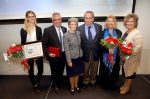
Left to right are Ann Montague, Dr. Blye Frank, Marta Santos Pais, Jerry Nussbaum, Lillian Boraks-Nemetz and Marny Point. (photo by Tiffany Cooper)

On Sept. 13, at the Dean’s Distinguished Lecture held by the University of British Columbia faculty of education in partnership with the Janusz Korczak Association of Canada (JKAC), the audience listened to the words of a saint.

It is an apt description of Marta Santos Pais, whose middle name does indeed mean saint, in Portuguese. Santos Pais is the United Nations special representative of the secretary-general on violence against children. She has worked for decades with remarkable optimism, resilience, focus and patience to try and create a world where no child will suffer violence. At the least, it’s a saintly endeavour.

Santos Pais, who has a law degree from the University of Lisbon, was appointed to her current position in 2009, after a distinguished career working in several capacities in Europe for the rights of children, including being involved in the drafting of many high-level resolutions and policies. As a global independent advocate, Santos Pais would like to see the elimination of all forms of violence against children: in the justice setting, in the home, in institutional care, in schools, in the workplace and in the community.

The co-sponsor of the lecture, JKAC, was established in 2002 and is dedicated to the remembrance of Janusz Korczak and the dissemination of his ideas about the protection and education of children. Korczak was a Polish Jew who was killed by the Nazis along with the orphaned children under his care in the Warsaw Ghetto. Despite being given the opportunity to escape, Korzcak instead chose to stay with the children and accompany them to Treblinka, where they were all murdered.

Marny Point, a coordinator and instructor in NITEP, the Indigenous Teacher Education Program at UBC, and a representative of the Hul’q’umi’num Salish peoples, spoke in her language as well as in English to open the event. Holocaust survivor, author and JKAC board member Lillian Boraks-Nemetz then spoke briefly, reading from Korczak’s ghetto diary and highlighting the need for those who care for children to first attain self-knowledge.

“How can we aspire to become the kind of teacher and human being Korczak was?” asked Boraks-Nemetz, underlining his claim that it was through knowing ourselves that we may begin. Evoking Korczak’s warning that children are too often overlooked amid the storms that blow through the adult world, Boraks-Nemetz quoted him to that effect: “It is the children who always have to carry the burden of history’s atrocities.”

Dr. Anton Grunfeld presented a graduate scholarship to Ann Montague, a researcher in child education. She was awarded the scholarship on the basis of an ethnographic study of children’s education she conducted in Bali with an eye towards “mobilizing children as agents of care for the environment.”

While Dr. Blye Frank, dean of the faculty of education, introduced Santos Pais, Dr. Mary Ellen Turpel-Lafond, an Allard School of Law professor who works at the Indian Residential School History and Dialogue Centre – and who served as British Columbia’s first representative for children and youth from 2006 to 2016 – spoke a bit about Santos Pais first. She highlighted Santos Pais’s influence on the Truth and Reconciliation Commission of Canada’s 94 calls to action for the federal government, especially the sixth, which advises the abolition of Section 43 of Canada’s Criminal Code allowing the corporal punishment of children. Several of the evening’s speakers noted the importance of convincing the Canadian government to repeal Section 43 and join other countries that have outlawed all physical violence against children. Turpel-Lafond noted with particular gratitude the work of JKAC president Jerry Nussbaum in this regard.

Santos Pais began by acknowledging Korczak’s legacy, citing its role in inspiring the provisions of the UN Convention on the Rights of the Child (CRC). She drew a connection between the achievement of sustainable development and putting children first – starting with investing in the early years and creating a safe, loving environment for all children.

Progress has been made in the areas of “data, legislation, policy and program developments,” but the daily reality of millions of children, particularly the most vulnerable and marginalized, cries out to be addressed with more effectiveness, she said.

Santos Pais spoke of the goal to “leave no children behind anywhere and at no time – but, of course, the world is not yet there.” She noted that 2019 marks the 30th anniversary of the CRC, giving us an occasion to recommit to addressing the one billion children still affected by violence each year.

Santos Pais spoke of the UN’s efforts both to listen to children around the world about their experience of violence, and to comprehensively study the wider social and economic costs of violence towards them. According to Santos Pais, presenting such evidence can be an important piece in motivating governments to see preventing violence towards children not as an expense but as a benefit to their country as a whole. Still, she said, many governments have told her that the goal of completely eliminating violence towards children in the near future is too idealistic, that it is “a joke.” To the contrary, she stressed, “We tend to believe that this goal can be accomplished and that there are many practical steps that we can take towards it.”

After Santos Pais’s speech, Nussbaum and Frank presented her with a Janusz Korczak statuette in honour of her service to children. “Thank you so much,” she said. “I’m going to cry now in my seat.”

Matthew Gindin is a freelance journalist, writer and lecturer. He is Pacific correspondent for the CJN, writes regularly for the Forward, Tricycle and the Wisdom Daily, and has been published in Sojourners, Religion Dispatches and elsewhere. He can be found on Medium and Twitter.

Vintage paddles for auction

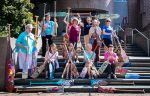
Members of the Tikun Olam Gogos show off some of the paddles being auctioned, until Oct. 10. (photo by Paula Simson)

Last fall, Sue Hyde, dragon boat master and member of Tikun Olam Gogos (which loosely translates as Grandmothers Repairing the World), walked into a board meeting with a hand-painted paddle she had decorated herself. Her idea was to sell paddles like it to raise money for the Stephen Lewis Foundation’s Grandmothers to Grandmothers Campaign, which supports grandmothers in Africa who are raising children orphaned by AIDS.

Tikun Olam Gogos is a Jewish charitable organization, sponsored by the Sisterhood of Temple Sholom, and it is dedicated to fundraising for Grandmothers to Grandmothers. The board was in favour of Hyde’s idea – and one of the board members bought the paddle on the spot. Paddles for African Grandmothers was born.

Hyde had access to more than 30 vintage paddles and the Tikun Olam Gogos asked various artists to paint them. The resulting paddles are being auctioned off until Oct. 10 at tikunolamgogos.org/on-line-auction.

“The paddles were done by a selection of different artists, including one stand-up paddle done by a Syrian refugee,” Tikun Olam Gogos member Sunny Rothschild told the Independent. “The rest are meant to hang on the wall. The paddles are amazing, intricately carved as well as painted. Some are two-sided and some aren’t.”

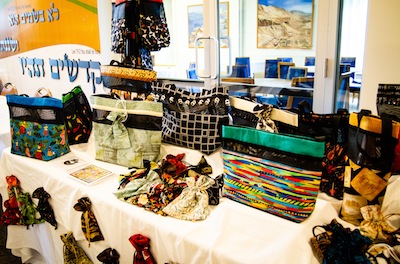
photo - Tikun Olam Gogos makes bags and other items to raise funds, which will be for sale at the group’s Many Rivers to Cross event Oct. 13
Tikun Olam Gogos makes bags and other items to raise funds, which will be for sale at the group’s Many Rivers to Cross event Oct. 13. (photo by Paula Simson)

The fundraiser will culminate with an evening concert on Saturday, Oct. 13, featuring the City Soul Choir and a meet-and-greet with the artists. Winning bidders can pick up their paddles then.

Marie Henry, the founder of Tikun Olam Gogos, also spoke with the Independent. The Tikun Olam Gogos are part of the Greater Vancouver Gogos, which includes more than 25 groups.

“I was visiting in-laws in Kelowna, and I went to a public market and saw a stall where women were selling beautiful tote bags. I found out they were supporting the Stephen Lewis Foundation,” she explained. “I came back and joined the group in Vancouver, but the only problem was I was the only Jew in the group and events kept conflicting with the Jewish calendar. ‘This is crazy,’ I thought, ‘I’m going to form my own group.’”

Henry did just that, in 2011. Today, the group, which is named after the Jewish concept of repairing the world (tikkun olam) and the Zulu word for grandmother (gogo) has Jewish and non-Jewish members. Henry said that only some of the members are actual grandmothers, with the rest being “grand others.”

There are a few hundred Grandmothers to Grandmothers groups across Canada, as well as organizations in the United Kingdom, Australia and the United States. Tikun Olam Gogos has sold more than 2,000 tote bags, with all profits going to the Stephen Lewis Foundation. That’s some $200,000 in donations from tote bags, said Rothschild.

“The admin costs are 11% of all the monies raised, one of the lowest rates of all charities in Canada,” Henry added.

While Henry takes care of notes and minutes and other administrative details for the group, she said, “We have a lot of really talented women in the group, like Sunny, who takes responsibility for part of the group and helps run it.”

Rothschild joined Tikun Olam Gogos almost four years ago, when she was slowing down her career as a lawyer and had more time for volunteer work. She is active in sewing the group’s signature tote bags, as well as taking turns selling them at local craft fairs, where the Gogos get a chance to tell people about their work and the Stephen Lewis Foundation. “That’s the best part,” she said.

“I have a Post-it up in my house – ‘May my life be for a blessing,’” said Rothschild. “This is one of the things that I do because I want my life to be meaningful and to have mattered.”

“The reason that I started this group when I found out what they are doing,” said Henry, “is to help these grandmothers raise up to 15 grandchildren. My grandchildren live a life of privilege and I feel so horribly guilty that these women in their senior years have to suffer so horribly badly. Doing this, I feel useful. In the final analysis, we are performing tikkun olam.”

“I don’t think that the governments in Sub-Saharan Africa understand the revolution that is going to take place because of these women becoming empowered,” said Rothschild. “There are amazing stories of what women are doing, standing up for their rights. It’s really quite amazing what’s happening.”

“The support that we give them helps them to do that,” added Henry. “I see this as the same to the way that suffragettes in North America stood up for their rights, and here it’s happening in a similar way nearly a hundred years later.”

For now, Henry and Rothschild are hoping the community will come out to support Paddles for African Grandmothers at the Many Rivers to Cross concert.

“We’ll be selling tote bags,” said Rothschild. “People can buy a glass of wine, there will be food too – it will be a lovely event.”

Tickets for the Oct. 13, 7 p.m., show at Temple Sholom can be purchased via tikunolamgogos.org/events.

Matthew Gindin is a freelance journalist, writer and lecturer. He is Pacific correspondent for the CJN, writes regularly for the Forward, Tricycle and the Wisdom Daily, and has been published in Sojourners, Religion Dispatches and elsewhere. He can be found on Medium and Twitter.

Is God’s very good world OK?

(photo from jpl.nasa.gov)

Rosh Hashanah commemorates God’s creation of the world. During the 10 days from Rosh Hashanah to Yom Kippur, we evaluate our deeds and do teshuvah (repentance) for cases where we have missed the mark. And, during Sukkot, we leave our houses and live in temporary shelters to commemorate our ancestors’ journey in the wilderness. Hence, these weeks provide an excellent time to consider the state of the planet’s environment and what we might do to make sure that the world is on a sustainable path.

When God created the world, He was able to say, “It is tov meod,” very good. (Genesis 1:31) Everything was in harmony as God had planned, the waters were clean, and the air was pure. But what must God think about the world today?

What must God think when so many species of plants and animals He created are becoming extinct at such an alarming rate in tropical rain forests and other threatened habitats; when the abundant fertile soil He provided is being depleted and eroded; when the climatic conditions He designed to meet our needs are threatened by climate change?

An ancient rabbinic teaching is all-too-relevant today: “In the hour when the Holy one, blessed be He, created the first human being [Adam], He took him and let him pass before all the trees of the Garden of Eden and said to him: ‘See my works, how fine and excellent they are! All that I have created, for you have I created them. Think upon this and do not corrupt and destroy My world. For, if you destroy it, there is no one to set it right after you.’” (Midrash Ecclesiastes Rabbah 7:28)

Today’s environmental threats bring to mind the biblical 10 plagues. When we consider the threats to our land, water and air from pesticides and other chemical pollutants, resource scarcities, acid rain, deforestation, desertification, threats to our climate, etc., we can easily enumerate more than 10 modern “plagues.” The Egyptians were subjected to one plague at a time, while our modern plagues threaten us simultaneously. And the Israelites in Goshen were spared most of the biblical plagues, while everyone on earth is imperiled by the modern plagues.

Instead of an ancient pharaoh’s heart being hardened, our hearts today seem to have been hardened by the greed, materialism and waste that are at the root of current environmental threats. While God provided the biblical plagues to free the Israelites, today we must apply God’s teachings in order to save ourselves and our planet.

There seem to be almost daily reports about record heat waves, severe droughts and wildfires, the melting of glaciers and polar ice caps, an increase in the number and severity of hurricanes and other storms, and other effects of climate change. All of the above, and much more, is related to a temperature increase in the past century of a little more than one degree Celsius, so it is frightening that climate experts project a temperature increase of three to six degrees Celsius in the next 100 years. Some leading climate experts have stated that global warming may reach a tipping point and spin out of control within a decade, with disastrous consequences, unless major changes soon occur.

All countries, including Israel, are affected by climate change. Israel is already suffering from one of the worst droughts in its history, with below average rainfall in each of the past five years, and the Kinneret, a major water source, at dangerously low levels.

Israeli climate experts are concerned that, with additional climate threats, there will be a rise in temperature causing many severe heat waves; a significant increase in the Mediterranean Sea level, which would threaten the narrow coastal strip of land that contains most of Israel’s population and infrastructure; and a significant decrease in rainfall, estimated at 20%-30%, which would disrupt agricultural production and worsen the chronic water scarcity problem in Israel and the region. Making matters worse, much of that rainfall would come in severe storms that would cause major flooding.

Fortunately, there are many Jewish teachings that can be applied to shift the earth to a sustainable path. Briefly, these include our mandate to be shomrei adama (guardians of the earth), based on the admonition that we should “work the earth and guard it” (Genesis 2:15); the prohibition of bal tashchit, that we should not waste or unnecessarily destroy anything of value (Deuteronomy 20:19-20); the teaching that, “The earth is the Lord’s and the fullness thereof” (Psalms 24:1), and that the assigned role of the Jewish people is to enhance the world as “partners of God in the work of creation” (Shabbat 10a); and the ecological lessons related to the Shabbat, sabbatical and jubilee cycles.

As coworkers with God, charged with the task of being a light unto the nations and accomplishing tikkun olam (repair of the earth), it is essential that Jews take an active role in applying our eternal, sacred values in struggles to reduce climate change, pollution and the waste of natural resources. Jews must work with others for significant changes in society’s economic and production systems, values and lifestyles. The fate of humanity and God’s precious earth are at stake and, if we fail to act properly and in time, there may be “no one after us to set it right.”

Richard H. Schwartz, PhD, is professor emeritus, College of Staten Island, president emeritus of Jewish Veg and president of Society of Ethical and Religious Vegetarians. He is the author of several books, including Judaism and Vegetarianism and Who Stole My Religion? Revitalizing Judaism and Applying Jewish Values to Help Heal Our Imperiled Planet, and more than 250 articles at jewishveg.org/schwartz. He was associate producer of the documentary A Sacred Duty: Applying Jewish Values to Help Heal the World.

Courage in a time of change

Rabbi Irwin Kula speaks in Vancouver on Sept. 16 at FEDtalks, the opening event of the Jewish Federation of Greater Vancouver annual campaign. (photo from JFGV)

The world is in a time of historic shifts and the way we interpret and respond to what is happening can make each individual a player in this civilizational drama.

This is the promise of Rabbi Irwin Kula, who will speak in Vancouver on Sept. 16 at FEDtalks, the opening event of the Jewish Federation of Greater Vancouver annual campaign. Kula is co-president of Clal, the National Jewish Centre for Learning and Leadership.

“We are living in one of the most dramatic, exciting times in human history,” Kula told the Independent in a telephone interview. “Whenever one lives in a dramatic transitional moment, the call to responsibility is also dramatic. The fear and the anxiety that we are feeling is all understandable. But managing the fear, managing the anxiety and, therefore, managing some of the loss that comes in these great moments of transition, is how we move on the journey.”

Kula promises audience members more than an interesting talk.

“Anyone who is going to be in that room, anyone who is willing to speak about it this way, really has an opportunity to be a part of not only the solution but one of the great adventures in the human drama right now,” he said.

At Clal, Kula is part of a team that is “reimagining Judaism for this era.”

“And not only Judaism, but religion in general,” Kula said. “What is religion and Judaism going to look like in an information age? In an age of globalization? In an age when the borders and boundaries of their identities are more permeable?”

Kula is an eighth-generation rabbi and holds a degree in philosophy. He has served congregations in Jerusalem and St. Louis, Mo., and, over the last 30 years, has been involved with Clal, which describes itself as a “do-tank” – “The thinking actually has to apply to people’s doing,” he explained.

Kula works “at the intersection of religion, innovation and human flourishing,” he said. “Those are the lenses I use.”

Kula analyzes how information, entertainment, media, retail and other components of society are affected by innovation. In his 2007 book Yearnings: Embracing the Sacred Messiness of Life, Kula considers the relationship between what we desire and how we live.

“Yearnings is a fancy word for desires,” he said. “The central insight in the book is that what animates us, what animates our lives, are our desires. They are sources of great wisdom for who we are as human beings. We know our most intense desires – our desire for love, our desire for the truth, our desire for meaning, our desire for happiness, our desire to be creative and have a purpose and to contribute.… The interesting thing about looking at our desires is, the more one can understand our desires, the wiser our lives are.”

Whatever the day’s headlines, Kula said, maintaining optimism is critical to making positive change in the world.

“Being an optimist doesn’t mean you have to be Pollyanna,” he said. “You can be an optimist and be 51-49 about it. The difference between being a 51-49 optimist and 51-49 the other way may be the biggest difference of all.”

And when the nightly news brings stories of authoritarian ascendancy or other alarming developments, the long view is an antidote.

“I use a long-term, macro-evolutionary take,” said Kula. “This is where Martin Luther King, I think, is right. The arc of history bends toward justice. But it doesn’t bend linearly. It’s not one plus one plus one plus one. It’s sometimes two steps forward and a step backward. We are in now a very, very significant moment of transition. There’s a lot of ways to talk about that transition – postmodern, information age, technological age – and all of the changes are hard to metabolize. So, it takes a very serious responsibility for elites and cultural creatives and people who experience themselves at the cutting edge of these changes to take very seriously the costs and pains and dislocation of these changes for different people. That is what I think we are all called to do.”

People may look at the state of the world and feel helpless or hopeless. But the better response, Kula said, is not only to acknowledge the ways in which we might affect improvements, but also to take individual responsibility for the situation.

“Maimonides, the great Jewish philosopher, said, in the face of trauma and in the face of political tragedies, the first thing to ask is how am I complicit in what is transpiring,” said Kula. “Not in a giant moral drama of blaming, because, if we are actually interdependent … then what’s happening with people with whom we deeply disagree is connected to us. It’s not some other, evil person over there.”

This is not to say there is not evil in the world, he cautions. But, asserting that those with whom we disagree are evil can potentially misallocate cause.

“In America, there aren’t 60 million evil people who voted for Trump that want America to be destroyed and become a homophobic, primitive, psychologically regressive place in the world,” Kula said. “It behooves us, says Maimonides, to address very seriously what have I missed and, therefore, perhaps been complicit in allowing this to emerge?”

Courage and a sense of adventure can help us navigate times like these.

“If we mitigate a little bit the fear and just stand at that burning bush and not be so scared, know there is tremendous possibility,” he said.

For tickets to FEDtalks, at the Vancouver Playhouse, visit jewishvancouver.com.

Bringing the invisible to light

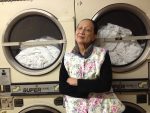
Actor Ching Valdes-Aran in a scene from The Washing Society. (photo from The Washing Society)

Faced with the challenge of making a documentary for which the voices of undocumented immigrants were crucial, filmmakers Lynne Sachs and Lizzie Olesker had to push the boundaries of convention. The result is The Washing Society, which will see its Canadian première at the Vancouver International Film Festival, as part of the festival’s Impact programming.

“For this year’s Impact stream, we decided to foreground films that represent prominent themes found in the festival at large – themes that are extremely topical at this historical moment,” said Alan Franey, director of international programming at VIFF, in a release. “Refreshing in their cinematic artistry, insights and lack of platitudes, these films have the power to inspire actual change.”

The Washing Society combines research, interviews, acting, dance, artistic images and other elements to introduce viewers in 45 minutes to some of the laundromats in New York City, which are disappearing, and the people who work in them. Olesker and Sachs, who both live in Brooklyn, will be in Vancouver for the festival and the Independent interviewed them by phone in anticipation of their visit.

The filmmakers are practically neighbours, and they met each other through their daughters, who are about the same age and have the same piano teacher. It was at a piano lesson where they first crossed paths. “Then we saw each other’s work, and really admired what each other were doing,” said Olesker.

The origins of the documentary are in a performance Olesker was commissioned to do in a laundromat, upon which she wanted to expand. Thinking that film would be a good element to add to it, she contacted Sachs.

“We had a series of conversations, which led me to unexpected places in how to think about laundry and women doing laundry, and so it became a deeper, more fruitful collaboration,” said Olesker.

Over a span of about two years, the pair researched the topic, then co-created the play Every Fold Matters with the actors performing it, as well as writing their own text. The site-specific performance and film project – which was performed in laundromats and various venues throughout New York from 2015 to 2017 – formed the basis for what has become The Washing Society.

“We’ve been working together now for probably over four years,” said Sachs, “because we spent almost a whole year traipsing all over New York City – mostly Brooklyn and Manhattan – trying to do the convention of documentary practices, ‘Let’s go into laundromats, let’s talk to workers.’ But the issues in New York are that so many of those workers are undocumented, so they’re very hesitant to have a conversation in front of a camera. So, we would have conversations and we would go back and write pieces and create characters based on all of those interviews we did, which we didn’t film. But then, over the course of time, as it shifted from being a live performance with media to a film, we got better at finding people who were willing to speak in front of the camera.”

They did this, in some cases, with the help of an actor or a translator, who then became more involved or involved in other ways. “One of the things both of us are really interested in,” said Sachs, “is breaking down the conventions of roles in the project.”

Both Sachs and Olesker have done cross-disciplinary work before.

“It’s been exciting for me to work in film and also to engage in questions like, What is a documentary? What does it mean to inquire into a subject or have a question and pursue it in different ways? As a creator of film or theatre, you’re always looking for a truth, not necessarily the truth.”

“I’m really interested in how documentary crosses over into fiction, and how fiction informs the documentary aspect,” said Olesker. In this project, she said, “It’s been exciting for me to work in film and also to engage in questions like, What is a documentary? What does it mean to inquire into a subject or have a question and pursue it in different ways? As a creator of film or theatre, you’re always looking for a truth, not necessarily the truth.”

The Washing Society contains a lot of theatre. “That’s an issue that raises questions with audiences in good ways and in challenging ways,” said Olesker, for whom this film is her first foray into documentary-making.

Sachs, however, has made this type of documentary before, mixing lived experience with fiction; for example, Your Day Is My Night, which she brought to the Vancouver International Film Festival in 2013. “Working in this way,” she said, “has started to make me to question all forms of documentary, or even narrative film, because you see a narrative film and it’s really a document of a bunch of people getting together and making a fictional story.”

One passion “that has been very nourishing for both of us in our work is our relationship to history, to the historical document,” said Sachs.

“With this film,” she explained, “when we came across the story of the Atlanta washerwomen, we found it absolutely riveting and astonishing that there was this moment in American history in which a group of 3,000 black women had enough power or wherewithal or vision … to organize and to change their working lives. Any art project that gives you an excuse to research, I think, is pretty exciting.”

The title for the documentary is inspired by what these washerwomen accomplished in 1881. As for more recent history, The Washing Society both exposes the harsh working conditions in laudromats and laments the loss of these neighbourhood establishments.

“I think it’s interesting to explore that contradiction,” said Olesker. “It is grueling, underpaid, under-recognized work. It’s also necessary work – not necessarily in the form that it’s taken, of dropping off your laundry and paying someone to wash and fold it, but someone is always going to have to do the wash, so that sense of broad history and the roles that women have had in doing that work is something that was behind the project, as well.”

“My nostalgia,” said Sachs, “is any space where there is an intersection.… It’s what makes cities great, the idea that there is a space in which there are intersections, and that people who have less and people who have more are in the same space and they’re spending time [together]. And that all has changed so much now. The thing is, though, that the basic infrastructure – of there being a large group of people who are hidden in some way, and they are doing service work for other people, who have much more access or means – isn’t going to change because, even if it [laundry service] becomes an app, like we show at the end of the film, there are still people doing the work, they’re just not as visible.”

One purpose of the film is to make that invisibility visible. But, said Olesker, “What’s interesting about the film to me is that we’re not so much leaving you with something that we think should happen. We’re opening it up as a question and saying, ‘Look inside this.’ We looked inside and now we’re taking you inside, what is this about?”

There is a challenge to making a documentary when the “people who we would want to have in the movie are undocumented, therefore, they don’t want to be documented by us – they want to be documented by the government….”

In the United States, added Sachs, the idea of the document “comes down to a sense of security.” There is a challenge to making a documentary when the “people who we would want to have in the movie are undocumented, therefore, they don’t want to be documented by us – they want to be documented by the government, and so there is this resistance to being in front of our camera until they can find something that legitimizes their status here in another way that will serve them.

“And it actually comes down to the whole project of making art,” said Sachs. “To whose advantage is it? For example, we’re getting to go to Vancouver and we were talking about, Could we manage to bring one of the people from the film? There is a lot of questioning about what access the artwork gives. We’ve tried to bring along the people in the film as much as possible, but we aren’t always able to.

“There’s even a point in the film where we have Chinese and Spanish … sometimes we translated that and sometimes we didn’t, because we wanted to give opportunity for people who are in the audience who had access to those languages to feel that they were in positions of strength over the rest of us. There’s something about subtitling that, if you subtitle everything, you bring it all into the English window, and people stop listening.

“A big part of the film,” she continued, “is to go outside of issues of work and of cleaning in an urban situation, which becomes involved in service … [and to delve into] all the layers of existence or the layers of identity that happen in cities these days, and who listens to whom. We hear Spanish all the time [in the United States], but are we really listening to it or is it something we can just pass by? Same with Chinese.”

Both Olesker and Sachs are Jewish.

“I’m from New York so, growing up, it’s been a part of my life,” said Olesker. “Not in a religious way, but certainly in the culture of my family and my world. And specifically around labour and labour history, union organizing – not that anyone was an organizer in my family, but there was always an awareness of that, so that is part of my identity in terms of the work I’m interested in making.”

Sachs is a member of Kolot Chayeinu. “The rabbi and founder of the congregation – her name is Ellen Lippmann – she’s always been a hero of mine,” said Sachs. “She’s just retired, about a month or so ago, after 25 years running Kolot Chayeinu. It’s a very, very progressive congregation and I worked with her just a couple of years ago on something that I found very moving.”

Lippmann would often ask Sachs to film various activities for the synagogue and, in 2016, when B&H photo and video store, which is run by ultra-Orthodox Jews, was challenged by labour activists for the company’s treatment of its warehouse workers, “a bunch of people from Kolot decided to organize with the workers in front of B&H,” said Sachs. “I was there to videotape it and so were some television stations. And I think that Ellen Lippmann really wanted to say, this is not, to our mind, following an ethical frame of reference that we want to claim as Jewish.”

Olesker pointed out that the B&H walkout was organized by the Laundry Workers Centre. “So, we actually made a little film, which is kind of a postscript to The Washing Society, where they organize this march through east Harlem to a laundromat … where two of the workers who were part of the Laundry Workers Centre went in and presented a list of demands to the owners … to talk about unfair labour practices and long hours and being underpaid and no breaks. We were part of that march and demonstration, which Lynne shot on film and we edited.”

The video epilogue, as well as teasers for The Washing Society, can be found on vimeo.com. For the film festival lineup, visit viff.org. The festival runs Sept. 27-Oct. 12.

Learning negotiation together

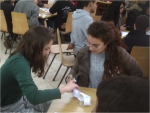
The Pathways program pairs Arab and Jewish high schools for two-day experiential workshops about interest-based negotiation skills. (photo by Emily Singer)

As politicians debate about how to bring peace to the Middle East, or if it’s even possible, a newly formed nonprofit organization is bringing together hundreds of Jewish and Arab children across Israel every year and teaching them how to get along.

The Pathways program, directed by Avi Goldstein and facilitated by Michael Schnall, pairs Arab and Jewish high schools for two-day experiential workshops about interest-based negotiation skills. The program, sponsored by the U.S. embassy and run in partnership with school networks and community organizations, is based in large part on concepts from the international bestselling book Getting to Yes: Negotiating Agreement Without Giving In by Roger Fisher, William Ury and Bruce Patton (Penguin Books, 2011) and on methodology developed at the Program on Negotiation at Harvard Law School. Thanks to the initiative of the Darca network, the school where I teach, Shaked Darca on Kibbutz Sde Eliyahu, has had the tremendous privilege of participating in Pathways for the past two years.

The Pathways program combines a few goals, the most important of which would be difficult to say. Last year, when we received the invitation to apply to participate, I saw it as an exciting opportunity to expose my students to two intensive days of study and conversation in English. The entire program is in English, and this is a natural common language for communication among the Jewish and Arab students. But the program exposes the students to so much more.

With rich and varied activities, the students learn English as the international language of negotiation, conflict resolution and peace. They develop many new skills with one central message – in order to “win,” you don’t need for someone else to “lose.” When you listen to others and you are curious about their needs, instead of reaching a compromise, you can often reach agreements in which both sides walk away with a feeling of success.

And all of this takes place in a setting in which students have the opportunity to meet kids from a very different population and culture. Or maybe not so different.

The program opens with an activity designed to foster cooperation among the students, while emphasizing what they share. They are divided into mixed groups and given the task to build a paper chain made up of things everyone in the group has in common. Sound simple? Now try it with one hand behind your back. Literally. The students need to talk and plan together, and also to write, cut and paste, all with lots of cooperation, creativity, and even laughter.

Throughout the program, the kids are given situations in which they have to negotiate with each other. For example, a kid lends his friend his iPod. The next day, after the iPod is returned, he discovers that it doesn’t work and he wants his friend to buy him a new one. This is his “position.” But, before he goes into negotiation with his friend, he has to weigh a number of important issues. What does he think his friend is going to claim? Might there be any truth to it? How valuable is his friendship with this person? What is most important to him, and on what is he prepared to compromise?

There is a lot of discussion over the two days about “positions” versus “interests.” If each side comes to the table after serious consideration of what is really important to him or her (their “interests”) and curiosity about what the other party wants and needs, this leaves open the possibility for empathy as well as creative, outside-the-box thinking, and then the sky’s the limit.

The students are exposed to a wide variety of situations that must be negotiated, but none of them addresses the political conflict in which they live. They are able to make connections and compare shared values with students whom they might never otherwise meet, in a setting where the “sides” are mixed up, so they are not negotiating as Jews and Arabs, but rather “Table 1” against “Table 6,” “parent” versus “child,” or friend and friend.

The first day concludes with two powerful exercises. In one, the students are asked to divide into pairs, lock arms and “try to bring their partner’s arm down to the table as many times as possible.” The students proceed to arm wrestle. Mike, the program facilitator, asks why the students felt a need to struggle with their partner. “Did anyone notice that with cooperation, both players could arrive at much higher results?”

The final activity of Day 1 is an improvisational role play of a negotiation between a father and child. The child wants to go to a party and to come home late. Mike is the stubborn father who says, “By 10:30.” The part of the kid is played by students, who take turns volunteering. It begins with a classic negotiation of compromises. Midnight? No, 10:40. How about 11:30? No, 10:45. Whatever the outcome, someone will walk away disappointed. Until one student finally goes up to the stage and asks the Pathways magic word, “Why?” After a real conversation about interests, the boy understands that his father is worried about safety on the roads at night, and he’s feeling too tired to stay awake until his son arrives home safely. So, the boy suggests he stay overnight at his friend’s house and return home in the morning. Dad agrees. Everyone “wins” and walks away happy.

The second day begins similar to the first. After another ice-breaker, volunteers are invited to participate in a game. The kids are divided into two teams. There is a long rope, and each side has to pull the middle of the rope over the red line on their side as many times as possible. Rida, my Arab partner teacher, and I stand there watching in disbelief as the two sides struggle with all their might to “win.” Do they not remember the arm wrestling from the day before? Why are they not working together? But we learned from this and from many other activities that these skills are like muscles. Our habits and assumptions need to be understood and new skills need to be developed and exercised often. The good news is that they are relevant in every aspect of our lives – whether with friends, colleagues, family or business partners – so there is no shortage of opportunities to practise.

By the end of the second day, the students leave with a new language of negotiation – positions versus interests, options versus alternatives, communication, legitimacy, obligation and, of course, everything in English. They also leave thinking a bit differently about “the other,” with some students exchanging emails and telephone numbers.

Unfortunately, after the two days, the program ends and the students remain 45 minutes away, but worlds apart. This year, Pathways has begun new initiatives to build on the program for the future. To this end, I participated in Pathways’ Negotiation Education Teachers Fellowship, funded by the U.S. embassy, designed to bring together a community of teachers to integrate the learning of problem-solving negotiation skills into the English-language curriculum. We are also looking for ways to continue bringing the students together.

I feel incredibly blessed to be a part of the Pathways program and the rich community of Arab and Jewish English teachers in Israel who devote their lives to making the world a better place through education. I’m deeply grateful to the Darca network and to my school, Shaked Darca, for their support and their ongoing desire for innovation and alternative education. I also appreciate the contribution of the U.S. embassy, and Mike and Avi, who created Pathways and continue to keep it going, always thinking how the program can be improved and expanded. Most importantly, I am thankful to our fabulous students, mine and my partner teacher Rida’s, without whose open minds, open hearts and willingness to try new things and to dare to speak in English for two straight days, none of this would be possible.

Our children are truly our future. The more they know the language – and tools – of communication, cooperation and peace, the better our world will be. For more information on Pathways Institute for Negotiation Education, see pathwaysnegotiation.org.

Emily Singer is an English teacher and coordinator at Shaked Darca School on Kibbutz Sde Eliyahu in Israel. Singer taught at Vancouver Talmud Torah and her husband, Ross, was rabbi of Vancouver’s Shaarey Tefilah congregation until 2004.

Celebrating a colleague

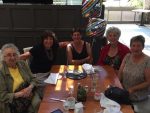
Left to right, are Sally Berry, Debby Altow, Judy Stern, Linda Arato and Shirley Hyman. (photo by Sharon Stern)

Judy Stern was honoured at a luncheon July 31 for her long service to National Council of Jewish Women of Canada, Vancouver section.

Stern was the office manager for NCJWC for more than 12 years. During that time, she fielded phone calls about the organization’s programs, organized callers for its annual fundraiser Friends and Angels, sent out thousands of tribute cards, edited the newsletter, connected with various communal agencies, shepherded the Books for Kids materials, communicated with NCJWC members old and new, and supported the longstanding program Operation Dressup. She was a valuable and cherished colleague and we wish her well.

The lunch at Shaughnessy Restaurant was attended by several past presidents of Vancouver section and other volunteers, including Debby Altow, Linda Arato, Sally Berry, Annette Chernin, Shirley Hyman, Anne Melul, Linda Shulman, Shelagh Stoller and current president Catherine Stoller.

Tikkun olam through photos

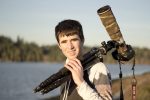
With his photos, Liron Gertsman hopes to raise awareness of environmental issues. (photo by Liron Gertsman)

Recent Vancouver high school graduate and award-winning photographer Liron Gertsman is heading to the University of British Columbia to study biology. His main passion is taking photos of nature, particularly birds, in the hope of sparking in viewers feelings of love and awe for the environment, leading to improved conservation.

“I believe people need to see the natural world if they want to protect it, so I try to do that through my photos,” Gertsman told the Independent in an interview.

From as young as 5 or 6 years old, Gertsman spent a great deal of his spare time walking around his neighbourhood, keeping an open eye.

“Around that time, my parents gave me a blue miniature camera,” he recalled. “Right from the start, I began taking pictures of birds and nature … and it grew and grew until, when I was 12, I bought my first personal DSLR camera equipment. And, since the very start, I’ve loved birds and have been fascinated by their behaviours … and have done my best to photograph them.”

Gertsman’s love of nature does not seem to have come from his parents, who are both businesspeople. His dad is a real estate tax consultant and his mom is an accountant.

“It was a big combination of things,” said Gertsman. “A lot of it was self-learning things – reading on the internet, reading books, and there were [other] influences because the bird-watching community is very large…. I would go attend bird walks and meet people that way. My Grade 2 teacher was a really big environmentalist and created an environmental conservation club at school.”

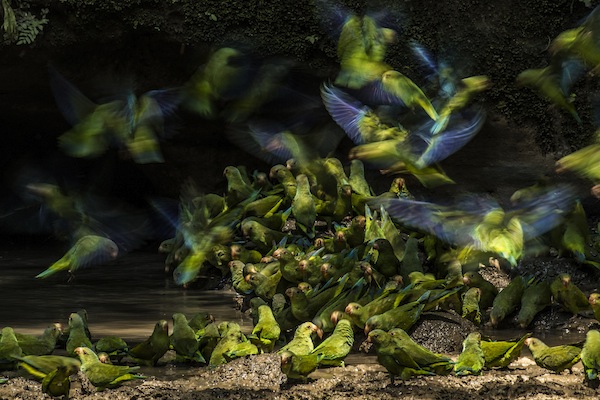
photo - Cobalt-winged parakeets. “To get this photo,” said Liron Gertsman, “I waited for hours three days in a row in a blind in the hot and humid rainforest of Yasuni National Park in Ecuador”
Cobalt-winged parakeets. “To get this photo,” said Liron Gertsman, “I waited for hours three days in a row in a blind in the hot and humid rainforest of Yasuni National Park in Ecuador.” (photo by Liron Gertsman)

Now that he is heading to UBC, Gertsman is not sure if he will integrate photography with research on birds, or if he will become a professional nature photographer.

“There are a lot of biologists who use photography to document their work,” he said. “They’re doing work that is hopefully going to benefit conservation and they need photographers, or they, themselves, will document their own work … to put it into a format that is easier for people to comprehend. Hopefully, I’ll get involved in some research projects – maybe over the summers – that will allow me to do things like that…. But, I’ll see what calls me more in the years to come and make a decision in a few years.”

Gertsman posts his photos on his website and social media accounts, and some have won contests. Most recently, three of his photos were recognized by the Audubon Photography Awards, winning the youth category prize and honourable mentions.

“It’s a great way to show more people your work, show them the beauty of nature,” said Gertsman. “Some of my photos have been featured, in the past, in magazines and in web articles.

“We are at a point now in the world where, if we don’t change something big … we’re going to be heading into some dark times. The environment is at a very unstable point right now. Our actions in the next little while are going to have a big impact on whether there’s going to be nature and a natural environment to live in, in the years to come.

“Everything we have as people comes from nature,” he continued. “Without nature, we can’t survive. But, it can be hard for people to understand that. It’s not a direct link. If you cut down a tree, it’s not going to have an impact on most people’s lives.”

But, on a larger scale, it matters. “So,” he said, “what I’m trying to do is, by photographing the natural world in the most beautiful way I possibly can and showing it to as many people I possibly can, I’m trying to educate the world the best I can on how incredible the environment is and how worth protecting it is.”

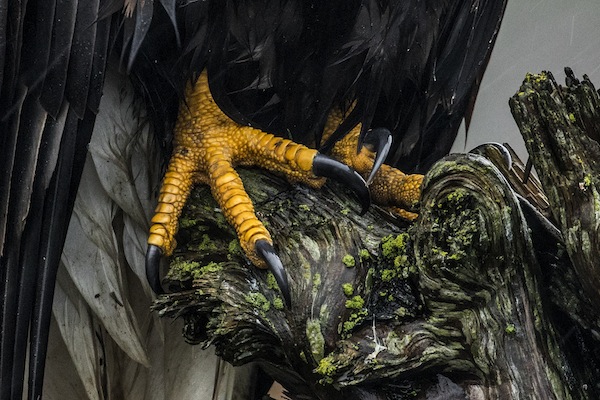
photo - The talons of a wild bald eagle, photographed on the southwest coast of British Columbia. “It was sitting near a popular walking trail, so perhaps it was used to attention from its human admirers,” said Liron Gertsman
The talons of a wild bald eagle, photographed on the southwest coast of British Columbia. “It was sitting near a popular walking trail, so perhaps it was used to attention from its human admirers,” said Liron Gertsman. (photo by Liron Gertsman)

This past spring, Gertsman was in Israel, one of the most amazing places in the world for birdwatching, as “all the birds migrating from Africa to Europe pass through in Israel,” he said.

There are many ways people can help promote the environment, he added. “You can help me spread my message – tell your friends, share my website, follow me on social media, my Instagram. I post, almost every day, my latest pictures on Instagram. Hopefully, through that, I’ll be able to reach more people.

“It’s increasingly difficult to motivate people to do things individually, but individual action can have wide affect. When a government adds a regulation, it has an impact and, when regulations are taken away, that too has a huge impact. So, in the way we think about our political leaders, there’s something we can do as a nation there.

“But also, just on an individual scale, cutting down on driving, not using plastic straws … little things, like carpooling, things you do every day can make a big difference. And, just spreading the message of how amazing nature is, and getting out and enjoying nature yourself.”

For more information, visit lirongertsman.com or @liron_gertsman_photography on Instagram.

Rebeca Kuropatwa is a Winnipeg freelance writer.

Kick scooting for a school

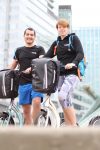
Gil Drori and Bex Band are kick scooting down the West Coast to raise money to build a school in Tanzania. (photo from Gil Drori)

Gil Drori and Bex Band are en route to the Mexican border. They left from Vancouver last month. What’s newsworthy is how and why. They will be making the journey entirely by way of kick scooter – that’s right, not electric scooter, but kick scooter, the glorified skateboard with safety rails, and they will be doing so to raise money for a school in Africa. They are calling their adventure Kicking the States.

“We decided to do a charity challenge like no other that would help raise money to build a school in a poor village in Tanzania. We visited the village and the half-built school last year and saw the reality and hardship that the children are living in,” Drori told the Jewish Independent in an email interview. “It wasn’t easy to see but we wanted to do something positive, which is how the idea for Kicking the States came about.”

The journey is about 2,500 kilometres long and will take the couple three months. It is, as they say, “entirely muscle-powered.” Drori and Bend have had to pack very lightly to fit all their gear into their modified front pannier, so they are carrying just a tent, sleeping bags and a spare change of clothes.

“When we first thought of the idea, it seemed an impossible challenge, which is exactly why we went for it,” Drori told the JI.

Drori was born in Jerusalem and grew up in Zichron Yaakov. He met Bend while traveling in Guatemala. He’d recently finished his army service and Bend, university. Despite having completely different backgrounds, they “instantly clicked.” They now both live in the United Kingdom, where Bend comes from, and call London home, although they still visit Israel regularly. They recently celebrated their third wedding anniversary.

A kick scoot journey of this kind has never been attempted before, so there are no precedents, and Drori and Bend are learning as they go. “It’s a real adventure!” said Drori.

They hope to raise a total of $10,000 along the way, through sponsorships and by delivering free talks at events for which admission is by donation.

Two years ago, Drori and Bend were working regular jobs, Drori in IT and Bend in teaching. They decided to leave the city life to hike the Israel National Trail, having never done anything like it before. It took two months to complete and, from that point, they have been attracted to adventure as a way of exploring and seeing of what they are capable. They now both work as digital nomads, which gives them the flexibility to keep taking on new challenges, like Kicking the States.

“I think the simplicity of traveling with just a bag with everything you need and working your body each day is really appealing,” said Drori.

Before taking on their latest adventure, they did a four-day mini-trip on scooters, which showed them that it was possible.

“We’ve had a tough but great first two weeks on the expedition,” said Drori. “Physically, it has been very demanding and we have been scooting distances of 30 to 50 miles a day [50 to 80 kilometres], so are left achy and tired. Hills also pose a challenge and we have to get off and push the scooters uphill, which is not easy with all our gear attached.”

Most days, Drori and Bend have no idea of where they’ll be sleeping that night. They have been reliant on people offering to host them, as well as staying at campsites and even sleeping in the yards of strangers. “It has been quite tiring sometimes, living with that uncertainty each day,” said Drori, “but we are trying to embrace the excitement that that also brings.”

The two have faced setbacks every day so far, from road blockages, wrong turns, running low on food and fatigue. Drori said focusing on the money they have raised is what gets them through.

“The children we met in Tanzania are living in real hardship and their only hope of escaping is by getting an education,” said Drori. “They are fed two meals a day at the school, learn to read and write, leave with qualifications and, more important than that, confidence in themselves. We believe that every child should have a right to an education no matter what their circumstances, which is why we are so passionate.”

Drori said they have been surprised by the amazing people they have met along the way. “It’s been the absolute highlight,” he said. “Such kind and wonderful people who, despite us being strangers, have hosted us for a night, fed us or made generous donations to the charity. We’ve met people from all walks of life and have heard so many interesting stories. It sounds cliché, but it restores your faith in humanity. People really are good!”

Drori stressed that 100% of the money raised goes directly to the school. “We really hope that people will support us and get behind this cause,” he said.

People can donate at justgiving.com/kickingthestates.

Matthew Gindin is a freelance journalist, writer and lecturer. He is Pacific correspondent for the CJN, writes regularly for the Forward, Tricycle and the Wisdom Daily, and has been published in Sojourners, Religion Dispatches and elsewhere. He can be found on Medium and Twitter.