Skip to content
  • Home
  • Subscribe / donate
  • Events calendar
  • News
    • Local
    • National
    • Israel
    • World
    • עניין בחדשות
      A roundup of news in Canada and further afield, in Hebrew.
  • Opinion
    • From the JI
    • Op-Ed
  • Arts & Culture
    • Performing Arts
    • Music
    • Books
    • Visual Arts
    • TV & Film
  • Life
    • Celebrating the Holidays
    • Travel
    • The Daily Snooze
      Cartoons by Jacob Samuel
    • Mystery Photo
      Help the JI and JMABC fill in the gaps in our archives.
  • Community Links
    • Organizations, Etc.
    • Other News Sources & Blogs
    • Business Directory
  • FAQ
  • JI Chai Celebration
  • JI@88! video

Recent Posts

  • Sharing her testimony
  • Fall fight takes leap forward
  • The balancing of rights
  • Multiple Tony n’ Tina roles
  • Stories of trauma, resilience
  • Celebrate our culture
  • A responsibility to help
  • What wellness means at JCC
  • Together in mourning
  • Downhill after Trump?
  • Birth control even easier now
  • Eco-Sisters mentorship
  • Unexpected discoveries
  • Study’s results hopeful
  • Bad behaviour affects us all
  • Thankful for the police
  • UBC needs a wake-up call
  • Recalling a shining star
  • Sleep well …
  • BGU fosters startup culture
  • Photography and glass
  • Is it the end of an era?
  • Taking life a step at a time
  • Nakba exhibit biased
  • Film festival starts next week
  • Musical with heart and soul
  • Rabbi marks 13 years
  • Keeper of VTT’s history
  • Gala fêtes Infeld’s 20th
  • Building JWest together
  • Challah Mom comes to Vancouver
  • What to do about media bias
  • Education offers hope
  • Remembrance – a moral act
  • What makes us human
  • המלחמות של נתניהו וטראמפ

Archives

Follow @JewishIndie
image - The CJN - Visit Us Banner - 300x600 - 101625

Tag: terrorism

The complexities of terrorism

The complexities of terrorism

Dr. Tami Jacoby, associate professor at the University of Manitoba, has been studying Middle East politics and international relations for nearly 20 years. (photo from Tami Jacoby)

Dr. Tami Jacoby, associate professor at the University of Manitoba, has been studying Middle East politics and international relations for nearly 20 years. She not only shares her expertise with students at the university, but the broader community as well, via books and lectures. She is currently teaching an eight-week class at Winnipeg’s Rady JCC called Terrorism and Political Violence.

After working toward her undergrad degree at the Hebrew University, Jacoby finished her studies at U of M. She then went back to Hebrew U for her master’s degree in political science and international relations. At that time, Jacoby made aliyah and started a family and life in Israel. Later, she moved to Toronto to do a doctorate in political science at York University. She eventually returned to Winnipeg, where she currently resides.

While doing her PhD, Jacoby traveled back and forth regularly between Canada and Israel, and did field work in Israel, conducting interviews and research on women’s protest movements.

Over the years, Jacoby has written several books, including Women in Zones of Conflict: Power and Resistance in Israel (McGill-Queen’s University Press, 2005). Using the framework of “a case study of three women’s political movements in Israel: Women in Green, the Jerusalem Link and the lobby for women’s right to fight in the Israel Defence Forces,” the book, according to the publisher’s description online, “challenges the traditional view, which suggests a natural connection between women and pacifism, based on the feminine qualities of caring, cooperation and empathy.”

“What I did was a number of years of interviews and research on women’s protest movements … and the book that came out was a book on the diversity of feminism in Israel, but as a level of extremism,” Jacoby told the Independent. “I was interested in how women in one national context could have such radically different views on the same things, like feminism, the Arab-Israeli conflict and just run-of-the-mill party politics.”

One of the interesting things Jacoby found was that many women on the left were interested in things like dialogue with the Palestinians about a two-state solution, and feminism. In contrast, right-wingers’ idea of dialogue with the Palestinians was through protest, the media and policy.

“They were very driven by their fear of not only losing the state of Israel, but of losing their identity as Jews, as Israelis,” said Jacoby. “And the left-wing portion of the Israeli women’s movement was very interested in dialogue with Palestinian women. They wanted to get together with them and have cultural programs and social events. They wanted to listen to and get to know the stories of Palestinian women, to be able to walk in their shoes and completely understand them.”

The class that Jacoby is teaching at the Rady JCC – which started last week and runs to March 21 – looks at terrorism in Canada and the legal and political/social aspects of it.

“This class I’m teaching at the JCC is, in a sense, piggybacking on other research and teaching that I’m doing right at the moment,” she told the Independent before the course began. “So, I’d assume the people in the class will be interested in the kind of terrorism that Canada and Israel deal with…. But the class takes a step back and looks at the phenomenon of terrorism as a philosophical and structural issue….”

While Jacoby is teaching the class, she is also a student of sorts, as she is interested in hearing what people have to say.

“People have a lot to say and it’s not just off the cuff; it’s substantiated by empirical evidence and anecdotes that are based on experience,” she said. “What I try to do is open a little window on something that I’ve been very heavily researching … and open a discussion about things that people may not have thought of before … so people can bring things to the table and we can work to enlighten ourselves about the topic.”

Touching a little on what will be examined in the course, Jacoby said, “One of the things I’ve come to realize about terrorism is that it has a particular dynamic to it, no matter where it is and what period of history it is in. And that is, you have a small group of people trying to terrorize, make afraid, a large group of people … so they start to feel their life is untenable and then pressure the government to act. That’s the case with literally every terrorist group, regardless of their philosophy, background or tactics. That’s the logic of terrorism. I’m interested in seeing how case studies fit into that logic.”

Another topic will be how to pair counterterrorism with policies like multiculturalism, democracy and liberalism.

“The human tendency is to look for people who might look like them, causing a whole range of Islamophobia, antisemitism, racism and xenophobia,” explained Jacoby. “These are the kinds of problems not specific to any one particular form of terrorism, but that fuel a broader understanding of terrorism in general.”

Jacoby sees political violence like terrorism as a way in which people express themselves at the extreme end of the spectrum. “Political violence is quite broad,” she said. “It could be something quite innocuous, like threatening someone or inciting someone to violence … or, it could be throwing a fist or a bomb, or using nuclear weapons as a scare tactic.”

The Middle East will likely be discussed in terms of the ongoing cold war between Iran and Saudi Arabia and their backers, as well as both American and Russian policies.

“One thing that people seem to not understand nowadays is that people may oppose a terrorist group’s tactics, but they may also support the underlying goals … which can be quite honourable,” said Jacoby. “For example, terrorists might use violence to press their point about Muslim victims in the Middle East, [while] a moderate person might say they are against and shocked by the high casualty rate of Muslim victims. There are a lot of divisions out there, of which terrorists only represent a very small group … [an] active, vocal, radical, but miniscule, minority. While we may not like the tactic, many people may support the ultimate goals, which include justice and peace. The reason we can’t see the ultimate goals is because terrorism destroyed them … [and] in the end, makes it worse.”

As for possible solutions to terrorism, Jacoby said it “is one of the most difficult tasks to respond to.”

She explained, “I would say this: the effect of terrorism is more psychological than anything else. Fewer people die from terrorist attacks every year than from faulty wiring or furniture falling on them when they sleep. But, because of the media and the dramatic nature of its coverage of terrorism (pervasiveness, images, taboos, fear), people spend more time worrying about terrorism than any other more concrete and actual danger to their lives. My suggestion is we, as a society, need to be more ‘comfortable’ with the psychological discomfort that comes with terrorism. We must continue to be vigilant, but also live our lives to the fullest so that the terrorists won’t ultimately win.”

Rebeca Kuropatwa is a Winnipeg freelance writer.

Format ImagePosted on January 27, 2017January 26, 2017Author Rebeca KuropatwaCategories WorldTags Canada, Israel, terrorism
Syrians speak in Israel

Syrians speak in Israel

From left to right, at Hebrew University’s Truman Institute Jan. 17: Issam Zeitoun, Sirwan Kajjo and Ksenia Svetlova. (photo by Reuven Remez/Truman Institute)

“You are living in a paradise in comparison to the Syrian people. Shame on you. We are being killed,” said Issam Zeitoun, who lives in the Syrian portion of the Golan Heights, in response to Arab-Israeli students who accused him of being a traitor because he was speaking in Israel.

Zeitoun was one of two Syrian opposition figures who addressed Israelis Jan. 17 at Hebrew University’s Harry S. Truman Research Institute for the Advancement of Peace in Jerusalem. The Syrians shared their plight and vision, and overcame an attempt to disrupt their message. A third Syrian opposition member gave remarks in a video message.

Moderated by Member of Knesset Ksenia Svetlova (Zionist Union), the event featured Sirwan Kajjo, a Syrian-Kurdish author and journalist from the city of Qamishili in northeastern Syria, where his family still resides, and Zeitoun, who is from the village of Bet Jan, which is situated minutes from the border with Israel.

Since the outbreak of the Syrian civil war about six years ago, Zeitoun has served as a liaison between rebel groups (such as the Free Syrian Army) and international players, including Israel. He maintains daily contact with rebel commanders in southern Syria.

Zeitoun’s address was interrupted by four Arab-Israeli students who were sitting in the audience and began protesting the willingness of the Syrians to visit Israel and address the public here. They heckled Zeitoun and shouted slogans against “the Israeli occupation” of the Golan Heights.

Svetlova attempted to restore order, telling the hecklers, “You are welcome to protest outside the event. If you wish to remain, you are welcome to do so if you are silent and let our guests finish the session.”

Kajjo, a refugee living in the United States who regularly visits Syria illegally, is wanted by Syrian President Bashar al-Assad’s regime. He was in Syria as recently as last July, and maintains contact with Kurdish armed groups such as the YPG, which is on the frontline in the war against Islamic State.

Speaking to JNS.org after the event, Kajjo said he is in touch with a network of activists in the northeast Kurdish area of Syria, and that he is keen to tell the Israeli people about what is happening in his homeland.

The Kurds have succeeded in securing most of their areas and ridding them of Islamic State, he said, and are currently trying to push into the de facto Islamic State capital of Al-Raqqah. “This is important strategically, to capture Raqqah with Arab partners and to ensure that there is no threat to the Kurdish areas,” he said. Kurdish fighters, backed by the United States and the international coalition against Islamic State, have been extremely effective in beating back the jihadist terror group, Kajjo said.

“This fight will only continue, because the Kurds are determined to eliminate ISIS…. It’s true that the Kurds are Muslims, but moderate Muslims. This is a different form of Islam – completely different from what exists in other parts of Syria. It is very important to keep ISIS and its ideology out of Kurdish areas,” he stated.

Read more at jns.org.


Format ImagePosted on January 27, 2017January 26, 2017Author Yaakov Lappin JNS.orgCategories WorldTags Hebrew University, Israel, Syria, terrorism
Do we seek solace or action?

Do we seek solace or action?

Armon Hanatziv Promenade in Jerusalem on Jan. 8 following a terror attack. Four Israel Defence Forces soldiers were murdered – Yael Yekutiel, 20, Shir Hajaj, 22, Shira Tzur, 20, and Erez Orbach, 20 – and at least a dozen other people were injured when a truck driver, from the East Jerusalem neighbourhood of Jabel Mukaber, drove at speed at a group waiting at a bus stop. The terrorist was shot dead. (photo from Ashernet)

Israel is threatened by enemies who respect no rules of engagement, as we saw in the brutal vehicular attack that killed four and injured many others in Jerusalem Sunday.

Israel has faced the challenge of maintaining the moral code of a democratic, humanitarian society under the cloud of threatened annihilation and incessant terror. At the age of 18, young Israelis are often faced with the most impossible dilemmas as citizen-soldiers sworn to uphold national security while conducting themselves in a manner as ethical as the national ideals they are defending.

When Israeli soldiers go rogue, as they occasionally do, and contravene the moral code of the country and the Israel Defence Forces, the response is often polarizing. Worldwide, critics depict individual crimes as symptomatic of the culture of an illegal, apartheid state that is rotten at the core, while defenders cite the judicial processes that follow as evidence that Israel does indeed live up to its values. Sometimes, these cases open deep schisms, as we have seen recently in the case of Sgt. Elor Azaria.

Last year, Azaria, an IDF medic, shot dead a Palestinian terrorist in Hebron who had been disarmed and incapacitated. Azaria told a fellow soldier: “He stabbed my friend and he deserves to die.”

A panel of three Israeli judges unanimously convicted him of manslaughter with a possible sentence of 20 years.

“The fact that the man sprawled on the ground was a terrorist, who had just sought to take the lives of IDF soldiers at the scene, does not in itself justify disproportionate action,” the judges determined.

The trial and its aftermath have opened a debate – or reopened an endless one – about what is moral and immoral as Israel, depending on your perspective, struggles for its existential survival or perpetuates the occupation of Palestinian lands.

The case is being depicted as a fight for the moral soul of the country, although many issues have been portrayed in this dramatic fashion over the decades.

For other countries, addressing essential questions of national morality, of right and wrong, is not necessarily second nature. Yet much of the world is facing choices as stark or starker than Israel’s.

Donald Trump is about to be sworn in as president of the United States. While governments in European and other democracies have, at times, been led by unpredictable individuals, Trump’s ascension is unprecedented for a plethora of reasons that do not need itemizing.

In responding to Trump, and to myriad other current events, we have few precedents to guide us, yet how we respond will determine what our world will become.

Do we quietly accept the presidency of the bigoted, petulant, potentially dangerous Trump, recognizing that, for better or worse, he is the leader of the world’s ostensibly greatest democracy? Or do we stand as steadfast in every way possible against the regressive parts of his agenda (as scattershot and incoherent as that agenda may be)?

Do we try to empathize with, understand and transform the economic, social and racial outlooks that led 63 million Americans to vote for him, or do we dig in our heels and declare them, if not outright racists and women-haters, at least voters for whom xenophobia, race-baiting and misogyny were not deal-breakers, and seek to isolate them from mainstream discourse?

Further afield, do we oppose with every fibre the far-right movements that are growing in France, Hungary, Poland, Italy, the United Kingdom and elsewhere in Europe, or do we seek to ameliorate the conditions that are leading increasing numbers of Europeans to support these sorts of ideologies?

Do we choose to view Syrian refugees as potential terrorists or, at least, as products of a society where antisemitism is deliberately inculcated? Or do we see in them the same desperate humanity of our recent and long-past ancestors?

There are situations in the world that can reasonably cause us to seek solace in isolation, to retreat to the literal or figurative woods and cut ourselves off from the daily news that is so unsettling. However, we have a tradition that encourages discourse and action, one that tells us to repair the broken world, even if we are unable to complete the task.

Format ImagePosted on January 13, 2017January 11, 2017Author The Editorial BoardCategories From the JITags antisemitism, Israel, Israeli-Palestinian conflict, racism, terrorism, tikkun olam, Trump

Where will the money go?

The Canadian government has announced that it will resume funding the United Nations Relief and Works Agency for Palestine Refugees in the Near East (UNRWA). The government made the announcement last week, allocating $20 million to UNRWA’s budget and an additional $5 million to support the emergency appeal issued by the organization in order to aid Palestinian refugees affected by the catastrophic war in Syria.

In a statement, the government said, “with this funding, Canada joins all other G7 countries in supporting UNRWA’s efforts to meet the ever-increasing needs of Palestinian refugees, assists in providing basic services for vulnerable people, and contributes to some stability in the region.”

Canada’s previous Conservative government backed away from supporting UNRWA, reducing funding from $32 million in 2007 to $19 million in 2009 and, in 2010, cutting funding entirely. The justification at that time was that UNRWA has ties to the terrorist group Hamas, which controls the Gaza Strip.

The $20 million just announced is expected to support health, social services and education “for millions of vulnerable Palestinian refugees,” according to Ottawa. But the announcement comes just days after renewed reports that raise concerns about the more than 200 Palestinian schools sponsored by UNRWA, which teach students between first and ninth grade.

One expert on the subject told a conference organized by the Centre for Near East Policy Research (CNEPR) this month that the textbooks reflect the educational principles introduced by Yasser Arafat when the Palestinian authority gained control over the education system in the West Bank and Gaza, and have not been cleansed of hate, antisemitism and incitement. Participants in the conference obtained textbooks from the warehouse that supplies Palestinian schools and they claim the books still encourage a violent struggle for the liberation of “Palestine,” which is defined to include all of present-day Israel, the rejection of historical facts about Jewish holy places and the demonization of both Israel and of Jews.

A spokesperson for UNRWA outright rejects the accusations, saying that two significant analyses of textbooks, including one by the U.S. Department of State, debunked the assertions of incitement in the curriculum. However, David Bedein, director of CNEPR, said he was prepared to present the U.S. government with evidence that contradicts the state department’s findings but told the Jerusalem Post he was rebuffed by the White House.

These conflicting reports are disconcerting. It should be possible for funders who send hundreds of millions of aid dollars to find out for sure whether their money is funding genocidal incitement. The Centre for Israel and Jewish Affairs is certainly correct in declaring that donor countries “have a responsibility to ensure that aid is used for the purpose for which it is given, and we are pleased Canada has taken the lead in establishing a robust accountability protocol.”

In announcing the renewed funding, the federal government promised “there will be enhanced due diligence applied to UNRWA funding … accompanied by a very robust oversight and reporting framework, which includes regular site visits and strong antiterrorism provisions.”

This would be a positive step, to say the least. It would also be a positive step if these Canadian funds do actually provide health, education and social services to people who need them. But this, too, will be difficult to discern. The Wall Street Journal reported earlier this year that an analysis by Israel’s Ministry of Foreign Affairs indicates that the Palestinian Authority budgets about $75 million a year to support Palestinian terrorists – about 16% of foreign donations the PA receives. A lack of transparency about where the rest of the money goes means the world has been unable to determine how much money is lining the pockets of cronies of the dictatorship and what proportion is making positive social and economic contributions in the lives of Palestinians. Notably, the Palestinians receive more international aid per capita than any other people in the world – by far. Even as the catastrophe in neighboring Syria has seen 250,000 killed and 6.5 million refugees displaced, Syrians receive $106 per capita in international aid, while Palestinians receive $176.

One could argue whether Canadian funds are needed by the Palestinian Authority at all. And, clearly, we cannot be entirely confident that funds are going to the places they are intended. But, if the Canadian government does indeed follow the money, as promised, and determines whether it is making life better for Palestinians or is instead inciting terrorism, this might finally answer some questions that today seem subject to accusations and denials. That would be money well spent.

Posted on November 25, 2016November 23, 2016Author The Editorial BoardCategories From the JITags antisemitism, Canada, foreign aid, Palestinians, terrorism, United Nations
Memorial to Mumbai terror victims

Memorial to Mumbai terror victims

Israeli President Reuven Rivlin lays a wreath in memory of the victims of the 2008 Mumbai terror attack at the Chabad House. To Rivlin’s left is First Lady Nechama Rivlin. (photo from Israel Government Press Office via Ashernet)

Israeli President Reuven Rivlin and First Nechama Rivlin participated in a Nov. 21 memorial ceremony for victims of the 2008 Mumbai terror attack at the Chabad House – Rabbi Gavriel and Rivka Holtzberg, Bentzion Kruman, Rabbi Leibish Teitelbaum, Yoheved Orpaz and Norma Rabinovich.

Also at the ceremony at Taj Palace Hotel were Chennamaneni Vidyasagar Rao, governor of Maharashtra state of India, other senior state officials, leaders and members of the Jewish community, and members of the business and academic delegation who accompanied the president on his state visit to India.

“As we stand here, we say clearly that terror will never win…. Our values of democracy and freedom are strong and we will defend them with all our might,” said Rivlin. He added, “We must act and work together: to share intelligence and best practices, to keep our peoples safe, to protect our borders, our towns and cities. India and Israel stand shoulder to shoulder in this fight. This is our duty to the memory of the victims, and will be the legacy we leave for future generations.”

Format ImagePosted on November 25, 2016November 23, 2016Author Edgar AsherCategories WorldTags Chabad, India, Israel, Mumbai, terrorism
A year of diplomacy, terror

A year of diplomacy, terror

Prime Minister Binyamin Netanyahu kisses Adel Banita’s 2-year old son on the forehead in Hadassah Hospital on Oct. 5, 2015. Netanyahu was visiting Banita, who was stabbed by a Palestinian terrorist in Jerusalem’s Old City. Her husband, Aharon, 22, died later of his injuries. (photo from Ashernet)

The Jewish year 5776 could be probably best described as a year of diplomacy and terror. Despite the toll of death and misery being inflicted by radical Islamic terror groups around the world, Israel this past year has been relatively quiet in so much as it has not had an outright war with its neighbors. Terror, however, has been present, with the knife and automobile being the weapons of choice to inflict fear and mayhem on the long-suffering citizens of Israel.

Radicalized, mostly young, Arab terrorists have been responsible for murdering or seriously injuring innocent men, women and children by stabbings or ramming their vehicles into groups of people, usually standing at bus stops or hitchhiking posts. Death and injury have also been caused by throwing large stones at passing cars in the West Bank. In several instances, firearms have been used by terrorists to kill people enjoying an evening out. On Aug. 17, a terrorist from the West Bank shot dead four people and injured a further six individuals at a restaurant in Tel Aviv. Perhaps the most outrageous attack was the murder of 13-year-old Hallel-Yaffe Ariel as she slept in her bed in her home in Kiryat Arba on June 30.

The year has been marked by intensive diplomatic activity, particularly as far as the African continent is concerned. Major countries, such as Kenya, Uganda, Ethiopia and Rwanda, played host to Prime Minister Binyamin Netanyahu this past summer. Their leaders have also visited Israel and trade agreements were signed. One African leader said the visit of the Israeli prime minister to Africa was to “reset Africa’s diplomatic relations with Israel.” Many African countries are anxious to use Israeli technology for water management and agricultural development. It is also worth noting that many African nations have also been victims of radical Islamic terrorism.

Israel’s Mediterranean neighbors were not forgotten this past year. Mutual interests of both energy and security have brought Greece, Israel and Cyprus closer. Greece and Israel have conducted military exercises in each other’s country, and the three countries are working together to maximize the natural gas deposits that have been discovered in the eastern Mediterranean.

Despite the tensions in the Middle East, beneath the surface, much is happening between Israel and its neighbor Jordan. Perhaps the most significant long-term change is the soon-to-be-completed Jezreel Valley railway project. Apart from the advantage for Israelis living in the north and working in the Haifa area, the new rail link will enable Jordanians to have a Mediterranean trade outlet, via Haifa. The only link to the sea for Jordan at present is at Aqaba on the Red Sea.

Another project between Israel and Jordan concerns the rapid evaporation of the Dead Sea. Already the lowest point on earth, the sea level is getting lower every year. Also, the annual replacement of water from rivers in the north does not reach the Dead Sea. This river water is being used for agriculture and domestic purposes. In principle, the two countries have agreed to build a water feed from the Gulf of Eilat to the Dead Sea. On the way, the flow of water would power generators to produce electricity.

As regards her other neighbors in the region, the terrible humanitarian crises being played out in Syria and Libya have once again demonstrated that Israel will never turn her back on those in need. As thousands of refugees have been pouring onto some Greek islands via Turkey to escape the unrelenting wars in the Middle East and North Africa, Israel’s aid organizations and medical teams have been on hand to offer help and expertise.

Among other happenings during the year, another state-of-the-art submarine was delivered during the summer from a German shipyard to augment Israel’s submarine fleet. And, finally, former prime minister Ehud Olmert was sent to prison after being found guilty of corruption and bribery. The positive side of this? The rule of law is the same in Israel for all of its citizens.

photo - Medical and rescue teams from IsraAID attend to Syrian refugees who have just landed in a rubber boat on the Greek island of Lesbos after the perilous crossing from Turkey
Medical and rescue teams from IsraAID attend to Syrian refugees who have just landed in a rubber boat on the Greek island of Lesbos after the perilous crossing from Turkey. (photo from Ashernet)
photo - The entrance to Al-Aqsa Mosque on the Temple Mount in Jerusalem after rioters tried to prevent police from arresting Arab stone-throwers
The entrance to Al-Aqsa Mosque on the Temple Mount in Jerusalem after rioters tried to prevent police from arresting Arab stone-throwers. (photo from Ashernet)
photo - In Tel Aviv in October 2015, thousands of Israelis came together to remember the 20th anniversary of the assassination of Yitzhak Rabin, who was murdered by Yigal Amir in this square
In Tel Aviv in October 2015, thousands of Israelis came together to remember the 20th anniversary of the assassination of Yitzhak Rabin, who was murdered by Yigal Amir in this square. (photo from Ashernet)
photo - A bus stop in Jerusalem’s Malkei Yisrael Street after a terrorist drove his car into the stop, killing one man, and then got out of his vehicle to stab others at random
A bus stop in Jerusalem’s Malkei Yisrael Street after a terrorist drove his car into the stop, killing one man, and then got out of his vehicle to stab others at random. (photo from Ashernet)
photo - Prime Minister Binyamin Netanyahu and President Barack Obama in Washington, D.C.
Prime Minister Binyamin Netanyahu and President Barack Obama in Washington, D.C. (photo from Ashernet)
photo - Prime Minister Binyamin Netanyahu looks through the periscope of the latest submarine to be delivered to the Israeli navy by the German government
Prime Minister Binyamin Netanyahu looks through the periscope of the latest submarine to be delivered to the Israeli navy by the German government. (photo from Ashernet)
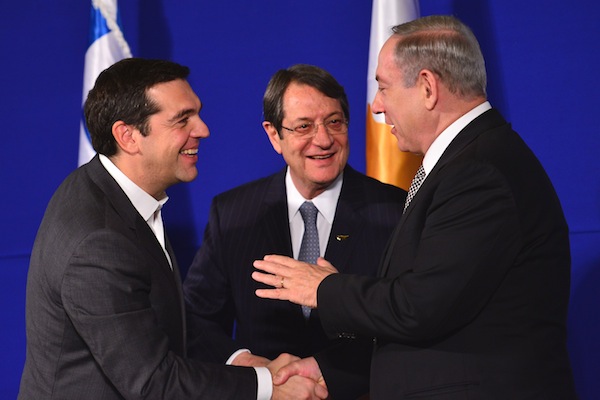
photo - Prime Minister Binyamin Netanyahu, left, Cypriot President Nicos Anastasiades, centre, and Greek Prime Minister Alexis Tsipras at a meeting in Nicosia to cement trilateral relations
Prime Minister Binyamin Netanyahu, left, Cypriot President Nicos Anastasiades, centre, and Greek Prime Minister Alexis Tsipras at a meeting in Nicosia to cement trilateral relations. (photo from Ashernet)
photo - Former Israeli prime minister Ehud Olmert at the Supreme Court in Jerusalem following the court’s decision to uphold his prison sentence
Prime Minister Binyamin Netanyahu, left, Cypriot President Nicos Anastasiades, centre, and Greek Prime Minister Alexis Tsipras at a meeting in Nicosia to cement trilateral relations. (photo from Ashernet)
photo - The Tamar gas rig in the Mediterranean, off the Israeli coast
The Tamar gas rig in the Mediterranean, off the Israeli coast. (photo from Ashernet)
photo - Prime Minister Binyamin Netanyahu outside Government House in Kenya, stepping out to inspect the honor guard
Prime Minister Binyamin Netanyahu outside Government House in Kenya, stepping out to inspect the honor guard. (photo from Ashernet)
photo - The almost-complete Jezreel Valley railway that goes from Haifa to the Jordanian border
The almost-complete Jezreel Valley railway that goes from Haifa to the Jordanian border. (photo from Ashernet)
photo - Goods from Turkey enter the Shalom Crossing into Gaza with goods from Turkey. Recently, Turkey and Israel resumed normal diplomatic relations for the first time since the 2010 Mavi Mamara affair
Goods from Turkey enter the Shalom Crossing into Gaza with goods from Turkey. Recently, Turkey and Israel resumed normal diplomatic relations for the first time since the 2010 Mavi Mamara affair. (photo from Ashernet)
Format ImagePosted on September 23, 2016September 21, 2016Author Edgar AsherCategories IsraelTags Greece, Israel, Jordan, Netanyahu, Obama, peace, refugees, terrorism, Turkey
A 22-year-old open wound

A 22-year-old open wound

Every year on July 18, thousands of people gather to remember the victims of the AMIA bombing, and demand that justice prevails. (photo by Jaluj via commons.wikimedia.org)

After more than 20 years, an entire nation continues to search for answers and justice.

With an estimated population of 330,000, Argentina’s Jewish community is the largest in South America and, outside Israel, the sixth largest in the world. First arriving in Argentina in early days, Jews have continued to immigrate ever since. During its “golden era” (1900s to 1950s), an estimated 500,000 Jewish people lived there.

The vast majority of Jews in Argentina are Ashkenazi, from central and eastern Europe. From the start, this active, prosperous and engaged community has left its mark in local business, infrastructure, culture and politics. My family was part of this group; Argentina was the place we called home and where four generations of my family were born. AMIA (Asociación Mutual Israelita Argentina or the Argentine Israelite Mutual Association) is the central support organization for all Jews in Argentina, tracing its roots back to 1894.

Everything changed the morning of July 18, 1994, at 9:53 a.m. While I was attending a history class, more than 600 pounds of explosives hidden in a vehicle were detonated in front of AMIA. The explosion was followed by a cloud of smoke and dust seen for miles. In seconds, along with the iconic Jewish organization in Argentina and everything surrounding it, the building housing all of Argentina’s rich Jewish history was, simply, gone. This tragedy was followed by panic, mayhem, sirens, ambulances, calls for help, deaths totaling 85 and hundreds more victims, severely injured and traumatized, transported to hospital.

At my school, phones started to ring. The principal rushed into our classroom to have a private word with our teacher, who then broke the news that AMIA in Buenos Aires was bombed. We were in shock. The same black dusty cloud that could be seen above AMIA descended upon the student body, the teachers and the administrative staff. Frantic activity ensued and, within a few hours, the school was deserted.

My first reaction was concern for my family and friends, many of whom worked at AMIA. I would soon learn that, although one miraculously survived under the rubble and a few others were spared, having not yet arrived at the time of the attack, three died in the explosion. I would learn of the tremendous cultural and historical loss of books, manuscripts, community records, art, pictures and more. I would learn of the disorientation felt by so many who could not comprehend the magnitude of the attack. And I would learn of the rage of those who survived their loved ones. To this day, I will never forget the conversations around the dinner table that revealed the pervasive feeling we were no longer safe.

Some of my friends were immediately withdrawn from the private Jewish school I attended and transferred to the public school system. I would learn of sentiments such as “Jews should be concentrated in one place and live together so innocent Argentines would not suffer.” Yet, in my mind, we were all Argentines.

Over the following years, as I transitioned from my teenage to adult years, I would learn of government cover-ups, of the miscarriage of justice, and of injustice done in the name of greed and corruption. I would also learn of Hezbollah, Iran and other terrorist elements suspected of involvement one way or another. And I would be constantly reminded of the pain of those left behind, and the impunity of the perpetrators, which reinforced the sense of insecurity that took over a proud and vibrant Jewish community.

In spontaneous reaction, hundreds showed up to the site where the AMIA building had stood. Many, my father was among them, were volunteering to assist in the rebuilding process. Those were dark days. The community needed to reorganize. Within a week of the attack at Pasteur 633, a community building a few blocks away began to function. As the temporary head office of AMIA, the Ayacucho 632 site became the place where families sought information about the victims of the attack and where AMIA resumed essential operations, especially those pertaining to social services and community relations.

The Ayacucho building also became the place in which I started my journey as a Jewish community volunteer and where I later decided to pursue a professional career serving the Jewish community.

Five years after the attack, on the original site, a new building was opened that symbolized the creative drive of a community willing to preserve the heritage of a cultural tradition that honors life and collective memory.

This July 18, as every year, the bombing was commemorated with a ceremony in front of the new, now heavily fortified, AMIA: This year’s ceremony marked 22 years since the attack, Argentina’s deadliest bombing ever.

The AMIA bombing was an assault on all society and one that has left deep political scars, not just upon Argentina’s Jewish community. It is a symbol of the entire Argentine state and a society still searching for the truth. And the truth – about a sophisticated terrorist act of mass murder that sent a brutal message of destruction and death – must come to light. The attack is a wound that remains open to this day.

I vow to neither remain silent nor rest until those guilty of these attacks are apprehended, and I hope that the Argentine government will make every effort to ensure that the terrorists responsible for this horrendous act are brought to justice.

Viviana, Cristian and Guillermo, I will never forget. Porque tenemos memoria, exigimos justicia. Because we have memory, we demand justice.

Nico Slobinsky is director, Centre for Israel and Jewish Affairs, Pacific Region. He was born and raised in Argentina before immigrating to Israel and, later, to Canada.

Format ImagePosted on July 22, 2016July 19, 2016Author Nico SlobinskyCategories Op-EdTags AMIA, Asociación Mutual Israelita Argentina, bombing, CIJA, justice, memory, terrorism
Particular and universal

Particular and universal

Vigils, like this one in Minneapolis, were held across North America to express grief and solidarity with the victims of the shooting in Orlando. (photo by Fibonacci Blue)

Still reeling from the latest gun attack in Tel Aviv, which killed four people last week, we awoke Sunday to the horrific news from Florida that a gunman had murdered 49 people in a gay nightclub in Orlando.

We whose job it is to put feelings into words struggle, though it seems nobody on social media lacks an opinion on gun control and the Second Amendment, homophobia or Islamic extremism, to which the murderer professed allegiance.

Immediately began the familiar cycle of Facebook solidarity, official condemnations and vigil-holding. President Barack Obama, who on the last such occasion of mass death declared, “Enough!,” had to conjure something original to say in this instance.

It is a peculiarity of the American political and cultural system that such tragedies are, it seems, accepted as a sad but unavoidable fact of life. Vested interests in the gun industry, which fund the powerful National Rifle Association, control members of Congress and have a not-insignificant base of grassroots Americans.

The murderer had been on the radar of intelligence authorities, yet he was able in the last two weeks to legally purchase a Glock pistol and a long gun, as was apparently his right as an American citizen.

When, in 2012, a gunman killed 20 children in Sandy Hook elementary school in Connecticut, some thought that would be the turning point, the moment some sense of sanity would be applied to guns in the United States. Nothing of substance changed and, if not then, it probably never will. Indeed, gun sales increase after such incidents, as the Wild West of American founding lore finds new life in the 21st century – self-preservation through firepower.

There are perhaps few who can as readily empathize with the LGBTQ community as members of the Jewish community. Jewish individuals and institutions are routinely targeted in Europe. Such incidents are far fewer but not non-existent in Canada and the United States. The ghosts of the 1994 Jewish community centre bombing in Argentina haunt us still. And Israelis are routinely attacked and killed by terrorists.

Though thousands of kilometres away from Orlando, the gay community and allies in Vancouver came together for a vigil Sunday night, as they did across North America. When an attack like this takes place against a small minority, it has particular resonance for members of that group even if they have no immediate connection with the victims. As a newspaper, we join with Jewish institutions and individuals in Canada in expressing grief and solidarity with the victims, the survivors and their loved ones, as well as with the entirety of the LGBTQ community here and everywhere.

After such tragedies, it sometimes seems that the particularity of the victims is downplayed to glean a universal lesson for humanity. We hear phrases like “injustice for one is injustice for all.” In his remarks Sunday morning, Obama said: “This is a devastating attack on all Americans.”

This is a necessary and true statement, but we shouldn’t only universalize our solidarity. The shooting was a deliberate, targeted attack on gay people and Obama’s remarks included articulate expressions of solidarity with the LGBTQ community. He did not, for example, make the same mistake he did during the Paris attacks, when he referred to Jewish victims as “a bunch of folks in a deli.” The Jewish particularity of the victims in Paris and the particularity of the Orlando victims’ sexual orientations must be recognized in order to confront the prejudices that underlie them.

Format ImagePosted on June 17, 2016June 16, 2016Author The Editorial BoardCategories From the JITags guns, homophobia, homosexuality, LGBTQ, Orlando, prejudice, terrorism

Focus on community safety

How safe is our community? That’s a question all of us ask from time to time, some of us on a daily basis as we come and go from our synagogue or community centre, or drop our kids off at school.

On April 4, dozens of members of the Jewish community across Canada participated in a webinar called Protecting Our People and Places: Redefining Risk, presented by insurance and risk management firm Arthur J. Gallagher Canada, which works internationally and has a significant presence in Canada. Speakers included Nir Maman, a krav maga expert with a background in security and policing in North America, Israel and elsewhere; Max Hazin of Northern Force Security; and Sam Feldman, Vishal Kundi, Justin Priestley and Paul Bassett of Arthur J. Gallagher. The webinar promoted the company’s insurance and risk management services, but also provided basic risk management information and a variety of community resources.

All of the speakers stressed that Canada is not immune to terrorist attacks and active shooter incidents of the kind seen in the United States and Israel. However, the webinar began with statistics that put the warnings into perspective: Between 2000 and 2006, Israel had suffered 27,905 terror attacks killing 1,116 Israelis and injuring 8,800; from September 2015 to the webinar date, 34 people have been killed in terror attacks and 400 injured.

Total casualties: 1,150 killed and 9,200 injured. Since 1973 until 2016, there have been 38 Islamic extremist terror attacks in the United States. Total casualties: 3,282 killed and 9,285 injured. Since December 1999, there have been four plots to carry out intended terror attacks in Canada and three perpetrated terror attacks. Total casualties: two killed and three injured.

Topics in the webinar included how to make a physical location an unattractive target to terrorists, how to create levels of resistance to a threat and how to handle an active shooter situation. Maman was critical of the security in place at most Jewish organizations as being more symbolic than effective, and stressed the need for training and education so as to empower people to protect and, if needed, defend themselves and their communities.

In his weekly email message on April 15, Jewish Federation of Greater Vancouver chief executive officer Ezra Shanken noted, “Over the past two years we have seen a rise in terrorist activity worldwide, some of which has targeted Jewish communities, such as in Paris and Copenhagen. While there has not been and is not currently an increased threat to our community, we should not assume that these types of events could never impact us.

“For many years, our Federation has taken a proactive approach to community safety and, in that vein, we have established the Community Security Committee, chaired by Bernard Pinsky, which is focused on identifying and assessing opportunities to enhance our collective safety. The committee will update the community about any security concerns, and will ensure community institutions have the appropriate protocols and technology in place to ensure maximum safety.”

Rabbi Dan Moskovitz of Temple Sholom told the Independent after the webinar that security is a way of life for modern Jewish communities, and will remain so for the foreseeable future. “This is just the way it is now,” he said. “In Europe, this type of security has long been the status quo. I remember one visit where you couldn’t enter a synagogue without someone in an orange jacket asking you what your bar mitzvah parashah was.

“Despite the lower risk level in Canada,” he continued, “cameras, security guards and security measures need to be in place both to deter attackers and to give people peace of mind. Many communities, like ours, have security committees, which receive training and actively protect the community. Many, some of whom have a background in the Israeli army or police training, see this as a sacred duty, as their calling in the community.”

For those who would like more information on safety protocols for the Jewish community, a number of useful resources can be found at chesedfund.com.

Matthew Gindin is a Vancouver freelance writer and journalist. He blogs on spirituality and social justice at seeking her voice (hashkata.com) and has been published in the Forward, Tikkun, Elephant Journal and elsewhere.

Posted on April 22, 2016April 20, 2016Author Matthew GindinCategories NationalTags safety, security, terrorism
Bleak future for Israel

Bleak future for Israel

Raphael Hoult, winner of the inaugural Barry Rubin Prize Essay Competition. (photo from Raphael Hoult)

“A Game of Clocks: An Analysis of the Situation in the Middle East and Its Effects on Israel” by Winnipeg’s Raphael Hoult is the winner of the Centre for Israel and Jewish Affairs’ inaugural Barry Rubin Prize Essay Competition.

Hoult, a physics major at the University of Winnipeg in his second year of studies, conjured up a mind-bending theory about the stability of Middle East security and consulted expert sources for his essay.

In physics, Hoult’s interests lie in the field of quantum gravitation, which attempts to combine two major theories – those of general relativity and quantum mechanics.

“These two theories don’t play well together,” said Hoult. “They conflict in places. The biggest place they conflict is in that every force in the universe has been quantized, meaning that we’ve found a very small, discrete package of it in the universe. For example, electromagnetism is delivered by something called a photon. The other forces have something that delivers them, as well. But, with gravity, we’ve found no such thing yet. What we say is we haven’t been able to quantify it, though there are a lot of theories out there for how to solve that problem. There’s string theory. Another is loop quantum gravity, that attempts to bring some parts together.

“I want to help look for a theory of quantum gravity, so we can finally resolve this dilemma … combine the two theories into one bigger theory, a more complete theory. And, hopefully, that will give us a lot more insight into the way gravity works and allow us to do more with our understanding of gravity – to utilize it more, similar to the way our deeper understanding of electricity and magnetism has allowed us to do more intricate electronics in the past couple years.”

According to Hoult, this reconciliation of quantum mechanics and general relativity has been the Holy Grail of physics for the past 50-some years, and solving it will be huge for physicists and the world as we know it.

“The proposed theoretical messenger particle for gravity is the graviton, which is something we’ve not yet observed at all,” he said. “Quantum mechanics requires there to be a graviton…. General relativity in no way makes reference to a graviton.

“The main thing is quantum mechanics works really well with very small things, general relativity works really well for really big things. Things with a lot of mass are usually very large. The problem comes when you have things that are very massive and also very small, such as neutron stars or black holes. These are very dense, have a lot of mass and exert a lot of gravitational force, but they are also very small. In the case of a black hole, they are actually on the atomic level. So, quantum mechanics is very important to the way they work, but general relativity also is in play. When our two theories don’t work and they are supposed to be working at the same time, that’s a problem and something we want to fix.”

In addition to his knowledge of physics, Hoult is also well-versed in Israeli politics. “I’ve actually never taken a political science course at university,” he acknowledged, “but I went to Gray Academy [of Jewish Education in Winnipeg], so I had a very strong basis in knowledge about Israel. I had a good grounding there. I also read the Times of Israel and Haaretz every day.”

When Hoult saw an advertisement for the Barry Rubin Essay Competition on Facebook, it piqued his interest. The contest topic was, “What does the current regional turmoil in the Middle East mean for Israel?”

In his essay, Hoult said, “The three main critical points I talked about were the constancy of Hezbollah, Hamas and Daesh (the Islamic State in Iraq and Syria [ISIS]). I wrote about the fact that Hezbollah is involved in the war in Syria, specifically as affiliates of Bashar Al-Assad. They support him and are fighting on behalf of him. On the flipside, a branch of ISIS, called Al-Wilayat Sinai, is operating in the Sinai Peninsula desert against the Egyptians, making their lives very difficult. They’ve also struck up an alliance with Hamas.”

According to Hoult, the main three players in regards to Israel involve Hezbollah in the north, Hamas in Gaza and Al-Wilayat Sinai (Daesh) in the south. Hoult does not delve into the Iranian threat in his essay, apart from Iran’s role in supporting these groups.

“My hypothesis was that these three forces are connected to one another,” he said. “And, because of the ongoing campaign against ISIS, my hypothesis is that, as soon as that campaign succeeds and breaks down ISIS, all hell will break loose for Israel.”

Hoult explained that this theory takes into account Hezbollah’s huge military arsenal, which is estimated at around 100,000 rockets, and their ability to hit every point in Israel from Metula to Eilat, combined with the southern threat from Hamas and from the Al-Wilayat Sinai, which, so far, has been mainly fighting the Egyptians.

“Once ISIS collapses in the north, the Al-Wilayat Sinai … will suddenly be like a tentacle that has been cut off from the squid,” he said. “It will have no control and will be in desperate throes to stay alive, making it likely that it will involve at least a couple cross-border raids. If those involve any Israeli deaths, it will force Israel to respond, which is an issue, due to the fact that Israel can’t cross the border without Egyptian permission.

“There is also the fact that Hamas is having another military build-up,” he added.

Hoult predicts this will likely lead to another war in 2017 and, once that war is over, he said Hezbollah would have had ample time to gather its troops and possibly attack Israel from the north. “This is not a good thing for Israel, as Hezbollah is dead set on destroying Israel if they can,” he said.

As to why Hoult thinks his essay was selected as the winner, he said he is not sure, although he imagines it may have “had something to do with all the sources cited, creating a compelling likelihood of my hypotheses coming true.”

One of his many concerns is that “the primary backer of Hezbollah and Hamas is Iran. Iran has just had billions of dollars unlocked, due to the nuclear deal … which I’m not going to condemn or support, though I’m a little bit skeptical of whether or not unlocking those funds was a good thing.”

 Rebeca Kuropatwa is a Winnipeg freelance writer.

Format ImagePosted on April 15, 2016April 13, 2016Author Rebeca KuropatwaCategories NationalTags Barry Rubin, CIJA, Daesh, Hamas, Hezbollah, Hoult, ISIS, Israel, terrorism

Posts pagination

Previous page Page 1 … Page 10 Page 11 Page 12 … Page 17 Next page
Proudly powered by WordPress