Skip to content
  • Home
  • Subscribe / donate
  • Events calendar
  • News
    • Local
    • National
    • Israel
    • World
    • עניין בחדשות
      A roundup of news in Canada and further afield, in Hebrew.
  • Opinion
    • From the JI
    • Op-Ed
  • Arts & Culture
    • Performing Arts
    • Music
    • Books
    • Visual Arts
    • TV & Film
  • Life
    • Celebrating the Holidays
    • Travel
    • The Daily Snooze
      Cartoons by Jacob Samuel
    • Mystery Photo
      Help the JI and JMABC fill in the gaps in our archives.
  • Community Links
    • Organizations, Etc.
    • Other News Sources & Blogs
    • Business Directory
  • FAQ
  • JI Chai Celebration
  • JI@88! video

Recent Posts

  • Sharing her testimony
  • Fall fight takes leap forward
  • The balancing of rights
  • Multiple Tony n’ Tina roles
  • Stories of trauma, resilience
  • Celebrate our culture
  • A responsibility to help
  • What wellness means at JCC
  • Together in mourning
  • Downhill after Trump?
  • Birth control even easier now
  • Eco-Sisters mentorship
  • Unexpected discoveries
  • Study’s results hopeful
  • Bad behaviour affects us all
  • Thankful for the police
  • UBC needs a wake-up call
  • Recalling a shining star
  • Sleep well …
  • BGU fosters startup culture
  • Photography and glass
  • Is it the end of an era?
  • Taking life a step at a time
  • Nakba exhibit biased
  • Film festival starts next week
  • Musical with heart and soul
  • Rabbi marks 13 years
  • Keeper of VTT’s history
  • Gala fêtes Infeld’s 20th
  • Building JWest together
  • Challah Mom comes to Vancouver
  • What to do about media bias
  • Education offers hope
  • Remembrance – a moral act
  • What makes us human
  • המלחמות של נתניהו וטראמפ

Archives

Follow @JewishIndie
image - The CJN - Visit Us Banner - 300x600 - 101625

Tag: Sukkot

Looking for new Jewish ideas

By the time you read this, our big run of fall Jewish High Holidays will be over. However, I’m still gathering up bits and pieces about it. What did I experience? What worked out and what didn’t? This isn’t a yes or no question, it’s complex. It takes time to process the intensity of what I learned.

Like many parents with kids, I don’t attend a full complement of adult religious services. Even if I didn’t have younger children, we’d still have to find dress clothes for everyone and make sure holiday meals are ready, never mind actually working for a living. Every fall is a juggling act. Will it work out smoothly? Sometimes it is good planning. Sometimes, it’s luck.

This year, I managed to access several sermons, done by various rabbis I know and respect. Some were published to the internet on the day after the holiday. Others were live-streamed.

Via the internet, I read the Rosh Hashanah sermons of a Long Island rabbi with whom I have studied and become friendly over the past year or two. Rabbi Susan Elkodsi shared several of her sermons as blog posts after the holiday. One sermon covered the confluence of 9/11 with the High Holidays. The other talked about how we connect with our ancestors over the New Year period, and how the “who will live and who will die” metaphor becomes alive for many.

For me, both of these topics struck home. My family in New York City and in D.C. lived through 9/11. Also, every time I sing the holiday Kiddush, it is as though I hear my grandfather, z”l, singing it. He sang it at my family’s holiday table, and he taught me to do it as a young adult. On erev Rosh Hashanah this year, I could hear his voice in my ear, although he died long ago. Thanks to those sermons, I have some Jewish historic context for two strong emotional memories.

Elkodsi’s next blog post covered a “water-optional” version of Tashlich, when people gather to throw their sins or breadcrumbs into the water. She described how Tashlich might be the time to clean up or discard the things that are holding us back or for which we can no longer find a use. In a sense, it’s a “KonMari” cleaning method for our lives. This, too, found resonance with me. I used it as unconscious encouragement – my kids and I cleaned up their art shelf, play room and living room toys before Yom Kippur. This mess weighed me down. Together, we cast it off to have a better start to 5779.

This year, even though we didn’t travel there, we heard Kol Nidre, sung in Virginia, and saw my father, as a past president, holding a Torah on the pulpit of my family’s congregation. How did we pull that off?

On erev Yom Kippur, my kids got into their pajamas. We read stories and got ready for bed. At exactly 7:30 p.m. CT, we started live-streaming the Temple Rodef Shalom Kol Nidre late service. My kids worried that the Torah was too heavy for their grandfather. (I did, too.) Later, my mom told me that past presidents on either side of my dad were spotting for him, and that my dad also recognized that this would probably be the last year he could do this. Torahs are heavy. Nobody wants to drop one. We felt the power of connecting with family, seeing my father do a mitzvah, and something difficult, at a big holiday service.

My kids made it until about 8:15, staying up through the Kol Nidre prayer and the first part of the service before they fell asleep. Using headphones, I listened to the rest of the service until, for some reason, I couldn’t access the live-streaming anymore. By then, I’d heard about how we should see teshuvah (repentance) through the eyes of a failing U.S. criminal justice system. It’s hard to balance the needs of victims, cope with crime and also give people who’ve made mistakes a second chance. Rabbi Jeffrey Saxe, a victim of violent crime, gave the sermon. He explained his social action efforts to advocate for reform with an interfaith clergy group that meets with Virginia’s governor.

I’m mentioning the positive things I can fit in one column. Sometimes accessing diverse voices, from every movement, with different Jewish experiences, enriches our observance. There’s no way my body could have been in synagogue in Manitoba, New York and Virginia. The traveling would have been torture, never mind the cost! However, my mind traveled. This helped me think about new things for 5779.

Some say that the High Holidays are the most important days of the Jewish year, but I’d argue that they are the most intense. Shabbat every week is important. All the other holidays have value, too. The thing about rituals, traditions and observance is that they don’t have an on/off switch. If we shift ourselves just a little, attend a different Jewish service, listen to a new sermon or approach things differently, we can have a startlingly new experience.

Most people attend one congregation all the time, hear one or two rabbis’ sermons and rarely see something new. It’s a lot of effort to break routines. Change is hard. However, every day is an opportunity to look up and find new things in our Jewish landscape. Sometimes, a slight shift in how we see our rituals (dog walks, meditations, synagogue services) can change the way we see the whole world. It’s going to take me time to sort through what I learned and what changed. I hope you, too, can take that time to gain something new, to learn something about the Jewish world, through this kind of exploration.

Joanne Seiff writes regularly for CBC Manitoba and various Jewish publications. She is the author of three books, including From the Outside In: Jewish Post Columns 2015-2016, a collection of essays available for digital download or as a paperback from Amazon. See more about her at joanneseiff.blogspot.com.


Posted on October 5, 2018October 3, 2018Author Joanne SeiffCategories Op-EdTags Judaism, lifestyle, Rosh Hashanah, Sukkot, Susan Elkodsi, Yom Kippur Kol Nidre
Sukkot in Jerusalem

Sukkot in Jerusalem

A Canadian delegation was among some 6,000 participants in the International Christian Embassy’s annual Sukkot march through the centre of Jerusalem last week. (photo from Ashernet)

Format ImagePosted on October 5, 2018October 3, 2018Author Edgar AsherCategories Celebrating the Holidays, IsraelTags Sukkot

Striving and building more

I wanted to share an interesting issue I stumbled into while reading online. It was in a Jewish discussion group. The short version (without violating anyone’s privacy) was that one person would be having surgery in the days before Yom Kippur. She was struggling with the concept that she couldn’t fast, as she had to be eating and drinking frequently, in small amounts, after the surgery.

It took me a while to figure this post out. This was bigger than the observance of a specific commandment. This was a person who was having a weight-loss procedure. Her issues around food were likely larger than fasting on Yom Kippur. The people in the discussion group emphasized how important the surgery was to her long-term health. (Nobody embarrassed her by asking difficult questions.) Meanwhile, another person in the group was having shoulder surgery. She worried about how she would hold a prayer book. This seemed easier to solve, as it was a physical and not a psychological issue. Suggestions flew across the web: a music stand, a lectern, a friend who could help, etc.

As a kid, growing up in the Reform movement, there was a great emphasis put on fasting on Yom Kippur. Fasting was a sign that you were really invested in the holiness of the day. Yet, this wasn’t something done on other fast days, or even in terms of other mitzvot (commandments). My family was involved in the Jewish community every day, but, on Yom Kippur, I remember seeing people at our congregation putting a big energy into fasting that I hardly saw at other times of the year.

When I was in university and when I met my husband, I was introduced to people with many other ways of observing Jewish tradition (or not). His family is everything from secular to Lubavitch, with every variation in between. He pointed out that, if you’re sick, a rabbi would tell you not to fast. He pointed out that, in his extended family, there were people who fasted but did not attend synagogue, and those who attended synagogue daily, but couldn’t fast for health reasons. He reminded me that this isn’t clear-cut, even if it initially looks that way.

When we learn about Judaism, often as kids before bar or bat mitzvah age, we’re presented with a lot of information in binaries. It’s black and white, but that is also the way most grade school children absorb any new information, not just Jewish content. As we age, we learn that, in fact, the world is often more complex. It’s often multiple variations of grey (never mind chartreuse) instead.

Health issues, child rearing, our work lives – these all affect how we observe holidays. There is no universal measuring stick that indicates how this works, either. Things change over our lives, and having kids or an illness can affect our observances. Some people fast easily, and others build sukkot (temporary hut dwellings) without a fuss. Others cannot fast without serious issues, and I’d bet there are plenty of people in the Jewish community who hesitate, for one reason or another, to erect a sukkah on their own.

The thing that hopefully does remain constant, for everyone, is the emphasis on striving to be better people in the year to come. Wherever you are, in your Jewish practice, or in the way you treat others, or in your business dealings, you can probably grow and improve. We can choose to make change in our lives.

There are, of course, people out there who are Jewish but don’t think about mitzvot, attend any synagogue or fast. However, some of these same people may pride themselves in being ethical in their business, in how they treat others, or in how they treat animals. They may not even realize that these, too, are Jewish values.

There are also so many ways in which these are particular Jewish concerns that link us to other faith communities. One of the pillars of Islam is jihad and, no, it’s not all about holy war. For faithful Muslims, this concept is about striving – striving to be a better student, family member or worker, to be more religious or spiritual, and onwards. Christians often speak about love, but also it must be put into action. It’s work to make compassionate acts towards others a priority, no matter your religion.

Whatever your community, you can offer others a supportive presence that helps them become the people they aim to be. It’s in a community, whether it’s physical or an online discussion group, that we can unwrap our concerns and get help in solving obstacles that keep us from doing what we’d hoped in life (Jewishly, or otherwise).

I love Sukkot and am looking forward to spending time in the sukkah outdoors. However, it’s also a time to welcome people in as guests – and to build that supportive space. You may not build a sukkah or wave a lulav and etrog, but you can be a builder. Begin by supporting others as they strive towards being their best selves. It starts with a smile, a welcoming invitation or a positive response. Happy 5779! May it be everything that you hope to become!

Joanne Seiff writes regularly for CBC Manitoba and various Jewish publications. She is the author of three books, including From the Outside In: Jewish Post Columns 2015-2016, a collection of essays available for digital download or as a paperback from Amazon. See more about her at joanneseiff.blogspot.com.
Posted on September 21, 2018September 20, 2018Author Joanne SeiffCategories Op-EdTags Judaism, Rosh Hashanah, spirituality, Sukkot, Yom Kippur
Sukkot at the Bayit

Sukkot at the Bayit

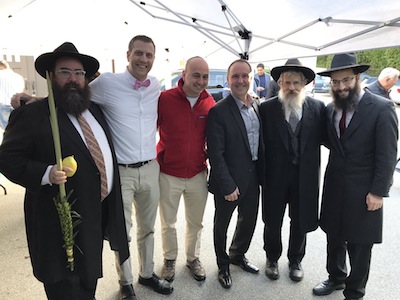
Bayit Rabbi Levi Varnai, MLA Jas Johal, Chabad of Richmond Rabbi Yechiel Baitelman, Bayit board member Keith Liedtke, Joe Dasilva, Bayit president Michael Sachs, MLA Mike Bernier, MLA Teresa Wat and MLA John Yap. (photo by Lauren Kramer)

photo - Rabbi Yechiel Baitelman, Michael Sachs, Jewish Federation of Greater Vancouver head Ezra Shanken, Mike Bernier, Rabbi Avraham Feigelstock and chief executive officer Rabbi Levi Varnai
Rabbi Yechiel Baitelman, Michael Sachs, Jewish Federation of Greater Vancouver head Ezra Shanken, Mike Bernier, Rabbi Avraham Feigelstock and chief executive officer Rabbi Levi Varnai. (photo by Lauren Krame

On the evening of Oct. 8, the Bayit and Chabad of Richmond hosted a Sukkot carnival called Shakes in the Shack. Scores of Richmond Jewish, and non-Jewish, community members came out and enjoyed the festivities.

Format ImagePosted on October 20, 2017October 19, 2017Author The BayitCategories Celebrating the HolidaysTags Bayit, Chabad of Richmond, Judaism, Sukkot

Sukkah more than symbolic

As we celebrate Sukkot this week, we’ll be thinking about many things – notably, how lucky the vast majority of us are to have a solid roof over our heads. For most of us, the sukkah is but a symbol of our wandering in the desert all those years ago, a symbol to remind us to be humble, empathetic, grateful. However, for many living in Metro Vancouver, including members of our own community, homelessness is a reality.

Last week, we ran a good news story from Tikva Housing Society – residents were moving into the recently completed Storeys complex in Richmond. The Diamond Residences at the Storeys will house six singles (five of whom are seniors) and 12 families. Tikva Housing is also working with various partners on the development of 32 townhouses in Vancouver, and they anticipate accepting residency applications by early 2018. These new projects are in addition to Tikva’s Dany Guincher House, in Vancouver – which has 11 units for people with low-income, people with disabilities who are independent and families fleeing abuse – and the Esther Dayson Rent Subsidy Program.

There is a lot of which to be proud. However, there is much more to do. Last year, Tikva Housing reported a decrease in donations to its rent subsidy program of more than $15,000. As a result, the organization had to decrease the monthly subsidy it provided to singles, couples and families.

According to Tikva, more than 16% of Jewish Vancouver residents – more than 4,200 people – are low-income and at least 450 Jewish children under the age of 15 in Vancouver are “living in households that depend on income assistance.” Its 2015 report on housing in Metro Vancouver concluded a need for 1,827 affordable housing units in the Jewish community, including for “those under 65, low-income singles, couples and families.” Calling this “an unreachable goal,” the report nonetheless suggests some solutions, most of which the Jewish community is already pursuing, such as rent subsidies and partnering with other agencies to develop new projects.

Yet, the problem remains. And, of course, it is not a problem unique to the Jewish community. On Sept. 26, the final report on Metro Vancouver’s 2017 Homeless Count was released. On the night of March 7, more than 1,200 volunteers conducted surveys throughout the region, on the streets and at shelters, “to obtain a 24-hour snapshot” of the situation. The final report confirmed the preliminary results – 3,605 were homeless in the metro area.

While there were four percent fewer homeless youth in 2017 as compared to 2014, there were five percent more homeless 55 and older. Overall, there was a 30% increase in homeless since 2014, “and the highest number since 2002, when the first metro-wide count occurred.”

According to the report, “The three most cited barriers to finding housing were the high cost of rent (50%), a lack of income (49%) and the lack of availability of housing that suits their needs (30%).” More than 80% of respondents reported having “at least one health condition, including addiction, mental illness, physical disability or a medical condition/illness. More than half of the respondents (52%) have two or more health conditions.” More than 40% of respondents received income assistance, 28% a disability benefit; 22% were employed.

Following the local Walk for Reconciliation on Sept. 24, where some 50,000 people – including an organized Jewish contingent – gathered downtown to join in a “call to action,” it is sobering to learn that 34% of the respondents of the Homeless Count self-identified as indigenous/aboriginal. “Indigenous people continue to represent about one-third of the homeless population in the region,” states the report, noting that it’s the highest proportion found to date in a regional count and “constitutes a strong over-representation compared to the total population, where two percent identify as aboriginal as per the 2011 Census.”

In a statement of the obvious, Mike Clay, chair of the Metro Vancouver Housing Committee, said, “In order to stem growing homelessness, it is clear we need more affordable housing options.”

But additional solutions are also needed, given the systematic discrimination that still exists for First Nations people and the health conditions many of the homeless are facing – and not only the homeless. Just last week, the Independent ran an article on the impact of addiction in our community. Jewish Addiction Community Service (JACS) Vancouver estimates that as many as 5,000 Jews in our community need support, “whether grappling with their own addiction issues or the addiction of a loved one.”

The Homeless Count’s findings most likely underestimate the problem. The report references the “hidden” homeless, which includes people “who do not have a regular address of their own where they have security of tenure, and who may be staying temporarily in another household – often called ‘couch surfing.’” The Tikva Housing press release about the new tenants at Storeys noted, “One 83-year-old woman cried when she was told she would be moving into a studio unit, as she has not had a place to live for years and was sleeping on someone’s couch.”

Then there are the tens of thousands of people at risk of becoming homeless. Apparently, housing shouldn’t account for more than 30% of a person’s or family’s gross income, yet the Homeless Count report notes there were 56,000 Metro Vancouver households in 2006 that spent more than 50% of their income on shelter, and the number had increased to 62,355 by 2011. (More recent data weren’t available but, based on skyrocketing housing costs, we can guess that the number of households spending 50% or more of their income on shelter has also increased.)

There is much to contemplate as we gather in our sukkot this week. And, once the holidays are over, once we celebrate Simchat Torah, thankful for the Jewish texts and traditions that have shaped the moral compass of even the most secular of us in some way, there is a lot of work to be done.


Posted on October 6, 2017October 5, 2017Author The Editorial BoardCategories From the JITags addiction, homelessnes, JACS Vancouver, Sukkot, Tikva Housing
Mayor visits the Bayit

Mayor visits the Bayit

On Oct. 19, Richmond Mayor Malcolm Brodie, second from the right, joined the Bayit’s celebration of Sukkot. He is pictured here with, from the left, Michael Sachs, Bayit president; Miki Fadida, sponsor of the Fadida Family Sukkah; Rabbi Levi Varnai, spiritual leader of the Bayit; and Moshe Fadida. The mayor discussed the local Jewish community, as well as some of the challenges facing young families. (photo from the Bayit)

Format ImagePosted on October 28, 2016October 27, 2016Author The BayitCategories Celebrating the HolidaysTags Sukkot, synagogue

Finding joy

From the solemnity of Yom Kippur, we move into the season of rejoicing, Sukkot. As with many of our traditions, this one has multiple layers. The shelters for which the holiday is named represent temporary dwelling places, the transitory generations on the way from bondage in Egypt to the Promised Land and, by extension, the impermanence or fragility of Jewish security.

It would be an understatement to say that the creation of the state of Israel 68 years ago changed Jewish perceptions of ourselves and our place in the world. The existence of a Jewish state presented an alternative for Jewish people living in places of repression and danger. For Jews living in free countries, like Canada, Israel is a source of pride but also the source of a deeply complicated and often challenging reconfiguring of our identities. Diaspora Jews, prior to the success of Zionism, were subject to the changing winds and whims of local populations and leaders. For a few years after the War of Independence, Israel was widely admired around the world as a model of what a new country can be. This was also a time in history when antisemitism may have been at its lowest ebb, or at least at its least visible. For emerging postcolonial states in 1950s and ’60s Asia and Africa, Israel’s head start provided a template for independence and progress.

After the 1967 war, though, the perception of Israel morphed from a model for post-colonialism to one of neo-colonialism, and Palestinians replaced Jews as a cause for progressive peoples. In the time since, Diaspora Jews have often been placed in the position of defending (or not defending) things that Israel does. Yet it remains a haven for Jews who are threatened in their homelands, including, incredibly, in parts of Europe. For those Jews who feel safe in our countries, Israel is also a beacon – of Jewish diversity, knowledge and technological innovation.

The Promised Land, as our historical narrative tells us, was not a place of permanent joy. Twice the Temple would be destroyed and the people dispersed. The impermanence of Jewish sovereignty, even after the ancient return of the exiles, would carry on another two millennia until 1948. The sukkah is a symbol, too, of that impermanence.

And yet, it also represents a joyfulness based on our people’s adaptability and willingness to find a unity and presence even in places and times of disunity and impermanence. And, at the end, we observe Simchat Torah, a celebration of the written word that many believe is the very reason a homeless people were able to maintain cohesion and continuity through generations of dispersion.

Posted on October 14, 2016October 13, 2016Author The Editorial BoardCategories From the JITags High Holidays, Israel, Jewish life, Judaism, Simchat Torah, Sukkot
Beautifying a sukkah

Beautifying a sukkah

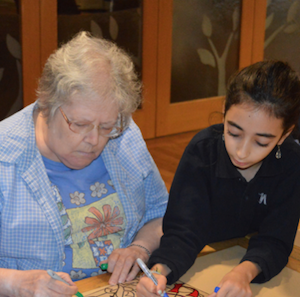
Grade 6 and 7 girls of Vancouver Hebrew Academy joined Louis Brier Home and Hospital residents in making decorations for the home’s sukkah. (photos from Vancouver Hebrew Academy)

photo - Grade 6 and 7 girls of Vancouver Hebrew Academy joined Louis Brier Home and Hospital residents in making decorations for the home’s sukkahJust before Sukkot, the Grade 6 and 7 girls of Vancouver Hebrew Academy were warmly welcomed to Louis Brier Home and Hospital, where they visited with the residents and worked on a special project. Together, the students and residents created stained glass-style decorations for the Louis Brier’s sukkah.

It is a mitzvah to beautify the sukkah and, in this art project, several mitzvot overlapped, including connecting the younger generation with those who laid the groundwork for our community – for which we are grateful – and helping both the residents and children celebrate the holiday of Sukkot with an extra level of beauty and simcha.

Format ImagePosted on November 27, 2015November 24, 2015Author Vancouver Hebrew AcademyCategories LocalTags Louis Brier Home and Hospital, sukkah, Sukkot, VHA
Reminder of fragility

Reminder of fragility

Until this summer’s drought, most Vancouverites would have prayed for weather that made their umbrellas unnecessary. These High Holidays, however, many of us will be joining more wholeheartedly in the prayer for rain. (photo by Cynthia Ramsay)

I never gave much thought to the significance of rain until I moved to Miami. Rabbis in Miami face the High Holiday season with more than the usual rabbinic anxiety. In South Florida, the High Holiday season coincides with hurricane season. In the last several years of Florida living, I have reflected often on the ways in which Judaism invests rain with religious meaning. Prayers for rain mark the culmination of the High Holiday season.

The land of Israel is known as the land “flowing with milk and honey.” However, Israel is not a land flowing with water. The limited resource of water in the Holy Land is a central feature of biblical theology. Rain in the Promised Land plays an essential role in the covenantal relationship between God and the Jewish people.

Deuteronomy explains the unique spiritual essence of precipitation in the land of Israel. Unlike Egypt, where the water comes up from one’s feet, Israel is a land where people must look to the heavens for rain. In Egypt, it was easy to fall into idolatrous practices. The natural abundance of water from the Nile made the Egyptians worship the products of their own hands. However, this spiritual shortcoming is prevented in a land where the natural resources are scarce. The need to look heavenward for rain and the need to pray for rain continually remind the Israelites of God’s involvement and concern for our livelihood. “It is a land which the Lord your God looks after, on which the Lord your God always keeps His eye, from year’s beginning to year’s end.” (Deuteronomy 11:10)

God’s responsibility for dispensing rain in the land of Israel is a central aspect of our covenantal identity. Not only do we live in a land that depends upon God for rain, but God’s gift of rain will be conditioned upon the fulfilment of our covenantal duties. Every day, twice a day, the Jewish people express our love and commitment to God in the words of the Sh’ma.

The second paragraph of the Sh’ma is an excerpt from Deuteronomy about the connection between our covenant with God and rain: “If, then, you obey the commandments that I enjoin upon you this day, loving the Lord your God and serving Him with all your heart and soul, I will grant the rain for your land in season…. Take care not to be lured away to serve other gods and bow to them; for the Lord’s anger will flare up against you, and He will shut up the skies so that there will be no rain….” (11:13)

The notion that the natural events of weather are reflective of God’s covenantal relationship with the Jewish people is a difficult one for many modern Jews. This paragraph is omitted in the version of the Sh’ma found in Reform prayer books.

However, the theological lessons of Deuteronomy can be teased out without adopting a literal reading of the text. Is it true that rain falls in Israel only if the Jewish people are observing all the commandments? Or perhaps our daily recitation of the Sh’ma establishes a consciousness about our fragility in a world where we cannot control the elements. In such a world of limited human power, we recognize that our lives are a gift from God. The recognition of our dependence leads to a sense of responsibility. The Jewish response to the precarious nature of life is to find meaning and purpose in commandedness. Rain in the land of Israel serves as a reminder of our covenant with God.

According to the Torah, the scarcity of rain in Israel is a spiritual safeguard. As the Israelite nation prepares to enter the Promised Land, the Book of Deuteronomy is consumed with a fear regarding the spiritual danger of sovereignty. Once we leave the desert and settle in our own land, we might forget about God’s role in our lives:

“When you have eaten your fill and have built fine houses to live in … and everything you own has prospered, beware lest your heart grow haughty and you forget the Lord your God … who led you through the great and terrible wilderness … a parched land with no water in it, who brought forth water for you from the flinty rock; who fed you in the wilderness with manna … and you say to yourselves, ‘My own power and the might of my own hand have won this wealth for me.’ Remember that it is the Lord your God who gives you the power to prosper.” (8:12-18)

For 40 years, the Israelites depended upon God for sustenance in a hostile environment lacking natural resources. That dependency cultivated an intimacy with God and an appreciation for our human weakness. However, when we enter the Promised Land, and we build our own houses and plant our own crops, we might grow arrogant and distant from God.

According to the medieval commentator Rashbam, it is precisely because of this threat that God instituted the festival of Sukkot at the time of the harvest, when we are most likely to glorify in our material success:

“Therefore, the people leave their houses, which are full of everything good at the season of the ingathering, and dwell in booths, as a reminder of those who had no possessions in the wilderness and no houses in which to live. For this reason, the Holy One established the festival of Sukkot … that the people should not be proud of their well-furnished houses.” (Rashbam, Commentary on Leviticus 23:43)

The purpose of dwelling in the sukkah, according to Rashbam, is to remind us of our vulnerability in the desert and to return us to that ideal spiritual state of humility and dependency. Without a yearly reminder of our frail human condition, we might grow too haughty in our own land and begin to worship the power of our own hands.

The festival of Sukkot culminates in the holiday of Shemini Atzeret. This obscure holiday embodies one main ritual – tefilat geshem, the prayer for rain. Focusing on the uncertainty of rain is the perfect conclusion to the High Holiday season. One of the recurring themes of the High Holidays is the nature of human mortality. As human beings, our existence is vulnerable and ephemeral. Will we even be here next year? “Who shall live, and who shall die … who by fire and who by water?” This yearly reminder of our fragile human condition is meant to jolt us out of our complacency, to inspire us in our search for greater meaning and purpose in life.

This central High Holiday motif finds its dramatic finale in tefilat geshem, as the cantor comes forward during the musaf prayers, dressed in a kittel, the white burial shroud, and invoking Yom Kippur melodies. We conclude the spiritual marathon of the High Holidays with prayers for rain, humbled by the awareness of our fragility and our dependence upon God for sustenance and survival. As we pray for rain, we also rejoice in the notion that God cares for us and keeps His eyes on us, from year’s beginning to year’s end. Rain will be a daily reminder of our human limitations and the greater meaning and purpose we can find in accepting a covenant with God.

On this Shemini Atzeret, may our prayers for rain remind us of our vulnerabilities and our responsibilities to God, “Who causes the wind to blow and the rain to fall.”

This article was originally published in the Jewish Week and can be found on the Shalom Hartman Institute website, hartman.org.il. It is reprinted with permission.

Format ImagePosted on September 11, 2015September 9, 2015Author Lauren BerkunCategories Celebrating the HolidaysTags High Holidays, rain, Shemini Atzeret, Sukkot, tefillat geshem

Tikva’s rent subsidy program

“Thank you for the gift you gave us this coming year. You made our lives less challenging during these difficult times. We are very grateful for your help and support. We have just received the cheque from you. Thank you so much for all you are doing for our family.”  – A beneficiary of Tikva Housing Society’s Esther Dayson Rent Subsidy Program

Sukkot is a holiday when we think about how fragile and exposed our lives can be without a proper roof over our heads. For many families in our community, living in a temporary shelter is not a short-term symbolic choice for the holidays; it is their permanent reality. Tikva Housing Society helps individuals and families pay their rent through a growing rent subsidy program.

The program began in 2011, when the board approved a subsidy for an individual who could not be housed at Tikva’s Dany Guincher House because there was a shortage of available units. Later that year, the Ben and Esther Dayson Charitable Foundation made a commitment to fund a rent subsidy program that would allow Tikva to extend its portfolio by housing people in private market units. The program thus became the Esther Dayson Rent Subsidy Program and grew large enough to subsidize seven households. In 2013, the Tikva fund subsidized three single and four family households for a total of 19 persons.

Since October 2011, Tikva has been involved in a Richmond development to administer 10 family apartments and, since December 2012, it’s been involved in Vancouver in a development of 32 townhouse units. As construction can take years to complete and the need for affordable housing is immediate, Tikva’s board decided to put greater emphasis into fundraising for the rent subsidy program. In 2014/15, with additional help from donors (such as the PAID Foundation and the Al Roadburg Foundation), Tikva will be able to house nine singles and eight families for a total of 39 persons.

During August and September 2014, the committee received 44 applications referred through the Jewish Family Service Agency, synagogues and Jewish day schools. All applications were point scored to determine the highest need. The top 20 applicants were interviewed. To date, agreements have been signed with 12 applicants. Of the 20 applicants interviewed, four singles and one family were homeless. The subsidy will allow all those funded to look for appropriate rental units to call home.

You may wonder what sort of poverty issues the 44 applicants for Tikva’s rent subsidy program experience. Here is a sampling of some of their stories.

Five of the applicants are homeless, living on the street, in shelters and couch surfing. One of the homeless applicants is a single father with three children who arrived in Vancouver in April 2013 after losing all they had during flooding in Saskatchewan. The Esther Dayson Rent Subsidy Program allowed this family to move out of the shelter where they were living and move into a three-bedroom apartment. The children will now be enrolled in the nearby school and the father will be able to look for work in the community.

A single woman moved to British Columbia from Alberta and does not meet the one-year residency requirement to apply for government rental assistance. Rents in Greater Vancouver are much higher than in Lethbridge, and her $1,100 pension barely allows her to pay $750 for rent, while leaving only $350 for all of her other expenses.

Another family of two parents and two small children lives in Surrey. They were relying solely on a disability pension after the husband was injured in a work-related accident that left him paralyzed. The wife looks after her husband and their small children and, therefore, cannot work outside the home.

While spending a cool evening in the sukkah, remember how important it is for each and every person to have the warmth and stability of his/her own home. For more information about the Tikva Housing rent subsidy program or to donate, visit tikvahousing.ca.

Susan J. Katz is a freelance writer, pastoral-care consultant and musician living in Vancouver. Her website is susanjkatz.com.

Posted on October 10, 2014October 9, 2014Author Susan J. KatzCategories LocalTags Esther Dayson, rent subsidy, Sukkot, Tikva Housing Society

Posts pagination

Previous page Page 1 Page 2 Page 3 Next page
Proudly powered by WordPress