Skip to content

  • Home
  • Subscribe / donate
  • Events calendar
  • News
    • Local
    • National
    • Israel
    • World
    • עניין בחדשות
      A roundup of news in Canada and further afield, in Hebrew.
  • Opinion
    • From the JI
    • Op-Ed
  • Arts & Culture
    • Performing Arts
    • Music
    • Books
    • Visual Arts
    • TV & Film
  • Life
    • Celebrating the Holidays
    • Travel
    • The Daily Snooze
      Cartoons by Jacob Samuel
    • Mystery Photo
      Help the JI and JMABC fill in the gaps in our archives.
  • Community Links
    • Organizations, Etc.
    • Other News Sources & Blogs
    • Business Directory
  • FAQ
  • JI Chai Celebration
  • JI@88! video
image - Weizmann Canada Physics Tournament 2025
image - The CJN - Visit Us Banner - 300x600 - 101625

Recent Posts

  • היהירות היא אחד האויבים הגדולים ביותר של ישראל
  • Vrba monument is unveiled
  • Music to build bridges
  • A better future possible
  • Anne Frank exhibit on now
  • Human rights in sport
  • Telling the story of an icon
  • Crawl bigger than ever
  • JCC Maccabi in Toronto
  • A way to meet fellow Jews
  • Time to include
  • Add Jewish joy to the mix
  • Reminder of humanity’s light
  • From the archives … editorials
  • Year-round holiday recipes
  • מדוע עזבתי את ישראל ואינני חושב לחזור ארצה
  • OJC hosts Oct. 7 memorial
  • A journey beyond self
  • Antisemitism a problem
  • Young man is missed
  • Orr action sparks complaint
  • Prison sentence for hate
  • Etgar Keret comes to Vancouver
  • New fall lecture series
  • Series explores music
  • Doc on Zapiro screens Nov. 6
  • Joy of shared existence
  • Community milestones … October 2025
  • MAID vs Jewish values
  • Cheshvan a great month, too
  • Bull, bear or bubble?
  • From the archives … a coin, etc.
  • מדוע האנטישמיות הולכת וגואה בעולם
  • New bio gives Vrba his due
  • Joy brighter than ever
  • When approaches differ

Archives

Follow @JewishIndie

Tag: Nazis

Revealing truth elicits threats

Revealing truth elicits threats

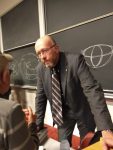
University of Ottawa’s Prof. Jan Grabowski delivered the Rudolf Vrba Memorial Lecture at the University of British Columbia Nov. 15. (photo by Pat Johnson)

Jan Grabowski, a University of Ottawa professor who is a leading scholar of the Holocaust, delivered the annual Rudolf Vrba Memorial Lecture at the University of British Columbia Nov. 15 – the same day he filed a libel suit against an organization aligned with Poland’s far-right government.

The Polish League Against Defamation, which is allied with the country’s governing Law and Justice Party, initiated a campaign against Grabowski last year, accusing him of ignoring the number of Poles who saved Jews and exaggerating the number of Jews killed by their Polish compatriots. Grabowski’s book, Hunt for the Jews: Betrayal and Murder in German-Occupied Poland, won the 2014 Yad Vashem International Book Prize for Holocaust Research. An English translation of an even more compendious multi-year analysis undertaken by a team of researchers under Grabowski’s leadership will be published next year. His Vrba lecture provided an overview of some of the findings in the new work. It is a harrowing survey that brought condemnation from Polish-Canadians in the Vancouver audience.

The new book, which does not yet have an English title, is a work of “microhistory,” Grabowski said. Holocaust studies is one of the fastest-growing fields of historical research, he said, partly because it got off to a slow start and really only picked up in the 1980s. Much of the written work being completed today is in the area of survivor memoirs, second- and third-generation experiences, including inherited trauma, and “meta-history,” the study of the study of the Holocaust.

“This assumes that we actually know what has happened,” he said. Grabowski maintains there is still much primary research to be done. “We are still far away from knowing as much as we should about this, one of the greatest tragedies in human history.”

There are millions of pages of relevant historical documentation almost completely untapped – primarily in provincial Polish archives, police records and town halls – that spell out in detail the often-enthusiastic complicity of Poles in turning on their

Jewish neighbours. By combing through these previously ignored records, Grabowski and his co-authors have amassed evidence of widespread – and eager – involvement of Polish police and other Poles in assisting Germans to identify, hunt down and murder Polish Jews.

The work has been met with official condemnation. Earlier this year, the Polish government adopted a law that would expose scholars involved in the study of the Holocaust to fines and prison terms of up to three years. The criminal component of the law, including imprisonment, was rescinded after international backlash, but the atmosphere around Holocaust inquiry in Poland remains repressive.

Grabowski said that the “explosion of right-wing extremists, xenophobia and blatant antisemitism” in Poland is related to the “undigested, unlearned and/or rejected legacy of the Holocaust” – the fact that Polish society has, by and large, refused to acknowledge the wounds of the past or to deal with its own role in the extermination of three million of its Jewish citizens between 1939 to 1945.

The concept of microhistory, which is the approach Grabowski’s team uses, is not local history, he said, “it is an attempt to follow trajectories of people.” He instructed his researchers to focus on the exact day, often hour by hour, when liquidation actions took place in hundreds of Polish shtetls and ghettoes. To do so upends a conspiracy of silence that has existed for decades.

“Why the silence?” he asked the audience. “There were three parts to the silence. One was the Jews. They were dead. They had no voice … 98.5% of Polish Jews who remained under German occupation, who never fled, died. You have a 1.5% survival rate for the Polish Jews. So, the Jews couldn’t really, after the war, ask for justice, because they were gone.”

The communist regime that dominated Poland for a half-century after the war was viewed not only as a foreign power inflicted on Poles from the Soviet Union, Grabowski said, “but, more importantly, as Jewish lackeys – that was a term that was used.

“So, it wouldn’t really stand to have trials of those accused of complicity with the Germans for murdering the Jews,” he said. “That would only confirm the widespread accusations that the communists were here doing the Jewish bidding.”

The third factor in the silence were the interests of Polish nationalists, whose ideology is inherently antisemitic, and who are the dominant political force in the country today.
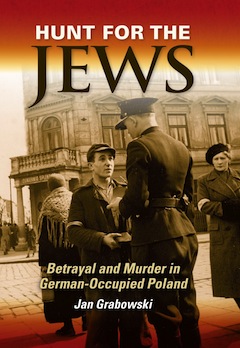
image - Hunt for the Jews book cover
Hunt for the Jews won the 2014 Yad Vashem International Book Prize for Holocaust Research.

While clearly not all Poles were collaborators, it would have been impossible for almost anyone in the country to claim ignorance of what was happening.

“Mass killing was taking place in the streets,” the professor said. Researchers found bills of sale charging city officials for the sand municipal workers needed to cover the blood on sidewalks.

“When you say that blood was running in the streets, it’s not a metaphor, it’s just a description of what really happened,” he said.

In some ghettos, as many as half the Jewish population was killed on the day of the action, with massive participation from Polish society.

“One area more, one area less,” he said. “Usually between 10 and 20% of Jews were slaughtered simply in order to frighten the remaining 80% to go to the trains, to be herded to the trains,” said Grabowski.

In Poland’s smaller communities, centuries of Jewish and Polish social, commercial and civic interactions did not result in camaraderie – on the contrary.

“The deadliest places of all [were] small shtetls, small towns, where anonymity was not available when the authorities were not far away,” he said. In one instance, a Jew in hiding heard his neighbour assure the Nazis he would return with a hatchet to help them break into the hiding place seconds before the door was axed down.

In another example, Grabowski described in minute detail the atrocities committed by Germans, Poles and Ukrainian recruits in Węgrów, a town in eastern central Poland with a Jewish population of about “10,000 starving Jews who have been terrorized for nearly three years and now the final moment has come.”

Rumours of liquidation swirled for months, as Jews fleeing neighbouring communities brought narratives of destruction. In the day or two before the liquidation, wives of Polish military and other officials rushed to their Jewish tailors, shoemakers and others craftspeople to obtain the items they knew would soon become unavailable.

“With mounting panic, people started to prepare themselves for a siege,” said Grabowski. “They built hideouts to survive the initial German fury, they started to seek out contacts on the Aryan side of the city, looking for help from former neighbours, sometimes friends and former business partners.”

On the eve of Yom Kippur in 1942, Polish officials in the town were instructed to assemble horses, wagons and volunteers. A cordon of Nazis and collaborators surrounded the city at intervals of no more than 100 metres.

The mayor of the town wrote: “Jews who woke up to the terrible news ran like mad around the city, half-naked, looking for shelter.” The same leader noted that, when the Germans demanded he produce volunteers to help with the task of rounding up their Jewish neighbours, he feared he would not be able to meet their needs.

“Before I was able to leave my office, in order to assess the situation and issue orders for the removal of the bodies,” the mayor testified, “removal of the bodies had already started. There were carts and people ready. They volunteered for the job without any pressure.”

For Jews, the Germans were to be feared, but their Polish neighbours were also a threat.

“The greatest danger was not associated with the Germans, but with the Poles,” said Grabowski. “Unlike the former, the latter could easily tell a Jew from a non-Jew by their accent, customs and physical appearance.”

Poles were rewarded with a quarter-kilo of sugar for every Jew they turned in.

“The searches were conducted with extreme brutality and violence … the streets were soon filled with crowds of Jews being driven toward the market square, which the Germans had transformed into a holding pen for thousands of ghetto inmates,” he said.

On the streets, “the cries of Jews mixed with the shouts of the Germans and the laughter of the Poles,” according to an eyewitness.

“All of this was done in a small town where everybody knows each other,” said Grabowski. “It’s not only the question of geographic proximity, it’s social proximity. These people knew each other.”

People were taking clothes, jewelry and other possessions from the dead bodies. A husband would toss a body in the air while the wife pulled off articles of clothing until what was left was a pile of naked cadavers.

“They even pulled out golden teeth with pliers,” said Grabowski. A court clerk responded defensively to accusations that the gold he was trying to sell was soaked in human blood. “I personally washed the stuff,” he protested.

The prevalence in the Polish imagination of a Jewish association with gold partly accounted for the actions.

“This betrayal, due to widespread antisemitism and hatred of the Jews, was combined with the seemingly universal conviction that Jewish gold was just waiting to be transferred to new owners,” Grabowski said. “The myth of Jewish gold was so popular and so deeply rooted among Poles that it sealed the fate of [many Jews].”

The historical records indicate many Poles saw no need to cover their collaborationist tracks. Police and others who took it upon themselves to aid the Nazis without pressure defended their actions.

One policeman, after the war, depicted the killing of Jews as a patriotic act, one that saved Polish villagers from the wrath of the Nazis, who would have learned sooner or later about Jews in hiding and who then, he claimed, would have burned down the entire village.

As efficient as the Nazi killing machine was, Grabowski contends it could not have been as effective without the enthusiastic complicity of so many in Poland and other occupied countries.

“It was their participation that, in a variety of ways, made the German system of murder as efficient as it was,” he said.

With trepidation, Grabowski and his fellow researchers followed the documents and met with people in the towns. They would review documents from a 1947 trial, for instance, then go to the village in question.

The entire village would be conscious of its war-era history, he said. And the people who are, decades later, ostracized by their neighbours are not those who collaborated in the murder of Jews.

“The person that is ostracized is the family who tried to rescue the Jews, because they broke a certain social taboo and it still visible 75 or 76 years after the fact,” he said.

“Every time I present a speech to a Polish audience, the question of Polish righteous is presented as if it is a fig leaf behind which everyone else can hide.”

In the question-and-answer session, Grabowski shut down a persistent audience member who identified as Polish and who took exception with Grabowski’s research, arguing that Poland has more Righteous Among the Nations at Yad Vashem than any other country.

“Every time I present a speech to a Polish audience, the question of Polish righteous is presented as if it is a fig leaf behind which everyone else can hide,” said Grabowski, who was born and educated in Warsaw. “The thing is, do you know how many Jews needed to be rescued? Poland had the largest Jewish community and using today Polish righteous as a universal and, let’s say, fig leaf behind which situations like I described here can be hidden is absolutely unconscionable. I protest against any attempt to overshadow the tragedy of Jewish people [with] the sacrifice of very, very few Poles.”

While Poland’s far-right government removed the mandated jail sentence for anyone found guilty of “slandering” Poland or Poles with complicity in Nazi war crimes, acknowledging the participation of Polish collaborators in the Holocaust remains a civil offence and Holocaust scholars in the country – and in Canada – face death threats and intimidation.

In introducing Grabowski, Richard Menkis, associate professor in the department of history at UBC, paid tribute to Rudolf Vrba, a Slovakian Jew who escaped Auschwitz and brought to the world inside information about the death camp, its operations and physical layout. Vrba, with fellow escapee Albert Wetzler, warned in 1944 that Hungarian Jews were about to face mass transport to the death camps. The news is credited with saving as many as 200,000 lives.

Vrba migrated to Canada and became a professor of pharmacology at UBC. He died in 2006.

The Vrba lecture alternates annually between an issue relevant to the Holocaust and an issue chosen by the pharmacology department in the faculty of medicine.
Format ImagePosted on November 23, 2018November 20, 2018Author Pat JohnsonCategories LocalTags history, Holocaust, Jan Grabowski, memorial, Nazis, Poland, politics, Rudolf Vrba, UBC
Witnessing her history

Witnessing her history

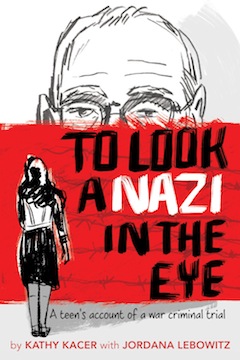
In spring 2015, at Luneburg Regional Court in Germany, the trial of Oskar Groening, “the bookkeeper of Auschwitz,” began. Nineteen-year-old Torontonian Jordana Lebowitz, a granddaughter of Holocaust survivors, was among those who witnessed the proceedings. The young adult book To Look a Nazi in the Eye: A Teen’s Account of a War Criminal Trial (Second Story Press, 2017), written with award-winning author Kathy Kacer, is about what Lebowitz experienced before, during and after the trial.

The book has different components and is not structured like a usual biography or historical account. It includes Lebowitz’s recollections as told to Kacer, as well as selections from Lebowitz’s blog, which the then-teen wrote for the Simon Wiesenthal Centre in Toronto about the trial. Numerous Holocaust survivors, now living in Canada, speak about their experiences at Auschwitz. They also traveled to Germany for Groening’s trial.

Lebowitz shares her concerns about going to Germany and readers learn how she made the trip come about. After almost every chapter, there are excerpts of Groening’s testimony that Kacer has based on news articles and interviews, as there were no transcripts from the trial itself. These sections allow readers to know what Groening was thinking as his claims were being assessed by the court. Charged with being complicit in the deaths of more than 300,000 Jews, he was eventually found guilty.

Lebowitz epitomizes how individuals from my generation should act. Her main goal was to ensure that the experiences of Holocaust survivors would be recorded so that future generations would be able to access them, and learn from them. Her main purpose in going to the trial was to witness this history and make sure that future generations would know it, too.

Lebowitz had been to Auschwitz on a March of the Living trip. The program takes students from around the world to Poland and Israel, so they can see firsthand and learn about the Jewish communities that once existed in Europe and the tragedy of the Holocaust that wiped almost all of them out. It was on March of the Living that Lebowitz met Holocaust survivor Hedy Bohm, with whom she became close friends. Bohm was imprisoned in Auschwitz for three months and testified in the trial against Groening.

As the bookkeeper at Auschwitz, Groening not only witnessed many Jews coming off the trains, but confiscated their possessions as they arrived. He was not tried for being a murderer, but for helping the Nazis murder Jews. The German government wanted Groening’s trial to occur, as they wanted Nazis who were still living to be brought to justice, even if it was many decades later.

Lebowitz heard about the trial from Bohm, and then set to figure out how she could attend it. The Simon Wiesenthal Centre agreed to fund the trip if she would blog her experience in the courtroom for others to read and follow as the trial was taking place. She managed to convince her parents she could handle what she would face on the trip during the trial, and Thomas Walther, the prosecutor, helped Lebowitz find a place to stay in Germany and procured a pass to allow her into the courtroom.

image - To Look a Nazi in the Eye book coverTo Look a Nazi in the Eye is powerful in part because it reveals the compassion Lebowitz initially felt for Groening, in his frailty, sitting in the courtroom each day. He recounted heartbreaking stories of what had transpired in the camp. But, while Lebowitz believed at the start of the trial that he was truly sorry for what he had done, Groening’s stories began to change, and not for the better. He also said he was not guilty because he did not personally hurt or exterminate Jews.

As her daily accounts progress, there are humourous moments that balance out the horrific stories about Auschwitz. For example, purses and paper were not permitted in the courtroom. In order to blog, however, Lebowitz needed a notepad and pen. So, she snuck toilet paper and a pen that was hidden in a place the security guards would not find during a body search. Her persistence paid off, and Lebowitz managed to take notes each day. That her family and others read her blog posts gave her some assurance that she was succeeding in her mission of helping keep the history alive and relevant.

One part of To Look a Nazi in the Eye that is amazing is how Lebowitz interacts with the Holocaust survivors. Bohm, Bill Glied and Max Eisen were among the survivors who attended the trial and were brave enough to recount their experiences at Auschwitz. For them, and others, it was a duty to their family and themselves to ensure that some form of justice was achieved. At first, they seem pretty hesitant of a younger individual being at the trial, but later open up to Lebowitz more. Seeing a person from a younger generation advocating for this cause made them happy, in a sense.

Since returning to Canada, Lebowitz has remained involved in Holocaust remembrance. As the book’s website notes, she “came to understand that, by witnessing history, she gained the knowledge and legitimacy to be able to stand in the footsteps of the survivors who went before her and pass their history, her history, on to the next generation.”

Chloe Heuchert is a fifth-year history and political science student at Trinity Western University.

***

The following excerpt was published by CM: The Canadian Review of Materials and can be found, along with a review of To Look a Nazi in the Eye, at umanitoba.ca/cm/vol24/no2/tolookanaziintheeye.html:

“I wanted to leave,” replied Groening again in a voice that had grown increasingly hoarse. “I asked for a transfer to the front.”

Was it Jordana’s imagination or was Groening faltering under the strain of the trial and the intense cross-examination? She hadn’t noticed it before, but he looked decidedly weaker at this point in the proceedings than he had looked in the beginning. His face was haggard, his shoulders slumped, and his hands trembled.

Finally, Thomas [Walther] gathered his notes together and stood in the centre of the courtroom. “Behind me sit the survivors who are here to testify, along with their descendants,” he said. “I ask you, Herr Groening, did you ever think when you were in Auschwitz that the Jewish prisoners might stay alive and eventually have their own children?”

Groening shook his head and closed his eyes. When he finally responded, his voice was faint. “No. Jews did not get out of Auschwitz alive.”

Format ImagePosted on November 16, 2018November 15, 2018Author Chloe HeuchertCategories BooksTags antisemitism, Auschwitz, Holocaust, Jordana Lebowitz, justice, Kathy Kacer, Nazis, Oskar Groening
Perpetrators offers new insights

Perpetrators offers new insights

Who could shoot at close range two million children, women and men who were standing at the sides of graves they had just been forced to dig? And then, when this process proved inefficient, who could herd four million more into cement bunkers and drop cyanide pellets on top of them? Were they monsters?

“Monsters do exist,” Primo Levi once said, “but they are too few in number to be truly dangerous. More dangerous are the common men, the functionaries ready to believe and act without asking questions.”

Christopher Browning, in his famous 1992 study of Holocaust perpetrators, Ordinary Men, came to the same appalling conclusion: the killers were simple, middle-class working men, “believing Christians” from all walks of life (including thousands of priests and seminarians), just witlessly and anxiously “following orders” and blindly obeying peer pressure, not, in most cases, virulent antisemites.

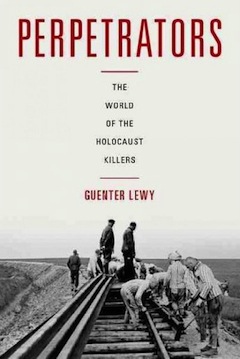
book cover - Perpetrators: The World of the Holocaust KillersThe controversial nonagenarian scholar Guenther Lewy, the author of Perpetrators: The World of the Holocaust Killers (Oxford University Press, 2017), and son of a camp survivor, begins his new study of Holocaust perpetrators with the same question: “How could such terrible deeds happen in the heart of Christian Europe and among a nation known for its poets and thinkers? What had converted so many seemingly ordinary people into killers, willing participants in what is the worst crime in modern history?”

Lewy’s study is the first English-language volume to make use of the 49-volume collection of 929 German trial records of Holocaust perpetrators recently published by the University of Amsterdam (it is not made clear why the records were not published in Germany). He also draws upon an enormous accretion of “previously untapped” sources such as the 50,000 letters and diaries of Wehrmacht soldiers recently released by German archives, as well as victim recollections and, most importantly, hundreds of trial records of Nazi functionaries, beginning in Nuremberg in 1945 and continuing to the present day. Of the 1,200 citations in the 25-page bibliography and the 600 footnotes, by far most of them are from the late 1990s to the present.

Lewy’s conclusion is similar to Levi’s and Browning’s: the perpetrators were not characteristically sadists or psychopaths, or even necessarily antisemites, but simply obtuse followers of orders, vassals to peer pressure, or simply “ordinary people” trying to advance their careers.

Lewy’s graphic details and conclusions will be familiar to readers of Saul Friedlander’s monumental Nazi Germany and the Jews, 1939-1945: The Years of Extermination (2007), but Lewy’s access to the most recent documentation brings some new and important facts to light.

First, the whole notion of a “clean Wehrmacht” can now be dismissed. Lewy proves conclusively that there was close contact between the Wehrmacht and the SS and particularly the 38 “Totenkopf” (“Death’s Head”) divisions of the Waffen-SS: new evidence shows that Jews were “squarely in the crosshairs of the Wehrmacht” and that the number of members of the Wehrmacht who took part in the murder of Jews “is in the tens of thousands.”

Second, Lewy’s close study of the new material available allowed him to conclude that “not a single person who asked to be relieved [from duty in the killing squads] was tried by a military court” and, in fact, “most of their requests were granted.” Lewy found 85 cases of Wehrmacht soldiers who refused to shoot civilians: all were simply transferred to other duties. The significance of this finding, of course, is that it puts the lie to the excuse frequently made by the killers that they “had no choice” and “had to follow orders.” (Lewy points out, significantly, that Yad Vashem has in fact recognized 45 Wehrmacht soldiers as “saviours of Jews.”)

In the sixth chapter of Perpetrators, “Flawed Justice,” Lewy makes his most significant mark. Here, Lewy reveals that, of the 200,000 or so former Nazi killers who, through 2005, were investigated by German authorities, fewer than 10% had charges brought against them; and, of these, only half were convicted. Light sentences were the norm; and only eight of the 2,000 former members of the Einsatzgruppen investigated received life sentences. Most of these examples of “flawed justice,” Lewy concludes, had to do with the fact that so many judges were “tainted” as former party members, and that German law (unlike Canadian law) distinguished between perpetrators and accomplices, usually finding the latter innocent, as they were “only following orders,” that they were only “tools” or were not “unseemingly zealous” in their murderous actions. (Two years ago, German courts finally adopted Canadian/American style “common design,” sharing the guilt between perpetrators and accomplices.)

In his final chapter, “Explaining the Holocaust,” Lewy concludes that nobody, ultimately, can simply give up his freedom. Situation, genetics, conditioning are all significant, but “they do not dictate or determine character.” In fact, recalling how anxiously in 1945 the Nazis strove to cover up what they had done led Lewy to conclude that “even Hitler and the members of his immediate entourage probably knew deep down that they were doing wrong.”

And, as Lewy concludes, in his last sentence, “The fact that so few avoided evil orders remains an ineradicable blot on an entire German generation and a cross that their descendants continue to bear.”

Perpetrators is a valuable addition to a long story, one which may never be conclusively told.

Graham Forst, PhD, taught literature and philosophy at Capilano University until his retirement and now teaches in the continuing education department at Simon Fraser University. From 1975 to 2010, he co-chaired the symposium committee of the Vancouver Holocaust Education Centre.

Format ImagePosted on January 12, 2018January 10, 2018Author Graham ForstCategories BooksTags Guenther Lewy, history, Holocaust, Nazis, Perpetrators
Brave choice to stage Taken

Brave choice to stage Taken

A scene from United Players’ production of Taken at Midnight, which is at the Jericho Arts Centre until Nov. 26. Seen here are Brian Hinson as the Nazi Dr. Conrad and Suzanne Ristic as Irmgaard, Hans Litten’s mother. (photo by Nancy Caldwell)

As a Jew, a lawyer and a child of a Holocaust survivor, I am embarrassed to say that I had never heard of Hans Litten until I saw United Players’ production of Taken at Midnight, which runs to Nov. 26 at Jericho Arts Centre.

Litten was a brilliant young Jewish-German lawyer, known for his defence of opponents of the Nazi movement. In 1931, he had the audacity to subpoena Adolf Hitler as a witness in the trial of four Nazis charged with murder, and subjected him to a grueling three-hour cross-examination, exposing the Nazi party for what it really was – a murderous bunch of thugs. Litten called Hitler “a cross between Baron Munchhausen and Attila the Hun.”

Unfortunately for Litten and the world, within two years Hitler was in power and he started to exact his revenge on his opponents. At midnight on Feb. 28, 1933, after the Reichstag (German parliament) fire, Litten, along with thousands of others, was arrested or, as the Nazis euphemistically called it, taken into “protective custody” at a series of concentration camps. Litten became known as “Hitler’s personal prisoner” – the cocky Jewish lawyer who had dared to expose the Fuhrer’s weaknesses – and, over the years, was subjected to brutal torture and unspeakable degradation as punishment. Despite the valiant efforts of his mother, Irmgaard, to obtain his release over the five years of his incarceration, Litten ultimately committed suicide in Dachau in 1938, which was a bit messy for the Nazis, as they wanted their political prisoners to die accidentally or naturally, not by taking their own lives.

The irony is that Litten was not technically Jewish. His mother was not Jewish and his father had converted to Christianity (to make things easier). As Litten says in the play, “I am an atheist Jew and, prior to that, I was an atheist Lutheran.” Of course, that made no difference to the Nazis, who went back three generations to ferret out Jewish blood.

Playwright and filmmaker Mark Hayhurst’s 2010 BBC films The Man Who Crossed Hitler and To Stop a Tyrant planted the seeds for this staged work. It had its West End (London, England) debut in 2014. Reviewers called it a “masterpiece of theatre not to be missed.” Now, United Players has taken on the formidable task of presenting this gripping story to Vancouver audiences. From the minute you walk into the theatre, the dark, shadowy, stark set – an elevated wooden platform fronted by barbed wire positioned between two floor-to-ceiling red banners emblazoned with black swastikas – is a harbinger of the grim things to come.

The entire cast, mostly comprised of veteran actors, is stellar and, as an ensemble, makes this a truly remarkable theatrical experience. Particular mention has to be made of the two main protagonists – Suzanne Ristic as Irmgaard and Sean Anthony as her son. Ristic is sublime in her portrayal of this strong, heroic woman who takes on the Gestapo establishment in a relentless battle to free her son. She often takes centre stage to talk directly to the audience, thereby breaking down the fourth wall, making for a very intimate encounter. And Anthony plays his difficult role with dignity, yet shows uncompromising defiance. We ache as we watch his physical and mental decline – his transformation from ordinary citizen to bloodied, head-shaven prisoner; a business suit to the striped concentration camp uniform, replete with the obligatory yellow Star of David.

Supporting, but not lesser, performances come from the rest of the cast.

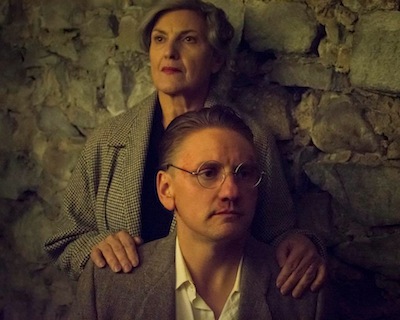
photo - Irmgaard Litten (played by Suzanne Ristic) tries everything to save her son Hans (Sean Anthony) from the Nazis in Taken at Midnight
Irmgaard Litten (played by Suzanne Ristic) tries everything to save her son Hans (Sean Anthony) from the Nazis in Taken at Midnight. (photo by Nancy Caldwell)

Brian Hinson as Dr. Conrad, Irmgaard’s Gestapo contact, portrays a man of culture and intelligence who appreciates this feisty woman and appears to feel affection for her. The scene where they share an ice cream on a summer’s afternoon in a park seems incongruous, juxtaposed against the darkness of this play. Yet it speaks to some form of humanity even in the worst of times.

Litten’s cellmates – Erich Muhsam, an anarchist (played by Richard Hersley) who refers to Hitler as “the Austrian transvestite,” and Carl von Ossietzky, a newspaper editor and winner of the 1935 Nobel Peace Prize (played by Jewish community member Michael Kahn) – show the camaraderie and trust that can evolve from difficult circumstances. The triumvirate produces an amusing reenactment of Hitler’s cross-examination, providing an island of levity in their sea of despair.

Douglas Abel plays Fritz Litten, Hans’ father, as a calm counterpoint to his wife’s intense persona. John Harris, with his posh English accent, is Lord Clifford Allen, an English diplomat, patrician and pacifist who Irmgaard seconds in her quest for her son’s freedom. Allen is able to secure a meeting with Hitler to discuss the matter, but to no avail. Allen’s political attitude highlights the European appeasement zeitgeist of the early 1930s – that Germany was just experiencing growing pains and Hitler was an effective statesman, not a threat to the world. If only it had been so.

The play provides an historical lesson in the rise to power of the fascist Nazi regime and the consequences of speaking truth to power, but, at its heart, it is the story of the love of a mother for her son and her fight, at great personal risk, to try and save him.

As director Michael Fera, states in his notes, this is “an informative and deeply engrossing play about the high price paid for resisting tyranny,” and is as relevant today as it was in 1933. “People are living it now, again. History is repeating itself in many ways.”

Taken at Midnight is a tough watch and an emotional ride but well worth a trip to the Jericho Arts Centre. Kudos to artistic director Andree Karas for having the courage to stage this work. The show runs to Nov. 26, Thursdays to Sundays, 8 p.m., with 2 p.m. matinées Nov. 12, 19 and 26. For more information, visit unitedplayers.com or call 604-224-8007, ext. 2.

Tova Kornfeld is a Vancouver freelance writer and lawyer.

Format ImagePosted on November 10, 2017November 9, 2017Author Tova KornfeldCategories Performing ArtsTags Holocaust, Jericho Arts Centre, Nazis, theatre, United Players
Charlottesville a turning point?

Charlottesville a turning point?

(photo by Ryan M. Kelly via cbc.ca)

Last weekend, in Charlottesville, Va., hundreds of white supremacists, Ku Klux Klanners, neo-Nazis and other racists and antisemites rallied and brought violence to the hometown of Thomas Jefferson.

The images that emerged are bone-chilling. Men (mostly) carrying torches, swastikas and Confederate flags, screaming the ugliest epithets imaginable against African-Americans, gays and Jews. When the city of Charlottesville eventually ordered the racists to disperse (the racists were authorized to rally until things got violent), one of them got in his car and rammed it through a crowd of counter-demonstrators, killing one young woman and injuring many. The violence could have been infinitely worse, it should be noted, as scores of racists in battle fatigues were seen carrying combat weapons on their way to the rally, as is their Second Amendment right in that open-carry state.

Anyone who spent any time on social media or watching cable news in the succeeding days knows that the events and the issues raised by the rally and the preceding march through the University of Virginia have been assessed from multiple angles. The delayed and impotent response of President Donald Trump has been singled out as among the more worrying aspects.

The president of the United States responded by blaming “many sides” for the violence, an appalling equivocation that diminishes the office even further than the depths to which he has debased it in the past eight months. Items of Trump paraphernalia, notably “Make America great again” caps, were prominent among the racist ralliers and some commentators think the president’s remarks were tempered so as not to upset a political base that includes the very worst elements in American society.

David Duke, the former head hood of the KKK, said the rally was a step toward fulfilling Trump’s promises and, after Trump’s bland statement on events, Duke crowed that, essentially, his guy is in the White House. Meanwhile, Maxine Waters, an African-American congresswoman and outspoken critic of Trump, dubbed it the White Supremacists’ House.

The American Civil Liberties Union advocated for the right of the racists to express themselves and, while Canada has different laws and customs around this, we would not contest the idea of racists expressing themselves peacefully, primarily because suppression can metastasize bad ideas the way mold grows in darkness. The answer to bad speech, we have been arguing in this space for decades, is not no speech, but more speech. Indeed, many Americans and others have been motivated by their revulsion at events in Charlottesville to recognize the racial and cultural problems it represents, and have engaged in the civil discourse on the side of good.

We admit, though, that free speech works best when decent people are in leadership. So, for instance, when white supremacists and neo-Nazis rally and murder, a U.S. president should arouse the country’s best instincts as the leading voice for unity in diversity and basic human decency. That didn’t happen after Charlottesville.

Also, police preparations may have been inadequate. When African-Americans have peacefully marched in recent years, militaristic counter-measures have been put in place, as in Ferguson, Mo., after the shooting death of Michael Brown. In Charlottesville, gun-swinging, fatigue-festooned, swastika-waving white people were met with limited police presence, to the extent that they were permitted to physically attack counter-protesters.

An additional factor – perhaps the only one not adequately hashed over – is the subdued reaction to the antisemitism permeating the event. The poster for the rally featured a Magen David about to be smashed by a sledgehammer. A recurring chant at the rally, premised on the idea of white culture being subsumed, was “You will not replace us … Jew will not replace us!” Seig heil salutes and chants of “blood and soil,” a Nazi slogan, were part of the show.

The president notwithstanding, most American leaders have condemned the racism of the event, but condemnations of antisemitism in particular have been far less prominent in the aftermath. Hopefully, people feel that their statements against bigotry encompass antisemitism; less optimistically, perhaps there is a feeling that, while other forms of hatred are anathema to American ideals, displays of antisemitism are less surprising and, therefore, less requiring of explicit denunciation. This is something that needs further consideration and discussion.

If, as former president Barack Obama was fond of saying (quoting Dr. Martin Luther King, Jr.), “the arc of the moral universe is long but it bends toward justice,” Charlottesville may turn out to be a positive turning point in a long and tragic history of racism, antisemitism and xenophobia in America. Optimists among us hope that the political awareness of erstwhile apathetic Americans will be awakened by the sight of torch-wielding Nazis in American streets – and spurred to action by the fact that this reality doesn’t elicit swift and strong condemnation from the most powerful person in the country and, indeed, in the world.

As Canadians, we have our own shameful history of racism and antisemitism to reckon with and should not allow ourselves any smugness when assessing our neighbour’s current spasm of hate. The passing of German-Canadian Holocaust-denier and Nazi-sympathizer Ernst Zundel this month in Germany – to which he was extradited in 2005 and convicted for inciting racial hatred – and a scan of Canadian web commenters around these subjects remind us that we remain far from some bigotry-free beacon to the world.

Still, it is only when these things are out in the open that they can be challenged and debunked. So, as debilitating as it may be to see and hear these ugly ideas and actions, it gives us the opportunity to counter them – if, unlike the president of the United States, we choose to do so sincerely.

Format ImagePosted on August 18, 2017August 16, 2017Author The Editorial BoardCategories From the JITags antisemitism, Charlottesville, Nazis, racism, Trump, United States
Trump equivocates

Trump equivocates

Format ImagePosted on August 18, 2017August 16, 2017Author Steve GreenbergCategories WorldTags antisemitism, Charlottesville, Nazis, racism, Trump
ROM’s Evidence Room

ROM’s Evidence Room

Interior perspective of The Evidence Room, with models of an Auschwitz gas column and gas-tight hatch, plaster casts and a model of a gas-tight door. (photo by Fred Hunsberger, University of Waterloo School of Architecture)

Visitors to the Royal Ontario Museum (ROM) will see an obscene display among the collections of dinosaur fossils, Egyptian mummies and suits of armour – a scale model of a gas chamber of the kind used at Auschwitz, where more than one million Jews were murdered between 1942 and 1945.

The Evidence Room exhibit, as it is named, consists of white plaster replicas of elements of the Nazi death camp murder machine, including the steel mesh columns through which pellets of Zyklon B insecticide were lowered to asphyxiate the prisoners locked inside the gas chambers. Similarly, it depicts the heavy door, which was bolted from the outside.

The exhibit features a reproduction of the original architectural drawings prepared by German architect, engineer and SS-Sturmbannführer Karl Bischoff, who served at Auschwitz as chief of the Central Construction Office of the Waffen-SS.

Visitors to ROM will note the meticulously planned airtight seal around the gas chamber’s door to prevent toxic leaks, and the grill-covered peephole that allowed dignitaries to watch the prisoners die.

“To understand this room … we first have to acknowledge that it’s related to the most murderous place,” said the exhibit’s creator, Robert Jan van Pelt, at a ROM Speaks lecture on June 27.

Van Pelt’s grisly display is the first in a ROM series intended to engender discussion of contemporary issues. And the issue here is forensic architecture, a relatively new field that uses planning and design tools to understand human rights abuses, in this case genocide.

For van Pelt, a Dutch-born architect who teaches at the University of Waterloo, The Evidence Room represents the culmination of two decades of work.

Van Pelt served as an expert witness during a trial, in London in 2000, in which Holocaust-denier David Irving unsuccessfully sued Emory University professor Deborah Lipstadt for libel after Lipstadt, in a book, called out the pseudo-historian’s falsehoods. Irving famously quipped “No holes, no Holocaust.”

Van Pelt testified that indeed there were apertures in the gas chambers’ ceilings through which poison pellets were dropped. His testimony led to his 2002 book The Case for Auschwitz: Evidence from the Irving Trial.

The 592-page volume greatly impressed Alejandro Aravena, curator of the 2016 Venice Architecture Biennale. The Chilean, who was awarded architecture’s Pritzker Prize for his work transforming slums and making architecture a tool of justice and social change, commissioned van Pelt to create an exhibit explaining the workings of an Auschwitz gas chamber. A model was on display at last year’s Venice Biennale.

In preparing for the current exhibit at ROM, van Pelt – together with colleagues Donald McKay, Anne Bordeleau and Sascha Hastings – wrote a supplementary book, The Evidence Room, published by the New Jewish Press in association with the University of Toronto’s Anne Tanenbaum Centre for Jewish Studies.

“It is difficult to imagine the details of a gas chamber, where humans were locked in to die,” says one Holocaust survivor quoted in van Pelt’s new book. “One has to feel the double grates that protected the bucket filled with poison pellets from the desperate hands of the condemned, peer into the bucket, imagine the pellets melting away, the poison oozing out of them.

“I knew a good deal about the Auschwitz-Birkenau murder factory,” says the survivor, “but the gas column really shocked me. Because of what I had read about people thinking they were going into a shower room, I had always imagined the gas being dispersed by sprinklers. Touching that construction had a profound effect on me – a new visceral recognition all these years later.”

And what of the pristine white plaster van Pelt and his architecture students used to build the reproduction?

For me, it jarringly evoked a sense of peace and innocence. But, as well, it called to mind that those murdered in the gas chambers defecated and urinated as they died and that Sonderkommandos (a special unit of slave labourers who removed gassed corpses and hauled them to the crematoria) had to whitewash the gas chambers after each usage.

The Evidence Room is on display at the Royal Ontario Museum until Jan. 28, 2018.

Gil Zohar is a journalist based in Jerusalem.

Format ImagePosted on August 18, 2017August 16, 2017Author Gil ZoharCategories NationalTags Auschwitz, forensic architecture, genocide, Holocaust, in this case genocide., museums, Nazis, Robert Jan van Pelt

An opportunity lost

Mykhailo Chomiak edited a Ukrainian-language Nazi newspaper in occupied Poland. It happens that Chomiak was the maternal grandfather of Chrystia Freeland, Canada’s foreign minister.

This fact is a matter of historical record, but apparently Russian operatives were shopping the story around as if it were fresh – and as if they believe Canadians will hold Freeland, and perhaps by extension the Liberal government, responsible for Chomiak’s past.

A writer on the Canadian online media outlet rabble.ca went so far as to accuse Freeland of a cover-up, which is nonsense, since she was acknowledged for her help editing an article on the subject that was written 20 years ago by her uncle, John-Paul Himka, an historian.

Freeland called it “public knowledge that there have been efforts, as U.S. intelligence forces have said, by Russia to destabilize the U.S. political system.… I think that Canadians, and indeed other Western countries, should be prepared for similar efforts to be directed at us.” She is absolutely correct. Russia almost certainly was involved in the U.S. presidential election and may indeed be responsible for the fact that Donald Trump is now in the White House.

Nevertheless, it seemed like a missed opportunity for Freeland not to use the chance to acknowledge some of the complexities and complicities around her grandfather’s history.

Let’s step back for a moment and realize that Canadians are relatively fortunate that, whatever enormous sacrifices Canadian families made during the Second World War, the war itself never reached our shores. For families in Europe at the time, many of whose descendants are, through immigration, now Canadians, the war impacted every aspect of civilian life. Possibly millions of people are responsible for acts of heroism or betrayal that are lost to history. Had it not been for the writings of a member of her own family, Freeland’s grandfather’s story might have been another largely forgotten piece of that war’s far-encompassing awfulness.

Who can estimate how many Canadians have ancestors who engaged in complicity (or worse) with Hitler’s regime, or with Stalin’s, or with any number of less-renowned tyrants and bad ideologies worldwide? We do not rest from seeking redress for the worst crimes during history’s worst times, but behaviours that do not constitute war crimes have rarely received the full attention of the media and public that Chomiak’s case has garnered in the past days. And we certainly do not – and should not – place any blame at the feet of grandchildren for events that took place before they were born. Freeland has done absolutely nothing wrong.

Still … she could have done something better. She could have (and perhaps by the time you read this, she will have) turned this into a teaching moment for Canadians.

The parents or grandparents of some Canadians may have chosen to, or been forced to, engage in actions we see as abhorrent. We cannot change the past. But we can potentially make a better future by acknowledging it, openly identifying wrongs and committing ourselves to better actions than that exhibited by some of our forebears. As examples, present-day Canadians have begun a process of reconciliation around the genocide perpetrated against indigenous Canadians, and Canadian governments have apologized for actions against Japanese-Canadians and the passengers of the Komagata Maru and the MS St. Louis.

In Freeland’s case, she is right to warn Canadians that Russia is attempting to undermine the credibility of our country’s foreign minister. But she should go further and insist that no Canadian – whether the country’s top diplomat or a new Canadian who was sworn in as a citizen yesterday – is guilty of acts undertaken by their grandparents. A few words about the complexity of historical memory could also be helpful. And it would be valuable for the federal government to make a firm public declaration that blackmailing or smearing a Canadian based on the acts of an ancestor will fail in its mission.

Posted on March 17, 2017November 20, 2018Author The Editorial BoardCategories From the JITags Canada, Chrystia Freeland, history, Nazis, reconciliation, Russia
Return of looted art

Return of looted art

“Young Man as Bacchus” by Jan Franse Verzijl was among about 400 works owned by Max Stern that were forcibly sold by the Nazis in the 1930s. (photo from Max and Iris Stern Foundation)

When the painting “Young Man as Bacchus” by Dutch master Jan Franse Verzijl (1599-1647) went on display in New York City two years ago, the FBI moved in and seized the work. In the possession of an art gallery in Turin, Italy, the painting was among about 400 works owned by Max Stern that were forcibly sold by the Nazis in the 1930s.

In 1935, Stern was a successful gallery owner in Düsseldorf, Germany, but because he was Jewish, his collections were confiscated and sold by the Nazis. Stern would later move to Montreal, where he became a leading figure in the Canadian art world. After Stern died, in 1987, the beneficiaries of his estate learned of Stern’s Düsseldorf gallery and an extraordinary project began to seek restitution for the confiscated artworks.

Dr. Clarence Epstein, director of the Max Stern Art Restitution Project and senior director of urban and cultural affairs for Concordia University, will speak in Vancouver March 23 about the successes and challenges of the project.

The beneficiaries of Stern’s will are Concordia University, McGill University and the Hebrew University of Jerusalem. As a result, the art restitution project may be the only program of its type with three academic institutions working collegially to a common goal, said Epstein. His visit here is presented by the Canadian Friends of the Hebrew University, the Vancouver Holocaust Education Centre and Congregation Schara Tzedeck and is sponsored by Heffel Gallery and the estate of Frank and Rosie Nelson.

The Dominion Gallery, Stern’s Montreal business, remained in operation for more than a decade after his death. During this time, the beneficiary universities became aware of Stern’s prewar history.

“There was an entirely additional gallery business in Düsseldorf that his family had run before the war but had been closed by force as a result of Nazi persecution,” Epstein told the Independent in a telephone interview. “It wasn’t public knowledge. I think some people were aware of Dr. Stern’s past, but it coincided with the time when the issue of restitution was just starting to gain a little bit of traction in the art world and so it merited questioning. We just didn’t know how far to take it.”

The Max Stern Art Restitution Project has become a significant entity, with staff in Montreal, Ottawa, Washington and New York, as well as researchers in Europe. In addition to the obligation Epstein has to maximize the financial outcome for the beneficiaries of Stern’s will, there are other factors driving the project.

“There were fiduciary obligations, which is part of estate management,” he said. “There were moral implications, because this was something that was right for the universities to do on behalf of their great benefactor Max Stern. And then there were educational opportunities that this could open up in the fields of art history, of social justice, of art and law, the mechanics of the art market – and this enticed all kinds of academics to get involved in the project.”

The return of “Young Man as Bacchus” is among 16 successes the project has seen so far. While the restitution of that piece involved law enforcement, it also exemplified the good faith response of the gallery into whose possession the painting had fallen.

Every country has different rules and statutes of limitations around the return of art that has been stolen or forcibly sold, and the Stern project navigates the law as well as less litigious means of restitution. Through the recommendation of the German Friends of Hebrew University, the German government recently announced tax receipts for the owners of returned artworks. In the cases of galleries or museums, the reputation of the institution could suffer if they are known to be in possession of a work of dubious provenance, so this encourages cooperation. Individual collectors may not have the same impetus for preserving a reputation, but once a piece of art is identified as coming from Stern’s Düsseldorf collection, it bears a figurative black mark that makes it valueless on the open art market. Even so, Epstein said, the project does not seek to punish anyone for unwittingly possessing such a work.

“We don’t intend to be the bearers of bad news about the state of the work that is in their possession,” he said, “so if there’s any way that we could alleviate that kind of misfortune with some kind of tax relief, we would do so. But it hasn’t been tested yet.”

One example of an innovative solution found is the case of a work that was discovered in a Düsseldorf gallery. While the ownership was transferred to the Max and Iris Stern Trust, the universities agreed to lend it back to the gallery for long-term display.

“In their case, everybody kind of got their cake and ate it, too,” said Epstein. “It is owned by the Stern Foundation but it is lent to the Düsseldorf Museum.”

While Canada does not have the sort of art sector that New York or the capitals of Europe have, Epstein credited the federal government, specifically Minister of Canadian Heritage Mélanie Joly, for expressing the Canadian government’s commitment to restitution.

What happens to the artworks when they are returned varies. In the Düsseldorf case, the gallery in possession maintained custody. In some instances, the pieces have been sold to fund additional work of the project. (Once returned, the black mark is eliminated and the piece can be exchanged in the legitimate art market.) Others are loaned to museums and public institutions.

Next year, an exhibition of works from Stern’s collections will open in Düsseldorf, later traveling to Haifa, Israel, then Montreal.

Popular culture has taken on the topic of art restitution, Epstein said, and this is a good thing. For example, Monuments Men is about Allied soldiers charged with rescuing cultural artifacts before the Nazis destroyed or hid them, and Woman in Gold focuses on an American woman’s legal fight with the government of Austria to return a painting by Gustav Klimt that was stolen from her family by the Nazis. There have also been documentaries on different aspects of pillaging during the war. Epstein credited Helen Mirren, the star of Woman in Gold, for personally taking up the cause of restitution and making it more public.

“Any way we can make more public the challenges of the recovery of these kinds of objects, and the more we keep it in the spotlight, the more I think we’re going to be able to generate sympathy and attention from the groups that are in possession of those works,” he said.

While the Stern project has seen the return of 16 works and has located several more that are the subject of negotiation, it is impossible to know precisely how many cultural artifacts were stolen and remain unidentified.

“There is a number circulating on the internet in the hundreds of thousands in terms of objects that remain unrecovered,” said Epstein. “I don’t think it’s ever going to be possible to nail down that number … because we are talking about an historic loss that is multiplied over millions of people’s losses, that is also somewhat effaced as a result of time and lack of memory and archives. But that’s really the tip of the iceberg in terms of losses because in terms of material losses, everything that was in the possession of a Jewish family that was oppressed could still be in circulation now – musical instruments, jewelry, the list goes on. But those items were a lot harder to trace in terms of ownership and attribution than a painting has been. Works of art that are under a certain value and have not been researched historically are probably still circulating in the tens of thousands.”

Epstein added that Stern also had significant B.C. connections. His gallery represented E.J. Hughes and Emily Carr, two of this province’s most noted artists.

Admission to the March 23, 7:30 p.m., talk at Schara Tzedeck is free but an RSVP is requested to [email protected].

Pat Johnson is a communications and development consultant to the Vancouver Holocaust Education Centre.

Format ImagePosted on March 10, 2017March 8, 2017Author Pat JohnsonCategories LocalTags art, CFHU, Heffel Gallery, Holocaust, Nazis, restitution, Schara Tzedeck, VHEC
Taking the higher road

Taking the higher road

On President Donald Trump’s inauguration day last Friday, Richard Spencer, an up-and-coming voice of the extreme right-wing in America, was punched in the face by a protester.

Spencer is president of the National Policy Institute, a white supremacist organization, and calls for a whites-only homeland. He is sometimes credited with inventing the term “alt-right,” which is a catch-all for the extremism emerging in the United States at present. He was giving an interview to a reporter when someone stepped into the frame and punched him in the face.

Social media erupted, with plenty of people contending that punching Nazis is fair game. (For the record, Spencer had denied he is a Nazi just before the punch landed. He describes himself as an “identitarian,” which is a term associated with far-right, white supremacist ideology.)

Spencer is one among many on the far right who are emboldened

by Trump’s victory. His attacker, apparently, was emboldened by the belief that violence against people like Spencer is justifiable. This is the reality of the day in parts of the American body politic.

No one knows what the Trump administration portends. The new president contradicts himself and has no guiding ideological compass. He speaks (and tweets) without any evidence of self-control and reacts wildly to the mildest provocation. It is probably safe to venture, however, that the Trump administration will not advance the rights of women, religious or ethnic minorities, refugees and immigrants or LGBTQ people. While the Trump team includes numerous Jews, Zionists and philosemites, the campaign also attracted support from the most racist and antisemitic individuals and entities in the country. Journalists with Jewish names who reported unflatteringly on Trump have been subject to particularly brutal online harassment.

As Trump moves from rhetoric to action, we will have plenty of opportunity to analyze his record. What is likewise worthy of consideration is the manner in which the opposition to Trump manifests. The mass rallies in Washington and around the world last Saturday were inspiring. While billed as “women’s marches,” participants reflected a panoply of interests and identities. The events went off, largely, without a hitch – there were no arrests in the approximately 600 marches that took place around the world, including here in Vancouver. It remains to be seen, however, whether the outpouring of political engagement demonstrated by marchers will morph into a structured political movement. As an historian of social movements told the New York Times, after big rallies like Saturday’s “there is a lot of unfun, unglamorous work to do.”

The marchers were overwhelmingly civil, their handmade signs frequently illustrating superb wit and insight. But not all of the resistance to Trump has been as peaceful. The individual who punched Spencer represents a different sort of character.

There is a stream on the left – perhaps we should call it the “alt-left” – which exhibits its own totalitarian tendencies. So righteous are some “progressives” – we’ve seen this very clearly among some anti-Israel activists – that opposition to their target is justified by any means necessary. For some, this means punching an opponent in the face. For others, it can mean justifying such violence, or completely rejecting in other ways the right of dissenting voices to be heard.

As odious as Spencer’s ideas are, and however much we might contend that people who share such views only understand force, the introduction of violence – as well as ideological extremism in defence of liberty – is, to contradict Barry Goldwater, indeed a vice.

Most of us can probably agree that if anyone’s ideas are worthy of approbation, it is Spencer and his like. Yet if we extend this to argue that, as a result, a punch in the face is justifiable, then – does this really need to be explicitly expressed? – we accept that violence based on political disagreement is a legitimate part of our society’s foundations. If mere disagreement is enough to merit physical attack, then what will our political institutions eventually become and how will we ever be able to keep our leaders, or those with the financial and other means, from systematically abusing human rights or other oppression? With even more violence?

It is, of course, challenging to engage with supporters of a man who is belligerent and nasty, and who licenses this behaviour in his followers. The booing of Hillary Clinton during the inauguration was a symptom of the mentality of some Trump supporters.

But we side with Michelle Obama on this, suggesting that when those on the extreme right go low, those of the centre and of the reasonable left and right should go high. To employ the tactics we have seen from Trump and his supporters – lying, scapegoating, vicious personal attacks – would not only debase causes deserving of defending, it would represent a spiral from which the political system might never return.

In addition to the many differences of policy that will emerge between the Trump administration and its critics in the years to come, we hope there will also be a discernible difference of style; that, in the face of boorishness, “alternative facts” and insensitivity, the opposition will demonstrate dignity, truth and respect for humanity.

Format ImagePosted on January 27, 2017January 26, 2017Author The Editorial BoardCategories Op-EdTags Nazis, racism, Spencer, Trump, violence, white supremacists

Posts pagination

Previous page Page 1 Page 2 Page 3 Next page
Proudly powered by WordPress