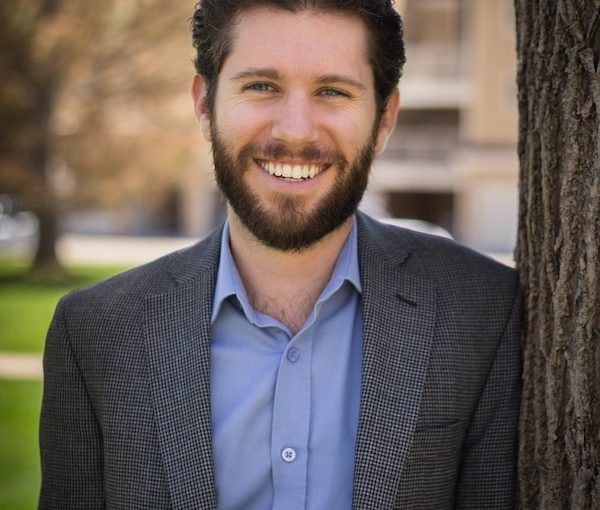
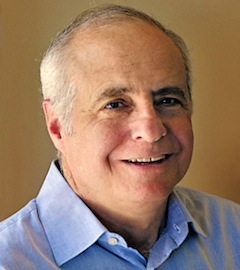
Rabbi Matt Ponak is the new education director and assistant rabbi at Congregation Emanu-El. (photo from AJNews)
Going as far back as his days with Northwest Canada Region of B’nai Brith Youth Organization, Matt Ponak has had a passion for the spiritual aspects of Judaism, and now he is bringing that passion to Victoria.
Having impressed the congregation as an interim rabbi during Rabbi Harry Brechner’s sabbatical, Congregation Emanu-El announced in mid-May that Ponak would be joining them on a full-time basis as education director and assistant rabbi. Officially, his position began last month, following his graduation – with a master’s degree in Jewish studies – and his June 7 ordination from Hebrew College in Newton, Mass.
Ponak grew up in Calgary, where he attended Jewish day school at Calgary Jewish Academy, and was a member of Beth Tzedec and Temple B’nai Tikvah congregations. Through high school, he was an active member of B’nai Brith Youth Organization and attended Camp BB Riback as a staff member. His ties to Vancouver Island are also strong.
“I grew up in Calgary and spent many summers on the Island growing up,” he said. “My mother is from Port Alberni and I have many relatives in the area.”
Although his spiritual education led him to American schools and life, Ponak said he is looking forward to planting roots back in Canada, and making Victoria his new home. “I’m so excited about this because I get to return to Canada and to live in an incredible city with a community of warm, embracing, open-minded and dedicated people,” he said.
Before rabbinical school, Ponak earned a master’s in contemplative religions at Naropa University, a Buddhist-inspired institution in Boulder, Colo. He earned an undergraduate multidisciplinary degree with a minor in religious studies from the University of Calgary, and also has a certificate in spiritual entrepreneurship through the Glean Network, in association with Columbia University.
During rabbinical school, Ponak interned with the Asiyah Jewish Community in Somerville, Mass.; the Common Street Spiritual Centre in Natick, Mass.; Temple Emanuel in Andover, Mass.; and the One River Foundation with author Rabbi Rami Shapiro. He also served as a curator of the Spiritual Paths Institute, working on an interspiritual website for people of all backgrounds who want to explore their inner lives more deeply. He is one of the founders of Or Chadash, the men’s group at Hebrew College.
Ponak’s capstone project, “Torah for the New Age,” focused on translating and commenting on Jewish mystical texts relevant to contemporary spiritual seekers of all backgrounds. With supervision from Hebrew College rector Rabbi Arthur Green, Ponak translated and commented on 42 mystical texts and used digital design layouts to make them look like Talmud pages. “It was an absolute pleasure working with Rabbi Green,” said Ponak. “He is one of the leading voices for Jewish mystical theology, commentary and translations in our era.”
Ponak is a talented banjo player. He specializes in leading niggunim, wordless melodies from the Jewish mystical tradition. During his first year of rabbinical school, he released a banjo niggun album entitled Bridges of Song. He is also a practitioner of qigong and focusing, using movement and body-centred contemplation to guide people through inner constrictions and into the emerging stages of their journey.
“I am a teacher, musician and lover of life,” said Ponak. “I help spiritual seekers follow the call of their soul. I am passionate about bringing forth ancient Jewish wisdom to meet the needs of today.”
Founded in 1921, Hebrew College is committed to Jewish scholarship in a pluralistic, trans-denominational academic environment, while Congregation Emanu-El is an egalitarian Conservative Jewish synagogue. At 157 years old, Emanu-El is Canada’s oldest synagogue in continuous use, and has been designated a national historic site.
Daniel Moseris editor of AJNews, where a longer version of this article was originally published. For more Alberta Jewish news, visit albertajewishnews.com.
No one was injured and police are ruling out antisemitic motivations after an intruder caused a standoff in Victoria’s Emanu-El synagogue.
Victoria police were called to the historic Blanshard Street synagogue shortly after 8:30 a.m. on Dec. 9 after a report of an unwanted man inside the building.
“Upon arrival of officers, they attempted to speak with the man, which was not successful,” according to a police statement. “Out of an abundance of caution, the Greater Victoria Emergency Response Team was activated along with crisis negotiators.”
The standoff lasted nearly four hours.
“Shortly before 12:30 p.m., the man, who was suffering a mental health crisis, was apprehended and transported to hospital with non-life threatening injuries,” according to police.
Rabbi Harry Brechner, spiritual leader of Congregation Emanu-El, which is Canada’s oldest synagogue in continuous operation, issued a statement later in the day.
“A mentally ill person brushed past a Gan Shalom (daycare) parent and managed to enter the building not due to any fault of the daycare parent,” Brechner wrote. “Another daycare parent quickly called emergency 911 and the police were dispatched. The police were remarkably responsive, communicative and efficient. Our daycare children were never in a dangerous situation and, for most of the incident, they were not aware that anything unusual was happening.
“This mentally ill man held himself up in the balcony of the sanctuary; we were not successful at talking him down and out of the building. The police provided a transit bus for the daycare to transport the children to the other Gan Shalom daycare and the children felt like they were going on a field trip. It took the police a bit of force to subdue and retain the intruder and we are left with some broken windows and a mess to clean up. I am super-thankful to Victoria’s finest for their professionalism in containing this situation and ensuring that everyone was safe,” said Brechner. “This incident had nothing to do with antisemitism and could have occurred in any downtown building. The incident is a difficult and powerful reminder of the intensity and difficulties associated with our current mental health crisis.”
The rabbi concluded: “I want to also state that the Gan Shalom staff and Gan Shalom parents who stayed by to ensure that the children were safe were remarkable and very calm. We are very safe, our protocols were tested and proved efficient.”
Bema Productions presents the Canadian première of the comedy O My God at Congregation Emanu-El Synagogue in Victoria, Jan. 16-26. In O My God by Israeli playwright Anat Gov, God walks into a therapist’s office suffering from depression. The therapist asks, “How long have you felt this way?” God says, “Two thousand, five hundred years. Give or take.” “You’ve been depressed for 2,000 years and only now you’ve come to therapy? What were you waiting for?” asks the therapist. And God says, “I thought time would heal.”
Gov, who died of cancer at 58, was born in 1953, and was a graduate of Thelma Yellin High School of the Arts. She was briefly a student in Tel Aviv University’s theatre department – she dropped out to become a successful playwright and television writer. She also married and was a mother of three and grandmother of two.
The Bema Productions staging of O My God is directed by Zelda Dean and performed by Christine Upright (the therapist), Rosemary Jeffery (God) and Jesse Wilson, who is on the autism spectrum himself, plays the autistic son of the therapist.
Tickets ($23) can be purchased online at ticketrocket.co or at the door.
With the speed of a street-corner caricaturist yet the precision of someone who seemingly misses nothing, Ben Levinson has for decades been capturing the cityscapes of the many places to which he has traveled with his wife, Carla. No pencil, no erasing. Just a black ink pen and a small sketchbook.
“My architectural career taught me to sketch quickly and furiously, and I am able to see details that most would not see,” Levinson told the Independent in an interview earlier this fall.
During these adventures, Levinson has sketched everything of architectural interest to him: churches, cathedrals, mosques, pyramids and, of course, synagogues, while Carla would station herself at a café.
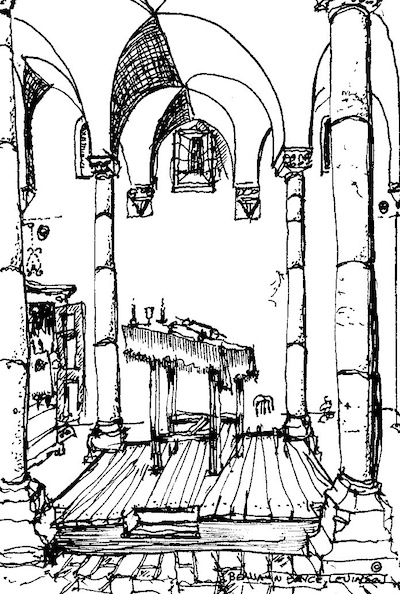
Synagogue at Tomar, Portugal. Sketch by Ben Levinson.
By the time she was done with her coffee and croissant, Ben would have a complete rendering to show her. During the infrequent occasions she would finish first, incomplete drawings would be filled out when they reached their hotel.
The alacrity, accuracy and artistry of the sketches were at times the envy of those whom they encountered on their travels.
“We met artists whose wives and partners waited all too patiently and were ready to move on, whereas Ben was long done,” Carla said.
After looking through Ben’s sketchbooks one day, Carla suggested he do a show devoted to synagogues. Carla, who ran Victoria’s Gallery 1248, helped curate the selection of sketches that appeared at the Wings of Peace Gallery at Victoria’s Congregation Emanu-El from Sept. 4 through Yom Kippur. Now those sketches have been compiled into a book which is tentatively titled In Search of Identity: The Story of the Wandering Jew.
The book’s 49 sketches transport the viewer throughout the old and the new worlds. Many of the sketches are connected by the common experience of Jews moving on because of antisemitic treatment, despite centuries of coexistence in a community.
The figurative journey, which includes interiors and exteriors and is really the result of several holidays the Levinsons took over the span of two decades, sets off in Toledo, Spain, home to one of the few remaining synagogues left after the Spanish Inquisition scattered Jews throughout Europe and the Americas. Levinson’s exhibit and book spend a lot of time in Sephardi lands: a 14th-century Moorish-style synagogue in Cordoba; a tiny shul in Tomar, Portugal, the only pre-Renaissance temple in the country; larger houses of worship in Morocco, home to the largest Jewish population in the Arab world; and, finally, to the Portuguese Synagogue in Amsterdam, completed in 1675.
Poignant reminders of the once-thriving Jewish communities of Eastern Europe follow. Levinson leads the viewer through Berlin, Prague and Budapest, along with artistic reconstructions of the Terezin sleeping barracks and an ancient dig in Vienna.
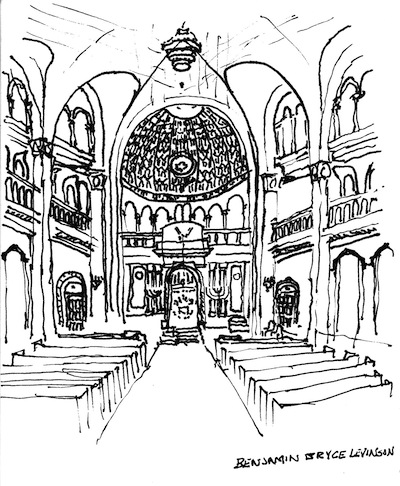
Templo Libertad in Buenos Aires, Argentina. Sketch by Ben Levinson.
The voyage shifts to France, Italy and Scandinavia, with the majestic Marais synagogue in Paris, the synagogue at the Museum of Jewish Life in Trieste and the Gothenburg Synagogue, the scene of a firebomb attack in 2017.
Levinson also presents active scenes of a crowd forming outside a Venice synagogue on a sunny Shabbat morning, passersby in front of an Antwerp temple and a sea of bicycles by the Great Synagogue of Copenhagen.
The visual trip wraps up with drawings from Mexico City and the Byzantine-style building of Libertad Synagogue in Buenos Aires.
Born in Medicine Hat, Alta., in 1942, Levinson graduated from the University of Manitoba’s architectural program. In 1966, he moved to Victoria and worked for various firms before starting his 30-year private practice as president of Benjamin Bryce Levinson Architects in 1980. In addition to leading his practice, he continued sketching and showing his work at various venues, including the Architectural Institute of British Columbia and the Jewish Community Centre of Greater Vancouver.
Levinson was instrumental in restoring Congregation Emanu-El in the early 1980s. When he arrived in town, he felt an initial disappointment upon seeing the synagogue with “its pink stucco, balcony balustrade pickets, missing fence and hidden dome ceiling.” He helped the synagogue’s leadership in obtaining grants and helped steer the building and fundraising committees to get the money necessary to revitalize the region’s most historic Jewish building.
Small Town Architect, the name of his first book, documents his 40-year career in architectural design and recounts his travels and artistic endeavours. His work can be found throughout Victoria and in numerous communities throughout the province; in elementary schools, municipal halls, grocery stores and restaurants, among other buildings.
Sam Margolis has written for the Globe and Mail, the National Post, UPI and MSNBC.
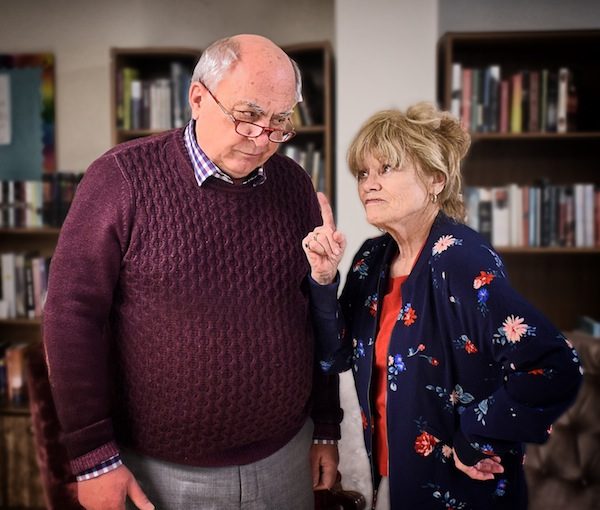
David Biltek and Susan Wilkes are part of the cast of Bema Productions’ presentation of We Are the Levinsons, by Wendy Kout. (photo from Bema Productions)
Bema Productions’ 2019 Mainstage presentation is the Canadian première of We Are the Levinsons, by Wendy Kout, an award-winning writer/producer of theatre, film, television and prose. Zelda Dean directs the Victoria production, which opened May 9 at Congregation Emanu-El’s Black Box Theatre.
The story details the phenomenon of the “sandwich generation” – adults caring for both children and aging parents – through the lens of one family’s momentous year. Rosie, a daughter with mother issues, surprises her parents with a trip home. And life surprises Rosie. Sanity, survival and humour are tested and love is deepened in this three-generation family, and chosen family, comedy.
We Are the Levinsons will be performed May 12, 3 p.m.; May 14-16, 7:30 p.m.; May 19, 3 p.m.; and May 23, 7:30 p.m., at Congregation Emanu-El, in Victoria. Tickets are $23 from Ticket Rocket, ticketrocket.co or 1050 Meares St.
Barbara Pelman speaks at the opening of the exhibit Encounters, which is at Congregation Emanu-El in Victoria this summer. (photo by Frances Aknai)
On June 3, the exhibit Encounters opened at Congregation Emanu-El in Victoria. It is the culmination of the most recent Calling All Artists exchange, a project that has been going on for more than a decade.
“Bible has to be interpreted to be relevant,” said Barbara Pelman, coordinator of Calling All Artists since its inception. “All Renaissance art is Bible interpretation. That’s what we do with this project.”
In 2004, Pelman was the head of the adult education committee at the synagogue.
“Rabbi Harry [Brechner] came up with the idea to gather a bunch of artists and writers for a few study sessions to teach them a particular theme and its rabbinic interpretation,” she recalled. “I thought it was a wonderful idea. The sessions were conducted once a month for five months. Afterwards, the artists would offer their own interpretations of the theme, and the synagogue would have an exhibit of their works.”
While the congregation also produced colourful chapbooks – mini catalogues of the exhibitions – in previous years, they did not do so this year.
Over the course of the project, the artists have studied a variety of subjects. The first exchange was based on the topic of Paradise, and the exhibit was held in 2005. In subsequent years, themes have included dreams and prophecies; creation; the Book of Ruth; death and afterlife; and reinventing rituals.
“We missed a few years since the beginning,” said Pelman. “Once, we thought that maybe we are finished with the project and won’t do it anymore, but everyone involved said, ‘No! No! We should continue.’ Another year, holidays interfered.”
This year’s theme examines divine-human interactions.
“What happens in these encounters? What does one look like and how is it reported and remembered? What are some examples in biblical and rabbinical tales? How do we understand divinity and how does that understanding affect our worldview? These are some of the questions the artists of different genres have been exploring,” Pelman explained.
She said that not all participating artists are members of the congregation, or even Jewish. “The project is open to the community,” she said. “This year, 30 people signed up for the project; 17 artists remained to the end to exhibit their works. Five of them are not Jewish, but all of them are interested in learning.”
Studying with the rabbi is a mandatory part of Calling All Artists, Pelman said. “This entire project is about learning from those who know more than we do. The point is not to exhibit but to learn. That’s why the art is not vetted.”
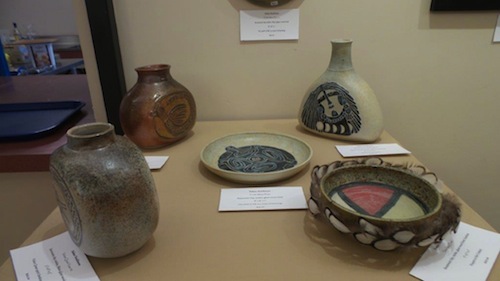
Encounters features a range of artistic genres, including pottery. (photo by Frances Aknai)
Participating artists represent a wide variety of media and genres, as well as skill levels. Some participants are professionals; others do art as a hobby. The exhibits feature photographs and paintings, fibre art and pottery, sculpture and poetry. Every piece is accompanied by an explanation of the work by the artist.
Pelman is a poet, so her involvement in every year’s project has been a poem. For her, divinity is not an all-knowing old guy somewhere above. “It’s the biggest and best part of you, of us all,” she said. “How do we find it? How does it inform our muse?” This is what she contemplates in her poem for this year’s explorative journey.
Pelman worked as an English teacher for many years. She taught high school, college and university classes, and she has been writing poetry for a long time. “I have three poetry books published,” she said. “The last two by Ronsdale Press, a Vancouver publisher.”
Another frequent participant in the project, artist and writer Isa Milman, said, “I participated in the first Calling All Artists, The Paradise Project, in 2005. It was a spectacular experience. The combination of Rabbi Harry Brechner’s teaching, the group of artists who gathered and learned from each other, wrestling with text that most of us were unfamiliar with, was truly energizing. The process involved five sessions spread over a few months, to learn from Harry’s teachings and engage with one another, as we entered a spiritual quest for meaning. Then we went off to put our learning into practice and create our responses.”
Milman has taken part in a number of Calling All Artists projects. “I’ve written poems as well as created paintings for these projects,” she said. “Learning with Rabbi Harry is an inspiration. He’s a gifted teacher and a wonderful spiritual guide. My Jewish education was extremely Orthodox and doctrinaire and I rebelled against it. Learning Torah with Rabbi Harry is so different. It’s an invitation to engage and converse, which I so welcome.”
Olga Livshinis a Vancouver freelance writer. She can be reached at olgagodim@gmail.com.
Congregation Emanu-El’s chuppah is on display throughout the summer. (photo by Janna Ginsberg Bleviss)
Congregation Emanu-El in Victoria is celebrating its 155th year. It is marking the occasion, in part, with the art exhibit Encounters, as well as by displaying a quilted chuppah that was created by a group of women in the community for the congregation’s 150th birthday.
The creation of the quilt was spearheaded by Janna Ginsberg Bleviss, who talked with the Independent about this unusual project.
“Five years ago, when Congregation Emanu-El was celebrating its 150th anniversary, I was active with a couple of projects,” she said, “and I was looking for a specific art project. Rabbi Harry Brechner suggested a new chuppah.”
The original chuppah of Emanu-El has a long history. According to Ginsberg Bleviss, it dated from 1864. Made in England from Chinese silk with gold embroidery, it was donated to the synagogue by the Hebrew Ladies of Victoria. Throughout the intervening century and a half, it had been used repeatedly. Of course, by 2013, it was showing its age. “It was frayed and tired looking,” said Ginsberg Bleviss.
The congregation needed a new chuppah, but was unsure how to approach the making of a new one. “Rabbi Harry directed me to Colleen Golumbia, a gifted quilter and fabric artist,” recalled Ginsberg Bleviss. “I had seen her work at the shul’s Calling All Artists displays and I thought that a fabric project would be suitable for the chuppah, as I already knew many textile artists. Colleen agreed to work with me, to coordinate putting the pieces together and make it look like a chuppah. She was absolutely the right person to be involved.”
Golumbia decided the chuppah would feature a central panel surrounded by 12 squares. “Colleen designed the gorgeous centre piece, resembling the stained glass window in the sanctuary ceiling, with colours of gold, red, white and blue,” said Ginsberg Bleviss.
Meanwhile, Ginsberg Bleviss put out a call and found 12 women interested in creating the surrounding panels. In the end, 14 women worked on the project.
“These women ranged in ages, the oldest [then] being 86. They came from Victoria, [elsewhere on] Vancouver Island and even as far away as Washington, D.C. Some were professional artists, some were experienced sewers or quilters or knitters, some worked in fabric from time to time and some took it on as a challenge. They were all pleased to participate in this project. Although not all were synagogue members, all were connected in some way to Congregation Emanu-El.”
Golumbia gave snatches of fabric to everyone in the colours of her portrayal of the stained glass window, thus linking the whole composition by colour; other than that, every participating woman had full creative freedom. Ginsberg Bleviss recalled: “I was frustrated at first because I kept asking Colleen: ‘Don’t you want to give them some directions?’ She didn’t.”
The artists got together a few times anyway, to share and learn from one another. Since they didn’t all live in Victoria, they mostly communicated through emails circulated by Ginsberg Bleviss.
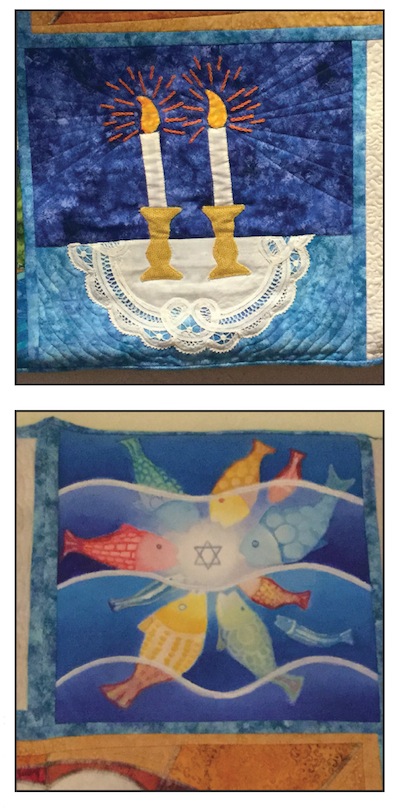
Each panel was created by a different artist. Annette Wigod sewed Shabbat candles, using an antique doily as the tablecloth and Phyllis Serota painted fish coming toward a Magen David (acrylic on canvas). (photos by Janna Ginsberg Bleviss)
“When the squares came in, the diversity and similarities were quite amazing. Many used the Magen David in various forms. There were images of Judaism, nature, light and colour. Some of the squares were abstract. Only one had words on it – the last piece that came in was from Washington, D.C. It said, ‘I am my beloved and my beloved is mine,’ which is often said at weddings. Done by Nancy Micklewright, it was a stunning gold stencil on a white background…. Phyllis Serota, known for her early fish paintings, painted fish coming into a Magen David centre. Annette Wigod, our oldest contributor, sewed Shabbat candles and used an antique doily as the tablecloth. Enid Elliot created a West Coast theme of oceans, mountains and sky. Arlene Ackerman, another experienced quilter, created pomegranates.”
The other participants included Narcis Kellow, Isa Milman, Jackie Saunders Ritchie, Natalie Beher, Charlotte Sutker, Gail Steinberg, Janis Diner Brinley and Barbara Horowitz.
“It was truly a communal effort, vibrant and colourful, meticulously sewn together,” Ginsberg Bleviss said. “Some squares were hand-stitched, some machine-stitched, some reflected quilting traditions, and some used appliqué. It was extremely varied. Colleen put all the pieces together and did the quilting lines. Several months later, in March 2013, we handed it to the synagogue as a donation from all the women…. It was too beautiful not to let others see it. We decided to place it in the sanctuary, where it has been ever since. Its first proper use came that same summer for the wedding of one of the artists and her partner.”
The old chuppah now resides at Royal B.C. Museum, although it was brought out for the 150th historical exhibit at Emanu-El.
Five years have passed since the new chuppah’s creation, and Ginsberg Bleviss thought it was time to display it to a wider audience.
“It was hanging in the sanctuary, with no explanation,” she said. “It kind of looked like a wall-hanging. I wanted to acknowledge the shul’s 155th anniversary this year and felt that there was still something to be learned about the chuppah and the process that went on in 2013. I wanted to move the chuppah to a more visible spot and give it some attention.”
Besides, everyone was getting older, she added. The oldest participant, Annette Wigod, is now 91. Ginsberg Bleviss wanted to give each woman a chance to talk about their pieces and what inspired them.
The new exhibit consists of the chuppah, the creators’ photographs and a story of each square.
“It is modern and beautiful, something that we could all be proud of,” said Ginsberg Bleviss. “I hope it might last as long as the original chuppah.”
Olga Livshinis a Vancouver freelance writer. She can be reached at olgagodim@gmail.com.
Nolan Hupp and Annika Hupp play two schoolchildren who protest to save the shul in The Original Deed.(photo by Gayle Mavor)
When Rabbi Shlomo Carlebach, z”l, sometimes known as the “Singing Rabbi,” visited Victoria on a concert tour in the 1960s, he heard about a plan to move the city’s downtown synagogue, Congregation Emanu-El, to the suburbs. According to local lore, the singer/songwriter’s impassioned advice to the shul community was, “Don’t sell the place. There’s too many prayers in the walls!”
In The Original Deed, staged for the first time last month by the play’s author, Sid Tafler, a similar thought emerged from the lips of the story’s main character, Sam Abelman, played with pathos and humour by Toshik Bukowiecki.
Sam, an amalgam of several longtime Victoria residents, invited his granddaughter, Ellen (delightfully portrayed by Ava Fournier), to listen as they walked together through the synagogue on a wet November day.
All Ellen heard was the sound of traffic outside. Sam smiled and said he heard people praying, even though the two of them were the only living souls walking around the old shul.
The plan of Sam’s son, Morris, to sell the old synagogue puts him at odds with his father, who had his heart set on restoring it. Their struggle fills most of the play, providing a perfect storm of difficult family dynamics made even more poignant by Jewish geography.
An active city-centre heritage synagogue is rare in Canada. During the last half-century, most urban Jewish communities moved to the suburbs, but not Victoria. This play helps us imagine why.
Zuzana Macknight plays Rivka Abelman. (photo by Penny Tennenhouse)
Performed at Congregation Emanu-El, the action unfolded within the synagogue’s sanctuary, mystically directed from the bimah by the ghost of Sam’s wife, Rivka.
The role of Rivka was tenderly portrayed by Zuzana Macknight, an accomplished Czech actress forced from her homeland in 1968 after it was invaded by the Soviet Union and its Warsaw Pact allies. Macknight expressed a deep affinity for Rivka’s emotional journey through life as a child Holocaust survivor. Rivka felt such a passion for peace in her family that she managed to influence the play’s happy outcome from beyond the grave.
The greatest magic in this play swirled around its youngest actors. As Sam tells his granddaughter the story of his solo escape from Germany on a Kindertransport train to England during the Second World War, Nolan Nupp stole the show as Sam’s younger self. Nolan is a natural as Young Sam, who gave his bewildered little sister, Esther (played by Nolan’s real sister, Annika), a candy to help her remember him, as their mother tearfully forced them apart at a German train station.
In another flashback, Nolan communicated the horror Sam experienced as he watched the destruction of his beloved German synagogue during Kristallnacht, the Night of Broken Glass, which unmasked the Nazis’ murderous intent in November 1938.
All four child actors staged a protest as Victoria Hebrew School students, chanting and waving signs proclaiming, “Save our Shul,” dressed as the elders who inspired them.
Although you may have missed this heart-warming show, which only ran four nights to packed houses in Congregation Emanu-El’s storied sanctuary, you can still visit. Come for Shabbos on a Saturday morning when you can hear prayers in the walls and add your own.
Shoshana Litman, Canada’s first ordained maggidah (female Jewish storyteller), lives in Victoria.
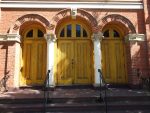
Congregation Emanu-El in Victoria is the subject and setting for The Original Deed, which opens Nov. 15. (photo by Sid Tafler)
Established in 1863, Congregation Emanu-El in Victoria is the oldest synagogue in continuous use in Canada. As the saying goes, if those walls could talk. Well, journalist and author Sid Tafler, a longtime member of Emanu-El, has given them a voice, of sorts.
Tafler, who has worked in theatre as a writer, actor and producer, has created The Original Deed, an historical drama about the synagogue.
Despite being such a landmark, Emanu-El “was nearly lost forever a generation ago, when a move was afoot to sell the old building and relocate to the suburbs,” reads the description. “The play tells the story of Sam Abelman, a Holocaust survivor and downtown jeweler, who fights to save the shul from the wrecking ball, while his son Morry tries to sell out and move the congregation to the suburbs. As the father/son struggle reaches a climax, Sam invokes ‘the Original Deed’ and a ghostly figure from his past emerges to salvage his dreams and his memories.”
Performed in the sanctuary, it features Toshik Bukowiecki as Sam, Zuzana Macknight as Rivka Abelman and Bobby Cleveland as Jack Abelman. John Roebuck plays Morry, while the rest of the Abelman clan is performed by Maureen Van Wyck as Leah, Annika Hupp as Esther, Nolan Hupp as Young Sam, and Ava Fournier, 12, who plays Ellen. Bill Taylor takes on the character of Phil Cogan, the lawyer.
“The play is set circa 1980,” Tafler told the Independent. “I say circa because the issue of selling the shul was discussed a number of times over 15 to 20 years, so 1980 is an average.”
Sid Tafler (photo from Sid Tafler)
Tafler mined the synagogue’s archives and online historical information, as well as the book Sefer Emanu-El, which was published by the synagogue on its 150th anniversary in 2013.
“I found that much of the written history about the shul is about the dynamic era of the founding in 1863 and the colourful figures of the gold rush and late 19th century,” said Tafler. “There is comparatively little about recent history. Some older members of the congregation knew about the proposed sale, which was discussed at board meetings, but not much detail about the how and why – specifically, why the idea was dropped.”
Tafler was inspired “by the intrigue and thinking behind this idea of selling the shul and moving to the suburbs, which many communities have done. When it first came up, the building was not the lovely restored heritage landmark it is now. It was covered in stucco and the ceiling had been lowered to exclude the balcony.”
In the real-life situation, there were proposals to buy an old church or to purchase land near the Jewish Cemetery on Cedar Hill Road, said Tafler.
“I created a family called the Abelmans to embody this story,” he explained. “Sam, an aging Holocaust survivor, is desperate to keep the old building, while his son Morry, head of the building committee, wants to sell out and move to a waterside location in Gordon Head (near the University of Victoria). Everyone gets involved: Sam’s wife Rivka, his granddaughter Ellen, his other son Jack, a wanderer; even his lawyer, Phil Cogan, who holds his finger to the wind and listens to his mother to decide which side he’s on.
“The stakes are very high for Sam,” said Tafler. “As a boy, he looked out the window of his home in Germany and saw his shul being destroyed on Kristallnacht. Soon after, he was shipped off to England in the Kindertransport, and never saw his family again.”
In addition to the history, Tafler said he was “also inspired by Zelda Dean, Emanu-El’s theatre maven, who suggested I write a play about the shul.”
It took two years and nine months for this production to go from idea to the stage, he said. “But, in some ways,” he said, it took 20 years. “My last play, Ghost on the Road, was produced at the Victoria Fringe Festival in 1997.”
The Abelmans are not real people, said Tafler, “but I have grown up with Holocaust survivors and their children and grandchildren from my earliest years. When I was still a toddler, my parents took in two teenage survivors from Hungary, a boy and a girl, who lived with our family in Montreal for a few years. In school, many of my classmates’ parents were survivors and I heard these stories firsthand. Here in Victoria, the survivors were a major presence in our shul.”
So, on whom is Sam based?
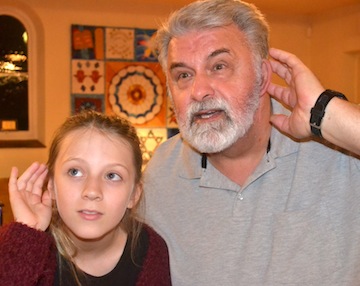
Sam (played by Toshik Bukowiecki) and his granddaughter Ellen (Ava Fournier) listen for the sounds of voices in the synagogue walls in The Original Deed, at Congregation Emanu-El this month. (photo by Gayle Mavor)
“Sam Abelman is one part Jack Gardiner. One part Peter Gary. One part Willy Jacobs. One part Ray Rose. One part each of my grandfathers, Sam Tafler and Eli Shetzer,” said Tafler. “But mostly, Sam, the lead character in The Original Deed, is himself, played by Victoria actor Toshik Bukowiecki.
“Jack, Peter and Willy were Holocaust survivors and members of our shul at different times,” Tafler explained. “They taught us about terrible loss and despair, redeemed by liberation, healing and building a new life.
“Ray was born in Victoria in 1920 and operated Rose’s Jewelers on Douglas Street, a business started by his father Joseph in 1912. He was a bombardier in the RCAF in the Second World War and flew 33 missions over Europe,” said Tafler.
“Sam and Eli were both born in shtetls in the Ukraine and immigrated to Canada in the early 20th century. They found work and raised families in Montreal and their many descendants now live across North America.”
As to some of the reasons Morry, or community members like him, wanted to abandon the historic building and move to the suburbs, Tafler provided several excerpts from the play, all spoken by Morry (Morris):
“‘… there’s not enough room in this building. We can’t keep holding seders and Hebrew classes in this little space.’ (gestures at back, behind pews)”;
“It’s a new age, Dad. We need a real school if we expect the kids to keep coming.”
“Dad, this building is old, it’s small, there’s no room for a school, for offices.”
“(At the site in Gordon Head): ‘Use your imagination. Two lovely, modern buildings. A social hall, parking lot over there. Open space for the kids. And for expansion.’”
We are taught from an early age that giving, repairing the world and being kind are the tenets of living a Jewish life. In our community we don’t have to look very far to find people who fit this description. One of the latest projects that has come to fruition is the Diamond Residences in the Storeys complex in Richmond. Thanks to the generosity of the Diamond Foundation, Tikva Housing Society now owns 18 (chai!) units that are being rented at below-market rates to people in the community for whom stable, safe housing was unpredictable and unaffordable, at best.
Tikva Housing partnered with four nonprofit societies and the City of Richmond to build these and other apartments. Tikva worked hand in hand with community agencies such as the Jewish Family Service Agency to place tenants in need in these units, as well as with the Jewish Federation of Greater Vancouver and B.C. Housing. Most of the tenants will have moved into their units by the end of this month.
The Diamond Residences will house six singles and, of those, five are seniors. Also, 12 families and a total of 22 children will be living there. One 83-year-old woman cried when she was told she would be moving into a studio unit, as she has not had a place to live for years and was sleeping on someone’s couch. A single Israeli mother with two children is moving into a three-bedroom unit; her kids have never had their own rooms. Another single mother with three children has been sharing a two-bedroom place and has not had her own room in two years. One family has moved to Greater Vancouver from out of town and can now attend Shabbat services, be close to their family and the Jewish community. There are many more such stories.
– Courtesy of Tikva Housing Society
* * *
Simon Fraser University recognized four distinguished alumni on Sept. 13 at Four Seasons Hotel. Among them was Gary Cristall, co-creator of the Vancouver Folk Festival.
The annual awards, presented by SFU and the Alumni Association, recognize those whose accomplishments and contributions reflect the university’s mandate of engaging the world. An advocate for the arts and human rights, Cristall has been a cultural groundbreaker, having co-founded the Vancouver Folk Music Festival in 1978. In an industry plagued with an unscrupulous reputation, Cristall has been instrumental in fighting for the rights of artists to be treated professionally and with respect while also defending their rights to fair performance fees and copyright ownership.
Cristall served as acting head of the music section of the Canada Council for the Arts and was the founding president of the Public Service Alliance of Canada, the first union at the Canada Council. Today, Cristall continues to serve as a prominent mentor and educator, assisting artists in building their careers and guiding communities in enhancing dynamic cultural interactions that enrich and benefit a healthy, democratic society.
* * *
After a grueling 33 hours of programming, DragonFruit – Benjamin Segall, Jacy Mark, Viniel Kumar and Pritpal Chauhan – completed StoryTree and demonstrated it live to a panel of judges at Hack the North, an international student hackathon held at the University of Waterloo in Ontario, which this year took place Sept. 15-17.
Canada’s biggest hackathon, Hack the North was founded and is organized by Techyon, a student-run nonprofit organization, in partnership with Waterloo Engineering. The event brings together 1,000 students from top universities across 22 countries in the world. Students collaborate and create impactful new hardware projects or mobile and web applications of their own design for a weekend at the University of Waterloo, all expenses paid.
DragonFruit’s StoryTree was one of the 14 projects chosen out of the more than 250 demonstrated at Hack the North. StoryTree is an online workspace for aspiring authors to collaborate on books together. All you have to do is write a paragraph or a chapter, or even just a sentence, and, as more and more people add or branch off from a story, that story you’ve always wanted to write becomes a reality.
DragonFruit will be continuing the project and are looking for alpha testers for January 2018. If anyone is interested in being a part of this project or for more information on it, contact them via facebook.com/dragonfruitcode or dragonfruitcode.com.
* * *
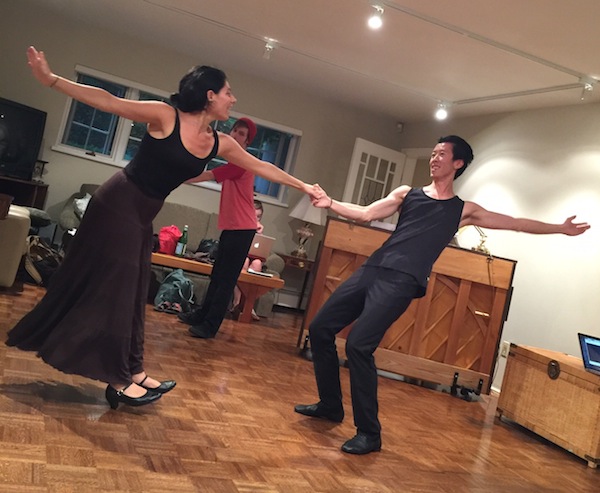
Swinging Sylvia rehearsals: Advah Soudack and Sky Kao create a whirlwind of action in rehearsal of the second one-act play that comprises Two Views from the Sylvia. (photo by Sue Cohene)
Rehearsals have started for Two Views from the Sylvia, a new musical theatre production by Kol Halev Performance Society. This original production – which will be at Waterfront Theatre Nov. 8-12 – tells the story of the iconic Sylvia Hotel and its historic connection to the local Jewish community and the city of Vancouver.
Two Views from the Sylvia comprises two one-act plays.
The first play, Sylvia’s Hotel, is set in Vancouver in 1912. It brings to life the origin of the Sylvia Hotel, named for Sylvia Goldstein (Ablowitz) and the story of the Goldstein family who built it. Young Sylvia Goldstein and the legendary Joe Fortes, the beloved English Bay lifeguard, develop a bond that helps Sylvia realize her dreams.
In the second play, The Hotel Sylvia, the story continues as we meet the characters whose lives and loves became interwoven with the story of the Sylvia over her 100-year history. It includes vignettes revealed to the production’s researchers by Huguette, the front desk clerk who worked at the Sylvia for 35 years.
Jewish community members play key roles in both plays. In the lead roles are Advah Soudack (as Sylvia) and Adam Abrams (as Abraham Goldstein); Anna-Mae Wiesenthal and Joyce Gordon are cast in important supporting roles. Behind the scenes are Sue Cohene (producer) and Heather Martin (associate producer), as well as Gordon (assistant producer) and Abrams (graphic designer and webmaster) and Gwen Epstein (production team). Marcy Babins and Michael Schwartz collaborate in their roles at the Jewish Museum and Archives of British Columbia, which has created an historical photo display to accompany the production.
Two Views from the Sylvia is a project of Kol Halev in partnership with the B.C. Arts Council, Government of British Columbia, City of Vancouver, Granville Island Cultural Society, CMHC Granville Island and the JMABC. For information and tickets ($28), visit sylviamusical.com.
– Courtesy of Kol Halev
* * *
Bema Productions’ Victoria Fringe Festival play Horowitz and Mrs. Washington was a great success. All seven performances at Bema’s Black Box Theatre at Congregation Emanu-El were sold out and the production company’s work was once again as one of the best dramas in the Victoria Fringe.
Bema Productions’ Victoria Fringe Festival play Horowitz and Mrs. Washington was a great success. (photo from Bema)
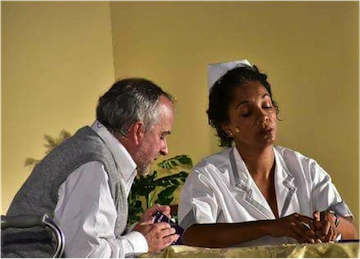
Mrs. Washington is hired to nurse Sam Horowitz, who’s been mugged and had a stroke. She’s a determined tyrant and he’s a bigoted Jewish widower. The two must find a mutually beneficial relationship when his daughter tries to make him leave his home. The play by Henry Denker reflects the attitudes of the 1970s and illuminates the power to be found in ordinary lives.
“The electric performance of the actors enabled the audience to visit uninhibitedly the issues of racism, stroke recovery and aging in place,” reads the review “Bravo Bema!” on Emanu-El’s website.
“For the most part,” said the review, “the actors were provided with a very humorous script that relied on stereotyping but went beyond it for its punchlines. The audience was asked to stretch their imaginations – who would have considered invoking Michelangelo to explain why the naming of a grandson ‘Douglas’ instead of ‘David’ was inappropriate? There were a few moments when the pace flagged but very few.”
While the play “revealed little about the face of contemporary racism,” the “potential disempowering of aging adults by their loving offspring is an issue of contemporary concern.”
The Bema production was directed by Zelda Dean and Angela Henry and was performed by David Macpherson, Rosemary Jeffery, Christine Upright, Alf Small, Cole Deo and Graham Croft.
– Courtesy of Bema Productions
* * *
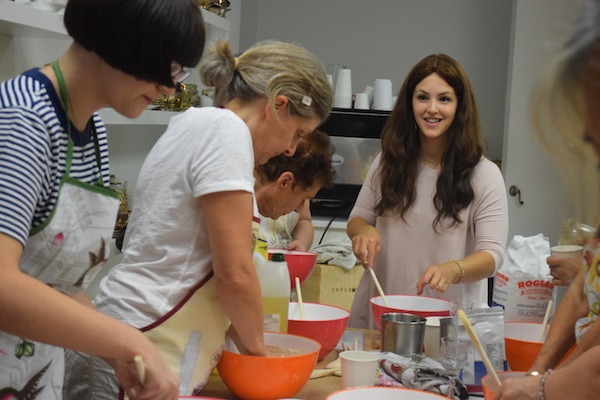
Miki Mochkin teaches a class on baking challah. (photo by Shula Klinger)
Chabad North Shore hosted a challah bake at Mia Claman’s store in West Vancouver on the night of Sept. 6. Miki Mochkin taught a class on baking challah to local women. While the bread was rising, she explained the significance of each ingredient for Jewish women. From the sweetness of the honey to the harshness of the salt, every element serves to remind the baker of its symbolic role in our lives as women and mothers.
– Courtesy of Shula Klinger
* * *
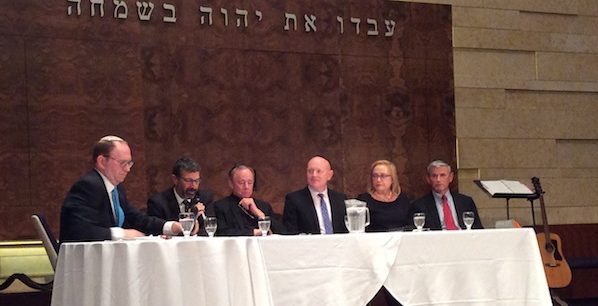
Panelists at Congregation Beth Israel discuss the topic Our Leaders: Are They Above the Law? (photo by Cynthia Ramsay)
In the photo, left to right, are Congregation Beth Israel Rabbi Jonathan Infeld, King David High School head of school Russ Klein, Vancouver Catholic Diocese Archbishop Michael Miller, Vancouver Police Chief Constable Adam Palmer, B.C. Court of Appeal Justice Sunni Stromberg-Stein and MLA Andrew Wilkinson. On Saturday night, Sept. 16, at the synagogue, this panel of speakers took on the topic Our Leaders: Are They Above the Law? Infeld framed the contemporary discussion around a talmudic discussion regarding an important rabbi in a community, rumours surrounding his conduct and whether the rabbi should be excommunicated. The panelists took this starting point to talk about their own professions, present-day accountability standards and various other issues.