The board of Congregation Emanu-El of Victoria has unanimously approved a motion to proceed with sponsorship of a Syrian refugee family. They believe that this is a moment to step forward as Jews and “welcome the stranger.”
Many in Victoria’s Jewish community trace their families’ arrival in Canada from the time they fled brutal pogroms in the Russian empire, and some came as the surviving remnant of European Jews after the Holocaust. Others landed here because they were expelled from their countries throughout the Middle East and North Africa after the creation of the state of Israel in 1948.
“As we cannot forget our oppression and persecution over millennia, we also count our blessings for living in freedom and comfort in Canada. Jewish ethics enjoin us to reach out to others to help end their suffering. The concept of tikkun, or repair, is central to Jewish belief, in that it is our duty to try and fix what is broken in this world,” said Congregation Emanu-El’s Rabbi Harry Brechner.
The synagogue welcomes all who wish to join in the fund-raising efforts. Office hours (1-250-382-0615) are Tuesday to Thursday, 9:30 a.m.-2:30 p.m., to make credit card donations, or cheques can be sent to 1461 Blanshard St., Victoria, B.C., V8W 2J3. Tax receipts will be issued for all donations.
For more information, contact Jean Dragushan, chair of the refugee sponsorship steering committee, at jean.dragushan@telus.net or 1-250-818-4132.
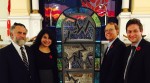
From left to right, Julius Maslovat, Carmel Tanaka, MP Murray Rankin and MLA Rob Fleming at the Victoria Holocaust Remembrance and Education Society’s annual Kristallnacht Commemoration on Nov 9. (photo from Victoria Hillel)
The following remarks have been slightly modified from the original welcoming and closing addresses given at the Victoria Holocaust Remembrance and Education Society’s annual Kristallnacht Commemoration, which took place at Congregation Emanu-El on Nov 9.
Shalom and welcome. Thank you all for coming to share in this evening of remembrance and resiliency. It is a dark Monday night in November, but you have chosen to be here. That is a statement in itself, and we thank you for taking part in tonight’s program.
We are remembering Nov. 9, 1938, a tragic night of destruction that carried on into the next day and was a portent of things to come. Remembering events such as these, as painful as they are, is vital. We don’t need to dwell on them so much as we need to draw on them for the lessons they can offer us.
Rabbi Harry Brechner of Congregation Emanu-El reminded me recently that one of our congregants, Steffi Porzecanski, may her memory be forever blessed, was a witness to the Night of Broken Glass. She lived in Berlin at the time. She would talk about how you couldn’t walk on the streets afterwards without feeling and hearing pieces of glass crunching under your feet. By the end of the destruction, some 1,000 synagogues had been burned, windows smashed, Jewish property damaged, ritual objects and cemeteries desecrated and some 30,000 Jews sent to concentration camps.
Sometimes, words are not sufficient in the face of epic horrors. Rabbi Leo Baeck, who also lived in Germany during this period, and who was eventually sent to Theresienstadt concentration camp in 1942 but did ultimately survive, wrote a prayer some years before for Jews to read at Yom Kippur. This prayer was eventually banned by the Nazis. Near the end of the prayer, he says: “We are filled with sorrow and pain. In silence, will we give expression to all that which is in our hearts in moments of silence before our G-d. This silent worship will be more emphatic than any words could be.”
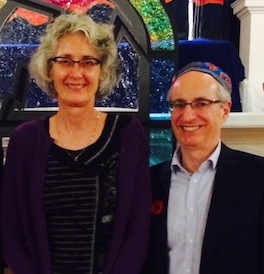
Elisheva Gray, left, and Micha Menczer. (photo from Victoria Hillel)
This is where we would like to begin tonight – allowing the silence to speak. I ask you to join me in just looking around our sanctuary and at our windows. All of the colors and nuances of our magnificently crafted windows can’t be fully appreciated at night, but they are, nevertheless, beautiful windows. At our early morning service on Thursdays, those of us who come are often treated to an extraordinary light show, as the soft, morning light gently begins touching on the blue glass.
We have all experienced the sound of breaking glass. Can we even begin to imagine the quiet and tranquility being shattered by the sound of window glass suddenly crashing to the ground and breaking into a thousand pieces, as happened in synagogues throughout Germany and Austria, beginning on that November night in 1938. The only reason? Because we were Jews. How would we feel if we witnessed that happening here, in our sanctuary, in our community, to these very windows?
As a symbol of our desire to work together in unity, to respect one another’s differences and to strive for a community that has tolerance and respect at its centre we will rebuild a window together tonight, a window resembling one of our very own windows.
While we are blessed to live somewhere where we haven’t had to witness an event like Kristallnacht, we also must be realistic of the need to remain vigilant and caring for one another in a world where such events have taken place and could, potentially, take place again. The more fractured and fragmented our world becomes, the more vital it is for us to come together, to put our differences aside and see each other on that most human level, stripped of labels and roles and categories. We may all pick our fruit from different trees, but we all share the same garden.
Tonight, as we commemorate the tragic events of that fateful November night and all that followed in its wake, we also recognize the strength and resilience of our people, the courage of the survivors, and we look towards the future with hope for a world where no group is targeted for attack, as the Jews were on the Night of Broken Glass and in the years that followed.
We are truly honored to have Holocaust survivors with us tonight, as well second- and third-generation descendants, representatives of political leadership, law enforcement agencies, faith groups and persons targeted for their sexual orientation, religious or political beliefs, participating in this symbolic reconstruction and in our candlelighting ceremony.
Our candlelighters will light seven candles. Six of them represent the six million lives lost in the Shoah. The seventh candle represents the many other persecuted victims of the Shoah. It is also our candle of hope.
Closing remarks
I’d like to thank our wonderful planning committee, our readers, volunteers and musicians for their hard work and dedication. Thank you, as well, to Rabbi Harry for his help and for his words. We are, again, especially honored and deeply grateful to our survivors, descendants of survivors and everyone who helped us with our candlelighting and our window building, especially Julius Maslovat (child Holocaust survivor), the b’nai mitzvah children from Congregation Emanu-El, local grandchildren of Holocaust survivors, MP Murray Rankin, Rabbi Harry of Congregation Emanu-El, Very Rev. Ansley Tucker, Constable Rae Robirtis from Victoria Police Department and Carmel Tanaka (Victoria Hillel director, granddaughter of Holocaust survivors and interned Japanese-Canadians).
The many problems out there in the world sometimes seem too big and too overwhelming for us to solve. Rebuilding our window here tonight may seem small in comparison to the challenges that face us in the wider world. But tonight, as we gathered to remember a difficult chapter from our past, it is our hope that, together, we injected a little more shalom into the world.
In Hebrew, every word has a three-letter root from which other words are formed. From the same root for the word shalom, peace, comes the word shalem, whole, and shlemut, wholeness. Each time we inject more shalom into the world, we are, in essence, diminishing brokenness and creating more wholeness. A little shalom goes a long, long way.
Our window may be fragile, but it is full of possibility. The cracks are a necessary reminder of our vulnerability. They are the scars that must be there, reminding us of our past, reminding us of the Night of Broken Glass.
A window allows us to look in – in this case, looking into the past, back to Nov. 9, 1938. And a window allows us to look out. What is that world that we, as individuals and as a community, want to see when we look out? A window also shows us our reflection. Who do we see looking back at us? Who do we want to see?
Elisheva Gray is a member of the Victoria Holocaust Remembrance and Education Society and is on the planning committee for the Kristallnacht Commemoration in Victoria.
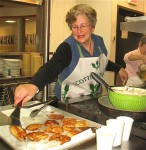
Avodah volunteer Daryl Levine makes latkes for last year’s latke lunch during Chanukah. (photo by Penny Tennenhouse)
Before 2003, Rabbi Harry Brechner of Congregation Emanu-El in Victoria had focused mostly on religious services and education. But that year, an Israeli mentor he’d known 15 years earlier paid him a surprise visit in a dream.
“I hadn’t thought about him in many years,” said Brechner, “but he came to me vividly and asked me what the real work was that I was doing. He told me I needed to go and serve, and that’s when I determined we need to devote our congregation’s energy to social action.”
Brechner wrote about his dream in his newsletter to synagogue members, hoping it would inspire the formation of a group of volunteers. It did. A social action group came together under the name Avodah, meaning work or service. Their goal was to put three main beliefs into action: to love thy neighbor as thyself, to repair the world and to commit to acts of loving kindness.
“Avodah is at the heart of being a holy congregation. There’s no being without doing and, through acts of loving kindness, we repair the world and transform our spiritual lives,” said Brechner.
Their first goal was to find out how the group could be of useful, meaningful service. They approached local organizations, such as Our Place Society and Cool Aid, to find out what they needed and one immediate answer was socks. It turned out there was a dire shortage of clean socks among the homeless. Thus, the Sock Project began.
Michael Bloomfield, a founding Avodah member, called Abe Lipson, chief executive officer of McGregor Socks Canada (a part of McGregor Industries), a Toronto-based sock designer and distributor. “I’m wearing your socks,” he told Lipson. “And the Island’s poor and homeless need your help.”
The first shipment arrived in 2005, and Bloomfield and his team fully expected it to be a one-time donation. They were wrong; a great relationship had started. Another shipment arrived in 2006 and every year that followed. To date, Avodah has worked with 27 organizations across the community to distribute some 54,000 pairs of socks.
At McGregor Socks, Lipson said the world stands on three pillars: the study of Torah, avodah and gemilut hasadim, or good deeds. “We make socks, which have a direct linkage to helping people stay warm,” he reflected. “So, socks we’re able to give. What we’re doing is actually quite small in comparison to the effort made by wonderful people who are helping the needy.”
The success of the Sock Project led to other efforts. The group began holding monthly birthday parties at Laurel House and Our Place Society, which provides assistance for the homeless, hungry and hurting. Every third Thursday, its members arrive with five buckets of ice cream and slab cakes, providing live music and birthday cards for those who have celebrated a birthday that month. “We’ve put on over 80 birthday parties, and there are usually a couple hundred people there,” said Penny Tennenhouse, Avodah’s chairperson. Avodah contributes to the Our Place annual Christmas party, and monthly to Laurel House.
Avodah also has initiated a partnership with the YMCA Outreach Van and Out of the Rain Youth Night Shelter, providing hot meals for those in need. In 2010, they expanded their involvement, opening the synagogue’s doors so that youth could sleep in the synagogue’s social hall on cold nights between October and April, as well. The meal program has become a weekly event and the synagogue has offered a warm night’s sleep for about 20 youth each week.
“We’ve tried to partner members with things they love doing,” said Tennenhouse. “In this case, we have wonderful cooks in our community who make marvelous casseroles and nutritious food for the children, and they love doing it.”
Another project, started in 2009, is a rent-supplement program to help families who are going through a crisis. Five years ago, Avodah began collaborating with the Burnside Gorge Community Association by aiding one family with $120 per month. Today, Avodah is assisting three families with their rent, providing $360 a month. As of May 2014, Avodah had contributed $19,320 for 161 rent subsidies.
“We’re trying to help with food, clothing and shelter,” said Tennenhouse, “but we also want to do what we can to help reduce poverty.” Avodah is a member of Faith in Action, an inter-faith group united by mutual concern for the poor and vulnerable in British Columbia, and dedicated to encouraging governments and community groups to address the root causes of poverty in the province.
Avodah has received many requests to help other community groups implement their own social action initiatives. To this end, it has created a presentation (available at congregationemanuel.ca/avodah.html) that outlines the work Avodah members have performed and offers a 10-step program for organizing, delivering and sustaining a community social action program.
“We want to help others to help their neighbors in need, too,” said Brechner. Avodah has brought a lot of pride to Congregation Emanu-El, he reflected. “We have a reputation of being small but mighty, of being a shining example in Victoria of what you can do when you’re determined.”
Lauren Kramer, an award-winning writer and editor, lives in Richmond, B.C. To read her work online, visit laurenkramer.net.