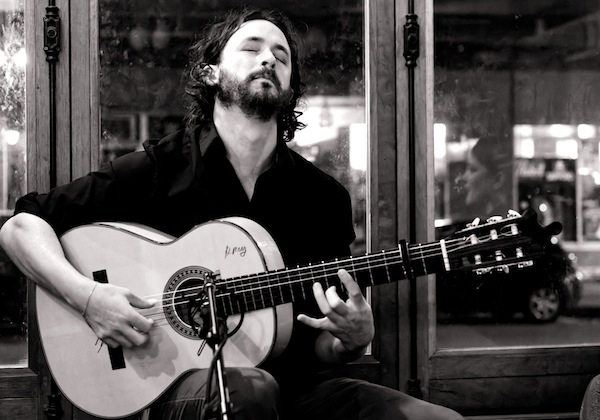
Montreal guitarist and member of the Jewish community Henry Garf takes part in this year’s Vancouver International Flamenco Festival. Presented by Flamenco Rosario, the festival features live performances, with both ticketed and free events.
Garf performs at the Waterfront Theatre Sept. 23, as part of Kara Miranda’s company. Sombras/Shadows is a live music and dance presentation with projections reflecting personal experience both visually and thematically. Shadows are explored as interplay between light and dark, through the lens of Swiss psychiatrist Carl Jung’s theories of the Shadow Self. A parallel search is for intangible shadows of the past, Miranda’s ancestral roots, living in the shadow of the flamenco greats that came before and the masters that reign today and finally accepting and actualizing her shadow side.
Garf also teaches a master class at the Scotiabank Dance Centre Sept. 24, with Alvaro Echanove, called Theory and Practice: Exploring the Skills of Improvisation, Dynamics and Active Listening through Palmas. Palmas is a style of handclapping that accompanies flamenco dance.
Other master classes take place Sept. 17 and 18, with Mucha Muchacha, and on Sept. 24, with Albert Hernandez. Other ticketed shows include Mucha Muchacha at the Rothstein Theatre Sept. 16. Their eponymous show started as theoretical and practical research about women artists from the “Generation of the 27th,” known as Las Sinsombrero, and evolved into a contemporary dance project focused on the ideas of empowerment, determination, voice, participation, freedom and cooperation. The performance is developed from force-driven movement, effort, celebration and physical exhaustion. They put “at risk” traditional Spanish dance’s corporeality in a confrontation with contemporary dancing.
The two other shows at the Waterfront Theatre are Anastassiia Alexander on Sept. 22, performing The Machination of Memories Suppressed, based on the poem “Maquina de Olvido,” which Alexander wrote, and the performance contains elements of spoken word with dance; and Flamenco Rosario on Sept. 24, with Nuevo III, a collection of new choreographies by Ballet Nacional de España choreographer Albert Hernandez, Granada’s Sara Jimenez and Rosario Ancer.
On the afternoons of Sept. 3 and 4, free performances take place on the Picnic Pavilion stage at Granville Island. The Saturday features Mozaico Flamenco, A.J. Simmons and company, Bonnie Stewart, Jhoely Triana, and Michelle Harding and Calle Verde. Performers on the Sunday are Mozaico Flamenco, Kara Wiebe, Harding and Verde, Linda Hayes, and Stewart. There is also a free 20-minute workshop on Sept. 4 for children at noon, and a 30-minute one for adults at 12:20 p.m.
The company of Bard on Beach’s production of Midsummer Night’s Dream. (photo by Tim Matheson)
The thespian delights of Shakespeare set against the glorious backdrop of mountains, sea and sky have been missed. But now, after a COVID-induced two-year hiatus, Bard on the Beach at Vanier Park is back with a bang, based on the audience buzz on opening night.
The comedy A Midsummer Night’s Dream, a perennial crowd pleaser, will occupy the BMO Mainstage all season. Harlem Duet, a tale of Black life spanning three periods in American history, runs until mid-July on the smaller Howard Family Stage, with Romeo and Juliet taking over that stage in August through to September.
This is the seventh time Bard has produced A Midsummer Night’s Dream, and this rendition has “hit” written all over it. It is one cheeky dream.
Set against the backdrop of the upcoming marriage of Athenian Duke Theseus (Ian Butcher) to foreign Queen Hippolyta (Melissa Oei), three stories weave their way through a mélange of mistaken identities, unrequited love, feuding fairy royalty and would-be actors, riotously intersecting in the enchanted wood outside of Athens.
Four young lovers, Hermia (Heidi Damayo), Lysander (Olivia Hutt), Helena (Emily Dallas) and Demetrius (Christopher Allen) dash through the woods in a mad, “looking for love romp” replete with a WWE-worthy cat fight and zingy insults.
Meanwhile, in the sylvan wonderland, Fairy King Oberon (Billy Marchenski) and his queen, Titania (Kate Besworth), are in the midst of a custody battle. Oberon sends his trusty servant, the mischievous Puck (Sarah Roa), to exact revenge on his queen with a potion meant to make her fall in love with the first thing she sees when she awakes.
Finally, we meet a troupe of bumbling tradesmen who seek refuge in the forest to rehearse Pyramus and Thisbe, the play they have written in honour of the duke’s pending nuptials. It is during this rehearsal, that one of them, Bottom (Carly Street), morphs into an ass, both literally and figuratively, and becomes the love interest of Titania.
In a nod to diversity and gender fluidity, director Scott Bellis (who knows this play from top to bottom, having performed in five of Bard’s previous Midsummer productions) has cast lovers Hermia and Lysander as a lesbian couple, while two of the tradesmen, Bottom and Snug (Jewish community member Advah Soudack), are played as females.
Bellis has also incorporated some interesting staging devices. Oberon arrives on stage on stilts, towering over his subjects. Bottom makes numerous asides to the audience and takes forays up the aisles. And the Mechanicals characters, at one point, move in a shuffling turntable motion around the stage.
Street steals the show as Bottom, the know-it-all of the working class group. Although given the lead of Pyramus, she wants to play all of the parts, thinking she can act better than the others. In her quest to prove this, she gives whole new meaning to the concept of emoting. It generally works and the audience loves it, although she often upstages her castmates.
Roa provides a refreshing spin on her impish character and Soudack, although in a minor role, is hilarious as the timid lion in Pyramus and Thisbe, as is Flute (Munish Sharma) as Thisbe, the reluctant object of Pyramus’s affection. Many of the actors are making their Bard debut and it is good to see new blood in the Vancouver theatre scene.
Jewish community members are prominent behind the scenes in this production. Amir Ofek’s set, backed by two leaded glass windows framing the view of the North Shore, easily transitions from the staid royal Athenian court to the warehouse of the tradesmen to the whimsy of the Oberon realm. Mishelle Cuttler, as sound designer/composer, provides original music that complements Tara Cheyenne Friedenberg’s ethereal choreography, as performed by students from the Simon Fraser University School of Contemporary Dance. You don’t usually get to see Shakespeare with so many dance elements, which adds an interesting layer to the mix.
Christine Reimer’s costumes are a delight – earth-toned, tailored day suits and cloche hats for the women, a white bejeweled gown for Titania, frothy candy-coloured tutus for the fairies and silky evening frocks for the final scene. Gerald King’s lighting – the greens, the purples, the reds – all work in harmony with the sun as it sets behind the stage.
To escape into the Bard’s fantasy world and enjoy the dream, visit bardonthebeach.org.
Tova Kornfeld is a Vancouver freelance writer and lawyer.
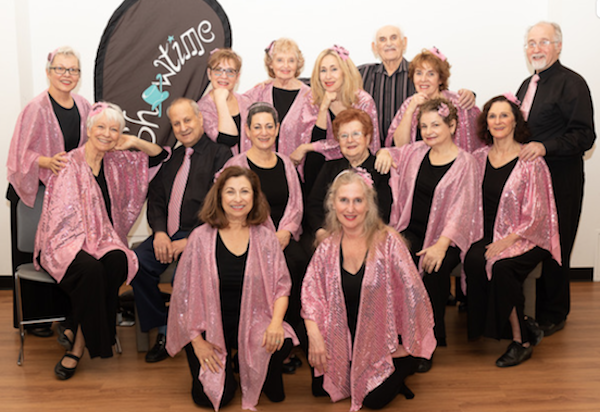
Back row, left to right: Jocelyne Hallé, Debbie Cossever, Nassa Selwyn, Susan Goldstein, Arnold Selwyn, Karon Shear and Marshall Berger. Middle row, left to right: Beryl Israel, Maurice Moses, Daniella Givon, Muriel Morris, Dawn Hurwitz and Rona Black. In front: Sara Bernstein, left, and Tamar Glaser. (photo by Jocelyne Hallé)
Shortly after she arrived in Vancouver from South Africa, in 2002, Beryl Israel founded Showtime, a seniors’ singing and dancing group. In the decades since, Showtime participants have performed 230 concerts. After a hiatus forced by the global pandemic, Showtimers are back to rehearsals, hoping to have their first public performance in September or October.
“It’s old-time, happy favourites, from the movies and from Broadway shows,” Israel said of the Showtime repertoire.
For most of the group’s history, rehearsals took place at the Jewish Community Centre of Greater Vancouver, but, as rehearsals return, they will be meeting at Kerrisdale Community Centre. Concerts are performed wherever they can bring happiness and good memories – community centres, church groups and Jewish venues like the Richmond Kehila Seniors, the Louis Brier Home and Hospital and the Weinberg Residence.
From the start, 20 years ago, the group – which usually consists of about 16 performers, many of whom are Jewish – has done a concert every three or four weeks. That came to an abrupt halt with the arrival of COVID. Now, as the group plans the first post-pandemic activity, Showtimers are reflecting on what the group – and Israel in particular – has meant to them. In a series of testimonials collected by participant Karon Shear, members spoke of the impact of their participation in general and of their friendship with Israel. The testimonials were compiled “behind my back!” Israel noted, and were shared in Senior Line, the publication of the Jewish Seniors Alliance of Greater Vancouver.
Muriel Morris, who has just retired as the group’s pianist, said the Showtime experience was important at a pivotal time in her life.
“Beryl came into my life shortly after Ben, my husband, died,” said the musician. “Meeting her was so fortunate for me. Showtime filled a great void in my life, as pianist of the group, giving pleasure to all our audiences and giving myself a true feeling of well-being and fulfilment.”
With Morris’s departure, the group will sing to music recorded by North Shore musician Bob York.
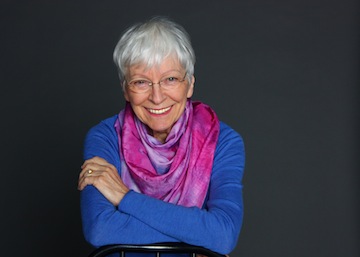
Beryl Israel founded Showtime shortly after she arrived in Vancouver from South Africa, in 2002. (photo by Jennifer Friezen)
“We’re very privileged and lucky that he’s done this for us,” Israel said.
While Showtime includes a cadre of singers and dancers, Israel alone fills many roles.
“I’m the everything,” she said with a laugh. “I’m the director, producer, choreographer, I make the costumes, I do the arrangements, I do the bookings. I ended up doing it all.”
Most of the performers are north of 70.
“I don’t know what’s happened with the 60-to-70 age group,” she said. “They sort of disappeared.”
A number of the most active participants are in their 90s – and maybe singing and dancing keeps them young.
“It’s very rewarding, both for participants and for the audience,” Israel said, a theme reflected in the many testimonials collected by Shear.
“I love the costumes, the rehearsals, being on the stage, singing and dancing and entertaining folks,” said singer Debbie Cossever. “Beryl gave me the opportunity to use my talents bringing joy to the lives of seniors. I have been with her troupe for 17 years
because I love it! I am so proud I am a Showtimer.”
“Beryl has enhanced my life and my dreams have been fulfilled,” said singer and dancer Sara Bernstein. “It has been an honour over the 17 years being part of Showtime. I witnessed how people sprung up from wheelchairs in elation of the dance, costumes and musical joy Beryl produced. I shall never forget seeing stroke victims joyfully tapping a finger or toe in unrestrained elation. Caregivers and staff mentioned that the residual energy of the shows carried on for days.”
“Although my stage presence in acting and singing goes back over 75 years,” Arnold Selwyn added, “the last 16 years, performing with Beryl’s Showtime group, has given me, without a doubt, the most satisfaction and pleasure. Her professionalism, choice of content and skill of program arranging, makes each show run smoothly and [be] enjoyable for the varied audiences. It is a joy to work with her and watching her dance is a delight.”
“Thank you for giving me the opportunity to do a mitzvah (again and again) while I do some of the things I love most – singing and dancing,” said Daniella Givon. “It is a pleasure to bring light and colour, music and movement to those who are wheelchair-bound, who cannot live on their own and who need special care. Every time I see our audience smile, nod their head, clap their hands and sing with us, I know this mitzvah counts.”
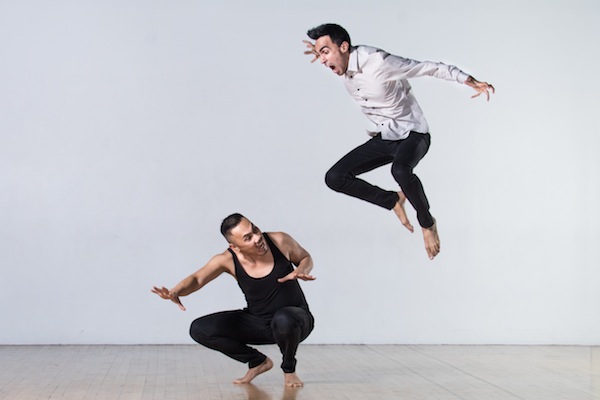
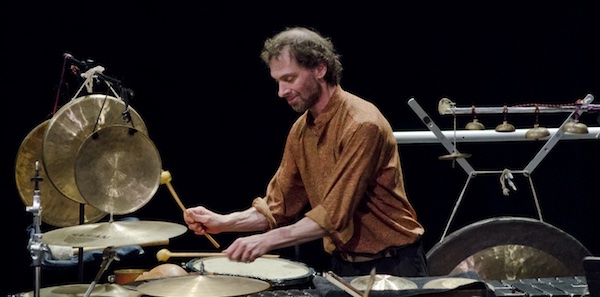
Dancers Alvin Erasga Tolentino, left, and Gabriel Dharmoo in Passages of Rhythms, in which Jonathan Bernard (below) is a percussionist. (photo by Yasuhiro Okada)
“Passages of Rhythms is inspired by a shared fascination with interculturalism, interdisciplinary activity, flamenco and collaborations between cultures,” percussionist Jonathan Bernard told the Independent about the Co.ERASGA production, which is being remounted May 19 and 20 at PAL Studio Theatre, in recognition of Asian Heritage Month. May is also Jewish Heritage Month.
“Canada is becoming well-known as an international centre of intercultural arts,” said Bernard, a member of the Jewish community. “I very much look forward to the remount and a bright future for the show on Canadian and international stages.”
In Passages of Rhythms, Co.ERASGA’s Alvin Erasga Tolentino highlights flamenco, Bharatanatyam and voices for the body, in a collaboration with local Chinese-Canadian flamenco artist Kasandra “La China,” Indo-Canadian Bharatanatyam dancer Sujit Vaidya and Montreal voice artist Gabriel Dharmoo. Ronald Stelting joins Bernard on the percussion music, and Jonathan Kim provides the lighting.
Bernard was in the original production, which took place at the Firehall Theatre as part of the Dancing on the Edge festival in 2018.
“The creation process of Passages was very smooth, full of joy and dedication, and the result brought a standing ovation from an enthusiastic audience,” he said. “Alvin is a director with a warm heart, an open mind, and is a passionate artist, so I’m overjoyed to be part of the remount.
“This is a dream gig for me,” he continued, “as I caught the flamenco bug back around 2005, I’ve traveled to the birthplace of flamenco in southern Spain to study and I’ve happily spent countless hours collaborating with flamenco dancers at local flamenco venues and on the concert stage. Kasandra was my first flamenco teacher, and we have had an artistic relationship going back to the mid-2000s. One of our groups, Orchid Ensemble, collaborated with Kasandra’s and Oscar Nieto’s Al Mozaico Flamenco Theatre to create a show named after the famous Café de Chinitas in Malaga, where Frederico Garcia Lorca penned some of his most famous works.”
Passages of Rhythms is percussionist Jonathan Bernard’s “dream gig.” (photo from Jonathan Bernard)
Another reason this is a dream gig for Bernard, he said, “is that I have the pleasure of surrounding myself with many of my favourite instruments, collected from 25 years of travel and study around the world, scouring through ancient temple and traditional markets for the best sounding instruments. For example, you will see/hear temple bells and opera cymbals from Beijing and Sichuan province; tuned gongs found in Thailand, Cambodia and Laos; the riqq (Arabic frame drum), handmade in Cairo’s old city; bells from India; and, of course, the cajon, a box drum adapted into the flamenco tradition in the 1960s.
“My compositional ideas that form the soundscape for Passages are not only inspired by the dancers’ movement,” he said, “but by the instruments themselves and the ancient styles traditions they represent. Further, as most often I am busy interpreting the work of composers, Passages gave me a chance to compose my own original music.”
Since the mid-1990s, Bernard and his wife and artistic partner Lan Tung have been creating intercultural ensembles, mixing instruments and instrumentalists from traditions ranging from Chinese, South Asian, Persian, Arabic, North African and Western traditions, creating original Canadian music, and touring internationally. “We looked to ancient centres of interculturalism such as the Silk Road and El Andalus for inspiration, and as reflections of our own unique cultural environment,” he said. “Andalusia was a golden age of interculturalism, where Jews, Muslims and Christians lived in relative peace and shared knowledge and cultural traditions, from architecture to music to the culinary arts.
“Since the birthplace of flamenco – approximately one hour by train to the ancient Mediterranean port city of Cadiz – was located in the heart of Andalusia, I believe flamenco was certainly shaped by the liberal sharing and mixing of traditions,” he said. “For example, the 12-beat time cycles that are of central importance to West and North African traditions are also deeply embedded in flamenco forms; the castanets and palmas (interlocking handclaps) can be found in the carcabas and rhythms of the Gnawa and Berber people of Africa; the Ashkenazi cantorial traditions must have influenced the passionate flamenco vocal style. It might be said that flamenco borrowed rhythmic elements from North Africa, melodic elements from the pre-inquisition Ashkenazi Ladino song, and with simple harmonic structures and the guitar from Europe.”
Passages of Rhythms’ May 19 and 20 performances start at 8 p.m. Tickets are $30 ($20 for students and seniors) and can be purchased at eventbrite.ca.
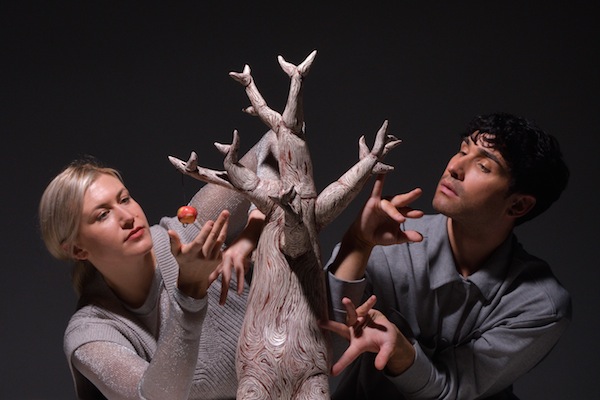
In DANCE:CRAFT, dancers Heather Dotto and Joey Matt interact with and reinterpret five elements – glass, metal, wood, fibre and ceramics – created by B.C. crafts artists. (photo by Michael Slobodian)
After years of development, DANCE:CRAFT will see its world première May 20-22, 7 p.m., at the SFU Goldcorp Centre for the Arts, Fei and Milton Wong Experimental Theatre. Among the craftspeople who contributed their creativity to the show is Hope Forstenzer, a glassworks artist, who also happens to be the director of the Gertrude and Sidney Zack Gallery.
“I was asked to be part of the project in October of 2016 and, at the time, the thinking was that it would take about two years to develop,” Forstenzer told the Independent. “It wound up taking longer than that for lots of reasons – I think one of the primary dancers went on maternity leave and, then, right as the project was about to begin rehearsals, COVID shut everything down.
“Initially, Joe [Laughlin] and I had all kinds of discussions and brainstorming sessions about ways to incorporate pieces into the dance. We rethought quite a bit of it when we started up again, and we wound up with some very interesting stuff that was quite different in some ways than we originally imagined. I think it’s going to be quite a bit different than any of us originally thought – the world isn’t what it was in October 2016.”
DANCE:CRAFT is described as “an exploration of two dancers interacting with numerous craft objects in a reconfigured theatre setting. It’s craft seen through the lens of dance and remixed, a look at our relationship to objects, creating and interacting with them.”
Presented by Joe Ink – which is led by Laughlin – and SFU Woodward’s Cultural Programs, DANCE:CRAFT also features five virtual reality films that give viewers a look into the artists’ studios.
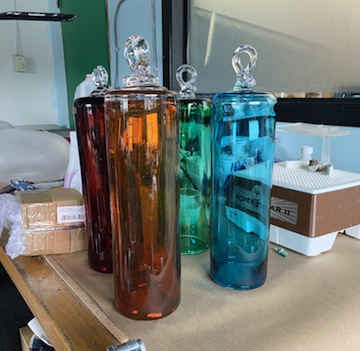
“I’ve made six large blown glass rock-like pieces with lights inside of them, a large acrylic box full of glass balls, and 12 hanging cylinders in various sizes,” said Forstenzer.
Hope Forstenzer has created 12 hanging cylinders for the performance. (photo by Hope Forstenzer)
The whole creative endeavour began as a research project focusing on dance and art. Laughlin conceived of the concept and the dancers are Heather Dotto and Joey Matt. They worked with five B.C. artists, facilitated by the Craft Council of British Columbia, curators of the show. In addition to Forstenzer, Stefanie Dueck (metal), Patrick Christie (wood), Deborah Dumka (fibre) and Debra E. Sloan (ceramics) provide the five elements that the dancers and Laughlin reinterpret.
“I have been thinking about the earth, the environment, the elements, evolution, geography, migration and humans,” says Laughlin in the press release. “The tactile sensation of handmade objects juxtaposed with the ephemeral quality of the dancing body triggers a memory experience. Being immersed in an environment and watching the body respond to texture and colour is what anchors us in time and space. We are looking for connections between communities and the natural world, geography and the human family.”
Laughlin added, “The process for creating a dancer incorporates fibre, sinew, muscle, bone, water, pressure, agitation and repetition. Craft is a transformative process that incorporates stone, fibre, wood, metal, water, pressure, agitation and repetition.”
DANCE:CRAFT asks audiences to consider, “How do objects further extend the language of the body and its narrative possibilities?”
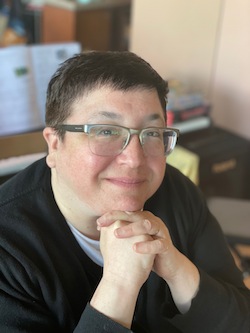
Glassworks artist Hope Forstenzer (photo from Hope Forstenzer)
“I come from a theatre background and have done a great deal of work with dancers and actors,” said Forstenzer in contemplating this question. “Objects – props, costumes, sets, and all things like them – become part of a performance completely. A knife becomes part of an arm, to use for harmless or harmful purposes; a table becomes a second stage if someone stands on it; a mask hides a face. The best performances use performers, environments and objects to tell a story fully. I think what we’ll see with DANCE:CRAFT is a full storytelling collaboration, in which the artists have given works to Joe, and he has created a story to tell with them.
“This has been a fun project to work on,” she continued. “It’s not that often you get to do a collaboration like this. I’m really excited to be part of it.”
Tickets for the performance are $30 ($25 for students and seniors) and they can be purchased at eventbrite.ca.
A Million Voices, choreographed by Matthew Neenan, is described as a “lighthearted and whimsical ode to Peggy Lee’s iconic jazz standards.” (photo by Rob LatourRob Latour)
Los Angeles-based BODYTRAFFIC returns to Vancouver for their DanceHouse debut, May 5-6, at the Vancouver Playhouse. The company, which is led by artistic director Tina Finkelman Berkett, will present Mixed Repertoire – A Million Voices, The One to Stay With, SNAP and PACOPEPEPLUTO.
“It is an immense privilege to present BODYTRAFFIC’s DanceHouse debut this spring, which also represents the company’s return to Vancouver since 2015,” said Jim Smith, artistic and executive director of DanceHouse, in a press release. “This is a masterful program of short works that effortlessly showcases BODYTRAFFIC’s singular ability to take on any dance genre, moving from hip hop to ballet to jazz and back again. Beautiful, virtuosic, political, and with a dash of much-needed lightness, this evening of dance will leave audiences breathless and wanting more.”
Tina Finkelman Berkett (photo by Guzman Rosado)
“We love coming to Vancouver,” Berkett told the Independent. “The audiences are always so welcoming and so curious. There always feels like a supportive energy for the work we are sharing. I loved that program that we offered back in 2015 [at the Chutzpah! Festival]. Typical to BODYTRAFFIC programming, it was packed full of works by choreographers who I believe in wholeheartedly.”
As for the May program, Berkett said, “The works the company will offer on May 5 and 6 showcase the versatility and virtuosity of our dancers. The program offers singular choreographic voices, some emerging and some established. Baye & Asa and Micaela Taylor are newer voices in our industry and are certainly taking the dance world by storm; I’m so excited to share their works. As always, the program will offer the audiences a chance to enjoy and be entertained.”
According to the press release, the 90-minute show will open with A Million Voices, from Matthew Neenan, which premièred in 2018. “A lighthearted and whimsical ode to Peggy Lee’s iconic jazz standards, this infectious piece featuring seven dancers reminds us that, even during our toughest moments, life is always worth enjoying.”
The One to Stay With by choreographers Baye & Asa was commissioned by BODYTRAFFIC and premièred only just last month. “Inspired by Patrick Radden Keefe’s 2021 book The Empire of Pain, about the Sackler family’s role in ‘Big Pharma’ and the current opioid epidemic,” The One to Stay With is a work for eight dancers. It “tackles ideas of power, greed and deceit, punctuated by a lively score of Russian waltzes and Romanian folk songs.”
SNAP, from Micaela Taylor, which BODYTRAFFIC premièred in 2019, features six dancers in a “hip hop-infused choreography [that] urges audiences to ‘snap out of’ pressures to conform, encouraging us to embrace the individuality of our own selves as well as those around us.”
The final piece, PACOPEPEPLUTO, by Alejandro Cerrudo, which premièred in 2011, features three male dancers, “who each perform an athletically charged solo set to a Dean Martin classic.”
BODYTRAFFIC was co-founded in 2007 by Berkett and Lillian Rose Barbeito. It is now under the sole artistic direction of Berkett, who started her career at Aszure Barton & Artists, with which she became a feature dancer, as well as Barton’s assistant and an instructor.
“I never dreamt of having a dance company,” Berkett told the Independent. “When I was a young dancer, I had a very different idea of what my future would be. I thought I’d join a repertory company – not start one! But life led me to Los Angeles and eventually to launching BODYTRAFFIC to fulfil my dreams as a dancer.”
Before moving to Los Angeles from New York and co-founding BODYTRAFFIC, Berkett was a founding member of Mikhail Baryshnikov’s Hell’s Kitchen Dance.
“Jewish values are a part of everything I do,” Berkett said when asked how her being Jewish influences her outlook and choices. “Family, community, charity, honour, respect, curiosity and a commitment to learning are also central to who I am and the work I do.”
BODYTRAFFIC’s May 5 and 6 shows at the Playhouse start at 8 p.m. Tickets (from $35) can be purchased at dancehouse.ca.
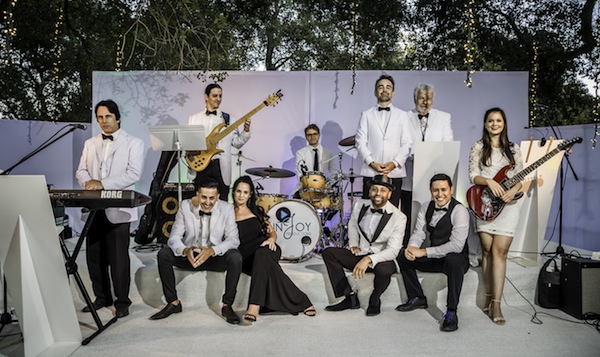
Israel’s Gilat Rapaport and the InJoy Band headline this year’s Yom Ha’atzmaut celebration on May 4 at the Vogue Theatre. (photo from injoyprod.com)
This year’s Yom Ha’atzmaut celebration on May 4 at the Vogue Theatre, headlined by Israel’s Gilat Rapaport and the InJoy Band, marks 20 years since the first large-scale community-wide event to celebrate Israel’s Independence Day was organized by the Jewish Federation of Greater Vancouver.
“Growing up in Vancouver, the community had occasional large Yom Ha’atzmaut events with Israeli performers and I have wonderful memories of attending them,” said Stephen Gaerber, who co-chaired that first major gathering. “I was incredibly impressed by a large event held to celebrate Israel’s 50th in 1998 at the Orpheum [which was chaired by Judy Mandleman]. It was 2001, the Second Intifada was raging, Camp David had resulted in failure and Israel was, as usual, being disparaged in the press. My friend, Rick Schreiber, had become the chair of the Federation’s Israel department, and I told him that I thought the community should be having large-scale events every year to celebrate Yom Ha’atzmaut and all that is wonderful about Israel. His response was, ‘OK, you chair it.’ That’s how I became chair for the 2002 Yom Ha’atzmaut celebration, first co-chairing with my wife, Shari, and then, starting in 2003, with my brother Allen.”
Of course, local groups celebrated Israel’s birthday in various ways prior to 2002, notably the now-defunct Canadian Zionist Federation (CZF). Bernard Pinsky was CZF chair in the late 1980s.
“In the 1980s,” said Pinsky, “CZF brought in big names from Israel for a Yom Ha’atzmaut concert, including top artists like Nomi Shemer, Chava Alberstein, and Haparvarim. The concert was held at the JCC and wasn’t always right on Yom Ha’atzmaut, it was when the artists were available. The venue meant that we could only sell about 400 tickets, and CZF did a lot of fundraising to cover costs.”
Geoffrey Druker, who still leads the community’s annual Yom Hazikaron (Israel’s Memorial Day) ceremony, said he was recruited by Pinsky to become involved in CZF and it was from Pinsky that Druker took over the role of local CZF chair in the early 1990s.
“We ran most Israel-related community programs,” said Druker, including Yom Ha’atzmaut, Yom Hazikaron, Walk with Israel (which took place on Jerusalem Day), the student public-speaking contest and other programs. When CZF closed nationally, Druker said he gathered past local leaders of the group to decide “whether to become an independent local organization or join Federation.”
The choice was to join the Israel desk at Federation, and Druker continued to chair many of the events, with most of the Yom Ha’atzmaut activities being held at the Jewish Community Centre of Greater Vancouver, he said.
“Federation didn’t have the funds for a large Yom Ha’atzmaut, and we couldn’t risk having a large celebration … while keeping the event tickets affordable to all,” said Druker. “So we ran smaller celebrations and with less-known artists.”
Affordability remained key when Federation, led by a committee put together by Stephen and Shari Gaerber, took over the event.
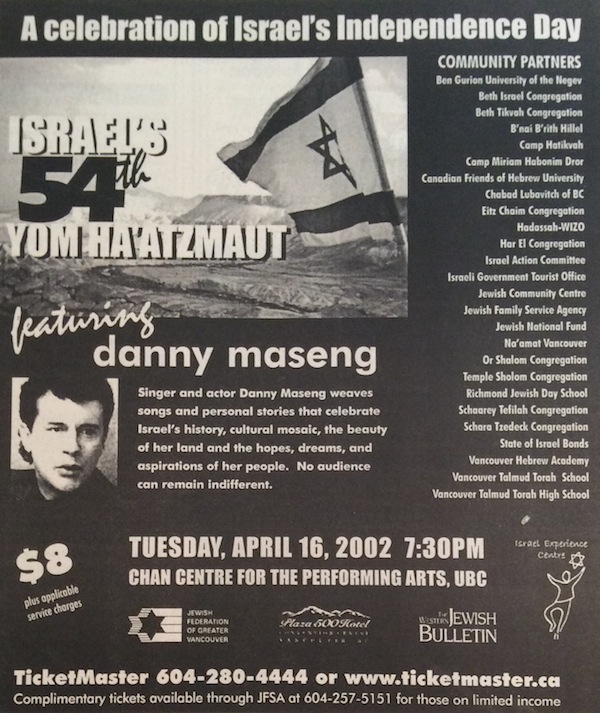
“Our goal wasn’t to just make it a concert, but a real community celebration,” said Stephen Gaerber. “We kept ticket prices very low so that everyone could afford to attend – and if they couldn’t afford even that, we made free tickets available through JFS [Jewish Family Services]. We invited all Jewish organizations in the city to add their names as Community Partners, and dozens did. We had children from Hebrew Academy, Talmud Torah and RJDS performing in addition to Israeli singer Danny Maseng.
The ad promoting the 2002 Yom Ha’atzmaut celebration.
“We were given no budget (other than staff time) for the event from the Federation and I didn’t want one. I was determined that the Federation not take anything away from what they were allocating to local community agencies in order to make this event happen. We believed that the community would support the event and we were right. We raised the funds from generous donors, rented the Chan Centre and signed a contract with the performer. We put tickets on sale and we sold out all 1,200 seats very quickly. The event itself is a bit of a blur, but my most vivid memory is the joy people expressed to us at its conclusion.”
With that success behind them, the goal was to involve even more individuals and organizations in the celebrations.
“For years,” said Gaerber, “Jonathan and Heather Berkowitz wrote a piece for young community members to perform and we were fortunate to have Wendy Bross Stuart direct them. We later added the JCC’s children’s Israeli dance troupes to the program, sometimes joined with dancers from our partnership region in the Upper Galilee.
“Pam Wolfman took over chairing the event in 2014 and continued to tweak things to make sure everything is new and fresh and even better each year, including involving the entire community in the community song,” he said. “What hasn’t changed is the support from the community. To this day, other than staff time, the Federation has not had to give any funding at all towards putting on the event. The group of donors has grown over the years and that allows the event to continue to stay true to our initial vision – tickets are still affordable and many are available at no cost to those who need them – and the events continue to sell out.”
The annual celebration brings Israeli performers – from veteran musicians to up-and-coming singers and musical groups – to Vancouver on Yom Ha’atzmaut.
“For many,” said Gaerber, “it was their first time performing outside of Israel on Yom Ha’atzmaut, as they hesitate to leave the country for this important day. Without exception, they have all expressed how incredibly meaningful it was for them to experience the warmth of our community and its love for Israel. A number of our performers who would not have otherwise considered coming to Vancouver for Yom Ha’atzmaut have only done so because they have heard from other performers about their experience and our Jewish community.
“Despite our Jewish community’s relatively small size,” he said, “we have been told by Israeli diplomats that Vancouver’s Yom Ha’atzmaut celebration, always occurring actually on erev Yom Ha’atzmaut, is one of the largest celebrations of its kind taking place on that day outside of Israel.”
For tickets to this year’s event and a sneak peak at the program guide, go to jewishvancouver.com/yh2022.
InJoy, led by Gilat Rapaport (centre), comes to Vancouver for the community’s Yom Ha’atzmaut celebration on May 4 at Vogue Theatre. (photo by Linda Kasian)
Tickets are now on sale for the community’s celebration of Israel’s 74th Independence Day. This year’s Yom Ha’atzmaut event will be held, COVID permitting, at the Vogue Theatre on May 4.
“The Yom Ha’atzmaut committee, Federation staff and I are really excited about our first large community gathering since before the pandemic,” said Pam Wolfman, chair of the committee. “This year also marks our 20th anniversary of this event, making it an extra special celebration for the whole community!”
Emcees Lu Winters, Kyle Berger and Adora Harel will guide attendees through the night’s festivities, which will include special guest performers Gilat Rapaport and the InJoy band, as well as local community dance groups, and Vancouver Talmud Torah and Richmond Jewish Day School students. Once again, a community song video will be screened – to participate, submit a video of yourself singing Jewish Federation’s version of “Salaam” by March 31. Video submissions will be edited into one that will première on May 4 at the Vogue. For details, including the audio and lyrics of the song, visit jewishvancouver.com/community-song-2022.
Rapaport was born and raised in Israel and has been performing on stages in Israel and around the world since the age of 12. After her service in the Israel Defence Forces’ entertainment groups, she moved to Los Angeles in 1998.
Rapaport began her career with classical training at the Israel Conservatory of Music in Tel Aviv and continued at the Rimon School of Music branch in Boston. She founded her company, InJoy Productions, just over 20 years ago.
Rapaport and InJoy have been touring – South America, South Africa, Australia, Europe and the United States – performing their joyful and energetic music for Jewish and non-Jewish communities around the world. For Metro Vancouver’s Yom Ha’atzmaut celebration, they will perform traditional and contemporary Jewish and Israeli repertoire, with the hope that audience members will dance and sing along.
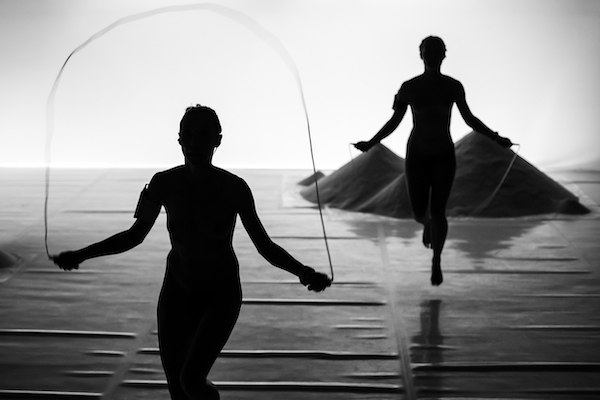
Body Line of Thought (BLOT) examines “our microbiome as a collection of organisms in perpetual transformation.” (photo by Ionut Rusu)
Vanessa Goodman (Action at a Distance) and Simona Deaconescu (Tangja Collective) explore aspects of our humanity in their dance and art. Their collaborative Body Line of Thought (BLOT) is a four-video installation that “aims to strip the body of social meanings and rethink it as an interconnected system.”
BLOT runs Nov. 24-28, 1-4 p.m., at KW Studios as part of the Dance Centre’s 13th biennial Dance in Vancouver.
“In BLOT, we are interested in examining our microbiome as a collection of organisms in perpetual transformation,” explained Goodman. “The human body contains trillions of microorganisms, that outnumber human cells by 10 to one. Each person’s bacterial composition acts as an ersatz fingerprint: when two people touch, they exchange parts of this identity. With each point of contact we essentially ‘infect’ each other with bacteria. We incorporate these themes of communication and contamination on a physical level. We are interested in the banality and the danger of such exchanges.
“One of the main focuses of BLOT is centred around bacteria being an agent of infection and salt becoming a cleaning and restructuring force in our bodies,” she continued. “We are not scientists, but we are fascinated by how these basic elements of our biological makeup can drastically inform our mental and physical health. Both salt and bacteria transform organic material, and we are drawn to transformation within our work. We are interested in applying these relationships to our art practice, and this has allowed us to create a new space to explore conceptually and physically.”
Without salt, “senses are dulled, muscles can’t fire, and nerves cease to function,” Goodman said. “In BLOT, salt acts as a conductor for our creativity. We explore salt as a staging material and incorporate many of its tactile qualities across various mediums, providing a textural through-line between visuals, sound and movement. We try to reframe the banality of sweat, a ubiquitous element of every dance, as a thematic focus instead of a mere byproduct.”
As part of their research, Goodman and Deaconescu went to Portugal, where they were in residence with Bio-Friction at Cultivamos Cultura. There, said Goodman, “we learned how to cultivate our own bacteria in agar dishes and studied this information and imagery to build BLOT.
“Our work in dance and art aims to speak not only about widely discussed issues but also about the unseen life that shapes our body and connects it with the outside world,” she said. “We seek reciprocity in our practice, parallel to that of a healthy immune system: to become stronger, one must first be vulnerable and exposed.” (BLOT includes nudity.)
BLOT was presented as a three-video installation at Left on Main last year, via 20 personal Zoom performances. Its creators, Goodman and Deaconescu (who is also a filmmaker), connected when they were both choreographers at Springboard Danse Montréal in 2019.
“During this intensive working period, we realized how many artistic interests we share,” said Goodman. “We both use a deconstructed vernacular that flirts with pop culture and is mediated by the lens of conceptual and physical landscapes. We are interested in looking at the body as a biological technology that can be altered by its environment, which is especially relevant today.”
Dance in Vancouver features many ticketed and free events at various locations. This year’s festival was co-curated by Australia-based Angela Conquet with Michelle Olson and Starr Muranko of Vancouver’s Raven Spirit Dance. Some performances, films and events will also be available online. For tickets and information, visit thedancecentre.ca/event/dance-in-vancouver-2021.
Live performances – that you can see in person – are, thankfully, a thing again. At least, for now. And this year’s Chutzpah! Festival, Nov. 4-24, features many shows that people will be able to attend, most of which will also be streamed digitally.
For the two artists the Jewish Independent interviewed this week about the festival, the upcoming performances hold special meaning.
“I am so looking forward to coming back to Canada,” said New York-based comedian and storyteller Ophira Eisenberg, who was born in Calgary. “And Vancouver at that! Where it all started.” Eisenberg performs Nov. 7 at the Rothstein Theatre.
Shay Kuebler/Radical System Art’s Momentum of Isolation sees its world première at the theatre Nov. 13 and 14. The dance company returns to Chutzpah! as resident artists. The Rothstein Theatre and Chutzpah! “have been critical to the growth of Radical System Art and my work as an individual artist,” Kuebler told the Independent, describing the theatre as “the cradle that supported us” during “our infancy as an organization.”
“When I stepped back into the theatre,” Kuebler said, “it was like being back in a close friend’s home. It feels right. There’s a groove and comfort there. This has enabled us to create with as much momentum as possible, both as a company and collective of artists.”
Stepping back into a theatre has been an emotional experience for many artists.
“This spring in New York, I performed numerous times outside,” said Eisenberg. “All of the situations were a little different and, a couple of times, the address of the show was a large tree in a park! It wasn’t ideal and definitely was challenging, but people really wanted to laugh and take in some live entertainment, so it was uplifting.
“My first real performance inside at a comedy club was in early May, when New York opened small performance venues,” she said. “The audience was distanced and masked, and I think they laughed louder and harder than an audience of 3,000 – or maybe my ears weren’t used to hearing live indoor laughter and it sounded explosive. Either way, it almost brought me to tears, and I know I’m not the only one that felt that way.”
Eisenberg comes to Vancouver soon after the final episode of National Public Radio’s comedy trivia show Ask Me Another, which she hosted for nine years, interviewing and joking with numerous famous folk, including Sir Patrick Stewart, Awkwafina, Ethan Hawke and Julia Stiles, among many others.
“After interviewing hundreds of celebrities, authors, musicians,” said Eisenberg, “one thing that stands out to me is that, whenever we talked about a project that meant a lot to an artist, they mentioned that what made that project so successful was the supportive environment – and the fact that they worked with people who allowed experimentation and even failure. That ended up bringing out their best work. I think about that a lot when it comes to creating a space for artists to truly succeed.”
Eisenberg has headlined and performed at countless festivals and appeared on numerous comedy networks and programs. She has her own comedy special, called Inside Joke, and her first book, Screw Everyone: Sleeping My Way to Monogamy (Seal Press), was optioned for a feature film. She is a regular host and storyteller with the Moth, an organization that has become a radio show and podcast, in addition to putting on live events and other activities.
As for what she would still like to accomplish in her career, Eisenberg said, “I’m working on another podcast that I hope is also long-running! But I have so many things I’d like to do. Maybe too many things! On the docket are writing another book, and I’d love to write for TV. Performing live is my first love, so I’m looking forward to a safer world where that can happen more often.”
Eisenberg’s journey to success began at a young age.
“I truly believe I was drawn to New York as a child from watching Sesame Street!,” she said. “I went to McGill for university, where I got a bachelor’s in anthropology and theatre, then moved to Vancouver for a couple of years, where I tried standup for the first time.
“I was honestly too scared to move to New York,” she admitted, “so I moved to Toronto and spent five years performing and starting to understand my craft. Then, one day, I thought, ‘I need to move to New York now while I can still happily live with a futon and milk crate furniture.’ Two years after moving here, I discovered the Moth…. I love writing jokes, but I was working on other material that just did not fit into the standup mold. I found an outlet of expression at the Moth and in this short form storytelling, and I continue to pursue both.”
When asked to describe her connection to Judaism and/or Jewish community or culture, Eisenberg said, “I have a joke in my act that goes something like this: ‘I was raised Jewish in Calgary, Alberta, or so I thought because when I moved to New York I wondered, “maybe I was raised Protestant?” Everyone in New York is more Jewish than I am. My Puerto Rican neighbour knows more about Judaism than I do.’
“That is just a joke but living in New York is definitely the first time I felt surrounded by pervasive cultural Judaism. My father was the principal of the Hebrew school in Calgary but left that job the year I was born, so I went to public school. We still practised at home and went to synagogue during the High Holidays. As an adult, I’ve definitely been able to find my community here in Brooklyn, which is very wonderful and embracing.”
Exploring isolation
In 2018, before the pandemic sent us all into relative isolation, the United Kingdom appointed its – and, apparently, the world’s – first minister of loneliness, to address the problem as a public health issue.
“Right away, the title of ‘minister of loneliness’ grabbed me,” Shay Kuebler told the Independent. “There’s something very simple about it and it almost feels like a caricature, yet, when you think of someone whose entire work/career is to disrupt loneliness, it becomes deeply serious. When you read about isolation and loneliness, the gravity of this position becomes even more clear.”
The United Kingdom’s action was a catalyst for Kuebler, who noted, “You can now find multiple countries that have ministers of loneliness.”
The work Momentum of Isolation “speaks to a number of ideas around isolation and loneliness,” he said. “By doing so, I hope to open up greater conversations around the topic and maybe have audiences start their own exploration of the topic.”
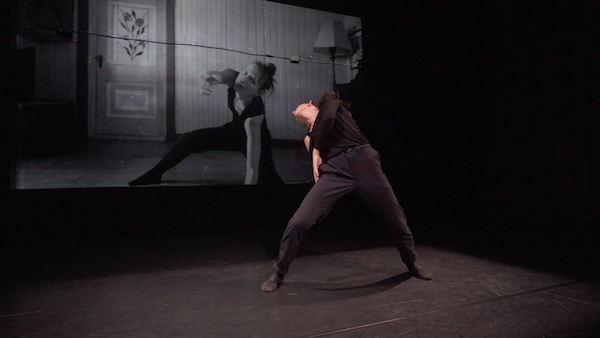
Sarah Hutton performs in Shay Kuebler/ Radical System Art’s Momentum of Isolation. (screenshot)
Momentum of Isolation explores the theme both through physical isolation and social isolation, explained Kuebler. “These two points are explored through a number of different scenes, which make the show episodic in its structure, with some through-lines and arcs for characters moving all the way through.”
The work has turned out to be even more relevant than Kuebler initially thought it.
“Honestly, this show took on an evolution that I could have never projected,” he said. “The timing of our first full-company research period coincided with the closures and lockdowns across 2020. I knew that this project was important, and being forced into an online/isolated form of research was profound, to say the least.
“This isolated online research, which enabled one-on-one time with each of the company artists, created a well of material,” he said. “It was a format that was completely new, but something I found extremely valuable. While working with each artist one on one, I was simultaneously writing and composing music for the work. This not only led to a lot of new scenes and ideas, but it also distilled what was most relevant and necessary to say.
“For me, this piece was both a rediscovery and a reinforcement of what I hold most valuable. It has brought me back to how and why I want to create. I am grateful for this.”
For those unfamiliar with Radical System Art and dance in general, Kuebler added, “I know when we hear ‘dance’ and, especially, ‘contemporary dance,’ a lot of people can feel hesitant. I want readers and audiences to see this show as more of a ‘contemporary theatre experience.’ It brings together technology, design and multiple art forms around a very relevant – and timely – theme. It is something being made now, through many different artists and their many unique experiences…. With a collaborative approach to connecting with our audiences, we hope to create something new, relevant and accessible.”
For Chutzpah! tickets and the full lineup, visit chutzpahfestival.com or call 604-257-5145.