Volumes in the silence

Jewish Voice for Peace held a discussion on antisemitism recently at the New School in New York City and the panel included Linda Sarsour, whose associations and opinions, particularly about Israel and Jews, are controversial.

The school defended its choice by saying that there are “differing views on the issue of antisemitism,” a Trumpian formulation on par with the idea that there are good people on both sides of every issue.

Sarsour, a daughter of Palestinian-American immigrants, rose to national prominence as a co-chair of the Women’s March earlier this year and was dubbed by Politico as “the face of the resistance” to Donald Trump.

She is also highly controversial. When she got into a public spat with ex-Muslims Ayaan Hirsi Ali and Brigitte Gabriel, Sarsour tweeted, “I wish I could take their vaginas away – they don’t deserve to be women.” (Hirsi Ali was subjected to female genital mutilation at the age of 5 in her native Somalia.)

Sarsour is particularly opinionated about Israel. She claims that Israel has a right to exist, but does so in the context of a “one-state solution” that would eliminate Israel’s Jewish identity. She supports the boycott, divestment and sanction movement and has defended sharing a stage with Rasmea Odeh, a terrorist involved in murdering two Israelis and wounding nine others. She has tweeted that “nothing is creepier than Zionism” (nothing?!) and said it is not possible to be a Zionist and a feminist.

So it was a point of contention when Sarsour was invited to join a panel on the subject of antisemitism. Yet Sarsour has something to say that everyone should listen to closely.

She says that antisemitism is “different than anti-black racism or Islamophobia because it’s not systemic.” As one commentator noted, what was more “systemic” than the Holocaust? But Sarsour was making a legitimate case: Jews in 21st-century North America do not suffer systemic economic disadvantage due to their Jewishness. Jews are no longer precluded from housing, universities or any place in the public realm because of their identity. Jews are not randomly pulled over and shot by police. Jews do not experience lower wages or lesser positions of employment because of their identity.

Antisemitism isn’t routinely expressed in the same ways as most other common forms of prejudice and discrimination. However, this doesn’t mean it doesn’t exist or should be dismissed.

Whether left, right or centre, most of us now accept an economic definition of discrimination: lower standards of housing, employment, opportunity and outcome. But antisemitism doesn’t manifest in these ways. However, it can manifest in hate speech, attacks on synagogues and other Jewish institutions, and physical assault. It can lead to genocide, as it has within the memory of the living generation. It can result in the ethnic cleansing of Jews from almost every Muslim-majority country on earth over the course of a couple of decades.

So, antisemitism is not a benign force, even if it does not fit the parameters we now widely use to identify and measure discrimination. In fact, it is, in itself, a form of discrimination to ignore the uniqueness of antisemitism.

Antisemitism can also take the form of a movement to eradicate the national homeland of the Jewish people. There are reasons to criticize Israel, but to argue that Jewish people are the only people in the world not deserving of national self-determination is problematic.

At the heart of the anti-Zionist movement is an imagined firewall between antisemitism and even the most extreme condemnation of Israel, including calls for it to be eliminated. It is fair to make the case that criticism of Israel is not necessarily influenced by anti-Jewish animus. But this is not the case being made by people like Sarsour. Their position is that there is effectively no connection at all between anti-Zionism and antisemitism and that any suggestion of a connection is a strategy to “silence” or discredit criticism of Israel.

The idea that opinions, stereotypes or prejudices about Jews play no role in perceptions of the Jewish state is unreasonable. If there is anything that should cause skepticism toward Sarsour and those like her, it is the stalwart refusal to even consider the presence in their worldview of prejudice about Jews. If any other group of people in the world so much as suggested that they were affected by bigotry or discrimination, people like Sarsour would take these concerns seriously. When Jews make this suggestion, it is rejected outright and labeled a ploy to win a political argument. This, in itself, speaks volumes.

Confront racism

On Remembrance Day, pro-Nazi posters were discovered at War Memorial Gym on the University of British Columbia campus. The posters depicted Nazi soldiers with the words “Lest we forget / The true heroes of WWII.”

This incident followed the discovery earlier in the week of antisemitic drawings on a chalkboard in the forestry faculty. Rabbi Philip Bregman, executive director of Hillel BC, sent an email to the community thanking the Forestry Undergraduate Society for making a clear statement of solidarity. While this is the good news, he wrote, there is also bad news. Students are reporting that the latest incidents are a “tip of the iceberg” of similar expressions and depictions that go unreported.

Earlier this month, white supremacist and antisemitic posters also appeared at the University of Victoria. “(((Those))) who hate us / Will not replace us,” read a poster. The use of triple parentheses is a method used online to identify Jews. The fear of white people being “replaced” by non-white people is a recurring theme in the white supremacist movement.

These incidents are local iterations of a larger and obviously deeply troubling phenomenon occurring worldwide. In part a response to the movement of refugees from Syria and elsewhere in the Middle East and North Africa, far-right groups in Europe have grown significantly in recent years. This is evident in the horrifying rally of an estimated 60,000 neo-Nazis, hyper-nationalists and racists in Warsaw, Poland, last weekend. And it is underscored by the neutrality or even affirming noises from those in positions of power at the sight of ralliers carrying signs urging “Clean blood,” “Pray for an Islamic holocaust” and “Jews out of Poland.”

Poland’s governing Law and Justice Party has informal connections with some of the extremist groups that organized Saturday’s rally. Poland’s foreign ministry, on the one hand, condemned the xenophobic, antisemitic and racist messaging, but, on the other hand, called the event “a great celebration of Poles.” The country’s interior minister called the rallying extremists “a beautiful sight.”

This sort of equivocation from leaders is perhaps as worrying, or more so, than the rallying mobs themselves. While the past year has seen numerous European far-right parties fail to live up to expectations in elections, their strength is nevertheless very concerning.

On the subject of elections … off-year elections in the United States last week delivered a strong rebuke to the U.S. president. Although polls indicate that 36% of American voters would vote for him again, no president in the history of polling has been this unpopular this early in his mandate. This is, perhaps, a sign that most Americans are turning against the divisiveness and xenophobia that this president advances.

Encouraging as that may be, possibly (wishfully) portending his defeat in 2020, the damage he is doing to the civil fabric of the country is incalculable. It is saddening to see the president of the United States overtly promote racism against Mexicans and people from Muslim-majority countries, threatening one group with a wall and the other with a travel ban that has been repeatedly deemed unconstitutional by the courts. Among his supporters are openly racist and white supremacist activists.

All of this is to say that the world is experiencing a time of extremism. Rather than throw up our hands in despair, this is a time to rededicate ourselves to the values that motivate us, the values for which Canadian and other Allied soldiers fought.

The posters at B.C. universities should be enough to sweep away any complacency we may have about our shores being free from this sort of racist ideology. This is a good thing. Canadians have a right to be proud of our comparatively decent record of multicultural harmony, but smugness is a blinder that can allow us to ignore very real undercurrents. We must be vigilant in calling out evil ideology when we see it at home and abroad.

Winning with grace

It was the model of dignity and decorum in a ludicrous situation. When Israeli judoka Tal Flicker won a gold medal last week at the Judo Grand Slam in Abu Dhabi, in the United Arab Emirates, his excitement was diminished by the Emirati host federation. Because of Flicker’s nationality, the UAE refused to play the winner’s national anthem or raise his nation’s flag. Instead, while the gold medal winner stood under a flag of the International Judo Federation and the federation’s theme song played, Flicker had to quietly sing his own private rendition of Hatikvah, the Israeli anthem.

Similarly, when Israel’s Tohar Butbul beat an Emirati judoka, the defeated competitor turned his back on Butbul’s extended hand, carrying through the tournament’s motif of betraying the values of judo in particular, and sports more generally.

Israel went on to win five medals in all at the tournament, with the rudeness by Emirati organizers repeated again and again. (The Israeli team was also forced to remove their nation’s flag from their uniforms.) Yet Flicker’s grace, and that of the other winners, was a model that Israelis and Jews worldwide – indeed, anyone with a smidgen of sportsmanship – should admire.

In what was a small consolation, two senior Emirati sports officials later apologized to the head of the Israeli judo delegation for the loser’s refusal to shake Butbul’s hand. But there has been no apology for the larger silliness around the Israelis’ participation in the competition.

In an ideal world, international sports federations and other bodies would reward behaviour like the UAE’s by preventing them from hosting major events for a specific period and demanding in advance that the most basic tenets of sportsmanship be respected by any country that hopes to host.

In the bigger picture, the incident demonstrates the absurd treatment Israel receives in the international community more broadly. The latest example, which also happens to involve the UAE, occurred on Monday in Paris at the 39th general conference of UNESCO, the United Nations Educational, Scientific and Cultural Organization. The UAE struck a commemorative medal to mark the renovation of UNESCO’s conference room. The medals feature a portrait of Hamdan bin Rashid Al Maktoum, the UAE’s finance minister (a keepsake for sure!) and one was left on the desk of every UNESCO member-state except … the Jewish one.

“The state of Israel has no need for gifts,” said Carmel Shama-Hacohen, Israel’s ambassador to UNESCO, “but this ugly and uncivilized step, here in the world’s organization for culture and education, which follows the outrageous treatment of our judokas during the tournament in the UAE’s capital, shows how much hatred, incitement and dark mentality surround these people.”

And so it seems.

Jewish groups’ M-103 advice

Left to right, MP David Sweet, MP Michael Levitt, CIJA chief executive officer Shimon Koffler Fogel, MP Scott Reid and MP David Anderson pose for a photo during the House of Commons Standing Committee on Canadian Heritage hearings on M-103 on Oct. 18. (photo from CIJA)

Jewish groups were in Ottawa on Oct. 18 to testify in front of the House of Commons Standing Committee on Canadian Heritage, which will make policy recommendations on M-103, a motion that condemns “Islamophobia and all forms of systemic racism and religious discrimination.”

Leaders of the Centre for Israel and Jewish Affairs (CIJA) and B’nai Brith Canada drew on the Jewish community’s experience with fighting antisemitism in their recommendations on how to maximize the motion’s efficacy.

In his testimony, CIJA chief executive officer Shimon Koffler Fogel pointed to statistics that showed Jews are the most targeted religious minority in the country.

“Nationally, there were 54 hate crimes targeting Jews per 100,000 individuals in 2015. While this number is relatively consistent with previous years, there was an increase in hate incidents targeting other minority communities, including the Muslim community. In fact, Muslims were the next most targeted group, with 15 incidents per 100,000 individuals,” Fogel said. “I mention these numbers not to showcase Jewish victimhood, but rather to demonstrate the very real experience our community has in grappling with the issues this committee is studying.”

B’nai Brith Canada chief executive officer Michael Mostyn recommended that the motion be constructed so that it will be “embraced broadly by all Canadians” and by “communities that are the targets of racism and discrimination, including Canadian Jews, who continue to be the target of antisemitism.”

Mostyn said the bill must not diminish “the threat to Canadians of all faith communities who face racism and religious discrimination and it must not suggest that one form of racism or religious discrimination is more threatening, or of greater priority, than another.”

Among Fogel’s recommendations was that the committee work to improve on the collection and publication of hate crime data, as it currently varies widely by police department.

He said statistics from the Greater Toronto Area – including Peel Region, Toronto and York Region – are readily available, “but even with these three neighbouring jurisdictions, each report provides different information, making direct comparisons sometimes difficult.”

He added that there are cities, such as Montreal, that don’t release data about which identifiable groups are being targeted, leaving policymakers with incomplete information.

Fogel said it’s important to properly define hate, as we “can’t effectively fight bigotry and hatred without precisely defining it. The term ‘Islamophobia’ has been defined in multiple ways, some effective and some problematic. Unfortunately, it has become a lightning rod for controversy, distracting from other important issues at hand.”

Fogel used the Islamic Heritage Month Guidebook, which was issued by the Toronto District School Board earlier this month and contains a definition of Islamophobia that includes “dislike toward Islamic politics or culture,” as an example.

“Muslims can be protected from hate without restricting critique of Islamist political ideologies,” Fogel said.

Mostyn agreed that the committee should “exercise great care in any definition of Islamophobia” because, if the definition is vague or imprecise, it can be “hijacked and only inflame tensions between and among faith communities in Canada.”

Mostyn said an imbalance can create “the impression that Canadian Muslims are the only victims of hate crimes. We are just as concerned with the source of hate crimes targeting Canadian Jews from within radical elements of the Muslim community.”

Fogel also recommended that greater and more consistent enforcement of existing laws is needed. “Recently, the attorney general of Quebec decided not to lay charges in a case of an imam in Montreal who had called for the murder of Jews. Quebec’s attorney general also declined to pursue a second charge of genocide promotion. This decision sent a message that someone can call for the death of an entire group of people without consequence,” he said, adding that the federal government should train police and prosecutors to better enforce the existing Criminal Code hate speech provisions and provide resources for the development of more local hate crime units.

In his testimony, David Matas, B’nai Brith Canada’s senior legal counsel, argued that some fear of radical Islam is rational.

“Adherents to some components of Islam preach hatred and terrorism, incite to hatred and terrorism and engage in hate-motivated acts and terrorist crimes,” Matas said. “What the committee, we suggest, can usefully do is propose criteria, with illustrative examples, which can guide those directly involved in the combat against the threat and acts of hatred and terror coming from Islamic radicals.”

Matas called on the committee to “focus both on those victimized by Islamophobia and on the incitement and acts of hatred and terrorism, which come from within elements of the Islamic community.”

In his remarks, Fogel also referred to the passing of Bill C-305 – a private member’s bill that would expand penalties for hate crimes against schools and community centres associated with identifiable groups – which had its third reading on Oct. 18.

“CIJA has long advocated for the changes contained in Bill C-305,” Fogel said. “C-305 is a clear example of how elected officials can work together, in a non-partisan spirit, to make a practical difference in protecting vulnerable minorities.”

CIJA chair David Cape said, “CIJA remains grateful for the tireless efforts of MP Chandra Arya, who has committed his time and energy to strengthening hate crime protections. As we celebrate Canada’s 150th anniversary, we’re reminded that the safety of at-risk communities is essential for a healthy, vibrant country. Criminals who target Jews or other minorities don’t distinguish between houses of worship, community centres and schools – neither should the law.”

– For more national Jewish news, visit cjnews.com

Writing Lives begins anew

This academic year marks the second session of Writing Lives, a two-semester project at Langara College, coordinated by instructor Dr. Rachel Mines. Writing Lives is a partnership between Langara, the Vancouver Holocaust Education Centre and the Azrieli Foundation.

This fall, students are learning about the Holocaust by studying literary and historical texts. They are using the resources of the Isaac Waldman Jewish Public Library to help them write detailed research projects on prewar Jewish communities in Europe. In January, students will begin interviewing local Holocaust survivors and then write the survivors’ memoirs on the basis of the interviews. Students are keeping journals of their personal reflections on their experiences as Writing Lives participants. Many students used their first journal entry to reflect on how the course material is changing their perceptions of current events. Here are some excerpts.

I have learned that a racist interaction between a person of colour and a white person is not only between those two specific people. In that interaction is embedded an entire history of racism. A racist society supports white and racist ideology in a way that has historically privileged white people and embeds power in a racist interaction. The social conditions in a racist society psychologically prime the person of colour to strategize in certain ways during interactions they may perceive as dangerous.

Similarly (I realize now), Jews were emotionally and psychologically primed by their history of using appeasement as a successful, non-violent form of survival-as-resistance. This history surely psychologically primed the German oppressors to see the Jews as appropriate targets for their unprecedented scapegoating and the ensuing genocide.

This is one of the few times so far that a concept I have learned as an undergrad is beginning to take hold in my mind, tangibly changing the way I think and interpret information. I am learning to more broadly apply what I have learned about oppression and resistance. My evolving thought process gives me hope that I will in my life have a greater understanding of such dynamics and that I will contribute to the effort to understand, influence and mitigate, or even transform, dynamics between people of power and vulnerable populations.

– April Curry

Learning about the origins of Nazi Germany, the slow and steady rise to power of Hitler and his party, and the various influences that led to the Holocaust has been enlightening, in a troubling way, of course. One of the scariest eye-openers about what I have learned recently is just how human this chain of events was. A hurt and angry nation was ready to find anything and anyone to take their frustrations out on. It’s scary how this chain of events makes sense in retrospect. Yet it’s also disturbing how little thought I gave to this chain of events; they were things that happened, so I left it at that. But there is so much insight to be gained from reading into this history. Learning the history of the Holocaust and the build-up to it has given me a sense of awareness. I feel much more enlightened thanks to learning this history.

– Clayton Dott

There has been much focus on Hitler’s personal pathology (his lack of self-esteem, sense of being an outsider, etc.) to explain his primal role in the Holocaust. Problematically, this view assumes that Hitler’s racist system of values and beliefs arose outside of the environment he lived in. It is clear, however, that antisemitism, a racist ideology, existed long before his time. Furthermore, restricting the discourse to individual pathology denies the connection between Nazi violence and antisemitism, as though “lone wolves,” driven by individual malice, had committed the crimes. For example, the claim that “without Hitler, no Holocaust” denies the incessant influence of historical antisemitism and other dominant ideologies, such as Aryan supremacy and nationalism. Moreover, placing an emphasis on personal characteristics fails to take into account structural oppression. Fascist and authoritarian leaders may be charismatic, but the popular support they garner relies heavily on their ability to create a sociopolitical framework that allows for organized and systematic coercion and manufacture of consent, achieved by subjecting people to and satiating them with dogmatic education and media propaganda.

– Marc Perez

As the class explored the factors that contributed to the prejudice and antisemitism that led to the Holocaust, I was confronted with the reality of the deep and painful cost that the fear of disconnection and abandonment has on our society. Research has shown that the human need for belonging, connection and community is in fact one of the precipitating causes of racism. It is strange and uncomfortable to step away from my generally positive understanding of connection and find that belonging can be built on the loyalty earned by excluding others. In fact, the act of ostracizing and dehumanizing others can help form a shared identity and sense of belonging.

In what ways do I meet my own needs for belonging when I fail to speak up after a racist joke is told or someone is scolded for not speaking English to their own peer group in the line at Starbucks? We have to ask ourselves, what does it mean when people like myself, with so much social privilege, fail to disrupt these sorts of racist attacks? In this way, am I not complicit in the propagation of intolerance and social isolation in my own community?

– L. Ann Thomas

Merkel’s election win

Angela Merkel was returned for a fourth term as Germany’s chancellor on Sunday, defeating her main Social Democrat opponent, as well as a seemingly global surge toward populism. However, while she succeeded, her vote share declined – and the footnote of the election turns out to be the bigger story.

The far-right Alternative for Germany (AfD) party came third, taking about 13% of the vote and entering parliament for the first time. The result was as good as any polls had predicted, meaning that some people who voted for them probably didn’t feel comfortable sharing their voting intentions with pollsters. The party was formed just four years ago, amid an anti-immigrant and anti-refugee backlash in response to Merkel’s liberal approach to the crisis caused by the Syrian civil war. In response, Merkel reined in her liberal approach somewhat, possibly saving her party from defeat. Just a few months ago, Merkel’s reelection appeared to be in doubt.

The success of Merkel’s conservative bloc is a sign that, when push comes to shove, German voters trust her steady hand at a time when the European Union and the world is in upheaval. While immigration remained a central issue in the election, its potentially negative impact on Merkel’s chances may have been blunted by the overarching desire for stable government.

In the face of Brexit and various economic crises in EU member states over recent years, Merkel emerged as the unequivocal leader of the vision of European unity. German voters endorsed her overall approach. But the emergence of AfD is worrying, though not surprising. Extremist parties have been burgeoning all over Europe – and extremism is flourishing in the United States. It would have been stunning if Germany completely avoided this trend.

For their part, the Social Democrats had been in a governing agreement with Merkel’s conservatives and, as is often the case in such scenarios, found themselves at a disadvantage in differentiating themselves from the incumbent government when putting their case to voters. They may choose to rebuild their party from the opposition side, rather than form another coalition with Merkel. However, if they choose to cooperate with the conservatives, that will put the third-party AfD in the enviable position of official opposition. This would give the radical right grouping even greater prominence than their 13% vote share would seem to justify.

“We will change this country,” declared Alexander Gauland, a co-leader of the AfD, on Sunday night. These are eerie words coming from the leadership of a group that promises a return to traditional German “volk” values, glorifies the Nazis and has been accused of racism and antisemitism.

The extremists will have an unprecedented platform (at least in the postwar era) in German politics and, even lacking legislative power, will be able to give voice to ideas that have largely been taboo in the German body politic for the past 70 years.

Yet, we should not allow the dark lining to obliterate the silver cloud. The election secured a stable, reliable and moderate direction for Germany that is good for Europe, the world and, not incidentally, Israel.

In its manifesto, Merkel’s party acknowledged a “special responsibility of Germany toward Israel” and earlier equated the BDS (boycott, divestment and sanction) movement with the Nazi campaign to boycott Jewish businesses. Under Merkel’s leadership, Germany has continued and strengthened its very close alliance with the Jewish state. The German government has been a bulwark, to the extent that a single government can be, against the anti-Israel movements at the EU and the United Nations.

In election after election in Europe over the past year, worst-case scenarios have been avoided. Extremist parties have made inroads, but generally less than anticipated. The AfD’s relative success may be seen as a protest vote, in which case we may be seeing its zenith. In any case, Germans will now get a clear view of what the party stands for – and will have the opportunity to stand up in opposition to the divisive and xenophobic policies the AfD promotes.

Controversy over Icke’s talk

David Icke spoke in Vancouver earlier this month at the Orpheum. (photo by Tyler Merbler via cjnews.com)

David Icke – a controversial conspiracy theorist, antisemite and Holocaust denier – spoke in Vancouver at the Orpheum on Sept. 2, despite the city’s civic theatres board’s recommendation to Mayor Gregor Robertson and city council that Icke’s booking be canceled.

In a statement quoted in the Vancouver Sun, the city said that under the Charter of Rights and Freedoms, “the city is not in a position to take action intended to censor speech that is otherwise permissible under Canadian law.”

Icke is a British author and speaker known for his bizarre views. A former football player and sports broadcaster for the BBC, Icke was once also a spokesperson for the U.K. Green Party. All that changed in 1990, when, by his own account, a psychic told him that he had a special mission on earth and would soon begin receiving messages from the spirit world. The following year, he announced on primetime British television that he was “the son of godhead” (also a title of Jesus Christ’s) and predicted global natural disasters to come.

Over the next several years, Icke developed his worldview, which has been called “new age conspiracism.” He described himself as “a full-time investigator into who and what are really controlling the world.” In his 1994 book The Robots Rebellion, he answered the question by singling out Jews. But, he also argued that the really major players in world dominion were an ancient order of shapeshifting, blood-drinking reptilian humanoids called the Babylonian Brotherhood. Their goal, according to Icke, is the creation of a neo-fascist global state, known as the New World Order.

When Icke added Holocaust denial to his worldview in his 1995 book And the Truth Shall Set You Free, his publisher felt he had crossed a line. As a result, that book, and Icke’s subsequent works, were published at his own expense.

Icke combines familiar New Age philosophies with conspiracy theories about public figures being reptilian humanoids and pedophiles. He believes in reincarnation, a collective consciousness that has intentionality and the “law of attraction” (that good and bad thoughts can attract like experiences).

According to a report by Political Research Associates – an American nonprofit research group that studies white supremacist groups and militias – Icke’s ideas are “a mishmash of most of the dominant themes of contemporary neofascism, mixed in with a smattering of topics culled from the U.S. militia movement.” The same report details the support that Icke has gotten from far-right and neo-Nazi groups, including the violent U.K. group Combat 18, which was linked to bombings of minority neighbourhoods in London.

Aiden Fishman of B’nai Brith Canada described Icke’s views as “classic antisemitic ideas” and said the booking should never have been allowed. “It’s totally, totally incompatible with the city of Vancouver’s role as an open and tolerant multicultural municipality to allow Mr. Icke to speak at a city-owned facility after we’ve brought all these concerns to their attention,” Fishman told CBC News.

“You are free to be a racist in Canada, you are free to say so and tell others that they should be, too,” Micheal Vonn, policy director of the B.C. Civil Liberties Association, told the CJN. “But this is not just about Mr. Icke’s rights. Everyone who comes to see him has their Charter rights involved, as well. The government should not be in a position to prevent you from hearing what you would like to hear.”

To those who say that the talk should not have been held at a city-owned venue, Vonn said: “The city does not support this, the city is neutral with regards to the content. Can you imagine if the city could pick and choose who among the public they allowed to make use of the venue? They can’t be cherry-picking what members of the public get that benefit. The city can’t be saying this is available only to people that we like. It is, as it should be, available to all members of the public involved in lawful activity.”

To be unlawful, Icke’s speech would have to constitute criminal hate speech, which has a high burden of proof in Canada. “He would need to be intentionally and explicitly inciting harm,” said Vonn.

An admittedly unscientific Vancouver Sun poll asking whether the event should be canceled, showed that most readers supported Icke’s right to free speech, with more than 81% of respondents saying the show should go on.

Despite significant coverage of the event leading up to the talk, Icke’s lecture, which he claimed would last 10 hours, apparently failed to attract a media presence. Nor have there been any allegations of criminal hate speech.

Matthew Gindin is a freelance journalist, writer and lecturer. He writes regularly for the Forward and All That Is Interesting, and has been published in Religion Dispatches, Situate Magazine, Tikkun and elsewhere. He can be found on Medium and Twitter. A longer version of this article was originally published by CJN.

Revisiting the Venice ghetto

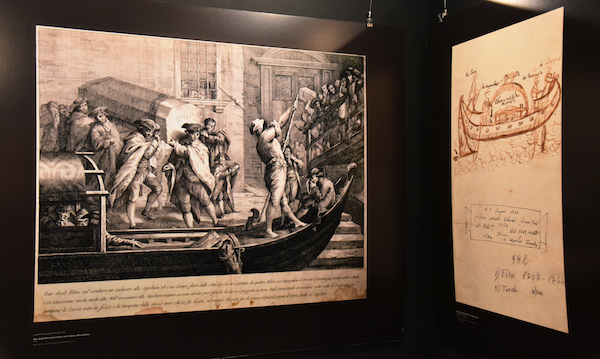
A page of the digital interactive installation of the domestic space of the Jewish ghetto, which was created by camerAnebbia. Part of the exhibit Venetian Ghetto: A Virtual Reconstruction: 1516-2017, which is at the Italian Cultural Centre’s Il Museo until Oct. 30. (photo by Cynthia Ramsay)

The Venetian ghetto – a segregated enclave for Jews and the one from which the very name “ghetto” emerged – was created 500 years ago. An exhibit at Vancouver’s Italian Cultural Centre tells the history of the ghetto and is one of a number of local cultural events this year marking the half-millennium since the notorious decree.

The Venetian Ghetto: A Virtual Reconstruction: 1516-2017 opened at the centre’s Il Museo this summer. It is an abridged version of a larger exhibit showing concurrently at the Doge’s Palace in Venice, said the museum’s curator, Angela Clarke.

Clarke and Il Museo had wanted to do something around the topic of the ghetto in part because of a connection with a member of Vancouver’s Jewish community. When the late renowned University of British Columbia architecture professor Dr. Abraham Rogatnick passed away in 2009, he left his collection of Venetian books and other materials to the museum.

“A lot of the prints we have in the hallways are from his collection,” said Clarke. “Venice was his specialty.”

Rogatnick took his architecture classes to Venice and was also noted for turning his lectures into theatrical performances, accompanied by moody lighting and complementary background music. (After his retirement, he became immersed in Vancouver’s alternative theatrical scene, depicting, as he put it, “usually dying old men.”)

“We have, for a long time, wanted to do something in honour of Abraham Rogatnick,” said Clarke. When she discovered that the Doge’s Palace was planning an exhibit to mark the 500th anniversary, she contacted the institution. They agreed to reproduce a version of the exhibit tailored to Il Museo’s space.

It was the palace’s 16th-century resident, Lorenzo Loredan, the doge of the Republic of Venice from 1501 until his death in 1521, who determined that Jews should be segregated from the general Venetian population.

Although the origin of the term “ghetto” is disputed, many accept the view that it comes from the Venetian dialect’s word ghèto, foundry, which was the neighbourhood in which Jews were confined. Jews were allowed access to the city during the day, but were restricted to the ghetto at night. Space limitations in the ghetto led to upward expansion, including multi-storey homes and buildings, a unique architectural approach to that date.

“They built upwards to accommodate their family life and their businesses, so you got these very, very high staircases in buildings and they just built upwards,” Clarke said. “For the Jewish community, it’s all about going up stairs. I think a lot about the aging people in these families. What happened to them? What would an 80-year-old do? How would they negotiate that and go about their family life and business? And the stairs are incredibly steep. That was just their everyday life.”

The exhibit has four parts, including an interactive exploration of the ghetto’s synagogues through a virtual reconstruction. The architecture of the ghetto, the cemeteries and “the ghetto after the ghetto” – the fate of the area after Napoleon conquered Venice and emancipated the city’s Jews in 1797 – round out the exhibit.

The ghetto was remarkably multicultural, Clarke emphasized.

There were four main cultural groups that came to Venice, she said. “There were the Italian Jews, there were the German Jews, there were the Spanish Jews and then there were the [Levantine] Sephardic Jews, and they all came to Venice, so there were a number of synagogues and each synagogue was like a different cultural centre, based on your group, because each synagogue, of course, had schools. You have Hebrew but then your own cultural language. So the synagogues really did deal with a diverse group of people who came.”

photo - Image of a boat leading to the Jewish cemetery circa 1700s. Part of the Venetian Ghetto: A Virtual Reconstruction: 1516-2017 exhibit at Il Museo
Images of boats leading to the Jewish cemetery circa 1700s. Part of the Venetian Ghetto: A Virtual Reconstruction: 1516-2017 exhibit at Il Museo. (photo by Meghan Kinnarny)

Jews began gravitating to Venice as early as the 900s, with a surge in the 1300s and then again after the expulsion from Iberia.

The segregation of Jews was premised on economic concerns, said Clarke, with restrictions on professional activities that pushed the Jewish residents into dubious roles like moneylender. As in so many instances across European history, Jews were forced to wear differentiating articles of clothing; in Venice’s case, a red hat. The exhibit demonstrates the constancy of the compulsory topper while also depicting changing styles across centuries.

“The fashions change but the red hat stays the same,” Clarke says guiding visitors from one painting to another. “The woman over there, she’s very Renaissance. Over here, it’s the 1700s and he’s still wearing the red hat but the fashion has changed dramatically.”

Napoleon liberated the Jews, but he had somewhat bigoted notions of the city of Venice.

“He called it the drawing room of Europe, depicting Venice as this beautiful little elegant community,” Clarke said. “However, I’ve been reading Florence Nightingale and she [observes that] referring to something as a drawing room is a pejorative term. For a man to be in a drawing room is basically to say that he’s effeminate.

“When you look at it in that historical context – especially when you’re dealing with a megalomaniac who’s got basically size issues – it’s a veiled term,” she said, laughing.

The exhibit at Il Museo coincided with the Stones of Venice exhibit at the Jewish Community Centre of Greater Vancouver (profiled in the Independent Aug. 18) and performances of Merchant of Venice and Shylock as part of this year’s Bard on the Beach (reviewed July 21).

“It all just seemed to come together, which is very bizarre,” said Clarke. “It doesn’t often happen that way.”

The Venetian Ghetto: A Virtual Reconstruction: 1516-2017 continues until Oct. 30 at Il Museo in the Italian Cultural Centre of Vancouver, 3075 Slocan St. More information at italianculturalcentre.ca.

Ottawa teen sentenced

The front doors to Ottawa’s Congregation Machzikei Hadas on Nov. 17. (photo from Machzikei Hadas via CJN)

An Ottawa teen who vandalized several Jewish buildings last autumn, and who professed pro-Nazi sympathies, was sentenced in August to a year in custody, including time served.

The teenage male, who cannot be named because he was arrested as a minor, has been in custody for nine months, meaning he will serve another three months at Ottawa’s William E. Hay Centre, a youth detention facility. At his sentencing on Aug. 31, he also received two years probation, with several restrictions.

As part of his probation, the youth was ordered to write three 500-word essays, one each on a notable Jewish Canadian, a Muslim Canadian and a black Canadian. He also faces a curfew, restrictions on internet use and was ordered to stay away from the buildings he vandalized.

The teen had pleaded guilty to five charges, including inciting hatred, mischief against religious buildings, threatening conduct, possession of weapons and breaching bail conditions from an assault conviction in 2015. The charges stemmed from a spate of incidents between Nov. 13 and 19, 2016, when spray-painted swastikas, white nationalist symbols and racial slurs were daubed on two area synagogues, a Jewish prayer house, a Jewish communal building, a mosque and a United Church that has a black minister. The Jewish targets were Congregation Machzikei Hadas, Kehillat Beth Israel synagogue, a Jewish prayer centre called the Glebe Minyan that is run out of a private residence and a building on Ottawa’s Jewish Community Campus.

The teen turned 18 soon after the offences occurred. After he pleaded guilty, the Crown prosecutor asked the judge to consider sentencing him as an adult, in order to treat his racist ideology, monitor his movements and designate him a long-term offender. But the judge, Peter Griffiths, denied that request, saying the accused has shown signs of progress that risk being undermined if he were sentenced as an adult.

“We hope the judge is correct in his assessment and that [the teen’s] progress continues, because the best outcome for our community is that he alters his worldview,” Andrea Freedman, president and chief executive officer of the Jewish Federation of Ottawa, told the CJN.

Freedman, who attended the court hearings, said she considered the sentence to be just. “I think the judge was fair and tried to balance the need to infer that public safety is protected and that the sentence acts as a deterrent for others, while balancing the need to rehabilitate this young man,” she said.

Freedman, along with Linda Kerzner, chair of the Jewish Federation of Ottawa, and Elly Bolleggraaf, a local Holocaust survivor, submitted victim impact statements to the court, saying the attacks shocked and hurt the city’s 14,000-strong Jewish community deeply.

Freedman told the CJN, during the teen’s sentencing hearing last May, that the accused “has an extended history of racist and antisemitic views and, by all accounts, is completely unrepentant for his deeply traumatizing actions,” and that he had refused treatment.

“Accordingly, we feel we have no choice but to ask the court to consider a lengthy sentence and an extended probationary period, as well as a restraining order barring him from proximity to Jewish institutions,” Freedman said at the time.

At his sentencing hearing, Dr. John Federoff, a forensic psychiatrist who examined the teen, testified that the young man likely had schizophrenia and blamed his crimes on Jews.

More recently, the teen apparently told youth workers that he’s interested in removing racist tattoos from his body, expressed an interest in mental health counseling and has shown progress in vocational training while in custody, CBC News reported.

Freedman said the teen apologized for his actions before receiving his sentence. “We’re appreciative that this individual has been held accountable for his actions,”she said. “Our primary concern is the safety of our community members.” She added she is hopeful that the progress in the offender’s behaviour noted by the judge “is genuine and continues.”

While previous attempts at outreach have not succeeded, she said, “we continue to remain willing to engage with him in a sincere manner to help him alter his worldview. And we’re hopeful that this is the type of engagement that will bring this individual to successfully change his ways.”

“One year in custody with a two-year probation is the longest sentence ever handed down a young offender for a hate crime,” said Bernie Farber, executive director of the Mosaic Institute, who testified as an expert witness at the teen’s trial. “It sends a strong message.”

– For more national Jewish news, visit cjnews.com

Progress on anti-racist front

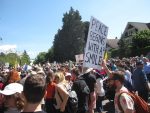
An estimated 4,000 to 5,000 people showed up at Vancouver City Hall Aug. 19 to protest a planned racist rally. (photo by Cynthia Ramsay)

A week after the tragedy in Charlottesville, Va., British Columbians faced the prospect of a clash between racist, anti-immigrant and neo-Nazi activists and their opponents.

An estimated 4,000 to 5,000 people showed up at Vancouver City Hall Aug. 19 to protest a planned racist rally. Among those at the counter-rally were members of the Jewish community, including several wearing kippot and at least one draped in an Israeli flag.

For those in attendance, it was an odd and strangely uplifting time. As it turned out, most attendees never came in contact with those they came to protest. Many left the event thinking that the other side never showed up. For all intents, they didn’t. Apparently, a couple of extremists appeared at one point but their voices were quickly drowned out. The counter-rally turned out to be the main event.

Since the sound system at the gathering was terrible, most of the crowd couldn’t hear the words of the pro-diversity speakers. For the record, the event was organized by an ad hoc group and the speakers included Vancouver Mayor Gregor Robertson, Ravi Kahlon, the parliamentary secretary for sport and multiculturalism in the new B.C. government, several indigenous representatives and people from a range of faith and multicultural organizations, including Independent Jewish Voices. (Anyone complaining that their own particular views were not represented on the official roster of speakers should bear in mind that we are all free to organize our own rallies, as this ad hoc group did, and those who organize such events are free to invite whoever they like to speak.)

There were concerns by some that the sort of anti-Zionist (and arguably antisemitic) undertones that pervaded some “progressive” events in the United States recently might pop up here, but there appeared to be nothing of the sort. One speaker – one of the few who could be heard, because she led the group in a boisterous chant – specifically identified Jews as brothers and sisters. It was reassuring and welcome.

The crowd was wonderfully diverse, including people of apparently every culture, religion and identity, milling about enjoying witty and positive handmade signs and running into old and new friends. It is probably safe to say that those who attended left feeling encouraged by the show of solidarity in the face of hatred, while social media responses suggest those who did not attend believe the crowd of thousands made the province and the country proud.

A similar event – on an even grander scale – was taking place at roughly the same time in Boston, with roughly as positive an outcome. Elsewhere in America, however, wildfires of hatred fanned by winds directly from the West Wing of the White House continued to spread, with one incident of particular concern to Jews.

Richard Spencer, one of the emerging leaders of white supremacism in the United States, told an Israeli TV interviewer that his “white nationalism” is essentially the same as Zionism.

Jonathan A. Greenblatt, head of the Anti-Defamation League, writing online at the Forward, summarized the stupidity of this comparison.

“Richard Spencer’s movement is based on hate, racism, negativity and exclusion,” wrote Greenblatt. “Zionism, the national liberation movement of the Jewish people in the Jews’ historic homeland, is based on providing for equal opportunity for the Jewish people, like others, to have sovereignty in their land while still fully protecting the rights of minorities who live within Israel. At its core, Zionism is a positive movement and is not intended to be ‘against’ anyone.”

Of course, as Churchill said, a lie gets halfway around the world before the truth has a chance to get its pants on. The equation of Zionism with racism is an idea we have been battling for four decades. Originating from the Muslim bloc at the United Nations, it has been happily incorporated by many organizations of the left.

But things are changing quickly. In just the past week, while the U.S. president has effectively endorsed the Charlottesville racists (or, at the very least, equivocated between good and evil), a new urgency has emerged among anti-racist advocates.

Sometimes, something good comes out of something terrible and, as we said last week in this space, Charlottesville may be a turning point.

In another example, the March for Racial Justice – potentially one of the most significant such rallies in recent U.S. history – has been scheduled for Washington, D.C., on Yom Kippur. The sadness, disappointment and anger expressed by Jews over this timing resulted in what appears to be a deeply heartfelt, apologetic and, honestly, beautiful response from organizers, including the observation: “Our mistake highlights the need for our communities to form stronger relationships.”

This incident is a reminder, much needed, perhaps, not to write off potential allies. We are experiencing an unprecedented lack of moral leadership from what was once deemed the leadership of the free world. That moral vacuum will be filled. As the battle for space in this time of change proceeds, we must continue to make the case for our place in a multicultural society and for Israel’s place in the world.