The new Jewish Museum and Archives of British Columbia website, jewishmuseum.ca.
The Jewish Museum and Archives of British Columbia has launched its revamped website, unveiling a new look for the organization, simplifying navigation and making it easier for users to engage with the museum’s diverse programming and to access the holdings of the B.C. Jewish community archives.
The website, jewishmuseum.ca, features a contemporary design. Implementing the archives database system Access to Memory (AtoM), the new site gives researchers access to thousands of documents, photos, audio and video items documenting the 150-year history of Jews in British Columbia.
“For the first time in the history of the JMABC, we have the capability of providing online access to the treasures in the archives, while at the same time adhering to important archival standards,” said archivist Jennifer Yuhasz. “We are excited to join the vast community of professional archives already using AtoM, including UNESCO, World Bank Group Archives, Library and Archives Canada, and most of the provincial, municipal and university archives and libraries across B.C.”
Selections from this archival collection are presented in the form of online exhibits recounting specific themes and events in community history. Exhibits will be added each year.
The production of the new site was made possible through the support of the Betty Averbach Foundation, the Jewish Community Foundation of Greater Vancouver, numerous private donors and the more than 100 contributors to the JMABC’s 2014 Indiegogo campaign. Its launch follows the introduction of a new graphic identity for the museum and archives, designed by local graphic design firm Adria Consulting, which also redesigned the website.
Important elements of JMABC’s new look include a new wordmark, new typography, a palette of vibrant colors and a suite of facet shapes drawn from the Star of David. Together, these elements celebrate the diversity of B.C. Jewish history and the innovative spirit of JMABC, and they will be implemented throughout all of JMABC’s print and online materials, unifying the organization’s public presence as never before. The public were given their first taste of the new identity at the recent JMABC exhibit, Fred Schiffer: Lives in Photos, presented this spring as part of the Capture Photography Festival.
“Our new look reflects the exciting work we are doing, always seeking new ways to share our community’s rich history with everyone,” said Michael Schwartz, JMABC’s coordinator of programs and development. “Adria understood this immediately and devised an identity that boldly conveys our core principles.”
JMABC is dedicated to the collection and sharing of community memories of Jewish life in British Columbia. With 300 linear metres of textual records, 300,000 photographs and 725 oral history interviews, it chronicles all facets of the community’s history.
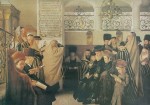
“Day of Atonement” by Isidor Kaufmann, circa 1900. “We cannot afford the luxury that accompanies the perception of atonement as an end unto itself. We must look at every facet of our lives, internal and external, collective and individual, and challenge ourselves to think anew,” argues Donniel Hartman. (photo from commons.wikimedia.org)
There are those who believe that the goal of Yom Kippur (Day of Atonement), as its name attests, is to merely attain atonement for our sins, to recalibrate our standing before God. These are called the Days of Awe, for our destiny stands in the balance: who will live and who will die. To achieve this atonement, we fast and pray for forgiveness.
The problem with this approach, however, is that, beyond fidelity to the laws and practices of the holy days, it does not make any other demands upon us. Instead of striving to change our behavior, we are satisfied with the yearning for atonement. The old year fades out and a new one approaches, and everything stays as it was.
There is much experience of awe in the Days of Awe, but there is little action. Instead of serving as a catalyst for change, the High Holidays often remain a line of defence for the status quo, a defence achieved by the idea of atonement itself. Isaiah’s critique against his generation, who complained before God, “Why, when we fasted, did You not see? When we starved our bodies, did You pay no heed?” (Isaiah 58:3), continues to reverberate and have new significance.
What is the cause for this continuing failure? I believe that it may be found in the fact that the idea of atonement has two distinct meanings and we, unfortunately, give preference to the more convenient and easy one. Atonement can be viewed as an end unto itself or as a means that enables a new beginning. As an end unto itself, its goal is to change the consequences of past behavior and not to change the behavior itself. God is the one who atones for past mistakes and erases them from the equation. Yom Kippur has a goal to recalibrate the world, a form of restart button. However, as an end unto itself, it enables the human being to start over from the same place and to wait again for the next Yom Kippur with its promised “new beginning.”
On the other hand, atonement can be viewed as a means. Its importance is derived precisely from the fact that it has the capacity to enable and serve as a catalyst for change and renewal.
One of the major stumbling blocks that prevents us from changing our behavior is the difficulty in believing that we are capable of it. We are shackled to mediocrity and the status quo, for we often believe that we are ruled by the past and that it defines us in the present and will continue to do so in the future. The idea of atonement can serve as the ally of the status quo or as the vehicle of liberation from it. A human being who achieves atonement can squander this moment of grace by repeating the mistakes of the past, or he or she can use atonement to establish the belief that the past does not necessarily define who we will be in the future. One who receives the gift of atonement is given a chance to reshape one’s life; the critical question is whether we use this gift or waste it by believing that atonement as an end unto itself is sufficient.
The rabbinic tradition understood both the challenge and danger embedded in the idea of atonement. It consequently ruled that Yom Kippur atones only when it is accompanied by tshuva (Mishnah Yoma 8:8). The days are truly Days of Awe, for they are days of reckoning, not merely with God, but primarily with ourselves and regarding our lives. This notion of a day of reckoning requires us to go beyond the experience of the awe that accompanies these days and to act and challenge ourselves to embark on new directions for our lives. To do so, however, we must not merely pray, but must internalize the central category that fulfils a key role throughout the rituals of the Days of Awe – hattanu – we have sinned.
The purpose of the ritual of confession, the Al Het, is not to remove our sins from the eyes of God, but to establish them in front of our eyes. It is only a human being who recognizes his or her limitations and who strips away the aura of self-righteousness who can recognize both the need and responsibility to change.
It is not simple to be a Jew, for we are obligated to strive for excellence and to see in a life of mediocrity a contradiction to our identity. We cannot afford the luxury that accompanies the perception of atonement as an end unto itself. We must look at every facet of our lives, internal and external, collective and individual, and challenge ourselves to think anew. We must reconnect to our values and ideals, and find new ways to allow them to guide our individual and national lives.
May these Days of Awe serve as a spiritual foundation and moral anchor for the renewal of our people. May we truly believe in our potential for renewal and may this belief give birth to new levels of aspirations, dreaming and action. May this year be a year of health, happiness and peace. Shana tova.
Donniel Hartmanis president of Shalom Hartman Institute and director of the Engaging Israel Project. He contributes a regular column to Times of Israel and writes for many other publications on a regular basis. This article can be found on the Shalom Hartman Institute website, hartman.org.il, and is reprinted with permission.
Following your dreams takes guts, hard work and perseverance. You have to admire someone who goes for it, whether or not they succeed. And if they succeed, it’s all the more impressive – and inspiring.
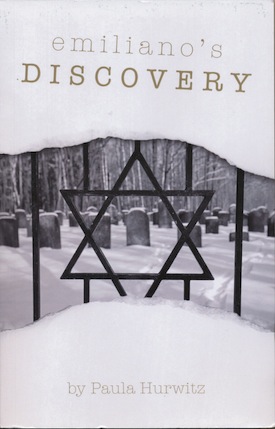
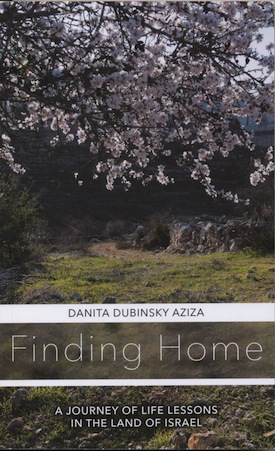
Two books came across my desk this summer via local connections. Emiliano’s Discovery is a first novel by Toronto-based Paula Hurwitz, whose uncle lives in Vancouver. Finding Home is a collection of non-fiction essays by Danita Dubinsky Aziza, whose mother lived here until recently moving to be closer to the family in Winnipeg. Both books were self-published with FriesenPress: Hurwitz’s in 2014, Aziza’s this year.
It might be an exaggeration to say that writing a novel was a dream of Hurwitz’s but she went to lengths to make it happen, a fact that can be seen from her acknowledgements. A lawyer by profession, she thanks a University of Toronto introduction to the novel course for giving her “the foundation to write this book,” as well as the Humber School for Writers, and several individuals. The end result is something of which to be proud.
Emiliano’s Discovery begins in Russia in 1903. The prologue in which Duvid, Malka and their family in Kishinev encounter the violent pogroms of the time sets the stage for Emiliano’s eventual search for family. It also reminds readers of the precarious world in which Jews seem to continually live. Chapter 1 takes us to Buenos Aires in 1994 and the terrorist bombing of the Asociacion Mutual Israelita Argentina (AMIA).
Emiliano – about to graduate university and in need of employment – heads to the AMIA with his girlfriend, Lia. With the lineup barely moving, he suggests they go and grab a coffee, but she chooses to stay behind. “Just as Emiliano steps out [of the elevator] an enormous blast knocks him from his feet. He hears people yelling and feels debris falling around him. Then he loses consciousness.”
While Emiliano is directly affected by the attack, both physically and mentally, more than 10,000 kilometres away, in Winnipeg, Naomi’s “lazy summer day” – she doesn’t start Grade 12 for six weeks – is interrupted by a newscast about the tragedy. Long after she turns off the television, “she can’t shut out the horrific images replaying in her mind. If only she could figure out how to help. Doing something might calm her down.”
The novel alternates between Emiliano and Naomi, until their paths combine. They do so in Winnipeg, and that is one of the most interesting aspects of this story because the Winnipeg Jewish community actually did encourage Argentine Jews to immigrate to their city, and it’s kind of like getting a peek behind the scenes. Another compelling aspect of the story is the concept of how two families – one in Buenos Aires, the other in Winnipeg – could have ancestors from the same village who ended up in such completely different places. While the novel may wrap up its narratives a little too neatly for some readers, it doesn’t detract from their value.
Not quite so neat – in fact, quite chaotic at times, perhaps because it is an account of her real-life experiences – is the story told through essays by Aziza of her family’s decision to make aliya, their years in Israel and their ultimate return to Canada.
Aziza has done a commendable job in compiling the almost 40 essays that were initially written as stand-alone articles or blog-type pieces. Rhonda Spivak, editor of the Winnipeg Jewish Review, asked Aziza to write about her experiences for the online publication, and she did. The Jewish Federation of Winnipeg also asked her to share some of her stories on its website.
Written over four years (2008-2012), each article – and now, each chapter – conveys a lesson Aziza learned, and not always the hard way. From “start slowly” (“leh-at, leh-at” in Hebrew) as a way of coping with all the changes one faces as an immigrant, to “your children are not your children” and, therefore, you need to let them make their own choices, even if it’s to enlist, to the title lesson, “finding home,” which may not be where you think it should be, Aziza takes readers on her journey. She writes with humor and with honesty, and without embellishment, a style I like very much.
The impetus to make aliya – Aziza, her husband, Michel, their three kids and their dog – came 23 years prior to when the family arrived at Ben-Gurion Airport in 2008. Aziza, living in Toronto in 1985, reluctantly headed to the gym. There, she met “the cute guy with curly black hair” and, after a couple of weeks, “with gym bags flung casually over our shoulders, Michel and I collided at the end of the cement walkway that led to the overcrowded parking lot of the JCC.” Regular meetings followed and, in one of those early encounters, Michel asked her, “Danita, would you ever consider living in Israel?” To which she replied, “Oh, for sure, I would love to live in Israel! I have visited three times and it is such an amazing place!”
As she would find out, visiting and living somewhere are two very different things. Learning a new language, negotiating a foreign culture, being far from your aging parent, seeing your son enter the army and facing the prospect of your daughters following suit, building a new home (in their case, literally constructing a house) and many other factors are challenging aspects of any immigration experience. There are also many new discoveries and joys. But sometimes leaving a place – in this instance, Winnipeg – makes you realize that you might have been home all along.
And, as Aziza writes about her response to a friend who was curious whether she “had failed at living in Israel. With an air of confidence I acquired only after living in Israel, I told her, ‘I didn’t fail. I think that our family did more in four years there than most. I believe the failure would have been for us not to have gone to Israel in the first place.’”
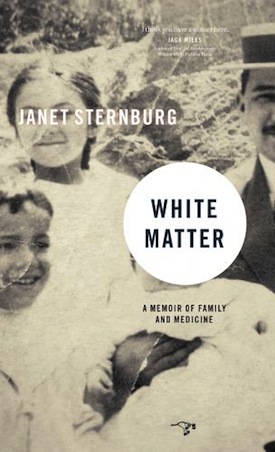
Most of us love a good mystery. Add intergenerational secrets to the mix and you’ve just upped the grip quotient. Add to that a medical procedure that’s the stuff of nightmares and horror movies, and you’ve got a potential hit. Janet Sternburg’s memoir White Matter (Hawthorne Books, 2014) takes this recipe and adds a layer of truth.
Born and raised in Boston, surrounded by members of her mother’s large Russian-Jewish family, Sternburg knew from an early age that her uncle and one of her aunts had undergone lobotomies, the form of neurosurgery that severs the “white matter” of the frontal lobe from the rest of the brain in the attempt to alleviate emotional and mental distress. Though the procedure went out of vogue years ago, it’s clearly a surgery that still has the power to fascinate. Just last week, People magazine featured the story of Rosemary Kennedy, who, more than 70 years ago, was subjected to a lobotomy in a decision apparently made by her father in the hopes that it would make her “less moody” and “docile.” The decision to have the young Rosemary undergo a lobotomy is referred to in the article as the Kennedy dynasty’s “darkest secret.” In a family famous for its “dark secrets,” that’s saying something, and it gives some idea of what the decision to lobotomize two out of six siblings must have meant to the Sternburg family legacy.
Sternburg has written an engrossing tale about unraveling her family’s secrets, how she came to be a writer and what it is about the intersection between the personal and the medical that fascinates her most. The memoir lays bare a trove of family lore against a backdrop of shifting attitudes toward mental health and the dislocations of assimilation and generational trauma, as well as the changing roles of women. Sternburg has woven into her family chronicle the history of lobotomies and the contributions of notable figures in the world of neurobiology and psychiatry, some of whom came into close contact with her family. As a filmmaker and poet as well as a prose writer, she also references depictions of mental illness in the film and literary worlds, offering her writing additional depth and cultural relevance.
While the decision to lobotomize two family members would today be unthinkable, we still face complex decisions about how to help family members struggling with mental illness in the face of stigma, and fears of inheritance. Sternburg’s family’s decisions to lobotomize are described as desperate attempts to keep the family together, particularly after her easily enraged grandfather abandons the family and her distraught grandmother quickly becomes overwhelmed. With the siblings left to care for their fractured family, decisions are made that have far-reaching – and disturbing – consequences.
The book hasn’t received a lot of pick up, even though it was chosen as an “indie” book to read by Publishers Weekly, but it does deserve a readership. This story has resonance in an age in which the debate around the origins of mental health and the efficacy of various treatments – drugs versus talk therapy, for example – are as ongoing and fierce as they ever were.
Aside from the ghoulishness of the lobotomies themselves, what I found most disturbing about Sternburg’s story is the lack of family intimacy. Her mother’s family was competitive and easily offended, and their early home was full of rage. They seemed to have little knowledge of how to take care of each other’s needs or emotions, yet they were “so entwined that to turn one’s attention elsewhere was tantamount to betrayal.” The family’s desire to reduce conflict and alleviate their siblings’ emotional and mental distress is understandable, even if it was misguided.
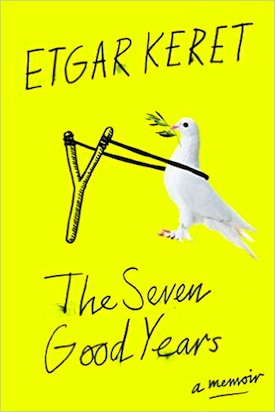
As much as Sternburg’s family mystery held my interest, it hasn’t had the staying power of The Seven Good Years (Granta Books, 2015), a new memoir by Israeli writer Etgar Keret. This collection of biographical essays begins with the birth of Keret’s son Lev (during a terrorist attack) and ends with the death of his father, from cancer, seven years later. Known for his collections of short fiction, this is Keret’s first piece of non-fiction, and I hope it’s nowhere near his last.
Keret navigates these seven years (referencing the seven “fat” years of grain harvest in Joseph’s biblical dream) with his sharp insight, humor and compassion. The 36 essays are tight – spare and direct – and Keret creates a deep sense of intimacy with readers. He seems acutely aware of this effect: he has declined to publish this collection in Israel, or in Hebrew, calling it “too personal” for his home turf.
The son of Holocaust survivors, Keret also has had to cope with intergenerational trauma, but it seems to have had a salutary effect on his inner life. In one essay, he’s unafraid to pretend to have a foot amputated just so he doesn’t have to hurt a stranger’s (a telemarketer’s!) feelings. He is acutely aware of other people’s perceptions, and his honesty is compelling, moving, electric and laugh-out-loud hilarious. Throughout, his attention is turned towards reducing the emotional friction around him and he recognizes the effect that living in Israel’s high-tension environment has on himself, his family and even on his interactions with strangers. He describes apprehensions about his newborn son’s future, relates intense discussions with his wife – the check and balance against his anxieties – and conspires with friends, siblings and others to make sense of his world. Through all of this, he worries about whether or not Lev will do his compulsory army service, about Iran getting the bomb, perceived and real moments of antisemitism, his relationship with the Holocaust, and when the next war might break out.
Critics have called Keret’s writing self-deprecating, but I don’t connect with that reading of his work. I see his expressions of uncertainty and self-doubt as the building block of his empathy, the foundation of his profoundly funny and humane observations about his fellow human beings. As a bulwark against the intensity of existence, Keret seeks moments of “meditative disengagement from the world,” whether those moments are captured alone while flying from one writers festival to another, in being a first-time parent or in dreaming of a better world in which even the Iranian regime turns towards love.
What makes Keret’s writing comforting is the importance he places on familial honesty, on sharing intimate space even with strangers, and on finding the good. It’s writing that makes me feel more alive.
Basya Layeis a former editor of the Jewish Independent.
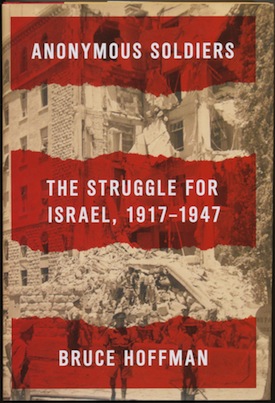
Does terrorism work? This is the question that opens Anonymous Soldiers: The Struggle for Israel, 1917-1947 (Alfred A. Knopf, 2015). Western leaders insist that the work of terrorists will never lead to the ends they seek, but one of the lessons from this book is that this may well be wishful thinking.
Anonymous Soldiers – the title is from the anthem of the Irgun, the Zionist paramilitary force led by Menachem Begin – is the latest book by Bruce Hoffman, an expert on terrorism.
In the aftermath of the First World War and the collapse of the Ottoman Empire, Britain came to control the region known as Palestine, a victory that would prove confounding and tragic. Hoffman’s book is a story of endless miscalculations, under-preparedness and overreactions on the part of the British military and police.
The Balfour Declaration of 1917 was a statement of intent by the British government to create a Jewish national homeland in Palestine and the Jewish people there and elsewhere saw this as a sign that Britain would be their fiercest ally. However, almost from the moment the British Mandate began, until the forces of the empire departed with their tails between their legs three decades later, Palestine was riven with not only violent clashes between its Arab and Jewish residents, but by both those parties against the British and, as brutally detailed by Hoffman, fraternal conflict between Jewish militias.
The Haganah was the “establishment” militia, associated with the Jewish Agency and intended as a self-defence organization after the British proved incapable of or unwilling to protect the Jews of Palestine. In 1929, Arab riots led to mass killings of Jews and, while British police killed almost as many Arabs as the Arabs killed Jews, the balance demonstrated an inability of the British police and military to control the area. The diplomatic response was to attempt to appease the Arabs, which appears to be the first example in the book to prove that terrorism works.
The riots led to an investigative commission, a white paper and another British obfuscation on Zionism. The white paper blamed Arab violence on “excessive” Jewish immigration to the area in the mid-1920s and the purchases of land by Jews. This led some Zionists – notably those of Ze’ev Jabotinsky’s Revisionist party – toward the idea that Britain may not be a reliable ally. In 1931, Revisionists defected from the Haganah and formed Haganah-bet (later the Irgun), which did not see itself solely as a self-defence force but opened the door to “sabotage, bomb making and hit-and-run attacks – in other words, the core tactics of terrorism.”
From 1936 to 1939, Palestine was in a state of near civil war in the form of an uprising by the Arab populations against the British and the potential of more Jewish migration. At precisely this time, the fate of Jews in Europe was being sealed and countries, including Canada, were slamming shut the gates.
Clouds of war in Europe were accompanied by fear of Muslim uprisings in the vast British Empire. The priority, in the words of foreign secretary Lord Halifax, was to avoid “arousing antagonism with the Arabs.” Neville Chamberlain, the prime minister at the time, said it was “of immense importance to have the Muslims with us. If we must offend one side, let us offend the Jews rather than the Arabs.”
This, too, was a miscalculation that did not take into account the determination of the Irgun. British caving in the face of Arab violence was taken by the Irgun as proof that terrorism works.
And a third group, which had broken away from the Irgun – Lehi, also known as the Stern Group (or the Stern Gang by the British) – went further. They attempted an alliance with the Axis, viewing Hitler as “just another antisemite” and proposing a mutually beneficial partnership based, the author writes, “on the fatally erroneous assumption that for Hitler the crux of the Jewish problem in Europe could be solved by evacuation, not annihilation.”
Meanwhile, as terror was rocking the Middle East, Chaim Weizmann, the Zionist leader who was plugged into the British establishment, was mending fences in London and urging the Haganah to crack down on the Irgun and Lehi.
Weizmann was warned by then prime minister Winston Churchill that if the violence didn’t end, “we might well lose interest in Jewish welfare.”
Of course, the Irgun did not expect to defeat the British Empire militarily. “History and our observation,” Begin later said, “persuaded us that if we could succeed in destroying the government’s prestige in Eretz Israel, the removal of its rule would follow automatically.”
Weizmann’s diplomacy and the cooperation of the Haganah with the British forces in Palestine regained the trust of Churchill, but that was of limited value after the war leader lost the 1945 election and the Labor party came to power at Westminster.
The new prime minister, Clement Atlee, inherited a paralyzed Palestine, in which there seemed to be no winning position. At a 1947 conference, the British tried to share the mess with the United States, but that failed and they eventually dumped the problem at the podium of the new United Nations.
So, does terrorism work? In the Palestine example, Hoffman demonstrates that the Arab riots of 1921 resulted in restrictions on Jewish immigration to Palestine and the 1929 riots resulted in Britain backpedalling from its commitment to Zionism. The Arab Rebellion, from 1936 to 1939, resulted in a huge reconsideration of Britain’s policy in Palestine and, though the author doesn’t make this explicit, possibly the deaths of millions of European Jews.
On the Jewish side, violence seems to have had its intended effect, as well. “By September 1947, the Irgun had achieved its objective,” Hoffman writes. “Each successive terrorist outrage illuminated the government’s inability to curb, much less defeat, the terrorists. Already sapped by World War II, Britain’s limited economic resources were further strained by the cost of deploying so large a military force to Palestine to cope with the tide of violence submerging the country.”
The author sees the Irgun’s campaign as critical to understanding the evolution and development of terrorism in the second half of the 20th century and the already bloody 21st century. “Indeed, when U.S. military forces invaded Afghanistan in 2001, they found a copy of Begin’s seminal work, The Revolt, along with other books about the Jewish terrorist struggle, in the well-stocked library that al-Qaeda maintained at one of its training facilities in that country.”
Limmud Vancouver is accepting submissions until Oct. 15 for presenters at the 2016 learning festival. (photo from Limmud Vancouver)
After two successful events in the past two years, Limmud Vancouver is returning for a third learning extravaganza in 2016.
Following a Saturday night Limmud cabaret, to be held Jan. 30, LimmudVan ’16 will offer a daylong celebration of Jewish learning at Beth Israel Synagogue on Sunday, Jan. 31. Presentation proposals are now being accepted from experienced as well as first-time presenters.
A non-denominational, pluralistic gathering for Jewish learning, Limmud is a growing global phenomenon that began 30 years ago in the United Kingdom and has attracted participants and presenters of all ages and backgrounds. There are now more than 80 Limmud festivals held annually in Jewish communities all over the world, from Canada and the United States to Australia, Turkey, Sweden, India, China, Brazil and, of course, Israel.
Since its inception in 2014, LimmudVan celebrates the wide range of wisdom and knowledge within our Jewish community and we encourage everyone to share their excitement for any topic with a Jewish aspect. In the first two years, presenters have included scholars, teachers, actors, rabbis, lay enthusiasts, scientists, artists, storytellers, cooks, musicians and others. Topics have ranged from Torah study to opera, social activism and Jewish environmentalism to Jewish humor, Czech Torah scrolls to Jews and indigenous peoples.
Whatever topic you are passionate about, you are welcome to present it in the format that appeals to you most, whether dramatic or interactive, as a lecture or something different – you decide. If you would like to be a part of a local, thought-provoking learning event, visit Limmud Vancouver’s website and submit a topic (or two?) about which you would like to share your knowledge and enthusiasm with the wider community.
A core Limmud value is that everyone is a student and everyone can be a teacher within this interconnected learning community. “Volunticipating” is also an important aspect of Limmud. Everyone, including organizers and presenters, registers to participate and take part in the daylong event. And, as a volunteer-led organization, its success depends on the time and energy of individuals who care about community-based Jewish learning. If this is something you are passionate about, and whether or not you would like to present this year, consider gifting some of your time as a volunteer and help make LimmudVan ’16 an event to remember.
Go to limmudvancouver.ca, where you can also see what was offered at last year’s learning event. Short- and long-term volunteers are accepted on an ongoing basis. Presenter submissions will be accepted until Oct. 15, 2015. Chosen presenters will be contacted and the program will be confirmed in November. Tickets for the event will go on sale soon afterwards. Follow Limmud Vancouver on Facebook and Twitter.
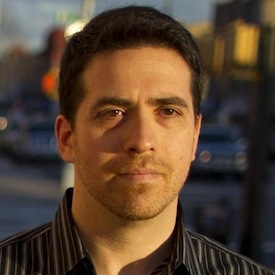
Shulem Deen, author of the memoir All Who Go Do Not Return. (photo by Pearl Gabel)
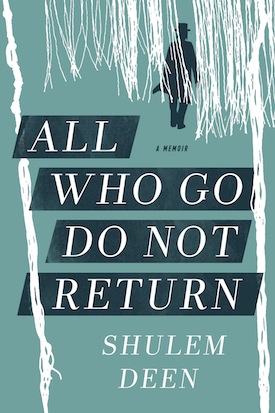
One of my Haaretz blogs several months ago told the stories of two individuals who left the Orthodox fold. This past June, I nearly swallowed whole the new former-Chassid memoir everyone was talking about: Shulem Deen’s All Who Go Do Not Return. I then caught up with Shulem by phone, where we spent two hours musing about Talmud and kabbala, faith and questioning, whether the concept of dogma can be expressed in Chassidic Yiddish, what he sees when he revisits the film The Chosen and whether he still loves Beethoven, the first movie he ever saw (he doesn’t).
Those who have read the memoir or the press coverage of it know that, after he was declared a heretic, his Skverer Chassid community in New Square, N.Y., excommunicated him. Along with their five children, his wife – still a firm believer – moved with him to the nearby town of Monsey, before his marriage ultimately dissolved. He now lives in Brooklyn and is on the board of Footsteps, an organization dedicated to helping former Chassidim adjust to secular life. Tragically, his children refuse all contact with him.
I admitted to being a bit confused as I approached the topic. In my youth, I had learned that Judaism, more than any other religion even, encourages questioning. Is this true? I asked Shulem. Of modern Judaism, it is, he admitted. But not of orthodoxy. He cited a talmudic dictum that appears in his book: “He who asks the following four questions – what is above, what is below, what is the future, what is the past – it is better if he were never born.”
Shulem described what it was like to lose faith. “Once my faith fell apart,” he told me, “my worldview fell apart…. If one of these [principles] is not true then what is true?” Shulem likened it to existing in a Matrix-type world, or being a character in The Truman Show.
Yet, despite rejecting his Chassidism at enormous personal cost, and no longer believing in God, Shulem maintains a strong Jewish identity, including a commitment to “Jewish peoplehood, Jewish history, Jewish text, Jewish culture and Jewish tradition.”
He studies Talmud weekly, approaching the text as “literature,” as he puts it. Neither is he dismissive of Yiddish – the language that has effectively kept many Chassidim ignorant of English: another barrier to engaging with the secular world. Yet he enjoys reading Yiddish writers such as Sholem Aleichem, Chaim Grade and Isaac Bashevis Singer, and even grants spoken Yiddish press interviews as the need arises.
Where he draws the line is dogma.
Community-instilled religious dogma is what arguably led his children to reject him. Shulem is insightful about how things unfolded. “When a child is taught that his parent is wicked … what the child feels … is shame,” Shulem writes in the book. And, from this shame, comes a desire to distance oneself from the perceived source of the shame.
It’s enough to make any parent rage forever into the night. But, as a writer, Shulem was careful to contain his anger, feeling that deploying that emotion “would have impeded” the reader’s experience.
And yet, others’ anger was on his mind as he decided what to include. At one point, he ran into a former student. Without his beard, Shulem wasn’t immediately recognizable, until something clicked. “I know you,” the student said. “You hit me with a wire.” Shulem apologized, and left the exchange feeling “incredibly ashamed.” Including the scene about his act of corporal punishment was for him an “act of penance.”
Before our interview, I had noticed Shulem recommending the film The Chosen on Facebook. One of the favorite movies of my own childhood, my curiosity was piqued. What would a former Chassid get from a film about the tension between fundamentalism and modernity? Hadn’t he lived it enough? Not so, which is what makes Shulem such a thoughtful and appealing writer and interlocutor. “I think it’s brilliant. It’s beautiful,” he says of the film. His favorite scene? The rebbe’s tisch (communal meal). Unlike the contemporary tisch (a setting that Shulem wrote about in a poignant 2011 essay revealing the pain of a once-believer), he said of the film’s scene, “This is a 1940s world where a rebbe has only several dozen followers. It’s a very intimate, very spirited setting. Something very simple, yet devout.”
I was touched by Shulem’s ability to still be able to glimpse goodness in a system that had oppressed him; perhaps this is the definition of open-mindedness, that rare commodity among the ultra-religious.
Indeed, the broad themes of the film continue to speak to him. Given the increasing porousness between Chassidism and the outside world due to the march of technology, “people are testing the boundaries and trying to see what is possible while staying within the community,” Shulem said. And, while his book recounts his struggle to do just that, via a primitive AOL internet hookup, a job in Manhattan and – something he relayed to me – taking his daughters to the public library, his world eventually imploded. Part of this was due to the feeling that the ground was opening beneath his feet. And part of it stemmed from a problem all too common in modern life: basic marriage incompatibility.
To a non-Chassid, Shulem’s story is a fascinating glimpse into a hidden world, just as it is ultimately a universal story about the pursuit of personal truth, the attempt to be open-minded in a close-minded world and, ultimately, the bitter inability to control what others believe about the righteousness of one’s path.
Mira Sucharovis an associate professor of political science at Carleton University. She blogs at Haaretz and the Jewish Daily Forward. A version of this article was originally published on haartez.com.
Apples and honey are essential at Rosh Hashana’s festive table. An old tradition of eating apples dipped in honey reflects our hopes for “sweet” and prosperous New Year. Shall we try and make this treat together?
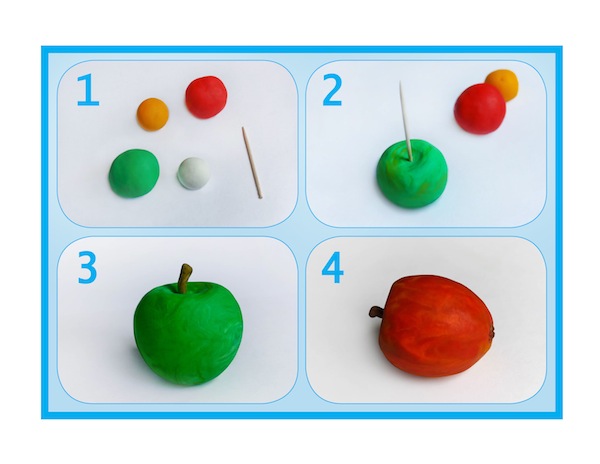
1. Take a toothpick and a few pieces of modeling clay (or Plasticine) in green, yellow, red and white colors.
2. Mix well a piece of green and a small amount of yellow modeling clay. Make a ball out of this mixture and, using the toothpick, make a hole in the bottom of the ball.
3. Next, you can make a stem for your apple by sticking a small brown piece of clay in the hole that you made. Your apple is ready!
4. Mix well a piece of red modeling clay and a small amount of yellow. Follow the procedure in Step 2 and make a red apple. Don’t forget about giving your apple a “tail” and a “nose” using brown clay.
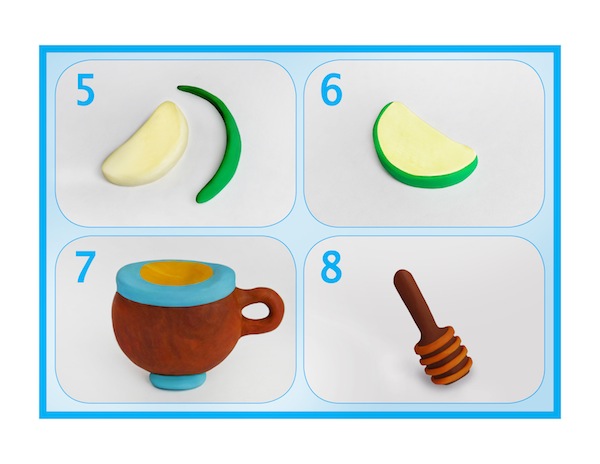
5. It is time to make some apple slices. Take white modeling clay and mix it with yellow. Shape the mixture into a crescent. Make the skin of an apple from green modeling clay.
6. Combine the crescent shape with the skin and your apple slice is ready. Make a few such slices.
7. We still need to make a pot of honey. For that, we use brown and blue modeling clay. First, make a brown pot, and then add a blue rim to it. Also attach a little handle to the side of your pot. “Fill” your pot with honey by putting a little oval made from yellow modeling clay on top.
8. Now we only need to make a dipper. Take brown modeling clay and roll it into a stick shape. It has to be thinner on one end and wider on another, resembling a hammer. To create the illusion of carving, typical for a dipper, encircle the wide part of it with few horizontal stripes made from orange clay.
Remember, you can use the toothpick to refine all your pieces of art. As well, before you start working with a new color, wipe your hands with a napkin to prevent the unwanted mixing of colors. And, most important of all – use your imagination! There are no strict rules when it comes to creativity. Don’t be afraid to experiment with colors.
Once you’ve finished your creations, if you put together all the pieces that you have made and take a picture, you will have a wonderful and unique Rosh Hashana greeting card.
Sweet and prosperous Rosh Hashana wishes to all the artists and all the Jewish Independent readers!
Lana Lagooncais a graphic designer, author and illustrator. At curlyorli.com, there are more free lessons, along with information about Curly Orli merchandise.
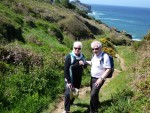
The writer and her husband, Ted Ramsay, hiking along a coastal path near St. Ives. (photo by Karen Ginsberg)
Porthcurno Beach, near Penzance. (photo by Karen Ginsberg)
A trip this spring to Cornwall in southwest England gave my husband and me the opportunity to experience the unique treasures in this part of the world. In addition to beautiful landscapes and breathtaking coastal hikes, we visited the Eden Project, Minack Theatre, Land’s End and the towns of St. Ives, St. Just and Mousehole. It was in Penzance, however, that we enjoyed the warmest of welcomes from representatives of the Council of Cornish Jews, otherwise known as Kehillat Kernow, when we stopped for a day to visit.
We were greeted by Kehillat Kernow chair Harvey Kurzfield, public relations chair Jeremy Jacobson, and Patricia and Leslie Lipert. Patricia serves both as a lay leader for the community, as well as editor of the community’s newsletter and website. Her husband Leslie is the Kehillat treasurer and, for the past several years, he has spearheaded a drive to raise the monies needed for repairs at two Jewish cemeteries, in Penzance and in Falmouth, which is about 50 kilometres away. The name Kehillat Kernow represents both their Jewish and Cornish roots, kehila meaning community in Hebrew, and Kernow, in Cornish, meaning Cornish.
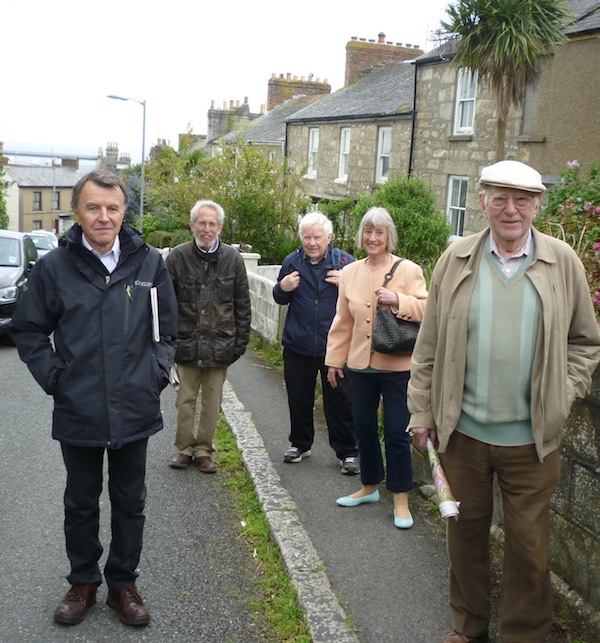
The writer’s husband, Ted Ramsay, centre, with Kehillat Kernow members, left to right, Jeremy Jacobson, Harvey Kurzfield, and Patricia and Leslie Lipert. (photo by Karen Ginsberg)
Keith Pearce, a Kehillat member, co-edited a collection of essays called The Lost Jews of Cornwall, which details the history of Cornish Jews. He has also written The Jews of Cornwall: History, Tradition and Settlement to 1913, which paints an intriguing picture of the first Jews who lived in the Penzance and Falmouth areas of the county since the 1740s and documents how much of their legacy remains. Falmouth, by the way, derives from the nearby River Fal and is an English translation of the Cornish Avber Fal.
The first Jews to settle in the Penzance/Falmouth area were from Bavaria, Bohemia and the Netherlands. They came, in part, to supply the tin mining industry, which was one of the major economic activities in the area at the time. Some were jewellers and clockmakers; they chose Cornwall because they felt it would be a safe haven for Jews.
Alexander Moses, a silversmith, was the first Jew known to settle in Falmouth, with his wife Phoebe in 1740. He became known as Zender Falmouth: Zender was a common diminutive among Jews, as was taking as a surname the name of their hometown. Surnames were not commonly used then.
Looking to the future, Zender built a building in 1766 along the seafront in Falmouth to be used as a synagogue when more Jews settled there. One of the stories told about him is that he had other peddlers in his employ whom he paid if they would come to Sabbath services and ensure a minyan. Later, another synagogue was built in Penzance. Despite Zender’s forward-looking vision, in time and with the coming of the industrial revolution, many people, including Jews who had settled in the area, moved from the rural and small-town settings to the cities. By 1913, the synagogue in Penzance was closed. Today, the building that housed that synagogue is a pub.
Another interesting aspect of the history of the Jews in Cornwall concerns the arrival in Penzance in the 18th century of the Hart family. The most famous member, Asher Laemle ben Eleazar, known later as Lemon Hart, was a distiller and a spirits merchant. Hart earned a national reputation as one of the first suppliers to the Royal Navy after it began giving each seaman a daily ration of blended rum.
Harvey told us that, when he first moved to Cornwall from London in 1971, there was no formal organizational life for Jews and there had not been for quite a long time. He recalled that he slowly began to make the acquaintance of other Jews with whom he and his family could share simchot but that the distances between the small towns in the county and the lack of a formal structure worked against people easily coming together.
That changed when, by happenchance, in 1996, the Cornwall county council appointed David Hampshire as the religious educator, a sort of advisor on all aspects of the religious studies that were part of the required curriculum among county schools. Hampshire was a former monk who had converted from Christianity to Judaism. In the course of his work, he encountered other Jewish families, and a “critical mass” of Jews who knew each other and were interested in meeting together to celebrate Judaism developed.
Kehillat Kernow’s beginnings were modest. There were 40 separate households within the Kehillat and they held Shabbat services in the Baptist church in the small town of Truro.
Today’s Jewish Council of Cornwall now enjoys the use of two Torah scrolls. One of the scrolls is on loan from a synagogue in Exeter; the second was acquired from the Royal Institution of Cornwall after years of negotiation. This latter Torah scroll is thought to be more than 350 years old and to have come from Bohemia in the early 18th century when the first settlers came to Falmouth. It has been refurbished for its use by this special community of Jews.
Kehillat Kernow has ongoing relationships with both the Movement for Reform Judaism and the United Synagogue (Modern Orthodox), both of which have departments that deal with smaller Jewish communities in England. Its current membership is just shy of 60 family units, totaling about 105 individuals. There are six to seven children enrolled in cheder and, last year, the community celebrated three b’nai mitzvot.
Services – which are held every two weeks – are lay led in a local school building and rotate among two women and three men as leaders. Services are held for all holidays and festivals; there are Hebrew classes, as well as classes in Shabbat cooking and in storytelling; and occasionally there are musical concerts. Conversions are done with local leaders but then formally carried out by a Reform bet din (religious court) in London. Lay leadership officiates at weddings and funerals.
While there is an abundance of fresh fish in local markets, kosher meat is available only from London or Manchester. The community newsletter, published monthly, and the Kehillat’s website are important communications tools to keep everyone up to date. After spending an afternoon with Pat and her colleagues, her description of this Jewish community rings very true: “What has evolved is like an extended family – we look after each other – we take care when we hear about someone needing something.”
Kehillat Kernow is an active participant in an interfaith forum in Cornwall. This forum has been working towards a dor kemmyn, Cornish for interfaith community building. In time, the building would be available for use by the Kehillat, as well as the other religious groups in the forum.
Kehillat Kernow is clearly held in high regard by other religious communities in the area. This is exemplified by the invitations they have received recently from various churches to be part of the churches’ international Holocaust remembrance services. Yet another interfaith group, Friends of Israel, recently invited Kehillat representatives to attend a film about the aftermath of the Shoah and the plight of Jews who were expelled from their home countries with the emergence of the state of Israel, and to say Kaddish within their midst at Holocaust remembrance services.
The entrance to Penzance Cemetery, the restoration of which is being funded jointly by the Heritage Lottery Fund, and organizations and individuals in the Jewish community. (photo by Karen Ginsberg)
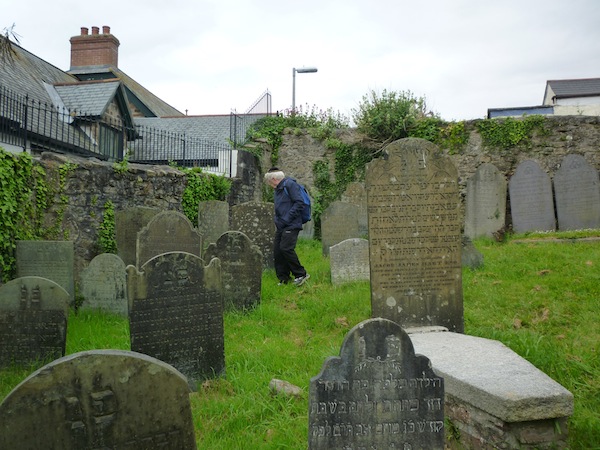
One of the Cornwall Jewish community’s most ambitious projects is the restoration of the cemeteries in Penzance and Falmouth. The Penzance Cemetery, which dates to the 1700s, is thought to be the finest example of the 25 Georgian Jewish cemeteries that exist outside of London. The work on it is being funded jointly by money raised from the Heritage Lottery Fund, and organizations and individuals in the Jewish community, including descendants of those buried in the graveyard. The Penzance Cemetery has a rare grave – that of an infant buried on a Shabbat because of a cholera epidemic.
Ted Ramsay in Penzance Cemetery. (photo by Karen Ginsberg)
In response to a question about what the community’s aspirations are for itself, Harvey’s response tells you everything a traveler might want to know about how you would be greeted, should you find your way to Cornwall. He said, “Continue as we are, attract more people to the Kehillat and its activities, be able to offer more Jewish educational opportunities and, especially, for more Jews from other parts of the world to make a point of visiting with us when they pass through Cornwall.”
Should your travels take you to Cornwall, you are invited to contact Harvey Kurzfield ([email protected]), Pat and Leslie Lipert ([email protected]) and Jeremy Jacobson ([email protected]) and to view the schedule of Kehillat Kernow’s activities in their newsletter at kehillatkernow.com.
Karen Ginsbergis an Ottawa-based Jewish travel writer.