Skip to content
  • Home
  • Subscribe / donate
  • Events calendar
  • News
    • Local
    • National
    • Israel
    • World
    • עניין בחדשות
      A roundup of news in Canada and further afield, in Hebrew.
  • Opinion
    • From the JI
    • Op-Ed
  • Arts & Culture
    • Performing Arts
    • Music
    • Books
    • Visual Arts
    • TV & Film
  • Life
    • Celebrating the Holidays
    • Travel
    • The Daily Snooze
      Cartoons by Jacob Samuel
    • Mystery Photo
      Help the JI and JMABC fill in the gaps in our archives.
  • Community Links
    • Organizations, Etc.
    • Other News Sources & Blogs
    • Business Directory
  • FAQ
  • JI Chai Celebration
  • JI@88! video

Recent Posts

  • Eby touts government record
  • Keep lighting candles
  • Facing a complex situation
  • Unique interview show a hit
  • See Annie at Gateway
  • Explorations of light
  • Help with the legal aspects
  • Stories create impact
  • Different faiths gather
  • Advocating for girls’ rights
  • An oral song tradition
  • Genealogy tools and tips
  • Jew-hatred is centuries old
  • Aiding medical research
  • Connecting Jews to Judaism
  • Beacon of light in heart of city
  • Drag & Dreidel: A Queer Jewish Hanukkah Celebration
  • An emotional reunion
  • Post-tumble, lights still shine
  • Visit to cradle of Ashkenaz
  • Unique, memorable travels
  • Family memoir a work of art
  • A little holiday romance
  • The Maccabees, old and new
  • My Hanukkah miracle
  • After the rededication … a Hanukkah cartoon
  • Improving the holiday table
  • Vive la différence!
  • Fresh, healthy comfort foods
  • From the archives … Hanukkah
  • תגובתי לכתבה על ישראלים שרצו להגר לקנדה ולא קיבלו אותם עם שטיח אדום
  • Lessons in Mamdani’s win
  • West Van Story at the York
  • Words hold much power
  • Plenty of hopefulness
  • Lessons from past for today

Archives

Follow @JewishIndie
image - The CJN - Visit Us Banner - 300x600 - 101625

Don’t vote for Momma!

Don’t vote for Momma!

A few weeks ago, I sat in the High Holy Day services looking around the room at the omany folks who make their annual pilgrimage to the synagogue that time of year. Most of them are there out of guilt or a sense of obligation instilled in them from when they were kids. Momma said, “You go to services on the High Holy Days!” And that was that! Most of them also hang onto a sense of Jewish identity and feel that attending that service once a year keeps them connected and fulfilled.

A few rabbis might wince as they read this, but I say there is nothing wrong with that. Religion is whatever we each want, need or don’t need it to be. It is personal. However we wish to acknowledge or pay attention to it is up to us. We don’t owe our beliefs or religious commitments to anyone but ourselves – and maybe our mommas.

This certainly isn’t just a Jewish-specific behavior. All sorts of folks in all sorts of religions follow a similar path, engaging at certain key times of the year to fulfill their personal obligations or commitments.

Unfortunately, too many Canadians carry on a similar mentality when it comes to national politics, with election time being the one time they feel compelled to celebrate their democratic rights by heading to the polling stations and voting.

While participating in a religious service without understanding the issues or knowing what it’s really about can still offer personal benefits, influencing politics and voting without knowing what it’s really about is concerning.

Everywhere I look on social media for the past month I see folks pleading with the country to show up and vote. We live in a democracy, after all. We are lucky to have the opportunity and the right to vote and, thus, we should. Many people sacrificed their lives so that we can have these choices today, with the right and freedom to vote for our leaders.

But it’s not just about stepping up to a pole and filling out a ballot. Important decisions are being made while every single vote carries the same weight.

It’s not just about the action of voting. It’s about contributing. It’s about respecting the rights and privileges we once fought for and now defend in this country. So please, don’t vote blind. Don’t vote based on the color of the lawn post you prefer. Don’t vote because the person in your riding has the same first name as you. Don’t vote because your momma told you who to vote for.

Everyone should vote! But if you can’t find some time to have at least a basic understanding of who or what you are voting for I am suggesting that you do not vote.

If you think you might fall under that category, take the time to read the posts linked here – both great places to start. Then get out there and vote!

Everything you need to know about the platforms, and JI interviews with the Liberals, Conservatives, Greens and NDP for all you need to about the federal leaders’ views on Israel, Iran, security, and more. And there’s even more at Federal Election 2015.


Format ImagePosted on October 18, 2015October 19, 2015Author Kyle BergerCategories It's Berger Time!Tags Canada, Canadian election, democracy, Election, Federal, vote
Mulcair talks about choices

Mulcair talks about choices

New Democratic Party of Canada leader Tom Mulcair. (photo from Tom Mulcair’s office)

“I think the values of the community that you’re writing for are very similar to the social values of the NDP historically, and I think that’s a strong connection that we have,” New Democratic Party of Canada leader Tom Mulcair told the Independent in a phone interview last week.

He added that his wife Catherine’s “family connection means that I’m the only person in this race who has a deep understanding of the Jewish community and of its history, and I’ll always be a strong stalwart based on that understanding.”

Even before the election campaign started, Mulcair always has been clear in his support for Israel.

“My position is very comfortable within the NDP,” he said, “because the party’s position has, for a long time, been in favor of a two-state solution. Essentially, we believe we have to be working with partners in the Middle East, in particular, in Israel and Palestine, within a framework of respect for UN resolutions and international law, that’s important. And, we always talk about working towards peace in the region, starting from a base where it has to be mutually agreed borders and, frankly, everyone free from attack of any kind: peace and security, in other words, within established and negotiated borders.”

He defended his strict enforcement of this view, which has included the dismissal of candidates who hold alternate opinions.

“I’ve tightened the reins in making sure people respect our position, and I think that that’s the key thing,” said Mulcair, adding that the NDP is “still the only party political party in Ottawa to have ever had a Jewish leader, in David Lewis [federally] and, of course, in Ontario, Stephen, Lewis’ son. And I’ve had a chance to visit Israel a couple of times and look forward to going back. I daresay that I’m the only leader in this campaign … who can count family in Israel, as well.”

“I think that free trade with a democracy is a good thing. We also backed the trade agreement with Jordan because we know that it’s also a very strong voice for stability and peace in a very tough region with a lot of problems.”

With respect to the expansion of the Canada-Israel Free Trade Agreement earlier this year, Mulcair said, “I think that free trade with a democracy is a good thing. We also backed the trade agreement with Jordan because we know that it’s also a very strong voice for stability and peace in a very tough region with a lot of problems.

“As you know, the NDP takes a pretty strong view that free-trade agreements have to represent dealings with countries that have values similar to ours, and that’s why in both cases we had no problem with it.”

The NDP also has no problem with the P5+1 (China, France, Russia, the United Kingdom, the United States and Germany) nuclear deal with Iran.

“I think that the P5+1 deal shows that diplomacy can achieve real results even after decades of hostility,” said Mulcair, who described himself as “very clear-eyed about the Iranians,” noting that the antisemitism there “is at a level rarely seen in the world today.”

He said, “I don’t have any illusions about what I’m dealing with … no Israeli government can ignore the threat of a nuclear Iran…. At the same time … as long as it is enforced rigorously, the deal shows the possibility of making sure that Iran’s nuclear ambitions are hemmed in.”

About security closer to home, and specifically Bill C-51, Mulcair said, “I think that it’s a question of approach and priorities. Don’t forget Mr. [Stephen] Harper’s approach is always about stark, false choices. He would have you believe, for example, that a government has to choose between the economy and the environment. Of course, that’s a false choice; you have to do both. He would have you believe that you either keep your communities safe or you respect your rights or freedoms. Well, the prime minister’s job is to do both: respect Canadians’ rights and freedoms, and keep communities safe. So, C-51 is a breach with that.”

Offering an example from the party’s history in balancing security and freedoms, Mulcair noted, “The NDP, you might recall, is the party that had the courage politically to stand up in 1970 against the imposition of the War Measures Act that put hundreds of Canadians in jail without trial, without accusation, and the NDP had the courage to stand up against that.

“When Mr. Harper came in with Bill C-51, I was told that I was being foolhardy to oppose it, that the vast majority of Canadians were in favor of it. Well, you know what? I don’t take that as the starting point in these issues. I am more than willing to stand up to Stephen Harper when he’s compromising Canadians’ rights and freedoms, and we did that. We did that with an articulate stance that explained to Canadians why it was a mistake, and you know what? At the end of that process, most Canadians agreed with us, so I’m proud of that.

“There are things that can be done here in Canada to help fight some of the situation there,” he said, referring to the conflict in Syria, as well as others in the region. “There are a couple of concrete things that I think Canada can and should be doing.

“First of all, Canada is the only country in NATO not to have signed the Arms Trade Treaty. Well, that’s something that’s easy to fix, and that can help stop the flow of arms to some of those conflicts right now.

“Deradicalization is entirely absent from Bill C-51 and that is, again, a mistake. Most of our partners in the world who are dealing with these issues realize that the flow of foreign fighters into those regions is one of the biggest problems and, instead of coming to grips with that, Mr. Harper completely ignores the problem.”

“There’s also an important element of deradicalization. And, again, Mr. Harper just doesn’t know how to get this right. For example, he doesn’t talk about going into houses of worship, as you hear President [Barack] Obama talk about. What Mr. Harper will talk about, specifically, are mosques. Now, of course, in that case, he’s finger-pointing a single community. That’s a mistake. Deradicalization is entirely absent from Bill C-51 and that is, again, a mistake. Most of our partners in the world who are dealing with these issues realize that the flow of foreign fighters into those regions is one of the biggest problems and, instead of coming to grips with that, Mr. Harper completely ignores the problem.”

Other problems that Harper has ignored, or about which he has been mistaken, according to Mulcair, concern the budget and jobs. The NDP’s approach to these issues, including its focus on the middle-class, has drawn some criticism that the NDP has strayed from its roots – a point with which Mulcair disagrees.

“We’ve been really clear all along, especially under my leadership, that Canada wants a government that knows how to deal with the big issues of the day in the interest of the population,” he said. “When we [the NDP] were in power in Saskatchewan, we ran 17 consecutive balanced budgets because we had taken over a province that was bankrupt after years of Liberal rule…. After those balanced budgets, we were able to bring in free, universal, public medical care – that was an NDP priority.

“This time around, I’m talking about the importance of bringing in quality, affordable, maximum-$15-a-day child care, and we’re going to do that on the basis of a balanced budget. There are some who would say, well, that’s not a very social-democratic thing, but if you look at the history of the NDP, we have a history of being very prudent public administrators. We know that we have that burden on us – that we’re always going to have to be the ones who have to be the most prudent because, if we’re not, people will judge us more harshly than the others.

“Some of the other parties are taking a different approach,” he continued. “Mr. Harper talked a good game but ran up $150 billion in new debt while he was in power. Mr. [Justin] Trudeau is promising to spend at least $10 billion a year more than what he takes in and, in the fourth year, he’s going to start cutting with, quote, everything will be on the table, in terms of cuts – that was the exact quote from Mr. [John] McCallum when he was asked how he was going to be able to cut $6.5 billion in the fourth year of his budget. So, that’s where the Liberals are, that’s where the Conservatives are.”

“Economically, we’re talking about balanced budgets, but we also want to create opportunities for good-paying jobs. There were 400,000 manufacturing jobs lost on Mr. Harper’s watch, and he wants to kill off tens of thousands more with this recent trade deal.”

Mulcair said the NDP are prudent administrators in other areas, as well. “I have a strong personal track record as a former environment minister as a strong enforcer of environmental legislation and I’m strong on principle on those things,” he said. “Economically, we’re talking about balanced budgets, but we also want to create opportunities for good-paying jobs. There were 400,000 manufacturing jobs lost on Mr. Harper’s watch, and he wants to kill off tens of thousands more with this recent trade deal,” meaning the Trans-Pacific Partnership. On Oct. 5, the 12 countries involved, including Canada, reached an agreement, which still has to be ratified by each country’s parliament.

“On the environment, on the economic issues, on social issues, we’re very different from the other two parties who, more often than not, are of one mind,” Mulcair said, giving three examples.

“Mr. Trudeau and Mr. Harper agreed with tens of billions of dollars of tax reductions for Canada’s richest corporations – we disagree, we’re going to start making them pay their fair share.

“We disagree with the Keystone XL Pipeline. We think that you don’t export your natural resources raw. Mr. Harper and Mr. Trudeau are of one mind, they think that it’s a good idea to send 40,000 Canadian jobs to the U.S. – we disagree.

“We’ve had a different approach on C-51. Mr. Trudeau was afraid of Mr. Harper. He said at the University of British Columbia that he was too afraid of Mr. Harper to stand up for what he thought was the right thing to do in that case. Well, I think that that’s sad, and I think that Mr. Trudeau has shown a lack of leadership and, frankly, a lack of experience.”

While the NDP would increase the corporate tax rate, its platform includes “supporting innovation and investment in companies.” When asked if this was not just a different way of subsidizing business, Mulcair responded, “No. For example, the Conservatives have continued to subsidize companies in the oil patch. We will remove subsidies. What we will do is bring back certain innovation tax credits because we know that the manufacturing sector is, and can be, a hub for innovation and technological jobs in the future that will be knowledge-based.

“We’ll also propose a small-business tax cut, so we’ll bring their taxes down from 11[%] to nine, which we think is a smart way of stimulating the creation of jobs by job creators because small- and medium-sized businesses in Canada create more new jobs. We don’t shy away from saying that government can play an active role in creating the conditions for the private sector to create jobs.”

“This is the first time in Canadian history that we actually have a choice. For 148 years, we’ve been told we have no choice but to alternate. When we get tired of the Liberals and the sponsorship scandal, we’re supposed to go back to the Conservatives. We get tired of the Conservatives and the Senate scandal, we’re supposed to go back. This time, the first time, there is a choice.”

Looking ahead to the last days of the campaign, Mulcair said, “This is the first time in Canadian history that we actually have a choice. For 148 years, we’ve been told we have no choice but to alternate.” For example, “When we get tired of the Liberals and the sponsorship scandal, we’re supposed to go back to the Conservatives. We get tired of the Conservatives and the Senate scandal, we’re supposed to go back. This time, the first time, there is a choice.

“For the first time in Canadian history, the NDP is forming the Official Opposition, we’re seen as a government-in-waiting. We’re doing great across the country but we’ve got very strong support in certain regions that are going to allow us to form a government, and we know that.

“B.C. is a good example of a province where we’re doing super well,” he said. “I just had an event there yesterday morning that showed me that the energy and the strength of the team and the campaign that we’re running are resonating … so we’re going keep that going.”

The Independent has interviewed Liberal leader Justin Trudeau (July 31), Minister of National Defence and Minister for Multiculturalism Jason Kenney (Sept. 18) and Green party leader Elizabeth May (Oct. 9). The federal election is on Oct. 19.


Format ImagePosted on October 16, 2015October 14, 2015Author Cynthia RamsayCategories NationalTags elections, Iran, Israel, NDP, New Democrat, Thomas Mulcair
A sentimental journey

A sentimental journey

Stephen Aberle as Dan and Annabel Kershaw as Sue reflect on their life together in Snapshots: A Musical Scrapbook, at Presentation House Theatre Oct. 28-Nov. 8. (photo by Megan Verhey, Megan Verhey Photography)

Theatre often allows us, the audience, a safe place in which to experience feelings that we are more guarded about showing in daily life. It can offer a way in which to reflect on our own lives and actions without the vulnerability that such introspection usually entails in “real life.” We can learn from what we witness on stage, whether a comedy, a drama or something in between. At the least, we can escape from our own cares for a time, immersing ourselves in someone else’s joys and pains. A perfect example? Snapshots: A Musical Scrapbook.

So popular was last year’s Canadian première of the show in Vancouver at Studio 1398, that WRS Productions – Ron and Wendy Stuart – is bringing it back for 12-day run at North Vancouver’s Presentation House Theatre, Oct. 28-Nov. 8.

“The response was amazing,” Wendy Bross Stuart told the Independent about last year’s production. “People laughed. People wept. Tissues were in short supply. The actors were very moved by the content and the music of Snapshots. The last five shows were completely sold out; people were turned away at the door. It was at that point that Ron and I decided we would seek the opportunity to remount the show.”

In Snapshots, Sue is set to leave her husband Dan after 30 years of marriage. While she is going through the attic, Dan comes home. A box of photographs (snapshots) falls open, leading the couple to reflect on their life together.

Conceived by Michael Scheman and David Stern, composer/lyricist Stephen Schwartz adapted music from his stage shows, feature films and original CDs to mesh with the book by Stern, which takes the audience back to Dan and Sue’s earlier days.

In the WRS Productions’ show, Dan and Sue are portrayed by Stephen Aberle and Annabel Kershaw; Daniel and Susan, by Steve Maddock and Jocelyn Gauthier; Danny and Susie, by Daniel Johnston and Georgia Swinton.

About the ways in which he personally related – or not – to Dan throughout the character’s life, Aberle said, “Hmm, well, younger Danny/Daniel has a winning way with women. Many, many women. I was definitely not like that growing up; I was shy and repressed and a bit of a goob, I guess.

“On the other hand, when Dan truly falls in love, he falls hard and he stays fallen. I identify with that. While he has this playboy past, he’s careful about where he really gives his heart, and he finds it hard to put the truth of his love into words. I think that’s the central struggle in the play for him. Casual physical intimacy comes easily to him (unlike me!), but he’s scared by commitment and emotional intimacy. He’s experienced deep hurt in the past, and he fears opening up too far because he doesn’t want to get hurt like that again. I get that.

“Details from the past – talismans, little triggers for powerful memories – really get to him. I guess they get to all of us one way or another, so it’s not necessarily a specific character thing, but it resonates for me.”

Like Aberle, most of the actors are reprising their roles, but there have been changes, and not only in casting.

“Last year’s Snapshots was in a ‘black box’ theatre,” explained Stuart. “This gave us the opportunity to configure the show ‘in the round.’ The set design was done by Jessica Oostergo.

“This year, we are working in partnership with Presentation House Theatre in North Vancouver. We are in a traditional theatre space. This meant the show needed to be completely reconfigured. With the experienced hand of Pam Johnson, we have a brilliant set – full of secret entrances and exits. This design is in conjunction with our new director and choreographer, one of Canada’s most sought-after and experienced, Max Reimer, former artistic director at the Vancouver Playhouse. The show will look very different.

“In addition, we have two new cast members: Daniel is played by Steve Maddock and Susie is played by Georgia Swinton. The rehearsals are very exciting; we have a chance, now, to add new interpretation and shape to the music. The sound of the ensemble is thrilling!”

Aberle spoke about the ensemble and what it feels like to have different actors “all playing aspects of the same role.”

“The other performers playing Danny and Daniel – my character’s younger selves – give me ideas about Dan that I wouldn’t necessarily have come up with on my own,” he explained. “There’s a lot of give and take. We have an opportunity to develop a shared physical vocabulary, for example: postural or gestural or vocal details that stay with the character as he grows older. That’s a lot of fun to explore.

“We’re all, all six of us – along with the band and the creative team – sharing the task of bringing this decades-long, deep relationship to life. One intriguing consequence is that I get to fall in love on stage with not just one woman but three. I have a lot of interplay with all three of Sue, Susan and Susie. When I’m watching them, the younger selves of the love of my life, remembering how we met as kids and how much we meant and gave to each other, it’s profoundly moving.

“It’s interesting,” he continued, “to relate on stage to my character’s younger selves. We don’t get a lot of direct connection but there are important moments, of both frustration and understanding. In real life, we don’t get to say to our younger self, ‘You idiot! Not that way, this way!’ It’s refreshing. It’s also illuminating to see how patterns set in youth change, or don’t change, in later life.”

And what is it about Schwartz’s music that touches people so much?

“I will speak more specifically about the music in Snapshots,” said Stuart, who also wears the music director and pianist hats in this production. “Here, we have examples of Stephen Schwartz’s music from as early as 1971 (Godspell) and as recently as Wicked (2003)…. Schwartz chose the songs to move the new story (book by David Stern) forward in the most compelling way. About 85% of the story is told in music.

“This plot line allows two characters to each communicate with themselves at different stages of their lives. Stated differently, we have a story that takes place 1) in the present, 2) in the past and 3) in one’s interior life. The music is not simply one song after another, it is multi-layered, with (formerly unrelated) songs performed simultaneously in gorgeous counterpoint with one another.

“I truly feel that the music and lyrics (often changed by Schwartz himself to fit the arc of the new story) can simply be enjoyed for their depth of meaning, their melodic interest and their beautiful harmonies. However, for those who know Stephen Schwartz’s music, the complexity and brilliance of the multi-layered nature of this work are simply breathtaking.”

Stuart added, “Yesterday at rehearsal, we had many moments when we simply had to stop. The actors were so ferklempt (choked up with emotion), they were unable to continue. I feel the same way.”

For tickets to Snapshots, visit phtheatre.org, call 604-990-3474 or drop by Presentation House Theatre, at 333 Chesterfield Ave.

Format ImagePosted on October 16, 2015October 14, 2015Author Cynthia RamsayCategories Performing ArtsTags Presentation House, Snapshots, Stephen Aberle, Stephen Schwartz, Wendy Stuart, WRS Productions
Korczak’s legacy now

Korczak’s legacy now

Left to right, keynote speaker Irwin Elman and panelists Rachel Malek, James Copping and Jess Boon. (photo by Cynthia Ramsay)

“Children are not the people of tomorrow but are people of today. They have a right to be taken seriously, and to be treated with tenderness and respect. They should be allowed to grow into whoever they are meant to be.”

Polish doctor, educator, writer and orphanage director Janusz Korczak’s philosophy and writing laid the foundation for the United Nations Convention on the Rights of the Child (UNCRC). Murdered in 1942 at Treblinka with the almost 200 children in his care, Korczak’s work and life remain relevant to this day.

Jerry Nussbaum, president of the Janusz Korczak Association of Canada (JKAC), was one of the many speakers on Sept. 29 to remind the approximately 70 people in attendance of this fact. “We hold this lecture series in his honor,” said Nussbaum, “because we seek to follow his example of respecting children and honoring the whole child.”

“How to Love a Child”: The Janusz Korczak Lecture Series is co-organized by the JKAC and the faculty of education at the University of British Columbia, with contributions from other faculties, universities, activists and advocates. The first of six lectures was called Keeping our Promise to Children: The Relevance of Korczak’s Legacy for Children Today. It featured as keynote speaker Irwin Elman, provincial advocate for children and youth of Ontario, and president of the Canadian Council of Child and Youth Advocates.

Other speakers included moderator Dr. Charles Ungerleider, director of research and managing partner of Directions Evidence and Policy Research Group, LLP; Marni Point, who welcomed attendees to the traditional and unceded Musqueam territory; Dr. Krzysztof Olendhi, ambassador titulaire, consul general of the Republic of Poland in Vancouver; and. Dr. Blye Frank, dean and professor, UBC faculty of education. The most poignant tribute came from child survivor Lillian Boraks-Nemetz, board member of JKAC, author and UBC instructor.

“Korczak has been my hero all my life,” she said. Both she and Korczak were among those held in the Warsaw Ghetto. She spoke of going to school secretly until one day two Nazis came in and pushed the teachers around (they were sent to prison) – “we children sat there frozen in fear for quite some time, then the teachers sent us home. The next day, the school was boarded up. And that is what I remember, clutching my father’s hand ever so tightly while looking into the cellar through a little window at the now-empty grey room, where once there was life, color and learning. I had lost my right to education.”

Her father took her to Korczak’s orphanage. Even though the doctor was not in, they were welcomed, and she saw the children reading and doing artwork, seemingly happy “inside this space, as if the horror of the ghetto and the threat of the always-impending danger didn’t exist. This was Dr. Korczak’s world…. I had the impression that the doctor also tried to raise the children’s spirits during the terrible times in which they lived.”

She described the deportations; she, her mother and little sister narrowly missing the transport cars to Treblinka when a commotion distracted the guards and her father managed to save them out of the line. “We were lucky, not so Dr. Korczak and his children, who were destined to walk along the same route.”

On Aug. 5, 1942, the Nazis came for the children of the orphanage. While he was offered a reprieve, “Korczak refused, saying I hate desertion and besides, my children need me.

“Father often spoke of that day and how Korczak’s 200 orphans were ordered out of the building and made to march through the Warsaw Ghetto with Korczak at the helm, holding a small child in his arms and one little one by the hand. They were carrying the green banner of King Matthew, the character in his [Korczak’s] popular book for children about a child king who fought for children’s rights…. No survivor who was there at that time can forget the long procession. Many wrote about it.”

Boraks-Nemetz said her father often spoke about Korczak and taught her his principles, principles she followed in raising her own children. She concluded her remarks with the poem “And Still They March” by Yala Korwin, before presenting the first JKAC scholarship award to UBC PhD student Matthew Lee for his work on children’s social and emotional development.

When Elman began his keynote address, he admitted that he only learned about Korczak about 15 years ago, on a trip to Japan, where he was invited to “help them learn about children’s rights and to help teach them to elevate the voice of children.” When visiting a children’s home – an institution that can have as many as 200 children living in it – a staff member mentioned Korczak and was amazed when Elman, a Jewish educator who had worked with children for 20 years at that point, did not know the name.

Elman has since learned enough to know that Korczak’s work and life are relevant. “In Canada today, there are approximately 350,000 children connected to care in one way or another…. Some say that there are as many as two million former Crown wards … in this country.”

Speaking of his home province, he said there were 23,000 kids in Ontario living in some form of care, 8,000-10,000 permanently (ie. Crown wards, which, in British Columbia, are called continued custody orders) – and they are not doing well. Of those, more than 18% are aboriginal; in British Columbia, it’s 60-65%; in other provinces even higher. “It’s not hard to understand and listen to and hear the echoes of the Truth and Reconciliation Commission’s report, and the need to address this over-representation of First Nations children across the country in our systems of care.”

In Ontario, he said, children can only come into care if a social worker (or somebody in such a capacity) has deemed the child in need of protection – from abuse or neglect – and a court has agreed. The children have not done anything wrong.

When the state takes children into care, said Elman, “You’re making a promise to them. The first thing, obviously, is, you’re protected now. The second thing is … if you’re permanently in our care, we’re going to take care of you … we’re going to ensure that you’re going to live to your full potential. And, when that child is brought into care, what do they hear? Maybe we don’t say it, but they hear, we’re going to love you, it’s OK now.”

But, he said, only 40% of children in care in Ontario graduate from high school, and that percentage doesn’t vary much between provinces; 43% of the homeless population of Canada have had an in-care experience. Young people connected to care are over-represented in the justice and mental health systems.

Elman shared many stories of his work as the province’s advocate. When somebody steps up for a child, he said – whether it be a community, foster parents, a group home, adoptive parents, anyone – “the government needs to say thank you, we’ve got your back, what do you need? We’ll do whatever is necessary, because we owe our children a home in which they are nurtured and loved…. That takes a whole different way of thinking about child welfare.”

He has been told, “We can’t legislate love.” His response is, “I don’t think you can legislate love, but I do think you can create conditions in which love can flourish. The government should be all over that… And, to do that, they need to ask young people and they need to ask children and they need to ask their caregivers in whatever form that is…. We owe that to children.”

If we took that approach, he said, if children in care were listened to, they would feel in charge of their own lives. If they knew what was in their files and had a say in what was written there, they would contribute to making policy, they would have a say in where they lived. Social and child-care workers would be trained differently, including respecting all the different cultures from which children in care come. “Many practical, revolutionary things … would happen in the way in which the system is run if children felt listened to.”

Panelists Rachel Malek, Jess Boon and James Copping – all members of the Federation of B.C. Youth in Care Networks – joined Elman on stage for a 35-minute Q&A. Questioners wanted to know more about the criteria for a child going into care, how to create a sense of belonging for a child and ensure their safety, how to reduce the number of children in care, the impact of poverty, and which programs in Canada reflect Korczak’s philosophy.

As the final question, the consul general asked the young panelists, all of whom had experienced the care system, “What does it mean to you to love a child?” Boon spoke of commitment, being there for the serious and fun times but also investing in your own education to give back to the community. Copping mentioned consistency in home, support for school, having someone on whom to rely through thick and thin. For Malek, it is to be vulnerable – to open your heart, to recognize that it’s a two-way street, to be willing to go the extra mile for a child.

The next lecture in the Korczak series takes place Oct. 29, 7 p.m., at UBC Robert H. Lee Alumni Centre. Registration is required via jklectures.educ.ubc.ca.

Format ImagePosted on October 16, 2015October 14, 2015Author Cynthia RamsayCategories LocalTags children's rights, education, Holocaust, Irwin Elman, Janusz Korczak, JKAC, Lillian Boraks-Nemetz
Housing woes in Vancouver

Housing woes in Vancouver

As housing prices in Vancouver continue to rise, people will have to be creative about, and flexible in, their living arrangements. (photo by Cynthia Ramsay)

Until recently, Naava Smolash was living in a collective house in East Vancouver with five roommates. The combined monthly rent for the 100-year-old character house, with high ceilings, fir floors and stained glass windows, was $2,700 and, though the inhabitants have changed over the past decade, Smolash has been a constant since she moved from Montreal 10 years ago.

What’s a collective house? “It’s people sharing spaces,” she explained. “We cook together, share our food and have a house bank account to which we all contribute money. It’s a small urban commune but the difference is that the members tend to be older, with families and professionals living together.”

Smolash’s fellow roomies, all in their 30s, included a scientist, a lawyer, an artist and a law student, while Smolash herself is a professor of English literature at Douglas College. In her spare time, she manages the Vancouver Collective House Network’s Facebook page. She estimates hers was one of 50 collective houses in the city, and that the residents of at least 10 of them are being evicted. Hers included.

Things changed this past summer when her house on Victoria Drive was sold for more than $2 million. A young family will be moving in and Smolash is stuck for a place to live. “There isn’t anywhere else we can afford,” she said. “This neighborhood is changing so quickly that only wealthy people can afford to live here, and I don’t think that’s what we want.”

She’s been talking with the Waterfront Consumers’ Cooperative, which suggested she and her roommates put in proposals for buying a house. “The problem is the co-op can’t buy a million dollar house and, even if they could, the mortgage would be $5,000 a month, which would make it unaffordable,” she said.

Smolash is feeling the panic. “We’re older, we can’t just keep moving,” she lamented. “And co-op houses tend to be rented to families, while a collective home has changing inhabitants.

“What we need is more cooperatively owned collective houses. We’re hoping that people who bought houses in the 1970s or 1980s will step up and sell it to the co-op for an amount the organization can afford. In so doing, they could create a legacy of affordable collective housing that’s cooperatively owned in East Vancouver.”

Michael Geller, a Vancouver architect, planner and developer, is sympathetic to her plight. “I think there’s a need for collective housing, and there’s a real problem here. But maybe this group should look at that $5,000 per month mortgage payment as a good way to go. While we’d like to think there’s some benevolent person in the community who might be willing to donate or reduce the price of a property, it’s been very difficult to achieve that in the past.”

Susana Cogan, housing development director at Tikva Housing Society, has a budget of $75,000 this year (down from $90,000 last year) to help subsidize the rent of those in the community who need it. “Right now, we’re helping 46 Jewish people,” she said. “Being Jewish is not a condition – we house low-income people, giving preference to Jews, so if there are two families with the same need and one is Jewish, we’d subsidize the Jewish family first.”

In February 2014, Adam M (not his real name), 57, and his wife moved to Vancouver from Montreal and the two, both shomer Shabbat, struggled to find jobs and affordable rental accommodation near the Jewish centre. Eventually, they found a one-bedroom apartment near Oak and 17th for $1,200. Tikva Housing is helping subsidize 38% of the monthly rent.

“People don’t like to ask for help,” Cogan said. “But, due to circumstances, they sometimes end up having to take it. Most of the needs arise because of unforeseen things – an illness, a divorce.”

In Adam’s case, the couple had arrived in Vancouver with some resources but depleted them before they were able to find affordable accommodation.

“Our rent subsidy program is supposed to help people for the short term, while they bridge their problems,” Cogan said, adding that each case is different, but one to one-and-a-half years is the average period of assistance.

Adam is grateful for help from the Jewish community in Vancouver but said more resources from donors are necessary. “I know a lot of religious people that would want to come and live in Vancouver with their families because of the lifestyle out west. The problem is, living close to the Jewish community is too expensive.”

Cogan said we definitely should not be encouraging people to come and live in Vancouver if they cannot afford it. Subsidies are scarce, she stressed. “We can’t assist everyone who comes here and we turn a lot of people away, only assisting those who have the most need.”

Right now, there are at least 50 people waiting for Tikva Housing’s help.

“Maybe next year we’ll have even less resources,” Cogan speculated. “But our goal is that if people come here and run out of resources, we don’t want them to be living on the street. We’ll help them find affordable accommodation.”

Lauren Kramer, an award-winning writer and editor, lives in Richmond, B.C. To read her work online, visit laurenkramer.net.

Format ImagePosted on October 16, 2015May 16, 2019Author Lauren KramerCategories LocalTags affordability, housing, Michael Geller, rent subsidy, Susana Cogan, Tikva Housing Society

Join the effort to help refugees

For me, it was those little blue shoes. In the picture of little Alan Kurdi, laying there like he was sleeping on the beach in Turkey. Only he wasn’t sleeping, I had been sleeping, we have been sleeping.

It was the shoes that woke me from my slumber, from my disregard for the suffering of the Syrian people in the midst of the greatest humanitarian refugee crisis since the Second World War. More than 10 million people have fled from chaos … into chaos. There are 360,000 refugee children under the age of 11 in Turkey alone.

But it only took one. It was those tiny shoes, on those tiny feet, with their tiny toes. I know those shoes, those feet, those toes, my own children have them. They should not be laying there lifeless on the beach – they should be running through sandcastles, stomping in puddles, chasing the tide in and out.

Two hundred thousand people have died in the fighting, or while running or swimming for their lives, many of them children like Alan and his brother Galib. Millions of children are suffering from trauma and ill health. A quarter of Syria’s schools have been damaged, destroyed or taken over for shelter. More than half of Syria’s hospitals are destroyed.

But “it’s the children that catch us,” wrote Sarah Wildman for the Jewish Daily Forward. It’s the children who “bring those dizzying numbers into full focus. Their eyes round, their faces tired or hidden behind a parent’s legs. They are asleep on their parents’ shoulders; they walk beside them or are strapped to their bellies, legs dangling, as their mothers or fathers stride ever forward.

“They are far younger than the Syrian conflict so many of them flee. They have been trapped the entirety of their young lives, and now we see them, lying lifeless on beaches.”

Jonathan Sacks, Britain’s former chief rabbi, wrote: “I used to think that the most important line in the Bible was ‘love your neighbor as yourself.’ Then I realized that it is easy to love your neighbor because he or she is usually quite like yourself. What is hard – is to love the stranger, one whose color, culture or creed is different from yours. That is why the command ‘Love the stranger because you were once strangers’ resonates so often throughout the Bible. It is summoning us now.”

Sacks suggests a modern-day kindertransport, like that which was organized to save Jewish children on the eve of the Shoah.

But “save the children” is not “love the stranger.” To love the stranger, you have to take the parents, too. To love the stranger, you have to love the Syrians, who were taught to fear and hate Israel, to fear and hate Jews.

“Love the stranger” does not mean you have to open wide the borders to Islamists, fundamentalists or terrorists. But, in these numbers the world is dealing with, how many innocents will die while we carefully screen for the next Osama bin Laden?

I hear the concern, the alarm, the plaintive note of caution in our community and beyond.

“Think before acting.”

“It’s a Muslim problem, let those countries come to their aid. They hate us anyway.”

“Allowing millions of Syrians and others from the Muslim Middle East into Europe will end up as a catastrophe for Europe and, therefore, for the West.”

I read these statements and I can’t help swapping the word Muslim for Jew. Re-read them that way and they are indistinguishable from the statements that were issued when it was our people, the Jewish people, trying desperately to get out of Europe ahead of the Nazi menace.

Jews were desperate to leave. Yet country after country shut its doors. Nation after nation, in effect, said it wasn’t their problem. Or, more precisely, said they didn’t want it to be their problem.

We know well the tragedy of the St. Louis, one of the last ships to leave Nazi Germany in 1939 before Europe became involved in the Second World War. Denied entry at every port from Cuba, to the United States, to Canada, the ship sailed back to Europe and the Jewish passengers ended up in Nazi concentration camps, a third of them died there.

We know the infamous response of an unidentified Canadian immigration agent who, in early 1945, was asked how many Jews would be allowed in Canada after the war. He replied, “None is too many.”

This is not the Shoah, thank God.

What’s happening in Europe is a humanitarian crisis of the first order, but it’s not genocide. It shouldn’t need to be said that the Holocaust was the determined effort by one of the world’s leading industrialized powers to murder all the world’s Jews in the course of a nearly successful effort to conquer the globe.

Raising images of the Holocaust may help draw attention to the crisis. But it also shuts down reasoned discourse, and thus drowns out urgent questions that need airing.

“If the borders are opened wide, how many millions will want to flee the world’s no-longer-liveable regions for the safe haven of a continent that works?”

Prime Minister Binyamin Netanyahu, rightfully, reminds us that Israel is a small country that lacks geographic and demographic depth – it cannot take in masses of Syrian refugees. Yet Israel is not standing idly by. Quietly, so as not to endanger those it is helping, Israel is treating hundreds of Syrian wounded on its northern border.

“But,” as J.J. Goldberg wrote in the Forward, “in an atmosphere where every dinghy is the St. Louis, where refrigerator trucks smuggling migrants into Austria become boxcars transporting Jews to the gas chambers, where numbers thoughtlessly scrawled on refugees’ forearms in felt-tip pen by Czech police frantically trying to keep track of the human tidal wave are transformed into numbers tattooed on death-camp inmates – in such an atmosphere, there’s nothing left to discuss.”

Is Canada the best place for Syrian refugees? No, it would be better to keep them near their homeland so that, when troubles are over, they are in position to return to rebuild. Lebanon, Turkey and Jordan have taken in two million; the rest of the oil-rich Gulf States have refused – they need to do their part.

But, as Irwin Cotler reminded us at the Jewish Federation of Greater Vancouver campaign launch, quoting Rabbi Tarfon from the Mishnah (2:16): “It is not our responsibility to finish the work [of repairing the world], but we are not free to desist from it either.”

On the Thursday between Rosh Hashanah and Yom Kippur (Sept. 17), five Vancouver synagogues, their rabbis and lay leaders met with the Jewish Federation and our interfaith partners in the Anglican Diocese and the immigrant aid service agency

MOSAIC to explore the possibility of each synagogue sponsoring a refugee family. We will meet again after the federal elections to continue our planning and due diligence in preparation for family sponsorships.

This will not be a small project. We will be responsible not only for raising enough money to show the Canadian government that we can support a family for a year; we will also be responsible for everything from meeting them at the airport to finding them a place to live, from helping them learn English to helping them find work and schools. If you are interested in getting involved, I urge you to contact your rabbi or the Jewish Federation and offer your support to those who are in desperate need.

We will be responsible long after their images and stories have disappeared from the headlines of our news. But we will stand together with other synagogues – and people of other faiths – across North America, stepping forward to do what we can, to love the stranger because we were once strangers.

This is an excerpt from a sermon delivered by Rabbi Dan Moskovitz on Kol Nidrei 5776 at Temple Sholom. The full sermon can be viewed at youtu.be/2cHd_FV2MWs.

Posted on October 16, 2015October 14, 2015Author Rabbi Dan MoskovitzCategories Op-EdTags immigration, refugees, Syria

Incitements to stab

It is an alarming phenomenon, to say the least. Seemingly ordinary Palestinian civilians, acting not on behalf of an organized terrorist organization but apparently on their own, taking everyday household instruments and stabbing Israelis with them on the streets.

Violence, in fact, has been a top-down factor in the Palestinian body politic. As recently as last month, the Palestinian leader Mahmoud Abbas was glorifying the murder of Jews, responding to the riots and killings in Jerusalem with this:

“Every drop of blood spilled in Jerusalem is pure, every shahid [martyr] will reach paradise, and every injured person will be rewarded by God.”

An imam in Gaza last Friday waved a dagger as he gave his sermon – a sermon broadcast weekly over the internet – urging followers to stab and kill Jews.

These incitements to murder are omnipresent in Palestinian society, from the “radical” Hamas to the “moderate” Fatah. So, the spate of stabbings is the natural fruit of seeds of hatred planted by decades of political and religious leaders, relentless media propaganda and the glorification of “martyrs” gone before.

It is often said that the Israeli-Arab conflict is an intractable one with complexities and nuances that make it drag on. That’s true. There are complexities, but some things are simple – when you inculcate violence, you get violence.

Our hearts go to those killed and wounded, their families and all who are suffering.

Posted on October 16, 2015October 14, 2015Author The Editorial BoardCategories From the JITags Israel, Israeli-Arab conflict, Palestinians, stabbing, terrorism

Make sure you vote

Voting always matters. But this election is among the least predictable in living memory. British Columbians’ choices could tip the balance to one party or another, or determine whether the next government is a majority or a minority.

In a world where journalists are advised to write to a Grade 8 reading level, the Jewish Independent is proud to treat our readers like adults. We will certainly not suggest for whom you should vote nor deliver a civics lesson on the importance of voting. We merely remind you that polls are open this Monday, Oct. 19, from 7 a.m. to 7 p.m. If you have not received your voting card in the mail, visit elections.ca for details on how to vote.

We also invite you to review the four articles we have run in recent weeks, featuring representatives of the four parliamentary parties. At jewishindependent.ca, you can find interviews with the leaders of the Liberal party, the NDP and the Green party, as well as a senior Conservative cabinet minister. Each makes their case directly to Independent readers and we urge you, if you have not already, to take the time to review these pieces, since Canada’s top political leaders took the time to speak with us in order to get their messages directly to you.

Posted on October 16, 2015October 14, 2015Author The Editorial BoardCategories From the JITags democracy, elections

Focusing on students

There’s a new Jewish kid on campus – one who is confident about her rights, able to educate others who might try to intimidate and bully her, and willing to express her Judaism proudly, while helping to combat the rising antisemitism and anti-Israelism around her.

photo - Vera Held, president of the Centre for Jewish Culture and Education
Vera Held, president of the Centre for Jewish Culture and Education. (photo from Vera Held)

This kid is no kid though, she’s a new community startup called the Centre for Jewish Culture and Education (CJCE). Founded by president Vera Held and executive director Lisa Cohen, the Toronto-based organization, which has applied for charitable status, is focused on helping Jewish young people become more confident emotionally, intellectually, spiritually and physically, about expressing their Judaism and their human rights in school settings. “With the overt resurgence of worldwide antisemitism, helping youth in this way is a must more than ever,” said Held.

This summer, the Simon Wiesenthal Centre released the report Antisemitism on Campus: A Clear and Present Danger. It explains that Israel is the subject of multi-pronged campaigns of delegitimization on campuses across North America, and that virulent anti-Zionism is often a thinly veiled disguise for virulent antisemitism. Testimonials from students indicate that young people are afraid to express themselves as Jews or to be pro-Israel, for fear of being bullied, threatened or discriminated against – both by their peers and by educators.

photo - Lisa Cohen, CJCE executive director
Lisa Cohen, CJCE executive director. (photo from Lisa Cohen)

In response to these reports, CJCE plans to provide workshops, literature, webinars and other tools to help students challenge antisemitic issues on campus, and to advocate for their rights. According to Cohen, who studied at York University in 2002, “In 13 short years, the tide has totally changed at York. I can’t even process how unwelcoming to Jews it’s become. We are supposed to move forward – it’s 2015. But, on campuses, it seems like we’re moving backwards in terms of antisemitism.”

CJCE is beginning its outreach with speaking engagements to community groups, Jewish societies and schools, and through continuing education at synagogues. “We want to appeal to and engage all generations,” said Held.

Held and Cohen are both full-time working professionals who came together for this cause due to their matched values. They met through the group Canadians for Israel and realized they had complementary skills. Held, with more than 30 years in communications, education and fundraising, and Cohen, with extensive experience on campuses via counseling and psychology, are working with a group of volunteers, mainly parents with high school- and university-aged children. Through information sessions and focus groups with their target audience, they are seeing an incredible amount of ignorance from students about their basic human rights, but they have also learned how frightened kids are and how upsetting their experiences with antisemitism have been.

CJCE’s volunteers each bring a different expertise to the organization, where they are researching university policies on human rights, making connections with professors and developing partnerships with like-minded advocates around the world to assist with communication, education and fundraising.

Held and Cohen are also trying to build alliances with groups across Ontario, and they hope to extend their work across Canada. They are currently in the midst of developing an education protocol and, soon, the curriculum will be available on the CJCE website (cjce.ca).

High school students – including those who feel the animosity and tension all around them – are being trained to be on-site liaisons at 20 Ontario universities. “We are developing professionals for the future,” said Cohen. “At university, you start defining your role as an adult. We want to make sure that Jewish students feel safe to be who they are, and are able to educate others. We want to give them the tools to make the best decisions, whether it’s dealing with the BDS [boycott, divestment and sanctions] movement or with antisemitic professors. If we don’t start with these kids now, they are going to think it’s normal to be afraid of being Jewish and expressing themselves as Jews. We have to work on preventing a time where there are signs reading ‘No Jews allowed.’ The ‘other’ side has resources and people working on making that happen. If we don’t do something now, I predict, in 15 years, we are going to be seeing those signs again. That’s why empowering the next generation is so important. Our work is critical.”

Shayla Gunter-Goldstein is a freelance writer and editor, living in Thornhill, Ont. Her articles have appeared in the Canadian Jewish News, Lilith and Parents Canada. This article originally was published in the CJN.

Posted on October 16, 2015October 14, 2015Author Shayla Gunter-GoldsteinCategories NationalTags antisemitism, CJCE, Lisa Cohen, the Centre for Jewish Culture and Education, Vera Held
Survivors living in squalor

Survivors living in squalor

Survivor Mitzvah Project’s Zane Buzby, centre, in 2012 with Abramas and Malka Dikhtyar, the last two Jews in Bazaliya, Ukraine, the birthplace of Buzby’s grandfather. (photo from Survivor Mitzvah Project)

It is officially autumn and British Columbians are nesting, settling in for the cozier, slower season to come. For impoverished Holocaust survivors living in shocking squalor in eastern Europe, the impending winter is a time of danger and scarcity.

Like most people, Zane Buzby initially had no idea that there were thousands of destitute, aged survivors of the Holocaust living in subhuman conditions across the former Soviet Union. After she first encountered some of the poorest of the poor, she returned to her California home and searched for organizations that help them.

“I thought a lot of them must be doing this, even the big organizations that have Holocaust survivor programs,” she recalled recently. “I called every single one of them, [asking] specifically what are you doing? It’s nothing. They’re not helping people financially. No one was doing with this.”

The Claims Conference, which was created by the German government to aid survivors of the Holocaust, has proven useless to most of these individuals.

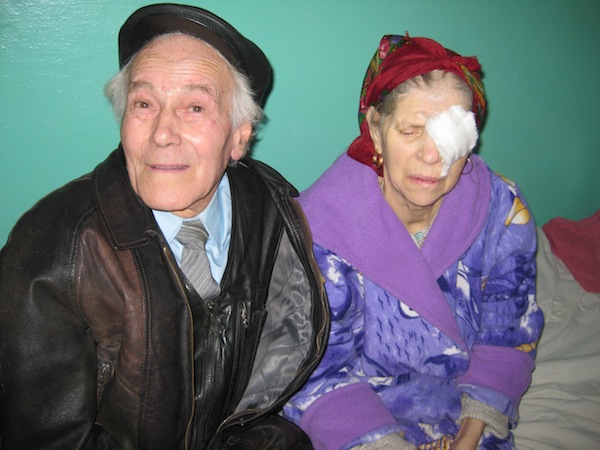
photo - Survivors Isak and Galina in hospital
Survivors Isak and Galina in hospital. (photo from Survivor Mitzvah Project)

“If you were in a concentration camp – and the Germans kept really good records – if you survived Auschwitz, they have your name … [even so], most people have to hire an attorney,” Buzby said. The survivors she helps don’t have records, partly because the Holocaust in the east was typified by on-the-spot mass murder by Einsatzgruppen killing squads rather than concentration camps. And the few survivors in eastern Europe today do not have the resources to apply.

“They don’t have computers, they don’t have people advocating for them, there’s no lawyers out there,” said Buzby.

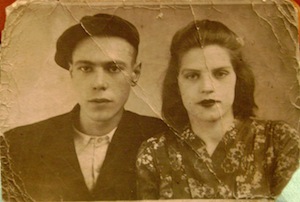
photo - Survivors Isak and Galina in their younger days
Survivors Isak and Galina in their younger days. (photo from Survivor Mitzvah Project)

In many cases, they also don’t have the money to pay for heating fuel, let alone medications or doctors. Some may have a pension of $10 a month, others have no income whatsoever. Food can be very scarce and many of the survivors are the last, or among the last, Jews in their villages, making their final years bleak and lonely.

Buzby took it upon herself to help. She formed the Survivor Mitzvah Project in 2001 and has helped thousands of the most desperate, destitute survivors. (See also jewishindependent.ca/oldsite/archives/may08/archives08may02-01.html.)

“This is the last generation of Holocaust survivors and we are the last generation who can say that we helped,” she said. “Everyone turned their back in 1939 but today we can do something to help them and we should.”

The Survivor Mitzvah Project (SMP) doesn’t try to create the infrastructure of social services or initiate major projects. The goal is simple. Get some money into the hands of the most destitute Holocaust survivors as quickly as possible.

“We try to give them between $100 and $150 a month to get food, heat and medication, so it comes out between $1,800 and $2,000 a year per survivor,” she said. “Of course, we don’t have the money, we don’t bring in enough money, we don’t have enough donors to help everyone every month and that’s the sad part. That’s why this is really a call to action. There is no tomorrow for these people. They need money now.”

Buzby, an actor and TV director before she became obsessed with helping destitute survivors, finds recipients through word of mouth, traveling to villages and asking around for Jews or looking for signs of Jewish life. Often, she said, survivors lead her to others. She recalled a particular example.

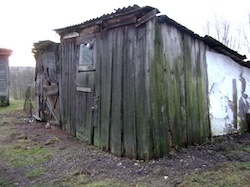
photo - Some survivors are living in huts – “no running water, no heat, broken windows.”
Some survivors are living in huts – “no running water, no heat, broken windows.” (photo from Survivor Mitzvah Project)

“When I went there, to this little village, it was in such poverty, it was unimaginable, unbelievable poverty. No bathroom, no running water, no heat, broken windows,” she said. “A lot of these people made the huts they live in themselves out of mud and straw bricks after the war. It needs to be refurbished every year but now in their old age they can’t do it, so ceilings fall in. I gave [a woman] $800 and, on the way out, she pulls on my jacket and says to me through a translator, ‘Can I split this was someone?’ And I said, ‘Who are you going to split it with?’ ‘There is a woman down the road who is much worse off than I am.’ And I thought, how could anybody be worse off than you are, so I said come with us and take us to this woman. So we went to see the second woman and she was very bad off, so she was put on the list, and that’s how it goes.”

The Jews in these villages are often surrounded by non-Jews who are also destitute, said Buzby.

“There’s always poor people to help, God knows,” she said. “But for the Jewish people who survived the Holocaust, not only were their families decimated and murdered, their communities were obliterated, especially if they were in the east, they were burned to the ground. There’s no community, there is no rabbi, there’s no Jewish community, there is no shul, there’s no sister, brother and uncle, there is no support system. So, these [non-Jewish] villagers, even though they are also poor, they have large families, they have maybe a church, they have community. These [survivors] have no community. There is absolutely nothing supporting them.”

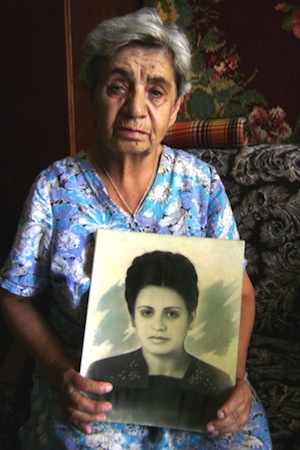
photo - Basya Kreyn with her prewar photo, Belarus
Basya Kreyn with her prewar photo, Belarus. (photo from Survivor Mitzvah Project)

Holocaust survivors in eastern Europe have one thing in abundance, Buzby clarified. Antisemitism.

“Rampant. Terrible,” she said. “There’s more antisemitism now than there’s ever been.”

In places, neo-Nazis march openly on the streets. Fascistic parties are gaining strength across eastern Europe. In Vilnius, Lithuania, kids dress up as “Jews” in masks with exaggerated features that are perceived as Jewish and trick-or-treat, demanding money. War-era Nazi collaborators are being rehabilitated as national heroes, she said.

The relationships between the few surviving Jews and their neighbors is additionally fraught because of the high levels of collaboration between the Nazi invaders and the native populations in the east. The almost complete destruction of the Jewish communities of Lithuania – an estimated 95% of the Jews there were killed – is credited to the assistance of Lithuanians. The Simon Wiesenthal Centre has said that Ukraine, for example, has never initiated any investigation into collaboration or prosecuted a perpetrator.

The Survivor Mitzvah Project gets almost no institutional help. Buzby said she routinely contacts major foundations but they demur, saying they support various organizations that assist survivors. But the survivors Buzby has tracked down have fallen through the cracks of whatever institutionalized assistance might be available.

What they do get is support from some of Buzby’s show biz colleagues. Buzby’s acting career includes turns in some of the classic comedies of the 1970s and ’80s, including Up in Smoke, National Lampoon’s Class Reunion and This is Spinal Tap. As a director, she worked on sitcoms including The Dick Van Dyke Show, Golden Girls, Newhart and Blossom. She has brought entertainment figures together for emotional events in which luminaries including Valerie Harper, Ed Asner, Frances Fisher, Elliott Gould, Lainie Kazan and Chris Noth read letters from survivors SMP has helped, who speak about their hardships and the difference the assistance has made in their lives. A powerful video of one of the events is online at survivormitzvah.org.

SMP has hit the $1 million a year mark, but Buzby estimates she needs $2.5 million to meet demand.

“This is an opportunity for people to change the course of history for the survivors,” she said. “Everybody has monuments and raises money for and builds museums for remembrance of those that perished, which is absolutely as it should be. But what about those that survived?”

The coming of the cold winter adds urgency to Buzby’s work. So does the obvious march of time, she said, as the remaining survivors near the end of their lives.

“It’s a time that’s never going to come again,” she said.

For more information or to donate, visit survivormitzvah.org or canadahelps.org.

Format ImagePosted on October 16, 2015October 19, 2015Author Pat JohnsonCategories WorldTags Holocaust, SMP, Survivor Mitzvah Project, survivors, Zane Buzby

Posts pagination

Previous page Page 1 … Page 537 Page 538 Page 539 … Page 650 Next page
Proudly powered by WordPress