Glenn Greenwald, the journalist who came to our attention as the conduit for Edward Snowden’s Wikileaks cache, has a theory on why members of the Canadian military have been killed in terror attacks like the one last week in Ottawa. They died for the sins of Canada’s foreign policy.
Greenwald wrote a piece after the incident in Quebec on Oct. 20, in which two soldiers were run over – Warrant Officer Patrice Vincent fatally – in a deliberate attack. Greenwald’s article was rerun at rabble.ca on Oct. 22, apparently posted to the site about the time another attack was taking place on and around Parliament Hill in Ottawa.
“It is always stunning,” Greenwald wrote, “when a country that has brought violence and military force to numerous countries acts shocked and bewildered when someone brings a tiny fraction of that violence back to that country.”
Greenwald shifts blame for the soldiers’ deaths from their murderers to Canadian involvement in Afghanistan, Canada’s newly announced air support for the Western battle against ISIS, and on Canada’s being “an enthusiastic partner in some of the most extremist War on Terror abuses perpetrated by the U.S.”
The article has been shared around social media and similar assertions have been made by other commentators.
It needs to be said that both of these incidents, in which the perpetrators themselves were also killed, were apparently “lone-wolf” attacks. Also popping up in social media are demands for greater attention to mental illness in Canada, the implication being that mental instability may have trumped ideology for one or both of these perpetrators. This is an important issue to consider.
Greenwald anticipates the inevitable comeback to his argument – that Islamists are not driven by reaction to our foreign policy but by hatred of our values. That is, they hate us not for what we do, but for who we are.
“They even invent fairy tales to feed to the population to explain why it happens: they hate us for our freedoms,” wrote Greenwald. “Those fairy tales are pure deceit. Except in the rarest of cases, the violence has clearly identifiable and easy-to-understand causes: namely, anger over the violence that the country’s government has spent years directing at others.”
It’s not a stupid idea, but it’s simplistic in the extreme. It suggests not only a self-deception about the ideology driving worldwide terror, but an almost understandable, desperate hope for safety: if we just stop provoking the terrorists, they will leave us alone.
What his position ignores – though it is shared by many – is that the perpetrators are fundamentalists, seeking the destruction of the existing order not only in Syria and Iraq, but worldwide. The deceitful fairy tales are those told and believed by those who refuse to acknowledge evil when they see it beheading people on the internet.
Greenwald’s position, in fact, is a version of the Western colonialist mentality. The actions and worldview of ISIS and other extremists are not born of ideology or theology. No, they are solely a reaction to our actions. It’s all about us. It’s a weirdly imperialist view in its own way.
But even if he is correct, even if the attacks we saw last week and those endured by other democracies including Israel in recent years, were motivated by government actions and policies, his solution is suicide.
Even if there were proof positive that terrorists were motivated by our policies, rather than the fact that we like freedom, equality, an after-dinner drink and mixed-gender dancing, the solution would still not be to change our policy.
For a country to base its foreign policy on whether or not it will be liked or hated by ideologues who scythe off the heads of innocents is a map to self-destruction. The idea that terrorists will target our soldiers and civilians because our government is engaged in far-off conflicts is not completely outlandish, but its corollary – that we should change our foreign policy to one more agreeable for the worst elements in the world – is horribly wrong. That is, to use a hackneyed and ridiculed phrase that is nonetheless spot on, how the terrorists win.
Sarah Marel Schaffer, left, and Sandy Hazan pause while sorting clothing for Operation Dress-Up, a social action project sponsored by the National Council of Jewish Women, Vancouver section. (photo from NCJW Vancouver)
Shlepping bags of new underwear and socks plus bundles of gently used, donated clothing to inner-city Vancouver gives Sarah Marel Schaffer and Sandy Hazan a sense of fulfilment.
The two women spearhead Operation Dress-Up, a social action project of the National Council of Jewish Women, Vancouver section. The clothing they buy, collect and distribute goes to needy children identified by school counselors and principals, by neighborhood youth and family workers, or by the Jewish Family Service Agency.
On Sunday, Nov. 16, the Vancouver section of NCJW will celebrate 90 years of education, advocacy and social action projects such as Operation Dress-Up. The event is set for 11 a.m. to 2 p.m. at VanDusen Gardens, and all are welcome.
Operation Dress-Up, begun 20 years ago, is supported by NCJW fundraising and by grants. United Way recently awarded the project $6,000. Schaffer said they are “quite lucky” to get this amount at one time and will soon call schools to see what’s on their wish lists and determine where the money will be best used.
Both women have been involved in Operation Dress-Up for 10 years. Schaffer said that for her it’s a way to give back to the community. “It’s a joy to dress your own kids in nice clothes and it’s a joy to help out in this way,” she said.
Hazan has found her participation to be a learning experience. “When you see the desperate need in Vancouver, it’s very humbling. I never knew that the poorest postal code in Canada is on the Downtown Eastside. I was shocked,” she said.
While Operation Dress-Up is a hands-on project, NCJW works with many local organizations, mainly by providing grants. One recipient is Children of the Street, whose mission is to intervene to prevent the sexual exploitation and human trafficking of children and youth.
Human trafficking, a modern form of slavery, is a focus for NCJW nationally and internationally. Council has advocated for passage of Bill C-36, to protect girls and women from sexual exploitation, sponsored by MP Joy Smith (Kildonan-St. Paul, Man.).
International Council of Jewish Women has joined with Stop the Traffik (stopthetraffik.org), devoted to ending human trafficking worldwide. ICJW also works on various projects with nongovernment organizations at the United Nations.
In Israel, ICJW lobbies on behalf of women kept captive by unfair divorce laws (agunot), and supports the Women of the Wall in its quest for gender equality. NCJW of Canada supports ALUMA, formerly known as IFCA, Israel Family Services Association.
At the 90th anniversary celebration, a roving magician, speakers – national NCJW president Sharon Allentuck from Winnipeg and international president Robyn Lenn from Australia – and finger food will be part of the fun. Organizations that partner with Vancouver NCJW will be arranged in a “farmers market” of informational booths. Some of these will include the Vancouver Public Library, Richmond Jewish Day School, Vancouver Coastal Health, Elizabeth Fry Society, Jewish Book Festival, Children of the Street, Home Instruction for Parents of Preschool Youngsters (HIPPY), B.C. Transplant Society, Barefoot Books and the Jewish Community Centre of Greater Vancouver. Council’s own projects, Books 4 Kids and Operation Dress-Up, will also be on display.
Tickets to the 90th celebration are $18, available at Vancouver NCJW’s office at the JCCGV. Call the NCJW office at 604-257-5180 for reservations.
“Do it! Just do it!” Cherie waves her hands impatiently, puzzled by my hesitation. We are sitting on the white sofa in her bright living room on Point Grey Road. Behind us, through the large picture windows, I see the waters of Burrard Inlet shimmer in the morning sun, framed by the blue mountains of the North Shore.
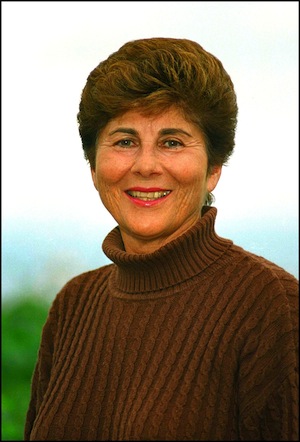
Cherie Smith (photo from Jewish Book Festival)
It is mid-morning and light is streaming into the comfortable open space, where each corner bears Cherie’s personal stamp: the beautiful flower arrangement on the glass-top coffee table, the white sculpture on a stand, the painting above the fireplace and the colorful blanket thrown casually over the back of a cozy armchair. Further in, two low steps up, is the large dining room table with the eight high-back, white leather chairs. Behind it, a cupboard with glass doors displays Cherie’s collections of china, glasses of all sorts and other small trinkets. More artifacts are displayed on the heavy, black wood buffet against the wall. The kitchen is small, but efficient, just off the dining room. From where we are sitting, we can see the entrance door and, on the right, a small corridor leading to the second floor where a large triptych, my own painting, hangs over the stairs. One entire wall of the hallway is covered with books.
Books are Cherie’s world.
I met Cherie at a party, a casual encounter in a room full of people. Despite her friendly manner, I was intimidated by her, knowing that she and her husband were not only affluent, but also people who could be defined as pillars of the community. Little did I know that, in time, we would become close friends; much more, that she would become my mentor, giving me all her support and encouragement in my attempt to publish my first book.
Sylvia Barbara, nicknamed “Cherie” by her father, was born in in the middle of the Great Depression, in the small town of Kamsack, Sask. Her father, a general practitioner, delivered her himself, since the local obstetrician was too drunk to perform. Both parents were Jewish immigrants from Poland and Russia, now living in this tiny town of 2,000, including many Doukhobors and First Nations. As a child, Cherie became keenly aware of the racism against minorities, and saw her father trying to offer assistance to those in need at every opportunity. Growing up in Kamsack was a very long way from Cherie’s later life in Vancouver. But, as I was to find out when I got to know her better, her modest childhood was the foundation for her generosity of spirit, her lack of prejudice, her warmth and her humanity.
Slim, well-groomed, her brown-reddish hair cut short, her dress casual but of good quality, Cherie was unaffected and friendly, a mover and a shaker. Once she made up her mind about a certain activity, there was nothing that could stop her. Speaking in quick, concise words, waving her hands about, she passionately advocated her ideas.
As I said before, books were Cherie’s world. She and her husband Buddy owned a bookstore for some time and later promoted writers whenever they could. Cherie would invite writers to speak and even subsidized them by paying their expenses. She was the founder of the Jewish Book Festival, which she tirelessly supported and organized, and now bears her name.
But I digress. Let’s return to that particular sunny morning in Cherie’s living room, where she listens to me worrying about the crazy idea of publishing a book.
“How can I do this? I have never done it before, what if it fails?” I am quite anxious. Perhaps the work is not good enough, perhaps I shall lose all the money lent to me so generously by friends, and perhaps I won’t find a publisher, perhaps, perhaps. But Cherie will have none of that. Doubt and fear of failure are not in her vocabulary.
“Do it! Just do it!” she urges me.
We revisit all the risks and all the benefits of this adventure. She tells me again and again that The Trials of Eve, the largest, most daring and risky work I have ever done, has to be published; it has to be launched into the world. She cajoles, encourages and prods me into taking the plunge. She is willing to help edit my poems; she will help with information and with whatever is needed for the publication process. “Just do it!” she says again and again.
And I did do it. The book came out in due time, first as a limited edition that won the Alcuin Citation Award and, later, as an expanded soft-cover version; both a victory of Cherie’s indomitable spirit.
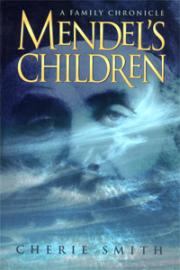
Cherie Smith published her memoir as a legacy to her grandchildren in 2001.
When Cherie became ill with the cancer that would eventually take her life, she took it in her usual commonsensical style, bravely fighting her way through without complaining. While visiting her, she told me about her swimming routine at Kitsilano Pool and about her efforts to publish her own book as a special gift to her grandchildren. We would take long walks on the beach, soaking in the beauty of English Bay. She, as usual, continued asking about my activities rather than talking about herself, her warmth and interest flooding over me like sunshine. Later, when she lost her hair due to the harsh chemotherapy she endured, she bought an elegant wig, always putting on a brave front, always concerned about her appearance, but almost never talking about her illness. Only when it became apparent that she was losing the battle did she begin making remarks about luck and fate. She became obsessed with the urgency of finishing the book that she was working on, and kept writing as much as she was capable of in her condition. The book was published before her death.
My last visit with Cherie in her white, sunny living room, took place shortly before her death. Her illness had taken a huge toll. Her body, devastated by the disease, was like a shadow of itself, transparently thin, her face lined, her voice a whisper. She still wanted to know what was happening in my life, but this time she also talked about her own death. I could barely answer her, my voice choking in my throat, tears welling in my eyes. We said goodbye and I left. It was the last time I saw my friend, Cherie.
After this, she refused all visits other than family. She wanted us to remember her as the vibrant, energetic and lively person she had been. And this is how I remember her. But each time I walk past her house, which has now been sold, a dull ache in my chest reminds me that I have lost a very rare, true and irreplaceable friend.
For information and a full schedule of events for the Cherie Smith JCCGV Jewish Book Festival, which runs Nov. 22-27, visit jewishbookfestival.ca.
Pnina Granirer is a visual artist who has exhibited locally, nationally and internationally and whose work is found in numerous private and public collections. Over the years, she has written short essays and poetry, some of which were published in Pnina Granirer: Portrait of an Artist by Ted Lindberg (Ronsdale Press). The Trials of Eve, a work of 12 mixed-media drawings and 12 poems, received an Alcuin Citation Award. This work is in the special collection of the Glenbow Museum in Calgary. The soft-cover edition features a lengthy essay written by the author. Granirer is currently in the process of working on a memoir. This article was originally written in 2009.
The Ministry of Health building in Jerusalem was the scene of a macabre wedding in 1881. (photo by Deborah Rubin Fields)
A government building, a zoological park, a bird observatory and a residential city street: What do these four Jerusalem locations have in common? In fact, each place is shrouded in mystery. Each conceals secrets. Each is part of Jerusalem’s landscape of spooky sites.
Back in 1881, the Ministry of Health building at 86 Jaffa Rd. (located across the street from the Mahane Yehuda market) was destined to be the villa of a well-to-do Christian Arab groom and his new bride. Unfortunately, the old adage “money does not buy happiness” came true. Personal wealth did not prevent personal tragedy; the young man died right before his wedding.
Making a macabre decision, the bereaved parents decided to go ahead with the gathering. At the party, the deceased groom was propped up next to his bride-to-be. Before everyone went off to the funeral, the bereaved mother supposedly honored “the couple” by performing the traditional wedding dance and dabbing the bride with henna.
Not surprisingly, this story had a chilling effect on local residents. The building remained empty for 10 years. After that, the Ottomans turned it into a general municipal hospital, a mustashfa. But because of its morbid history, even the most destitute patients were afraid to go there. It took a long time for people to forget its spooky beginnings, but eventually Jerusalemites, particularly from Lifta, Malha and Silwan, began to use the 30-bed facility.
Although financially strapped, the hospital stayed open until the British took over in 1917. They turned it into the Mandatory’s offices of the Ministry of Health. After 1948, the Israeli government made the building the Jerusalem regional offices of the Health Ministry. Today, Jerusalemites know it as the place to get their anti-rabies shots or their inoculations for the big post-army trip to South America or Asia.
Unfortunately, today the inside looks like many other old Jerusalem buildings: modern fixtures rudely stuck to old structures in utilitarian rather than esthetic fashion. Yet, some of the intriguing architectural additions remain outside: the winding, exposed staircases at the front of the building, for example, still shine. At one point, the stairs led to a roof from which guards had a good command of the comings-and-goings on Jaffa Road, at that time the main artery to the coast.
Both the Jerusalem Biblical Zoo and the Jerusalem Bird Observatory offer visitors a chance to see and learn more about bats. (photo by Deborah Rubin Fields)
Some animals also bear the brunt of unearned labels and gossip. Take bats, for example. At one time or another, many of us will have heard fears about bats biting people, as well as the mythical association of bats with vampires.
While some might take points off due to the fact that bats are not considered kosher (see Deuteronomy 14:18), bats deserve credit for keeping our environment in check by consuming copious amounts of insects. Besides that, close up, bats are rather cute.
Strange as it may seem, if you stroll past 83-87 Bar Kochba St. in residential French Hill at dusk (or near HaChayil 41, close to midnight), you might notice some of the small, winged creatures (not larger than an adult hand) darting through the air. At this time of day, bats leave the east side of the street and head for the park on the west side. Look quickly before they disappear from view.
If this subject drives you batty, the Jerusalem Biblical Zoo offers explanation and viewing of both insect-eating bats and fruit-eating bats. The zoo takes part in the research and conservation of the dwindling insect-eating bat population. Moreover, some time ago, the zoo acquired a new male Australian fruit bat. He was apparently quite the hit with the ladies, who evidently enjoyed “hanging out” with him.
In past years, the zoo has hosted summer’s eve tours focusing on bats and other night-active animals. Pre-registration has been mandatory and there is a charge. For more information, call 972-02-675-0111. Children 8 years old and over are welcome to participate.
The Jerusalem Bird Observatory near the Knesset also offers bat- (and other night-active animal-) watching activities for children ages 5 and above. For more information, call 972-02-653-7374 or 972-052-386-9488, or email [email protected]. There is a small fee for the walking tour.
Remember when you visit Jerusalem, keep an eye out for surprising sights and historical facts; things are not always what they appear to be and surprises are in store.
Deborah Rubin Fieldsis an Israel-based features writer. She is also the author of Take a Peek Inside: A Child’s Guide to Radiology Exams, published in English, Hebrew and Arabic.
A group of women at a Hadassah-WIZO event, 1950. (photo from JWB fonds; JMABC L.19711)
If you know someone in this photo, please help the JI fill the gaps of its predecessor’s (the Jewish Western Bulletin’s) collection at the Jewish Museum and Archives of B.C. by contacting [email protected].
Roberta Grossman (director), left, and Nancy Spielberg (producer) on the Duxford set of Above and Beyond. (photo from playmountproductions.com)
On Nov. 6, the 26th annual Vancouver Jewish Film Festival begins with the Canadian première of Above and Beyond, about a mainly American group of pilots, veterans of the Second World War, who fought for Israel in 1948. As part of Machal (foreign volunteers), “this ragtag band of brothers not only turned the tide of the war, preventing the possible annihilation of Israel at the very moment of its birth, they also laid the groundwork for the Israeli Air Force.”
Directed by Roberta Grossman, the 96-minute documentary was produced by Nancy Spielberg, who will be in Vancouver for the screening. Spielberg took the time to speak with the Independent via email in anticipation of her visit.
JI: What was it about the Machalniks’ experiences, in particular those of the air force pilots, that you found so compelling that you not only wanted to make a documentary but are following up Above and Beyond with a feature film version?
NS: First of all, we focused on pilots because, frankly, pilots are a lot sexier than infantry! There’s a romantic, tough, swagger, daring, live-on-the-edge, sweep-you-off-your-feet personality that felt bigger than life. I was so curious why these WWII pilots survived their tour of duty for the good ol’ US of A and then turned around and risked their lives for another country, and I was surprised that most of them were not at all Zionistic.
What drives a person to risk everything to save another person in need? Would I do that? Would you? Do we still do that as Americans? Is it part of that generation? Is it part of the American psyche? I was intrigued by their motivation and then I was swept off my feet by their charm and their chutzpah! The “adventures” that took place along the way and during their time in Israel make for great storytelling.
JI: What will a feature film be able to communicate that the documentary could not, or did not?
NS: I do hope that a feature film (dramatization) will communicate the same messages that we hope the doc does – how far does one go to help a brother in need? With a dramatization, we have more freedom to embellish the pilots’ stories and capers that we may have had to reduce in the doc or discard altogether. There are so many details and wild antics that could not be included in the doc but we’d love to explore in the dramatization.
JI: Near the end of Above and Beyond, you ask Coleman Goldstein whether he thought Israel would survive in tough times. What prompted the question and what was your reaction to his response, that, yes, it would survive, as “Israel’s an article of faith”? What is your answer to the question, and is it different now than it would have been when you asked it, given the most recent Israel-Hamas conflict (and the antisemitism it exposed) and as the U.S.-led fight against IS continues?
NS: We asked every pilot we interviewed whether he thought Israel had a fighting chance, or whether he thought he might not make it out alive. George Lichter said, “I thought we would lose….” We were surprised at Coleman’s answer because he was a very pragmatic, matter-of-fact gentleman, and he responded from his heart, as many of the pilots we interviewed did. Maybe they’ve become “softies” in their golden years, but there was a lot of emotion in our interviews.
My personal answer is that I am a spiritual person, and I agree with Coleman and Prime Minister David Ben-Gurion who, in 1956, said, “In Israel, in order to be a realist you must believe in miracles.” I need to hold on to that thought and belief in spite of the latest Israel-Hamas war and the antisemitism that has, once again, reared its ugly head.
JI: How does Israel and Judaism or Jewish culture fit into your life, and what would you tell North American Jewish youth today who, if polling is any indication, aren’t as connected to the Jewish state or Jewish practice as previous generations?
NS: I grew up in Phoenix, Ariz., where our family was the only Jewish family in the neighborhood (who didn’t always take too kindly to us). We were three-times-a-year Jews – Pesach, Yom Kippur and Chanukah. Outside of that, we were gastronomical Jews with a love for Yiddish and Russian melodies.
When I was in fifth grade, I started to go to a Jewish day school, which prompted me to come home and tell my mom that we needed to start keeping kosher so that I could have school friends over for play dates. Slowly, we evolved into kosher and Sabbath observance. When I was 19, I decided to leave UCLA and spend time on a kibbutz in Israel with my sister. That was it! I fell head over heels. I found a home that I didn’t know I was even missing. From that time on, I’ve been involved in Israel, Judaism and Jewish culture. My children went to Jewish schools and Jewish camps. In fact, my 26-year-old, Jessy Katz, has been living in Israel for two years. When I say to her, “I miss you, come home!” She says, “I am home.”
One of my main motivations in making this film is to reach out to the North American Jewish youth who feel very disconnected in the hopes that this film will be a much-needed shot in the arm of Jewish pride. I’m hoping that they will find a connection and take a fresh look at Israel and how it plays an integral part in being a Jew.
Above and Beyond screens at Fifth Avenue Cinemas on Nov. 6, 7 p.m. For more information about the film, visit playmountproductions.com. For the full schedule and tickets for this year’s Vancouver Jewish Film Festival, which runs Nov. 6-13, visit vjff.org.
Maya Tenzer joins Ballet BC for its 2014/15 season. (photo by Michael Slobodian)
Earlier this year, Ballet BC welcomed five new company members, bringing the total to 14, and four new apprentices. Now part of this intimate group is Maya Tenzer, who has joined the company as an apprentice for its 29th season, which begins Nov. 6 with No. 29.
No. 29 features the world première of White Act by Fernando Hernando Magadan, the Ballet BC première of An Instant by Lesley Telford and the reprisal of A.U.R.A. by Jacopo Godani.
“With this program, we will have commissioned 29 new works over the past five years by dance makers from around the world,” said Emily Molnar, Ballet BC artistic director, in a press release. “No. 29 is an evening that will showcase a dynamic and versatile range of dance while offering an engaging experience for audiences. It will grab you, excite you and challenge your ideas of ballet.”
Tenzer, 20, should fit in well with Ballet BC, which prides itself on being “grounded in the rigor and artistry of classical ballet, with an emphasis on innovation and the immediacy of the 21st century.” She joins the company from Arts Umbrella, with whom she studied and worked – with countless choreographers – from age 10.
“I was led to Arts Umbrella through a friend who did the summer intensive there and loved it,” Tenzer told the Independent. “I had begun to dance one year before in Paris, France, where my family had been living for the year. I started out taking one class a week, but I knew the following year I wanted to be doing more. In the many years to come of my training at Arts Umbrella, the school became my home and provided me with invaluable training. At Arts Umbrella, I was given the tools to joy and success in dance and in the world.”
She also trained at the San Francisco Conservatory of Dance. In a four-week summer intensive, she said, “I danced six days a week with demanding classes and a high level of commitment always demanded. The training there was vital to me. I was exposed to Gaga (a movement language created by Ohad Naharin, the director of Batsheva Dance Company in Tel Aviv) and all the studios there have no mirrors, so I learned to love the freedom of not having the mirror as a distraction while dancing. I felt my individuality and ownership as a dancer take off while there.”
Locally, Tenzer apprenticed, in 2013, with choreographer Justine A. Chambers in the creation of Sphinx, “a solo created in collaboration with contemporary gamelan composer, Michael Tenzer,” according to Chambers’ website.
“For that project, being an apprentice meant acting as a body Justine could look at her movement on,” Tenzer told the JI. “It sometimes meant developing movement with her, and it was above all an amazing opportunity to work alongside Justine, who is an intelligent and generous artist.
“Also, Michael Tenzer is my father! Both my parents are music teachers – my dad at UBC and my mom at Suncrest Elementary School in Burnaby. The creative arts have always been an irreplaceable part of my daily life.”
As has Judaism, “in bringing together … family in a special way. I was never strongly religious but I love the bonds that the traditions of Judaism have made for me,” she said.
On the international front, Tenzer has toured with Arts Umbrella Dance Company, an experience she described as “a joy.”
“I thrive on the relentless schedule and the new experiences,” she said. “Last year, we spent one week in Holland and one week in Italy, taking workshops, rehearsing with NDT (Netherlands Dance Theatre), and preparing our own show. Being tired was a constant but, often, being at your end can be a catalyst for the best kinds of change and improvement.”
And that brings us back to Ballet BC. “Being an apprentice means I have the same schedule and opportunities to work with the incredible people that come to Ballet BC, but that often I will be an understudy for a piece instead of dancing in the first cast,” she explained. “This gives me a chance to learn from the artists of Ballet BC as they work to create the powerful art we see onstage.”
Tenzer spoke of dance as allowing her to connect body and mind. “To practise aligning the two daily, as my job, is a gift and an inspiration,” she said. “The environment at Ballet BC is supportive of being vulnerable and taking risks in order to enter new territory, and this is exciting and a privilege to be a part of.”
No. 29 is at the Queen Elizabeth Theatre Nov. 6-8, 8 p.m. Tickets range from $30 to $80 (including service charges) and can be purchased from Ticketmaster at 1-855-985-2787 or ticketmaster.ca.
The poverty rate among Canadian Jews is increasing, according to the Jewish Federations of Canada-UIA’s 2011 National Household Survey, and social-service providers across the country are weighing in on the issue.
“For the first time in two decades, Jewish poverty in Toronto is on the rise,” said Nancy Singer, executive director of the Kehilla Residential Program, a nonprofit housing agency in Toronto.
The survey reported that the Jewish poverty rate is climbing across the country. There are 57,195 Jews living below the poverty line, which translates to 14.6 percent of Canada’s Jews, compared to 14.8 percent among the wider Canadian population. In 2001, the Jewish poverty rate was 13.6 percent.
Montreal has the highest rate of Jewish poverty of Canada’s major cities, at 20 percent, while Ottawa has the lowest rate of 8.9 percent. Vancouver sits at 16.1 percent, Toronto at 12.9 and Calgary at 10.8.
Robin Gofine, vice-president of strategic community planning and engagement at UJA Federation of Greater Toronto, said the statistics on poverty highlighted in the survey are “sobering.”
“Poverty in the Jewish community is an issue that affects more than one in 10, certainly in Toronto, and it is imperative that poverty be atop the communal agenda,” Gofine said.
“It is not just people with low socioeconomic standing, but people who are suffering from mental and physical illness, people with disabilities, new immigrants, seniors, Holocaust survivors and single parents,” she said.
More than 24,000 Jewish people in the GTA live under the poverty line, said Fran Chodak, a Jewish Family and Child (JF&CS) social worker and coordinator of the agency’s STEP – Striving to End Poverty – project.
“We also know that the line is somewhat arbitrary and that there are a whole lot of people who struggle financially, even though they may not be defined as poor, among the working poor.”
Referring to the increased number of Jewish people in the GTA living under the poverty line, Singer noted that the cost of living in Toronto has increased. “Rents have certainly gone up and the stock of affordable housing has not,” she said. “People are struggling … and these are hard-working people who can’t make ends meet, who have two jobs.”
The numbers suggest that Montreal’s Jewish community has been hit the hardest.
“In 2001, 18.6 percent of the population was considered living in poverty, and now we’ve reached 20 percent,” said Leah Berger, senior planning associate for Federation CJA in the department of strategic planning and community relations.
“What we’re observing in Quebec is that there is a progressive offloading of services from the government on to community organizations, on to families and individuals. Services and programs that were initially provided by the government are no longer being provided and there is still a need for these. So, in response, communities, families and individuals are having to offer responses without necessarily the financial means to do so,” Berger said.
“We know government-mandated health-care premiums have increased over the last few years, while services have been reduced. Transportation costs have increased; the price of a bus pass increase[d] almost annually over the past 10 years. Finding a subsidized spot in a day care is another challenge, particularly for single-parent families. The cost of rent has increased.”
Susan Karpman, director of community services and immigration at Ometz, an employment and social service provider in Montreal, said the reason why Montreal’s Jewish community has the highest poverty rate in the country is due in large part to the city’s aging community.
Seniors make up 20.4 percent of Montreal’s Jewish community, compared to 16.9 percent in Canada’s Jewish population as a whole.
“We also have significant numbers of large families with lots of children in the observant community, and that also tilts the balance, because that community has its own challenges in terms of supporting the larger and growing communities,” she said.
In Vancouver, the most recent statistics indicate that 16 percent of Jews here live below the poverty line, an increase of about two percentage points since 2001, said Susana Cogan, housing development director at Tikva Housing Society, a nonprofit agency that works to provide affordable housing for working-age, Jewish, low-income adults and families.
Cogan also attributed Vancouver’s growing poverty rate to an “increase in [the number of] seniors and the difficulty for people to get full-time positions.
“Vancouver has the most expensive housing – rental and ownership – costs of the whole of Canada. Yes, there is an affordability problem that affects everyone, including members of the Jewish community,” Cogan said.
Mark Zarecki, a Montreal native who serves as the executive director of Jewish Family Services of Ottawa, said the poor in Ottawa used to be more diverse when immigration rates were higher, but the demographics in Ottawa have changed dramatically.
“The elderly community is much larger than it was 10 years ago, and the youth community, from ages zero to 14, has shrunk by 500 kids. It is an aging community,” he said.
Chodak, of JF&CS in Toronto, said poverty numbers are rising in the Jewish community for the same reasons they’re going up in the general community.
“The systemic issues that everyone faces in the community, Jewish people face, too. So whether there is a great deal of youth unemployment, we know that newcomers face poverty. We know single parents, when there is a family breakdown, we see single women raising children facing poverty. There are a lot more elderly living in poverty, and there are a great deal of people who are precariously employed,” Chodak said.
“Twenty-two percent of jobs in Ontario are precarious, meaning not stable, not full-time. There is no pension, no union, and these are often the jobs that youth have, that women have, that newcomers get, that older people might have, that the disabled might have, and that is where we are seeing a huge rise in poverty.”
Perhaps the first step to eradicating poverty in the Jewish community is raising awareness about the fact that it is an issue at all, Singer said.
“It’s a myth that we don’t have Jewish poor. The starting point is making the community aware that we are not much better off than the rest of the community at large. We are maybe a percentage point or two below the national average, and that is nothing to be proud of. The fact that we are [also] a well-off and generous, philanthropic community, we should be addressing the problem and helping people,” Singer said.
Robyn Segall, programs and marketing director at Ve’ahavta in Toronto, said she has encountered many people who are shocked to learn there are poor Jews.
“When we talk about our program to serve the homeless, very often the first question is, ‘But are there Jewish homeless? That’s impossible,’” Segall said.
“There certainly are Jewish people living on the streets…. People live on the street for so many different reasons – they’re escaping abuse, they are escaping myriad things, dealing with mental illness and, for each person, there is a different appropriate response, and sometimes what the community has to offer isn’t always what they need.”
Zarecki illustrated the fact that this issue is of vital importance to the Jewish community by referring to a quote he heard from a social- work professor at McGill University that stuck with him.
“A Jew is poor among Jews and Jewish among the poor,” Zarecki said. “So poverty has two impacts. It marginalizes Jews because they are not fully accepted within the Jewish community, and they are not fully accepted in the poor community [either].”
Zarecki also suspects that the Jewish poverty rate is higher than is being reported. “When you look at government statistics, they don’t include Jewish quality of life. What I mean by that is, for somebody who wants to affiliate with the community, it costs money. Eating kosher food, sending a child to a Jewish school, going to a synagogue, living near a Jewish facility – often the rents are higher in an area where there is a concentration of Jews,” he said.
“My thesis is that Jewish poverty increases assimilation…. That is why it is incumbent on Jewish communities to reach out to low-income people because … they will vanish from the community if they’re not reached out to.”
– For more national Jewish news, visit cjnews.com.
In late August, a $250 million fund for Jewish child survivors of the Holocaust was established. (photo from Memorial de la Shoah, Paris, via claimscon.org/2014/09/child-survivors)
On Wednesday, Aug. 27, a symposium was held at the Centrum Judaicum in Berlin. The topic was Lost Childhood, referring to the impact of the Shoah on Jewish children who survived and continue to live with its consequences to this day. The audience was comprised of German government officials, members of the Conference on Jewish Material Claims Against Germany, and child survivors of the Holocaust.
Among those present were members of the negotiating committee, including Ambassador Colette Avital from Israel, Ambassador Stuart Eizenstat from the United States, Roman Kent, treasurer of the Claims Conference, and Greg Schneider, who serves as executive vice-president of the Claims Conference. From Germany, representative Rüdiger Mahlo and deputy director of negotiations Konrad Matschke were in attendance, as was Stefanie Seltzer, president of the World Federation of Jewish Child Survivors of the Holocaust and Descendants, and Max Arpels Lezer, its European representative.
A variety of speakers, from historians to psychiatrists, politicians to psychoanalysts, participated in order to press the case for restitution to previously overlooked Jewish children, now aging in trying circumstances connected directly to their early childhood deprivations and traumas. The negotiations following the symposium took place on Aug. 28, and resulted in the recognition of child survivors as a distinct entity deserving of restitution. Mahlo noted, “German politics has been made aware of the particular fate of the child survivors and its negotiations with the German government, the Claims Conference succeeded in establishing a Child Survivor Fund. With this, the loss of childhood is recognized for the first time as a case of damage.”
A fund of $250 million was established for Jewish child survivors worldwide. My address, entitled The Continuing Struggle to Survive After Survival, follows:
I stand before you keenly aware that I am here only because of a narrow escape from those who sought to murder me. As a Jewish child born in 1940 in The Hague, Holland, my family was ordered to report on Aug. 19, 1942, for “resettlement to the east.” That meant being assembled at Westerbork and, from there, deported primarily to Auschwitz or Sobibor.
My mother and I would have been killed shortly after arrival. Mothers with babies were doomed. One hundred and eight thousand Dutch Jews were sent to the factories of death. About 5,500 returned.
I stand before you keenly aware that I am in Berlin, the city in which were conceived the most grotesque crimes in human history. It was here that the minds of well-educated and presumably civilized Germans formulated plans for the annihilation of Europe’s Jews: men, women and children. And, by war’s end, in German occupied countries, 93 percent of Jewish children had been murdered.
I survived in the care of my Dutch Christian rescuers, Albert and Violette Munnik and their daughter, Nora, who I shall visit in The Hague in two weeks. Nora is 83 years old, nearly the age of Anne Frank had she lived. But the Frank family was betrayed and deported on the last train to leave Holland, on Sept. 3, 1944, destination Auschwitz.
And I stand before you also aware of the great strides that Germany has made to preserve this history and to remember not only what it has done but to teach this history to succeeding generations, indeed, to the world.
For those who pose the question concerning whether there are long-term consequences, a story. One day, my mother, in her mid-80s, suddenly apologized for giving me away into hiding. I was stunned. I told her she had been heroic; there was nothing to apologize for. Her response, “When I left you, you tried to follow me pulling a little suitcase, and I looked into your eyes and knew you would never forgive me.”
And it is true. She was so smart. She knew that having saved my life through her uncommon courage that I would nevertheless be unable to truly forgive her for abandoning me. A child cannot comprehend the reasons for such a rejection. That, we learn only as adults. We live with such complexities, we Holocaust children.
What was done to us involved not only physical annihilation. Those who survived also experienced the touch of death, the murder of the soul. My parents, who miraculously survived in frightening circumstances, never recovered. How could they?
In 1945, my father learned that his parents and two sisters were dead; my mother was informed that her parents, two brothers and little sister were dead. And so, there were three of us. Only the son of one of my father’s sisters survived also.
We spent those postwar years in shock. While Dutch citizens resumed their lives, traumatized by years of occupation but largely intact, Dutch Jews were shattered. I saw them. They came to our home, some with whip lashes on their backs. I heard them describe the horrors of the camps, the smell of the crematoria. It was too much for a little boy aged 5 or 6. And you may ask, even today, were there consequences and did they last all these years? The answer is, “What was done to us, never, ever left us. The Shoah envelops us like a shroud. But we put it aside so that we can function as if normal.”
For children under the age of 16 in 1945, there was little help. Most surviving children were orphaned and housed in orphanages or shelters such as Ecouis in France, where 426 boys from Buchenwald were looked after by the OSE [Oeuvre de Secours aux Enfants]. And yes, of these boys told by a psychiatrist or psychologist that they would never recover, the majority led productive lives, even attained great achievements. They included Elie Wiesel, a Nobel Peace Prize winner, Rabbi Israel Meir Lau, a chief rabbi of Israel, George Goldbloom, a U.S. businessman, and Kalman Kalikstein, a physicist who worked with Einstein.
But who can say that they recovered from the Shoah? Elie Wiesel, who devotes his life to healing, injustice and Holocaust remembrance and education? Rabbi Lau, who is now the director of Yad Vashem, Jerusalem’s Holocaust Remembrance Authority? Their lives remain rooted in Holocaust memories. The Holocaust’s imprint was too traumatic to overcome, too painful for healing, and medical professionals shied away from us in the postwar years. There was no help.
Think of it. Before the war, every psychiatrist, psychoanalyst and psychologist focused on the traumas visited upon a child in the developmental years. Anna Freud discussed the vulnerability of a child’s ego. One symptom, and therapists recommended years of individual or play group therapy to heal children suffering from anxieties. But postwar, where was this legion of therapists? They were nowhere to be seen. They were not prepared to deal with us, we were the carriers of traumas too great to confront.
We left for Canada in 1951 and I set about becoming a normal Canadian. With after-school jobs and summer work, I put myself through medical school, then psychiatry in Philadelphia and Stanford, and became professor of child psychiatry at the University of British Columbia in Vancouver, Canada.
In the 1970s, Holocaust survivors brought me their children and I worked with Holocaust survivor families struggling with overwhelming memories, some of which complicated the lives of the entire family. I helped some of the adults fill out restitution forms. A particularly poor and troubled survivor patient who had worked in the mines as a slave laborer, and who lost eight brothers and sisters, was awarded $1,300. I was furious upon hearing this. He saw it differently: “They acknowledged my suffering. They owned up to what they did to me.” I learned from him that reparation is not just about money, it is also about justice.
I soon discovered that Holocaust survivors who sought restitution were, in many instances, directed toward German psychiatrists for evaluation. Can you imagine it?
One child taken by her mother in an effort to obtain some financial help faced a particularly gruff doctor who yelled at her in German. This particular child, who, when hidden with a Polish family, had sat in total silence under a dining table at which German soldiers had a meal. Had she spoken, moved or coughed, her death was inevitable. And, years later, she endured this harsh treatment from a German physician. Dr. Kurt Eissler, in his powerful article “Perverted Psychiatry” in the American Journal of Psychiatry (1967), cites instances of reparations exams performed by appointed German psychiatrists:
“A Jewish woman aged 23 years lost her father and two younger sisters upon arrival in Auschwitz. She went through four concentration camps in which she often had to collect corpses. Amongst her complaints during examination were lack of initiative, difficulty in concentrating, poor memory and hypermnestic preoccupation with traumatic events. The psychiatrist’s diagnosis was ‘anxiety neurosis, unconnected with the persecution.’
“A woman was interviewed whose parents, brother, three sisters with their children, husband and 8-year-old daughter had been killed during the course of the persecutions. She herself spent years in a ghetto and in several concentration camps and had frequently been beaten to unconsciousness. She complained of depression, anxiety, phobia, feelings of guilt. The doctor denied any connection between these symptoms and the experience of persecution. He included in his report, ‘despite such grave experiences, of which no one is spared, most people continue their lives and have no chronic depressions.’”
It may stretch belief, but these psychiatrists frequently attributed the excruciating symptoms of atrocity to the patient’s prewar personality or to that of their upbringing.
It is no wonder that children who survived the Shoah all but disappeared into their own lives. The few who tried to talk were told that, as children, they had no memories and, therefore, did not suffer; or, if it looked like they were suffering, were told to forget it and get on with their lives. The comparative few who applied for compensation were humiliated and shamed again.
I got on with my life. My Holocaust preoccupations never stopped. I did not let on. But, when I presented myself for a Dutch restitution program to personally experience the process, the examiner, a pleasant lady representing the Netherlands, asked me why I thought I should seek compensation. After all, her Dutch husband had been a child during the war and he did not need any help. She did not even recognize that her non-Jewish husband suffered neither loss of family nor required hiding, at risk of discovery and death. Yes, he was hungry also.
As protocol dictated, she referred me for a psychological interview. I felt confident. After all, I was a 60-year-old professor of psychiatry, successful in my career and with a lovely family. I was asked the reason for my assessment and then I cried for two hours. I remained in therapy for five years.
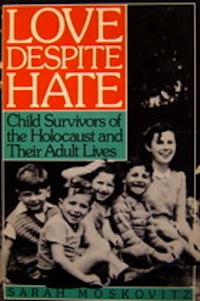
From 1982, Dr. Robert Krell worked with Prof. Sarah Moskovitz, author of Love Despite Hate.
I became deeply involved in the self-discovery of child survivors and our emergence as a distinct group of Holocaust survivors that culminated in the 1991 Hidden Child Conference in New York. From 1982, I worked with Prof. Sarah Moskovitz, author of Love Despite Hate, concerning 24 child survivors found in Terezin and brought to England for their recovery, and followed up by her nearly 40 years later. In 1982-83, I helped found the Los Angeles Child Survivor group and we began to write about child Holocaust survivors and their coping skills and adaptation.
In the course of that work, we defined child survivors generally as those children who were aged 16 and under by 1945, and we also examined restitution issues concerning children.
In 1998, Sarah and I coordinated a survey of child survivors to inquire about their experiences for war-related consequences. One thousand questionnaires were sent out. At that time, child survivors were aged mid-50s to mid-60s and were asked, “As you look back on your life, how do you think you were affected by your Holocaust experiences in childhood, physically, socially, emotionally, educationally and economically?” Six hundred and sixty-four child survivors responded.
The general findings revealed a staggering number of separations from parents with three-quarters of fathers and two-thirds of mothers never returning. More than half of respondents lost both parents.
Three-quarters of the child survivors in this survey reported themselves to have suffered serious to severe lifelong effects emotionally as a result of their traumatic past.
With respect to restitution, there were at that time, six main road blocks to obtaining restitution.
Missed deadlines: Many children did not know how to make claims. Nor did they know if their families had property or insurance. Children placed in adoptive or foster homes were not in touch with the community. They were taught not to think of themselves as survivors. When they did, it was too late to apply. According to our survey, over half never applied or had applied and been rejected. One third of those who applied received a one-time lump sum payment, one half of them less than $700 US.
Documentation requirements: In most cases, young children had neither the knowledge nor resources to obtain proof of country of origin, birth certificates, death certificates or names of witnesses. As one respondent stated, “First they killed my family and now they want proof that they existed.”
Time requirements for those in hiding or in ghettos: In order to qualify, a child was required to have been in closed hiding (confined) for 18 months. “Open” hiding (able to be outside) did not warrant restitution – as if these children had not also suffered loss of home, family, identity and religion, leaving them with feelings of abandonment, identity confusion and loyalty conflicts. A 1987 study by Moskovitz had also revealed that over one half of child survivors in hiding were harshly treated, beaten, and one in five were sexually abused.
Time requirements for six months in concentration camp: In Treblinka and Majdanek, young children were unlikely to live more than one day. In Auschwitz, the majority of adults lived no longer than three months. It raises the question, “How many days in Auschwitz are required for the experience to have left its mark on a child?”
The means test: One’s economic status was required to be at poverty level, precisely the persons who cannot afford legal advice or the resources to pursue rightful compensation. Even today, the annual net income for residents of Canada to meet the income eligibility requirement for a monthly pension is $29,103.
Requirement to be interviewed by German psychiatrists: Under certain circumstances, such as continuation of pension, an interview is arranged with a German psychiatrist rather than simply a board-certified psychiatric practitioner. This raises a single question: Where any Jewish child survived the Nazi occupation, what could possibly be grounds for discontinuing a pension? Each and every child has suffered enormous losses, profound disruptions, fear and malnourishment, and lifelong consequences.
To summarize, in our survey, child survivors reported themselves, despite personal successes and achievements, as seriously and permanently affected to this day: emotionally, 81 percent; socially, 69 percent; educationally, 66 percent; physically, 67 percent; economically, 65 percent.
We are 15 years beyond our 1999 survey and child survivors are now aged mid-70s to mid-80s. And, for many, the war’s memories are returning to cripple them once again. For those persons who have had reasonably normal lives, childhood recollections are a nostalgic review of mostly cherished memories. For child Holocaust survivors, it is a trip back into bottomless despair.
It should be noted that in Los Angeles this year there is a shortfall of $1.1 million for the care of Holocaust survivors. This is being raised by the local Jewish community. A typical account follows:
“I am a 78-year-old survivor of the Holocaust. I was a child during the Nazi occupation and I was hidden in the countryside by a Christian farm family. Both of my parents perished in German concentration camps. I immigrated to the United States in the early 1950s.
“I live on a limited income. I receive $800 in monthly income from social security and a $1,100 monthly pension from Holland. I rent a small apartment on the west side of Los Angeles that costs $1,180 per month. I have a lot of medical bills related to hearing loss, arthritis and psychiatric care relating to chronic depression.
“Last year, I was granted about $4,800 from the Holocaust Survivors in Urgent Need Fund. This was a life saver for me. I used the funds to cover dental work and bills relating to my apartment. I am feeling much better and able to eat and chew without pain.”
I suggest you view those who express need with compassion. Do not humiliate them with seeking proof beyond establishing they lived under the Nazi domination and survived. And do what is right and just to ensure their remaining years are dignified.
Remember that it is not only about establishing a degree of
financial security. It is also about assuring a measure of justice. And justice demands an official acknowledgement by responsible governments, particularly those that collaborated in the murders of my people.
It is growing late in the day. Our sun is setting.