Aviva Kanoff has been described as “the Indiana Jones of cooking,” and the subtitle of her latest book, Gluten Free Around the World (Brio Books, 2014), is “a journey of food, travel and extraordinary adventure.” She is a graduate of the French Culinary Institute and has worked as a chef, painter and photographer. Her previous book, The No-potato Passover, received the Gourmand Award for the best Jewish cuisine in 2012 and was original; so is this book.
Her 104 recipes are divided into breakfast, soups and salads, sides, vegetarian, fish, poultry, meat and desserts. There are recipes from England, Thailand, France, Ireland, Israel, Ecuador, Vietnam, Italy, India, Morocco, Spain, Scotland, Cambodia, Indonesia and Arizona. Ingredients are listed clearly and – my favorite – directions are numbered. Each recipe is accompanied by a mouth-watering color photograph and additional photos from its country of origin, all of which enhance the presentation of the book and make it unique.
Not only is this a great book for anyone who is gluten free; it is good for people who enjoy recipes from different countries that are distinctive and innovative. This would be a great gift for anyone who collects cookbooks or who likes to try imaginative recipes.
Here are a couple of recipes that would work perfectly as Chanukah treats in keeping with the tradition of eating foods made with oil.
CHURROS Reviewer’s note: Churros are a fried-dough pastry popular in Spain, France, the Philippines, Portugal, Mexico and Latin America. The recipe that follows is from Ecuador.
1/4 cup granulated sugar 3/4 tsp ground cinnamon 1 cup water 1/2 cup unsalted butter 2 tbsp brown sugar 1/2 tsp salt 1 cup gluten-free all-purpose flour 1 large egg 1/4 tsp pure vanilla extract canola oil for frying confectioner’s sugar
In a medium bowl, combine granulated sugar and cinnamon. Set aside for topping.
In a medium saucepan, combine water, butter, brown sugar and salt. Bring to a boil over medium heat. Add flour all at once, stirring vigorously with a wooden spoon. Cook and stir until the mixture forms a ball and pulls away from the sides of the pan. Remove from the heat and let cool.
Line a baking sheet with greased parchment paper. After the dough has cooled for 10 minutes, add the egg and vanilla to the saucepan, and beat ingredients with a wooden spoon to blend them completely. Transfer the mixture to a decorating bag fitted with a large star tip. Pipe four-inch lengths onto the prepared baking sheet.
Heat three inches oil in a deep saucepan over medium high heat. Fry a few strips at a time in hot oil (at least 375°F), turning once, until golden brown on all sides, about five minutes. Drain on paper towels. Roll warm churros in the cinnamon-sugar mixture to coat. Serve warm.
BOCADITOS DE PAPA Ecuadorian potato-cheese fritters
1 lb russet potatoes, peeled and quartered 1 cup shredded pepper jack or cheddar cheese 2 tbsp shredded Parmesan cheese 3 large eggs, lightly beaten 1 tbsp chopped fresh cilantro 1/4 tsp salt 1/4 tsp ground cumin 1/4 tsp cayenne pepper canola oil salsa (optional)
In a large saucepan, place potatoes in enough salted water to cover. Bring to a boil then reduce heat. Simmer, covered for 15-20 minutes or until potatoes are tender, then drain.
In a large bowl, mash potatoes with a potato masher until smooth. Fold in cheeses, eggs, cilantro, salt, cumin and cayenne pepper. Shape mixture into 12 three-inch-diametre patties. If desired, covered and chill for up to 24 hours before cooking.
In a large skillet, heat one-inch of oil to 375°F. Add potato patties, three or four at a time and fry about two minutes or until golden brown, turning once halfway through cooking time. Drain on paper towels. Serve hot and top with salsa if desired.
Sybil Kaplanis a journalist, foreign correspondent, lecturer, food writer and book reviewer who lives in Jerusalem. She also does the restaurant features for janglo.net and leads weekly shuk walks in English in Jerusalem’s Jewish food market.
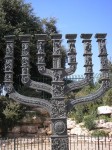
Many scholars believe that the menorah is a stylized version of a tree. The Knesset Menorah, pictured here, was built by Jewish sculptor Benno Elkan, and presented to Israel by the U.K. parliament in 1956. (photo from commons.wikimedia.org)
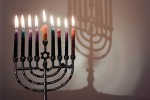
For the winter festival of Chanukah, we will all light the candles of our chanukiyot. A chanukiyah is a menorah with an additional two candles. The eight candles (not including the shamash), we are told, represent the miracle of Chanukah, in which the oil for the Temple menorah lasted for eight days following the Maccabean victory. But what of the menorah itself? From where does it derive its form, and what does it mean?
Many scholars believe that the menorah was a stylized version of a tree. This should seem quite obvious; it is, after all, a central trunk with branches. Indeed, when first mentioned in the Book of Exodus, it is described as having branches and cups like almonds, and bearing flowers.
Sacred trees play an important role in Jewish mythology, beginning with the Trees of Life and Knowledge in the Garden of Eden. The Tanach refers to trees or wood a total of 535 times, more than any other organism other than humans. Olive trees, for instance, were important not only biblically, but to the economy of ancient Israel. The menorah was lit with olive oil. Jeremiah metaphorically describes Israel itself as an olive tree: “The Lord called thy name, a green olive tree, fair, and of goodly fruit: with the noise of a great tumult He hath kindled fire upon it, and the branches of it are broken.” (Jeremiah 11:36)
Note in the preceding passage reference not only to a branching tree, but one crowned with fire. Taking Jeremiah’s image of the burning olive tree to be a menorah, one can then conclude that the menorah is a symbol of Israel. Not that it should necessarily be considered to specifically represent an olive tree per se. Different scholars have attributed it to various trees, like the almond tree, or tamarisk, or even a special species of sage indigenous to Israel that looks strikingly similar to the menorah, and may have been used as incense by the priests of the Temple.
Many Jewish holidays involve agricultural celebration with an emphasis on arboreal reverence. One such holiday, Tu b’Shevat, also called the New Year of the Trees, takes place in late winter/early spring, around the time of the blossoming of the almond trees. Depictions of menorot found archeologically would often be accompanied by other Jewish religious symbols, such as the etrog, lulav and shofar. Their use in the autumn harvest holiday of Sukkot is described in the Tanach as follows: “And you shall take on the first day the fruit of beautiful trees, branches of palm trees, and boughs of leafy trees and willows of the brook, and you shall rejoice before the Lord your God for seven days.” (Leviticus 23:40)
It should be noted the special religious significance placed upon trees and the number seven, both of which are embodied within the menorah itself. The holidays of Sukkot and Tu b’Shevat both would have once involved pilgrimage to the Temple in Jerusalem, and be celebrated with the lighting of the menorah. These associations clearly indicate that the menorah is not only a ritualistic object, but symbolic of holidays and celebrations, bringing light into people’s lives both literally and figuratively.
The lights of the menorah are thought to have had the power to ignite the soul. Its seven lamps could be representative of the seven days of Creation. When Adam and Eve were banished from the Garden of Eden, God created a magical fire to protect the way to the Tree of Life, which perhaps also has some significance to the symbolism of the fires atop the menorah “tree.” The prophet Zechariah supposedly had a vision in which God had seven eyes that wandered through heaven. Some scholars have speculated that the seven lights in that vision, and the seven lights of the menorah, are in fact symbolic of the seven planets of classical astronomy. Some rabbis believe that the shamash represents the sun, and the first day of Creation. In the story of Genesis, on the first day, God created light. The first verse of Genesis is, in fact, composed of seven words, in Hebrew, which translate as: “In the beginning God created the heaven and the earth.” (Genesis 1:1)
The early analytical psychologist Carl Jung noted that the menorah is a synthesis of the antagonistic symbols of the tree/growth from the earth and fire/the heavens, which combine to symbolize the growth of spiritual enlightenment. Jung hypothesized that the lights of the menorah were symbolic of the illumination of consciousness. The burning bush, the way God chose to reveal himself to Moses, is thus a symbol embodied within the form of the menorah as a symbol of revelation.
Ben Leyland is an Israeli-Canadian writer, and resident of Vancouver. This article is the first of a short series examining the menorah.
How can we explain the mitzvah of the Chanukah light? What about two of its features? One, the lights are to be placed by the door of one’s house that is next to the street or public domain, and they must be placed on the left-hand side of the door. These features have deep symbolism: our tradition tells us that the “left hand side” and the “public domain” both stand for the realm of the profane; by placing the lights there, we are bringing the Divine light into the area of existence that is most resistant to it.
The mitzvah of the Chanukah lights is similar in two respects to that of the mezuzah: both have to be placed by the side of the door of a house or courtyard, and both must be set on the “outside.” However, there are also two differences between them. A mezuzah must be fixed on the right-hand side of the door, while Chanukah lights are to be set on the left. Though both are placed outside, in the case of the mezuzah, this is only to mark the entrance. Chanukah lights, however, are intended to illuminate the outside, the public domain. The mezuzah points inward, while the menorah shines outward.
These points of difference may, in fact, be connected. We learn that the public domain, rishut ha’rabim, literally the domain of the many, suggests the idea of multiplicity or a lack of unity; the left-hand side is the name for the source of life in which there is a separation and disunity. Public domain and left-hand side, therefore, are related, both symbols for the dimension of division and alienation from G-d.
Interestingly, the precept of mezuzah is said to be equal in importance to all the other mitzvot together; it is said to include all other mitzvot within itself. Indeed, almost all mitzvot share the two features that characterize the mezuzah: the idea of the right hand, and of being directed inward.
Most mitzvot are to be performed with the right hand. For example, burnt offerings were vitiated if they were not offered with the right hand. Certain commandments must be performed indoors, and it remains evident that those that may be done outside have no integral connection with the idea of the public domain, since they may also be performed indoors. In short, they have no connection with place at all.
The Chanukah light – occupying the left-hand side and intended for the outside – has a different character to almost all other precepts in Judaism. The difference between the mezuzah (and all other mitzvot) and the Chanukah light is analogous to that of positive and negative commandments. The positive are those that can only be performed with objects that belong to the domain of the permitted; the negative covers the (non-performance of the) forbidden.
Every performance of a mitzvah brings spiritual light to the world, in the form of Divine light. The light that is drawn down by the fulfilment of a positive mitzvah is of the kind that can be internalized in the act itself, clothed or contained within it. The act “clothes” the light in the same way as the body “clothes” the soul. A Divine light that can be contained in such a way is finite; it takes on the character of that which contains it, and cannot descend to the realm of the impure or forbidden.
The light that is released by the fulfilment of a negative command, however, is infinite. It cannot be contained by the forbidden (or indeed by any) act, nor does it share its character, so it can be released only by refraining. Only an infinite light can reach that far, into impurity, in order to be undimmed where it shines. The Chanukah light is of this infinite kind; it brings light to the left-hand side and the public domain, both symbols of impurity and alienation from G-d. However, Chanukah light goes even beyond the negative commandment. Recall that it is, in fact, a positive command. Chanukah lights illuminate and purify, rather than negate, the world of outside, just as a positive command purifies the world of inside.
This is the connection between the Chanukah lights and the Torah, which is also called “a light.” The Torah also specifies acts that are forbidden and things that are impure. Through studying the Torah, the sparks of holiness embedded in the realm of the forbidden are released and elevated.
The miracle of Chanukah is apparent not only in the fact that “for your people, Israel, You worked a great deliverance and redemption as at this day” – a deliverance from a people who were “impure,” “wicked” and “arrogant,” and despite their being “strong” and “many”; but also in the result that “afterwards, Your children came into Your most holy house, cleansed Your Temple, purified Your sanctuary, and kindled lights in Your holy courtyards.”
May each and every one of us recognize the beauty in the mitzvah of lighting Chanukah candles, and may we be blessed with a fun, delicious and wonderful eight-day festival.
Esther Tauby is a local educator, counselor and writer. This article is based on the talks of the Lubavitch Rebbe, OBM.
The word dreidel is Yiddish, and comes from the German verb dreihen, meaning “to spin.” Dreidel literally means “little spinner.” The first dreidel players were Yiddish-speaking Jews in medieval Europe. In fact, playing with tops has been a popular pastime across Western Europe since at least the 16th century!
Many believe that the four letters on the dreidel – nun, gimel, hay and shin – were taken from the Hebrew expression “Nes gadol hayah sham,” meaning “a great miracle happened there,” referring to the miraculous events of the Chanukah story in ancient Israel. Really, this meaning was added later on. The letters originally represented the Yiddish instructions for what to do when you land on each one (Yiddish and Hebrew use the same alphabet): gimel for gantz, whole, take the whole pot; hay for halb, half, take half the pot; nun for nisht, nothing, don’t take out or put in; and shin for shtehl einl, put in, i.e. put some of your coins into the pot.
As the dreidel became a symbol associated with Chanukah, many legends began to stem from it. For example, the following one: When Antiochus decreed that Jewish law may no longer be studied in public, righteous Jews defied him and continued to teach Torah to their children. When they saw the king’s henchman coming, groups of students would quickly hide their books and bring out their dreidels, pretending that they had merely gathered for a bit of fun and gambling.
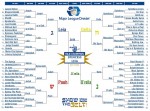
From those times to nowadays, dreidel spinning has even become a competitive sport. The group Major League Dreidel hosts tournaments each year in New York City and crowns a champion for the longest-lasting continuous spin.
Binyamin Kagedanhas a master’s in Jewish thought from the Jewish Theological Seminary of America.
Reb Cantor discovers that some families, like Chelm’s Gold family, light eight candles on the first night of Chanukah. (photo by Dov Harrington from commons.wikimedia.org)
“I’m sick of Chanukah,” Reb Cantor, the merchant of Chelm, muttered. His wife, Shoshanna, looked up with surprise. “What’s wrong with it?”
“Did I say that aloud?” Reb Cantor paused and frowned. “But now that you ask…. I’m tired of Jewish holidays. I’m tired of non-Jewish holidays. I’m done with giving and getting. I’m bored with lighting candles and saying the same blessings over and over and over again. I’m finished with wondering when Chanukah is, and I’m exhausted by all the conversation about whether it’s early or late. And I am so fed up with latkes and greasy food. If I never see another potato pancake in my life it won’t be too soon.”
“But Chanukah’s a tradition,” Shoshanna said. “It’s a mitzvah! And is it so wrong to celebrate one of the few battles the Jews actually won?”
“I don’t care anymore,” Reb Cantor answered. Shoshanna Cantor nodded and sighed. Her husband, Isaac, had always been prone to depression and, as the winter days got longer, his moods often got darker. Usually, she wouldn’t worry, but Chanukah hadn’t even started yet, and listening to him kvetch for a whole eight-day week would be too much to take.
“Well, there’s a one benefit.” She smiled. “If you’re not eating latkes, you’ll probably lose some weight.”
Then she rubbed his big belly and kissed his balding forehead.
Reb Cantor tried to be grumpy about this too, but he couldn’t help himself and snorted a laugh.
***
The door of the Cantor house slammed. It was late in the afternoon of the first evening of Chanukah, and Reb Cantor was furious. He was ready to rant and rage and stomp. Not only did he hate potato latkes, he hated the way Shoshanna fried them in advance and then left them to warm in the oven until they became greasy and soggy. He sniffed the air and … there was nothing … no rancid oil or stale potato scent.
“Shoshanna!” he bellowed just as his wife appeared. “What….”
“Don’t take off your coat,” she said as she put on a wrap. “We’re not having dinner at home.”
“I’m not going to the Chelm Chanukah party!” Reb Cantor barked. “Mrs. Chaipul’s latkes always make me queasy.”
“It’s not till tomorrow night anyway,” she said. “Come with me.”
Then she walked out. He had no choice but to follow.
It wasn’t far to the Gold house. The poor cobbler lived with his many children in a home that had been completely rebuilt after it had accidentally won the sukkah contest several years before.
Shoshanna knocked on the door, and then went in. Clearly, they were expected.
Reb Cantor frowned and stomped his feet on the stoop in frustration.
A quiet voice asked, “What are you doing?”
Reb Cantor looked down at Reb Gold’s youngest daughter, Fegi, who seemed a little frightened.
“Nothing,” the merchant said, softening his voice. “I’m just making sure my boots are clean before I come inside.”
“Oh,” the little girl said. “Mama makes us take them off so we don’t track mud or scratch the floors.” She beckoned to a stack of shelves on the wall that were filled with shoes and boots.
Reb Cantor forced a smile, and sat on a bench.
“What’s that amazing smell?” he asked.
“Latkes!” the girl said with delight. “Mama’s making them and everybody’s gobbling them as fast as they come out of the pan.”
“You eat before the candles are lit?” the merchant said.
“Papa says that since Chanukah is so late this year and there are so many people to feed that we should eat while the oil’s hot.”
“So, they’re not warmed-over and limp?”
“They’re hot and crispy!” Fegi grinned. “With delicate, lacy edges.”
Reb Cantor’s mouth watered, despite his attempts to be angry and upset.
He padded his stocking feet into the kitchen full of the Gold family, large and small.
“Here, eat this,” Esther Gold said, popping a tiny warm latke into his mouth before he could say a word. “We wouldn’t want it to get cold.”
Reb Cantor couldn’t speak because of the savory explosions in his mouth.
“You’re just in time for the blessings,” Joshua Gold said.
The room fell silent. Even the oil stopped sizzling.
Soon it was filled with the song of the blessings. Each child harmonized and, as soon as he had chewed and swallowed the delicious bite, Reb Cantor couldn’t help himself and joined in.
Each of the Gold children and both their parents lit a candle until eight lights and the shammos were burning brightly. The sun had set and there was no other light in the room but the glow from the stove and the tall tapers in the middle of the long table.
“Why does your family light eight candles on the first night of Chanukah?” Reb Cantor asked.
“Chanukah celebrates a miracle,” Reb Gold said. “And my family is a miracle. That we are together is a blessing. That we have a house and food and enough money to buy so many candles is a blessing. Chanukah is a golden holiday. The latkes are golden. The light from the candles is golden. And this is the Gold house. We are so fortunate it would be a shame not to celebrate that.”
Reb Cantor looked at his wife, who was smiling at him. He did his best to hold back his tears.
“Besides,” Fegi said brightly. “If we only lit one candle it would be dark.”
Everyone laughed. Latkes were made, dreidels were spun, and the cold dark night was made warm and bright.
The End.
Mark Binderis the author of the award-winning Life in Chelm series, which includes A Chanukah Present, The Brothers Schlemiel and Matzah Mishugas. His latest book is Cinderella Spinderella. A professional storyteller, he regularly performs at synagogues, Jewish community centres and the National Yiddish Book Centre.
Ben-Gurion University of the Negev. (photo by Dani Machlis)
Approximately 2,000 Ben-Gurion University of the Negev students served during Operation Protective Edge, and another almost 1,000 remained in Beersheva to volunteer in the community. Between July 8 and Aug. 26, all activities, classes and exams were canceled. It was the third time and the longest period that the university has had to close its campus because of rockets from Gaza.
“Tragically, four members of the BGU family fell in battle. Their deaths are the latest permanent and heartbreaking reminder of the enormous price we continue to pay for an independent Jewish state,” wrote Prof. Rivka Carmi, MD, president of BGU, in her Sept. 14 e-message.
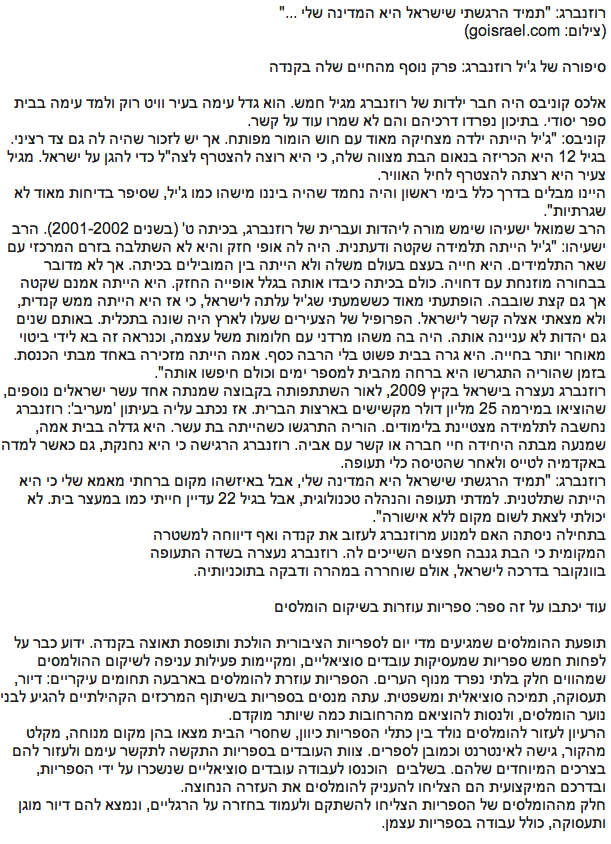
Prof. Rivka Carmi is in her third term as president of Ben-Gurion University of the Negev. (photo by Dani Machlis)
“Other members of the university family, more than I believe we will ever know, served their country, their neighborhoods, their communities and their families by devoting time and energy to helping others endure the more than 50 days of what seemed like never-ending sirens, explosions and the awful anticipation of the next one,” continued the message.
“For many of those affected by the war, the plans they had to work and earn the money needed to cover the costs of tuition and living expenses never came to fruition.”
To help, Carmi asked BGU’s associates organizations to raise $1 million, which they did. As of that message, Canadian Associates of BGU had raised more than $125,000 “for scholarships, with more expected to be donated.” As well, “approximately $120,000 … [was] received to purchase a 3-D electrocardiograph to be used with the wounded soldiers in Soroka hospital.” In August, American lawyer and philanthropist Murray H. Shusterman had pledged $1 million to improve campus safety against rocket attacks.
“We are worrying about our students so that they won’t suffer from the consequences of the university being closed and from the impact of having done extended military duty, while outlining how we need to be prepared for the possibility of more rockets in the future,” Carmi told the Jewish Independent in an email interview. “Basically, we reopened immediately on Aug. 26th to minimize loss of time, so that we wouldn’t have to delay the start of the fall semester. We have also had to institute a number of budget cuts to cover the many unexpected costs of the summer’s closure.”
While the university’s “annual operating budget comes from the government (primarily for salaries) through the Council for Higher Education in Israel, all growth and development comes through fundraising,” she explained. “Growth – in both physical infrastructure and human capacity – are made possible through amazing philanthropists who share our vision.” She voiced appreciation for the Canadian Jewish community’s support.
Carmi is the first woman to have served as president of an Israeli university, and the first as dean of a health sciences faculty. Elected for her first term as BGU president in 2006, she was confirmed for her third term this past May.
“I am sorry to say it is still an accomplishment to be the first woman and, though the situation is improving, it isn’t happening fast enough for me,” she said when asked about how women’s involvement at these levels had changed in the past 15 years or so. “There is a real problem still today to encourage girls to pursue their studies in the sciences. BGU operates a number of programs to encourage girls to expand their horizons through our Access to Higher Education program.”
One of her favorites is Inbal, which was spearheaded by Prof. Hugo Guterman. According to the blurb that accompanies the YouTube video of a group of program participants, “‘Only three to five percent of students in the department of electrical and computer engineering are women. In general engineering, it’s about 25 percent,’ he notes. Three years ago, he, along with BGU and the Beersheva municipality, began a course in robotics for female middle school and high school pupils. Beginning with less than 15 girls participating, this year [2012] nearly 120 girls took part in the course.”
With similar intent – to get more women into higher education – Carmi co-founded with Fatma Kassim the nongovernmental organization Alnuhud, the Association for the Promotion of Bedouin Women’s Education in the Negev. “It was the first such an organization … in the community,” said Carmi. “We realized then that an educated woman has a huge impact on the community and her family. The goal was to ensure that girls can compete on their own level to enter into university. At the same time, the university created what has turned into a very successful medical cadet program, launched by Prof. Riad Agbaria, to find promising Bedouin high school students and help them prepare for university studies in the health sciences.
“People like Shira Herzog (z”l) and the Kahnaoff Foundation have put us in a position to be able to offer scholarships to Bedouin women. When you are out in the Negev, you really feel the difference. There are now many Bedouin women out there making a difference in their communities.”
Two years ago, Carmi led a national committee examining the barriers and possible solutions to the situation. “The findings were conclusive,” reads BGU’s President’s Report 2014, “while Israel graduates a large number of female PhDs, it has far fewer women in the ranks of senior faculty than other European countries.
“This year, there were 216 women among the faculty, not including clinical medical staff, representing 27 percent of the total. The higher one ascends the ladder of seniority, the lower the percentage of women. Today, 40 percent of lecturers, 35 percent of senior lecturers, 19 percent of associate professors and only 16 percent of full professors are women. Of the 38 new faculty members recruited this year, one third are women.
“The average age for a woman completing a doctorate in Israel is relatively high: 37.3 years old. Israeli women also tend to have more children than similarly educated women around the world. The result is that potential candidates for international fellowships are older, with more children and less flexibility than their peers.”
“One of the key stumbling blocks, the report found, is the postdoctoral fellowship, generally done abroad. The average age for a woman completing a doctorate in Israel is relatively high: 37.3 years old. Israeli women also tend to have more children than similarly educated women around the world. The result is that potential candidates for international fellowships are older, with more children and less flexibility than their peers.”
The report listed a few initiatives that had been implemented based on the findings, but it is a continuing process. Just last month, said Carmi, “we organized a national conference to encourage women to a pursue an academic career. More than 350 young academics – men and women – came to Beersheva for the event that included hands-on advice and a panel of young female researchers who have ‘made it’ talking about their experiences. The responses we received from the participants have been overwhelmingly supportive.”
Carmi herself is a renowned researcher, and there is even a medical condition named after her. “During my work as a neonatal physician, I treated babies who were born without skin and with other severe birth defectives,” she explained about how the Carmi syndrome came to be named. “I was highly motivated to find the cause for this horrible condition. The problems we observed had never been seen before so it was decided to name this horrible disease after me. Twenty-five years later, I was fortunate enough to identify the gene mutation that causes it!”
For Carmi, genetics has been a long-held passion. “When I was in school,” she said, “I fell in love with the whole idea of research. My curiosity was captured by genetics and how it all shapes our lives. I decided very early on to become a genetics researcher. I realized that the best way to do this and help people at the same time was to study medicine and combine it with scientific research.”
While time no longer permits Carmi to be actively involved in research, she said, “It was my life, but I am happy in my new career that allows me to make a difference. I moved to the Negev in 1975. Watching it change and grow is very satisfying.”
“We are overcoming budget shortages and the incredible competition with universities around the world to attract the best and brightest young researchers through a special presidential fund…. I have funded researchers in fields that range from Yiddish to cognitive brain sciences.”
One of Carmi’s missions when she became BGU president was to “inject scientific content and research” into the university. On the progress of that mission, she said, “We are overcoming budget shortages and the incredible competition with universities around the world to attract the best and brightest young researchers through a special presidential fund. This allows BGU to offer competitive packages to researchers who might otherwise go elsewhere and opens up new positions as part of a wider agenda to stop Israel’s brain drain. I have funded researchers in fields that range from Yiddish to cognitive brain sciences.”
Carmi has received many honors over her career, including from Canadian organizations, and there have been several collaborations between BGU and Canadian science/academia.
“As a researcher, I had no Canadian contacts, but when I became dean of the faculty of health sciences, I became involved with the Canada International Scientific Exchange Program (CISEPO), which honored me in 2002 for my work. Now, our students participate regularly in their programs,” Carmi told the Independent.
“Over the past few years,” she added, “we have created a number of cooperative agreements with Canadian universities, the most noteworthy is with Dalhousie,” from which she received an honorary doctorate last year. The BGU-Dalhousie memorandum of understanding involves joint research projects, among other cooperative ventures, including the development of an Ocean Studies Centre in Eilat.
“We have had a significant increase in the number of Canadian academics coming to the Negev. The result has been a number of agreements for students and cooperative projects,” said Carmi, who was among those participating in a late-October conference in Ottawa on innovation that “focused on the Canadian-Israeli connection. It was fascinating,” she said, “and is sure to result in further partnerships.”
For more information about BGU, visit bengurion.ca.
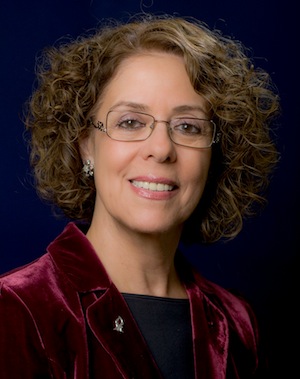
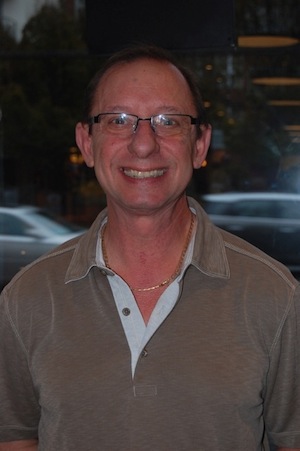
Eppy Rappaport welcomes new and old customers to Omnitsky’s new location at 5775 Oak St. (photo by Cynthia Ramsay)
Kreplach. Smoked meat. Tongue. Turkey pastrami. Salami and eggs. If this list of dining options makes your mouth water, read on because the new Omnitsky’s is open for business.
Taking over the location previously occupied by Kaplan’s, Eppy Rappaport has done a gut-renovation of the space in order to create a 21st-century kosher deli. The new Omnitsky’s has actually been open since just before Rosh Hashanah, but only for the retail end of the business. After a number of setbacks, Rappaport was able to cut through the last of the tangles of red tape and, once the licensing came through late last month, he was able to unveil his brand new restaurant and kitchen.
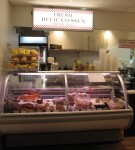
Eppy Rappaport (photo by Michelle Dodek)
About the delays, Rappaport was pragmatic. “I want it to be right,” he told the Independent. He’s excited to reveal the new space to the public. At long last, he said, his dream is coming true.
The new Omnitsky’s concept is different from the old store on Cambie at 43rd Avenue. There has been a reduction in dry goods available, but a large expansion of the refrigerated and frozen sections of the retail space. The increase in retail and take-out deli products reflects an emphasis on the expanded menu the new Omnitsky’s has on offer.
“The designer and contractor got the maximum out of the space,” Rappaport explained, adding that he hopes the look and layout will foster positive dining and shopping experiences. The deli has a traditional feel, with both food and décor to match. There are tables with banquets along the walls and the fresh deli counter is located at the back by the kitchen.
Rappaport has developed several new products, as well, including an apple turkey sausage that is nitrate-free, along with other sausages he makes himself in his plant on Annacis Island. “We have an expanded product line including fresh baked goods, salads, four soups every day,” he said. There will be the usual chicken soup with noodles or kneidelach, but now you can add kreplach, as well.
Alongside an array of deli sandwiches, there are several hot items on the menu, including kasha and shells, knishes, three kinds of hot dogs with five choices of toppings, and turkey shwarma. Omnitsky’s signature dish? “Deli done the old-fashioned way,” Rappaport said proudly.
Not only has he added variety to the menu, but Omnitsky’s hours are also extended. Monday through Thursday, he plans to serve breakfast, lunch and an early dinner, staying open 8 a.m.-8 p.m. Friday and Sunday, he will be open for breakfast and lunch – with plenty offerings to take home for dinner. To satisfy those who crave breakfast all day, he said that salami and eggs, a classic, is an all-day affair.
Rappaport is thrilled that his restaurant is finally open for business and reaching a new and expanded clientele. The Oak Street location has brought him a much bigger client base, he said. “People remember the old Kaplan’s. I’ve had old Kaplan’s customers returning, wishing me luck and waiting for the restaurant to open.”
Along with the street parking available for much of the day, Rappaport said there are 20 or so parking spots behind the restaurant. He believes that the growth in the kosher meat business is on the restaurant side of things and, with his new and expanded menu and a loyal customer base, he’s ready for things to really take off.
One of the well-loved features of Kaplan’s was the baking, the desserts that reflected an Old World taste and style. Fortunately, Rappaport said that the same woman who baked those familiar treats is working in his new kosher kitchen. This is welcome news for people who are looking to nosh on a shtikl kuchen after a chazerai of smoked meat on rye.
Wait no more, lovers of kosher meat and all that it can become. Omnitsky’s doors are open and the blue tarp that has covered the rear half of the store for months is gone. Whether it’s a trip down memory lane you’re looking for or a new culinary experience with an “old” twist, the only classic kosher deli west of Winnipeg is open for business.
Michelle Dodekis a freelance writer and community volunteer living in Vancouver.
Left to right: Cathy Golden, MP Wai Young, Erin Kizell, Pamela Martin, Dr. Tracy Ames, MLA Selina Robinson, Jes Simkin, Maya Russell, Enav Zusman, Eleanor Millar, MP Dr. Hedy Fry and Karen James. (photo by Lianne Cohen)
On Nov. 13, Canadian Jewish Political Affairs Committee (CJPAC) hosted its second annual Women in Politics event at Congregation Schara Tzedeck, bringing together a multi-partisan group of more than 40 community members of all ages, genders and cities to learn more about what it is like to be a woman in politics.
Inspiring stories were shared and thoughtful questions were posed throughout the evening as the moderators and committee members, some of whom are graduates of CJPAC’s Fellowship program, helped facilitate the conversations.
“Events such as these are a key part of CJPAC’s mandate to mobilize and engage Jewish and pro-Israel Canadians in the democratic process and increase political participation,” said committee member Karen James. “I think that it is especially important to increase the political engagement of women in our community because we often bring a different perspective to the issues.”
Participants gathered in small groups and met with MPs Dr. Hedy Fry and Wai Young, MLA Selina Robinson, Pamela Martin, Maya Russell and Eleanor Millar. These women spoke about life as an elected official or political staffer and the unique challenges often faced by women in this milieu.
“Listening to those wonderful, powerful women talk about the path they took in life and how they ended up where they are today was inspiring and motivational. As a young woman at the beginning of my career, I learned a lot from participating in the event,” said Enav Zusman, one of the moderators.
Erin Kizell, another of the evening’s moderators, noted, “The women who spoke at the CJPAC event really showed why political engagement is important. It doesn’t require the full-time commitment of being an elected official or political staffer – even just a few hours of volunteer work can make a huge difference. What’s most important is that we all get involved to ensure that our voices are heard.”
CJPAC recently opened a new office in Vancouver and will be hosting events into the new year and in advance of the 2015 federal election. CJPAC can offer guidance on how to volunteer on a campaign of your choice, and can organize volunteer training sessions for your staff, students, board or sports team. To learn more, contact Kara Mintzberg, CJPAC B.C. regional director, at [email protected] or 604-343-4126.
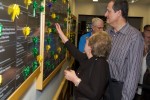
Attendees at the Nov. 16 event at the Louis Brier Home and Hospital check out the Gallery of Donors Wall. (photo from Louis Brier Jewish Aged Foundation)
On Nov. 16, the Louis Brier Jewish Aged Foundation honored donors on its Gallery of Donors Wall, located in the walkway linking the Louis Brier Home and Hospital and the Weinberg Residence. The afternoon celebration, which was attended by more than 100 people, was led by event chair Lisa Sirlin, who introduced foundation president Harry Lipetz.
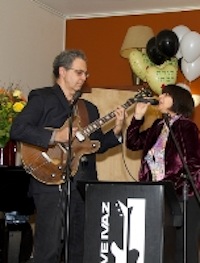
Jazz duo Dave Ivaz and Julie Boton were among the entertainers on Nov. 16. (Photo from Louis Brier Jewish Aged Foundation)
Lipetz spoke of the importance of donors to the vitality of both the Louis Brier and the Weinberg. He also thanked Dvori Balshine, who retired last month from the foundation after 12 years as its director of development.
Louis Brier board chair Arny Abramson thanked all of the donors as well for their continued support and chief executive officer Bob Breen detailed how the funding from the foundation is being used. Breen emphasized that the Louis Brier is the only home in the Lower Mainland that staffs several full-time occupational therapists and physiotherapists, as well as a full-time music therapist.
The Sunday afternoon event hosted donors, friends, family and residents, who enjoyed performances by the JCC Or Chadash dancers, musical interludes from Annette Wertman on piano, and the jazz duo Dave Ivaz and Julie Boton. The audience was in full spirits as they moved from the social hall to the boardroom, where the Zalkow family were honored for their donation towards its renovation and a plaque was unveiled, honoring the Edith Lando Charitable Foundation for its donation of audiovisual equipment.
Attendees then moved on to the Gallery of Donors Wall, where Rabbi Yitzchak Wineberg was on hand to say Shehecheyanu, as guests enjoyed a l’chaim. The wall was marked with green, yellow and purple bows, delineating donors who participated in the Maintain, Sustain and Enhance 2014-2016 campaign, plaques moving to a higher category and new donors on the wall. Final words were given by Balshine, who conveyed her appreciation to all the donors, emphasizing that their support is vital to the Brier and the Weinberg Residence.
A reception at the Weinberg, hosted by Chabad Catering with music by Wertman, Ivaz and Boton, concluded with another performance by the Or Chadash dancers. Guests went home with a chocolate confection donated by Chabad Catering.