Skip to content
  • Home
  • Subscribe / donate
  • Events calendar
  • News
    • Local
    • National
    • Israel
    • World
    • עניין בחדשות
      A roundup of news in Canada and further afield, in Hebrew.
  • Opinion
    • From the JI
    • Op-Ed
  • Arts & Culture
    • Performing Arts
    • Music
    • Books
    • Visual Arts
    • TV & Film
  • Life
    • Celebrating the Holidays
    • Travel
    • The Daily Snooze
      Cartoons by Jacob Samuel
    • Mystery Photo
      Help the JI and JMABC fill in the gaps in our archives.
  • Community Links
    • Organizations, Etc.
    • Other News Sources & Blogs
    • Business Directory
  • FAQ
  • JI Chai Celebration
  • JI@88! video

Recent Posts

  • Sharing her testimony
  • Fall fight takes leap forward
  • The balancing of rights
  • Multiple Tony n’ Tina roles
  • Stories of trauma, resilience
  • Celebrate our culture
  • A responsibility to help
  • What wellness means at JCC
  • Together in mourning
  • Downhill after Trump?
  • Birth control even easier now
  • Eco-Sisters mentorship
  • Unexpected discoveries
  • Study’s results hopeful
  • Bad behaviour affects us all
  • Thankful for the police
  • UBC needs a wake-up call
  • Recalling a shining star
  • Sleep well …
  • BGU fosters startup culture
  • Photography and glass
  • Is it the end of an era?
  • Taking life a step at a time
  • Nakba exhibit biased
  • Film festival starts next week
  • Musical with heart and soul
  • Rabbi marks 13 years
  • Keeper of VTT’s history
  • Gala fêtes Infeld’s 20th
  • Building JWest together
  • Challah Mom comes to Vancouver
  • What to do about media bias
  • Education offers hope
  • Remembrance – a moral act
  • What makes us human
  • המלחמות של נתניהו וטראמפ

Archives

Follow @JewishIndie
image - The CJN - Visit Us Banner - 300x600 - 101625

Category: Op-Ed

Changing Israel education

In the longstanding debate over whether collective narratives should be transmitted as capital-T truth, or whether they should be challenged and problematized, there is a flurry of activity around rethinking Israel education for the next generation. As if they were speaking to each other (they weren’t – neither creative team knew of the other), a short documentary film and a new curriculum have emerged to address an apparent gap in critical thinking around Israel.

The director of the short film Between the Lines, Ali Kriegsman, was frustrated with the kind of Israel-right-or-wrong messaging she received growing up in Jewish day school. In the film, she interviews students, rabbis, Jewish educators and professors who each suggest that it’s time to allow the light of critical thought into our community’s classrooms when it comes to Israel.

As a professor who teaches Israeli-Palestinian relations, I am well aware that the kind of one-dimensional Israel education that some students receive does not make them well placed to take in the more intellectual, critical-thinking approach that is the hallmark of higher education. But where the film makes its most counter-intuitive suggestion is in the area of Israel advocacy on campus.

The film suggests that even for those who want to create effective Israel advocates, the current tone of Israel education falls short. Kriegsman, who says she “wants to see improvement and justice in Israel,” believes that “antisemitism still exists in the world” and is troubled by the fact that the Palestinians “are marginalized and mistreated and settlements continue to expand,” puts it this way. She believes that a student who has been force-fed a simplistic view of Israel and arrives on campus where the discourse is almost inevitably contentious and polarized will do one of three things.

In one scenario, the student will become embarrassed by the actions of the country they were taught to idealize and thus choose to detach entirely. In another scenario, the student will draw on the “AIPAC”-style advocacy “bubble” they lived inside during Jewish day school and will become completely closed to any alternative narratives. In this scenario, the hypothetical student might become an “exaggerated version of a day school student” – discriminatory and racist. In a third scenario, the hypothetical student may feel “duped or betrayed” by her Jewish day school education and burn her emotional connection to Israel entirely.

Having premièred at a SoHo loft in New York City, the documentary – which received seed money from the Bronfman fellows alumni fund – is slated for a West Coast première in October sponsored by a Los Angeles synagogue.

Unbeknown to Kriegsman, as the film was being made, a rabbi in Madison, Wis., was creating a new curriculum that appears to address the conceptual gaps that Between the Lines identifies. Called Reframing Israel, the curriculum is meant to address what Rabbi Laurie Zimmerman saw as a major deficiency in Israel education at the elementary and high school level: “There was virtually no published material that asks students to think critically about the conflict.”

The rabbi wants kids to think in more complex terms, to be inspired to look at Jewish texts.

How do you cultivate compassion for both Israelis and Palestinians? How do you understand Palestinian stories?

Rather than emphasize a “love” for Israel, Zimmerman uses the term “connection.” As she puts it, “We pick one of the following: Eretz Yisrael (the Land of Israel), Medinat Israel (the State of Israel) and Am Yisrael (the Nation of Israel). We ask, What does it mean to be connected to each of these?”

She has been piloting parts of the program over the last couple of years. Last year, two 13-year-olds created a debate with each other on the question of the one-state versus two-state solution to the Israeli-Palestinian conflict. “It didn’t matter what they believed,” she said. Rather, the act of articulating the critiques was really valuable.

Some critics of this open-minded approach will claim that, to be agnostic about whether Israel remains a Jewish state (given that a one-state solution, in its democratic form, would basically spell the end of Israel as we know it) is itself a betrayal. Zimmerman, however, “trust[s] kids enough to draw conclusions that are sound and solid.”

As for what kind of Jewish student she hopes to send to campus once they have graduated from religious school, Zimmerman wants to send kids who are “inquisitive; have open minds, can evaluate an argument, apply their knowledge; research a position and make an informed choice. I guess that makes me radical since I’m not trying to send kids to campus to defend Israel. I care mostly that they go to campus and think deeply about being Jewish, about their connection to Israel, about Palestinian perspectives. The role of education is to create people who are actively engaged in their communities.”

Mira Sucharov is an associate professor of political science at Carleton University. She blogs at Haaretz and the Jewish Daily Forward. A version of this article was originally published on haartez.com.

Posted on September 11, 2015September 9, 2015Author Mira SucharovCategories Op-EdTags Ali Kriegsman, Between the Lines, education, Israel, Laurie Zimmerman

Breathe in and breathe out

Life in its individual expression is finite. Nearly all of us accept that. Living things reproduce themselves, so life goes on in that way. But, for the individual, life begins and, after a time, it comes to an end. An important thing is that, for most of us, we do not know when this ending will come. It is indeterminate.

Because the end time is unknown, we have the illusion, in the immediate, that life will just go on, is just going on. We are alive, we are full of plans, we are the centrepiece of the circle we have built around ourselves; it seems like it will go on forever. Certainly, in our younger years, the question of an ending hardly ever arises in our minds. Our lifetime stretches out before us into the dimly perceived future.

Am I discussing a question of universal import, or am I obsessed with my personal condition? Yoohoo! Do I still have you with me?

Even for those of us who are older, particularly those of us who are active, seemingly in good health, our lifetime also appears to be elastic. The events inhabiting our lifetime fill our consciousness. But we are aware of statistics. We see that our ranks are thinning. Some, even many, of those contemporary companions with whom we began our journey are missing at roll call. These realities do give us pause. How many more beautiful sunrises, how many more flaming sunsets will we witness? The languorous minutes of an afternoon with friends in inviting surroundings, imbibing all the consumables that yield to us their potential for pleasure, absent the pain to which all flesh is heir, how many more times will those unique experiences be ours?

I am exhilarated by being a part of the essential life event, the experience of being a living, breathing, feeling being. I know not if we are the sole sentient creatures in this universe, but I am grateful that it has fallen into my fortunate lifetime to experience this place and this time. How many of you out there must feel the same? None of us is guaranteed a life solely made up of music and roses. The inverse is true for great masses of humanity. But each of us, in some small measure, finds those moments of existence, those instants when we bless the stars that we are present, that we are here. It is inherent in being alive, in the human life experience. We really know only the present. Yesterday is gone. Tomorrow is speculation. I tell myself to ignore the extraneous. Breathe in and out; find those elements in our current experience that give us enjoyment in this instant of being alive.

Today, here in Vancouver, harvest time continues for tender fruits of all kinds. Sumptuous fruit, which for most of the year command a king’s ransom for purchase, is still being offered in the grocery outlets for a mere bagatelle. Earlier in the summer, mounds of red, ripe strawberries were being displayed in our markets in the form of architectural wonders, tempting us to reach out and bring those fruity edifices crashing down as we indulge the urge to taste. They were there, stressing the most disciplined. Blueberries, which, for most of the year, are retailed by the ounce, have been urged on us by the pound. Peaches, nectarines and melons of all kind compete for our attention on the groaning boards. We are overwhelmed with nature’s bounty, what is here and what is yet to be on offer, as the season progresses. These are just the ordinary things of the seasonal round, but they are a soft whisper of the simpler pleasures lavished on those of us who are alive.

Consumables are just an asterisk, a footnote, compared with the joys of human companionship. Were we blessed with tasks in life that stretched our potential, labor that was worthwhile? Did we find a person in our lives with whom we dared to show our essential vulnerability? A parent, a sibling, a friend, a teacher, a lover, a creature, with whom we found a basis for growth that might lead to healthy adulthood, with whom we distilled a shared experience we will remember unto death? Did we find a place and people where we felt that sense of peace, identification and commitment that determined the paths we would follow during the rest of our lives? Do the beauties of the natural world we inhabit bring home to us how tiny an element we are in the cycle of life of which we are a part? Have you looked up at the stars lately, preferably in a place where they are not blotted out by our man-made illumination, and understood just where man stands in the greater scheme of things?

We may be infinitesimal in our universe, less than the insects beneath our feet in the world man is astride like a colossus, but our tiny lives are full of meaning for us in the sheltered universe we seek to construct around ourselves. How central to us are our individual lifetimes. For most of us, our consciousness is concerned primarily with little else. How could it be otherwise? We mirror the behaviors of all the living species on our planet, seeking to ensure our survival and enhance our lifestyles. It is written in our DNA.

For some, the vision is a little broader, but even for them, the object is the enhancement of our lives in the broadest sense.

Let us toast the now of our lifetimes! To life!

Max Roytenberg is a poet, writer and blogger. An octegenarian, originally from Winnipeg, he is newly returned to Canada from Ireland and enjoying Vancouver with his bride.

Posted on September 11, 2015September 9, 2015Author Max RoytenbergCategories Op-EdTags mortality
Aliya changes a personality

Aliya changes a personality

Salomon Centre for American Jewish Thought fellow Eliana Rudee, left, and senior editor Joanie Berger enjoy lunch in Chicago. (photo by Paul Miller)

As I sit on a bench at the First Station in Jerusalem, just about to leave Israel for a weeklong conference in the United States, I watch the people around me on the most perfect Thursday. A bodybuilder-looking man feeds his young daughter and smiles at her as he leads the spoon of food into her mouth. Friends laugh and chat over ice cream, and couples walk hand in hand alongside the train tracks.

Suddenly, a sadness cascades over me as I get a too-familiar feeling of intense sadness that I experience every time I leave this amazing country. Some people call it the “Israel bug” and others call it “post-Israel depression.” Whatever it is, it feels like you’re about to leave something fulfilling and head towards a more robotic, mundane life. It means leaving behind the “Shabbat shaloms” heard from storekeepers on Thursdays and Fridays, and heading towards the “Merry Christmases” from storekeepers throughout December. It’s leaving behind the transcendent resonance of the shofar and heading towards elevator music while you’re on hold with the credit card company for the umpteenth time. It’s leaving the buzz of the people crowded into the shuk and heading towards the metronomic beeping as items are scanned at the grocery store. It feels like I am headed in the wrong direction.

But then I remember – I live here. I live in Israel. I am coming back in less than a week, and even though I am still sitting at the First Station in Jerusalem, I already cannot wait to come back. This is the epitome of my feelings for Israel, the land with which I am completely obsessed and the land that I am so very thankful to call home.

It was at this moment that I realized yet again that I have made the right decision by making aliya. This place truly fulfils me and fills my life with a sense of meaning that I have found only in my happiest moments elsewhere – an intimate gathering with my extended family, the moment I realized I had fallen in love, a birthday party that brought together all of my friends from the many parts of my life, and the feeling of learning something in college that changed my perspective on life.

As I write, I realize that these feelings are quite mushy-gushy, which (honestly!) is not usually how I am. So, in true rational form, I have concluded many times that I may be idealizing Israel, as my previous trips to Israel had been spent vacationing with family or new friends. But then, I think, how could I not idealize as I sit in the Jerusalem sun as the weekend hits, feeling so happy and sad at the same time? I honestly feel like a changed person in Israel.

My mom tells me that even before I was born, my personality was the same as it is today: I know what I want, I work hard to get it, I am rooted in facts and reality and I am a perpetual list-maker. I do things a little differently than most, and I like to lead others and pass along my passions. I am impatient and, because I feel so strongly about what I believe, my passion and confidence can often come off as inflexibility and stubbornness.

In Israel, much of my personality is unchanged. But I have found new parts of my personality finding expression and I think it is more a reflection of Israel than of myself. In Israel, I am quite able to express my emotions about this place, something that I would have found difficult and somewhat silly before. A new friend actually called me “artistic” the other day, something that I have not been called since I was very little.

After talking about Myers-Briggs with friends over the weekend, we decided to retake the test. After years and years of getting the same results, my personality profile shifted from “sensing” to “intuition.” This means that before I came to Israel, I paid more attention to the information absorbed through my five senses, but now I pay more attention to the information I receive through intuition. It also means that perhaps I am now a little more interested in the bigger picture than the details, the meaning behind the events, and new possibilities.

But I digress. Why I think this is worth mentioning is because I believe that something about being in Israel has changed this in me and has the power to change everyone who visits. When people have asked me why I chose to make aliya, I resort to talking about my feelings rather than rationality. (After all, I am not sure that someone who is purely rational would make this decision to move here!) I usually find myself saying something like this: “Well, there are a number of reasons why I moved here. One is because when I first came I fell in love with this place. I came back a number of times in the next several years, but it was never enough! I feel a fulfilment here that I missed when I lived in the U.S.” And then, when people look as if they want a more practical reason, I explain that my boyfriend and I were both thinking about living here before, so we chose to come together. It’s also a great place professionally, as a writer, because I write about Israel all the time. Rationally, it makes sense to be living in Israel if I am writing about Israel.

Previously, in explaining my decision to others, I would begin with the rational and move on to the emotional only if pressed to do so. But something about this place makes me tap into my emotions and intuitions. My theory about why this occurs is this: being in Israel inspires self-reflection in a way no other place does for me.

Israel’s history, culture, language and religion all relate to my past, present and future because of my identity as a Jew and my values of self-determination and freedom. My ancestors longed for the actualization of these values, died for the actualization of these values and survived for the actualization of these values. And now, I am helping to actualize these values by being in the Jewish state. This automatically triggers a cheshbon hanefesh – introspective monitoring about how well I am continuing to actualize the values that I find to be more important than my own being. I am, therefore, prompted every day here to integrate the values into my life, my actions, my choices.

As I am headed to the United States for the first time since making aliya, I reflect on the fact that even my choice to come for this week was based on these values. I believe to my core that creating the conditions for every person to find meaning in their lives should be a goal of humanity. For many Jews, finding their identity within the context of their culture, family and traditions means finding their identity within the context of Judaism. Israel is the place to find that identity, as nowhere else in the world do Jews come together like this to honor our past, present and future, actualize our values and traditions, and return to the only land that is inextricably tied to our identity as a people.

I came to the United States this week in order to be trained as a Birthright leader, someone who leads a group trip of young Jews to Israel, often for their first time, and guides them in learning about their own identity as a Jew. Birthright Israel and I share the same mission of creating the conditions for Jews to find their identity and meaning. I hope that, in this next week, I will learn to most effectively carry out this mission. And I think there is no better reason than this to leave my precious Israel, even for a week.

Eliana Rudee is a fellow with the Salomon Centre for American Jewish Thought and the author of the new “Aliya Annotated” column for jns.org. She is a graduate of Scripps College, where she studied international relations and Jewish studies. She was published in USA Today and Forbes after writing about her experiences in Israel last summer. Follow her aliya column on jns.org, facebook.com/aliyaannotated and instagram.com/israelgirl48.

Format ImagePosted on September 11, 2015September 9, 2015Author Eliana Rudee JNS.ORGCategories Op-EdTags aliya, Birthright, Israel, Salomon Centre

Enriching or superficial?

With the High Holidays around the corner, I have noticed my usual light bout of pre-holiday anxiety. So much always seems to ride on this part of the Jewish calendar. For strong believers, there’s the spiritual reckoning. For the less religious who still care about affiliation, there’s the loaded nature of synagogue attendance, compounded by the challenge of pricey tickets. And, for the simply social, there’s the pressure of ensuring some communal marking of the calendar.

Amid all of this, Reboot – an organization that bills itself as “affirm[ing] the value of Jewish traditions and creat[ing] new ways for people to make them their own” – is taking a lighter touch: its annual 10 questions project. Sign up at doyou10q.com and, starting on Sept. 13 and lasting 10 days, the website will email you one question per day encouraging you to engage in the kind of personal reflection that is customary during the intervening days between Rosh Hashana and Yom Kippur.

Once completed, the answers are sent to Reboot’s “vault” for safekeeping, and users can decide whether to share them or not. Either way, one year later, Reboot will send the answers back to the participant, and the questions will be posed again, so one can see what changes in life perspectives occur over time.

It’s a truism that Jewish life is fundamentally communal. A quorum of 10 is required for prayer; weekly Shabbat dinners are often an extended-family-and-friends affair; Jews are encouraged to educate their children Jewishly in a group setting; Jewish summer camp focuses on intense communal experiences; and bar and bat mitzvahs are marked by a public aliya la-Torah.

So, are individual, web-based initiatives like Reboot’s enough to scratch the itch of Jewish communal practice? Or are they, in their push-a-button way, a frivolous addition to what should be undivided attention to the technicalities of Jewish literacy and to the bricks and mortar of conventional Jewish life, where Judaism is experienced publicly and communally?

This question isn’t a surprising one, but it may be misplaced.

In the age of “destination” bar and bat mitzvah ceremonies, where almost no one from one’s community may be in attendance, and in the age of concierge Judaism – a term the Jewish Outreach Institute now uses to suggest that Jews may be looking for an array of products and services tailored to their own individual needs – and in the generation of the Millennial who seeks to refashion Judaism to suit her own sensibilities, Reboot knows that one has to reach Jews where they are.

But there’s more to it than simply realizing that initiatives like Reboot may be what’s needed to save do-it-yourself-style Jews from disconnection. Despite the absence of Hebrew or Jewish texts or a group of Jews sitting in a study session with a rabbi, initiatives like the 10 questions project is not a challenge to Jewish literacy at all. In discussing the initiative with colleagues, I realized that, without Reboot’s initiative, I might never have given those intervening days another thought.

In my typical hectic pace, I would likely be rearranging my work schedule, securing a break-fast invitation for my family or deciding whether to host one, and practising the Haftorah my shul has asked me to prepare for Yom Kippur morning. No doubt the personal reflection bit would fall by the wayside and, even if I did try to engage in it, it likely would not be as fulsome as that encouraged by the kinds of daily questions Reboot sends. That kind of thinking and writing – including being faced with one’s past challenges – takes immersive effort, both intellectual and emotional.

So, tailored-and-trendy versus tried-and-true may be a false dichotomy, after all. We would be better placed to think of Jewish life as being enriched by as many touch points as our current crop of Jewish innovators can create.

Mira Sucharov is an associate professor of political science at Carleton University. She blogs at Haaretz and the Jewish Daily Forward. This article was originally published in the Canadian Jewish News.

Posted on September 4, 2015September 2, 2015Author Mira SucharovCategories Op-EdTags High Holidays, Judaism, Reboot

“Threat” term problematic

When it comes to Israel, many Diaspora Jews harbor a double standard. They want their own countries to embrace pluralism and multiculturalism, owing to the kind of fluid immigration that allowed their own grandparents and great-grandparents to build a better life in America and Canada and many other places across the West. But, when it comes to Israel, they are comfortable articulating their desire to maintain a Jewish majority. Israelis – even those on the left – have a term for this need: they openly refer to Palestinians (whether in the West Bank, whether refugees living abroad or whether Palestinian citizens of Israel itself) as a “demographic threat.”

Palestinian citizens of Israel are pouncing on this usage more than ever. Ayman Oudeh, head of the Joint List, has called it offensive. He wants Israeli citizens to view their Palestinian citizen brethren as partners in nation-building. Still, he is not looking for a melting-pot version of Israeli identity: he demands that Israel grant the Palestinian citizens “collective rights.” Since they already have their own school system, presumably, by collective rights he means at the very least equal funding for schools and towns, including removing the unequal bureaucratic barriers to gaining building permits, something I’ve written about at the Globe and Mail.

Yousef Munayyer is also distressed by the term “demographic threat,” and concludes that it is intrinsic to Zionism. Instead of having a demographic problem, Israel has a Zionism problem, he argued last March in The Nation. This, as Bibi was whipping up fear against the Arab minority on election day, claiming they were coming to the polls “in droves.”

The scope of the issue is more complex than these critiques – as important as they are – allow. There are at least three aspects at play.

First, strategy. There are reasons why a peace activist may choose to use the term “demographic threat” to sell the idea of withdrawal from the West Bank, for example. This kind of reasoning may appeal to those on the centre or even the right who, unfortunately, aren’t moved by human rights imperatives. When it comes to language and lobbying, we must not forget the game of persuasion.

This connects to the second aspect: emotions. Here, the question is this: without undermining democracy, can a majority population privately desire to maintain its majority status? And, in the event that these private desires are shared publicly – through art or literature, say – should the users be chastised as being anti-democratic?

Here, we need to recall what may be motivating these feelings. It may not be anti-democratic tendencies or racism or even a sense of national superiority. As a national liberation movement, Zionism was acutely concerned with Jewish self-determination, more than it was with undermining any other national group in its midst. And, along with the material gains of statehood has come the desire to sustain a modern Jewish national culture, most markedly in the form of Hebrew. To contemplate becoming a minority in one’s country is to consider the attrition of one’s national language, at the very least, if not the possibility of collective safety and self-determination. Even if the fears are unfounded, even, if, somehow, a post-Zionist Israel can engage in a project of radical multiculturalism such that Hebrew culture maintains its treasured place alongside Palestinian culture and Arabic language, the impulse is still understandable.

Finally, there are the public policies themselves. On this, there is clearly much room for improvement. Oudeh’s call for a high-profile “civics conference” in the tradition of other annual conferences in Israel on issues – including security, social issues and economics – is a good one. As is the urgent need to close the funding gap to Arab schools and towns, and to educate against casual racism, including some landlords not renting to Arabs and “social suitability” committees determining who can live where, the kind of practices outlined by Amjad Iraqi in +972 Magazine. These attitudes and the practices that stem from them are corrosive to democracy.

All this is to say that the creation and maintenance of national identity, particularly in a state as young as Israel, is an enormous project. Using the term “demographic threat” as a way of describing the actual collective emotions and preferences of some citizens is as useful as any analytic phrase. To censor it completely, therefore, would be anti-intellectual and anti-democratic. But, when it comes to policy advocacy, thoughtful Israelis should consider thinking twice about using these words. As citizens of democracies, we should at least strive to hear things as our fellow citizens hear them.

Mira Sucharov is an associate professor of political science at Carleton University. She blogs at Haaretz and the Jewish Daily Forward. A version of this article was originally published on haartez.com.

Posted on August 21, 2015August 19, 2015Author Mira SucharovCategories Op-EdTags Arab-Israeli conflct, democracy, Diaspora, Palestinians, Zionism

Poet chooses politics over love?

In times of protracted conflict, can matters of the heart exist apart from politics? An award-winning documentary from Israeli filmmaker Ibtisam Mara’ana Menuhin left me at once spellbound, uplifted, sad and restless, as I found myself wrestling with this question.

Write Down, I am an Arab depicts the life of Palestinian national poet Mahmoud Darwish. The politics is important – more on that below – but what makes the film especially gripping is the story of Darwish’s catapult to national and international fame against the backdrop of his private longings for a woman on the other side of the Palestinian-Jewish divide.

Darwish met Tamar Ben Ami in the early 1960s at a political rally – this one for the Communist party in Israel. Frequently separated geographically – he under military administration (as all Arab citizens were until 1966) in Haifa, she studying in Jerusalem – Darwish documented his feelings for her in a series of letters.

I spoke with Tamar – by phone, Facebook and email – over the course of a few days. A dancer and choreographer (the film chronicles her stint in the Israeli navy’s performing troupe), Tamar divides her time between Tel Aviv and Berlin. She describes her art – and really her entire personal life – as being shaped by her time with Darwish. Her love for him is palpable, still.

Caught up as I am as a political scientist and columnist in contemplating political arrangements – refugees, Jerusalem, borders, one-state, two-state, federation or separation – Tamar operates differently.

“It’s cliché, and maybe I sound naive, but I believe in unconditional love,” Tamar tells me when I ask her what kind of political future she envisions. She is disturbed by what she sees as the artificial divisions of nations, races, ethnicities and religions, including what she sees as a dangerous interpretation of Jewish chosenness. “On this, the occupation has been nurtured.”

And, while it’s hard to disagree, I find myself confounded. Is the Palestinian national struggle one over occupation? Is it about the West Bank settlements, the land appropriation, the checkpoints and night raids and administrative detention? Or is it about the stones and earth of Palestinian towns and villages within Israel itself to which many Palestinians long to return? And, if it is the latter, how can the two national dreams ever be squared?

In the film, we see video footage of Darwish meeting a resident of Kibbutz Yas’ur, which was founded on the ruins of Darwish’s childhood village, al-Birwa. “It’s a moment of sadness and hope,” Darwish says to the man. “The sadness is that I’m not allowed to go back to that place and you have the right to go back there. But if we have the ability to be friends and we are friends, then peace is still possible.”

On one hand, it’s a wholly human encounter. On the other hand, once we put the subject of Israeli towns, cities and kibbutzim within pre-1967 Israel on the table, we are talking about the core of Israel’s identity, one which Israelis – and most Jews worldwide – are loathe to give up. And, if I’m really honest with myself, as a (liberal) Zionist who shares the Jewish national dream of those kibbutzniks, then perhaps the pain is also mine.

Nowhere was the tension between resisting occupation and demanding more fundamental claims more evident than in Darwish’s highly controversial 1988 poem called “Passers Between the Passing Words.” There, Darwish wrote: “It is time for you to be gone. Live wherever you like, but do not live among us…. For we have work to do in our land. So leave our country, our land, our sea, our wheat, our salt, our wounds, everything; and leave.”

With the first intifada raging at the time, Tamar is certain that the poem is about the occupation, not about Israel itself. “What can the occupied do?” Tamar recalls Darwish saying. The irony is that Darwish didn’t even think it was a good poem, Tamar says. To be judged by that poem pained him, and more than anything he longed to be considered a universal poet, Tamar adds.

After the 1988 poem controversy, Tamar found herself in Paris, trying to reconnect with Darwish, who was now at the centre of Palestinian politics. While she was sitting with him, Darwish took a call from Yasser Arafat. They spoke in Arabic. She could not make out what they were saying. The next day, when she called him again, Darwish rebuffed her: “You are not my girlfriend.”

We can never know whether Darwish, who died in 2008, chose politics over matters of the heart, or whether this unkind ending was just like so many ruptures between once-lovers: prosaic and universal.

But Darwish and Tamar did have contact again. After Prime Minister Yitzhak Rabin’s assassination, Darwish reached out to her in compassion. And, in 2000, Education Minister Yossi Sarid attempted to introduce two Darwish poems to the Israeli (Jewish) national curriculum. Stormy Knesset debate ensued, and the government narrowly survived a no-confidence vote. Darwish called Tamar. “My poetry is so important that over it the government nearly fell?” he mused.

Though their romance had ended, they clearly shared a sense of absurdity in how the universal language of poetry can be thrust into the forefront of the ugly struggles over land, narratives, history and invisibility. It’s a story that continues to be told, even as Tamar will always think in terms of interpersonal love as much as in terms of borders and territory.

Mira Sucharov is an associate professor of political science at Carleton University. She blogs at Haaretz and the Jewish Daily Forward. A version of this article was originally published on haartez.com.


Posted on July 31, 2015July 28, 2015Author Mira SucharovCategories Op-EdTags Ibtisam Mara’ana Menuhin, Israel, Israeli-Palestinian conflict, Mahmoud Darwish, peace, poetry, politics, Tamar Ben Ami
Journey is a crucial experience

Journey is a crucial experience

The Coast-to-Coast March of the Living group, as well as a few Israeli youth, in Israel. (photo from Talya Katzen)

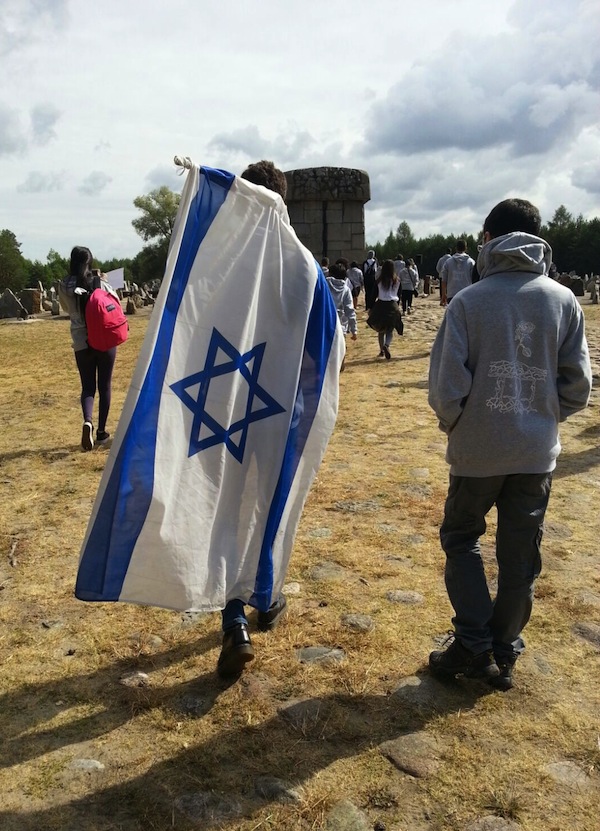
This past spring, I took part in the March of the Living 2015 program – a two-week trip to Poland and Israel, where people from 45 different countries are brought together to learn about the Holocaust and the current state of Judaism in Israel.

The trip was the most emotional and heartbreaking two weeks of my life. I never could have anticipated the kind of life-changing journey I was about to embark on.

photo - Participants in March of the Living stand together in front of the ashes of those murdered in the concentration camp, Majdanek
Participants in March of the Living stand together in front of the ashes of those murdered in the concentration camp, Majdanek. (photo from Talya Katzen)

The week in Poland was extremely draining, and I came to many realizations. I felt so strongly about things I simply cannot put into words. Our pre-trip informational sessions came nowhere near to preparing me for what I was going to witness. How can anything prepare you for walking through a gas chamber where, just 70 years ago, thousands of innocent lives were erased each day? Pictures may speak louder than words, but physically being there is like a blood-curdling scream right in your face.

Each day’s event was a new brick dropped on my shoulders and, as the bricks piled up, I came to appreciate more and more the wonderful life I have been blessed with. The weather in Poland was cold and windy, spitting rain into our eyes as we walked through extermination camps, cemeteries and ghettos in our warm down coats and hats. Our complaints about the cold were no match to the below-zero temperatures that those starving prisoners in the thousands of concentration camps across Europe had to face day in and day out.

The tour of Majdanek concentration camp was truly an experience that will be with me for the rest of my life. The defining moment of the journey was visiting the monument that holds the ashes of the victims of the camp. A recording of the prisoners, just liberated from Bergen-Belsen, singing “Hatikvah” began to play as we all stood hand-in-hand. My mind was blank and completely full at the same time. The mutual sorrow all we marchers felt was overpowering. A connection to one another that I doubt will ever be broken.

photo - Left to right, Talya Katzen, Hayley Kardash, Shauna Miller and Alyssa Diamond participate in Yom Ha’atzmaut celebrations in Israel
Left to right, Talya Katzen, Hayley Kardash, Shauna Miller and Alyssa Diamond participate in Yom Ha’atzmaut celebrations in Israel. (photo from Talya Katzen)

This feeling of grief was flipped on its back upon our arrival in the beautiful state of Israel, a country that is now home to Jews who have survived some of the worst events in history – and prospered. I was fortunate to be there during the festival that celebrates Israeli Independence Day. Israelis gather together to celebrate community and overcoming many hardships. Having just experienced the height of grief in Poland, I could not have been more grateful for Israel, and the promise it holds for the Jewish people. Of course, our celebrations of freedom were constantly overshadowed by the memory of those who perished in Europe, who never had the chance to visit our homeland. It made me realize how absolutely crucial it is for young Jewish people of the world to experience this journey so that we may never forget.

March of the Living taught me that I have family all over the world who are just as passionate about keeping Judaism alive as I am, and that it is completely up to us to carry the torch from generation to generation, to keep the flame of the Jewish people burning forever. I am a third-generation survivor and it is my duty to be a witness, to live out the lives of those who never had the chance to see their 10th or 18th or 85th birthday simply because of who they were. Hitler and the Nazis may have been successful in murdering millions of people who didn’t fit their blueprint of the ideal race, but they failed miserably in taking away our Jewish identity. I am a person, I am a witness, I am a Jew, and no one can take that away from me.

Talya Katzen originally wrote this article as a Lord Byng Secondary school assignment. Jewish Federation of Greater Vancouver offsets the cost of March of the Living by $2,000 for each local participant. The funds for this are generated through the Federation annual campaign, and are distributed to participants through the Israel and Overseas Connections fund. Jewish Federation also provides support through staff resources, program leader training and participant education.


Format ImagePosted on July 24, 2015July 22, 2015Author Talya KatzenCategories Op-EdTags Holocaust, Israel, Majdanek, March of the Living, Yom Ha'atzmaut

What’s next with Iran deal

Given the copious amount that has been written on the Iran deal, we publish this summary of key points by American Jewish Congress to help readers wade through the various articles and blogs, and form their own opinion about the deal:

The historic deal with Iran intended to curb its nuclear weapons program will receive a full airing in the U.S. Congress in the next several weeks. The following is a short summary of key points to keep in mind as the debate unfolds:

  1. Several steps must be taken before the Iran deal goes into effect. Congress has 60 days to review the deal’s terms, hold hearings, conduct a debate and take a vote in both the House and Senate.
  2. If Congress passes a resolution of disapproval and sends it to President Barack Obama for his signature, he has 12 days to veto the resolution. The president has said already that he would take such action, if necessary.
  3. Many members of both parties in Congress have expressed deep skepticism. Israel is lobbying hard against it; Gulf states, led by Saudi Arabia, also oppose the deal, but are conducting their lobbying efforts more quietly.
  4. The deal also must be brought to the United Nations Security Council. It is unclear at this time if that will happen before or after a congressional vote.
  5. No sanctions will be lifted before the end of this year. The International Atomic Energy Agency (IAEA) first must provide, by Dec. 15, a baseline assessment of Iran’s possible military activities relative to its past nuclear program.
  6. The IAEA will be given “when necessary, where necessary” access to monitor Iranian compliance, with a mechanism that gives Iran up to 24 days before permitting inspectors to visit designated sites.
  7. This “managed access” falls well short of the president’s earlier assertion that the IAEA must be allowed to have intrusive access on an “anytime, anywhere” basis.
  8. The current UN arms embargo will remain in place for five years and UN ballistic missile sanctions will stay in place for eight years, though both time periods can be reduced if Iran is judged to be acting in full compliance with the deal.
  9. The lifting of the arms embargo is outside the parameters set by President Obama, who repeatedly said during negotiations that only issues related to the nuclear file were legitimate subjects for compromise.
  10. Economic sanctions against Iran will be removed in stages, with some frozen assets scheduled to be released when the deal moves to implementation by the end of the year, in which case Iran is expected to benefit from $100 billion to $150 billion in cash.
  11. Many observers are concerned that Iran, whose current annual defence budget is approximately $30 billion, will use the influx of cash to support proxies such as Hezbollah in Lebanon and Syria, Hamas in the Gaza Strip and Houthi rebels in Yemen, and to foment instability throughout the region with greater funding to the Iranian Revolutionary Guard and the al-Quds force’s efforts in Iraq and Syria. This is on top of billions in expected oil revenues and the significant economic bump Iran is expected to enjoy through increased commerce with the international community.
  12. Sanctions can be restored should Iran violate the deal, though most observers are highly dubious that so-called “snapback” provisions will be effective.
  13. The deal will be terminated 10 years from the date of its adoption as long as Iran does not violate UN sanctions, though there are elements of it that have a 15-year life expectancy.
Posted on July 24, 2015July 22, 2015Author American Jewish CongressCategories Op-EdTags Barack Obama, IAEA, International Atomic Energy Agency, Iran, nuclear deal, UN, United Nations
Ethical will still holds true

Ethical will still holds true

Family, Israel remain at centre of Dvora Waysman’s ethical will. (photo by Ashernet, taken on Jerusalem Day 2015)

Very often wills – including ethical wills – are updated as circumstances change. I wrote my ethical will in the early 1970s, when I was still dewy-eyed about aliya and Israel was somehow more innocent, despite the wars she had endured and her ongoing fight for survival.

It was a less materialistic society back then. If you had one car per family, you were well-off; TVs, videos and microwave ovens were a rarity. In fact, not everyone had a telephone and, thank heavens, the ghastly, intrusive cellphone had not been invented.

Our four children (two sons and two daughters) were still kids. They now have all done their army service, graduated university, married and given us 18 wonderful Sabra grandchildren and 10 great-grandchildren, all still living in Israel.

While Israeli society has changed over the past four decades, many of the things I loved have endured. I still find it a great privilege to live in the beautiful city of Jerusalem – it still inspires my poems and my dreams. I still feel part of a family – even though it’s often a squabbling, divisive one. I’ve never considered leaving – to do so would be for me an amputation.

So, with these modifications, I present again my ethical will as it was first published by the World Zionist Press Service, who distributed thousands of copies and reprinted it in two anthologies, Ethical Wills and So That Your Values Live On, both edited by Jack Riemer and Nathaniel Stampfer. I have not changed it, because I can still become misty-eyed at my love affair with Israel. Perhaps today, like a marriage, the passion has somewhat abated, familiarity may have reduced the miraculous to the humdrum but, nevertheless, I am still in love!

My ethical will

As I write this, I am sitting on my Jerusalem balcony, looking through a tracery of pine trees at the view along Rehov Ruppin. I can see the Knesset, the Israel Museum and the Shrine of the Book – that architectural marvel that houses the Dead Sea Scrolls.

I am at an age where I should write a will, but the disposition of my material possessions would take just a few lines. They do not amount to much. Had we stayed in Australia, where you – my four children – were born, they would be much more. I hope you won’t blame me for this.

For now, you are Israelis, and I have different things to leave you. I hope you will understand that they are more valuable than money in the bank, stocks and bonds, and plots of land, for no one can ever take them away from you.

I am leaving you the fragrance of a Jerusalem morning – unforgettable perfume of thyme, sage and rosemary that wafts down from the Judean hills. The heartbreaking sunsets that give way to Jerusalem at night – splashes of gold on black velvet darkness. The feel of Jerusalem stone, ancient and mellow, in the buildings that surround you. The piquant taste of hummus, tehina, falafel – foods we never knew about before we came here to live.

I am leaving you an extended family – the whole house of Israel. They are your people. They will celebrate with you in joy, grieve with you in sorrow. You will argue with them, criticize them and sometimes reject them (that’s the way it is with families). But, underneath, you will be proud of them and love them. More important, when you need them, they will be there!

I am leaving you the faith of your forefathers. Here, no one will ever laugh at your beliefs, call you “Jew” as an insult. You, my sons, can wear kippot and tzitzit if you so wish; you, my daughters, can modestly cover your hair after marriage if that is what you decide. No one will ridicule you. You can be as religious or as secular as you wish, knowing it is based on your own convictions, and not because of what [non-Jews] might say. You have your heritage – written with the blood of your people through countless generations. Guard it well and cherish it – it is priceless!

I am leaving you pride. Hold your head high. This is your country, your birthright. Try to do your share to enhance its image. It may call for sacrifice, but it will be worth it. Your children, their children, and all who come after, will thank you for it.

I am leaving you memories. Some are sad – the early struggles to adapt to a new culture, a new language. But, remember, too, the triumphs – the feeling of achievement when you were accepted, when “they” became “us.” That is worth more than silver trophies and gold medals. You did it alone – you “made” it.

And so, my children, I have only one last bequest. I leave you my love and my blessing. I hope you will never again need to say, “Next year in Jerusalem.” You are already here – how rich you are!

Dvora Waysman is the author of 13 books. She can be contacted at [email protected] or through her blog dvorawaysman.com.

Format ImagePosted on July 17, 2015July 15, 2015Author Dvora WaysmanCategories Op-EdTags ethical will, Israel

Summer, sun … melanoma

A public service video produced a few years ago and making the rounds again this year hits me close to home. Produced by the David Cornfield Melanoma Fund and called Dear 16-Year-Old Me, the video warns of the dangers of melanoma and the importance of sun smarts and mole checks.

When I was 21, I had just recently returned from a year living in Israel, where I attended Hebrew University. One morning in Vancouver as summer was winding down, I was flipping through the Vancouver Sun at my parents’ kitchen table and paused on a full-page feature about melanoma.

I glanced over at my right forearm. I had long had a mole there, but now I noticed the mole contained one of the warning signs of melanoma: rather than being a uniform brown, it had a darker spot on a medium-brown background. Overcoming my fear of needles and scalpels, I insisted that my family doctor remove the mole.

A week later, back in Montreal for my final year of university at McGill, I received a call from my parents that I should make an appointment with a plastic surgeon as soon as possible. The biopsy results had come back and I indeed had malignant melanoma, thankfully only to a depth of 0.4 millimetres – so far. I was more scared than I’d ever been. One of my best friends scooped me up that evening for a distracting sojourn on St. Laurent Boulevard.

A few days later, I left my flat in the McGill Ghetto and went to the Jewish General Hospital. My surgeon, the late Dr. Jack Cohen, was a much-admired member of the medical profession in Montreal. He was also an excellent amateur whistler, and I asked him to whistle through the surgery to help calm my nerves. He warmly complied before leaving me with a formidable scar: a small price to pay for saving my life.

That night, swaddled and bandaged, I walked over to the McGill Arts Building to hear Canadian author Michael Ondaatje read from his latest novel. As the evening closed, the painkillers began to wear off.

My friends and family know that because of my melanoma history, I am much less fancy-free when it comes to summer fun than many of my fellow Canadians who are desperate for sunlight after our country’s seemingly endless winters.

I take care to wear hats and sunscreen (I seek out favorite brands and stick to them). I constantly seek out shade. I don’t sunbathe. I don’t turn my face to the sun and quip about needing vitamin D; instead, I take oral supplements.

As for sun-smart clothes, this season’s “maxi dress” fashion trend has helped a little. And, with the recent development of vitiligo on parts of my body, my vanity helps me want to avoid the sun for the cosmetic goal of keeping an even skin tone, as well.

When I’m feeling sarcastic, I joke that my Zionism – given the first of three years I spent in Israel – gave me melanoma. Sometimes, I look wistfully at the last photograph of my pre-surgery arm, my near-deadly mole visible as I sport a large backpack, smiling for the camera while waiting for the Egged bus from Jerusalem to take me to kibbutz Urim, one of my favorite weekend hangouts.

When I’m feeling ironic, I think about how the religious laws of modesty that I often privately disdain are actually very prudent for protecting the body from the dangers of the sun’s rays. It is for the reason of modest dress, researchers have inferred, that Palestinian citizens of Israel develop melanoma at lower rates than that of Jewish Israelis.

When I’m feeling especially cautious – which is always, when summer comes – I’m careful to apply sunscreen to my kids each morning. No one said that the sticky, daily ritual was fun. But it’s important.

I try not to saddle my kids with more fear than they deserve to have in their innocent years. Life is scary, and we need to protect ourselves where we can.

Mira Sucharov is an associate professor of political science at Carleton University. She blogs at Haaretz and the Jewish Daily Forward. This article was originally published in the Canadian Jewish News.

Posted on July 10, 2015July 8, 2015Author Mira SucharovCategories Op-EdTags cancer, melanoma

Posts pagination

Previous page Page 1 … Page 49 Page 50 Page 51 … Page 56 Next page
Proudly powered by WordPress