Skip to content
  • Home
  • Subscribe / donate
  • Events calendar
  • Business Directory
  • FAQ
  • News
    • Local
    • National
    • Israel
    • World
    • עניין בחדשות
      A roundup of news in Canada and further afield, in Hebrew.
  • Opinion
    • From the JI
    • Op-Ed
  • Arts & Culture
    • Performing Arts
    • Music
    • Books
    • Visual Arts
    • TV & Film
  • Life
    • Celebrating the Holidays
    • Travel
    • The Daily Snooze
      Cartoons by Jacob Samuel
    • Mystery Photo
      Help the JI and JMABC fill in the gaps in our archives.
  • Community Links
    • Organizations, Etc.
    • Other News Sources & Blogs
  • JI Chai Celebration
  • JI@88! video

Recent Posts

  • Or Shalom reopens its doors
  • JFS from past to future
  • Need holistic approach
  • Sharing stories, advice
  • Journalist shares fears
  • Skills to live together
  • Road to independence
  • Cutting grass with scissors
  • Zionism as a solution
  • Deceit, desire & the divine
  • Reclaiming sacredness
  • Creative project ideas
  • Summer squares and cobbler
  • Thou shalt … summer commandments
  • Legal help for students
  • Revisiting myth of Lilith
  • Wrong person rebuked
  • Canada’s mixed messages
  • Questions for museum
  • Symposium on antizionism
  • Making soccer political
  • CJPAC lauds Pulver’s impact
  • City recognizes Vrba’s legacy  
  • Organ donation saves lives
  • Theodore’s March premiere
  • A healing Shabbaton
  • Supplying healthy food
  • A chime of metal tags
  • Yellowknife seder a first
  • Ishai energizes, unifies
  • A Lag b’Omer to remember
  • Expanding the healing
  • Hannah Senesh – a unique hero
  • Community milestones … May 2026
  • Деньги до зарплаты на карту Займ до зп онлайн за 5 минут 2026
  • Микрокредит онлайн в Казахстане Микрозайм в Акшамат

Archives

Follow @JewishIndie
image - The CJN - Visit Us Banner - 300x600 - 101625

Category: World

Champions of Jewish values

Champions of Jewish values

Left to right, Dr. Mehmet Oz, Rabbi Shmuley Boteach, Sean Spicer and Ron DeSantis, at the Champions of Jewish Values International Awards Gala in New York on March 8. (photo by Dave Gordon)

What do an American soldier, a former athlete and a former U.S. press secretary have in common? According to the World Values Network (WVN), they are all – in their own way – defenders of the Jewish people and Israel.

The Champions of Jewish Values International Awards Gala took place on March 8 in New York City at the Plaza Hotel. The event was led by well-known rabbi and author of 32 books Shmuley Boteach, director of WVN.

Several awards were given out, honouring individuals who, according to the network, have shown exemplary actions to further the causes of human rights and the defence of Israel in the public forum.

Former Olympian and reality star Caitlyn Jenner was given the Champion of Israel and Human Rights Award.

“I’ve been thinking about the Jewish community, and how it has affected me several times in my life,” she said. Her father, William Jenner, was part of the unit that liberated Buchenwald concentration camp. Later in life, he showed Caitlyn the pictures that still haunt her to this day.

Jenner broke the decathlon Olympic record in Montreal in 1976. In the 1972 Olympics in Munich, a then-22-year-old Jenner witnessed the terror activity from an adjacent dormitory.

About Israel, she said the Jewish state’s example “should be followed, as a nation that has succeeded in dissolving many of the prejudices against the trans and gay communities. It is now celebrated as having the best city in the world for gays – Tel Aviv.”

She added that Israel is one of only 19 countries where members of the trans community can serve in the army.

In an overall message of inspiration, she said, “Our communities have no borders and our love is without borders. Every person in the world deserves to receive dignity.”

The Elie Wiesel Award was posthumously given to Yonatan Netanyahu and Taylor Force. Netanyahu was killed in the line of duty in the 1976 Entebbe rescue, and Force was a U.S. soldier killed by a Palestinian terrorist in Tel Aviv on March 8, 2016, exactly two years prior to the gala event.

During his life, Wiesel, among other things, wrote the book Night, in which he narrates his own experience as a young boy in Auschwitz death camp, as well as more than 35 other publications dedicated to the subject of the Holocaust.

In introducing the award, American television show host Dr. Mehmet Oz noted, “Elie Wiesel saw a spark of dignity in everyone that he met.”

In presenting the award, Elisha Wiesel (Elie’s son), spoke about how the Force family is advocating for the cessation of American aid to the Palestinian Authority until the PA stops financially rewarding terrorist acts. It is through the Forces’ efforts that the Taylor Force Law has been passed by Congress and now only needs a signature by President Donald Trump to become law.

Accepting the awards were Yonatan’s brother, Israeli Prime Minister Binyamin Netanyahu, via a previously recorded video, and Taylor’s father, Stuart, mother, Robbi, and sister, Kristen.

“Elie Wiesel showed such devotion to our people and showed that we control our destiny,” said Netanyahu in his remarks. “Elie spoke to the soul of our consciences. He was a great warrior on the battlefield of conscience, and can inspire many of us on our own quests for justice.”

As for other honours that were given out, Florida congressman Ron DeSantis was given the Falic Family Defender of Israel Award. In his acceptance, DeSantis said he led a trip to Israel last March to look for appropriate sites for the new U.S. embassy in Jerusalem. The embassy is slated to open May 14, coinciding with the 70th birthday of Israel. DeSantis ended his speech by saying, “At least in terms of the embassy we can say, ‘this year in Jerusalem.”’

Sean Spicer, former White House press secretary, was given the Friend of Israel Award. Of Trump, he said, in regard to how the president would treat Israel, “We knew he was going to be a real friend who was going to get results.”

Dave Gordon is a Toronto-based freelance writer whose work has appeared in more than 100 publications around the world.

Format ImagePosted on March 23, 2018March 23, 2018Author Dave GordonCategories WorldTags Caitlyn Jenner, Israel, Judaism, Mehmet Oz, Ron DeSantis, Sean Spicer, Shmuley Boteach, Taylor Force, Yonatan Netanyahu
Gerrer Rebbe’s “tent”

Gerrer Rebbe’s “tent”

Gerrer Chassidim consider the burial place of Rebbe Avraham Mordechai Alter and his son, Rabbi Pinchas Menachem Alter, a holy site in Jerusalem. (photo by Gil Zohar)

Among the many events this spring marking 70 years of Israel’s independence is the yahrzeit of Rebbe Avraham Mordechai Alter, known as the Imrei Emes, who served as the fourth admor (rabbinic sage) of the Gerrer Chassidim from 1905 until his death in Jerusalem on June 3, 1948, during Shavuot.

Since the capital of the nascent Jewish state was under siege during the War of Independence, the rebbe’s disciples were unable to bury their sage in Mount of Olives Cemetery, where the pious have been laid to rest since biblical times. Unwilling to bury their master in the city’s improvised graveyard in the abandoned Palestinian village of Sheikh Bader (today Givat Ram), they instead turned his shtibl (small house of prayer) on Yehosef Shwartz Street near the Machane Yehuda food market into a mausoleum.

The Sfas Emes Yeshiva, which Alter founded in 1925 during a visit to Palestine, and where he lived from 1940 – after escaping Nazi-occupied Poland when his followers paid an enormous bribe to gain his release – has today evolved into one of the most unusual shrines in Jerusalem. His son, Rabbi Pinchas Menachem Alter, the seventh Gerrer Rebbe, also resided in the yeshivah complex and was buried alongside his father in 1996. On the yahrzeits of the two rebbes, thousands of Gerrer Chassidim – who distinguish themselves from other Chassidic groups by placing their peyot (sidelocks) into their skullcaps and tucking their pants into their socks, called hoyzn-zokn – flock to the pilgrimage site.

photo - A garden lies to the side of the ohel, and the façade of the adjoining building recalls the original Ger yeshivah in Góra Kalwaria, Poland
A garden lies to the side of the ohel, and the façade of the adjoining building recalls the original Ger yeshivah in Góra Kalwaria, Poland. (photo by Gil Zohar)

The decision to entomb Pinchas Alter, known as the Pnei Menachem, beside his father sparked opposition from the Jerusalem municipality, but the funeral went ahead. A red-brick ohel (tent) was erected over their twin graves, turning the courtyard into a holy site for the Gerrer Chassidim, who constitute the largest such ultra-Orthodox group in the country, numbering more than 100,000 members, who are concentrated in Jerusalem, Bnei Brak and Ashdod.

The ohel includes separate men’s and women’s sections. A garden lies to the side of the ohel, and the façade of the adjoining building recalls the original Ger yeshivah in Góra Kalwaria, Poland – a small town on the Vistula River, 25 kilometres southeast of Warsaw. A partially open roof above the ohel permits ritual impurity from the dead to exit so that kohanim (Jews of the priestly caste) may visit the gravesite.

Toronto businessman and philanthropist Daniel Goldberg wants to build on the fame of Jerusalem’s Gerrer shrine to secure and restore the sect’s historic home in Góra Kalwaria. The name means Mount Calvary or Skull Hill in Polish, explained Goldberg, whose mother’s family came from the area. But the town, called Ger or Gur in Yiddish, was also called Nowa Jerozolima (New Jerusalem), reflecting its holiness for both Jews and Christians.

Goldberg, who together with other Canadian donors has supported the preservation of several historic synagogues in Hungary, views the restoration of Jewish landmarks in Góra Kalwaria as critical to combating antisemitism and acknowledging Poland’s complex role in the Holocaust.

“I am visiting Poland after Pesach and will be meeting with various people from our Jewish community there,” he said. “I have been in contact with the different leaderships, including in Gur. So many communities were wiped out during the war. It is vital that we support our history in such places.”

In 1802, Góra Kalwaria’s “de non tolerandis Judaeis” law prohibiting Jewish settlement was annulled, and Jews became the predominant ethnic group in the town, Goldberg noted. Between 1852 and 1939, the Jewish population tripled, from 1,161 (half of the town’s population) to around 3,600, as Góra Kalwaria became an important Chassidic centre.

When the Nazis invaded Poland in September 1939, they immediately targeted Góra Kalwaria’s Jews. The town’s ethnic German mayor Ewald Jauke banned Jewish residents from engaging in trade, crafts and pigeon breeding. Jews were also forbidden from listening to radio broadcasts. A group of 100 Jews was conscripted daily in front of the town hall for forced labour.

In the spring of 1940, some 400 Jews from Lodz, Pabianice, Aleksandrow, Sierpc, Wloclawek and Kalisz were deported to Góra Kalwaria. That June, a ghetto was established with 3,500 residents. The ghetto was liquidated Feb. 25-26, 1941. About 3,000 Jews were deported to the Warsaw Ghetto, and ultimately murdered in the summer of 1942 in the Treblinka death camp. Only 35 of Góra Kalwaria’s residents survived the war. The Jewish community was never reconstituted after liberation.

For Goldberg, the coming 70th yahrzeit of the Imrei Emes and the controversial amendment to Poland’s 1998 Act on the Institute of National Remembrance by the country’s ruling Law and Justice party, criminalizing the words “Polish Holocaust,” offer an opportunity to celebrate Jews’ deep roots in the country.

Goldberg wants to preserve the physical remains of Góra Kalwaria’s Jewish community. These include the 1903 synagogue building at ulica Pijarskiejj, now used as a shop. Across the street is a metal gate at the yard that marks the home and house of prayer of Rabbi Yitzhak Meir Alter (1798-1866), the founder of the Gerrer dynasty, known as the Chiddushei HaRim, after his primary rabbinic tome by that title. Above the entrance, one can still see the Magen David rosette window depicted in the Gerrer Jerusalem mausoleum.

“I am continuing my efforts [in Góra Kalwaria and elsewhere] despite the discomfort it always causes politically with the local municipalities. No town or city likes to admit to antisemitism,” said Goldberg.

Gil Zohar is a journalist based in Jerusalem.

Format ImagePosted on March 23, 2018March 23, 2018Author Gil ZoharCategories WorldTags Canada, Daniel Goldberg, Gerrer Chassidim, Góra Kalwaria, history, Imrei Emes, Israel, Pnei Menachem, Poland
Winnipeggers reach to Israel

Winnipeggers reach to Israel

Samara Carroll, second from the left, with Dawit Demoz, right, and members of his host family – Sunita and her daughter Persia. (photo from Samara Carroll)

Soon after Samara Carroll returned from a yearlong program in Israel, she took action to help African asylum seekers in Israel come to Canada.

Carroll grew up in Winnipeg, went to Talmud Torah and then to Gray Academy. She was involved in many aspects of the Jewish community growing up, including with B’nai B’rith Youth Organization, leading trips to Israel, and attending Camp Massad for 17 years (for two of which she was the camp director).

In 2012, Carroll was accepted to be the first Canadian participant of the New Israel Fund Social Justice Fellowship. “This fellowship gives you the opportunity to choose an Israeli nonprofit and work there for a year,” Carroll told the Independent.

“I chose ASSAF – Aid Organization for Asylum Seekers and Refugees – located in south Tel Aviv. I worked as a community organizer, activist and counselor, supporting families who had fled, mostly from Eritrea and Sudan, and were dealing with the trauma related to their past experiences and the ongoing challenges of being in Israeli society.”

During her time at ASSAF, Carroll heard hundreds of gut-wrenching stories, but also learned many things from the asylum seekers with whom she worked.

“The Israeli government does not have a proper process to assess whether or not someone is an asylum seeker,” said Carroll. “So, instead of creating a system, they have created policies that make life extremely difficult for asylum seekers…. They do not have basic access to healthcare, proper housing, employment or education. And, they face significant racism, directly from the Israeli government. They have been referred to as a ‘cancer.’

“The Netanyahu government claims that the asylum seekers have come to Israel for employment opportunities, but you only have to hear one story from an asylum seeker about their experience facing genocide and dictatorship in their country of origin – leaving behind everything they knew, being smuggled, human trafficked and tortured by smugglers in Sinai and then arriving in a foreign country – to understand that they are fleeing desperate situations.

“When you ask many asylum seekers where they’d want to be, they say ‘back home,’ but they cannot go back home,” Carroll said, summing up her belief using a quote from writer Warsan Shire: “You have to understand no one puts their children in a boat unless the water is safer than the land.”

After her year in Israel, Carroll decided to pursue a master of social work degree at the University of Toronto. About six months after she had arrived in Toronto, she was approached by Dawit Demoz, an Eritrean asylum-seeking man who was an activist in Israel, about giving asylum seekers more rights in Israel.

“He approached me, asking if I would sponsor him to Canada,” explained Carroll. “He felt that, although he loved the community he had established in Israel – his Israeli friends, the food and the culture – the policies of the Israeli government were just getting worse and he knew he had to try to leave the country if he ever wanted freedom.

“I agreed to sponsor him and did so through a SAH (Sponsorship Agreement Holder). The sponsorship process is detailed, but is very manageable and I believe more people would be open to sponsoring asylum seekers if they understood this.”

photo - Samara Carroll and Dawit Demoz
Samara Carroll and Dawit Demoz. (photo from Samara Carroll)

Demoz arrived in Toronto in March 2016. “He says this is the first time in his life he has felt free,” said Carroll. “He studies psychology at York University, works as an interpreter for a refugee organization, led canoe trips through Algonquin Park as a counselor last summer, and worked as a counselor at the Heart to Heart Program through Camp Shomria. He also plays soccer on a team, hosts Eritrean dinners for his many Jewish friends, and enjoys life.

“Five of our friends have submitted a Group of Five sponsorship to bring his mother [who he hasn’t seen in 10 years] to join him in Toronto,” said Carroll.

Following her example, Carroll’s parents, Sharon Chisvin and Marshall Carroll, have sponsored an Eritrean couple with the support of a local church-based sponsorship agreement agency, Jewish Child and Family Service Winnipeg and donations from friends, family and community members. The couple – Tsege and Kidane – arrived in Winnipeg in May 2016.

“They are generous, wonderful people and have created a strong community for themselves in Winnipeg, and they also support other newly arrived asylum seekers,” said Carroll. “While it is clear that you can positively shape someone’s life who has never experienced freedom before, you do not know how much they will positively impact your life.”

According to Carroll, the situation for asylum seekers in Israel has worsened since 2016. Prime Minister Binyamin Netanyahu has signed an order to deport asylum seekers from Israel to third-party countries, such as Uganda and Rwanda, she said. “This is a human rights violation, as we do not know what is waiting for them in these new countries – countries they have no connection to. Men who have already been deported there have been given no status or rights.”

For her part, Chisvin has started working with Canadians Helping Asylum Seekers in Israel (CHAI), which she described as “a grassroots group formed in Toronto in response to Netanyahu’s deportation order. It is primarily made up of Toronto Jewish activists who feel deeply that Israel’s intent to deport 38,000 African asylum seekers to third countries – and to certain suffering – is a strict violation of Jewish values, history and memory. This sentiment has been shared by 20,000 Israelis who protested against the deportation in Tel Aviv [recently], myriad Israeli rabbis, teachers, psychiatrists, El Al pilots and authors, as well as Irwin Cotler, Alan Dershowitz, the ADL [Anti-Defamation League], HIAS [Hebrew Immigrant Aid Society] and many other individuals and agencies.”

In Toronto, there is growing group of support for CHAI, and Chisvin is working to create a similar group in Winnipeg and beyond. Its goals, she explained, include raising awareness within the Jewish community about the deportation; encouraging people to ask the Israeli government to rescind its deportation order and implement a humane strategy for refugees and asylum seekers; appealing to the Canadian government to pressure the Israeli government to rescind the deportation order and work together on a solution; and encouraging people to commit to private refugee sponsorships.

“I have been assisted in my efforts, helped by a handful of people here in Winnipeg, who are helping me raise awareness in the community about the issue – urging others to speak up and fundraise for the refugees I have, and am in the process of sponsoring,” said Chisvin.

Further to that, Chisvin is in the early stages of organizing a community event to raise awareness about the issue and to explain how and why Canadian Jews should be moved by the plight of African asylum seekers who are at risk of being deported or indefinitely detained, and how and why they should commit to help sponsor some of them to Canada as refugees.

“The best solution, of course, is for Israel to rescind its deportation order, properly process the refugee claims of the asylum seekers, grant them refugee status, and all the rights inherent in that status,” said Chisvin. “But, if Israel doesn’t rescind the order, it is incumbent on Canadian Jews to lobby their government to increase the number of African asylum seekers it brings to Canada and to commit to privately sponsor African asylum seekers to Canada.”

There are many other ways to become involved, including supporting sponsors with money to help settle asylum seekers, provide housing and employment opportunities – as well as just being open and generous with newcomers. For more information, email [email protected] or visit facebook.com/canadianshelpingasylumseekersinisrael or letushelpil.org/canada.html.

“Israel needs to deal with the asylum seeker situation in their country and not force out people who have already experienced unspeakable trauma to a third country that will again violate their human rights,” said Carroll. “Our message and the message of many Jewish communities now is, ‘Do not deport. Let us help.’”

Rebeca Kuropatwa is a Winnipeg freelance writer.

Format ImagePosted on March 16, 2018March 15, 2018Author Rebeca KuropatwaCategories WorldTags asylum seekers, Canada, human rights, immigration, Israel, Samara Carroll, Sharon Chisvin
A sapling grows in Jerusalem

A sapling grows in Jerusalem

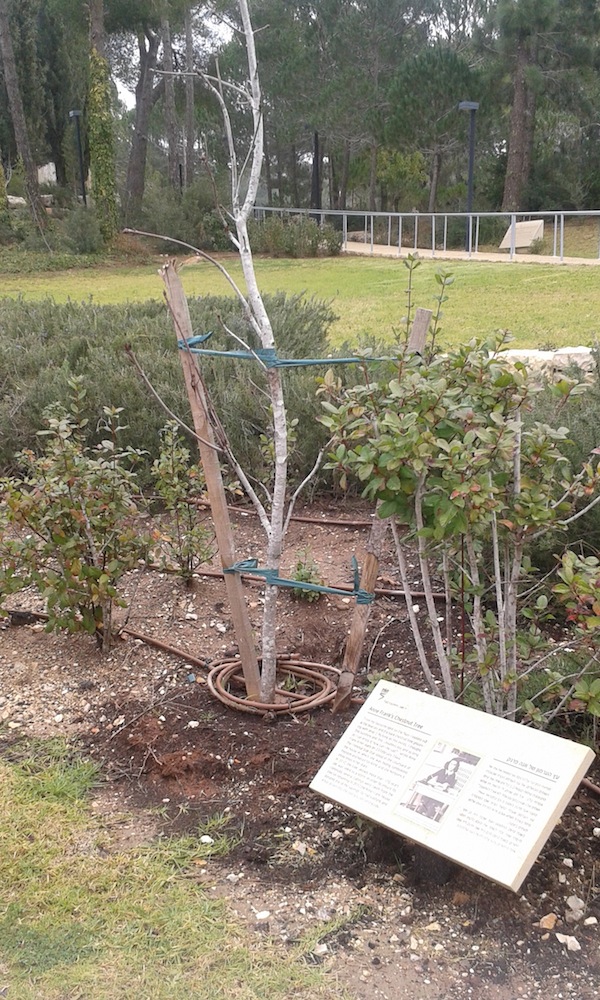
A sapling seeded by Anne Frank’s horse-chestnut tree in Amsterdam is growing at Yad Vashem, near its International Institute for Holocaust Research. (photo by Gil Zohar)

treJerusalem and its environs have many historic trees, including the grove of gnarled olives in the Garden of Gethsemane, under which Jesus may have sheltered two millennia ago; the looming cypress planted by Godefroy de Bouillon, today the site of Hôpital Saint Louis, but where French knights camped in 1099 during the first Crusade; and the 700-year-old Kermes Oak that stands alone in Gush Etzion, south of the city. And now, there is another – a sapling seeded by Anne Frank’s white horse-chestnut tree in Amsterdam, which is growing at Yad Vashem, near its International Institute for Holocaust Research.

Initially, Yad Vashem was concerned that the chestnut tree would not acclimate to Jerusalem’s long, dry summers, but it is doing well.

For more than two years until her arrest on Aug. 4, 1944, Frank (1929-1945) hid in her family’s secret annex at Prinsengracht 263-265. Through a window in the attic that was not blacked out, she admired the chestnut tree, planted around 1850, that stood in the courtyard of a neighbouring residential block, at 188 Keizersgracht just north of the landmark Westerkerk. The tree was her only connection to the outside world and the changing seasons.

Frank wrote about the tree three times in her diary. On the last occasion, on May 13, 1944, she observed: “Our chestnut tree is in full bloom. It’s covered with leaves and is even more beautiful than last year.”

A month earlier, on April 18, 1944, she wrote: “April is glorious, not too hot and not too cold, with occasional light showers. Our chestnut tree is in leaf, and here and there you can already see a few small blossoms.”

The first reference was on Feb. 23, 1944, when Frank noted: “The two of us [Peter van Pels and Frank] looked out at the blue sky, the bare chestnut tree glistening with dew, the seagulls and other birds glinting with silver as they swooped through the air, and we were so moved and entranced that we couldn’t speak.”

For decades, the storied tree was cared for by Amsterdam’s Pius Floris Tree Care at the behest of the city’s Central Borough Council. In 2005, it was determined that the tree was ailing, and valiant efforts were made to save it.

In the meantime, Anne Frank House asked permission of the tree’s owner to gather and germinate chestnuts. The saplings – grown and cared for by Bonte Hoek Nurseries – were donated to schools around the world named after Anne Frank, and other organizations. In 2009, 150 saplings of the tree were donated to Amsterdamse Bos woodland park.

A sapling was recently planted in Vienna’s 2nd district – a neigbourhood that had many Jewish residents before the Anschluss in 1938. Another was planted in Ajaccio, Corsica, to honour the Righteous Among the Nations there. And 11 chestnut trees are growing in the United States, including one at Manhattan’s Liberty Park commemorating 9/11, thanks to the sapling project of the New York-based Anne Frank Centre for Mutual Respect.

As for the original tree, in 2008, the Support Anne Frank Tree Foundation placed iron struts around it to prop it up, hoping the tree would remain standing for further decades. But it was already too rotten. During a violent rainstorm on Aug. 23, 2010, the tree collapsed together with the girders supporting it, leaving a one-metre high stump.

On its website, the Dutch-based Support Anne Frank Tree Foundation responds to the question, was the battle to save the tree all for nothing?

“The answer is a resounding no!” they say. “The tree and the struggle to preserve it … has fulfilled an important task in an extraordinary manner: the reawakening of the world’s collective memory of the Holocaust and a call for tolerance and mutual respect. The seedlings planted all over the world will continue to spread the message, a grand and dignified final stage in the life of this tree. This would not have happened were it not for the battle for its preservation.”

Gil Zohar is a journalist based in Jerusalem.

Format ImagePosted on March 9, 2018March 7, 2018Author Gil ZoharCategories WorldTags Amsterdam, Anne Frank, continuity, history, Holocaust, Jerusalem, sapling
Business of building peace

Business of building peace

Barbara Stegemann’s 7 Virtues perfumes help farmers in war- or weather-torn countries rebuild. (photo from Barbara Stegemann)

Barbara Stegemann (née Rabinovitch) was born and raised in an Anglophone neighbourhood in Montreal. While her Catholic mother disallowed any practise of Judaism, Stegemann recalled having begged her zaida to take her to synagogue to meet the rabbi.

“My soul felt very Jewish,” Stegemann told the Independent. “As Ben Stiller says, ‘When I look in the mirror, I see a Jew.’ That’s how I feel. My 23andME report came back and said I am 47.7% Ashkenazi Jew – so, science even accepts it.

“Interestingly, this genetic DNA test does not tell you if you’re Christian, Catholic or Muslim, but your DNA tells you that you are Jewish. For me, that is how powerful the connection is to being Jewish. It’s undeniably in our DNA.”

After earning a degree in journalism in 2006, Stegemann moved to British Columbia and settled in Port Moody, where she started a boutique PR firm, providing community economic development and strategy to clients from the City of Coquitlam to Mitacs, which designs and delivers research and training programs.

Then, something happened that shook Stegemann to the core. Her best friend from university and mentor, Capt. Trevor Greene, took off his helmet in a village in Afghanistan during a discussion about the need for clean drinking water and healthcare for the residents. A man attacked Greene, taking an axe to his head.

“We didn’t think he would make it through the night,” said Stegemann. “I prayed harder that night than I have ever prayed in my life. He made it through the night and, together with his fiancée, Debbie, and family, we all went on a healing journey. Since then, he married Debbie and they now have two children, Grace and Noah.

“I was blessed that I had my own company, so I could visit him in the Vancouver General three times a week. I lived in Port Moody, so it was not far. And, in the hospital, I promised him I would take on his mission of peace while he healed. Then, I realized, as a female in this patriarchy, I didn’t have a way to touch peace.”

Stegemann knew that, if women could find a way to harness their power – their buying and voting power – they had a chance to end war and corruption, two roots of poverty and suffering. With this in mind, she wrote the book The 7 Virtues of a Philosopher Queen: A Woman’s Guide to Living & Leading in an Illogical World, which was published on International Women’s Day (March 8) in 2008. A bestseller, it will see its seventh edition this year.

“I took all of the stoic wisdom of Socrates and Aurelius, the great leaders who guided [Winston] Churchill and the leaders who had to guide us out of hell,” said Stegemann. “I realized that our mothers didn’t talk to us about Adam Smith, capitalism, Plato and the polis … and that, if we, as women, were to take our rightful places changing policy and leading to an end of the cycles of war and poverty … we needed to have that same wisdom men have been given for 2,400 years.

“I used to walk around as a child with my Bible story records and play them for anyone who’d listen. My favourite story was The Wisdom of Solomon. I became entranced by the virtues and how they could change your life through their daily practice – wonder instead of judgment (which gives you all the resources you need on this earth), balance, truth, courage, justice, wisdom and beauty.”

One day, while Stegemann was studying about Afghanistan, she read about Abdullah Arsala in Afghanistan and about how Arsala was growing legal rose and orange blossom crops to liberate the farmers from growing illegal poppy crops.

She learned that the same people who had attacked her friend, Greene, were knocking over Arsala’s distillery, which made his flowers into essential oils for use in perfumes.

“I decided, that is it! I am going,” said Stegemann. “I flew to Ottawa and met with CIDA (Canadian International Development Agency) and told them to help me find Abdullah. I bought what little orange blossom oil he had on my Visa and launched The 7 Virtues [perfumes] in 2010, on International Women’s Day.

“Two weeks later, we were on the front page of the Globe and Mail. And, eight weeks later, I was on Dragons’ Den, pitching to venture capitalists. By then, I’d moved back home to my province of Nova Scotia and became the first woman from Atlantic Canada to land a venture capital deal on the popular CBC show.”

Stegemann helps farmers transition into growing legal crops, and make twice as much profit as they did growing poppies. According to Stegemann, when a farmer in Afghanistan grows legal crops for her perfumes, “His daughters are safe from being taken by the Taliban opium traders if the poppy crop fails. There is less heroin that ends up on the streets, destroying lives. And, when a farmer grows legal crops, he is honouring his faith. It goes against Islamic law to grow the illegal poppy crop.”

By helping the farmers, Stegemann believes she is helping bring peace. “It may not be my faith, but the truest way to peace is to honour one another and our beliefs,” said Stegemann. “The Taliban are completely going against their faith, forcing their neighbours to grow the illegal poppy crop. So, we must help one another.

“Our legal essential oil purchases in Afghanistan began this peace journey by liberating farmers from the illegal poppy trade and all of the abuses they and their families endure at the hands of the Taliban.

“Then, countries rebuilding after war or strife began coming to us, asking us to purchase from their distilleries to further build peace in nations rebuilding. The next country was Haiti. We began sourcing their vetiver oil.”

Stegemann travels often to Haiti to volunteer. On a trip after Hurricane Matthew hit, she was devastated to learn of a boatload of aid being turned away from the south, where not a mango stick stood and people had no shelter, as a result of the hurricane. The local official had asked for a bribe so large that the aid workers on the ship could not pay it.

“Haiti is the 10th most corrupt country in the world,” said Stegemann. “We have to engage our world leaders to end the culture of corruption in Haiti, in Afghanistan, and other nations that can’t take care of their people because their leaders are corrupt and don’t pay their police fair wages.

“There are many steps that have to be taken, but sourcing from a nation, spending time there and getting to know the issues, allows us to not only purchase fair trade products that give people dignity and jobs … but I can then write articles and be a voice as a trained journalist and activist to push our government to expect more from these countries.”

Stegemann believes social enterprise is a key way to build peace. She also believes that these cycles of war and poverty will remain if we expect our military and government to do the heavy lifting. According to Stegemann, we need a cavalry of businesses to come and buy saffron, pomegranates, essential oils or any other ethically sourced product, and this will help build peace.

It wasn’t until Stegemann moderated a panel discussion on the Middle East at a German Marshall Fund of the United States-hosted forum in Halifax that she realized the potential. On the panel were then-deputy minister of defence for Israel Matan Vilna’i and the minister of housing for the Palestinian Authority Dr. Mohammad Shtayyeh – and everyone got along.

“I feel strongly that destruction takes no imagination, no creativity, no intelligence, and it is actually boring,” said Stegemann. “I am not going to give my energy to it. Now, rebuilding, that is exciting! My real job is to make building more exciting than destruction.

“I do this through perfume. I decided to make a perfume of harmony from the Middle East. I sourced sweetie grapefruit from the Sharon region of Israel, with the help of ambassador [Miriam] Ziv. And we tried to get oils from the Palestinian region but could not.

“When I learned of Israeli Ronny Edry’s ‘We Love you Iran’ campaign, I decided to put Israel and Iran together with lime and basil essential oils from the Shiraz region of Iran. In our classic collection at the Hudson’s Bay stores, it is called Middle East Peace. It’s our bestselling fragrance and sells out quite often.”

In their new contemporary collection, launching at Sephora this month, they have a fragrance with the same oils, named after the oils – Grapefruit Lime – and the story is on the packaging, as is information about the oils’ healing properties.

On Stegemann’s most recent volunteering trip to Haiti (after Hurricane Matthew), she learned of the Sephora Accelerate program for female founders in the beauty business. As fewer than four percent of beauty company chief executive officers are women, Sephora decided to mentor, empower and create a network for these women.

“I felt so alone before,” said Stegemann. “I never had other female social entrepreneurs to share knowledge and suppliers with, and to bounce ideas off of. I wanted the program so badly that, when I first met with my Sephora buyers, I asked about this program. They immediately connected me with the women in San Francisco who run the program. They wanted the trailer to our doc film, Perfume War (perfumewar.com), and said they loved it. So, I got in. I was mentored by the director of Sephora Canada, Will Chung. They gave me the confidence to stretch out of my comfort zone and hire a branding agency.”

Going with Sephora was a hard decision for Stegemann, as that meant she had to leave the small boutiques she had built. But she was determined to stick with her mission of helping as many farmers as she could, and going big was the only way to do that.

The 7 Virtues perfumes can be found at Sephora online (sephora.com) and in stores, including the Robson, Park Royal and Richmond stores in Metro Vancouver.

Rebeca Kuropatwa is a Winnipeg freelance writer.

Format ImagePosted on March 2, 2018March 1, 2018Author Rebeca KuropatwaCategories WorldTags Afghanistan, Barbara Stegemann, business, farming, Haiti, peace, perfume, Sephora, tikkun olam
Netanyahu warns Iran

Netanyahu warns Iran

Prime Minister Binyamin Netanyahu at the Munich Security Conference. (photo by Amos Ben Gershom IGPO via Ashernet)

Speaking at the Munich Security Conference, which took place Feb. 16-18, Israeli Prime Minister Binyamin Netanyahu holds a piece of an Iranian drone shot down over Israel last week. Netanyahu warned that Israel could strike the Islamic Republic. Looking directly at Iranian Foreign Minister Mohammad Javad Zarif, Netanyhau asked, “Mr. Zarif, do you recognize this? You should, it’s yours. You can also take back with you a message to the tyrants of Tehran – do not test Israel’s resolve!” The drone, which entered northern Israel from Syria near the Jordanian border, was shot down by an Israeli attack helicopter. In response to the drone incursion, the Israeli Air Force attacked the mobile command centre from which it was operated. During the operations, one of the Israeli jets was hit by a Syrian anti-aircraft missile and crashed; its pilot and navigator were able to parachute out of the plane and land safely in Israel.

Format GalleryPosted on February 23, 2018February 21, 2018Author Edgar AsherCategories WorldTags Iran, Israel, Munich, security
China-Israel trade ties

China-Israel trade ties

Rebecca Fannin, founder of Silicon Dragon, at the event in Tel Aviv on Jan. 29. (photo from silicondragonventures.com)

Perhaps unlikely partners – 6,000 kilometres away from each other – Israel and China are cooperating and collaborating on business and investment deals worth billions of dollars. But it’s a not-so-hidden secret that China has been falling in love with Israeli start-ups, entrepreneurs and high-tech in general. And the feeling’s mutual.

The phenomenon was discussed Jan. 29 at an event called Silicon Dragon Israel, held at WeWork Sarona in Tel Aviv. Silicon Dragon events have occurred around the world since 2010.

Forbes contributor and author Rebecca Fannin is founder of Silicon Dragon, which boasts a 30,000-strong network of executives, entrepreneurs, venture capitalists and angel investors. She recently noted in Forbes that “several mega-funded Chinese tech startups are poised to go public this year or next,” with a potential combined worth of a quarter-trillion dollars.

There are likely to be Israeli fingerprints in some of those, and other recent, deals, given how Royi Benyossef, developer relations manager of Samsung Next, explained, “They’re mesmerized by Israel and their technology-exporting capabilities…. The idea that it’s a ‘start-up nation’ leads the Chinese to believe this is a place they want to invest in.”

Benyossef was on the panel discussing how key Asian corporations are leveraging Israel tech knowhow. He was joined by the director of investments of Singtel Innov8, Gil Prashker.

In another panel, moderator Simon Weintraub of Yigal Arnon and Co. explained the best way to cooperate with investors, especially when dealing with cultural barriers. As Yahal Zilka, managing partner and co-founder of Magma Venture Partners, explained, “In one word, building trust…. That doesn’t happen in one day.”

By way of example, Zilka said the GPS mapping app Waze “failed twice, miserably” in China. “And it all had to do with trust, nothing else. It clearly is a different interaction, pace and activity.”

Avishai Silvershatz, managing partner, Infinity Group, added, “The short answer is, be careful. Nothing in your experience will give you the experience to enable you to understand it. You have to have local partners, and be careful with them as well – it takes … years to understand. You have to be smart. There’s a lot of money to be made, because there’s as much money to be made as lost.”

One jolt for which most investors were unprepared was a recent government intervention. Weintraub said that, in 2016, business interaction from China was at an all-time high, until the authorities there “cracked down on the outflow of currency.” He said, “It caused tremendous uncertainty for 2017 … but now they’ve eased some of those restrictions.”

Zilka noted that the bureaucracy in China is comprised of “very complex structures.”

“In the same way that [Donald] Trump says ‘America first,’ the Chinese are saying ‘China first,’” explained Silvershatz. “They want investments to go towards their own strategic interests and goals. This is the ‘party line.’ It’s government, then corporate … so long as the government has their way.”

This panel also included Ehud Levy of Canaan Partners Israel, Aaron Mankovski of Pitango Venture Capital and Nathan Low of Sunrise Israel Tech Capital.

Independent of the event, some academics weighed in on why the Israel-China business relationship works so well.

“It’s different in organizational culture,” Daniel Galily, a former lecturer at Beijing-Geely University, told the Jewish Independent. “The educational system in China places great emphasis on discipline and obedience to superiors, while the Israeli educational system and the Israeli army encourage students and soldiers to think about new ideas and to solve problems in situations of uncertainty. The Chinese understand that, and so they strive to integrate the Israeli creativity to their economy, and also strive to learn how to combine creativity in to their economy.”

Dave Gordon is a Toronto-based freelance writer whose work has appeared in more than 100 publications around the world.

Format ImagePosted on February 23, 2018February 21, 2018Author Dave GordonCategories WorldTags business, China, high-tech, Israel, Rebecca Fannin, Silicon Dragon
Grossman wins and nominations open for RBC Top 25 Canadian Immigrant Awards to Feb. 26

Grossman wins and nominations open for RBC Top 25 Canadian Immigrant Awards to Feb. 26

David Grossman at a peace rally in Tel Aviv, August 2014. (photo from Ashernet)

Israeli author David Grossman will be awarded the highest Israeli civilian honour, the Israel Prize, which is presented on Yom Ha’atzmaut (April 19) in Jerusalem.

Grossman is one of Israel’s most celebrated and prolific authors; his books have been translated into more than 35 languages.

Born in Jerusalem in 1954 and educated at the Hebrew University of Jerusalem, Grossman has always been connected to the Israeli peace movement. He and his wife lost one of their sons in 2006 during the Lebanese War – Uri, a tank commander, was killed by an anti-tank missile shortly before the ceasefire.

Speaking about Grossman following the announcement of the prize, Education Minister Naftali Bennett said, “David Grossman is one of the most exciting, profound and influential voices in Israeli literature. With deep wisdom, sensitivity to fellow human beings and a unique linguistic style, he has become an internationally renowned artist. We are honoured that he is one of our own.”

– Edgar Asher, Ashernet

 ***

Is there an inspiring newcomer in your life? Do they have a story that should be heard and celebrated? Canadian Immigrant and RBC are now calling on nominations for the 10th annual RBC Top 25 Canadian Immigrant Awards. This will be the fourth year there is an Entrepreneur Award and the second year for the Youth Award. New this year is the Settlement Agency Award, for agencies excelling in helping newcomers integrate and succeed in Canada.

A nominee can be anyone who has immigrated to Canada and has since contributed to the success and uplifting of this country and/or its people. Achievements can be professional or personal. Nominees must hold landed immigrant (permanent resident) or citizen status in Canada, and must reside here.

Nominations can be made at canadianimmigrant.ca/rbctop25 until Feb. 26, 11:59 p.m. EST. A list of 75 finalists will be announced in March, after which all Canadians can vote for their favourite nominees. The 25 winners will be announced in June.

Format ImagePosted on February 23, 2018February 21, 2018Author Ashernet & Canadian ImmigrantCategories WorldTags awards, Canadian Immigrant, RBC Top 25
Bride-to-be Markle’s got style

Bride-to-be Markle’s got style

Prince Harry with Meghan Markle wearing Tuxe’s Boss bodysuit. (photo from Beretta/Sims/REX/Shutterstock via Israel21c)

Since announcing her engagement to Prince Harry last November, all eyes have been on Meghan Markle’s style. Coats, shoes, dresses and other fashion items worn by the bride-to-be have sold out in minutes. It’s no surprise that after she wore a bodysuit by Israeli designer Tuxe for an evening out with her betrothed, the style is now backordered until May.

The couple, set to marry in May, went to London’s Goldsmiths’ Hall for the Endeavour Fund Awards, which recognize injured servicemen and women. Known for her dressed-down-meets-royal style, the former actress layered Tuxe’s silk Boss bodysuit underneath a tailored black Alexander McQueen suit. On her feet, she wore Manolo Blahnik pumps.

“We’ve been royally approved!” the brand posted on Instagram after Markle was photographed wearing the bodysuit. “We absolutely love Meghan for all she has done for women’s rights and are honoured to be worn by someone who encapsulates what we stand for as a brand. She uses her spotlight to be an inspiration and she definitely is to us!”

Tuxe founder Tamar Daniel was born in Jerusalem, raised in London and is a graduate of Shenkar College of Engineering and Design in Ramat Gan. She founded her Philadelphia-based bodywear line in 2015, focusing on transforming the bodysuit, once a 1990s staple, into a chic, modern garment.

Her collection includes a range of bodysuits and has become particularly popular with professionals and religious communities, Daniel told Vogue in an interview. Prices range from about $80 for a simple sleeveless bodysuit to $463 for a cashmere turtleneck version.

Tuxe may not be the first Israeli designer that Markle has had her eye on. In December, news broke that Israeli designer Inbal Dror had been approached by the royal family to provide a sketch of a potential dress for Markle’s upcoming wedding to Prince Harry.

* * *

photo - Selections from the 2017 Inbal Dror catalogue. The Royal family is rumoured to have approached Dror for a sketch of a potential wedding dress for Meghan Markle
Selections from the 2017 Inbal Dror catalogue. The Royal family is rumoured to have approached Dror for a sketch of a potential wedding dress for Meghan Markle. (photo from Inbal Dror via Israel21c)

On Dec. 18, 2017, Israel21c posted the story, “Is Meghan Markle going Israeli for her wedding dress?”:

It’s rumour, it’s conjecture, and it’s probably an awful lot of wishful thinking, too, but that’s not stopping Israelis from getting excited at the thought that Meghan Markle may choose an Israeli wedding designer for her dress on the big day.

All the kerfuffle began when news broke that Israeli designer Inbal Dror had been approached by the Royal family to provide a sketch of a potential dress for Markle’s wedding to Prince Harry in May.

Dror, who began making wedding dresses in 2014, favours sensual red-carpet glamour, with plunging necklines and figure-hugging hand-woven dresses. It’s quite a step away from traditional royal wedding gowns that usually err on the side of caution.

This isn’t the first time that Dror has been approached by celebrities for designer dresses. In 2016, pop diva Beyoncé wore a sheer high-necked white lace Inbal Dror bridal gown to the Grammy Awards.

“Beyoncé casually wore a wedding dress to the Grammys,” read the headline of Elle magazine afterwards, adding as a sub-head: “The queen can do as she pleases.”

“It was an amazing moment to see one of my favourite stars wearing one of my designs,” Dror told Brides after seeing Beyoncé in her dress. “I can’t even begin to explain the feeling. I am so excited for what is yet to come!”

Dror, a graduate of Shenkar College of Engineering and Design, sells her dresses for between £6,000 and £9,000 (about $10,500 to $16,000 Cdn) at the Morgan-Davies Bridal boutique in London – with fittings by appointment only. All of her outfits are individually made, and are based on 30 different measurements.

In an interview with Bridal magazine in 2015, Dror said, “A wedding is such a significant event in a woman’s life, and it’s how she feels wearing the dress that emphasizes her features, [which] can make her feel like the queen of the night.”

Israel21c is a nonprofit educational foundation with a mission to focus media and public attention on the 21st-century Israel that exists beyond the conflict. For more, or to donate, visit israel21c.org.

Format ImagePosted on February 23, 2018February 21, 2018Author Rebecca Stadlen Amir ISRAEL21CCategories WorldTags fashion, Inbal Dror, Israel, Meghan Markle, royal family, Tuxe, weddings
Israel’s Olympic alpine skier

Israel’s Olympic alpine skier

Israel’s lone Olympic alpine skier, 19-year-old Itamar Biran. (photo from @the_itamar)

This year’s Winter Olympics, currently underway in Pyeongchang, South Korea, feature Israel’s largest-ever representation, with 10 athletes competing – in figure skating, skeleton and alpine ski racing. In the alpine skiing events, there is only one Israeli competitor – Itamar Biran – and the Independent spoke with him prior to the Games.

Born in London, England, Biran, 19, lives in Verbier, Switzerland, but grew up in Israel. As Israel’s second-ever Olympic skier, he follows in the footsteps of Mykhaylo Renzhyn, who competed for Israel in the 2006 and 2010 Winter Games. Renzhyn was Israel’s highest-ranked skier in those years, and made his Olympic debut at 27. Virgile Vandeput was 19 when he qualified in 2014, but wasn’t able to compete due to an injury sustained weeks before the Games. Though Biran is not the first Israeli skier, he has posted better results than all of his predecessors.

Biran said the 2018 Games are different than any other past Winter Olympics for Israel.

“The Israeli Olympic Committee is supporting us a lot more, and they are starting to recognize our winter sports are as important as summer,” he said in a phone interview from France, before heading to Pyeongchang. He went on to point out how the increase in support and funding has allowed more Israeli athletes to get the top of their respective sports. For example, Israel now has figure skaters in the world’s top 10 and Biran is in the top 15 for his age.

“In Israel, the only thing people know about skiing is Club Med in Europe,” said Biran, not excluding himself. It wasn’t until age 4 that his father, Doron Biran, took him from Israel to France, where he learned to ski and instantly fell in love with the sport.

After a number of years going to Club Med in France, Biran’s dad bought a house in Verbier in 2006. It was there where Biran really started to excel at the sport. At first, he and his father would travel to Switzerland over school holidays. Soon, the holidays turned into a full season living in Switzerland, and Biran started to race.

European ski racers usually begin racing at 8 years old, but Biran started late, at 12. As a dual citizen of Israel and the United Kingdom, he had the option of racing for Britain. He joined the British Ski Academy at 13, and was with them for a year, splitting his time between London and Verbier. He chose to race for Israel because he wanted to reconnect with where he had spent most of his childhood, and with his family in Tel Aviv.

Not only is Biran the best Israeli ski racer, he would also be one of the highest ranked British technical skiers if he had continued in their program. However, after he chose to represent Israel, at age 14, he dropped out of the British Ski Academy and joined a private training group of athletes from small nations. The group S-Team is based in Gerardmer, France, and includes athletes from Spain, as well as other nations that don’t have large alpine programs.

The 2018 Winter Olympics will not be Biran’s first test against the best. He made his debut in the top level in 2015 at the FIS (Fédération Internationale de Ski) Alpine World Championships in Beaver Creek, Colo., where he was the youngest competitor out of all male events, finishing 62nd in the Giant Slalom (GS). He competed at that level in the GS again in 2017 at St. Moritz, Switzerland.

Biran also represented Israel at the Youth Olympic Games in Lillehammer, Norway, in 2016, where he finished 38th in the Super-G. The Super-G is the second-fastest skiing event, behind the downhill, and is one of the two speed events. It is not an event he will be competing in at Pyeongchang, since he has focused on the more technical disciplines in slalom and GS since the Lillehammer event.

“You have to treat the Olympics as just another race,” said Biran, for whom rubbing shoulders with the best is nothing new. “I have no idols because I want to be their rival,” he explained about the racers on the FIS Alpine World Cup series.

In the weeks leading up to the Games in Pyeongchang, Biran competed in the World Junior Championships in Davos, Switzerland, and made his Europa Cup debut in Chamonix, France.

The young Israeli is among the first generation of athletes to have the opportunity to both go to school as well as continue racing on a European or World Cup level. Germany’s David Ketterer currently attends the University of Colorado and races for their college team, and Biran has similar plans – he has applied to Bocconi University in Milan, Italy, and Dartmouth College in New Hampshire, two schools that will accommodate his high level of sport. He is not in school at the moment, having graduated high school last year, but will begin his post-secondary education in the fall.

In Pyeongchang, Biran is set to compete in the GS on Feb. 17 at 5:15 p.m. Pacific time, as well as the slalom on Feb. 21, with the same start time. For the full Winter Olympics schedule, visit pyeongchang2018.com.

Ben Steiner is a Grade 11 student at St. George’s school. He is a freelance journalist as well as being a teaching assistant at Temple Sholom Religious School. Check out more of Steiner’s coverage at his website, vancitysport.com.

Format ImagePosted on February 16, 2018February 16, 2018Author Ben SteinerCategories WorldTags alpine skiing, Israel, Itamar Biran, Olympics, Pyeongchang, sports

Posts pagination

Previous page Page 1 … Page 14 Page 15 Page 16 … Page 33 Next page
Proudly powered by WordPress