Crews from the office of the Rabbi of the Western Wall remove tens of thousands of written prayers from the Western Wall. (photo by Gil Zohar)
On April 10, equipped with long sticks, crews from the office of the Rabbi of the Western Wall removed tens of thousands of written prayers, which worshippers had wedged into crevices at the holy site over the previous half year. The painstaking work is done twice annually, in advance of Passover in April and Rosh Hashanah in September, to ensure space for new prayers. The notes that are removed are buried in Mount of Olives Cemetery.
The origin of the practice of placing small folded sheets of paper between the cracks of the 2,000-year-old ashlars is unclear. According to tradition, God’s female presence (Shechinah), has never left the holy site.
A retaining wall of the Temple Mount, built by King Solomon circa 960 BCE and destroyed by the Romans in 70 CE, the Kotel Maaravi (Western Wall) stands today beneath a religious plaza known in Arabic to Muslims as al-Haram ash-Sharif (the Noble Sanctuary). Jews believe the holy hill marks the navel of the world from where God began his creation 5779 years ago; the site also marks where Abraham brought his son Isaac to offer him up as a sacrifice. Muslims consider the Western Wall to be where Muhammad tethered his winged steed al-Burak when he ascended to the Seventh Heaven. And Christians believe Jesus was one of the millions of Jewish pilgrims in antiquity who came here during the festivals of Passover, Tabernacles and Pentecost.
From 1948 until 1967, when East Jerusalem was under the control of Jordan, Israelis were prohibited from visiting the site.
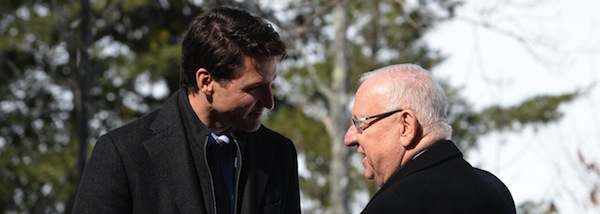
נשיא המדינה, ראובן ריבלין, קיים לאחרונה ביקור רשמי בקנדה, שכלל פגישת עבודה עם ראש הממשלה, ג’סטין טרודו. טרודו אמר לריבלין בפגישה ביניהם: “אנו מציינים שבעים שנה לכינון היחסים הדיפלומטיים בין שתי המדינות. יש לנו הרבה על מה לדבר כמו חידוש הסכם הסחר שלנו, ולדבר על פלורליזם ועל סובלנות ומאבק נגד שנאה וחוסר סובלנות. אני יודע שאתה מחזיק בדעות חזקות בנושא הזה. תענוג גדול לשבת איתך בזמן שבו ישראל וקנדה חברות נהדרות”. ריבלין הישיב לטרודו: “תענוג להיות איתך ולהכיר חבר כל כך טוב. אנחנו חולקים ערכים ואידיאלים. יהודים באו לקנדה כבר לפני מאה וחמישים שנה. אני גאה מאד להיות כאן ולהחליף ידע ורעיונות איתך. אנחנו חווים ימים קשים במרחב, ואתם עושים המון עבורנו במטרה לשמור על המרחב העדין ועל הקיום שלנו. אתם עושים זאת בסוריה, בלבנון ובסיני”. הנשיא הודה לטרודו על תמיכתה של קנדה בישראל בזירה הבינלאומית ועל התמיכה נגד הפעילות האנטישמית של תנועת הבי.די.אס. ריבלין מקווה שקנדה תביע עמדה נגד מהלכים חד-צדדיים של הפלסטינים נגד ישראל. וכנגד היחס המפלה כלפי המדינה במוסדות הבינלאומיים.
השניים דנו בסוגיה האיראנית והנשיא ציין לטובה את החלטת הפרלמנט הקנדי על הקפאת היחסים עם איראן, ואת ההכרזה כי משמרות המהפכה האיראניים הם ארגון טרור. בנושא זה אמר ריבלין: “איראן מובילה את התבססות הציר השיעי בעיראק, סוריה, לבנון ותימן. ובפעולותיה היא מחריפה את המתח הסוני-שיעי, העלול להביא להסלמה אזורית ולאיים על העולם כולו”. הנשיא הדגיש כי: “אסור לעולם לאפשר התבססות איראנית. בלימת ההתבססות האיראנית תושג רק באמצעות לחץ בינלאומי מתואם ופעולות צבאיות נקודתיות בכל עת שנדרשת”.
לפני הפגישה עם טרודו, נפגש הנשיא עם המושלת הכללית של קנדה, ז’ולי פאייט. השניים קיימו פגישת עבודה מדינית. הנשיא העניק למושלת (שהייתה בעבר אסטרונאוטית והיו לה שתי משימות בחלל), דגם מוקטן של החללית “בראשית”. החללית הישראלית הראשונה עתידה הייתה לנחות על הירח וכידוע התרסקה וגרמה לעוגמת נפש גדולה בישראל. פאייט אמרה דברים מרגשים לזכרו של האסטרונאוט הישראלי, אילן רמון ז”ל, שעימו הייתה ביחסי ידידות. ריבלין מצידו הזכיר את מותה של אשתו, רונה רמון, ופאייט אמרה שהדבר מאוד העציב אותה.
טרודו וראש עיריית טורונטו, ג’ון טורי, השתתפו באירוע מיוחד: שבעים שנה לידידות בין קנדה וישראל. האירוע נערך בטורונטו בהשתתפות כאלפיים איש. הוא אורגן על ידי מגבית היהודית קנדה והבונדס, בשיתוף פעולה עם ארגון הגג של הפדרציות היהודיות בקנדה.
טרודו נשא באירוע נאום פרו-ישראלי יהודי יוצא דופן, גינה את האנטישמיות ואמר כי בניגוד אליה, הערכים היהודיים של נתינה וקהילה הם ערכים קנדיים. טרודו: “האנטישמיות בעולם מרימה ראש. התקפות אנטישמיות מתרחשות נגד ילדים שהלכו עם כיפות בקנדה, ההתקפה נגד בית הכנסת בפיטסבורג, ההתקפות בפריז, בירושלים ובכל העולם. אנטישמיות נמצאת במגמת בעלייה והיא מפיצה שנאה”. טרודו הוסיף עוד כי האנטישמיות החדשה כוללת גם את הדמוניזציה של ישראל. לדבריו אין מקום לתנועת האפרטהייד נגד ישראל בקנדה. ראש ממשלת קנדה הדגיש: “אני יכול להבטיח לכם שקנדה תמיד תגנה כל שנאה נגד כל קהילה, ותזכיר את המסר שוב ושוב כי אנטישמיות היא התקפה על קנדה. ישראל היא לא רק בת ברית, אלא שותפה אמינה שאפשר לסמוך עליה והיא יכולה לסמוך עלינו”.
טרודו אפוא מנסה להתקרב לישראל ואל היהודים בקנדה לקראת הבחירות הכלליות שיערכו כאן בחודש אוקטובר.
Clockwise, from top left: U.S. Vice-President Mike Pence, Joe Lieberman, Senator Marco Rubio and Senator Cory Booker address attendees of last month’s AIPAC Policy Conference. (photos by Dave Gordon)
U.S. Vice-President Mike Pence, in addition to other ranking American politicians, spoke of their unwavering support for the Jewish state to 18,000 people at the American Israel Public Affairs Committee (AIPAC) Policy Conference, in Washington, D.C., March 24-26.
Speech themes revolved around recent rocket attacks against Israeli civilians, the Golan Heights being recognized as Israeli sovereign territory by the United States, and sanctions against Iran. Every official who mentioned BDS, the boycott, divestment and sanctions movement against Israel, condemned it.
Much was said about the Democratic congresswoman from Minnesota, Ilhan Abdullahi Omar. Her statements – including “Israel has hypnotized the world” and that AIPAC has influenced U.S. policy through money – have been interpreted as antisemitic by some Jewish leaders.
Pence said, “History has already proven [Donald Trump] to be the greatest friend of the Jewish people and the state of Israel ever to sit in the Oval Office of the White House.”
Among the pro-Israel bona fides of Trump, Pence said the United States shut down the Washington branch of the Palestinian Authority as a consequence for funding terror; ended tax dollar funding for United Nations-funded Palestinian schools; moved the U.S. embassy to Jerusalem; and recognized the Golan Heights as Israeli territory.
“We stand with Israel because her cause is our cause, her values are our values,” he said.
In addition, Pence talked about the end of the “disastrous nuclear deal with Iran” that has been replaced with “a maximum-pressure campaign” of sanctions, thereby causing Iran’s economy to dip.
“There’ll be no more pallets of cash to the mullahs in Iran,” he said.
In a swipe across the political aisle, Pence said, “It’s astonishing to think that the party of Harry Truman, which did so much to help create the state of Israel, has been co-opted by people who promote rank antisemitic rhetoric and work to undermine the broad American consensus of support for Israel.”
Without mentioning her name, he referred to Omar as “a freshman Democrat in Congress” who “trafficked in repeated antisemitic tropes.”
Former U.S. ambassador to the UN Nikki Haley’s first comments were about what she believes is the UN’s hypocrisy.
“You know, what’s interesting is, at the UN, I can guarantee you this morning it is radio silent,” she said, in reference to the rocket attacks from Gaza into Israel. “They are not saying anything about Hamas, they’re not saying anything about the lives lost, they’re not saying anything. But, if it was any [other] countr[y], they’d be calling an emergency Security Council meeting.”
David Friedman, U.S. ambassador to Israel, claimed that Trump is “Israel’s greatest ally ever to reside in the White House” and, to those who think otherwise, “please, take a deep breath and think about it some more.”
How America is now sanctioning Iran was one example of an Israel-friendly policy. Friedman criticized the previous administration for paying the Islamic Republic $100 billion in the hopes that country would “self-correct.”
“What did Iran do with all its newly found treasure?” he asked. “Did it build up its civilian institutions? Did it improve the quality of life of its citizens?” Instead, he said, it “doubled down on terrorist activity in Yemen, in Iraq and in Lebanon. It increased its stock of ballistic missiles and it invested in military bases in Syria, on Israel’s northern border.”
Protesters at this year’s AIPAC Policy Conference, in Washington, D.C., last month. (photo by Dave Gordon)
Israeli Prime Minister Binyamin Netanyahu delivered an address via satellite, initially planning to take the podium in person, but returning to Israel to deal with the rocket attacks.
“The Golan Heights is indispensable for our defence,” he said of the recognition by the United States of the northern land seized by Israel in the Six Day War, in 1967. “It’s part of our history. When you put a shovel in the ground there, what you discover are the ruins of ancient synagogues. Jews lived there for thousands of years and the people of Israel have come back to the Golan.”
Netanyahu said he thought comments like Omar’s are antisemitic.
“Again, the Jews are cast as a force for evil,” he said. “Again, the Jews are charged with disloyalty. Again, the Jews are said to have too much influence, too much power, too much money. Take it from this Benjamin, it’s not about the Benjamins.”
In the session Canada’s Relationship with Israel, the panel included Liberal member of Parliament Anthony Housefather, Conservative MP Erin O’Toole and former Conservative foreign minister John Baird.
Housefather said he believes Israelis do not think there’s a negotiating partner for peace, but they share some blame in the conflict: “The more they create settlements, the less likely there will be peace … they should think carefully before expanding settlements.”
A questioner asked him when the Canadian prime minister would do something “real” for Israel and Housefather noted that, in recent weeks, Prime Minister Justin Trudeau forcefully condemned the BDS movement in a town hall meeting.
Another audience member asked why the Trudeau government continues to fund the United Nations Relief and Works Agency. While acknowledging that UNRWA has “curricula problems” that involve “anti-Jewish, anti-Israel comments, misogynistic comments and anti-gay comments,” he said that the $50 million in funding was just.
Housefather said he had spoken with the head of UNRWA and voiced his “concerns at the slow pace they are making changes in the curricula,” but added that their schools make children “a lot less likely to become terrorists against Israel.”
“Yes to helping them with UN aid programs; no to funding their schools,” said O’Toole. And Baird agreed.
On the topic of a peace plan, O’Toole said he “kept hearing from Palestinians their want for a ‘one-state solution,’” while their government “exerts violence, and does not take care of the needs of their people.”
“I think you’ll see from Israeli leaders that they’re prepared to experience real pain [in concessions],” Baird said, but “Palestinians have to stop the incitement” and the “hate-mongering.”
While several candidates for the Democratic party’s 2020 presidential nomination skipped the conference, leading Democratic figures were prominent at AIPAC, including House Speaker Nancy Pelosi, who insisted no one will be permitted to make Israel a partisan wedge issue.
Dave Gordonis a Toronto-based freelance writer whose work has appeared in more than 100 publications around the world.
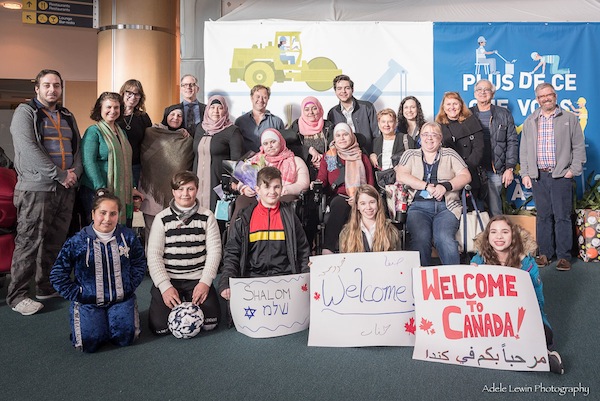
Welcomers of the Alsedawe family at Vancouver International Airport Jan. 21. (Adele Lewin Photography)
More than three years ago, Hanan Alsedawe’s family story of survival began as a waiting game on both sides of the ocean. But, on Jan. 21, 2019, the wait became a welcome as Hanan and her children stepped foot on Canadian soil.
In early 2015, congregations Beth Israel and Beth Tikvah began the long process of sponsoring and reuniting a Syrian refugee family with family who already lived in Vancouver. We worked with the government-approved sponsorship agreement holder – the Anglican Diocese – to prepare and submit our private sponsorship application to the Canadian government. It was a journey requiring perseverance by our coordinating committee, and patience and understanding from the many donors of both synagogues who demonstrated belief in our efforts regardless of the length of time it was taking.
On the Jordanian-Saudi Arabian border, in the Azraq Refugee Camp, Hanan and her two children – Mahros and Safa – shared limited resources with more than 55,000 refugees. Their extended family had made their way to Canada under government sponsorship, but Hanan had stayed behind, in Duma, Syria, because her husband, Raslan Abdulmalik, had been taken away by Syrian government forces and she had no idea of what had happened to him. She waited, she hoped, she prayed, but, eventually, with no sign of Raslan being alive, yet with no confirmation that he was either in prison or dead, Hanan decided to escape from Duma. She made her way with her two young children to Amman, Jordan, and eventually was placed in the Azraq refugee camp. There, she waited for a miracle.
Sept. 2, 2015, was a watershed moment that captured the hearts of people around the world and galvanized Canada into accepting 25,000 Syrian refugees into the country. Hanan’s mother and five siblings came to our shores under those auspices. But it would take years of work and hope to bring the last of Fayzeh Alsedawe’s daughters, with her children, to join the family here.
More than three years after initiating the sponsorship, Beth Israel and Beth Tikvah fulfilled Hanan’s dreams of joining her mother and siblings in Vancouver. On Jan. 21, representatives of both synagogues were on hand at Vancouver International Airport to welcome their sponsored family.
On any given day, at any given time, the international arrivals hall at YVR is a kaleidoscope of colours. On that Monday in January, the full spectrum was visible, augmented by the cacophony of diverse languages and a blending of bodies. Clearly, Canada is at its most multicultural in an airport setting.
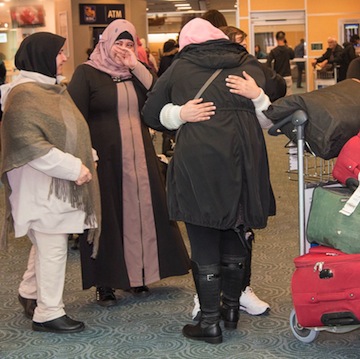
Members of the Alsedawe family at YVR: Fayzeh, Hanan, Mahros and Hanadi. (Adele Lewin Photography)
Also palpable was the range of emotions. There was the full gamut of human feelings on display among those awaiting families, friends and strangers to enter the hall. Contrasts abounded: joy competed with sadness, anticipation with angst, relief with uncertainty. Each person arriving searched for familiar faces, welcoming arms and handwritten signs, indicating that someone was there for them.
In this swirl of humanity were representatives of Beth Israel and Beth Tikvah, their dream to sponsor a refugee family from Syria finally reaching fruition. Sharing this moment – indeed, at the centre of this moment – was the local family: the mother, Fayzeh, and her five adult children, Hanadi, Huda, Maha, Hatem and Mohammed, who had arrived in Canada three years ago and had waited anxiously to be reunited with the remainder of their family.
There was something so surreal, yet so tangible and in the moment at that airport reunion. Words are inadequate to describe the outpouring of relief and love when Hanan and her children emerged in the arrivals hall. An invisible bubble enclosed the family, as they looked at each other for the first time in more than four years. And then, quickly, the bubble grew, as our delegation surrounded the family with our own contributions of hugs, gifts and welcome. One gift in particular seemed to unite the new family with our Canadian sponsors – a Whitecaps soccer ball given to 13-year-old Mahros. Soccer, a universal language for children and adults alike!
Every family has a history, a story that captures the essence of their character and experiences. The Alsedawes’ story is one of courage and hope. Their life in Syria was destroyed by war but their determination to escape, under circumstances almost impossible for us to comprehend, means that, today, their story is one of hope and gratefulness. In Hanan’s own words to the committee, “I thank God and I thank you.”
Settlement requires patience. Never has the Hebrew word savlanut meant so much to our small committee. Patience was required in the very lengthy process from application to arrival. Patience is required as we work to settle the children in school, the mother in English-as-a-second-language classes and the family into a way of life totally foreign to them. Within weeks of their arrival, the family had visited a family physician, dental appointments were booked, the children were enrolled in public school, bank accounts were set up and, important in this day and age, cellphones and tablets were provided to them.
Our year of sponsorship has only just begun, but this journey has been undertaken with the generosity of many people. Our donors have compassion and commitment, and understand that, “There but for the grace of God go I.”
Rosalind Karbyis co-chair, with Miranda Burgess, of Beth Israel Congregation’s Committee for the Syrian Refugee Sponsorship Initiative.
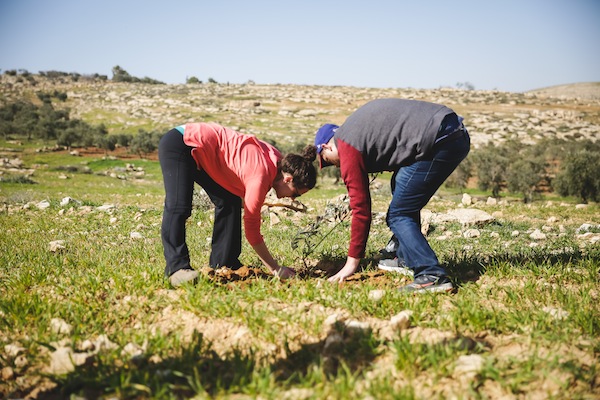
T’ruah students help plant trees in the Hebron Hills. (photo from T’ruah)
U.S.-based T’ruah: The Rabbinic Call for Human Rights works in Jewish social justice circles in Israel and North America.
“We work with human rights of both Israelis and Palestinians…. We’ve also worked on introducing rabbis and rabbinical students, and also congregations, to what’s happening in West Bank and more,” executive director Rabbi Jill Jacobs told the Independent.
T’ruah, which supports a two-state solution, offers the Year-in-Israel program for rabbinical students.
“Students study in Jerusalem at various institutions,” said Jacobs, “but they don’t necessarily get to see human rights issues up close. We take them once a month to see a human rights issue on the ground, either in the West Bank with Palestinians, in Bedouin Israeli communities in the Negev, asylum seekers, etc.”
At these sessions, students meet with Israeli human rights and other leaders on the ground. The program is held during students’ free time, separate from their regular studies.
“The goal of the program is to help them develop a rabbinic moral voice,” said Jacobs. “As rabbis, they’re going to be called on to speak about Israel. The question is, how do they talk about Israel as a rabbi? Rabbis talk out of their values, and also are generally dealing with politically diverse communities…. So, the question is, how can a rabbi speak in a way that will push people to listen to perspectives they might not otherwise listen to, [based on] Jewish texts and Jewish values?”
Jacobs recognizes that the information they provide is not comprehensive. Their focus is to give students the opportunity to interact with human beings – to meet Palestinians, Bedouins and others and learn from them what their life experience is like.
“It’s also crucial to us that they are meeting with Israeli human rights leaders,” said Jacobs. “Very often, there’s a dichotomy that suggests that being pro-Israel means supporting the right-wing government of [Binyamin] Netanyahu and that being pro-Palestinian means being against Israel. We’re pro-human rights and we want them to meet Israelis working every single day to push for human rights in their own country because they love their country. We want them to see that there are actually people who are changing the situation.
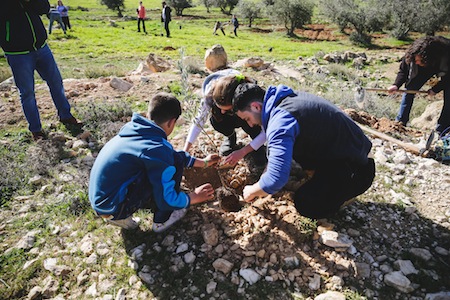
T’ruah students planting trees. (photo from T’ruah)
“We hear a lot from the students that our program gives them hope. Sometimes, they are so hopeless about what is happening in Israel and then they meet people, both Jewish and Palestinian communities, who are trying to change their situation.”
One T’ruah graduate is Rabbi Philip Gibbs, spiritual leader of Congregation Har El in West Vancouver.
“During my year in Israel, during my second year of rabbinical school, I had the opportunity to then be a fellow with T’ruah for their rabbinical student program,” Gibbs told the Independent. “I really appreciated the opportunity, both because, at least the year I was doing it, there was clearly a huge focus on the Israeli-Palestinian conflict. But, also because the way, in terms of educating about social justice issues in Israel, they were able to show some of the other issues happening – whether it was meeting with Bedouins, talking to some asylum seekers from Africa … really seeing what their home-grown needs are and seeing how it developed into a strong sense of the how they were fighting for many of those needs through the legal systems in Israel.”
Gibbs met with Palestinians who had been displaced from the Jerusalem area after the 1967 war. “We had the chance to hear their narrative,” he said, “highlighting how their status as refugees during that conflict had really come into question because of both the policies of Jordan, as they were occupying the area, as well as some of the motivations of different settler organizations in their attempt to create a much stronger Jewish presence behind the Green Line… I felt like that was more educating us in understanding the way that the nature of a lot of these neighbourhoods had been going back and forth.
“For the Israeli settlers, they felt they were reclaiming a neighbourhood that was Jewish. For the Palestinians that had been living there, their legal status was caught up in layers of legal confusion of having that area under control of many different authorities over the past 150 years.”
Gibbs has not yet had an opportunity to bring this part of his rabbinical education to his congregation directly, but it has definitely played a role in how he shares his perspective regarding, for example, the upcoming Israeli election.
“I’m making sure there’s a deeper sense of having the recognition that a lot of these questions that are coming up, some of these issues are on the minds of most Israelis … but that, no matter what, a lot of the work that human rights organizations are doing, a lot of that is going through the overt legal system of Israeli government.”
Regarding the many Israelis he has met who work for human rights organizations, Gibbs said he appreciated the way their main motivation was a deep sense of trying to make their country the best it can be, noting that every government needs to be transparent in their treatment of their citizens, allowing for a certain amount of criticism.
“That’s something coming from a place of love and it’s the most ideal way to get things done in a constructive way,” said Gibbs. “People can debate about how much people living outside of Israel are supposed to be making any sort of direct intervention, which happens on both sides of the political spectrum, but, I think, there’s absolutely nothing that we should hide in terms of understanding the full array of political work happening in Israel.”
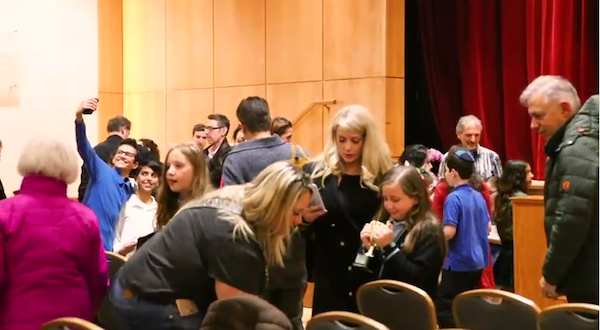
This screenshot from the 30th anniversary video of the Public Speaking Contest shows participants’ excitement. Larry Barzelai can be seen at the back of the crowd on the right.
On March 14, about 90 young participants and their families and friends, as well as volunteer judges and moderators and others from the Jewish community gathered for the annual Public Speaking Contest, presented by Jewish Federation of Greater Vancouver and State of Israel Bonds.
“This contest was established in memory of my father, Morris Black, who left money in his will to support such a contest,” Larry Barzelai told the Independent. “It has morphed from a Peterborough-based essay contest for famous people in Jewish history, to an Ontario-based essay contest, to a public speaking contest in Hamilton (run by my brother Rick) and the present public speaking contest in Vancouver. I give credit to my brother Rick, who originally came up with the idea of a public speaking contest in Hamilton, where he lives, and I started the contest in Vancouver a few years later.
“For my father, family, education and Judaism were the most important things in life,” Barzelai added. “This contest combines all three.”
This year’s Grade 4 through Grade 7 participants came from Gilpin Elementary School, Richmond Jewish Day School, Temple Sholom Religious School, Vancouver Talmud Torah, Vancouver Hebrew Academy and West Point Grey Academy. Some of the public school entrants may also attend a synagogue school.
Speeches had to run less than three minutes, but could cover any topic. Students were given a list of suggestions, such as the following: What is your favourite Jewish holiday and why? Describe a family member or someone from Jewish history and tell us why you admire them. Israel is often described as the “start-up nation” – name something invented in Israel and discuss how you think it has made a difference to people’s lives. Reduce, reuse, recycle are terms used to describe how people protect the environment – tell us about two Jewish values that you feel are connected to environmental protection. If you only had time to visit one city in Israel, which city would it be and why?
“To prepare a talk, students must conceive of a topic, organize information about that topic, and be prepared to deliver a speech to an audience of fellow students and strangers,” said Barzelai. “The preparation helps their ability to organize their thoughts in a coherent manner. Subsequently, they have to be prepared to present the information in a manner that is convincing to other people. These tasks require time and effort. After they give their speeches, they usually feel a well-deserved sense of accomplishment. What could be a better learning environment for the students and more positive experience for the families!”
Lissa Weinberger, manager of Jewish education and identity initiatives at Federation, is in charge of managing the literally hundreds of moving parts of the machine the contest has become. She provided the Independent with the list of winners for this year’s event, though the contest organizers rightfully stress that every participant is a winner for having participated and put in the work.
With the contest in its 31st year, Barzelai said, “It continues to be rewarding to watch the smiles on students’ and parents’ faces after they have given their speeches. This reflects the fact that the students have worked hard, have accomplished something valuable and are proud of themselves.”
He added, “It is also rewarding to see the children of parents who were in the contest themselves when they were in elementary school.”
Last year, to celebrate the contest’s 30th anniversary, Barzelai had a video created.
“It was hoped that the video would encourage future students to participate,” he said. “They would see that most participants seemed to enjoy their involvement in the contest, and viewed it as a positive learning experience.”
Written and directed by Adam Bogoch and edited by Thomas Affolter, the video gives a brief history of the contest, shows clips of the 2018 event and features interviews with the students, community leaders and volunteers, including Barzelai’s spouse, Rhona Gordon, who is an advisor on the project and is always on hand to help give out the awards on contest night.
This year’s awards went to, in Grade 4: Myelle Leung (1), Lia Golik (2) and Miri Grad (3) in Group 1; Miriam Ora Yeshayahu (1), Arlo Foxman (2) and Yanky Baitelman (3) in Group 2; and Naomi Bernal (1), Hannah Pressman Chikiar (2) and Jake Silver (3) in Group 3.
In Grade 5, the winners were Mira Hurwitz (1), Baila Shapiro (2) and Anne Cohen (3) in Group 1; Adina Ragetli (1), Sophie Rossman (2) and Jakob Murphy (3) in Group 2; and Sarah Malul (1), Hannah Setton (2) and Hannah Norden (3) in Group 3.
In Grade 6, winners were Chaya Malul (1), Eden Almog (2) and Tamir Gini (3) and, in Grade 7, they were Chasya Berger (1), Rivka Feigelstock (2) and Max Dodek (3).
For more about this year’s contest and to watch the 30th anniversary video, visit jewishvancouver.com/psc2019.
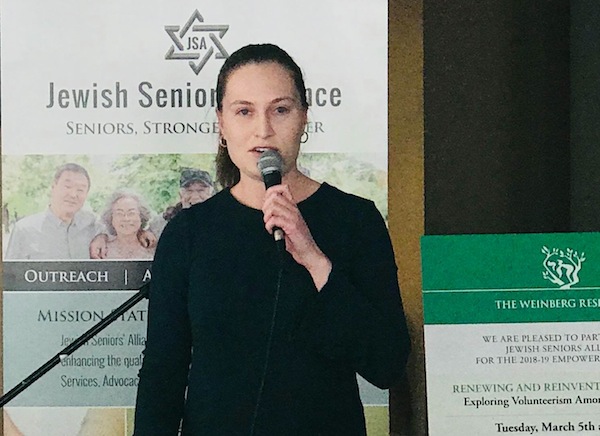
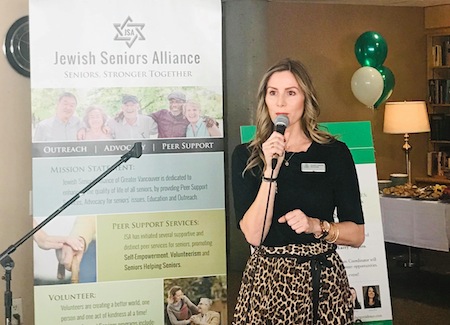
Eireann O’Dea speaks at the March 5 session of the Jewish Seniors Alliance Empowerment Series. (photo from JSA)
The following talk was delivered March 5 at the third session of the 2018/19 Jewish Seniors Alliance Empowerment Series, which took place at the Weinberg Residence. Speakers also included Larry Shapiro, JSA’s second vice-president; Jessica Bruce, volunteer coordinator for the Weinberg and the Louis Brier Home and Hospital; and Vanessa Trester, manager of the Weinberg.
It is relatively common knowledge that volunteering provides tremendous benefits to individuals and to the community at large. Volunteers have the opportunity to bring an increased sense of meaning and purpose to their lives, expand their social network, exercise unique skills and hobbies and, of course, help others in need. The presence of volunteers within a community increases social cohesion, builds trust and creates a “social infrastructure” of support, reciprocity and concern for others.
But what do volunteer roles really mean to those who participate in them? How does one start volunteering, and why do they continue? The Jewish community is exemplary in its provision of services and volunteer opportunities for children, youth, adults in mid- to late life, and the elderly. Yet the personal experiences of those who volunteer in the community, from a research standpoint, are largely unknown. This fact, along with my own experiences of working and volunteering within the community, inspired my master’s thesis, titled, An Exploration of Pathways, Motivations and Experiences Among Older Jewish Volunteers in Vancouver. The findings reflect interviews with 21 volunteers.
The majority of participants have volunteered for most of their lives. They described having parents who were community-minded, as well as adolescent experiences of being a part of Jewish youth organizations or women’s groups dedicated to community service. The expectation from others to volunteer was also discussed. Often, participants were asked to volunteer by their peers, rather than having sought out opportunities themselves. Over the years, this allowed them to experience multiple volunteer roles, as they would often be exposed to another role as a result of their status as a volunteer in the community.
Vanessa Trester, manager of the Weinberg Residence. The Weinberg hosted the March 5 JSA Empowerment event. (photo from JSA)
Participants found volunteering to be personally rewarding, describing how their roles made them feel better about themselves, kept them busy and productive, as well as mentally fit. Participants were also motivated to volunteer for generative reasons; that is, to help the next generation and the community at large. The desire to pass on Jewish culture was evident, with many describing their efforts and desire to serve organizations that preserved historical documents, worked to support Jewish infrastructure and educate children in the community. They felt that volunteering represented an important part of Jewish life and cited the importance of helping others within Jewish culture and religion. Tzedakah, a Hebrew phrase meaning justice or righteousness, was frequently referenced.
Participants described the connections formed with their fellow volunteers and to the community. Friendships were maintained both within and outside of the context of the volunteer role. Caring for seniors was another common experience among participants. Many took on roles that involved working with older adults, whether it was making home visits to isolated older adults, or assisting with recreational programs. It was also found that participants gravitated towards leadership roles within volunteer organizations and, in some cases, had founded their own initiatives. Participants also found their volunteer roles to be an opportunity to engage in personal interests and hobbies, as well as a chance to use skills they learned during their professional careers.
Volunteering is a highly productive way for older adults to increase their level of activity, foster their interests, help others and continue to be social and connected to their communities. As Canada continues to diversify in terms of ethnic composition, it is essential that volunteer opportunities be made accessible to and inclusive of older adults from all backgrounds. To achieve this, it is imperative that future research in this area encompasses the experiences and stories of older adults themselves.
Eireann O’Deais a PhD student in gerontology at Simon Fraser University. Her research interests are related to community engagement among older adults, ethno-gerontology and environmental accessibility. She wrote her master’s thesis on senior volunteers in the Jewish community and has recently joined the board of Jewish Seniors Alliance.
Recent graduates of Jewish Seniors Alliance’s peer support counseling training program. (photo from JSA)
On the evening of March 6, Jewish Seniors Alliance honoured the recent graduates of its peer support counseling training program with the presentation of certificates and a dinner.
Fourteen peer counselors completed the program, which consisted of 14 weeks of training for four hours on Sundays. The certificates were presented by Ken Levitt, president of JSA, and the program’s trainer, Grace Hann, and social worker, Charles Leibovitch. Hann and Leibovitch also serve as support workers for the counselors. They match them with clients and stay involved with their progress and offer help when needed.
Currently, JSA has 100 trained counselors volunteering to help isolated and/or homebound seniors. The counselors are usually seniors themselves and many have impressive education and experience in various fields.
The graduation evening began with Hann and Leibovitch welcoming everyone. This was followed by comments from Levitt and Serge Haber, founder and president emeritus. Three of the graduates – Nancy Bell, Lorraine Drossis and Tessie (Fatima) Rebello – spoke about how much they had learned during the classes. They all mentioned that learning empathy and active listening had contributed to their personal growth. They thanked Hann for her getting them involved and participating in the program and with one another.
Ruby Boychuk, senior peer counselor, offered remarks about seniors helping seniors and Nancy Bennett, another volunteer, was acknowledged for her contributions to the program.
Speakers from the community thanked JSA for the extensive help that its peer counseling offers. Dr. Beverly Pitman of United Way spoke of the significance of the program to the community and emphasized the importance of lobbying the provincial government for more funding. Shelley Rivkin of the Jewish Federation of Greater Vancouver talked about the positive effects of the program and how it corresponded to the Jewish values of tikkun olam (repair of the world). Dorothy Leclair of Burnaby Seniors Outreach continued on the theme of the value of helping seniors and spoke about the Burnaby program.
The final speaker was Kathryn Patterson of Vancouver Coastal Health. She asked the audience to close their eyes and hold hands, then to give one another a hug. It had the effect of relaxing everyone and making them feel as if they knew one another better.
The ceremony and speakers were followed by a buffet dinner, and music and song by David and Julie Ivaz. Many of the graduates got up and danced. As they were leaving, some of the participants remarked that they had had a wonderful evening.
Shanie Levinis an executive board member of Jewish Seniors Alliance and on the editorial board of Senior Line magazine.
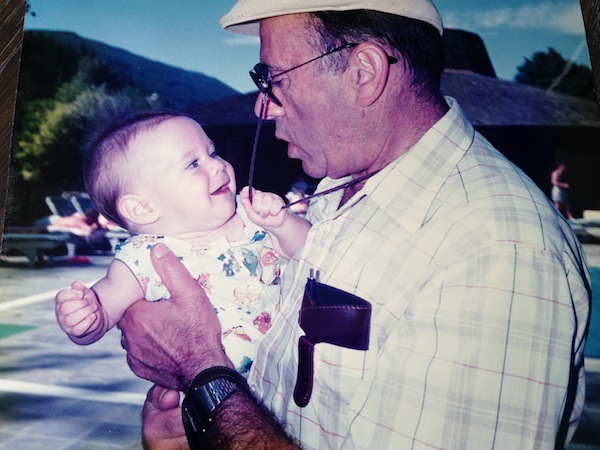
The writer with her grandfather, George Wertman. (photo from Becca Wertman)
I believe it was in Grade 6 at Vancouver Talmud Torah that we had to do a project about a “Jewish hero.” I remember other students wrote about Theodor Herzl, the founder of modern Zionism; Golda Meir, the first female Israeli prime minister; and Hannah Senesh, the Palmach paratrooper who was executed by Nazis while attempting to save Hungarian Jews. I wrote about my zaida.
My zaida, George Wertman, was born on May 17, 1921, in Lwów, Poland (now Lviv, Ukraine), and passed away on March 25, 2019, in Vancouver. He was a Holocaust survivor, yet that alone is not why I consider him my hero – it is because of how he survived and what he managed to accomplish in his life.
In fall 1941, Zaida was taken to a forced labour camp, Camp Winniki, where he became an assistant steamroll engineer, enslaved to build roads for the Nazis.
Zaida always marched in the first group of three during the 12-to-14-kilometre trek from the camp to the work site. One day, he lined up in the third group and, on that same day, two individuals escaped the camp. As was the “camp policy,” three people were shot for every person who escaped. The SS officer selected the first two rows and took them into the forest to their deaths. Zaida survived by sheer luck.
On other occasions, it was more than just luck that saved his life – it was his reputation as being a hard worker. In his second year in the camp, Zaida became ill with typhoid and was taken to the camp’s infirmary. An SS officer and a Ukrainian policeman came to the infirmary to select sick Jews to be shot for, as Zaida explained to me, why would Nazis spend scarce resources on healing sick Jews? The SS officer yelled to my zaida, “Out!” but the Ukrainian insisted that Zaida was his best worker and to save him.
In July 1943, Zaida’s determination to live motivated him to run when an SS officer came to his barracks in the middle of the night and told him to get dressed and, again, “Out!” Zaida preferred dying on his own terms – while doing everything he could to survive – and, therefore, jumped out of the window and ran. He ran through puddles to trick the scent dogs and eventually outsmarted the Nazis, managing to escape to “safety.” The rest of the camp was liquidated and sent to their deaths.
“Safety” meant reuniting with my great-grandfather in his hiding spot in a secret room located in a building where German officers lived. For one year, Zaida spoke in whispers and did not see the sun.
Zaida was liberated in summer 1944, but his story of survival by no means ended there. He met my grandmother (my baba, who I call Babi), and she, Zaida and my great-grandfather began a “business” of necessity – smuggling goods across one European border and the next. They would hollow out suitcases, fill the frames with gold and give them to my 20-year-old grandmother to carry across the border.
They eventually made enough money to get visas to Canada and, in July 1949, arrived in Vancouver.
The money they had made in Europe was invested in property, including a piece of land bought from the Canadian Pacific Railway that became my dad’s childhood (and current) house and a property that housed George Wertman Ltd., Zaida’s coat hanger factory.
Zaida worked extremely hard to succeed in Canada, making wire coat hangers and doing everything to ensure that his three children and eight grandchildren would never have to suffer.
His retirement largely consisted of wining, dining and drinking coffee throughout Vancouver. From the age of 91 to 96, he could be found daily at the Hotel Georgia’s Bel Café sharing a grilled cheese sandwich with Babi.
As the granddaughter of Holocaust survivors, I have unique childhood memories. I remember my family parking at least a 15-minute walk away, usually more, from the best restaurants in Vancouver in order to not pay for parking and to “save a buck”; of eating chicken soup in bowls of gold-rimmed china that my grandparents brought from Allied-occupied Germany; and of always asking Zaida to tell me stories, like the ones above.
In Zaida’s Holocaust survivor testimony to the University of Southern California Shoah Foundation, he explains that his philosophy is that you “have to work to get somewhere” and that he believes in “honesty, hard work and, once in awhile, if you can do a mitzvah,” do it. Indeed, hard work saved his life and being an honest businessman in Canada allowed him to give his family everything they needed.
As Zaida also instructs in his testimony, “Try to make a better world. If you cannot make a better world, do not make it worse.”
This is why he was, is, and will always be, my hero and my inspiration for how I live. I hope his story, summarized here, will inspire others as well. May his memory be a blessing.
Becca Wertmangrew up in Vancouver and currently lives and works in Jerusalem.
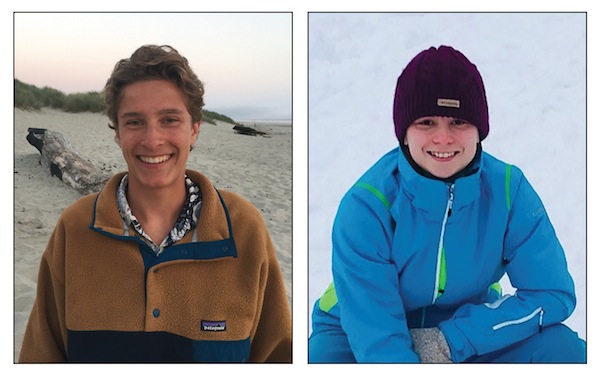
Sam Albert, above, and Liana Gerber are co-winners of this year’s Temple Sholom Teen Tikkun Olam Awards. (photos from Temple Sholom)
The Dreamers and Builders gala event May 5 provides Temple Sholom the opportunity to present its third annual Tikkun Olam Awards. The awards are the dream child of Rabbi Dan Moskovitz, and are funded by Michelle and Neil Pollock.
In addition to highlighting exemplary dreamers and builders like honourees Susan Mendelson and Jack Lutsky, this year’s gala will recognize two among the many amazing teens in the community. These youth see the needs in the world and work hard to address those needs, with creativity and compassion.
The application process for the 2019 Tikkun Olam Awards produced eight applicants and two co-winners: Sam Albert and Liana Gerber.
Sam, 17, is in Grade 11 and already recognizes the power of the pen – he plans to study journalism. His parents, Jennifer Tater and David Albert, have encouraged his devotion to community involvement. He is the youngest of three and has two older sisters. His interest is protecting the planet and preventing climate change. He is involved in many local organizations and has spent a lot of his spare time working to clean Metro Vancouver’s beaches. He is so well-known in the world community that he has been invited to attend a climate change conference in Bonn, Germany, this summer.
Liana, also 17, is a Grade 12 student. The daughter of Michelle and Martin Gerber, Liana has a twin and a younger sister. Next year, Liana plans to start studying interior design and also hopes to become a paramedic one day. For several years, on a volunteer basis, she has baked for the kids who enter Ronald McDonald House. In the process of doing this, she has spoken with and persuaded the manager of her local grocery store to provide reduced prices for the grocery items required. She also has fundraised to ensure that meals are provided for families when they enter the home, so that they may focus on the needs of their child and not worry about feeding themselves. While traveling in the United States, Liana found a Ronald McDonald House and baked for the residents there. How basherte it is that Liana is a co-winner the year that Temple Sholom recognizes Mendelson, a founder of the Lazy Gourmet catering company, among other accomplishments, for all of her work and devotion to tikkun olam.
Temple Sholom is proud and honoured to recognize excellence among its teens. On June 7, at the Shabbat evening service at the synagogue, all of the Tikkun Olam Award candidates will be acknowledged and celebrated with a special presentation. The entire community is invited to participate.