Skip to content
  • Home
  • Subscribe / donate
  • Events calendar
  • News
    • Local
    • National
    • Israel
    • World
    • עניין בחדשות
      A roundup of news in Canada and further afield, in Hebrew.
  • Opinion
    • From the JI
    • Op-Ed
  • Arts & Culture
    • Performing Arts
    • Music
    • Books
    • Visual Arts
    • TV & Film
  • Life
    • Celebrating the Holidays
    • Travel
    • The Daily Snooze
      Cartoons by Jacob Samuel
    • Mystery Photo
      Help the JI and JMABC fill in the gaps in our archives.
  • Community Links
    • Organizations, Etc.
    • Other News Sources & Blogs
    • Business Directory
  • FAQ
  • JI Chai Celebration
  • JI@88! video

Recent Posts

  • Story of Israel’s north
  • Sheltering in train stations
  • Teach critical thinking
  • Learning to bridge divides
  • Supporting Iranian community
  • Art dismantles systems
  • Beth Tikvah celebrates 50th
  • What is Jewish music?
  • Celebrate joy of music
  • Women share experiences 
  • Raising funds for Survivors
  • Call for digital literacy
  • The hidden hand of hate
  • Tarot as spiritual ritual
  • Students create fancy meal
  • Encouraging young voices
  • Rose’s Angels delivers
  • Living life to its fullest
  • Drawing on his roots
  • Panama City welcoming
  • Pesach cleaning
  • On the wings of griffon vultures
  • Vast recipe & story collection
  • A word, please …
  • מארק קרני לא ממתין לטראמפ
  • On war and antisemitism
  • Jews shine in Canucks colours
  • Moment of opportunity
  • Shooting response
  • BC budget fails seniors
  • Ritual is what makes life holy
  • Dogs help war veterans live again
  • Remain vital and outspoken
  • An urgent play to see
  • Pop-up exhibit popular
  • An invite to join JWest

Archives

Follow @JewishIndie
image - The CJN - Visit Us Banner - 300x600 - 101625

Author: Dave Gordon

Election bid put into context

Election bid put into context

U.S. Senator Bernie Sanders speaking at a town meeting at the Phoenix Convention Centre in Arizona in July 2015. While a Jewish American president would be a first, many other countries have had Jewish leaders. (photo from Flickr user Gage Skidmore via commons.wikimedia.org)

U.S. presidential candidate Bernie Sanders is the first Jew to win a presidential primary and, given that he is only one of two Democratic hopefuls in the race, there is the possibility of a Jewish president after this fall’s election.

But this milestone isn’t such a milestone when one looks around the world, and the United States – with its approximately seven-million-strong Jewish population (including children) – could be considered behind the curve. After all, Italy, France, New Zealand, Panama, Peru and Russia all have had multiple Jewish heads of state or heads of government in the past century or so. Such places as El Salvador, Honduras, Guyana, the Dominican Republic and Norway, with relatively few Jews, have all had Jewish heads of state.

We know some of the stories of antiquity, with Jewish leaders of lands other than Israel. The most famous are Joseph, as viceroy of Egypt; Moses, the prince of Egypt; and, in the fifth-century BCE, Queen Esther in Persia. Among others are:

  • In the early first century, Queen Julia Bernice II, married the Cilician king, Polemon II of Pontus.
  • Queen Shushandukht ruled Persia (and some of Mesopotamia) in the fifth century.
  • Beginning around the fourth century, Jewish kings and queens reigned in Ethiopia for about a millennia.
  • King Abu Karib ruled Yemen in the fifth century and, a hundred years later, King Dhu Nowas.
  • Queen Dahiya Kahina reigned in Algeria in the early eighth century.

In modernity, there are/were dozens of Jewish prime ministers, presidents and vice-presidents outside of Israel. As best as we can figure, with some latitude for converts, those born Jewish but raised in another religion, high-ranking officials that were a heartbeat (or two) from becoming head of state, and those who came close, there have been roughly three dozen Jewish leaders outside Israel, with about a dozen “almosts.”

Great Britain/United Kingdom

  1. Benjamin Disraeli, prime minister in 1868 and 1874-80 (converted to Anglicanism)
  2. Rufus Isaacs, 1st Marquess of Reading, viceroy of India, 1921-26
  3. Almost: Ed Miliband, opposition leader of Great Britain, 2010-15; and Prime Minister David Cameron, elected in 2010, who in a speech to the Knesset, said his great-great-grandfather was a German Jew

Switzerland

  1. Ruth Dreifuss, president, 1999

France

  1. Leon Blum, prime minister, 1936-37, 1938, 1946-47
  2. René Mayer, prime minister, 1953
  3. Pierre Mendès France, prime minister, 1954-55
  4. Michel Debré, prime minister, 1959-62 (convert to Catholicism)
  5. Laurent Fabius, prime minister, 1984-86 (raised Roman Catholic)
  6. Nicolas Sarkozy, president, 2007-12 (born to a Jewish father)

Spain

  1. Juan Álvarez Mendizábal, prime minister, 1835-36 (raised Roman Catholic)

Italy

  1. Alessandro Fortis, prime minister, 1905-06
  2. Sidney Sonnino, prime minister, in 1906 and 1909-10 (raised Anglican)
  3. Luigi Luzzatti, prime minister, 1910-11

Eastern Europe

  1. Kurt Eisner, president of Bavaria, 1918-19
  2. Paul Hirsch, president of Prussia, 1918-20
  3. Zigfrids Anna Meierovics, prime minister of Latvia, 1921-24
  4. Petre Roman, prime minister of Romania, 1989-91 (raised Romanian Orthodox)
  5. Jan Fischer, prime minister of Czech Republic, 2009-10

Scandinavia

  1. Jo Benkow, president of Norway, 1985-93
  2. Dorrit Moussaieff, first lady of Iceland since she married President Ólafur Ragnar Grímsson in 2003

Russia

  1. Yevgeny Primakov, prime minister of Russia, 1999
  2. Mikhail Fradkov, prime minister, 2004-07 (Russian Orthodox)

New Zealand

  1. Sir Julius Vogel, premier, 1873-76
  2. Sir Francis Bell, prime minister, 1925 (raised Anglican)
  3. John Key, prime minister since 2008

Africa

  1. Sir Roy Welensky, prime minister of the Federation of Rhodesia and Nyasaland (Zimbabwe), 1956-63 (raised Anglican)

Central/South America (one-offs)

  1. Francisco Henríquez y Carvajal, president of the Dominican Republic, 1916
  2. Janet Jagan, president of Guyana, 1997-99
  3. Mike Eman, prime minister of Aruba since 2009
  4. Nicolás Maduro, president of Venezuela (raised Roman Catholic) since 2013

Honduras

  1. Juan Lindo y Zelaya, president of El Salvador, 1841-42; and president of Honduras, 1847-52 (raised Roman Catholic)
  2. Ricardo Maduro, president of Honduras, 2002-06 (raised Roman Catholic)

Panama

  1. Max Delvalle, president, for one week in April 1967, because the National Guard General did not approve of his succeeding his predecessor
  2. Eric Arturo Delvalle, president, 1985-88 (in 1988, he attempted to remove Manuel Noriega as the de facto military dictator, but instead Noriega overthrew him; Delvalle fled to the United States and died in Cleveland at age 78)

Peru

  1. Efraín Goldenberg Schreiber, prime minister, 1994-95
  2. Yehude Simon Munaro, prime minister, 2008-09
  3. Salomón Lerner Ghitis, prime minister, 2011

Costa Rica (almosts)

  1. Rebeca Grynspan Mayufis, vice-president of Costa Rica, 1994-98
  2. Saul Weisleder, president of Costa Rica’s Legislative Assembly, 1997-98
  3. Luis Liberman Ginsburg, vice-president of Costa Rica, 2010-14 (the grandson of the first mohel of Costa Rica’s Jewish community)

North America (almosts)

  1. Barry Goldwater, GOP presidential candidate, 1964 (Jewish father)
  2. Henry Kissinger, as secretary of state (fourth in line of succession), 1973-77
  3. Madeleine Albright, as secretary of state, 1997-2001
  4. Joe Lieberman, 257 votes away from U.S. vice-president in 2000
  5. Eric Cantor, former speaker of the House (third in line to the presidency), 2011-14
  6. Herb Gray, deputy prime minister of Canada, 1997-2002 (Canada’s first Jewish federal cabinet minister, one of only a few conferred the title “right honorable” who were not prime ministers, and the longest continuously serving member of Parliament in Canadian history)

Dave Gordon is a Toronto-based freelance writer whose work can be found in more than 100 publications globally. His is managing editor of landmarkreport.com.


Format ImagePosted on March 4, 2016March 3, 2016Author Dave GordonCategories WorldTags politics, Sanders, U.S. election, world leaders
Teaching young chefs

Teaching young chefs

Deborah French’s children – Henry, Elisheva, Amariah and Rafaella – about to enjoy the fruits of their labor, having made their first chocolate cake. French published The Cookbook for Children with Special Needs in 2015. (photo from Deborah French)

Deborah French’s rollercoaster ride began on June 14, 2004, when she gave birth to her second child, Amariah, who unexpectedly had Down syndrome. “Up until that point, we had absolutely no experience with special needs and never considered we ever would,” said French.

Growing up in northwest London, French made aliyah with her husband Johnny and their first two children in 2007. French chose to become a stay-at-home mom with the birth of Amariah. A year later, the couple’s eldest child, Henry, who was 2 years old at the time, was diagnosed with high-functioning autism.

“We felt incredibly alone and found those years extremely difficult,” French told the Independent.

Once a meticulous planner, these days, French finds that if she thinks too far ahead, she gets filled with anxiety and concern about how they will manage and how their children will fare in the future. “I don’t have the answers, so we don’t have expectations,” said French. “We take everything day by day, one step at a time…. We both only want our children to be happy and fulfilled.”

Going against the advice of many experts who said Henry could not concentrate on a single task for longer than five minutes and that he had poor motor skills, French set about baking cookies with her son one day when he was 4 years old.

“In the kitchen, his fine motor skills were excellent,” she said. “Henry worked solidly for an hour and, as freshly baked cookies with recognizable shapes came out the oven, I knew I was on to something. Being in the kitchen calmed Henry, channeled his energy and gave him a huge confidence boost, as he was able to provide food for others.”

French was asked if she would consider taking other kids into her kitchen. This paved the way for her cooking classes and, eventually, led to her compiling a comprehensive cooking course for children with special needs.

French, who is now the mother of five, has become an expert via life experience.

“After bringing my children into the kitchen, I saw firsthand the effect cooking had on their self-esteem and confidence,” she said. “I believe that any child suffering with learning or emotional difficulties will improve and develop their abilities at a faster rate if they are relaxed and participating in an activity that does not feel like therapy. This type of environment allows them to give of themselves to others and stimulates their creativity, giving them more chance to overcome their challenges.”

French is an advocate for families and their children with special needs in Israel. As well, she and her husband co-created the Chai on Life organization, which provides opportunities for such families to participate in regular activities while educating the wider community about children with special needs.

“We believe that education breaks down barriers and paves the way for acceptance and inclusion – a concept that benefits all children,” said French. “Our Mazal Le Chaim program takes children from mainstream to special needs schools to activities and events to encourage integration, teaching them to confront their fear of the unknown and embrace it.”

book cover - The Cookbook for Children with Special NeedsFrench’s first foray into writing was a memoir, A Brief Moment in Time (ASD Publishing, 2013), which won honorary mentions at Paris and New York book festivals. Her most recent publication is The Cookbook for Children with Special Needs (Jessica Kingsley Publishers, 2015).
French’s greatest pleasure comes from seeing how much Henry enjoys helping others who are struggling. “Many children with special needs are very in tune with the feelings of those around them,” she said. “And it is a wonderful feeling when my son notices that I’m tired and he responds by declaring, ‘Don’t worry, Mommy, I’m making lunch for everyone today. You sit down.’ Being able to help me in that situation gives him great satisfaction.”

Her cookbook is 200 pages and is geared toward children and young adults with special needs, their parents, caregivers and guardians. In essence, it is a cooking course to be followed from levels 1 through 3, with each level introducing additional foods, techniques and recipes.

Within each of the three levels, there are 10 recipes, seven of which are savoury and three of which are sweet. “The focus on savoury dishes reinforces the importance of moderation in our diet, ensuring that our primary foods are healthy ones, but that our indulgent foods are exactly that,” said French.

In the cookbook, she writes: “I was angst-ridden the day I allowed Henry to use a kitchen knife. After a month of continuously baking cookies, I took a giant leap of faith and watched as Henry followed my careful instruction and prepared a salad. There was not a chopped finger in sight! Henry sliced cucumbers, pepper and tomatoes. He was calm and attentive throughout. It was so exciting to see his elation after preparing the final dish. We ate salad for weeks after that day whether we wanted to or not!”

Said French, “Learning how to cook is an essential life skill that boosts self-confidence and develops individuality and creativity in all who try it. Those with special needs are no exception and proficiency in the kitchen will play a key role in their independence as adults.”

Rebeca Kuropatwa is a Winnipeg freelance writer.

Format ImagePosted on March 4, 2016March 10, 2016Author Rebeca KuropatwaCategories IsraelTags Chai on Life, cookbook, Deborah French, Israel, special needs
Synagogue more inclusive

Synagogue more inclusive

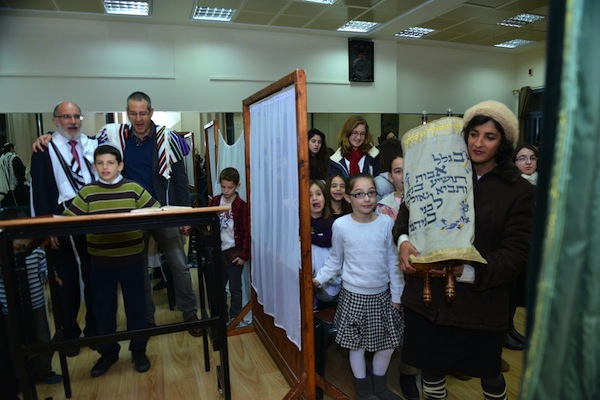
At Zemer Hazayit, a Modern Orthodox congregation in Efrat, when the Torah reading is finished, the scroll is passed from the men’s side to a woman who takes it through the women’s side. (photo from David Bollag)

Ten years ago, a group of people in a Modern Orthodox congregation in Efrat, a Gush Etzion settlement, decided they wanted women to be more involved in their synagogue services. The majority of the congregation was reluctant, however, so they set out to form a community of their own.

They consulted with Efrat’s chief rabbi, Shlomo Riskin, about the idea and, he said, “Listen, I don’t think it should be the only reason why you would start a new community – the position of women. Why don’t you also make it special in terms of prayer and make it kind of a song?” So, they named the community Zemer Hazayit (Song of the Olive). “There was strong contact with the head rabbi from the very beginning,” said Rabbi David Bollag, spiritual leader of Zemer Hazayit.

Bollag, originally from Switzerland, made aliyah 25 years ago. He has been with the community for the past eight years. He still flies home eight times a year to teach at two Swiss universities, the University of Zurich and the University of Lucerne.

“My field is Jewish philosophy, but I also teach some Jewish history, Bible, whatever they need in the institutes,” he said.

“Our congregation is Modern Orthodox. In Modern Orthodoxy, in almost every aspect of life, women are fully integrated and emancipated, and have almost the same role as men – socially, professionally, in politics and at home. They have the same rights, almost the same education possibilities.”

Ever since Zemer Hazayit opened its doors, the community has been growing. It has some 200 community members today. While this community is new to Efrat, there are many like it elsewhere.

“The process that is taking place is a slow development,” said Bollag. “More and more, laymen and rabbis realize the difference between normal life and religious life isn’t sitting well with most people.” While women are intellectually engaged at schools, workplaces and in politics, he said, “when it comes to religious life, they’re treated like second-class citizens, and they are just going to leave religion or consider it something primitive. For that reason, changes have to take place.”

While people see the need, they also understand that change takes time to be accepted. “That’s why the process is very slow, sometimes very painful – there’s a lot of opposition,” said Bollag.

The tensions and discussions are not only between their community and the rest of Efrat’s Modern Orthodox communities, but within Zemer Hazayit, as well.

“We definitely have people who are more progressive, who are interested in more changes, and others who are much less,” said Bollag. “Not only do we have to find the right balance between introducing new things and making sure we remain within the limits of Modern Orthodoxy, we also have to make sure we find the right balance that’s OK for everybody in our community.”

When Bollag was asked to be the community’s rabbi, one of the first things he wanted was to have an official meeting with members of other neighborhood synagogues. “I wanted to make sure to explain to them what we’re interested in doing, to make sure they would fully accept us,” he said. “They don’t have to agree with us, but I would like them to be accepting.”

photo - Women at Zemer Hazayit return the Torah scroll to the ark
Women at Zemer Hazayit return the Torah scroll to the ark. (photo from David Bollag)

Zemer Hazayit first gets Riskin’s blessing before implementing any proposed changes. So far, these changes have included splitting the prayer room in the middle from front to back, giving women equal access to the ark and, when the Torah reading is finished, the scroll is passed from the men’s side to a woman who takes it through the women’s side and then places it back in the ark.

“One of the main issues being discussed at the moment is whether or how women can read from the Torah,” said Bollag. “So, we have, about once in two months, a reading of the Torah by women, but just among women.”

At the moment, the opinion is that they cannot have women reading for men. “So, we separate for that reading – the women are in one place and the men in another,” said Bollag. “Women read for women. We usually also do that when there’s a bat mitzvah, as most of the girls are interested in reading Torah.

“Also, women say Kaddish – that goes without saying in our community – even if there is just a woman and no man.”

According to Bollag, the ordination of women in Reform synagogues has influenced Modern Orthodox congregations, as well, noting that these communities now will hire a woman as part of the discussion, including as a rabbi/spiritual leader.

“When they approached me about being the rabbi of this community, we made it very clear that it isn’t just me, but also my wife who will be very involved in leading our community,” said Bollag. “We also put a lot of emphasis on integrating children into the services as much as we can.”

Zemer Hazayit is currently raising funds to build a synagogue, as they have outgrown the room they have been using in a local school. For more information, visit buildzemerhazayit.org.

Rebeca Kuropatwa is a Winnipeg freelance writer.


Format ImagePosted on March 4, 2016March 3, 2016Author Rebeca KuropatwaCategories IsraelTags Bollag, Efrat, equality, Modern Orthodox, Riskin, women, Zemer Hazayit
Golda Meir lived her beliefs

Golda Meir lived her beliefs

Foreign Minister of Israel Golda Meir meets with U.S. President John F. Kennedy on Dec. 27, 1962. (photo by Cecil Stoughton, National Archives and Records Administration, via commons.wikimedia.org)

Few people reach the pinnacle of power in their country of origin. Even fewer born outside their country of residence climb all the way up the political ladder of their adopted country. Finally, almost no women attain the highest positions of any national government. Yet one woman defied all these societal norms to become the fourth prime minister of the state of Israel – Golda Meir.

Meir (1898-1978) was born in Kiev, Ukraine, raised in the United States and lived in Israel for 56 years. Her long Israeli political career began in America in 1918 when she attended a Philadelphia conference. She wrote in her autobiography, My Life (G. P. Putnam’s Sons, 1975), that she “sat for hours listening, completely absorbed … [in] the excitement of the debates and of being able to cast my own vote.”

This American right to voice an opinion was a value she treasured all her political life. Hence, even in her later power-wielding positions as Israeli government minister, ambassador and prime minister, she sought the views of people from all walks of life. She saw it her duty to leave the door open to common citizens and diplomats alike. Life in the United States had given her “an understanding of the meaning of freedom, and awareness of the opportunities offered to the individual in a true democracy.”

At the time of the above conference, she was 20 years old. Though she was already planning to move to Palestine, it is unlikely she envisioned becoming an Israeli prime minister, as no Jewish state existed then. In fact, she believed young people did not need to pick a profession they would follow, so much as they needed to pick the way they would behave. When, in 1971, she met with students from her old Milwaukee, Wisc., elementary school – then called Fourth Street School, today named after her – she advised: “It isn’t really important to decide when you are very young just exactly what you want to become when you grow up. It is much more important to decide on the way you want to live.” She suggested it was enough for a young person “to be honest [and] to get involved with causes which are good for others, not only for yourselves.”

She put words into practice. By age 11, she was already involved in her first public service project. With a friend, she formed the American Young Sisters Society. The group’s goal was to raise money for youngsters who had difficulty paying for schoolbooks. With her school friends, she painted posters, held community meetings and raised the much-needed funds.

This obligation to assist others was a major part of Meir’s life. In Israel, her goal was to achieve social equality for all people, and she insisted that this would not happen unless she had the help of all citizens. She asserted that people of lesser means must not sit back and be “passive,” that they had to speak up for themselves and work to better their life situation. On the other hand, she held that people of greater means had to work to close the social and economic gaps. She believed that, for everyone’s lot to improve, there had to be a sharing of responsibility.

Still, Jewish-American feminist Letty Cottin Pogrebin criticizes Meir for not specifically advancing the case of women. On the Jewish Women’s Archive website, Pogrebin writes in the section on Meir: “She was, in current parlance, a ‘queen bee,’ a woman who climbs to the top, then pulls the ladder up behind her. She did not wield the prerogatives of power to address women’s special needs, to promote other women or to advance women’s status in the public sphere. The fact is that, at the end of her tenure, her Israeli sisters were no better off than they had been before she took office.

“Just as some Jews choose not to be Jewish-identified because they think they have the option to behave as if peoplehood doesn’t matter, Golda Meir chose not to be woman-identified and behaved as if gender doesn’t matter. But, of course, when one is Jewish and female, both facts matter.”

Meir’s career came to a relatively inauspicious end. After the Yom Kippur War, which was fought while Meir was prime minister, the government’s actions were questioned. Although the official investigation committee did not blame her for what had happened, she decided to resign. When she announced she was quitting in 1974, she said: “Five years are enough. I have come to the end of the road. It is beyond my strength to continue carrying the burden.” (reprinted in Front Page Israel: Major Events as Reflected in the Front Pages of the Jerusalem Post, edited by Ari Rath and Erwin Frenkel)

She later wrote that, while she did not feel guilty, she felt responsible for not having mobilized troops earlier in that conflict. She came to believe that she should have rejected the assessment of her military and intelligence staff. She writes in My Life: “That Friday morning, I should have listened to the warnings of my own heart and ordered a callup. For me, that fact cannot and never will be erased, and there can be no consolation…. I know that I should have done so, and I shall live with that terrible knowledge for the rest of my life. I will never again be the person I was before the Yom Kippur War.”

After 60-plus years of public service, Meir did what she had been doing since she lived in the United States. She listened to what people in the street were saying about the government’s actions, and she took responsibility for those actions.

Deborah Rubin Fields is an Israel-based features writer. She is also the author of Take a Peek Inside: A Child’s Guide to Radiology Exams, published in English, Hebrew and Arabic.

photo - In New York City, there is Golda Meir Square
In New York City, there is Golda Meir Square. (photo by Billy Hathorn (talk) via commons.wikimedia.org)

More on Meir

Looking at the current state of Golda Meir’s former places of residence, one could say they reflect the mixed feelings Israelis harbor toward her. On the one hand, not too long ago, northern Kibbutz Merchavia turned her first apartment into a small museum. Southern Kibbutz Revivim, moreover, established the Golda Meir Cultural Centre and the Golda Meir Memorial Wing, as Meir was a founding member of the kibbutz.

Her later Ramat Aviv apartment, however, stands derelict – a grimy plaque mentions she once lived there and the guard post, which once protected her, stands abandoned. Meir’s home while prime minister – the home that once served as the official residence for

photo - Golda Meir has been commemorated in Israel in various ways, including on the new sheqalim banknote in 1992, as well as in other countries
Golda Meir has been commemorated in Israel in various ways, including on the new sheqalim banknote in 1992, as well as in other countries. (photo by Berlin-George via commons.wikimedia.org)

Israel’s prime ministers – has fared a little better, perhaps because this prime piece of real estate is looking for a suitable buyer. While living at 46 Ben Maimon (Rambam) St., Meir customarily invited members of her inner cabinet – what became known as the “Kitchen Cabinet” – for advance briefing. She prepared the coffee and cake.

* * *

Interviewed in 1973 for Ms. Magazine, Meir said: “Fashion is an imposition, a rein on freedom.” She wore sturdy, black, tie shoes with a thick low heel. In the early days of statehood, women soldiers wore similar shoes. They became known as “Golda shoes.”

– DRF

Format ImagePosted on March 4, 2016March 3, 2016Author Deborah Rubin FieldsCategories IsraelTags feminism, Golda Meir, Israel, Letty Cottin Pogrebin
שרנסקי תומך בפדרציה על החלטתה

שרנסקי תומך בפדרציה על החלטתה

נתן שרנסקי (צילום: Nathan Roi via Wikimedia Commons)

הפדרציה היהודית של אזור ונקובר ממשיכה לקבל תמיכה רחבה לאור החלטתה לקיים את המופע של הזמרת אחינועם ניני, במסגרת חגיגות יום העצמאות. עתה מתברר שראשי הסוכנות היהודית בישראל שלחו אגרות ברכה לפדרציה על שהזמינה את ניני ליום העצמאות. יו”ר הנהלת הסוכנות, נתן שרנסקי, שלח אגרת אישית למנכ”ל הפדרציה, עזרא שנקן. שרנסקי מצדיע לארגון על פעילותו הענפה והישגיו למען הקהילה היהודית של ונקובר וכדי לתמוך בצורה איתנה בישראל. שרנסקי אומר: “באופן טבעי בישראל ובעולם הרחב יש הרבה דעות וויכוחים צורמים על הדרך הנכונה לשלום. אבל בשום מקרה איננו יכולים להרשות לעצמנו שהדעות השונות יחתרו ויפגעו בערכי הליבה שמאחדים אותנו, ברצוננו להגיע עתיד יהודי חזק עם מדינת ישראל יהודית ודמוקרטית במרכז. דווקא בימים קשים אלה כשאויבים מבחוץ שואפים לעשות דלגיטימציה לישראל, חייב להיות מקום למגוון דעות רחב”. לסיום דבריו מוסיף יו”ר הסוכנות: “כמו אחד שלעתים קרובות היה לו העונג להינות מהקול היוצא דופן של נועה בעלת הכישרון המרהיב, אני משבח את הפדרציה של ונקובר ואני יודע שחגיגות יום העצמאות שלכם יהיו נפלאות”. ואילו מנכ”ל הסוכנות, אלן הופמן, מציין באגרת שלו כי הסוכנות תומכת בפדרציה של ונקובר על שהזמינה את נועה להופיע ביום העצמאות. לדבריו: “קנדה וישראל חולקות את אותם ערכים דמוקרטיים המאפשרים מגוון רחב של דעות, כולל גילויים מגוונים של ציונות. דיאלוג כולל על ישראל הוא בליבה של מאמצי הסוכנות היהודית לבנות עתיד יהודי משגשג וישראל חזקה”.

הפדרציה קיבלה כאמור אגרות תמיכה רבות על הזמנתה של ניני להופיע בוונקובר, בין היתר ממנכ”ל הפדרציה של ונקובר לשעבר, מרק גורביס, שמשמש כיום סגן נשיא בכיר של הפדרציות היהודיות בצפון אמריקה, ראשי הפדרציות היהודיות של קנדה ורבנים.

שנקן אומר כי דברים מדהימים קרו בשבוע האחרון, בהם למשל ההכרזה ששגרירות ישראל והקונסוליה הישראלית יתנו חסות רשמית לאירוע יום העצמאות בוונקובר. שנקן: “הייתי בר מזל על כך שנפלה בידי ההזדמנות לדבר עם אנשים רבים אשר חולקים אהבה עמוקה למדינת לישראל, כולל חברים בקהילה שלנו, רבנים שלנו וראשי ארגונים יהודים ברחבי העולם. כל אחד מהם מראה בדרך המגוונות שלו כיצד הם אוהבים את ישראל, וכל אחד מראה באופן מדהים כיצד הם חולק את אותה אהבה לקהילה שלנו. אנו גאים בהם שהם תומכים בקהילה שלנו”.

הפדרציה היהודית גייסה למעלה משמונה מיליון דולר בקמפיין האחרון

הפדרציה של מטרו ונקובר גייסה 8.3 מיליון דולר בקמפיין האחרון לשנת 2016. בפועל גיוסו כשלוש מאות אלף דולר יותר לעומת הקמפיין של אשתקד. בפדרציה מסבירים את החשיבות שבגיוס הכספים מהקמפיין: “יש להאכיל את הרעבים, לטפל בזקנים ולטפח את הדור הבא”. בפדרציה מודים לתורמים על המחויביות שלהם לקהילה, לערכים של חסד לתיקון עולם ולצדקה. תוצאות הקמפיין מאפשרות לפדרציה ולארגונים השונים להגיע לרבים יותר בקהילה ולהגיב בצורה יעילה יותר מתמיד לצרכי הקהילה.

יו”ר הפדרציה, סטיבן גרבר, אומר: “העלות הגבוהה של החיים בוונקובר מגבירה את הקשיים של החברים רבים בקהילה להתקשר עם החיים היהודים, משתי סיבות עיקריות. או שהם אינם יכולים להרשות לעצמם לגור קרוב לתוכניות ולשירותים יהודיים, או אינם יכולים להרשות לעצמם להשתתף בהם. גיוס הכספים מתייחס לסוגיות כמו אלה, מאפשר לבנות קשרים בין חברי הקהילה לבין אזורי השותפות שלנו בישראל ומסייע ליהודים במצוקה ברחבי העולם”.

Format ImagePosted on March 1, 2016Author Roni RachmaniCategories עניין בחדשותTags Achinoam Nini, affordability, annual campaign, Gaerber, Gurvis, Hoffmann, Jewish Federation, Noa, Shanken, Sharansky, Yom Ha'atzmaut, אחינועם ניני, גורביס, גרבר, הופמן, הפדרציה היהודית, יום העצמאות, קמפיין, שנקן, שרנסקי
LEAF works for equality

LEAF works for equality

Michele Landsberg and her daughter, Ilana Landsberg-Lewis. (photo from West Coast LEAF)

Michele Landsberg and her daughter Ilana Landsberg-Lewis laughed and spoke over each other in an animated joint telephone interview with the Jewish Independent. The two women, who are among Canada’s most influential activists, agreed more than they disagreed, and their ideas and opinions flowed and meshed in a way made possible perhaps only through a lifetime of dialogue.

The mother-daughter duo will be keynote speakers at West Coast LEAF’s Equality Breakfast March 11. West Coast LEAF was founded in 1985, alongside its sister organization, the Women’s Legal and Education Action Fund (LEAF National), to ensure that the promises contained in the Canadian Charter of Rights and Freedoms would become a reality for women in British Columbia. West Coast LEAF’s founders recognized that there would be challenges and great potential in putting the abstract legal rights of Section 15 (the equality provision) into action through the courts. The annual Equality Breakfast generally falls around International Women’s Day, which is May 8.

Landsberg is a writer and social activist who wrote for the Globe and Mail and Chatelaine before a 25-year run as a columnist for the Toronto Star. An officer of the Order of Canada, Landsberg’s name is synonymous with feminist perspectives on Canadian and global events.

Landsberg-Lewis is a labor and human rights lawyer. She is the executive director of the Stephen Lewis Foundation, which she co-founded with her father, the former leader of Ontario’s New Democratic party, who also served as Canada’s ambassador to the United Nations. The foundation works with grassroots organizations in sub-Saharan Africa to turn the tide of the AIDS pandemic.

Landsberg-Lewis said she never felt any pressure to go into the family business. In addition to her mother’s writing and activism and her father’s political and diplomatic career, her grandfather David Lewis was leader of the federal NDP.

“There was always interesting and lively conversation,” she said. “Whatever column Mom was writing, whatever Dad was doing … all three of the kids, but I was the eldest, were encouraged to be part of that thinking and lively debate. Yes, I landed very firmly a millimetre away from the tree but, if you ask me, that was the right place to be.”

In her work with her father, Landsberg-Lewis sees the catastrophic advance of AIDS in Africa, but is also inspired by the responses of women who are, she said, “the most affected and infected” by the disease.

“They’re bearing the brunt of the apocalypse of AIDS, they are raising the children, they are pulling their communities together, they are the ones who are trying to effect change, they are the ones who are most adversely affected by discriminatory laws and, on that level, it’s pretty grim,” she said. On the other hand, she continued, despite global funding for fighting AIDS flatlining, affected women are stepping up.

“Take the grandmothers, for instance, who are raising 17 million orphaned children, who were living in isolation, stigma, absolute abject poverty, and were terribly grief stricken because of the loss of their adult children, and they get up the next morning and they look after all these kids. And more than that now – you see that they are beginning to run for local councils and land rights councils and they’re pushing for pensions and pushing for better health care for older women, and so there’s a groundswell of demands for their own rights to be recognized,” she said. “The world is being negligent. This is not surprising or unusual when it comes to women, but the women themselves, as usual, are not waiting for that support, they’re just making it happen.”

Back in North America, a whole different type of change is happening, both mother and daughter agree. Feminists who remember the fights of the 1950s and ’60s are coming up against a generation of young women with a very different idea of what equality and feminism mean. The recent comments by former U.S. secretary of state Madelaine Albright and feminist icon Gloria Steinem, who is a friend of Landsberg’s, nearly led to inter-generational warfare on social media.

Steinem apologized for her comment that young women are abandoning Hillary Clinton’s campaign for Bernie Sanders’ “because that’s where the boys are.” Landsberg blames a grueling book tour and Steinem’s emphatic support for Clinton for the comment, but added she thinks Steinem was getting at an important point when she misspoke.

“I think she meant that young women are still swayed by the power dynamics of our very gendered system, our gendered culture,” said Landsberg. “Boys have more clout and presence in the political world and young women tend to take their cues from them still, quite often, not always, obviously. I think that’s what she meant: that they are swayed by young men’s enthusiasm for Bernie.”

Landsberg-Lewis interjected, contending that the division between Clinton and Sanders supporters is based on ideology more than gender.

Landsberg, who admits she has never shared her friends’ enthusiasm for Clinton, leapt on Albright’s comment, “There is a special place in hell for women who don’t help other women.”

“If we really want to get it right, her quote is misguided,” Landsberg said. “It should be ‘there’s a special place in hell for women who don’t support feminist women.’ Not just any woman, because there was [British prime minister Margaret] Thatcher.”

Clinton, Landsberg said, is “not the kind of woman we can look to to undo the power that has oppressed many, many people.… She is part of the establishment, she is backed by Wall Street, she has endorsed many wars and would endorse more wars as president.”

The rise of Sanders, the democratic socialist whose campaign bills itself as a movement for change, is a good sign on several fronts, say the two. Feminism, among other movements, has struggled in the face of American individualism. This is something that differs in Canada, they agreed, but may signal a revival of movement feminism as more Americans hear Sanders’ message of shared responsibility.

“He’s talking about collective responsibility for changing the situation of women, collective power in collective action and vision,” said Landsberg-Lewis. “And I think that’s an extraordinarily powerful antidote to the individualism that has, I think, for young women – not all young women, not all the time – but has eclipsed the sense of feminism as really being about a movement as opposed to individual power.”

Moving to Canadian politics, mother and daughter both expressed optimism.

“I think the whole country woke up the day after the election and realized that that bad headache they’d had for 10 years was gone,” Landsberg said, laughing. “I think we had a nationwide depression under that grim regime and people felt a sense of relief that we had a new beginning.”

She’ll be watching the new government’s approach to a national child-care plan and worries that Trudeau may be too insulated in the world of “nannydom” to understand that affordable child care is key to women’s equality.

“It is very exciting to have a prime minister who runs around calling himself a feminist,” said Landsberg-Lewis. “I think that that is not a small thing. It’s a first time thing and it’s a big deal.”

“I am thrilled Michele and Ilana are coming together for our Equality Breakfast,” said West Coast LEAF interim executive director Alison Brewin. She said, “The fact that they are mother and daughter reflects the intergenerational nature of the fight to advance women’s equality. West Coast LEAF uses the law to make change, but the work comes in waves that catch and move mothers and daughters, fathers and sons – Michelle and Ilana represent our national struggle for justice.”

Tickets for the West Coast LEAF Equality Breakfast March 11, 7 a.m., at Fairmont Hotel Vancouver are $90 (tax receipt for eligible portion) from 2016equalitybreakfast.eventbrite.ca.

Format ImagePosted on February 26, 2016February 25, 2016Author Pat JohnsonCategories LocalTags Alison Brewin, Charter of Rights and Freedoms, equality, feminism, Ilana Landsberg-Lewis, justice, Michele Landsberg, West Coast LEAF
Miller’s urgency to create

Miller’s urgency to create

Gallim Dance performs the Canadian première of Wonderland at Chutzpah! March 10-13. (photo by Yaniv Schulman)

Gallim Dance’s Wonderland premières in Canada at the Chutzpah! Festival March 10-13. It was inspired by artist Cai Guo-Qiang’s Head On, which is an awe-inspiring installation even when viewed only in photos. Ninety-nine wolves run into the sky, an arc of animals intent on moving forward and fast – right into a glass wall.

“I like this dance very much, which isn’t true of all my earlier works,” Andrea Miller, Gallim Dance founder and artistic director, told the Independent. “It’s the first of my works that I built like a story. It’s an absurdist narrative but a story nonetheless. I created four archetypal characters that depict the dangers of pack mentality. I use a broad range of music, from the Chordettes’ 1954 ‘Mr. Sandman,’ to Chopin, to indie singer-songwriter Johanna Newsom, to minimalist electronic music inspired by the circus.

“Seeing Head On at the Guggenheim Bilbao consolidated my mixed feelings about the war in Iraq,” she added. “As I was looking at the installation, I was making the dance in my head.”

The archetypes are “the fool, death, the lovers and Cassandra,” according to Gallim’s website. They “evolve in a universe influenced by the imagery of the American atomic age. Behind the smiles of an Esther Williams dream world, Wonderland reveals psychological and physical episodes of a herd acting as a unit through the uncoordinated behavior of self-serving individuals. Although pack mentality is a natural and ongoing strategy in the animal kingdom, among humans it can indicate a vicious, desensitized brutality and disregard for humanity – a concept that is at the core of Wonderland.”

Head On was part of Cai’s first solo show in Germany, at the Deutsche Guggenheim in Berlin in 2006. While communicating a universal message, the danger of people blindly following others, among its themes are the rise and fall of Hitler – Wolf’s Lair was one of Hitler’s headquarters – and the rise and fall of communism, as symbolized by the Berlin Wall.

Such heady source material is not unusual for Miller. The writings of Raymond Carver and Albert Camus, for example, were inspirations for Fold Here and Sit, Kneel, Stand, respectively.

“I used to read a lot,” said Miller, “but now I feel like I’ve replaced books with work emails and video. I’m currently in a literary desert, but I love reading. Anything can inspire me, not just books; I’m available for being influenced and inspired by what I live and see happening to people in the world.”

Mama Call was directly related to her Sephardi heritage.

photo - Gallim Dance founder and artistic director Andrea Miller
Gallim Dance founder and artistic director Andrea Miller. (photo by Peggy Jarrell Kaplan)

“I grew up in a Conservative Jewish home. My father grew up Orthodox and eventually became atheist and my mother was Catholic and converted to Judaism,” she said about her background. “Because we lived in Salt Lake City, one could feel, as Jews, like we were in a minority and the synagogue became a really important place for feeling part of a community. I guess because of that, Judaism has always been a strong presence in my life. I currently attend Shabbat services with my two children whenever we aren’t on tour. We also attend Catholic services with my boyfriend, their father. Truthfully, I can’t exactly delineate the contours of what is exactly Jewish in me, but I feel that it is a latent presence in my life. In any case, that’s ultimately a personal circumstance; everybody has their own personal circumstances.

“I feel that, in order to relate to humanity, to each other, to art, we must understand that our personal circumstances are just departure points, which we should be ready to transcend. In this sense, I am more drawn to the universal human condition than restricting my artistic research to my personal circumstances, whatever they may be (nationality, age, cultural background, ethnicity or spiritual beliefs). Mama Call began its inspiration with the Jewish Diaspora and eventually became a story of home for any immigrant or displaced person.”

Miller’s professional journey began in Salt Lake City at the Children’s Dance Theatre, which was developed by a Doris Humphrey disciple, she explained. “The philosophy behind the training was in discovering movement through improvisation and dramatic play, and I loved it.

“We moved to Connecticut when I was 9 and, by pure coincidence, I ended up dancing with another Humphrey master, Ernestine Stodelle, and learned the technique and repertory of Doris Humphrey and Charles Weidman. At that time, I became sort of a young expert in pioneering modern dance, hungry to interpret the works of [Martha] Graham, [José] Limón and choreographers of that era.

“I got into Juilliard, which baffles me to this day considering I had very little ballet training. In my first year at Juilliard, the director Benjamin Harkarvy would work often with me, imploring me to undo myself, my body, from the 1930’s esthetics. It took a year of identity crisis and it was then that I started obsessing over living choreographers and contemporary art. I met Ohad Naharin at Juilliard and, after graduating, joined the ensemble Batsheva.”

It was during her time with Batsheva, she said, that “choreography changed from a passion to an urgency.” When she left the ensemble, she started creating her own work. Back in New York, she founded Gallim in 2007.

“Early rehearsals of the company were at Juilliard between 9 p.m. (when the students typically had to leave the studios to rest) and midnight,” she said. “My first piece was a quarter evening called Snow. I made it for a performance by video application at Joyce SoHo. It went well and they invited us back for a solo week for which I created my first full evening, I Can See Myself in Your Pupil. After that, we were invited back for two weeks, where we repeated Pupil and premièred Blush. Ella Baff from Jacob’s Pillow saw it and booked it for the summer festival. Everything started moving from there. The next year, we were asked to open Fall for Dance and perform at the Joyce.”

Gallim Dance has become an internationally renowned company. Miller has won multiple honors and her work has been commissioned around the world. Also of note is the company’s financial viability and continued growth. According to its 2014 annual report, that year ended “with a balanced budget just over $700,000 and an increase in net assets of more than $46,000.” In addition to looking after itself, the company invests in community programs in its Brooklyn neighborhood and beyond.

“I don’t feel I have any innate talent in the hard skills of business but I seem to have an intuition for the soft ones,” said Miller when asked about her apparent business savvy. “One of my understandings for both my business and my choreography is that progress is incremental and incremental steps take giant leaps of creativity, risk, strategy, planning and commitment. I think I have a combination of chutzpah and common sense that helps me push us forward without threatening our sustainability. I’ve learned a lot about leadership and business from my dancers, staff and board.”

Early in the company’s history, Miller articulated her vision for Gallim Dance: “to play inside the imagination, to find juxtapositions in the mind and body that resonate in the soul, to investigate our limitations and pleasures, and to realize the endless human capacity for inspiration.”

“It describes where everything begins for me and how I relate to all art, not just mine,” she told the Independent. “I think this vision captures both the values I hold for the process of making dances, as well as the larger impetus for making dances at all.”

Gallim Dance performs Wonderland March 10-13, at Rothstein Theatre. For tickets ($29/$25/$21), call 604-257-5145 or visit chutzpahfestival.com.

Format ImagePosted on February 26, 2016February 25, 2016Author Cynthia RamsayCategories Performing ArtsTags Andrea Miller, Cai Guo-Qiang, Chutzpah!, Gallim Dance, Wonderland
Mixed reaction to Nini

Mixed reaction to Nini

Achinoam Nini at the 21st UNESCO Charity Gala 2012 in Dusseldorf, Germany. (photo by Michael Schilling via commons.wikimedia.org)

The Jewish Federation of Greater Vancouver’s invitation to Israeli singer Achinoam Nini (Noa) to perform at the community’s Yom Ha’atzmaut celebrations has received mixed reactions, including a withdrawal of support for the event by Jewish National Fund of Canada, Pacific Region.

In a Feb. 18 statement, JNF Canada chief executive officer Josh Cooper said the organization would be taking a one-year hiatus from its tradition of sponsoring the Yom Ha’atzmaut event “due to the views of the entertainment booked for this year’s celebration. The entertainer that has been hired does not reflect nor correspond to the mandate and values of the Jewish National Fund of Canada.” When pressed to answer where, specifically, Nini diverged from JNFs mandate, Cooper said he had “nothing further to add.”

Among the many Jewish community partners in a Jewish Federation of Cincinnati-sponsored performance by Nini and Mira Awad in June 2015 was JNF, and JNF was one of the sponsors of a Nini and Gil Dor concert in Atlanta less than two weeks ago. About the different mandates and values of JNF Canada and JNF USA, Cooper said “JNF/KKL has offices in 48 countries. While we all work together in Israel, we operate independent of each other in our respective countries.”

Jewish Federation of Greater Vancouver issued a statement saying the organization was “disappointed” by JNF’s decision to withdraw support: “JNF has been a valued sponsor of our Yom Ha’atzmaut celebration for many years, and we look forward to welcoming them back next year.”

In a Feb. 20 article, the world chair of Keren Kayemeth LeIsrael (KKL)-JNF, Danny Atar, told Haaretz that he was against JNF Canada’s withdrawal of support over Nini’s views, saying, “I intend to express my opinion on the decision directly to the leadership of JNF Canada at a meeting we will be having shortly in Israel.”

Locally, Nini’s scheduled appearance is drawing strong reactions from some community members.

Richmond resident Arnold Shuchat expressed his “complete opposition to the decision to engage the controversial artist” in a Feb. 18 letter to Ezra Shanken, chief executive officer of the Jewish Federation of Greater Vancouver, and to its board of directors. “The purpose of a Jewish community event should be to marshal and unify our community as opposed to fragment it,” he wrote. “It had to be obvious to any reasonable person who might have investigated her political positions that she would be a polarizing figure to many in the community. This decision is a regressive and irresponsible one and should be reversed as quickly as possible to prevent damage to both the reputation and fundraising ability of our Federation.”

René Ragetli, also from Richmond, agreed. “I think she’s a divisive figure and it’s a big mistake to have her here, especially for Yom Ha’atzmaut. She’s said some outrageous things – called our leaders fascist thugs and expressed admiration of Mahmoud Abbas. The woman is not balanced,” he said. “Her bringing comfort to the widow of a terrorist at an event to honor the Israeli fallen – it’s insulting. Sure, people are entitled to their own opinions, but having her on the stage for Yom Ha’atzmaut degrades the event. This is a storm that’s not going away, and a mistake that needs to be corrected.”

An online petition titled “Stop Achinoam Nini from performing at our Yom Ha’atzmaut celebration” had almost 400 signatures at the time of publication. Cynthia Ramsay, publisher of the Jewish Independent, said she has received several letters and emails about Nini.

“Every person who’s tried to get me to run a letter or has cc’d me on an email to Federation has the exact – and I mean exact – same two points: she supports B’Tselem and Breaking the Silence, and she’s anti-Israel or pro-BDS,” Ramsay said. (See “Let’s talk about Nini…” by the JI editorial board.) “No one has provided any evidence, not even a Jerusalem Post quote, to support their allegations, some of which are even nastier and also with zero proof. Because of the wording of most people’s emails/letters, I think it’s a chain reaction, everyone’s just repeating what they’ve heard from someone else without doing any research of their own. The main concern seems to be about BDS and she is against BDS from what I’ve read.”

Shuchat said the issue with Nini was not about BDS. “This has been very divisive because she’s very controversial, she’ll offend a lot of people and it was very foreseeable that this would happen. She’s polarizing so it was a dumb decision to invite her. Mainstream media are going to see this and say, ‘Look at all these heebs fighting with each other!’ Federation should cancel the engagement and focus on building a cohesive community.”

Ramsay disagreed. “I think it would be very sad if Federation withdrew its invitation or if Nini declined it because of the controversy it’s causing, which, I think, is unmerited.”

A Feb. 22 letter to Federation board chair Stephen Gaerber signed by more than 30 Israeli Canadians also urged “Federation to stick to the invitation.” It notes that “the current political climate in Israel condemns every person who advocates for peace and human rights, and campaigns, such as the recent one by Im Tirzu and other similar extremist groups, single out progressive artists, including Amos Oz and David Grossman to name a few.

“By canceling the invitation of Achinoam Nini to perform in Vancouver,” the letter continues, “we will not only be missing the opportunity to experience a great musician, it will also mean taking a stand against everything Vancouver and Canada is proudly known for, our belief in tolerance, pluralism, human rights, these same core values as they are reflected in our Jewish heritage. Here in Vancouver we must not get entangled in the type of intimidation that is going on in Israel. If the opportunity to bring her is missed due to politics, it sends a terrible message and may create rupture in the local Jewish community and will distance plural and liberal people like us from it.”

Lauren Kramer, an award-winning writer and editor, lives in Richmond. To read her work online, visit laurenkramer.net. A version of this article was published by Canadian Jewish News.


Format ImagePosted on February 26, 2016February 25, 2016Author Lauren KramerCategories LocalTags Achinoam Nini, Arnold Shuchat, Cynthia Ramsay, Danny Atar, Jewish National Fund, JNF, Josh Cooper, Noa, René Ragetli, Yom Ha'atzmaut
Holocaust awareness

Holocaust awareness

The Post-Survivor Exhibit in Mystic Market, one of the busiest spots on campus. (photo by Chorong Kim)

The following remarks have been modified from the original address given during Hillel Victoria’s Second Annual Holocaust Awareness Presentation during Holocaust Awareness Week, which took place at the University of Victoria Jan. 25-29.

When my co-organizer, Dr. Kristin Semmens in the history department at the University of Victoria, and I embarked on planning Holocaust Awareness Week, we decided to put a call out for poster submissions to include in the Post-Survivor Exhibit to be publicly displayed in Mystic Market, one of the busiest spots on campus. The aim was to feature personal stories of post-survivors – UVic students who are descendants of Holocaust survivors – and we welcomed submissions from survivors of other genocides and atrocities. We thought that, between all the Jewish students and the diverse student body, we would be overflowing with submissions and would struggle to select 20 stories to include in the exhibit. As it turned out, our struggle was to get any submissions at all. Why am I sharing with you our experience of failed expectations? Well, it’s quite simple. This has been a learning experience for us, just as much as it has been for the students we approached to participate in the exhibit.

Many of the Jewish students said they knew very little about their grandparents or their survival story, and felt they didn’t have enough to write personal reflections about it. I was coming from the point of the view that you can write about “not having enough to write about” and attribute that to the implications of being a descendant of a survivor and the negative effects of post-Holocaust syndrome (a form of transferable post-traumatic stress disorder). Others didn’t want to share their story in public and recommended that we ask people to submit anonymously; some were too scared to be identified as Jews on campus. Both Kristin and I were not surprised by the reasons we received but, as advocates of Holocaust awareness and education, we thought the students could overcome their fear and disassociation from their family’s past.

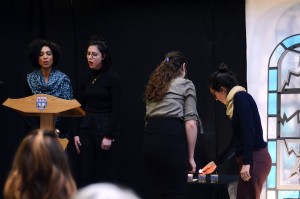
photo - Dr. Orly Salama-Alber, left, and Hannah Faber sing “Mi Ha’Ish,” while Cheryl Noon, left, and Kaitlin Findlay light the second candle
Dr. Orly Salama-Alber, left, and Hannah Faber sing “Mi Ha’Ish,” while Cheryl Noon, left, and Kaitlin Findlay light the second candle. (photo by Chorong Kim)

As a granddaughter of Holocaust survivors from Poland (and today Belarus) on my mother’s side and a granddaughter of interned Japanese-Canadians on my father’s side, I can tell you that there are two types of survivors. Those who talk and those who don’t. My maternal safta (grandmother) spoke about the Holocaust and would tell everyone that the only reason she survived was because of her blond hair and blue eyes, whereas, my other three grandparents chose to never talk about what happened to them. So much so, that my Japanese bachan and gichan (grandmother and grandfather) completely abandoned their Japanese heritage and opted to raise their children with English names and, tragically, my maternal saba (grandfather) couldn’t even recall the names or faces of his murdered first wife and baby girl. That’s how he dealt with his past.

I only know about my histories because I wanted to know about them and I asked questions. That got me thinking, how can I ask students to write about their stories if they haven’t gone through this process of asking yet? And who am I to pressure them to do so? I know now that I may have asked too much of the students. Perhaps we are not as ready as I thought to share our stories, let alone share them collectively as an international community.

I thank the handful of students who did send in poster submissions for their bravery in sharing their stories. Each one was on a different page in their personal journey to coping and understanding their family or nation’s past. Some already knew all the details while others had to ask their families for help in obtaining old photographs and putting all the bits and pieces of their grandparents’ stories together into one cohesive personal reflection. One of my students wrote to me on Facebook, “I just found out a ton of information that I didn’t know before, and I’m still kind of processing it”; another texted me saying that, although they have decided not to submit a story, this has started a personal desire to find out more about their family’s history. Coming to terms with the past is not easy, we all need healing and we all have the right to look to a brighter future.

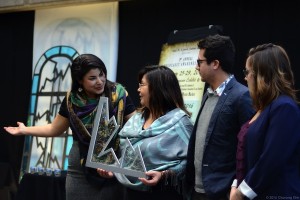
photo - Carmel Tanaka with, left to right, Dawn Smith, Thomas Laboucan-Avirom and Rachelle Trenholm of the Indigenous Law Students Association
Carmel Tanaka with, left to right, Dawn Smith, Thomas Laboucan-Avirom and Rachelle Trenholm of the Indigenous Law Students Association. (photo by Chorong Kim)

This weeklong exhibit and the presentation today have already served their purpose – Holocaust awareness. It was not smooth sailing organizing this event. The Holocaust is a very sensitive subject and everyone has their views on how to approach Holocaust education. I am very moved by the outpouring of support from participating organizations in our very diverse community. May this be an example of collaboration, tolerance, compassion and love towards our ultimate goal: peace on this campus, in our community and around the world.

Traditionally, during Holocaust commemorations, six memorial candles are lit to represent the six million Jewish lives lost in the Holocaust. Today, we have chosen to light seven memorial candles, to be lit by UVic students representing various communities and causes, with our seventh candle symbolizing our hope. Performing “Mi Ha’Ish” is post-doctoral fellow Dr. Orly Salama-Alber, accompanied by Hannah Faber, the volunteer coordinator of UVic’s Jewish Students Association, and the same song that has been incorporated into our gift to Dawn Smith, who performed the First Nations acknowledgement earlier. In English, the lyrics read: “Who desires life, loving each day to see good? Then guard your tongue from evil and your lips from speaking deceit. Turn from evil and do good, seek peace and pursue it.” (Psalm 34:12-4)

Our first candle will be lit by undergraduate students Shelly Selivanov, Paige Gelfer and Anat Kelerstein and master’s student Keenan Anthony, grandchildren of Holocaust survivors, and they will be lighting on behalf of the six million Jews who perished in the Shoah.

Our second candle will be lit by I-witness Field School student Cheryl Noon and history graduate student Kaitlin Findlay on behalf of all other persecuted victims of the Holocaust.

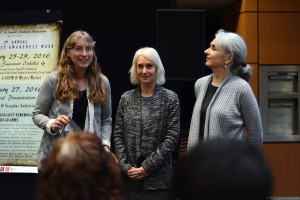
photo - Holocaust educators at UVic, left to right, Dr. Helga Thorson, chair, Germanic and Slavic studies department; history professor Dr. Kristin Semmens; and Dr. Charlotte Schallié, co-chair of the European Studies Program
Holocaust educators at UVic, left to right, Dr. Helga Thorson, chair, Germanic and Slavic studies department; history professor Dr. Kristin Semmens; and Dr. Charlotte Schallié, co-chair of the European Studies Program. (photo by Chorong Kim)

Our third candle will be lit by international students Moe Ezzine and Abbie Urquia, who are members of the African Awareness Club, on behalf of all the victims of genocide, including, but not limited to, the Armenian genocide, the Rwandan genocide, the Ukrainian genocide and, more recently, the Syrian genocide.

Our fourth candle will be lit by student advocates Lane Foster and Maks Zouboules from the Sexualized Violence Task Force on behalf of all victims of sexualized violence on and off campus.

Our fifth candle will be lit by undergraduate student Nicola Craig Hora and graduate student Lauren Thompson, who are co-designing a teaching unit on the Holocaust for high school students, on behalf of all the children whose lives were cut short and were robbed of their bright futures.

Our sixth candle will be lit by members of the Indigenous Law Students Association, Thomas Laboucan-Avirom and Rachelle Trenholm, on behalf of all victims of residential schools and Japanese internment camps here in Canada.

Our seventh and final candle, our candle of hope, will be lit by Multifaith Services work-study students Olivia Bos and Gabriela Turla, on behalf of all humanity, regardless of their race, religion, creed and sexual orientation.

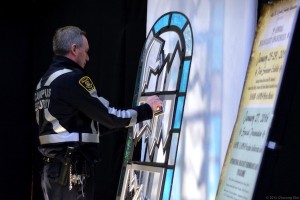
photo - Team leader Mike Brosselard from Campus Security
Team leader Mike Brosselard from Campus Security. (photo by Chorong Kim)

On stage, between the candles is our broken window. This window is shattered and represents Kristallnacht, the night of Nov. 9, 1938, on which a massive coordinated attack on Jews occurred and swept across Europe, marking the beginning of the Holocaust. This night is otherwise known as the Night of Broken Glass. Throughout this presentation, we will be reclaiming the broken pieces of glass and rebuilding this very window in a communal act of resilience.

The eight window pieces were placed by members or representatives of the following groups: 1) First Nations community; 2) UVic Multifaith Services; 3) Jewish Federation of Victoria and Vancouver Island; 4) UVic Holocaust educators; 5) Campus Security; 6) student leaders (Jewish Students Association, Indigenous Law Students Association, History Undergraduate Society, Multifaith Services work-study students, Germanic and Slavic studies students, I-witness Field School students, and student advocates from African Awareness Club and Sexualized Violence Task Force); 7) UVic administration (Equity and Human Rights Office); and 8) children of Holocaust survivors and members of the Kristallnacht planning committee.

It takes a community to overcome trauma and rebuild a peaceful future. It also takes a community to prevent trauma from happening in the first place.

Carmel Tanaka is the Hillel BC director at the University of Victoria, a granddaughter of Holocaust survivors and an advocate for Holocaust awareness.

Format ImagePosted on February 26, 2016February 25, 2016Author Carmel TanakaCategories LocalTags Hillel BC, Holocaust, UVic
The West Coast style

The West Coast style

Oberlander Residence II, Vancouver. Peter Oberlander and Barry Downs, architects, 1969. Photograph by Selwyn Pullan, 1970. Courtesy of West Vancouver Museum.

New Ways of Living: Jewish Architects in Vancouver, 1955 to 1975, “focuses on two significant expressions of modernism in the practices of Jewish architects and landscape architects in Vancouver,” explained curator Chanel Blouin at the exhibit’s launch Jan. 28. “First, the integration of the West Coast Modern home into the natural landscape in a way that invites the outdoors in. And, second, in creating home designs that respond to the specific needs and living habits of the family within.”

For her research, Blouin interviewed architect Judah Shumiatcher; architects Kate and Erika Gerson, daughters of the late architect Wolfgang Gerson; University of British Columbia professors emeritus Andrew Gruft and Rhodri Windsor-Liscombe; Leslie van Duzer, head of UBC School of Architecture and Landscape Architecture (SALA) and author of House Shumiatcher; and landscape architect Cornelia Hahn Oberlander, whose late husband, architect Peter Oberlander, is featured in the exhibit, as well.

In addition to the interviews, Blouin traveled to the Canadian Centre for Architecture in Montreal to consult their collections, in particular that on Hahn Oberlander. A highlight of the online exhibit, which can be found at jewishmuseum.ca, is the photography of the houses featured, including photos by Michael Perlmutter, Selwyn Pullan and Fred Schiffer.

“Architecture and the design of cities have always been interests of mine, and I’ve known for awhile that there are and have been members of our community who are or were innovators in these fields,” said Michael Schwartz, coordinator of programs and development at the Jewish Museum and Archives of British Columbia, about the exhibit’s origins. “As we move from theme to theme in each of our exhibits and in each issue of The Scribe, it seemed fitting to turn the lens on this group. Chanel has a footing in architectural history, so when we hired her, this was the topic she was most drawn to. As she progressed through her research, it became clear what era and which individuals to focus on.”

Blouin was hired by the JMABC for the summer of 2015 with support from the Canadian Heritage program Young Canada Works. An extension to the grant allowed her contract to continue through January 2016, said Schwartz, “giving her time to dig much deeper into the topic and produce a more comprehensive result.”

Blouin, a master’s student in art history at UBC, will begin her PhD at University College London in September. “My current research was influenced by my work on New Ways of Living and considers the complex genealogy of the mid-century modern residential designs conceived by the Oberlanders and Wolfgang Gerson,” she told the Independent. “I want to examine how these figures’ exposure to Central European modern art and architecture of the Bauhaus and Werkbund in the Weimar period, as well as their exile and studies at the Architectural Association and the Harvard School of Design with Walter Gropius, influenced their practices in Vancouver.”

About 200 people attended the launch of the exhibit at Inform Interiors. There was a panel discussion between Blouin, Shumiatcher and Windsor-Liscombe; and Hahn Oberlander, the Gersons and van Duzer were in attendance. “There were also representatives from the Jewish Federation, the City of Vancouver and Canadian Heritage, all strong supporters of the JMABC,” said Schwartz.

In his opening remarks, Schwartz noted, “Not only are we very pleased to launch this new exhibit, New Ways of Living, but this week marks the 45th anniversary of the Jewish Museum and Archives of B.C.

“We have with us tonight our founder, Cyril Leonoff, who had the original vision of an organization that would preserve and celebrate the history of Jewish life in B.C…. With a small, dedicated corps of volunteers, Cyril collected documents and carried out oral history interviews with some of our community’s earliest pioneers – people who, in the 1960s, were already in their 80s and 90s.

“From this founding collection, our archives have since grown to comprise over 300,000 photographs, 750 oral history interviews and 300 metres of documents recounting all aspects of the rich 150-year history of our community.”

In the panel discussion, Blouin spoke about the process of developing and curating the exhibit. “I also provided an introduction to the major themes in the exhibit, such as the features of the West Coast style of architecture, site specificity and the important events that introduced Vancouverites to the modernist ethos in the postwar period,” she said. “Rhodri Windsor-Liscombe elaborated further on Jewish involvement in the development of the West Coast Modern home and considered questions of Jewish identity. Judah Shumiatcher shared the story of House Shumiatcher. He described the experience of designing his home and the challenges that the steep slope of the landscape posed as well as the property’s incredible views. We also had a lively Q&A period with many interesting questions from the audience.”

This interaction and excitement is why the JMABC does a launch event. While online exhibits are more cost-efficient and “have no expiry date,” said Schwartz, meaning that researchers around the world will be able to access this material years from now, “there is still value in creating an occasion for people to come together to learn about and celebrate our past. This is why events like the exhibit launch are so important; they give us the chance to dig deeper into the topic and share with our audience a glimpse into the exhibit creation process. This shared experience so essential to museums is generally missing from an online exhibit, hence the need to supplement the exhibit with public programs.”

Blouin said, “One of the most interesting ideas that I hope people will take away from this exhibit is the fact that Vancouver is home to an extraordinary regional style. Many iconic West Coast Modern homes are located in Point Grey and West Vancouver and it’s possible to visit some of them – the West Vancouver Museum provides annual tours. The West Coast style is complex and the Jewish architects who arrived to the city in the postwar period played a prominent role in its development. It’s a fascinating history!”

photo - Interior of House Shumiatcher, 2013. Judah Shumiatcher, architect, 1974
Interior of House Shumiatcher, 2013. Judah Shumiatcher, architect, 1974. Photo by Michael Perlmutter.

The exhibit online, the content of which Blouin wrote, explains that Vancouver “underwent a period of momentous transformation and modernization” after the Second World War. “Returning veterans and new immigrants alike prompted a need for more affordable housing, transportation systems, civic spaces and infrastructure. Between 1940 and 1970, Vancouver required 45,000 new housing units to accommodate the city’s growing population. The city’s expansion was informed by new thinking on improved civic living.”

Blouin explained, “The vibrant art and architecture community that converged around the newly founded School of Architecture at UBC introduced the modernist ethos in Vancouver through various means, including a series of Richard Neutra lectures. The first director of the school, Frederic Lasserre, and B.C. Binning promoted modern architecture in response to the shifting needs of the city.”

The regional domestic architecture of this period “was the post-and-beam house built of locally sourced cedar with wide overhangs and large horizontal windows. Regional West Coast innovations included an exposed timber frame, which allowed for open fluid spaces and immense freestanding ribbon windows oriented toward the picturesque views of the Pacific Northwest landscape.”

While parts of the modernist project will not carry into the future – Marine Gardens, for example, 70 family-sized units designed by Hahn Oberlander and Michael Katz in the 1970s, will be replaced by large residential towers comprising more than 500 units – it will leave a legacy, believes Blouin.

“I think the modernist project has and will continue to inform our thinking about sensitive architecture that responds to both the landscape and the people who inhabit their interiors,” she said. “I hope that New Ways of Living and similar projects, such as the UBC School of Architecture and Landscape Architecture (SALA) West Coast Modern homes book series, will raise awareness about the significance of the West Coast-style homes and the importance of preserving them as they become endangered by escalating land values.”


Format ImagePosted on February 26, 2016February 25, 2016Author Cynthia RamsayCategories LocalTags architecture, Chanel Blouin, Gerson, Jewish Museum and Archives of British Columbia, JMABC, Michael Schwartz, Oberlander, Shumiatcher, West Coast Modern

Posts pagination

Previous page Page 1 … Page 524 Page 525 Page 526 … Page 661 Next page
Proudly powered by WordPress