Left to right, Laura Luongo (Mindy), Melanie Preston (Georgeanne), Michelle Weisbom (Meredith), Devon Oakander (Tripp), Christine Reinfort (Trisha) and Yvette Benson (Frances) in Metro Theatre’s production of Five Women Wearing the Same Dress. (photo by Tracy-Lynn Chernaske)
The wedding reception thrown by Metro Theatre Vancouver will be one of the most engaging and fun that you’ve attended – without the hangover or other morning-after regrets. Well, not necessarily, anyway.
Five Women Wearing the Same Dress is at Metro to March 12 and it is well worth seeing. Not only will you be supporting a wonderful theatre space but some very entertaining theatre, as well.
Two Jewish community members are among the five women at this over-the-top Knoxville, Tenn., wedding – Michelle Weisbom as Meredith and Melanie Preston as Georgeanne. Meredith is the younger sister of the bride, Tracy, who none of the bridesmaids, including Meredith, like. Georgeanne was a friend of Tracy’s in high school but Tracy’s then fiancé, Tommy, caused a lasting rift. And Tommy is a recurrent topic among the bridesmaids – he is what you would call a real shmuck.
We meet the bridesmaids after the wedding, just as the reception at Tracy’s parents’ home is starting. The women are decked out in teal sleeveless taffeta dresses that wouldn’t look half bad but for the huge sash with a bow that wraps about the butt, and the hat with a bow to match.
Frances (Yvette Benson) is the first to take refuge in Meredith’s bedroom. Tracy and Meredith’s cousin, Frances is a believer, and every time she is offered a drink, a smoke, a joint, she declines, giving as her reason, “I’m a Christian.” One of the best exchanges in the play is between Frances and Trisha (Christine Reinfort), another former high school friend of the bride, who describes herself as “the reigning queen of the bad rep.” They argue about the difference between having the right to an opinion versus imposing your opinion on others, and Frances’ accusation at one point, “That is secular humanism talking!” is hilarious – and thought-provoking – in context.
Rounding out the bridal party is the groom’s sister, Mindy (Laura Luongo). A lesbian whose coming out was almost universally poorly received, except by her cousin Tripp, Mindy is high-strung and somewhat defensive. She is also clumsy and a compulsive eater, at least in stressful situations, which this wedding is for her and her fellow bridesmaids.
The one man in the cast is Tripp (Devon Oakander), who we meet late in the play, though we hear about him earlier, as Trisha finds him attractive and talks about him with the other women. She tries to resist his charms, as she has slept with many, many men to date and been hurt many times. The scene between Trisha and Tripp is delightful, though it is one spot at which the play loses a bit of its momentum. It is unclear why playwright Alan Ball (whose credits include American Dream, True Blood, Six Feet Under) needed have a male character in the play at all. Perhaps to defend his sex? Show clearly that there are some good men out there?
The only criticisms of Metro’s Five Women lie with the writer. He touches on a number of themes – religion, homophobia, AIDS, sexual abuse, drug use, race, wealth, etc. – and the points are sometimes lost. As well, there are a few moments where the story drags a bit. But director Don Briard has done a fantastic job with this production overall. All of the actors have just enough of a Southern twang that the play is well-situated geographically, and the set of the play, which premièred in 1993, puts it firmly in its temporal space. The actors have a great chemistry and interact with each other convincingly. You really will feel as if you’re the sixth bridesmaid in the room – though much more comfortably dressed.
Five Women is recommended for audiences age 16+. For tickets ($24/$21, two for $35 every Thursday), call 604-266-7191 or visit metrotheatre.com.
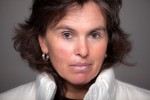
Leah Goldstein shares her life story in No Limits. (photo from Leah Goldstein)
Leah Goldstein put the “severe” into persevere. The physical demands and rigors she has experienced in her life include being a kickboxing champion, a Taekwondo champion, a professional road-racing cyclist, an officer in the Israeli commando and elite police unit, and a participant on the Race Across America, a 3,000-mile bike trek. The B.C. local recently published her memoir, No Limits, outlining the triumphs and the tragedies of her athletic life.
Lessons in fortitude and grit began with her grandparents – survivors of the Shoah – trickling down to her parents, who arrived in Canada from Israel with very little English and a hundred dollars to their name. To make ends meet, her parents worked opposite shifts.
“It’s just the determination of somebody wanting something that bad, and would do anything to get there,” Goldstein told the Independent.
That would be something of a mantra throughout her life, beginning with Taekwondo lessons at age 9. By 16, she achieved a black belt as National Junior Champion. She then moved on to kickboxing. While jugging high school classes, she became World Bantamweight Kickboxing Champion.
As a teenager, her coach had her follow a strict regimen of “no smoking, no drinking, no friends, no phone, no junk food, and seven days a week of training. I did exactly what he said and I didn’t have a teenage life,” recalled Goldstein, now 47.
She went on to win a slew of championships provincially, nationally and in the United States. “Those sacrifices were worth the payoff at the end,” she conceded.
That distilled willpower carried into her Israeli military service. She became one of a handful of women instructors of the elite commando division and, later, a krav maga self-defence trainer for special unit soldiers.
Goldstein was one of only two women to successfully complete the harsh commando training of Course Madaseem, and the only woman out of about 30 recruits to graduate from a then newly established special program at the Israeli Police Academy. She went on to work in the undercover narcotics division, the intelligence services, anti-terrorism department, violent crime investigations, and was an instructor for officials and field workers.
In one 20-hour long grueling military training session that she describes, recruits subsisted on 30 minutes of sleep, then had to repeat the exercise. While many “dropped like flies,” she learned that survival depended largely on what “happens in our mind.”
That was a lesson that went back to her tournament days as a youth. As a second-degree black-belt kickboxer, she had won virtually every bout, but an admitted inflated ego led her to be distracted, and badly defeated, in one match in particular.
“Refocus, and be humble,” she recalled her coach insisting. “And, with every opponent that I had, or any challenges, treat it like it’s your biggest threat.”
When she left policing, she shifted to professional cycling. While her law enforcement career left her emotionally tattered, it was cycling that left her the most battered and bruised physically.
In a Pennsylvania race just prior to the 2004 Olympics, she fell off the bike, breaking her hand. And then, in 2005, after winning nine of her first 11 races, she was involved in what she calls “the mother of all crashes” during the Cascade Classic – she landed on her face at 80 kilometres an hour, “breaking practically every bone in my body, ripping my face right off.”
Doctors were astounded she survived at all, she said.
More astounding was her outlook on the situation: “I actually came back out of that stronger than I was prior.”
It was in 2007 approximately when she started to consider taking David Spanner’s advice – he wrote a feature on her for the Province newspaper – to write a book for the purpose of inspiring others.
“I didn’t understand that at the time because, when you’re an athlete, you’re very self-absorbed and everything is about you,” she said.
The decision to write a book solidified as she did more public speaking engagements. Attendees were quite moved by her stories of resilience.
“I said, ‘Woah, if my story is really that powerful, and I can potentially change lives and help inspire, motivate people, then this book has to be written,’” she explained. “For many of us, it’s easy to be safe. We’re so afraid to fail. But part of succeeding is facing failure. I think it’s just having movement in life, and not watching great things that other people do, but starting to do great things and wowing yourself.”
Goldstein walked her talk or, rather, pedaled her talk, returning to the racing circuit in 2011, winning the women’s solo category of Race Across America, breaking the previous record by 12 hours.
“It’s really using your mind,” she said of perseverance. “When you feel every element of pain, and you’re exhausted and tired, and you just don’t want to be there – and then it starts raining and it’s minus-two degrees – it’s just all about being able to keep it together.”
Dave Gordon is a Toronto-based freelance writer whose work can be found in more than 100 publications globally. His is managing editor of landmarkreport.com.
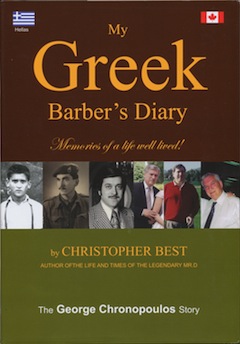
Christopher Best’s recent book, My Greek Barber’s Diary, is a biography of George Chronopoulos, told in the barber’s own words. In recent years, Best has been writing about history and people. Not celebrities but regular citizens who have made Canada a thriving multicultural country. His goal as a writer and as a publisher is to preserve precious memories.
Best will talk about My Greek Barber’s Diary at the Isaac Waldman Jewish Public Library on March 2.
The book follows Chronopoulos’ life from his childhood in Greece, through wars, hardships and immigration to Canada, to the modern day. Through the years, he has tried his hands at various business ventures, from restaurants to real estate, but he always comes back to being a barber. His hair salon has always been a hub of friendships and conversations, confidences and laughter.
Chronopoulos’ bright, ebullient personality, his courage and insatiable curiosity to try new things, to learn new skills, attracted the young entrepreneurial crowd of the 1960s, ’70s and ’80s. Many of Vancouver’s industry leaders started out during those years, and many of them became Chronopoulos’ personal friends and golf buddies.
My Greek Barber’s Diary is a series of more or less chronological stories as remembered by Chronopoulos. A large part of the book is dedicated to the barber’s extended family and their adventures. He sponsored many of his relatives into Canada and helped many others with their first jobs or first homes. A man of big heart, he also was one of the founders of the Gold Plate Dinner charity event in Vancouver in 1977, which was later picked up by the Hellenic communities all across Canada. Today, the events are considered the most important fundraiser in the Canadian Greek community.
Chronopoulos talks in the book about the many people he got to know from different cultural and ethnic backgrounds. Among his many Jewish clients and friends are business tycoons and philanthropists Joe Segal, Bob Golden, Syd Belzberg and Max Fugman. Everyone first came to his shop because of Chronopoulos’ well-known talent for styling men’s hair, but they stayed for their barber’s charisma and the joy of his friendship. The book includes tributes to Chronopoulos, friends sharing their memories of good times and bad times together, of triumphs and losses.
As did the others, author Best first met his subject at the barbershop. “We started talking,” Best recalled of that haircut a couple of years ago. “George asked me what I do, and I said I’m a writer. He said he always wanted to write a book – his life story. Afterwards, we met many times, and George told me about his life and about the people he knew.”
It took Best a year to record and transcribe Chronopoulos’ memoirs, and about six months to edit the book, which he published in 2015.
My Greek Barber’s Diary is not Best’s first book. The writer owns his own publishing company, Warfleet Press, and, since 2007, has published eight books, all of them on local history, including one about Canadian Airlines.
His first publication was By Jove What a Band, about Arthur Delamont and the Vancouver Boys Band. Before becoming a writer and publisher, Best was a musician and a music teacher and, in the 1960s, he was a member of Vancouver Boys Band. He recorded his memories and those of others about the band and its legendary leader, Delamont, who became a member of the Order of Canada in 1980 and even had a park in Vancouver named in his honor. It took three decades and the founding of Warfleet Press before the memoirs became a published book in 2007. Best writes about By Jove What a Band: “It is a story about the band which never grew old. The band that won over 200 trophies and awards during its unprecedented 50-year history. The band that made 15 European tours and attended five world fairs. The band that dined with royalty but never lost the common touch.”
Best’s talk on My Greek Barber’s Diary at Waldman Library on March 2 starts at 7:30 p.m.
Olga Livshin is a Vancouver freelance writer. She can be reached at [email protected].
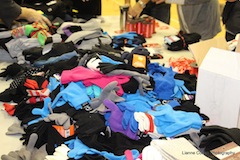
Rose’s Angels: Courtney Cohen, centre, is holding two bags, and Lynne Fader is to Cohen’s left. The two women created the group in honor of Rose Lewin, Cohen’s grandmother. (photo by Lianne Cohen)
Each Rose’s Angels contributor, supporter and volunteer has a story about why they give back to the community. With Rose’s Angels, it is not only to ensure that Rose Lewin’s legacy of love and generosity lives on, but also to support the many not-for-profit organizations in Richmond that desperately are in need of assistance.
Rose’s Angels was created by Richmond residents Lynne Fader and Courtney Cohen. Lewin, Cohen’s grandmother, was a well-respected and much-loved Holocaust survivor who believed in doing good for everyone she could.
(photo by Lianne Cohen)
Now in its third year, Rose’s Angels, which is supported and endorsed by the Richmond Kehila Society, just wrapped up its Feb. 14 Care Package Campaign. With the help of 40-plus volunteers, more than 400 toiletry and non-perishable-food care packages, along with 750 warmth bundles (toques, scarves, gloves and socks), were packaged and distributed to a variety of nonprofit organizations in Richmond servicing individuals living in poverty or well below low-income standards. Recipients included the St. Alban Drop-In Centre, Touchstone Family Services, Chimo Outreach, Richmond Multicultural Community Services, Richmond Food Bank, Jewish Food Bank, Turning Point Recovery, Richmond Family Place, Pathways Clubhouse and Light of Shabbat Program.
“It was very fitting to coordinate this event on Valentine’s Day,” said Cohen, “as this is a day when people go on dates and it’s supposed to be ‘extra-special,’ where people buy each other cards, heart-shaped boxes of chocolate, roses, teddy bears and other stuff that basically tells them they love them…. We wanted to share our love within the Richmond community.”
Anyone wishing to make a donation to Rose’s Angels should contact the Richmond Kehila Society at 604-241-9270.
While the three stated goals of the boycott, divestment and sanction (BDS) movement are an end to Israel’s “occupation” of “Arab lands occupied in June 1967,” equal rights for Arab Israelis and the right of return for Palestinian refugees (bdsmovement.net), its real aim is the destruction of Israel. As BDS activist Norman Finkelstein succinctly explained in a 2012 video, the ultimate result if the BDS’s three goals are achieved is: “There’s no Israel. That’s what it’s really about.” And, indeed, Palestinian Authority president Mahmoud Abbas has said, “I will not accept a Jewish state.”
In a Jan. 19, 2016, interview Fatah Central Commitee member Tawfiq Al-Tirawi said: “a Palestinian state in the 1967 borders [i.e. limited to the West Bank and Gaza], with Jerusalem as its capital, is just a phase.” While initially suggesting giving Jews plane tickets to leave the region, he says, “I want to live together with them” in “Palestine, in its historical borders, and we want all the Palestinian refugees [to] return to their country.” Omar Barghouti, a BDS leader who apparently studied at Tel Aviv University for a time, acknowledged during a University of Ottawa talk in 2009, “if the refugees were to return, you cannot have a two-state solution like one Palestinian commentator remarked, you will have a Palestinian state next to a Palestinian state rather than a Palestinian state next to Israel.”
There are many other myths perpetuated by the BDS movement and its supporters, which point to it being antisemitism disguised as anti-Zionism, the denial of the right of Jewish people to live in peace and security in their own homeland. Examples follow.
BDS supporters talk about boycotting products from the Israeli “invasion of Palestine.” Jews did not invade nor did they steal the land. Thousands of Jews were already living in the region before the state of Israel was established, and Jews used to call themselves Palestinians. Jews are indigenous to Israel. Jerusalem was the capital of the Jews. Even during the British Mandate, banknotes, coins and stamps had the initials of Eretz Israel (Land of Israel). And the Jews who immigrated to Palestine, as Israel was then called, as a reaction to the ethnic cleansing and genocide they suffered in European and Muslim countries, bought their properties, as returning Jews had been doing for decades.
The Arab Palestinians rejected the United Nations partition of the land (77% for Arab Palestinians and 23% for Jewish Palestinians) in November 1947, and have yet to establish their own state. After the War of Independence, it was not Israel but Jordan and Egypt that occupied illegally Cisjordan (Judea and Samaria, or the West Bank) and Gaza, respectively.
Abbas, Barghouti and others also have accused Israel of genocide. Israel has done no such thing. While its military has been forced to act against terrorism, it has not set out to deliberately wipe out an entire people. The Palestinian population is growing, according to the Palestinian Central Bureau of Statistics. At the same time, 1.7 million Arabs make up 20% of the Israeli population.
The charge of apartheid is another false accusation. As Dr. Kenneth Meshoe, South African politician, president of the African Christian Democratic Party, aptly put it: “Israel apartheid is a lie.” Every Israeli citizen has rights and freedoms. All minorities in Israel, including Arabs, can study in universities, are allowed to become professionals, businesspeople, athletes, work in public sector jobs and hold seats in the Knesset. In the current Parliament, Arab Israelis occupy 14 seats. As an anecdote, the sentence of Israel’s Supreme Court of former prime minister Ehud Olmert was read by an Arab Israeli judge, Justice Salim Joubran. Could that happen in an “apartheid” country?
Another issue BDSers protest is that of Israel’s blockade on Gaza, despite that it is legal, according to international law and the San Remo Manual, given that “relations between Israel and Hamas (which has ruled the Gaza Strip since 2007) are in the nature of armed conflict.” What would be illegal is if Israel let only some boats seeking to break the blockade pass, as a blockade must apply to every ship unless special permission is given. For more on this, see the article by Prof. Ruth Lapidoth (jcpa.org/article/the-legal-basis-of-israel’s-naval-blockade-of-gaza).
The blockade is needed to prevent terrorist groups from getting more weapons. Hamas’ charter specifically states their will to destroy Israel. More than 15,000 missiles in the past 15 years have been launched from Gaza at innocent Israeli civilians, leaving in their wake deaths, injuries and billions of dollars in damages, in addition to three wars and continued missile and rocket fire at Israel, combined with ongoing incitement against Israel and Jews on Palestinian TV and in schools and training camps.
The security fence – yet another mark against Israel in BDSers’ views – is also a legal method of self-defence. While it is not ideal and while some of it (less than 10%) is an imposing concrete wall as opposed to a wire fence, it reduced terrorist attacks by 90% in its first many years. While terrorist attacks have since increased, there are still fewer than before, and the barrier is a part of the reason for the decline.
As to the BDSers’ demand for the right of return. “The Palestinian demand for the ‘right of return’ is totally unrealistic and would have to be solved by means of financial compensation and resettlement in Arab countries,” Egypt’s then-president Hosni Mubarak noted in 1989. As Barghouti correctly observed, if Israel were to absorb the more than six million Palestinian Arab refugees, Israel as a Jewish and democratic state would disappear.
Refugees, as defined by the UN Relief and Works Agency, are “persons whose normal place of residence was Palestine during the period 1 June 1946 to 15 May 1948, and who lost both home and means of livelihood as a result of the 1948 conflict” – which began when Arab countries attacked the newly forming state of Israel – and their descendants. Approximately 750,000 Palestinians fled or left Israel by choice because of that conflict, and more left after the 1967 Six Day War, which was also the result of Arab aggression.
As former Canadian justice minister Irwin Cotler wrote in a 2014 Times of Israel blog and has spoken and written about elsewhere, there is another aspect that must be considered when speaking of the rights of refugees: “the pain and plight of 850,000 Jews uprooted and displaced from Arab countries – the forced yet ‘forgotten exodus,’ as it has been called – has been expunged and eclipsed from both the Middle East peace and justice agenda for 67 years.”
Another question more people need to ask of BDS supporters is about the lack of protest when Egypt considers building a wall on her border with Gaza, blockades Gaza, destroys neighborhoods adjacent to her border with Gaza to create a buffer zone and destroys tunnels used for arms smuggling, kidnapping of civilians and soldiers and infiltration for attacks.
If BDSers really were concerned about Palestinians, they would be protesting the treatment by the Palestinian Authority and Hamas of their own people, the lack of basic human rights and freedoms that people living in the West Bank and Gaza possess. But they’re not. Instead, they focus their sights on Israel, their ultimate goal its destruction.
Silvana Goldemberg is an award-winning author of more than 20 books and magazines published in Spanish and English throughout the Americas. Originally from Argentina, she is currently based in Richmond.
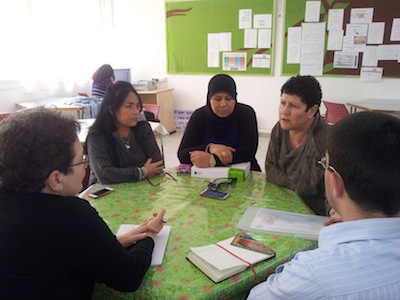
English class at Shaked School in Raanana. The school participates in the Arab Teacher Integration in Jewish Schools program. The teacher’s name is Fatam and she is from the Arab town of Tayibe. (photo from Merchavim)
In a country of eight million, one-fifth of Israel’s population are Arabs. According to research published last year in the Jerusalem Post, 35% of Jewish teenagers have never spoken to an Arab peer and 27% of Arab Israelis reported never having spoken with a Jewish youth.
In a conflict-ridden political climate, there is no shortage of angry rhetoric. Reading this rhetoric, it is tempting to imagine that Israeli society is simply a dysfunctional collection of intergroup battles. Nonetheless, there are organizations that remain focused on Israel’s immense social capital, its long history of social innovation and the initiative and dedication of its educators. Guided by words like tolerance, fairness and mutual understanding, these organizations value diversity rather than emphasize differences, and continue to work to build a more egalitarian society.
Esti Halperin, Merchavim Institute chief executive officer, is the woman on the right. (photo from Merchavim)
Merchavim Institute is one such organization. Founded in 1998 and based in Lod, Merchavim promotes shared citizenship in several ways. It places Arab teachers in Jewish schools, to teach spoken Arabic. It offers a wealth of classroom materials to teachers and supports 500 schools and kindergartens in the Jewish-secular, Jewish-religious and Arab-Israeli school streams.
In a separate collaboration with the Ministry of Education, Merchavim also places Arab teachers of English, science and mathematics in Jewish schools. These teachers cover material on Arab culture and society.
Merchavim’s chief operating officer, Roi Maor, explained that “dialogue, shared culture, education and improved communication” are essential if one wants to stem the flood of anger and resentment on both sides. Rather than getting stuck on debates about the country’s flag, for example, he argued, “Israel’s best chance for growth and self-improvement is through programs that focus on enrichment.”
The Arabic Teacher Integration (ATI) program does just that, by giving Arab teachers an opportunity to work in and become part of a Jewish community. But, quite apart from meeting their curricular goals, these teachers – all of whom are women – are excellent role models, said Maor. He described them as resilient and “charismatic, with exceptional leadership skills.”
Nonetheless, he acknowledged, “There is a degree of concern or tension when an Arab teacher enters a Jewish school; half of these teachers wear headscarves. Often, the teacher herself has her own concerns and worries, concerns about how she will be integrated.” Since more than one teacher has been stopped by school security and refused entry, these concerns seem valid.
Fortunately for the teachers, Merchavim’s idealism is tempered with the clear-sighted pragmatism of lived experience. Encounters between Arab teachers and their Jewish students and colleagues follow a framework, leaving little to chance. Maor wants the ATI program to be “the gold standard” and explained how encounters must be continuous. “They have to happen in the context of a larger project and be a powerful, meaningful experience,” he said.
Maor also respects the students’ “legitimate desire to maintain and preserve [their] cultural identity.” He believes that one’s identity is a tool to meet the other, rather than a hindrance or a threat. “It allows you to understand and connect to your own identity better,” he said.
Of course, change does not happen overnight. Tamara Klinger-Levi, Merchavim’s director of resource development, reflected that, even with a wonderful start to the school year, acts of violence create a “public sentiment of hatred or prejudice,” which can be a tremendous setback for Merchavim staff and partners.
Rana Younis has been teaching at Gvanim Junior High School, Kadima-Zoran, for nine years. She related an incident in her school, where she had overheard a student speaking ill of Arabs. There had been a violent incident and emotions were running high. Having turned and seen her, the student apologized instantly. “I am sorry,” he said. “It’s not you.” Younis told him, “I understand, it’s not you and it’s not me, and he hugged me. It was so touching. I tell them: there are bad people and good people in Arab society, just like any society.”
Merchavim staff are well aware of this dynamic and their staff make regular visits to Gvanim. Younis is unequivocal in her praise of the support they offer. “They help me all the time. They are like my family,” she said.
A highlight of the program comes in the form of tours for overseas visitors. This is an example of the kind of “powerful, meaningful experience” described by Maor. “Children don’t have a strongly formulated notion of [Arabs]. All kinds of negative ideas flourish in isolation but [with Merchavim teachers] all that evaporates. They learn to regard each person as an individual. We are building a generation that doesn’t generalize.”
Younis’ observations confirm this. “Reality is not what you read,” she said. “Putting the idea of Arabs and Jews aside, I am just there to teach. I love my work as a teacher. I love my students.”
Younis’ voice conveys energy, dedication and love. She spoke of an upcoming collaboration between Israeli and Arab students, called
Living Together, for which only a limited number of places was available. “When some of the students didn’t get in, they cried, they were so disappointed,” she said.
About what her own family thought of her work, Younis laughed as she related her mother’s frequent questions. “Are you OK, are you happy? I tell her, I am happy! I have no problems.”
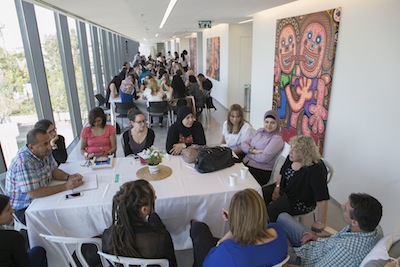
The annual Arabic Teacher Integration conference, held jointly with IDC Herzliya, is when all the players (government officials, school administrators, teachers, researchers, funders et al) meet to discuss issues and learn about new research. (photo from Merchavim)
Merchavim’s contribution to Israeli education and society at large have gained recognition at home and abroad. The new language initiative of Israel’s education ministry, led by Naftali Bennett (Jewish Home), dovetails nicely with Merchavim’s vision. In this program, Arab students will learn Hebrew starting in kindergarten and continue right through high school. As Likud MK Oren Hazan said last year (Israel National News), “When the Jewish population understands Arabic the way the Arab public understands Hebrew, we will see better days.”
Thanks to the investments of Merchavim and other organizations, these ways of thinking could become the norm for a whole generation of children. These children will finish school and assume leadership positions in society. When they do, they will have communication skills, as well as the empathy and cultural capital needed to reinvest in a fair future for all Israelis.
Speaking of the wider Arab population, Maor said Merchavim’s program “sends a message to people back in the communities that they can be successful in Jewish society.” And, while Arab women meet the urgent need for more teachers in the Jewish system and find empowerment through work, their presence enriches the entire school site.
The Arab Teacher Integration program enjoys financial support from numerous philanthropic groups in Israel, all of which support civil rights, social justice and democracy in the country. These include the Moriah Fund, the Beracha Foundation and the Jacob and Hilda Blaustein Foundation. Overseas funders include the Jewish Federations of North America and the Hadassah Foundation, which also works in Israel.
Nonetheless, even with this and the Ministry of Education support for Merchavim’s work, funding remains a challenge. Discretionary budgets for enrichment are small and programs like music are typically prioritized above Arabic electives. Maor, who finds it “outrageous” that Arabic is not a mandatory subject in Israeli schools, described this as a “missed opportunity for cross-cultural learning and huge advancement for the cause of shared society in Israel.”
However, Maor is optimistic about the future because “animosity and fear comes from ignorance.” With long-term, committed professional relationships between Arab and Jewish educators, and between Arab teachers and their Jewish students, Israeli society can change. “Citizenship is not just a piece of paper,” said Maor. “It’s about being part of a collective enterprise, in which we share a joint destiny.”
That destiny relies on every individual having the right to prosperity under egalitarian social and economic conditions. Once the majority of Israelis understand this, he said, they will also see that “the success of Israeli Arabs is not a separate phenomenon but a boon to all sectors of the population.”
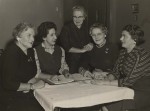
Pioneer Women meeting, circa 1960. Cissie Eppel is sitting second from left. (photo from JWB fonds, JMABC L.12598)
If you know someone in this photo, please help the JI fill the gaps of its predecessor’s (the Jewish Western Bulletin’s) collection at the Jewish Museum and Archives of B.C. by contacting [email protected] or 604-257-5199. To find out who has been identified in the photos, visit jewishmuseum.ca/blog.
Julianne Moore as Alice in Still Alice. (photo by Jojo Whilden, courtesy of Sony Pictures Classics)
Fifteen years ago, the subject of dementia was the “elephant in the room,” a very large issue that everyone is acutely aware of, but nobody wants to talk about. If you or a member of your family developed symptoms such as forgetfulness or confusion, you kept it quiet as long as you could. The first time your grandfather found himself somewhere and did not know why he was there was but the coup de grâce, the decisive stroke that heralded the end of a lifestyle as he knew it. This was the beginning of a terrifying and tragic journey towards senility and death.
I remember my paternal grandmother; she was a wonderful cook, Polish style. Her husband took care of her until she had to be placed in a seniors residence. The topic of her illness never came up at home. My father visited her every week. My brother and I did not go with him. Then there was the telephone conversation with my aunt: she was surprised to hear that I lived in Vancouver (I had moved here eight years prior). I knew then that she had Alzheimer’s disease. It was a shock.
During the last 10 years, things have changed. Articles about dementia, in terms of statistics, symptoms, prevention strategies, caregivers and residential settings, abound in our newspapers, magazines, on the radio and on the internet. Seminars, forums, courses, self-help and support groups are readily available – and world cinema has made up for lost time. For the last few years, I have been tracking American, Canadian, British, European and Israeli films that feature people who are suffering from some form of dementia, especially Alzheimer’s. These movies show the impact of their condition on caregivers, whether they be spouses, sons, daughters or friends.
Jim Broadbent with Judi Dench in Iris. (photo from Everett Collection / Rex Features)
The British film Iris (2001) reveals the true story of the lifelong romance between novelist Iris Murdoch and her husband John Bayley, and her gradual deterioration due to Alzheimer’s disease.
The Canadian movie Away from Her (2006) follows a loving couple; she acknowledges her condition and moves into a seniors residence, and the husband must cope with his wife’s new romantic attachment to a male resident of the facility. Still Mine (2012), also a Canadian movie, is an old-age love story told with minimal sentimentality and spiky integrity. She has Alzheimer’s, he wants to build her a smaller house, with his own hands; complications ensue.
Amour (2012), a French film, gives us an unflinching vision of dementia caused by stroke and the complex relationship between the members of the octogenarian couple. It was widely acclaimed and nominated for several Academy Awards.
The British comedy Quartet (2013) brings together four superb actors in a magnificent seniors residence for musicians. Each member of the ensemble has his or her own impairments and talents. Somehow they cope and produce beautiful music together.
The American movie Still Alice (2014) shocked and educated every viewer who stayed until the end. We watch as early-onset dementia gradually overcomes the heroine’s intelligence and independence. Her strategies and courage educate and enrich our lives as she struggles with her loss of memory and mental abilities. Julianne Moore won an Academy Award for her performance.
In the American documentary Glen Campbell … I’ll be Me (2015), the legendary singer agrees to a final North American tour knowing that he has Alzheimer’s. The family supports, encourages and devises ways in which he can continue to perform despite the debilitating effects of the disease. A superb real-life drama that makes one appreciate how drastically the disease affects everyone close to the struggling singer.
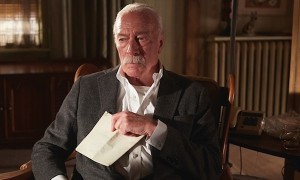
Christopher Plummer in Remember. (photo from Serendipity Point Films)
In the Canadian movie Remember (2015), two residents of a seniors home seek revenge against the Nazi killer of their families in the Holocaust. With Alzheimer’s robbing him of his capacity to remember, one old man goes forth, with detailed instructions in hand, to find and kill his tormentor. He struggles with his inadequacies and perseveres.
Then there is the Israeli drama The Farewell Party (2015), which deals with the topic of assisted suicide and dementia. Notwithstanding the topic, it is a sweet, funny and sad tale that teaches us compassion and acceptance.
I recommend all of these movies to you, no matter at what stage of life you find yourself. But you might say, why should I watch these movies, why should I care? I am not there yet. It is not my issue, I don’t need to know about all this. It is too depressing. I defy readers to tell me they do not know someone who is suffering or has suffered from dementia. One in nine people over the age of 65 will develop some form of dementia. We must acquire knowledge of the disease, we must become familiar with the signs and symptoms, we must acquaint ourselves with the various paths that dementia takes.
How can we understand, empathize and assist these people, our grandparents, our parents, our friends, in their journey? As ethical human beings, it is our obligation and privilege to make the disease and those who suffer from it an integral part of our society. Watching these movies will provide you with the tools and strategies to be informed, to be helpful and to be accepting of this condition. After all, you or I may receive the diagnosis of dementia tomorrow.
Dolores Luberis a retired psychotherapist and psychology teacher living in Vancouver. She writes regular columns for Senior Line, blogs for Yossilinks and writes movie reviews for Isaac Waldman Jewish Public Library. This article was originally published on yossilinks.com.
Farhad Sultanpour of the Kurdish Association of Manitoba speaks to members of the Winnipeg Jewish community and others. (photo by Yolanda Papini Pollock)
According to Farhad Sultanpour of the Kurdish Association of Manitoba, Kurds are the largest nation of people without a state. The majority of Kurdish people, he said, live in a strip of land that stretches through Iran, Iraq, Syria and Turkey.
Sultanpour was speaking to a Winnipeg audience about the connections between Kurds and Israel at an event organized by Winnipeg Friends of Israel (WFI).
Sultanpour came from Orumieh, in east Kurdistan, the northwest part of Iran, and was brought up as a Sunni Muslim. He made his way to Canada in the late 1980s.
“In 1979, during my mid-teens, the Islamic Revolution began and the Kurds fought adamantly to protect and liberate their towns and villages against Iran’s leader, Ayatollah Khomeini, who was rising to power,” said Sultanpour.
During this time, Khomeini was stalling in the negotiations with Dr. Abdul Rahman Ghassemlou, the Kurdish leader, regarding the creation of a Kurdish autonomous state. What was actually happening, said Sultanpour, was that “Khomeini was reinforcing his revolutionary army. He led the invasion of the Kurdish territories, while declaring jihad to all Kurds. In 1989, the agents of the Islamic Republic of Iran assassinated Dr. Ghassemlou in Vienna, Austria.”
Sultanpour, who was 19 at the time, needed to make a decision – join Khomeini’s army or join the Kurdish Peshmerga.
“I chose to be a Peshmerga, fighting against Khomeini’s regime,” said Sultanpour. “After a year and a half, I went to the United Nations office in Ankara, Turkey, to apply for refugee status. A year and a half later, I was granted a refugee visa by Canada.”
Integration into Canadian culture was challenging for Sultanpour, mainly due to the language barrier. At the time, he hardly understood or spoke English, and had made the move alone.
Sultanpour has nothing but good things to say about Canada and the second chance at life afforded to him by Canadians. “I painstakingly pursue my English class and university courses for self-improvement,” he said.
He and his wife feel it is time to raise awareness about the plight of the Kurds, especially with the rise of ISIS.
“In the last 10 years, my wife and I have built three public schools, purchased a prefabricated trailer home-style classroom, and built a community centre near the city of Orumieh, in east Kurdistan-Iran,” said Sultanpour. “For the last 20 years, we have been helping, financially, 65 to 100 very poor families in Kurdistan.”
Sultanpour is now working to strengthen the Kurdish-Jewish connection in Winnipeg. He is saddened by the lack of knowledge about the Kurdish situation in the general public, as well as with federal public servants who have not heard about Kurds or Kurdistan.
He referred to an article in the Dec. 29, 2015, issue of Time Magazine: “Alan Kurdi was one of a million. In the summer of 2015, the 3-year-old Syrian boy of Kurdish origins and his family fled the war engulfing their country, hoping to join relatives in the safety of Canada. They were part of a historic flow of refugees from the Middle East to Europe this year, and they followed the dangerous route taken by so many others. In the early hours of Sept. 2, the family crowded onto a small inflatable boat on the beach of Bodrum, Turkey. A few minutes into the journey to Greece, the dinghy capsized. Alan, his older brother, Ghalib, and his mother, Rihanna, all drowned, joining the more than 3,600 other refugees who died in the eastern Mediterranean this year.”
Sultanpour said, “Alan, his brother, Ghalib, and mother, Rihanna, were identified as Syrian when, in fact, they came from Kobane, the Kurdish town invaded by Syria. The tragedy of the death of these three Kurdish people made Alan’s father, Abdullah, prefer to bury his family in Kobane and stay in his beloved motherland, Kurdistan. Up to their dying day, Alan, Ghalib and Rihanna were stripped of their identity and state.
“In the heart of the Kurds, the Kurdi family are Kurds from Kobane, Kurdistan,” he continued. “Alan’s dead body was the only Kurdish child seen by the world, not knowing that there were hundreds of thousands of Kurdish men, women and children who are dead and are dying in Kurdistan – the biggest nation without a state.”
Sultanpour, like many other Kurds, sees Israel and the Jewish people as their only allies in the Middle East. He sees Kurdistan and Israel living in a very hostile region with common enemies, with both nations finding Iran and ISIS as threats to their existence.
With only about 500 members of the Kurdish community in Manitoba, the Kurdish Association of Manitoba is looking to network with the local Jewish community to have a larger impact.
“Both Yolanda Papini Pollock of the WFI and Bernie Bellan of the Jewish Post and News have been instrumental in the speedy interconnection of the Kurds and Jewish people in Manitoba,” said Sultanpour.
The approximately 35 attendees at the event had many questions for Sultanpour about Kurdish-Jewish connections, Kurdish political parties’ relationships with one another, and Palestinian-Kurdish relations.
According to Sultanpour, many in attendance were surprised to know that the present Kurdish capital of Erbil was the capital city of Jewish Kurds from the end of the first century when some Kurds converted freely to Judaism.
“There were numerous questions about political and religious issues regarding the Kurds,” said Sultanpour. “It was very obvious that the attendees were happy to welcome the Kurds and that they could have accepted them earlier had they known about them sooner. But, it’s not too late to develop a much stronger bond with the Jewish people here in Winnipeg and increase the connection globally.”
In related news, another manifestation of Kurdish-Jewish friendship occurred in January, when Israeli Justice Minister Ayelet Shaked called for an independent Kurdistan, saying, “The Kurds are an ancient, democratic, peace-loving people that have never attacked any country. It’s time to help them.”
March of the Living International (MOLI) has published a study examining the effects that the program has had on its participants. The educational program takes, on average, 10,000-20,000 students annually to Poland and Israel with the goal of educating and inspiring future generations to learn from the destruction of the European continent during the Second World War. MOLI accepts applicants from all walks of life and religions, hoping to ensure that not only is the Holocaust not forgotten, but also that it is never repeated.
The report studies the impacts that the program has on its Jewish participants, and highlights the educational and religious changes that the program has inspired since its creation in 1988. Of the population surveyed, most initially signed on to the program in order to better understand their Jewish culture. Many of the participants in the study said that the program has directly impacted them, leading many to visit, study in or move to Israel. Fifty percent of the respondents said that the program caused them to consider moving to Israel later in life.
The study was conducted by Prof. William Helmreich of CUNY Graduate Centre and the Colin Powell School at City College, a sociologist and expert on ethnic identity. “What’s most remarkable about the March is how deeply it impacts participants over a period of many years,” he states. “These include life choices like selecting a mate, moving to Israel and career choices. In addition, it greatly impacts not only on Jewish identity but also on compassion toward other people as well.”
Indeed, 54% of respondents said that the March had made them more tolerant towards other groups. And the effect increases over the years, as 66% of those who attended the March 10 years ago, reported it had made them more tolerant.
The study also found that 86% of the participants asserted the importance in their spouse being Jewish, and 91% in raising their children with some sort of Jewish education; 65% felt the importance of raising their children in a Jewish neighborhood.
Of those surveyed, 90% felt the March instilled in them the importance of reacting to confrontations with antisemitism, and 95% stated the March had strengthened their sense of Jewish identity.
“To think that the March is such a successful program in terms of ensuring and enhancing Jewish identity and in making people realize the importance of engaging as a Jew within their communities and caring for those outside of them, truly illustrates the goals that we had when initially forming the first March so many years ago,” said Dr. Shmuel Rosenman, MOLI chair.
March of the Living brings individuals to Poland and Israel to study the history of the Holocaust and to examine the roots of prejudice, intolerance and hate. Since the first March in 1988, more than 220,000 participants from 52 countries have marched down the same three-kilometre path leading from Auschwitz to Birkenau on Yom Hashoah as a silent tribute to all victims of the Holocaust. March of the Living is a partnership between March of the Living International, local MOTL foundations, the Claims Conference, individual donors, private philanthropists and Jewish communities around the world. Visit motl.org.


 It was in 2007 approximately when she started to consider taking David Spanner’s advice – he wrote a feature on her for the Province newspaper – to write a book for the purpose of inspiring others.
 My Greek Barber’s Diary is a series of more or less chronological stories as remembered by Chronopoulos. A large part of the book is dedicated to the barber’s extended family and their adventures. He sponsored many of his relatives into Canada and helped many others with their first jobs or first homes. A man of big heart, he also was one of the founders of the Gold Plate Dinner charity event in Vancouver in 1977, which was later picked up by the Hellenic communities all across Canada. Today, the events are considered the most important fundraiser in the Canadian Greek community.