Zionism as a solution

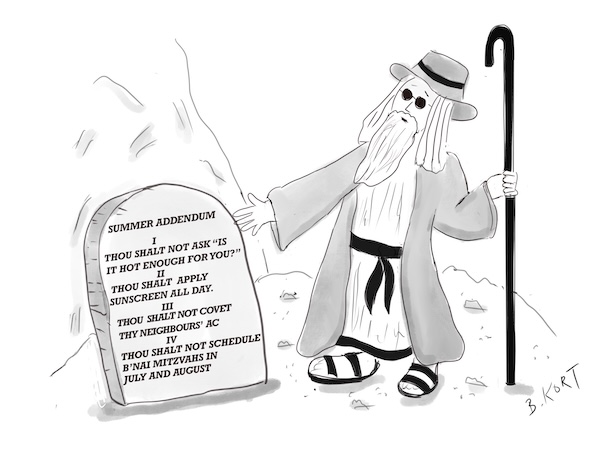
(internet photo)

On May 17, Tafsik Organization and Stop Antizionism hosted a full-day World Symposium Against Antizionism. With justifiable pride, the organizers declared that this was the first conference in the world specifically dedicated to combating antizionism. Keynote speaker was Ben Shapiro, co-founder of The Daily Wire, along with Gad Saad, Eve Barlow, Leora Shemesh and a packed A-list of inspiring Jewish leaders from around the world.

The fire of Jew-hatred has been ravaging the Jewish community across our country, and elsewhere, and absolutely every option must be considered to put it out. At the same time, I wonder, What if this conference had been organized around the topic of Zionism, where these same speakers focused on all the many visions, projects and ways that Jews everywhere could support the cause of Zionism?

Whether you identify more with Zionism, Jewish peoplehood, Israel or Judaism, if we really want to declare war on antizionism and antisemitism, I think it is by embracing everything that makes us proud to be Jewish and to live Jewishly. For every action each of us takes to combat antisemitism/antizionism, imagine the impact if we also did an equal action that deepens our Jewish identity. Consider it a one-to-one combating antisemitism, promoting Zionism challenge. 

As Canadian Jews, we have endured longstanding discrimination. Many of us remain vigilant, knowing our lives will be shaped by the latest surge of  “protesters” in Jewish neighbourhoods, or by flash mobs of such protesters at Toronto subway stations or at public forums like Phillips Square in Montreal. where effigies were hung. 

When, in Vancouver, someone sets fire to the entrance of Schara Tzedeck Synagogue and the Jewish Federation of BC reports that 62% of Jewish community members have experienced at least one antisemitic incident, wearing Jewish symbols in public is an act of pride and defiance against any of our fellow Canadians who secretly, or openly, hate us for being Jews.

Even before Oct. 7, 2023, B’nai Brith recorded that, in Canada, in 2021, for the sixth consecutive year, records were set for antisemitic incidents in the country, reaching 2,799 that year. In their recently released 2025 Annual Audit of Antisemitic Incidents, B’nai Brith found there were 6,800 incidents of antisemitism documented that year. 

Zach Bodner, chief executive officer of the Palo Alto Jewish community centre and the head of the Zionism 3.0 movement, declares: “We have to stop pretending that anti-antisemitism will keep Judaism alive for the next generation…. We have to stop believing that fighting against antizionism will keep our kids loving Israel.”

Rabbi David Hartman, in his 1982 essay “Auschwitz or Sinai?” challenges us to examine if we will live our Judaism shaped by trauma, persecution and hatred, or if will we be shaped by covenant, responsibility and moral purpose. “It was not Hitler who brought us back to Zion, but rather belief in the eternal validity of the Sinai covenant,” he wrote.

Recently, as a simple test, I went to the Jewish Independent archives and clicked on the antisemitism tag, I found 45 pages of articles. When I went to the Zionism tag, I found only four, but the tag for Israel had 111 pages, while antizionism/anti-Zionism had three pages of results combined. 

I then decided to compare the number of articles published in 2026 between the antisemitism and Israel tags. I found about 30 articles in the former and roughly 25 in the latter. Of those 25 Israel stories published in 2026, at least four dealt with antisemitism and included that tag search as well. Of the 21 remaining Israel articles, most could be construed as some form of cultural connection, solidarity with or interest in Israel, more than enough to classify as Zionism. 

While close in number, so far in 2026, antisemitism stories are outpacing stories about Israel and/or Zionism. I have no doubt this same test could be used with any other Canadian Jewish publication, with similar findings. 

I’m sure we can agree that there is so much more we can do to inspire ourselves and pass the torch from Sinai to our future generations, rather than allow so much of our creative and intellectual drive and energy to be focused on those who hate us. 

We are living in the aftermath of 1948, the year when we Jews finally transformed the seemingly impossible dream of reestablishing statehood into reality. We have a strong North American Jewish community and representative organizations that make us an undeniable political force. 

With these resources that were unimaginable to previous generations of Jews, we have new goals to set, new visions to dream, new swamps to drain, new heights to achieve – as Jews.

So, I ask every one of you reading this: What inspires you about being Jewish? What about Judaism, Zionism or Israel inspires you? What leads you to live a Jewish life and gives you strength during tough times? What drives you to be the best Jew you want to be? 

For every statement, action, rally or event you attend where you roar with defiance against our haters, please take a moment to express why you are the Jew you are; how you live Jewishly; and why you are proudly part of the Jewish nation. Your words, your ideas, your vision can and will inspire many others. 

Alan Herman has lived in Israel twice, including when attending Ben-Gurion University, where he completed his master’s degree in Middle Eastern studies. He participated in the Quebec-Israel Committee’s parliamentary program in Montreal, and organized many Israel and Zionism related events as a co-chair for the Toronto chapter of the Canadian Institute for Jewish Research from 2013 to 2025. He is a proud member of the board of Upstanders Canada.
Deceit, desire & the divine

In Seattle, hours after the terrorist attacks of 9/11, two FBI agents knock on Monty’s door, asking questions about his Afghan partner, who has seemingly disappeared. How much does Monty really know about Jamal? What does he know about himself?

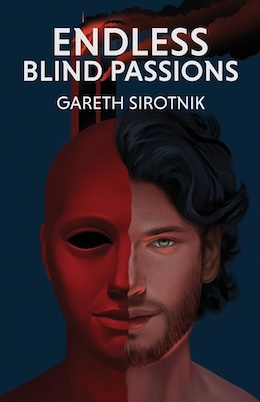
image - Endless Blind Passions book coverVancouver writer Gareth Sirotnik’s Endless Blind Passions (Capsicum Press, 2025) jumps right into the chaos and uncertainty that 9/11 sparked in the United States, and beyond. The novel centres on the character of Monty, a Jewish, gay man in his mid-50s, who thought he had finally settled into himself and his life, yet is forced to reevaluate that thought when the FBI arrive.

Alternating between the repeated visits of the FBI agents and the memories their inquiries trigger for Monty, we witness the fragility of Monty’s contentment and the tumultuous paths that he has chosen. He has lived fully, most would say, experimenting sexually, spiritually, politically and morally. He is a seeker and his soul-searching is a work in progress, despite his initial belief that he had found himself – and peace – once he’d met Jamal.

Endless Blind Passions is a thriller-meets-coming-of-age story, unusual perhaps in its seriousness, which sometimes gets in the way (as does dialogue that doesn’t always sound natural), but it’s entertaining. Most of us don’t really “find” ourselves as teenagers – Monty certainly didn’t – but are continually discovering aspects of ourselves. In our lives, we do things that make us proud, and things that carry shame or regret. Hopefully, we learn from our experiences and become a better person, but who is even to say what that means.

Sirotnik’s personal journey inspires Monty’s, that’s for sure. Sirotnik grew up in Los Angeles, graduated from college in Portland, moved to Canada in 1971 (Monty’s brother lives in Canada) and, most notably, is gay, Jewish and a longtime practitioner of Zen Buddhism.

As the novel’s title implies, Zen is a vital component of the story. Monty’s spiritual awakening occurs alongside drug-fueled encounters and unconventional relationships. He works (both consciously and subconsciously) to strip away social personas and confront his “true self.” He lives intensely, even hedonistically, but not necessarily deeply in the introspective sense, or even in knowing his various romantic partners. His ego prevents him from seeing the reality of situations, including the impact of his own actions on others throughout his life.

That’s all on a personal level. Paralleling Monty’s understanding of his “blind passions” is the realization that American society is not what it was, let’s say, sold as being. Sept. 11, 2001, marked a significant increase in racism, xenophobia, paranoia, government surveillance – it did not create them. In the novel, Jamal represents “the other” that became society’s “blind passion” after the attacks that day on the United States, but Monty’s past – though only going back 50ish years – highlights that the concept of “the other” has existed as long as humanity.

Ultimately, the novel posits that true spiritual awakening only happens when we acknowledge our “endless blind passions,” drop our masks and face reality as our true selves. It does this in an engaging way, with readers learning a lot along the way, while rooting for love to win out. 

Reclaiming sacredness

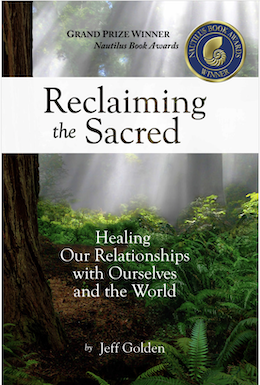
“Everything changes when we are rooted in our sacredness,” writes Jeff Golden in his self-published, award-winning book Reclaiming the Sacred: Healing Our Relationships with Ourselves and the World (2022). 

image - Reclaiming the Sacred book cover“When we can feel that we are an essential part of the universe, that we are the breath of the divine,” Golden believes that we can transform what he describes as our “morally, spiritually, ecologically, and, soon enough, economically” bankrupt system into “an entirely different way of living and being, rooted in the wonder, reverence, and connection that have long nourished our ancestors, yet unique to our times and needs and opportunities.”

Reclaiming the Sacred is a densely packed book, almost overflowing with facts and ideas (there are 38 pages of endnotes). Golden includes narratives, data, poems, blessings and philosophy from countless thinkers and doers. He repeats key themes – a necessary action given the amount of information he imparts. He has some punchy and creative, if long, chapter headings (“More Sleep, Less Cow: Physical Health and Happiness” and “Retail Therapy: Taking Our Insecurities and Fears to the Mall,” for example) and writes conversationally.

His thesis is that materialism not only can’t make us happy but prevents us from realizing our own inherent wealth, and that of the world, which we are destroying, along with many of its inhabitants. “Between 40 and 80% of all species may not survive to see the next century,” he writes. “We are one of those species.”

Golden argues against the idea that we come into the world alone and die alone; in fact, he contends that we are never alone, so intertwined we are with the world, its elements, its creatures, its plants, its particles. He sees “religion as the experience of profound belonging,” rather than as “a set of doctrines that must be believed and obeyed.” He hopes the book will support readers on their journey to reclaim themselves and the world as sacred. 

Proceeds from the sale of Reclaiming the Sacred go to nonprofits doing work related to its themes. For more information about that and about the courses and workshops Golden teaches, go to reclaimingthesacred.net.

Creative project ideas

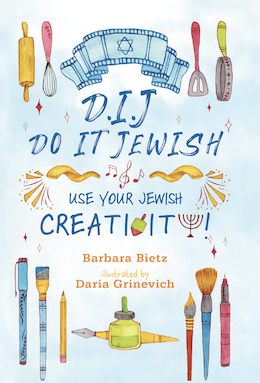
image - DIJ - Do It Jewish book coverConsidering the extra challenges Jews have faced these last few years, there are many of us who have reacted by delving more into our Judaism and our Jewish identities. Perhaps that’s why a book the Independent received a handful of years ago seems even more relevant now – both as a way to explore one’s identity, but also one’s creativity. With summer approaching and school soon letting out, who couldn’t use some ideas on how to fill the coming increase in a young person’s unstructured hours?

DIJ – Do It Jewish: Use Your Jewish Creativity! by Barbara Bietz, with colourful and playful illustrations by Daria Grinevich, is targeted to children 8 to 12 years old, but, honestly, any older person who has been contemplating their creative side would glean something, many things, from it. Published by Intergalactic Afikoman in December 2020, in the heart of the pandemic, it fell by the JI’s wayside, unfortunately, but not out of mind. So, while not hot off the press, it is hot off the JI bookshelf, and well worth adding to your household as a guide for worthwhile projects that could be used simply to pass the time in a fun, imaginative way, or it could spark a career or hobby path.

The book has chapters on filmmaking, cartooning and graphic novels, cooking, songwriting, painting and art, midrash, and Judaica. Each chapter comprises a main interview with a practitioner of the artform being presented, with the interview divided into four main sections: Doing It Jewish, Keeping It Going, Making It As Good As It Can Be, and Taking It Further. Then, there is a secondary artist spotlight.

Each chapter concludes with a how-to summary of sorts, featuring ideas of what to do and what questions you might ask yourself as you work through an idea. And, each chapter includes a list of necessary tools for the project, as well as a glossary of terms comprised mainly of Jewish words, like Talmud, kreplach, Shavuot or dreidel, but also script, graphic design, choreography and beatnik.

DIJ – Do It Jewish features almost 20 artists sharing some of their inspirations, processes and advice, as well as concrete steps for aspiring artists to embrace their Jewishness and express it creatively. 

Summer squares and cobbler

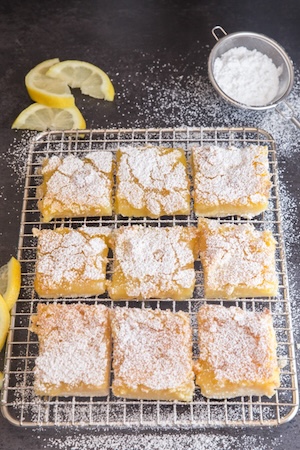
photo - Rosemary Molloy’s lemon squares are tart, melty, crumbly heaven in a pan. For more of Molloy’s recipes, visit anitalianinmykitchen.com
Rosemary Molloy’s lemon squares are tart, melty, crumbly heaven in a pan. For more of Molloy’s recipes, visit anitalianinmykitchen.com. (photo from anitalianinmykitchen.com)

Pucker up, you lemon lovers! On my search for a refreshing lemon-based dessert, I found a simple recipe (my favourite kind) that will have me making this on repeat. 

As I might have mentioned before, I’m a wee bit addicted to Instagram, where I learn things I didn’t even know I wanted to learn. Like how to string pearls; how to make a coin levitate; the art of velveting meat; and even more random nonsense. But, every once in awhile, I strike gold and, this time, it came in the guise of lemon squares. I made a pan of them and almost singlehandedly finished them all. I’ll be seeing my dentist shortly. They’re tart, melty, crumbly heaven in a pan, created by Rosemary Molloy at anitalianinmykitchen.com/lemon-squares.

EASY LEMON SQUARES

shortbread base
1/2 cup salted butter (softened)
1/4 cup powdered sugar
1 cup flour
1 pinch salt

lemon filling
2 large eggs
1 cup granulated sugar
1/2 tsp baking powder
3 tbsp fresh lemon juice
1 tbsp lemon zest
1 pinch salt

Pre-heat the oven to 350˚ F. Lightly grease and flour an 8”x8” square cake pan or line it with parchment paper (which will make for easier removal).

In a medium bowl, beat the butter (full disclosure: I had no butter so I used the vegan Becel margarine) and powdered sugar on medium speed until combined, then add the flour and salt (increase from a pinch to 1/4 teaspoon if using unsalted butter). Beat until a soft dough forms. Pat it evenly onto the bottom of the baking pan. Bake for 18 to 22 minutes, depending on your oven. Remove from the oven, but leave the heat on. Let the crust totally cool before adding the filling.

The shortbread base should look mostly pale across the surface with light golden-brown edges. If the entire crust turns golden, you’ve baked it too long. It should be soft with a crumbly texture, but it’s got to be firm enough to hold its shape without turning mushy under the lemon filling. Don’t be fooled: the shortbread centre may look undercooked, but that’s how you want it.

Meanwhile, in a medium bowl, beat together the eggs, sugar, baking powder, lemon juice, zest and salt. The recipe says to add 2 to 4 tablespoons of flour it you’re worried about the filling sinking to the bottom. Being a natural-born worrier, I added 2 tablespoons of flour and it was perfect.

Pour the filling over the cooled baked crust and return it to the oven for 20 to 25 minutes or so, until the centre is set. The lemon squares are done when you gently shake the pan and the filling no longer jiggles, or only slightly jiggles. Cool the squares in the pan for about an hour. Then chill them in the fridge for one to two hours for easier cutting. Cut into squares, remove from pan, dust with powdered sugar and serve.

If you are lucky enough to have any left, store them in an airtight container in the fridge. According to “experts,” they will last four days. If you happen to live at our place, they will last about a day. I’ve heard rumours that any remaining lemon squares can be frozen. Just put the cooled, cut squares on a cookie sheet, freeze for an hour, then transfer to a freezer-safe container, putting parchment paper between the layers. This next part is hilarious: those same “experts” say that the squares will keep for up to four months in the freezer. I’d give it a week before one of us (by which I mean me) succumbs to our (my) insatiable sweet tooth and raids the freezer. You are most welcome.

For another dessert that is the epitome of summer, I have a peachy recipe – almost anyone can transform sweet, fresh summer peaches into a warm, sugary cobbler. Chef Tieghan Gerard (founder of the brand Half-Baked Harvest) has a recipe for old school peach cobbler that’s fast and easy, eschewing fancy ingredients and show-offy techniques. It calls for fresh peaches, but you can use canned peaches in a pinch. They won’t be exactly the same as using fresh, but it’s doable. The recipe says to smother the cobbler in ice cream and maple butter; if you go this route, I wouldn’t recommend inviting any diabetic friends over for dessert. This recipe serves eight normal eaters (or four me’s) and bakes in just under an hour. It’s comfort food at its best.

OLD SCHOOL EASY BROWN SUGAR PEACH COBBLER

1 stick (8 tbsp) salted butter, cut into small pieces
1 cup all-purpose flour
1 cup light or dark brown sugar
2 tsp baking powder
1/2 tsp cinnamon
1/2 tsp kosher salt
1 cup milk
1 tbsp vanilla
5-6 fresh peaches, cut into 8 wedges
2 tbsp maple syrup

maple butter
4 tbsp salted butter
1/4 cup maple syrup

Preheat the oven to 375˚ F. Put the butter into a 9”x13” baking dish and place the dish in the oven to melt.

Stir together flour, 3/4 cup brown sugar, baking powder, cinnamon and salt. Add the milk and vanilla. Mix until just combined.

In a bowl, toss the peaches with 1/4 cup brown sugar and 2 tablespoons maple syrup.

Layer half of the peaches over the melted butter. Then, pour on the batter, but don’t stir it. Layer the remaining peaches over the batter. Bake for 50 to 55 minutes, until the centre is just set and the edges start to get to brown.

For the “sauce,” mix 4 tablespoons butter and 1/4 cup maple syrup together in a pan. Boil for 2 minutes, then remove from the heat.

Serve the cobbler warm with ice cream and maple butter drizzled on top.

(On a completely different note, I recently bought myself a Danish dough whisk. Don’t worry, I hadn’t heard of them either, until I started using the stretch-and-fold method to make focaccia dough. It employs a no-knead technique that makes a sticky, craggy kind of dough, that’s more easily mixed with a Danish dough whisk than a food processor. Check it out, if you’re into focaccia – all the cool kids have one.) 

Shelley Civkin, aka the Accidental Balabusta, is a happily retired librarian and communications officer. For 17 years, she wrote a weekly book review column for the Richmond Review. She’s currently a freelance writer and volunteer.