Eastside artists open studios

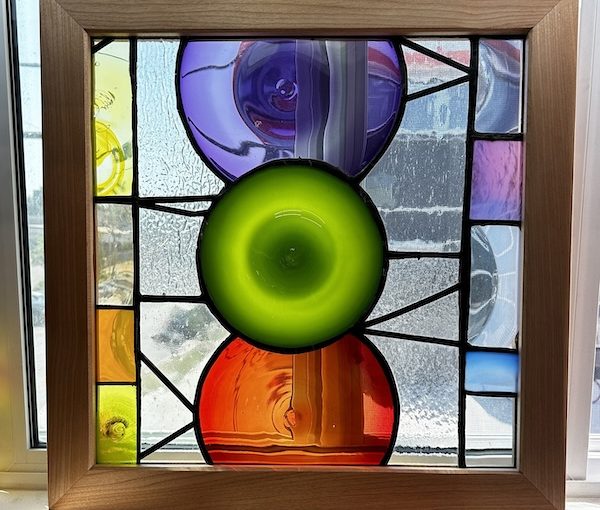
A stained-glass panel in a wood frame by Hope Forstenzer. (photo by Hope Forstenzer)

More than 500 artists are opening their studios, galleries or workshops to the public Nov. 14-17 for the 28th annual Eastside Culture Crawl Visual Arts, Design & Craft Festival. Among the artists are many Jewish community members, including Suzy Birstein, Olga Campbell, Ana Clara Feldman, Hope Forstenzer, penny eisenberg, Lori Goldberg, Lynna Goldhar Smith, Ideet Sharon, Stacy Lederman, Shevy Levy, Lauren Morris and Esther Rausenberg. 

“The Culture Crawl offers a unique opportunity to connect with our communities, to support artists in their livelihoods, and to come away inspired and reinvigorated by the countless ways in which artists explore and share their creativity with the world,” said Rausenberg, who is also the artistic and executive director of the Eastside Arts Society, which puts on the event.

Birstein, who creates and showcases her work from her 1000 Parker Street studio, is a figurative artist whose ceramic sculptures and paintings are self-portraits connecting her to women of history and mythology. 

“I am merging my own personal narratives with the narratives of inspiring women artists whose lives and art ‘embrace enchanting intrigues’ to transcend life’s challenges,” she explained. “This includes Frida Kahlo, Leonora Carrington, Leonor Fini, Vali Myers, Artemesia Gentileschi and Niki de Saint Phalle,” as well as figures like Athena and Alice in Wonderland.

photo - “I’m Going With Myself” by Suzy Birstein
“I’m Going With Myself” by Suzy Birstein. (photo by Byron Dauncey)

Her upcoming solo retrospective, curated by Dr. Angela Clarke at Il Museo, is now scheduled for 2026, rather than next year, which is what was originally planned. The retrospective will combine her Tsipora and Ladies-Not-Waiting series.

“This past year has brought me two profound highlights that resonate deeply in my artwork,” said Birstein. “First, I’ve embraced the idea that the Tsiporas – my Hebrew name, meaning ‘Bird’ – have always been part of the Ladies-Not-Waiting.

“On the personal side, my husband courageously and successfully underwent two major surgeries in 2024, which deepened my appreciation for life and the importance of love and compassion. Additionally, our daughter-in-law became a permanent resident of Canada, allowing our family to thrive together.

“These experiences have infused my art with newfound freedom, imagination, and a willingness to experiment with construction, colour and concept. Each piece I create reflects this journey and the richness of these connections, as with my Ladies-Not-Waiting.”

Birstein and fellow Crawl artist Lori Goldberg spent October in Italy on a self-directed residency, which comprised four segments, each with its own and overlapping purposes, said Birstein.

They explored art at Venice Biennale and other exhibits in Venice. They went to Amalfi, where, Birstein said, “I created a most special and memorable experience – to visit Gianni Menichetti, who was the partner of Vali Myers (one of my artists). In a valley above Positano, Gianni lives off the grid with his family of animals – 10 dogs, ancient doves, chickens, fish, a rooster and others. Gianni himself is a well-known poet, artist, writer, as well as protector and preserver of the land and its natural inhabitants. He’s a most unique human being. Although we were only together for 24 hours, it is as though we have always known each other and always will.”

In Napoli, said Birstein, “within the ancient graffiti-covered walls of this chaotic, lively city, we [were] exploring, experimenting and expressing evolving directions for our art practice.”

Lastly, they went to the island of Ischia for a family celebration, visiting thermal springs, gardens and the sea.

photo - "You sing my songs" by Suzy Birstein
“You sing my songs” by Suzy Birstein. (photo by Alan @ Fidelis Art Prints)

“There are moments in my life when personal and global experiences intertwine – what I like to call destiny with focus,” said Birstein. “My Italian adventure, from connecting with Gianni in Positano, family in Ischia and gallerists in Naples, to engaging with art at the Venice Biennale, inspires every aspect of my life. I sense that I’m in the midst of crafting my next ‘big story,’ which will undoubtedly reflect in my evolving art practice. These experiences shape not just who I am, but also how I create.”

Ceramics and glass artist Hope Forstenzer is also expanding the way she creates. 

“I got a grant to learn woodworking throughout 2024, and that’s been a big highlight,” she told the Independent. “I’ve been working to make pieces that use both glass and wood, and it’s been exciting and challenging to learn a whole new medium. My progress has been slow and steady, and some of the work I made will be in the Crawl this year.”

This is Forstenzer’s third year of making clocks for the Crawl, and she said she’s really been enjoying the process. 

“This year, I’m experimenting with different colours and patterns, and I’ve also got one that’s in a stained-glass panel in a wood frame I made. I’ve spent more time with clockworks and hand design, as well, and am experimenting with different materials for those aspects of the clocks.”

photo - A seder plate by Hope Forstenzer
A seder plate by Hope Forstenzer. (photo by Hope Forstenzer)

In addition to the clocks, visitors to Forstenzer’s studio in the Mergatroid Building, 975 Vernon Dr., will see her stained-glass panels in wood frames, blown seder plates, dreidel blown ornaments, small blown lamps with battery-powered LEDs inside, and some vessels and bowls.

“One of my roles at Terminal City Glass Co-op is the coordinator of the Learning Fire Program, and I’ll be doing a glassblowing demonstration with some of our students on Saturday the 16th from 1:15-3:15,” said Forstenzer.

For more about Learning Fire, visit terminalcityglass.com/pages/learning-fire.

Both Birstein and Forstenzer have works in the Culture Crawl’s preview exhibition, which runs to Nov. 29 at Pendulum Gallery, Alternative Creations Gallery, the Cultch and Charles Clark Gallery, with display dates depending on the venue.

For the full list of events and participating artists, go to culturecrawl.ca. 
The joys of connection

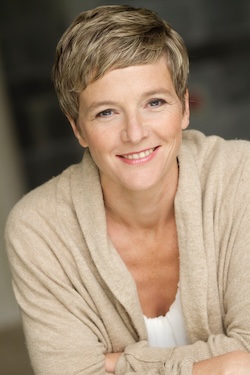
Actor Kerry Sandomirsky – who has more than 130 stage and screen credits – is making her producing debut with the Vancouver première of The Sound Inside, written by Adam Rapp, which was nominated for six Tony Awards in 2020, including best play. The Nov. 14-24 performances at Vancity Culture Lab represent two other milestones – the first production of Sandomirksy’s newly established company, all day breakfast theatre, and the launch of the Search Party’s New Cartography initiative.

photo - Actor Kerry Sandomirsky produces her first play – the Vancouver première of The Sound Inside, by Adam Rapp – and launches her new company, all day breakfast theatre
Actor Kerry Sandomirsky produces her first play – the Vancouver première of The Sound Inside, by Adam Rapp – and launches her new company, all day breakfast theatre. (photo from the Cultch)

“I was looking for something to produce, so I was reading a lot of scripts,” Sandomirsky, who is Jewish, told the Independent. “There was something about The Sound Inside that kept pulling me back. Adam Rapp describes it as haunting, and I think I was haunted by it. My aunt and uncle who live in LA are avid theatre-goers. On two previous occasions they have suggested work I should consider. Coincidently, those pieces became important touchstones in my career. When I was in the middle of negotiating rights for The Sound Inside, they contacted me once again about this compelling show they had just seen. I hung up and bought the rights.”

Being a producer comprises multiple responsibilities.

“Producing involves raising money, putting a team together, creating a budget, getting insurance, finding a theatre, organizing and initiating publicity and marketing campaigns, and ensuring the production is created in a supportive environment,” said Sandomirsky. “So often in life we are in a state of reactive business, and producing was a way for me to take agency.”

Sandomirsky not only produces The Sound Inside, but co-stars in it with Jacob Leonard; Mindy Parfitt, founding artistic director of the Search Party, directs.

Sandomirsky portrays the character of Bella Baird, “an under-appreciated novelist and tenured creative writing professor who forms an unlikely bond with a mysterious yet talented student, Christopher Dunn,” played by Leonard, who happens to have been a student of Sandomirsky’s when she taught at Studio 58. “Brimming with suspense, Rapp’s riveting play explores the limits of what one person can ask of another,” reads one description of the 90-minute play.

The Sound Inside is about two people who have isolated themselves from the world, but, to their great surprise, find in each other a reprieve from loneliness,” said Sandomirsky of the play’s appeal. “It is about the delight of connection, the joy of a shared sense of humour, and the power of being seen.”

“The Search Party created New Cartography as a response to Kerry’s desire to produce The Sound Inside,” Parfitt told the Independent. “It has been a way for us to expand how we create theatre and to identify ways we can support and encourage artists to develop themselves.”

photo - Mindy Parfitt, founding artistic director of the Search Party, whose New Cartography initiative offered Kerry Sandomirsky support in her first producing role
Mindy Parfitt, founding artistic director of the Search Party, whose New Cartography initiative offered Kerry Sandomirsky support in her first producing role. (photo from the Cultch)

The Search Party’s website notes that the initiative’s purpose is “to provide mid-career and established artists an opportunity to develop new aspects of their practice. Initiated by the artist, it provides hands-on practical experience in a previously unexplored area of their own creative landscape. Through the New Cartography program, artists receive mentorship, resources, tools and systems in theatre production.”

An application process for the initiative isn’t in place yet, said Parfitt. But, if artists are interested, they can contact her through the company’s website, searchpartyproductions.com.

“There are many aspects to this process which are new for me,” Parfitt said. “Kerry brought me the script. She and Jacob had done considerable work on it before I got involved and so there was some catching up for me to do. This is unusual as a director. Usually that process is completely reversed.

“We have been rehearsing part-time over several weeks, which also is different from the complete immersion that all of us are used to,” she continued. “The Search Party is dedicated to marrying a strong design with a compelling script. Kerry’s company – all day breakfast theatre – prioritizes actor-driven theatre.  is an exploration in uniting our two visions.”

“Mindy has been instrumental in demystifying the many logistics of producing,” said Sandomirsky. “She has provided practical advice and infrastructural support. The experience has given both of us an opportunity to make theatre in a new way.”

For tickets to The Sound Inside, visit thecultch.com/ticket/the-sound-inside. 

Feel-good comedy at Metro

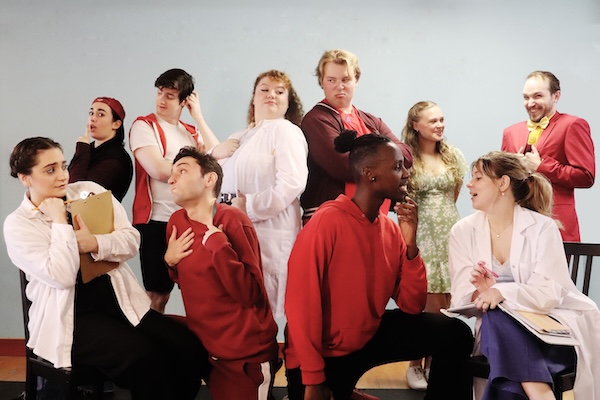
The cast of Bound! The Musical (In Concert), a quirky, character-based show, the story of which is a vehicle for the characters’ journeys and personal growth. (photo by Joelle Wyminga)

For two nights only, Nov. 19-20, Metro Theatre and Bound Musical Theatre Society are presenting the world première of the feel-good comedy Bound! The Musical (In Concert). 

Written by longtime friends Wayne Morris and Glen Freedman, their collaboration on Bound! – music and lyrics by Morris, book by Freedman and Morris – began in 2015. Morris had been working on the concept for several months.

The show is a reimagining of Shakespeare’s Love’s Labour’s Lost. Four Olympic-bound male athletes “are tricked into abstaining from vices and ‘romance’ during their high-intensive training, only to find themselves suddenly at the centre of a research study run by a group of attractive, brilliant and highly driven women,” reads the synopsis. “What follows is a hilarious battle of wills as their desires and the binds of their stringent guidelines battle for the win.”

“Glen and I were hanging out at Kits Beach, and I started telling him about the show,” Morris recalled. “Glen peppered me with all kinds of questions about the characters and the story. It turned into a two-hour conversation, after which I said, ‘Glen, you have to write this with me.’”

“To which, without any hesitation, I said, ‘yes,’” Freedman told the Independent. “The idea of working with Wayne on a creative project again (yes, we’ve been down this road before, though many years ago) carried a sentimental nostalgia for me.”

“When we first met, we started writing and performing songs together,” said Morris. “Together, we joined an ’80s band led by one of Glen’s friends. It was the ’80s after all!”

“It was a blast, even though they wouldn’t let me sing,” quipped Freedman.

The pair has lived in Metro Vancouver for more than 25 years, Morris in Maple Ridge, Freedman in Yaletown.

“We met at Marianopolis College in Montreal in our late teens, and became great friends. After university, we backpacked through Europe together,” said Morris.

Morris was an actor before becoming a singer-songwriter and then music producer as well. Freedman, while a keyboardist, took a less musical route and became a psychiatrist. Along the way, he also completed a creative writing program at Simon Fraser University and attended Bishop’s University in Quebec, where he performed in Chekhov’s The Cherry Orchard.

Morris and Freedman formed the Bound Musical Theatre Society earlier this year “as the vehicle for this and future productions,” said Morris. “Our lawyer recommended a not-for-profit society as the type of entity the local theatre industry is used to working with.”

The Metro Theatre production of Bound! is directed by Hailey Fowler, with musical direction by Kylie Fonacier. It features a diverse ensemble cast in what Morris describes as “a character-based show, and the story is a vehicle for the characters’ journeys and personal growth.

“For me,” he said, “this focus on character was challenging at first as a lyricist, in that the lyrics needed to reflect 10 distinct voices. As the show and characters continued to develop, and the songs were continually rewritten and refined, this process became easier, as both the characters and the lyric-writing process became more familiar.”

“As our show is about resilience and the possibility of change at times of challenge,” said Freedman, “it was my view that we had to create characters, each with their own unique personality quirk that was getting in their way – ‘bounding’ them up, you might say. Each character would then get their own story arc, in which they would overcome these constraints, to a realistic degree. The goal was to induce the audience to see themselves in these characters, such that they would walk away from the show with a feeling of hope and a bounce in their step.”

No doubt the musical’s 16 original songs will contribute to that bounce. Morris said his biggest musical influence is the Beatles, “and so that is a big musical influence for the show, including having a wide variety of musical styles across the show, in the same way the Beatles do.”

In a similar vein, Morris based the story on Shakespeare’s Love’s Labour’s Lost because, he said, “I wanted to have the best possible source material, and what better source than Shakespeare? Using Shakespeare ensured a solid story structure. Love’s Labour’s Lost is a very fun story, with silliness and great wordplay. That’s the type of show I wanted to write. Also, in Love’s Labour’s Lost, I loved the fact that the women in the story consistently have the upper hand over the men; very progressive then, and seems to fit our world today!”

“I couldn’t agree more,” said Freedman, whose day job has helped him in the creation process.

“Due to the nature of my work as a psychiatrist, I have, over time, developed an understanding of the nature of suffering – a human experience that ties us all together – and how personality informs how we suffer,” he said. “I have also had the privilege of having seen firsthand how change in how we think can manifest. This, I feel, has helped in our creating characters that are true to life, and who undergo change for the better, in a manner that we hope will be experienced by the audience as believable and relatable.”

And which will leave audiences feeling positive, though Morris and Freedman differ slightly in their outlook.

The press material describes Morris as a “glass half-full person.”

“It’s part of my nature to look for the good in everyone, and I’ve discovered that almost everyone means well deep down,” he said, acknowledging, “I’ve also been very fortunate that hard work and some good life decisions have led to things working out for the most part in my life.”

As for Freedman, optimism comes a little harder.

“Through my adult life (and with lots of therapy), I’ve gradually moved to a place of being able to recognize what’s in and out of my control, of what I have agency over and what I have to accept, of understanding that, just because I accept something does not mean I have to like it, and of letting go of expectations of how I wish things should go,” he said. “This mindset has fostered within me a capacity to face the events of life, sometimes tumultuous, with curiosity, a sense of humour and presence.”

While neither Morris nor Freedman are religious, Judaism does impact their lives.

“Judaism has shown me the value of a strong sense of community and connection,” said Morris. “The importance of these is a huge theme of the show.”

“I would add,” said Freedman, “that feeling oneself to be part of a community helps to add meaning to our lives.”

For more information and tickets to Bound!, go to boundthemusical.com/in-concert. 

The ethics of triage in war

Dr. Salman Zarka (photo from Ziv Medical Centre)

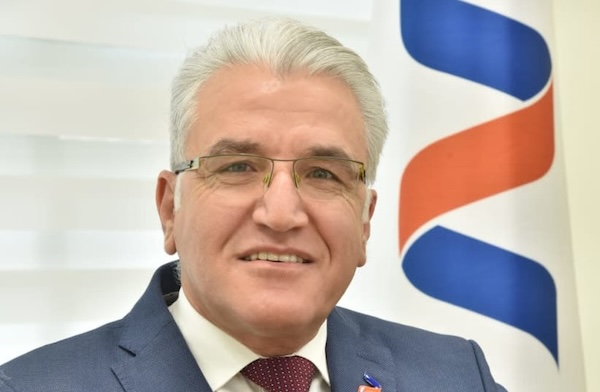
Dr. Salman Zarka is general director of Ziv Medical Centre, in Safed, Israel, which is about 11 kilometres from the border with Lebanon. He visits Vancouver this month, speaking at Congregation Beth Israel on Nov. 21, 7:30 p.m., on the topic of Medicine Under Fire: The Ethics of Triage in War. He also speaks during Shabbat morning services on Nov. 23 about Who are the Druze? And How Does Diversity Help Medical Outcomes in Ziv Hospital?

Zarka is a member of the Druze community. He served in the Israel Defence Forces for 25 years, and is a colonel brigadier in the reserve force. An epidemiologist, he is an expert in public health and public health administration. He is also a practising physician, and lectures at University of Haifa’s School of Public Health. He was chief COVID-19 officer in Israel’s Ministry of Health from 2021 to 2023 and, prior to that, the medical assistant of the ministry’s general director.

To hear Zarka speak, register at bethisrael.ca.


NCJW marks 100

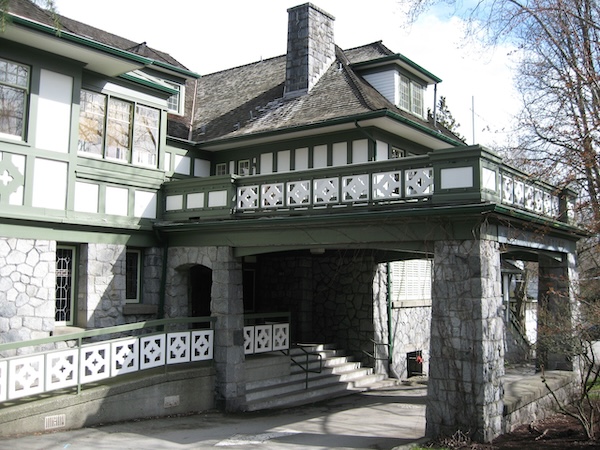
On the afternoon of Nov. 24, NCJW Vancouver celebrates its 100th anniversary at Aberthau Mansion, which is evocative of the era in which the organization planted its roots in Vancouver. (photo by Chris10Chan / wikipedia)

A century is a long time for any organization. For a Jewish women’s organization on the West Coast of North America, that is an especially major milestone. National Council of Jewish Women Canada, Vancouver section, is marking 100 years since its founding with a Roaring ’20s party this month.

Jordana Corenblum, president of the chapter, said the celebration location – Aberthau Mansion in West Point Grey – is evocative of the era the organization planted its roots in Vancouver. Era-appropriate dress is encouraged at the afternoon event, but not mandatory. The fact that Corenblum has a collection of flapper-era dresses is coincidental to the party’s theme, she said.

The organization itself was founded in Chicago in 1893 to engage Jewish women in social justice work, especially around issues of poverty affecting women and children. The first Canadian chapter started in Toronto in 1897 and the Vancouver branch began 27 years later.

photo - Jordana Corenblum, president of National Council of Jewish Women Canada, Vancouver section
Jordana Corenblum, president of National Council of Jewish Women Canada, Vancouver section. (photo from Jordana Corenblum)

Corenblum emphasized that she is a relative latecomer to the group. Her ascendancy to the presidency represents a generational shift, she said, but she sees herself and others of her age as carrying on the traditions of their mothers and grandmothers while adapting NCJW’s work to women who are deeply involved in careers.

For earlier generations of women who may not have worked outside the home, Corenblum said, groups like National Council, Hadassah and others allowed women – even in the era when they could not vote – to contribute to the larger society. 

Corenblum’s profession is youth work and so she is bridging generations.

“I have a lot of exposure to what young people are doing,” she said, “so I am in the space of honouring all of the beautiful feminist work that has been done, all of the things that I’ve seen that the generations ahead of me have done. I’m really trying to bridge what the younger generations are coming up with. They are very socially justice-minded. They have all different ideas of gender and religion and culture and what all of that looks like, so I’m trying very hard to be this person that can bridge both and honour both, honour the past and move forward into the future.”

The 100th birthday party is a welcoming way to bring light into the figurative and literal darkness, she said. It takes place on a Sunday afternoon – Nov. 24, from 2:30 to 5 p.m. – so people who don’t want to drive in the dark can comfortably attend.

“Especially after the year that we’ve had, we need a feel-good event,” she said. “There is no agenda to this other than ‘Come celebrate.’”

There will be mocktails and a grazing table, as well as professional childminding, live music and swing dance lessons.

Tickets are available at give-can.keela.co/100th.

Judaism’s funny sides

Los Angeles-based comedian and podcaster Antonia Lassar brings The Best Jew to Vancouver Performing Stars’ theatre on Nov. 30. (photo by Xander DePascale)

Ever wonder how Sarah might have welcomed back Abraham and Isaac from their “camping trip”? Who’s the biggest diva in the Hebrew Bible? What elements an interior designer for synagogues considers? These are just a few of the questions comedian Antonia Lassar answers in recent social media posts.

On Nov. 30, Vancouverites can see the Canadian debut of Lassar’s The Best Jew, in which she shares anecdotes about her Reform Judaism upbringing, contemplates questions like whether the late Debbie Friedman is the Messiah, and much more. Music and singing play a big part in the show, which will be opened by the Klezbians, a band from Victoria.

Lassar draws her inspiration from the Jewish communities she’s lived in, in Boston, New York and Los Angeles. “It’s sometimes brutal to be sitting in shul and not be able to pull out my phone to take notes, because I just noticed something hilarious that I need to write about,” she said. “I’m constantly having great ideas in places where I’m not allowed to write anything down!”

Lassar grew up in Newton, Mass., and attended theatre school before moving to New York City. Two years ago, she relocated to Los Angeles to focus on film and television. “I’ve known since I was a kid that I wanted to perform, but I didn’t pinpoint comedy as my strong suit until I got out of college,” she said. 

Today, she describes herself as being deeply immersed in the Jewish community, but, for many years, Lassar found her Jewish life uninspiring. “I didn’t like Judaism growing up,” she admitted. “It felt like an afterschool activity I was forced to do, in the same way I was forced to take piano lessons. I thought both were useless and probably just child abuse.”

It took a foray into other religions before Lassar returned to Judaism with genuine interest and curiosity. For that, she thanks Chabad in Brooklyn. “They sucked me in and gave me a great love for Judaism,” she said. “But I wouldn’t call myself Reform or Chabad. Like many Jews of my generation, I feel like I’m between denominations.”

When it came to writing comedy, Lassar turned to what she knew best, and that was Judaism. “Most Jewish comedy stays at the level of cultural Ashkenazi stereotypes of bagels and overbearing mothers,” she said. “This never felt representative of my experience. I wanted to write comedy for Jews that went beyond stereotypes and that shows a different side to Judaism, one that’s not commonly portrayed in comedy.”

She wrote The Best Jew for a pluralistic Jewish audience and has performed it for a wide range of Jews, from Reform to Hassidic. “My material is very clean, and any passing reference to controversial subjects like the Holocaust is extremely respectful,” she said. “This is an 18+ show, but it won’t offend anyone.”

In the show, Lassar jokes about the Reform movement’s obsession with the word “meaningful,” and Chabad’s distribution of menorahs, among many other subjects. “It’s so much more fun performing for Jewish communities than at comedy clubs, where you’re just another comedian,” she reflected. “When I perform at a synagogue, they treat you like you’re Moshiach! It’s a dream job to travel around the country and meet amazing Jewish communities who are so diverse and so welcoming.”

Lassar comes to Vancouver as a guest of JQT Vancouver, a volunteer-run Jewish, queer and trans nonprofit, and Jewish Family Services Vancouver, as part of the organizations’ Mental Health Support Series. While Lassar’s queer identity does come up, “it’s not a huge part of the show,” she said. “I’ve spent a lot of time in very Orthodox spaces, where the question of queerness is unavoidable. And I’m proud to be a queer Jew who is deeply engaged in Judaism.”

To get an idea of Lassar’s comedy, check out her sketches on Instagram and TikTok. She also co-hosts, with comedian Raye Schiller, Yenta Pod, a weekly podcast with the tagline “Sometimes funny, sometimes Jewish, always gossip.”

For tickets ($18) to The Best Jew on Nov. 30, 7 p.m., at Vancouver Performing Stars’ theatre, visit comedynightwithantonia.eventbrite.ca. 

Lauren Kramer, an award-winning writer and editor, lives in Richmond.

When new is also ancient 

It turns out that a war and a worldwide increase in antisemitism may cause more Jewish people to return to Jewish spaces. Some Jewish atheists try out fasting for Yom Kippur. New faces appear at synagogue. Lectures and events that were sparsely attended in the past seem to have more takers. If you’re a regular in a Jewish community, you may have seen this already. There are many reasons, including a need to find community and avoid antisemitism, or to return to religious practice after dealing with so much death. For those who were already attending or even occasionally attending Jewish services or events, things have also changed.

My twins had their b’nai mitzvah in June. I’d long thought of how cool it would be if they could help fill out a minyan more often (a group of 10 needed for communal prayer). However, there have been obstacles. Our congregation’s building was under renovation. The temporary spot, while lovely and hospitable, required a car ride.

This fall, the congregation moved back to its building and we live in easy walking distance. My kids attend public school and didn’t have Sukkot off. Yet, when one kid asked to attend minyan on Hoshanah Rabbah, the last day of Sukkot, I immediately said yes. He would have “an appointment” that morning, according to the attendance sheet, and arrive a little late. We figured, no need to claim a religious holiday (antisemitism concerns, again), but that’s what it was, of course.

Hoshanah Rabbah was a new experience for us, though it’s an ancient ritual. It involves circling the pulpit (a stand-in for the Temple altar) seven times, with lulav and etrog in hand. Marking the end of the fall holidays, it’s a last chance to ask for forgiveness and a better year.

Traditions differ about what is said during this ritual, but our congregation read piyyut, which are traditional poems, a part of Jewish liturgy that often includes acrostics (poems that use the alphabet). Some of the piyyut are very old. I found myself praying that my fruit trees don’t get fungus or that my fields wouldn’t be cursed. It might seem funny to ask for some of these things, but my city backyard has young apple, apricot, plum and cherry trees. I don’t want fungus!  

It was especially poignant to pray – in the “Foundation Stone (“Even Shetiyah”) poem – about “the goodness of Lebanon, beautiful place, joy of the world.” This came straight out of the Siddur Ashkenaz (the Ashkenazi prayerbook), with specific quotes from Isaiah, Psalms and Lamentations. Our historic relationship with Lebanon is a rich one. Many of us, Israelis and diaspora Jews, would love to visit Beirut, the “Paris of the Middle East.” Some of us have ancestors who lived there, and we would like to see where they grew up or spent time. This urge isn’t new; our desire to have a good connection to Lebanon as a neighbour is ancient.

Then, we all were handed bundles of willows. We beat these on the lectern with force while saying, “Save your people and bless your heritage, care for them and carry them forever.” It was primal, cathartic, and very messy. There were willow leaves everywhere. 

My kid was only a little late to first period art class. I went home in wonder. Later, I joked with one of my professors from graduate school, Jack Sasson, who I respect deeply, about how, for me, this previously unknown Jewish ritual felt stirring and exotic. He suggested that paganism still has something to teach us. The beating of the willows is ancient indeed. It’s a namburbi ritual from Mesopotamia, he said. When I remarked that I could get into this paganism thing, his reply left me laughing. “Ishtar will welcome you.”

I was still reflecting on all this when watching some new friends with young kids dancing on the evening of Simchat Torah. To help everyone through the first yahrzeit of Oct. 7/Simchat Torah, our rabbi dedicated each hakkafah (circuit around the room with the Torahs) to a different group: first responders, those who had died in the past year, the unity of the People of Israel, etc. The next afternoon, the kids came over for snacks and to play. One of the parents asked me why there was so much reference to Israel stuff. I realized that here, too, was a confluence of old customs and new experience.

I explained that some of these prayers, for instance, the prayer for the hostages, weren’t new. The Talmud, codified in 500 CE, discusses the topic of hostages at length. The first instance of the prayer for the redemption of hostages that we use today was documented in the Mahzor Vitry, named for Simhah b. Samuel of Vitry, a French talmudist who died in 1105 CE.

I reminded them that many present at the synagogue were in mourning for people who had died. While celebrating old holidays, we need to acknowledge the current situation. These days, services usually include prayers for the state of Israel and the Israeli army, too. None of these are newly written prayers. 

Of course, Sukkot itself, a harvest festival that required Israelites to go to the Temple in Jerusalem – last destroyed in 70 CE – is also all about Israel.

I drew a few conclusions from these social encounters. First, for those who may feel jaded and aware of Jewish yearly events, there’s always something new to learn. For me, it was the primal connection to Mesopotamia, namburbi ritual and, yes, Ishtar, the goddess herself. For those who hadn’t been at synagogue for some time, there were many questions, new encounters and experiences, too. What unites it all is a realization that, while our individual learning curve might be new to us, the rituals, the prayers, and the historic connections to Israel are ancient.

For all of us, in a time when political rhetoric seeks to disconnect diaspora Jews from the land of Israel, Sukkot and Simchat Torah were a powerful – and timely – reminder of our past and our future, together. 

Joanne Seiff has written regularly for the Winnipeg Free Press and various Jewish publications. She is the author of three books, including From the Outside In: Jewish Post Columns 2015-2016, a collection of essays available for digital download or as a paperback from Amazon. Check her out on Instagram @yrnspinner or at joanneseiff.blogspot.com.

Running in the human race

I am still running in this race. For those of us who are older, it seems to take much of our strength to show up every morning and run the course. It seemed easier when we were younger, full of the energy of youth. We have forgotten what it was like when we were discovering who we were, who we were going to be. Surely, that was a struggle, even if it was a different one than we face today as older people.

There are mysterious things about this race. Who are the winners? What does winning mean? The rewards don’t necessarily go to those who arrive soonest at the finish line. Maybe it is more like a relay race, in a family sense. Lots to think about.

I have a grandson, more than one, in fact. All of them are fully engaged in finding their way in the foot race in which all of us living on this planet are engaged. As are my granddaughters. Seeing the challenges they face, the stories they tell me about what they are doing and what they are planning, bring memories of my own beginnings. I see how competitive the world they are inhabiting is. I see how some of them are so conscious that their every move, every decision they make, everything they do, right or wrong, is recorded, and will affect their future possibilities. These children, in their mid-teens and early 20s, are struggling with perspectives we did not awake to until we were 10 or 15 years older. How about that kind of pressure!

I think of the path I have followed, growing up in Winnipeg, moving away to make my fortune, seeking to put my own personal mark on the journey I was taking. I was so determined that I had to be the only architect of the life I was building. Was I foolish not to be a seeker of advice? I threw myself recklessly into that life, confident that, come what may, I could overcome any obstacle to my desires that might appear in my path.

I never worried about missteps. I never worried about making wrong decisions. My life was a tabula rasa, a blank slate to be shaped as I wished. Of course, my grandchildren probably think that whatever they are doing is right, too. Many of the decisions we make in the days of our beginnings have a dramatic impact on our future.

I am not complaining. I have had a glorious life. I may not have realized all the potentialities – I have not conquered like an Alexander, created language like a Shakespeare, envisaged shapes like a Moore, painted visions like a Picasso. But, like most of us, I have delivered some blessings for my fellow human beings, and I am content.

I have seen the mountains of America, Europe and Africa, and their valleys. The waters of Canada and Brazil have roared before my eyes, and in my ears. I have had a good share of the delightful places and times the world has to offer. And I had the chance to spend some of my life with the woman of my dreams.

On my travels, during the race I have run, I have learned how fortunate we are, and what real misery is. I know what the view from Dublin is like, and have witnessed the views from New York, Washington, London, Paris, Rome, Johannesburg, Cape Town, Hong Kong, Singapore, Sydney, Khartoum, Cairo, Vientiane, Bangkok, Dakar, Ougadougou, Buenos Aires and Rio de Janeiro. These were some of the places I lived in and visited.

Like many of us, I did not make the most of my potentialities as a consequence of my decisions. One day, I heard Neil Young say, in a television interview with Charlie Rose, that our pasts are like an overcoat. When we put the coat on, it tells the world who we are. Or the world chooses to see us as we appear wearing the overcoat of our past.

Sometimes, we wish we could shed our past and take a new direction. I’ll tell you a secret. We don’t need to do that. We can be new people any day we choose. The past we wear like an overcoat, that we have the choice of shedding, can inform the choices we want to make, but it doesn’t have to limit who we are today, and will be tomorrow.

I am not the economist that I was, the manager of people that I was, the public relations speaker and writer that I was, the researcher and marketing consultant that I was, the real estate broker, the financial advisor, the whatever I had to be. Now, in beautiful Vancouver, I write stories and poetry. I have played with clay until the faces jumped out at me. I meddle in the stock market. I try to talk to my kids often. I try to be present for my Bride. We try to make our home a friendly place.

Today, I try to be a better husband, a better friend, a better parent; some things, perhaps, that were lacking quality in my past. I am still running the race. It is sometimes a little tiring, and I have to exercise to build my stamina – but I hope to run it well, right to the end. 

Max Roytenberg is a Vancouver-based poet, writer and blogger. His book Hero in My Own Eyes: Tripping a Life Fantastic is available from Amazon and other online booksellers.

The search for a new home

A crane lifts a tunnel boring machine part out of the excavated Arbutus Station. With all the changes the Broadway Subway Project is bringing, the Accidental Balabusta and her husband are looking for a new condo – going from renters to owners. (photo from broadwaysubway.ca)

Growing up in the 1960s and ’70s in the then-Jewish neighbourhood of Oakridge, I was certain my future would include a beautiful house and a large yard. And, of course, a husband. Only part of that dream came to fruition, in 2009, when I got married at age 53. Before Harvey came along, I was a single woman making a decent but not extravagant living, and a house was way out of reach for me. So, I rented apartments. For decades. Welcome to my bad-news, good-news story. 

As I got older, the importance of attaching myself to the Jewish community became stronger and, as luck would have it, I ended up renting a place a mere seven-minute walk from a shul. And I stayed put for 37 years. Now, faced with expulsion from our apartment because of the Broadway Subway Project, I am struck not by anger or nostalgia, but by gratitude. And maybe a touch of anxiety about having to move at this stage of my life. At 68 years old, I have never owned anything in my life, except a car.

Having a deep-seated faith, I try, I really try to remember that everything that comes from G-d is good. I try, also, to take the mindset of “I don’t understand why this is happening to me, but I know in my bones that it’s good for me in some way.” This imposes a much-needed positive outlook. One that will propel me forward, rather than keep me stuck in a negative “Why me?” loop.

As renters in this situation, we are entitled to compensation by law. However, it’s cold comfort when confronted with the stark reality of having to find a new home. Politicians talk blithely about “affordable, below-market rental housing,” but, in reality, no such thing exists for those who are retired and on a fixed income. In short, living in Vancouver has become an absurd luxury.

As luck would have it, I am a thrifty kind of gal and, over the decades, I have saved a respectable amount of money. So, along with my husband, we have finally decided to buy a condo – in Vancouver. One of the most expensive cities to live in. 

Having spent the past while looking for a condo to purchase, I am bombarded by conflicting emotions: 

excitement, fear and trepidation. But mostly gratitude. Waking up at 3 a.m. for a full week while battling insomnia, I got to the point where, instead of trying to think of five foods starting with each letter of the alphabet (a trick to induce boredom and sleep), I started to think of everything I am thankful for. I’m happy to report that the list is very long. This is just a sampling.

I am grateful that I can choose between carpeting and hardwood.

I am grateful that I will finally have in-suite laundry.

I am grateful that I will have a bigger kitchen, where I can bake challah regularly and cook luscious Shabbat meals in a space that is larger than a Smart Car.

I am grateful that I can, within reason, afford a condo in Vancouver.

I am grateful that I have friends who are guiding me through this process.

I am grateful that I have the energy to run around looking at prospective homes.

In short, I am grateful that I have choices. Plenty of choices. 

It’s common knowledge that Jewish family values begin at home, and that’s what I’d like to continue nourishing and cultivating. From a real home. My home. For now, I am focusing on having faith and trust that Harvey and I will find a comfortable forever home. I have accepted that we may or may not still be a seven-minute walk from a shul. Thankfully, faith isn’t tied to geography. We can practise our Judaism anywhere.

As for the nuts and bolts, the experience of condo-hunting is an eye-opener for me. Little by little, condo by condo, I’m readjusting my priorities, figuring out what I can and can’t live without. Our realtor, thank goodness, has the patience of a saint and the temperament of a golden retriever.

Pragmatists that we are, we’ve started the search for a new home early, long before we are forced to move out of our rental apartment. But, as I’m learning, our property owner seems loathe to put money into a building that will be torn down within two years. So, we are living with stained hallway carpets, communal washers and dryers that rarely work, and balconies that haven’t been power-washed since before COVID. Am I enjoying this? Not even a scintilla. But still, I practise gratitude.

My constant refrain these days is: “It’s not the Vancouver I grew up in!” There are cranes everywhere on the horizon and there’s no telling what will be torn down next. It’s very unsettling. But at least we are fortunate enough to have options.

My periodic anger (which I am trying valiantly to contain) stems from the fact that I’ve lived and worked in Vancouver nearly my entire life and, while I was single until 15 years ago, I could never afford to buy a home. Thank G-d, my situation has changed, circumstances have opened up choices that never existed before, and the planets have aligned, allowing us to finally buy a home. 

Now, we just have to find one that meets my simple needs: in-suite laundry, hardwood floors, a good-sized kitchen and not south-facing. I say “my needs” because we can all agree on the universal truth: “happy wife, happy life.” It’s a buyer’s market at the moment, so yippee for us. This whole roller-coaster journey offers a new chapter in our lives; one filled with hopefulness, possibilities and joy. I look forward with gratitude to a beautiful mezuzah on a new door to bless our new home. All I can say is l’chaim! 

Shelley Civkin, aka the Accidental Balabusta, is a happily retired librarian and communications officer. For 17 years, she wrote a weekly book review column for the Richmond Review. She’s currently a freelance writer and volunteer.