Making a will during COVID

For hundreds of years, the basic rules for making a valid will have been the same: the person making the will has to sign it in the company of witnesses, and the witnesses have to sign, too. How can that requirement stand when we’re supposed to stay apart? Is it OK to sign and witness a will with everyone two metres apart from one another and wearing masks and even gloves?

Signing with COVID-19 precautions like distancing and wearing safety gear is legally valid, but not always practical. You’re passing around a paper document, and possibly sharing a pen. As we move into the winter months, it becomes less likely that you’ll all gather outside to sign. Signing indoors, despite social distancing and personal protection equipment, is still considered a greater risk than staying home.

Many of us have become far more familiar with videoconferencing technologies this year than we ever expected to be. How many of us had a Zoom seder or a Skype Rosh Hashanah dinner? Why can’t we update a centuries-old practice for the 21st century, especially given the COVID-19 crisis? We can.

The British Columbia government, as part of the emergency measures brought in this year, made changes to the rules for executing wills to accommodate pandemic precautions, and has also made those changes permanent. The Wills, Estates and Succession Act, which governs how we make wills, was amended to include two new sections on something called “electronic presence.”

The basic rules are still the same – the will has to be signed by the person making the will and by two witnesses, all witnessing one another more or less simultaneously, but they can sign separate paper copies – to be put together and treated as one original document – as long as they are in each others’ “electronic presence.” In other words, it should be the “witnessing a will” version of that Zoom seder.

Like everything with a will, there are technical details and you should always get professional guidance, but it is reassuring that you can remain safe, while attending to your critical planning needs.

Jeremy Costin is a business and estates lawyer practising in Vancouver. He sits on the board of directors and the governance committee of the Vancouver Holocaust Education Centre, and is a frequent guest instructor at the Law Society of British Columbia.

(Disclaimer: This article should not be construed as legal advice. Only your lawyer can give you proper advice specific to your needs.)

We must plan for our death

While our ultimate death is a certainty, when and how we will die is unknowable. And though death is inevitable, it remains a taboo subject for most. None of us knows what the future will bring. It is better to be prepared, so that if you become unable to make medical care decisions, your designated family members and healthcare providers, if you have talked to them, will have the knowledge and confidence to make those decisions for you.

As long as you are capable of understanding and communicating effectively with your doctor, nurse or other healthcare provider, you will be asked to make your own healthcare treatment decisions. But a serious accident or illness can result in you being incapable of making your own healthcare decisions at the time care is needed. This is why thinking about your preferences and talking to your future decision-makers now is so important. Making an advance care plan is a choice that will help alleviate some of the stress your family and friends could face if they are required to make important decisions for you, including who, exactly, you want your doctor to approach to learn about your wishes.

Advance care planning begins by thinking about your beliefs, values and wishes regarding future healthcare treatment and talking about them with selected family members or friends, as well as your doctor. When people you trust know what is important to you, it will be easier for them to make treatment decisions on your behalf.

Healthcare providers will always offer medically appropriate healthcare based on clinical assessment. They will want to ensure that any symptoms like pain, dizziness, nausea, bleeding or infection are understood and addressed. As long as you can understand and communicate, your healthcare provider will explain the medically appropriate care best for you, including any risks, benefits or alternatives. They will also ask if you have any questions and if you wish to accept or refuse the proposed healthcare treatment.

Some of the hardest decisions deal with the use of life support and life-prolonging medical interventions. These can include a ventilator to help with breathing, tube feeding, kidney dialysis, or CPR to restart the heart and lungs. If you were to have a life-threatening illness or injury, would you want to accept or refuse CPR? All, some, or no life support or life-prolonging medical interventions? A trial period of life support and life-prolonging medical interventions, allowing a natural death to occur if your condition is not improving?

Your advance care plan should at a minimum include these three things:

  • Having conversations with selected family members, friends, your family doctor and, if applicable, your spiritual leader, about your beliefs, your values and your wishes.
  • Writing down your beliefs, values and wishes for future healthcare treatment.
  • Writing down the contact information for the people who qualify to be on your temporary substitute decision-maker list (see below), or, if you prefer, the contact information for the representative you have chosen and named in an enhanced representation agreement, which is the one that allows you to name a person to make personal-care decisions and some healthcare decisions, including decisions to accept or refuse life support or life-prolonging medical interventions for you. (If you choose to have a representative agreement, I recommend you seek legal advice).

Bear in mind that your health and personal circumstances will change over time. As long as you are capable, you may change or cancel your advance care plan at any time and for any reason. Be sure to notify your doctor and your family members/friends of all changes you make.

Palliative care

When thinking about what to cover in your advance care plan, you might want to expressly include your wish to receive palliative care if you are suffering from a serious illness or condition. Palliative care is specialized medical care that focuses on providing patients with relief from the symptoms, pain and stress of a serious illness, whatever the diagnosis. The goal of palliative care is not to prolong life, nor to shorten it. The goal is to improve quality of life for both the patient and the family, and can be provided in a variety of locations, including the patient’s home, in a hospice, in a residential care facility or in a hospital.

Palliative care is provided by a team of doctors, nurses and other specialists who work with a patient’s other doctors to provide an extra layer of support. While often associated with end-of-life situations, palliative care is appropriate at any age and at any stage in a serious illness and can be provided alongside other appropriate treatments.

Many people choose to stay at home right to the end of their lives while receiving in-home palliative care from specialized healthcare providers. But if you are in the last few months of your life and feel that you are no longer able to manage at home, a hospice may be a good option for you. Hospices are meant to feel more like a home than a hospital. They are designed and furnished to provide a peaceful, homelike environment for you and your family while you receive end-of-life palliative care.

For more information on the delivery of palliative care in each of these settings, search the B.C. Health Ministry website or contact your local health authority.

Medical assistance in dying

Medical assistance in dying (MAiD) was made legal in Canada in 2016. It provides eligible patients who are experiencing intolerable suffering due to a grievous and incurable medical condition the option to end their life with the assistance of a doctor or nurse practitioner.

If your beliefs and values allow you to consider MAiD in the face of intolerable suffering, you should start by speaking with your doctor or your local health authority. For a variety of reasons, not all doctors will provide MAiD, and no one is required by law to do so. For some, MAiD may conflict with their personal beliefs or professional ethics. However, a patient can expect to be provided with information on how to access this service. Healthcare providers must not discriminate against patients with beliefs or values different from their own, and must provide an effective transfer of care to another healthcare professional who does offer MAiD.

To be eligible for MAiD, a patient must meet all of the following criteria:

  • be registered under B.C. Medical Services Plan
  • be at least 18 years old and capable of making healthcare decisions
  • have made a voluntary request for medical assistance in dying that was not made under any external pressure. This request must be in writing and signed and dated in front of two independent witnesses
  • have given informed consent after having been informed of the other means that are available to relieve their suffering, including palliative care, and
  • on assessment by two independent doctors or nurse practitioners, are determined to have a grievous and incurable medical condition, which means they have a serious and incurable illness, disease or disability; they are in an advanced state of decline that cannot be reversed; the illness, disease, disability or state of decline causes enduring physical or psychological suffering that is intolerable and cannot be relieved under conditions that the patient considers acceptable; their natural death becomes reasonably foreseeable. (On Feb. 24, 2020, the Liberal government of Canada introduced a bill to further amend the Criminal Code to, among other things related to MAiD, allow eligible persons to pursue a medically assisted death whether their natural death is reasonably foreseeable or not.)

A patient who has requested MAiD must be given the opportunity to withdraw their request throughout the process, including immediately before the medical assistance is administered, and this withdrawal need not be in writing or in any other particular form. Just an indication of a change of mind will do. And be aware that only patients who are themselves capable of giving consent can request MAiD. A request by a substitute decision-maker or by way of an advance directive is not valid.

Start the discussion

There is much more information available on end-of-life options than touched on in this article, and many matters not covered herein, but there is enough here to allow you to begin a conversation with those in your life who you want to make decisions for you when you cannot.

This is a lot to cover in one conversation. You can have as many conversations as you need – just get started before unwelcome circumstances make it too late. You will be doing yourself and your loved ones a big favour.

Tony DuMoulin is a founder of the law firm of DuMoulin Boskovich, where he practised commercial and real estate law for 40 years. He has a long history of involvement in Jewish organizations and municipal projects. DuMoulin is on the executive board of Jewish Seniors Alliance, in whose magazine, Senior Line, this article originally appeared in July 2020, Vol. 27(2).

Help repair the world

I am flipping through one of my social media outlets, as I lie on my bed, cuddling my 7-month-old baby to sleep. A picture catches my eye. Garbage strewn in front of a restaurant. I look closer, puzzled as to why someone would post a picture of garbage. Then I see. Discarded needles littered amongst the garbage. I read the accompanying message. The poster says that we need to relocate addicts to a secured facility in the north. Provide them with drugs and food and medical care, but we need to get them off of our streets.

I scroll through the comments. I cringe as I read them. I see posts such as, “These people,” “Get them off of our streets,” “Decided to act against societal norms,” “Until they wish to act like proper citizens,” “Undesirables” and so much worse.

The poster is Jewish. Many of the people commenting are Jewish.

My mouth drops open. I take a sharp breath and feel a pain deep inside of me. My heart hurts. I want to cry. My hands shake. It takes all the strength I have not to respond. I am hurt and angry. I shake my head in pain.

I am a recovering alcoholic and drug addict. I haven’t had a drink or a drug in a little over 20 years.

Yes, I am one of those undesirables. So is my husband. My mother and some of my best, most cherished friends.

I was 25 years old when I found recovery. I am one of the lucky ones. I never lived on the street. I didn’t do needles. I didn’t have to experience that kind of bottom, but what being in recovery has taught me is that I am no different than those who live on the streets, than those who inject themselves with needles. Because I am an addict. Once I use, I can’t stop.

The American Psychiatric Association classifies addiction as a complex brain disease that is manifested by compulsive substance use despite harmful consequence. I have a brain disease. I will drink and drug even though it causes harm to me and those close to me. Once I use, I don’t care about anything else. I have a disease that I have to live with and battle for the rest of my life. It is painful. It is a struggle. Some days are easier than others, but the fact of the matter is, I have to live with a disease that can return at any moment. Like a person in remission from cancer.

Does the Jewish community not want me or my children because I am an addict? Am I less of a worthy Jew because of my disease? What about my children? Even as I write this, my heart is beating fast, my breathing is shaky. I think of v’ahavta l’reacha kamocha. I think of how we, as Jews, are commanded to love the stranger who dwells among us, to have one law for the stranger and the citizen, to never embarrass our fellow human beings in public, and to guard our tongues and speak no evil.

Where is the love of humankind when we classify human beings as undesirables? Where is the humanity in suggesting that we take human beings and put them into remote locations, away from civilization? Is this starting to sound familiar? Perhaps like the Shoah? When Hitler classified us Jews as undesirables? Did those Jews have a choice as to whether or not they were classified as Jews even?

I have a disease. I did not choose to be an addict. I did not know, when I drank my first drink and smoked my first joint that I would end up addicted. I was a kid. I did what almost every other teenager did. I experimented. None of my friends from high school are addicts. I am. I got it.

Addicts come from all walks of life. They are your teachers, your lawyers, your doctors, heads of companies, celebrities. They are also those living on the street and leaving their dirty needles behind. Addiction doesn’t discriminate based on your ethnicity, your socioeconomic status or your religion, yet we, as a community, want to believe that addiction doesn’t happen among our tribe. I can tell you that it does. I can also tell you that there are many Jewish addicts and their families who are afraid to come forward precisely because they are afraid that they will be looked down upon and judged as morally impaired. As undesirables.

This, to me, is morally reprehensible. We, as a community, need to act with love. Let’s help repair the world that we live in so that we can love and support all people, even when they are sick with a disease that we don’t understand. It is our duty as Jews. V’ahavta l’reacha kamocha and tikkun olam. Love your fellow as yourself and help repair what is broken.

Amanda Haymond Malul is a JACS (Jewish Addiction Community Service) Vancouver supporter.

Must teach about Holocaust

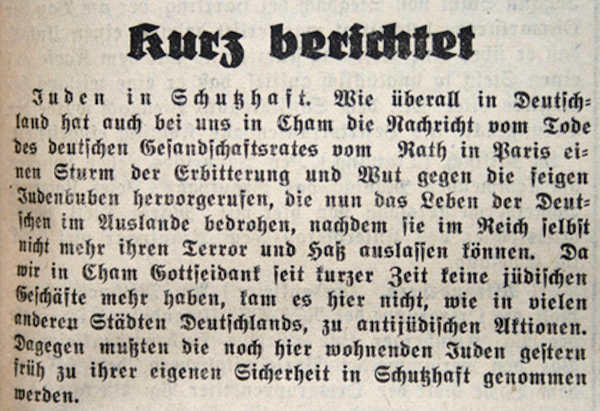
An item from the Nov. 10, 1938, newspaper in Helen Waldstein Wilkes’ mother’s hometown, Cham, Bavaria. It reads: “In Brief. Jews Taken into Protective Custody. As was the case everywhere in Germany, news of the death of the German Councilor von Rath in Paris unleashed a storm of bitterness and fury against the cowardly Jewboys who are now threatening the lives of Germans abroad because they can no longer unleash their terror and hatred within the Reich. Since, by the Grace of God, we no longer have any Jewish shops in Cham, anti-Jewish action did not take place as it did in so many other German cities. However, for their own safety, those Jews still living here had to be taken into custody yesterday morning.” (Translation by Waldstein Wilkes.)

As we have sat waiting to hear who will be president of the land that was once the beacon of hope for so many, we have asked ourselves, “What can I do? Are there meaningful avenues for action?”

Election day Nov. 3, Kristallnacht Nov. 9 and Remembrance Day Nov. 11 form a cluster. For Jews who became refugees or who lost family in the Holocaust and for all their descendants, Nov. 9 has particular resonance. Peter Gay was there. Here’s how he describes it:

“Synagogues were severely damaged or totally burnt out, sacred scrolls desecrated with the peculiar elation and ingenuity that the plunderers brought to their work. Businesses were destroyed, private houses and apartments were reduced to piles of rubble, with furniture, pictures, clothing and kitchen equipment thrown around so that they were barely recognizable. There was some looting…. But for the majority, the thrill lay in destruction for its own sake.

“The world watched, disapproved, and did almost nothing. In the United States, the public’s attention was still focusing on the midterm congressional elections of November 8, and the press was busy assessing the results.” (From Gay’s My German Question: Growing Up in Nazi Berlin, Yale University Press, 1998.)

For me, the parallels to today send shivers down my spine. The world must not be allowed to forget the depths to which humans can sink.

Awareness of the Holocaust is shrinking. In the United States, a 2018 survey showed that 66% of millennials could not identify what Auschwitz was. A recent survey revealed that about a third of 7,000 European respondents across seven countries knew “just a little or nothing at all” about the Holocaust.

Knowing about the Holocaust can provide a necessary understanding of how an entire population was bullied and manipulated by demagogues before succumbing to hate and fear-mongering. It can also serve as a blueprint for recognizing the dangers of demonization and incitement and help guard human rights and strengthen core democratic values.

Instead of endlessly fretting about social isolation and the threat of COVID-19, I’ve been seeking ways to make the gift of my days here on earth matter. I, a woman who calls herself “accidentally alive,” a woman who left her first home by horse and buggy, now count technology as among the miracles of my life. Recently, from out of the blue, the wife of a second cousin in New York, whom I’d met only once many years ago, decided to gather the extended family (all that’s left, thanks to Hitler and his efficient helpers) via Zoom. Welcoming me to this gathering of the mishpocha was a man in Israel claiming that his great-great-grandparent and mine had been siblings, and that he had read my book Letters from the Lost in connection with his volunteer work at a museum there. The museum used to be a kibbutz, founded by survivors from Theresienstadt, the concentration camp where both of my grandmothers perished and where most of my family suffered before being sent to their final destination, Auschwitz. Perhaps to distance itself from the German and to place upon it the stamp of renewal that Israel became for these lost souls, the kibbutz was named Beit Terezin.

Together with David, this fourth cousin in Israel, I am building a pathway for keeping alive that which we forget at our peril. Please, if you can, go to jgive.com and search for “Letters from Arnold.”

Using artwork and graphics contributed by those early survivors in Beit Terezin, alongside the words of my beloved Uncle Arnold, who spent 17 months in Theresienstadt before enduring the hellfires of Auschwitz, we hope to create a book that will find a home in every Holocaust museum in the world. If finances permit, we will use technology to bring the contents to life in new ways so that those who cannot visit a Holocaust museum in person nonetheless can receive our reminder that it must not happen again. Never Again.

I urge you to visit our website. And if you’d like to do an additional mitzvah, please forward the link to contacts near and far whose family members may once have lived through the hell of Theresienstadt – or worse.

Born in a country that no longer exists at a time hopefully never to be repeated, Helen Waldstein Wilkes describes herself as “accidentally alive” because she, too, was marked for eradication. Now an energized octogenarian with a richly rewarding life, she is author of two award-winning books, The Aging of Aquarius, an uplifting book that encourages people to live their passion by striving to effect change for the better, and Letters from the Lost (also available in German and Spanish translation), a moving memoir of how a box of letters from prewar and postwar Europe changed everything.

That which no one else can do

Listening to an online class by a Chassidic rabbi, I heard this: “We’re each put on this earth to do something unique, something which no one else can do. No one before you, and no one after you.”

A little pressure? No kidding.

He went on to say: “Fulfil your true and essential purpose. That’s where you will see and experience your ultimate blessings.”

High expectations? Heck, yeah.

I hear these words time and again. Why? Because they’re one of the countless mantras of Chassidim. What’s more, they’re encouraging, positive and impressive, so who wouldn’t be curious? Until you find yourself asking: “But what is my purpose in this world?”

I ask myself that regularly. There are days when maybe I do a good deed for someone and see that person benefit and I think, “There it is.” Maybe I call an elderly friend and wish them good Shabbos. Perhaps I bake a bunch of challah to give away and I think, “There it is. That’s my purpose. Or is it?”

The $64,000 questions are, How do we identify our purpose? And can we have more than one purpose in life? I think the answer to the second question is a resounding yes.

According to a wise rabbi I know, “Every element of our lives is an integral part of our purpose. It’s multi-faceted at every moment.” Sometimes, our purpose can be doing something that makes us happy. Sometimes, it’s the exact opposite – it’s something we struggle with that, in the end, serves a higher purpose and maybe even has a holy outcome. It’s certainly not random though.

As for identifying our purpose, that can be a bit trickier. My guess is that often we don’t even recognize it in the moment, but it’s there, nonetheless. If you have the privilege of recognizing G-d’s purpose for you, consider yourself lucky.

Some people are blessed to have one, humongous, overarching talent, like being an inspirational public speaker. Or a devoted caregiver. Or whatever. Most of us though – we fumble along searching for what resonates, not only with us, but with others. Because, in the end, we are a collective. What we do is never in isolation. Never. We always impact others. Even if it’s not immediately apparent.

We are not single humans floating around this world, alone, or islands unto ourselves. We’re an integral part of relationships – with G-d, with our loved ones, with our co-workers, with our friends. Even with strangers. What purpose we have in life only comes to life when it impacts others. We don’t exist in a vacuum, thank goodness, because those are filled with shmutz.

The thing is, the details of each individual’s purpose look different. Your purpose is something that no one else on earth can do. However, it all converges at the same point, which is to make the world a holier, more light-filled, compassionate place where G-d’s presence is revealed. Whoa, that’s some heaviosity! I dare you to unpack that.

Constantly dipping my amateur toes in the ocean of Judaism – Chassidism, to be specific – I am struck by how often I hear those words: revealing G-d’s presence in this world. Don’t ask me to explain it. I’m just a rookie, trying to understand it a tiny bit more every day. I have miles to go. But I’m certainly up for the challenge.

All I know is this: sometimes we seek out our purpose, sometimes it seeks us out; sometimes gently, sometimes it whacks us upside the head. It doesn’t matter how it happens. It only matters that it does happen. Sooner rather than later. Because sooner gives us an opportunity to do something great, even if it seems small or insignificant. Purpose is all relative. But to what? To the precise moment when that specific purpose finds its way into the world and affects another human being. That’s all it takes. Simple. Like neuroscience. Or astrophysics.

I don’t profess to have any answers or even suggestions, or insights. I just have my own experiences to share. For most of my life, it never crossed my mind that each of us has a purpose that we’re put on this earth to fulfil, except maybe for the obvious ones: teachers help kids learn, doctors heal people, mechanics fix cars. But what was my purpose?

I spent my working life as a librarian and communications officer at a public library. I mostly helped people find things and do research. For a short period, I was a children’s librarian, so I shared the love of literacy, reading stories, singing songs and teaching rhymes to little ones and their parents. Is that purpose? I’m not sure. Certainly it was fun. But it wasn’t what I would call meaningful, in the spiritual realm. Maybe I impacted a few people in some way, who knows. But did I change lives? It didn’t feel like it.

As a communications officer, I spent a good part of each day writing: annual reports, speeches, press releases, book reviews, brochures. Anything and everything. Was that my purpose in life? I doubt it. Maybe I touched a few people with the annual article I wrote in memory of my father’s yahrzeit. But did that give me purpose? Only momentarily.

Then I retired. And started volunteering.

First, I started baking challah buns, as part of the Light of Shabbat meals that Chabad Richmond delivers to homebound seniors on a regular basis, and delivering some of those meals. Now, I know it sounds kind of flimsy and trivial, but baking challah gave my life more meaning. I wasn’t just mixing ingredients, forming them into buns and baking them. As I learned from some rebbetzins, making challah is an auspicious time to give tzedakah and pray for what you want or need for yourself, for your family and for others. I knew that the people who’d be receiving my challah buns might not otherwise have challah for Shabbat. And, even if it wasn’t meaningful to them, it was to me. Oddly enough, that simple act of baking challah gave me a sense of purpose. Delivering it and shmoozing with the seniors was an extra bonus.

As my volunteer activities increased, so did my sense of purpose. When I began tutoring English to Israeli high school students via video chat through the Israel Connect program, I was terrified, but willing to try. After all, what did I know about teaching? Exactly bupkis. Little did I realize that the curriculum was only the supporting cast. The main actors were my student and me. While the goal of the program is for Israeli teens to become proficient in English vocabulary, comprehension and conversation – and they do – the meaningful stuff happens in our connection to one another. When you parse it, life is all about building relationships. About finding ways to connect. It’s about trust and compassion, learning and discovery. It’s about impact. Traveling both ways.

All that to say that having a sense of purpose in life doesn’t require monumental acts. It simply requires meaningful acts. Acts of giving.

So, go out and find your purpose. Or let it find you. Just get out of your own way.

Shelley Civkin is a happily retired librarian and communications officer. For 17 years, she wrote a weekly book review column for the Richmond Review. She’s currently a freelance writer and volunteer.

Comfort food and COVID

There’s been an uptick in the eating of comfort food in our house since the pandemic began. Cooking and eating are a big deal during stressful times.

Now, we were “into” food pre-pandemic. I cook a lot. However, everything went up a notch when our focus turned inwards, particularly for holidays like Passover, Rosh Hashanah, Sukkot and Thanksgiving. When our neighbourhood bakery closed down in the spring, I went from making only challah to making all our bread. My kids, surprised, said, “Mommy, you made this? It’s really good!” – as they gobbled up the crusty spelt bread I turned out. Over these months, it’s gone from bread production to canning. Once the shelves filled up with jams, pickles and applesauce, autumn became baking and roasting season.

We’ve eaten too much: apple pie and crisp, sweet potato pie, cherry pies, and more. I tried for moderation – and then my husband bought Halloween candy. He started doling out two snack-sized chocolates a day. I couldn’t resist.

In the summer, I combated all this “extra” with dog walks and playing outside, but now it’s cold out again. It’s harder to take long walks. Fall virus numbers have soared, so swim lessons, gym visits and other kinds of exercise are off the table for now.

Imagine my surprise when Daf Yomi, the practice of reading a page of Talmud a day, came to the rescue! I found good advice while reading Eruvin 82b and 83b. After all, it’s not the first time in Jewish history that we’ve gone through periods of stress. When feeling out of control, it might only be natural to struggle with basics like “how much is enough to eat?”

In Eruvin 82b, a discussion emerges. To extend the eruv, the boundary of how far you can go on Shabbat, you can place food in a location, usually cooperatively, with your neighbours, so that you all “share” the space. When you establish this with your neighbours, it’s communal space, like in your house. You can carry things within a larger area. Imagine a block party potluck, and you’re understanding this.

How much food is enough? It’s supposed to be enough when each neighbour puts in enough for two meals. However, that amount must be defined. Is that food enough for two “work day” meals, when people might be doing hard labour? On Shabbat, we eat more, so do we put more out to designate the eruv? How much should it weigh? Does it need to be expensive or fancy food?

The rabbis then do math, which is always a bit dodgy, to be honest. Why? Measurements in the ancient world varied from one geographic location to another. Food staples varied, too – for instance, some places had better access to one kind of grain as compared to others. Rice bread is acceptable, for example, but millet bread can’t be used, because the rabbis say it’s hard to make edible millet bread.

Different communities couldn’t afford the same things and, even if they could afford them, in some cases, the bread they produced was simply not edible. In Eruvin 81a, there’s a discussion about a kind of mixed grain lentil bread, a concoction of wheat, barley, beans, lentil, millet and spelt as spelled out in Ezekiel 4:9. “Rav Hiyya bar Avin said that Rav said: One may establish an eruv with lentil bread.” The Gemara determines that there was a bread made like this in the days of Mar Shmuel, and even his dog wouldn’t eat it. So, the food put out for the eruv must be edible to humans (and dogs) and taste good!

The rabbis refer to the Torah and decide that the manna the Jewish people received while wandering in the desert was about an omer (two litres) each. There’s some dubious calculating to determine how much food is “enough.” The most helpful information I found was repeated by multiple sages over more than a thousand years.

In Sue Parker Gerson’s introduction of Eruvin 83 on myjewishlearning.com, she offers some context for understanding the talmudic text. The sages say, “One who eats roughly this amount [an omer] each day is healthy, as he is able to eat a proper meal; and he is also blessed, as he is not a glutton who requires more. One who eats more than this is a glutton, while one who eats less than this has damaged bowels and must see to his health.”

Maimonides, a physician and a Torah scholar more than 800 years ago, wrote a lot on healthful eating. In Gerson’s article, she includes eating tips from him, as well as from Rashi and Adin Steinsaltz. Regarding Maimonides, he said, “One should not eat until his stomach is full. Rather, he should stop eating when he has eaten close to three-quarters of his full satisfaction.… Overeating is like poison to anyone’s body.”

It’s only natural to use food to celebrate, to comfort and to cope during this crazy time of upheaval. How can we combat this temptation? The rabbis advise: remember not to overeat, eat only what is edible and healthy, and practise moderation.

This is hard. We live in a world of plenty, possibly even including leftover Halloween chocolates. But there are Jewish teachings, over generations, about avoiding overeating. Weight gain could make us more susceptible to complications from COVID-19, and so many other illnesses. It’s not good for us, but, knowing how much food is “enough” isn’t a new issue and, like everything else, it’s a Jewish one. The rabbis probably didn’t have leftover candy or sweet potato pie, but they knew the temptations we might feel to make, or eat, too much of them.

Joanne Seiff has written regularly for CBC Manitoba and various Jewish publications. She is the author of three books, including From the Outside In: Jewish Post Columns 2015-2016, a collection of essays available for digital download or as a paperback from Amazon. Check her out on Instagram @yrnspinner or at joanneseiff.blogspot.com.


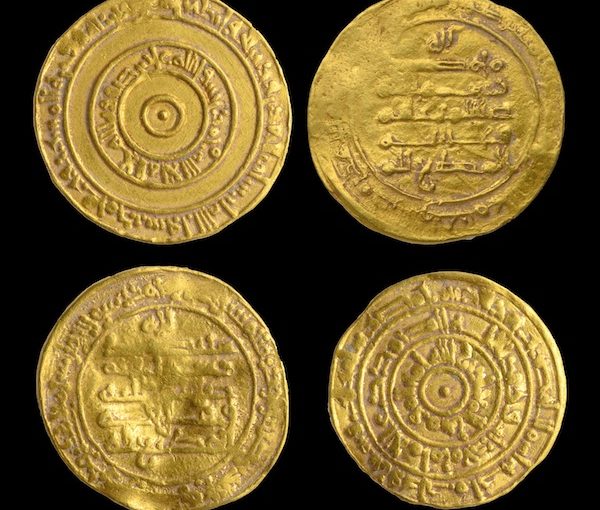
Golden coins found

(photo by Shai Halevi/IAA via Ashernet)

A small pottery jar containing four pure gold coins dating from the Early Islamic period was unearthed during archeological excavations conducted by the Israel Antiquities Authority (IAA), as part of the Jewish Quarter Development Corporation’s plan to build an elevator and make the Western Wall Plaza more accessible. The jar was found by IAA inspector Yevgenia Kapil and, some weeks later, excavation director David Gellman found the coins inside it. “To my great surprise, along with the soil, four shiny gold coins fell into my hand,” said Gellman. “This is the first time in my archeological career that I have discovered gold, and it is tremendously exciting.”

According to IAA coin expert Dr. Robert Kool, “The coins date from a relatively brief period, from the late 940s to the 970s CE. This was a time of radical political change, when control over Eretz Israel passed from the Sunni Abbasid caliphate, whose capital was Baghdad, Iraq, into the hands of its Shiite rivals, the Fatimid dynasty of North Africa, who conquered Egypt, Syria and Eretz Israel in those years.”

According to Kool, “Four dinars was a considerable sum of money for most of the population, who lived under difficult conditions at the time. It was equal to the monthly salary of a minor official, or four months’ salary for a common labourer. Compared with these people, the small handful of wealthy officials and merchants in the city earned huge salaries and amassed vast wealth. A senior treasury official could earn 7,000 gold dinars a month and receive additional incomes from his rural estates amounting to hundreds of thousands of gold dinars a year.”

יום הבוחר בארה”ב

(image by Zoonar/A.Makarov)

יום הבוחר: תושבי בריטיש קולומביה במערב קנדה הימרו כי דונלד טראמפ ינצח בבחירות לנשיאות ארה”ב היום, וימשיך בתפקיד לארבע שנים נוספות. אירוע הבחירות יהיה הפופולארי ביותר בהיסטוריה בקרב המהמרים

הבחירות לנשיאות ארצות הברית שיערכו היום יום שלישי, יהפכו לאירוע הפופולרי ביותר מאז ומעולם בקרב המהמרים השונים בעולם. רבים מהם מהמרים כי הנשיא הנוכחי, דונלד טראמפ, נציג המפלגה הרפובליקנית, הוא זה שינצח בבחירות את המועמד מטעם המפלגה הדמוקרטית, ג’ו ביידן. להערכת המהמרים אם כן טראמפ ימשיך לשמש נשיא ארה”ב בקדנציה נוספת בת ארבע שנים בבית הלבן.

בארה”ב חל איסור להמר בנושאים פוליטיים כמו הבחירות לנשיאות. לעומת זאת ניתן להמר על תוצאות הבחירות בקנדה במספר מדינות באירופה ובמקומות נוספים בעולם.

תושבי מחוז בריטיש קולומביה שבמערב קנדה השכנה מצפון של ארה”ב, החליטו כבר מי ינצח בבחירות לנשיאות ארה”ב, שיערכו היום (שלישי). לפי הערכת הקנדים או יותר נכון בין אלה שמהמרים, טראמפ ינצח בבחירות את ביידן.

לפי מצב ההימורים להיום: ארבעים וארבעה אחוז מצביעים על טראמפ כזוכה בבחירות, לעומת עשרים ושבעה אחוז שמאמינים שביידן ינצח. ואילו ללא פחות מעשרים ותשעה אחוז אין בשלב זה מועמד עדיף וזה קצת תמוה.

התאגיד של ממשלת בריטיש קולומביה – בי.סי לוטוריס קורפוריישן – שאחראי על כל ההימורים במחוז, החליט לאפשר לתושבים המקומיים להמר גם על זהות המנצח בבחירות לנשיאות בארה”ב, מבין השניים שמנהלים קרב איתנים, טראמפ וביידן. לפי הערכת בי.סי לוטוריס קורפוריישן למעלה מעשרת אלפים ישתתפו בהימורים לנשיאות ארה”ב היום. ובכך צפוי להישבר שיא המהמרים לאירוע בודד ביום אחד. אם כן ההימורים על הזוכה לנשיאות בארה”ב יותר פופולריים במחוז בריטיש קולומביה, מאשר זהות המנצחים באירועי הספורט הבולטים ובהם: משחקי הפלייאוף של הסופר בול, משחקי הפלייאוף של האן.בי.איי ומשחקי הפלייאוף של ההוקי. אגב, בבחירות לנשיאות לארה”ב הקודמות (שנערכו לפני כארבע שנים) בין טראמפ למועמדת המפלגה הדמוקרטית, הילרי קילנטון, כשבעת אלפיים ומאתיים מתושבי בריטיש קולוביה לקחו חלק בהימורים על זהות המנצח.

יש לציין כי אתר ההימורים של הבי.סי לוטוריס קורופריישן הוא הראשון בקנדה שהציע להמר על הבחירות בארה”ב. בשנה האחרונה בעיקר לאור מגיפת הקוביד, היקף ההימורים באתר של הבי.סי לוטוריס קורופריישן גדל משמעותית והגיע לכשני מיליארד דולר קנדי.

גם בקרב המהמרים באמצעות פלטפורמת ההימורים של אתר ההימורים הבריטי אודצ’קר, טראמפ ינצח את ביידן. בשלב זה בין המהמרים המועמד הפופולארי ביותר הוא טראמפ שזוכה לחמישים ושישה אחוז. זאת לעומת ביידן שזוכה לעשרים ושמונה אחוז בלבד. סגנית הנשיא המועמדת של ביידן, קמלה האריס, זוכה לפופולריות בשיעור של שמונה אחוזים בקרב המהמרים, ואילו סגן הנשיא של טראמפ, מייק פנס, זוכה לפופולריות בשיעור של חמישה אחוזים בלבד בקרב המהמרים. ואילו הזמר הראפר השחור, קניה וסט, שגם הוא הכריז על ריצתו לנשיאות ארה”ב, זוכה לשלושה אחוזים בלבד כמועמד פופולארי לזכייה בבחירות בקרב המהרים.

באתר אודצ’ר מציינים כי ההימורים על הזוכה לנשיאות ארה”ב היום, הופכים להיות האירוע הפופולרי ביותר בהיסטוריה מאז ומעולם, בקרב המהמרים השונים ברחבי העולם.

הקנדים כאן נערכים אף הם לבחירות: לפי הערכה כשש מאות ועשרים אלף קנדים שמחזיקים גם באזרחות אריקנית יכולים להצביע בבחירות אלה. בבחירות הקודמות לנשיאות רק כשלושים ושלושה אלף מהם הצביעו, ומדובר בכחמישה אחוזים בלבד. אך הפעם הדבר אמור להיות שונה בתכלית וקרוב לוודאי שאחוז הקנדים שיצביעו בבחירות לטובת טראמפ או ביידן יהיה הרבה יותר גבוה.