

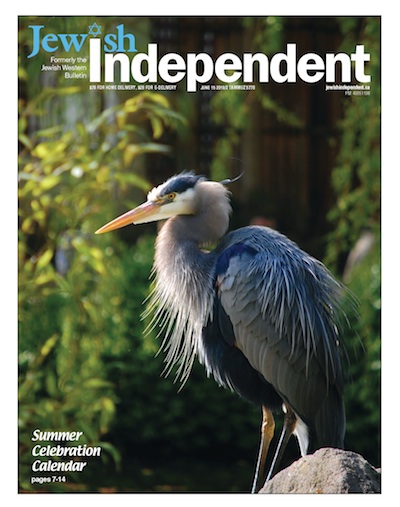
 Pictured on the cover of this year’s Jewish Independent Summer Celebration issue is a great blue heron. Winnifred Tovey, who lives in Vancouver, shot the photograph in Dr. Sun Yat-Sen Park. The heron was a frequent visitor, and Tovey has taken scores of photos of him over the years. When she lived in Strathcona, Tovey would walk to the park and the gardens next door every day after work. The heron would usually hang out in a tree or elsewhere higher up, waiting for the gates to close and the tourists to clear out, but occasionally he’d pose for a picture. Tovey took up photography when she lived in New York City, 2000-2007. Perhaps because New York was such a city, Tovey took to hanging out in wildish places and photographing birds. She’s kept it up ever since.
Month: June 2018
Check out JI’s 2018 Summer Celebration calendar!

Kick scooting for a school
Gil Drori and Bex Band are kick scooting down the West Coast to raise money to build a school in Tanzania. (photo from Gil Drori)
Gil Drori and Bex Band are en route to the Mexican border. They left from Vancouver last month. What’s newsworthy is how and why. They will be making the journey entirely by way of kick scooter – that’s right, not electric scooter, but kick scooter, the glorified skateboard with safety rails, and they will be doing so to raise money for a school in Africa. They are calling their adventure Kicking the States.
“We decided to do a charity challenge like no other that would help raise money to build a school in a poor village in Tanzania. We visited the village and the half-built school last year and saw the reality and hardship that the children are living in,” Drori told the Jewish Independent in an email interview. “It wasn’t easy to see but we wanted to do something positive, which is how the idea for Kicking the States came about.”
The journey is about 2,500 kilometres long and will take the couple three months. It is, as they say, “entirely muscle-powered.” Drori and Bend have had to pack very lightly to fit all their gear into their modified front pannier, so they are carrying just a tent, sleeping bags and a spare change of clothes.
“When we first thought of the idea, it seemed an impossible challenge, which is exactly why we went for it,” Drori told the JI.
Drori was born in Jerusalem and grew up in Zichron Yaakov. He met Bend while traveling in Guatemala. He’d recently finished his army service and Bend, university. Despite having completely different backgrounds, they “instantly clicked.” They now both live in the United Kingdom, where Bend comes from, and call London home, although they still visit Israel regularly. They recently celebrated their third wedding anniversary.
A kick scoot journey of this kind has never been attempted before, so there are no precedents, and Drori and Bend are learning as they go. “It’s a real adventure!” said Drori.
They hope to raise a total of $10,000 along the way, through sponsorships and by delivering free talks at events for which admission is by donation.
Two years ago, Drori and Bend were working regular jobs, Drori in IT and Bend in teaching. They decided to leave the city life to hike the Israel National Trail, having never done anything like it before. It took two months to complete and, from that point, they have been attracted to adventure as a way of exploring and seeing of what they are capable. They now both work as digital nomads, which gives them the flexibility to keep taking on new challenges, like Kicking the States.
“I think the simplicity of traveling with just a bag with everything you need and working your body each day is really appealing,” said Drori.
Before taking on their latest adventure, they did a four-day mini-trip on scooters, which showed them that it was possible.
“We’ve had a tough but great first two weeks on the expedition,” said Drori. “Physically, it has been very demanding and we have been scooting distances of 30 to 50 miles a day [50 to 80 kilometres], so are left achy and tired. Hills also pose a challenge and we have to get off and push the scooters uphill, which is not easy with all our gear attached.”
Most days, Drori and Bend have no idea of where they’ll be sleeping that night. They have been reliant on people offering to host them, as well as staying at campsites and even sleeping in the yards of strangers. “It has been quite tiring sometimes, living with that uncertainty each day,” said Drori, “but we are trying to embrace the excitement that that also brings.”
The two have faced setbacks every day so far, from road blockages, wrong turns, running low on food and fatigue. Drori said focusing on the money they have raised is what gets them through.
“The children we met in Tanzania are living in real hardship and their only hope of escaping is by getting an education,” said Drori. “They are fed two meals a day at the school, learn to read and write, leave with qualifications and, more important than that, confidence in themselves. We believe that every child should have a right to an education no matter what their circumstances, which is why we are so passionate.”
Drori said they have been surprised by the amazing people they have met along the way. “It’s been the absolute highlight,” he said. “Such kind and wonderful people who, despite us being strangers, have hosted us for a night, fed us or made generous donations to the charity. We’ve met people from all walks of life and have heard so many interesting stories. It sounds cliché, but it restores your faith in humanity. People really are good!”
Drori stressed that 100% of the money raised goes directly to the school. “We really hope that people will support us and get behind this cause,” he said.
People can donate at justgiving.com/kickingthestates.
Matthew Gindin is a freelance journalist, writer and lecturer. He is Pacific correspondent for the CJN, writes regularly for the Forward, Tricycle and the Wisdom Daily, and has been published in Sojourners, Religion Dispatches and elsewhere. He can be found on Medium and Twitter.
Ageism and advocacy
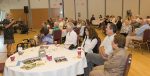
Wanda Morris of the Canadian Association of Retired Persons speaks at the Jewish Seniors Alliance Spring Forum May 13. (photo from JSA)
The annual Jewish Seniors Alliance Spring Forum was held on May 13 at the Peretz Centre for Secular Jewish Culture. Even though it was Mother’s Day, attendance was strong, with 70 to 80 enthusiastic attendees enjoying a lively afternoon presentation and discussion.
Ken Levitt, president of JSA, introduced the program, reminding everyone of JSA’s motto, “Seniors Stronger Together.” He explained that, among other things, JSA is involved in advocating for a national pharmacare initiative, as well as helping older adults become more self-reliant, thus enabling them to stay in their homes longer. He spoke about the Chai Tea, which was held on June 10, and honoured Serge Haber, who has been instrumental in the JSA, on the occasion of Haber’s 90th birthday. Levitt then introduced Wanda Morris, the forum’s guest speaker.
Morris is vice-president of advocacy for the Canadian Association of Retired Persons (CARP). Prior to that, she was chief executive officer of Dying with Dignity Canada, where she led a strategic campaign for legislative change, leading to the Supreme Court of Canada’s decision in the groundbreaking case Carter v. Canada for the right to die with dignity. In the process, Morris established her reputation as a key influencer and go-to commentator in national discussions on issues of importance to all Canadians, particularly on issues pertaining to aging. She brings to CARP years of successful advocacy and policy development, plus a track record of fundraising results and business expertise gained from three decades as a chartered professional accountant. Morris is a regular contributor to the Vancouver Sun.
Morris began by talking about some problems experienced by many elder adults, such as having to spend more than 30% of their income on housing, especially when that income is fixed; the high cost of prescription drugs; the long wait times for medical procedures; the long wait times in emergency rooms; and the difficulty of finding a family physician. In this context, she introduced the audience to the term “GOMER” – “get out of my emergency room.”
There are numerous challenges facing older adults and there are many more of them all the time, she said. For example, there are more Canadians over 65 years old than under 15, 1,000 Canadians turn 65 daily, and centenarians are the fastest growing demographic.
Morris pointed out that ageism is one element that is making life more difficult: it is harder to find work as we age and doctors prefer not to take on older patients, as they tend to have more health issues. There are also many safety issues that involve getting around in the community; for example, the short time green lights allow for crossing the street, the lack of benches for resting and the few public washrooms. In addition, there are often long lines in such places as airport security or in supermarkets. Ageism starts with disrespect and can lead to neglect and abuse, said Morris.
So, what are the solutions? Engagement is the most important factor, she said. Anger is not helpful but active advocacy in the areas of media, politics and bureaucracies can have an effect. The approach must be respectful and concise, she said. Point out when people make ageist jokes but do it in a non-threatening manner, she suggested. And stories of individual experiences can be more effective than long tirades – Morris gave the example of a Sears employee who had worked there for many years and was left with little or no pension.
CARP has more members across Canada than all the political parties combined, and can thus have a strong effect on the political process in their advocacy for seniors. They can work together with other seniors groups for change in such areas as pharmaceutical policy. CARP’s largest groups are in Ontario, said Morris, but the organization is hoping to revitalize the B.C. chapters.
Morris’s presentation was followed by a spirited question-and-answer period. Most of the questions focused on health care and its costs. Morris said it was reorganization rather than more money that could be the solution. As an example of this, she noted the number of seniors taking up acute care beds at a very high cost because of the lack of home care and/or live-in facilities like long-term care. Other topics touched upon were the addressing of incontinence by having more staff for regular toileting; advance directives about death and dying; using the term “rewire” rather than “retire”; and shuttle buses to bring seniors to cultural events, thereby reducing social isolation.
After the discussion, Ezra Shanken, executive director of the Jewish Federation of Greater Vancouver, gave greetings to all and JSA’s Gyda Chud thanked Morris for elevating our voices with new and powerful information focused on current and future solutions. Chud pointed out that stories, as Morris had said, are important not just for children, but also for adult learning. Everyone then enjoyed snacks and desserts by Gala and shmoozed.
JSA is dedicated to enhancing the quality of life of all seniors, by providing peer support services, advocacy for seniors’ issues, education and outreach. For more information, visit jsalliance.org.
Shanie Levin, MSW, worked for many years in the field of child welfare. During that time, she was active in the union. As well, she participated in amateur dramatics. She has served on the board of the Jewish Federation of Greater Vancouver and is presently on the executive of Jewish Seniors Alliance and a member of the editorial committee.

Traveling with family
Levinsky Market (photo by Daniel Dodek)
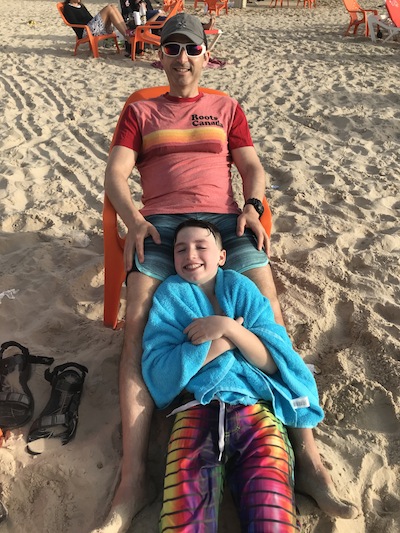
The decision to travel with your family to Israel is a big one. It’s so expensive and the long distance requires going for at least two weeks to make it worthwhile. My husband and I debated for years on the merits of taking our children on such a trip. Finally, our daughter’s bat mitzvah convinced us it was time. At nearly 13, she would get a lot out of it, and our 11-and-a-half-year-old son seemed ready as well. To mitigate jet lag, I traveled a week early with the kids to London, England, where we laid low, staying with friends and taking in a few sights. We then met my husband in Jerusalem.
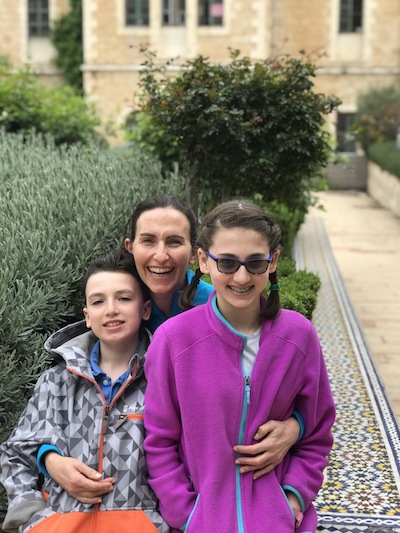
The morning after we arrived, we went on a walking tour. Our guide, Dvir, specializes in tours of the Old City, which must be done on foot. Not only did he take us to all of the highlights, find us the best food in the Old City and explain the geopolitics of Jerusalem but, also, he knew where to find all of the clean toilets. And our children surprised us with the knowledge they had gleaned from their years of Jewish education, enriching our experience, as well. That day, we walked more than 13 kilometres, helping us sleep well and rid us of any jet lag that might have been lingering.
The next day, we returned to the Old City to buy special gifts of Judaica, and managed to pick up plenty of beautiful treasures for ourselves. We finally found use for our son’s bargaining skills, which had previously only been used to negotiate things like screen-time and treat consumption.
One of the best decisions we made was to stay in apartments. With two preteens, the need for food sometimes comes fast and furious. Knowing breakfast was in the fridge and we could make nutritious snacks to take along with us every day contributed enormously to the success of our trip. The other element that made it the best vacation we’ve ever had with our children was the planning my husband did, combining some days with a tour guide and other days with age-appropriate activities. Since neither of us is interested in driving in Israel, he also worked our plans around all the different kinds of transit. Our centrally located lodging enabled us to walk many of the places we wanted to go.
We were invited by a friend, who was also visiting Israel with her family, to join their tour one morning of an agriculture reserve called Neot Kedumim. Near Modi’in, the site is of archeological significance and takes visitors back to biblical times through the landscape, agriculture and activities. Our experience included tree-planting, za’atar-grinding, pita-making, cooking and pulling water up from a cistern. My husband’s dream now is to spend his birthday working as a shepherd there. Another morning, with the same friends, was spent in fierce competition at the Tower of David doing something called the Amazing Race. It was good fun and educational, too.
We ventured one windy day to Ein Gedi and did a hike. Luckily, before driving to Masada, we discovered that, when it’s too windy for the cable car to run, Masada is closed. However, the Dead Sea was open for business as usual and, while we took in the experience of the mud and the floating, we also loved the variety of people from around the world visiting the waters.
In Jerusalem, we loved the green spaces like Station One. Formerly a train station and tracks, it is beautifully landscaped and is perfect for cycling, so we rented bikes. The public art in Israel makes the parks and streets even more interesting. Markets are favourites when we travel and Machane Yehuda did not disappoint. We returned there a number of times to buy Israeli essentials like halva, rugelach and dates, as well as more mundane food like fruit, vegetables and bread. The dinner scene is like the best food court in the world.
We all enjoyed the food in Israel. Gone are the days when every corner had falafel, fly-covered shawarma and pizza with corn and tuna. You can still find those delights in a few places but, these days, no matter what you like to eat, you can find it in Israel (except on Shabbat or holidays in Jerusalem). Keeping kosher for Passover, once the holiday began, was certainly easier than we find it in Vancouver.
Two days before Passover started, we took the bus from Jerusalem to Tel Aviv. Comfortable, cost-effective and an experience in Israeli culture, the bus took only 45 minutes. Our lovely apartment in Tel Aviv was in an area in transition. Just over a block from the beach and a short walk from Shuk HaCarmel (where we went almost daily), the location was excellent. We were able to walk to many places, including Sarona (the market is like an upscale Granville Island), Shenkin (shopping), the Tachana (eclectic Israeli items) and Neve Tzedeck (artists and fancy touristy stores). We ended every day relaxing at the beach on the powdery sand.
The seder was delightful at my cousin’s house in Ramat Hasharon. Seeing my secular Israeli cousins argue over the tunes and forget the words occasionally showed us that they observe Passover similarly to how we celebrate it. The only difference was that they served twice as much food as I do, including seven types of meat. The food was almost as unreal as the traffic jam at 12:30 a.m., as people left their respective seders.
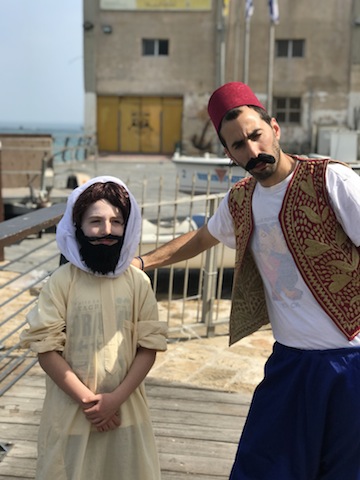
Other excellent parts of our trip included a fun and informative walking tour of Jaffa. Our guide, Noam, dressed in Turkish garb of 1905 – and, for awhile, our son dressed up as well, beard and all. We spent a day in Ramat Aviv, between the Museum of the Diaspora (Beit Hatfutsot) at Tel Aviv University and the Palmach Museum, just down the road. All of us took full advantage of the many types of exercise equipment in the public parks all around Tel Aviv and rode bikes along the Yarkon River, in addition to enjoying the lively promenade (Tayelet) along the ocean. One day, we took a fabulous full-day private tour up north to Akko, Haifa and Caesarea. The guide enabled us to get the most out of the day.
When we saw the family dynamic start to go sideways, we split up. Our ability to keep good snacks handy and to make sure everyone got enough outdoors time each day made everything we were able to see and do a wonderful experience for all of us. I would recommend a trip to Israel to anyone.
Michelle Dodek is a freelance writer living in Vancouver who spent enough time in Israel in her youth to speak sufficient Hebrew to communicate with taxi drivers and vendors in the shuk.
Fast-paced spiritual trip
The bimah of Ari Ashkenazi Synagogue in Tzfat (Safed) was part of the Land and the Spirit tour, which is organized by the Rohr Jewish Learning Institute. (photo by Roy Lindman)
My husband and I excitedly counted down the days until the Land and the Spirit Israel experience in March. Having met with Chabad Richmond’s Rabbi Yechiel Baitelman and his wife Chanie, who accompanied our group on this trip, we learned that the touring days would be long, but that the sights we’d see and the people we’d meet would more than offset the intensity factor. The Land and the Spirit tour is organized by the Rohr Jewish Learning Institute, the adult educational arm of Chabad.
The tour took place March 4-13 and drew approximately 800 Jews (and a handful of non-Jews) from across North America. Knowing that we’d hit the ground running, my husband and I decided to arrive in Israel a few days ahead of the tour, to get acclimated. We also spent an additional two weeks after the tour exploring Israel on our own. This was my sixth trip to Israel and my husband Harvey’s third.
The tour was, in some ways, like an Israel 101 course, supplemented by in-person meet-and-greets with high-level people from all walks of life – we had special access to soldiers, politicians, religious leaders and other VIPs. On some levels, it was geared to people who’ve never been to Israel before, and they got an overview of the highlights Israel has to offer. Yet, even for those of us who had been to Israel, it was a chance to discover places we’d never seen.
Participants had the freedom to choose from a variety of “tracks,” including: “In the Footsteps of the Bible,” “Classic,” “Borders and Security,” “Israel Encounters,” “Israel in Depth” and “Food and Wine.” Presumably, participants would get a glimpse of Israel that sparked their desire to return again. The flip side of this is that there was not a lot of in-depth learning, and we didn’t get a chance to spend a great deal of time in any one place. It was primarily surface introductions and more of a visit-the-sights kind of trip, rather than an intense learning experience, like the National Jewish Retreat.
There were way more things to see and do than each of us had time for, hence the need to choose “tracks” each day. Highlights for my husband and me included Caesarea, with its fascinating historical ruins and stunning location, overlooking the Mediterranean. We also found Silicon Wadi fascinating. It’s the area in Israel where scientists, techies and businesspeople work in shared spaces to develop groundbreaking technologies. When we were there, we toured a WeWork site, where young technology whizzes were producing 3D and other objects inspired by their sky’s-the-limit imagination.
Kfar Chabad was another high point of our trip. This Chabad-Lubavitch village is not far from Lod, and has a life-size replica of 770 Eastern Parkway, Chabad’s Brooklyn headquarters. More than 6,000 Chabad live in the village, and the site is home to an etrog orchard. Our tour included a shmurah matzah bakery, where they make Passover matzah by hand.
The highlight by far, though, was the Ohr Simcha Children’s Home, where 300 high-risk boys from troubled environments live with their adoptive Chabad families. Ohr Simcha was established in partnership with the Israeli government, to help some of the most socially challenged children gain a sense of security. Seeing the kind of patient, loving care it takes to sustain these kids, to give them a real home of their own, was inspiring and emotional. True chesed in action.
The ancient mystical city of Tzfat (Safed), “the City of Kabbalah,” with its narrow streets and beautiful tiny synagogues, was magnificent. We went to Ari Sephardic Synagogue, where the famous Jewish mystic Rabbi Yitzchak Luria (known as the Ari) prayed. We also went to the Ari Ashkenazic Synagogue. Guest speakers explained the detailed history and designs of the synagogues. Unfortunately, we didn’t squeeze as much spirituality out of Tzfat as we would have liked, because time was limited. But it left a lasting impression.
It bears mentioning that all the tour guides on our buses were incredibly knowledgeable and made the places we visited come to life.
The Latrun Tank Museum was yet another highlight on the tour. There, we got to meet Israel Defence Forces soldiers and hear firsthand their inspiring personal stories. Live music, dancing and delicious food topped off the evening.
We spent a moving Kabbalat Shabbat at the Kotel (Western Wall). Having never visited the Kotel at night, much less experienced Shabbat at that holy site, we felt like Israel had wrapped its arms around us. Shabbat day was quiet and gave us the opportunity to walk the empty streets of Jerusalem in peace.
The second to last day of the tour was super-charged, and saw us traveling from Jerusalem to Masada, to the Dead Sea, where we schmeared mud on ourselves and bobbed around like human corks in the salt-laden water. After a long day, we showered off the Dead Sea water, got dressed in our finest and went to a gala banquet, where music, speakers and other entertainment were on the menu.
The final day was spectacular. First, we boarded a bulletproof bus that took us to our Matriarch Rachel’s Tomb, in Bethlehem. This was a particularly emotional experience, to see so many people praying so fervently. But it only got better, as we got on the bus and traveled to historic Hebron, where we visited the Cave of the Patriarchs (the Cave of Machpelah), one of the holiest places for the Jewish people. There, all 800 of us walked through Hebron carrying a Torah scroll that had been saved from the Nazis. This was followed by a spectacular light show, fireworks and a lively dinner.
On the whole, the tour was phenomenal, albeit arduous, especially for those of us in our 60s and older. Early morning starts, long stretches on the bus, shlepping and climbing, eating and touring. Repeat. For eight days. Was it worth it? You bet! The entire trip was spiritually nourishing, and fed our desire to start planning when we would next return to our home away from home.
Shelley Civkin is a happily retired librarian and communications officer. For 17 years, she wrote a weekly book review column for the Richmond Review, and currently writes a bi-weekly column about retirement for the Richmond News.
Traveling with young kids
(photo by Masada Siegel)
Taking a red-eye flight was no way to end a glorious Hawaii vacation with my nine-month-old, but it was the only nonstop and I figured everyone would go to sleep. Ah, how wrong I was! My little guy, who just had started walking, was so excited that we were not only awake the entire flight, but we spent it walking up and down the aisle.
Having little ones is a game-changer. After having traveled solo for months at a time, where I could follow any whim and not plan if I didn’t want to, my travel style has been turned completely upside down, but for all the right reasons.
So, while I always pack lots of extra food and supplies for my little guy, who’s now a toddler, I’ve learned to pack light for myself. Everything needs to be multipurpose. For example, my go-to travel uniform consists of a wrap-sweater because I use it as a baby blanket, and many friends use it as a nursing cover-up. Also, because it’s attractive, it can dress up a simple outfit.
Part of the travel experience is keeping your kids entertained. The best compliment I got recently was when a woman two rows behind me exclaimed, “What, you have a toddler with you? I had no idea. Thank you for making this a pleasant flight for all of us.”
Truth is it helps to be extremely prepared with planned activities, as well as making sure your little one is excited about the journey. A happy kid makes for a pleasant flight for all. Prior to our trip, I gave my son his own luggage, a super-cute airplane-themed rolling suitcase that also turns into a backpack. He loves it and constantly drags it around with him. I find it helpful for him to feel as if he is one of us, and part of the adventure.
I always pack a number of toys – they all must be useful both on the long flights and at the destination. I never leave home without our Bubzi, a stuffed owl that plays lullabies and projects stars on the ceiling, as it helps with sleep. Another lightweight item to bring is the Cinemood, an ultra-light three-inch portable projector that can be used just about anywhere with a flat surface, as its preloaded with lullabies, books and kid-friendly content. Be sure to pick up kid-safe headsets that protect little ears; Buddyphones are especially good on planes to help drown out the noise, too.
Traveling with a toddler has its ups and downs. On a recent trip, my son, who has always disliked cribs, was sleeping in a bed. Even though he was right next to me, he still flew off of it in the middle of the night, leading to a bruised up nose and an upset mom. There seem to be a million tiny situations that need to be thought through, some as simple as piling pillows all over the floor around a bed.
I’ve also learned that the details matter, such as keeping my little one out of the sun. While I tan easily, my son is blond and fair, leading me to explore a million different sunscreens, many sticky, which led to complaints. While we do use sunscreen, I’ve heard conflicting reports of how useful they are and how bad some of the chemicals are, so I finally changed my travel stroller to one that has on oversized canopy, as extra protection.
A sturdy stroller is also important because you can place your bags in it and my son can walk alongside me or even push the stroller. I’ve realized, the more active he is in the airport, the more tired he will be on the airplane. I always research the airport we are flying into, to see if there is anything to see, such as an aquarium, museum or viewing deck, so as to keep everyone entertained.
However, being organized takes a lot of effort and, while I try my best to keep everything in its place in my diaper bag, sometimes I don’t. I’ve had to dig around for my wallet, plane tickets and all sorts of odds and ends. Usually, a box of milk or other liquid slips my mind and then security zeroes in on me.
Even with a baby in tow, I have been patted down on every single flight I have taken with my son. Security is in no rush and generally don’t care if you miss your plane. On my last flight, I had to run through the airport holding my son to make it in time.
Traveling with a toddler certainly keeps you on your toes, but isn’t that why we travel in the first place, because we want to have new experiences? So, while the getting to the destination is part of the journey, my best advice is to try to enjoy the ride.
Masada Siegel is an award-winning journalist and photographer. Follow her at @masadasiegel and visit her website, masadasiegel.com.

Mobileye’s self-driving tech
A total of 12 cameras offer a 360-degree configuration for long-range surround view and parking in the Intel Mobileye autonomous car. (photo from Intel Corp.)
Jerusalem-based Intel subsidiary Mobileye reportedly has struck a deal to supply its future EyeQ5 chips for integration in eight million partially automated cars to be manufactured by an unidentified European automaker in 2021.
Partial automation, a step toward the eventual goal of fully self-driving vehicles, requires the driver to remain alert to road conditions. Mobileye is a world leader in advanced driver-assistance technology, dominating about 70% of the current market.
Intel acquired Mobileye in March 2017 for $15.3 billion, the largest-ever acquisition of an Israeli high-tech company.
“By the end of 2019, we expect over 100,000 Level 3 cars with Mobileye installed,” said Amnon Shashua, chief executive officer and chief technology officer, referring to self-driving cars in which the driver has about 10 seconds to take over if the system fails.
Shashua announced last month that Intel and Mobileye are starting to test their responsibility-sensitive safety (RSS) model in a 100-car autonomous vehicle (AV) fleet – each equipped with 12 cameras for 360-degree visibility – on the notoriously difficult-to-navigate streets of Jerusalem.
“In the coming months, the fleet will expand to the U.S. and other regions,” he said in a May 17 statement. “While our AV fleet is not the first on the road, it represents a novel approach that challenges conventional wisdom in multiple areas. Leveraging over 20 years of experience in computer vision and artificial intelligence, our vehicles are proving the Mobileye-Intel solution is the most efficient and effective.”
Shashua said a radar/lidar layer will be added to the cars in the second phase of development.
Regarding the next-gen EyeQ5-based compute system due out in early 2019, he added, “the current system on roads today includes approximately one-tenth of the computing power we will have available [then].”
Israel21c is a nonprofit educational foundation with a mission to focus media and public attention on the 21st-century Israel that exists beyond the conflict. For more, or to donate, visit israel21c.org.

Voice will have control
One day, your car might be able to sense your mood and, if you’re agitated, send soothing music. (photo from autospies.com)
Back in 1995, Shlomo Peller founded Rubidium in the visionary belief that voice user interface (VUI) could be embedded in anything from a TV remote to a microwave oven, if only the technology were sufficiently small, powerful, inexpensive and reliable.
“This was way before IoT [the Internet of Things], when voice recognition was done by computers the size of a room,” Peller told Israel21c. “Our first product was a board that cost $1,000. Four years later, we deployed our technology in a single-chip solution at the cost of $1. That’s how fast technology moves.”
But consumers’ trust moved more slowly. Although Rubidium’s VUI technology was gradually deployed in tens of millions of products, people didn’t consider voice-recognition technology truly reliable until Apple’s virtual personal assistant, Siri, came on the scene in 2011.
“Siri made the market soar. It was the first technology with a strong market presence that people felt they could count on,” said Peller, whose Ra’anana-based company’s voice-trigger technology now is built into Jabra wireless sports earbuds and 66 Audio PRO Voice’s smart wireless headphones.
“People see that VUI is now something you can put anywhere in your house,” said Peller. “You just talk to it and it talks back and it makes sense. All the giants are suddenly playing in this playground and voice recognition is everywhere. Voice is becoming the most desirable user interface.”
Still, the technology is not yet as fast, fluent and reliable as it could be. VUI depends on good internet connectivity and can be battery-draining.
Peller said, in five years’ time, voice user interface will be part of everything we do, from turning on lights, to doing laundry, to driving.
“I met with a big automaker to discuss voice interface in cars, and their working assumption is that, within a couple of years, all cars will be continuously connected to the internet, and that connection will include voice interface,” he said.
As voice user interface moves to the cloud, privacy concerns will have to be dealt with, he added. “We see that there has to be a seamless integration of local (embedded) technology and technology in the cloud. The first part of what you say, your greeting or ‘wakeup phrase,’ is recognized locally and the second part (like, ‘What’s the weather tomorrow?’) is sent to the cloud. It already works like that on Alexa but it’s not efficient. Eventually, we’ll see it on smartwatches and sports devices.”
Diagnosing illness
Tel Aviv-based Beyond Verbal analyzes emotions from vocal intonations. Its Moodies app is used in 174 countries to help gauge what speakers’ voices (in any language) reveal about their emotional status. Moodies is used by employers for job interviewees, retailers for customers, and in many other scenarios.
The company’s direction is shifting to health, as the voice-analysis platform has been found to hold clues to well-being and medical conditions, said Yoram Levanon, Beyond Verbal’s chief scientist. “There are distortions in the voice if somebody is ill and, if we can correlate the source of the distortions to the illness we can get a lot of information about the illness,” he told Israel21c. “We worked with the Mayo Clinic for two years confirming that our technology can detect the presence or absence of a cardio disorder in a 90-second voice clip.
“We are also working with other hospitals in the world on finding verbal links to ADHD, Parkinson’s, dyslexia and mental diseases. We’re developing products and licensing the platform, and also looking to do joint ventures with AI companies to combine their products with ours.”
Levanon said that, in five years, healthcare expenses will rise dramatically and many countries will experience a severe shortage of physicians. He envisions Beyond Verbal’s technology as a low-cost decision-support system for doctors.
“The population is aging and living longer, so the period of time we have to monitor, from age 60 to 110, takes a lot of money and health professionals. Recording a voice costs nearly nothing and we can find a vocal biomarker for a problem before it gets serious,” said Levanon.
Beyond Verbal could synch with the AI (artificial intelligence) elements in phones, smart home devices or other IoT devices to understand the user’s health situation and deliver alerts.
Sensing your mood
Banks use voice-analysis technology from Herzliya-based VoiceSense to determine potential customers’ likelihood of defaulting on a loan. Pilot projects with banks and insurance companies in the United States, Australia and Europe are helping to improve sales, loyalty and risk assessment regardless of the language spoken.
“We were founded more than a decade ago with speech analytics for call centres to monitor customer dissatisfaction in real time,” said chief executive officer Yoav Degani. “We noticed some of the speech patterns reflected current state of mind but others tended to reflect ongoing personality aspects, and our research linked speech patterns to particular behaviour tendencies. Now we can offer a full personality profile in real time for many different use cases such as medical and financial.”
Degani said the future of voice-recognition tech is about integrating data from multiple sensors for enhanced predictive analytics of intonation and content. “Also of interest,” he said, “is the level of analysis that could be achieved by integrating current state of mind with overall personal tendencies, since both contribute to a person’s behaviour. You could be dissatisfied at the moment and won’t purchase something but perhaps you tend to buy online in general, and you tend to buy these types of products.”
In connected cars, automakers will use voice analysis to adjust the web content sent to each passenger in the vehicle. “If the person is feeling agitated, they could send soothing music,” said Degani.
Personal robots, he predicted, will advance from understanding the content of the user’s speech to understanding the user’s state of mind. “Once they can do that, they can respond more intelligently and even pick up on depression and illness,” he said.
Degani predicted that, in five years’ time, people will routinely provide voice samples to healthcare providers for analytics, and human resources professionals will be able to judge a job applicant’s suitability for a specific position on the basis of recorded voice analysis using a job-matching score.
Israel21c is a nonprofit educational foundation with a mission to focus media and public attention on the 21st-century Israel that exists beyond the conflict. For more, or to donate, visit israel21c.org.

טראמפ צריך ללמוד היסטוריה
נשיאה לשעבר של ארצות הברית, ביל קלינטון, מגיע לוונקובר לקדם את ספרו החדש ‘הנשיא נעדר’, שיצא לאור בימים אלה. עם קלינטון יתארח הסופר ג’יימס פטרסון, שהוא שותפו בכתיבת הספר.
טראמפ צריך ללמוד היסטוריה: טען קנדה שרפה את הבית הלבן בזמן שזו הייתה בריטניה
נשיא ארצות הברית, דונלד טראמפ, מוכיח שוב שהוא אינו יודע היסטוריה וכרגיל מעוות עובדות לצרכיו האישיים והפוליטיים. הפעם מדובר באירוע שקרה רק לפני כמאתיים שנה אותו טראמפ הזכיר, וטעה בעובדות. בשיחת טלפון כועסת עם ראש ממשלת קנדה, ג’סטין טרודו, שהתקיימה בסוף מאי, במסגרת מלחמת הסחר בה פתח הנשיא האמריקני, אמר בין היתר טרודו: האם אנו קנדה מהווים סיכון לביטחון הלאומי לארה”ב כפי שאתה אומר, כדי להצדיק את המכסים שהטלת על הסחורות שלנו? טראמפ השיב בשאלה: האם לא אתם שרפתם את הבית הלבן במלחמת 1812? טראמפ קצת התבלבל כיוון שהכוחות הבריטים הם ששרפו את הבית הלבן ב-1814 במסגרת מלחמת 1812, לאחר שהאמריקנים התקיפו את אזור יורק באונטוריו, שהיה אז מושבה בריטית.
טראמפ שוב הפך את עצמו לבדיחה באמצעי התקשורת האמריקניים, ששאלו שוב ושוב כיצד הידידה הקרובה ביותר קנדה, מהווה סיכון לביטחון הלאומי של ארה”ב?
הנשיא לא נעדר: ביל קלינטון מגיע לוונקובר וידבר על ספרו החדש ועל צפוי שגם על הנשיא הנוכחי
נשיאה לשעבר של ארצות הברית, ביל קלינטון, מגיע לוונקובר לקדם את ספרו החדש ‘הנשיא נעדר’, שיצא לאור בימים אלה. עם קלינטון יתארח הסופר ג’יימס פטרסון, שהוא שותפו בכתיבת הספר. פטרסון והנשיא לשעבר ידונו ארוכות בספר החדש, באופן כתיבתו והחיבור היחודי ביניהם. נראה שהשניים יעסקו במישרין או בעקיפין גם בנשיא השערורייתי הנוכחי של ארה”ב, דונלד טראמפ, שניצח את אשתו של ביל הילרי קלינטון, בבחירות שהתקיימו לפני כשנה וחצי. צפוי שגם לקהל הרחב תהיה אפשרות לשאול שאלות בנושאים שונים. האירוע היחודי יתקיים במרכז הקונגרסים של ונקובר (באולם הבולרום המערבי), ביום שישי ה-29 בחודש, החל משעה 4.05 אחר הצהריים. נותני החסות: תחנת הטלוויזיה גלובל בי.סי, עיתון הוונקובר סאן ועיתון סטאר – מטרו ונקובר. שבוע קודם לכן ב-22 ביוני, יתקיים אירוע עם קלינטון בלבד במרכז התערוכות של טורונטו (באולם בינפילד סנטר), החל משעה 7.30 בערב. נותן החסות עיתון הטורונטו סטאר. מחירי הכרטיסים לכל אחד מהאירועים: 99 דולר, 159 דולר, 249 דולר והיקר שבהם לווי.איי.פי 1,895 דולר.
הספר ‘הנשיא נעדר’ (בהוצאת אלפרד קנוף וליטל ובראון) הוא מותחן בידיוני שעוסק בחטיפה של נשיא ארה”ב, אך כולל גם תכנים אמיתיים מעניינים שכוללים מידע על מה “קורה מבפנים” ומאחורי הקלעים בבית הלבן, בליווי מתח ודרמה למכביר. מדובר ברומן הראשון של קלינטון, שכאמור אותו הוא כתב ביחד עם פטרסון האמריקני, הנחשב לאחד מהסופרים המצליחים ביותר בעולם, ומטבע הדברים לאחד ממוכרי הספרים הגדולים בעולם. פטרסון הגדיר את העבודה עם קלינטון: “שיא הקריירה שלי והגישה לסינון מיד ראשונה תרמה באופן ייחודי לכתיבת הספר הזה”.
קלינטון (בן ה-71) שימש נשיאה הארבעים ושתיים של ארה”ב, במשך שתי קדנציות מטעם המפלגה הדמוקרטית. קודם לכן הוא שימש מושל מדינת ארקנסו. שיעורי התמיכה בקלינטון (הפופולריות שלו בקרב הציבור) היו גבוהים מאוד, גם עם סיום תפקידו. על הקדנציה השנייה שלו העיבה פרשת מוניקה לווינסקי, אך קלינטון ניצל מניסיון ההדחה של חברי המפלגה הרפובליקנית. בימים האחרונים שודר ראיון עם קלינטון ברשת אן.בי.סי האמריקנית, בו הוא ציין כי אינו חייב התנצלות ללווינסקי. הוא הוסיף כי גם בעידן הנוכחי (של ‘המי טו’) הוא לא היה מתפטר. לדבריו הוא הודיע באופן פומבי על כך שהוא מצטער על מעשיו אך לא דיבר עם לווינסקי.