Cemetery improvements

(photo from cemeteryboard.com)

The Schara Tzedeck Cemetery Board has appointed its board of directors for 2018, and is planning more facility upgrades for the coming year.

The cemetery board is co-chaired by Jack Kowarsky and Arnold Silber. Other members of the board are Shirley Barnett, Harvey Dales, Joshua Hauser, Dr. Mark Schonfeld, Gary Segal, Herb Silber, Isidor Wolfe, Rabbi Yosef Wosk and Barrie Yackness. Honourary board members are Charles Diamond and Joseph Segal. Howard Kallner, president of Congregation Schara Tzedeck, also serves on the board in an ex-officio capacity.

The board has made significant improvements to the chapel in New Westminster over the past two years. Constructed in the early 1990s to house the chevra kadisha, as well as to provide a chapel at the New Westminster cemetery, this building was in need of repairs and upgrades. This $600,000 project was completed last year with the generous contributions of many in our community.

Other improvements to the New Westminster cemetery included beautification initiatives and projects to help manage the organization more efficiently, including developing a grave-finding system that people can instal on their mobile devices, a GIS (geographic information system) to better track records and land use at the cemetery, and the implementation of a system that broadcasts funerals on the internet so that those unable to attend in person can view the funeral. (This service is available at cemeteryboard.com.)

This year, the board is planning to move ahead with another key project. The community cemetery located in Surrey has about 2,500 plots, and began having burials in 2008. To date, there is little infrastructure at that location, only a small handwashing station and a portable building.

Plans are being developed for the construction of a chapel building that will allow the cemetery to better serve those who choose this location. The chapel will seat between 40 and 50 people, provide a private space for families to gather prior to a funeral service and have two accessible washrooms. It will also provide facilities for cemetery board groundskeepers to store equipment. Part of this project will include improvements to the fencing of the cemetery, as well as improving the gardening and landscaping to make the cemetery a more welcoming place.

The cemetery board provides its services to the entire community. Members and non-members of Congregation Schara Tzedeck may purchase plots in any of the cemeteries. Orthodox, Conservative, Reform, and those involved with congregations associated with other Jewish movements, all use the chevra kadisha, which is comprised of diverse members of the greater Jewish community. Funeral directors Rev. Joseph Marciano and Howard Jampolsky (who also serves as the executive director) are available anytime to answer any questions, and to provide more information about the availability of burial plots in all three of the community’s cemeteries – New Westminster, Surrey and the Jewish section of Mountain View. They are also available to provide information about pre-planning funerals in order to relieve family members of this task during the difficult time when a loved one passes away. They can be reached at 604-733-2277.

To learn more about the board or to contribute to the current Surrey Chapel Project, call Jampolsky at 604-733-2277 ext. 204, or email howard@cemeteryboard.com.


Mystery photo … Feb. 23/18

Beth Israel Synagogue, 1967. (photo from JWB fonds, JMABC L.09754)

If you know someone in this photo, please help the JI fill the gaps of its predecessor’s (the Jewish Western Bulletin’s) collection at the Jewish Museum and Archives of B.C. by contacting archives@jewishmuseum.ca or 604-257-5199. To find out who has been identified in the photos, visit jewishmuseum.ca/blog.

Netanyahu warns Iran

Prime Minister Binyamin Netanyahu at the Munich Security Conference. (photo by Amos Ben Gershom IGPO via Ashernet)

Speaking at the Munich Security Conference, which took place Feb. 16-18, Israeli Prime Minister Binyamin Netanyahu holds a piece of an Iranian drone shot down over Israel last week. Netanyahu warned that Israel could strike the Islamic Republic. Looking directly at Iranian Foreign Minister Mohammad Javad Zarif, Netanyhau asked, “Mr. Zarif, do you recognize this? You should, it’s yours. You can also take back with you a message to the tyrants of Tehran – do not test Israel’s resolve!” The drone, which entered northern Israel from Syria near the Jordanian border, was shot down by an Israeli attack helicopter. In response to the drone incursion, the Israeli Air Force attacked the mobile command centre from which it was operated. During the operations, one of the Israeli jets was hit by a Syrian anti-aircraft missile and crashed; its pilot and navigator were able to parachute out of the plane and land safely in Israel.

China-Israel trade ties

Rebecca Fannin, founder of Silicon Dragon, at the event in Tel Aviv on Jan. 29. (photo from silicondragonventures.com)

Perhaps unlikely partners – 6,000 kilometres away from each other – Israel and China are cooperating and collaborating on business and investment deals worth billions of dollars. But it’s a not-so-hidden secret that China has been falling in love with Israeli start-ups, entrepreneurs and high-tech in general. And the feeling’s mutual.

The phenomenon was discussed Jan. 29 at an event called Silicon Dragon Israel, held at WeWork Sarona in Tel Aviv. Silicon Dragon events have occurred around the world since 2010.

Forbes contributor and author Rebecca Fannin is founder of Silicon Dragon, which boasts a 30,000-strong network of executives, entrepreneurs, venture capitalists and angel investors. She recently noted in Forbes that “several mega-funded Chinese tech startups are poised to go public this year or next,” with a potential combined worth of a quarter-trillion dollars.

There are likely to be Israeli fingerprints in some of those, and other recent, deals, given how Royi Benyossef, developer relations manager of Samsung Next, explained, “They’re mesmerized by Israel and their technology-exporting capabilities…. The idea that it’s a ‘start-up nation’ leads the Chinese to believe this is a place they want to invest in.”

Benyossef was on the panel discussing how key Asian corporations are leveraging Israel tech knowhow. He was joined by the director of investments of Singtel Innov8, Gil Prashker.

In another panel, moderator Simon Weintraub of Yigal Arnon and Co. explained the best way to cooperate with investors, especially when dealing with cultural barriers. As Yahal Zilka, managing partner and co-founder of Magma Venture Partners, explained, “In one word, building trust…. That doesn’t happen in one day.”

By way of example, Zilka said the GPS mapping app Waze “failed twice, miserably” in China. “And it all had to do with trust, nothing else. It clearly is a different interaction, pace and activity.”

Avishai Silvershatz, managing partner, Infinity Group, added, “The short answer is, be careful. Nothing in your experience will give you the experience to enable you to understand it. You have to have local partners, and be careful with them as well – it takes … years to understand. You have to be smart. There’s a lot of money to be made, because there’s as much money to be made as lost.”

One jolt for which most investors were unprepared was a recent government intervention. Weintraub said that, in 2016, business interaction from China was at an all-time high, until the authorities there “cracked down on the outflow of currency.” He said, “It caused tremendous uncertainty for 2017 … but now they’ve eased some of those restrictions.”

Zilka noted that the bureaucracy in China is comprised of “very complex structures.”

“In the same way that [Donald] Trump says ‘America first,’ the Chinese are saying ‘China first,’” explained Silvershatz. “They want investments to go towards their own strategic interests and goals. This is the ‘party line.’ It’s government, then corporate … so long as the government has their way.”

This panel also included Ehud Levy of Canaan Partners Israel, Aaron Mankovski of Pitango Venture Capital and Nathan Low of Sunrise Israel Tech Capital.

Independent of the event, some academics weighed in on why the Israel-China business relationship works so well.

“It’s different in organizational culture,” Daniel Galily, a former lecturer at Beijing-Geely University, told the Jewish Independent. “The educational system in China places great emphasis on discipline and obedience to superiors, while the Israeli educational system and the Israeli army encourage students and soldiers to think about new ideas and to solve problems in situations of uncertainty. The Chinese understand that, and so they strive to integrate the Israeli creativity to their economy, and also strive to learn how to combine creativity in to their economy.”

Dave Gordon is a Toronto-based freelance writer whose work has appeared in more than 100 publications around the world.

Grossman wins and nominations open for RBC Top 25 Canadian Immigrant Awards to Feb. 26

David Grossman at a peace rally in Tel Aviv, August 2014. (photo from Ashernet)

Israeli author David Grossman will be awarded the highest Israeli civilian honour, the Israel Prize, which is presented on Yom Ha’atzmaut (April 19) in Jerusalem.

Grossman is one of Israel’s most celebrated and prolific authors; his books have been translated into more than 35 languages.

Born in Jerusalem in 1954 and educated at the Hebrew University of Jerusalem, Grossman has always been connected to the Israeli peace movement. He and his wife lost one of their sons in 2006 during the Lebanese War – Uri, a tank commander, was killed by an anti-tank missile shortly before the ceasefire.

Speaking about Grossman following the announcement of the prize, Education Minister Naftali Bennett said, “David Grossman is one of the most exciting, profound and influential voices in Israeli literature. With deep wisdom, sensitivity to fellow human beings and a unique linguistic style, he has become an internationally renowned artist. We are honoured that he is one of our own.”

– Edgar Asher, Ashernet

 ***

Is there an inspiring newcomer in your life? Do they have a story that should be heard and celebrated? Canadian Immigrant and RBC are now calling on nominations for the 10th annual RBC Top 25 Canadian Immigrant Awards. This will be the fourth year there is an Entrepreneur Award and the second year for the Youth Award. New this year is the Settlement Agency Award, for agencies excelling in helping newcomers integrate and succeed in Canada.

A nominee can be anyone who has immigrated to Canada and has since contributed to the success and uplifting of this country and/or its people. Achievements can be professional or personal. Nominees must hold landed immigrant (permanent resident) or citizen status in Canada, and must reside here.

Nominations can be made at canadianimmigrant.ca/rbctop25 until Feb. 26, 11:59 p.m. EST. A list of 75 finalists will be announced in March, after which all Canadians can vote for their favourite nominees. The 25 winners will be announced in June.

Importance of rite of passage

Our son, Nissim Shalom, recently became a bar mitzvah, and it is a living reminder for us of our family’s remarkable and ancient history. According to Jewish law, a Jewish boy reaching the age of 13 becomes a bar mitzvah and is responsible for assuming the mitzvot of Jewish adulthood. (A girl becomes a bat mitzvah at the age of 12.) Once a bar mitzvah, a person may be counted in a minyan (prayer quorum) and may lead religious services in the family and the community.

The bar mitzvah age was selected because it roughly coincides with physical puberty (Talmud Niddah, 45b). Prior to a child becoming a bar mitzvah, the child’s parents are responsible for the child’s actions, but b’nai mitzvah bear responsibility for their own actions with respect to Jewish ritual law, ethics and tradition and are able to participate in all areas of Jewish community life.

Upon a boy’s becoming a bar mitzvah, a celebration is made in his honour. The current scale of celebrations is much greater than it used to be in the mellah, or shtetl, of the old countries. In the past, this rite of passage was a joyous matter of course for every Jewish child without exception. In more recent times, however, this milestone is unfortunately not as absolute as it once was. Hence, we celebrate the occasion with more ostentation to highlight the cherished continuity of our heritage.

In the Moroccan community, we have many unique customs.

On the eve of the celebration, the bar mitzvah gets a haircut in the presence of his family and, as in every Moroccan celebration, traditional henna is put on his hand. On the celebratory day, it is customary for the family to help the bar mitzvah boy don tallit and tefillin, thereby showing him how dear this mitzvah is.

Many in the Moroccan community had the custom of taking the boy to a mikvah, stressing the idea of purity and holiness. Some had the custom of snatching the tefillin from the boy, so that the father would be obliged to redeem them with money, thereby demonstrating their importance.

When the bar mitzvah is called to the Torah, it is customary for the women to ululate “lulululu.” This custom originates from a kabbalistic source stating that, in every holy and happy occasion, the evil inclination (yetzer harah) is challenged to act. Thus, the women scream out in order to confuse and to chase away the yetzer harah.

It is hardly an exaggeration to say that the future of the Jewish people depends in large measure upon the bar (and bat) mitzvah event. Education, and particularly education of our young, has been and remains the means by which we continue to thrive, to exist, to ensure the future of Klal Israel. Is it any wonder that we celebrate with such gusto, as families and communities, this uniquely Jewish simchah by which we renew ourselves and our time in Jewish history?

Rabbi Ilan Acoca is a veteran rabbi and educator. He is the rabbi emeritus of Vancouver’s Congregation Beth Hamidrash and currently serves as the rabbi of the Sephardic Congregation of Fort Lee-Bet Yosef, in Fort Lee, N.J., and rav beit hasefer of Yeshivat Ben Porat Yosef, in Paramus, N.J. He is the writer of the book The Sephardic Book of Why and has written hundreds of articles on various topics for different publications.

My homemade Purim poncho

I might have been a Jewish Martha Stewart if fate had been kinder to me. I used to watch with envy as she placed her rose-scented candles on the needlepoint tablecloth in the centre of which were the exquisite paper flowers she crafted. In my fantasy, I imagine my own dinner table now ready for the chopped liver, with braised lamb shanks, kasha pilaf and apple kugel, which would be served on my designer Star of David ceramic plates. Blossoms of fresh orchids from my greenhouse would fill the room. And it would be a good thing.

It is to my chagrin, however, that domestic tasks have never been my forte. Instead, I learned to deflect sizzling hockey pucks from four older brothers as they practised their shots on goal on the frozen North End streets of Winnipeg. I couldn’t whip up a chocolate brownie, but I could power a strike ball for the boys baseball team. I would likely have made a slam-dunk career in basketball if not for my growth spurt maxing out at five feet at an early age.

But, as I became an adult, stopping a puck, throwing a baseball or shooting baskets were no longer in demand. Domestic tasks became the necessity of life and I had few skills. I did manage to accumulate some basic cooking skills, however, and, to date, none of my family has succumbed to starvation.

Now, the task of sewing is a different ball of yarn. What little I learned, I picked up in school. I still remember the pained look on the face of my Grade 7 teacher as I zigzagged the hemline on the proverbial apron running it through the sewing machine. Nonetheless, my lack of proficiency with domestic skills had not interfered greatly in my life – that is, until I became a mother. Then it all came to a flashpoint!

My then-5-year-old daughter, who was attending Peretz School at the time, needed a costume for their annual Purim carnival. She, the little princess, wanted to be a queen – Queen Esther, no less. Oh sure, I’ll just whip up a queen’s costume as soon as I finish the cheese soufflé, the salmon mousse, chocolate-coated orange peels and homemade halvah. What to do? Well, creativity helps where skills fail. I pondered that maybe I could pick up a large piece of fancy material, cut a hole in the middle, and then throw the whole thing over her head, like a poncho.

So, for the first time in my life I found myself in a fabric store like a rookie at a textiles Superbowl. I looked and felt and touched, feigning expertise. Eventually, I settled on a rich red satin. I cut out a round hole in the centre using a “dummy” circle for an approximate size of her head. If I was looking for a “dummy,” I could well have used my own head. The hole had to be adjusted several times to make it big enough to actually get her head through it. The biggest problem, however, was the edges. They were frayed all around and still needed something more to dress it up.

After another search, I discovered long strands of sequins sold by the yard. Exactly what I needed! I chose gold. Very royal, I thought. Much to my surprise, I still remembered the basic back and hemstitch from my sewing class – not a total loss. With needle and thread, I painstakingly stitched on the sequins around the neck and all the edges (I knew enough not to have her head in it at the time). After numerous hours, with bleary, red, irritated eyes, stitch by stitch, it was done.

“What will I wear for a crown?” whined my unappreciative daughter. Once again, I called on some inner resources for inspiration. I found an expandable holder used for tying hair back in a knot or bun. It was gold-coloured metal dotted with decorative “pearls.” When it was fully extended, it sat on the top of her little head like a crown. She loved it! Perfect!

We were ready. Her long, blonde hair flowed softly over her simple red satin poncho gilded with gold sequins, and her greenish-blue eyes sparkled like the “crown” on her head. She was a queen! A blonde Queen Esther!

The party was already in full swing when we arrived, with blue-and-white streamers and balloons lining the walls and ceiling. Chattering children were milling about in all kinds of wonderful outfits. Although her costume was not as elaborate as many, she blended with the others and joined in the games, sang Purim songs and ate hamantashen. At the end of the afternoon, everyone was told to gather around because the judges were ready to announce the winners of the contest.

What contest?

But before I could answer my own question, I heard them announce, “The winner for the best girls costume is Queen Esther.”

“Who?” I whispered under my breath in disbelief.

“Queen Esther!” they called again, as if responding to me personally.

With astonishment, I watched, tears welling in my eyes, as my daughter scrambled onto the stage of the school auditorium for her special moment. I was delighted for her, but bursting with pride for me. It had not been my goal but turned out to be my slam-dunk. This small victory was my personal triumph. I was a Martha Stewart after all. Well, a Jewish Martha Stewart, or maybe substitute Miriam Silver? Regardless, it was a good thing.

Libby Simon, MSW, worked in child welfare services prior to joining the Child Guidance Clinic in Winnipeg as a school social worker and parent educator for 20 years. Also a freelance writer, her writing has appeared in Canada, the United States, and internationally, in such outlets as Canadian Living, CBC, Winnipeg Free Press, PsychCentral and Cardus, a Canadian research and educational public policy think tank.

A food fit for a queen

In my North American Ashkenazi house growing up, my mother always cooked arbis at Purim time. The dish is associated with Queen Esther, for whom this was supposedly a mainstay. Why? Because, some Jewish sources say, Queen Esther kept kosher in the court of her non-Jewish husband, King Ahasuerus. Eating this dish nowadays is one way in which Jews remember Queen Esther’s fortitude.

As I recall, this basic and healthy dish of cooked chickpeas took forever to cook, but it was worth it. It had a chewy, nutty kind of taste.

Arbis, like other Jewish foods, has been quite the globetrotter. For example, some Yiddish speakers refer to the dish as nahit, which, according to L.J.G. Van Der Maesen in a 1987 article, is close to the name used in Turkey, Romania, Bulgaria, Iran, Afghanistan and other adjacent former Soviet bloc countries, with arbis actually referring to another legume, peas. However, H. Gams’s 1924 legume study claims that the ancient Greek words for chickpea were orobos and erebinthos, and that these two words are related to the old German word arawiz and sound similar to erbse, the new German word for chickpea.

Besides eating arbis on Purim, traditional Ashkenazi Jews serve this dish at the Shalom Zachar, an after-dinner gathering on the first Friday night following the birth of a baby boy. There is a mourning aspect to this event, as the newborn’s soul, which had once dwelt in the heavenly realm, must now reside inside the earthly, physical body. Hence, arbis is served at this gathering as a food symbolic of the circle of life.

But a different explanation involving a play on Hebrew-Yiddish words goes like this: arbis, the Yiddish word for chickpeas, helps us remember the promise G-d made to Avraham. “I shall multiply [in Hebrew, arbeh] your seed like the stars of the Heavens.” (Genesis 22:17)

There is a Sephardi version of chickpeas, also served on Purim. Iraqi Jews call it sambusak el tawa, or chickpea turnovers. While most recipes call for adding salt and pepper to arbis, nahit or chickpeas, author Claudia Roden, in her book The Book of Jewish Food, suggests serving them as a sweet side dish with sugar or honey. Editors Anne London and Bertha Kahn Bishov also offer a sweet nahit casserole – in their Complete American-Jewish Cookbook recipe, brown sugar is added. Meanwhile, in the Jewish Vegetarian Year Cookbook, authors Roberta Kalechofsy and Rosa Rasiel recommend eating arbis as a Yom Kippur break-the-fast entree containing salt, cumin, green pepper and tomato sauce.

As we read every year, Megillat Esther opens with an assessment of the vastness of King Ahasuerus’s kingdom – it covered areas from India to Ethiopia.

Indian chickpea history goes way back: the earliest occurrence of chickpeas in India dates from 2000 BCE, at Atranjikhera in Uttar Pradesh, according to Van Der Maesen. Moreover, archeologists have discovered Bronze Age (2500–2000 BCE) chickpeas, peas, green gram and black gram inside storage jars at the Harappan site of Farmana, located in the Indian state of Haryana.

The Archeology of Africa: Food, Metal and Towns, edited by Thurstan Shaw, notes that, in the Natchabiet and Laliblea cave excavations near Ethiopia’s Lake Tana, there was evidence of chickpeas, barley and legumes. Significantly, shiro, which is made from powdered chickpeas, is a staple in Ethiopia.

In his book Ancient Canaan and Israel: New Perspectives, Jonathan Michael Golden reports that, during the Early Bronze Age, at Halif Terrace (located in Israel’s northeastern Negev), people were eating chickpeas, possibly with olive oil. Israeli archeobotanists say there was an agricultural revolution during the Neolithic period. Although not the easiest legume to cultivate – the crop can be wiped out by ascochyta blight and needs good drainage in sunny, dry, warm conditions – chickpeas became one of the early domesticated plants. Zohar Kerem, Simcha Lev-Yadun, Avi Gopher, Pnina Weinberg and Shahal Abbo offer an explanation. In a 2007 article, they claim that the cultivators of that period sensed the nutritional benefits of chickpeas. Today, scientists know that chickpeas are rich in tryptophan, an essential amino acid. They can bring about higher ovulation rates, improved infant development, a feeling of satiety, better performance in stressful situations and a lessening of depressive moods.

Indicative of how important chickpeas are to the Mediterranean diet, an international Hummus Day was inaugurated almost six years ago, on May 13. But let’s give arbis the last word: what goes around, comes around. Here’s a recipe.

ARBIS

1 pound uncooked, dry chickpeas
Cold water to cover chickpeas
Salt to taste (added during the cooking process)

Soak the chickpeas 12 to 24 hours in a pot. Drain the water and rinse the chickpeas to get rid of possible lectin, phytic acid and enzyme inhibitors. Return the chickpeas to the pot, adding enough water to cover them, plus another two inches. Total cooking time will be about two hours, but could be up to four hours, depending on what you consider tender or soft. Cook with the pot covered. Skim off the white froth, which early in the cooking might form at the top. Keep the flame low and add water as needed. After 45 minutes, add salt to taste and go back to cooking the chickpeas. When soft enough to eat, drain and spread out on a paper towel to dry. Sprinkle with salt. May be served hot or cold.

Deborah Rubin Fields is an Israel-based features writer. She is also the author of Take a Peek Inside: A Child’s Guide to Radiology Exams, published in English, Hebrew and Arabic.

Poppy seeds for Purim

Purim is coming the evening of Feb. 28, and if your schedule doesn’t allow time for making hamantashen, try poppy seed cookies. The Yiddish word for poppy seed is mohn, which some say sounds like Haman. Another story says Esther kept kosher and ate as a vegetarian; her diet including seeds, nuts, legumes and poppy seeds, so many Jews serve these foods on Purim. Another tradition says Esther subsisted on poppy seeds during her three-day fast. Whatever the reason, here are a few recipes.

MOHN KICHLACH

1/2 cup margarine
1/2 cup sugar
1 egg
1 tbsp water
1/2 tsp vanilla
1/4 tsp almond extract
1/4 to 1/3 cup poppy seeds
2 cups flour
1/2 tsp baking powder

  1. Preheat oven to 350°F. Spray a cookie sheet with vegetable spray.
  2. In a bowl, cream margarine and sugar. Beat in egg, water, vanilla and almond extract.
  3. Mix in poppy seeds.
  4. Add flour and baking powder and mix well.
  5. Drop by teaspoon onto cookie sheet and flatten with a fork. Bake for 15 minutes.

POPPY SEED COOKIES #1

1 cup poppy seeds
1/2 cup hot milk
1/2 cup margarine
1/2 cup sugar
1 1/4 cups flour
1 tsp baking powder
1/2 tsp cinnamon
1/4 tsp cloves
1/2 cup raisins
1/4 cup chocolate chips (optional)

  1. Preheat oven to 350°F. Spray a cookie sheet with vegetable spray.
  2. Soak poppy seeds in milk.
  3. In a mixing bowl, cream margarine and sugar.
  4. Add flour, baking powder, cinnamon, cloves, raisins and, if using, chocolate. Add milk and poppy seeds and mix.
  5. Drop by teaspoon onto greased cookie sheet. Bake for 20 minutes.

POPPY SEED COOKIES #2

1/4 cup vegetable oil
1/4 cup unsalted butter or margarine
2/3 cup sugar
2 eggs
1 tsp vanilla
dash cinnamon
2 cups flour
2 tsp baking powder
1/4 cup poppy seeds

  1. Preheat oven to 375°F. Spray a cookie sheet with vegetable spray.
  2. In a bowl, combine oil, butter or margarine, sugar and eggs. Mix well. Add vanilla and cinnamon.
  3. Add flour and baking powder. Then add poppy seeds. If dough is pasty, add more flour until dough is easy to form into small balls.
  4. Place balls on cookie sheet and flatten. Bake for 8-10 minutes, until lightly browned.

Sybil Kaplan is a journalist, lecturer, book reviewer and food writer in Jerusalem. She created and leads the weekly English-language Shuk Walks in Machane Yehuda, she has compiled and edited nine kosher cookbooks, and is the author of Witness to History: Ten Years as a Woman Journalist in Israel.

Bride-to-be Markle’s got style

Prince Harry with Meghan Markle wearing Tuxe’s Boss bodysuit. (photo from Beretta/Sims/REX/Shutterstock via Israel21c)

Since announcing her engagement to Prince Harry last November, all eyes have been on Meghan Markle’s style. Coats, shoes, dresses and other fashion items worn by the bride-to-be have sold out in minutes. It’s no surprise that after she wore a bodysuit by Israeli designer Tuxe for an evening out with her betrothed, the style is now backordered until May.

The couple, set to marry in May, went to London’s Goldsmiths’ Hall for the Endeavour Fund Awards, which recognize injured servicemen and women. Known for her dressed-down-meets-royal style, the former actress layered Tuxe’s silk Boss bodysuit underneath a tailored black Alexander McQueen suit. On her feet, she wore Manolo Blahnik pumps.

“We’ve been royally approved!” the brand posted on Instagram after Markle was photographed wearing the bodysuit. “We absolutely love Meghan for all she has done for women’s rights and are honoured to be worn by someone who encapsulates what we stand for as a brand. She uses her spotlight to be an inspiration and she definitely is to us!”

Tuxe founder Tamar Daniel was born in Jerusalem, raised in London and is a graduate of Shenkar College of Engineering and Design in Ramat Gan. She founded her Philadelphia-based bodywear line in 2015, focusing on transforming the bodysuit, once a 1990s staple, into a chic, modern garment.

Her collection includes a range of bodysuits and has become particularly popular with professionals and religious communities, Daniel told Vogue in an interview. Prices range from about $80 for a simple sleeveless bodysuit to $463 for a cashmere turtleneck version.

Tuxe may not be the first Israeli designer that Markle has had her eye on. In December, news broke that Israeli designer Inbal Dror had been approached by the royal family to provide a sketch of a potential dress for Markle’s upcoming wedding to Prince Harry.

* * *

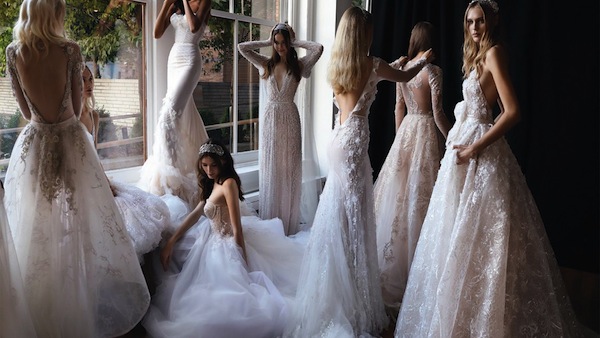
photo - Selections from the 2017 Inbal Dror catalogue. The Royal family is rumoured to have approached Dror for a sketch of a potential wedding dress for Meghan Markle
Selections from the 2017 Inbal Dror catalogue. The Royal family is rumoured to have approached Dror for a sketch of a potential wedding dress for Meghan Markle. (photo from Inbal Dror via Israel21c)

On Dec. 18, 2017, Israel21c posted the story, “Is Meghan Markle going Israeli for her wedding dress?”:

It’s rumour, it’s conjecture, and it’s probably an awful lot of wishful thinking, too, but that’s not stopping Israelis from getting excited at the thought that Meghan Markle may choose an Israeli wedding designer for her dress on the big day.

All the kerfuffle began when news broke that Israeli designer Inbal Dror had been approached by the Royal family to provide a sketch of a potential dress for Markle’s wedding to Prince Harry in May.

Dror, who began making wedding dresses in 2014, favours sensual red-carpet glamour, with plunging necklines and figure-hugging hand-woven dresses. It’s quite a step away from traditional royal wedding gowns that usually err on the side of caution.

This isn’t the first time that Dror has been approached by celebrities for designer dresses. In 2016, pop diva Beyoncé wore a sheer high-necked white lace Inbal Dror bridal gown to the Grammy Awards.

“Beyoncé casually wore a wedding dress to the Grammys,” read the headline of Elle magazine afterwards, adding as a sub-head: “The queen can do as she pleases.”

“It was an amazing moment to see one of my favourite stars wearing one of my designs,” Dror told Brides after seeing Beyoncé in her dress. “I can’t even begin to explain the feeling. I am so excited for what is yet to come!”

Dror, a graduate of Shenkar College of Engineering and Design, sells her dresses for between £6,000 and £9,000 (about $10,500 to $16,000 Cdn) at the Morgan-Davies Bridal boutique in London – with fittings by appointment only. All of her outfits are individually made, and are based on 30 different measurements.

In an interview with Bridal magazine in 2015, Dror said, “A wedding is such a significant event in a woman’s life, and it’s how she feels wearing the dress that emphasizes her features, [which] can make her feel like the queen of the night.”

Israel21c is a nonprofit educational foundation with a mission to focus media and public attention on the 21st-century Israel that exists beyond the conflict. For more, or to donate, visit israel21c.org.