In October, our community lost one of its most devoted supporters, Leon Glassman, z”l. Leon will be remembered for generations to come for his commitment to Jewish education and its central role in Jewish identity and continuity. Through the Jewish Community Foundation, Leon created a legacy that reflects his lifelong passion in these areas. Together with his wife Rose Marie, they made an indelible impact on our community – an impact that will ensure his memory lives on.
Leon and Rose Marie’s commitment to Jewish education goes back decades to their life as young parents in Regina. Their move to Vancouver was motivated in part because here they would be able to provide their children with a Jewish education, which they saw as an integral aspect of helping them develop strong Jewish identities.
Leon and Rose Marie recognized that the high cost of living in the Lower Mainland today has reduced the ability of many families to enrol their children in Jewish day schools and Jewish educational programs. They wanted to find a way not just to help families and children, but to strengthen Jewish continuity for the community as a whole.
In April 2016, Leon and Rose Marie made a million-dollar gift to create the Leon Glassman Fund for Jewish Continuity through Education endowment fund. The response from community members who share their passion, as well as from the day school community that understands so clearly the impact this endowment will make, was tremendous, and it inspired Leon and Rose Marie to make a second million-dollar gift to the fund.
The fund will provide a steady source of support for tuition assistance, so more children can reap the benefits of a Jewish day school education. This endowment will support an area of need that was close to Leon’s heart, enriching our community in perpetuity.
According to executive director Marcie Flom, the Jewish Community Foundation was “privileged to work with the Glassmans to create Leon’s legacy for the Jewish community.” She said, “Leon’s philanthropy reflected his life’s passion and his commitment to Jewish education in a way that perpetuates his memory for his children and grandchildren.”
Like Leon and Rose Marie, there are many community members who support causes that reflect their interests and their values. If you are among them, then you, too, can create a legacy at the Jewish Community Foundation that reflects your passions. To make a contribution to the Glassman Fund or for more information on how to create a legacy, visit jewishcommunityfoundation.com.
U.S. President Donald Trump with Palestinian Authority President Mahmoud Abbas at the Presidential Palace, Bethlehem, May 2017. (photo by the White House)
Mahmoud Abbas has had enough. Thirteen years into his four-year term as elected leader of the Palestinian people, he has nothing of substance to show for his efforts and his friends are abandoning him.
On Sunday, his frustration was on full display during a two-and-a-half-hour speech.
Things have been building up lately for Abbas and his Fatah faction and, at a meeting of the Palestinian Central Council, he finally let loose.
Naturally, he focused on Israel, which he declared a European colonialist enterprise and denied Jewish connection to the land.
“Israel is a colonialist project that has nothing to do with Jews,” Abbas said. “The Jews were used as a tool under the concept of the Promised Land – call it whatever you want. Everything has been made up.”
Abbas, who has a doctorate in history, has taken a creative approach the discipline from the start, when his dissertation discounted the number of Jews murdered by the Nazis and contended that European Jews were collaborators in their own genocide in order to advance the cause of Zionism.
Of course, Abbas also railed against the U.S. president for his announced intention to move the American embassy to Jerusalem. Abbas accused Donald Trump of destroying the prospects for peace.
“Yekhreb Beitak,” Abbas said in the general direction of Trump. According to the Associated Press, the curse literally translates as “may your house be demolished.”
“In colloquial Palestinian Arabic,” AP explained, “the phrase can have different connotations, from a harsh to a casual insult, but its use in a widely watched speech seemed jarring – and could exacerbate his already fragile relationship with an American president who is particularly averse to criticism.”
If the U.S. president is a notorious hothead, that’s exactly how Abbas appeared Sunday, but certainly not without reason.
What must hurt more than anything is that Abbas now sees those who have been the Palestinians’ historic allies softening their resolve. As a New York Times investigation earlier this month indicated, while Arab leaders from Egypt to Saudi Arabia were making appropriate noises in public about Trump’s Jerusalem gambit, behind the scenes they are giving every indication that they won’t expend political energy on the matter.
The irony is clear – and for Abbas and his allies it must be especially painful.
The welfare of Palestinians has never been a genuine priority for the Arab world, even as they have propelled the Palestinian cause to the top of the global agenda, paralyzing the United Nations in the process. For Arab leaders, Palestinians have always been little more than a battering ram with which to land blow after blow against the Zionist entity. Palestinian life under Israeli occupation and autocratic leaders is filled with small and large indignities.
Now that geopolitics suggests Israel is not so much the regional threat that Iran poses, the Palestinians, once a useful weapon for the Arabs in their 70-year confrontation with Israel, are being cast aside.
Abbas’s obvious frustration Sunday suggests there may finally be a change afoot to the status quo that has been unsatisfactory for Israelis and even more so for Palestinians. What the future looks like for the Palestinians – and for their relations with Israel – remains unclear.
***
Note: The headline of this editorial has been changed. In the Jan. 19 newspaper, the piece ran as “Abbas rightly irked,” which misled some readers to think that we agreed with Mahmoud Abbas’s remarks. We in no way condone his abandonment of historical fact, his inhumane accusation that Jews were complicit in the Holocaust or the many other false and immoral statements in his two-and-a-half-hour diatribe.
Hospitality is culture itself and not simply one ethic amongst others. (Jacques Derrida, On Cosmopolitanism)
One of the late French-Jewish philosopher Jacques Derrida’s most famous short works is his On Cosmopolitanism, in which he discusses the problem of refugees. Cosmopolitanism is a word first coined in ancient Greece by wandering, homeless philosophers and popularized by the Stoics. It refers to the idea that the whole world (cosmos) is my city, or community (polis). It is the idea of an international or, better, transnational humanity and citizenship. Cosmopolitanism became popular again during the European enlightenment and slowly had a growing influence on international law and modern ethical sensibilities, including the sense that countries have a duty of hospitality, of offering refuge even to peoples of other nationalities.
This same ethical idea occurs in Derrida’s own Jewish tradition, where “love the stranger” is a commandment uttered many more times than “love your neighbour” and where Isaiah the prophet urged Israeli kings to give shelter to refugees of war.
In On Cosmopolitanism, which was based on a speech Derrida gave to the International Parliament of Writers on the subject of refugees, Derrida discusses the nature of hospitality and the contradiction at its heart. Hospitality involves welcoming guests into your home, in sharing resources and shelter, yet, to do so, it must remain “a home.” Should all boundaries of the home dissolve in unconditional welcome then the possibility of hospitality itself will also be obliterated. Derrida’s insight mitigates against a naive or utopian call for the obliteration of borders or the indiscriminate welcome of refugees.
In this thought of Derrida we see a tragic conflict at the heart of modern Zionism. Do we want a hospitable Zionism? Is the house the Jews built in Israel for Jews alone? Yet if the doors are flung wide, what will happen to “our Jewish home”?
There is much anxiety to protect our “home,” of that we can be sure. An extensive security wall, checkpoints, and airport border guards who are masters of interrogation. When we press Israel to become more hospitable – to African asylum seekers, to displaced Palestinians – we hear a chorus of voices arise: if we let them in, if we include them, the demographics will dissolve our home!
And we so badly want a home. Wandering for 2,000 years, we were homeless, exiled, a tolerated or cursed minority. Finally, we returned to our ancient home and, amid controversy with others who had come to live there and also claim it as home, built walls to protect it. We now again had a home, and we have chanted this word to ourselves over and over again, “home, home,” for the last 70 years.
Yet what good is a home that does not extend hospitality? Sure, we airlifted Ethiopians, we opened our arms to Russians, and so on and so forth. Yet they were us, our family. True hospitality, though, as it says in our own foundational text, is given to the stranger. The other.
Unconditional welcome is not the only way to destroy a home. What good is a home that offers no hospitality? Is a home that offers no hospitality even a home at all?
Israel is in the process of deporting the 60,000 African refugees who arrived before the building of a barrier wall with the Sinai to prevent more entering. As Russel Neiss wrote in the Forward, “For years, in actions held to be illegal multiple times by Israel’s Supreme Court, the Israeli government has arrested and placed these refugees in a detention centre in the Negev and forcefully deported them to other African nations in exchange for money or favourable terms for weapons contracts and military training.”
Twenty thousand refugees, most from Sudan and Eritrea, have already been deported or left of their own accord, and the government has ordered the rest to leave, with a small financial gift and plane tickets paid, or be jailed.
According to Derrida, hospitality is both a duty and a defining feature of a real home. The feeling that an inhospitable Israel is not really a home, I fear, is growing and will continue to grow among Israelis and Jews. Maintaining the feeling that Israel is a Jewish home only will require an unremitting focus on perceived and real threats to Jews in Israel and abroad. It will reinforce the unhealthy sense of home as a shelter from others, rather than fostering the healthy sense of home, one that is open to sheltering others.
The result may be that we have a very well guarded home. But, for those of us who perceive the lack of hospitality on offer, it begins to feel like no home at all. The opposite of Derrida’s formula – “in order for there to be hospitality, there must be a home” (a formula that is surely true and needs due respect) – is “in order for their to be a home, there must be hospitality.”
Jews, being a transnational people for so many years, became, in two senses, a “cosmopolitan people.” One was that fact of transnationality; the other stemmed from the involvement of Jews in socialist political movements, which problematized nationalism, as well as our involvement in activism aimed at the liberalization of immigration laws. It was all of this, seemingly, which coalesced to give birth to the use of “cosmopolitan” as an antisemitic code word for “Jew.”
I don’t think “cosmopolitan” is an insult, but rather a very high compliment. When an antisemite calls Jews “cosmopolitan,” I hear it as a calling, not a calling out. Israel will not truly be our Jewish home until it embodies the highest cosmopolitanism of the Jewish spirit, which can be read in the Torah’s call – millennia ago – to love the stranger and refugee.
Matthew Gindinis a freelance journalist, writer and lecturer. He writes regularly for the Forward and All That Is Interesting, and has been published in Religion Dispatches, Situate Magazine, Tikkun and elsewhere. He can be found on Medium and Twitter.
Left to right are Jason Murray, Pacific Region LPC, CIJA; Carmel Tanaka, CIJA-Pacific Region; Nico Slobinksy, CIJA-PR; Alexandra Moses, CIJA-PR; Shelley Rivkin, Jewish Federation of Greater Vancouver; Ezra Shanken, JFGV; and Kara Mintzberg, CJPAC, B.C. (photo from CIJA and CPJAC)
On Dec. 19, local elected officials, interfaith leaders and Jewish community members gathered at King David High School for a Chanukah reception hosted by the Centre for Israel and Jewish Affairs (CIJA) and the Canadian Jewish Political Affairs Committee (CJPAC). Guests at the reception sampled Israeli wines and enjoyed traditional holiday foods like latkes and sufganiyot.
“We are thrilled that so many elected officials and community partners were able to attend our Dreidels and Drinks event,” said Nico Slobinsky, director of the Pacific Region for CIJA. “Events like this allow us to bring members of our community together with political and civil society leaders in order to deepen the already existing relationships.”
“It was a fantastic opportunity to engage political and interfaith officials in a fun and festive environment, as well as a wonderful way to celebrate the holidays as a community,” added Kara Mintzberg, CJPAC’s B.C. regional director. “In the new year, Nico and I plan to co-host more events in the Greater Vancouver area, that focus on bringing the Jewish and political community closer.”
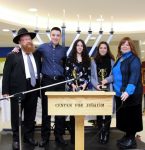
Left to right are Rabbi Falik Schtroks, Jason Aginsky, Jessie Miller, Emily Miller and Rebbetzin Simie Schtroks. (photo by Naomi Nelson)
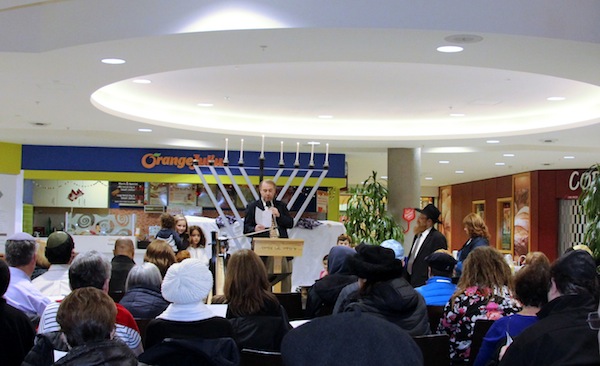
When Adina Ragetli, age 9, opened the annual public menorah lighting event on Dec. 17 at the Semiahmoo Shopping Centre by playing “Padah Bishalom” on the harp, “we knew it was going to be a ‘light-filled’ Chanukah program,” said Rabbi Falik Schtroks, co-director of the Centre for Judaism-Chabad of the Lower Fraser Valley (C4J).
Members of the Legislative Assembly Marvin Hunt and Tracey Redies, as well as White Rock Councilor Bill Lawrence and Surrey Councilor Mike Starchuk, each addressed the crowd with meaningful and timely messages. Chazzan Yaakov Orzech lit the chanukiyah and got everyone to join him in singing some Chanukah favourites. Prof. Rudy Rozanski entertained the audience with an arrangement of Jewish lullabies and music of Jewish composers.
Chazzan Yaakov Orzech lit the chanukiyah and got everyone to join him in singing some Chanukah favourites. (photo by Naomi Nelson)
Perhaps the greatest highlight of the evening was the 2017 Young Lamplighter Award, which was presented to Emily Miller and Jessie Miller. The young women devote a lot of their time to making life more pleasant for those who are struggling materially or emotionally. By spearheading the Live2Give program in their NCSY chapter, they are also managing to get many other teenagers involved in projects that are focused on helping others.
“Kudos to the supportive parents and grandparents of Emily and Jessie Miller. We know that these young women have great role models in their lives and that they were not raised in a vacuum,” said C4J co-director Simie Schtroks at the event.
A few rounds of “Let’s Make a Chanukah Deal” were played, and there were doughnuts, chocolate gelt, dreidel glasses and dreidels given out.
Rabbi Yitzchak and Henia Wineberg made it out from Vancouver on a very rainy evening to join the festivities. Marat Dreyshner and Ella Dreyshner donated the doughnuts and Moshe Chanowitz of Plaque Impact in Montreal made the beautiful awards.
(photo from teenlife.com/summer-program/urj-camp-kalsman)
Going to camp was a rite of passage when I was growing up. Everybody went to camp. In my day, it was the B’nai B’rith camp that all Jewish kids went to, in Sandy Hook, past Winnipeg Beach.
I don’t recall much detail of my really young days as a camper, but we never missed a summer. As small kids, we went with our mothers. It all had to do with getting away from the oppressive summer heat and time at the beach, wading and swimming, sunning on a blanket, playing the games on the boardwalk. I would have an ice cream cone every day, even though, back then, all you could get were vanilla and strawberry flavours. There may have been chocolate, too.
I enrolled in Young Judaea in my early teens. In the heady days leading up to and after Israel declared its independence, movements of every political stripe in Israel had a youth group and camps in Canada and in the United States.
At camp, we built our Jewish consciousness and reinforced our Jewish identity. We were part of larger society, of course, but the one that was becoming central to our lives was the Jewish one, and the camp experience strengthened all that. Everything around our activities focused on our life as Jews, intellectually and emotionally, in our developing teen years. It was easy to pick out the future leaders – assertive, confident, basing their arguments on material accepted as fact. That was the stuff we brought forward into our adult years, colouring what we would become and the messages we would transmit to our children.
Aliyah to Israel was an enormous focus of the Zionist camps I associated with. This possibility, went the argument, was why we had to study our history, our customs, our holidays. We were building a new kind of Jew, unapologetic for his striving nature, determined to never again be a victim. History’s lessons were clear and we had to take heed and take our future into our own hands. The camps I attended were the educational vehicle.
In those days, we pretended we were chalutzim (pioneers), so we went out into the bush and made like we were going to live off the land. We built lean-tos to sleep under, chopped down trees, built things, learned how to make a campfire even without matches, and engaged in marches, canoeing, the whole megillah.
The years I spent as a camper – learning to be a scout, learning to create things with my hands, to develop myself physically, to compete for excellence – we were modeling the new Jew. We were not content with just being students, we knew we could do that – we were going to be doers. We were building pride in ourselves and in our accomplishments.
In turn, I became one of the leaders trying to transmit the messages I had absorbed to others. The young people I grew up with at camp worked in their own communities in the same way. All across the country and across the United States, we were a network fighting assimilation, building loyalty to Israel and a consciousness of being Jewish and the values it represented.
One of the best experiences I had was when I was invited to be a Camp Shalom program director in Gravenhurst, Ont. I spent six months preparing programs and then threw them all out on my second day on the job. I spent the next two months preparing different programs on the fly, built around Jewish holidays or events in Jewish history. We organized camper teams, choosing names, uniforms and cheers, and had athletic competitions, colour wars, talent competition skits, swimming competitions or just fun at the beach. I don’t know about the campers, but I had a great time exploring my creative capacities. We set up a pattern that was followed for years at that camp.
Some of us became community leaders. A few of us even got to Israel, at least for a time. Many of the associations we made have withstood the test of time. Some of the best friendships I have today are ones I made in those years. A good number of marriages came out of those experiences, including one of my own.
What a wonderful institution camps are, whatever their nature! Bringing kids into a healthful environment with responsible supervision, living lives completely different from what they are accustomed to, meeting people they would not normally meet, exposing them to alternative behavioural norms, has to be good. And getting away from the city into a natural environment, who has to be convinced that that is a good thing? Let’s hear it for camp days. Rah, rah, rah!
Max Roytenberg is a Vancouver-based poet, writer and blogger. His book Hero in My Own Eyes: Tripping a Life Fantastic is available from Amazon and other online booksellers.
לאור אתגרי הביטחון השונים הג’ואיש פדריישן של אזור מטרו ונקובר מינתה לאחרונה את דניאל היידנריך, לתפקיד מנהל הביטחון של הארגון. (צילום: jewishvancouver.com)
אנטישמיות בקנדה: גם בית כנסת בוויקטוריה קיבל מכתב שנאה
לרשימת בתי הכנסת ברחבי קנדה שקיבלו מכתבי שנאה מצטרף גם בית הכנסת קהילת עמנואל בוויקטוריה. לפי הערכה למעלה מאחד עשר בתי כנסת ברחבי קנדה קיבלו עד כה את מכתבי השנאה האנונימיים המדוברים. מחלקות פשעי שנאה של משטרות קנדה בערים השונות, פתחו בחקירה לבדוק את זהות שולחי מכתבי השנאה לבית כנסת ברחבי המדינה בחודש האחרון. עד כה ידוע שהמכתבים נשלחו למוסדות היהודים בערים הבאות: טורונטו (ארבעה בתי כנסת), מונטריאול (שני בתי כנסת), אוטווה, המילטון, קינגסטון, קלגרי, אדמונטון (שני בתי כנסת) וכן כאמור ויקטוריה.
המכתבים כוללים ציור של צלב קרס על מגן דוד צהוב עם דם נוטף, בצרוף הסלוגן “היהודים חייבים במיתה” גן כן עם דף נוטף. בשלב זה לא ברור האם קמפיין השנאה היה קשור לחג החנוכה שחל באותם ימים, או להכרזתו החד צדדית של נשיא ארה”ב דונלד טראמפ, כי ירושלים היא בירת ישראל, או שמדובר בפעילות אנטשימית “רגילה”.
ראש ממשלת קנדה, ג’סטין טרודו, אמר בתגובה לפרשה החמורה: “למעשי שנאה ואנטישמיות אלה אין מקום במדינתנו ואנו לא נסבול זאת”. לפי נתוני הלשכה המרכזית לסטטיסטיקה מכלל פשעי השנאה ברחבי קנדה כשלושה עשר אחוז מתבצעים כנגד הקהילה היהודית המקומית.
בבני ברית קנדה מציינים כי בשנת 2016 נרשמה עלייה משמעותית בהיקף של עשרים ושישה אחוז בפשעי שנאה נגד יהודים במדינה (1728 מקרים בסך הכל), לעומת השנה החולפת (2015). בבני ברית מוסיפים עוד כי 2016 הוותה שנת שיא בפעולות האנטישמיות מתוך 35 השנים האחרונות, שבהן הארגון מנהל רשום בנושא.
מכחישת שואה קנדית נעצרה בגרמניה
משטרת גרמניה עצרה לפני מספר ימים את מוניקה שייפר, מכחישת השואה שגרה בעיירה גא’ספר שבאלברטה. המשטרה המקומית חוקרת את שייפר לאור טענותיה שהשואה לא התקיימה – דבר הנחשב לעבירה פלילית בגרמניה. שייפר הגיעה למינכן כדי לתמוך במכחישת שואה אחרת סילביה סטולץ, שמשפטה מתנהל בימים אלה. סטולץ שימשה בעברה עורכת דין הורשעה כבר על הכחשת השואה. לטענת שייפר (שהיא בת להורים מגרמניה) השואה היא השקר העיקש ביותר בתולדות העולם. היא מציינת כי לא נהרגו בשואה שישה מיליון יהודים והיא אומרת בפשטות כי זהו שקר השישה מיליון.
לראשונה: מנהל ביטחון בפרדציה היהודית של ונקובר
לאור אתגרי הביטחון השונים הג’ואיש פדריישן של אזור מטרו ונקובר מינתה לאחרונה את דניאל היידנריך, לתפקיד מנהל הביטחון של הארגון. בתוכנית של עדיפויות אסטרטגיות ל-2020 נקבע כי יש צורך למנות מנהל מיוחד לעניניי ביטחון.
היידנריך שמכהן בתפקיד מאז חודש אוקטובר האחרון, הספיק להיפגש עם ראשי למעלה מעשרים ארגונים שונים שפועלים בקהילה, כדי לעמוד מקרוב על צרכי הביטחון שלהם, שיבואו לידי ביטוי בבקשותיהם לקבלת תקציבים כספיים מהממשלה הפדרלית. במקביל נעשה מאמץ לחזק את הקשר בין הארגונים לבין כוחות הביטחון המקומיים.
בתפקידו בפדרציה היידנריך מתמקד בשלושה תחומים עיקריים: אבטחה שוטפת של הקהילה היהודית והמוסדות השונים המסונפים אליה, קיום סדנאות מקצועיות כדי לסייע ולהדריך את הארגונים היהודים בנושא רמת הביטחון הנדרשת לאבטחתם, הפעלת רשת מתנדבי ביטחון לסייע למערך הביטחון של הארגונים השוינם ובעיקר באירועים.
היידנריך שירת במשך כעשרים שנה בצבא הבריטי. לאחר מכן שימש במשך כשלוש עשרה שנים יועץ לענייני ביטחון בארגונים שונים בעולם (בהם בעיראק ואפגניסטן, קפריסין ודרום אפריקה). בוונקובר הוא שימש בין היתר ראש האבטחה של קניון אוקרידג’ ולאחר מכן מנהל הביטחון של מלון הדירות טראמפ ונקובר.
Mishelle Cuttler has the challenge of supervising the musical elements of The Events, which features a different community choir every show. (photo from Pi Theatre)
In 2011, while he was out with his son, who was then 12 years old, writer David Greig read the news that Anders Breivik had killed 77 people in Norway – eight using a car bomb in Oslo, which also injured more than 200 other people, and then traveling to the island of Utøya to a summer camp for teens, where he shot and killed another 69 and injured more than 100.
“My son saw I was very affected and, because he was wondering why, I began to try and tell him what the news was and its implications,” said Greif in an interview with BBC Writersroom. “He just kept repeating the question why? why? why? and I found the discussion quickly became very profound, about the nature of evil and whether it is ever possible to understand someone who shoots children for a political reason. I found trying to answer these questions became a compulsion I had to try and understand.”
The result was The Events, which came into being when Greig met producer Ramin Gray at the Edinburgh Fringe. Gray had been having similar thoughts, said Greig. “That meeting made me know it had to be a play.”
It’s a play that has been staged around the world, and presenting it in Vancouver are Pi Theatre and the PuSh International Performing Arts Festival. After every performance, there will be a post-show discussion and, after the Jan. 17 preview, Rabbi Laura Duhan Kaplan, director of inter-religious studies at Vancouver School of Theology, will speak about various aspects of the play.
While its initial questions came from the terrorist attack in Norway, The Events centres on Claire, a priest who works and lives in her community, including leading a community choir. When The Boy attacks that choir, Claire survives the shooting, setting her on a quest similar to Greig’s – and that of most of us, when such a horrific act is committed. She needs to know, why?
There are only two actors in the production. In Vancouver, Luisa Jojic will play Claire, while Douglas Ennenberg will play six characters opposite her, including The Boy, a grief counselor, the shooter’s father, a school friend of the shooter, Claire’s lover, and various others to whom Claire speaks in her effort to find understanding. A unique aspect of this play is that the choir is “played by” real community choirs, who have practised the music (score by John Browne), sing some songs from their own repertoire, and have some lines to read, but are not given the script.
Jewish community member Mishelle Cuttler has the challenge of being the musical supervisor and accompanist for the local show, which is directed by Richard Wolfe.
“The great thing about The Events is that the choirs are given ownership of the music,” Cuttler told the Independent. “We’ve provided each choir director with the material they need to learn, and my job is to facilitate their integration into the show each night…. I’ll be visiting each choir during their regular rehearsals and hearing how they’ve interpreted the music. I’ll talk them through how they will fit into the play, but they don’t ever see the full script. There will certainly be a lot of variables onstage each night, and that’s what makes this piece so exciting. The singers will be witnessing the show for the first time along with the audience.”
And the focus will be on the dialogue and music, without many other distractions.
“There will be a very small amount of recorded sound in the show,” said Cuttler, “but the majority of the aural experience will come from the singers, the actors and one upright piano.”
Pi Theatre has spent several months planning the logistics. “Essentially,” notes the press material, “more than 220 community members from 12 different choirs will participate over the show’s run.”
It also notes that, while Claire “struggles to understand the event that changed her life, we are asked to decide whether love and hope can survive in the wake of an inexplicable act of violence.”
The Events previews Jan. 17 and runs Tuesdays to Sundays until Jan. 28, with evening and matinée performances, at the Russian Hall, 600 Campbell Ave. Tickets ($31/$26) are available from pitheatre.com/the-events.
When boys are hurting, are at-risk or are vulnerable and abused, they act out. They join gangs, skip school and get into fights,” Danielle Burenstein, executive director of Beit Ruth, told the Independent. “But, when girls are hurt or abused, they disappear and become transparent; they hurt themselves. When the system identifies a girl who is at risk, it’s normally because she has disappeared from the school system, is living on the streets or tries to commit suicide.”
Beit Ruth, in the northern part of Israel, was founded by Susan and Michael Ashner, a philanthropic couple from New York who, in 2003, were in Israel to visit a project they were supporting – a program that was educating vulnerable boys. During this visit, Burenstein said, “Susan asked something that would change both of their lives forever: ‘What happens to their [the boys’] sisters? Where are the programs for the sisters?’ The answer, pretty much, was there is really no need for those programs for the girls, because we don’t have those issues with the girls.”
Nevertheless, said Burenstein, Susan Ashner researched more about the status of at-risk and vulnerable girls in Israel, and determined “that there was a need for programs and services in Israel for those girls.” Beit Ruth began as a hostel in Rishon LeZion in 2006, which housed 13 at-risk girls between the ages of 13 and 18. By 2014, a new location had started operating on the outskirts of Afula, in a gated village setting. Today, Beit Ruth Village in Afula houses 45 girls in three houses.
Recently, a new school building was completed. Next on the list of capital projects are two more homes that will allow the village to take in 30 more girls. Following this, the plan is to add five more homes, giving the village and school the capacity to help 150 girls.
“Beit Ruth is a long-term residential village for at-risk and vulnerable girls,” said Burenstein. “It is a learning, healing and caring community that embraces the whole child, emotionally, socially and academically. It gives girls who have been removed from their homes by the Ministry of Welfare – due to incidents of severe neglect or abuse … and, when I say abuse, I mean emotional, physical or sexual; in many cases, it is incest – it gives these girls a chance…. Most, for the first time in their lives, have the chance to receive therapy for this abuse.”
Beit Ruth also “gives them the chance to get a high school education and life skills, so they can be prepared for life outside the village.”
Walking into the village, she said, is “like walking into a gated community in Vancouver. There are homes, with between 12 to 15 girls living in each home. They are not dormitories. They are decorated like homes.”
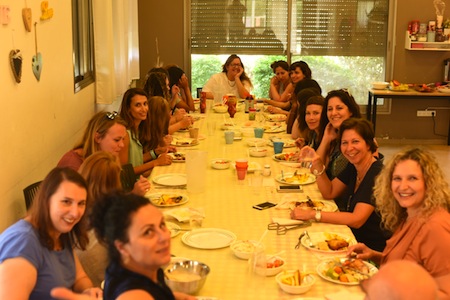
Lunchtime in one of the residential houses at Beit Ruth Village. (photo by Meir Azoulay)
Each house has a kitchen with a dining room, where the girls cook together, eat together, and have chores and responsibilities, and a living room. They have a bedroom they share with three other girls, and they can decorate it however they wish.
“We’re recreating that security and foundation that any child needs to have in order to be a successful human being,” said Burenstein. “I mean, to be able to have trust and respect, communication skills and a desire to learn, like most kids have.
“When our girls come to us in the village, I can tell you that, if you were to visit as an outsider, you’d probably be able to point out which girls have just come to us … because they are a shell of what a child should look like at that age – withdrawn, many sitting in a corner. You can tell that they are scared. They won’t make eye contact with you. They speak in a low voice.
“In a matter of weeks or few short months, you’ll see them start to smile, hang out with the other girls, talk with staff, engage, listen … some will laugh out loud.”
The girls who come to Beit Ruth have to choose to do so themselves, and they can choose to leave at any time. The purpose of the village gate is to keep out unwanted visitors, not to lock the girls in.
“The girls need to commit to the hard work it takes to overcome their trauma, to face their trauma through therapy, to listen to the values we instil in the village, which are all about teamwork, respect and trust,” said Burenstein.
Something that makes Beit Ruth unique are its guiding principles, one of which is creating the atmosphere of a home life – the kind of support a family should give a young child. Another guiding principle is therapy, which helps each girl face her own personal trauma, with the goal of overcoming it.
There are also enrichment programs, such as therapeutic art or music, sports and physical activities, all of which are mindfully selected and designed to help a young girl find her voice, passions and skills, to forge communication skills, trust and respect.
Many girls come to Beit Ruth with big gaps in their education. Some don’t know how to read or write at 13 or 15 years of age.
“When you’re hungry, when you’re scared, or when you’re in an abusive situation, school is not what you’re focusing on,” said Burenstein. “So, our girls are given the opportunity to have a high school education and we help instil a love of learning and curiosity that most kids have.”
Once at the village, each girl gets the support she uniquely needs. Beit Ruth does not go with one-size-fits-all programs, as each child comes with her own trauma, past and capabilities.
Beit Ruth’s educational programs, which were developed for the village, are trickling down into use by Israel’s Ministry of Education, to other schools around the country, and into hospitals.
“Each girl has her own journey to take,” said Burenstein. “It’s really hands-on for each one of the girls. They know it’s a place they can call home. They know this is a place where they are safe. They know this is a place that, no matter what … and, trust me, they try to test us … they know that we’re here for them and that we’re not giving up on them. That comes across loud and clear.”
Prime Minister Binyamin Netanyahu takes off for Kenya on a trip last year. (photo by Haim Zach/GPO via Ashernet)
Recent years have seen a mass migration of people from Africa and the Middle East, primarily to Europe. Images of rickety boats filled with migrants and bodies washing up on European shores jolted the world’s conscience.
To be more accurate, these images jolted some people’s consciences. Others, like far-right political parties in Europe, have been more concerned with preventing migrants from entering their countries than they have been with the dangers the migrants face at home or in transit.
Israel’s experience has been somewhat different. Beginning even before the peak of the migration, thousands of east African migrants traveled to Israel, crossing the Sinai border with Egypt and entering Israel illegally. In some cases, migrants, many of them asylum-seekers, paid Bedouins to transport them across the border into Israel. The once-porous border has been secured and Israel’s attention has now turned to how to deal with those who entered the country illegally.
Some have been held in a facility called Holot, in the Negev, which the government describes as an “open-stay centre.” It is run by the prison authority and, while “residents” are free to leave during the day, they cannot work and if they miss an evening curfew they can be jailed.
There are an estimated 27,500 Eritreans and 7,800 Sudanese in Israel. The Israeli government department responsible says that 1,420 of these people are being held in detention facilities.
Migrants say they came to Israel to escape conflict or persecution, but the Israeli government characterizes them as economic migrants and refers to them as “infiltrators.” Prime Minister Binyamin Netanyahu has also suggested that African migrants threaten the Jewish nature of the country.
Thousands of migrants have already voluntarily left Israel, apparently not seeing a future there, despite arriving filled with the promise that life there might be free and prosperous.
Now, Netanyahu has announced a crackdown that puts the fate of the remaining tens of thousands in doubt. The government had already announced plans to deport migrants, a plan that Israel’s high court approved last summer, on the condition that safeguards were in place in third countries that would accept the expelled people. Rwanda has accepted several thousand African people from Israel.
Some who have returned to their home countries have been tortured or placed in solitary confinement. And reports say that others who have left continue their journeys through successive countries, many of them with an eye to eventually making it to Europe. Libya has been the departure point for many Africans setting off for Europe. For around 2,000, it has also been the last sign of land before drowning. In Libya, also, migrants are being sold in contemporary slave markets. Others are sexually assaulted or coerced into forced labour.
Irrespective of all of this, Netanyahu announced last week that the remaining migrants would be given the equivalent of about $3,500 US and sent packing. Those who do not leave will be imprisoned, the prime minister promises.
The choice is not necessarily obvious for everyone. One migrant told the New York Times recently: “If it’s between going back to Africa or to jail in Israel, I’ll go to jail.”
The government’s plan is inhumane.
We have plenty of sympathy for the need to maintain Israel’s Jewish character, but the assessment that 40,000 Africans present a serious threat to that demographic necessity – even generations down the line – is not credible.
A country that absorbed one million migrants from Russia in the course of a few years (albeit imperfectly) and whose entire history has been one of absorbing migrants, can do better than this for 40,000 Africans.
It is also startling to see the Jewish state behaving in such a callous way to migrants. Eve if some – or all – of these migrants were “economic” migrants rather than fleeing persecution and conflict, this would still not be an acceptable strategy. Jewish history should imbue Israel with more sensitivity to the humanity of migrants of any colour or origin. Even if the sensitivity to the migrants’ humanity were not genuine, Israel should at least be sensitive to the appearance created by their inhumanity toward the migrants.
In this space, we have always maintained that Israel has the right to determine its policies and directions first based on their self-determined needs, not on whether it makes it easier or more difficult for overseas Zionists to make our case. But does the Netanyahu government absolutely need to behave in ways so blatantly and unnecessarily nasty?