Bleak future for Israel

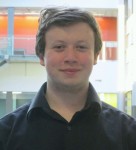
Raphael Hoult, winner of the inaugural Barry Rubin Prize Essay Competition. (photo from Raphael Hoult)

“A Game of Clocks: An Analysis of the Situation in the Middle East and Its Effects on Israel” by Winnipeg’s Raphael Hoult is the winner of the Centre for Israel and Jewish Affairs’ inaugural Barry Rubin Prize Essay Competition.

Hoult, a physics major at the University of Winnipeg in his second year of studies, conjured up a mind-bending theory about the stability of Middle East security and consulted expert sources for his essay.

In physics, Hoult’s interests lie in the field of quantum gravitation, which attempts to combine two major theories – those of general relativity and quantum mechanics.

“These two theories don’t play well together,” said Hoult. “They conflict in places. The biggest place they conflict is in that every force in the universe has been quantized, meaning that we’ve found a very small, discrete package of it in the universe. For example, electromagnetism is delivered by something called a photon. The other forces have something that delivers them, as well. But, with gravity, we’ve found no such thing yet. What we say is we haven’t been able to quantify it, though there are a lot of theories out there for how to solve that problem. There’s string theory. Another is loop quantum gravity, that attempts to bring some parts together.

“I want to help look for a theory of quantum gravity, so we can finally resolve this dilemma … combine the two theories into one bigger theory, a more complete theory. And, hopefully, that will give us a lot more insight into the way gravity works and allow us to do more with our understanding of gravity – to utilize it more, similar to the way our deeper understanding of electricity and magnetism has allowed us to do more intricate electronics in the past couple years.”

According to Hoult, this reconciliation of quantum mechanics and general relativity has been the Holy Grail of physics for the past 50-some years, and solving it will be huge for physicists and the world as we know it.

“The proposed theoretical messenger particle for gravity is the graviton, which is something we’ve not yet observed at all,” he said. “Quantum mechanics requires there to be a graviton…. General relativity in no way makes reference to a graviton.

“The main thing is quantum mechanics works really well with very small things, general relativity works really well for really big things. Things with a lot of mass are usually very large. The problem comes when you have things that are very massive and also very small, such as neutron stars or black holes. These are very dense, have a lot of mass and exert a lot of gravitational force, but they are also very small. In the case of a black hole, they are actually on the atomic level. So, quantum mechanics is very important to the way they work, but general relativity also is in play. When our two theories don’t work and they are supposed to be working at the same time, that’s a problem and something we want to fix.”

In addition to his knowledge of physics, Hoult is also well-versed in Israeli politics. “I’ve actually never taken a political science course at university,” he acknowledged, “but I went to Gray Academy [of Jewish Education in Winnipeg], so I had a very strong basis in knowledge about Israel. I had a good grounding there. I also read the Times of Israel and Haaretz every day.”

When Hoult saw an advertisement for the Barry Rubin Essay Competition on Facebook, it piqued his interest. The contest topic was, “What does the current regional turmoil in the Middle East mean for Israel?”

In his essay, Hoult said, “The three main critical points I talked about were the constancy of Hezbollah, Hamas and Daesh (the Islamic State in Iraq and Syria [ISIS]). I wrote about the fact that Hezbollah is involved in the war in Syria, specifically as affiliates of Bashar Al-Assad. They support him and are fighting on behalf of him. On the flipside, a branch of ISIS, called Al-Wilayat Sinai, is operating in the Sinai Peninsula desert against the Egyptians, making their lives very difficult. They’ve also struck up an alliance with Hamas.”

According to Hoult, the main three players in regards to Israel involve Hezbollah in the north, Hamas in Gaza and Al-Wilayat Sinai (Daesh) in the south. Hoult does not delve into the Iranian threat in his essay, apart from Iran’s role in supporting these groups.

“My hypothesis was that these three forces are connected to one another,” he said. “And, because of the ongoing campaign against ISIS, my hypothesis is that, as soon as that campaign succeeds and breaks down ISIS, all hell will break loose for Israel.”

Hoult explained that this theory takes into account Hezbollah’s huge military arsenal, which is estimated at around 100,000 rockets, and their ability to hit every point in Israel from Metula to Eilat, combined with the southern threat from Hamas and from the Al-Wilayat Sinai, which, so far, has been mainly fighting the Egyptians.

“Once ISIS collapses in the north, the Al-Wilayat Sinai … will suddenly be like a tentacle that has been cut off from the squid,” he said. “It will have no control and will be in desperate throes to stay alive, making it likely that it will involve at least a couple cross-border raids. If those involve any Israeli deaths, it will force Israel to respond, which is an issue, due to the fact that Israel can’t cross the border without Egyptian permission.

“There is also the fact that Hamas is having another military build-up,” he added.

Hoult predicts this will likely lead to another war in 2017 and, once that war is over, he said Hezbollah would have had ample time to gather its troops and possibly attack Israel from the north. “This is not a good thing for Israel, as Hezbollah is dead set on destroying Israel if they can,” he said.

As to why Hoult thinks his essay was selected as the winner, he said he is not sure, although he imagines it may have “had something to do with all the sources cited, creating a compelling likelihood of my hypotheses coming true.”

One of his many concerns is that “the primary backer of Hezbollah and Hamas is Iran. Iran has just had billions of dollars unlocked, due to the nuclear deal … which I’m not going to condemn or support, though I’m a little bit skeptical of whether or not unlocking those funds was a good thing.”

 Rebeca Kuropatwa is a Winnipeg freelance writer.
Interpreting Torah with art

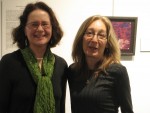
Artists Nancy Current, left, and Robin Atlas at Zack Gallery. (photo by Linda Lando)

Visual Midrash: Plagues and Visions, which opened at Zack Gallery on April 7, features the work of Seattleites Robin Atlas and Nancy Current, the only West Coast artists creating in the genre of visual midrash. The show is the culmination of a four-year collaboration that started in 2012.

“We met through the Jewish Art Salon in New York,” said Current. “Even though we both live in Seattle, we didn’t know each other at that point.”

Atlas elaborated: “The president of the Jewish Art Salon sent us both an introductory email. She said we probably knew each other already, but we didn’t – and we lived only 10 minutes apart.”

“Robin was about to open a new show in L.A. and she brought her works to my studio,” said Current. “I was amazed. There was so much beauty and thought behind it all. That’s what visual midrash is all about. It requires two elements: the clarity of story and the visual beauty of the artist’s interpretation. I looked at Robin’s art and I said to myself, I’m going to work with her forever.”

They started working together, but their chosen genre – interpreting Torah through visual art – is not widely known. “We didn’t have a ready audience in the West,” Current explained, “not like in New York. We needed to build it, so we started teaching adult classes two years ago. The classes include the texts from the Torah, introduced by a Torah instructor, and a visual component, taught by an art instructor.”

“We would do slide shows, video presentations, and the students would have a chance to create their own art,” Atlas said. “Linda Lando, the Zack Gallery director, facilitated the first class we did in Vancouver earlier this year.”

For the current show, the artists explored the theme of the 10 plagues. “We were drawn to the story,” said Current.

Although each artist works with different media – Atlas with textiles and Current with glass and paper – their creative vision is similar. Their symbolic abstracts mesh extremely well, as if the images belong together, buzzing with the same esthetic sense and the same muted elegance, complementing each other to tell the same tale.

While the Vancouver Jewish community was introduced to Atlas when she exhibited at the Zack in mid-2014, Current is a new name for most local art appreciators.

“I always drew and painted as a child but I can’t say that I had the conscious idea to be an artist,” Current recalled. “I grew up in Seattle, in an old house with stained-glass windows. That undoubtedly affected my later fascination with glass. I learned to blow glass when I was about 24, but gave that up in favor of painting on stained-glass.”

She explained, “Glass is different from other mediums because light passes through it (transmitted light) instead of bouncing off [of it], like with paper or canvas (reflected light). Transmitted light, especially through colored glass, connects to a person’s emotional centre more directly than reflected light. It also has a spiritual aspect. Think of all those stained-glass windows in churches and synagogues. That is important to my Jewish work.”

Although she has worked in other visual genres, Jewish themes absorb her artistic passion now.

“Jewish art has gradually replaced my other work, life drawing and landscape, because it is much more meaningful,” she said. “Visual midrash is the most meaningful Jewish art of all. It requires a lot of study and thought, and those are things I highly value about living a Jewish life.”

Current pointed to two particular influences on her development as an artist.

“The first was studying at Pilchuck Glass School,” she said. “The school attracted many artists early in the history of the American studio glass movement. I studied there with the amazing British glass painter Patrick Reyntiens. He is 90 years old now and still a good friend.

“The second was finding the Jewish Art Salon (JAS) in New York. Becoming a fellow in the JAS has led me to friendships with several Jewish artists who have been doing visual midrash for years. They have helped a lot.”

Current doesn’t concentrate on making a living with her art. Her main concern is to share it with as many people as possible. “Of course, eventually I want to sell my work,” she said, “but not until I’ve had a chance to show it in several exhibitions. The purpose of doing my work is to cause people to think about their Jewish heritage.”

Current and Atlas’ show runs until May 8.

Olga Livshin is a Vancouver freelance writer. She can be reached at olgagodim@gmail.com.

Learning about other faiths

During mock weddings, participants learn about Jewish and Sikh rituals. (photo from Shaul Osadchey)

While Judaism is the main focus of any synagogue, and many stop there, that is not the case with Calgary’s Beth Tzedec Congregation. They have decided to take their Jewish engagement into the wider world and have hired scholars from other faiths to teach them about those faiths.

“There are a great number of religious traditions that are present in the community,” said the synagogue’s Rabbi Shaul Osadchey. “How do we learn about other people? How do we engage in conversation and interfaith relationships with people unless we know something about them? That’s the challenge.

“In thinking about that, which is fundamentally an issue of how we make Jews more religiously literate about other religions, the challenge is to do that in a way that people will come out and actually participate in the learning.”

Osadchey knew that if he left it to others to start the process, he’d be able to count participants on one hand – out of the 600 families that are a part of the synagogue.

“People aren’t going to initiate that,” said Osadchey. “People are intimidated going into other people’s houses of worship. They don’t find the time to do this on their own. The thought was, then, sanction it and bring it into the synagogue … making it ‘kosher’ in the sense that it’s acceptable for us to do. Secondly, it will be much more effective, because people will be much more comfortable coming into a familiar environment to learn about others.”

Osadchey was able to find someone in his congregation willing to support the cause, leading to the creation of the Lil Faider Interfaith Scholar in Residence Program.

“The idea was to allocate $10,000 a year for five years and pick five religions we wanted to examine, and invite a scholar or religious leader from the chosen tradition to be on our staff and teach within the synagogue for about 10 months (not over the summer).

“The first year, 2013-2014, we selected Sikhs. I thought that would be a good starting point because we know very little about Sikhs. They have a fairly significant amount of people in the Calgary community. Approximately 20,000 Sikhs live here, which is at least twice the size of the Jewish community, and they are very visible and yet kind of mysterious to us, we don’t know much about them.”

In his High Holiday sermon that launched the program, Osadchey invited attendees to learn about Sikhism. “All we know about them is they work at the airport, they

drive taxis and they wear a turban,” said Osadchey to congregants. “People kind of chuckled, and said, ‘Yeah, yeah. I know that.’ The point was, what do you know beyond that? The answer was relatively nothing. That’s not enough to engage people in conversation let alone collaborate in community activities.”

The synagogue hired Dr. Harjot Singh, a medical doctor and leader in the Sikh community. She presented lectures, followed by some experiential activities. One program was called Turban and Tefillin.

“That was pretty amazing, because it was a way in which we explored what the meaning of religious apparel is in our respective traditions,” said Osadchey. “The fact that we both cover our heads and wear identifiable religious objects was a starting point. During this program, all the Jewish participants were shown how to put on a turban and each of us was wrapped in one.

“We see turbans, but we don’t see them unwrapped … and now [we] understand how complicated it is for the novice to actually do that. Even though it only takes them three to five minutes to do, it’s quite an art. It was really quite wonderful to be wearing this turban and get a feel for what it’s like. Then, we wrapped them in a tefillin and they got an idea of what that was as a religious object.”

The congregation was invited into a gurdwara, the Sikh house of worship, and experienced a service. Then, they joined everyone in the langar, or common kitchen, where people can eat for free. Lastly, they finished the year off with a mock Sikh wedding and a mock Jewish wedding, for which they put up a chuppah, and presented the wedding rituals, acting them out and taking note of the similar and different rituals.

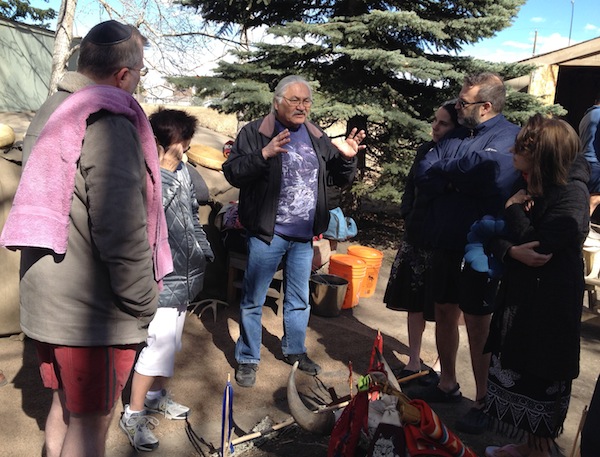
photo - Casey Eagle Speaker welcomes Beth Tzedec’s interfaith learning group to a sweat lodge
Casey Eagle Speaker welcomes Beth Tzedec’s interfaith learning group to a sweat lodge. (photo from Shaul Osadchey)

In 2014-2015, the synagogue focused on aspects of First Nations spirituality, inviting Casey Eagle Speaker and another teacher to give lessons on their culture.

“The year ended with a sweat lodge we went to, for us exclusively,” said Osadchey. “Afterwards, we sat around and passed the peace pipe together. People really learned a lot from that, as native spirituality is an oral tradition mainly. These are customs passed on and taught – sundance, sweat lodges and so forth – but they also have a very interesting perspective about the creator, nature and the role of people in terms of building community and families. That was quite eye-opening.”

This year, with all the new connections the synagogue has made with the Muslim community, they decided to focus on Islam.

“We didn’t start with Islam and we didn’t start with Christianity, because people probably would have said, ‘Oh, I know everything I need to know about Christianity, so I’m not going to show up,’” said Osadchey. But it was time to get to Islam, he said. “The next two years are going to be Hinduism and Buddhism.”

For Islam, the congregation selected Imam Syed Hadi Hasan of the Shia branch of Islam, who has a long history of interfaith work.

“What we did, however, was to respond to some of the naysayers and the skeptics by inviting a Jewish rabbi/scholar from L.A. after the imam had given about three lectures, and then we had Dr. Reuven Firestone come and speak,” said Osadchey. “He’s written books on Islam for Jews, about what Jews should know about Islam and what Muslims should know about Judaism. He’s very active in Muslim-Jewish dialogue. He came up and gave us a weekend of four lectures on different aspects of Islam and how we approach it. We invited our Islamic friends to come and many did. And, they were very impressed by his scholarship and knowledge of the Koran and so forth.”

At Chanukah time, the synagogue invited three imams to share their thoughts on religious freedom and join in the lighting of the chanukiyah, along with the rabbis. At the end, they all held up letters that spelled the phrase, “We refuse to be enemies.”

Osadchey said, “It was a powerful moment and brought Chanukah and the whole meaning of respect into a much different perspective.”

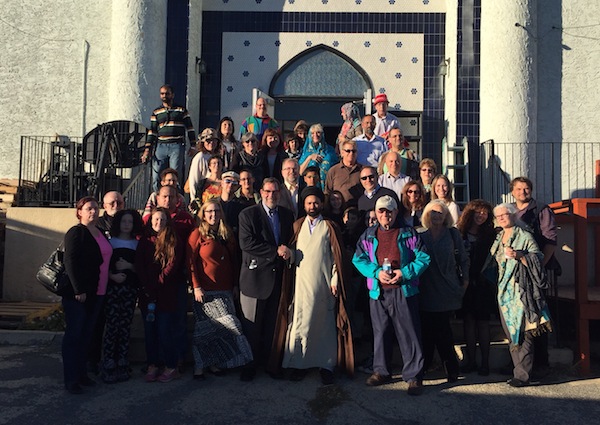
photo - Imam Syed Hadi Hasan, right centre, takes Rabbi Shaul Osadchey, left centre, and some congregants on a tour of his mosque
Imam Syed Hadi Hasan, right centre, takes Rabbi Shaul Osadchey, left centre, and some congregants on a tour of his mosque. (photo from Shaul Osadchey)

This March, the synagogue initiated the program Our House is Your House, which will be profiled in a future issue of the Independent.

Although Christianity is not one of the religions studied in the first five years of the program, the synagogue hopes to continue with a sixth year focused on Christianity. The program so far has been beneficial.

“It has given people permission to go out into the community and do things in a way they may have been hesitant to do before,” said Osadchey. “They have more confidence that they have the knowledge and the literacy to engage people.”

The scholars, too, gained much from the experience. “I was thrilled and amazed at that request and immediately accepted it,” said Hasan. “And I did my best to teach about Islam and answer all the questions from the participants of the five sessions I was part of.

“In the first session, participants were not very comfortable…. They were friendly, but they were a little bit formal in the beginning … but, gradually, we developed a friendship.”

Hasan is planning to bring Judaism into his mosque in a similar fashion, calling Beth Tzedec’s method “perfect and brilliant.”

He said, “We will be inviting Rabbi Osadchey for probably three to four sessions and he will be introducing Judaism…. When we are ignorant, when we don’t know each other, definitely, we have a lot of misconceptions. We are going to bring knowledge and awareness, and show that we are almost the same. We all work for the welfare of humanity and the universe. In this sense, we all are the same. In doing these programs, we are promoting peaceful coexistence and we are bringing harmony and unity within our communities.”

Speaker, who is a member of the Blood Tribe, which is part of the Blackfoot Confederacy in Alberta, echoed Hasan’s feelings, mentioning he found the experience very valuable.

“I enjoyed the hospitality and the openness that the people had,” said Speaker. “The congregation was very open in mind, body and spirit, very open to listening, to understanding who we are as a people, as indigenous people, and about the concerns or issues prevalent in society. They showed me a hunger to learn and to create an understanding, rather than just knowing.

“In our culture, we share openly to create an understanding and come together as human beings, rather than being separated by race, creed, color and religion. Those don’t work. We’ve seen the conflict that those create.

“They shared with me. They felt safe. They didn’t feel threatened. It felt more like family and how we do … the openness of sharing and expressing kindness, generosity and acceptance of each other was something they really came to be accustomed to. And, our style of ceremony, going into prayer and stuff like that, it’s so heart-warming.”

Rebeca Kuropatwa is a Winnipeg freelance writer.
Faxes, printers hacked

Simon Fraser University was among those targeted by a hacker spewing antisemitic hate. (photo from facebook.com/PeakSFU)

Simon Fraser University was among many universities targeted by a white supremacist computer hacker purveying antisemitic hate.

Andrew Auernheimer, an Arkansas native now living in Abkhazia, a secessionist region of the republic of Georgia, told the Washington Post that he was responsible for causing at least 20,000 printers and fax machines throughout North America to spew out copies of an anti-Jewish hate poster.

SFU was among the campuses whose fax machines were affected last month, according to Nancy Johnston, executive director of student affairs.

“They weren’t actually posted, they just arrived on people’s faxes,” Johnston said. “It was all just removed and trashed here.”

The sheet featured two swastikas and the words, “White man, are you sick and tired of the Jews destroying your country through mass immigration and degeneracy? Join us in the struggle for global white supremacy at the Daily Stormer,” followed by the web address for the neo-Nazi hate site.

The printer hacking affected administrative and departmental offices at campuses in many U.S. states, the Post reported, adding that an official for the Anti-Defamation League said his organization had received many reports from people concerned about the content emerging from their printers and fax machines.

“Any demonstration of anti-Jewish hostility is a cause of serious concern,” said Nico Slobinsky, director of the Centre for Israel and Jewish Affairs, Pacific region. “This flyer and its contents have no place on any campus in Canada.”

Rabbi Philip Bregman, executive director of Hillel BC, which serves SFU among other campuses, sent this statement to the Independent: “We at Hillel BC are extremely concerned about this latest example of antisemitism that is circulating throughout North American universities. It is our hope and dream that humanity will eventually find a way to live with each other with respect and loving kindness.”

Refugee policy evolves

Rabbi Dan Moskovitz, left, and Dr. Harold Troper. (photo by David Berson)

The current refugee crisis – and Canada’s responses to past crises – was the topic of an interfaith panel recently, which raised issues especially relevant as Passover approaches.

Our Home and Native Land? A Multi-Faith Symposium on Refugee Settlement featured a keynote presentation by Dr. Harold Troper, co-author of None is Too Many: Canada and the Jews of Europe, 1933-1948. The event, on March 18, also included a panel discussion that featured Rabbi Dan Moskovitz of Temple Sholom. Catalina Parra brought a First Nations perspective, Imam Balal Khokhar spoke from a Muslim point of view and Rev. Dr. Richard Topping spoke as a Christian.

Troper recalled being part of a Canadian group that traveled to eastern Germany two decades ago, after the Berlin Wall fell. States in the east of the newly reunified Germany were seeing an upsurge in migration from countries further to the east. A group of Canadians was invited to listen and give advice on Canada’s experience integrating newcomers. At one point, a local official thanked Troper for his comments, but asked, “What do you do with your foreigners?”

Troper expounded on the concept of “new Canadians,” a formulation perhaps unknown in any other country, in which people arriving with the intent of making Canada their home are acknowledged not as foreigners or as migrants, but as people becoming part of our polyglot population already on a path to inclusion.

Of course, Troper acknowledged, this was not always so. None is Too Many, published in 1983, was a seminal book that has had lasting impacts on Canadian views of migration and refugees. The title comes from a quote from an anonymous Canadian immigration official who responded with these words to the question of how many post-Holocaust refugees to admit. The words have been attributed, in some tellings, to F.C. Blair, Canada’s then-director of immigration. However, while this is not provable, Blair’s actions were in line with the words.

Recounting this country’s exclusionary policies toward the desperate Jewish populations of Europe in the prewar period, but also a similar disregard after the war, the book has been held up as an object lesson in how not to respond to people in crisis. Troper said he didn’t know until years later the impact the book had had on one very significant episode in Canadian history.

In 1979, Troper and Abella sent an academic paper that preceded the book to Ron Atkey, Canada’s immigration minister. Atkey was a member of Joe Clark’s cabinet and, though that Progressive Conservative government lasted only nine months, it was during Clark’s term as prime minister that the decision was made to welcome 60,000 Vietnamese refugees, known as “boat people.” Troper said he found out later that the manuscript they sent played a role in the decision.

“We hope Canada will not be found wanting in this refugee crisis the way it was in the previous one,” the authors wrote in a note accompanying the manuscript. They expected no response and they received none. But, several years later, Troper said, Atkey told him that he had read it.

“He told us he was shocked and dismayed when he saw the political parallels between the Vietnamese and Jewish refugee crises,” Troper recalled. “Then and there, Atkey told us, he decided he was not going to go down as the F.C. Blair of the boat people.”

Already predisposed to encourage his cabinet colleagues to take a generous approach, the article stiffened his resolve to stand firm against ministers who disagreed. The government initiated a joint federal-private sponsorship program.

“It today serves as the prototype for Canada’s Syrian refugee program,” said Troper.

Now, as refugees are coming from North Africa, Asia and, most notably, the Middle East, fleeing civil war and ruin in Syria and Iraq, Troper sees parallels between the fears expressed now and those of seven decades ago.

“The fears are not only around the expenses of accommodating these refugees, but that the intake of a population of different race, religion and cultural assumptions and social expectations will destabilize destination countries,” he said.

Not dissimilar, he said, were fears that European Jews might bring socialism, communism, anarchism – even Nazism – with them.

“Foreshadowing the kind of anti-refugee arguments commonly heard today,” Troper said, “reports of persecution were dismissed as exaggerated if not bogus, fabrications designed to justify an end-run around Canadian immigration restrictions. And who were these refugees anyway? Were they really innocent victims? Surely they must have done something to turn their fellow citizens against them. Why make Europe’s problem our problem? And weren’t Jews in Canada already a pesky problem? Do we want more? And who’s to say that communists or even Nazis would not pose as refugees to infiltrate as subversives into Canada? Keeping Canada strong and united meant keeping Jews out.”

Another haunting parallel was the galvanizing photo of the 3-year-old Kurdish child who washed up on a Turkish beach and a photo Troper came across decades ago in his research for None is Too Many while going through archival boxes in the Toronto office of the Jewish Immigrant Aid Society. The boxes were filled with prewar letters from European Jewish parents who, knowing that entire families were unlikely to be granted admission to Canada, begged that their children might be taken in by a Canadian family. In each case, a terse response told the desperate parents that Canada was not admitting any Jews but that the request would be held on file in case something changed.

“Going through these files, I came across a letter that impacted me the way I imagine the photo of 3-year-old Alan Kurdi lying facedown in the sand of a Turkish beach impacted on all of us,” he said. “The letter was from a father begging for some shelter for his two daughters. A picture of two smiling children was attached. As I read this letter, my eyes began to tear; you see, I am also the father of two girls. At the time they were 3 and 5 years old. For a split moment, it was as if I was that desperate father, his children were my children and his fears were my fears.”

As part of the panel that followed, Moskovitz spoke of the bread of affliction.

“How inappropriate it might seem to hold up a matzah when we sit around a seder table filled with food, and to think that we are supposed to connect with this when we have so much,” the rabbi told the Independent after the event. “The point is to remind us that there was a time in our lives when we didn’t have so much.

“Each of the faith traditions,” he said, “spoke about that lens of empathy, of remembering historically that we once ate the bread of affliction, that we once didn’t have much and so we have to share with those who do.”

Religious perspectives are critical in this discussion, he added.

“Left to our own devices, society will often do what they think is in [their] own immediate best interest, which is often isolationism – we’re seeing that in the U.S. elections today – and fear of the other,” he said. “The role of religion is to compel us to do what is morally right and good, what is spiritually elevated, what is holy. It’s a religious foundation that is compelling us to love the stranger, because our political reality, especially in the wake of the terrorist attack in Brussels, is telling us to fear the stranger.”

For Jews, he said, the plight of refugees is not a momentary news story.

“This is not just a headline that has come and gone,” said Moskovitz. “Our Passover Haggadah makes it a headline for Jews every year, that we are reminded to see the world through the lens of a refugee every single year. It’s the most observed Jewish holiday in the Jewish calendar – that says something about how important the status of a refugee is in Jewish tradition.”

The multi-faith symposium was organized by the Inter-Religious Studies program at Vancouver School of Theology and facilitated by Rabbi Laura Duhan Kaplan, the program’s director.

Measuring footprints

Ben-Gurion University of the Negev’s Dr. Meidad Kissinger is doing collaborative work with colleagues in British Columbia. (photo by Zach Sagorin)

Five years ago, Vancouver set the goal of becoming the greenest city in the world by 2020. According to the 2014/15 update to the Greenest City 2020 Action Plan, as well as research being conducted at the University of British Columbia in collaboration with Ben-Gurion University of the Negev, there is a long way yet to go.

Nonetheless, Dr. Meidad Kissinger told the Jewish Independent, “I really like Vancouver. It’s, in a way, a second home.”

Kissinger is the head of the Negev Centre of Sustainability and a faculty member in the department of geography and environmental development at BGU. He completed his PhD in urban and regional planning at the School of Community and Regional Planning at UBC and returned last summer for a research leave that continues to this coming summer.

“UBC is a great place … there is a lot of interest in issues that I am engaged with around sustainability science and ecology economics,” he said. In addition, “it was important that the family would decide where to go, and Vancouver felt comfortable.”

Not needing to teach or focus on other administrative tasks while he’s here, Kissinger said, “My time here is focusing on research. My own goals are reading a lot, thinking a lot, writing a lot.” He is working on a book while at UBC, as well as engaging in projects with colleagues here.

On one project, Kissinger is collaborating with researchers from UBC and Kwantlen University on a study of local food systems, looking at the potential of the Lower Mainland to produce its own food. It’s similar to a project in Israel, he said, which questions “what is the ability of the state … to produce its own food.”

Kissinger is also researching urban “metabolism,” which “looks at the flow of resources into a city and looks at the city as a living organism, and asks questions of what is being consumed, who is consuming it and what is being emitted,” he explained.

He is also studying interregional sustainability, which considers sustainability from a global perspective. “Any country, including a huge country like Canada, depends on resources from other [places],” he said, giving the example of Canadian food consumption (mostly vegetables and fruits) from California. “When looking at the world from an interregional level,” he said, “you understand that there are linkages between the tomato that you are eating here to the drought in California. These are kind of the interactions. It’s common sense.”

The problem is, he said, “We don’t take these things into account and we don’t measure them.” He did acknowledge, however, that there is an “increasing understanding that we need to look at interactions between the human system and the natural system.”

Using 2006 data, Kissinger and colleagues Jennie Moore and William Rees of UBC’s School of Community and Regional Planning applied interregional analysis to Vancouver’s “metabolism” to see whether there was validity to Vancouver’s claim that it is the greenest city in the world. “Now, we haven’t completed research yet,” he said, “but I suspect that what we will find is that maybe there are some incremental improvements in certain parts but when you are looking overall, the metabolism of this region has just continued to increase over the years. So, there is a major gap between the political arguments and what actually the research tells us.”

“Urbanization has both positive and negative environmental implications,” write the three colleagues in the Journal of Environmental Management (2013). “On the one hand, cities are nodes of consumption that depend utterly on a constant flow of materials and energy from around the world in order to function…. On the other hand, the economies of agglomeration (lower costs due to proximity of related activities) and the economies of scale (lower costs due to higher volumes) associated with the city’s high population density and concentration of economic activity contribute to a significant ‘urban sustainability multiplier.’… Furthermore, the sheer wastefulness of many cities implies major opportunities for energy and material conservation. It follows that, in the 21st century, cities are an appropriate focus for research into ecologically necessary, socially acceptable and politically feasible ways of reducing the overall human load on the world’s ecosystems.”

In analyzing Vancouver’s “bottom-up ecological footprint,” the study examined the “energy and material consumption using locally generated data” on areas such as water, food, transportation and buildings. It found Vancouver’s total ecological footprint in 2006 to be “an area approximately 36 times larger than the region itself.”

Kissinger explained to the Independent in an email that his research largely culminates in “analyzing the socio-biophysical systems and what authorities/institutions at different scales can do” to reduce the ecological footprint. On a personal level, people need to consider their consumption in general, he said, “and particularly of food, with emphasis on minimizing animal products.”

Research collaboration such as that of Kissinger at UBC is rare. “There is hardly any Canadian-Israeli research collaboration,” he said. “Very different from what you have between Europe and Israel, between the U.S. and Israel. Even between China, India and Israel, there is more than what you have between Canada and Israel, which is … something that needs to be changed. Saying that, again, I’m working this year with Canadians, here in this part of the world, and with colleagues in Toronto, and so I do find that it is possible and I like to work with Canadians.”

The reason for the relative lack of collaboration is largely financial, said Kissinger. It has nothing to do with factors such as the boycott, divestment and sanction movement against Israel, for example.

“I’m aware that there are attempts to undermine Israel in the world for different reasons,” he said, but “I’m working with colleagues here, I’m working with colleagues in European universities.”

He added, “It’s one thing to put pressure on Israel to change policy, and I wish this is something that hopefully will be done. It is a different thing to do what BDS is doing…. I don’t think this is the way.”

He tried to explain how such actions are seen from the Israeli side. “I guess it happens to any society when it feels that it’s being attacked, it’s being under pressure from outside,” he said. “It [tries] to push the pressure away and at least appear unified and I think it is very natural.… So, when you are looking at Israeli media … it will try to resist [external pressure] and try to show how everyone is against us, instead of reflecting inside and looking at what is wrong with what we are doing. This is kind of the other side of this external pressure. It’s complicated.”

Zach Sagorin is a Vancouver freelance writer.

Will the NDP survive?

While there were signs that the New Democratic Party’s rank and file were somewhat ambivalent about Thomas Mulcair’s leadership, the magnitude of the party’s rejection of him Sunday was stunning. Fully 52% of delegates to the party’s national convention in Edmonton voted for a leadership convention, in effect ousting Mulcair as leader.

The NDP, having almost never been a serious contender for government, has generally been accepting of a leader’s inability to win federal elections. But never had the party been so tantalizingly close to power as it was after Jack Layton’s 2011 result, which catapulted the party into official opposition for the first time. In last October’s election, under Mulcair’s leadership, the party returned to its historic levels: a poor third place.

Mulcair’s ability to remain as head of the party after that showing was destined to be a challenge. Many New Democrats never viewed Mulcair as ideologically pure, coming as he did from the Quebec Liberal party. He became leader in part because many believed he had the experience and capability to build on the Layton legacy and lead the NDP into government for the first time. His failure last October to realize that dream was, in retrospect, the end of the story.

The coup was fairly bloodless. There was little overt campaigning against his leadership and each delegate seems to have made their individual decision, which led to a collective rejection unprecedented in federal politics.

In his short speech to the delegates after the vote results were announced Sunday, Mulcair urged the party to come together in unity behind whoever is to replace him. Yet that seems like extraordinarily wishful thinking.

Mulcair, because he embodied the prospect of electoral success, was able to keep a lid on some of the most extreme elements in his party, including the far-left and the anti-Israel extremists (between which there is a great deal of overlap). At the convention that ousted him, the party gave a thumbs-up in principle to the so-called Leap Manifesto, a hard-left document that could probably guarantee electoral failure for a generation. The party also divided sharply between those who see climate change as a priority challenge and those who believe the party must continue to support workers above all, including those in the host province of Alberta whose industries often contribute to global warming.

So, the question may not be whether the party will now take a left-leaning lurch, as the U.K. Labor party has done, or whether it will pursue the more pragmatic path set by Layton and Mulcair, but rather whether the hard-core leftists and the pragmatic centrists can coexist at all. Especially with the Liberal party sucking the air from the centre-left of the political spectrum, whether the NDP can maintain any sort of cohesion is a bigger question than who will be the next leader.

Case for a positive rethink

When speaking to Jewish audiences about advocacy, I often refer to my own background as a Jewish convert in making the point that we sometimes have to apply a fresh perspective – and have a collective “out-of-body” experience – to understand the reality of our own circumstances. Sometimes, we are too close to the situation to evaluate it with clear eyes and objectivity.

Among the many things that make me proud of my father is the fact that, early in his career, he chose to serve the public as a police officer. I have heard it said that police disproportionately interact with the most challenging and marginal elements of society, perhaps just five percent of the public, on a regular basis. Just as one in such a role knows their daily encounters are not representative of broader society, we as Jews – who understandably take notice of antisemitism and anti-Zionism – must be cautious not to attribute these toxic manifestations to the majority of Canadians.

I could write an entire series of columns on how we as a community have far more allies in the non-Jewish world than we often appreciate. Instead, I’ll offer two factors internal to the Jewish world that suggest pro-Israel advocates should be optimistic.

1. There is far greater unity of purpose – and welcoming of diversity – in the Jewish world these days. In the past, there was significant disagreement between Jews on the best means to secure the future of the Jewish people in an often hostile world. The community was split along various lines: between Zionists and non-Zionists, assimilationists and Orthodox Jews, socialists and capitalists.

Today, post-Shoah and post-1948, the overwhelming majority of Jews are Zionists in that they believe the state of Israel should exist and thrive as a democratic Jewish homeland. Among Zionists, there is extraordinary diversity: we are Labor and Likud, religious and secular, social activist and academic alike.

There is ceaseless debate over how Israeli policies can best secure the ideals of Zionism and how Diaspora Jews can engage Israel in a meaningful way. This is all healthy. We wouldn’t be Jews if we didn’t subject these issues to serious thought and debate.

But this occurs within a strong consensus that Israel’s existence is fundamentally just, a blessing to the Jewish people and the entire world, and, ultimately, the centrepiece of our collective future just as it is our ancestral homeland. These aren’t just clichés; they are ideals brought to life every time a young Jewish Canadian boards a plane for Birthright, challenges anti-Zionism on Facebook, downloads the latest Israeli music, or volunteers for the Israel Defence Forces.

2. Despite facing serious challenges, Israelis are far more successful, happy and optimistic than we might think.

While Israelis have suffered in every generation from war and terrorism, none of this detracts from the fact that the IDF has proven its capacity to provide Israelis with secure borders and an astonishingly high level of public safety. This is no mean feat in the Middle East, let alone for a country smaller than Vancouver Island.

At the same time, Israel has seen remarkable economic and technological success. From 1992 to 2013, Israel-China trade skyrocketed from $50 million to $10 billion annually. Israeli exports to Europe have nearly doubled since the boycott-divestment-sanctions movement was launched in 2005. Trade with emerging markets like India has likewise increased. Outside Silicon Valley, Israel now has the highest concentration of high-tech firms on the planet.

Success at a macroeconomic level doesn’t mean there aren’t serious challenges. The cost-of-living, for example, continues to be a burden for many Israelis. But, with each passing generation, Israel grows stronger economically and Israelis are afforded greater opportunities to learn, work and engage the world.

Israelis also enjoy a remarkably high quality of life. Israelis have the same life expectancy as Canadians (81) and Israel boasts a universal health-care system that typically beats Canada in international performance rankings. According to the OECD’s 2015 Better Life Index, which measures various social and life factors, Israel is the fifth happiest country in the world – ahead of Canada, the United States and most of Europe.

What would early Zionist thinkers like Theodor Herzl and his contemporaries say if they could read these statistics and walk the streets of Jerusalem or Tel Aviv today? How often do we forget how far we have come as a people?

I had the honor this February of leading a group of Canadian master’s-level students on a public policy study trip to Israel, one of many fact-finding missions we organize. (CIJA annually takes some 200 Canadians to Israel.) The students, all of whom are non-Jewish, were amazed at the innovation, diversity and vitality shown by Israelis despite living in the world’s most unstable neighborhood. They saw what we should never lose sight of: a country and a people from whom we can learn so much.

Indeed, Israel embodies so much of what’s right in the world today – and it is on this basis that we should share all that Israel has to offer with the world around us.

Steve McDonald is the deputy director of communications and public affairs, Centre for Israel and Jewish Affairs.

Reflections on Pesach

Passover is coming next week, yet it seems to have been with us in spirit a great deal this year. Many Jewish individuals and congregations in Vancouver and elsewhere have been involved in welcoming Syrian and Iraqi refugees fleeing tyranny and violence. And, almost inevitably, part of the justification for helping has been the Exodus story.

Through our religious teachings and rituals, we are engaged in applying the experiences of the past to the events of the present. The Pesach story is certainly applicable when a people is in need of refuge. So is the more recent, and less triumphal, story of the Jewish experience in the 20th century, which saw every nation on earth shut its doors to desperate refugees until it was too late. (See “Refugee policy evolves.”)

As we join together at seder tables around the city and around the world, let us continue to invite the lessons of the past to illuminate our path to the future.

At moments during the holidays, we are encouraged to seek out the transcendent values in our traditions and integrate them into our lives so that we can make a better world. It is clear from the work being done to aid refugees that these values are already well entrenched in so many individuals and congregations. Let this Passover be a time of rededication for all of us to the values that welcome the stranger, show gratitude, celebrate freedom and hasten the world we seek.

A glimpse of new Israel

Participants in the Central Conference of American Rabbis’ annual convention, which took place in Jerusalem and Tel Aviv in February. (photo from Dan Moskovitz)

Among the approximately 400 Reform rabbis who gathered in Israel in the last week of February for the 127th annual convention of the Central Conference of American Rabbis (CCAR), which is the rabbinic leadership organization of Reform Judaism, were Temple Sholom’s Rabbi Dan Moskovitz and Rabbi Carey Brown.

Of the rabbis who attended, about 100 of them were from Israel and Europe, the rest from North America. Moskovitz traveled from Vancouver, while Brown was in Israel at the time on her rabbinic sabbatical.

“It’s important for Reform rabbis to have a presence in Israel, to show that we are committed to an Israel that is based on our shared the values of democracy, pluralism, peace and inclusivity,” said Moskovitz in a press release before the convention. “This valuable on-the-ground experience in Israel, including with Israeli leaders, will enable me to share the insights I gained with my community and deepen our ongoing learning and relationship with Israel.”

“The highlight of our time there, for me, was the egalitarian Torah service at the new prayer space, Ezrat Israel, at the Western Wall,” Moskovitz told the Independent after his return. “We had the privilege of being present at the first official Torah service, which was officiated by Rabbi Ada Zavirov of Israel and Rabbi Zach Shapiro of Los Angeles.” That the Torah service was led by a woman and a gay man increased its poignancy for many. Rabbi Rick Jacobs, the head of the Reform movement, addressed the crowd after the service.

Moskovitz also participated in a fact-finding mission about poverty and women’s rights in the Orthodox community. They met with Hamutal Guri, chief executive officer of the DAFNA Fund: Women Collaborating for Change, a group that works on a broad spectrum of issues facing women in Israel. They also met with Efrat Ben Shoshan Gazit and Liora Anat-Shafir, who are both leaders in the ultra-Orthodox community. Their contacts highlighted many of the unseen struggles that women face in order to succeed in Israeli society, and the many issues they face in the ultra-Orthodox world in particular.

Gazit led the successful No Voice, No Vote Campaign, which told Orthodox men that unless women can run in Orthodox political parties they will not vote for Orthodox political parties. Anat-Shafir was instrumental in banning tzniyut (modesty) squads, which policed how women dressed in her community of Beit Shemesh.

In Hebron, Moskovitz met with members of the Jewish community. Hebron, traditionally a spiritual destination for religious pilgrims, is now a divided city. Israel Defence Forces checkpoints, barbed wire and fences restrict Palestinian movement and protect the Jewish population and holy sites. The rabbis arrived minutes after a terror attack that killed one Israeli soldier at a checkpoint outside the city. “As our bus arrived, the carnage and crime scene were right before our eyes,” said Moscovitz.

On a more positive note, Brown met with representatives of the Israel Religious Action Centre to discuss racism and incitement in Israel, and studied an IRAC project that examines locations in Israel where there is a high level of coexistence between Arabs and Jews in order to find patterns of success for the future. “One particular area of focus is the health-care field,” she said, “one area which serves as a wonderful example of Arabs and Jews working together in Israel.”

Knesset members representing eight different political parties addressed more than 300 of the Reform rabbis at a special meeting of the Israeli-Diaspora Knesset Committee on Feb. 25. MK Isaac Herzog (Zionist Union and leader of the opposition) told those assembled: “I congratulate all of you for the recent decisions on the Kotel to create an egalitarian and pluralistic prayer space and the Supreme Court decision giving rights to Reform and Conservative converts to use state-sponsored mikvaot. The decisions of the Israeli government and the High Court of Justice are not acts of kindness. They are based in Jewish responsibility and democratic principles, which is what the state of Israel is meant to advocate. Religion in the state cannot be monopolized by the ultra-Orthodox. You in the Reform movement are our partners and will always be our partners.”

Similar statements came from MKs Tamar Zandburg (Labor), Tzipi Livni (Tenua), Amir Kohana (Likud), Rachel Azariah (Kulanu), Dov Khanin (Arab List), Michal Biran (Labor), Nachman Shai (Labor), Michal Michaeli (Meretz), Michael Oren (Kulanu) and others.

The convention wasn’t all meetings. To support Reform Judaism in Israel, CCAR rabbis participated in the Tel Aviv Marathon (running or walking five or 10 kilometres). Everywhere they went, they were warmly welcomed and cheered on, said Moskovitz, and the rabbis saw the marathon as a chance to promote the benefits of the Reform movement to Israeli society.

“The Reform Movement in Israel, which is growing daily, aims to create an Israel that is democratic, pluralistic and inclusive,” stressed Moskovitz. “Those are values which many Israelis strongly identify with.”

Both Moskovitz and Brown were impressed with the growing profile of Reform and Masorti (Conservative) Judaism in Israel, and the increasing strides being made for religious liberty and pluralism. Since the rabbis’ return to Vancouver, the agreement on the egalitarian prayer space has hit some roadblocks, but the momentum seems clear. The extreme statements coming from ultra-Orthodox politicians – such as Meir Porush of United Torah Judaism’s recent call to throw the Women of the Wall “to the dogs” – are likely an indication of a growing desperation in the face of a loss of power to dictate the course of Judaism in Israel.

“Every day we were there,” said Moskovitz, “we were vilified in the press by ultra-Orthodox rabbis and politicians. I was happy to see that: if they’re not talking about you, you’re irrelevant.”

Matthew Gindin is a writer, lecturer and holistic therapist. As well as teaching holistic medicine, Gindin regularly lectures on topics in Jewish and world spirituality, and has a particular passion for making ancient wisdom traditions relevant in the modern world. His work has been featured on Elephant Journal, the Zen Site and Wisdom Pills, and he blogs at Talis in Wonderland (mgindin.wordpress.com) and Voices (hashkata.com).