Skip to content
  • Home
  • Subscribe / donate
  • Events calendar
  • News
    • Local
    • National
    • Israel
    • World
    • עניין בחדשות
      A roundup of news in Canada and further afield, in Hebrew.
  • Opinion
    • From the JI
    • Op-Ed
  • Arts & Culture
    • Performing Arts
    • Music
    • Books
    • Visual Arts
    • TV & Film
  • Life
    • Celebrating the Holidays
    • Travel
    • The Daily Snooze
      Cartoons by Jacob Samuel
    • Mystery Photo
      Help the JI and JMABC fill in the gaps in our archives.
  • Community Links
    • Organizations, Etc.
    • Other News Sources & Blogs
    • Business Directory
  • FAQ
  • JI Chai Celebration
  • JI@88! video

Recent Posts

  • Sharing her testimony
  • Fall fight takes leap forward
  • The balancing of rights
  • Multiple Tony n’ Tina roles
  • Stories of trauma, resilience
  • Celebrate our culture
  • A responsibility to help
  • What wellness means at JCC
  • Together in mourning
  • Downhill after Trump?
  • Birth control even easier now
  • Eco-Sisters mentorship
  • Unexpected discoveries
  • Study’s results hopeful
  • Bad behaviour affects us all
  • Thankful for the police
  • UBC needs a wake-up call
  • Recalling a shining star
  • Sleep well …
  • BGU fosters startup culture
  • Photography and glass
  • Is it the end of an era?
  • Taking life a step at a time
  • Nakba exhibit biased
  • Film festival starts next week
  • Musical with heart and soul
  • Rabbi marks 13 years
  • Keeper of VTT’s history
  • Gala fêtes Infeld’s 20th
  • Building JWest together
  • Challah Mom comes to Vancouver
  • What to do about media bias
  • Education offers hope
  • Remembrance – a moral act
  • What makes us human
  • המלחמות של נתניהו וטראמפ

Archives

Follow @JewishIndie
image - The CJN - Visit Us Banner - 300x600 - 101625

Tag: Talmud

Talmudic advice on life, work

If you listen to lifestyle advice, finding one’s work-life balance has never been harder. Indeed, work obsesses many of us 24/7. We’re always struggling to find time for family, household and leisure activities. Like every generation, we think we’ve invented a new problem.

It only takes a little while studying Jewish texts to respond to this with a “Don’t be ridiculous!” Yes, our technology makes our work lives faster and more omnipresent, but, in Jewish tradition, we’ve been discussing and debating how to balance these issues for thousands of years.

When I started thinking about this, I remembered how many detailed tips are available to us by studying Midrash and Talmud. There are discussions about how much sleep we need. Depending on their profession, there are views about how many times a week men are obligated to be intimate with their wives. There is advice on how to raise your (Jewish) children and how to take care of your livestock.

By the way, in case you raise livestock (for work or fun) or have pets, you should always feed them first, before you eat. Is that irrelevant? Not in my household, where we conscientiously feed our dogs first every morning and evening, before breakfast and dinner. (It cuts down on begging at the table, too.)

A few weeks ago, a new start-up that works on networking and advice for people in university alumni communities asked me to participate in a career path interview. It was done entirely online. I was happy to do it, because it struck me as a useful exercise. New university graduates might be able to learn from older peers, and gain useful information and connections. I responded to the questions without hesitation.

Although I listed plenty of professional qualifications, I focused on how important it was to be flexible, evolving and intellectually curious as your life changes. In my experience, things like getting married, having health issues or kids, or moving affect your career path enormously. I figured this was not news to anyone, but that it was advice worth offering to 20-somethings or career changers.

To my surprise, someone at the start-up contacted me and asked if they could feature me in a “career journeys” email. At first, I thought, “Sure, why not?” I even wondered if it might bring in more writing or editing jobs. Then I read their draft.

Their draft email sandwiched my photo and quote in between two male professionals, a medical physician/specialist and a virtual reality DJ. The quote they chose for me highlighted that moving for my husband’s academic career forced me reinvent myself to find paying work and to stay competitive.

I was the only woman featured, and the only professional whose married status was mentioned first. I felt angry. Why were my peers’ work credentials front and centre but, for me, it was about marital status and career sacrifice for a partner?

I asked them to cut me from their interview or significantly revise what they posted. I pointed out why. They responded quickly, apologized, and let me revise the text so that it featured what I brought, as a professional, to the conversation rather than my gender or family status. In the end, my quote read: “You do not need to know ‘what you want to be when you grow up’ when you are 18 or 21. We need to be flexible, evolving and intellectually curious.”

So far, at least, I have heard nothing as a result of the e-newsletter’s publication but, at least, I’m not embarrassed by it.

Twenty years ago, this past June, our wedding program featured a quote from Bava Metsia 59a. It came from what Rav Papa said to Abaye: “If your wife is short, bend down and listen to your wife, and whisper in her ear.” If you’ve ever met me (and my partner) in person, you know that I am certainly short … and the key to keeping a healthy balance is in these discussions, too. If we want to maintain good work lives and, more importantly, healthy, happy overall lives, we need to listen to one another, and value what we each bring to the table.

Sometimes, it’s hard work to maintain a marriage, raise kids, or even feed the dogs promptly before we eat. The technology aspect of the work-life balance makes us think that it’s all new, but something was always the newest thing in every generation. Rather, look at it another way. We aren’t alone. Network backwards. We’re lucky to be bolstered by thousands of years of good Jewish advice. Just like our ancestors, we’re free to sift through it and take what works best for us.

Joanne Seiff writes regularly for CBC Manitoba and various Jewish publications. She is the author of three books, including From the Outside In: Jewish Post Columns 2015-2016, a collection of essays available for digital download or as a paperback from Amazon. See more about her at joanneseiff.blogspot.com.

Posted on July 20, 2018July 18, 2018Author Joanne SeiffCategories Op-EdTags Judaism, lifestyle, philosophy, Talmud
Transforming Judaism

Transforming Judaism

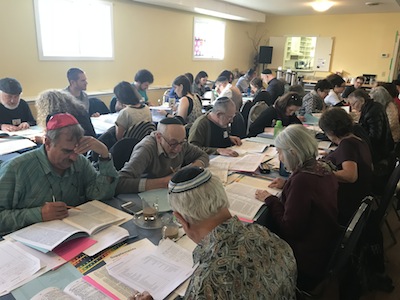
Rabbi Benay Lappe, founder and rosh yeshivah of Svara, in Chicago, taught Talmud at Congregation Or Shalom earlier this month. (photo from Or Shalom)

“For all you straight folks, let me tell you – you’re all queer. Your job is to find that queer part of you, wear it on you, walk it through the world. That’s how the world changes.”

Rabbi Benay Lappe, founder and rosh yeshivah of Chicago’s Svara: A Traditionally Radical Yeshivah, made this observation during a lecture at Congregation Or Shalom on March 10. Lappe is a passionate and unique teacher of Talmud, who is “dedicated to bringing the Talmud to the 99%,” meaning the majority of Jews who do not study it.

As Lappe explained at Or Shalom, there are three kinds of queer. The first refers to, as she put it, “me, a lesbian woman, and other people with non-heteronormative sexualities or folks who are trans or non-gender-conforming. The second refers to those who ally themselves with queers, embracing queer culture and rights. The third category is someone profoundly ‘othered’ or marginalized, who owns that experience and walks it through the world as a critique to the mainstream.”

It is in the third sense of the word that Lappe addressed the audience. “The rabbis who wrote the Talmud were a small group of queer, fringey people,” she said, explaining that the talmudic sages were a small group of Jews who responded to a time of crisis in Jewish history with radical creativity. When the Temple was destroyed after centuries of colonization at the hands of the Romans, only one group was poised to respond effectively – the sages who wrote the Mishnah, and their spiritual descendants, who later wrote the Talmud. “When the master story doesn’t work anymore,” said Lappe, “it matters how you respond.”

According to Lappe, for the Jews of that time, some retreated into the old story and built walls around it, many abandoned the Jewish story and assimilated, and a small group remained faithful to the Torah while radically transforming and updating it. The Talmud, she explained, records for posterity how the rabbis evolved Judaism. “The rabbis knew that master stories change,” she said, “and they encoded a set of mechanisms into their new master story that enabled constant change.”

photo - Talmud workshop at Or Shalom
(photo from Or Shalom)

The “new master story” is embedded in the Talmud, which was updated to reflect changing moral and social sensibilities. It shifted Judaism from a Temple-based religion practised in Israel to a home- and synagogue-based one founded on a communal and personal discipline of halachah (Jewish law) that could be practised anywhere. Lappe believes that, through studying the Talmud in a non-fundamentalist way, in a way that gives primacy to the power of our reason and moral intuition in confrontation with the text, we can learn lessons for how to transform and vitalize Judaism today. (Reason is “svara” in Aramaic, the name of her yeshivah.)

According to Lappe, Judaism is once again going through what she calls a “crash,” a shattering of its master story, and the study of Talmud provides us with case studies in how to respond.

Lappe has an enthusiastic supporter in Or Shalom’s Rabbi Hannah Dresner.

“I have known Rabbi Benay for many years; we shared a spiritual community in Chicago,” said Dresner. “She is fun and funny and tough and with the quickest mind. Her crash theory is a different languaging of Reb Zalman Schachter-Shalomi’s theory of paradigm- shifted halachah. This is based on the truth that halachah, as a path, is meant to evolve and move forward, alive in the pilpul, in the wrestling of how we can enact Torah now, in our authenticity.” (Schachter-Shalomi is the founder of the Jewish Renewal movement to which Or Shalom belongs.)

“I always thought I was at the margins of Judaism, being a queer Jewish woman,” said Alicia Jane Fridkin, who attended the weekend teachings. “Rabbi Benay helped me to realize that queer people are not at the margins: we are at the forefront of an ever-changing religion. She illustrated how each era of Judaism began with radical Jews who sought to practise in new and meaningful ways, including the era of rabbinical Judaism that we have been practising for the past 2,000 years.”

Fridkin added, “I immediately blocked off the dates in my calendar for Queer Talmud Camp at her yeshivah, Svara, which I hope to attend this summer.”

Matthew Gindin is a freelance journalist, writer and lecturer. He writes regularly for the Forward and All That Is Interesting, and has been published in Religion Dispatches, Situate Magazine, Tikkun and elsewhere. He can be found on Medium and Twitter.

Format ImagePosted on March 23, 2018March 22, 2018Author Matthew GindinCategories LocalTags Benay Lappe, education, Judaism, LGBTQ, Or Shalom, Talmud

In spirit of Jewish law

The other night, I sat on the couch with my husband in an attempt at togetherness. We watched an episode of Madam Secretary. It was our second attempt. On the first try, worn out, I was about to fall asleep when my spouse suggested that we save it for another time so I could go to bed. It was, he pointed out, supposed to be fun. Sticking to the initial “date time” wasn’t working. Thank goodness for the PVR.

The show we watched was full of allusions to knitting and design, which are parts of my freelance work. I cringed inwardly, preparing for derogatory comments about “women’s work.” To my surprise, the textile theme was respectful. A man with PTSD takes up knitting as part of his therapy – it helps him focus his mind. A first-year university student struggles with a design assignment – she comes away with a couture dress, but not before we hear the sounds of her sewing machine at work in the background. Best yet, when her sister begins to panic at modeling the dress, the student gives her a pep talk, saying, “Pull yourself together, be strong. Do this, I need you.” What started as a frivolous thing – “help me out at this fashion show” – became more. It became a chance to succeed academically, and to use inner strength to prevail over a trying situation. The episode showed strong women and struggling men seeking to be their best selves.

All this came to mind later, in the context of a Talmud class. I signed up for a Jewish Theological Seminary online course. With the wonders of technology, I can hear lectures by Rabbi Dr. Judith Hauptman, who is a gifted teacher and intellect. Her course has an interesting premise – looking at situations when “law meets life.”

She began with basic information, and got started studying talmudic text. Whenever I study Talmud (or any older text), I have to remember the inherent inequalities. Women were seen as subservient, with less agency than we think is appropriate today. Through careful reading, we saw lists of tasks wives are obligated to perform for their husbands (Bavli Ketubot 61a) and a discussion about how one might “wash” – sprinkle water on – a floor on Shabbat (Bavli Shabbat 95a). (This last reference was not cleaning so much as providing a form of air conditioning and reducing dust on an extremely hot Shabbat in Babylonia.)

Hauptman showed us how women’s interpretations allowed them both to obey the spirit of Jewish law, and to accomplish what needed to be done. In more than one place in these readings, the rabbis (all male) allude to the fact that women were smart and had power or agency. Even if the language of the Talmud relegates women to being “property of a man’s house,” the women in these stories shine through as being shrewd and savvy.

We think sometimes that our lives are infinitely more complicated, sophisticated and detailed than those in the nostalgic past. Yet, these talmudic texts reminded me that, more than 1,500 years ago, smart people focused on the details that make our households and lives function. We may have a way to record entertainment now (and a TV!) or access to machine-produced clothing, but our fundamental concerns are similar. How are we to balance the spirit of our commitments with the laws’ requirements? What is the intention of our roles? How do men and women balance and subvert traditional roles in order to cope? How do our household tasks make life comfortable and/or meaningful?

The first text we studied refers to tasks that wives perform for their husbands: grinding grain, baking bread, doing the laundry, cooking, nursing his babies, making his bed, and working with wool. When she has wealth and servants, she can avoid some of these household obligations. As we studied this text together, I was knitting a wool sweater I’d promised to finish for one of my kids. I thought the webcam was trained up, only on my face. No, as it turned out – a friend, also taking the class, in New York, said she could see my knitting.

That’s OK. In the end, the more things change, the more they stay the same. Regardless of your level of observance, we still wrestle with these issues. Women often interpret Jewish law and tradition when it comes to household details. If one doesn’t have enough servants or financial resources, or even enjoys knitting and finds it focuses the mind, one might still be working with wool.

A recent study indicated that, in Reform Jewish congregations, rabbis who are women are paid less than their male counterparts. Women have fewer positions “at the top” as senior or sole congregational rabbis. We continue, even in the most progressive Jewish movements, to struggle with pay equity and gender roles.

The Talmud is an essential part of Jewish oral law, but it’s also literature, with narratives that shed light on daily life. A current TV show portrays a woman as U.S. Secretary of State, and shows that interaction with fibre arts is still an important, useful and viable thing to devote time to creating, no matter your gender.

In both the show’s legal negotiations and this talmudic text, we’re taught that, sometimes, the spirit of the law, the intention, is more important than the letter of the law. Through all the big decisions, it’s sometimes the small household details that make people’s lives rich. I’ll keep knitting handmade sweaters for my kids – and studying Talmud. Even in these times, there’s a place for both.

Joanne Seiff writes regularly for CBC Manitoba and various Jewish publications. She is the author of three books, including From the Outside In: Jewish Post Columns 2015-2016, a collection of essays available for digital download or as a paperback from Amazon. See more about her at joanneseiff.blogspot.com.

Posted on February 9, 2018February 7, 2018Author Joanne SeiffCategories Op-EdTags equality, Jewish life, Judaism, Madam Secretary, Talmud, TV, women
The greatest Jewish novel?

The greatest Jewish novel?

What strange quirk brought it about that what may be one of the greatest and most Jewish of Jewish novels should be written not by a Diaspora Jew, nor an Israeli Jew, nor a Diaspora Jew who had made aliyah, but rather an Israeli who relocated to New York?

Further stymying expectations, Ruby Namdar did not write this novel in English, but in Hebrew (it was recently translated by Hillel Halkin). “For who?” asked an audience member at the Cherie Smith JCC Jewish Book Festival event on Nov. 26, when I had the pleasure of interviewing Namdar in front of a small gathering. If Namdar wanted his novel, which he acknowledged to be soundly in the lineage of Bernard Malamud, Saul Bellow and Philip Roth, to be read by New Yorkers, why write it in Hebrew? If he wanted the novel to make sense to Israelis, why write it about a rootless Diaspora Jew with no connection to Israel?

“I don’t know what I was thinking,” said Namdar, “I don’t know who I was writing for, I just wrote.”

The Ruined House is not just a great Jewish novel or a great novel in modern Hebrew. It possesses a structure that is at once talmudic and kabbalistic, a structure that is deep and intricate yet carried off with such a sense of understatement and naturalness, effortlessly unfolding within Namdar’s lucid, lyrical and vivid prose, that most English-language reviewers thus far have not fully noticed it. This structure is what gives the novel its profoundly Jewish resonance, which is at once modern and ancient, rootless and anchored in the archetypal depths of Jewish experience and textuality.

Talmudic structure

The Ruined House is divided into seven books, with its seventh book being the culmination of an obviously Jewish numerical pattern. Each book follows the anti-hero, Andrew P. Cohen, over the course of one year of his life, as he enters what seems to be a midlife crisis from hell (or perhaps from heaven).

Cohen is a successful and wealthy professor of comparative culture, who lives in an idyllic Manhattan high-rise with a view of the river, a pristine Apollonian realm in the skies. He has a beautiful young lover, Ann Lee, and an adoring group of followers and acolytes. He cherishes his controlled, harmonious and detached existence, which he has gained through leaving his wife and two daughters years before.

At the end of the first six sections of the novel are a few pages of text designed to look like a blat Gemara, a page of Talmud. The central text in these inserts tells the story of a high priest preparing and executing the Yom Kippur sacrifices. While he does so, he is watched by Obadiah, a humble Levite who wonders whether the priest is truly pious or just a functionary in league with the elite. Encircling the narrative are passages from the Talmud, Mishnah and Tanakh, which describe the laws, folklore and spiritual significance of the high priest’s duty. They also feature key excerpts from Shaarei Gilgulim (The Gate of Reincarnation), a kabbalist text written by Chaim Vital (1542-1620) to expound the cosmology of his master, the Ari HaKodesh, Isaac Luria (1534-1572).

The insertion of these texts is deliberate and precise. Just as the narrative in the inserts is flanked by canonical Jewish sources, the narrative of the novel is surrounded by ancient Jewish forces. As the hidden, broken nature of Cohen’s life begins to surface, he begins to have intense, waking visions of the ancient Temple in Jerusalem. His dreams turn nightmarish, alternating between repressed guilt at his betrayal of his family and dreadful tableaus of the rape of Jerusalem by the Romans and the murder of Jews by the Nazis.

The structure of the story and the inserts are not the only mirrors in the book: Cohen’s life is cast as priest-like. His elite status; the pure harmonious realm in which he lives; his having separated from his wife like Moses to live in the skies; even the elaborate meat dinners he cooks up for his dinner guests alone in his perfect kitchen all point to it. His name, of course, highlights both the substance and the irony of his life as priestly metaphor. At one point, his daughter, Rachel, disgustedly mocks people who think that Jews named Cohen are descended from the priestly lineage: “Everyone knows they just gave out those names randomly at Ellis Island.”

As Cohen descends into apparent madness, a grotesque version of the priestly sensibility gets stronger in him. He becomes morbidly obsessed with the impure and averse to the physical, the decaying and the dead. He finds himself horrified by menstrual blood and semen. The explanation of this growing claustrophobic sensibility lies in the paragraphs of Shaarei Gilgulim, which are included in Namdar’s inserts.

Kabbalist elements

Shaarei Gilgulim describes the way that some souls, during the process of reincarnation, unite with other souls in order to complete their own tikkun (repair). In the first pages of The Ruined House, “one shining soul, the figure of a high priest” is suddenly visible above New York among the celestial machinations momentarily revealed as the veil is briefly sundered. The key to the priest’s identity lies in the kabbalist doctrine of ibbur, or impregnation, where a soul from beyond enters into an earthly person in order to help them, to complete their own mission, or some combination of the two. In Cohen’s case, as suggested in a last talmudic insert, he has been “impregnated” by the soul of the high priest in need of tikkun for feeling himself superior to Obadiah, the humble Levite. The high priest and Cohen share a sin in common: arrogance. Their collective confrontation and reckoning with it will be psychically violent and cathartic and come close to doing Cohen in.

Critique of Diaspora?

Some reviewers have read The Ruined House as a critique of the Diaspora Jew, viewing the narrative as a kind of punishment of Cohen, enacted on him by the rising tide of archaic Jewish intrusions into his life. Namdar said this is a moralistic distortion of his ambivalent, questioning text. Instead, Namdar pointed to the shatterings of the illusion of wholeness and perfection that happen in the book. “Where things are broken, there, seeds can take root and grow,” he said.

For example, Cohen’s harmonious life is an illusion that is shattered in the course of the book, leaving a “ruined house.” Yet the figure of the ruined house (bayit asher necharev in the original Hebrew, a phrase that comes from a poem by Yehuda Amichai) is also an allusion to another ruined house, that of the Beit Hamikdash, the Jerusalem Temple, whose pristine world of order and control, Namdar suggests, also was illusory.

The third ruined house is suggested by the timing of the events in the novel. The story begins in the Hebrew month of Elul (signifying its theme of repentance), on Sept. 6, 2000. After the narrative comes to a head on Tisha b’Av, the date of the destruction of the Temple, it jumps from Aug. 1, 2001, to Sept. 18, 2001, leaving a lacuna where Sept. 11, 2001, and the destruction of the Twin Towers, resides.

“I did not want Sept. 11 to appear in the narrative, thus making the novel reducible to being about that event,” said Namdar when I asked him about this. “Rather, I wanted the trajectory to point to its occurrence outside the frame.”

There is much more to talk about in this remarkable novel, which manages at once to be so Jewish, so Israeli, so American and so human. I did not touch here on the attention Namdar lavishes on the details of Cohen’s daily life or Namdar’s subversion of the lineage of Malamud, Bellow and Roth in his intense empathy with the female characters of the novel, and his unsparing deconstruction of Cohen’s narcissistic masculinity. I did not examine his vivid and hilarious slow-motion evocation of a grossly excessive bar mitzvah, or his brilliant parody of the Zionist clichés of a Birthright-like propaganda tour of Israel, and many other delights. I hope this introduction is enough to invite you to step into Namdar’s mesmerizing fusion of a talmudic-esoteric structure with an incandescent evocation of life in Manhattan, and discover what else he has hidden there, of which, I promise you on good authority, there is much.

Matthew Gindin is a freelance journalist, writer and lecturer. He writes regularly for the Forward and All That Is Interesting, and has been published in Religion Dispatches, Situate Magazine, Tikkun and elsewhere. He can be found on Medium and Twitter.

Format ImagePosted on February 2, 2018February 1, 2018Author Matthew GindinCategories BooksTags Cherie Smith JCC Jewish Book Festival, Jewish life, Judaism, kabbalah, literature, Ruby Namdar, Talmud, Torah, translation

Does God love dogs and cats?

As a boy growing up in the foothills of Berkeley, my parents encouraged me to have pets. From guinea pigs to parakeets to even a pet chicken named Fwedwika, my home was full of little critters throughout most of my childhood. By encouraging me to be a caretaker for my pets, my parents taught me the meaning of responsibility, consistency and perhaps even love. So, I’ve often wondered if the Jewish religious scriptures supports animal activism and what exactly God would say if I posed the question, “Do You love dogs?”

Dogs are the only animals in the Torah that receive a reward for their actions. When the Jewish slaves flee Egypt, it states, “not one dog barked.” (Exodus 11:7) As a reward for that refrain, God said, “… and flesh torn in the field you shall not eat; you shall throw it to the dog[s].” (Exodus 22:30; Mechilta) However, God’s affection for animals doesn’t end with affable companions such as dogs. This affection even extends to insects. King David had to learn this lesson when he questioned the purpose of such “vile creatures” as spiders. Subsequently, God created an event whereupon a spider’s web saved his life, thereby impressing upon Judaism’s mightiest king that every creature has purpose (Midrash Alpha Beta Acheres d’Ben Sira 9).

The Talmud teaches that the reason the Almighty created animals before humans on the sixth day of creation was to teach humans humility, so much that “even a lowly gnat” may be more deserving of life (Sanhedrin 38a).

So, one may infer from here that God does indeed love dogs … and all the rest of His creatures, too. But does this manifest itself into practical animal activism or does it remain a more generalized and undefined value in Judaism?

Jewish law is replete with requirements for the caring of animals. Examples include laws prohibiting inflicting pain on animals (Kesef Mishneh, Hilkhot Rotzeah 13:9), requiring one to feed animals in a loving manner (Igg’rot Moshe, Even haEzer 4:92) and protecting animals from being overworked (Hoshen Mishpat 307:13). We see from these and more, the extensive lengths to which the Torah goes in order to ensure the proper care of animals. Even when one must slaughter an animal to feed one’s family, there are numerous Jewish laws set in place to guarantee that the animal’s death is quick and painless (Guide to the Perplexed III:48).

One insight we can glean from the Torah about why God may have made animals is that they were created to express the “glory of the Creator.” (Pirkei Avos 6:11) The sheer diversity and beauty of animals leads one to appreciate the Creator even more, thereby leading one to proclaim, “How great is Your work, O Lord.” (Psalm 92:5) One might also say that the Creator has placed us, the descendants of Adam and Eve, in His beautiful garden to be the “caretaker” of “God’s garden” and all the animals therein (Genesis 2:19-20).

Mankind is created last in the days of Creation because humans are the pinnacle of Creation; we are the beings created in God’s image (Genesis 1:27). When we use our free will responsibly, acting with compassion and sensitivity, we become like God, as it says, “Just as He is compassionate, so should you be compassionate. Just as He is righteous, so should you be righteous.” (Midrash Sifre Deuteronomy 49) When we develop ourselves to be spiritually refined, we fully realize the title of “caretakers of the world,” of God’s beautiful world and all the animals in it.

Imagine what message it sends a child when parents teach that God wants all our animals to be fed before we feed ourselves (Talmud, Brachot 40a). Imagine what message it sends our child when parents teach that God watches us to see if we are being compassionate to the animals in our midst (Talmud, Bava Metzia 85a). And imagine what message we bequeath to our children when we say that to become truly righteous and spiritually fulfilled, we must cultivate a sensitivity towards animals, as it says “A righteous person knows the needs of the animal.” (Proverbs 12:10)

Perhaps this is why God specifically made Noah build an ark to save all the animals during the Flood. After all, God could have easily made a miracle where the animals were saved without Noah needing to slave away for 40 days and nights meticulously tending to the care of each animal in the ark and even sharing his own table with them (Malbim, Genesis 6:21). One could answer that this was precisely to highlight that the concept of being the “caretakers of the garden” didn’t end with Adam and Eve but is an essential responsibility of mankind for all time.

Additionally, one can also say that the way we treat animals is a reflection of the way we treat people. In the Torah, we observe the repeating story of how a loving shepherd is chosen by God to lead the spiritual flock of the Jewish people after previously demonstrating his dedication to a flock of sheep (Midrash, Shemot Rabah 2:2). A barometer for one’s sensitivity towards other people can be seen in how we treat the animals in our midst. This emphasis on caring for animals can be a way to further those feelings of sensitivity that may eventually lead to goodwill for all mankind.

There is a final fascinating perspective that the Torah is teaching us. Animals can serve as our teachers. There are God-given qualities inherent in the instinctual habits and mannerisms of the animals around us that can serve to inspire humans to achieve greater heights of spiritual fulfilment. For example, the very first law in the Code of Jewish Laws is, “Rabbi Yehuda ben Taima said, ‘Be as bold as a leopard, light as an eagle, swift as a deer and strong as a lion to do the will of your Father in Heaven.’” (Avot 5:20) Poignantly, this is placed as the first law in a book of Jewish legalities. This idea is most evident in the statement of Rabbi Yochanan: “If the Torah had not been given, we could have learned modesty from the cat, honesty from the ant, chastity from the dove and good manners from the rooster.” (Talmud, Eiruvin 100b) Perhaps we could also learn from a dog the power of devotion, loyalty and even having a positive attitude.

I will conclude with a teaching about man’s best friend, the dog. The notable 16th-century Jewish leader, the Maharsha, says that a dog is a creature of love. Hence, the Hebrew name for a dog is kelev, which is etymologically derived from the words kulo lev, or all heart (Rabbi Shmuel Eidels, Chidushei Aggadot, Sanhedrin 97a). Remember that Adam and Eve were instructed by God to give all the animals of the world their Hebrew names (Genesis 2:19-20). When they made this personal connection with the beasts of the world, the names they chose were prophetically accurate so as to encapsulate the essence of each animal into a name that truly revealed its soul (Bereishit Rabbah 17:4). Thus, one may extrapolate from this that the Hebrew name for a dog was precisely chosen to be indicative of the loving soul of this marvelous creature.

So, yes, God loves dogs. And we should, too.

Rabbi Levi Welton is a writer and educator raised in Berkeley, Calif. A member of the Rabbinical Council of America, he graduated from the Machon Ariel Rabbinical Institute in 2005 and from Bellevue University in 2008 with an MA in education. Having served Jewish communities in San Francisco, Sydney and Montreal, he currently resides in New York and specializes in working with youth and young adults. This article was originally published by Aish Hatorah Resources and is distributed by Kaddish Connection Network.

Format ImagePosted on December 12, 2014December 11, 2014Author Levi WeltonCategories Op-EdTags animals, cats, dogs, Talmud, Torah

Calderon begins discussion with Bride

Newly elected Knesset member Ruth Calderon caused a sensation last year when she engaged a member of the Sephardi religious party Shas in a discussion of Talmud during her inaugural speech in the Knesset. She had brought her copy of the Talmud to the podium and read a short excerpt about Rav Rehumi, who stayed at the yeshivah to study on Yom Kipper eve. He fell to his death at the moment that his wife realized he was not coming home.

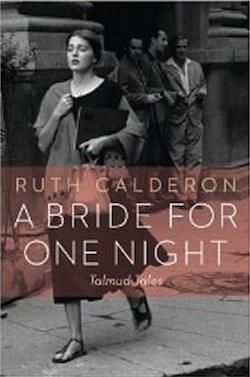
Calderon read the cryptic tale first in Aramaic “for the music” and then in Hebrew. The story is one of 17 included in A Bride for One Night, an English translation (by Ilana Kurshan) published earlier this year by the Jewish Public Society. The book was originally published in Hebrew, in 2001.

image - A Bride for One Night cover
In the lingo of these modern times, this book is a “disruptor.”

Although the talmudic tale focuses on Rav Rehumi, Calderon in the book re-imagines the event from the perspective of his unnamed wife. The vivid first-person account portrays the wife’s challenging life, from her joy in marriage to her anxiety as she waits.

Similar to the format of the Talmud, Calderon also offers commentary on the story. “Just between us,” she writes in her breezy style, “Rev Rehumi was a rather mediocre scholar.”

Calderon draws a parallel to the legends of Odysseus, who took 10 years to return home after the Trojan War. “The time has come to turn to the true hero of the story, she who carries Rav Rehumi on her shoulders. She is like Odysseus’ Penelope,” Calderon says, referring to the wife of the wandering warrior. “If Rav Rehumi achieved any fame, it is thanks to his wife.”

The commentary, with footnotes, offers some observations about the Rav’s emotional life, romance and morals. Calderon also provides sources for further readings.

In the lingo of these modern times, this book is a “disruptor.” Calderon has flung open the doors to the study halls. She has liberated the ancient texts, taken them out of the exclusive preserve of religious male scholars and made them accessible to anyone who is interested in learning about how to be a good human being.

Calderon brings a strong woman’s voice to talmudic vignettes about a world that is, in her words, “topsy-turvy, frightening and funny. It is a world in which the impossible happens.”

A mortal steals the knife of the Angel of Death, God asks to be blessed by a human being, the wife of a Torah scholar dresses up as a prostitute and seduces her husband, a rabbi sets a test for his wife that leads to her suicide. Legend, creative literature, relationship advice, folk sayings, guideposts for a moral life – Calderon turns the kaleidoscope just a little bit and the ancient Talmud becomes a text for modern times.

The title of the book, A Bride for One Night, comes from a text in the Babylonia Talmud. In two different passages, highly respected itinerant rabbis ask, Who will be mine for a day? The question is associated with a woman selected by the community as a “wife” for the duration of the rabbi’s stay. Calderon imagines these situations from the perspective of a widow who has been asked to be a bride for one night.

“I don’t know how one learns a story like this in a yeshivah,” she writes in her reflections on this scandalous passage. “I read it with mixed feelings.”

After considering several possible ways to understand the tale, she concludes that the concept of marriage for a day is intended as a test of Western conventions about love.

Calderon approaches the sacred text with the belief that the contemporary Jewish bookshelf should include the Talmud, Midrash, kabbalist works and other religious texts, as well as Jewish literature and Torah.

The Talmud and other sacred texts are the common denominators of all the Jews of the world, she said recently during an address to graduates of Hebrew College in Boston. More than half of the Jews in the world are secular.

Calderon was raised in a secular family and neither her school nor the local library had a copy of the Talmud. She had to search for copies of sacred texts. She began to study Talmud after her army service.

“This is something that belongs to me, is part of me and I had to reclaim it,” she told the graduates.

Long before she entered politics, Calderon was involved in studying Talmud and bringing sacred Jewish texts to all Jews, regardless of religious affiliations or their level of learning. She founded Elul in Jerusalem, Israel’s first “secular yeshivah” for men and women, religious and non-religious. She also started Alma, a Home for Hebrew Culture, in Tel Aviv.

For many years, she studied daf yomi, a daily page of the Talmud, with a chavruta, a study partner. She has a doctorate in talmudic literature from Hebrew University.

With this book, Calderon challenges the reader to imagine the life and inner thoughts of religious leaders, to see beyond the text on the page and flesh out all those mentioned in the tale. She takes ancient theology, often with outdated and distasteful concepts, and reinterprets them for the modern age.

Similar to Talmud, her book is best read with a study partner. She has said during the U.S. promotional tour for the book that the imaginative tales reflect what she was thinking at the time she wrote them, and that she might offer an entirely different point of view if she were to become engaged once again in studying those passages. Yes, she is right there. A Bride for One Night is just the beginning of the discussion.

Media consultant Robert Matas, a former Globe and Mail journalist, still reads books. A Bride for One Night is available at the Isaac Waldman Jewish Public Library. To reserve it, or any other book, call 604-257-5181 or email library@jccgv.bc.ca. To view the catalogue, visit jccgv.com and click on Isaac Waldman Library.


Posted on October 24, 2014October 23, 2014Author Robert MatasCategories BooksTags Bride for One Night, Ruth Calderon, Talmud

Posts pagination

Previous page Page 1 … Page 7 Page 8
Proudly powered by WordPress