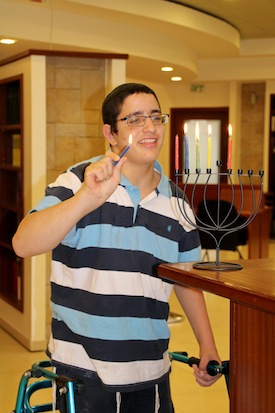
Classmates congratulate Oz Attal, second from the left, after he completed Alyn Hospital’s Wheels of Love bike-a-thon. (photo from Canadian Friends of BTJ)
This Chanukah, Boys Town Jerusalem is celebrating its own miracle. Student Oz Attal is taking an active role in the school-wide celebrations. Just over three years ago, the then-12-year-old boy was hit by a bus as he was coming home from day camp. With severe head and internal injuries, he was in a coma for six weeks. The moment he regained consciousness, he began an intense, painstaking struggle to regain his function and independence. Today, pushing a walker, 16-year-old Oz (Hebrew for “strength”) has rejoined his class at Boys Town.
Oz Attal participated in the school’s Chanukah celebrations this year. (photo from Canadian Friends of BTJ)
“There wasn’t a day that Boys Town wasn’t there for Oz,” recalled his mother, Yael. “Rabbi Meir Linchner, dean of students, and principal Rabbi Elimelech Yaakov were at our side in the hospital almost immediately after the accident. Once Oz was conscious, the school sent a steady flow of classmates to visit him regularly. Even when Oz entered the Alyn Pediatric Rehabilitation Centre for what would become nearly a three-year stay, several teachers voluntarily came each week to tutor him. Although he could barely communicate, Oz clearly felt strong and loved.”
Watching Oz dart through Boys Town’s halls – and stairs – his mother noted that, two years ago, the doctors declared that her son would never walk again. Although Oz needs a walker for support, he cuts himself no slack when heading indoors or outdoors with his class. “Yet, with traumatic brain injury (TBI), no one can know the extent of the permanent injury,” she said. “For now, Oz’s left side is weak, and his hand shakes. Sadly, he has no long-term memory and no control over what he may say, yet he understands the academic material quite well. Most crucial, he has iron motivation.”
Last year, Oz began coming to Boys Town several hours, one day a week, accompanied by his mother. At the start of the school year, Linchner informed her that, for the four days that Oz is not in treatment at Alyn Hospital, he can return to his 11th-grade class, where Linchner himself is the main instructor. The classroom was then moved to a lower floor. “At first, I stayed at Oz’s side in class and also helped him manoeuvre his way through the halls between classes,” she explained. “Very soon, Rabbi Linchner informed me that BTJ had made arrangements for a ‘shadow’ to accompany Oz for the year and relieve me.” (At home, Oz’s seven siblings await her.)
Tears filled Oz’s eyes when he first took his seat in class, Linchner recalled. “His 36 classmates received him with love and extreme patience. They are now learning an invaluable lesson in how to give of themselves.”
Recently, the entire class joined Oz in a moment of triumph when he pedaled to the finish line of Alyn Hospital’s Wheels of Love bike-a-thon. Waving signs that said, “Oz the King!” his classmates and teachers heartily cheered for him.
“Oz has been blessed with an extraordinary family and a fierce will to live,” Linchner said. “For us, his teachers and classmates, it’s an honor to be a part of the miracle of Oz’s life.”
In the winter, the Yellow Submarine hosts a collection of shows, many of them jazz, as part of the International Music Showcase. (photo from itraveljerusalem.com)
This article was written several months before the daily terrorist attacks began against Israel. While tourists may be understandably hesitant to visit Israel right now, the country needs support, and a visit is one of the tangible ways in which to give that support. (Editor)
***
Jerusalem may be better known for its religious and historical context than its music scene but, below the surface, a burgeoning jazz scene featuring some of the best musicians in the country delivers a steady diet of under-the-radar concerts in Jerusalem that frequently wow unassuming tourists and locals alike.
“A lot of the best jazz musicians for a couple of generations have come out of Jerusalem,” commented Steve Peskoff, a jazz musician who has lived in Jerusalem for 30 years and teaches jazz guitar and music workshops at the Jerusalem Academy of Music and Dance. “This is the only school in the country granting a degree [in jazz] at the college level,” said the former New Yorker.
Ask around town about jazz, and you’ll typically hear about three mainstays of the scene that are constantly providing a platform for local and international jazz musicians to put their considerable talents on display for the patrons of the Holy City – Birman, Barood and the Yellow Submarine.
If you’re just visiting Jerusalem and don’t have time to wait around for concert dates, then Birman Musical Bistro is your most likely destination.
The popular “musical bistro” located just off the bustling Ben Yehuda Pedestrian street hosts local musicians every day for free-of-charge live concerts. Jazz is the music of choice at least four nights of the week, and the bistro boasts the atmosphere of an old-school music club, with a clientele made up of local musicians, students and music-lovers eager to take advantage of the live music and tasty, yet reasonably priced, food and drinks.
Jerusalem-born Dan Birron opened Birman’s about 10 years ago with live music every night, four of which are usually reserved for jazz, including the Saturday night jam session.
“All musicians in Jerusalem, especially jazz, know my place,” said Birron, who also takes the stage himself on some nights to serenade the crowd with his styles on the accordion. “I’m totally booked for months.”
The performers at Birman are a mixed bag of some of the city’s most established jazz musicians and the younger crop starting out after finishing the army or graduating from the Academy of Music. The city’s jazz scene is “very interesting, with many very talented musicians,” Birron said. “The best ones are coming to my place.”
Not far away from Birman in the picturesque Feingold Courtyard, Barood Bar and Restaurant is one of the most talked-about jazz institutions in the city. Owner Daniela Lerer remembers as a young child hearing jazz and feeling that it spoke to her more than any other genre. It would be another 30 years before she opened Barood in 1995 but, ever since, jazz records have dominated the background music at Barood. These days, you can regularly catch live shows on Saturday afternoons or evenings – in the courtyard during the summer and in the restaurant when the cold weather comes.
After working as a TV producer and at other jobs, she said, “I knew for sure I would have jazz in my bar and restaurant. I began to play jazz here all the time, then I started to bring [other] musicians.”
For many years, well-known American saxophonist Arnie Lawrence, who moved to Israel in 1997, played at Barood once a week until he died in 2005. For the past year, Israeli saxophonist Albert Piamenta, has been playing at Barood one Saturday every month, while other local musicians perform two to three times a month. You won’t find a lot of promotion for the concerts, but most of the hotels in the area keep up to date with Barood’s schedule.
While the jazz community in Jerusalem is relatively small, Lerer has nothing but praise for the local musicians, students at the academy and the small but growing scene. “Jerusalem is very open to jazz now,” she said. “The scene is growing and the young people are really good.”
In addition to the music, Barood also boasts a unique Sephardi kitchen with a Greek influence, where Lerer’s son is chef, featuring pastelicos, a special meat pie made by Lerer, as well as appetizers, salads, main courses, vegetarian dishes, stuffed vegetables, and desserts, all from her Sephardi background.
No list of Jerusalem music institutions would be complete without the Yellow Submarine, one of Jerusalem’s première music venues. For the past seven years, it has offered free weekly jazz concerts.
The weekly night dedicated to jazz is designed to give local musicians the opportunity to be heard, said manager Yaron Mohar, a talented musician, as well as being a sound technician and the director of the School of Engineering and an instructor in the music education department. He explained that the Yellow Submarine is more than just a venue – it is a multidisciplinary music centre, where musicians can rehearse, record and attend programs and performances. It also offers aspiring musicians in high school the chance to earn credits toward graduation through Yellow Submarine courses.
The Yellow Submarine is where you are most likely to catch international jazz acts. Recently, it hosted Austrian jazz guitarist and songwriter Wolfgang Muthspiel and Swedish cellist/bassist Svante Henryson as part of the Israel Festival. In the winter, the Yellow Submarine hosts a collection of shows, many of them jazz, as part of the International Music Showcase.
Within Jerusalem’s community of young, aspiring musicians, there is certainly an appreciation that bodes well for the future.
Ami, a 17-year-old, attends a high school that offers a music major. Beginning in ninth grade, the program concentrates on jazz.
“Jazz is a language,” said Ami, a second-generation pianist. “I’ve been in the program three years but I’ve only actually learned what it means to be part of a jazz community now.”
Ami’s father has a doctorate in music and had a musical career in the United States before he moved to Israel, where he plays jazz piano on a freelance basis at weddings and other venues – and, not surprisingly, frequents jazz nights at Birman.
Sybil Kaplanis a journalist, foreign correspondent, lecturer, food writer and book reviewer who lives in Jerusalem. She also does the restaurant features for janglo.net and leads weekly walks in English in Jerusalem’s market. A longer version of this article was originally published on itraveljerusalem.com.
Sirens always make me pause. I fall silent and count one off, praying that there won’t be another. Because two sirens, as we used to say, are not women in labor.
Distant memories from the Intifada segue into those of summer last. Somehow, the rise of conflict in Jerusalem always comes along with the rising temperatures. But after the emergency meetings, the touring politicians, the dramatic headlines, there comes the first rain, and everything calms down. Then the countdown begins for next summer.
Some, though, aren’t content with just counting the days. Jeremy made aliya from D.C. six years ago. A reserve paratrooper officer, he rides his bike to work, halfway across town, each time reassuring his mother, thousands of miles away, that he wasn’t anywhere near the most recent attack. Last month, he joined a crowd of 5,000 to watch Matisyahu, the famous Jewish-American rapper, perform beneath the Old City walls. “Jerusalem If I Forget You gets a whole new meaning these days,” he tweeted, referring to the ancient prayer borrowed by Matisyahu for one of his songs.
Michal is a mother of four. At night, after putting her own children to bed, she has been going downtown, where she volunteers for a group seeking out dialogue with angst-filled youth bent on revenge. To her ever-concerned sister, she vows never to leave Jerusalem, with its crisp, cool air and still-low crime rates. It’s her husband who drops off the kids at school the following morning, where they are taught about the complexities of living in a mixed city, where you have to defend yourself with one hand and reach out to your would-be enemies with the other.
Another person is Ibrahim, a Hebrew University law student, and also a resident of Ras el-Amud, a Palestinian suburb shaken by recent events. Intimidating glares by Hamas supporters notwithstanding, he goes online every day, trying to convince people to stop the cycle of violence. Despite the long-standing advice of friends to relocate to Ramallah or the United States, he clings on to his naïve faith that there’s still hope in this conflict. Meanwhile, he alerts the authorities to suspicious happenings and, a few weeks back, confiscated a knife off of a 15-year-old brainwashed neighbor kid.
Then there’s Batia. She is an ultra-Orthodox woman. Every day she walks to work at City Hall. Despite having recently bought a canister of tear gas as a precaution, she prefers to put her faith in G-d and in the ubiquitous policemen. Just before Shabbat, she often goes up to them, to deliver fish, meat and chicken and to make their shift a little more pleasant.
Jerusalem keeps going, not through pompous statements, but through the hard work and devotion of its people, some elected officials, some social entrepreneurs and some ordinary citizens, united by relentless optimism and a profound love for their city. When things started getting really bad, I put out a call for an emergency meeting of Jerusalem civil society organizations. Within three hours, representatives from 33 organizations sat around a conference table at City Hall. It came as no surprise; even during “normal” times, the amount of people willing to sign up for civilian “reserve duty” is astounding.
There are teenagers handing out Israeli flags. Elderly people handing out small gifts to security personnel. Psychologists supporting youth in distress, activists helping out local businesses, and a string of independent online campaigns. These ordinary citizens allow the city to keep on living its life: thousands of students going back to school, the basketball team fighting to retain its championship title, and Buzz Aldrin, the second man on the moon, joining 2,000 people at the International Astronautical Congress last month.
This energy, this drive to take responsibility and think out of the box, are precisely what is needed to resolve the complexity of current events. We have to crack down on violence, while empowering moderate leaders; fight incitement on both sides and defend the right of every man and woman for freedom of worship; and make sure East and West Jerusalem get their share in infrastructure investments.
It’s time for this fresh perspective to rise from the bottom up. We are tired of instant solutions, quickly denounced by this side or the other of the political map. We are tired of those who take turns making political gains out of our hardship. Jerusalem is a different place, and requires a different point of view. The one we, young people of Jerusalem, discovered 10 years ago, when everyone else said the city was lost, and we formed Wake Up Jerusalem.
From this point of view, there is a lot of good to see. And even more to do.
Hanan Rubinis a Jerusalem city councilor and a co-founder of the solution-oriented political movement Wake Up Jerusalem, which focuses on quality of life issues for all Jerusalem residents.
An inscription on a water fountain built by Suleiman the Magnificent. (photo by Ariel Fields)
When it comes to Jerusalem, the writing really is on the wall. The problem is, some people (easily recognized, as they go around saying “it’s like talking to a brick wall”) will try to convince you walls can’t tell you anything. Don’t listen. If you ignore Jerusalem’s walls, you’ll miss out. The following matryoshka/babushka story (or story within stories) shows that “walls are the skin of the residents,” as the muralist cooperative CitéCréation is fond of saying.
Admittedly, you might initially doubt whether writing on the wall matters. To quell your uncertainty, here is what Tel Aviv University’s Prof. Jonathan Price has to say: “Inscriptions are an important and unique historical source. They provide information in many areas no other source can provide.”
Thus, while there’s no CD of the trumpet/shofar playing, we know that trumpet blasts from the southwest end of the Temple Mount indicated the beginning and end of the Sabbath. How? In his extensive history, The Wars of the Jews, Flavius Josephus writes about this practice.
The truly astounding physical evidence, however, is a stone carved sign now located in the Roman/ Byzantine section of Jerusalem’s Israel Museum. The inscription on this first century CE stone reads, “‘To the place of the trumpeting.” The stone directed the Temple kohain “trumpeter to the high point on the Temple Mount, where he would announce the beginning and end of the Sabbath.”
An archeologist described its discovery. It was found in the “debris from the dismantled walls, engraved on an eight-foot-long piece of limestone. The stone has a rounded top indicating it was a kind of parapet situated on top of the wall or the tower at the southwest corner of Herod’s giant Temple Mount. Unfortunately, the clearly readable inscription is broken off, so we only have the beginning of it.”
The trumpeter’s corner had a distinct vantage point. From his post, the trumpeter looked out over ancient Jerusalem, from the City of David to the Upper City in the West. When he gave a blast, even the merchants and shoppers in the markets heard.
Moving slightly away from the Old City, we come to an ornate Ottoman inscription just above the southern end of Sultan’s Pool. It reads: “[There] has ordered the construction of this blessed sabil, our master the Sultan the greatest prince and the honorable Khaqan, who rules the necks of the nations, the sultan of the [land of] Rum, the Arabs and the non-Arab [’ajam], the Sultan Suleiman, son of Sultan Selim Khan, may God perpetuate his reign and his sultanate. On the date of the tenth of the month of Muharram the sacred, in the year of 943 [29 June 1536].” (Ottoman Jerusalem, Auld and Hillenbrand, eds., 2000)
This sabil (drinking fountain) served the many passing pilgrims. The Ottoman ruler Suleiman the Magnificent built five more sabils inside the walls of the older city. Moreover, several other sabils (the earliest dating back to the Byzantine period of the sixth/seventh century) have been excavated at this same location.
The drinking fountain’s water came from an aqueduct originating at Solomon’s Pools, near Bethlehem. Importantly, this aqueduct primarily serviced the Temple Mount area. To insure an adequate water supply, Sultan’s Pool (today an outdoor concert venue) was a floodwater reservoir. Just a few years ago, archeologists uncovered a Second Temple period bridge that stood over the adjacent ravine of Ben Hinom Valley. The original bridge maintained the elevation of the path along which the water coursed. In 1320 CE, the Mamluks rebuilt the bridge. Two of the original nine arches supporting the bridge were excavated to their full three-metre height.
A relatively short walk from the fountain, but with a significant leap in time, we arrive at the Hebrew year 5694 (corresponding to 1933-1934). At that time, builders completed work on a structure at 6 King David St. As the country was still controlled by the British (the Mandatory period lasted from Sept. 29, 1923-May 14, 1948), the Hebrew stone dedication might be termed both prophetic and Zionist. The inscription from Psalms 102:15 reads: “Your servants take delight in its stones and cherish its dust.” Heads up, however, to view this stone, as it is high on the right side of the entranceway.
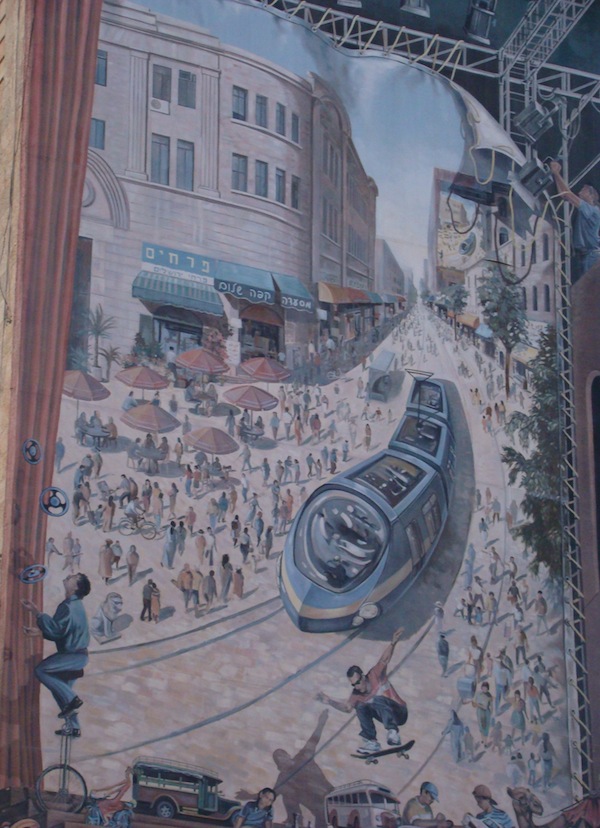
In 2001, the French art group CitéCréation painted a mural depicting the Jerusalem Light Rail system, which didn’t start running until 2011. (photo by Ariel Fields)
No matter what you think of the Mandatory period, most people will agree that the British constructed attractive and made-to-last Jerusalem streets and boulevards. Although King George Street has changed tremendously since Israel gained independence, the stateliness of the road’s 1924 commemoration is visible in the dedication stone on the side of what is now a woman’s clothing store. The esthetically pleasing inscription is carved in the languages of the time: English, the official language of the British Crown has a central spot on the stone. It is flanked by slightly smaller Hebrew and Arabic translations.
They say a picture is worth a 1,000 words, so here goes: Across from the above inscription, where King George, Strauss and Jaffa Road intersect, look up to see what was for 10 years regarded as a “time-warp” fresco. In 2001, the French art group CitéCréation painted a long exterior building wall depicting the Jerusalem Light Rail system. Since the light rail only began running at the end of 2011, for years Jerusalemites considered this painting a bad joke. Like many other Jerusalem projects, this one finally came into being years after its original promised inauguration.
Despite a violent summer and fall, the Jerusalem Light Rail demonstrates that the city’s ethnic and religious groups can – and do, literally – come into close contact. Jerusalem’s train is an example, albeit a fragile coexistence.
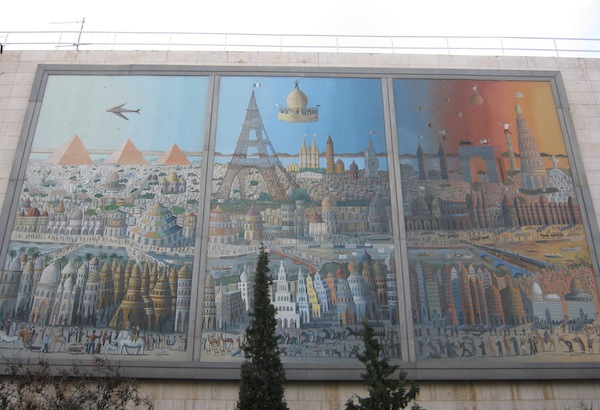
Gavriel Cohen’s 1976 mural on the Gerard Behar building. (photo by Orli Fields)
In sharp contrast to the slow development of the light rail, the wall project on the Gerard Behar Theatre (its address is 11 Bezalel St.) shows how quickly things can get done, if one really works at it. In 1976, Gavriel Cohen painted a huge building mural in just 92 days. Humorously, this 18-metre-wide painting is entitled “Around the World in 92 Days.” When you see the painting, you will understand its “play” on the title of Jules Verne’s famous adventure story.
Like Verne, Cohen was born in France. Moreover, the Jerusalem Foundation donor who underwrote the building’s renovation was himself a millionaire French Jew. He named the building after his son, Gerard Behar. Today, the wall has added significance, as many French Jews are making Israel their home. The Jewish Agency reported nearly 7,000 French Jews made aliya in 2014, doubling the number of the preceding year.
We now move back in time to the Hebrew year 5632 (1872). In the tiny Jerusalem neighborhood of the House of David – the fourth neighborhood built outside the walls of the Old City – there is another inscription above the doorway of what (with controversy between different religious blocs) has recently become a yeshiva. David Reiz, a Jew from Jonava, Poland (today the Republic of Lithuania) donated the money to build this area. The Hebrew stone dedication contains a description of the 1872 purchase of the lot and the subsequent building of the apartments and a study house (bet midrash). The home of Rav Kook (first chief Ashkenazi rabbi of Mandate Palestine) and the popular dairy restaurant Ticho House (currently undergoing repair) are a few steps away. The square courtyard in which the inscription is found still has the wells residents used for their household needs. Reportedly, today’s residents are a mix of doctors, artists and yeshiva students.
Even if they never took up residence in Israel, over the years people of different denominations have considered Jerusalem to be their centre of the world. Thus, in front of Jerusalem’s City Hall, there is a large reproduction of Heinrich Bünting’s 1581 map of the world. Bünting (1545-1606), a German Protestant pastor and theologian with a strong interest in cartography, created a map (included in his printed map book) featuring a three-leaf clover (which to this day is still part of his native Hanover’s coat of arms). Europe is the western leaf, Asia is the eastern leaf and Africa is the southern leaf. Jerusalem lies at the centre of the clover.
As Hebrew University’s Prof. Rehav Rubin (1987) wrote: “These maps do not teach us anything about the appearance of the city in ancient times, but from them we learn how Christian Europeans and the map-makers themselves saw sacred texts and the place of Jerusalem in the sacred texts.”
So much of Jerusalem’s history is laid out on its walls; come visit to discover it.
Deborah Rubin Fieldsis an Israel-based features writer. She is also the author of Take a Peek Inside: A Child’s Guide to Radiology Exams, published in English, Hebrew and Arabic.
Jerusalem has been known as the Eternal City of the Jewish people since the days of King David and his son Solomon. (photo by Cynthia Ramsay)
My daily routine probably doesn’t differ much from yours. This morning, I went for an early morning walk, and enjoyed the pearly dawn before the sun broke through the clouds. Then I went to a local grocery store and bought some fresh bread for breakfast, before my workday began. Trivial, mundane things. The only difference is my day took place in Jerusalem.
This fact adds an extra dimension to all of my activities. Jerusalem has been known as the Eternal City of the Jewish people since the days of King David and his son Solomon. Even today, generation after generation continues to pray, “If I forget thee, O Jerusalem, may my right hand lose its cunning.” This line was sung under the chuppa at a wedding I recently attended. Jews turn towards Jerusalem as the focus of their longing three times a day in prayer – no matter in what part of the world they live.
The city’s history is long. Five thousand years ago, a group of settlers chose to make their homes on the steep ridge called the Ophel, south of the Old City. In 2000 BCE, Abraham and Isaac ascended Mount Moriah; a thousand years later, King David captured the city, bringing the Holy Ark to Jerusalem, and establishing its sanctity for the Jewish people. From the years 961-922 BCE, King Solomon constructed the First Temple. In 537 BCE, the Jews returned from their exile in Babylon and, in 517 BCE, completed the building of the Second Temple. Then the Greeks, under Alexander the Great, took the city. Antiochus ruled, desecrating the Temple until the Maccabees liberated it. In 63 BCE, Pompey the Great captured it and, for 33 years, King Herod reconstructed the Second Temple. That’s 4,000 years of Jewish history!
Jerusalem’s history continued to be a story of conquest and destruction by an endless chain of occupiers lusting for this precious jewel … the Romans, the Greeks, the Crusaders, Egyptian Mamluks, the Ottoman Empire, the British Mandate, the Jordanians, all lusting for this battle-worn city that possesses no material riches, neither gold nor precious metals, no minerals, no oil, nothing to enrich their coffers.
I don’t know why, although many have tried to come up with some reasons. Jews and non-Jews alike have felt Jerusalem’s magnetism across the ages. Midrash Tehillim 91:7 tells us, “Praying in Jerusalem is like praying before the Throne of Glory, for the gate of heaven is there.” In his 1950 book Jerusalem Has Many Faces, Judah Stampfer wrote: “I have seen a city chiseled out of moonlight, its buildings beautiful as silver foothills, while universes shimmered in its corners.”
I have had the opportunity to visit many enchanting cities, including Venice, Avignon, Bruges, Hong Kong, Paris; all have a magic that transforms the senses. Yet, I can’t define the magnetism of Jerusalem. Certainly there are cities that exceed it in beauty and dignity. Perhaps we can think of Jerusalem as more an emotion than a city. It arouses passions, it nurtures the soul, it is spiritual and inspiring.
To call it home for the past 44 years is, for me, an enormous privilege. I am always aware of the history under my feet. I never forget the nameless heroes who fought to retain it for the Jewish people. Not just in long-ago history, but also those who fought to reunite the city in 1967’s Six Day War. So many heroes who gave their lives so that I, and thousands of ordinary people just like me, could live out our lives in the Eternal City.
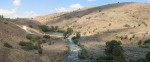
The Jordan River is “the only river on planet earth that on its good days is a few feet wide, and people claim that it has a bank 40 miles wide.” (photo from Beivushtang via Wikimedia Commons)
Settlements or Jewish communities? West Bank or Judea and Samaria? East Jerusalem or eastern Jerusalem? Those are some of the language choices that journalists covering the Israeli-Palestinian conflict are faced with each day – and those choices should not be taken lightly, experts say.
“It’s the terminology that actually defines the conflict and defines what you think about the conflict,” said Ari Briggs, director of Regavim, an Israeli nongovernmental organization that works on legal land-use issues. “Whereas journalists’ job, I believe, is to present the news, as soon as you use certain terminology, you’re presenting an opinion and not the news anymore.”
“Accuracy requires precision; ideology employs euphemism,” said Eric Rozenman, Washington director of the Committee for Accuracy in Middle East Reporting in America (CAMERA).
At the conclusion of his essay, “Politics and the English Language,” George Orwell argues that writers have the power to “send some worn-out and useless phrase … into the dustbin, where it belongs.” Many Jewish leaders, organizations and analysts wish to do just that with the following terms, which are commonly used by the mainstream media in coverage of Israel.
West Bank: Dani Dayan believes the “funniest” term of all that is used in mainstream coverage of Israel is West Bank. Dayan is the chief foreign envoy of the Yesha Council, an umbrella organization representing the municipal councils of Jewish communities in an area that the Israeli government calls Judea and Samaria, in line with the region’s biblical roots. Yet, media most often use West Bank to describe the area in reference to the bank of the river situated on its eastern border.
“[The Jordan River] is the only river on planet earth that on its good days is a few feet wide, and people claim that it has a bank 40 miles wide [spanning across Judea and Samaria],” Dayan told this reporter. “There is no other example of such a thing in the geography of planet earth. That proves that West Bank is the politicized terminology, and not Judea and Samaria, as people claim.”
Member of Knesset Danny Danon (Likud) has said it’s “ridiculous” that West Bank – a geographic term that once described half of the Mandate of Palestine – has “taken on a political meaning that attempts to supersede thousands of years of Jewish tradition.”
“The correct name of the heartland of the Land of Israel is obviously Judea and Samaria,” he said.
Rozenman, the former editor of the Washington Jewish Week and B’nai B’rith Magazine, draws a distinction between the context of Palestinian and Jewish communities in the area. “If I’m referring to Palestinian Arab usage or demands, I use West Bank,” he said. “If I’m referring to Israeli usage or Jewish history and religion, etc., I use Judea and Samaria. Israeli prime ministers from 1967 on, if not before, used and [now] use Yehuda and Shomron, the Hebrew from which the Romans latinized Judea and Samaria.”
West Bank is fair to use, “so long as it’s noted that Jordan adopted that usage in the early 1950s to try to legitimate its illegal occupation, as the result of aggression, of what was commonly known as Judea and Samaria by British Mandatory authorities,” added Rozenman.
Dayan, meanwhile, prefers to call Palestinian communities in Judea and Samaria exactly that. “The area is Judea and Samaria and, in Judea and Samaria, there are indeed Palestinian population centres, and that’s perfectly OK,” he said. “We cannot neglect that fact, that yes, we [Jews] are living together with Palestinians. And, in Judea and Samaria, there is ample room for many Jews, for many Palestinians, and for peaceful coexistence between them if the will exists.”
Settlements: Judea and Samaria’s Jewish communities are often called settlements, a term that can depict modern-day residents of the area as primitive.
Settlements “once referred in a positive manner to all communities in the Land of Israel, but at some point was misappropriated as a negative term specifically against those Jews who settled in Judea and Samaria,” Danon said. “I prefer to use ‘Jewish communities in Judea and Samaria’ when discussing the brave modern-day Zionistic pioneers.”
Dayan said that “settlements” is not pejorative, but still inaccurate. “It’s a politically driven labeling in order to target those [Israeli] communities,” he said. “Most communities in Judea and Samaria are not different from any suburban or even urban community in Europe, in the United States, in Israel itself, or elsewhere.”
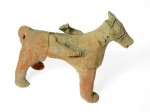
A horse figurine is evidence of early Jewish ritual practice. (photo by Clara Amit/IAA.COM)
One might think that a significant archeological find a few hours’ walk from Solomon’s Temple in Jerusalem would turn up artifacts we would recognize as Jewish. But since the Judaism of the day was not what we know, the find yielded ritual objects that seem vaguely pagan, almost heretical by today’s standards.
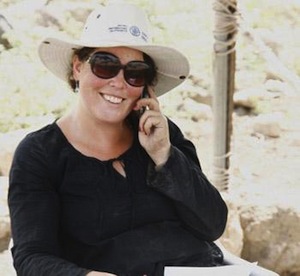
Archeologist Shua Kisilevitz describes the religion of the era as “pagan Yahwism.” (photo from cjnews.com)
Shua Kisilevitz, the archeologist who was part of the team that excavated the site at Tel Motza, about seven kilometres west of Jerusalem, prefers the phrase “pagan Yahwism” to describe the religion of the era.
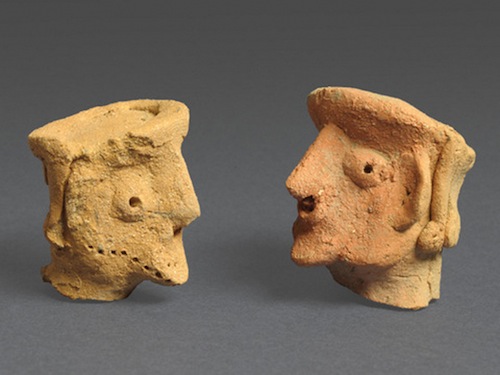
Last December, Kisilevitz and three fellow archeologists announced what they called an “unusual and striking” find, unearthed in construction for a highway: the 2,750-year-old walls of a temple, along with a cache of ritual objects that included a pedestal decorated with lions and sphinxes, pendants, pottery and vessel fragments, and figurines – two human and two animal – that may or may not have depicted deities.
The dig provides “rare archeological evidence for the existence of temples and ritual enclosures in the Kingdom of Judah in general and in the Jerusalem region in particular,” the team announced.
The uniqueness of the find is even more remarkable, the archeologists said, because of its proximity to the First Temple, built, according to the Bible, under King Solomon in 960 BCE. But archeologists know little about the period’s religious practices because there are hardly any remnants of ritual buildings from the era, according to Kisilevitz.
While more study is needed, the find provides valuable insights into what those rituals might have been, she said in an interview prior to her recent talk on the subject at the University of Toronto. While those practices may seem strange and un-Jewish today, they were in keeping with the rules of the time, Kisilevitz said.
Previous excavations showed that Motza functioned within the royal administration of the Kingdom of Judah, she said. “It was very much connected to Jerusalem. [It couldn’t] create its own religion. The people of Motza didn’t wake up one morning and say, ‘Oh, we want to create something new.’ They couldn’t break off so easily.”
According to Shua Kisilevitz, artifacts such as these found at Tel Motza, are important because they reflect a formative time for Judaism. (photo by Clara Amit/IAA.COM)
The artifacts are important because they reflect a formative time for Judaism, she noted, adding they show that the ancient Israelite faith was not always centralized in Jerusalem and its practitioners may have used ritual objects now forbidden as graven images. “There are all these presumptions we have which we project onto the early formation of religion,” Kisilevitz said. “This temple finally shows us how the religion started out and what it really looked like at the time. They [were] doing what was common in the period.”
The find also conforms to biblical accounts, which mention local religious precincts outside Jerusalem, she added. And “Motza” is mentioned in the Book of Joshua as a town in the tribal lands of Benjamin, which bordered Judah.
Kisilevitz, who works for the Israeli Antiquities Authority and is in Ontario for several months on an exchange with the University of Toronto, said the team does not know whether the human and animal figurines served a religious purpose. “It’s kind of tricky and a little bit hard to say,” she noted.
The archeological team believes the temple at Tel Motza must have functioned before religious reforms enacted in the times of kings Hezekiah and Josiah, which abolished all ritual sites outside Jerusalem and concentrated religious practices solely in the Temple.
Kisilevitz believes the artifacts do not conflict “at all” with modern understanding of Judaism. “We just have to change the way we think of the religion at the beginning.”
Ron Csillag is a Toronto freelance writer. A version of this article was originally published in theCanadian Jewish News.