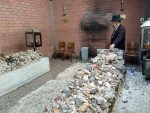
Gerrer Rebbe’s “tent”

Gerrer Chassidim consider the burial place of Rebbe Avraham Mordechai Alter and his son, Rabbi Pinchas Menachem Alter, a holy site in Jerusalem. (photo by Gil Zohar)

Among the many events this spring marking 70 years of Israel’s independence is the yahrzeit of Rebbe Avraham Mordechai Alter, known as the Imrei Emes, who served as the fourth admor (rabbinic sage) of the Gerrer Chassidim from 1905 until his death in Jerusalem on June 3, 1948, during Shavuot.

Since the capital of the nascent Jewish state was under siege during the War of Independence, the rebbe’s disciples were unable to bury their sage in Mount of Olives Cemetery, where the pious have been laid to rest since biblical times. Unwilling to bury their master in the city’s improvised graveyard in the abandoned Palestinian village of Sheikh Bader (today Givat Ram), they instead turned his shtibl (small house of prayer) on Yehosef Shwartz Street near the Machane Yehuda food market into a mausoleum.

The Sfas Emes Yeshiva, which Alter founded in 1925 during a visit to Palestine, and where he lived from 1940 – after escaping Nazi-occupied Poland when his followers paid an enormous bribe to gain his release – has today evolved into one of the most unusual shrines in Jerusalem. His son, Rabbi Pinchas Menachem Alter, the seventh Gerrer Rebbe, also resided in the yeshivah complex and was buried alongside his father in 1996. On the yahrzeits of the two rebbes, thousands of Gerrer Chassidim – who distinguish themselves from other Chassidic groups by placing their peyot (sidelocks) into their skullcaps and tucking their pants into their socks, called hoyzn-zokn – flock to the pilgrimage site.
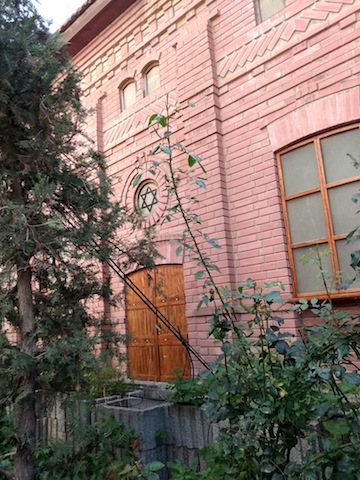
photo - A garden lies to the side of the ohel, and the façade of the adjoining building recalls the original Ger yeshivah in Góra Kalwaria, Poland
A garden lies to the side of the ohel, and the façade of the adjoining building recalls the original Ger yeshivah in Góra Kalwaria, Poland. (photo by Gil Zohar)

The decision to entomb Pinchas Alter, known as the Pnei Menachem, beside his father sparked opposition from the Jerusalem municipality, but the funeral went ahead. A red-brick ohel (tent) was erected over their twin graves, turning the courtyard into a holy site for the Gerrer Chassidim, who constitute the largest such ultra-Orthodox group in the country, numbering more than 100,000 members, who are concentrated in Jerusalem, Bnei Brak and Ashdod.

The ohel includes separate men’s and women’s sections. A garden lies to the side of the ohel, and the façade of the adjoining building recalls the original Ger yeshivah in Góra Kalwaria, Poland – a small town on the Vistula River, 25 kilometres southeast of Warsaw. A partially open roof above the ohel permits ritual impurity from the dead to exit so that kohanim (Jews of the priestly caste) may visit the gravesite.

Toronto businessman and philanthropist Daniel Goldberg wants to build on the fame of Jerusalem’s Gerrer shrine to secure and restore the sect’s historic home in Góra Kalwaria. The name means Mount Calvary or Skull Hill in Polish, explained Goldberg, whose mother’s family came from the area. But the town, called Ger or Gur in Yiddish, was also called Nowa Jerozolima (New Jerusalem), reflecting its holiness for both Jews and Christians.

Goldberg, who together with other Canadian donors has supported the preservation of several historic synagogues in Hungary, views the restoration of Jewish landmarks in Góra Kalwaria as critical to combating antisemitism and acknowledging Poland’s complex role in the Holocaust.

“I am visiting Poland after Pesach and will be meeting with various people from our Jewish community there,” he said. “I have been in contact with the different leaderships, including in Gur. So many communities were wiped out during the war. It is vital that we support our history in such places.”

In 1802, Góra Kalwaria’s “de non tolerandis Judaeis” law prohibiting Jewish settlement was annulled, and Jews became the predominant ethnic group in the town, Goldberg noted. Between 1852 and 1939, the Jewish population tripled, from 1,161 (half of the town’s population) to around 3,600, as Góra Kalwaria became an important Chassidic centre.

When the Nazis invaded Poland in September 1939, they immediately targeted Góra Kalwaria’s Jews. The town’s ethnic German mayor Ewald Jauke banned Jewish residents from engaging in trade, crafts and pigeon breeding. Jews were also forbidden from listening to radio broadcasts. A group of 100 Jews was conscripted daily in front of the town hall for forced labour.

In the spring of 1940, some 400 Jews from Lodz, Pabianice, Aleksandrow, Sierpc, Wloclawek and Kalisz were deported to Góra Kalwaria. That June, a ghetto was established with 3,500 residents. The ghetto was liquidated Feb. 25-26, 1941. About 3,000 Jews were deported to the Warsaw Ghetto, and ultimately murdered in the summer of 1942 in the Treblinka death camp. Only 35 of Góra Kalwaria’s residents survived the war. The Jewish community was never reconstituted after liberation.

For Goldberg, the coming 70th yahrzeit of the Imrei Emes and the controversial amendment to Poland’s 1998 Act on the Institute of National Remembrance by the country’s ruling Law and Justice party, criminalizing the words “Polish Holocaust,” offer an opportunity to celebrate Jews’ deep roots in the country.

Goldberg wants to preserve the physical remains of Góra Kalwaria’s Jewish community. These include the 1903 synagogue building at ulica Pijarskiejj, now used as a shop. Across the street is a metal gate at the yard that marks the home and house of prayer of Rabbi Yitzhak Meir Alter (1798-1866), the founder of the Gerrer dynasty, known as the Chiddushei HaRim, after his primary rabbinic tome by that title. Above the entrance, one can still see the Magen David rosette window depicted in the Gerrer Jerusalem mausoleum.

“I am continuing my efforts [in Góra Kalwaria and elsewhere] despite the discomfort it always causes politically with the local municipalities. No town or city likes to admit to antisemitism,” said Goldberg.

Gil Zohar is a journalist based in Jerusalem.

Israeli horses’ ancient links

In 2016, under the supervision of Prof. Jodi Magness of the University of North Carolina at Chapel Hill, archeologists excavating at the fifth-century CE Huqoq synagogue found a mosaic floor on which there is an image of an Egyptian soldier and his horse floundering in the Red Sea. (photo by James Haberman)

Who doesn’t have some mental picture of the crossing of the Red Sea? Now, you can check how your subjective image matches the “facts on the ground,” as it were. In the summer of 2016, under the supervision of Prof. Jodi Magness of the University of North Carolina at Chapel Hill, archeologists excavating at the fifth-century CE Huqoq synagogue in Israel’s Lower Galilee found a stunning mosaic floor. Of relevance to the soon-to-be-upon-us Pesach holiday is an image of an Egyptian soldier and his horse floundering in the Red Sea (see Exodus 14:28). The Egyptian has separated from his horse and is about to become a large fish’s dinner.

The horse is not one of the animals that immediately comes to mind when thinking of both ancient and modern Israel. Most people would probably think of camels, donkeys, goats or sheep, rather than horses. Yet, the horse and Israel “go way back.” This history possibly starts at Ubeidiya, a location close to the southern end of the Sea of Galilee. There, Israeli archeologists found a horse bone dating back to the Lower Paleolithic Period. At the Hayonim Cave in Israel’s Galilee region, Israel Antiquities Authority archeologists discovered an image of a horse engraved in limestone, a find that dates back to the Upper Paleolithic Period.

From these and other digs, we can assume Israel’s ancient inhabitants were familiar with the horse. This is confirmed, for example, in the City of David, where archeologists uncovered a horse figurine from the Iron Age II. Indeed, there is concrete evidence that, thousands of years ago, people had already domesticated horses and were using them as a means of transportation. Thus, during the first millennium BCE, the horse was transformed from a yoked animal pulling some kind of wagon or cart to an animal that could be mounted. Archeologists discovered another horse-and-rider pottery set at the Tel Erani excavation in southern Israel, near Kiryat Gat, which dates to the Persian Period. Furthermore, an Achziv (located along Israel’s northern Mediterranean coast) discovery of a clay horse and rider, also dating back to the Iron Age II, indicates that the horse was already being used in battle, as the rider is holding a round shield.

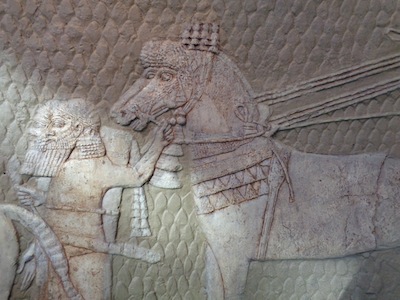
A visual depiction of the Assyrian destruction of the town of Lachish in 701 BCE – the original relief is housed at the British Museum while a copy hangs at the Israel Museum – clearly shows that the conquerors used warhorses. Also at Lachish, archeologists dug up an even older piece crafted from gold. This piece is a plaque from the 13th century BCE, the Late Bronze Age. It depicts a naked goddess, probably Astarte or Anat, standing on a horse.

While on the subject of conquests of ancient Israel and pagan gods, the Hebrews returning from Egypt were instructed not to raise horses nor to return to Egypt to obtain horses (Deuteronomy 17:16). In the later period of the kings, King Josiah took away the horses of the kings of Judah, as “they had given them to the sun.” (II Kings 23:11)

Horses are also mentioned in early administrative documents of ancient Israel. Hence, at Arad in southern Israel, archeologists recovered a list written in ink on pottery. This fourth-century BCE list supposedly details items to be given to a particular person named Qos. The list includes a horse.

photo - A copy of panels depicting the Assyrian destruction of Lachish, part of Israel Museum’s archeology collection. The original panels date to the Late Iron Age, First Temple Period, 1000-586 BCE, and are housed at the British Museum
A copy of panels depicting the Assyrian destruction of Lachish, part of Israel Museum’s archeology collection. The original panels date to the Late Iron Age, First Temple Period, 1000-586 BCE, and are housed at the British Museum. (photo by Deborah Rubin Fields)

Moving to northern Israel, archeologists in the Dan region discovered a unique Aramaic inscription, which was part of a monumental basalt stone slab. (In the ancient world, Aramaic was, for a time, the Near East’s lingua franca of commerce and trade.) The writing, which dates to the ninth-century BCE, commemorates the military victories of Hazael, king of Aram. In the text, the king claims he killed 70 kings who harnessed thousands of chariots and thousands of horsemen (horses).

Probably the earliest literary reference to horses is found in the Book of Genesis (47:17), where it says that, during a famine in Egypt, Pharaoh’s right-hand man, Joseph, gave “bread in exchange for horses.” And, from the report in I Kings 10:26, it seems King Solomon had 400 chariots and 12,000 horsemen. Moreover, there is a legend, possibly originating with the Bedouins, which states that the Queen of Sheba presented King Solomon with a mare named Safanad. All Arabian horses are supposedly descended from this mare. As it happens, Israel’s Arabian Horse Association is today made up of both Jews and Arabs, and the organization’s bilingual website is indicative of the members’ cooperation.

Later rulers of the divided kingdoms of ancient Israel likewise used horses. Thus, at Tel Meggido, the remains of King Ahab’s (869-850 BCE) stables have been discovered. Evidence, however, of ancient stables does not end there. Rock-hewn Crusader stables and water troughs from 1140 CE are still visible at the Tomb of Samuel the Prophet (also called Kever Shmuel ha-Nevi, Nebi Samwil or Mont de Joie). It stands to reason that, instead of returning to their European (or Asian) home countries, the Crusaders and later conquerors of the Holy Land acquired local horses when they needed to resupply their armies.

The horse has continued to importantly figure in Israel’s more modern period. For political and religious reasons, in 1898, Kaiser Wilhelm II (the last German emperor and king of Prussia) presented himself in Jerusalem on a white horse. Less than 20 years later, after the Ottomans had been defeated, Britain’s General Edmund Allenby dramatically rode on horseback to Jerusalem’s Jaffa Gate (but then purposely entered the Old City on foot).

At the end of October 2017, some 200 visiting members of the Australian Light Horse Association reenacted at Beersheva River Park the charge of the Australian Light Horsemen. In this battle, mounted Allied soldiers helped take Beersheva from the Ottomans. In the 100-year commemoration, original First World War uniforms were worn.

Israel’s horse connection continues to this day. Although it is an expensive pleasure, some Israelis ride for enjoyment. Therapeutic riding schools exist for people with special needs. And Israeli police use horses for crowd control.

How to summarize Israel’s long interest in horses? With this Song of Songs (1:9) quote: “I have compared you, my love, to a company of horses in Pharaoh’s chariots.”

The documentary Lachish the Epic was released earlier this year. It can be found on YouTube.

Deborah Rubin Fields is an Israel-based features writer. She is also the author of Take a Peek Inside: A Child’s Guide to Radiology Exams, published in English, Hebrew and Arabic.

What is freedom?

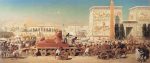
“Israel in Egypt” by Edward Poynter, 1867. (photo from Wikimedia Commons)

There is a certain inherent ambivalence when we think of the meaning of freedom and its association with the holiday of Pesach. One of the essential features of the liberation story is our freedom from human subjugation: “Yesterday we were slaves to Pharaoh, today we are free men and women.”

This freedom, however, did not come about as a result of a revolution instigated by the Jewish people but, rather, as the biblical story relates, through the redemptive hand of God. As a result, this physical redemption is often connected with a religious duty: “I am the Lord your God, who brought you out of Egypt, out of the land of slavery; you shall have no other gods besides me.” (Exodus 20: 2-3)

What is the nature of this connection? Is it an obligation or an opportunity? Is our commitment to God and the Torah a price we pay for the Exodus, or is it a gift – a gift made possible by our physical freedom, but one that we may choose whether or not to receive? The question we as Jews ought to reflect on this Pesach is whether the freedom from Egypt is limited to liberation from physical servitude, or does it include freedom of conscience and faith.

Historically, Jews did not engage extensively in questions of personal autonomy; at most, they spoke about what Isaiah Berlin referred to as “positive liberty” (Berlin, Two Concepts of Liberty). As opposed to the simple, more intuitive concept of negative liberty – “the freedom from” constraints or compulsion, positive liberty is “the freedom to” – the freedom to be all one ought to be, to do that which is the fullest expression of one’s potential. The notion of positive liberty is clearly present in the rabbinic tradition, in such statements as, “There is no free person but he or she who studies Torah.” (Avot 6:2) Freedom, for Jews, has traditionally meant “the freedom to” – the ability to achieve complete self-realization, through a firm, unwavering commitment to God and His word.

Standing alone, however, positive liberty is an extremely precarious concept. We need look no further than the 20th century, when different fascist leaders established their rule on a promise of positive liberty (the freedom to live in a stable society, the freedom to attain financial prosperity, the freedom to fulfil one’s destiny as a member of the master race), to appreciate the danger it harbours: the creation of oppressive, totalitarian regimes, violently trampling the rights of their citizens in the name of freedom. Without the underlying basis of negative liberty, positive liberty means nothing more than the freedom to do that which others determine you ought, to fulfil what others have decided to be your potential.

This question becomes all the more pointed in the context of the state of Israel. So long as Jews lived in Western liberal democracies, they vicariously inherited the value of negative liberty and functioned within its confines. But an essential question facing the modern state of Israel, the only Jewish democracy, is what concept of liberty does it officially espouse? Is Israel a “free state” that dictates the forms of Judaism that are most appropriate? Or does it guarantee its citizens the right and conditions to determine their own individual Jewish path?

If Pesach is going to be not simply a liberation story of our past but a modern, continuous liberation story “in every generation,” we must recognize that positive liberty is an incomplete liberty, that the freedom from Egypt – indeed, our very existence as a free people in our own country – must be accompanied by a commitment to religious freedom and the diversity it will engender.

The spirit of Pesach requires a national pledge to free Israeli society of all and any vestiges of religious coercion, including the manipulation of public funds in order to constrain spiritual choices. In the spirit of Pesach, we must commit ourselves to speaking only in the language of education, and never in the language of indoctrination and coercion.

One of the great paradoxes of Israeli society is that those who function in the name of positive liberty actively limit the actualization of the spiritual potential of Jews. Consequently, the state of Israel is one of the only places in which non-Orthodox Jews can barely receive a Jewish education. Religious coercion and legislation hasn’t furthered our marriage with God; rather, it has created an ever-increasing rift and divorce.

The freedom of Pesach has multiple dimensions. It is our responsibility to ensure it is understood and employed as a catalyst for progress, as a basis for assimilating the broadest notions of negative liberty within our religious language and values. Just as we reject being enslaved by Pharaoh, so, too, must we reject the subjugation of our minds and souls to any authority. In the end, if God is to be the God of the Jewish people, if Judaism and its values are to shape our lives, it will not be because we owe God for our redemption from Egypt, but because we choose a life with God as free men and women.

Rabbi Dr. Donniel Hartman is president of the Shalom Hartman Institute and author of the 2016 book Putting God Second: How to Save Religion from Itself. Articles by Hartman and other institute scholars can be found at shalomhartman.org.

מדד השחיתות

מדד המדינות המושחתות בעולם: קנדה במקום השמיני וישראל רק במקום השלושים ושתיים. (צילום: Cynthia Ramsay)

בימים האחרונים התפרסם מדד המדינות המושחתות בעולם לשנת 2017. המדד כולל מאה ושמונים מדינות שנסקרו, ומיקומן נקבע על פי השחיתות במגזר הציבורי, באמצעות שלושה עשר מקורות מידע משנים עשר מכוני מחקר עצמאיים ובלתי תלויים.

מהתוצאות עולה כי קנדה נמצאת במקום השמיני והגבוה בקרב המדינות הכי פחות מושחתות. ואילו ישראל איך לא לאור פרשות השחיתות הרבות שמאפיינות אותה, ובעיקר את ראש הממשלה, בנימין נתניהו, נמצאת מאחור במקום השלושים ושתיים.

להלן העשירייה הראשונה של המדינות הכי פחות מושחתות: ראשונה – ניו זילנד, שנייה – דנמרק, שלישית – פינלנד, רביעית – נורבגיה, חמישית – שוויץ, שישית – סינגפור, שביעית – שבדיה, שמינית – קנדה, תשיעית – לוקסמבורג ועשירית – הולנד.

העשירייה השנייה: אחד עשרה – בריטניה, שתיים עשרה – גרמניה, שלוש עשרה – אוסטרליה, ארבע עשרה – הונג קונג, חמש עשרה – איסלנד, שש עשרה – אוסטריה, שבעה עשרה – בלגיה, שמונה עשרה- ארצות הברית, תשעה עשרה – אירלנד ועשרים – יפן.

העשירייה השלישית: עשרים ואחד – אסטוניה, עשרים ושתיים – איחוד האמירויות הערביות, עשרים ושלושה – צרפת, עשרים וארבעה – אורגוואי, עשרים וחמשה – ברבדוס, עשרים וששה – בהוטן, עשרים ושבעה – צ’ילה, עשרים ושמונה – איי בהאמה, עשרים ותשעה – פורטוגל ושלושים – קטאר.

אחריהן במקום השלושים ואחד טיוואן, במקום השלושים ושתיים ישראל, במקום השלושים ושלושה ברוניי, במקום השלושים וארבעה בוטסואנה ובמקום השלושים וחמשה פולין.

ערים מתקדמות הופכות אשפה למשאב: ונקובר פועלת להיות העיר הירוקה בעולם

ערים רבות בעולם פועלות בשנים האחרונות לחסוך את העלות הגבוהה של סילוק פוסלת האשפה, הנוצרת בהן מדי יום בכמויות ענק. הן פועלות להפחית את כל צורות הפסולת שלהן, ולהשתמש בפסולת עד כמה שאפשר כמאשב, כך שהיא תהפוך לחומר גלם אחר. כך מדווח אתר הידען מישראל המפרסם מידע בתחום המדע והטכנולוגיה.

הערים בעולם הופכות למאוכלסות יותר וראשי הערים מחוייבים לשאת באחריות למצוא ולפתח פתרונות להרי הזבל שנוצרים בהן. הנוף העירוני הוא כיום הסביבה, שבה מתרכזים האתגרים הכרוכים בניהול חיים אנושיים מורכבים. בערים מתבזבות כמויות גדולות של אנרגיה, פחמן דו-חמצני, מזון, מים, מרחב וזמן. העירייות יכולות לפתור מספר בעיות בעת ובעונה אחת, ולהבטיח לתושבים, הפחתה משמעותית של חלק מהפסולת, תוך הפיכתה למשאב בעל יתרונות כלכליים.

כיום אין בהזרמת הפסולת למי הביוב פתרון סופי ויש להפחית מראש את הפסולת שנוצרת בערים, ולהשתמש בחלק גדול ממנה, לשימושים יעילים יותר. פעילות זו נקראת “כלכלה מעגלית”.

באתרי הטמנה האשפה של ונקובר לוכדים את גז המתאן הנפלט מהאשפה הרבה, ובחום שנוצר משריפתו משתמשים לחימום חממות בסמוך להם, בהן גדלות עגבניות. זו דוגמא טובה של יצור אררגיה חיובית מאשפה.

ונקובר שפועלת להיות העיר הירוקה ביותר בעולם, מחלקת לתושבים מיכלים נפרדים לאשפה רגילה, לפסולת אורגנית (כמו שאריות מזון, ענפים וגזם), לפסולת זכוכית, פסולת נייר, פסולת פלסתיק ועוד. עיריית ונקובר שמצפה מאזרחי העיר שיפעלו בהתאם עם הפסולת לסוגייה כמתבקש, שולחת מעת לעת פקחים לבדוק שזה אכן נעשה.

מן הפסולת האורגנית העירייה מפיקה את גז המתאן, וכן מוצרים מוצקים שיכולים לשמש לדישון הקרקע. לפתרונות אלה מספר יתרונות בעת ובעונה אחת: הם חוסכים לעיר הוצאות על אנרגיה, הם מפחתים משמעותית את הצורך בהטמנת פסולת באתרי האשפה וכן הם מועילים לענף החקלאות.

Winnipeggers reach to Israel

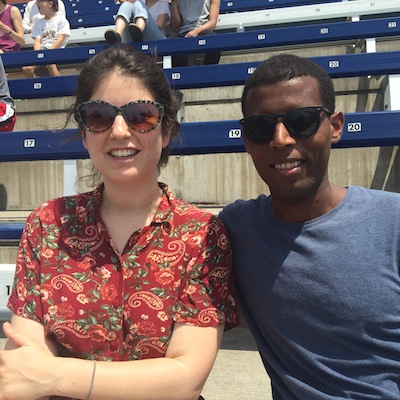
Samara Carroll, second from the left, with Dawit Demoz, right, and members of his host family – Sunita and her daughter Persia. (photo from Samara Carroll)

Soon after Samara Carroll returned from a yearlong program in Israel, she took action to help African asylum seekers in Israel come to Canada.

Carroll grew up in Winnipeg, went to Talmud Torah and then to Gray Academy. She was involved in many aspects of the Jewish community growing up, including with B’nai B’rith Youth Organization, leading trips to Israel, and attending Camp Massad for 17 years (for two of which she was the camp director).

In 2012, Carroll was accepted to be the first Canadian participant of the New Israel Fund Social Justice Fellowship. “This fellowship gives you the opportunity to choose an Israeli nonprofit and work there for a year,” Carroll told the Independent.

“I chose ASSAF – Aid Organization for Asylum Seekers and Refugees – located in south Tel Aviv. I worked as a community organizer, activist and counselor, supporting families who had fled, mostly from Eritrea and Sudan, and were dealing with the trauma related to their past experiences and the ongoing challenges of being in Israeli society.”

During her time at ASSAF, Carroll heard hundreds of gut-wrenching stories, but also learned many things from the asylum seekers with whom she worked.

“The Israeli government does not have a proper process to assess whether or not someone is an asylum seeker,” said Carroll. “So, instead of creating a system, they have created policies that make life extremely difficult for asylum seekers…. They do not have basic access to healthcare, proper housing, employment or education. And, they face significant racism, directly from the Israeli government. They have been referred to as a ‘cancer.’

“The Netanyahu government claims that the asylum seekers have come to Israel for employment opportunities, but you only have to hear one story from an asylum seeker about their experience facing genocide and dictatorship in their country of origin – leaving behind everything they knew, being smuggled, human trafficked and tortured by smugglers in Sinai and then arriving in a foreign country – to understand that they are fleeing desperate situations.

“When you ask many asylum seekers where they’d want to be, they say ‘back home,’ but they cannot go back home,” Carroll said, summing up her belief using a quote from writer Warsan Shire: “You have to understand no one puts their children in a boat unless the water is safer than the land.”

After her year in Israel, Carroll decided to pursue a master of social work degree at the University of Toronto. About six months after she had arrived in Toronto, she was approached by Dawit Demoz, an Eritrean asylum-seeking man who was an activist in Israel, about giving asylum seekers more rights in Israel.

“He approached me, asking if I would sponsor him to Canada,” explained Carroll. “He felt that, although he loved the community he had established in Israel – his Israeli friends, the food and the culture – the policies of the Israeli government were just getting worse and he knew he had to try to leave the country if he ever wanted freedom.

“I agreed to sponsor him and did so through a SAH (Sponsorship Agreement Holder). The sponsorship process is detailed, but is very manageable and I believe more people would be open to sponsoring asylum seekers if they understood this.”

photo - Samara Carroll and Dawit Demoz
Samara Carroll and Dawit Demoz. (photo from Samara Carroll)

Demoz arrived in Toronto in March 2016. “He says this is the first time in his life he has felt free,” said Carroll. “He studies psychology at York University, works as an interpreter for a refugee organization, led canoe trips through Algonquin Park as a counselor last summer, and worked as a counselor at the Heart to Heart Program through Camp Shomria. He also plays soccer on a team, hosts Eritrean dinners for his many Jewish friends, and enjoys life.

“Five of our friends have submitted a Group of Five sponsorship to bring his mother [who he hasn’t seen in 10 years] to join him in Toronto,” said Carroll.

Following her example, Carroll’s parents, Sharon Chisvin and Marshall Carroll, have sponsored an Eritrean couple with the support of a local church-based sponsorship agreement agency, Jewish Child and Family Service Winnipeg and donations from friends, family and community members. The couple – Tsege and Kidane – arrived in Winnipeg in May 2016.

“They are generous, wonderful people and have created a strong community for themselves in Winnipeg, and they also support other newly arrived asylum seekers,” said Carroll. “While it is clear that you can positively shape someone’s life who has never experienced freedom before, you do not know how much they will positively impact your life.”

According to Carroll, the situation for asylum seekers in Israel has worsened since 2016. Prime Minister Binyamin Netanyahu has signed an order to deport asylum seekers from Israel to third-party countries, such as Uganda and Rwanda, she said. “This is a human rights violation, as we do not know what is waiting for them in these new countries – countries they have no connection to. Men who have already been deported there have been given no status or rights.”

For her part, Chisvin has started working with Canadians Helping Asylum Seekers in Israel (CHAI), which she described as “a grassroots group formed in Toronto in response to Netanyahu’s deportation order. It is primarily made up of Toronto Jewish activists who feel deeply that Israel’s intent to deport 38,000 African asylum seekers to third countries – and to certain suffering – is a strict violation of Jewish values, history and memory. This sentiment has been shared by 20,000 Israelis who protested against the deportation in Tel Aviv [recently], myriad Israeli rabbis, teachers, psychiatrists, El Al pilots and authors, as well as Irwin Cotler, Alan Dershowitz, the ADL [Anti-Defamation League], HIAS [Hebrew Immigrant Aid Society] and many other individuals and agencies.”

In Toronto, there is growing group of support for CHAI, and Chisvin is working to create a similar group in Winnipeg and beyond. Its goals, she explained, include raising awareness within the Jewish community about the deportation; encouraging people to ask the Israeli government to rescind its deportation order and implement a humane strategy for refugees and asylum seekers; appealing to the Canadian government to pressure the Israeli government to rescind the deportation order and work together on a solution; and encouraging people to commit to private refugee sponsorships.

“I have been assisted in my efforts, helped by a handful of people here in Winnipeg, who are helping me raise awareness in the community about the issue – urging others to speak up and fundraise for the refugees I have, and am in the process of sponsoring,” said Chisvin.

Further to that, Chisvin is in the early stages of organizing a community event to raise awareness about the issue and to explain how and why Canadian Jews should be moved by the plight of African asylum seekers who are at risk of being deported or indefinitely detained, and how and why they should commit to help sponsor some of them to Canada as refugees.

“The best solution, of course, is for Israel to rescind its deportation order, properly process the refugee claims of the asylum seekers, grant them refugee status, and all the rights inherent in that status,” said Chisvin. “But, if Israel doesn’t rescind the order, it is incumbent on Canadian Jews to lobby their government to increase the number of African asylum seekers it brings to Canada and to commit to privately sponsor African asylum seekers to Canada.”

There are many other ways to become involved, including supporting sponsors with money to help settle asylum seekers, provide housing and employment opportunities – as well as just being open and generous with newcomers. For more information, email chai@asylumseekers.org or visit facebook.com/canadianshelpingasylumseekersinisrael or letushelpil.org/canada.html.

“Israel needs to deal with the asylum seeker situation in their country and not force out people who have already experienced unspeakable trauma to a third country that will again violate their human rights,” said Carroll. “Our message and the message of many Jewish communities now is, ‘Do not deport. Let us help.’”

Rebeca Kuropatwa is a Winnipeg freelance writer.

Foxtrot steps on toes

Itay Exlroad as Dancer Soldier. (photo by Giora Bejach, Courtesy Sony Pictures Classics)

An audacious work of art that melds raw emotion and absurdist allegory into a blistering assessment of contemporary Israel, Samuel Maoz’s Foxtrot deserves to be seen and demands to be discussed.

Winner of the Silver Lion at the Venice Film Festival – where Maoz’s taut debut, Lebanon, won the Golden Lion in 2009 – and eight Ophir Awards (Israel’s Oscars), including best film, director and actor, Foxtrot uses a small-scale story to examine some of Israel’s deepest issues: the concept of military sacrifice, the oppression of Palestinians and the legacy of the Holocaust.

Skilfully strewn with ironies all the way to the final shot, Foxtrot was shortlisted for the Academy Award for best foreign language film but did not receive a nomination.

The film begins with a middle-aged man (the sublime Lior Ashkenazi, who played a fictitious prime minister last year in Norman and Yitzhak Rabin in this month’s 7 Days in Entebbe) opening his door to the worst possible news for a father with a son in the army. Even as the gravity of the situation and the intensity of his response wallops us in the face and grabs us by the collar, Maoz counter-intuitively undercuts the emotional naturalism with precision camerawork and a stylized set design.

It appears, at first, that the filmmaker is evoking the surreal, detached and alienating experience of being struck with a life-changing bulletin. But we get the nagging feeling, from Ashkenazi’s character’s black-humour interactions with the army representatives to the off-centre introductions of his wife and daughter, that there’s more on tap than the melodrama of domestic tragedy.

Indeed, Maoz pulls the rug out from under us, then cuts from the climate-controlled setting of a high-in-the-sky condo to an isolated checkpoint in the barren, forgotten north of Israel. This is where the son, Yonatan, is assigned the “mission” of guarding a remote, nonessential road with a handful of other bored young men.

The tilted shipping container that comprises the soldiers’ base and barracks fronts on a puddle-strewn mudfield, which they must trudge across to the checkpoint. The roadblock itself is cartoonishly minimalist, resembling a set you’d see onstage more than a military installation, and putting us in mind of surrealist (anti-)war films like Apocalypse Now and Catch-22.

Nothing happens in this God-forsaken spot, and everything happens here. Each detail has significance, though one must pay close attention because it may not be clear until events play out. In fact, the meaning of a close-up or sound cue often remains obscure until the movie is over, at which point the viewer is required to arrive at his or her interpretation.

Two key events occur at Yonatan’s base: one at the checkpoint involving a carload of Palestinians heading home from a party and the other in the barracks when the soldiers are killing lonely downtime. The latter scene, in which Yonatan relates an anecdote from his father’s youth, is the most astonishing passage in this taboo-trampling movie.

photo - Left to right: Danny Isserles as Official Military Officer, Yehuda Almagor as Avigdor, Michael’s brother, and Lior Ashkenazi as Michael
Left to right: Danny Isserles as Official Military Officer, Yehuda Almagor as Avigdor, Michael’s brother, and Lior Ashkenazi as Michael. (photo by Giora Bejach, Courtesy Sony Pictures Classics)

Yonatan has rendered his memory into a graphic novel, and Maoz brings it to life in the form of animation. This harrowing episode connects the Holocaust – and the self-reliance, persistence, shared sacrifice and residual faith that survivors applied to building the Jewish state – to a modern Israel, where idealism has curdled into a pursuit of temporary pleasures, and worse offences.

To be sure, in every land and every age, older generations castigate young people for ignoring tradition and abandoning their core values. But this parable takes place in Israel, so Yonatan’s father’s hormone-driven rashness hearkens to Esau swapping his birthright for a bowl of stew.

Threaded through Foxtrot is a critique of Israel’s leaders for maintaining a culture of cynicism and corruption that results in the unnecessary deaths of young soldiers. Furthermore, each loss is described as heroic regardless of the circumstances.

This is not unique to Israel, of course, but it’s harder to push back against the military spin when you’re a small country surrounded by enemies than a superpower. Maoz satirizes PR functionaries in the opening scene, in fact, and never stops spearing sacred cows.

Maoz’s triumph, finally, thanks in large measure to Ashkenazi’s unexpectedly vulnerable performance, is tracking the human cost amid the not-quite-real scenarios and sociopolitical commentary. Foxtrot is an altogether remarkable work, not least because it is a beautiful film about ugly truths.

Foxtrot is in Hebrew with English subtitles, runs 113 minutes and is rated R for some sexual content, including graphic images and brief drug use. It opens at Vancity Theatre on March 23, and runs to April 1.

Michael Fox is a writer and film critic living in San Francisco.

A record marathon

Jerusalem Marathon winner Kipkogey Shadrack (No. 1) led the field from the start. (photo from Ashernet)

photo - The half-marathon gets underway
The half-marathon gets underway. (photo from Ashernet)

More than 35,000 runners, including some 4,000 from 72 countries outside Israel, participated March 8 in this year’s Jerusalem Marathon – the largest to date. The winner of the main event was 27-year-old Kenyan runner Kipkogey Shadrack, who completed the course in 2:21.26. Participants set off opposite the Israel Museum in slightly overcast, but dry, weather. Many of the city’s streets were closed from 5:30 a.m. and scheduled to reopen at 2:30 p.m. There were five other courses apart from the 42.2-kilometre main event: a half-marathon, a 10k, a 5k, a family race (1.7 km) and a community race (800 metres) for people with special needs.

What is anti-Zionism?

Last year, the Students’ Society of McGill University, in Montreal, barred the reelection of three Jewish members of the board of directors. The issue, according to a report undertaken on behalf of the university, was not the students’ Jewishness, but their Zionism. It was, the report concluded, a political issue, not one of discrimination against Jews. There is a great deal to unpack in this story.

B’nai Brith Canada has launched a petition calling for a comprehensive investigation into antisemitism on the campus, noting that the SSMU incident was far from the only concerning episode in recent years.

Sometimes, antisemitism is unequivocal. Swastika graffiti and statements that overtly target Jews for condemnation or murder are uncontestable. But, in many cases, unwitting perpetrators are so unaware of the history of antisemitism and its associated symbols and tropes that they employ antisemitic concepts without consciously knowing it. For example, many images and much of the language of the anti-Zionist movement dovetails with traditional images of scheming Jews merely recast as scheming Zionists or Israelis. Note the term “Israel lobby,” which does not imply a legitimate political position but rather suspect coercion.

With the McGill situation, part of the problem is that “anti-Zionism is not antisemitism” is often stated as a self-evident truth. A more accurate statement would be “anti-Zionism is not necessarily antisemitism.” Because, sometimes it is. For example, the most casual perusal of online discussions about Israel turns up volumes of images evoking blood libels of the Middle Ages. And the equation of Zionism with Nazism, which can plausibly be denied as explicitly antisemitic, intentionally rubs salt in the most painful of Jewish historical memories. Label such comments as one will, they have the very deliberate effect of inflicting pain on Jews.

And this is the important point here. People can defend their positions by saying that their criticisms are of Israel, not of Jews; that their positions are political, not based on ethnicity or religion. But, as we have said in this space before, outcome matters as well as intent. Israel may be the intended target but Jews feel the effects.

It doesn’t matter that not all Jews are Zionists. It would not matter even if most Jews opposed Zionism. The fact is that opposition to the existence of a Jewish state – which is the definition of “anti-Zionism” – is arguably de facto antisemitic. There are all sorts of defences, of course. Some people claim to oppose all forms of nationalism, yet the practical application of their ideology is to start by boycotting the Jewish state rather than, say, the Mexican, Malaysian or Dutch nations. As well, opposing Zionism, while knowing the historical impacts of Jewish statelessness, including history that took place in the memory of living generations, could be viewed as such disregard for Jewish individual and collective security as to be antisemitic.

Others claim they support Israel’s right to exist, but then take positions that defy these words, such as denying Israel’s right to defend itself, which in effect is a denial of, if not statehood outright, the right of Israeli citizens to live free from terrorist murder and missiles. What name should we give that?

When Jews say they feel singled out because of their Jewish identity or because of their support for a Jewish state, they are met with responses ranging from outright denial of the legitimacy of their experiences to accusations that they are fabricating their concerns as a political weapon. The idea that anti-Zionism is not rife with antisemitism would be more believable if its purveyors acknowledged that such a thing does exist, and condemned it.

VR is coming to your home

Inception’s collaboration with FashionTV brings viewers backstage. (photo from Inception)

Netflix has become the go-to service for finding the latest and greatest movie and television programming. An Israeli startup called Inception wants to do the same for virtual reality.

The Tel Aviv-based company operates as both a production studio and an aggregator of curated virtual reality (VR) content. On Feb. 6, it announced the launch of a new channel to introduce more VR into the news experience, offering 360 top Associated Press (AP) videos across a broad spectrum of historical, cultural and social topics. The channel can be downloaded from the Inception app across platforms including Oculus Rift, HTC Vive, Microsoft MR, Samsung Gear, Google Daydream, iOS and Android.

Inception, which first caught Israel21c’s attention at the launch of the Tower of David Museum’s Innovation Lab last fall, received a $15 million investment in August 2017 from European television conglomerate RTL Group. The Series A round also included angel investors James Packer, Gigi Levy-Weiss and iAngels.

RTL’s FreemantleMedia owns the rights to dozens of big-name television shows, which helps explain where Inception is going. For example, Inception wants to use VR to transport viewers truly behind the scenes of the reality TV program The X Factor. Imagine standing beside the singer – or sitting with the judges watching the performance – in a 3-D immersive and interactive environment. Right now, that experience has to be pre-recorded but, someday, VR users will be able to jump into a program as it happens.

Live streaming is “already technically available today and we believe that, with the right content it will become mainstream,” Inception chief executive officer Benny Arbel told Israel21c.

Or, here’s another scenario. Imagine exploring in virtual reality the Shadow Monster’s tunnels in the Upside Down on the hit Netflix show Stranger Things.

“The beauty of VR is that it lets you actually enter a new location or scene,” said Arbel, “whether you’re a spectator or a participant.”

Inception’s focus on serialized TV sets it apart from other VR companies like Within and Here Be Dragons, which produce beautiful but mostly one-off VR experiences. Among the dozens of VR entries on Inception’s website are collaborations with Time Out for virtual walks through exotic locations (from Thailand to Tel Aviv) and FashionTV, where you can sidle up to a super-model as she heads down the catwalk.

Inception has standalone projects, too: a partnership with Pitchfork is the driving force behind the pop culture magazine’s new VR Music Channel. And Inception is developing a VR experience that transports visitors to the world of medieval knights at Jerusalem’s Tower of David Museum.

It’s the episodic content that gets Arbel most excited. With Time Out, he said, “we continuously add new content about different city locations and venues. We hope users will start using these channels for their city updates instead of existing TV or the web.”

If and when they do, it’s likely to start with a “360” experience, which Arbel called “the biggest enemy of VR.” He explained that 360s are flat, non-interactive videos that allow you to explore VR on your computer, often via YouTube. While Inception makes 360 video versions, too, Arbel said, “It’s a necessary evil, a way of promoting what we do to everyone.”

photo - Inception’s collaboration with Time Out brings virutal reality to virtual tours
Inception’s collaboration with Time Out brings virutal reality to virtual tours. (photo from Inception)

Inception’s VR content is video-based. Depending on which way you turn your head or make a gesture, a new video will be triggered. This is a bit reminiscent of Israeli pop-star-turned-startup-maven Yoni Bloch’s Interlude, now renamed Eko, which develops tools for making interactive (though not VR) videos.

Inception was founded in 2016 by Arbel, Dana Porter, Effi Wizen and Nitzan Shenar. The company’s 30 employees are spread out in offices in London, New York and Los Angeles, in addition to the Tel Aviv headquarters.

Inception is “platform agnostic,” Arbel stressed. That means its content “will play well with all the different kinds of headsets out there,” including Oculus, which Facebook acquired for some $3 billion in 2014, as well as Samsung’s Gear, the HTC Vive and Microsoft MR.

Some of these devices operate by placing one’s mobile phone into the headset, but those aren’t so popular or user-friendly. “People don’t like giving their phone to someone else,” said Arbel. “The most interesting segment is the standalone headsets, where there’s no phone or computer required; the graphic engine is built into the device and it’s connected to the cloud via wi-fi.”

Arbel added that new and improved headsets come out every few months and the next generation of the Oculus may be the “hero device that changes things for everyone.” According to Statista, the installed base of VR headsets is projected to grow to 37 million by 2020.

What about the kind of virtual experiences made terrifying by science-fiction TV shows such as Black Mirror, where the VR is broadcast directly into a user’s mind without the need for goggles or other external hardware?

“We know for a fact that what we are seeing today is just early days of VR form factors,” Arbel said. “We are sure hardware will change dramatically and become much easier for us to include as part of our daily lives. Precisely because of this, we make sure that our content can be viewed on any type of device – even the futuristic ones.”

In the meantime, and for those without a headset, Inception’s VR experiences are available on the Apple and Android app stores. For more information, visit inceptionvr.com.

Israel21c is a nonprofit educational foundation with a mission to focus media and public attention on the 21st-century Israel that exists beyond the conflict. For more, or to donate, visit israel21c.org.

Partisan decision

Andrew Scheer was two days old when Joe Clark was elected prime minister of Canada in 1979. In that election campaign, then-Progressive Conservative leader Clark promised to move the Canadian embassy in Israel to Jerusalem from Tel Aviv.

Cabinet documents recently released help explain why that promise was never fulfilled. There were diplomatic and, yes, commercial considerations though, at the time, the government claimed potential backlash from Arab states and businesses was not a factor.

Andrew Scheer is now leader of the Conservative party, facing a different Prime Minister Trudeau, and this week he promised to, well, you guessed it.

“Canada’s Conservatives led by Andrew Scheer will recognize Jerusalem as Israel’s capital when we form government in 2019,” declares a pledge on the party’s website. It describes the party as “a strong voice for Israel and the Canadian Jewish community.”

The Conservative government under Stephen Harper was indeed a strong voice for Israel – at times the only government in the world to be so – and for the Jewish community in Canada. There is no reason to believe that a Conservative government under Scheer would be any different, but the politics around this pledge are disappointing.

The statement came in the form of a petition-type pledge on the party’s website. That is, for those unschooled in the modern art of email harvesting, a strategy – legitimate and legal, certainly – of inviting people who agree with a topic to sign their name (and share their email address). The party can then target that voter, knowing they have a particular interest in the topic.

Again, there is nothing untoward about this, in general. But if a party that wants to form government chooses to issue a significant platform plank or promise dealing with one of the most contentious diplomatic issues in the world, perhaps a speech in Parliament or other suitable venue would be a more appropriate medium than a partisan webpage unabashedly accumulating names of voters for future political solicitations.

It is also so blatantly an imitation of the U.S. president’s shameless move on the issue. As we wrote here at the time, Donald Trump’s actions were not motivated by principle, but by sheer political calculation. Or, inasmuch as that president is not given to overthinking matters, more intended as a slap in the face to his political enemies.

We will leave aside here whether the embassy move is a good idea, a fair one, timely or otherwise merited or unmerited on substance. The point here is that the Conservatives are exploiting this issue for political purposes – and that is not good for Israel or for Jewish Canadians.

When Justin Trudeau became prime minister and effectively adopted the same policy approach vis-à-vis Israel as his predecessor, it was clear that a Canadian consensus was essentially in place. The New Democratic Party, in convention a few days ago, managed to put a lid on most of whatever dissent there was on this topic. Elizabeth May, the leader of the Green Party, put her leadership on the line in the summer of 2016 to let her members know she would not lead a party with an extremist agenda toward Israel.

This consensus is not a result of stifling free expression or of Zionist power or of anything other than a fair Canadian reading of important world events. In other words, for whatever else we disagree on, Canadians, by and large, accept Israel’s right to exist free from terrorist attacks.

Scheer’s move this week is cynical. It turns the legitimate consideration of the embassy’s location into a partisan one, when it should be entertained within the broader consensus we have developed. That is not the kind of voice Israel or Jewish Canadians want from our elected representatives.