Gerrer Rebbe’s “tent”

Gerrer Chassidim consider the burial place of Rebbe Avraham Mordechai Alter and his son, Rabbi Pinchas Menachem Alter, a holy site in Jerusalem. (photo by Gil Zohar)

Among the many events this spring marking 70 years of Israel’s independence is the yahrzeit of Rebbe Avraham Mordechai Alter, known as the Imrei Emes, who served as the fourth admor (rabbinic sage) of the Gerrer Chassidim from 1905 until his death in Jerusalem on June 3, 1948, during Shavuot.

Since the capital of the nascent Jewish state was under siege during the War of Independence, the rebbe’s disciples were unable to bury their sage in Mount of Olives Cemetery, where the pious have been laid to rest since biblical times. Unwilling to bury their master in the city’s improvised graveyard in the abandoned Palestinian village of Sheikh Bader (today Givat Ram), they instead turned his shtibl (small house of prayer) on Yehosef Shwartz Street near the Machane Yehuda food market into a mausoleum.

The Sfas Emes Yeshiva, which Alter founded in 1925 during a visit to Palestine, and where he lived from 1940 – after escaping Nazi-occupied Poland when his followers paid an enormous bribe to gain his release – has today evolved into one of the most unusual shrines in Jerusalem. His son, Rabbi Pinchas Menachem Alter, the seventh Gerrer Rebbe, also resided in the yeshivah complex and was buried alongside his father in 1996. On the yahrzeits of the two rebbes, thousands of Gerrer Chassidim – who distinguish themselves from other Chassidic groups by placing their peyot (sidelocks) into their skullcaps and tucking their pants into their socks, called hoyzn-zokn – flock to the pilgrimage site.
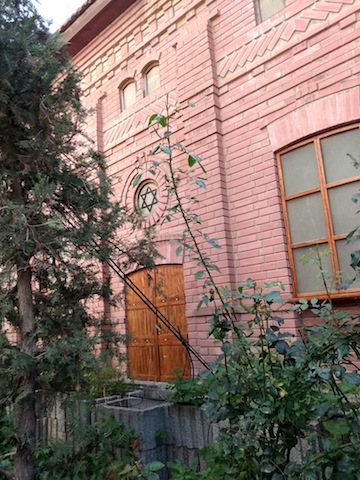
photo - A garden lies to the side of the ohel, and the façade of the adjoining building recalls the original Ger yeshivah in Góra Kalwaria, Poland
A garden lies to the side of the ohel, and the façade of the adjoining building recalls the original Ger yeshivah in Góra Kalwaria, Poland. (photo by Gil Zohar)

The decision to entomb Pinchas Alter, known as the Pnei Menachem, beside his father sparked opposition from the Jerusalem municipality, but the funeral went ahead. A red-brick ohel (tent) was erected over their twin graves, turning the courtyard into a holy site for the Gerrer Chassidim, who constitute the largest such ultra-Orthodox group in the country, numbering more than 100,000 members, who are concentrated in Jerusalem, Bnei Brak and Ashdod.

The ohel includes separate men’s and women’s sections. A garden lies to the side of the ohel, and the façade of the adjoining building recalls the original Ger yeshivah in Góra Kalwaria, Poland – a small town on the Vistula River, 25 kilometres southeast of Warsaw. A partially open roof above the ohel permits ritual impurity from the dead to exit so that kohanim (Jews of the priestly caste) may visit the gravesite.

Toronto businessman and philanthropist Daniel Goldberg wants to build on the fame of Jerusalem’s Gerrer shrine to secure and restore the sect’s historic home in Góra Kalwaria. The name means Mount Calvary or Skull Hill in Polish, explained Goldberg, whose mother’s family came from the area. But the town, called Ger or Gur in Yiddish, was also called Nowa Jerozolima (New Jerusalem), reflecting its holiness for both Jews and Christians.

Goldberg, who together with other Canadian donors has supported the preservation of several historic synagogues in Hungary, views the restoration of Jewish landmarks in Góra Kalwaria as critical to combating antisemitism and acknowledging Poland’s complex role in the Holocaust.

“I am visiting Poland after Pesach and will be meeting with various people from our Jewish community there,” he said. “I have been in contact with the different leaderships, including in Gur. So many communities were wiped out during the war. It is vital that we support our history in such places.”

In 1802, Góra Kalwaria’s “de non tolerandis Judaeis” law prohibiting Jewish settlement was annulled, and Jews became the predominant ethnic group in the town, Goldberg noted. Between 1852 and 1939, the Jewish population tripled, from 1,161 (half of the town’s population) to around 3,600, as Góra Kalwaria became an important Chassidic centre.

When the Nazis invaded Poland in September 1939, they immediately targeted Góra Kalwaria’s Jews. The town’s ethnic German mayor Ewald Jauke banned Jewish residents from engaging in trade, crafts and pigeon breeding. Jews were also forbidden from listening to radio broadcasts. A group of 100 Jews was conscripted daily in front of the town hall for forced labour.

In the spring of 1940, some 400 Jews from Lodz, Pabianice, Aleksandrow, Sierpc, Wloclawek and Kalisz were deported to Góra Kalwaria. That June, a ghetto was established with 3,500 residents. The ghetto was liquidated Feb. 25-26, 1941. About 3,000 Jews were deported to the Warsaw Ghetto, and ultimately murdered in the summer of 1942 in the Treblinka death camp. Only 35 of Góra Kalwaria’s residents survived the war. The Jewish community was never reconstituted after liberation.

For Goldberg, the coming 70th yahrzeit of the Imrei Emes and the controversial amendment to Poland’s 1998 Act on the Institute of National Remembrance by the country’s ruling Law and Justice party, criminalizing the words “Polish Holocaust,” offer an opportunity to celebrate Jews’ deep roots in the country.

Goldberg wants to preserve the physical remains of Góra Kalwaria’s Jewish community. These include the 1903 synagogue building at ulica Pijarskiejj, now used as a shop. Across the street is a metal gate at the yard that marks the home and house of prayer of Rabbi Yitzhak Meir Alter (1798-1866), the founder of the Gerrer dynasty, known as the Chiddushei HaRim, after his primary rabbinic tome by that title. Above the entrance, one can still see the Magen David rosette window depicted in the Gerrer Jerusalem mausoleum.

“I am continuing my efforts [in Góra Kalwaria and elsewhere] despite the discomfort it always causes politically with the local municipalities. No town or city likes to admit to antisemitism,” said Goldberg.

Gil Zohar is a journalist based in Jerusalem.

Israeli horses’ ancient links

In 2016, under the supervision of Prof. Jodi Magness of the University of North Carolina at Chapel Hill, archeologists excavating at the fifth-century CE Huqoq synagogue found a mosaic floor on which there is an image of an Egyptian soldier and his horse floundering in the Red Sea. (photo by James Haberman)

Who doesn’t have some mental picture of the crossing of the Red Sea? Now, you can check how your subjective image matches the “facts on the ground,” as it were. In the summer of 2016, under the supervision of Prof. Jodi Magness of the University of North Carolina at Chapel Hill, archeologists excavating at the fifth-century CE Huqoq synagogue in Israel’s Lower Galilee found a stunning mosaic floor. Of relevance to the soon-to-be-upon-us Pesach holiday is an image of an Egyptian soldier and his horse floundering in the Red Sea (see Exodus 14:28). The Egyptian has separated from his horse and is about to become a large fish’s dinner.

The horse is not one of the animals that immediately comes to mind when thinking of both ancient and modern Israel. Most people would probably think of camels, donkeys, goats or sheep, rather than horses. Yet, the horse and Israel “go way back.” This history possibly starts at Ubeidiya, a location close to the southern end of the Sea of Galilee. There, Israeli archeologists found a horse bone dating back to the Lower Paleolithic Period. At the Hayonim Cave in Israel’s Galilee region, Israel Antiquities Authority archeologists discovered an image of a horse engraved in limestone, a find that dates back to the Upper Paleolithic Period.

From these and other digs, we can assume Israel’s ancient inhabitants were familiar with the horse. This is confirmed, for example, in the City of David, where archeologists uncovered a horse figurine from the Iron Age II. Indeed, there is concrete evidence that, thousands of years ago, people had already domesticated horses and were using them as a means of transportation. Thus, during the first millennium BCE, the horse was transformed from a yoked animal pulling some kind of wagon or cart to an animal that could be mounted. Archeologists discovered another horse-and-rider pottery set at the Tel Erani excavation in southern Israel, near Kiryat Gat, which dates to the Persian Period. Furthermore, an Achziv (located along Israel’s northern Mediterranean coast) discovery of a clay horse and rider, also dating back to the Iron Age II, indicates that the horse was already being used in battle, as the rider is holding a round shield.

A visual depiction of the Assyrian destruction of the town of Lachish in 701 BCE – the original relief is housed at the British Museum while a copy hangs at the Israel Museum – clearly shows that the conquerors used warhorses. Also at Lachish, archeologists dug up an even older piece crafted from gold. This piece is a plaque from the 13th century BCE, the Late Bronze Age. It depicts a naked goddess, probably Astarte or Anat, standing on a horse.

While on the subject of conquests of ancient Israel and pagan gods, the Hebrews returning from Egypt were instructed not to raise horses nor to return to Egypt to obtain horses (Deuteronomy 17:16). In the later period of the kings, King Josiah took away the horses of the kings of Judah, as “they had given them to the sun.” (II Kings 23:11)

Horses are also mentioned in early administrative documents of ancient Israel. Hence, at Arad in southern Israel, archeologists recovered a list written in ink on pottery. This fourth-century BCE list supposedly details items to be given to a particular person named Qos. The list includes a horse.

photo - A copy of panels depicting the Assyrian destruction of Lachish, part of Israel Museum’s archeology collection. The original panels date to the Late Iron Age, First Temple Period, 1000-586 BCE, and are housed at the British Museum
A copy of panels depicting the Assyrian destruction of Lachish, part of Israel Museum’s archeology collection. The original panels date to the Late Iron Age, First Temple Period, 1000-586 BCE, and are housed at the British Museum. (photo by Deborah Rubin Fields)

Moving to northern Israel, archeologists in the Dan region discovered a unique Aramaic inscription, which was part of a monumental basalt stone slab. (In the ancient world, Aramaic was, for a time, the Near East’s lingua franca of commerce and trade.) The writing, which dates to the ninth-century BCE, commemorates the military victories of Hazael, king of Aram. In the text, the king claims he killed 70 kings who harnessed thousands of chariots and thousands of horsemen (horses).

Probably the earliest literary reference to horses is found in the Book of Genesis (47:17), where it says that, during a famine in Egypt, Pharaoh’s right-hand man, Joseph, gave “bread in exchange for horses.” And, from the report in I Kings 10:26, it seems King Solomon had 400 chariots and 12,000 horsemen. Moreover, there is a legend, possibly originating with the Bedouins, which states that the Queen of Sheba presented King Solomon with a mare named Safanad. All Arabian horses are supposedly descended from this mare. As it happens, Israel’s Arabian Horse Association is today made up of both Jews and Arabs, and the organization’s bilingual website is indicative of the members’ cooperation.

Later rulers of the divided kingdoms of ancient Israel likewise used horses. Thus, at Tel Meggido, the remains of King Ahab’s (869-850 BCE) stables have been discovered. Evidence, however, of ancient stables does not end there. Rock-hewn Crusader stables and water troughs from 1140 CE are still visible at the Tomb of Samuel the Prophet (also called Kever Shmuel ha-Nevi, Nebi Samwil or Mont de Joie). It stands to reason that, instead of returning to their European (or Asian) home countries, the Crusaders and later conquerors of the Holy Land acquired local horses when they needed to resupply their armies.

The horse has continued to importantly figure in Israel’s more modern period. For political and religious reasons, in 1898, Kaiser Wilhelm II (the last German emperor and king of Prussia) presented himself in Jerusalem on a white horse. Less than 20 years later, after the Ottomans had been defeated, Britain’s General Edmund Allenby dramatically rode on horseback to Jerusalem’s Jaffa Gate (but then purposely entered the Old City on foot).

At the end of October 2017, some 200 visiting members of the Australian Light Horse Association reenacted at Beersheva River Park the charge of the Australian Light Horsemen. In this battle, mounted Allied soldiers helped take Beersheva from the Ottomans. In the 100-year commemoration, original First World War uniforms were worn.

Israel’s horse connection continues to this day. Although it is an expensive pleasure, some Israelis ride for enjoyment. Therapeutic riding schools exist for people with special needs. And Israeli police use horses for crowd control.

How to summarize Israel’s long interest in horses? With this Song of Songs (1:9) quote: “I have compared you, my love, to a company of horses in Pharaoh’s chariots.”

The documentary Lachish the Epic was released earlier this year. It can be found on YouTube.

Deborah Rubin Fields is an Israel-based features writer. She is also the author of Take a Peek Inside: A Child’s Guide to Radiology Exams, published in English, Hebrew and Arabic.

A sapling grows in Jerusalem

A sapling seeded by Anne Frank’s horse-chestnut tree in Amsterdam is growing at Yad Vashem, near its International Institute for Holocaust Research. (photo by Gil Zohar)

treJerusalem and its environs have many historic trees, including the grove of gnarled olives in the Garden of Gethsemane, under which Jesus may have sheltered two millennia ago; the looming cypress planted by Godefroy de Bouillon, today the site of Hôpital Saint Louis, but where French knights camped in 1099 during the first Crusade; and the 700-year-old Kermes Oak that stands alone in Gush Etzion, south of the city. And now, there is another – a sapling seeded by Anne Frank’s white horse-chestnut tree in Amsterdam, which is growing at Yad Vashem, near its International Institute for Holocaust Research.

Initially, Yad Vashem was concerned that the chestnut tree would not acclimate to Jerusalem’s long, dry summers, but it is doing well.

For more than two years until her arrest on Aug. 4, 1944, Frank (1929-1945) hid in her family’s secret annex at Prinsengracht 263-265. Through a window in the attic that was not blacked out, she admired the chestnut tree, planted around 1850, that stood in the courtyard of a neighbouring residential block, at 188 Keizersgracht just north of the landmark Westerkerk. The tree was her only connection to the outside world and the changing seasons.

Frank wrote about the tree three times in her diary. On the last occasion, on May 13, 1944, she observed: “Our chestnut tree is in full bloom. It’s covered with leaves and is even more beautiful than last year.”

A month earlier, on April 18, 1944, she wrote: “April is glorious, not too hot and not too cold, with occasional light showers. Our chestnut tree is in leaf, and here and there you can already see a few small blossoms.”

The first reference was on Feb. 23, 1944, when Frank noted: “The two of us [Peter van Pels and Frank] looked out at the blue sky, the bare chestnut tree glistening with dew, the seagulls and other birds glinting with silver as they swooped through the air, and we were so moved and entranced that we couldn’t speak.”

For decades, the storied tree was cared for by Amsterdam’s Pius Floris Tree Care at the behest of the city’s Central Borough Council. In 2005, it was determined that the tree was ailing, and valiant efforts were made to save it.

In the meantime, Anne Frank House asked permission of the tree’s owner to gather and germinate chestnuts. The saplings – grown and cared for by Bonte Hoek Nurseries – were donated to schools around the world named after Anne Frank, and other organizations. In 2009, 150 saplings of the tree were donated to Amsterdamse Bos woodland park.

A sapling was recently planted in Vienna’s 2nd district – a neigbourhood that had many Jewish residents before the Anschluss in 1938. Another was planted in Ajaccio, Corsica, to honour the Righteous Among the Nations there. And 11 chestnut trees are growing in the United States, including one at Manhattan’s Liberty Park commemorating 9/11, thanks to the sapling project of the New York-based Anne Frank Centre for Mutual Respect.

As for the original tree, in 2008, the Support Anne Frank Tree Foundation placed iron struts around it to prop it up, hoping the tree would remain standing for further decades. But it was already too rotten. During a violent rainstorm on Aug. 23, 2010, the tree collapsed together with the girders supporting it, leaving a one-metre high stump.

On its website, the Dutch-based Support Anne Frank Tree Foundation responds to the question, was the battle to save the tree all for nothing?

“The answer is a resounding no!” they say. “The tree and the struggle to preserve it … has fulfilled an important task in an extraordinary manner: the reawakening of the world’s collective memory of the Holocaust and a call for tolerance and mutual respect. The seedlings planted all over the world will continue to spread the message, a grand and dignified final stage in the life of this tree. This would not have happened were it not for the battle for its preservation.”

Gil Zohar is a journalist based in Jerusalem.
Rejuvenation of mah jongg at the JCC

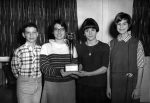
Melanie Samuels, left, and Pam Wolfman were the winners of this year’s mah jongg tournament at the JCC. (photo from JCC)

On any given day and evening across Vancouver, Jewish women are gathering in sets of four and playing mah jongg. But, until recently, only a small number considered the Jewish Community Centre of Greater Vancouver a place to play and learn the game. In December, however, the JCC began offering mah jongg tutorial classes – and more than two dozen women joined in. Friendships are being made around the table, and mah jongg is helping build a women’s social network.

This game has been passed from generation to generation, including renewed interest from younger players, some of whom remember their moms and grandmas playing the game but only now have the interest and time to learn it themselves. On Jan. 28, more than 50 women attended the first-ever mah jongg tournament at the JCC (at least the first in a very long time). The proceeds benefitted Orr Vancouver Israeli Dance School and Festival Ha’Rikud. Pam Wolfman and Melanie Samuels were the tournament winners.

So, how did this centuries-old Chinese game of tiles become such a fixture in the lives of Jewish women in North America? There is much speculation, but one fact is known: Jewish women created the National Mah Jongg League (NJML) in 1937 to create consistency in rules and hands. This stability helped the game survive and spread. Jewish organizations selling cards generate charitable donations to causes of their own choosing, a feature of the league that encourages the quest for new players. In Vancouver, local sales of the game cards generate needed funds for the food bank at Jewish Family Services.

Historically, Jewish women found mah jongg to be an inexpensive form of communal entertainment, particularly in the urban setting of New York, and the game’s popularity spread from friend to friend, mother to daughter, according to Anita Luu and Christi Cavellero’s book Mah Jongg: From Shanghai to Miami Beach. And now, younger women learning the game are getting a newfound understanding of why their mothers were so passionate about the game that they and their friends played for decades together.

Players of all levels are welcome to join Mah Jongg & Margaritas, on March 8, 7:30 p.m., at the centre. The no-admission event is underwritten by the Marion Seeklus Mah Jongg Fund, a newly established endowment for mah jongg programming at the JCC. To attend, contact Lisa Cohen Quay at 604-638-7283 or lisa@jccgv.bc.ca.

A new foundational resource

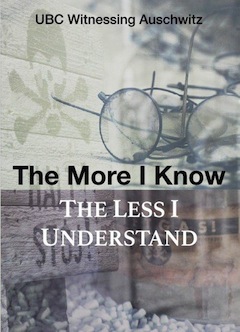
The book The More I Know, the Less I Understand (Auschwitz-Birkenau State Museum, 2017) summarizes the findings of University of British Columbia students in various fields of Holocaust research and the implications of Nazi German crimes committed in Central and Eastern Europe.

It is often claimed that, since the events of the Holocaust took place more than 70 years ago, most of the available information has already been collected and there is little chance of gaining new knowledge about what happened. This claim, often made without substantial questioning, has been debunked by, among others, a group of UBC students who traveled to Poland on the Witnessing Auschwitz Program from 2014 to 2016.

The young scholars conducted extensive fieldwork and consulted with world-class experts in Holocaust studies at the Auschwitz-Birkenau State Museum, the Emanuel Ringelblum Jewish Historical Institute and other organizations; they also used primary-source archival documents. Each of the student essays in The More I Know, the Less I Understand is accompanied by footnotes prepared by experts in the field. The essays show that many complexities of human life and politics, and historic processes associated with the Holocaust and the Second World War, remain understudied. Over the course of the Witnessing Auschwitz Program, the students found more questions to ask with every answer they were able to uncover.

The uniqueness of this volume and its substantial contribution to the market of knowledge rests on the comprehensiveness of the analysis – largely resulting from the diverse areas of expertise of the individual scholars. Furthermore, the authors in the book write on various subjects that have largely remained untouched in Canadian academia: the profitability of the work camps for the German economy; the artistic expression of prisoners; moral dilemmas, such as betrayal of others for the sake of survival; and complex emotions such as love.

book cover - The More I Know, the Less I UnderstandImportantly, various authors in this volume critique the methods by which the contemporary public is educated about events that took place before and during the Holocaust. For example, a common misconception exists, often reinforced through the education system and media, that the rationale for the crimes committed by the Nazi German regime was primarily rooted in ideological conviction. The essays in The More I Know, the Less I Understand collectively show that the motivations behind Nazi German actions prior to and during the Second World War were far more complex.

In early chapters, a number of the scholars correctly point out that the state of the economy was a major motivator for the leadership of the Third Reich. For example, Maria Dawson, in her chapter, “The Role of Food in the Development and Implementation of Nazi German Policies,” writes that the ethnic cleansing of Poles, commonly tied to the ideological motives of Nazi Germany, was substantially rooted in the perceived need of the Nazi regime for agricultural land to support their war effort. Joe Liu, in his chapter, “Deciphering Business Relationships in Nazi German-occupied Europe,” notes that the collection of data on prisoners entailed the development and modernization of mass data collection technology, particularly aided by IBM. The More I Know, the Less I Understand is full of such details, which are often surprising. The book not only breaks common misconceptions about the Holocaust, but provides a comprehensive picture of some of the real reasons behind Nazi crimes.

Because educating Canadian scholars and the public at large about the Holocaust will continue to be important for future generations, the methods of education on the subject must evolve. Helena Bryn-McLeod writes that, because of its importance in our daily environment, the Auschwitz-Birkenau State Museum recently joined various dominant social media networks. Since more people are using the internet than are reading books, social media is, as Bryn-McLeod identifies, “a new mode of remembering.”

Social media can also be an effective tool for the storage and capture of memories in an environment where there are fewer and fewer remaining survivors and other primary carriers of Holocaust memories. Moreover, Bryn-McLeod notes that social media conveys information to readers in similar ways as traditional forms of representation, such as journals and books – through photographs and other visuals – so little content will be lost with the transition to this new mode of memory. However, she acknowledges that, with the internet, new concerns have emerged, such as visitors taking offensive photographs in front of memorial sites and posting them. So, while the rise of fast-access media enables educators to reach a broader audience, Bryn-McLeod warns that ethical issues will continue to arise.

The More I Know, the Less I Understand holds valuable lessons. Notably, it highlights the dangers of adopting radical ethno-nationalistic positions, which, historically, have yielded catastrophic results. In his writing, Mark Twain brilliantly noted that “history does not repeat itself, but it does rhyme.” With the rebirth of populist political discourses in the West and elsewhere, the collection of works in The More I Know, the Less I Understand stresses that it is our responsibility, as a society, through education and awareness, to prevent certain chapters from history to rhyme with future chapters. Ultimately, this unique publication should be a foundational resource in Canadian scholarly environments – and elsewhere – where the subjects of the Holocaust and the Second World War are covered.

Dani Belo is a PhD student at the Norman Paterson School of International Affairs (NPSIA) at Carleton University in Ottawa, specializing in international conflict analysis and resolution. He is the editor-in-chief of the Paterson Review of International Affairs, associate editor at iAffairs Canada and contributing author in various publications for the NATO Association of Canada and the Canadian Global Affairs Institute. His area of research is international security, evolution of Russia-NATO relations, and inter-ethnic relations in the post-Soviet region.

***

The More I Know, the Less I Understand can be purchased at the UBC Bookstore or from the Auschwitz-Birkenau State Museum.

Mystery photo … Feb. 23/18

Beth Israel Synagogue, 1967. (photo from JWB fonds, JMABC L.09754)

If you know someone in this photo, please help the JI fill the gaps of its predecessor’s (the Jewish Western Bulletin’s) collection at the Jewish Museum and Archives of B.C. by contacting archives@jewishmuseum.ca or 604-257-5199. To find out who has been identified in the photos, visit jewishmuseum.ca/blog.

A food fit for a queen

In my North American Ashkenazi house growing up, my mother always cooked arbis at Purim time. The dish is associated with Queen Esther, for whom this was supposedly a mainstay. Why? Because, some Jewish sources say, Queen Esther kept kosher in the court of her non-Jewish husband, King Ahasuerus. Eating this dish nowadays is one way in which Jews remember Queen Esther’s fortitude.

As I recall, this basic and healthy dish of cooked chickpeas took forever to cook, but it was worth it. It had a chewy, nutty kind of taste.

Arbis, like other Jewish foods, has been quite the globetrotter. For example, some Yiddish speakers refer to the dish as nahit, which, according to L.J.G. Van Der Maesen in a 1987 article, is close to the name used in Turkey, Romania, Bulgaria, Iran, Afghanistan and other adjacent former Soviet bloc countries, with arbis actually referring to another legume, peas. However, H. Gams’s 1924 legume study claims that the ancient Greek words for chickpea were orobos and erebinthos, and that these two words are related to the old German word arawiz and sound similar to erbse, the new German word for chickpea.

Besides eating arbis on Purim, traditional Ashkenazi Jews serve this dish at the Shalom Zachar, an after-dinner gathering on the first Friday night following the birth of a baby boy. There is a mourning aspect to this event, as the newborn’s soul, which had once dwelt in the heavenly realm, must now reside inside the earthly, physical body. Hence, arbis is served at this gathering as a food symbolic of the circle of life.

But a different explanation involving a play on Hebrew-Yiddish words goes like this: arbis, the Yiddish word for chickpeas, helps us remember the promise G-d made to Avraham. “I shall multiply [in Hebrew, arbeh] your seed like the stars of the Heavens.” (Genesis 22:17)

There is a Sephardi version of chickpeas, also served on Purim. Iraqi Jews call it sambusak el tawa, or chickpea turnovers. While most recipes call for adding salt and pepper to arbis, nahit or chickpeas, author Claudia Roden, in her book The Book of Jewish Food, suggests serving them as a sweet side dish with sugar or honey. Editors Anne London and Bertha Kahn Bishov also offer a sweet nahit casserole – in their Complete American-Jewish Cookbook recipe, brown sugar is added. Meanwhile, in the Jewish Vegetarian Year Cookbook, authors Roberta Kalechofsy and Rosa Rasiel recommend eating arbis as a Yom Kippur break-the-fast entree containing salt, cumin, green pepper and tomato sauce.

As we read every year, Megillat Esther opens with an assessment of the vastness of King Ahasuerus’s kingdom – it covered areas from India to Ethiopia.

Indian chickpea history goes way back: the earliest occurrence of chickpeas in India dates from 2000 BCE, at Atranjikhera in Uttar Pradesh, according to Van Der Maesen. Moreover, archeologists have discovered Bronze Age (2500–2000 BCE) chickpeas, peas, green gram and black gram inside storage jars at the Harappan site of Farmana, located in the Indian state of Haryana.

The Archeology of Africa: Food, Metal and Towns, edited by Thurstan Shaw, notes that, in the Natchabiet and Laliblea cave excavations near Ethiopia’s Lake Tana, there was evidence of chickpeas, barley and legumes. Significantly, shiro, which is made from powdered chickpeas, is a staple in Ethiopia.

In his book Ancient Canaan and Israel: New Perspectives, Jonathan Michael Golden reports that, during the Early Bronze Age, at Halif Terrace (located in Israel’s northeastern Negev), people were eating chickpeas, possibly with olive oil. Israeli archeobotanists say there was an agricultural revolution during the Neolithic period. Although not the easiest legume to cultivate – the crop can be wiped out by ascochyta blight and needs good drainage in sunny, dry, warm conditions – chickpeas became one of the early domesticated plants. Zohar Kerem, Simcha Lev-Yadun, Avi Gopher, Pnina Weinberg and Shahal Abbo offer an explanation. In a 2007 article, they claim that the cultivators of that period sensed the nutritional benefits of chickpeas. Today, scientists know that chickpeas are rich in tryptophan, an essential amino acid. They can bring about higher ovulation rates, improved infant development, a feeling of satiety, better performance in stressful situations and a lessening of depressive moods.

Indicative of how important chickpeas are to the Mediterranean diet, an international Hummus Day was inaugurated almost six years ago, on May 13. But let’s give arbis the last word: what goes around, comes around. Here’s a recipe.

ARBIS

1 pound uncooked, dry chickpeas
Cold water to cover chickpeas
Salt to taste (added during the cooking process)

Soak the chickpeas 12 to 24 hours in a pot. Drain the water and rinse the chickpeas to get rid of possible lectin, phytic acid and enzyme inhibitors. Return the chickpeas to the pot, adding enough water to cover them, plus another two inches. Total cooking time will be about two hours, but could be up to four hours, depending on what you consider tender or soft. Cook with the pot covered. Skim off the white froth, which early in the cooking might form at the top. Keep the flame low and add water as needed. After 45 minutes, add salt to taste and go back to cooking the chickpeas. When soft enough to eat, drain and spread out on a paper towel to dry. Sprinkle with salt. May be served hot or cold.

Deborah Rubin Fields is an Israel-based features writer. She is also the author of Take a Peek Inside: A Child’s Guide to Radiology Exams, published in English, Hebrew and Arabic.

Denying facts not a solution

For years, Poles have bristled at terms like “Polish death camps” or “Polish concentration camps.” Rightly so. Places like Auschwitz-Birkenau were Nazi German camps on Polish soil. Calling them Polish camps was misleading and imputed the murder of millions of Polish Jews (and many other Poles) to Poles themselves. This is a linguistic formulation that should be avoided.

But it should not be illegal. There are few, if any, words that should be illegal, in our judgment. But the Polish government thinks otherwise and has passed a law that penalizes any suggestion that Poland was complicit in the Holocaust. So, anyone who uses such terminology as “Polish death camps” could face fines or up to three years’ jail time.

However, while the camps were German, there has never been any question about the willing complicity of plenty of Poles in the extermination of most of their Jewish compatriots. Many Poles were conscripted into the Nazi killing program, but others willingly advanced the mission. Notably, the murder of Jews in Poland did not end with the Nazis’ defeat. There were many instances of Holocaust survivors returning to their homes after the war only to be murdered by their former neighbours, the most notorious example being the Kielce pogrom of July 1946, in which about 40 Jews were killed and as many injured. To utter these facts in Poland now is presumably illegal. On the other hand, it is presumably not illegal to state the fact that many Poles risked their lives to save the lives of Jewish Poles.

The dreadful and confusing new law has been condemned by the American and Israeli governments, among others. Israel’s criticism hit a particular nerve with Andrzej Zybertowicz, an advisor to the Polish president and a sociology professor at Nicolaus Copernicus University. He suggested that Israel’s response to the law resulted from a “feeling of shame at the passivity of the Jews during the Holocaust” and he accused Israel of “clearly fighting to keep the monopoly on the Holocaust.” He went on to say: “Many Jews engaged in denunciation, collaboration during the war. I think Israel has still not worked it through.”

The irony is as stark as it is distressing, that Zybertowicz could accuse Israel of failing to work through its Holocaust history when his own country has just codified its own refusal to do just that.

Conversely, Germany has just announced that it will acknowledge as Holocaust survivors Jews who lived in Algeria under the Nazi-collaborationist Vichy French regime. This means about 25,000 people will be eligible for some compensation under the Conference on Jewish Material Claims Against Germany. This is a positive development, no matter how late it has come.

These two very different present-day actions, 73 years after the liberation of the camps, are but two examples of how we are still navigating the facts of the Holocaust. We are still determining, among much else, who are to be included among the perpetrators and who among the victims. And these are not even the much more difficult, perhaps impenetrable, moral questions and issues raised by the Holocaust. We have not come close to understanding the patterns of antecedents, the human and historical prerequisites that allowed the Holocaust to happen – and which permit genocides to continue happening.

Klondike’s Jewish links

Entrance of the Jewish Cemetery in Dawson City, Yukon. The sign reads Bet Chaim (House of the Living). The photo was taken in 1961. (photo by Irving Snider; Dr. Irving and Phyliss Snider fonds; Jewish Museum and Archives of BC L.18992)

As visitors to the traveling exhibit The Jewish Presence During the Klondike Gold Rush 1897-1918 will learn, while the hope of striking it rich drew thousands upon thousands to the Klondike during the gold rush, most had left the region within five years, many as poor as when they arrived.

The exhibit, created by the Jewish Cultural Society of Yukon, is currently at Temple Sholom and will open at Congregation Beth Israel on Jan. 31, 7:30 p.m. The opening will feature a talk by Michael Schwartz of the Jewish Museum and Archives of British Columbia, and the exhibit will be on display at BI until Feb. 7.

The first panel, called “Gold Fever Strikes,” begins, “It was at Schwabacher’s dock on Seattle’s Elliott Bay that the steamer Portland arrived on July 17, 1897, with her ‘ton of gold’ that electrified the world and sparked the Klondike gold rush. Soon thousands would leave that dock and others on their way to Alaska.” It notes that the Schwabachers – Abraham, Sigmund and Louis – who founded their Seattle merchandising business in 1869, had been born “in Germany of Jewish heritage” and “they left to escape the oppression of Bismarck.” The rest of the panel highlights several Jews who were involved in supplying goods and transportation to Yukon.

The second panel – “Life in the Klondike” – relates some of the stories of successful, and not so successful, Jewish prospectors and merchants. For example, “Louis Brier, a native of Romania, followed the rush and provided grubstakes to prospectors on a percentage basis. He eventually left for British Columbia with what he called ‘a rather bulging bankroll,’” it notes.

One of the less happy outcomes is that of the Shudenfreis. Among the first Jews to arrive, in fall 1897 to Dawson City, Solomon and Rebecca Shudenfrei came to the Klondike without their children. By September 1898, Rebecca had left and, soon after a fire in March 1899 that destroyed many of the city’s homes and businesses, including Solomon’s hotel, Solomon also left. The loss of the hotel was a mixed blessing, according to a letter he wrote: “I only lost all I had, which is not much, and I was glad that the fire occurred so that I could get rid of all my bed-bugs, which I could not do otherwise … the loss is not so great when you come to consider that we would have to remove the building anyhow by May 1, and [that] would have been a great expense to me…. The whole town is on the buy, and all my acquaintances are not any better off than I. This is the only consolation we have.”

The second panel also touches upon other aspects of life at the time – religious observance, politics, the Jewish cemetery and crime (of which Jews, as much as anyone else, were among the victims and perpetrators). The third panel, “After the Gold Rush, Where Did They Go?” provides brief descriptions of where some 15 Jews went after the rush was over.

The exhibit includes a booklet, as well as four videos, each about eight minutes long. They centre on the finding and rededication of the Jewish cemetery in Dawson City in 1998. One video shows the finding of the cemetery, which was established in 1902 but fell into disrepair as the Jewish presence in the area disappeared; one video covers the cemetery’s restoration; and one the July 31, 1998, rededication ceremony, which included many guests, including then-deputy prime minister Herb Gray, who spoke at the ceremony. (Gray passed away in 2014.) The fourth video, explains the document about the exhibit’s setup, “is the CBC TV coverage of the arrival of a Torah, the first time in history that Shabbat services were held in Whitehorse, a little tour of Dawson City … and the rededication services.”

That Torah, in 1998, was only the second to have been brought to Whitehorse – the first having been brought during the gold rush. With the rededication, the Dawson City Jewish cemetery, Bet Chaim (House of the Living), once again became a place where Jews can be buried.

photo - Rick Karp, president of the Jewish Cultural Society of Yukon
Rick Karp, president of the Jewish Cultural Society of Yukon. (photo from JCSY)

“Cyril Leonoff’s book Pioneers, Pedlars and Prayershawls: The Jewish Communities in British Columbia and the Yukon was what started all of our research,” said Rick Karp, president of the Jewish Cultural Society of Yukon, in an email. Additional research was contributed by Dr. Brent Slobodin, who has a doctorate in Canadian history from Queen’s University and was the assistant deputy minister of advanced education in Yukon. Slobodin has been a member of a number of heritage advisory and volunteer boards.

Karp’s day job is president of the Whitehorse Chamber of Commerce, and Slobodin joined the chamber when he retired to manage its Partnering for Success Program, Karp told the Independent. “As an historian, he was fascinated with the work we were doing on the Jewish presence during and after the Klondike gold rush and we hired him to work on the research, design and preparation of the mobile display,” said Karp.

Now that the exhibit has been completed and displayed both within and outside of Yukon, Karp said the cultural society has two main priorities, the first of which is keeping “the display going across the country, so, after Vancouver, it will go to Edmonton, Calgary and Winnipeg. Then we will get it back here and it will go to Alaska and a few other cities in the U.S.”

The second priority is closer to home. “We are also educating the Yukon on what it is to be Jewish so, for example, we celebrate Passover and have the seder in the United Church meeting hall (about 40 people attended last year), and we are part of the interfaith community in Whitehorse,” said Karp.

“We also have more than 12 Israelis living in Whitehorse and have visits from Israel often,” he added. “For example, we have Dr. Wayne Horowitz coming … from Hebrew University and we will have him do presentations when he is here, and Dr. Paul Sidoun, as well, who is coming in February.”

Perpetrators offers new insights

Who could shoot at close range two million children, women and men who were standing at the sides of graves they had just been forced to dig? And then, when this process proved inefficient, who could herd four million more into cement bunkers and drop cyanide pellets on top of them? Were they monsters?

“Monsters do exist,” Primo Levi once said, “but they are too few in number to be truly dangerous. More dangerous are the common men, the functionaries ready to believe and act without asking questions.”

Christopher Browning, in his famous 1992 study of Holocaust perpetrators, Ordinary Men, came to the same appalling conclusion: the killers were simple, middle-class working men, “believing Christians” from all walks of life (including thousands of priests and seminarians), just witlessly and anxiously “following orders” and blindly obeying peer pressure, not, in most cases, virulent antisemites.

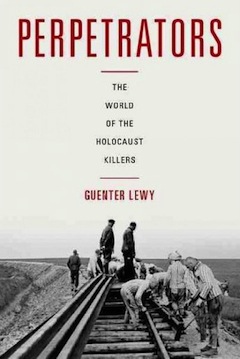
book cover - Perpetrators: The World of the Holocaust KillersThe controversial nonagenarian scholar Guenther Lewy, the author of Perpetrators: The World of the Holocaust Killers (Oxford University Press, 2017), and son of a camp survivor, begins his new study of Holocaust perpetrators with the same question: “How could such terrible deeds happen in the heart of Christian Europe and among a nation known for its poets and thinkers? What had converted so many seemingly ordinary people into killers, willing participants in what is the worst crime in modern history?”

Lewy’s study is the first English-language volume to make use of the 49-volume collection of 929 German trial records of Holocaust perpetrators recently published by the University of Amsterdam (it is not made clear why the records were not published in Germany). He also draws upon an enormous accretion of “previously untapped” sources such as the 50,000 letters and diaries of Wehrmacht soldiers recently released by German archives, as well as victim recollections and, most importantly, hundreds of trial records of Nazi functionaries, beginning in Nuremberg in 1945 and continuing to the present day. Of the 1,200 citations in the 25-page bibliography and the 600 footnotes, by far most of them are from the late 1990s to the present.

Lewy’s conclusion is similar to Levi’s and Browning’s: the perpetrators were not characteristically sadists or psychopaths, or even necessarily antisemites, but simply obtuse followers of orders, vassals to peer pressure, or simply “ordinary people” trying to advance their careers.

Lewy’s graphic details and conclusions will be familiar to readers of Saul Friedlander’s monumental Nazi Germany and the Jews, 1939-1945: The Years of Extermination (2007), but Lewy’s access to the most recent documentation brings some new and important facts to light.

First, the whole notion of a “clean Wehrmacht” can now be dismissed. Lewy proves conclusively that there was close contact between the Wehrmacht and the SS and particularly the 38 “Totenkopf” (“Death’s Head”) divisions of the Waffen-SS: new evidence shows that Jews were “squarely in the crosshairs of the Wehrmacht” and that the number of members of the Wehrmacht who took part in the murder of Jews “is in the tens of thousands.”

Second, Lewy’s close study of the new material available allowed him to conclude that “not a single person who asked to be relieved [from duty in the killing squads] was tried by a military court” and, in fact, “most of their requests were granted.” Lewy found 85 cases of Wehrmacht soldiers who refused to shoot civilians: all were simply transferred to other duties. The significance of this finding, of course, is that it puts the lie to the excuse frequently made by the killers that they “had no choice” and “had to follow orders.” (Lewy points out, significantly, that Yad Vashem has in fact recognized 45 Wehrmacht soldiers as “saviours of Jews.”)

In the sixth chapter of Perpetrators, “Flawed Justice,” Lewy makes his most significant mark. Here, Lewy reveals that, of the 200,000 or so former Nazi killers who, through 2005, were investigated by German authorities, fewer than 10% had charges brought against them; and, of these, only half were convicted. Light sentences were the norm; and only eight of the 2,000 former members of the Einsatzgruppen investigated received life sentences. Most of these examples of “flawed justice,” Lewy concludes, had to do with the fact that so many judges were “tainted” as former party members, and that German law (unlike Canadian law) distinguished between perpetrators and accomplices, usually finding the latter innocent, as they were “only following orders,” that they were only “tools” or were not “unseemingly zealous” in their murderous actions. (Two years ago, German courts finally adopted Canadian/American style “common design,” sharing the guilt between perpetrators and accomplices.)

In his final chapter, “Explaining the Holocaust,” Lewy concludes that nobody, ultimately, can simply give up his freedom. Situation, genetics, conditioning are all significant, but “they do not dictate or determine character.” In fact, recalling how anxiously in 1945 the Nazis strove to cover up what they had done led Lewy to conclude that “even Hitler and the members of his immediate entourage probably knew deep down that they were doing wrong.”

And, as Lewy concludes, in his last sentence, “The fact that so few avoided evil orders remains an ineradicable blot on an entire German generation and a cross that their descendants continue to bear.”

Perpetrators is a valuable addition to a long story, one which may never be conclusively told.

Graham Forst, PhD, taught literature and philosophy at Capilano University until his retirement and now teaches in the continuing education department at Simon Fraser University. From 1975 to 2010, he co-chaired the symposium committee of the Vancouver Holocaust Education Centre.