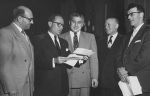
Mystery photo … May 18/18

B’nai B’rith, 1966. (photo from JWB fonds, JMABC L.09493)

If you know someone in this photo, please help the JI fill the gaps of its predecessor’s (the Jewish Western Bulletin’s) collection at the Jewish Museum and Archives of B.C. by contacting archives@jewishmuseum.ca or 604-257-5199. To find out who has been identified in the photos, visit jewishmuseum.ca/blog.

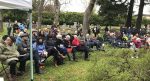
Retracing family history

(photo from Victoria Shoah Project)

The following remarks have been edited from a talk given at the April 15 Yom Hashoah commemoration at Victoria’s Jewish Cemetery, which was organized by the Victoria Shoah Project.

I recently saw a beautifully poignant play called We Keep Coming Back. It’s about a Jewish mother and her son who – in real life – travel to Poland, retracing the steps of her parents, who survived the Shoah. They documented their journey and now share their experience with audiences in theatres around the world. Their play triggered me on many levels.

I have yet to do my roots trip. I’ve been thinking about it, but haven’t done it yet. At the age of 30, I have done extensive traveling around the globe, yet somehow have always managed to avoid four places: Poland, Belarus, Japan and New Denver (the Slocan Valley camp where my Japanese-Canadian family was interned). After being exposed to this mother and son’s story and seeing proof that traveling to an historically hostile land can be done and that it can be a profound and life-changing experience for the better, I am finally at a point in my own life journey where I feel ready to start tracing the steps of my grandparents on both sides of my Second World War-torn family.

* * *

It was a sweltering hot summer day in Israel and I was 12 years old. I was helping my mom clean my grandparents’ gravesites in a Haifa cemetery, overlooking the Mediterranean Sea, located on Mount Carmel (after which I’m named). In this cemetery, in addition to the person’s name who is laid to rest, there are also the names of grave-less victims etched into the headstone of their one surviving family member. My maternal grandparents’ headstones are no different.

Shifra Atlasovich (my savta) was born in Bialystok, Poland, in 1917. She was the daughter of a wealthy businessman who owned a cooking oil factory. Before the war, she attended the Hebrew Gymnasium High School, enjoyed traveling and skiing, and was admired for her beauty, especially her blond hair and blue eyes. She married her high school sweetheart and seemed to have a picture-perfect life.

A year before the war broke out, her mother died of cancer, which, some say, was a blessing, considering what was to follow. When the war began, her father was deported by the Russians, who occupied eastern Poland and deported all capitalists and influential people to Siberia. He suffered an unknown fate.

Shifra, her husband and her brother were also deported by the Russians, but sent to Kazakhstan, where they spent the rest of the war. When the war ended, non-Russians were given an opportunity to return to their home countries. Taking advantage of this, Shifra left with her infant son and brother, leaving behind her husband (her sweetheart), who, after being tortured and brainwashed by the KGB, chose to stay behind and become a communist – she never saw him again.

Once back in Poland, Shifra handed her son to Catholic nuns while she and her brother searched for survivors. She went to their family home, which had been taken over by their gentile nanny, who said that, if Shifra did not leave the premises immediately and cease to claim the house, she would call the neighbours, who may kill her.

When Shifra went to pick up her son, he was warm, well-fed, settled and no longer on the run – but the nuns refused to return him. Only with the help of American officers was she able to get him back.

From Bialystok, they migrated to West Berlin, where they stayed in a refugee camp and she taught Hebrew to orphaned children. While there, her brother fell ill and, tragically, died at the age of 33 in a hospital in East Berlin from an infection of the lining of his heart, which today could have been cured by penicillin, a rare commodity back then.

Berel “Dov” Gottlieb (my saba) was born in 1914 in Drahichyn near Pinsk, Poland (today, Belarus), into a working-class family. He was a skilled carpenter by trade and married when the war broke out – he had to leave his pregnant wife when he was drafted into the Polish army, which quickly lost within several weeks to the Nazis. He later escaped to Russia, joining to fight with the Jewish Partisans.

Dov’s second-oldest brother, Mordechai, fled to Israel in 1938. After the war, Dov found out that most of his family, including his parents, five other siblings, as well as his wife and newborn daughter, were all sent to Auschwitz concentration camp and gassed to death.

Dov secured a visa to the United States – he had relatives in Chicago, who had emigrated in 1905 after pogroms in Eastern Europe – and made his way to a refugee camp in West Berlin to wait for his pending departure. It was there he met my grandmother, Shifra, and, instead of going to America, they headed to Israel on the first boat to enter the newly independent country in 1948. There, he was reunited with his brother, Mordechai.

Both Dov and Shifra became active members of the Irgun, an underground resistance movement headed by Menachem Begin.

* * *

In 1950, my mother, Dalia Gottlieb, was born in Haifa, Israel. During her days at Bezalel Academy of Arts and Design in Jerusalem, she fell in love with a Japanese-Canadian foreign exchange student, my father, Mineo Tanaka, and would follow him to Canada, eventually marrying him in 1976. My sister Talia was born in 1979 and I came along in 1987.

I remember spending many a summer in Israel visiting my grandparents. I didn’t know Hebrew well at the time or Yiddish or Polish, so, in the absence of a common language, I would play gin rummy – Shifra’s favourite card game – repeatedly with her. Boy, was she good at that game, and taught me to be just as ruthless. I’d give endless bear hugs to Dov and lick my plate clean at every meal to show them just how much I loved them and their matzo ball chicken soup.

Dov passed away in 1995, followed by Shifra in 2004, taking with them the chance for me to ask the questions to which I so crave answers: What was your life like before the war? What did you enjoy doing? Do I remind you of any of my relatives? What were my great-grandparents like? How did you survive? How did you find the will to live life? To start again? It’s questions like these that the child I was would not have thought to ask, but nor would I have understood the answers.

On that hot summer day visiting my grandparents’ final resting place, I noticed that the names of my grandfather’s first wife and first daughter (my half-aunt) were not written on his headstone. At this point, my grandmother was still alive and had been active in getting both his and her headstones engraved. In retrospect, I feel bad assuming my grandmother had something to do with the missing names on his headstone. When I spoke with my mother, she told me that she once asked her father about them and the sad truth was that he couldn’t remember his first wife’s name or what she looked like, and he never had the opportunity to meet his firstborn and learn her name. It was in this moment when I first learned about the impact of trauma and that there could be such a thing as repression in people who have gone through horrific loss.

* * *

Between the Holocaust survivors on my mother’s side and my interned Japanese-Canadian grandparents on my father’s side (a story for another time), I joke that there is enough post-traumatic stress disorder to go around in my family. But, pushing dark humour aside, I would like to draw attention to what has and continues to be a rather taboo topic at many Holocaust commemorations and symposiums – the topic of trauma, specifically intergenerational trauma.

When people tell me, “The Holocaust happened long ago … get over it … it’s time to move on,” I find it very hard to do so. Among other things, I have been raised and prepared my entire life for when the Nazis, or their equivalent, will return.

There are no longer survivors in my family to tell the world about what happened to them, and I am their voice now. I consider myself one of the lucky ones, as I know from my mom the survival stories of my Jewish grandparents – not everyone does. My personal post-Holocaust syndrome has thankfully, to my knowledge, not presented itself in the form of serious or debilitating mental illness or addiction; however, some of my family members have not been so fortunate. I speak candidly to break down these chains and to spread awareness within our own community and beyond – on the need for proper support for victims of trauma to ensure a brighter future.

I plan to drive to New Denver this summer and fly to Poland next year. My story is just beginning.

Carmel Tanaka is partnerships manager at the Centre for Israel and Jewish Affairs, Pacific Region, and former director of the University of Victoria branch of Hillel BC.

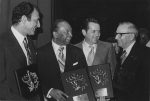
Mystery photo … April 20/18

B’nai B’rith, 1977. (photo from JWB fonds, JMABC L.09486)

If you know someone in this photo, please help the JI fill the gaps of its predecessor’s (the Jewish Western Bulletin’s) collection at the Jewish Museum and Archives of B.C. by contacting archives@jewishmuseum.ca or 604-257-5199. To find out who has been identified in the photos, visit jewishmuseum.ca/blog.

Tel Aviv’s Independence Trail

Children follow the new Independence Trail in Tel Aviv. (photo by Ricky Rachman)

In honour of Israel’s 70th Independence Day, the city of Tel Aviv has introduced a new interactive walking route that takes visitors past 10 of the city’s heritage sites. All of the sites are connected in some way with the Declaration of Independence and the beginnings of Tel Aviv itself.

The trail is just under a kilometre long and features a golden track that illuminates at night. The route begins at the first kiosk of Tel Aviv, at the intersection of Rothschild Boulevard and Herzl Street. The walking route brings two stories to life that are central to the story of modern Israel: the birth of Tel Aviv, the first Jewish, self-governed, Hebrew-speaking city, in 1909; and how, in 1948, Tel Aviv would make way for the birth of the state of Israel, fulfilling a millennia-old dream.

Visitors can follow the route with a mobile app, or can guide themselves using a map that features information in eight different languages.

The building of the trail demanded extensive infrastructure work, including the implementation of a unique lighting system that allows visitors to walk along the trail at night. The Independence Trail was inspired by the Freedom Trail in Boston, one of the most popular heritage sites in the United States.

The Independence Trail’s 10 sites are:

The first kiosk was established in 1910, and quickly became a central meeting place. During the 1920s, about 100 kiosks operated in the city under the Association of the Kiosk and Soft Drink Store Owners.

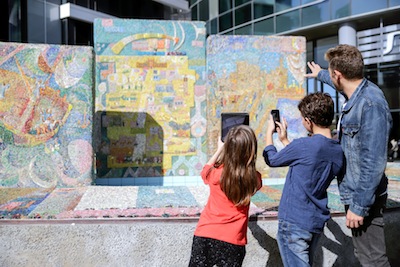
photo - The mosaics at Nahum Gutman Fountain
The mosaics at Nahum Gutman Fountain. (photo by Ricky Rachman)

Nahum Gutman Fountain: Nahum Gutman was an Israeli artist who grew up in Tel Aviv along with the new city, and whose work reflected the simplicity of the early days of “the First Hebrew City.” An illustrator, photographer and writer, Gutman was awarded the Israel Prize in 1978. His mosaics around the fountain tell us the history of Jaffa, the ancient port city from which Tel Aviv was born.

Akiva Aryeh Weiss’s house: Weiss was the founder of the Ahuzat Bayit neighbourhood, which evolved into Tel Aviv. As president of the then newly established building society, Weiss presided over the 1909 lottery in which 66 Jewish families drew numbers written on seashells to determine the allocation of lots in the about-to-be established city.

Shalom Meir Tower: former site of the Herzliya Hebrew Gymnasium, the first Hebrew-language high school. The building on Herzl Street was a major Tel Aviv landmark until 1962, when it was razed for the construction of the tower. Its destruction sparked widespread recognition of the importance of conserving historical landmarks. Today, Shalom Meir Tower is home to a visitors centre about the history of Tel Aviv, which is open, free to the public, on weekdays.

The Great Synagogue was the spiritual centre of Tel Aviv, located in the heart of the city’s business centre. The building features a huge dome, elaborate lighting fixtures and magnificent stained glass windows.

The Haganah Museum is located in what was the home of Eliyahu Golomb, the founder and de facto commander of the Haganah. From 1930 to 1945, the Haganah’s secret headquarters were located in this house. Golomb’s residential room, his office on the ground floor, as well as the exterior of the house, were fully preserved. The museum will be open to the public free of charge during 2018, to mark Israel’s 70th anniversary.

Bank of Israel’s Visitors Centre, at the historical headquarters of Israel’s national bank, presents the history of the financial system in Israel. It features an extensive exhibit of banknotes and coins issued from pre-state days to the present. The centre also will be open to the public free of charge until the end of the year.

Tel Aviv Founders Monument is dedicated to the men and women who established Tel Aviv in the first half of the 19th century. It is a quiet spot, dotted with benches and centred around a small pool and fountain.

Statue of Meir Dizengoff, honouring the first mayor of Tel Aviv, who was known for riding his horse from his home – which is now Independence Hall – to City Hall, which was then located on Bialik Street. The statue of Dizengoff on his horse was created by artist David Zondolovitz.

Independence Hall: Dizengoff dedicated his home for the establishment of the Tel Aviv Museum of Art. In the home, on May 14, 1948, the ceremony of the Declaration of Independence took place.

In addition to the Independence Trail, visitors will be able to enjoy, until the end of December, the Israeli Democracy Pavilion, which features a presentation about the story of the Declaration of Independence. The project, which is a collaboration between the Israel Democracy Institute and the Tel Aviv-Yafo Municipality, takes place in a majestic pavilion on Rothschild Boulevard, in which visitors are shown a film in 360 degrees, highlighting important moments of Israeli democracy. The pavilion is surrounded by arcades reflecting the diversity of Israeli society. Selected quotes from the Declaration of Independence are showcased on the pavilion’s arches and visitors are invited to sign a pledge to uphold the core values of the declaration. Entry to the film is free of charge, and the pavilion is expected to travel to other cities in Israel next year.

Mystery photo … March 30/18

B’nai B’rith, circa 1970. (photo from JWB fonds, JMABC L.09551)

If you know someone in this photo, please help the JI fill the gaps of its predecessor’s (the Jewish Western Bulletin’s) collection at the Jewish Museum and Archives of B.C. by contacting archives@jewishmuseum.ca or 604-257-5199. To find out who has been identified in the photos, visit jewishmuseum.ca/blog.

The import of pigeons

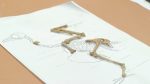
Pigeon bones from 1,500 years ago. (photo from University of Haifa via Ashernet)

Israel’s Negev Desert has not always been a dusty, almost treeless place – 1,500 years ago, many parts of the Negev were green and produced basic foods. And a new study – led by Dr. Nimrod Marom of the University of Haifa and Tel Hai College, in cooperation with Prof. Guy Bar-Oz and Dr. Yotam Tepper of the Institute of Archeology at the University of Haifa and Dr. Baruch Rosen of the Volcani Centre – reveals the first archeological evidence of the role played by pigeons in Byzantine agriculture: improving and fertilizing soil in vineyards and orchards. Among other goals, the researchers are interested in understanding how the Byzantines managed to maintain a broad-based agricultural system in the desert, and what led to the sudden abandonment and eventual collapse of these flourishing communities. 


A grandfather’s sins

Prof. Roger Frie’s  Not in My Family rises above the merely personal (image from cenes.ubc.ca)

Forty-three years ago, at Vancouver’s first Holocaust Symposium, for which I was the chair, the keynote speaker was the Lithuanian partisan fighter Leon Kahn. His presentation to a large group of high school students described, among other things, how he watched, in hiding, while his mother and sisters were raped and murdered by members of the Einsatzgruppen – the murderous “task forces” mandated to kill Jews by gunshot (the so-called “Holocaust by bullets”) in German-occupied countries. Approximately two million Jews were murdered by the Einsatzgruppen.

After Leon was finished speaking, a tall, blond, blue-eyed boy walked slowly up to the podium. He was, he said, of German origin, and wanted to apologize to Leon. His face revealed how devastated he was. Leon shook his hand and told him, “Look, it wasn’t your fault. Now go on and live your life.”

That was my first experience with deutsche Schuld, German guilt.

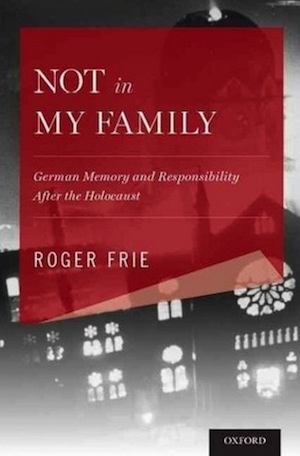
There are literally hundreds of books and websites approaching deutsche Schuld from every angle. The author of Not in My Family: German Memory and Responsibility After the Holocaust (Oxford University Press, 2017) is Roger Frie, a Simon Fraser University professor and locally practising psychotherapist who is a third-generation German-Canadian. Based on his profession, he addresses the issue of German guilt in the present book from a personal psychological perspective, using his fear of being exposed as a “bad German,” along with his experience with inherited guilt, as his templates.

Frie’s Not in My Family was triggered, he says, by his mid-life discovery, long hidden by his family, of his beloved grandfather’s Nazi past. The book invites us to follow him as he slowly builds up the courage to go to the archives in Berlin to find the documentation revealing his grandfather’s Nazi membership and wartime activities.

“Opa” was hardly a high-ranking Nazi functionary, it turns out: he was “an ordinary German,” who operated, for all intents and purposes, as a minor motorcycle repairman. (Frie writes more about this apparently apolitical “motorcycle club” later in the book, but one is still left to wonder how the author, already heavily burdened with inherited guilt, would have felt if his Opa were discovered to have been say, a camp guard, or a member of the Totenkopfverbaende, the infamous Death’s Head Units.)

Ironically, Frie has professionally analyzed children of Jewish survivors, and some of his most intimate reflections arise from his wrestling, during these sessions, as to whether or not to reveal that he is himself of German heritage.

image - Not in My Family book coverConstantly throughout Not in My Family, Frie reiterates that he “has an obligation to remember the past” and, while remembering, he has many sincere reflections on post-Holocaust German guilt and responsibility, complicity, prejudice, cowardly denial and “shameful silence” of past issues, as well as, of course, the “need for redemption” and “the problematics of trauma,” especially of his own, rooted in a questionable notion of vicarious perpetration, three generations down the line.

On this last point, clearly, there was a therapeutic dimension for the writing of Not in My Family: it reflects on every page. But the book rises above the merely personal. For example, Frie is brutally honest in rejecting the moral camouflage of the “Germans suffered too” ilk, and on the need to be suspicious of Germans who feel “deluged” with the Holocaust.

Near the end of Not in My Family, Frie reflects that “writing can be a form of discovery, of examining life and making sense of the past.” This book, for him, he admits, was “personally meaningful” and “emotionally draining.” But if, as he puts it, the book “creates a space for dialogue and reflection on the nature of German memory and the Holocaust,” it is a valuable contribution to an ever-growing body of knowledge about how the greatest crime in human history came to be perpetrated by, among others, affectionate, family-loving, probably not dogmatically antisemitic, minor motorcycle repairmen.

Graham Forst, PhD, taught literature and philosophy at Capilano University until his retirement and now teaches in the continuing education department at Simon Fraser University. From 1975 to 2010, he co-chaired the symposium committee of the Vancouver Holocaust Education Centre.

Londres foresaw fate of Jews

Albert Londres was a Parisian journalist born in 1884. He became an international reporter who chose to chronicle human suffering and expose injustice and cruelty. He denounced inhuman conditions in mental asylums, the ordeals of black workers, conditions in a penal colony. His journalistic philosophy: “our profession is not to give pleasure nor to do harm; it is to twist the pen into the wound.”

Why was I drawn to Londres’ The Wandering Jew Has Arrived (Gefen Publishing House, 2017)? For one, I had spotted it in Israel and it was produced by Gefen, a familiar name in the publishing world. Its founder, Murray Greenfield, his late wife, Hana, and I once visited Terezin together and his son, Ilan Greenfield, published a book about the Buchenwald boys I co-wrote with Judith Hemmendinger back in 2000.

Secondly, I quickly read the introduction by Rav Daniel Epstein. He described Londres as a non-Jewish Parisian reporter with an insatiable curiosity. He wanted to inform his French readers, “nurtured for centuries on a teaching of contempt and antisemitic clichés,” about the world of Jews, a world he also did not understand. So he learned. He observed. He made a brief visit to Poland in 1926 and was exposed to the reality of pogroms and ghettos (his word for shtetls). Who would not want to join him on his journey?

In 1929, he began to familiarize himself with the London Jewish community of Whitechapel. Then he traveled to Poland, Russia and Romania. He described observant and secular Jews, Zionists and anti-Zionists, Torah scholars, yeshivah students. From all that he observed and experienced, Londres concludes “the passion for learning is uniquely Jewish,” and links this passion as “undoubtedly the real mystery of Israel and the secret of its survival.”

He discussed the dangerous circumstances of Jews living among hostile nations in 1929. “The Jew,” he writes, “is guilty of one crime; that of being Jewish.” He elaborates, “A Pole or Russian chases a Jew from a pavement as though the Jew who is passing by, is stealing his air.” Londres travels as well to Palestine to witness and observe a “metamorphosis: the cowering Jew of the ghetto now holds his head high … he finds the wandering Jew in Jerusalem.”

Londres’ translator, Helga Abraham, writes, “Still widely read in France, the book came to my attention when the Hebrew translation was published in 2008 (Nahar Books). Surprisingly, I discovered that no English translation was available. An English translation had been published in 1932 but soon was out of print. I use the word surprisingly because it is hard to read this work without being arrested by its enormous significance – as a unique eyewitness account by a non-Jew of a pivotal period in Jewish history, as a major literary work in itself and as a masterful example of journalism at its best.”

Let me take you through some of his journey. In the opening chapter, “A Bizarre Personage,” he describes meeting in London the Jew who would squire him on his journey – a Polish Galician rabbi on a fundraising mission in London.

Londres wrote, “But I had to begin in London. Why? Because England, 11 years ago, had proclaimed to the Jews the same words that God, sometime before, had proclaimed to Moses on Mount Horeb,” assigning him the land of milk and honey.

This time the proclamation had come from Lord Balfour. Londres records both proclamations adding, “England knew how to defend its interests better than God His: God had given Palestine and Transjordan in one stroke. Lord Balfour kept Transjordan.”
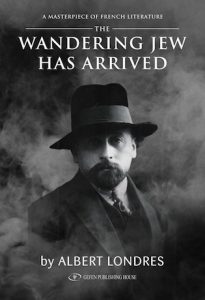
image - The Wandering Jew Has Arrived book coverLondres writes of the 1917 Balfour declaration as well as the betrayal of the Jews following the declaration, because, although the San Marino conference legalized the promise, by 1922, 78% of the British Palestine mandate was severed from becoming a potential Jewish area. And, only 10 years later, in 1939, unbeknown to Londres, who died in 1932 in a fire that broke out on the boat returning him from Shanghai, the slaughter of Europe’s Jews began.

It is all forecast by him, as he describes Jewish history to that time and modern Jewish history from the days of Theodor Herzl (1860-1904). Herzl became a journalist in Paris, where he witnessed the Dreyfus Affair. He wrote a book called The Jewish State. He was particularly shocked by hearing the cry, “Death to the Jews” in Paris, particularly in France where, “if the suspicion that rested on an individual (Alfred Dreyfus) was projected onto all, it meant that a Jew, even in this privileged country was not in his own home.”

Herzl set out to convince monarchs and leaders to establish a home for the Jews. He visited heads of state, royalty and philanthropists, and reunited Israel as a nation, in Basel, for the First Zionist Congress. In London, 10,000 Jews came to hear him. In Vienna, another 10,000.

His schedule was hectic, his leadership challenged and he succumbed to illness at age 44. Londres notes: “Herzl is dead. His dream lives on!” Londres writes, “Three thousand two hundred forty-seven years after Moses, he succeeded Moses.” And, “He awoke a people that had slumbered for nineteen centuries.”

And so, Londres embarks on his mission to describe “the state of the Jews in the world to the French.” In London, he speaks with immigrant Jews and recognizes that, in countries like Poland and Romania, due to antisemitism, “A Jew over there is always a Jew. He may be a man, but he is neither a Romanian nor a Pole. And if he is a man, he must be prevented from growing.”

Londres places into historical perspective the Lord’s designation of Abraham as the patriarch and assigning to him the land of Canaan around 1920 BCE, and the assignation of the land at the San Remo conference, also in 1920, but CE. At San Remo, the Supreme Allied Council gave England the mandate to establish a “Jewish national home” in Palestine. Londres notes wryly that from 1920 BCE to 1920 CE, “the Arabs have not stopped creating an uproar. They deny that Palestine is the cradle of the Jews.”

Londres describes the development of Jew-hatred; the loathing of Jewish adherence to the laws of the Torah, followed by the birth of Christianity and then dispersion to hostile nations. They were ghettoized, marked with yellow badges, forced to give up Judaism in Spain and blamed for cholera in Germany, whereupon they moved to Poland followed by Chmielnicki, the leader of Ukrainian Cossacks, who “passed through all the ghettos to massacre 300,000 Jews.”

The French Revolution led to greater acceptance of Jews, less so in Vienna. But Londres was familiar with the Jews of the West. He wanted to see those in the East, and journeyed to Prague and followed others to Mukachevo, in Subcarpathian Russia. Jews were driven from their homes in Moravia, Poland and Russia into misery and poverty, all described by Londres, the roving journalist.

Even in Prague, in a more civil society in the heart of Europe, he notes, “Chased, beaten, mocked, unable to leave their concentration camp, accused of witchcraft, sorcery, illnesses, their garments marked with a yellow badge, they walk stooped, pale and thin, beards flowing, down the little alleys of yore, with big strides, heads bent, toward this old synagogue. It was their sole homeland.”

What is the vision that prompts him to use the words “concentration camp” for the Jewish area they cannot leave and the yellow badge to mark them, in the year 1929?

The reader will soon enough discover what Londres began to envision. For he discusses as well the absence of Jewish rights, their lack of political power combined with the ever-increasing torment of pogroms, forced conscription and soul-destroying laws. Londres emphasizes that Jews without a land of their own create a space in which to worship and temporarily escape the travails of their wretched lives. He knows there is no future for these Eastern European Jews who happen to number six million, without including those in Germany, France and the Netherlands.

He describes the pogroms of Kishinev in 1903 and the great pogrom of 1918-1920 in Ukraine and eastern Galicia, where 150,000 Jews were murdered and 300,000 wounded. Londres notes there is no particular reason for pogroms except one: “the fundamental cause of pogroms is loathing of Jews. Then come the pretexts.” In Bessarabia, he meets a chalutz (pioneer) from Palestine urging Jews to leave their misery. Alter Fischer had survived a Cossack pogrom and fled to Palestine. Now a proud Palestinian Jew on a mission, he attempts to inspire the Jews of Kishinev. At one point, he rages, “By dint of waiting for him [the Messiah], they will all end up slaughtered. They are like the inhabitants of Stromboli, waiting for the volcano to erupt.”

In contrast to “the wild Jews of the Marmarosh Mountains, the frightened Jews of Transylvania, of Bessarabia and of Bukovina, the begging, beaten Jews of Lwow” stands Warsaw, which is, in Londres’ words, “the Jewish queen of Europe.” Three hundred and sixty thousand Jews – but living in a country where, “One of the main pillars of Poland’s political program is to ‘crunch the Jews.’ A Jew cannot work for the government, or the army, or a university.”

Londres’ descriptions of the depth and intensity of Jewish life reflect an admiration of the commitment to study and education. But, he worries. His travel companion from Prague, Ben, offers these words, “The Jews of Russia? They know they are enjoying a truce now. Bolshevism has brought them peace. But every regime that follows Bolshevism will bring them war. And they will pay the price. It will be even worse than Petliura’s pogroms. Everyone knows this and it will be ghastly. In Poland? The situation is worse than it’s ever been. In Romania, the antagonism is blatant. In Czechoslovakia, there is neutrality but also neglect. That’s the picture. Who wouldn’t want to get out?” Ben adds, “All of us here are not at home. But we are no more than guests wherever we live.” It is 1929.

Londres travels to Palestine on a vessel, the Sphinx. He exclaims, “Here is the sun! I left Warsaw in the year 5690” (on the Hebrew calendar). “Now I enter year 10” (roughly a decade after the Balfour declaration). Londres exults in the discovery of “Herzl Street! Edmond de Rothschild Boulevard! Max Nordau Street! The synagogue, the main monument in the process of being completed, seems to say it all. It is like a flag, floating over a camp. The sole, unrivaled flag. No crosses in its shadow, no minarets in its radius. Just as when the Temple dominated Jerusalem, before the Church of the Holy Sepulchre and the Mosque of Omar.”

In discussing the defeat of the Ottoman Empire and its 400-year occupation, Londres states simply, “Victory came. England puffed its cheeks and exhaled. The Arab kingdom vanished. Israel took its place.” He writes, “There is no point labouring over historical texts. Whether the settlement of the Jews in Palestine is called a ‘national home’ rather than a ‘Jewish state’ does not alter the fact. And the fact is this: this time, the Jews were arriving not as beggars, but as citizens. They were no longer asking for hospitality – they were taking possession of the land. They would no longer be a tolerated people, but equal.”

Londres’ remarkable work – of a period of time wedged in between two world wars, the latter resulting in the destruction of European Jewry – deserves a wide readership. Londres, the journalist, captures the essence of Jewish life and foreshadows what is to come through his awareness that Jewish survival is not possible and that the wandering Jew is destined to return home.

Dr. Robert Krell is professor emeritus, department of psychiatry, University of British Columbia, distinguished life fellow of the American Psychiatric Association and founding president of the Vancouver Holocaust Education Centre.

Tranquility and restoration

The Upper Galilee’s Mizpe Hayamim is a beautiful place. (photo by Karen Ginsberg)

Unless you are one of the lucky Canadians who lives in the Okanagan Valley or the Niagara Peninsula, chances are that most of the “fresh food” that you buy – particularly fruits and vegetables – travels some distance before it reaches your table. On a recent trip to Israel, my husband and I experienced how very splendid it would be to live adjacent to a 35-acre organic farm that produces everything from its own olive oil and soaps to bountiful dairy products, as well as every fruit, vegetable, grain and herb one could imagine. We enjoyed all of this at Mizpe Hayamim Spa Hotel, located on Mount Canaan, near the town of Rosh Pina, in Israel’s Upper Galilee.

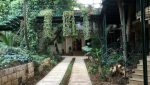
photo - Mizpe Hayamim Spa Hotel, located on Mount Canaan, near the town of Rosh Pina, is adjacent to a 35-acre organic farm
Mizpe Hayamim Spa Hotel, located on Mount Canaan, near the town of Rosh Pina, is adjacent to a 35-acre organic farm. (photo from Isrotel)

The history of the 96-room hotel dates back to 1921, when a German internist, Dr. Erich Yaroslovsky (later shortened to Yaros), bought the acreage now known as Mizpe Hayamim. Yaros’ vision was to build a convalescent home based on a vegetarian diet and natural treatment methods, which he felt would best serve the rehabilitation needs of his patients. The doctor was particularly drawn to the quality of the air and the tranquility of the setting. The land was originally owned by Baron de Rothschild, who had also been captivated by the beauty and tranquility of the area.

Before realizing his dream, Yaros encountered a series of setbacks, including receiving only a modest water allotment from the town of Rosh Pina, which was developing rapidly; the need to return to Germany for several years to support aging parents; the failure of promised positions as a physician in nearby communities to materialize; and a stint in Tel Aviv serving as its only homeopathic doctor. There was also a construction prohibition order from the British army, which was then planning fortifications in the area to protect against possible Nazi invasion through Lebanon.

Notwithstanding the long series of delays, by 1968, Yaros had the building authorities, financing and his personal determination to develop Mizpe Hayamim, albeit on a more limited scale. He built his first home at the location where the current Mizpe Hayamim now stands. It included a dining room, kitchen, bedrooms for his family and 12 guest rooms for the first of his patients. In later years, he was able to expand.

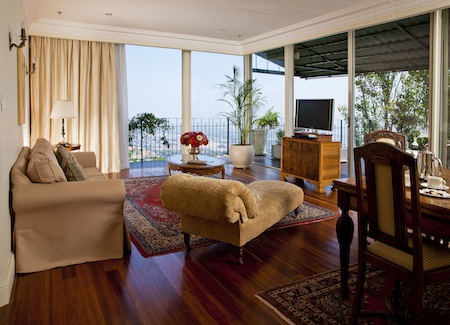
photo - view from a room at Mizpe Hayamim
(photo from Isrotel)

In English, mizpe hayamim means a view between two bodies of water, in this case, the Sea of Galilee and the lakes of the Hula Valley. The view from the highest and most expansive terrace at the hotel includes the town of Rosh Pina just below and to the left, an Israeli military base in the middle and the tip of the Sea of Galilee to the right. Small Jordanian villages dot the horizon and were barely visible in the mist of an October morning. At the time of our visit, the “mizpe” was only partially green. We were told that, with each teef, toof (bit of winter rain), the surrounding lands would become greener and that, before long, the whole of the Upper Galilee would be lush and vibrant.

A year before he died, in 1984, Yaros sold Mizpe Hayamim to Sammy Chazzan, an Israeli who shared Yaros’s commitment to the healing powers of organic food and tranquil surroundings. For more than 35 years, Chazzan led every dimension of the development of Mizpe Hayamim – hotel and farm – until 2016, when he sold the hotel portion to the Israeli chain Isrotel. He retained stewardship of the farm.

The organic farm was the first-of-its-kind in Israel and employs nine workers. From the time he was 14, Chazzan has had an interest in organic farming – a rather unusual passion for a young man but a passion he has sustained. Until the recent sale to Isrotel, Chazzan’s daily schedule started at 4 a.m., when he would draft the day’s orders for the hotel staff and then walk over to the adjacent farm to work at whatever needed to be done there. At 8 a.m., he would return to manage the hotel and then finish the day with a few more hours spent on the farm.

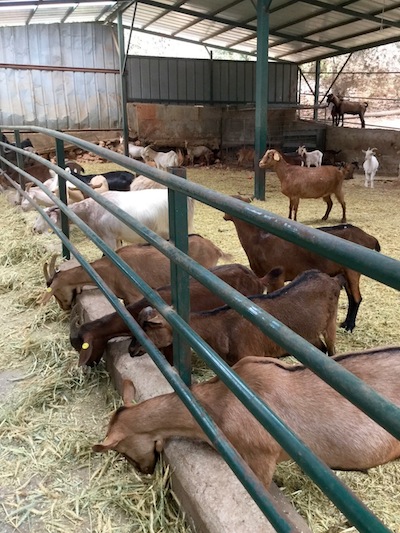
The achievements of his 35 years of agricultural experimentation are truly remarkable. The farm now includes nine large vegetable, herb and flower gardens, a herd of dairy cows and goats whose milk helps create about 40 individual dairy products – milk, yogurts, ice cream and cheeses. The animals are cared for in the most pristine of settings, feeding on grasses and able to roam about freely. Should they fall ill, they are cared for by a holistic veterinarian practitioner.

photo - Mizpe Hayamim goats
(photo by Karen Ginsberg)

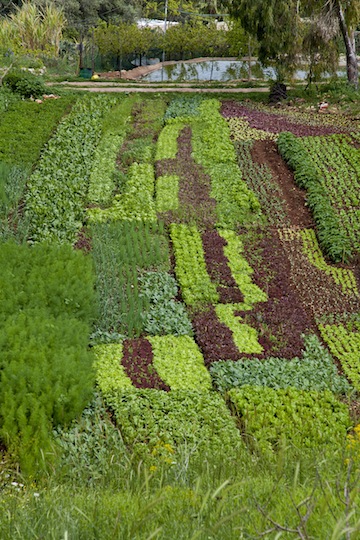
Manure is recycled to fertilize the gardens, and the fruit and nut trees and flowers grow in abundance. Years of trial and error have helped establish which flowers or herbs planted alongside which vegetables reduce insect infestations, eliminating the need for pesticides of any kind. Several times a day, ripened produce is brought to the Mizpe Hayamim kitchen and finds its way to the dinner or breakfast buffets with the sort of haste that most Canadians can hardly fathom. Natural soaps are made on the farm for sale and for use in the hotel. In addition, there is a bakery and small retail outlet that sells some of the produce to guests and members of the public.

At the hotel, there is a full range of spa services for guests. Our casual conversations with other guests suggest that many Israelis come here, seeking a reprieve – nourishment and rest – from the tensions and high activity levels of city life. Guests can enjoy a coffee and tea bar all day long, with many of the farm’s fresh herbs – lemongrass, hyssop, chamomile, spearmint – available to enrich their beverages. Daily exercise classes, an art studio and evening entertainment are optional for guests and help sustain the goal of total relaxation and rejuvenation.

Isrotel plans to refurbish and update some of the hotel rooms but the essential philosophy underpinning this unique endeavour will remain the same. And Chazzan intends to continue his life’s work of building a knowledge base about organic farming and its impacts, through small-scale experimentation.

Long after their visit, guests fortunate enough to enjoy some time at Mizpe Hayamim will continue to benefit from the tranquility and beauty of the area, the organic vegetarian diet, as well as the various spa treatments on offer. For more information, contact Liad Nudelman, reception manager at Mizpe Hayamim, at liadn@isrotel.co.il, or visit isrotel.com.

Karen Ginsberg is an Ottawa based travel writer.

Unexpected Barbadian find

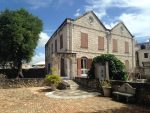
Nidhe Israel Synagogue is a UNESCO World Heritage Site. (photo by Tasha Nathanson)

One of the oldest synagogues in the Western Hemisphere is in Barbados. I was living in Barbados, working on a Canadian agricultural development project, when I tripped over this unexpected fact. I knew that the real estate agent who helped me find housing – and who, not coincidentally, became my neighbour – was Jewish, but I had assumed he was an anomaly here, in the most eastern island of the Caribbean. This was not the place I had anticipated a Jewish story to unfold.

The neighbour, Steven Altman, is reasonably well known in this small place where everyone seems to know most everyone. But many of the islanders I met inserted the comment, “he’s Jewish” into any mention of him, which reinforced my impression that being Jewish was unusual here. The Barbados I encountered in the seven months I lived there is a place that runs according to racial categories and everyone seems to be categorized according to skin colour and place of origin. Even though I’m half-Jewish, I was the white Canadian woman at work.

Curiosity prompted me to board a crazy ZR van headed into Bridgetown one day to find out more about Nidhe Israel Synagogue. ZR vans are semi-unregulated transport vehicles built to seat about 10 passengers, though I’ve been in them packed with more than 20 fellow travelers. People squish in, pressing up against each other with infinite stony-faced endurance. The soca music is generally blaring and often the driver has the flag of some neighbouring island pinned to the front, indicating where he lived before ending up in Barbados driving the public bus route in a private vehicle. The cost is always exactly two Barbadian dollars to ride and the experience is totally worth it.

The Synagogue Historic District is a UNESCO World Heritage Site in the Barbados capital city of Bridgetown. Originally built around 1654, it was destroyed by an 1831 hurricane, rebuilt in 1833 and restored from 1987 through 2017. Constructed by Sephardi Jews fleeing Recife, Brazil, after that colony passed from Dutch to Portuguese hands, these arrivals sought the relative safety of British-controled territory. The Jewish community was able to practise their faith openly here even before they regained that right in England.

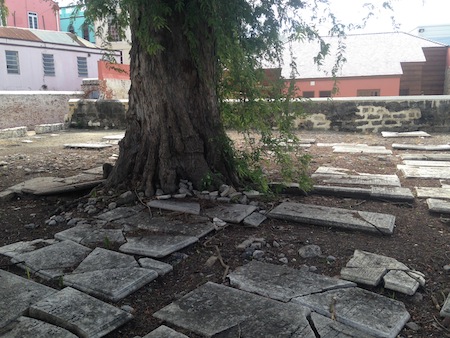
photo - The synagogue grounds include a cemetery
The synagogue grounds include a cemetery. (photo by Tasha Nathanson)

The refugees settled into housing on Jew Street (now Swan Street) and brought with them knowledge and experience of the sugar cane industry. For this, I raise a glass of fine Barbadian rum, as this accident of history resulted in a terrific local finished product. By the mid-1700s, the Jewish community was 800 strong, which was the peak of Jewish settlement.

The hurricane in 1831 was a disaster that destroyed more than just the synagogue, resulting in an exodus to the United Kingdom and the United States. By the 1920s, only one Jewish resident, Edmund Baeza, remained, holding the keys to the building. When he, too, left, the synagogue was sold and deconsecrated.

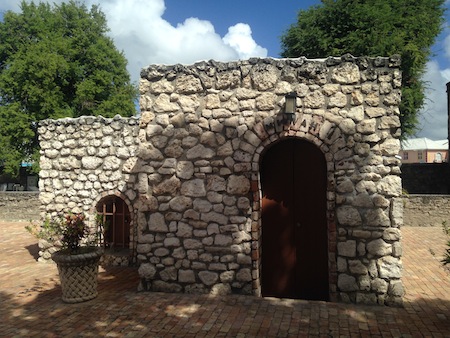
photo - The mikvah wasn’t open to the public, but the inside could be seen from the window
The mikvah wasn’t open to the public, but the inside could be seen from the window. (photo by Tasha Nathanson)

By the 1980s, the building was dilapidated, in use as a warehouse and destined for demolition, when a renewed Jewish community stepped in to begin the process of restoration. The synagogue officially reopened in April 2017, and it is a gorgeous, tranquil and instructive space.

When my neighbour Steven boasted that it was his family that was responsible for the resurgent Jewish community in Barbados, I filed away his comment with a few of his other questionable statements, such as when he had appealed for my company on the basis of needing someone to wash his laundry. Steven wasn’t even aware that I might take offence. Standards of male expression and behaviour are one of the more dubious cultural differences for a Canadian woman living temporarily in Barbados.

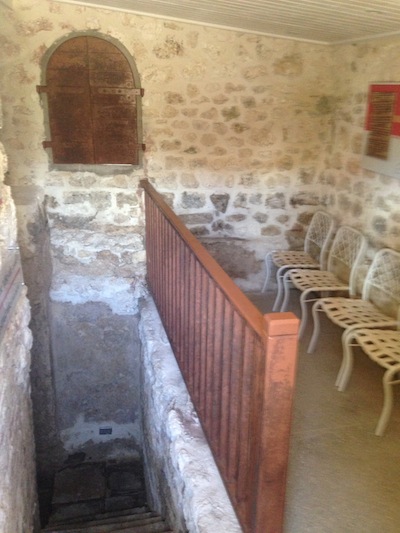
photo - The inside of  the mikvah
The inside of the mikvah. (photo by Tasha Nathanson)

Despite my skepticism, however, the Altmans were indeed a primary element of the reconstruction effort and are longstanding pillars of the community, according to the plaques at the synagogue. Steven, when asked, wistfully described the tight-knit community of his childhood, drawn together to play games, fundraise for charity and visit each other’s homes, in addition to worshipping together. I grew to enjoy hearing Steven’s voice trailing out the windows of his home and through the tropical evening heat when he practised the prayers for services; it became a pleasant part of my experience of Barbados.

The second wave of Jewish Barbadians was Ashkenazi, mainly fleeing Europe, starting to arrive shortly after Baeza’s departure. My tour guide at the synagogue museum, curator Celso H. Brewster, described desperately seasick travelers bound for South America with skeins of cloth and other mercantile goods to start anew, stumbling out onto the solid ground of Barbados and refusing to go any farther. They set up shop in Bridgetown instead of continuing their journey.

As for Celso himself, he informed me that he was Baha’i but that he did have some Jewish roots as well. Those roots travel through his family line via a version of what was once a Jewish name, bestowed on a born-out-of-wedlock ancestor via a certain plantation holder with, shall we say, quite liberal application of his affections. I’ve heard various versions of this story from other Barbadians. Jews were not only merchants, but there were some Jewish pirates and, sadly, Jewish slave owners.

Nidhe Israel Synagogue and its grounds – which include the original mikvah, which was uncovered in 2008 to reveal a still-flowing spring; an extensive cemetery, as well as a museum – is a beautiful oasis for thoughtful reflection and learning.

The Synagogue Historic District is located on Synagogue Lane, Bridgetown, Saint Michael’s, Barbados. The museum is open weekdays, 9 a.m. to 4 p.m. It is free to enter the courtyard to look around; the entrance fee to the museum is $25 BDS (about $16 Cdn). To find out more, visit synagoguehistoricdistrict.com. Better yet, visit the synagogue.

Tasha Nathanson recently returned from a stint in the eastern Caribbean as gender equality and youth empowerment advisor on a World University Service of Canada project.