Skip to content
  • Home
  • Subscribe / donate
  • Events calendar
  • News
    • Local
    • National
    • Israel
    • World
    • עניין בחדשות
      A roundup of news in Canada and further afield, in Hebrew.
  • Opinion
    • From the JI
    • Op-Ed
  • Arts & Culture
    • Performing Arts
    • Music
    • Books
    • Visual Arts
    • TV & Film
  • Life
    • Celebrating the Holidays
    • Travel
    • The Daily Snooze
      Cartoons by Jacob Samuel
    • Mystery Photo
      Help the JI and JMABC fill in the gaps in our archives.
  • Community Links
    • Organizations, Etc.
    • Other News Sources & Blogs
    • Business Directory
  • FAQ
  • JI Chai Celebration
  • JI@88! video

Recent Posts

  • BGU fosters startup culture
  • Photography and glass
  • Is it the end of an era?
  • Taking life a step at a time
  • Nakba exhibit biased
  • Film festival starts next week
  • Musical with heart and soul
  • Rabbi marks 13 years
  • Keeper of VTT’s history
  • Gala fêtes Infeld’s 20th
  • Building JWest together
  • Challah Mom comes to Vancouver
  • What to do about media bias
  • Education offers hope
  • Remembrance – a moral act
  • What makes us human
  • המלחמות של נתניהו וטראמפ
  • Zionism wins big in Vegas
  • Different but connected
  • Survival not passive
  • Musical celebration of Israel
  • Shoppe celebrates 25 years
  • Human “book” event
  • Reclaiming Jewish stories
  • Bema presents Perseverance
  • CSS honours Bellas z”l
  • Sheba Promise here May 7
  • Reflections from Be’eri
  • New law a desecration
  • Resilient joy in tough times
  • Rescue dog brings joy
  • Art chosen for new museum
  • Reminder of hope, resilience
  • The national food of Israel?
  • Story of Israel’s north
  • Sheltering in train stations

Archives

Follow @JewishIndie
image - The CJN - Visit Us Banner - 300x600 - 101625

Tag: history

Recipes for a tradition

Recipes for a tradition

(photo by Noa Fisher via PikiWiki-Israel)

Pomegranates are referred to in the Bible in many various ways. In the sensual poetry of Song of Songs, we read, “I went down into the garden of nuts … to see whether the vine budded and the pomegranates were in flower.” In another passage, the poet writes, “I would cause thee to drink of spiced wine, of the juice of my pomegranate.” Song of Songs has four additional mentions of pomegranates, and there are also references in Joel, Haggai and I Kings.

For many Jews, pomegranates are traditional for Rosh Hashanah. Some believe the dull and leathery skinned, crimson fruit may have really been the tapuach, apple, of the Garden of Eden. According to Forward “Food Maven” Matthew Goodman, the pomegranate originated in Persia and is one of the world’s oldest cultivated fruits, having been domesticated around 4000 BCE. The Egyptians imported pomegranates from the Holy Land in 1150 BCE and natural pomegranate juice, made into spiced wine, was a favourite of Hebrews living in Egypt. Pomegranate wood could also be carved into skewers on which to roast the lamb for Passover.

The word pomegranate means “grained apple.” In Hebrew, it is called rimon, which is also the word for hand grenade! In fact, the English term “hand grenade” is said to come from this and that both the town of Granada in Spain and the stone garnet come from the name and colour of the pomegranate. The juice can also be made into grenadine.

The Hebrews yearned for the pomegranates they left behind in Egypt while wandering in the desert – “And wherefore have ye made us to come up out of Egypt, to bring us in unto this evil place? It is no place of seed, or of figs, or of vines, or of pomegranates.” (Numbers 20:5) And the spies reported their findings in Canaan to Moses: “And they came unto the valley Eshkol and cut down from thence a branch with one cluster of grapes, and they bore it upon a pole between two; they took also of the pomegranates and of the figs.” (Numbers 13:23)

Pomegranates were also used on the faces of the shekel in the second century BCE. King Solomon had an orchard of pomegranates, and pomegranates of brass were part of the pillars of his great Temple in Jerusalem. Throughout the Bible, pomegranates are referred to as a symbol of fertility. As well, in the Jewish mystical tradition of kabbalah, it is said there are 613 seeds in each pomegranate, equaling the number of mitzvot commanded by God.

On the second night of Rosh Hashanah, when it is customary to eat a “new” fruit, one that celebrants have not eaten during the year, many Sephardi Jews choose the pomegranate. They recite the prayer “ken yehi ratzon, may it be thy will, O Creator, that our year be rich and replete with blessings, as the pomegranate is rich and replete with seeds.”

In modern days, a study at the Technion in Haifa a few years ago showed the power of the fruit. The cholesterol oxidation process, which creates lesions that narrow arteries and result in heart disease, was slowed by as much as 40% when subjects drank two to three ounces of pomegranate juice a day for two weeks. The juice reduced the retention of LDL, the “bad” cholesterol that aggregates and forms lesions. When subjects stopped drinking the juice, the beneficial effects lasted about a month. Other studies have shown that pomegranates fight inflammation and cancer, and slow cellular aging. Pomegranates are a good source of potassium, low in calories and low in sodium.

When choosing a pomegranate, look for one that is large, brightly coloured and has a shiny skin. You should store a pomegranate in a plastic bag in the refrigerator, and it can keep up to 10 weeks. To open a pomegranate, score the outside skin into four pieces, then break the fruit apart with your hands following the divisions of the membranes. Pull off the membranes then scrape the seeds into your mouth or lift them out with a spoon. Here are some recipes for those seeds.

POMEGRANATE SYRUP

6 pomegranates
1/3 cup white sugar
1/3 cup brown sugar
1 cinnamon stick
1/8 tsp nutmeg
1/8 tsp allspice

  1. Puree seeds from pomegranates in blender or food processor and strain. Place in saucepan.
  2. Add white sugar, brown sugar and cinnamon stick. Bring to a boil. Reduce heat and simmer about 10 minutes. Add nutmeg and allspice and cook one minute.
  3. Remove from heat, discard cinnamon stick and strain.

BAKED APPLES IN POMEGRANATE SYRUP
6-8 servings

4 slightly tart apples
1 halved pomegranate
apple juice
1/3 cup preserves of your choice
1/2 tsp cinnamon

  1. Cut each apple into four wedges. Place in microwavable dish.
  2. Squeeze juice from half the pomegranate into a measuring cup. Add enough apple juice to make half a cup. Add preserves and cinnamon and mix well. Pour over apples to coat them.
  3. Cover with plastic wrap and microwave for two minutes. Stir and microwave two more minutes. Place apple wedges in serving dishes.
  4. Remove seeds from other half of pomegranate and garnish apples.

POMEGRANATE FRUIT SOUFFLE

3 eggs
1 cup + 3 tbsp confectioners’ sugar
1 tbsp unflavoured gelatin
1/2 cup hot water
1/2 cup cold water
7 tbsp orange juice
2 1/2 tbsp lemon juice
pulp and seeds of 6 pomegranates

  1. Place yolks and sugar in a saucepan over a second saucepan filled with water (double boiler-style). Cook, stirring, until thick and creamy.
  2. Dissolve gelatin in a bowl of hot water. Then stir in cold water.
  3. Add orange juice, lemon juice, pomegranate pulp and seeds and mix.
  4. Add juice mixture to egg yolk mixture.
  5. Beat egg whites until stiff. Fold into pomegranate mixture. Pour into a soufflé dish or casserole with height built up of three to four inches with a double thickness of wax paper or aluminum foil, stapled or held in place with a paper clip.
  6. Chill in refrigerator until set. Remove band of paper. Decorate with whipped cream.

Sybil Kaplan is a journalist, lecturer, book reviewer and food writer in Jerusalem. She created and leads the weekly English-language Shuk Walks in Machane Yehuda, she has compiled and edited nine kosher cookbooks, and is the author of Witness to History: Ten Years as a Woman Journalist in Israel.

Format ImagePosted on September 15, 2017September 14, 2017Author Sybil KaplanCategories Celebrating the HolidaysTags food, history, Judaism, pomegranates, recipes, Rosh Hashanah
Apples and honey – so good

Apples and honey – so good

(photo by Markus Hagenlocher)

One of the most well-known customs of Rosh Hashanah is the dipping of apple pieces in honey but what is its origin?

In the time of King David, we know he had a “cake made in a pan and a sweet cake” (II Samuel 6: 15, 19) given to everyone. Hosea 3:1 identifies the “sweet cake” as a raisin cake.

The Torah also describes Israel as eretz zvat chalav u’dvash, the land flowing with milk and honey, although the honey was more than likely date honey, a custom retained by many Sephardi Jews to this day.

While honey may have been used in King David’s cake, the honey of ancient Eretz Yisrael was made from dates, grapes, figs or raisins because there were no domestic bees in the land. At that time, only the Syrian bees were there and, to extract honey from their combs, it had to be smoked. Still, honey was of importance in biblical times, as there was no sugar then.

During the Roman period, Italian bees were introduced to the Middle East, and bee honey became more common. Today, Israel has roughly 500 beekeepers who have some 90,000 beehives, which produce more than 3,500 tons of honey annually. Kibbutz Yad Mordechai is the largest producer of honey – 10,000 bottles a day.

Among Ashkenazi Jews, challah is dipped in honey on Rosh Hashanah, instead of having the usual salt sprinkled on it. The blessing over the apple is, “May it be Your will to renew for us a good and sweet year,” before it is dipped in honey.

Dipping the apple in honey on Rosh Hashanah is said to symbolize the desire for a sweet new year. Why an apple? In Bereishit, Isaac compares the fragrance of his son, Jacob (who he thinks is his son Esau), to a field, and Rashi says it is sadeh shel tapuchim, a field of apple trees.

Scholars tell us that mystical powers were ascribed to the apple, and people believed it provided good health and personal well-being.

Some attribute the using of an apple at Rosh Hashanah to the translation of the story of Adam and Eve and the forbidden fruit, which caused the expulsion from paradise. The Garden of Eden is also called Chakal Tapuchim, “Garden (or field) of Apple Trees.”

According to Gil Marks (z”l) in Encyclopedia of Jewish Food, “the first recorded association of apples with Rosh Hashanah was in Machzor Vitry, a siddur compiled around 1100, which included this explanation: ‘The residents of France have the custom to eat on Rosh Hashanah red apples….’ Future generations of Ashkenazim adopted the French custom … leading to the most popular and widespread Ashkenazi Rosh Hashanah tradition.”

Rabbi Jacob ben Asher, born around 1269, who fled with his family to Spain in 1303, was the first to mention the custom of apples dipped in honey in his legal compendium Arbah Turim, circa 1310, citing it as a German tradition.

Rabbi Alexander Susslein of Frankfurt, Germany, a 14th-century rabbinic authority, revealed it had become a widespread practice in Germany.

A few years ago, an article revealed that the average Israeli eats 125 apples and 750 grams of honey a year, mostly around the High Holy Days. Israel is very self-sufficient with regard to apples, with around 9,900 acres cultivated yearly, grown in the north, the Galilee hills and the Golan Heights. The most popular types of apples grown are Golden Delicious, Starking, Granny Smith, Jonathan, Gala and Pink Lady.

Honey in Hebrew, dvash, has the same numerical value as the words Av Harachamim, Father of Mercy. We hope that G-d will be merciful on Rosh Hashanah as He judges us for our year’s deeds.

Moroccans dip apples in honey and serve cooked quince, which is an apple-like fruit, symbolizing a sweet future. Other Moroccans dip dates in sesame and anise seeds and powdered sugar in addition to dipping apples in honey. Among some Jews from Egypt, a sweet jelly made of gourds or coconut is used to ensure a sweet year and apples are dipped in sugar water instead of in honey.

Honey is also used by Jews around the world not only for dipping apples but in desserts. Some believe in the phrase, “go your way, eat the fat, drink the sweet,” the sweet referring to apples and honey. Here are some recipes using honey for your Rosh Hashanah eating.

TISHPISHTI: MIDDLE EASTERN HONEY-NUT CAKE

Honey syrup:
1 1/2 cups honey
2/3 cup water
1/3 cup sugar
1/4 cup lemon juice

Cake:
2 cups finely ground almonds, hazelnuts, pistachios or walnuts
1 cup cake meal
2 tsp orange juice
1 tsp ground cinnamon
1/2 tsp allspice or ground cloves
6 eggs
1 cup sugar
1/2 cup vegetable oil
1 tbsp grated orange or lemon zest

  1. Stir honey, water, sugar and lemon juice in a saucepan over low heat until the sugar dissolves, about five minutes. Increase heat to medium, bring to a boil and boil for one minute. Let cool.
  2. Preheat oven to 350°F. Grease a 13-by-nine-inch baking pan.
  3. Combine nuts, cake meal, cinnamon and cloves in a mixing bowl.
  4. In another bowl, beat egg yolks with sugar. Add to nut mixture with orange juice. Add oil and orange or lemon zest.
  5. In a third bowl, beat egg whites until stiff but not dry. Fold into batter. Pour batter into baking pan and bake for 45 minutes. Cool.
  6. Cut cake into one- to two-inch squares or diamonds. Drizzle cooled syrup over the warm cake. Serve at warm or room temperature.

MY GRANDMA SADE’S TEIGLACH
Though my grandmother was born in New Jersey, her mother came to the United States as a young girl from Russia, so she probably learned this dish from her mother. Teiglach means “little dough pieces,” and it was originally for family celebrations and various holidays. Today, it is made primarily for Rosh Hashanah as a symbol for a sweet new year. According to my favourite reference book for any food, Marks’ Encyclopedia of Jewish Food, Teiglach was brought to the United States by Eastern Europeans in the early 1900s, and nuts were not part of the recipe in the old country.

2 1/2 cups flour
1 tsp baking powder
4 tbsp oil
4 eggs
1/8 tsp salt
3/4 cup brown sugar
1 1/3 cups honey
1 tsp ground ginger
1/2 tsp ground nutmeg
1 cup finely chopped pecans

  1. In a mixing bowl, combine flour, baking powder, oil, eggs and salt. Stir until dough is formed.
  2. In a saucepan, boil sugar, honey, ginger and nutmeg for 15 minutes.
  3. Wet a board with cold water.
  4. Pinch pieces of dough and drop them into the boiling honey mixture. Cook until very thick. Add nuts and stir. Pour honeyed pieces onto the wet board and cool slightly.
  5. With wet hands, shape dough into two-inch balls or squares. Let cool. Store in an airtight container.

Sybil Kaplan is a journalist, lecturer, book reviewer and food writer in Jerusalem. She created and leads the weekly English-language Shuk Walks in Machane Yehuda, she has compiled and edited nine kosher cookbooks, and is the author of Witness to History: Ten Years as a Woman Journalist in Israel.

Format ImagePosted on September 15, 2017September 14, 2017Author Sybil KaplanCategories Celebrating the HolidaysTags food, history, Judaism, Rosh Hashanah
City overflowing with history

City overflowing with history

The early 20th-century Casa Bianca is today one of the locations of the Municipal Art Gallery of Thessaloniki (Salonika). (photo by Pappasadrian)

When you think Salonika, don’t think old, think ancient. Because of its geographic location on the Via Egnatia trade route, this northern Greek city traces its beginnings to 316 BCE. Even back then, who you knew was key. Thus, the town was named Thessalonike, after Alexander the Great’s sister, the wife of Cassandrus. Over the years, it has been called Thessaloniki, Saloniki or Salonika. (Note: sometimes the “k” is switched to a “c.”)

Jewish Salonika is a small community of about 1,000. But it was not always this way. Trade drew lots of different people to Thessaloniki, including Jews.

The original Jewish residents were Romaniot Jews – they spoke Greek and maintained a Hellenistic culture. In the beginning, Romaniot Jews and non-Jews held the same occupations and language. As a strategic town in the Byzantine Empire, both groups faced invasions. But, by the 1000s, the empire reached a level of stability that permitted flourishing Jewish scholarship. During this early phase of the Middle Ages, Jews from other areas, such as Anatolia, Germany and Hungary, settled in Salonika. In the late 1300s, more Jews arrived, this time from Provence, Northern Italy, Sicily and Catalonia.

What followed will sound familiar. Religious affiliation defined the Jewish Salonikan way of life: the Romaniotes had their synagogue, the Ashkenazim had theirs and the Jews from Italy and France had theirs. The situation intensified when Salonika received the many Jews that Spain and Portugal expelled. Back then, there was no worry about space and growth, as the Ottoman takeover had depleted the city’s population, but the influx of Sephardim was so great that, by the end of the 16th century, Romanite ritual was no longer practised. Ladino or Judeo-Español became the Jewish community’s language of choice.

For more than four centuries, half of Salonika’s population was Jewish, pinning it with the title, “Mother of Israel,” or “Madre d’Israel.” With so many Jews, it was not uncommon for the non-Jews of Salonika to be conversant in Ladino.

Not only that, but, as the Renaissance had influenced many of the Sephardi arrivals, Jewish Salonika received a significant secular and religious boost. The city became famous for its Jewish silk producers, weavers and wool dyers. Libraries, an influential talmudic academy, a printing press and a conservatory for Jewish religious singing all started during this golden period.

By the 1600s, the corrupt and inept Ottomans had started milking the merchant class. When, in 1636, Judah Kovo, the chief of the Salonika delegates, came to Murad IV to pay the annual “clothes tax,” the sultan capriciously ordered his execution. No Jew was well enough “connected” to stay the order. Unfortunately, at the same time, key foreign markets dried up. Having the means to escape, many wealthy Jewish merchants left. Other Salonikan Jews tried to escape troubles by following in the footsteps of a false messiah, Shabbetai Zvi.

photo - The 15th-century White Tower is one of the most-recognized monuments in Salonika
The 15th-century White Tower is one of the most-recognized monuments in Salonika. (photo by MaurusNR)

The Ottoman Empire was in decline by the 17th century. Nonetheless, in the late 1800s and early 1900s, Salonika’s well-to-do Jewish residents managed to open flour mills, brick factories, breweries, soap-works and silkworm nurseries, carpet and shoe-making factories and several large tobacco workshops. Most of the Jewish population, however, remained poor. Considerable philanthropy within the community eased some of the daily hardships and provided education for many of the male children.

During this period, Jewish economic, social and political pursuits varied: on the one hand, some influential Jews continued in commerce and banking; on the other hand, some Jews became heavily involved in socialism. (The Workers’ Union, for example, was started in 1909 by a group of Salonika Jews. It became the most important socialist organization in the Ottoman Empire.) The railroad and port were important factors. Amazingly enough, until 1923, the city’s port closed on Shabbat and Jewish holidays.

The social balance started to shift in the intervening years of the First and Second World Wars. The national government passed laws aimed at hellenizing the city. Slowly, the Jews – numbering 61,439 in a 1912 Greek census – became segregated (the horrendous 1917 fire probably abetted this process) and reduced many to second-class citizens by virtue of their not speaking the Greek language. Some antisemitic activities occurred, leading to a pogrom that drove many Jews to leave. (See the 2015 essay “Mother of Israel” by Dr. Lena Molho at greece-is.com/mother-of-israel.)

When the Nazis arrived, they herded Jews into a ghetto, then to Auschwitz. While the courageous actions of Archbishop Damaskinos Papandreou (and the Athens police chief) saved thousands of Greek Jews, the Nazis killed 96% of Salonika’s Jews.

The killing was not enough for the Nazis, however. They also destroyed Salonika’s 2,000-year-old Jewish cemetery. Headstones ended up as pavement, urinals, driveways and even a dance floor. More damage – both physical and emotional – was sanctioned by the Greeks themselves. The university was built right on top of the cemetery. Even today, there is still no campus memorial to the massacred Jews.

Interestingly, individual Jewish Salonikans might well tell you their families came from Spain – as if this migration happened only recently. (See Bea Lefkowicz’s PhD thesis, published in 1999 by the London School of Economics.) At least among the older generation, this seems to be part of their personal narrative.

Today’s Jewish community is tightly run. A council provides numerous services to its members. Rabbi Eliyahu Shitrit, an Israeli with Moroccan roots, has been the community’s spiritual leader for several years now.

Central Salonika has the feel of a port town like Haifa, but with its own unique history. Some of its Jewish-related buildings from the 19th and 20th centuries still stand. Even if you don’t believe in ghosts, there is something eerie about today’s Jewish Salonika. But visitors will also see how grand and vital this place once was. Walk around and you will see sites specifically related to the Nazi occupation of the city, but also the Baron de Hirsch Hospital, the Villa Allatini and Allatini Flour Mill, Villa Bianca, Villa Modiano, Villa Mordoh, the White Tower, the market synagogue, Yad l’Zikaron and the Museum of Jewish Presence in Thessaloniki.

Deborah Rubin Fields is an Israel-based features writer. She is also the author of Take a Peek Inside: A Child’s Guide to Radiology Exams, published in English, Hebrew and Arabic.

Format ImagePosted on September 15, 2017September 14, 2017Author Deborah Rubin FieldsCategories TravelTags Greece, history, Judaism, Salonika
Charleston’s southern charm

Charleston’s southern charm

The Orthodox synagogue Brith Sholom Beth Israel. (photo from jsilverman.weebly.com/synagogues-in-charleston.html)

Charleston, S.C., is one of the most popular travel destinations in the United States. With its perfectly preserved old mansions, Charleston has charm and grace, in addition to genuine human warmth. Just walk along any of its streets and the first person you meet will surely give you a friendly hello.

Jews have resided in Charleston since 1695, attracted by economic opportunities and its proclamation of religious liberty for all. In 1749, there were enough Jewish pioneers in town to organize a congregation, Beth Elohim, the second-oldest synagogue in the country (now Reform) and the oldest in continuous use. Its imposing colonnaded neo-classical structure on Hasell Street was designated a National Historic Landmark in 1980.

The congregation’s small museum features the historic 1790 letter that George Washington wrote in response to the synagogue’s good wishes upon his becoming president: “May the same temporal and eternal blessing which you implore for me rest upon your congregation.”

This letter is emblematic of the spirit of friendship between the gentile establishment and Jews – and the acceptance, even early on, of Jews into the American mainstream, especially in the South. (More than 20 Jews from Charleston fought in the American Revolution and one, Francis Salvador, was a delegate to several Provisional Congresses. This may explain the friendly link between George Washington and the Charleston Jewish community. And, besides, Washington was known as a decent and courtly man.)

During the first decade of the 1800s, Charleston, with its 500 Jews, almost all of them Sephardi, was considered the largest, most cultured and wealthiest Jewish community in America. But, because of the destruction of the city during the Civil War, the city and its Jews became impoverished, and the waves of Jewish immigration in the 19th and 20th centuries passed it by. However, after the Second World War, the city prospered, as did its Jews. Today, the nearly 2,000 Jews in the city are in the professions, trade and business, teaching, politics and the arts. In the 1920s through the early 1950s, the city’s main street, King Street, was virtually shut down on Saturday. Walk along King Street today and you will still see many Jewish names on the shops.

photo - Congregation Kahal Kadosh Beth Elohim (now Reform)
Congregation Kahal Kadosh Beth Elohim (now Reform). (photo from charlestonsmuseummile.org)

In addition to three synagogues, one each from the major branches of American Jewry, there are a number of Jewish philanthropic and communal organizations, a Jewish community centre and a well-established day school.

The College of Charleston, the oldest municipal college in the United States, also has a broad-ranging and ever-growing Jewish studies program under the devoted and imaginative direction of Prof. Martin Perlmutter – now with its own building, thanks to the generosity of Henry and Sylvia Yaschik. The 800 Jewish students make up a significant minority of the college population. In addition to an active Hillel, the array of courses includes Hebrew language, Jewish culture and history and Israel- and Holocaust-related courses.

What makes Charleston especially attractive is its visible Jewish history, coupled with the world-class arts festival Spoleto USA, which runs for about two-and-a-half weeks every year, from the end of May to early June. The festival is an all-encompassing cultural experience: opera, dance, theatre, jazz and classical music, popular music, even acrobatics. The twice-daily chamber concerts, at 11 a.m. and 1 p.m., hosted with humour and panache by first violinist of the St. Lawrence Quartet, Geoff Nuttall, are considered the musical anchor of the festival.

But there is more. The Piccolo Spoleto Festival, sponsored by the City of Charleston, which runs during the same two-and-a-half weeks, offers a dizzying array of classical music, plays, cabaret and comedy acts, jazz cruises and much, much more. The College of Charleston’s Jewish studies unit also sponsors several events during the festival, including A World of Jewish Culture.

This year, the Orthodox synagogue Brith Sholom Beth Israel, on Rutledge Avenue, hosted four evenings of chamber music, featuring Jewish composers like Kurt Weill, George Gershwin, Paul Ben-Haim, Ernest Bloch and Eric Korngold, and non-Jewish composers who wrote Jewish music, like Ravel’s “Kaddish” and Max Bruch’s “Kol Nidrei.”

In Charleston, too, lived the people who inspired Porgy and Bess, by George and Ira Gershwin. The Gershwins resided temporarily on James Island, just outside the city, while writing their opera. They purposely came to Charleston to get a feel of the city, its ambience and its people. One of the great tunes in Porgy, of course, is “Summertime,” with its Yiddish-sounding melody in a minor key.

Charleston also has a Conservative congregation, and the three Charleston congregations – Reform, Conservative and Orthodox – are unique in that their rabbis cooperate for the greater good of the community and even meet once a month for lunch and a study session. Another fascinating crossover is that many Jews in the community belong to more than one shul – a kind of anti to the old joke about the Jew on the desert island who builds two shuls. When asked why, he responds, “That one, I daven in; the other, I wouldn’t be seen dead in.”

One longtime Jewish resident, a spry and active octogenarian agnostic proudly and only half-facetiously remarked, “I belong to all three shuls, thank God, but you won’t catch me praying in any of them.” And when he was indeed caught one Sabbath morning davening in the Orthodox shul, one of his pals came up to him and joked, “What are you doing here? Today’s not Yom Kippur.” In response, the 80-year-old quipped in his slight Carolina drawl, “Well, then I hope God forgives me for coming today.”

At the College of Charleston during the academic year, there is a kosher dairy cafeteria, Marty’s Place. And Chabad has pre-packaged prepared meat meals that are available at the famous Hyman’s Fish Market on King Street. For delicious vegetarian meals at reasonable prices, go to Jon York’s Gnome Cafe, at 109 President St.

Be sure to also take a horse-and-buggy ride in the historic district. The knowledgeable guides will take you through the residential part of town, focusing on the homes and the history of their occupants. Then stroll along the quiet streets, in the famous covered market, and tour the nearby plantations.

Two useful telephone numbers are those of the Charleston Visitors Bureau, 1-800-774-0006, and Spoleto’s, 1-843-579-3100 or spoletousa.org.

Curt Leviant’s most recent books are the critically acclaimed novels King of Yiddish and Kafka’s Son.

Format ImagePosted on September 15, 2017September 14, 2017Author Curt LeviantCategories TravelTags Charleston, history, Judaism, United States
Atheism has a long history

Atheism has a long history

The title of a book review in Biblical Archaeology Review caught my eye, “Ancient atheism.” I read, “A common assumption is that atheism – a lack of belief in gods and the supernatural – is a recent phenomenon, brought on by the advent of science during the Enlightenment.” I ordered the book immediately: Battling the Gods: Atheism in the Ancient World by Tim Whitmarsh (Alfred A. Knopf, 2015).

Bumbling, staggering, veering and lurching: these are the words that come to mind when I think of my path towards a Jewish identity. As the product of a secular household, my only contact with Judaism was my brother’s bar mitzvah and a yearly Passover seder at a family friend’s home. I was born in 1939, the beginning of the Second World War, yet the word “Holocaust” was never mentioned during my childhood or adolescence. The topic of God was not broached. The exception to the rule was that my brother and I were sent for seven summers to a Jewish camp in the Adirondacks, in New York state. There, we became familiar with Friday night services, which included singing Jewish songs and a few prayers in Hebrew.

Fast forward to 1970, after 12 years of marriage, the birth of four sons and a sincere attempt at keeping a kosher home (it lasted three years), creating Passover seders and Chanukah parties and the decision to prepare our sons for bar mitzvahs, my husband and I divorced.

I enrolled immediately in courses at Concordia University. English and French literature introduced me to the Hebrew Bible and the New Testament. This led to a bachelor’s in French literature, which was followed by many courses in a master’s program called The History and Philosophy of Religion.

My search was on. I was determined to find out what religiosity and devotion to God entailed. I studied Judaism (modern and medieval), Jewish mysticism, Christianity, Buddhism and Hinduism. I wrote scholarly papers on these subjects. Later, I would take up the study of Modern Hebrew at McGill University. Upon moving to Vancouver, I studied Biblical Hebrew for three years and enrolled in the Judaic studies program at the University of British Columbia. Jewish law, Jewish ethics, Proto-Hebrew, I loved it all; but I was no closer to feeling comfortable during the High Holiday services at any synagogue.

I tried Conservative, Reform, Reconstructionist and Jewish Renewal congregations. I could not make that leap of faith required to pray to God. The secular humanist group had replaced Hebrew with Yiddish. I wanted my Hebrew! The result is that, every year, during Rosh Hashanah and Yom Kippur, I felt uneasy, out-of-step and different.

I continued studying Modern Hebrew. I became editor of Jewish Seniors Alliance’s magazine, Senior Line. Studying, writing, volunteering and participating in the Jewish community were rewarding and gratifying activities, yet I felt like a second-class Jew. Was there something wrong with me?

Then along came Battling the Gods: Atheism in the Ancient World. As the May/June 2017 Biblical Archaeology Review notes, “In clear prose, Whitmarsh explores the history of atheism from its beginnings in ancient Greece in the eighth century BCE through the fourth century CE, when Christianity was adopted as the state religion of the Roman Empire. Whitmarsh says up-front that he is not interested in proselytizing atheism – but rather in studying its first thousand years. He argues that the history of atheism is an issue of human rights because denying the history of a tradition helps to delegitimize it and paint it as ‘faddish.’”

In reading this book, I came to understand, as Stephen Greenblatt is quoted on the back cover as saying, that “atheism is as old as belief. Skepticism did not slowly emerge from a fog of piety and credulity. It was there, fully formed and spoiling for a fight, in the bracing, combative air of ancient Athens.” And I agree with Susan Jacoby’s comments – also cited on the back cover – that it “is a pure delight to be introduced to people who questioned the supernatural long before modern science provided physical evidence to support the greatest insights of human reason.”

I devoured Battling the Gods, relishing the research and the historical insights. Homer’s epic poems of human striving, journeying and passion were ancient Greece’s only “sacred texts,” but no ancient Greek thought twice about questioning or mocking his stories of the gods. Whitmarsh states that “this book thus represents a kind of archaeology of religious skepticism.…This loss of consciousness of that classical heritage [the long history of atheism] is what has allowed the ‘modernist mythology’ to take root. It is only through profound ignorance of classical tradition that anyone ever believed that 18th-century Europeans were the first to battle the gods.”

Whitmarsh writes, “The Christianization of the Roman Empire put an end to serious philosophical atheism for over a millennium. The word itself, indeed, acquired an additional meaning, which was wholly negative: rather than the rational critique of theism as a whole, it came to mean simply the absence of belief in the Christian god.”

With Whitmarsh’s sentence, “The conclusion seems inevitable that the violent ‘othering’ as atheists of those who hold different religious views was overwhelmingly a Judeo-Christian creation,” my self-respect was restored. I now understand that I come from a longstanding tradition of atheists. My beliefs have history and credulity behind them. I will continue to study Hebrew, write, volunteer and participate in the Jewish community. In accepting my skepticism, I join the minds and hearts of the ancient Greek and Roman skeptics and atheists who came before me.

Dolores Luber, a retired psychotherapist and psychology teacher, is editor of Jewish Seniors Alliance’s Senior Line magazine and website (jsalliance.org). She blogs for yossilinks.com and writes movie reviews for the Isaac Waldman Jewish Public Library website.

Format ImagePosted on September 8, 2017September 5, 2017Author Dolores LuberCategories BooksTags atheism, Battling the Gods, history, Judaism, religion, spirituality, Tim Whitmarsh

How we memorialize the past

The most recent racist conflagration in the United States was ignited, ostensibly, by the removal (or threatened removal) of Confederate commemorative statues and plaques. We say ostensibly because it seemed some people were just itching for a fight and this issue popped up.

Each community, or each society, must determine who and what it commemorates. It is understandable that African-Americans, among others, would be offended by statues and other historical monuments that adulate those who defended slavery in the U.S. Civil War. Those who decry their removal as an “erasing of history” seem to be unfamiliar with the concept of libraries and museums, which are among the foremost repositories of history. Remembering history is different from venerating it. For example, a statue of Confederate General Robert E. Lee in front of a courthouse is an affront to equality before the law. The same statue in a museum could provide an opportunity for reflection and discussion.

Outside Budapest is a curious outdoor museum featuring dozens of statues and monuments from the communist era. It is a kitschy museum but it invites guests to ponder the propaganda of earlier eras, even admire some of it from a perspective of artwork, but it is decidedly not a place of veneration. It is a clear statement that such works, if they are to be publicly displayed, should be positioned in a way that does not esteem the ideas that inspired them, but instead invites observers to reflect on their meanings and the often catastrophic outcomes of their ideologies.

Similarly, the preservation of Auschwitz and other places of Nazi terror was not done in honour of that terrible time and the evil that defined it, but for the opposite reason: to ensure that future generations face the reality of that history and to inspire people to seek a better future. Context is crucial.

While Americans battle their demons, some Canadians have taken issue with our history and how it is commemorated. The government of Sir John A. MacDonald, Canada’s first prime minister, was responsible for implementing the residential schools system, a past with which most Canadians are only now beginning to grapple. Last month, the Ontario elementary teachers’ union said MacDonald’s name should be stripped from the nine schools in that province that are named for him. By that logic, we would eliminate his visage from our $10 bills and remove his statues and other likenesses from our public spaces.

Should we? Well, if Canadians had a thoroughgoing national discussion on the subject and a consensus clearly emerged that what was bad about MacDonald outweighs that which was good, then yes. But we should not jump in willy-nilly, thoughtlessly applying the values of today upon people of the past. To be clear: the residential schools system was an atrocity and a national disgrace; we know this now. How we attempt to rehabilitate our country and make amends for this awful history is a discussion in which we are immersed. The veneration of figures who were party to that history invites a legitimate and thoughtful reconsideration – neither those whose knee-jerk reaction is to tear down statues, nor those who reflexively balk at the very idea, are exhibiting the sort of approach we need. Ontario’s elementary school teachers, for example, may have missed the mark. If ever there were a teaching opportunity, it would be to engage young Canadians in critical thinking about why their school is named for the first prime minister, why some people think that’s problematic, and how empathy toward minorities is key to a better future.

But we should be careful in determining the measuring stick we apply. In considering the legacies of any public figure who lived more than a couple of decades ago, we would be hard-pressed to find one who would measure up to today’s standards on the rights and roles of Canadian indigenous peoples, Jews, women, gay people, or really any minorities. One might even argue: Who are we to judge? Are we assuming this generation has reached the moral summit of civilization? The state of the world today suggests we have much left to do to advance tikkun olam. Future generations will not likely give us any great kudos for perfecting humanity.

In the end, we cannot fathom how our descendants will view us and our behaviours. If, as now seems tragically inevitable, human-created climate change wreaks havoc on our world, future generations may look at our car driving, energy consumption and jet vacations as the direct cause and remove the names and likenesses of even the best of our generation from their schools and public squares.

By all means, we should consciously consider representations of our past and whether they are appropriate or inappropriate for our times. It is a discussion worth having, but we should have that discussion before we go racing around tearing down monuments and renaming schools.


Posted on September 1, 2017August 30, 2017Author The Editorial BoardCategories From the JITags Charlottesville, history, memorial, racism
Recalling our history

Recalling our history

An architectural rendering of the proposed Jewish Legion Centennial Pavilion to be built in Windsor, N.S. (image from MacKay-Lyons Sweetapple Architects Ltd.)

David Ben-Gurion and Yitzhak Ben-Zvi will be among more than 1,000 men remembered when the 100th anniversary of the Jewish Legion is commemorated next year in Windsor, N.S.

These two prominent Jewish community leaders, who became the first prime minister and second president of the state of Israel, respectively, were part of the legion, which was approved by the British War Office as a Jewish military contingent for active duty during the First World War. Ben-Gurion and Ben-Zvi, as members of the training squad, earned 50 cents a day and slept in a bell tent on Nova Scotia earth.

photo - David Ben-Gurion, taken in Windsor, N.S., in 1918
David Ben-Gurion, taken in Windsor, N.S., in 1918. (photo from West Hants Historical Society)

Jewish recruits from across Canada and the United States assembled at the Imperial Recruits Depot, located at Windsor’s Fort Edward, in 1918. Fort Edward served as a basic training centre and point of departure for all North American recruits of the Jewish Legion. Once their training was complete, they went to England, where they joined other Jewish battalions for the last phases of the campaign against the Ottoman Turks. This Jewish fighting force, which included the 38th, 39th, 40th and 42nd battalions of the Royal Fusiliers, would become known as the Jewish Legion.

In a letter to Windsor’s mayor in 1966, Ben-Gurion wrote, “In Windsor, one of the great dreams of my life, to serve as a soldier in a Jewish unit to fight for the liberation of Israel, became a reality. I will never forget Windsor, where I received my first training as a soldier and where I became a corporal.”

The Jewish Legion Centennial Society, chaired by former Atlantic Jewish Council executive director Jon Goldberg and guided by Sara Beanlands, principal of Boreas Heritage Consulting Inc., is commemorating the centennial of the training of the Jewish Legion in Windsor. In conjunction with the town of Windsor, West Hants Historical Society and the Atlantic Jewish Council, events are planned for the town in May and September of 2018. As well, a distinct earthworks Centennial Pavilion will be built, with considerable private funding, near Fort Edward. Names of the more than 1,000 North American Jewish trainees will be listed on a Wall of Honour at the pavilion.

To donate to the Centennial Pavilion or for further information, contact Goldberg at [email protected] or 1-902-221-2174. For historical information or to include a name of a Jewish Legion soldier, contact Sara Beanlands at [email protected] or 1-902-483-7999.

Format ImagePosted on September 1, 2017August 30, 2017Author Jewish LegionCategories NationalTags Ben-Gurion, Ben-Zvi, Canada, history, Israel, Jewish Legion
Miraculous discovery

Miraculous discovery

(photo from Israel Antiquities Authority via Ashernet)

A 1,500-year-old mosaic floor, with a Greek inscription, was discovered this summer following groundwork for a communications cable infrastructure near the Damascus Gate in the Old City of Jerusalem. David Gellman, the director of the excavation on behalf of the Israel  Authority, said, “The fact that the inscription survived is an archeological miracle…. We were about to close the excavation when, all of a sudden, a corner of the mosaic inscription peeked out between the pipes and cables. Amazingly, it had not been damaged.” Hebrew University in Jerusalem’s Dr. Leah Di Segni deciphered the inscription, which “commemorates the founding of the building by Constantine, the priest. The inscription names the emperor Flavius Justinian. It seems that the building was used as a hostel for pilgrims.”


Format ImagePosted on September 1, 2017August 30, 2017Author Edgar AsherCategories IsraelTags antiquities, archeology, Hebrew University, history, IAA, Israel
Mystery photo … Aug. 25/17

Mystery photo … Aug. 25/17

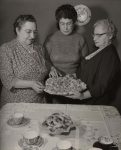
Na’amat Pioneer Women, 1960. (photo from JWB fonds, JMABC L.12599)

If you know someone in this photo, please help the JI fill the gaps of its predecessor’s (the Jewish Western Bulletin’s) collection at the Jewish Museum and Archives of B.C. by contacting [email protected] or 604-257-5199. To find out who has been identified in the photos, visit jewishmuseum.ca/blog.

Format ImagePosted on August 25, 2017August 22, 2017Author JI and JMABCCategories Mystery PhotoTags history, JMABC, Na'amat
Celebration of Venice

Celebration of Venice

Artist Iza Radinsky at Zack Gallery. (photo by Olga Livshin)

Just over 500 years ago, in 1516, the Venetian Republic forcibly moved 700 Venetian Jews to an island, the abandoned site of a 14th-century foundry. In doing so, they created the first ghetto. The word ghetto means “foundry” in the old Venetian dialect.

photo - Rachel Singel
Rachel Singel (photo from Rachel Singer)

The Venetian ghetto had two access bridges, both guarded at night, and boats also patrolled the canals. Despite the isolation and other restrictions, the republic was relatively tolerant. Inside the ghetto, Jews were free to practise their religion and traditions; they were not forced to convert, as was the case in Spain and many other places throughout Europe. The ghetto became known as a place of study and scholarship, and its population grew from 700 in 1516 to more than 6,000 a hundred years later. The area – which existed until 1797, when Napoleon conquered the republic and gave equality to all citizens – remains a centre of Jewish culture.

Many Jewish and Italian organizations in North America and Europe have commemorated the 500th anniversary of the Venetian ghetto in some way. Here in Vancouver, Zack Gallery, in conjunction with Il Museo at the Italian Cultural Centre, are presenting Stories from the Stones of Venice: The Art of Rachel Singel and Iza Radinsky. The exhibit was the brainchild of Singel, an artist, printmaker and assistant professor at the University of Louisville, in Kentucky.

“The year 2016 marked the 500th year since the establishment of the Jewish ghetto in Venice,” she said in an email interview with the Jewish Independent. “To honour the historical anniversary and the influence of this uniquely urban space, I worked onsite in Venice for two months to create a series of etchings illustrating the buildings, structures and streets of the ghetto.”

That was not Singel’s first visit to Venice. “I first went to Venice in 2012 for an artist residency,” she said. “I have had the opportunity to return to Venice every year since. My artworks have been increasingly influenced by Venice and its fragile state…. The last two years, I have also brought my students to the Scuola Internazionale di Grafica Venezia.”

photo - “The Corner Synagogue” by Rachel Singel
“The Corner Synagogue” by Rachel Singel. (photo from Rachel Singer)

Singel has exhibited her 10 ghetto prints at the international school and at the Jewish community centre in Louisville.

“Each of the 10 images seeks to call attention to the Venetian ghetto’s importance, not only as an architectural complex within the confines of Venice, but also its worth internationally. Its structures are resonantly symbolic, representing the community’s resolute will to survive and prosper in what was an exceedingly hostile social environment.”

When Singel heard about the exhibition that was being planned at Il Museo – The Venetian Ghetto: A Virtual Reconstruction 1516-2017, which opened on July 25 – she looked into the possibility of engaging with their event. “I reached out to the Zack Gallery director, Linda Lando, about exhibiting my prints at the JCC,” Singel said.

Lando liked the idea of a Venice exhibition, but 10 small prints were not enough to fill the Zack, so Lando invited Radinsky, a local artist, to exhibit her paintings of Venice in the same show.

“Linda Lando saw five of my paintings of Venice before,” Radinsky said. “She asked me if I had more and if I would like to participate in a two-artist show together with Rachel Singel. I was happy to.”

Radinsky’s 14 large paintings and Singel’s prints form the Zack exhibit.

“I love Venice,” Radinsky said. “I first visited it in 2006, with my 86-year-old father. I was awed by the city. It was as beautiful as in the old masters’ paintings I admired as a child in the museums of Moscow and St. Petersburg, even better. Afterwards, every time I go to Europe, I visit Venice. It draws me. It’s quiet there, no cars. People walk and gondolas float on the canals. Nothing artificial, just earthy colours, red roofs, water and sky – and reflections in the canals.”

photo - “Gondolier” by Iza Radinsky
“Gondolier” by Iza Radinsky. (photo from Iza Radinsky)

In her paintings, gondolas and gondoliers look as intrinsic to the ancient city as the sunlight and shadows, the unique water streets and multiple bridges of Venice. The muted colours coalesce into one another, creating combinations that have no names. The sky and the water blend together, weaving one fantastic, living canvas.

“Venice is built on water,” Radinsky explained. “Because of the dampness, it’s hard to maintain the paint of the outside walls of the buildings. The paint often flakes off, and green mold grows close to the water. But gondolas – those look luxurious. Lots of gilt and bright colours, golden ornaments and lush fabrics and cushions for the passengers. Every gondola is an amazing piece of art. In the past, gondolas were part of the Venetian fleet. They could ram into an enemy ship, and their sharp iron bows could cut like knifes. Now, they are tourist attractions, and gondoliers are very friendly and knowledgeable. They wear special hats and traditional striped shirts. They have to study long and hard to learn manoeuvring in the narrow canals. They have to pass an exam and get a licence.”

The artist’s eyes glowed with enthusiasm as she talked about her beloved Venice. “I’ve been there four times already and I want to go again,” said Radinsky.

Stories from the Stones of Venice opened at Zack Gallery on July 27 and continues until Sept. 3.

Olga Livshin is a Vancouver freelance writer. She can be reached at [email protected].


Format ImagePosted on August 18, 2017August 16, 2017Author Olga LivshinCategories Visual ArtsTags antisemitism, ghetto, history, painting, Venice, Zack Gallery

Posts pagination

Previous page Page 1 … Page 51 Page 52 Page 53 … Page 57 Next page
Proudly powered by WordPress