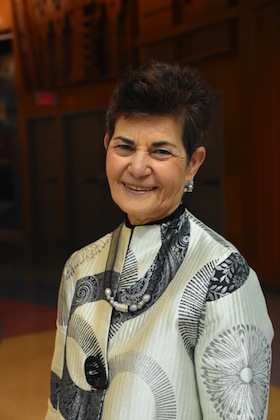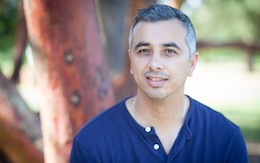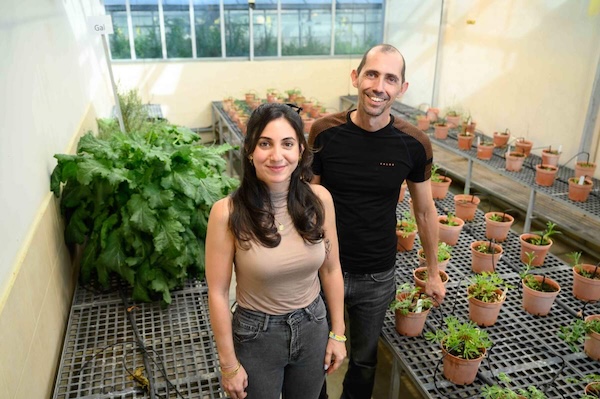
Gal Raviv, left, and Prof. Tamir Klein in the plant sanctuary at Weizmann Institute of Science in Rehovot, Israel. (photo from Weizmann Institute of Science)
When PhD student Gal Raviv thought of creating a sanctuary garden at the Weizmann Institute of Science, what she had in mind was saving endangered plants. But, after the Oct. 7, 2023, attack on Israel, the garden became for her a refuge of serenity and strength. “There’s something grounding about plants that keep growing no matter what happens around us. If they can do it, so can we,” she said. “They represent what the land of Israel can produce and, in these difficult times, they symbolize our own roots in this land.”
Raviv came up with the idea of the garden after hearing a lecture on plant conservation at a conference that Prof. Tamir Klein, whose Weizmann lab specializes in tree research, had organized at the institute. In late summer of 2023, they set up the garden in Weizmann’s greenhouses, with full backing from Weizmann’s Institute for Environmental Sustainability.
Raviv’s doctoral research, conducted in Prof. David Margulies’s lab, is unrelated to plants and focuses on molecular aspects of cancer therapy. Nonetheless, she volunteered to tend the garden, getting crucial help from the greenhouse staff and relying on their expertise.
“When people hear about endangered species, they usually think of a toad whose swamp has dried up, or other animals or birds. But at the basis of any ecosystem are plants: they are the very foundation of our existence,” Raviv said.
“Plant diversity supports diverse insects that in turn provide food for birds and animals. When plant species go extinct, their loss can disrupt the integrity of an entire ecosystem,” added Klein.
Of some 2,300 wild plants found in Israel, more than 400 are in danger of extinction, according to the Red Book of Israel’s Nature and Parks Authority. Plant species that are unique to Israel are particularly threatened: there are about 55 such species, and 35 of them are endangered.
“We have a global responsibility to preserve these plants,” Klein said.
The major threat to plants is habitat loss, which in Israel is especially acute along the Mediterranean. Sand dunes and other parts of the coastal plain are home to an unusually large proportion of wild plant species, yet, to the plants’ misfortune, that’s also where humans love to settle. Less than 30% of the pristine coastal sands that used to line the Mediterranean in the early 20th century remained undeveloped by the beginning of the 21st. These sands might disappear altogether if left unprotected.
There are several plant sanctuaries in Israel, but not all have the proper climate to grow coastal plants outdoors, whereas the Weizmann campus, with weather that’s similar to that of the coast, is well suited to this end. Raviv and Klein kept this in mind when preparing a list of plant species for the sanctuary. The final list was compiled in collaboration with the Israel Nature and Parks Authority, which also provided seeds.
Now in its third year, Weizmann’s sanctuary garden holds some 20 endangered plants, a number of which are unique to Israel’s coastal plain; others also grow in neighbouring regions. Most are flowering annuals, but there are also perennials, as well as two species of ancient wheat, genetic relatives of today’s crop varieties. These plants are gradually revealing their preferences and personalities to Raviv and the greenhouse staff, while occasionally serving up challenges and surprises.
For example, since the greenhouses have no bees or other natural pollinators, some of the plants bloomed but produced no seeds. “So, I became the bee,” Raviv said.
To help some species, she made adjacent flowers “kiss,” that is, touch in a way that pollen from one flower could get to the stigma, or ovary system, of another – a process known as self-pollination or cross-pollination, depending on whether the two flowers belong to the same plant or to different ones. She did that, for instance, for Erodium subintegrifolium, known as stork’s bill in Europe and heron’s bill in North America.
In other species – such as the perennial Salvia eigii, named for the botanist Alexander Eig – the reproductive organs are too deep inside the flower for the kiss method to work. Raviv came up with a creative solution. She collected whisker hairs shed by her three cats and used them to transfer pollen from one flower to the stigma of another.
Luckily for Raviv, however, most plants in the sanctuary garden manage to pollinate by themselves.
Other challenges now solved include “late bloomers.” Silene modesta, from a genus also known as campion or catchfly – an annual plant that grows in sandy soil on the coast and in the western Negev desert – thrived in the sanctuary garden from the start. However, even though it produced lots of flower buds, these seemed to dry up before getting a chance to bloom.
A plant conservation expert told Raviv to open one of the dried buds to see if it contained seeds. Indeed, it did, which meant that it had bloomed at some point without being caught in the act. So Raviv went to the garden late at night and, sure enough, found the slender Silene in full bloom. Keeping the bud closed after sunrise is the plant’s strategy for reducing water evaporation during the hot hours, while also protecting its flowers from the strong daytime coastal winds.
The discovery prompted Raviv to initiate a research project in which she compares Silene modesta with its non-endangered relative, Silene palaestina. The goal is to uncover the biochemical processes that ensure water conservation in the endangered plant.
In fact, a major goal of plant conservation is to preserve valuable properties that might be lost forever should their carriers disappear. Revealing the mechanisms behind such properties might make it possible to transfer them to other plants to, for example, help them grow in arid conditions or otherwise adapt to the adversities of climate change.
– Courtesy Weizmann Institute of Science