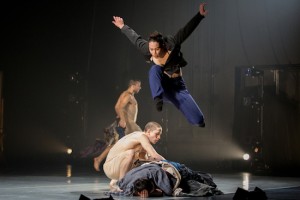
The 15th annual Chutzpah! Festival of the Jewish Performing Arts concluded on Sunday with the group Diwan Saz. Their main message: music has no borders. And, “Don’t believe the news,” i.e. Israel is more than a conflict zone.
Yet, our brains are hardwired to find the negative in life. As one neuropsychologist writes, “the brain is like Velcro for negative experiences but Teflon for positive ones.” It is no coincidence that the news the media mainly reports is bad. It not only titillates, but it sticks with us. However, there are good news stories, and they should not be dismissed as “fluff,” or as less significant than the “serious” news. On the contrary.
The arts are vital to our lives, as are sports and other cultural endeavors. They are not merely for entertainment or to escape from reality. Among other things, these pursuits encourage creativity and propel innovation, they nurture our souls and provide ways in which we can connect to each other. They can be catalysts for all types of change in the world, making people aware of issues they might not otherwise consider, bringing people together to speak out against injustice or in favor of peace, for example.
The multicultural Bedouin, Israeli Arab, Turkish, Jewish Israeli (Ashkenazi and Sephardi) group Diwan Saz, comprised of nine musicians, is a prime example of how people of different places, beliefs and backgrounds can live, play and travel together – by choice, and happily, enriched by one another’s friendship and musicianship.
Since its beginnings, Chutzpah! has shown how arts and culture can bring diverse people together. In recent years, Israeli performers have graced the cover of the Georgia Straight in its Chutzpah! coverage. What better ambassadors of Israeli and Jewish culture, and the cross-cultural possibilities of the Middle East?
This week’s JI cover stories provide another couple of examples.
Twenty kids from the Canada Israel Hockey School, a joint venture of the Jewish Community Centre of Greater Vancouver and the Jewish Federation of Greater Vancouver, visited last week – Jewish Israeli, Arab Israeli, girls and boys, the hockey players see each other as teammates, playing for the love of the game. Not only are positive bonds and memories being formed among the players, but also between them and their coaches in Israel and in Vancouver, the local hockey players they met, both from the Jewish league and from the Canucks. Interviewed by CBC’s Shane Foxman, these kids were representing not just themselves, but the sport of hockey and their country of Israel – and they are cause for pride.
Sholom Scouts are also not “just” scouts. Not to put too much pressure on them, but they are Jewish ambassadors to the larger Scouts community as well as the general community. Within the Jewish community, they represent a spectrum of Jewish beliefs, all coming together to become good stewards of the land and good citizens.
It is healthy to see the negative: it helps us to be safe, to become aware of what isn’t quite right, what needs adjustment and what areas of justice still need to be pursued. As Leonard Cohen sings, “there is a crack in everything, that’s how the light gets in.” But, focusing exclusively on the negative – the crack instead of the light – isn’t healthy, not for ourselves personally or for society at large. This does not imply blocking out the reality of the suffering that does exist, but instead recognizing that we ignore the beauty, loving kindness and bright spots of reality to our detriment.
Whether it’s by being more mindful, cultivating more loving kindness, reducing stress and anxiety, re-balancing our middot, being open to new and challenging experiences or learning more about something that interests or concerns us, we can find more good. It takes time and effort to “hardwire happiness” in our brains and in our lives, but it’s possible.
It helps when we consciously draw out the positive, such as the stories mentioned here, and engage in the positive cultural and social behaviors that make us more than mere human animals, and more fully and happily human.
Caitlin McCarthy and Amitai Marmorstein co-star in What You’re Missing by Tamara Micner, which is at Chutzpah! March 10-15. (photo by Tim Matheson)
Playwright Tamara Micner returns to Vancouver in March for the North American première at Chutzpah! of What You’re Missing, a play based on her family’s stories, but in which we will all, no doubt, see aspects of our own experience.
Tamara Micner returns to Vancouver for the North American première at Chutzpah! of What You’re Missing, a play based on her family’s stories. (photo from Tamara Micner)
Micner left Vancouver in 2003 for Yale, where she earned her bachelor of arts in English literature. She worked with Google for a few years, which took her to San Francisco and Toronto, then studied at Cambridge, receiving her master’s of philosophy in 2011. When she last spoke with the Independent, she was on her way to London, England, because, as she told the JI, “for plays, London is the best city in the world.” There, she has continued learning and working, not only in theatre, but also as a journalist and copywriter. The JI caught up with Micner earlier this month.
JI: When the JI last spoke with you, Fantasmagoriana was at the Edinburgh Festival Fringe, and you also had two new plays in the works, one of which was called Highlight. Could you share some aspects of its development, from its première at Cambridge in 2011 as Highlight to its run last year as What You’re Missing at King’s Head Theatre in London, to its upcoming production at Chutzpah?
TM: What You’re Missing has been in the works for four years, and hopefully it will continue to live after Chutzpah as well.
We started developing the play during my master’s degree at Cambridge, with a rehearsed reading and a run at the main student theatre. I then left it for awhile and worked on other projects, and gave myself time to come back to it with greater distance and a clearer head.
In 2013, I did more rewrites and started submitting it to theatres in London, including the King’s Head, which accepted it for final development. By the time we performed it last year, it was pretty well “finished.”
It’s gone through many rounds of changes. It started out more purely comedic and, over time, it’s gotten more political and more serious, alongside the comedy that (hopefully) pervades the piece.
JI: You described Highlight in the 2011 JI interview as being based on the beginning of your parents’ relationship, and as “a dysfunctional family comedy.” In general, what has been the reaction of family (and friends) to the plays in which they see themselves represented? Do you have any advice for aspiring writers as to how to use family/friend elements without causing (too many) hard feelings?
TM: My sense is that my relatives who inspired the characters in What You’re Missing have enjoyed seeing versions of themselves and their experiences represented onstage. (Or they’ve just been polite.) The play is critical and truthful, but it’s also a dramatization, and it’s written from a place of love and affection, which I think comes through. I wasn’t alive in the 1970s, when this play is set, so it’s drawing from elements of my family’s stories – from a specific time, place and set of experiences – to explore broader questions about family, love, politics, religion, gender and so on.
When we debuted the play in London, people of different nationalities, religions and backgrounds said that they related to the story and characters, and saw themselves or their lives reflected in the piece in some way. That response really pleased me (and was a relief!) because that was my hope. I see theatre as, among other things, a way to bring people together and remind us of the things we share.
I think artists need to share their truths, and personal experience is where a lot of our truths come from. That might cause hard feelings. But, if we’re honest and nuanced, rather than heavy-handed, people will respond and connect to the work, and the truth in it will come through.
JI: In 2011, you said that you chose to move to London for its theatre presence and because you loved the city. Has the city lived up to your expectations? Do you plan on staying for the foreseeable future?
TM: I’m very happy living in London. I’ve found a neighborhood and communities that I feel at home in, including easy access to pita, dates and baklava, and I’m still discovering more of the city and the country. I was approved for Polish citizenship last year, so assuming the U.K. doesn’t vote to leave the EU, I plan to stay here indefinitely.
JI: Will you be coming to Vancouver for the Chutzpah shows? If so, how much input, if any, will you have into this production? Did you have any hand in casting?
TM: Yes, I will be in Vancouver for the run. I’ve met with the director, John Cooper, in person and on Skype, and we’ve talked about the origins and development of the play and his vision for the production. He oversaw the casting, and I trust his instincts and judgment. It’s exciting to see how other people interpret your work and bring it to life, sometimes in surprising ways.
JI: Are there any projects you have currently on the go, or that you’re considering undertaking, that you would like to share with JI readers?
TM: I’m developing a new show, Wink the Other Eye, with two actors and a musician. It’s about music hall, a major genre of British entertainment from the mid-19th century until about the ’20s (when ragtime and revue, and radio, started taking over). For example, if you know the song “Daisy Bell,” that’s actually from music hall.
The show is devised – collaboratively created and written – which is a new style of working for me. We plan to do some showings of the piece in the spring, working toward a production later this year. We’ve been approved for funding from Arts Council England to finish development, which is a big help and a stamp of credibility.
Our show looks at Marie Lloyd, one of the most famous performers of her day, who toured the British Empire (South Africa, Australia, North America) and sang from the age of 15 until she died aged 52. She had a story similar to Whitney Houston’s, Judy Garland’s: an insatiable entertainer who lived to perform and had a pretty awful life offstage (including domestic abuse and alcoholism). The show combines live performances of her songs with important moments from her private life, and the actor who plays her is related to her. (We’ve put some of the music and comedy from the show online: soundcloud.com/winktheothereye.)
What You’re Missing is at the Rothstein Theatre from March 10-15. The other theatre offering is Kafka and Son, performed by Alon Nashman, on March 2. Visit chutzpahfestival.com for more information on these and other productions.
Germany’s Daniel Kahn and the Painted Bird play at the Electric Owl on March 6 as part of the Chutzpah! festival. (photo from Daniel Kahn and the Painted Bird via Chutzpah!)
Daniel Kahn and the Painted Bird live up to the hype. They are indeed “helping klezmer reach a new renaissance, seasoning it with folk, punk and deep-digging lyrics, full of sarcasm and wicked self-irony.” They most certainly belong “to this caste of Yiddish music agitators” and their music is “[a]n absolute must for lovers of unusual, intelligent, challenging, exciting folk music and a blast at every instant.” They are “forward-marching and backward-glancing,” making “truly great art.”
And that’s not the half of it. On their website (paintedbird.de), you can read more about what reviewers have said, you can download the lyrics to all their songs, you can watch several videos – and you can get an excellent idea of what to expect when they perform at the Electric Owl on March 6 as part of this year’s Chutzpah! festival. Kahn spoke with the Jewish Independent ahead of that one-night only show.
JI: Could you share a bit about your background – how you came to be a musician, how and when you came to live in Berlin, for example?
DK: I’ve been a musician all my life but I first started working professionally as a singer-songwriter in Detroit, and then in New Orleans in 2001.
I was a part of founding the Earthwork music collective in Michigan, which has grown to a large community of artists and activists. I produced four albums of my songs with them. I first really invested in klezmer music and Yiddish after attending Klez Kanada, in Quebec, for the first time in 2004. It was there that I met Alan Bern, who was my accordion teacher. He had been living in Berlin for many years and he offered me his apartment to sublet. I was already quite interested in German theatre, particularly Brecht, and I wanted to live in Europe, so it fit.
After going to the Jewish festivals and workshops that summer in Krakow and Weimar, I had the idea to start the band the Painted Bird. And it was around then that I really started learning not only German, but Yiddish and incorporating translations into my songs, and performing in many languages at once. The band has had many members but the heart of it for all these years has always been Michael Tuttle, whom I met in New Orleans, playing bass, and Hampus Melin, a drummer from Sweden, whom we met in Berlin. We wanted to create a band that would be able to take traditional songs, folk songs, in different languages and infuse them with a modern sensibility that we take from the other music we dig – punk, jazz, new music. And Berlin is the perfect city for this band. It’s a real cosmopolis.
JI: You’ve studied drama and your bio notes that you’ve been a professional actor since age 12. How does acting fit in with your music career?
DK: From a performance perspective, I’ve never made too much of a distinction between ways of being on a stage. Songs and plays are simply different modes of collaborative or solo storytelling. As a musician, I get to employ many of the techniques I need to write, direct or act in the theatre. And I’ve never really quit making theatre. I’ve done many productions over the years, in the States, as well as in Germany. I’ve been involved as a composer or arranger of music and songs for various productions, and I’ve been acting and directing again, as well.
I’m currently very involved in Berlin at the Maxim Gorki theatre, a wonderful space for progressive work these days. The new artistic director, the Turkish-born German Shermin Langhoff, is an inspiring, powerful voice for diversity and political engagement in drama. I’ve been a kind of “house-poet” for the theatre, working on several productions as composer, actor, musician, etc. I’m about to direct a small play in their studio theatre space, an adaptation of Romain Gary’s The Dance of Genghis Cohn. It’s become an important family for me, and has also connected to the international klezmer family, as well. I curate a concert series there, focusing heavily on new Jewish music.
JI: What drew/draws you to Yiddish as a language in which to write and sing?
DK: Besides the connection it may have to my personal background as a descendant of immigrants from what we could call Yiddishland, I’m attracted to Yiddish on a purely esthetic level. I like the way Yiddish sounds, how it feels to sing and speak it. It tastes good. I like the things you can express in Yiddish that don’t quite work in other languages. And I like the challenge of trying to translate that not only into English, but into a kind of performance that makes sense to an audience that may not have the cultural or historical literacy to know where it comes from. I think Yiddish has a lot to teach us about the world we live in today, as well as the world of a century ago. It’s a language which defies borders, which defies easy categorization, which defies simple historical narratives. It’s a defiant language.
JI: Your lyrics are poetry, full of meaning, commentary on history and contemporary society. How would you describe your core beliefs/values? Do they have any foundation in Jewish traditions/ teachings?
DK: My core beliefs, which are never fixed, have their foundations in many things in my life. Some of those things are Jewish. Others simply come from being a child of Detroit in the late 20th century, being an ex-pat, being someone who travels a lot, etc. But some of what I received as a Jewish education goes against other values that I hold to. I try to take what I need from traditions and leave the rest alone. But this is itself a tradition. So, insofar as Jewish tradition contains a tradition of subverting other traditions, I’m a fairly traditional subversive.
JI: You also arrange the words of others, Heinrich Heine, Bertold Brecht, Itzik Manger, Leonard Cohen, and a wide range of writers. How do you choose, or what aspects of a poet’s words tend to interest/excite you?
DK: I work on what speaks to me.
I’ve loved Leonard Cohen since I was about 14 or 15 years old. I definitely owe the fact that I chose to be a songwriter and a poet largely to him. Brecht was the thinker and poet who kept me interested in the radical potential of the theatre to dynamically reflect the world in a political and lyrically effective way. My first plays that I worked on out of college were by him, in New Orleans and Detroit. Somehow, they were the best response I could find to the Bush era. Brecht wrote of living in “bad times for poetry.” I think I know what he meant. He was also a tremendous songwriter, who directly influenced people like Bob Dylan and performers like Nina Simone.
Heine and Manger were poets whom I really discovered in learning German and Yiddish. And now I understand that they are relatives of Cohen, Dylan (both Bob and Dylan Thomas) and others. They are just obscured behind the barriers of language and the catastrophes of history. I like to think of what a young woman I met once said after attending Klez Kanada and first encountering modern Yiddish poetry, she’s from Newfoundland, not Jewish, and she said: “I can’t believe it. It’s like a crime that I’ve been alive for 25 years and no one has ever told me about Itzik Manger!” I think a lot of people would feel that way if they could read him. He was amazing.
Daniel Kahn and the Painted Bird’s 19+ show at the Electric Owl, 1926 Main St., starts at 8 p.m. Tickets are $30/$25. For the other musical performances, as well as the dance, theatre and comedy shows that take place during Chutzpah!, visit chutzpahfestival.com.
Zvuloon Dub System is at the Imperial on Feb. 20, the first of several world-class musicians taking part in this year’s Chutzpah! festival. (photo by Naom Chojnowski)
“Come prepared to dance!” advises the Chutzpah! promotional material about Zvuloon Dub System’s upcoming show at the Imperial. Wise words, indeed. Just listen to a few bars of any song and you will find yourself moving to the beat.
Founded in 2006 by brothers Asaf and Ilan Smilan, the Tel Aviv-based band is part of an impressive world music lineup at this year’s Chutzpah! As part of its series on the festival this month, the Jewish Independent spoke with Asaf Smilan about ZDS’s evolution into an internationally known reggae group.
JI: How did you come together as the current incarnation of the band, and who will be coming to Vancouver?
AS: ZDS is a little bit like a sports team. We have an extended lineup with sub musicians, and when we go on tour, we need to do some personnel changes in some of the positions from time to time.
The core lineup of ZDS has included eight musicians since 2010. When we recorded our latest album, Anbessa Dub, we brought more musicians to the studio to achieve a certain sound. When we released the album, we wanted to credit all the musicians that took part in the production of the album – the sub musicians that play with us – so we credit all of them on our website.
We’ll come to Vancouver with eight members: Gili Yalo on vocals, Inon Peretz on trumpet, Idan Salomon on saxophone, Ilan Smilan and Simon Nahum on guitars, Lior Romano on organ, Tal Markus on bass and me on drums. This is the same lineup that will play tonight [Jan. 22] in Tel-Aviv.
JI: Is there something about the tribe of Zvuloon that inspired you to choose the name for your band?
AS: Back in 2006 when we start to play together, I used to live on Zvuloon Street in Tel Aviv. We used to rehearse in my apartment and we were surprised to see that many neighbors really liked what they heard. One couple from the other side of the street used to go out to the balcony to listen, another neighbor from our building used to come down to our apartment and sit with us, the man from the grocery shop on the corner brought us Arabic coffee and cookies. We felt strong vibes from that place. So, when we thought about a name for the band, we wanted to capture that special vibe in the name of the band and, because we’re playing roots reggae that relates to Rasta (that relates to the 12 tribes of Israel), we felt that Zvuloon was the right name for us.
JI: Have the reactions to your music differed between Jewish and mainstream audiences? Have you played in the Caribbean and/or in Ethiopia? If so, what was the experience like? If not, any plans to do so?
AS: There are small differences, but basically it’s the same reaction. Sometimes we’re playing in front of a mixed audience of Jewish people, Caribbean people, Ethiopians and mainstream audiences and our music can speak to all of them. This is the beauty of music, the power to touch the hearts of many people no matter where they’re coming from.
When we played last summer in Jamaica, we sang mostly in Amharic. The Jamaican people were really curious to hear how reggae mixed with Ethiopian music, so after we played at Reggae Sumfest in Montego Bay, we got an invitation to come to play in Kingston at the Haile Selassie birthday celebrations organized by the Rasta people.
In Israel, we’re playing many times in front of Ethiopian and non-Ethiopian audiences and we can feel how the music brings people together and how people from different backgrounds can enjoy and dance together to our music.
When people who were not familiar with Ethiopian culture come to me after the show and ask me where they can hear more Ethiopian music, I get the feeling that we’re really doing something important that opens the minds and the hearts of the people.
JI: On Anbessa Dub, there are Ethiopian songs done in ZDS style. Can you talk about adapting them for this album?
AS: I started to listen to Ethiopian music in the early 2000s, a long time before we started to work on Anbessa Dub. After Gili joined the band in 2010, we started to know each other and, one day, we were sitting together and listening to music. I asked Gili if he knew a song in Amharic that I really liked. From that conversation, we started to think maybe we could play this song in the band in our version. A week later, I brought the arrangement to the band rehearsal and everybody really liked the new song, [as did] our audiences. Slowly, we added more Ethiopian songs to our set until we came up with the Anbessa Dub album.
During the work on the album, we developed a unique way to translate the Ethiopian music, which is based on 6/8 rhythms, into a reggae beat in 4/4, so the tempo of the song isn’t changing but the whole feeling is extremely different. When we worked on some of the songs with Ethiopian artists who knew the original versions, it took them some time to understand what we’d done to the songs.
JI: Freedom Time features English lyrics and Anbessa Dub songs in Ethiopian languages. Any plans to do a Hebrew album?
AS: Lately, I have found myself exploring the influences of biblical text on Jamaican reggae so maybe we’ll do something with that in the future. Last year, we released “Manginah,” our first single in Hebrew, so I believe that some day in the future we’ll come up with a Hebrew album.
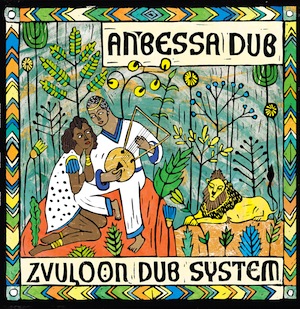
Israeli artist Moran Yogev created the cover of Zvuloon Dub System’s Anbessa Dub album.
JI: Who did the cover art of King Solomon and the Queen of Sheba for Anbessa Dub?
AS: The beautiful artwork featuring King Solomon and the Queen of Sheba was done by Moran Yogev, a very talented young Israeli artist.
I saw some of Moran’s works that combined elements of Ethiopian art in the newspaper and I felt that she could bring the right appearance to the album. I was very happy when she told me that she loves our music and would be happy to design our album.
JI: What’s the Tel Aviv music scene like these days? In what kinds of venues do you usually play?
AS: Tel Aviv is a small city but the music scene is quite big. You’ll find many talented musicians playing all kinds of musical genres, from Middle Eastern to jazz, from Ethiopian music to rock and roll and electronic music.
We’re playing in many venues, like the Barbie Club, Hangar 11, Levontin 7, the Zone and many other venues in the city.
JI: Are there any musicians, Israeli or not, with whom you would like to work?
AS: We have a list of musicians that we would like to work with, and from time to time we’re doing it. In the reggae field, we have worked with artists like U Roy, Cornell Campbell, Echo Minott, Ranking Joe, the Viceroys and others. In the Ethiopian field, we have worked with the legendary Mahmoud Ahmed, with Zemene Melesse and Jacob [Tigrinya] Lilay. In Israel, we have worked with Carolina, and Ester Rada. I have a dream to collaborate one day with Ehud Banai.
JI: What’s next for ZDS?
AS: I hope we’ll continue to move forward, to create more music, to tour as much as possible and to collaborate with more musicians and, by doing so, to develop our unique sound.
JI: If there is anything else you’d like to share with our readers, please do.
AS: I invite each one of you personally to come to our show in Vancouver and to discover something new, music that unites people and cultures into a groovy soundtrack.
Opening for Zvuloon Dub System at the Imperial (319 Main St.) 19+ show on Feb. 20, 8 p.m., is Brooklyn-based band Twin Wave, which fuses jazz, soul, rock and pop. Tickets are $30, $25 for students. Other Chutzpah! music offerings are Les Yeux Noirs; the Borealis String Quartet, Eric Wilson and Boris Sichon; Daniel Kahn and the Painted Bird; Diwan Saz; and, in Chutzpah!Plus, Ester Rada. For tickets and the full schedule of music, dance, comedy and theatre, visit chutzpahfestival.com.
Maria Kong opens this year’s Chutzpah! festival on Feb. 19. (photo by Guy Prives)
The 15th season of Chutzpah! kicks off Feb. 19 with Tel Aviv-based dance troupe Maria Kong. Founded in 2008 by former Batsheva Dance Co. members, Maria Kong combines dance with art, sound, light, visual effects and technology. And, for the opening of Chutzpah! they take their performance off the stage and into the audience – or, rather, they bring the audience “backstage.”
The JI spoke with Israel’s Talia Landa, Maria Kong performer, artistic director and co-founder (with Anderson Braz from Brazil), in anticipation of the presentation in Vancouver of Backstage, which will take place at Red Room Ultra Bar.
JI: From where does the name Maria Kong come? What is its significance?
TL: We are “Virgin Marias” and “King Kongs” (not necessarily defined by gender). Together, we make Maria Kong.
JI: There is so much innovative dance coming from Israel. What makes the dance scene so “fertile” there?
TL: There could be many reasons why that happens; some more obvious than others. Israel is a great place where people from all over the world meet, connect and meld their talents in order to create magic. It’s a place where creativity and innovation are a driving force in our lives, hearts and souls. We have our fair share of challenges, so we are pushed to approach them with unique solutions. It’s no secret that Israel is the land of high-tech and start-ups; it only makes sense that this creative research and innovation would spread to the world of dance. We have a drive to do things passionately and intuitively, triggered by an inner impulse to never stop moving.
JI: Your vision centres on teamwork. How does Maria Kong’s creative process work in general? How is it decided what ends up in a performance? As artistic director, do you have “final” say?
TL: Maria Kong’s creative process works like this:
1) An idea is born.
2) The idea is placed on the table.
3) The team members from all of the different divisions (dance, music, light, sound and technology) come together to share their unique input and express their particular perspective.
4) The idea transforms from a 2-D piece of paper on the table, to a three-dimensional creation, which we continue to develop together.
Yes, perhaps I have the “final” say, but each creation undergoes many stages of dialogue before the concluding decision is made.
JI: The show planned for Chutzpah!, Backstage, is choreographed for “off the dancer’s stage,” so to speak. In what ways, if any, is the performers’ (and technical crew’s) preparation different for this type of show from that for a stage-based performance? And is there anything the audience should do to prepare?
TL:Backstage is unique in the way that it takes any given space and transforms it into a stage, but not in the conventional manner where the performers are on stage and the audience takes their seats. In Backstage, the members of the audience can grab a beer, join friends at the opposite end of the venue, change views, and experience the performance from a number of different angles.
The audience, time and space are a fundamental element of Backstage. Every venue has its unique infrastructure and particular vibe. In order to prepare for our performance for Chutzpah!, we inserted the Red Room Ultra Bar’s measurements and properties into our computer programs, as we aim to ensure that the graphics and choreography fit the venue and our energies can dance with the people of Vancouver. We reshape our bodies, mind and soul in order to create a tailor-made unique experience in each performance.
Should the audience do anything to prepare? Bring an open heart and wear comfortable shoes.
JI:Backstage, and other Maria Kong pieces, have featured live musical performances, including known vocalists. Will the Vancouver show feature live vocals? If so, can you share from whom?
TL: We are very lucky to have great friends with great talents who are happy to join us on our journey to this great festival. I don’t want to give it all away, but I will share that one of the special guests we are bringing is very close to my heart, and happens to have Canadian roots.
JI: For the simple fact of being an Israel-based group of artists, there was a call by some in India to boycott your performance there in November. How do you respond to such efforts?
TL: Maria Kong is a team of artists with a shared vision: a vision of common values. Our artistic creations are a result of open dialogue and passionate collaboration between the Israeli, French, Brazilian, Russian and Japanese members. We strongly believe in the language of movement: a language that knows no border and holds no passport. It is boundless, endless, holds no limits – a language of human connection, a language of physical and spiritual communication, traveling through all forms of artistic creation. Think of yourself, right now, as you read this text. You are probably in a room, inside a building, within a city, territorially bound by a country, on this wild earth that contains us all. As you continue going through this text, our wonderful earth is dancing in perfect synchronization with our sun, infinitely spinning within our endless universe. The beautiful language of movement is our core – it is fundamental to our survival, and an inseparable element of our existence.
JI: If there is anything else you’d like to add, please do.
TL: I would just like to say that the artistic director of Chutzpah!, Mary-Louise [Albert], along with her team, are the coolest people ever to have believed in us and chosen us to come and share our magic in Vancouver. We are really looking forward to it. So thank you, and see you soon!
Backstage will be at Red Room Ultra Bar Feb. 19, 21 and 22, 8 p.m., and Feb. 22, 4 p.m. Tickets are $29/$25/$20. By way of dance, Chutzpah! 2015 will also feature Shay Kuebler Radical System Art, Idan Sharabi and Dancers with Vanessa Goodman, Bodytraffic, ’Namgis T’sasala Cultural Group and, in Chutzpah!Plus, Serge Bannathan/Les Productions Figlio. For the full schedule of performances, tickets and other information, visit chutzpahfestival.com.
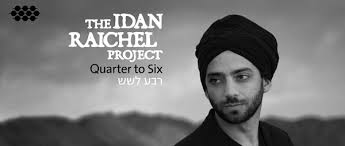
Idan Raichel performs for one night only at the Vogue Theatre on May 12. (photo by Eldad Rafaeli)
Vancouver audiences are in for a treat next month when Israeli musician and uber-producer Idan Raichel together with the ensemble of international musicians that comprise the Idan Raichel Project perform for one night only at the Vogue Theatre on May 12.
The IRP’s unique sound – a blend of African, Middle Eastern, Indian and Latin American rhythms and instruments, is familiar to Vancouver audiences. Their three previous tour stops here – also presented by the Chutzpah! Festival – were sold out well in advance. This time, in addition to old favorites, audiences will be treated to some songs from Raichel’s latest and most successful album to date, A Quarter to Six, released in late 2013 to enthusiastic reviews from music critics and fans, sky-rocketing to double-platinum status within two months of its release.
The album’s title, taken from a work by Israeli dramatist Yossi Banai, refers to the twilight hour, a time of transition from day to night. “This is a very special time in Israel, the change of the day … you can think about what has happened up until now, also what could happen,” explained Raichel, who spoke with the Jewish Independent from his home in Tel Aviv. “The hour of the day that is like the crossroads in life…. After 10 years with the Project, I feel we have reached this time … of change, a transition, both musically and personally.
“A Quarter to Six [is] a kind of closure,” mused the artist. “It speaks about the crossroads we have in life. I don’t know if it’s age, or different perspectives, but we all have it about life … it doesn’t have to be a matter of age, you can feel this crossroads when you are 15 or 50.”
More than a collection of songs, the album is what Raichel terms “a complete piece of art,” as it includes a booklet of small paintings that he has been working on for the past two years. This album “is a big musical journey – inside my life spiritually and outside, touring and collaborating with [musicians] from Germany, Portugal, Columbia. The thing that touches me the most is that people see each song fits … [it’s] part of a story and they are listening from start to finish, writing comments about the booklet.” The songs are “not just singles,” he continued. “Every song is a script in a movie, every scene is singing about the situation that he or she is in. At concerts, I see kids and their parents, grandparents with kids coming, it’s reaching a wide audience…. The first time this is a full album that goes deeply into the theme of crossroads in life.”
While the format of this album differs from previous recordings, what hasn’t changed is Raichel’s unique sound, created in part by the collaboration with international musicians. A Quarter to Six brings together an eclectic mix of voices, languages and musical disciplines with guest artists that include German counter tenor Andreas Scholl, Colombia’s Marta Gómez, Portuguese fado star Ana Moura, Arab-Israeli singer/songwriter Mira Awad, Malian singer and guitarist Vieux Farka Touré, and a selection of some of Israel’s top up-and-coming singers and musicians. Raichel wrote all the melodies and lyrics but collaborated with each artist, allowing them to interpret and adapt their song to their own personal style.
This latest record is a very personal album – mirroring the very real crossroads that Raichel faces at this stage of his life and career. The 36-year-old recently settled down with his steady girlfriend, became a father and – in a move that elicited some very strong reactions from fans across the world – cut off his trademark dreadlocks. Raichel agreed that in retrospect the album foreshadowed his own transition into adulthood.
A Quarter to Six was released in late 2013 to enthusiastic reviews from music critics and fans, sky-rocketing to double-platinum status within two months of its release.
“Is it personal? When I wrote the album, I still had my dreadlocks, I was on and off in my relationship with my lady but somewhere inside I knew it was time to make decisions, to change things. I knew … I have to shave my dreadlocks after 14 years, I knew we were on and off but I knew I wanted her to be the mother of my kids.… Later on, it was natural. One month after the album was released, we knew that we were pregnant, things were happening.”
Having a child has opened Raichel up to a whole new world. Having a baby “gives me such a perspective about life…. I just enjoy this miracle, see how she develops and discovers new things every day…. It opens my appetite for more young creatures, maybe another nine or so. I wish!” But Raichel and his Austrian girlfriend, Damaris, are not planning on adding to their brood just yet. Their baby girl, Philipa Helena Damaris Raichel, remains with her mom in Israel while Raichel is on the road. “Damaris and the baby won’t tour with me…. I think it’s good to separate things. On the road, everyone has stuff to do. I don’t want them to feel forced to have to wake up early or, you know, to see the concerts every night.”
IRP’s blend of international musicians and sounds has put it at the forefront of the world music scene. In addition to that, Raichel calls the Project’s music “the soundtrack of Israel,” adding that the group plays the role of cultural ambassador for Israel. “The definition of world-music artist can change from one time to another, but world-music artists bring the soundtrack of where they come from. For example, Bob Marley is the voice of Jamaica; Edith Piaf, the voice of France; or like Miriam Makeba is the voice of South Africa. We feel honored when people describe our music as the soundtrack of Israel. If people don’t know anything about our country but can remember our music … especially people from conflict regions, then they see the other side of our culture.“
The past year has been a banner one for Raichel, who performed privately for Barack Obama during his state visit to Israel, appeared with French superstar Patrick Bruel and was awarded ACUM’s Composer of the Year 2013. To top it off, the popular Israeli entertainment magazine Pnai Plus named Raichel “Man of the Year.” Far from finding this flattering, the title made the unexpectedly humble musician feel uncomfortable. “Well, I was speechless then, and I’m speechless now,” he said. “In such a crazy country like ours, with so much happening every day, even every half day … how weird it [is] to get this recognition. I think a better Man of the Year would be … there is the story of one of the army commanders, he lost his two hands in an explosion and, a few months after that, he came back to the army to lead [his soldiers] again.” He added, “Just the struggle, even if it wasn’t an army, even if it was a soccer team … I don’t know, to see the power of good will, how strong you can be facing such trauma, how you can not give up to depression or pain or disappointment, that was an inspiration, I guess.”
Raichel said there is “a lot of good music coming from the Israeli music scene” nowadays. “It’s becoming more and more open to sounds from all over. Back in the day, you would hear less of the Yemenite roots, Middle Eastern influences,” it was “mostly Ashkenazi music.” And while he enthused about Israel’s modern musicians, mentioning DJ Avishai Cohen and Yemen Blues in particular, he still enjoys the music of Arik Einstein and Shoshana Damari. “Now, there are so many more radio stations, for more artists. Today, you hear music that more reflects the sound of the Israeli melting pot.”
Chutzpah! Festival artistic managing director Mary-Louise Albert said audiences are in for a whole new experience at the May 12 concert. “I have brought Idan back because it builds his audience here in Vancouver and I’m committed to supporting many artists beyond just presenting them one time. Artists develop and grow, so audiences get to experience this growth also when an artist performs multiple times.” With its 10-member ensemble (the largest of IRP’s Chutzpah! engagements), Albert said the Vogue Theatre is the perfect showcase for this high-energy, “plugged-in” event. “Vancouver audiences have not experienced this show before,” she said.
Opening for IRP is Vancouver’s Babe Gurr, who will showcase songs from her current album, SideDish, a unique blend of world music and her own roots style that has earned Gurr glowing reviews and a strong following.
Nicole Nozick is a Vancouver-based freelance writer and communications specialist.
Back in Vancouver for the third time, Sidra Bell Dance New York presents a double bill of STELLA and garment March 27-29. The performances are co-presented by the Chutzpah! Festival as part of its PLUS series and the Dance Centre. Artistic director Sidra Bell spoke with the Jewish Independent via email about her background, what inspires her, the power of dance theatre and what makes her company unique.
JI: Could you share a bit about your background?
SB: I was born in New York City to mixed heritage and grew up in the northernmost part of Manhattan in a neighborhood called Inwood. My father’s background is Italian, Irish and Bohemian (on my grandmother’s side) and my mom is African-American. Both of my parents were raised in New York City, in the Bronx and Brooklyn respectively. My paternal grandparents came in through Ellis Island.
I identify with my mixed heritage and was always exposed to the various components that make me who I am although we didn’t specifically practise religion in our household. My parents are both pianists and met through music. They went to New York College of Music and went on to direct together, as well as teach. I am the youngest of four siblings who are all involved in the arts…. In some way or another, most of my family and extended family are artists or use art as an entry point into what they are doing now, and we are all largely entrepreneurs….
JI: How and when did you first discover dance? When did you discover choreography?
SB: I participated in preschool in an after-school dance program, Ms. Patti Ann’s Dance, in my kindergarten years. A couple of years later, my mom took me to an audition at the Dance Theatre of Harlem. I resisted mainly because I was extremely shy and very nervous. I started taking classes in ballet there at age 7 and fell in love with the language of dance and its rigor. I was a very serious child and loved delving into the form that was being taught. I excelled very quickly and was asked to join the weekday program on scholarship, which increased my level and the number of classes a week. By 13, I was taking classes with the professional division, particularly in my summers when I could participate in the intensives.
At age 14, I realized I needed to stretch away from just a classical training and that is when I was accepted into the Ailey School, where I spent two-and-a-half years on scholarship. It was during that time, as I became more exposed to modern techniques, that I became interested in generating my own movement vocabulary. I was able to create a few solos for myself that were showcased at Ailey’s student showcases and also at my high school, the Spence School, where they had a dance program. Because both were New York City based, these showcases were taken very seriously and showcased in well-attended venues such as Symphony Space.
From an early age, I knew that I had to be very rigorous in my craft. In college at Yale, I was part of a student dance company called Yaledancers that produced its own shows in the New Haven, Conn., community. I became more active in my choreographic process and there started truly investigating and making work. This was outside of a conservatory environment and it allowed me to work with my own movement invention. My college years were formative exploration years.
JI: Can you describe how a piece comes together, from inspiration to the stage?
SB: I simply start with movement. Movement has been a driving force behind all of my works. There is always a question around why movement is an important means of expression. This question leads to larger subtexts within a work and perhaps characterizations. What is important to me is to challenge my collaborators to investigate movement with various qualities, tones and entry points. This collaborative focus has led to wildly different worlds onstage. The dancers ingest the vocabulary and regurgitate it based on the tasks or objectives at hand. I find that the concept evolves as we dig deeper each day into the vocabulary. There is a lot of trying and playing in the studio. Sometimes we are at ease and just talking, which leads to insights into what the dancers are thinking about in relationship to the world around us. How does movement bring in larger overtones about the world around us? I love form and that is a huge emphasis. Inventing forms is my primary concern. As we continue, the lens and environment come into play, as well as how the dancers are interpreting each relationship. More recently, I have been working more closely with my lighting designer to create limits onstage that inform how the dancers will interact with the arena or environment set up for them.
JI: Is this Vancouver performance part of a larger tour? I see that STELLA is from 2012, but garment is a brand new piece. How did garment come about? How do the two pieces work together, if at all?
SB: This has been a wonderful year of touring for the company. We have already completed residencies and tours in Philadelphia, Pittsburgh … and Atlanta’s Tanz Farm. [Two weeks ago], we world premièred garment as part of the Kelly Strayhorn Theatre’s commissioning series KST Presents. STELLA was created in 2012 and world premièred at NYC’s Baruch Performing Arts Centre. Before arriving at Chutzpah!, we will be showcasing the same program of garment and STELLA in our San Francisco Season at Dance Mission Theatre.
Sidra Bell Dance New York performs garment in Vancouver March 27-29. (photo by Mark Simpson)
garment is about living in the skin you are in. Like STELLA, it deals with voyeurism and culture, but I think it drives towards the idea that we can rid ourselves of cultural constructs to re-establish or reclaim our personal and unique identities. Both works deal with popular constructs and individualism in an episodic framework. STELLA has a more cultish feeling, where you really see the dancers playing games and you can’t guess who “Stella” actually is until the end. garment sees the dancers reproducing trends and systems, and also working with joyful abandon. I think the two pieces are in conversation with each other and inhabit many different worlds within these general themes.
JI: Critics have called your work powerful, atmospheric, surreal, sensual and ferocious. I would add that your work is also in many ways hyper-modern, with industrial or “futuristic” qualities, from the costumes to the electronic soundscape you work within. It’s also very theatrical. Is there an overarching aspect of contemporary life that you’re exploring through your choreography?
SB: The main thread of my work is the personal questions that I grapple with. I think they are universal questions about our condition in contemporary life. As the world changes more rapidly, I grapple with my individual questions around identity, legacy, the afterlife, politics, community. The list can go on. I think I deal with these questions in my work, and not in a politicized way. The dancers contribute to this probing research and we work with play to reach and deconstruct content around these themes. Personas get developed through movement research and worlds get built from our collective thinking. I like playing this out on stage. There is often no resolution, but I am happy that there are always more questions. There is no one way to view the work and I like that the audience can reach in and find their own personal story. I am always surprised and pleased at the level of analysis an audience can bring to a moment. They bring up aspects I didn’t see and I think that is the beautiful quality that dance has. Its ephemeral and abstract nature can really make you feel. You may not know why you feel a certain way because it is truly coming from a visceral space. I like the fact that dance doesn’t have to deal with realism in such a direct way.
JI: What are the lines between dance and theatre, and what elements of performance bring them together? As well, can you share something about your work on Test and what draws you to work in the medium of film?
SB: I actively aim to eliminate the lines between dance, theatre and visual art. They are mediums that create a mutual, shared experience for the performers and the audience. I use whatever elements help me create those experiences for the viewer. I think this is why I have explored so many different aspects of dance and theatre. I use whatever technique or model that I believe services the work in the moment. I was the lead choreographer on Test (testthefilm.com), which has now been seen and awarded prizes worldwide. The film was shot and created on location in San Francisco. It was an incredible process working with Chris Mason Johnson, who wrote the screenplay and directed. He was a former dancer with Frankfurt Ballet and White Oak Project. I learned so much about the process of film making that I believe has improved my skills as a dance maker. Everything that was created on set was to service the storyline about dancers in the 1980s during the AIDS epidemic. My material was tempered to that era and I found it refreshing to have such a guide. It made me much more clear in the process of creating a choreographic work, which I consider to be a directorial act as well.
JI: How does your academic orientation and background impact your dance work, if at all? Are you currently teaching?
SB: I guest teach internationally. Teaching is a passion and I truly love the exchange I get to have with dancers from all over the world. My mind expands each time I lead a workshop because of the collaborative nature of working with such diverse communities. My academic background gave me a strong sense of language and articulation. My analytical nature has kept me interested in the research of movement not just its results.
JI: Are there differences in how you approach choreography for your own company versus commissions from other companies?
SB: My process is highly collaborative and I always go into a studio with very little expectation. This has produced very different works in each environment I visit. I like going into a new community on commission and introducing my language, but also learning about what gets that particular company excited about movement. With my company, we have such a history together that each work seems to be a reflection or a response to the last. I have been working with my dancers for some years and there is rich history that they bring to the studio but also a curiosity in moving forward.
JI: Vancouverite Rebecca Margolick is one of your dancers. Is there anything you can tell me about Rebecca’s contributions to SBDNY for her hometown audience?
SB: I met Rebecca when she was 16 years old at Arts Umbrella, where I taught and staged work. She was so wise and left a great impression on me. She brings a beautiful physical quality to the work but is also highly theatrical. When she is on stage she inhabits another aura. I find that fascinating about her. She is very discrete offstage but onstage she is a bold performer. She is a chameleon.
JI: Is there is anything else you would like our readers to know?
SB: This is our third visit to the Chutzpah! Festival as a company and I am so excited to be returning with these two works. I’m also thrilled to be co-presented by Chutzpah! PLUS and the Dance Centre. We love the city and can’t wait to see our Vancouver friends.
Sidra Bell Dance New York presents STELLA and garment March 27-29, 8 p.m., and March 29, 2 p.m., at Scotiabank Dance Centre, 677 Davie St. Tickets, $28/$24/$20, are available at chutzpahfestival.com or ticketstonight.ca.
Dudu Tassa & the Kuwaitis will play at Vancouver FanClub on March 9. (photo from Chutzpah!)
The 2012 Vancouver Jewish Film Festival brought Dudu Tassa to local audiences – on film. The 2014 Chutzpah! Festival is bringing Tassa to the city again – in person.
Dudu Tassa & the Kuwaitis will play at Vancouver FanClub on March 9. Tassa, on vocals and guitar, will be joined by Nir Maimon (bass guitar), Neta Shani Cohen (cello), Eyal Yonati (computer), Barak Kram (drums) and Ariel Qasus (qanun). They will perform “Iraq ’n’ roll” – not coincidentally the name of the documentary that screened at VJFF.
Gili Gaon’s film Iraq ’n’ Roll followed Tassa as the rock musician/composer reconnected to his musical roots: specifically, as he gathered information about his grandfather and great-uncle, Daoud and Saleh al-Kuwaiti, respectively, who were famous musicians in Iraq in the 1930s. When they emigrated to Israel in the 1950s, they were unable to make a living as musicians and their music was all but forgotten. That is, until Tassa set about discovering more about his cultural heritage.
In addition to the film, Tassa’s 2011 release – Dudu Tassa and the al-Kuwaitis – reinterprets the al-Kuwaiti brothers’ work in a contemporary context. On the album, Tassa “sings their songs in Arabic and Hebrew, and integrates Iraqi, Middle Eastern and Israeli rock music.” The album features archival materials from the Kuwaitis and “integrates a variety of styles and guests, among them Yehudit Ravitz and Barry Sakharov. Tassa’s mother and Yair Dalal also take part in this exciting project.”
Tassa grew up in Ramat Hasharon, in central Israel, close to Tel Aviv. “I started out by playing the guitar and singing at a young age,” he told the Independent in an e-mail interview. “I was noticed, and realized that this was what I wanted to do in my life and went in that direction. Growing up, my musical taste changed but, in my heart, I will always be a rocker. At home, my mum listened to mostly Arabic music when my dad was out of the house. The general idea was to become ‘Israeli’ and to listen to Hebrew music.”
Tassa put out his first album when he was only 13 years old. He described the genre of the music on that recording as “more oriental singing. I then turned towards rock and, by 2000, I was a singer/songwriter. I joined many productions and became a requested guitar player. I played for many years on a famous TV show with a comedian – that’s how I earned the money to finance my own material.”
His second album came out in 2000 and his third, Out of Choice in 2003, includes a version of “Fug el-Nahal,” which his grandfather and great-uncle used to perform; the song also appears on Tassa’s 2004 album Exactly on Time. While the al-Kuwaiti brothers did not write the song, they performed it, and the song represents Tassa’s first foray into interpreting and performing that type of music, sung in Arabic.
“My grandfather and his brother, Daoud and Saleh al-Kuwaiti, were great composers coming from Kuwait to Iraq. They composed many songs, which spread in popularity throughout the entire Middle East. The sultan in Iraq in the ’40s appointed them to start the National Broadcasting Orchestra and they composed, played and recorded for many years, until they emigrated to Israel in the ’50s.
“My grandfather and his brother, Daoud and Saleh al-Kuwaiti, were great composers coming from Kuwait to Iraq,” explained Tassa of what he discovered in his research. “They composed many songs, which spread in popularity throughout the entire Middle East. The sultan in Iraq in the ’40s appointed them to start the National Broadcasting Orchestra and they composed, played and recorded for many years, until they emigrated to Israel in the ’50s.
“I am named after my grandfather Daoud (David); Dudu is a short name for David,” he added. “My grandfather died just when my mum was pregnant with me.
“I had always heard of my grandparents and the dark side of it was that, when arriving to Israel, they had to make their living out of other things and could not support themselves with music. I was aware of it always, but didn’t deal with it.”
He has since dealt with it, of course, and he is continuing his family’s musical legacy with his current work. About that, he said, “In a way, I guess, it keeps their names alive. In Iraq during Saddam Hussein’s period, the composers’ names were deleted on all the compositions (because of their Jewish heritage), and now the world again recognizes them. Also in Iraq, a few years ago, Iraqi musicologists on TV recognized the Kuwaitis to be the most important composers of modern Iraqi music.”
Tassa is also a record producer, he has composed music for film and TV, and has even tried his hand at acting, which was “a truly new experience” for him – he played a Syrian prisoner in Samuel Maoz’s 2009 film Lebanon.
“I am currently working on a new album,” he said, sharing with the Independent that he still gets “excited each time before the release … like a child.”
Dudu Tassa & the Kuwaitis’ appearance at the Chutzpah! Festival is the first of a tour. “We continue to New York – the Jewish Heritage Museum, where they also have an interesting exhibition on Iraqi Jewry – then to Boston, South by Southwest showcases in Austin and, finally, San Francisco.”
About how musical performance has changed since his grandfather and great-uncle took to the stage, Tassa said, “The fact that we can use the computer, and involve recordings inside a live performance, does change a lot.
“As for the audience, I think they will judge good music and bad music so, in that sense, maybe nothing has changed. As a matter of performance, it’s the same. Either you’ve got it on stage or not. I think that although we try to impress [people] with great lights and sounds, it all comes down to if the listener is moved or not.”
Vancouver FanClub is at 1050 Granville St. The March 9 show starts at 8 p.m. Tickets ($25/$30 plus taxes and fees) are available at chutzpahfestival.com, as is the full festival schedule.
Since last year’s Chutzpah! Festival, the Jewish Independent has been waiting to see Noah Drew’s Tiny Music. The read-through in 2013 was a unique experience of a work-in-progress, and it will be fun to compare that “teaser” with the production that takes to the Rothstein Theatre stage later this month as part of this year’s Chutzpah!
“This play has actually been slow-cooking for almost 10 years,” Drew told the Independent in an e-mail interview. “In 2004, the fabulous actor/writer Josh Epstein approached me about writing and composing a musical together. We jammed on ideas, and decided to adapt a short story by Sholem Aleichem called The Fiddle, which I’d been very fond of growing up. At my grandparents’ house, I used to listen to a record of the great Howard Da Silva reading Aleichem’s stories accompanied by a klezmer band, and The Fiddle was one of my favorites: a dark fable in which a boy who’s obsessed with music is forbidden to have anything to do with it, but can’t help himself, to his family’s ruin. Josh and I wrote a few songs and scenes about a boy in the Old Country who was born with unusually large and dexterous hands – a violin prodigy. Some of the material was great, but then, life happened – Josh booked a big show in Toronto and moved there, and shortly afterwards I got a full scholarship to do my MFA in acting at Temple University in Philadelphia, and also moved east. Every once in awhile, Josh and I would connect and talk about working on the show, but it never quite happened.
“Then, in 2010, I was visiting my friend Sarah Shugarman (a wonderful musician in Toronto) and ended up unearthing one of the songs I’d written for the Fiddle project. When I read her the lyrics, she was effusive in her praise and excitement, and encouraged me to reopen the piece. We talked about co-composing, but in the end the scheduling and geography didn’t cooperate (I had completed my degree and moved back to Vancouver by this point) so I decided to push forward with the project alone.”
At the heart of Tiny Music is Ezra, described in the Chutzpah! program as “an autistic man with an auditory-processing disorder that heightens his experience of the sounds around him.” About the writing of such a character, Drew explained that, around the time he re-committed himself to the play, he was “spending a fair amount of time with two members of my family – one adult and one child – who are on the autism spectrum. I also had a private acting student who was autistic. I noticed that all three of these individuals had certain challenges, particularities and special abilities when it came to focusing, and that all three seemed to have a very strong relationship to music. Music has always been incredibly important in my life also, and I was finding nice connections with my autistic family members through listening to and/or playing music together. I conceived of a contemporary version of the Sholem Aleichem story with an autistic man who hears in an extraordinary way at the play’s centre.”
Drew said he wrote a handful of songs and a first draft. “A two-day script workshop in Montreal in January 2013 led me to a second draft of the script, which was presented as a reading in the 2013 Chutzpah! Festival,” he said. “That reading was a bit of a whirlwind – we had only the one day to rehearse – but it was a good opportunity to see how the story was working (and where it wasn’t) and to hear a few of the songs with piano and voice. I learned from that reading that some aspects of the characters and story were really working, but others were a bit superficial and/or clunky.
“I went back into the writing process and, in October 2013, the show’s director/dramaturg Jamie Nesbitt and musical director Yawen Wang came out to Montreal to join me, sound designer Joe Browne and eight Concordia theatre and music students for a six-day workshop of the piece. That was a fantastic process! In addition to further developing the script and story, we got to explore the most important question of the piece stylistically: how can we make the songs, story, instrumental music and sound design all work together as a cohesive whole? We did some wonderful experiments, played around with ways of combining the elements and made discoveries such as: in this show, sometimes a sound cue or instrumental moment could actually replace dialogue. The script, music and sound all moved forward a couple of drafts. The characters were becoming more three-dimensional. The music was becoming more contemporary (‘less Sondheim and more Bjork’). The unique world of the show was coming into focus.”
Rethinking the storytelling
At this point, however, Drew and Nesbitt – co-founders of Jump Current, the producer of Tiny Music – noticed a “significant problem with the script.”
“Although the show is experienced from the perspective of an autistic individual, the storytelling mode was still quite ‘neurotypical,’” explained Drew. “Ezra had monologues in which he explained his situation and point of view to the audience in a very linear, chronological way. But the more I read and spoke to people about the range of autistic experiences, the more I realized that this linear way of speaking and thinking didn’t feel right. At Jamie’s urging, I took the script apart, and re-imagined it as a world in which time and memory are at times fluid, fragmented and unpredictable. Now, in the language, sound, music and staging, we are finding rhythms, patterns and textures that feel more true to who Ezra is. Rather than just describing and showing the story of this unique individual, we are figuring out how to invite the audience to share his visceral experience.”
This is what makes Tiny Music not just a regular, run-of-the-mill musical.
A sound design musical
“I call Tiny Music a ‘sound design musical’ because I want the audience to spend 90 minutes really hearing through Ezra’s ears,” explained Drew. “For Ezra, tiny details of the sonic environment that might go unnoticed by most people are very vivid. Sometimes, these details might mesmerize him. At other moments, they might overwhelm him. And sometimes, he hears the patterns in things so vividly that mundane sounds coalesce and occur for him as music. So, the songs in Tiny Music don’t just happen because, hey, it’s a musical. Instead, we only have songs because either (a) it makes sense that another character would actually be singing to Ezra in a certain situation, or (b) Ezra’s internal experience of certain sound patterns ends up transforming non-musical sounds into a kind of song. And, there are many times in the show – even some pieces I’ve called a ‘number’ – when nobody actually sings. Instead, it’s more like the environment itself that sings … all the sounds on all the floors of the building he’s in combine to make a kind of ‘sound design song,’ or a the voice of a person who is just speaking warps and distorts in Ezra’s perception, becoming rhythmic and harmonic. Every sound can be a kind of music if you really listen.”
The producers: Jump Current
Tiny Music is but one of several projects that Jump Current is currently producing, despite its relatively recent appearance on the theatre scene. “Very close friends who have led kind of parallel lives for awhile now,” Drew and Nesbitt started the company last spring. Of the reasons for the collaboration, Drew said, “We’re both fairly well known in Canada as theatre designers (he for video projections and I for sound), but we both consider ourselves to be theatre artists in a much broader way than only design. In fact, we both are suspicious of the way that sometimes design tricks and flash can get in the way of real, organic moments of storytelling in the theatre. (Also, as it happens, Jamie and I are both married to yoga teachers who used to work as actors, who are now studying to be expressive arts therapists – go figure.)
“In 2012, Jamie got very involved in working on Tiny Music, and I started working as a dramaturg on a play he’s writing called Salamandra (which is based on the true story of his inheriting a 150-bedroom castle in Poland from his great-uncle, Poland’s former minister of war, and his great-aunt, a former Polish movie star). Because we were doing these two projects together, and because our views about theatre, politics and life are so aligned, we decided to start a company together.
“In addition to creating and producing works of theatre and media-based performance,” he continued, “Jump Current’s mission is to research, develop and champion uses of design and technology that illuminate live human-to-human connection, and counteract people’s sense of alienation from one another. We believe deeply that, although, of course, it’s true that we live in an age when technology can really separate people from direct, organic connection, there are ways that it can also facilitate a shared experience of wonder that can really unite people.”
Another project that Drew and Nesbitt are developing is The Riot Ballet, “which explores themes of crowd psychology, identity and protest – both peaceful and violent,” said Drew. “We recently participated in a two-week development process in Barcelona, which led to some really exciting material and ideas. The team is amazing – this project brings us together with fantastic theatre companies from Spain, Colombia, the U.S., and a dance company from Toronto. We’re aiming for a late 2015 or early 2016 première in the U.S., then dates in Canada and Europe.”
All of this is in addition to Drew being a tenure-track faculty member in the theatre department of Montreal’s Concordia University, his continued freelancing in sound design and his voice teaching work. One of his sound design projects, he told the Independent, is for Horseshoes and Hand Grenades’ production of This Stays in the Room, which will be performed at Gallery Gachet in Vancouver March 19-30.
About his full schedule, Drew said, “I feel very grateful that my years as a full-time freelancer and the demanding process of doing an MFA really helped me develop good time-management skills! But, when it’s all amazing, a busy life is a pleasure. Sometimes, when things get a little too intense, my wife and I look at each other and say, ‘At least it’s not boring!’ We’re usually smiling.”
Tiny Music takes place Feb. 25 and 26, 8 p.m., at the Norman and Annette Rothstein Theatre. It stars Anton Lipovetsky, Susinn McFarlen, Caitriona Murphy and Bob Bossin, with musicians Yawen Wang (piano and accordion), Joe Browne (live electronics), Caitriona Murphy (violin), Mike Braverman (clarinet), Jodi Proznick (bass) and Jason Overy (drums). There is a post-performance talk-back on Feb. 25. For tickets, visit chutzpahfestival.com, call 604-257-5145 or 604-684-2787, or drop in to the Jewish Community Centre of Greater Vancouver.