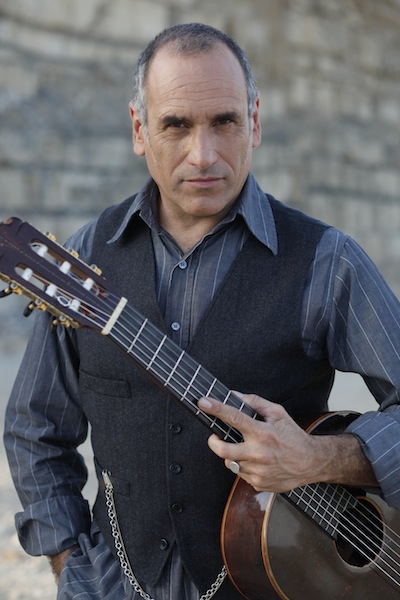
Lyla Canté’s Cristian Puig, left, and Cantor Alty Weinreb. (photo from Chutzpah!)
The best creative ideas often come when you least expect them. This was certainly the case for Lyla Canté, which performs on March 9 as part of the Chutzpah! Festival.
“In the summer of 2012, I walked into a New York City SoHo bar,” Cantor Alty Weinreb told the Independent. He and flamenco guitarist Cristian Puig are Lyla Canté’s front men.
“The room was steamy, hot and teeming with people. I heard the sounds of a guitarist, dancer and singer, and felt the intense passion coming from the stage,” Weinreb recalled. “The guitar is preening and screaming. I was floored by what he was doing without a pick. I hadn’t seen an acoustic guitar played like that. This was raw, urgent and beautiful. I had an epiphany. I started singing Sephardic and (Shlomo) Carlebach melodies over these tunes and they’re working.
“After the show, I approached the guitarist – Cristian Puig – and met with him to see if our musical styles could mesh. They did. We started performing ballads as a duo at chuppah ceremonies [weddings]. We then began arranging dance tunes and added some wonderful musicians: a Cuban percussionist, a blues electric guitarist and a rock-and-roll bassist. The happy result became Lyla Canté, which combines the Hebrew word for ‘night’ and the Spanish word for ‘song.’ We now perform our music at concerts, festivals and private parties internationally.”
While both musicians are based in New York, it was an unlikely encounter, given the men’s diverse backgrounds.
Puig was born in Buenos Aires; his parents also flamenco artists. He began studying classical guitar at 19, in addition to flamenco guitar with his father, before branching out into various other styles. He plays with and has co-founded various groups, and he composes both for himself as a solo performer and for different flamenco companies. He also teaches, composes music for film and works as a flamenco singer.
Weinreb, on the other hand, was raised in New York City in a strict Orthodox, Jewish family, where, he said, “secular music was off limits.”
“As a child,” he said, “the sound of my synagogue’s cantor was some of the first music I remember hearing. Listening to these cantors wail with yearning left an impression on me – this is how a Jew sings.
“Years later, I had another watershed musical moment. Hearing James Brown for the first time felt like a rhythmic ‘burning bush.’
“For the past 20 years, I’ve been cantor at High Holiday services and chuppah ceremonies across the United States. I currently sing with the Simcha All-Stars (jazz klezmer) and Cuban Jewish All-Stars (Cuban klezmer). I teach drums and percussion to children.”
As to where Lyla Canté fits into their busy schedules, Weinreb explained, “The creative process generally starts with me writing an arrangement idea for a song. I then play it for Cristian, who puts it through his blender, which turns it into something else. We then take it to the full group, where it’s further transformed.”
From their solo work and collaborations, it is obvious that both Weinreb and Puig are drawn to the concept of fusion.
“Since I love many different styles of music, I naturally incorporate them into the music I write and arrange,” said Weinreb. “Also, I don’t want to copy all the wonderful Jewish music that I love (including Jewish fusion). By being true to my musical myself, I can’t help but be original. Like everyone alive, I’m blessed with unique experiences and influences.”
Puig said his idea of “fusion is to have a musical style (flamenco, for me) and take elements of other musical cultures and experiment.”
About whether the Judeo-Spanish element changes the traditional flamenco melodies and/or rhythms, Puig said, “It does not really change my approach much, since the flamenco art is a mix of different cultures, among them Jewish. Many melodies and harmonies are similar in both Jewish and flamenco music.”
As for how flamenco influences traditional Jewish melodies and rhythms, Weinreb said, “Flamenco adds a tremendous musical and historical component to our music. Flamenco, which has deep Jewish roots (and Arabic, Gypsy, Moorish and Roman), is really the intersection of Eastern and Western Jewish culture.
“Paco De Lucia, considered the greatest flamenco guitarist in recorded history, said he discovered ancient Sephardic music transcriptions in Spain and was struck by the profound influence Jewish music has had on flamenco music.
“Musically, Cristian’s flamenco guitar adds a fiery energy to our music with its immediacy and earthiness. He then can turn on a dime and be heartbreakingly beautiful as well. I’m fortunate and grateful to play with him.”
Lyla Canté performs March 9, 8 p.m., at Rothstein Theatre. For tickets ($29.47-$36.46), call 604-257-5145 or visit chutzpahfestival.com. In addition to other musical offerings, the festival also features dance, theatre and comedy.
Maya Avraham will perform on March 7 at Rothstein Theatre, as part of the Chutzpah! Festival. (photo from Chutzpah!)
With two highly praised albums under her belt and a third one in the works, Maya Avraham has come a long way from Rishon LeZion and her days as a backup singer. All her experiences have made her the talented and entertaining artist she is today, as Chutzpah! Festival audiences will see for themselves on March 7.
Avraham told the Independent that she will be coming with two of her band members and two musicians who live in Los Angeles. “From there,” she said, “we’re flying out to Vancouver to perform at the Chutzpah! Festival.”
Avraham has been performing since she was a teenager.
“At 14, I was in a band called Kol Rishon [First Voice] in my hometown,” she said. “And, at the same time, I also sang in my school band. There, I realized how much I enjoy singing and performing. We performed at all festive events in Rishon LeZion.
“I began private singing lessons at age 16,” she continued. “Already, from a young age, the atmosphere at home was musical – we heard Egyptian music and Yemenite.
“At 16, I joined the Moroccan band Sahara, which performed at major family events throughout the country. With them, I was exposed to the Moroccan music that I still listen to and am influenced by today.”
In the Israel Defence Forces, Avraham was in the army’s music ensemble, where she was a singer and also responsible for the ensemble’s schedule. “Of course, we performed all around the country, and I gained more experience,” she said. “In this group was also where I met Moran Gamliel who, eventually, wrote and composed the song ‘Lama’ [‘Why’] with Adam Perry.”
“Lama” was Avraham’s first single.
“In addition to my involvement with the band Sahara, I was also a backup singer in different studios across the country and sang with various artists who recorded albums,” explained Avraham. “In my work as a studio singer who does vocals and harmonies, I gained a lot of professionalism and accuracy. At one point, I was singing backup vocals for the album of a singer named Amir Benayoun. Amir decided to write me songs and I sent them to Helicon, the company with which he was signed. As a result, the manager of Helicon chose to sign me and we started working on the first album. That was at age 23 and I was with Helicon for five years before I ended the contract.”
It was also at 23 that Avraham met fellow Israeli musician Idan Raichel.
“While searching for musical materials for my first album after I signed with Helicon,” she said, “I had the privilege of meeting with Idan Raichel about a song he wrote for his album that he wanted me to sing. So we met. After the success of the song, Idan approached me and wanted me to be part of his project. I agreed, and started the path to my own career by being part of a larger project, called the Idan Raichel Project, which was a success worldwide.
“Working with Idan was very enriching musically and professionally. I learned a lot from him and I was privileged to work with other talented people who were also part of the group. During the many performances in Israel and abroad, I got to know a lot of talented musicians and I was always learning, gaining knowledge and experience from, for example, singers like Martha Gómez and Shoshana Damari.
“I was part of the project for 12 years and the experiences were many,” she said. “Every performance we did or country we visited, we received a lot of respect and admiration, and I am certain it also shaped and strengthened my own personal career.
“The album Rak Ratzit Ahava [All You Wanted Was Love] came out when I was signed with Helicon and the album La Yom Haze Chikiti [This is the Day I’ve Waited For] came out recently, produced by Rafi [Refael] Krispin of Ze-Nihal.”
In a 2016 interview with French magazine TipTopTelAviv, Avraham said she was nine months pregnant when she met Raichel. Two months after her second daughter was born, she said, “Idan telephoned me and asked me to leave for the United States [for a tour], which was to begin a month later. I agreed and my husband stayed with the kids!”
Avraham and her husband have four kids now: Ruth, 12, Jonathan, 10, Tamar, 5, and Hadas, 3.
“Throughout the years with the project, when I toured abroad, I always had help along the way from my parents and my husband,” Avraham told the Independent. “They’re good kids, so it’s easier to trust that everything will be fine and the support from home is important, assuring me that everything is in order. Of course, you always have to come back with gifts.”
Avraham said she is happy and excited about coming to Vancouver. According to the Chutzpah! website, she and her band will be performing her own hits, songs she sang with the Idan Raichel Project and some of her favourite covers.
Maya Avraham Band performs March 7, 8 p.m., at Rothstein Theatre. For tickets ($29.47-$36.46), call 604-257-5145 or visit chutzpahfestival.com. Other music offerings include the Klezmatics 30th Anniversary Tour (Feb. 23), David Broza and Mira Awad (Feb. 28), Marbin with the band MNGWA opening (March 3), Shalom Hanoch with Moshe Levi (March 8), Lyla Canté (March 9) and Landon Braverman and Friends (April 2). The festival also features dance, theatre and comedy.
In Wrestling Jerusalem, which is at Chutzpah! March 1 and 2, Aaron Davidman tries to understand the complexities of the Israeli-Palestinian conflict. (photo by Ken Friedman)
Most of us have an opinion on the Israeli-Palestinian conflict. But how many of us have listened to others’ perspectives, really considered them and tried to understand them? Aaron Davidman has. And he will share his emotional and thought-provoking journey with Chutzpah! Festival audiences March 1 and 2.
Written and performed by Davidman, Wrestling Jerusalem, directed by Michael John Garcés, is Davidman’s personal journey, as an American Jew, to understand a situation that is often polarizing and over-simplified. The play gives voice to 17 different characters – all performed by Davidman – who represent the breadth, depth and complexity of the conflict; its political, religious and cultural aspects.
As personal as it is, however, Davidman was commissioned to write the play by Ari Roth, who, in 2007, was the artistic director of Theatre J, which is based in Washington, D.C. After 18 years with Theatre J, Roth founded Mosaic Theatre Company, also in Washington, in 2014, and is still its artistic director.
“He asked me to write a solo performance piece investigating the deaths of Rachel Corrie and Daniel Pearl and reflect on the public conversation in America about the Israel-Palestine issue,” Davidman told the Independent about the commission. “The play started there and, as I developed it, it became much more personal and those two subjects no longer relevant to my investigation, which became about the multiple perspectives and competing narratives at the heart of the conflict.”
Davidman is not only a playwright and actor, but also a director and producer. He received a master of fine arts in creative writing and playwriting from San Francisco State University and is a graduate of the University of Michigan; he received his theatrical training at Carnegie Mellon University.
Davidman was raised in Berkeley, Calif., he said, “by Jewish-identified but not religious parents, with a social justice context.”
In an interview with CJN, when Wrestling Jerusalem had its Canadian première in Toronto in November, Davidman said he “fell in love with Israel as a Jewish homeland” when he first visited the country, in 1993, at age 25. “I spent six months living there and had a really incredible spiritual and Jewish identity-forming experience. That story is in the play,” he told CJN.
In the process of researching, writing and performing Wrestling Jerusalem, Davidman told the Independent, “My views about the importance of engagement have deepened, as has my conviction that understanding the ‘other’ is a vital part of the process of reconciliation.”
The play, which premièred in 2014, has also been made into a feature film, directed by Dylan Kussman, which was released in 2016.
“The transcendent themes of the piece remain front and centre now more than ever in a world that is growing only more polarized,” said Davidman. “This piece stands for understanding multiplicity and complexity as humanity’s best chance to live together.”
To facilitate understanding, talk-backs often take place after performances.
“We try to have community conversation – I prefer that term to ‘talk-back’ – after performances and screenings because the piece opens people up,” Davidman said. “They’ve just had a fairly unique experience concerning this topic and there is hunger to process it. It’s a densely written piece and unpacking it and allowing people to hear where they each are coming from in response has proven to be very useful and moving.”
As for advice for people wanting to try and move the public – or even personal – discussion to a more nuanced or empathetic space, Davidman said, “Listen deeply. Don’t know so much. Try to connect.”
Wrestling Jerusalem is at Rothstein Theatre March 1-2, 8 p.m., with audience conversations after both performances, featuring Rabbi Dan Moskovitz of Temple Sholom and Aaron Davidman. For tickets ($29.47-$36.46), call 604-257-5145 or visit chutzpahfestival.com. The festival’s other theatre offering combines Cree storytelling, Chekhovian character drama and comedy, performed by Edmonton-based, award-winning improv troupe Folk Lordz – Todd Houseman and Ben Gorodetsky of Rapid Fire Theatre – on Feb. 22, 8 p.m., at Rothstein Theatre. The festival also features dance, music and comedy.
David Broza (below) will be joined by Mira Awad in concert on Feb. 28, as part of this year’s Chutzpah! Festival. (photo by Nahum Leder)
Israeli singer-songwriter David Broza is returning to Vancouver – and he’ll be joined by friend and fellow Israeli, musician (and actor) Mira Awad. The two will perform in concert on Feb. 28 as part of the Chutzpah! Festival, which runs Feb. 16-March 13.
“I have known Mira Awad for about six years,” Broza told the Independent. “First time I saw her perform was at the Tel Aviv Cameri Theatre, which is one of the most important theatres in Israel. I was very impressed and started following her work. When I was ready to go into the studio to record the album East Jerusalem/West Jerusalem, I asked her to come and sing a couple of duets with me.”
While Awad and Broza may have met only a handful of years ago, Awad told the Independent, “I grew up on Broza’s music and persona, and admired what he did.”
The two crossed paths on more than one occasion after their first meeting, said Awad. “Later on, we met several times on stages and in life, until he called me and asked that I collaborate with him on his album and movie East Jerusalem/West Jerusalem. I was proud to join him on that brave project, and we’ve been performing together since.”
East Jerusalem/West Jerusalem, which features mainly Israeli and Palestinian musicians, was recorded over the space of eight days and nights in Sabreen Studio in East Jerusalem in 2013 and released the following year. Co-produced by musician (and actor) Steve Earle and music producer Steve Greenberg, the creative journey was filmed and made into a documentary by the same name, which also came out in 2014 – and is currently available on Netflix.
“(What’s So Funny ’Bout) Peace, Love and Understanding?” is among the songs featured on the album and in the film. As is clear from human history – and current events – peace, love and understanding are downright scary to some people. Nonetheless, Broza and Awad have dedicated their lives not only to music, but to peace and other social issues.
“I am a human being and I feel kinship with all other human beings. It is beyond my grasp how people can hurt other people like what is happening in the world,” said Awad. “I just cannot understand how one man can think that another is less than him, or deserves less. So, inequality and injustice, no matter where, are total obscenities in my opinion, and I feel obligated to do anything in my power to banish them.”
David Broza (photo by Ilan Besor)
“I have always been involved in social activities, ever since I was a young boy,” said Broza, giving as an example his continuing work with people with disabilities and, in particular, with the Israel Sports Centre for the Disabled in Ramat Gan, which his father helped found when Broza was about 6 years old. “He would then take me along and ask me to help around,” said Broza of his father.
Broza also brings music to Shuafat refugee camp in East Jerusalem, which he discusses in the documentary East Jerusalem/West Jerusalem.
“The coexistence initiatives I have been involved with since I was 19,” he said, “are much due to my grandfather, Wellesley Aron, who, amongst many other initiatives, was one of the founders of the Israeli Arab village Neve Shalom/Wahat al-Salam, where the essential curriculum for peace studies and conflict resolution is developed. So, when I recorded my first written song ‘Yihye Tov’ (‘Things Will Be Better’) and it became a big success, I joined in all activities … in support of the peace process which had just started, [in] 1977.”
On the peace front, both Broza and Awad – and many others advocating for peace – face strong and even dangerous opposition.
“I would think that Mira probably has more of an issue since she is very committed to finding a way and is ahead of the pack,” said Broza. “I have been at it for so many years that it has become part of my being. I also believe in working with everyone when it comes to coexistence and conflict resolution, so I don’t exclude either the Palestinian side or the settler side. Of course, I am not immune to controversial and sometimes harsh commentary and opposition.”
In an interview last year with British online media outlet Jewish News, Awad – who was born in Rameh, in the Galilee, in northern Israel, and whose father is Palestinian and mother is Bulgarian – describes her situation.
“You call me Israeli Arab – but I call myself Israeli Palestinian and even that causes controversy,” she told the paper. “If I say that I am Israeli Arab, then my fellow Palestinians think that I am trying to disown my Palestinian roots and if I call myself an Israeli Palestinian, then the Israelis feel offended. They say: ‘If you are so Palestinian, go live in Gaza.’
“So, I identify myself only as an Israeli and not Palestinian. It mixes things up when you say both. The mere fact there is controversy around the definition might show you just a little bit of the situation faced by Israeli Palestinians in Israel. We are walking a very thin line all the time.”
In the song “Bahlawan” (“Acrobat”) and in a TEDx Talk, Awad describes how she maintains her balance in life, using the metaphor of an acrobat, who, she explains, must keep looking forward, both in order to not fall, but also to potentially “fly” (again, metaphorically).
“When you believe in something, when your vision is clear, you are like a good acrobat, you look onto the horizon and keep your balance,” she told the Independent. “If you start looking down, and calculate your risks, you will certainly fall and be eaten by the wolves waiting for you to trip. I think both David and I have a clear vision for what we believe in and, therefore, we keep our balance.”
“Empathy is the key,” said Broza. “You cannot think of yourself as the one who knows better than the other. Must learn to listen, always. I learn all the time from being exposed to such diverse people. With music, there is only one way, and that is to harmonize, so we keep eyes and ears open and stay in tune together.”
“The evidence is there, everywhere, that people just want to live, go to work, raise their children safely and take them on the occasional holiday,” added Awad. “We just need to encourage these silent masses to participate in the change process, to push their leaders towards resolution that is good for humans on both sides of the fence.”
One of the ways in which Broza attempts to do this is through music, giving benefit concerts, performing in hospitals and in crisis areas, offering workshops, and participating in or leading other social-minded projects and collaborations. “It is the backbone of my world,” he said of music.
“Music is my personal therapy,” said Awad. “As a musician, I deal with my thoughts, pains, joys, through music. Nothing stays cooped up inside, it is all put out into the fresh air, where everyone can see and hear it. But, in addition, I really feel that music has an advantage, it aims straight to subconscious levels, where people have fewer defences and borders, therefore, we as musicians can penetrate where other change-makers cannot.”
Broza is “very much looking forward to returning to perform in Vancouver and finally to take part in the Chutzpah! Festival.” He said his show will cover songs from his 40-year career, including some of his biggest hits, such as “HaIsha Sheiti” (“The Woman by My Side”) and “Yihye Tov.”
“It also covers my Spanish albums and some of the American albums,” he added. “The highlight is my having Mira join me on our songs from the album and film East Jerusalem/West Jerusalem, and she will be performing a couple of her own songs.”
For her part, Awad said she is “looking forward to arriving in Vancouver with this powerful collaboration. I cherish the friendship with David and the magic that happens when we are on stage together. I hope we convince all the people present how stupid and foolish all these disputes are, and that the things we have in common are way deeper than the stuff that divides us.”
David Broza and Mira Awad in concert takes place Feb. 28, 8 p.m., at Rothstein Theatre. For tickets ($43.75/$31.35), call 604-257-5145 or visit chutzpahfestival.com. Other music offerings include the Klezmatics 30th Anniversary Tour (Feb. 23), Marbin with the band MNGWA opening (March 3), Maya Avraham Band (March 7), Lyla Canté (March 9), Shalom Hanoch with Moshe Levi (March 8) and Landon Braverman and Friends (April 2). The festival also features dance, theatre and comedy.
A-WA plays at the Chutzpah! Festival on March 12. (photo by Tal Givony)
For a breakup song, “Habib Galbi” is pretty darn upbeat. And the three women in the video – who are singing of a lover who has left – don’t seem too crushed. In fact, they end up dancing the Yemenite step with three young men in tracksuits and baseball caps, who seem to have popped in from a hip-hop video. Colorful clothing contrasts with bleak desert, a traditional melody pulses with a pronounced electronic beat. In a word, A-WA.
The three women are sisters Tair, Liron and Tagel Haim. They hail from the village of Shaharut in southern Israel. The video for the title track of their first CD was filmed nearby, though the sisters have been based in Tel Aviv for about five years now. “Tel Aviv is one of our favorite cities in the world and one of the coolest places in terms of culture, food, fashion and music,” they told the Independent in an email interview.
And they have been to many cities in recent years, touring all over Israel, Europe and now North America. On March 12, they perform at Biltmore Cabaret as part of the Chutzpah! Festival. The week later they’re in Toronto. The only other place they’ve performed in Canada to date is Montreal. “We had so much fun and we can’t wait to be back again!” they said.
A-WA’s CD Habib Galbi (The Eighth Note, 2015) is described as “electronic, funk/soul, folk, world and country”; its style, “Afrobeat.” Produced by Tomer Yosef of Balkan Beat Box, it comprises 12 traditional Yemenite songs that have been modernized with the help of Yosef’s unique vision, for sure, but the Haim sisters grew up listening to, creating and/or performing an eclectic musical mix, from “Greek music, Yemenite music, jazz, R&B, hip-hop, reggae, progressive rock and more,” according to their website. And they grew up in a culturally mixed household, with their father’s parents having come to Israel from Yemen and their mother being of Ukrainian and Moroccan heritage.
“We grew up in a very musical family,” they explained to the Independent. “Our parents are both music lovers and they used to play records around the house all the time; a lot of Middle Eastern stuff, but also a lot of great pop from the West. Our dad used to play his bouzouki and guitar every day – he’s obsessed with old Greek music. We have one brother and two younger sisters and they all sing and play instruments. Our brother is a sound engineer and he helped us from the very beginning to record demos for the album. Our littlest sister, Tzlil, is working on composing the film score of her dreams.”
When the sisters heard the recording by Yemeni singer Shlomo Moga’a of “Habib Galbi,” they were hooked. “From there,” reads their website, “a door was opened [to] a hidden treasure of ancient Yemenite women’s chanting, that was passed from generation to generation for centuries and has been recorded a few times. Moga’a was one of the only chief curators of these songs and after passing has left a legacy just waiting to be discovered.”
“When we released the track ‘Habib Galbi,’ we had no idea how people would react to it, but we loved it and wanted to share it with the world,” the sisters told the Independent. “We always had a good feeling but the fact that it went viral so fast and reached so many people worldwide is still overwhelming for us. It was such an awesome surprise!”
In an August 2015 article in the Forward, writer Madison Margolin describes A-WA – pronounced Ay-Wah, and meaning yes or yeah in Arabic – as “part of a movement that celebrates Jewish-Israeli cultural roots in Arabic. Now, after decades of discrimination, the younger generation of Mizrahim is rediscovering their Jewish ethnic identity as Middle Easterners and reclaiming their heritage.”
“It seems like there is a revival of Mizrahi culture and also a longing for the magic and simplicity of old times, not only in Israel, but in the whole world, and we think it’s great,” the sisters told the Independent. “People feel a strong desire to explore their histories, especially artists, who are constantly seeking inspiration from their roots. For us, Yemenite culture was always really fascinating and something we are very proud of.”
The sisters said that, in school, they all took dance, theatre, art and voice lessons, and performed as much as they could around the area. But then they went their separate ways for a spell. Tair got a BA in music and did her master’s at Levinsky College of Education, Liron got a degree in architecture and interior design, and Tagel studied illustration and visual communication.
“We started A-WA,” they said, “because we were always already playing music together and just wanted to keep creating, so the project was born. Music was always our passion and having our own band is a dream come true. We actually are best friends (really!) so working together is a lot of fun and it keeps our bond strong.”
About touring, they said, “Being on tour means having a very dynamic schedule with long hours of traveling, but the chance to meet new people, see cool places for the first time, expand our own perspectives, and opportunities to try a lot of different food, make it all worth it. It is also really challenging because of the feeling of being away from our home and family and close friends, but, in a way, it keeps us and the whole band very united.”
While they’ve already started working on their next album, the sisters said, “We’re mainly focused right now on the release of our debut Habib Galbi in the U.S. and Europe, but, in the meantime,” they admitted, “we’re already jotting down songs for the next album and finishing up collaborations with some musicians we’re really excited about. We will always keep true to our funky Yemenite sound and might mix in some English stuff, but as for the Greek” – the music their father loves so much – “we’ll have to wait and see.”
For more on A-WA, visit a-wamusic.com. Their March 12 performance at Biltmore Cabaret, 2755 Prince Edward St., starts at 8:30 p.m. For tickets ($29/$25/$21), call 604-257-5145 or visit chutzpahfestival.com.
Gallim Dance performs the Canadian première of Wonderland at Chutzpah! March 10-13. (photo by Yaniv Schulman)
Gallim Dance’s Wonderland premières in Canada at the Chutzpah! Festival March 10-13. It was inspired by artist Cai Guo-Qiang’s Head On, which is an awe-inspiring installation even when viewed only in photos. Ninety-nine wolves run into the sky, an arc of animals intent on moving forward and fast – right into a glass wall.
“I like this dance very much, which isn’t true of all my earlier works,” Andrea Miller, Gallim Dance founder and artistic director, told the Independent. “It’s the first of my works that I built like a story. It’s an absurdist narrative but a story nonetheless. I created four archetypal characters that depict the dangers of pack mentality. I use a broad range of music, from the Chordettes’ 1954 ‘Mr. Sandman,’ to Chopin, to indie singer-songwriter Johanna Newsom, to minimalist electronic music inspired by the circus.
“Seeing Head On at the Guggenheim Bilbao consolidated my mixed feelings about the war in Iraq,” she added. “As I was looking at the installation, I was making the dance in my head.”
The archetypes are “the fool, death, the lovers and Cassandra,” according to Gallim’s website. They “evolve in a universe influenced by the imagery of the American atomic age. Behind the smiles of an Esther Williams dream world, Wonderland reveals psychological and physical episodes of a herd acting as a unit through the uncoordinated behavior of self-serving individuals. Although pack mentality is a natural and ongoing strategy in the animal kingdom, among humans it can indicate a vicious, desensitized brutality and disregard for humanity – a concept that is at the core of Wonderland.”
Head On was part of Cai’s first solo show in Germany, at the Deutsche Guggenheim in Berlin in 2006. While communicating a universal message, the danger of people blindly following others, among its themes are the rise and fall of Hitler – Wolf’s Lair was one of Hitler’s headquarters – and the rise and fall of communism, as symbolized by the Berlin Wall.
Such heady source material is not unusual for Miller. The writings of Raymond Carver and Albert Camus, for example, were inspirations for Fold Here and Sit, Kneel, Stand, respectively.
“I used to read a lot,” said Miller, “but now I feel like I’ve replaced books with work emails and video. I’m currently in a literary desert, but I love reading. Anything can inspire me, not just books; I’m available for being influenced and inspired by what I live and see happening to people in the world.”
Mama Call was directly related to her Sephardi heritage.
Gallim Dance founder and artistic director Andrea Miller. (photo by Peggy Jarrell Kaplan)
“I grew up in a Conservative Jewish home. My father grew up Orthodox and eventually became atheist and my mother was Catholic and converted to Judaism,” she said about her background. “Because we lived in Salt Lake City, one could feel, as Jews, like we were in a minority and the synagogue became a really important place for feeling part of a community. I guess because of that, Judaism has always been a strong presence in my life. I currently attend Shabbat services with my two children whenever we aren’t on tour. We also attend Catholic services with my boyfriend, their father. Truthfully, I can’t exactly delineate the contours of what is exactly Jewish in me, but I feel that it is a latent presence in my life. In any case, that’s ultimately a personal circumstance; everybody has their own personal circumstances.
“I feel that, in order to relate to humanity, to each other, to art, we must understand that our personal circumstances are just departure points, which we should be ready to transcend. In this sense, I am more drawn to the universal human condition than restricting my artistic research to my personal circumstances, whatever they may be (nationality, age, cultural background, ethnicity or spiritual beliefs). Mama Call began its inspiration with the Jewish Diaspora and eventually became a story of home for any immigrant or displaced person.”
Miller’s professional journey began in Salt Lake City at the Children’s Dance Theatre, which was developed by a Doris Humphrey disciple, she explained. “The philosophy behind the training was in discovering movement through improvisation and dramatic play, and I loved it.
“We moved to Connecticut when I was 9 and, by pure coincidence, I ended up dancing with another Humphrey master, Ernestine Stodelle, and learned the technique and repertory of Doris Humphrey and Charles Weidman. At that time, I became sort of a young expert in pioneering modern dance, hungry to interpret the works of [Martha] Graham, [José] Limón and choreographers of that era.
“I got into Juilliard, which baffles me to this day considering I had very little ballet training. In my first year at Juilliard, the director Benjamin Harkarvy would work often with me, imploring me to undo myself, my body, from the 1930’s esthetics. It took a year of identity crisis and it was then that I started obsessing over living choreographers and contemporary art. I met Ohad Naharin at Juilliard and, after graduating, joined the ensemble Batsheva.”
It was during her time with Batsheva, she said, that “choreography changed from a passion to an urgency.” When she left the ensemble, she started creating her own work. Back in New York, she founded Gallim in 2007.
“Early rehearsals of the company were at Juilliard between 9 p.m. (when the students typically had to leave the studios to rest) and midnight,” she said. “My first piece was a quarter evening called Snow. I made it for a performance by video application at Joyce SoHo. It went well and they invited us back for a solo week for which I created my first full evening, I Can See Myself in Your Pupil. After that, we were invited back for two weeks, where we repeated Pupil and premièred Blush. Ella Baff from Jacob’s Pillow saw it and booked it for the summer festival. Everything started moving from there. The next year, we were asked to open Fall for Dance and perform at the Joyce.”
Gallim Dance has become an internationally renowned company. Miller has won multiple honors and her work has been commissioned around the world. Also of note is the company’s financial viability and continued growth. According to its 2014 annual report, that year ended “with a balanced budget just over $700,000 and an increase in net assets of more than $46,000.” In addition to looking after itself, the company invests in community programs in its Brooklyn neighborhood and beyond.
“I don’t feel I have any innate talent in the hard skills of business but I seem to have an intuition for the soft ones,” said Miller when asked about her apparent business savvy. “One of my understandings for both my business and my choreography is that progress is incremental and incremental steps take giant leaps of creativity, risk, strategy, planning and commitment. I think I have a combination of chutzpah and common sense that helps me push us forward without threatening our sustainability. I’ve learned a lot about leadership and business from my dancers, staff and board.”
Early in the company’s history, Miller articulated her vision for Gallim Dance: “to play inside the imagination, to find juxtapositions in the mind and body that resonate in the soul, to investigate our limitations and pleasures, and to realize the endless human capacity for inspiration.”
“It describes where everything begins for me and how I relate to all art, not just mine,” she told the Independent. “I think this vision captures both the values I hold for the process of making dances, as well as the larger impetus for making dances at all.”
Gallim Dance performs Wonderland March 10-13, at Rothstein Theatre. For tickets ($29/$25/$21), call 604-257-5145 or visit chutzpahfestival.com.
Itai Erdal brings A Very Narrow Bridge to Chutzpah! March 5-13. (photo by Emily Cooper)
There’s the family into which you were born, and the families you create yourself. Itai Erdal has built a life in which he is surrounded by family, both on and off stage. He often shares vulnerable aspects of himself and his family in his work, and he is one of the more collaborative playwrights out there.
While A Very Narrow Bridge, which runs March 5-13 at this year’s Chutzpah! Festival, is about Erdal’s “relationship with his sisters, Judaism and the state of Israel,” it is written by Erdal, Anita Rochon (artistic director of the Chop theatre company) and Maiko Yamamoto (artistic director of Theatre Replacement), is directed by Rochon and Yamamoto, and co-stars Erdal, Anton Lipovetsky, Patti Allan and Tom Pickett. The original score is written and performed by Talia Erdal.
“It is a dream come true for me to work with my sister,” Erdal told the Independent. “She is a brilliant musician and I’ve always admired her talent and her spirit. Talia is much younger than me … and we’ve been very close from the day she was born. In the past few years, she has become religious and, since I am not religious at all, I was worried that it would pull us apart. This fear of mine is indeed addressed in this show, which makes her being here and participating in the show even more special.”
The play’s description is minimal: Erdal “relives a trial in order to obtain a get – a divorce document in Jewish religious law – where everything he knows is at stake.” Its title comes from a teaching of the founder of the Breslov Chassidic movement, Rabbi Nachman of Breslov (1772-1810): “All the world is a very narrow bridge, and the most important thing is not to be overwhelmed by fear.”
That certainly seems to be Erdal’s approach to creativity. A Very Narrow Bridge is not the first work in which he puts a part of his life on a public stage.
“I’ve always been a very candid and open person,” he said. “I am an extrovert and I enjoy telling stories and being the life of the party. Having said that, in all my shows I talk about very personal things and sometimes about things that are hard to reveal or even to admit to myself. But I’ve learned that when something is hard to talk about, it often makes for good dramatic material, and I really trust my collaborators, who are all brilliant and steer me in the right direction.”
And they have. How to Disappear Completely, which was also a collaborative writing effort, is a one-man show that deals with the last months of Erdal’s mother’s life before she passed away from lung cancer. First produced by Chop Theatre for Chutzpah! 2011, it has since been mounted in many other cities, and continues to tour. It was nominated for Jessie and Dora awards, which both honor excellence in theatre.
Rochon was one of the writers of How to Disappear Completely, and its producer. Erdal, who is also an award-winning lighting and set designer, has worked with Yamamoto before, as well.
“One of the things I like the most about theatre is the collaborative nature of the process, and knowing each other well and understanding each other’s strengths and weaknesses makes it that much more rewarding,” he said. “The three of us have done many shows together, in different capacities. I have lit five shows for Maiko’s company, Theatre Replacement, some of which she acted in, some of them she directed and all of them she produced…. All this familiarity makes for a very symbiotic process and a totally democratic room, where no one is precious about anything and the best idea always wins.”
Erdal is the artistic director of Elbow Theatre, which is presenting A Very Narrow Bridge. He explained how the collaboration with his fellow artistic directors on this work came about.
“I always wanted to do a show about my sisters and my complicated relationship with Judaism and the state of Israel, and I always wanted to work with my dear friend Maiko, so I approached her and pitched her this project about three years ago and we’ve been working on this project ever since.
“Initially, we thought that Maiko would be on stage with me, so we approached Anita, who is in my mind the most exciting director in Vancouver. When we started writing this play, the focus shifted from my sisters to a show about immigration and Judaism, we added the three rabbis and Maiko’s role has changed from performer to writer and director.
“Creating a show from scratch is very hard and you never know which direction it will take,” he added, “so it’s important to stay open and do whatever serves the play. The various directions this process took have led us to create an exciting piece of theatre that we are all proud of.”
Would A Very Narrow Bridge exist if Erdal had never left Israel?
“Since this play is about emigrating from Israel, I am sure I couldn’t have written it if I still lived there,” he said. “Even though I am very happy in Canada, immigration is a very hard thing to do and this show is about the lingering doubt in the back of every immigrant’s mind: Did I do the right thing? Would I have been happier had I stayed home?
“When I grew up in Israel, everybody around me was Jewish, so I never felt particularly Jewish. I knew that there were people in the world who weren’t Jews, but I had never met them. Since moving to Canada, I feel a lot more Jewish because I am defined as a Jew by my surroundings. It’s a bit like family: you take it for granted when it’s there and you start appreciating it when it’s gone. Moving to Canada made me appreciate my heritage and my family, and this show is about both.”
A Very Narrow Bridge runs March 5-10, 12-13, 7 p.m., in the Dayson Board Room of the Jewish Community Centre of Greater Vancouver. For tickets ($29/$25/$21), call 604-257-5145 or visit chutzpahfestival.com.
Israel’s Victoria Hanna is coming to Vancouver for the Chutzpah! Festival (photo from Chutzpah!)
Victoria Hanna is unique. There is no doubt that her concert at the Chutzaph! Festival on Feb. 23 will be one of the most uplifting and intriguing performances you’ve ever seen.
A longtime vocalist and performer, Hanna’s mainstream popularity skyrocketed last year when the video of her song “Aleph-Bet (Hosha’ana)” went viral. She describes herself as a voice artist, and the phrase does best describe her work. Though music is a large part of it, Hanna explores the sounds that we make when we speak, the physical mechanics required to form letters, diacritics (the nekudot in Hebrew) and words, their meanings and those of the space into which they travel. She uses her whole body as an instrument, singing, voicing beats, gesturing with her arms, tapping her chest, stamping her foot. She is mesmerizing to watch and hear.
“I am very curious about voice and speech,” Hanna told the Independent. “I had a stuttering problem and it made me enter deeply into the act of voice.”
When Forbes Israel chose the Jerusalem-based artist as one of the 50 most influential women in 2015, it noted as one of her most important messages: “If you have a disadvantage you can turn it into a kind of gift.”
Hanna grew up in Jerusalem in a religious family, “in which the language and elocution of prayer were valued, above all other arts,” notes her bio. Hence, her source material: texts such as Sefer Yetzirah (Book of Creation, traditionally ascribed to Abraham) and the writings of 13th-century kabbalist Rabbi Abraham Abulafia.
“I grew up hearing both Iraqi-Persian and Egyptian liturgy,” she said, “and it influenced my art in the sense that I am completely intrigued by the scales and accents.”
The way in which Hanna presents the melodies and the rhythms of the texts gives listeners a sense of meaning even if they don’t understand the words.
“When I sing in ancient Hebrew for audiences who do not speak Hebrew,” she explained, it provides “a better understanding that language is sound, and music crosses boundaries.”
She also crosses boundaries between the seen and the unseen, making tangible the intangible. She uses letters, nekudot (or vowels), syllables and her whole body to create choreography in the space sound inhabits. She refers to it as “voicing space.”
“The concept,” she said, “means ‘to fill the space with voice,’ giving the voice action. Voice in action has to react to space. When you intend to put the voice into space, then it is called ‘voicing space.’”
Her art includes song and spoken word.
“Singing has to do with the purity of voice and speaking has the intention to deliver information,” she explained. “These two levels are mentioned in the kabbalistic scripts as two different dimensions.”
Her performances also include theatre, music, of course, and video or some form of visual. In a 2015 lecture-performance at Tel Aviv University (TAU), which she has posted on her website, she uses a dry-erase board to illustrate various concepts.
A graduate of Nissan Nativ Acting Studio, Hanna has performed around the world – in Mumbai, Berlin, Sao Paolo and Boston, to name only a handful of the diverse places she has been. Her Chutzpah! show in Vancouver marks her first visit to Canada.
Hanna recently released her second single, “22 Letters,” a “kabbalistic rap from Sefer Yetzirah.” In the TAU lecture, she explains that there are 22 letters (in Hebrew). These foundation letters are engraved by the voice, carved with breath set in the mouth in five places: in the throat, in the palate, in the tongue, in the teeth, in the lips. With these 22 letters, God depicted what would be formed and all that would be formed; He made nonexistence into existence. She connects the creation of letters, writing, to human conception, birth. Therefore, our souls are full of letters, from head to foot, and the letters combine with the nekudot, alternating sounds, back and forth, in many melodies.
Her work is thought-provoking as well as entertaining, but is there some specific understanding that she is seeking, or that listeners are supposed to glean? “The exploration is the purpose,” she said, examining the “meeting point between voiced language and space.”
And it’s a journey that many are now following her on. As to what about her personal search speaks to so many people, she said, “I think that voice is a universal code, the basis of everything. The word was created by sound.”
For more on Hanna, visit victoriahanna.net. Her Feb. 23 performance at Rothstein Theatre starts at 8 p.m. For tickets ($29/$25/$21), call 604-257-5145 or visit chutzpahfestival.com, where the entire festival schedule can be found.
Tickets are now on sale for the 16th annual Chutzpah! Lisa Nemetz International Jewish Performing Arts Festival. The 2016 festival will run from Feb. 18 to March 13, and it will once again showcase theatre, comedy, music and dance performances and workshops by international, Canadian and local artists.
The Chutzpah! Festival’s Dance Series includes Canadian and North American premières from Italy’s Spellbound Contemporary Ballet; Israeli dance company Maria Kong performing their much-lauded Open Source; and New York-based Gallim Dance in their repertory work Wonderland by choreographer Andrea Miller, which Dance Magazine praised as “Gutsy. Wild. Smart. Original.” New to the international scene, New York City’s all-male company MADBOOTS appears in a double bill with a world première from Chutzpah’s resident dance company, Shay Kuebler Radical System Art; and Ballet Kelowna presents works by artistic director Simone Orlando, James Kudelka, Heather Myers and John Alleyne, with Toronto’s Continuum Contemporary Music accompanying (Chutzpah!PLUS, May 4-6).
Baladino (photo by Omri Barel)
The global landscape of music presented this year showcases performers from Israel, Mexico City, New York City, Canada and Cuba. Highlights include Israel’s sister group A-Wa; Juno Award-winners Odessa/Havana; trumpeter and composer David Buchbinder and Grammy-nominated Cuban piano master Hilario Durán joined by a team of jazz and world musicians; Mexico City band Klezmerson; Baladino’s interpretations of Sephardi and Ladino melodies, with Mediterranean-Gypsy grooves, electronics, improvisation and vocals; and Israel’s Victoria Hanna’s ongoing experimentation with the vocal and conceptual boundaries of language, presenting sacred Hebrew texts and spirituals in a modern context, integrating music, spoken word and video. Also on the music roster are Israel/New York jazz artists Rotem Sivan Trio; mandolinist and clarinetist Andy Statman from New York with Jim Whitney (bassist) and Larry Eagle (drummer and percussionist); and Israel’s Avishai Cohen Quartet, featuring award-winning trumpeter Avishai Cohen, described by the New York Times as “an extravagantly skilled trumpeter, relaxed and soulful … deftly combining sensitivity and flair.” (Chutzpah!PLUS, May 7)
Chutzpah!’s theatre and comedy lineup includes a world première from Israeli-Canadian B.C.-based playwright, performer and lighting designer Itai Erdal in collaboration with Maiko Yamamoto (Theatre Replacement) and Anita Rochon (Chop Theatre). The audience will enter the Jewish Community Centre of Greater Vancouver’s Dayson Boardroom for a humorous and moving play, A Very Narrow Bridge, that reveals the complexity of living between cultures and family relationships. Erdal re-lives a trial in order obtain a get (religious divorce). Joining him are local actors Patti Allen, Tom Pickett and Ryan Biel.
The festival also features two separate stand-up comedy performances from New York City comedians Jessica Kirson and Jon Steinberg, a perennial favorite on CBC Radio’s Debaters.
New this year, as part of Chutzpah!PLUS (April 2), is a memoir book reading and interview with Jennifer Teege, the bi-racial granddaughter of Nazi commandant Aon Goeth, portrayed by Ralph Fiennes in Schindler’s List. In her memoir, My Grandfather Would Have Shot Me (co-written with journalist Nikola Sellmair and newly translated from German), Teege reveals the moment she discovered her ancestry after being given up for adoption, and recounts how this discovery shook her life to the core.
Celebrating its 16th year, Chutzpah!’s artistic and managing director Mary-Louise Albert said, “Another great year with world premières by B.C. dance and theatre artists and a focus on the continuation of our established and well-warranted excellent reputation of bringing numerous outstanding international music, dance and comedy to our audiences!”
Chutzpah! performances will take place at Rothstein Theatre, Biltmore Cabaret, the J, Fox Cabaret and Frankie’s Italian Kitchen. Single tickets are $21 to $36 and can be purchased online at chutzpahfestival.com, by phone at the Chutzpah! box office (604-257-5145) or Tickets Tonight (604-684-2787). Chutzi Packs are also available: see four different shows of your choice for $89.
The Feb. 5, 1931, editorial, “A cultural program,” in the Jewish Western Bulletin laid out some of the hopes, dreams and challenges to the beginnings of organized arts and cultural programming in the Jewish community of Vancouver. In many ways, today’s challenges echo the challenges of 84 years ago: arts and culture requires participation and support. They also require belief; belief that they form the bedrock of any healthy, sustainable community and are a way to celebrate and connect to the past while envisioning a brighter future.
The JI spoke with the directors of five mainstays of the local Jewish arts and culture scene in 2015 – the Cherie Smith JCC Jewish Book Festival, Chutzpah!, the Sidney and Gertrude Zack Gallery, the Vancouver Film Centre and the Vancouver Jewish Folk Choir – and asked them the same five questions. Their responses follow.
CHERIE SMITH JCC JEWISH BOOK FESTIVAL Nicole Nozick, director
1. Could you give a brief history of your organization?
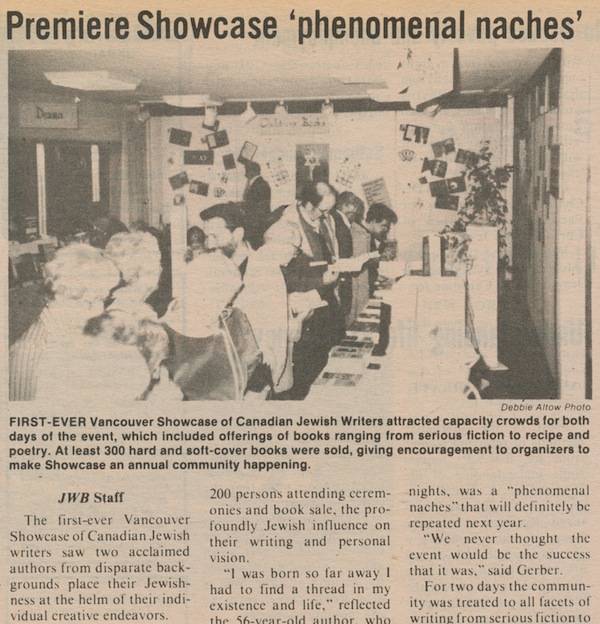
The JCC Jewish Book Festival (JBF) was founded in 1984 by a small group of book club friends led by Vancouver writer and publisher Cherie Smith. The group decided to create a forum to showcase Jewish writers to Vancouver audiences. After Cherie passed away, the Smith and Rothstein families established an endowment fund in her honor to support the festival in perpetuity and placed it under the stewardship of the Jewish Community Centre of Greater Vancouver.
The first book festival, Jewish Western Bulletin, May 1984.
The JBF – which celebrates its 31st year this November – has grown into a literary event of some magnitude, featuring award-winning international authors, showcasing Canadian writers, supporting local authors and publishers, and encouraging a love of reading across all generations. Despite its exponential growth, the JBF has not lost sight of its original core values and mission. The mostly volunteer-led operation echoes the passion of its original founders, many of whom continue to attend and support festival events to this day.
2. When did you become involved with it and what drew you to it?
I have always been an avid reader and, at a very young age, I recall making a solemn declaration to my classmates that “books are my best friends.” To this day, you’ll never find me without a book in my bag to keep me company wherever I may be. When the position of festival director presented itself in 2008, it was the perfect opportunity to marry my professional experience in management and production with my passion for reading and writing. Equally important, the part-time hours of the position allowed me to have the time I wanted to be with my young children.
3. What are some of the ways in which your organization has contributed to the community over the years? ie. Why is it important for the community to have/support?
As bearers of the auspicious moniker “The People of the Book,” it is hardly surprising that literature plays such a significant role in the Jewish community, and our Vancouver Jewish community has shown itself to be more erudite than many in North America. The Vancouver JBF is on an equal footing in terms of participating authors, events, duration and audience as festivals from much larger Jewish communities, including Atlanta, Houston and San Diego. Further, the Vancouver JBF far exceeds other Jewish book festivals in Canada such as Toronto, Winnipeg and Calgary in its scope, outreach and operations. This is testimony to our community’s passion for literature and learning, and the arts.
It has been a pleasure to introduce our already well-read audiences to new writers – and to welcome old favorites. The festival’s focus on Israeli writers has had an important impact not only on our Jewish community but has had far-reaching impact on the community at large – both in Vancouver and across Canada. Etgar Keret, one of Israel’s foremost “new generation” writers credits his appearance at the JBF and subsequent interview broadcast on CBC’s Writers & Co. with his increasing success in Canada and sold-out speaking engagements in Toronto and Ottawa. (Keret will appear at the 2015 Vancouver Writers Festival.)
4. What are some of the challenges in keeping it going? Are there specific ways in which community members could help with those challenges?
The book publishing world has gone though unprecedented change and upheaval in recent years. Increasingly, sophisticated technologies that introduced us to tablets, smartphones and e-readers have taken a heavy toll on the simple pleasure of reading a book. In this new age of shortened attention spans and 140-character communication, fewer and fewer people are making the time and applying the focus required to read a book. This is evident not least in the closure of countless bookstores and the bankruptcy of many publishing houses. One of our most important challenges at the JBF is to keep books and reading relevant not only to our current society but to generations to come.
The JBF has adapted to these changing circumstances in order to remain current and vital. Examples include collaborating with Chapters/Indigo to introduce e-readers to our bookstore, changing the scope of the bookstore’s inventory, creating new programs that incorporate digital technology. The JBF also incorporated emerging technologies to showcase international authors: for example, Etgar Keret, whose opening night gala interview was presented via international video-conferencing.
Of course, other important issues such as budget constraints have a detrimental effect not only on the JBF but on many arts and culture organizations. In times of economic uncertainty, arts organizations often bear the brunt of decreased funding, as both government and private sector funding is impacted. At the JBF, we are very blessed to be supported by a loyal and strong donor support base who recognize the crucial role literacy and literature plays in our society. This generous base has helped to keep the JBF sustainable.
5. What are some of the benefits, in your opinion, of the arts in general and why it’s important to have arts and culture in one’s life?
Without the magic of art and culture in our lives, the world would be a drab and dreary place, indeed. Though misquoted, the great bard, William Shakespeare, declared that “music is the spice of life,” and he was right – though certainly his reference was to all of the arts. Reading a good book opens our minds to new worlds, feeds our souls, impacts us in the way that little else can.
***
CHUTZPAH! FESTIVAL AND THE NORMAN AND ANNETTE ROTHSTEIN THEATRE Mary-Louise Albert, artistic managing director
1. Could you give a brief history of your organization?
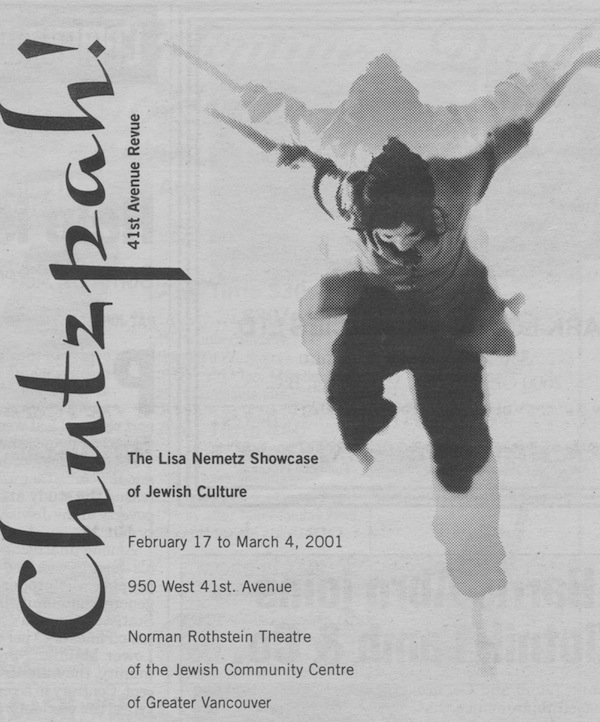
The Norman and Annette Rothstein Theatre (NRT), housed in the Jewish Community Centre, is a professionally equipped 318-seat performing arts proscenium theatre. It was established to enhance the cultural life of both the Jewish and general communities and is one of the Lower Mainland’s few mid-size proscenium theatres. The annual Chutzpah! Festival, Chutzpah!’s Creation Residencies, workshops for urban and rural youth and young adults program and Chutzpah!PLUS are our main professional programming activities.
Part of an ad in the JWB, February 2001. Current Chutzpah! Festival director Mary-Louise Albert is the dancer featured.
The Chutzpah! Festival, established in 2001 and named in honor of the late Lisa Nemetz, is one of the most respected international festivals in B.C. and Canada. Chutzpah! is known for presenting world and Canadian premières; supporting the creation of new work by way of multi-week dance residencies in the NRT with confirmed presentation of the residency work; and 2015 brought satellite dance festival residencies, youth workshops and performances to the North Island region of B.C., an exciting area of program growth and outreach.
2. When did you become involved with it and what drew you to it?
My first involvement in the Chutzpah! Festival was performing in the very first Chutzpah! in 2001. The founding artistic director of the festival, Brenda Leadlay, also put me on the poster. I was a professional dancer for over 17 years, and, after my second child was born, I left company life and freelanced as an independent dancer doing project and solo work, mainly. My company years had been with Anna Wyman Dance Theatre, Karen Jamieson Dance Company, Judith Marcuse Dance Company and apprenticing with Les Grands Ballet Canadian. My show in the inaugural Chutzpah! Festival was a shared evening with Toronto’s Kaeja d’Dance.
Shortly after this performance, I transitioned out of dance and studied arts management and business administration at Capilano University and BCIT. About a year after graduating from BCIT with a post-diploma of technology in business administration, the JCC hired me as the artistic managing director. My first Chutzpah! Festival as the AMD was the 2005 one, and I will never forget the fun photo shoot with Boris Sichon as the photographer snapped (I’m revealing my age) away for that year’s perfect poster image.
3. What are some of the ways in which your organization has contributed to the community over the years? ie. Why is it important for the community to have/support?
For the past 10 years, Chutzpah! has been programming Israeli artists to the point where they make up the most numbers of our international artists. The importance of connecting Israeli artists to B.C. (and in most cases to Canada for the first time) helps develop an understanding of Israeli culture and the amazing complexities of its arts.
The exciting and entertaining multifaceted ways the performing arts accomplishes this understanding of Israel is a mainstay of the festival. No other festival in Canada programs the range or number of artists from Israel as we do. We have brought known artists and large groups such as Batsheva Dance Company, Kibbutz Contemporary Dance Company, Balkan Beat Box and the Idan Raichel Project, which we have presented in progressively larger productions. Many of our Israeli artists have been unknown to Canadian audiences, but we have still given these eclectic talented performers the opportunity to tour internationally, such as with Idan Sharabi and Dancers, Zvuloon Dub System, giving Yemen Blues and Maria Kong their first North American shows, Ish Theatre, Dudu Tassa, Itamar Boracov, Uri Gurvich and many more.
These artists perform in our home, the JCC, in the Rothstein Theatre, as well as off site and out into the general community. It is a sharing of Jewish arts and culture with the Jewish and general communities. The Lower Mainland Jewish community is integral in helping us with this and the loyalty of the Jewish community and its willingness to take a chance with artists they don’t know is so appreciated and keeps us going. When I looked out into the audience of our Chutzpah!PLUS concert with Ester Rada at the Imperial this year, my heart melted as I saw so many familiar faces. We can’t do what we do without this support.
Another area we are proud of is our commitment to programming world premières by B.C. artists, as well as our multi-week Creation Residencies. Supporting artists this way is paramount to artistic growth. This past year alone saw three world premières by B.C. artists and the year before we had three, as well.
4. What are some of the challenges in keeping it going? Are there specific ways in which community members could help with those challenges?
One of the biggest challenges is that with a festival the size of Chutzpah!, most artists (and, in particular, international artists) have to be programmed and committed to before most granting and donation revenue is secured, often one or two years in advance. Maintaining and increasing corporate and donor sponsorship is important to the sustainability of the festival. We have yearly support for our programming from government funders, such as Canada Council for the Arts and Canadian Heritage. A challenge is that we are a Canadian festival that programs many artists from another country, Israel. We are very grateful for annual support from the Jewish Federation of Greater Vancouver and the Israel Consulate, for instance, who help us with expenses relating specifically to our Israeli programming, as they know how important our Israeli programming is to the community. And … the community helps us so much by attending shows!
5. What are some of the benefits, in your opinion, of the arts in general and why it’s important to have arts and culture in one’s life?
The arts engage on multiple levels, such as opening up new dimensions and developing creative expression as a stimulus for spiritual and ethical understanding. Exposure to the performing arts allows for the nurturing of inventiveness as a tool to develop self-discipline, self-motivation and self-esteem. Participating in artistic activities helps to gain the tools necessary for understanding the human experience, adapting to and respecting others’ ways of working and thinking, developing creative problem-solving skills, and communicating thoughts and ideas in a variety of ways.
The strength of Jewish arts and culture embraces and promotes the blossoming of divergent forms and points of view, and shares it with audiences from diverse communities. Many Jewish artists connect us to the differing aspects of the Jewish Diaspora. Exploring beautiful tensions and contradictions in these juxtaposed, but parallel, experiences helps feed a rich and engaging life.
***
SIDNEY AND GERTRUDE ZACK GALLERY Linda Lando, art gallery director
1. Could you give a brief history of your organization?
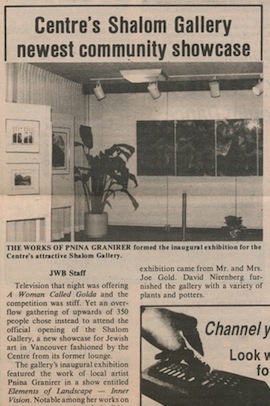
The gallery began as the Shalom Gallery in the Jewish Community Centre; the then size of the gallery was 19’ by 40’ (760 square feet). The current size is 22’ by 40’, with excellent lighting and a high ceiling with skylights.
The Zack Gallery started life as the Shalom Gallery, JWB, May 1982.
In 1988, the gallery received a donation from the Sid and Gertie Zack family, and the gallery was renamed the Sidney and Gertrude Zack Gallery of the Jewish Community Centre of Greater Vancouver. At that time, the gallery was designed as part of the overall Phase II renovation project of the JCC.
The gallery has as goals: to create and promote a gallery of stature in which only high-calibre artwork (in all media) is shown, featuring artists of local, national and international reputation; to encourage the serious Jewish artist; to promote understanding of contemporary artistic concerns; and to participate in multi-cultural events.
2. When did you become involved with it and what drew you to it?
I have been an art dealer with a gallery presence in Vancouver for 30 years. It was time for me to make a change in my life, to have less responsibility and to become more a part of the community. At one time, I was a board member of the JCC and I was on the Zack Gallery committee for many years, as well, so I have always been drawn to the JCC and the gallery. As you can well imagine, I am very comfortable running the gallery, dealing with artists, having openings, etc.
3. What are some of the ways in which your organization has contributed to the community over the years? ie. Why is it important for the community to have/support?
The Zack Gallery opened with a group show, JWB, June 1988.
The Zack Gallery has supported Jewish artists for many years. There have been shows that relate specifically to Jewish and or Israeli themes, as well as shows by Israeli artists. The gallery is a venue for Jewish artists who are not necessarily mainstream to show their work. It is unique in the city. It is important to support the gallery, as arts and culture are a huge part of the glue that holds the community together.
4. What are some of the challenges in keeping it going? Are there specific ways in which community members could help with those challenges?
Artists are always underfunded/underpaid. Part of the cost of having a show falls upon the artist. Funding is always a challenge.
Community support would be wonderful. I would be happy if more people supported the gallery by coming to the many openings, talks, poetry readings, etc. That would be very satisfying.
5. What are some of the benefits, in your opinion, of the arts in general and why it’s important to have arts and culture in one’s life?
As I stated, arts and culture are community glue. They bring together artist and patron, student and teacher, ideas and realization. Creativity is what is left when there is nothing else.
***
VANCOUVER JEWISH FILM CENTRE Robert Albanese, executive and artistic director
1. Could you give a brief history of your organization?
Jewish films were first brought to Vancouver [by what is now known as the Vancouver Jewish Film Centre] under the umbrella of the Jewish Festival of the Arts, a community organization that was founded in May 1984. Films were sought out that showcased the diversity of Jewish culture, heritage and identity. In 1988, the Festival of the Arts morphed into the Vancouver Jewish Film Festival and, as demand from community organizations for Jewish film grew beyond an annual festival, the name was changed in 2013 to the Vancouver Jewish Film Centre to better reflect the breadth of offerings presented year round.
2. When did you become involved with it and what drew you to it?
In 2009, I was approached by the CEO of Jewish Federation and asked to take a meeting with the executive committee of the board of directors of the Vancouver Jewish Film Festival. The board was conducting a search for a new executive director.
The Jewish Film Centre developed out of the Jewish Festival of the Arts Society, JWB, February 1989.
At the time, I had held the position of director of exhibitions for the Vancouver International Film Festival for the previous 10 years. I had also been a general manager for Cineplex Entertainment. I was a successful photographer with a background in film-set photography and had previously been the managing director of Montreal’s premier repertory cinema.
The offer from the board of the Jewish Film Festival would allow me to bring to the organization 30 years of professional experience in all aspects of the film industry. In addition to the executive director position, I would also be their artistic director. The opportunity to make a difference, to contribute to the arts in our community was the “icing” on a long career in the film business. The added opportunity to grow the organization was a challenge I was eager to undertake.
3. What are some of the ways in which your organization has contributed to the community over the years?
The film centre has held an annual Vancouver Jewish Film Festival for 27 years; it is the longest-running Jewish film festival in Canada. We have engaged our community by bringing the best quality films that inspire, entertain, educate and connect us to the diversity of Jewish culture. The Vancouver Jewish Film Centre was founded to preserve and showcase our Jewish culture, heritage, identity, and we reach all members of the community. Our annual film festival is presented in a mainstream cinema, a secular environment, and is open to all who want to attend. It is a major social event that brings the community together. Film is the most reasonably priced form of cultural entertainment available today.
Film accesses and engages the broadest community. We are deeply committed to outreach and we work tirelessly with community organizations to bring films to their stakeholders. Generally speaking, the film centre is an organization with the potential to reach the whole Jewish community.
It’s Jewish continuity through storytelling in today’s visually oriented world.
4. What are some of the challenges in keeping it going? Are there specific ways in which community members could help with those challenges?
The film exhibition industry has changed dramatically in just a few short years. Everything is now digital, and the technology required for state-of-the-art presentation is very expensive. Film costs and venue rentals have risen through the roof; movie theatres with the proper screening equipment are in short supply. In spite of all of this, we have responded to the increased demand for more film presentations from our greater Jewish community. We travel to community organizations with projector and screen in hand to bring the films directly to them. We are co-presenting Victoria’s first Jewish film festival this November. We are facilitating film with the Okanagan Jewish community. We’ve facilitated numerous fundraising film events throughout the community for Jewish organizations of all kinds. All of the above means increased costs for us at the same time that our community in general is faced with aging infrastructures with large capital campaigns in place. That often means cultural entities are left struggling to attract funding from the community, funding required to keep us vibrant and relevant.
Our attendance has been growing year over year and is a direct result of the quality of both the films and the presentations. However, since relocating the annual film festival to the Fifth Avenue multiplex cinema we’ve seen a number of community members walk by our screenings to attend a “Hollywood” film in the next auditorium. The most obvious way to help is to attend the films we present; the old mindset of what constitutes a Jewish film no longer applies. The films we present are world class and just as good, if not better, than any other film showing in that multiplex today.
We always welcome more help from volunteers. Assisting us to bring our offerings to the community is a real way a community member can help.
Finally, we are soon launching our first-ever endowment campaign with matching funds from dedicated donors. We hope and trust the rest of our community will support this effort.
5. What are some of the benefits, in your opinion, of the arts in general and why it’s important to have arts and culture in one’s life?
There is a mountain of documentation from researchers all over the world about the benefits of having art and culture in one’s life. In my opinion, in the case of the Jewish Film Centre, we bring people together. Film opens a dialogue where none may have existed before. It can fill us with pride, self-esteem; it can literally break down barriers by allowing us to experience the life of the other. Film can help foster a sense of belonging and pride within a community. Film can preserve a collective memory and foster a continuing dialogue about the past.
The Vancouver Jewish Film Centre exists for this, we convene an inclusive community that celebrates, educates, entertains and inspires through thought-provoking films. We present the stories about the many diverse aspects of Jewish life. We aspire to be a cultural organ of the Jewish community in Vancouver, in British Columbia, and to act as a repository of culture for future generations.
***
VANCOUVER JEWISH FOLK CHOIR Donna Modlin Becker, program coordinator, Peretz Centre for Secular Jewish Culture
1. Could you give a brief history of your organization?
The Vancouver Jewish Folk Choir of the Peretz Centre for Secular Jewish Culture was founded in 1980 by conductor/arranger/ composer Searle Friedman with the aim of keeping Jewish music alive and educating both Jewish and non-Jewish audiences to a world cultural treasure. The choir has about 25 members, both adults and seniors, and at present performs between eight and 10 times per year, both at the Peretz Centre and at venues within and outside of the Jewish community.
2. When did you become involved with it and what drew you to it?
Vancouver Jewish Folk Choir third season ad in the JWB.
In the late 1990s, I was looking for a choir to join, and found the Vancouver Jewish Folk Choir. I was excited to be singing in Yiddish, which I grew up surrounded by, and pretty quickly felt very at ease with the other choir members. The older people reminded me of the grandparents I lived with growing up in a Jewish community in Brooklyn; politically, and in many other ways, I was very culturally comfortable in the choir. And it gives me great pleasure to be singing in the language of my ancestors – I feel I am honoring them with my music. And I love the beautiful minor mode of so much of the repertoire.
3. What are some of the ways in which your organization has contributed to the community over the years? ie. Why is it important for the community to have/support?
Some of the ways in which the choir has contributed to the community, in no particular order:
• Thanks to founder Searle Friedman and current director David Millard, the choir is keeping the Yiddish repertoire alive. (Not only to entertain the old people, but also for the sake of future generations, I think keeping our Yiddish roots alive and visible as long as possible is hugely important.)
Both Friedman and Millard have arranged traditional and contemporary Yiddish music (and other Jewish music) for choir. Over the years, the choir has focused more and more on Yiddish, and exposed audiences to a wide variety of songs in that language, as well as major works by Srul Irving Glick, Mordecai Gebirtig, Max Helfman and others.
• In addition to regular performances at the Peretz Centre, which include holiday celebrations and an annual major concert, the choir also performs a Chanukah concert annually at two seniors homes – the Louis Brier and South Granville Park Lodge. In the last few years, the choir has also performed its Pesach repertoire at the Louis Brier. We hear from the people who work with the residents at both venues that many people who are very cognitively impaired in other areas can still relate to music, and people who can no longer speak are still able to sing. The joy we feel in the audience at the Louis Brier as we offer them songs both familiar and new is palpable.
• The choir gives people who like to sing a chance to sing in some of the languages of our people – Yiddish, Hebrew, Ladino and English – and an opportunity to socialize with other people who also enjoy singing this music. Many of the people in the choir have no other connection to the Peretz Centre.
• The choir has also performed at other venues, such as the Jewish Community Centre, the Richmond Seniors Centre, CityFest, VanDusen Festival of Lights, and the Federation of Russian Canadians. In this, we provide an outreach to the broader community, and expose wider audiences to Jewish music beyond modern Israeli or religious music or klezmer.
4. What are some of the challenges in keeping it going? Are there specific ways in which community members could help with those challenges?
The main challenge is cost. At present, the conductor, accompanist and three section leaders are paid on a weekly basis. We often have to hire additional voices for major concerts, as well.
Two major ways that community members could help with those challenges: join the choir, and come to the concerts! Another way: write support letters that the choir can use in grant applications.
5. What are some of the benefits, in your opinion, of the arts in general and why it’s important to have arts and culture in one’s life?
I touched on some of this previously in regards to stroke victims and other cognitively impaired people responding to music long after they are no longer able to respond to other forms of communication. But, in more general terms, what would life be without arts? The question is so huge; all I can think of to say is: “Hearts starve as well as bodies, give us bread but give us roses, too.”