In spring 2015, at Luneburg Regional Court in Germany, the trial of Oskar Groening, “the bookkeeper of Auschwitz,” began. Nineteen-year-old Torontonian Jordana Lebowitz, a granddaughter of Holocaust survivors, was among those who witnessed the proceedings. The young adult book To Look a Nazi in the Eye: A Teen’s Account of a War Criminal Trial (Second Story Press, 2017), written with award-winning author Kathy Kacer, is about what Lebowitz experienced before, during and after the trial.
The book has different components and is not structured like a usual biography or historical account. It includes Lebowitz’s recollections as told to Kacer, as well as selections from Lebowitz’s blog, which the then-teen wrote for the Simon Wiesenthal Centre in Toronto about the trial. Numerous Holocaust survivors, now living in Canada, speak about their experiences at Auschwitz. They also traveled to Germany for Groening’s trial.
Lebowitz shares her concerns about going to Germany and readers learn how she made the trip come about. After almost every chapter, there are excerpts of Groening’s testimony that Kacer has based on news articles and interviews, as there were no transcripts from the trial itself. These sections allow readers to know what Groening was thinking as his claims were being assessed by the court. Charged with being complicit in the deaths of more than 300,000 Jews, he was eventually found guilty.
Lebowitz epitomizes how individuals from my generation should act. Her main goal was to ensure that the experiences of Holocaust survivors would be recorded so that future generations would be able to access them, and learn from them. Her main purpose in going to the trial was to witness this history and make sure that future generations would know it, too.
Lebowitz had been to Auschwitz on a March of the Living trip. The program takes students from around the world to Poland and Israel, so they can see firsthand and learn about the Jewish communities that once existed in Europe and the tragedy of the Holocaust that wiped almost all of them out. It was on March of the Living that Lebowitz met Holocaust survivor Hedy Bohm, with whom she became close friends. Bohm was imprisoned in Auschwitz for three months and testified in the trial against Groening.
As the bookkeeper at Auschwitz, Groening not only witnessed many Jews coming off the trains, but confiscated their possessions as they arrived. He was not tried for being a murderer, but for helping the Nazis murder Jews. The German government wanted Groening’s trial to occur, as they wanted Nazis who were still living to be brought to justice, even if it was many decades later.
Lebowitz heard about the trial from Bohm, and then set to figure out how she could attend it. The Simon Wiesenthal Centre agreed to fund the trip if she would blog her experience in the courtroom for others to read and follow as the trial was taking place. She managed to convince her parents she could handle what she would face on the trip during the trial, and Thomas Walther, the prosecutor, helped Lebowitz find a place to stay in Germany and procured a pass to allow her into the courtroom.
To Look a Nazi in the Eye is powerful in part because it reveals the compassion Lebowitz initially felt for Groening, in his frailty, sitting in the courtroom each day. He recounted heartbreaking stories of what had transpired in the camp. But, while Lebowitz believed at the start of the trial that he was truly sorry for what he had done, Groening’s stories began to change, and not for the better. He also said he was not guilty because he did not personally hurt or exterminate Jews.
As her daily accounts progress, there are humourous moments that balance out the horrific stories about Auschwitz. For example, purses and paper were not permitted in the courtroom. In order to blog, however, Lebowitz needed a notepad and pen. So, she snuck toilet paper and a pen that was hidden in a place the security guards would not find during a body search. Her persistence paid off, and Lebowitz managed to take notes each day. That her family and others read her blog posts gave her some assurance that she was succeeding in her mission of helping keep the history alive and relevant.
One part of To Look a Nazi in the Eye that is amazing is how Lebowitz interacts with the Holocaust survivors. Bohm, Bill Glied and Max Eisen were among the survivors who attended the trial and were brave enough to recount their experiences at Auschwitz. For them, and others, it was a duty to their family and themselves to ensure that some form of justice was achieved. At first, they seem pretty hesitant of a younger individual being at the trial, but later open up to Lebowitz more. Seeing a person from a younger generation advocating for this cause made them happy, in a sense.
Since returning to Canada, Lebowitz has remained involved in Holocaust remembrance. As the book’s website notes, she “came to understand that, by witnessing history, she gained the knowledge and legitimacy to be able to stand in the footsteps of the survivors who went before her and pass their history, her history, on to the next generation.”
Chloe Heuchert is a fifth-year history and political science student at Trinity Western University.
“I wanted to leave,” replied Groening again in a voice that had grown increasingly hoarse. “I asked for a transfer to the front.”
Was it Jordana’s imagination or was Groening faltering under the strain of the trial and the intense cross-examination? She hadn’t noticed it before, but he looked decidedly weaker at this point in the proceedings than he had looked in the beginning. His face was haggard, his shoulders slumped, and his hands trembled.
Finally, Thomas [Walther] gathered his notes together and stood in the centre of the courtroom. “Behind me sit the survivors who are here to testify, along with their descendants,” he said. “I ask you, Herr Groening, did you ever think when you were in Auschwitz that the Jewish prisoners might stay alive and eventually have their own children?”
Groening shook his head and closed his eyes. When he finally responded, his voice was faint. “No. Jews did not get out of Auschwitz alive.”
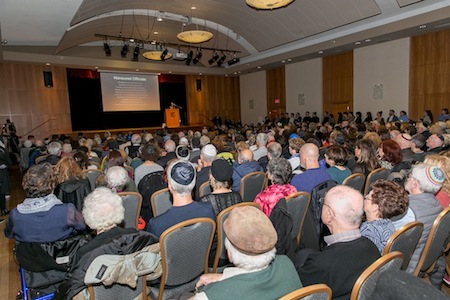
American political commentator and writer Ben Shapiro addressed more than 900 people at the Faigen Family Lecture, which was held at Congregation Schara Tzedeck on Oct. 30. (photo by Jocelyne Hallé)
More than 900 people came out to hear conservative commentator and writer Ben Shapiro give this year’s Faigen Family Lecture, which took place at Congregation Schara Tzedeck on Oct. 30.
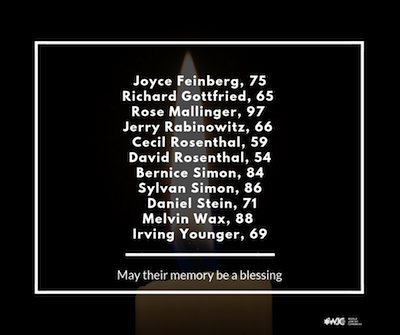
Saul Kahn began the evening by reading the names of the 11 Jews murdered at Tree of Life synagogue in Pittsburgh a few days earlier. After a moment of silence, Vancouver Hebrew Academy head of school, Rabbi Don Pacht, recited a prayer for those who were killed. The security presence at Schara Tzedeck was notable, from every attendee being checked at the entrance to several guards within the sanctuary.
In introducing the lecture, Kahn explained, “Almost a decade ago, Dr. Morris Faigen, of blessed memory, created the Faigen Family Lecture Series in partnership with Rabbi Pacht and the Vancouver Hebrew Academy. This endeavour arose from their mutual love of Israel, a shared concern for the mindset of the modern Jew in North America and a desire to help influence the next generation.”
Kahn thanked VHA’s Teagan Horowitz and office staff, Rochelle Garfinkel and the Schara Tzedeck staff, Dr. Jeffrey Blicker, “for his instrumental role in bringing this event to fruition,” the Jewish Federation of Greater Vancouver for help with the additional security and “Gina Faigen and the Faigen family for their appreciation of how very vital it is to have a program such as this that supports an open and meaningful exchange of ideas.”
Pacht linked the lecture’s importance to Jewish tradition, noting how the word cherubs (in Hebrew) appears only twice in the Torah. In Exodus, it appears when God is explaining to Moses how the Mishkan (Tabernacle) is to be constructed: the cherubs (“angels with childlike faces”) are set above the holy ark. However, in the beginning of Genesis, when Adam and Eve are expelled from the Garden of Eden, God places cherubs to guard the entrance. “Interestingly,” said Pacht, “here the word is translated differently. It’s translated, by Rashi, as ‘angels of destruction.’” One explanation – from Rabbi Moshe Mordechai Epstein, who was head of the talmudic academy in Slabodka, Lithuania – is that, “as parents, as educators, we have a responsibility to take the next generation, to cultivate within them, the ideas and the ideals that we hold most dear. If we are successful in our endeavour, they are cherubic, they are the angels with childlike faces. Unfortunately, if we’re not successful, there’s an entire different pathway that may lay before them.”
Among the values that need to be imparted, said Pacht, are the centrality of Israel and the moral values as laid out by the Torah. Free speech and open debate, he continued, are “most dear to us.” He put them among the ideals we have “from our parents and our grandparents, and we want to see that passed on from generation to generation.”
This generational aspect was picked up on by Gina Faigen with humour in her welcoming remarks. She said she sometimes wonders, “because I’m a lot more liberal than my late father was, if he didn’t create this event in part so that, on at least one day a year, I would have to listen to somebody who shared his views. It’s definitely something I have come to appreciate more as the years go by. My father was passionate about ideas, about intelligent discourse on Israel, and he created this lecture series to ensure a space in Vancouver for a conservative and pro-Israel perspective. I know he would be really excited by tonight’s speaker, Ben Shapiro.
“For those of you who share these views, we hope to continue to provide a place for you here,” she continued. “And, for those of you who may not share all of the speaker’s views, it’s great that you’re here open-minded and part of this conversation.”
Blicker – who suggested Shapiro as a potential speaker after he and his family heard him at a Passover event in Henderson, Nev., more than three years ago – introduced Shapiro. Among other things, Shapiro is a lawyer, editor-in-chief of DailyWire.com, host of the podcast The Ben Shapiro Show, and author of seven books.
Shapiro addressed his critics right off, admitting that he does “sometimes phrase things in an intemperate fashion or spoken too hastily or out of anger or even, on occasion, over the course of a 17-year career of writing things, I’ve written stuff that I disagree with and that I think is immoral. It’s my job to hear those critiques, it’s my job to respond to those critiques in good will and in the spirit of self-betterment, and I’ve tried to do so repeatedly in different places and I look forward to doing so in the future, as well as tonight, that is my job. It’s also the job of my critics to keep an open-mind and not to mistake a political viewpoint for objective righteousness or to slanderously mislabel people like me bigoted or racist – that is unjustified, unjustifiable and hypocritical.”
Given what had happened in Pittsburgh, Shapiro decided to speak about his planned topic – the future of the state of Israel – in connection to global antisemitism. He described three general types of antisemitism.
• Right-wing antisemitism – “in this view, the presence of an independent Jewish community is a threat to national identity.”
• Left-wing antisemitism is “based on hierarchies of power.” Therefore, “when you see an imbalance in life and inequality in life, that is inherently due to inequity, so, if you see two people in a room and one guy has five bucks and one guy has one buck, that means the guy with five bucks somehow screwed the guy with one dollar. Left-wing antisemites, in terms of group politics, see the Jews as the people with five dollars. The Jews are simply too powerful and, thus, they must have participated in exploitation and egregious human rights violations.”
Shapiro offered his take on how intersectional theory would rank the groups whose “opinions should be taken most seriously because they have been most victimized by American society: LGBT folks are at the top, then it usually goes black folks, then Hispanic folks, then women, then Asians, then Jews, then, at the very bottom, white males.” In this framework, since Jews and Israel are relatively successful, they must have done something terrible, “be responsible for the ills.”
• Radical Islamic antisemitism “is the most traditional form of antisemitism – not Islamic, but religious antisemitism.” This is the belief, said Shapiro, “that the religion of Judaism itself is to blame for the problems in Western society. The history of religious antisemitism obviously, goes back thousands of years and it spans a wide variety of religions.”
Today, he said, “Islamic antisemitism has been combined with a sort of Nazi-esque racial antisemitism, which is why you see textbooks in the Palestinian Authority referring to Jews as the sons of pigs and monkeys, and it’s also been combined with a sort of intersectional antisemitism … Jews are successful because they are somehow damaging other people and, also, they happen to be a terrible religion.”
For Jews in the United States and, to a lesser extent, in Canada, Shapiro said right-wing antisemitism is probably the biggest threat, “as we saw in Pittsburgh. There has been a spate of such violence that has been consistent throughout my lifetime.” He said, “The thing that folks don’t understand if they don’t live in the Jewish community is that every single person in the Jewish community is one degree removed from some sort of tragedy of this kind.”
However, he said, for Jews worldwide, radical Islamic antisemitism is the biggest threat. “Whether it is Jews who are living under the possibility of an Iranian nuclear [regime], whether it is … Jews living under the threat of Hezbollah rockets, whether it’s Jews living under the possibility of kidnapping along the Gaza border or whether it is Jews living under the possibility of being murdered while walking the streets in France, whether it is Jews being threatened with the possibility of murder in Malmö, Sweden, whether it is Jews being threatened with murder in London. Islamic antisemitism and the rise of that antisemitism throughout Europe is deeply dangerous to Jews across the world.”
“The thing that folks don’t understand if they don’t live in the Jewish community is that every single person in the Jewish community is one degree removed from some sort of tragedy of this kind.”
There are two main perspectives on antisemitism, said Shapiro. One is that antisemitism is not another form of racism, but is unique – that it comes from a “conspiratorial mentality that the Jews are behind everything bad and, therefore, the Jews must be annihilated.” The second view is that “antisemitism is not unique, it’s not an age-old virus, it’s no different really than anti-black racism or anti-Native American racism or sexism or homophobia…. That means we have to treat the death of a Jew in Efrat at the hands of a terrorist differently than we treat the death of a Jew in Pittsburgh at the hand of a white supremacist because these two Jews scan in different areas of this intersectional pyramid,” said Shapiro. “These two Jews are not equivalent. They are not being killed for the same reasons. The Jew being killed in Pittsburgh is being killed because that Jew is a victim. The Jew being killed in Israel may or may not be being killed because of victimology. It’s possible that that Jew was being killed because of Israeli settlements or some such [reason].
“The second view, as you might imagine, I believe to be deeply troubling, counterproductive and helpful to antisemitism.”
In Shapiro’s opinion, this latter, more troubling view is mainstream on the political left in the United States and in Europe. When a Jew is murdered in certain areas of Israel, he said, “we are supposed to take into account the territorial claims of Palestinians as though that justifies the murder of a civilian who happens to be living in Efrat. We’re supposed to pretend that the dispute is merely territorial and not a symptom of a broader underlying antisemitic disease. When a Jew is murdered in Pittsburgh, then we’re allowed to talk about antisemitism.” This is why, he said, Jews can be excluded from women’s marches and antisemitism can be tolerated, if the Jews in question rank lower than the antisemite in the intersectional hierarchy.
While Israel holds a high position in the world, it is under threat from forces that we refuse to call antisemitism, he continued, citing several examples, such as the numerous votes against Israel at the United Nations. Criticism of Israel is legitimate, he said, but holding the country to a higher standard than any other nation is antisemitic, “and that has been the standard to which the world has held Israel.”
He called wanting to boycott, divest from and sanction Israel “antisemitic in the extreme…. The stated goal by many of those pressing BDS is to destroy the state of Israel…. Not a single person pushing BDS has ever condemned the Palestinian Authority for insisting on a fully judenrein state, a state completely free from every single Jew. Israel allows – and should allow – millions of Arabs to live within its borders, millions of Muslims to live within its borders, that is a good thing. Israel is a multicultural, multi-ethnic democracy. The same is not true of any of the nations facing down Israel, and yet Israel is facing down boycott, divestment and sanctions for saying that we can build an extra bathroom in East Jerusalem. No other nation would tolerate this sort of nonsense. This is targeted hatred and nothing less.”
So, what is our mission, given these realities? “Well, number one, to stand up to antisemitism wherever we see it, on left and on right,” said Shapiro, whether it is coming from our allies or our enemies. “This is not a partisan issue nor should it be. And, our other mission is also the same as it ever was, which is to spread light. What we’re watching right now in American politics and, I think, Western politics more broadly, is a fragmentation of certain eternal and true values that used to undergird a civilization. Those basic values of faith and family and those values of tolerance and openness within the bounds of recognition of certain central individual rights, that’s all fragmented. And whenever society fragments, antisemitism starts to seep through the cracks. As the Tree of Life synagogue name attests, the only way to fight back against all of this is to cling to that Tree of Life, is to cling to the Torah.”
The attack on the Tree of Life synagogue was not just an attack on Jews but on civilization, said Shapiro, “because Judaism, Jews, we stand at the heart of Western civilization…. The only proper response is the same response Jews have given throughout time: to fight back, to fight darkness with light, to fight untruth with truth and fight death with life.”
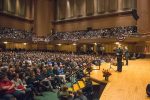
Ben Shapiro responded to 22 questions at the Faigen Family Lecture on Oct. 30. (photo by Jocelyne Hallé)
After a standing ovation for his remarks, Shapiro responded both to questions submitted in advance by event sponsors and then to questions from an open mic. In total, he responded to 22 questions, which ranged from the political to the cultural, from economics to education, tort law to religion. Several of the questioners identified themselves as being Christian, many as fans.
One of the first questions was the language Shapiro uses around transgender issues. “When I’m talking about transgenderism,” he said, “the contention of folks in the political realm is that transgenderism is not, in fact, a mental illness; that, in fact, gender identity disorder or gender dysphoria, whichever DSM [Diagnostic and Statistical Manual of Mental Disorders] you choose to use, 4 or 5, that that particular disorder is no longer a disorder, it’s actually just an expression of gender identity that has no bearing whatsoever on mental health. That’s a lie, and it’s a damaging lie. And, when a society blinds itself to the realities that gender and sex exist, it is less likely to pursue policies that alleviate the pain of a lot of folks and it’s also less likely to pursue policies that have any realities extant on the ground.”
In a few responses, Shapiro differentiated between his use of language in dealing with people one-and-one versus in the political arena or on social media, noting in particular that Twitter is meant to be a more fun space, where you don’t have to be nice. He also talked about his general wariness of government intervention and offered pretty standard conservative views on immigration, economic migration, free speech and abortion.
When asked by the mother of a 14-year-old boy who brought Shapiro’s views into their liberal household about Shapiro’s portrayal at times of the left as monolithic (and unprincipled) and whether it was “part of the game, like [you do] on Twitter?” he responded, “No, it’s political shorthand.”
However, he added, he does try to distinguish between the left and liberals. For example, “when it comes to free speech, I think the left wants to crack down on free speech and I don’t think liberals do. I think liberals are happy to have open and honest debates; they just disagree with me on the level of government necessity in public life. Listen, every individual has different political viewpoints and people self-describe in different ways … but, as a generalized worldview, if I’m hitting the target, when I say the left, 85% of the time, that’s good enough for ditch work. In politics, you’ve got to cover too much ground to break down every single constituent of a particular group. Now, is it an over-generalization? Of course. But politics operates on generalizations, so do our everyday conversations.”
Today, Nov. 9, is the 80th anniversary of Kristallnacht. Seen by some historians as the moment when the Nazis’ legalized discrimination against Jews turned irreversibly toward genocide, the date has been marked by the Vancouver Jewish community for several decades.
Jews view the present and the future through a lens of the past. This has its advantages and disadvantages. Unable to see the future clearly, a keen awareness of the past can lead us to reasonably project expectations. But the memory of Kristallnacht and what came after it instils a rightful and necessary caution in interpreting current events. History tells us that vigilance is crucial and that complacency can be fatal.
Of course, no two moments in history are identical. Are we overreacting by drawing too instructive an historical parallel when we experience traumas like the mass murder at the Tree of Life synagogue on Oct. 27? We can’t be certain. It is probably wise to err on the side of caution and respond with vigilance.
The reaction from so many faith groups and other allies, including at a “solidarity Shabbat” last weekend that filled synagogue seats throughout Metro Vancouver and across North America, is not only a reassuring phenomenon. These demonstrations of intercommunal friendship are underpinned by the awareness that, while some might dismiss the events in Pittsburgh as the deranged act of a single madman, historical consciousness places the terrible act within a larger context.
History is important, too, because we live busy lives and a lot of things are slammed into our consciousness every day. Stepping back and placing contemporary events in a larger context helps us assimilate our place in society, individually and collectively. This is being demonstrated particularly well this week, as Remembrance Day (Nov. 11) approaches.
The Government of Canada’s apology for the 1939 refusal to accept the imperiled Jewish refugees aboard the MS St. Louis comes as part of a long line of apologies for historic wrongs. A cynic could look at the litany of regret and see political expediency. We prefer to look at it as a progressive, healthy way of not only addressing the past but of improving the future.
The journey of the MS St. Louis saw just 29 of the 937 passengers allowed to disembark in Cuba, the intended destination and presumed final refuge for the passengers fleeing the imminent Holocaust. The ship then sailed to the United States and on to Canada, where, in both places, xenophobic and antisemitic attitudes among the general public and the governing elites prevented the asylum-seekers from disembarking. Forced to return to Europe, 254 of the passengers would be murdered in the ensuing genocide.
At a time when many Jews are looking at the news with trepidation, the prime minister’s statement represents the voice of a country facing the antisemitism of its past and, more importantly, committing to face and combat similar sentiments today and in future.
Presaging the prime minister’s formal apology this week, Canada’s ambassador to Israel, Deborah Lyons, speaking at the General Assembly of the Jewish Federations of North America last month (see “Interdependent communities” and “GA pitches softballs at Bibi”) spoke movingly about the importance of applying historical knowledge to the present. She quoted a 17-year-old from Hamilton, Ont., who, after completing the March of the Living, observed that, “as our hearts were breaking, our hearts were also growing.”
Said Lyons: “We need to acknowledge these difficulties, we need to acknowledge these injustices. It may break our hearts, but it will teach our hearts to love again and to grow.”
“I’m writing this while the victims are still being buried at the Tree of Life congregation in Pittsburgh. This period, just after any death, is a hard time, and lot of meaningful things have been said in the media already. The worst part about this rise in hatred and violence is that it was entirely predictable. In fact, I wrote about it in November 2016, in an opinion piece for the CBC in a piece called “Keep your passports up to date.”
On the day of the Pittsburgh shooting, I walked to synagogue in Winnipeg, where I live, with one of my twins to go to services. The other kid had the “I’m grouchy” sniffles and stayed home with his dad. We had a marvelous Shabbat “date” together. It was only when I got home and we were eating lunch together that my husband said, “Don’t turn on the radio or TV news.” That’s how I knew something really bad had happened.
By Sunday morning, we all needed to blow off some steam. I took my kids to the brand new accessible playground at Winnipeg’s Grant Park. It’s right near the Pan Am Pool building. After 45 minutes of bone-chilling playground duty, I grabbed both boys by the hand and steered them towards the car. That’s when I saw the graffiti on a door to a mechanical room for the pool. It was a big Jewish star – and inside it was a swastika.
I went to the pool front desk at 11:15, both kids in tow, and reported it. Then, I went home and reported it, with the help of a friend, to 311, to B’nai Brith, to the editor of the Jewish Post and News and to the police. This wasn’t an active emergency, so I called the non-emergency phone number. It took more than 30 minutes to get through to the police. When I did, they said, “Well, it’s on the Pan Am’s property, they have to report it.” I got nowhere, and it was time to take my kids to their piano lesson.
I’ve learned since having kids that you can’t just put them on pause and ask them to wait around. I had to keep going with life. I also didn’t want my whole day to be about somebody’s hate graffiti. I briefly mentioned my concerns about the exchange with the police to my non-Jewish friend, Kirsten, in Brandon, Man. She apparently posted it on Facebook. Within a short time, seven Winnipeg friends of hers reported the graffiti and, get this, two American friends called long-distance. They both live in Pennsylvania: one in Philadelphia, and one in Pittsburgh.
By the time piano lessons were over at 2:15, Ran Ukashi was following up on behalf of B’nai Brith. The graffiti had been painted over.
At the end of the weekend, I felt exhausted with emotions, as I’m sure many did. My parents, who live in Virginia, send video clips to my kids, as a way of keeping up with them from afar. Their video for Monday morning was heartening. They showed “just a regular” Sunday evening at their congregation. Multiple meetings and events were scheduled, and Jewish life went on as usual – aside from the evening service, which included an impromptu memorial service.
Then I was contacted via an online forum by an online acquaintance from Quebec, a (non-Jewish) Canadian named Esther. She moved here from Germany. She felt worried. She told me she wanted to be an ally, to support and reach out, and then she gave me her full name, address and phone number. “Just in case … for an emergency,” she said.
At our community’s memorial service, the sanctuary was so full that I stood for half of it. There were hundreds of people who could not get inside, it was too crowded. There were probably more than a thousand people there, including every kind of Winnipegger. Sikhs, Muslims, Christians, women in hijabs, priests in their clerical collars – everyone. Also there were the mayor, the police chief and many other “important” political people. All there to support the Jewish community.
The service was like a Jewish funeral, but, instead of one person, we were mentioning Tree of Life congregation in Pittsburgh and doing a prayer or two for healing, peace and hope. It was a good moment to be a Canadian.
This morning, we got a video from my folks about their official memorial service, also held on Tuesday, Oct. 30. Like ours, it was completely packed to overflowing with good people who came together, from all religions, from all over the area, to support the northern Virginia Jewish community.
I wondered what to write about, and mentioned it to Kirsten. She was visiting with her dad, Bruce McFarlane, a retired professor of sociology, who is in a care home there. He recalled, with pleasure, spending time with Chassidic families at their celebrations in Montreal. His response?
“What can one write after this week? Honestly, I thought this world would have been better by the time I got this old!” Later, he said, “I’m tired of the violence. Why is it still happening?” And, finally, he wished me peace. He wished peace to me and my family.
This has been a hard time, and I can’t do any better than what Prof. McFarlane said. Jewish tradition has many prayers for peace, hope and healing, and there’s no better way to commemorate the lives lost in Pittsburgh than to find yourself a place (at a shul or wherever you worship) to say those prayers. It’s a good moment to stand tall, surround yourself with community and be counted and comforted.
I’ve been heartened by the ad hoc support the Jewish community has been offered from everyone around us during this difficult time. If someone offers you support, please say thank you. I know I sure appreciate it. I have felt so grateful to hear others tell me, out of the blue, “I have your back.”
Joanne Seiffwrites regularly for CBC Manitoba and various Jewish publications. She is the author of three books, including From the Outside In: Jewish Post Columns 2015-2016, a collection of essays available for digital download or as a paperback from Amazon. See more about her at joanneseiff.blogspot.com.
I am not normally someone who is especially active on social media. I am not normally someone who curates current events, even though I consume them like undergrads do coffee – habitually, obsessively, out of necessity.
For a long time, my political associations and the extent to which I follow world news have been largely separate from the image I have cultivated for public view. As far as Facebook is concerned, I am represented through dog videos, feel-good intercommunity displays of solidarity, recipes and the occasional satire poking fun at the absurd and horrifying climate we’re living in – but there has been a shift. A shift toward police brutality, transphobia, racism. A shift toward synagogue shootings.
I do not share news stories on such topics because I enjoy doing so. I don’t enjoy reading about things that make my heart heavy, nor offering vulnerabilities to people who do not see me as a person, but rather the embodiment of an idea they disagree with. I do not take pleasure in sharing pain. It is my very nature to shield myself and others from it. Although part of love is letting others learn, and that involves experiencing pain and hurt.
It is easier to stick one’s head in the sand, but it doesn’t make it right. It is important to denounce insidiousness and nefariousness when you see it, especially if it does not directly affect you. It is important to hold space for those who are impacted by the injustices of the world, to hold them up and offer your strength. In doing so, we hope others do the same for us, and perhaps that is the only way we can get through these dark times with any semblance of sanity, of humanity.
I used to make a point of sharing light-hearted, feel-good posts, cognizant of the “bad news,” which is in no short supply. I believe my intention to provide some degree of respite from the political apocalypse we’re currently observing was a good one, but I would wager also misguided. To curate news is one thing, to disengage from it is another.
It became clear to me that, just because I am kept abreast of political happenings, and that I see them all over social media, does not mean others do; a classic cognitive bias that I should have spotted much earlier. This is true of what is happening in Trump’s America, to people of colour, LGBTQ folks, indigenous peoples, immigrants and refugees, Muslim communities. This is true of issues and current events related to antisemitism – I am now startlingly aware just how little people know about it. Not only the frequency of antisemitic incidents in North America and Europe, but, at a much more basic level, what antisemitism is and how to spot it.
For many of my friends, especially those who I’ve met in London, I am the only Jewish person they know. While it shouldn’t significantly impact the way I conduct myself, the weight my actions carry is not lost on me when I am the entire schematic representation of “Jew” for many of the people I come across. There is a pressure to behave in a way that is contrary to the many persistent stereotypes that precede my traditions and my culture. I must be generous to a fault lest I be stingy. I must laugh off antisemitism and micro-aggressions lest I be perceived as a paranoid, uppity Seinfeld type. I must be soft and kind and open, I must not have strong opinions lest I be the overbearing, naggy Jewish woman. I must downplay my love of bagels (they’re so damn good).
I also must be a political chameleon, dodging demonization from the left and right for equal and opposite accusations: we are the puppet masters, yet the infiltrators. We are the root of capitalism, yet the root of communism. We are somehow the one percent who controls the world’s wealth, yet we also fund the movement that rallies against it. We are insular elitists, yet permeating globalists. Those of us who look like me have assimilated to whiteness and reap the benefits, yet we will never be “white enough” to those who would see us dead.
Over time, the belief sticks: “I must not behave in any way, shape or form, in any manner that would give credence to the ideas that this is how Jews are, as I represent them to so many.” Yet it’s as exhausting for me to keep up as it is to keep this narrative straight.
I thought that, perhaps if I wanted to be a socially engaged citizen of the world, I could avoid these pitfalls by sharing information about the world as neutrally as I could. I could be the “impartial reporter,” make the news palatable, make it sterile. I could be taken more seriously, sanitized of emotional attachment that would otherwise be paint me as “irrational,” which is the ultimate insult in political and academic discourse. (Undoubtedly rooted in sexism and undoubtedly seen as weak, as it is perceived as feminine.)
But to do this serves no one well. It is inherently more harmful to the people who are affected by the issues being reported. To be “unbiased” in the wake of something that should not be polarizing, yet somehow is, ultimately reflects complicity. It is contrary to my values as a person. It is contrary to my values as a Jew.
This confuses many people, who know I am largely secular and open in my agnosticism. How can I profess myself to be as Jewish as I do, while maintaining such a wide berth from religiosity and theism? By that definition, I’m not “that Jewish.”
I may not believe in a God, but I do believe in my people, and in the traditions that shaped me to be who I am. I am Jewish insofar as my birth and upbringing, in my values and my conduct, in my pursuit of tikkun olam, repairing the world. I am “Jewish enough” to lead services despite my relationship with my faith. I am “Jewish enough” to abstain from pork but not “Jewish enough” to abstain from shellfish or cheeseburgers. I may not be “so Jewish” as to observe Shabbat to the letter, but I am Jewish enough to be gunned down in a synagogue.
My tradition is one of orthopraxy, of deed over creed. We are meant to “pray with our feet” as well as with our words. The Talmud teaches us not to be overwhelmed by the enormity of the world’s grief, but rather to do justly now, love mercy now, walk humbly now; that we are not obligated to complete the work of repairing the fractures and chasms in our world, but neither are we free to abandon it.
There is the story in the Talmud of a man who came to the great rabbis of the day and told them to teach him Torah while he stood on one foot. He did this to mock them. He first went to Rabbi Shammai, who refused to engage when he recognized the man’s intentions. The man went next to Rabbi Hillel and made the same challenge: teach me your Torah while I stand on one foot. Rabbi Hillel knew this man’s intention as well, but he was patient. He simply said, “What is hateful to you, do not do to others; all the rest is commentary. Go and study this.”
It should be that simple. If only it were that simple. I don’t know if the reason it isn’t is because of psycho-schematic representations in our minds, or nationalism, or capitalism, or groupthink, or whataboutisms, or strawmen, or ego, or that we forget that, when we bleed, we all bleed the same. I don’t know if it’s because we’ve forgotten how to be empathetic, or we’ve stopped doing it because it hurts, or that we feel powerless and that feels worse.
A friend told me recently that they don’t engage with this stuff because they’ve become numb to the horrors of the world. I can understand that, truly. Although I think it is precisely because of the commonplace, routinized nature of these injustices that we must engage because, when we don’t, they become routine, and they become a part of the fabric of our society that we will forget shouldn’t be there in the first place.
We have a saying in Judaism, “tzedek, tzedek, tirdof,” “justice, justice, you shall pursue.” But our understanding of tzedek is different to that of mishpat or din, other Hebrew words referring to justice or law in a strictly legal sense. Tzedek is tempered by compassion, of doing not necessarily what is lawful, but what is the right thing to do. And there is an emphasis on the action, on the doing. This may very well be rooted in some of the many names Jews use to refer to God, and the concept that people are made in God’s image.
In our tradition, there are many different names for God to reflect different aspects of God’s characteristics. Elohim is common, derived from the ancient word for judge. Certainly, people who are unfamiliar with the Torah often criticize the “Old Testament” for barbarism, for a wrathful, vengeful God that falls uncompromisingly into this depiction of an impartial, removed judge who delivers reward or punishment in accordance with the word that was given. I’m not about to unpack that, that’s a whole other essay in itself.
Unquestionably, the most sacred name we have for God is one we don’t even know how to pronounce, and are not supposed to pronounce, that is often anglicized as YHVH. It is derived from the Hebrew word for “to be,” and it is sometimes understood to translate roughly as “the Essence of Being.” This name is said to reflect an intimacy, a mercy, a love that perhaps we don’t even know how to name.
These different names may suggest a God of multiple beings, or even multiple gods, but Judaism is quite strict in its monotheism, and these names are used in scripture deliberately in ways that are context-dependent: Elohim deals justice, YHVH deals in mercy.
“Genesis tells two creation stories,” writes Rabbi Mark Glickman, “in the first, Elohim is the Creator, in the second, the creator is YHVH Elohim. To reconcile the accounts, ancient rabbis argued that God first tried to create the world using only justice, and it didn’t work.”
I’m very much a Darwinist by trade, but the message of this rings true to me. To exact change, to make something sustainable, we must do so with justice that is tempered by compassion.
Now, compassion does not mean, “try to understand neo-Nazis and justify their actions.” What compassion does mean, at least in part, is to show kindness and solidarity to other groups who are being hurt, even when we ourselves are licking our wounds and trying to find our feet. It means to support one another, even when we ourselves have trouble standing. It means speaking up for those whose voices are hoarse and raw from screaming. It means using our visibility to shed light on stories that are sequestered to shadows. It means form a patchwork quilt of community, which, when stitched together and reinforced, is warm, strong and unbreakable.
These are dark times. I say this not with the intent to be dramatic or prosaic, but simply factual. But that doesn’t mean we can’t kick at it until it bleeds something more hopeful. That being said, if we want any chance of making it out alive, we’ve got to get to work.
Sasha Kaye is currently studying in London, England. An alumnus of King David High School and the University of British Columbia, she enrolled at the Royal College of Music in London in performance science after her studies in classical voice performance and psychology at UBC. She was recently awarded a master’s of science with distinction for her research on the use of simulation technology as part of an intervention strategy to manage performance-anxiety symptoms. Now a doctoral student at RCM, Kaye is working to identify areas where elite musicians may require additional support to thrive in life, rather than simply survive.
Selina Robinson, minister of municipal affairs and housing, speaks at the local memorial for the victims of the shooting at Tree of Life synagogue in Pittsburgh. (photo by Alan Katowitz)
On Sunday afternoon, Oct. 28, the day after a gunman opened fire on Shabbat worshippers in Pittsburgh in the Tree of Life synagogue, hundreds gathered at the Jewish Community Centre of Greater Vancouver for a vigil for the victims.
Eleven congregants were murdered and four police officers wounded before the shooting suspect, Robert Bowers, was apprehended, in what the Anti-Defamation League is calling the greatest antisemitic massacre in American history. Above the crowd in the Wosk Auditorium at the JCCGV, a projector showed a version of the logo of the Pittsburgh Steelers that had been created in the wake of the shooting – it had one of the iconic stars replaced by a Star of David.
The local response was so large that a separate service had to be held in the community centre’s atrium. The Jewish Independent attended the vigil in the auditorium, which was opened by Rabbi Hannah Dresner, spiritual leader of Or Shalom Synagogue and head of the Rabbinical Association of Vancouver.
“We must stand with other minorities to combat hatred with nobility, goodness, and with radical love,” said Dresner. “We must strengthen our empathy with marginalized peoples and do the job, each of us, that is uniquely ours, to create a heaven right here on earth. But first, we must grieve a Jewish loss.”
The rabbi closed with reading a poetic translation of Psalm 23, which is traditionally read at funerals.
Rabbi Jonathan Infeld of Congregation Beth Israel said, “I’ve lived for the last 13 years in Vancouver but was born in and grew up in Pittsburgh. I went to Tree of Life many times as a teenager. HIAS [Hebrew Immigrant Aid Society], the organization the deranged individual was most upset about, was the organization that brought my parents to the sanctuary of Pittsburgh.”
The shooter, who had yelled, “All Jews must die!” before opening fire, had written on Facebook before the attack that he was incensed by Jewish support for immigrants and refugees, who he believed were entering the United States to slaughter white people.
“The massacre took place in Squirrel Hill, in Mr. Rogers’ neighbourhood, where Fred Rogers taught us the Torah verse, ‘you shall love your neighbour as yourself,’ so well,” Infeld noted. “The response to something like this is repairing the world.”
He appealed to everyone present, and all Jews, to fill every synagogue to capacity in the coming weekend. “I ask that all synagogues in Vancouver be filled, with not one seat empty,” he said.
Karen James, chair of the board of the Jewish Federation of Greater Vancouver, addresses the community in the Wosk Auditorium. (photo by Alan Katowitz)
Karen James, chair of the board of the Jewish Federation of Greater Vancouver, then spoke, followed by Selina Robinson, minister of municipal affairs and housing, who read a statement from B.C. Premier John Horgan.
“British Columbians’ hearts are broken, hearing the devastating news of the shooting at the Tree of Life synagogue in Pittsburgh. Everyone should feel safe in a place of worship,” said Horgan in his statement. “My caucus and I and everyone in the House reject antisemitism, racism, discrimination, intolerance and bigotry. When these rise up, we must stand up united and denounce them together in the strongest of terms. An attack like this is a deep violation of safety and security. Our thoughts are with the families of those targeted and Jewish people around the world.”
Robinson was among many officials present, including Bruce Ralston, minister of jobs, trade and technology; Ravi Kahlon, parliamentary secretary for sport and multiculturalism; Howard Chow, Vancouver Police Department deputy chief constable; Irene Lanzinger, president of the B.C. Federation of Labour; and several members of the Legislative Assembly. Richmond North Centre MLA Teresa Wat changed a flight to be there.
“I am quite connected to the Jewish community,” Wat told the Jewish Independent, “especially the Bayit congregation in Richmond. When I saw what’s happening, I felt really sad. We need to combat this kind of attack on humankind as a global village. Everyone is related and, if it happens to one ethnic group, it can happen to any other. I am happy to see this vigil and hope that all ethnic groups will gather in solidarity to condemn this kind of atrocity.”
Rabbi Dan Moskovitz of Temple Sholom led a candlelighting in remembrance of the victims, with help from Rabbi Adam Rubin of Beth Tikvah. Moskovitz read the names of each victim and shared something from their biography. “In the Jewish tradition,” said Moskovitz, “we need the names. To say Kaddish, to pray, to remember.”
Rabbi Aaron Bisno of Congregation Rodef Shalom in Pittsburgh then joined the service in the auditorium on video, thanking the Vancouver Jewish community for their solidarity. He told the story of being at his synagogue on the day of the shooting – where he was doing a baby naming for two Jewish fathers who had adopted a child – and hearing the news and having to tell the congregation that they were on lockdown until the shooter was apprehended. Bisno urged the crowd to “repair the world when we find it fractured instead of blaming each other for that which we find uncomfortable. I give you my most sincere blessing of gratitude.”
Rabbi Shlomo Gabay of Congregation Beth Hamidrash chanted El Male Rachamim (God Full of Compassion), a traditional prayer of mourning. Rabbi Philip Gibbs read an English translation.
Many non-Jewish community clergy were present at the vigil, including Dr. Kala Singh and Pritam Singh of the Sikh community, Prof. Harry O. Maier of the Vancouver School of Theology and Haroon Khan of the Al Jamia Masjid mosque.
Matthew Gindinis a freelance journalist, writer and lecturer. He is Pacific correspondent for the CJN, writes regularly for the Forward, Tricycle and the Wisdom Daily, and has been published in Sojourners, Religion Dispatches and elsewhere. He can be found on Medium and Twitter.
Israeli Minister of Jews in the Diaspora and Minister of Education Naftali Bennett addresses a memorial in Pittsburgh on Oct. 28. (Alexi Rosenfeld courtesy Ashernet)
On Sunday, Oct. 28, Israeli Minister of Jews in the Diaspora and Minister of Education Naftali Bennett addressed a memorial vigil at the Soldiers and Sailors Memorial Hall and Museum in Pittsburgh, for the 11 members of the Jewish community murdered in the shooting attack at the Tree of Life synagogue the day before.
Bennett was visiting the city as an official emissary of the Government of Israel, to offer strength and support to the Jewish community following the tragedy. The minister met during the day with leaders of the Pittsburgh Jewish community, and wider American Jewry, as well as with Pennsylvania Governor Tom Wolf, Pittsburgh Mayor Bill Peduto and members of Congress representing the state.
In an emotional meeting, Bennett sat with Rabbi Jeffrey Myers, spiritual leader of the Tree of Life congregation. During the attack, Myers had led many of his congregants to safety.
“Our whole nation is feeling the pain you are feeling here after this heinous hate crime,” Bennett told the leaders of the Pittsburgh community. “I want to extend my condolences to the families of the victims. People who have seen so much in their lives could not imagine they would be gunned down in Shabbat prayer.”
The minister visited the site of the attack and met with ZAKA (Israel’s volunteer emergency response force) and other emergency crews, who had helped the local police, who he also thanked for their great bravery.
Addressing the memorial vigil – attended by more than 4,000 people from the Jewish and non-Jewish communities in the city, including the governor and mayor, senators and members of Congress, President Donald Trump’s Special Envoy Jason Greenblatt, Israeli Ambassador Ron Dermer and New York Israel Consul General Danny Dayan – he said, “Today, we stand in the shadow of death, in the shadow of evil, in the shadow of a cowardly terror attack on Jews who were in synagogue to pray – the deadliest antisemitic attack in the history of the United States.”
He added, “But, today, I met the people and the leaders of the community here in Pittsburgh and I didn’t see death. I saw life, strength. I saw a warm community of love and unity. I saw the Tree of Life, which will never be uprooted by hatred.”
He said, “We stand together, as Jews from all communities united, as well as members of all faiths. Together we stand. Americans and Israelis. People who are, together, saying no to hatred. The murderer’s bullet does not stop to ask, Are you Conservative or Reform, are you Orthodox? Are you right-wing or left-wing? It has one goal, and that is to kill innocent people. Innocent Jews.”
Bennett told the thousands at the memorial that he came to offer the support and condolences of all the Israeli people.
“Nearly 80 years since Kristallnacht, when the Jews of Europe perished in the flames of their houses of worship, one thing is clear,” he said. “Antisemitism, Jew-hating, is not a distant memory. Antisemitism is a clear and present danger. From Sderot [in southern Israel] to Pittsburgh, the hands that fire missiles are the same hands that shoot worshippers. We will fight against the hatred of Jews and antisemitism wherever it raises its head, and we will prevail.”
Stressing the shared values that bond the American and Israeli peoples together, Bennett concluded, “Freedom will overcome. Unity will defeat division. Love will defeat hatred. Light will defeat darkness. Am Yisrael Chai.”
Sunday morning’s cabinet meeting in Israel. (photo from IGPO via Ashernet)
On Oct. 28, at the regular Sunday morning cabinet meeting in Israel, Prime Minister Binyamin Netanyahu, together with ministers, stood for a moment of silence. At the meeting, Netanyahu said, “The entire people of Israel grieve with the families of the people who were murdered in the shocking massacre at the Tree of Life synagogue in Pittsburgh [on Oct. 27]. On behalf of myself, the Government of Israel and the people of Israel, from the depth of our hearts, I send our condolences to the families who lost their loved ones. We all pray for the swift recovery of the wounded.”
He added, “It is very difficult to exaggerate the horror of the murder of Jews who had gathered in a synagogue on Shabbat and were murdered just because they were Jews. Israel stands at the forefront with the Jewish community of Pittsburgh, with all Jewish communities in the U.S. and with the American people. We stand together, at the forefront, against antisemitism and displays of such barbarity.
“I call upon the whole world to unite in the fight against antisemitism everywhere. Today, regretfully, we refer to the United States, where the largest antisemitic crime in its history took place, but we also mean, of course, Western Europe, where there is a tough struggle against the manifestations of a new antisemitism. Of course, there is also the old and familiar antisemitism, and that of radical Islam. On all these fronts, we must stand up and fight back against this brutal fanaticism. It starts with the Jews, but never ends with the Jews.”
Hundreds of Vancouverites came together Sunday night, driven by the need for community after the news that 11 congregants were murdered during services at a Pittsburgh synagogue a day earlier.
The attack – the deadliest terror act against a Jewish community in North American history – devastated the Pennsylvania Jewish community and elicited grief, alarm and solidarity among Jews across the continent and beyond. As some commentators have said, shock may not have been a foremost response. The very fact that we in Vancouver and Jews almost everywhere else pass by security personnel and infrastructure every time we enter a Jewish facility conditions us to expect that something like this might happen.
The assembly at the Jewish Community Centre of Greater Vancouver, convened by the Rabbinical Association of Vancouver, drew hundreds of people, mostly Jews but also members and clergy of other faith communities, as well as elected officials and other individuals. The words from the speakers – mostly rabbis – were powerful and thoughtful, though perhaps the words were less significant than the simple sense of commonality of emotion among those assembled.
In the hours and days since the incident, so many of us have tried to somehow assimilate the meaning and implications of the violence.
Extremism has been growing worldwide. Antisemitism, racial supremacism, nativism and other dangerous tendencies have infiltrated societies throughout the Western world. We have seen political successes for once-fringe parties in Europe and, most recently, in South America. In the online and general discourses in North America, extremist commentary has become so commonplace that it approaches the mainstream, if that is not an oxymoron. Words have consequences. All actions, good and evil, begin as ideas, move into language and ultimately manifest in behaviours.
This raises the matter of free expression. While some seek to smother the expression of hateful and other repugnant ideas, the events of last weekend present an argument for more, not less, discussion. Open dialogue of all ideas, including appalling ones, is not just a theoretical value. It allows us to monitor antisocial ideas, rather than pushing them under rocks. The perpetrator’s long record of deranged rants about Jews did not prevent this tragedy. But knowledge of such ideas and those who hold them represent our best chance for preventing repetition of such terror acts. (This sort of knowledge is critical to intelligence-gathering services. In Israel, recent reports indicate, 10 potential attacks are thwarted for every one that is successfully executed.)
Americans’ access to guns is also raised as an issue when things like this happen. We have little optimism of seeing this matter resolved in our lifetimes. It is notable, though, that, in what should be a moment of national mourning, the U.S. president has aimed to score political points by advancing the idea that the synagogue should have been, essentially, an armed defensive encampment. This idea is not a solution. It is a capitulation to a dystopic reality. A better president would have had words of national unity and consolation.
While we seek healing as a community, welcome condolences from so many allies, and wish blessings on the murdered and comfort for the survivors, we also now enter unfamiliar realms. In many mass murder incidents, the perpetrator does not survive the attack. In this case, he has. We will watch as the victims’ families confront this terrible act through the justice system, hoping for something approaching closure. Some people are already calling for vengeance, and the death penalty is a possible punishment for the perpetrator, which raises additional quandaries for those among us for whom state-sanctioned killing is an evil unto itself.
The larger issue facing us in the coming weeks is that true justice, in a practical sense, must convey to all people that this is a society that rejects and condemns not only the act that took place Saturday, but the ideas that inspired it and other heinous hate crimes. The mantra of Simon Wiesenthal’s life, which was devoted to as proper a response as possible to the greatest crime perpetrated against the Jewish people, was “justice, not vengeance.” This was in keeping with the ancient obligation of Judaism – justice, justice, you shall pursue.
We grieve, we mourn, we console. But, through these processes and after, we continue what our tradition has demanded for millennia, the ultimate bulwark to this and every other wrong: we seek justice.
Left to right: Nico Slobinsky (CIJA Pacific Region), Rabbi Adam Stein (Beth Israel), Rabbi Andrew Rosenblatt (Schara Tzedeck), speakers J.J. Goldberg and Jonathan S. Tobin, Cynthia Ramsay (Jewish Independent), Rabbi Hannah Dresner (Or Shalom and RAV) and Rabbi Dan Moskovitz (Temple Sholom). (photo by Glen Bullard)
“We have lost the ability to listen to each other. We have lost the ability to credit each other with good intentions when we disagree…. What we must do is somehow regain a sense of community.”
In his response to the last audience question at Left vs. Right: The Battle for Israel’s Soul, Jonathan S. Tobin, editor-in-chief of JNS.org and a contributing writer for National Review, among other publications, went on to say what he hoped the audience would take away from his 90-minute debate with J.J. Goldberg, editor-at-large and senior commentator at the Jewish Daily Forward.
“You have to open yourself up to both sides,” said Tobin. “You have to relearn the ability to listen, to be open. If you agreed with J.J., maybe you should read some of the things that I write… If you agreed with me, read J.J. at the Forward and his column…. It’s not what we’re used to anymore because we live in these social media silos…. It’s what we have to model for our kids. It’s what we have to model for ourselves because, when we listen, when we open ourselves up to ideas that are different from our own, that don’t just confirm what we already thought, we are reminded of something that is always true but we often forget…. That which unites us is still stronger than that which divides us.”
Ten community organizations united to host the Oct. 23 event in the Wosk Auditorium at the Jewish Community Centre of Greater Vancouver: the Jewish Federation of Greater Vancouver, the Centre for Israel and Jewish Affairs, the JCCGV, the Jewish Independent, Ameinu, Or Shalom, Congregation Schara Tzedeck, Congregation Beth Israel, Temple Sholom and the Rabbinical Association of Vancouver (RAV).
In his response to the last question of the night – on how young people could have similar respectful dialogues on Israel, which the speakers broadened to include all community members – Goldberg stressed the importance of having self-doubt. “If you believe the other side is saying something that could bring about the end of the world, the death of the Jewish people, you’re not going to be tolerant. And, as Jonathan says, if you listen, look for the grain of truth, because then you can allow yourself not to shout and scream when you hear something you don’t like, because it’s not the end of the world.”
Rabbi Hannah Dresner, spiritual leader of Or Shalom and head of the RAV, welcomed the approximately 100 people who came to hear Goldberg and Tobin engage in a formal debate on four prepared questions, and then on a handful of questions from the audience. “Our guests hold differing points of view and speak to one another with respect and we would like all to follow their examples,” she said. While there was some audible discomfort from listeners in a couple of instances, it was a model event, made easier by the fact that it featured two journalists who may disagree on the details, but who both agree that Israel has a right to exist and that Israel has a right to defend itself. As well, neither speaker is an ardent supporter of U.S. President Donald Trump – although Tobin gave the president credit for moving the U.S. embassy to Jerusalem and reinstating sanctions against Iran to delay its attainment of nuclear weapons, he criticized Trump’s relationship with Russia. One has to separate Trump the man and his Twitter account from the policies the administration has implemented, said Tobin. “It’s clear,” he said, “that Israel can count on the United States, certainly it can count on this administration to have its back.”
Tobin made these comments in response to the first question of the night, which was about Trump and whether Israel could rely on an “unstable United States as a shield in an unstable Middle East.” Goldberg was more concerned than Tobin, saying that character counts. “Having a president who is lacking in elementary characteristics of personal ethics and grace is a problem,” he said. “It is a problem that this is a president who has no respect or loyalty for America’s allies; and says he’s in love with the dictator in North Korea, who, by the way, does have nuclear bombs; and who can’t say a bad word about the dictator of Russia…. If Canada can’t rely on the United States, and France and Germany and Sweden can’t rely on the United States, how long can Israel rely on the United States?”
Goldberg and Tobin also had opposing views as to the continued relevance of a two-state Israeli-Palestinian peace agreement and whether the construction of settlements is an obstacle to peace.
Goldberg pointed to the 2002 Arab League declaration, which outlined the terms under which they would recognize Israel and normalize relations with it; the declaration has been renewed since then and, last year, “Iran voted yes.” He said we believed the Arab countries when, in the 1970s, they were talking about “driving Israel into the sea,” and we should believe them now when they say they would accept Israel. He argued that peace negotiations have not failed but been continually interrupted, giving several examples, including the assassination of Yitzhak Rabin and Ehud Olmert’s having to step down as prime minister when he was indicted on corruption charges.
While a two-state solution is the most rational, said Tobin, he argued that Israelis have made several attempts at peace and have shown their willingness to trade land for peace, but they are rightfully not willing to trade land for terror, which is what Israel got after the withdrawal from Gaza.
On the question of how much world opinion should matter to Israel, both Tobin and Goldberg said it does. Tobin gave examples – such as diplomatic trips to Africa by Prime Minister Binyamin Netanyahu – of how Israel is not isolated, despite an increase in the world of antisemitism disguised as anti-Israel sentiment. The boycott, divestment and sanction (BDS) movement, he said, won’t hurt Israel, but us. “Their target is us – Jews, Jews here,” he said. “We are their target. That’s why resistance against BDS, fighting back against it is, I think, the issue that should unite us, if anything could. It’s not a liberal issue, it’s not a conservative issue, it’s a Jewish issue.”
Goldberg said Israel “pretty much controls events on the ground” – noting that cooperation between Israeli and Palestinian security forces has decreased the number of deaths caused by terrorism significantly – but that the Palestinians “have the advantage in international opinion: they’re the underdogs, they’re the Third World, they’re the people of colour” and they use this advantage “as a way of fighting back against Israel.”
That said, Goldberg contended that Islam aspires to rule the world and there are Muslims who believe that to the extent that they will use violence. However, he added, no matter how right Israel is to defend itself, the optics of a tank shooting at a kid throwing rocks can never “look good on television” and “antisemitism increases, in part, because people are mad at Israel.” Since Diaspora Jews are one with Israel, then they become a target: “An Arab who’s willing to blow up a bus full of children in Haifa, who had nothing to do with this, is certainly willing to blow up a Federation building in Seattle.” World opinion is a problem “because there’s a war going on and it hasn’t ended yet,” he said. “If and when Israel enters into negotiations with the Arab League … one of the things Israel can and must demand is that Saudi Arabia stop teaching the hatred of Jews that it teaches in schools and mosques around the world.”
In response to the question about how Jews should position themselves in “this polarized and hyper-partisan political culture,” Goldberg said, “If we are attached to Israel at a time when our traditional allies on the left, in the liberal world, are souring on Israel, we don’t have to accept that. If the right is becoming more extreme … there are reasons we have our social values and we don’t need to give them up to be friends with the pro-Israel forces on the right.”
Goldberg noted that we often consider antisemitism, but overlook the respect the world holds towards Jews – as evidenced by the number of Nobel Prize winners, and three Jews out of nine justices on the U.S. Supreme Court. He said we must use this respect “not only to advance our own particular interests in defending our brothers and sisters in Israel, but in also defending the things that we believe in and the things that we believe make a better world.”
Tobin, on the other hand, said, “As Jews, we have an issue that should unite us – the survival of the Jewish people, the survival of the Jewish state. That should be a priority. We are probably more divided on it than we are on abortion, as my friend [J.J.] likes to say, but that is still our first obligation. And when we put that aside and instead favour partisanship, our partisan loyalties over that, I think we’re doing a disservice to our community….”
By the end of the night, Goldberg and Tobin fielded nine questions, responding to audience members’ concerns about such issues as the health of Israel’s democracy – Tobin thinks it is not declining, while Goldberg observed that the way in which governments are elected means that a democratically elected government does not always reflect the will of the majority population. They also responded to questions about the lack of leadership on the Israeli left, the impact of the ultra-Orthodox on Israeli society in the long-term, Trump’s popularity in Israel and how we can enable young people to have such discussions as took place that night.

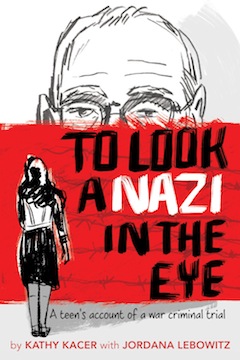 To Look a Nazi in the Eye is powerful in part because it reveals the compassion Lebowitz initially felt for Groening, in his frailty, sitting in the courtroom each day. He recounted heartbreaking stories of what had transpired in the camp. But, while Lebowitz believed at the start of the trial that he was truly sorry for what he had done, Groening’s stories began to change, and not for the better. He also said he was not guilty because he did not personally hurt or exterminate Jews.