In anticipation of the Jewish holiday of Passover, Curly Orli and I are making cute froggies. It is true that frogs were one of the Ten Plagues, but frogs are also believed to be the bringers of spring! These days, they are happily hopping around in parks and forests after a long winter slumber. Now, you can have one of them at home … a Plasticine one, that is.
Steps 1-4 of making a Passover Plasticine froggie.
1. Prepare green Plasticine. Separate it into pieces for different body parts: eyes, head, torso and two pairs of legs.
2. Using white and blue Plasticine, make eyes. With the help of a toothpick, make a nose by poking two holes, then a mouth and, finally, add a red tongue.
3. From earlier prepared pieces, let’s make a lower part of the body and legs. Attach them together.
4. Connect upper and lower body. The froggy is ready!!!
Steps 5-7: making a flower for our Passover Plasticine froggie.
5-6. Our froggy is festive and joyous, so let’s give him a beautiful flower. We can make petals from various small and round colorful Plasticine pieces by making them pointy at the end.
7. Let’s add petals to the flower and connect them to the stem.
8. Now, we will give this flower to the froggy. Our creation is complete.
Happy Passover to all the readers of the Jewish Independent! We wish you peace, joy and new creative adventures.
Lana Lagoonca is a graphic designer, author and illustrator. At curlyorli.com, you will find more free lessons, along with information about Curly Orli merchandise.
Beet salad from Gluten-Free Goes Gourmet. (photo by Ruchy Schon)
At least three times a year – Rosh Hashanah, Chanukah and Passover – I liven up my dinner menus by trying out some new recipes from recently published cookbooks. I don’t keep a kosher kitchen, I’m not gluten or dairy intolerant, nor am I diabetic or allergic to corn, yet I ventured this spring to try Vicky Pearl’s Gluten-Free Goes Gourmet (Moznaim Publishing Co.), which actually came out last September. While many of the recipes may be appropriate for Pesach meals, many are not chametz-free, particularly in the dessert section – but they’ll make for delicious treats after the holiday.
There are more than 100 recipes in Gluten-Free Goes Gourmet; most are easy-to-follow and quick to make (even without a mixer), but others require a few hours (preparation plus cooking time), so make sure to plan ahead and carefully read through the recipes before setting about to make them. Everything I tried in Gluten-Free Goes Gourmet turned out just like the photos (which are lovely) and, with the exception of the kugel – which, for some reason, I couldn’t get to the quite the right consistency and which had too much salt for my liking – everything tasted great. There was one typo in the book that I came across: the oatmeal chocolate chip cookie recipe makes almost four-dozen cookies, not 18, as indicated.
Gluten-Free Goes Gourmet contains useful information on many of the ingredients used in the recipes, including their nutritional benefits. It has numerous sections: dips and drinks, salads, soups, meat and poultry, fish, mock dairy, side dishes, breads, desserts, and cakes and cookies. It would have been nice to experiment with these last chapters more, as the cookies I made were so delicious – and all indications are that the other gluten-free desserts and breads will be just as tasty.
The following recipes will give readers an idea of how good “free” eating can be. Enjoy!
BEET SALAD
Try to buy beets that are uniform in size, since they’ll cook more evenly. As an added bonus, smaller beets are sweeter.
Beet salad from Gluten-Free Goes Gourmet. (photo by Ruchy Schon)
10 beets, peeled 1 red onion
Dressing: 1/2 cup liquid from cooked beets or water 1/3 cup vinegar or freshly squeezed lemon juice 1/4 cup agave, xylitol or granulated sugar 1/4 cup oil 2 tsp kosher salt 1/2 tsp freshly ground pepper
Place beets in an eight-to-10-quart pot (depending on size of beets); cover with water. Bring to a rolling boil over high heat. Cook for one or two hours, maintaining a rolling boil, or until beets are tender enough that the tines of a fork meet with little resistance. Reserving 1/2 cup of cooking water, remove beets from water. Cool slightly. Slice beets according to your preference.
Place beets in a serving bowl; add onions. In a separate small bowl, mix together dressing ingredients. Pour dressing over vegetables, tossing gently until well coated. For best results, cover with plastic wrap and refrigerate overnight. Bring to room temperature before serving.
Yields eight to 10 servings.
CREAM OF ZUCCHINI SOUP
5 large zucchinis, scrubbed clean, washed and cut into thirds 3 large potatoes, peeled and cut into quarters 1 large onion, halved 1/4 tsp freshly ground black pepper 1-2 tbsp (heaping) kosher salt
Place all ingredients into an eight-quart pot. Fill three-quarters full with water and bring to a boil over high heat.
Reduce heat to medium; cook, with lid slightly ajar, for half an hour.
Place immersion blender in pot; blend until smooth.
Makes eight to 10 servings. Freezes very well for up to six months: chill before freezing and thaw in refrigerator.
Preheat oven to 350°F. In the bowl of an electric mixer, cream together eggs and oil. Change paddle attachment to a dough hook.
Add sesame seeds, salt, flour, potato starch, onion and garlic to bowl; mix well.
Divide dough in half. Working with one piece at a time, roll out between layers of parchment paper to 1/16th of an inch thickness.
Remove the top parchment paper; transfer the dough with the parchment paper still under it to a cookie sheet. Cut into one-by-three-inch rectangles. Repeat with the remaining dough.
Bake in preheated oven 14 to 16 minutes or until golden.
Allow crackers to cook on parchment paper on rack.
Yields 60 crackers and the crackers freeze well for up to two months. They will store well in an airtight container at room temperature for up to two weeks.
SHOULDER STEAK
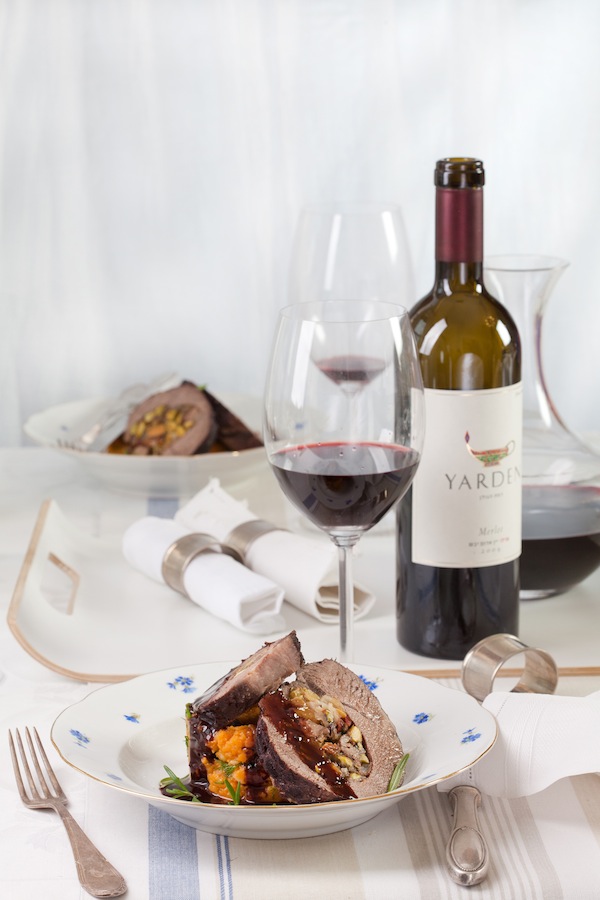
Shoulder steak. (photo by Ruchy Schon)
1/4 cup oil 3 cloves garlic, minced 3 large onions, sliced thinly 1 lb shoulder steak or pepper steak, or 4 pieces minute steak 1 cup semi-dry red wine 1 bay leaf 1 tsp kosher salt 1/2 tsp dried minced garlic 1/4 tsp dried rosemary leaves (optional) 1/8 tsp freshly ground pepper
Heat oil in a large skillet set over medium heat. Add garlic; brown for about one minute. Add onions; sauté until translucent, three to five minutes.
Add steak, wine, bay leaf and spices. Increase heat to high; bring to a boil. Add five cups water; return to a boil. Reduce heat to medium; cook, covered, for two to two-and-a-half hours or until meat is tender. Remove bay leaf before serving.
Makes four servings. Freezes very well for up to six months.
POTATO KUGEL
5 large eggs 1 cup oil 2 tbsp (heaping) kosher salt 10 large Idaho/russett potatoes (about 5 lbs), peeled and cut in half lengthwise 1 large onion, peeled and cut in half
Preheat oven to 450°F. In a large bowl, whisk together eggs until lightly beaten. Whisk in oil and salt.
In a food processor fitted with the blade with tiny holes and working in batches, process potatoes and onion until almost smooth. Transfer potato mixture to bowl, blending well with egg mixture.
Pour mixture into a parchment-paper-lined nine-by-13-inch baking pan.
Bake in centre of preheated oven for one hour or until top is browned. Reduce heat to 350°F. Bake for two hours.
Yields 12 generous servings.
OATMEAL CHOCOLATE CHIP COOKIES
Oatmeal chocolate chip cookies. (photo by Ruchy Schon)
1 cup peanut butter 1/4 trans-fat-free margarine, room temperature (1/2 stick) 3/4 cup agave 1/2 cup xylitol or granulated sugar 2 large eggs 1 1/4 tsp baking soda 3 cups old-fashioned rolled oats 2/3 cup chocolate chips (sugar-free, if you prefer)
Preheat oven to 350°F. Line two baking sheets with parchment paper. Set aside.
In an electric mixer, cream together peanut butter, margarine, agave and xylitol (or sugar). Add eggs and baking soda. Mix well.
Stir in oats and chocolate chips until well combined.
Use a tablespoon to drop spoonfuls of dough onto prepared baking sheets. Bake in centre of preheated oven for 11 minutes or until golden yet soft. Do not overbake. Remove to rack to cool completely.
Veganism is about much more than dietary choice. It is an ethical philosophy based on the belief that other animals are not ours to use. Like humans, animals are sentient: they experience pain and pleasure, they suffer and they form deep emotional bonds with others in their families and communities. Vegans do not use animals for food, clothing, entertainment or animal experimentation regardless of taste, pleasure or tradition. Being a vegan is also much more commonplace today, as is following a vegan diet for health reasons. This means it might not be unusual to find a vegan at your table on Passover.
For the fourth year in a row, my wife and I will be hosting an all-vegan Passover seder, or “veder,” as we call it. We started this tradition after a group of Jewish vegan friends expressed how alienating it can be to celebrate the holiday in the traditional way. As ethical vegans, it is difficult to sit at a table laden with the body parts of the nonhuman animals that we are working to protect and rescue. Many had stopped attending their family dinners, and one friend was no longer invited simply because others felt uncomfortable when she passed up most of the food on the table. But our hunger for the Jewish tradition of Passover remained.
The Passover seder commemorates our liberation from Pharaoh and the larger issue of the immorality of slavery. As Jews, we have a long history of suffering, oppression and slavery and, as animal activists, this has informed our choices to work to help others end their own oppression – including animals. It’s no wonder Jews have played key roles in other movements such as civil rights, women’s rights, gay rights and animal rights. The liberation of animals is another social justice movement for which the Jewish community should naturally feel empathy. Jews and vegans share common values such as justice, fairness, equality and compassion.
How we as animal activists celebrate the meaning of the Passover seder is to remember the evils of the past and to expand our circles of compassion and justice so that no group, human or nonhuman, need experience the suffering and exploitation of being different or unequal. Passover is a great opportunity to reflect on how we can create less suffering for all those who are oppressed through our personal behaviors and choices.
Simply adding vegan foods and vegan versions of traditional dishes to the table is a way of making a statement that we include the most vulnerable and innocent among us when we celebrate this holiday. These days, it’s as simple as Googling “vegan [whatever dish] recipe,” vegan or “vegan Passover recipes,” and thousands of animal-free options will magically appear. At our veder, we serve all of the traditional dishes we grew up eating – matzah brie, brisket, gefilte fish, potato latkes, matzah ball soup, kugel, macaroons – in veganized versions without meat, dairy or eggs.
With a little effort and creativity, your entire seder dinner can be made vegan. We even have an animal-friendly seder plate. Instead of a lamb shank bone, we use a dog cookie-cutter to make a playful bone-shaped piece of tofu. Instead of an egg, we use a small dab of commercial “egg replacer” used in vegan baking. I encourage all Jews to embrace the meaning and tradition of the holiday while also incorporating new traditions that reflect values of justice, ethics and compassion. When we can celebrate the holiday without doing any harm to others, why wouldn’t we?
VEGAN CHOPPED LIVER
Adapted from The Jewish Vegetarian Year Cookbook by Roberta Kalechofsky and Roda Rasiel (Micah Publications, 1997).
1/2 lb brown lentils 1 large onion, diced 2 tbsp olive oil 1 cup walnuts salt and pepper to taste
1. Put lentils in a two- or three-quart pot and cover with water. Bring to a boil, partially cover and simmer until tender, about 30-40 minutes. Check occasionally to make sure water has not boiled off, and add water as needed.
2. Sauté onions in olive oil until golden and tender. Allow to cool slightly.
3. Drain lentils and blend, along with the walnuts and onions, in a food processor until homogenized, but leave some of the texture intact.
4. Add salt and pepper to taste. Chill about two hours.
Gary Smith, co-founder of Evolotus, a PR agency working for a better world, blogs at thethinkingvegan.com and has written for many publications. He and his wife are ethical vegans and live in Los Angeles with their cat Chloe and two beagles rescued from an animal testing laboratory, Frederick and Douglass.
(Editor’s note: Some vegan recipes will contain ingredients that are not strictly kosher for Passover. For those who are less strict, the options abound. For more strict kosher diets, incorporate dishes that are heavier on fruits and vegetables, and avoid using legumes, like lentils, or products that contain wheat or gluten. Also, only certain egg substitutes are kosher for Passover, and many Ashkenazi Jews abstain from eating kitniyot on Passover; tofu is made from soybeans, and is considered to be kitniyot.)