Yellow dates for New Year’s

To make biblical date honey, Middle Eastern Jews boil and press dates that range in color from yellow to brown. (photo by Barry A. Kaplan)

The Torah describes Israel as eretz zvat chalav u’dvash, the land flowing with milk and honey, although the honey was more than likely date honey, since beekeeping is not mentioned in the Bible.

The word honey in Hebrew, dvash, has the same numerical value as the words Av Harachamim, Father of Mercy. We hope that G-d will be merciful on Rosh Hashanah as He judges us for our year’s deeds.

To make silan, or biblical date honey, Middle Eastern Jews boil and press dates that range in color from yellow to brown. Apples can be dipped into the date honey in the hope for a sweet new year. In the markets in Israel during this season, one finds strings of these dates.

In the 2011 article “Cooking class, it’s a date, honey,” cookbook author Faye Levy writes: “For many Jews, apples are the Rosh Hashanah fruit par excellence. For me, fresh dates are the fruit that herald the coming of the New Year. As soon as I see the bright yellow dates at the market, I begin to plan my menus.

“I’ve heard people say they’re not fond of fresh yellow dates. I have learned to enjoy them at their khalal [initial] stage, when they are crunchy and less sweet, but I prefer to wait until they become honey-brown, [the] stage called rutab.”

There are several kinds of dates grown in Israel, including Medjool, which Levy notes “are delicious and easier to find than perfectly ripened yellow dates.”

But, regardless of type, dates are a traditional Rosh Hashanah food, and form part of the Sephardi seder, which dates to the Babylonian Talmud.

“An elaborate Maghrebi [the region made up of Morocco, Algeria, Tunisia and Libya] specialty calls for nut-stuffed dates that are used to stuff a chicken or a large fish,” writes Levy. For Shabbat, she explains, dates might be added to dafina, which is a Sephardi meat stew cooked overnight to eat on Saturday lunch, or Moroccan hamin, another slow-cooked overnight stew for Saturday eating. The dates “contribute a subtle sweetness that mellows the flavor of the sauce. A dish from Baghdad from the Middle Ages calls for stewing lamb with dates and sweet spices.”

Silan, which Levy notes was brought to Israel by Iraqi Jews, is also known as date molasses or date syrup.

Varda Shilo, author of Kurdistani Cooking (in Hebrew), describes how to make it. Dried dates are simmered in water to porridge consistency, then the mixture is spooned into a cloth bag, moistened with more water and squeezed to remove the juice. This juice is simmered until thickened and is kept in jars.

Shilo explains that breakfast is the meal at which date honey is most often enjoyed in the Middle East, mixed with tahini (sesame seed paste) and served with bread.

Kinneret Farm silan makers suggest other ways of using date honey, such as adding it to stir-fried vegetables, as a sweetener for beverages, in sweet-potato pancakes, with an added dash of cinnamon.

“Dates are best known for their uses in sweets,” writes Shilo. “They are a favorite filling for the rich Middle Eastern cookies called ma’amoul and for rolled cookies resembling rugelach that are popular around the region.”

“In Persia,” write Reyna Simnegar, author of Persian Food from the Non-Persian Bride, “walnut-stuffed dates are a Rosh Hashanah treat. The stuffed dates are drizzled with a little syrup and sprinkled with cinnamon.

“Another popular way to serve dates is as a snack with tea.”

“Cooks in Egypt use the firm, fresh yellow dates to make jam,” says Levana Zamir in Cooking from the Nile’s Land (in Hebrew). “They also use them to make stuffed dates. First, they remove the dates’ very thin peel with a sharp knife and cook the dates in water until they are soft. Next, they pit the dates without cutting them in half.

Instead, they push the pit out with a hairpin so that each date can be stuffed with a blanched, peeled almond. Then they make a clove-and-lemon-flavored syrup from the dates’ cooking liquid. One by one, the stuffed dates are carefully added to the syrup, simmered and then cooled. The sweets are served with Turkish coffee and a glass of cold water. Making them is quite an undertaking but … these stuffed fresh dates are a delicacy fit for kings.”

Some Moroccans dip apples in honey and serve cooked quince, which is an apple-like fruit, symbolizing a sweet future. Other Moroccans dip dates in sesame and anise seeds and powdered sugar in addition to dipping apples in honey.

In her book The Foods of Israel Today, Joan Nathan writes about having lunch at Jerusalem restaurant Eucalyptus, when owner/chef Moshe Basson put a bowl of tahini “on the table and swirled in a date syrup called silan or halek, which he explained was a biblical ‘honey,’ one of the seven foods in the land of Canaan cited in the Book of Deuteronomy. Today, visitors can see a 2,000-year-old date-honey press, similar to an ancient wine press but smaller, near the Dead Sea at Qumran, the sites where, in 1947, a Bedouin youth found the Dead Sea Scrolls hidden in earthen jars.”

Nathan writes further that Ben-Zion Israeli, one of the founders of Kibbutz Kinneret, dressed as an Arab and, in 1933, went to Iraq and smuggled 900 date saplings back to Palestine. Over the years, with many trips, he brought back more than 7,000 saplings from Iraq, Iran and Kurdistan; about half took root. Shmuel Stoller later brought saplings from Egypt and Saudi Arabia. In the 1970s, Medjool and Deglet Noor varieties were introduced from the Coachella Valley in California.

If you are wondering about dates and your health, Judy Siegel-Itzkovich writes in the 2013 Jerusalem Post article “Local dates are best variety to fight disease”: “All nine varieties of dates grown in Israel and found on any supermarket shelf have characteristics that make them better than other varieties at helping protect those who consume them against cardiovascular diseases.

“This has just been demonstrated by Prof. Michael Aviram and colleagues from Haifa’s Rambam Medical Centre and Technion-Israel Institute of Technology. The research was published in the prestigious Journal of Agriculture Food Chemistry.”

The research team found that the most effective varieties for health are yellow, Barhi, Deri, Medjool and Halawi dates, and that, despite there being about 20 different types of dates growing around the world, those from the Jordan Valley and the Arava are the best.

Aviram warned Siegel-Itzkovich, however, that silan won’t help much. “As silan is a sweet concentrate that does not contain fibres, it is far from the real thing,” he said.

The article also noted, “A study the researchers published in the same journal four years ago showed that eating three dates a day does not raise blood sugar levels in healthy people, but it does reduce blood triglycerides and even ‘improves the quality’ of blood cholesterol by reducing its oxidation. These effects reduce the risk of heart disease, stroke and other vascular diseases, they said.”

Nonetheless, Aviram advised diabetics against eating a lot of dates, as they are high in sugar.

photo - Antioxidants from the group of polyphenols found in pomegranates, red wine and olive oil help remove plaque from inside the arteries
Antioxidants from the group of polyphenols found in pomegranates, red wine and olive oil help remove plaque from inside the arteries. (photo by Barry A. Kaplan)

In addition to the health benefits of dates, the Post article also highlighted 2009 research Aviram had led, showing that “antioxidants from the group of polyphenols found in pomegranates, red wine and olive oil help remove plaque from inside the arteries. In the new research, the team found that dates can bring about the slowing and even regression of atherosclerosis (accumulation of fatty plaque) in the coronary arteries, and that eating one of the three specific date varieties is most effective.

“The material in dates has the clear ability to speed up the removal of excess cholesterol from endothelial cells inside blood vessels, the team said.”

While dates have been grown for thousands of years and their health benefits have been cited since ancient times, it is only in relatively recent history that science is confirming many of the beliefs.

High in fibre and also containing many minerals, such as potassium, zinc, magnesium and calcium, Aviram and his team, writes Siegel-Itzkovich, “recommend following a Mediterranean diet – with its variety of vegetables and fruit (including dates), fish, whole grains and olive oil – rather than eating just one or two ingredients, so that a whole range of oxidative factors that cause atherosclerosis can be neutralized.”

Sybil Kaplan is a journalist, foreign correspondent, lecturer, food writer and book reviewer who lives in Jerusalem. She also does the restaurant features for janglo.net and leads walks in English in Jerusalem’s market.

Making your own traditions

As an alternative or addition to synagogue services, you could find a nice place outside in which to pray or reflect. (photo by Jan Lieberman via Wikimedia Commons)

There is a lot of beauty to the traditional synagogue experience. However, a traditional High Holidays service just does not speak to some, especially many young adults.

“Buying seats for the High Holidays is super-expensive,” said Rachel Moses, a marketer for a Jewish nonprofit from Mt. Washington, Md. “It also just doesn’t feel like it’s my place.”

If you think like Moses, consider skipping the tickets, and celebrating Rosh Hashanah and Yom Kippur outside the traditional four walls of your family synagogue. Here are nine alternative ways to connect to the High Holidays without stepping foot in a shul.

  1. Build community

Thomas Arnold, who works in Homeland Security and is from Pikesville, Md., says people often interpret Yom Kippur as a heavy day of repentance. In contrast, the day’s prohibitions – things like fasting, not wearing leather footwear, not making love to your partner, refraining from taking a bath – are intended to help us think less about our own needs and more about those of others.

“The point is to understand there are people that don’t have food, that don’t have water, that don’t have shoes to wear,” said Arnold, citing the 18th-century ethical Jewish book Mesillat Yesharim: The Path of the Upright by Italian rabbi and philosopher Moshe Hayyim Luzzatto. “We don’t have sex because there are people in the world who don’t have partners and cannot connect in that way.”

Arnold looks for people who are in need, lacking something or are lonely, and makes a point of giving to them during the High Holiday season. Sometimes, he invites them over for a meal, and other times he just lends them a helping hand.

“On Rosh Hashanah and Yom Kippur, make it about other people,” he said.

  1. Host a meal

Rabbi Jessy Gross, named by the Forward as one of the most inspiring rabbis of 2016, said some of her best holiday memories are not from the synagogue, but from places where people came together, like at her holiday table.

“Having meals with other people, especially if the person hosting can serve traditional Jewish foods, creates an opportunity … to celebrate Jewish food and culture,” said Gross.

Shari Seidman Klein of Beit Shemesh in Israel agrees. She cooks a holiday meal for her family, as well as for her children, a few of whom choose not to attend traditional activities. Apples and honey, round raisin challah and other sweet things bring the kids and their friends back to her dining room each year.

  1. Change something

Klein said she often instructs her Hebrew school students, many of whom are products of intermarriage, to use the High Holidays as a time to better themselves. She tells them, “Take on one thing for one day.”

For example, rather than fasting on Yom Kippur, she recommended giving up candy, soda or something else they like to eat. Older individuals might decide to give up the personal comfort of watching TV, or they might make the higher commitment of refraining from talking badly about others.

“It’s the idea of tikkun olam, bettering the world,” said Klein. “That one thing on that one day can take you back to the basics of being – and thinking.”

  1. Do Tashlich

One of Gross’ favorite rituals is Tashlich, for which all a person needs is access to a body of natural water such as a creek, pond or river. She recommends taking some bread or crackers and spending some time by the water meditating or journaling.

“I like to think about where I have missed the mark or haven’t reached my potential and cast this out,” she said. “It is great opportunity to … think about what you want as we evolve into the coming year. It’s a process of spiritual cleansing and preparedness.”

  1. Form a minyan

The Israeli organization Tzohar has been working to bring together the religious and secular Jewish communities in the Jewish state. In the central city of Lod, Tzohar’s executive vice-president, Yakov Gaon, said his organization found that many secular Israelis refrain from going to synagogue, not because they don’t want to pray, but because the service is too fast, politicized, costly or uncomfortable.

“They don’t know how to dress, when to stand up or sit down,” Gaon said.

About 15 years ago, Tzohar began creating alternative minyans in community centres, schools and gyms. The services bring like-minded people together. Each service is assigned a leader who announces the prayer page numbers to read, and explains what’s happening in the prayers. Today, more than 56,000 people take part in these Yom Kippur services at 300 locations across Israel. An additional 1,500 people attend one of Tzohar’s 60 Rosh Hashanah services.

  1. Go to Israel

While it may be too late now to book a trip, in general, traveling to Israel on or around the High Holidays is a more special experience than traveling there during nearly any other time of year, said Arnold, whose daughter is studying in Israel for the year.

Arnold said Israelis have a reputation for being rude or pushy, but during the Hebrew month of Elul – this month, which leads up to Rosh Hashanah – Israelis tend to mellow out.

“It’s like they know it instinctively,” Arnold said with a laugh. “Their Jewish souls come out and they know it is the Yamim Noraim (High Holy Days) and they better get themselves together.”

The whole country prepares with holiday festivals, music, delicious holidays foods and smells, he said.

  1. Host discussion

Skipping the rabbi’s sermon? Write your own, and invite others to hear it. Klein has tapped into several online resources, such as myjewishlearning.com, to provide fodder for discussion at the table, or for her son and his friends to discuss in an intimate setting. Gross, too, said that using online content and hosting a discussion group can help you learn about the holiday, and then share those insights with others.

  1. Reflect in Elul

There is still time to make an Elul reflection calendar. Create a pie chart divided by the Hebrew months, said Gross. Break each pie down by the number of days in that month. On each slice, record a guided meditation question or something you want to work on. Then, every morning or before bed, read it and reflect.

Here, too, Gross added, there are plenty of online trigger questions if you need guidance.

  1. Have a picnic

Mt. Washington’s Moses said hosting or attending a holiday picnic brings people together, offering a venue to eat traditional foods and also spend time in nature. While the children are playing, the adults can host the aforementioned discussion group, or meditate under the open sky.

  1. Pray outside

In general, being outside is a good way to infuse spirituality into your holiday. Transform your backyard, a park or a forest into a synagogue and pray.

Most years, Moses attends Baltimore Hebrew Congregation’s Rosh Hashanah Under the Stars program, which offers an alternative Jewish New Year get-together for members and non-members.

“There are thousands of people there, right under the stars, with no ceiling above you,” said Moses. “You feel like you are one with nature, with each other and with God – whatever sense of God there is.”

On years she cannot make the service, she and her family might travel to Ocean City, Md., instead. “We’ll just sit there and listen to the ocean,” she said.

To read more from JNS.org, click here.

Can we all get along?

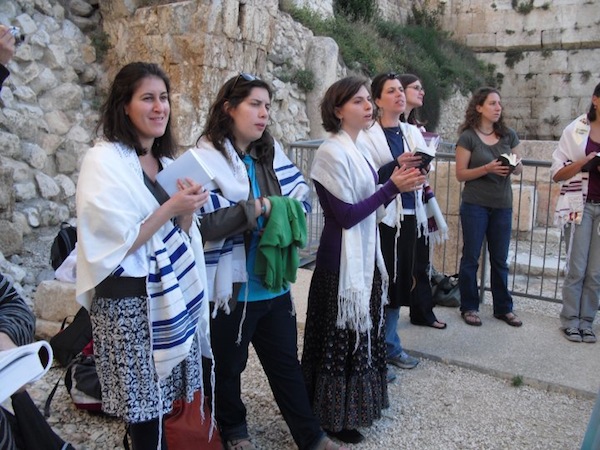
Women of the Wall was founded as a minyan of women from different movements coming together on common ground for Rosh Chodesh. (photo by Michal Patelle via Wikimedia Commons)

In April 2015 – in the aftermath of the death of 25-year-old African-American Freddie Gray inside a police van after being arrested by the Baltimore Police Department, followed by days of riots in Baltimore, Md. – African-American street gangs, the Bloods and Crips, stood side-by-side against police brutality. The Baltimore Sun, and several national papers and social media outlets, carried photographs of the members of the typically warring gangs posing together, with captions about the gangs being determined to “unite for a common good.”

Tzippi Shaked, author of Three Ladies, Three Lattes: Percolating Discussions in the Holy Land, believes that the case of the Bloods and Crips unifying together is a valuable lesson for the Jewish community, in which there are frequent divisions along religious lines. This was echoed by Israeli Prime Minister Binyamin Netanyahu in his annual Rosh Hashanah greeting last year, in which he urged Jewish unity by working “together … [to] build our Jewish state – because we’re united, proud of our past and committed to our future.”

Can Jewish people of different religious denominations truly unite and work together for a common good?

The concept of Jewish unity is one that comes up around the High Holidays due to the Torah portions read before the holidays: Nitzavim and Vayelech. In Nitzavim, we read, “Today, you are all standing before God your Lord; your leaders, your tribal chiefs … even your woodcutters and water drawers.” (Deuteronomy 29:9) Eighteenth-century Rabbi Schneur Zalman explained this in his famous work Likkutei Torah as all Jews standing equally and united before God despite their differences.

Vayelech also concludes when Moses addresses “the entire assembly of Israel” (Deuteronomy 29:1) in a unified manner. Such a colorful image is harder to picture today, when headlines and op-eds tend to stress divisiveness, and the parts over the whole.

“I come from a family with a Charedi brother. I am Modern Orthodox. I have a sister who is secular. Growing up, my father was secular and my mom religious. If we can pull it off under one roof, I believe so can society in general,” said Shaked.

photo - Moses speaks to the Children of Israel.  An illustration from The Boys of the Bible by Hartwell James, published by Henry Altemus Company, 1905 and 1916
Moses speaks to the Children of Israel.  An illustration from The Boys of the Bible by Hartwell James, published by Henry Altemus Company, 1905 and 1916. (photo from Wikimedia Commons)

Shaked, together with one Charedi and one secular woman, spent two and a half years discussing the topics that divide and unite Jewish women, and then embarked on a mission to teach others that, while Jews might not always agree ideologically, politically or religiously, they can be united. This is the topic of her book.

Rabbi Joel Oseran, vice-president emeritus for international development at the World Union for Progressive Judaism, said that, in his experience, it is “rare to see the common good having the highest value,” especially in Israel, where “the playing field among denominations is not level at all.”

“When I am right and you are wrong, how can there be diversity?” Oseran asked. “You have to allow for more than one way to be right in order to respect diversity.”

Shaked disagreed, saying that unity and friendship have little to do with accepting others’ opinions or hoping to change them.

“It’s naive to think that anyone will change his or her mind,” she said, and it has more to do with a belief that people can become friends in spite of differences in levels of religious observance.

“It is very easy to rip apart the other. It is very difficult to look for the positive,” she said. “Irrespective of which religious background you come from, you have to ask yourself, do I look to build bridges or do I look to inflame?”

This has been Marne Rochester’s modus operandi. An active Conservative Jew, Rochester moved to Israel 26 years ago. In the Jewish state, she maintains her Conservative identity, while sending her daughter to a religious school and praying at a variety of different synagogues. She is most active in a Jerusalem Masorti (Conservative) congregation, but she also attends a Sephardi, egalitarian minyan.

“I think Conservative and Orthodox, and Conservative and Reform, have a lot in common,” said Rochester. “Both the Orthodox and Conservative movements are halachic movements. We just see the interpretation more liberally than the Orthodox.”

When it comes to daily life, she said it’s easy to get along, especially in Israel, where Conservative congregants tend to follow more of the movement’s code of conduct, as opposed to the United States, where “a lot of people who belong to Conservative shuls don’t necessarily go by what the movement says.”

Rochester has Orthodox friends willing to eat in her home and share Shabbat together with her.

But, Rochester, who takes part in monthly Women of the Wall ceremonies at the Kotel, said the biggest differentiator between the Orthodox and the Conservative is the role of women in public Judaism and the synagogue. While in Orthodox Judaism women take a back step to men in religious life, “since my bat mitzvah, I read from the Torah, lead services, put on a tallit and tefillin,” she noted. “But, I feel like in my neighborhood, we all get along. We all respect each other and don’t check each other’s tzitzit.”

Rochester added that Women of the Wall was founded as a minyan of women from different movements coming together on common ground for Rosh Chodesh. While it has become a major media focus, and a point of divisiveness between Jews in the Diaspora, in Israel, at its core, “You have Orthodox, Reform and Conservative women all together – that is such a powerful, beautiful thing.”

Oseran said he wishes he would see more leaders taking a stance in the direction of unity.

“I am not optimistic from the top down,” he said, but admitted positive steps are percolating on a grassroots level.

“There are many Orthodox Jews who understand there is more than one way to be Jewish and are prepared to bridge some of the differences in order to be stronger together,” he said, noting that Israelis could learn a lot from the Jewish Federations of North America movement, which is built on a sense of a collective Jewish community in which any Jewish people can fit and find their place.

“How do you create a building bridges mindset?” Shaked asked. “Take the time to make yourself available to talk to others. Be open to meeting people.… We all have to take the plunge.”

She also recommends celebrating the successes of others and volunteering in communities different than your own.

Harkening back to the unity established by the Bloods and Crips in the wake of the Baltimore riots in 2015, Shaked said she read a study published more than 20 years ago by the Simon Wiesenthal Centre that found that gang members cannot unify by simply learning about one another through movies, being told positive messages about one another, or even through dialogue. Rather, they need to work together on a common project. By working for a common goal, the Bloods and Crips found unity.

“I ask this Rosh Hashanah to join with all Israelis, with friends of Israel, with the Jewish people everywhere in wishing for a better future,” said Netanyahu is his previous Rosh Hashanah address.

“I believe these friendships can be struck. I have seen it and I live it,” Shaked said.

To read more from JNS.org, click here.

The Jewish holiday of love

Since it takes place in summer, Tu b’Av has become popular for open-air events. A local example is the JNF Future’s annual Summer Sail, for which guests are encouraged to follow the tradition of wearing white.

Picture this potentially risqué scene: “… the daughters of Jerusalem used to go out … and dance in the vineyards [and] whoever did not have a wife would go there.”

Surprisingly, perhaps, this description is in the Babylonian Talmud, Tractate Taanit, 31a. In the days before internet dating sites and apps, speed-dating or singles bars, this was how Jewish singles met up at least once a year, on Tu b’Av. Welcome to the Jewish day of romance, Temple-times style.

Maybe it didn’t go as far as the cliché “clothes make the [wo]man,” but even back then, it apparently mattered what you wore to the vineyard. The bachelorettes decked out in white. If a single woman didn’t have white clothes, she’d borrow from someone else. In fact, the tractate describes this nice touch – everyone borrowed, so that no one felt embarrassed if they didn’t have something.

Presumably, wearing white at night had its advantages, too, as it made the women stand out in the moonlit vineyard. Moreover, when we think “white,” most of us think purity and, associatively, virginity, which brings us to this: wearing white underscores the next step, the Jewish wedding. At this ceremony, both the bride and the groom traditionally wear white – the groom (chatan, in Hebrew) puts on a white robe (kittel) or a prayer shawl (tallit) and the bride wears a white dress.

The writings of medieval Jewish scholars like Rabbi Aaron ben Jacob ha-Kohen and Rabbi ben Solomon ibn Abi Zimra (the Radbaz) suggest that wearing white at Jewish wedding ceremonies is a very old custom. They write that one’s wedding day is like a personal Yom Kippur, when the bride and groom’s sins are forgiven. Thus, the wearing of white becomes a proof-text for the line from Isaiah 1:18: “If your sins prove to be like crimson, they will become white as snow.”

Jewish scholars actually connect Yom Kippur and Tu b’Av. Unexpectedly, the Talmud claims that Tu b’av is as important as Yom Kippur in at least one way: “Rabbi Shimon b. Gavriel said: There were no days as joyous in Israel like the 15th of Av and Yom Kippur.” (Taanit 26b)

Chag Haahava, the Holiday of Love, or Tu b’Av (the 15th day of the Jewish month of Av), falls just six days after we mournfully recall that, on Tisha b’Av (Ninth of Av), both the First and Second Temples were destroyed, and numerous other Jewish catastrophes occurred. Here again, we link Tu b’Av to another Jewish wedding custom – the breaking of the glass, recalling the Temples’ destruction.

According to Tractate Taanit (30b-31a), the 15th of Av also joyously commemorates a number of other events in early Jewish history:

(1) This day marked the end of the “wilderness” generation; that is, the end of G-d’s punishing with death the Hebrews who had been the contemporaries of the spies who lacked the requisite faith for conquering the land (Numbers 14: 29-35). The 40 years of desert wandering ceased at this point and the children of the exiles entered Canaan.

(2) On 15 Av, G-d lifted the restriction on intermarriage between members of the 12 tribes.

(3) G-d reinstated the tribe of Benjamin, which He had banned for the tribesmen’s gang rape in Gibeah of a visiting concubine, who subsequently died.

(4) During the Temple period, the task of providing firewood for sacrifices ended on 15 Av, when the woodcutters would ceremoniously break their axes.

(5) Hosea, son of Elah, the last king of the Northern Kingdom, permitted travel to Jerusalem’s Holy Temple for the pilgrimage holidays.

(6) This day also marks when permission was given to bury those killed by the Romans at the Betar fortress.

While the Shulchan Aruch (Code of Jewish Law) doesn’t specify any particular customs for Tu b’Av, it does indicate that, as with other joyous days in the Jewish year, Jews should skip reciting tachanun (confession of sins) on this day.

Given the injunction to “be fruitful and multiply,” it is not hard to understand why this ancient holiday was judged to be so important. Indeed, one could make the claim that the holiday’s timing is hardly coincidental. It comes when the moon is full, reminding us that its cycle parallels women’s 28-day reproductive cycle.

Moreover, on a spiritual level, the sun’s illumination of the full moon suggests a cosmic union of the masculine and feminine – a kesher (Hebrew for connection) between G-d and His Divine Presence (Shekhinah). Rabbi Dr. Jill Hammer writes: “In the Zohar, the full moon signals the time when the

Divine womb creates pure and blessed souls. It is the time when the moon and sun, which, in kabbalist thought, represent the feminine and masculine faces of G-d, are most in contact. The Zohar [notes] that, at the full moon, the Shekhinah is called a field of apples, while at the dark moon, she is called field of anatot [poverty].”

It is somewhat ironic that this great holiday was not celebrated in Israel until recently. But Israelis seem to be making up for lost time. As Tu b’Av approaches, articles on the true meaning of love appear on a variety of websites, in ultra-Orthodox through to humanistic Judaism posts. Moreover, the day has evolved into a favorite Jewish Israeli wedding date – to get married on this day, couples must make their wedding arrangements far in advance.

As Tu b’Av falls in the summertime – this year, it starts the evening of Aug. 18 – it is ideal for outdoor events. Hence, the holiday has become popular for open-air evening concerts and all-day festivals.

As we become more of a global community, it is not surprising that modern Tu b’Av rituals have been influenced by Valentine’s Day accoutrements. Indeed, Tu b’Av art often mimics Valentine’s Day graphics, Israeli magazines guide people to romantic getaways, Israeli newspapers recommend places to feast on heart-shaped ravioli or splurge on rich chocolate mousse desserts or get tipsy on Pink Monica cocktails.

Anyone interested in learning more about Jewish rituals for celebrating Tu b’Av, however, can start their research at ritualwell.org.

Deborah Rubin Fields is an Israel-based features writer. She is also the author of Take a Peek Inside: A Child’s Guide to Radiology Exams, published in English, Hebrew and Arabic.

Make Shavuot special

At sundown on Saturday, June 11, Jews around the world will start the two-day holiday of Shavuot, which lasts only one day in Israel. Also known as the Festival of Weeks because it marks the completion of the counting of the Omer period – which is 49 days long, or seven weeks of seven days – Shavuot is one of the Jewish calendar’s shalosh regalim, three pilgrimage holidays.

Unlike the other two pilgrimage festivals – Passover and Sukkot – there is no definitive ritual associated with Shavuot in the text of the Torah. As such, many Jews struggle to connect with the holiday, which has yet another name: Chag Hakatsir, the Harvest Festival.

But, despite its undefined nature, Shavuot “is a gift of a holiday,” says Roberta Miller, a Chicago Jewish day school teacher. “It’s when we got the Ten Commandments, God’s greatest present to the Jewish people.”

In that spirit, here are seven ways to infuse more meaning and minhag (tradition) into your Shavuot this year:

1. Food. It is traditional on Shavuot to eat dairy foods. Rabbi Robyn Frisch, director of InterfaithFamily/Philadelphia, explained some believe this is because the scripture compares Torah to “honey and milk … under your tongue.” (Song of Songs 4:11) Another explanation is that when the Israelites received the Torah for the first time, they learned the kosher dietary laws and didn’t immediately have time to prepare kosher meat, so they ate dairy instead.

Baking and consuming dairy foods can differentiate Shavuot from other holidays, said Miller. “We all have very strong memories associated with scent. If I smell a honey cake, I think of my grandmother and Rosh Hashanah. The smell of cheesecake generates a connection to Shavuot for my kids.”

In Miller’s family, Shavuot marks the first ice cream cake of the season, and that knowledge builds anticipation for the holiday. Just as no one in her house is allowed to eat matzah until the seder, she said no one gets ice cream cake until Shavuot.

2. Games. For families with children, games are a great way to educate youth about the messages of Shavuot. Miller suggested counting games. “You can count up to 49 of anything: 49 ways Mommy loves you, 49 things you are grateful for,” she said.

For older children, Miller suggested a Jewish commandments version of Pictionary, in which, before the holiday, children write their favorite commandment or commandments on a notecard. The cards are mixed up and put into a box or bag. Then, the family gets together, members draw picture cards, and someone acts out each commandment while participants guess which commandment it is and why it is important.

3. Guests. On the second day of Shavuot, we read the Book of Ruth, the story of the first Jew by choice. Frisch explained that it is also a story of welcoming the stranger and inclusivity. Shavuot is the perfect holiday for inviting new friends over for a meal, or for opening one’s home to people who are interested in learning more about Jewish traditions, she said.

4. Learning. Taking part in a tikkun leil Shavuot (a night of Jewish learning) is another Shavuot custom. Many traditional Jews stay up all night on the first night of the holiday to study Torah. Frisch also suggested hosting a communal night of learning that can draw in a more diverse mix of Jewish learners, or hosting an evening of learning at an individual’s home.

“Jewish learning doesn’t have to be biblical texts.… It could be liberal values or social justice or just a discussion about Jewish identity or Jewish laws,” said Frisch.

5. Birthday party. Tradition has it that King David, Ruth’s great-grandson, was born and died on Shavuot. Miller suggested holding a King David birthday party featuring decorations, cake, ice cream and gifts.

“Use it as a learning tool,” she said, noting how the party can springboard into an historical discussion. “What would you write on a card to [King David]? What do you want to ask him? What would he want for a present? What would he put in the goody bag that he gives to each of us?”

6. Nature. On Shavuot, it is customary to decorate our homes and synagogues with flowers and plants. Ruthie Kaplan, who lives in the Nachlaot neighborhood of Jerusalem and is a former Hebrew school teacher, said following this tradition of surrounding ourselves with the lushness of the natural world could “add a lot of beauty to the day.” She said Shavuot is “the perfect time” to connect with nature and appreciate the beauty of the world that God created for us.

7. Goals. Kaplan said a deeper reading of the Book of Ruth can transform Shavuot from simply another Jewish holiday into an opportunity to set goals and resolutions. Ruth, she said, believed in something (Judaism) and followed through on her belief.

“That story of Ruth excites me and really comes to life on Shavuot,” said Kaplan. “Ruth is open to the truth and, therefore, she sees it and she is willing to be honest with herself. For anyone searching and struggling, Ruth is a good role model for life.”

Making Pesach matzah

Ben Harrington churns the wheat while Joel Harrington and Sara Basya Mochkin look on. (photo from Chabad of East Vancouver)

On April 10, Chabad of East Vancouver hosted a packed Model Matzah Bakery at its Centre for Jewish Life on Fraser Street. Following a week of similar events at Chabad Lubavitch, children had an opportunity to make their own matzah from scratch. They began by winnowing the wheat kernels, then grinding and sifting them into fine flour. Water was then added to make dough. The kids rolled out the matzah, scoring it with dockers before handing it over to the grownups for baking.

The children managed to get the dough kneaded, shaped and into the oven in under 18 minutes to prevent the dough from rising. This would have made it chametz, a fermented grain, which is forbidden over Passover.

This process only began after a careful eye was cast over all of the ingredients and tools, from start to finish: whether keeping the grains and flour completely dry, to the meticulous cleaning of the tools used in the matzah production.

When 18 minutes were up, an egg timer went off, to cheers from the kids and applause from Rabbi Mendy Mochkin of Chabad North Shore.

The finished matzot were pulled from the oven by Rabbi Schneur Wineberg of Chabad East Van. After savoring the matzah with cries of “Mmm, delicious!” oranges were served, followed by knishes from Shuk restaurant.

Extra hands-on supervision was provided by Maggie Karpilovsky and the staff of North Shore Hebrew School.

Shula Klinger is an author, illustrator and journalist living in North Vancouver.

Make a butterfly for spring

Spring is the time of nature’s reawakening, when we are treated to so many vibrant and beautiful colors and shades. Spring is also when Jewish communities around the world celebrate the unique and important holiday of Passover. So why don’t we combine the two and make a festive Passover postcard with a spring butterfly against flowery background?

In making our postcard, we can unleash our imaginations! There are so many beautiful butterflies in the world – it is impossible to count them all. And there are no strict rules in art projects, so feel free to be creative, dear young artists. But, if you want to try and make your butterfly look like a real one, you will need to choose a design you can repeat, as both wings of a butterfly are the same in design and texture.

So, gather all the brown, black, blue, yellow, purple, green, pink and other colors of Plasticine you have at home. You will also need toothpicks. Now let’s get started!

image - Passover postcard steps 1-4 by Lana Lagoonca1. Take brown Plasticine and make the butterfly’s head, thorax (torso) and abdomen.

2. Put all the butterfly body parts together. Make black antennae (a butterfly’s “whiskers”). After that, make and attach blue eyes and a pink mouth.

3. Take yellow Plasticine and make one wing, attach it to the body on the top left side. Make one more wing – purple – and attach it underneath the yellow wing.

4. Use your fingers to make the wings smooth.

image - Passover postcard steps 5-8 by Lana Lagoonca5. Now make and attach identical wings to the right top and bottom sides. Make them smooth, too.

6. Make beautiful ornaments for the top left yellow wing using, for example, green, blue, purple, red and pink colors, just like we did. You can use other colors, if you’d like.

7. Repeat the same design on the top right yellow wing.

8. Using the same technique, make colorful ornaments for the two bottom wings on both sides. You may use yellow, orange and blue colors to do that. Now your butterfly is ready!

To make the postcard, you can put your butterfly in front of some flowers, attaching it using a piece of wire or a thin stick, and take a picture of it with this flowery background. You can then print out the image, and you will have your own beautiful Passover postcard with a fluttering butterfly.

Happy Passover, dear Jewish Independent readers – to you and your families!

Lana Lagoonca is a graphic designer, author and illustrator (lunart.ca). At curlyorli.com, there are more free lessons, along with information about Curly Orli merchandise.

Making your Haggadah unique

The website haggadot.com offers numerous template options.

The Hebrew word haggadah means narration or telling. As the Passover seder’s instruction manual, the Haggadah is perhaps the most important tool for fulfilling the Passover mitzvah of telling the story of the Jewish Exodus from Egypt – a mitzvah that is mentioned six times in the Torah.

The Rambam (Maimonides) in his Mishneh Torah explains that relating the miracles and wonders that were done for our ancestors in Egypt on Passover night is a positive commandment, and that it is a mitzvah to inform our children about it. Many interpret this to mean that telling the Passover story is actually two mitzvot: a mitzvah to tell the story among adults and a mitzvah to teach children about the story.

ArtScroll and Maxwell House have done their parts to make a simple seder manual accessible and inexpensive. But sometimes just reciting the words of the seder isn’t enough to engage seder participants – or even to help them understand the Passover story.

“What I learned is that my family had never really understood the service they had been using for many, many years,” said

Barbara Bayer of Overland Park, Kan., who about 30 years ago decided to write a Haggadah, which she continues to revise each year. “I went to simple sources that told the story simply and succinctly and the family loved it and still does.”

Making your own Haggadah is not as complicated as one might think. For starters, there are many web platforms that allow you to create a customized seder manual by providing curated sources from across the Jewish community. Haggadot.com, for instance, offers readings, artwork and video clips to enliven the seder. The clips can be assembled in one of the website’s templates.

Other sites, such as livelyseders.com, allow users to download an English translation of the complete traditional Ashkenazi Haggadah text, which can be cut and pasted to create your own piece. Jewishfreeware.org carries a range of editions of Haggadot, each one directed to specific interests and needs, in terms of the Haggadah’s length and rituals of choice. All the files are downloadable and some are editable.

Once you’ve found your base, personalizing the Haggadah for your seder experience can be loads of fun and really creative, according to those who do it.

Renee Goldfarb of Solon, Ohio, said one year she set up a laptop, projector and screen at the Passover table and showed a relevant video for each of the 15 steps of the seder.

Suzanne Levin-Lapides, on the other hand, compiled her family Haggadah from the texts of various seders for women she had attended in her Baltimore community, adding an orange to her seder plate as a symbol of feminism, as well as the inclusion of LGBT individuals and other marginalized groups within the Jewish community.

At the Katz family home in Kemp Mill, Md., the Passover seder has been turned into a play by their 12-year-old daughter, Abigail.

Read more at jns.org.

Celebrate Shabbat, Pesach

One look, and it’s clear – it’s springtime in Vancouver. It is no accident that Passover is celebrated at this time of year. (photo from Alex Kliner)

This year, Passover begins on Friday night, April 22, and continues through Saturday, April 30. The first seder is on Shabbat and the second is on Saturday evening. What is the significance of this?

Rabbi Moshe ben Maimon (Rambam or Maimonides) was born on the eve of Passover in 1135 in Cordoba, Spain. He writes that, on the night of the 15th of Nissan, it is a positive commandment of the Torah to relate the miracles that transpired with our forefathers in Egypt. For it is written, “Remember this day on which you went out of Egypt.” The meaning of “remember” here is similar to that which is written about Shabbat: “Remember the day of Shabbat.”

The Rambam explains, at the beginning of the Laws of Shabbat, that resting from labor on the seventh day is a positive commandment, for it is written, “On the seventh day you shall rest.” The fact that the Rambam begins the laws with the positive command indicates that the main aspect of Shabbat observance lies in the positive aspect. Shabbat is a weekly occurrence, when we take a break from our work and enjoy time with family and friends at home and in synagogue, as we focus on the spiritual aspects of the day.

By connecting the tale of the Exodus on 15 Nissan to the remembrance of Shabbat, the Rambam is indicating that, with regards to relating the events of the Exodus, the main aspect is the positive step of becoming free. So, the obligation to relate the story of the Exodus involves not only the recalling of our release from slavery, but the recounting of how we became free. The Haggadah adds that an individual is obligated to feel as if they themselves had just gone out of Egypt.

As Passover approaches, the Torah instructs us that this festival of liberation should always be celebrated in the spring – Chodesh Ha’aviv, the month of spring. It relates that, on the day of Rosh Chodesh Nissan (the head of the month of Nissan), two weeks before the deliverance from Egyptian enslavement, we received the first mitzvah: sanctification of the new moon, whereby the first day of each month is sanctified as Rosh Chodesh, in conjunction with the molad (rebirth) of the moon as it reappears as a narrow crescent.

Together with this came other details of our Jewish annual calendar. Our calendar is based on the lunar year (12 lunar months), coupled with an adjustment to the solar year by the insertion of an additional month every two or three years, making a leap year, consisting of 13 months, as we just marked with the months of Adar I and Adar II. In this way, the accumulated lag of the lunar year relative to the solar year, 11.5 days, is absorbed. This requirement and the necessity for Nissan to fall in the spring, the time of the Exodus, is vitally important, so all our other Jewish festivals also occur in their proper season; for example, that Sukkot takes place in autumn.

On Rosh Chodesh Nissan, G-d instructed us, the Jewish nation, about the Passover sacrifice and the laws of the festival of Pesach, which is also known as the Festival of our Liberation. This was deliverance from our physical slavery from ancient Egypt. However, given that the instructions in the Torah are eternal and valid at all times and wherever Jews live, in every generation, the Festival of our Liberation is also freedom in a spiritual sense; that we might be liberated from our limitations and leap over our everyday shackles.

How? By focusing our energy on our being free and thanking G-d for allowing us to be able to use our minds to release ourselves from any obstacles we may face. Also, by remembering that G-d loves us so much that He Himself redeemed us, not wanting to send any angels to do this precious job for His suffering children. Due to His great love for us, He took us out in the spring, when the weather was favorable.

This Passover, in the Lower Mainland, we are fortunate to be able to see the renewal in the earth, as trees and flowers bloom and fruits blossom, the rainy weather that we have endured for months changes to sunshine and baby birds and animals are born.

May we enjoy this special Passover, which begins and ends on Shabbat, with family, friends and guests at our seders, yom tov meals and synagogue or Chabad House attendance. May G-d grant us, as the Haggadah concludes, “Next Year in Yerushalayim,” with the imminent coming of Moshiach.

Wishing everyone a special Shabbat shalom and a kosher and happy Passover!

Esther Tauby is a local educator, writer and counselor. This article is based on talks that were given by the Lubavitcher Rebbe z”l.

Sponge cake a Pesach must

Another version of orange-glazed sponge cake, minus the Sabra. (photo from littlemisscelebration.com)

Sponge cake. It’s an integral part of Pesach for many people, even though there is no special plate for it, and no bracha said over it. Sponge cake comes in two types – angel food and true sponge.

Angel food cake has cream of tartar, an acid ingredient, which used to be combined with baking soda and salt to make a form of baking powder before baking powder was produced commercially. Cream of tartar is what gives an angel food cake its white color, and it also creates an acid reaction in the batter.

Sponge cake has a more delicate cousin referred to as sunshine cake. Most people, however, refer to the Passover version as sponge cake. Sponge cake is usually baked without shortening or butter or baking powder but with lots of eggs. Its lightness and texture come from careful handling and the air beaten into the eggs. Recipes with nine to 12 eggs are not uncommon.

The aim of making a sponge cake is to beat the maximum amount of air into the yolks and whites while handling them as little as possible. An electric or rotary beater gives better results than whipping by hand. Since there is no baking powder, the main rising factor is the air plus steam.

In making a sponge cake, it is important that the yolks are beaten until light and thick, and the whites must be beaten until they are stiff and glossy. Essences such as vanilla lemon or orange rind add special flavor to a sponge cake.

The best pan for a sponge cake is a tube pan with a removable rim, thus the central tube gives support to the batter.

In Israel, many old-timers use a wonder pot (in Hebrew, sir pella) about which I wrote a cookbook in the 1970s for people without an oven (see jewishindependent.ca/cookbook-resurfaces). A wonder pot is basically a sponge cake pan that sits on a coned base and then has a lid with strategic holes around its top to let out the steam. It is placed atop a stove burner for baking. Last year, in the weeks leading up to Passover, one of the large supermarkets in Jerusalem carried three different sizes of wonder pots (dairy, meat and parve) so you didn’t have to kasher your oven before the holiday.

A regular sponge cake pan should be ungreased. A preheated 350˚F oven is the best heat for baking a sponge cake. When the cake is done, the pan should be inverted to cool for about an hour and a half. Before removing the cake from the pan, the sides should be loosened with a knife. It is best not to try to cut a fresh sponge cake with a knife; rather, use a divider with prongs instead, and slide it back and forth gently.

In Let My People Eat, Zell Schulman offers these additional tips to keep your sponge cake from falling: have the eggs at room temperature and use only large eggs; don’t add sugar until the egg whites begin to hold small, soft peaks; beat the egg whites until stiff but not dry; and never make a sponge cake on a wet day.

Here are three different kinds of sponge cake.

ORANGE-GLAZED SABRA SPONGE CAKE

1/2 cup unsalted parve margarine or 1/4 cup plus 2 tbsp oil
2/3 cup sugar
1 tsp orange rind
5 tbsp Sabra liqueur
3 separated eggs
2 tbsp sugar
1/2 cup potato starch
4 tsp orange rind

  1. Preheat oven to 325˚F. In a bowl, cream margarine or oil and sugar. Add one teaspoon orange rind, two tablespoons of the Sabra liqueur and the egg yolks and blend.
  2. In another bowl, beat egg whites until stiff, gradually adding two tablespoons sugar. Add to creamed mixture gently, then stir in potato starch.
  3. Pour into a greased tube pan. Bake for 45 minutes to one hour. Let cool for at least an hour then gently remove to a plate.
  4. Meantime, in a bowl, combine orange juice, the other three tablespoons of liqueur and the orange rind. While cake is still hot, punch holes around it with a toothpick and pour the glaze over it.

MIRIAM’S BANANA CAKE
This is from one of my close friends in Overland Park, Kan., who, at 88, is still a really creative cook. 

7 eggs, separated
1/4 tsp salt
1 cup mashed bananas
3/4 cup potato starch
1 cup sugar
1 cup chopped walnuts

  1. Preheat oven to 350˚F. In a bowl, beat egg whites until stiff but not dry, then refrigerate.
  2. In another bowl, beat egg yolks until thick and lemon-colored. Gradually add sugar and salt, beating continually. Fold in bananas and potato starch. Fold in egg whites then nuts.
  3. Turn into an ungreased tube pan and bake for 45-50 minutes. Invert pan to cool.

PAN DI SPAGNA
This recipe comes from The Classic Cuisine of the Italian Jews by Edda Servi Machlin. Pan di Spagna (bread of Spain) is also called pasta reale and was made in the matzah bakery with the same flour that was used for the matzot.

6 eggs, separated
1/8 tsp salt
1 cup sugar
1/4 cup fresh orange juice
1/2 cup Passover cake meal
1/4 cup potato starch
freshly grated rind of 1 large lemon

  1. Preheat oven to 350˚F. In a small bowl, beat egg whites with salt until soft peaks form.
  2. In a larger bowl, place egg yolks, sugar and orange juice and beat until frothy and lemon-colored.
  3. Combine the cake meal with potato starch and gradually add to the egg yolk mixture, beating until the batter is smooth. Add the lemon rind and fold in the egg whites.
  4. Pour into an ungreased sponge cake pan with removable bottom and bake for one hour. Remove from oven and invert over a wire rack to cool before unmolding.

Sybil Kaplan is a journalist, foreign correspondent, lecturer, food writer and book reviewer who lives in Jerusalem. She also does the restaurant features for janglo.net and leads weekly walks in English in Jerusalem’s market.