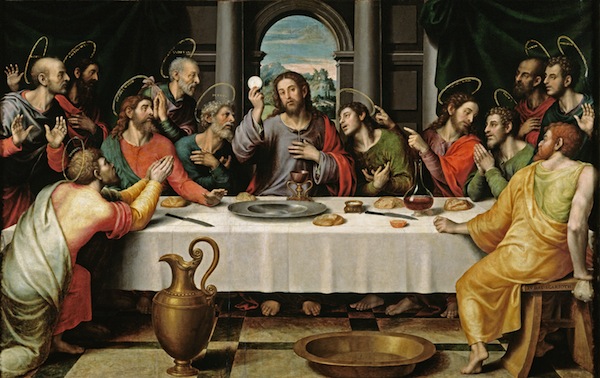
Was the Last Supper a seder?

“The Last Supper,” by Juan de Juanes (also known as Vicente Juan Masip), circa 1562, housed in Prado Museum. (photo from Wikimedia Commons)

Nearly every year around the time of the Jewish holiday of Passover and the Christian holiday of Easter, theologians and historians start to ask the same question. Was Jesus’ Last Supper a Passover seder?

“It is all very mysterious,” said Rabbi Raymond Apple, rabbi emeritus of the Great Synagogue in Sydney, Australia.

Let’s start with the facts. There are four accounts in the New Testament that refer to the Last Supper with reference to the Passover holiday. They are Mark 14:12-31, Matthew 26:17-30, Luke 22:1-19 and John 13:1-30. But Mark, Matthew and Luke are synoptic Gospels, which means they are closely related and best studied together, making the three Gospels – according to Jonathan Klawans, a professor in Boston University’s department of religion – “one testimony, which was then copied twice.”

“Mark … fashioned and inserted a single ‘Passover’ paragraph (14:12-16) … between what we identify as 14:11-17,” explained author Michael J. Cook, a professor of Judeo-Christian studies at Hebrew Union College-Jewish Institute of Religion. “So, the entire problem resides with Mark’s text.”

According to Mark’s text, Jesus prepared for the Last Supper on “the first day of Unleavened Bread, when they sacrificed the Passover lamb.”

We know that the Passover lamb was sacrificed on the 14th day of the Hebrew month of Nissan, and consumed by Jewish families either on that night or the onset of the 15th day of Nissan.

Klawans notes that there are those who can cite no fewer than 14 parallels between the account described in Mark and the modern-day Passover seder. These include the bread and wine, the hymn or blessings that were recited and the reclining diners. Jews at their seders discuss the symbolism of the Passover meal; Jesus at his Last Supper discussed the symbolism of the wine (“This is the blood of my covenant”) and the bread (“Take, eat; this is my body”).

Nonetheless, scholars Klawans, Apple and Cook all do not believe that Jesus’ Last Supper was a Passover seder, for several reasons.

For starters, the parallels that can be drawn seem to be those that are general, rather than decisive. It would not be uncanny for Jesus to eat a meal with his disciples in Jerusalem. During that meal, they would have reclined, broken bread, drank wine and possibly even sang a hymn.

“Such behavior may have been characteristic of the Passover meal, but it is equally characteristic of practically any Jewish meal [at the time],” said Klawans.

Some key Passover elements are missing from the Last Supper: the Passover lamb, references to matzah (unleavened bread), the bitter herbs, charoset, the four cups of wine, the recitation of the Four Questions and the narrative retelling of the Passover story.

Moreover, the parallels drawn between the Last Supper and the Passover seder ritual we celebrate today assume that the seder as we know it was celebrated in Jesus’ day. But this is not the case. Nearly all scholars agree that the modern Passover Haggadah and the rabbinic accounts of Passover traditions all emanate from after the destruction of the first Jewish Temple in the year 70 CE. The Gospels date Jesus’ ministry from around 26 CE to early 37 CE, with Jesus’ death coming between 30 and 33 CE.

“At that time, the core element of the Passover observance had been Jerusalem’s sacrificial cult, from 621 BCE up until 70 CE,” said Cook. “Jewish families brought lambs for sacrifice on the Temple altar as biblically prescribed.… For the ceremony, the kohanim (Jewish priests) conducted the sacrificial rite. Then families retrieved and consumed their meat as part of their Passover meal, which also included unleavened bread and bitter herbs. The Passover meals Jesus experienced in his lifetime would have had to be along these Temple-centred lines.”

Klawans said many people assume that Jesus ate matzah at his Last Supper because Catholics eat wafers as their Eucharist bread. The custom of using wafers, however, does not date back as far as one might think, but rather only to medieval times. The oldest customs in Orthodox Christian churches involve bread, and the New Testament describes bread, not unleavened bread.

“There is no reason to think the bread was matzah unless that was specified,” Klawans said.

Additionally, Klawans said it is impractical for Jesus’ crucifixion to have taken place on Passover, as the Sanhedrin (Jewish High Court of 70 elders) would not have worked on the yom tov, which was already one of the Israelites’ most important pilgrimage festivals.

Read more at jns.org.

Holiday in which God hides

Purim is, by any account, a strange holiday. Jews dress up in costumes, get shickered to the point that they can’t discern a hero from a villain, and read one of the two books of the Torah where God doesn’t figure in the narrative. One might think that the point of the day is to “eat, drink and be merry” and celebrate the fact that an ancient Jewish heroine outwitted the Persians. It seems like the classic “they tried to kill us, they failed, let’s eat” holiday. But under its surface of masks lies something deeper.

Rebbe Nachman of Breslov taught that Purim prepares us for Pesach (Likutey Moharan 2.74). The connection is that Purim is about hidden miracles and Pesach is about revealed miracles. As winter begins to turn to spring around Purim, the powerful life hidden under the cold exterior begins to blossom and rise; around Pesach, spring is in full bloom and the smell of freedom is in the air.

Traditionally on Purim most people dress like characters from the story, as opposed to Batman or Darth Vader. The story of Purim is our story, after all. God’s name is never once mentioned in the Book of Esther because God is behind the whole story, a story of sequential coincidences leading to God’s presence and activity being revealed.

The Purim story has a series of reversals: the Jews go from helpless victims to warriors; Haman goes from powerful to powerless; Mordechai goes from weakness and danger to strength and security.

Esther, of course, whose very name means hidden (hester) goes from entrapped woman whose Jewishness is secret, to free, triumphant, openly Jewish heroine. All of these reversals are about God’s reality breaking into ours.

The message of the story is that God works in hiddenness. Our daily lives seem mundane only when our eyes have become jaded. As Rabbi Abraham Joshua Heschel said with characteristic beauty in Man is Not Alone: “The ineffable inhabits the magnificent and the common, the grandiose and the tiny facts of reality alike. Some people sense this quality at distant intervals in extraordinary events; others sense it in the ordinary events, in every fold, in every nook, day after day, hour after hour. To them, things are bereft of triteness; to them, being does not mate with nonsense.”

Purim is a celebration of the revelation of God in the overturning of what appears to us to be reality. What seems to be random (pur, a lottery) is shown to be anything but; what seems to be God’s absence is actually his presence. Often the only way for us to see God’s presence is to put aside our own opinions about what is good and what is bad in order to see deeper. Purim nods at this truth with its famous injunction to drink until we can’t tell the difference between Haman and Mordechai – an injunction, by the way, which most rabbis argue is better acknowledged with a symbolic wee drink rather than actually getting sloshed.

Rebbe Nachman’s point is that when we see God’s presence in the mundane details of our lives, then we will be prepared to see God in a way that is not hidden. When we see God’s presence in everything, then we are liberated min ha meitzar, from the narrow places that constrict us and weigh upon us. As Leonard Cohen writes in the song “Born in Chains,” we are “out of Egypt, out of Pharaoh’s dream.”

Matthew Gindin is a writer, lecturer and holistic therapist. As well as teaching holistic medicine, Gindin regularly lectures on topics in Jewish and world spirituality, and has a particular passion for making ancient wisdom traditions relevant in the modern world. His work has been featured on Elephant Journal, the Zen Site and Wisdom Pills, and he blogs at Talis in Wonderland (mgindin.wordpress.com) and Voices (hashkata.com).

Shabbat 100 success

Among the many Shabbat 100 volunteers were, from left to right, Ben Felstein (Chabad Jewish Student Club and Israel on Campus), Daniella Malpartida (Jewish Students Association), Anna Kapron-King (Progressive Jewish Alliance), Lior Bar-el (JSA and PJA), Michelle Levit (CJSC), Sydney Switzer (CJSC), Katrin Zavgorodny (CJSC board), Jennifer Brodsky (CJSC) and Becca Recant (Hillel BC). (photo from Chabad at UBC)

More than 140 students, faculty and alumni gathered in University of British Columbia’s newly built AMS Student Nest on Jan. 22 for Shabbat 100, which was organized by Chabad Jewish Student Centre-Vancouver.

photo - Prepared for the 140 guests to arrive for Shabbat 100
Prepared for the 140 guests to arrive for Shabbat 100. (photo from Chabad at UBC)

The event was co-sponsored by Jewish Federation of Greater Vancouver, Lohn Foundation, Chabad of Richmond and Great Canadian Superstore on Marine Drive, and co-hosted by Chabad Jewish Student Club, Hillel BC, and all of the Jewish clubs at UBC: Jewish Student Association, Progressive Jewish Alliance and Israel on Campus.

Guests enjoyed a three-course Shabbat dinner by Forty One Catering, and the evening included ice-breaker games, Shabbat songs and a presentation from each club.

Chabad hopes this will become an annual gathering. “It was so nice to see so many Jewish students coming together for this event,” said Rabbi Chalom Loeub of Chabad UBC. “We are on a high and look forward to bigger and better next year!”

Land connections

Dried fruit and almonds are traditionally eaten on Tu b’Shevat. (photo from Gilabrand (talk) via commons.wikimedia.org)

Until Jews began to return to Eretz Israel in 1948, no one thought of them as farmers. For nearly 2,000 years, we had been dispersed throughout the world and, in many places, were not permitted to own land or engage in agriculture. But, in ancient Palestine, we were an agricultural people. We treasured the olive tree, the grape vine and the date palm. The Bible encouraged us to plant “all manner of trees” and forbade the destruction of trees of a conquered land.

Just as we believe that on the first day of the seventh month, Rosh Hashanah, we are judged and our fate for the coming year is inscribed in the Book of Life, so we are taught to believe that trees are similarly judged on the New Year of the Trees, Tu b’Shevat (the 15th day of Shevat, this year Jan. 25), the first day of spring.

This semi-holiday has always been associated with tree planting. In ancient times, one planted a tree at the birth of a child – cedar for a boy, cypress for a girl. Special care was given to these trees on Tu b’Shevat and, when the children married, branches of their own trees were cut for the chuppah (wedding canopy).

It is said that, on the 15th day of Shevat, the sap begins to rise in the fruit trees in Israel. So, we partake of the fruits of the land: apples, almonds, carobs, figs, nuts, dates and pomegranates. The pious stay up very late on the eve of the holiday reciting passages from the Torah that deal with trees and the fertility of the earth. We read the story of how trees and plants were created (Genesis 1:11-18), the divine promise of abundance as a reward for keeping the commandments (Leviticus 26:3-18 and Deuteronomy 8:1-10) and the parable of the spreading vine, which symbolizes the people of Israel (Ezekiel 17).

Sephardi Jews have their own special manual, The Fruit of the Goodly Tree. It was first published in the Judeo-Spanish language, Ladino, in Salonica, composed by Judah Kala’i. Each verse is recited as the relevant fruits are eaten, and some of the verses translate as follows:

  • “G-d increase our worldly goods / and guard us soon and late / and multiply our bliss like seeds / of the pomegranate.”
  • “For our Redeemer do we wait / all the long night through / to bring a dawn as roseate / as the apple’s hue.”
  • “Sin, like a stubborn shell and hard / is wrapped around our ssoul / Lord, break the husk and let the nut / come out whole.”

Each of the fruits has symbolic meaning. The rosy apple stands for G-d’s glowing splendor; the nut represents the three kinds of Jews – hard, medium and soft. The almond stands for swift divine retribution, for it blossoms more quickly than other trees. The fig means peace and prosperity, and the humble carob stands for humility, a necessary element of penitence.

Judaism’s strong ties to agriculture and ecology are captured by Rabbi Yohanan ben Zakai, who once declared: “If you hold a sapling in your hand and hear that the Messiah has arrived, plant the sapling first and only then go and greet the Messiah.”

Dvora Waysman is a Jerusalem-based author. She can be contacted at dwaysman@gmail.com or through her blog dvorawaysman.com.

Lighting up Lower Mainland

The lighting of the Silber Family Agam Menorah at Vancouver Art Gallery also featured some clowning around. (photos by Glenn S. Berlow)

photo - The lighting of the Silber Family Agam Menorah also featured some clowning around

Among the many community celebrations of Chanukah this year were, from the first to fourth night of the holiday, gatherings in Vancouver, Richmond, Surrey and the North Shore.

More than 300 people gathered at Vancouver Art Gallery on the first night of Chanukah, Dec. 6, for the lighting of the tallest menorah in Canada, the Silber Family Agam Menorah. The children enjoyed crafts and entertainment inside the gallery and then everyone went outside (in the pouring rain!) for doughnuts and cocoa. The annual event, which is sponsored by the Silber family in memory of Fred Silber z”l, featured greetings from the dignitaries and politicians who were present, live Chanukah music by Dr. Anders Nerman and the menorah lighting led by members of the Silber family.

***

photo - Gary Averbach, left, and Richmond Mayor Malcolm Brodie light the menorah in Richmond

photos - Gary Averbach, left, and Richmond Mayor Malcolm Brodie light the menorah in Richmond, where there was also live music
Gary Averbach, left, and Richmond Mayor Malcolm Brodie light the menorah in Richmond, where there was also live music by Anders Nerman. (photos from Richmond Public Library)

Approximately 300 adults and kids celebrated the second night of Chanukah with the lighting of a giant menorah, live music by Nerman, magic by Yeeri the Magician, and traditional potato latkes and sufganiyot at the Richmond Library and Cultural Centre.

“Sharing the Jewish Festival of Light with so many people was an incredible community celebration that really expanded cultural awareness,” said Shelley Civkin, library communications officer. Three generations of the Averbach family joined Richmond Mayor Malcolm Brodie in lighting the menorah.

The event was held in partnership with the City of Richmond, Vancouver Kollel, the Richmond Public Library and the Ebco group of companies. “The evening started off with Yeeri the Magician performing his magic for families, then singer and guitarist Anders Nerman played music while the menorah was being lit,” said Civkin. “It was a lively event and there was even a Chanukah miracle – no rain!”

***

photo - Menorah lighting at Centre for Judaism

photo - After the menorah lighting, the Iron Chef Chanukah competition began in Surrey
After the menorah lighting, the Iron Chef Chanukah competition began in Surrey. (photos from Centre for Judaism)

On the third night of Chanukah in Surrey, after the menorah lighting led by Rabbi Falik Schtroks, and a dairy and latke dinner, those who attended the event at the Centre for Judaism, Chabad in White Rock/Surrey, participated in the third Iron Chef Chanukah. Iron chef Marat Dreyshner was helped by sous chefs Ella Dreyshner, Rabbi Nuta Yisroel Shurack and Debbie Cossever. Competing for this year’s title was award-winning pizza chef Aaron Gehrman and culinary expert Rae Friedlander Sank, who worked with sous chefs Nissim Gluck and Avraham Nissan Zabylichinski. Host and director of Iron Chef Chanukah, Rebbetzin Simie Schtroks, said that, although this year was the fiercest competition yet, there was an energetic and fun atmosphere in the Iron Chef kitchen. Many in the audience tried to assist the teams with small tasks or by keeping them entertained with Chanukah songs. Ethan Dreyshner helped the rebbetzin as second emcee and interviewer. Mariasha Schtroks created the rating sheets for the judges. While prizes were earned by all participants, the winning team and their friends will be treated to a five-course gourmet dinner catered by Simie Schtroks. Scores were so close that you will have to attend next year’s Iron Chef to find out which team won.

***

photo - Chabad of North Shore Rabbi Mendy Mochkin speaks at the first-ever menorah lighting at Lonsdale Quay
Chabad of North Shore Rabbi Mendy Mochkin speaks at the first-ever menorah lighting at Lonsdale Quay. (photo by Shula Klinger)

The evening of Dec. 9 saw the first-ever menorah lighting at Lonsdale Quay in North Vancouver. Set against the backdrop of downtown Vancouver, the event was hosted by Chabad of North Shore Rabbi Mendy and Rebbetzin Miki Mochkin and their family.

Rabbi Mochkin opened the occasion with a few words about the meaning of Chanukah. He stressed the importance of standing one’s ground in the face of adversity, and the value of picking oneself up, no matter how hard one has fallen. The menorah was lit by Rabbi Yitzchak Wineberg, executive director of Chabad Lubavitch BC.

Doughnuts were enjoyed by everyone and the kids had a grand time at the impromptu Dreidel Station.

***

photo - Flora Field, left, and Emily Glass, students learning Yiddish with Haya Newman at the Peretz Centre for Secular Jewish Culture, take time out for Chanukah
Flora Field, left, and Emily Glass, students learning Yiddish with Haya Newman at the Peretz Centre for Secular Jewish Culture, take time out for Chanukah. (photo by Haya Newman)

Spreading the lights of Chanukah

The Jewish Renewal synagogue in East Vancouver, Or Shalom, is marking the eight nights of Chanukah by honoring eight “lights” of life on the city’s east side.

“I had this idea that it would be really special to open ourselves out to our community and to really focus on the notion of Chanukah being a celebration of light emitting from darkness, or the notion of Chanukah as being about light that seems unlikely to continue to shine but miraculously does persevere,” explained Rabbi Hannah Dresner, spiritual leader of the shul. “I would really like our community to focus on what it means to be a human being that is a light in the community.”

The synagogue will have a celebration this Saturday night that recognizes the contributions of eight individuals and organizations that add light to the east side community.

Among the honorees are John Jardine of Vancouver’s Native Education College; firefighters from the hall nearest Or Shalom; a group within the Or Shalom congregation devoted to aiding refugees; Kim Leary, executive director of the Homework Club associated with Britannia Secondary School; members of the Habonim-Dror youth movement; Angela Marie MacDougal, the director of Battered Women’s Support Services; Mount Pleasant Neighborhood House; and Rev. Sally McShane of First United Church, which runs programs in the Downtown Eastside.

“Our miracle story is that, when the Temple in Jerusalem was desecrated, they came in afterwards and wanted to relight the candelabra that was kept lit all the time but there wasn’t enough oil, so they lit it anyway and the miracle that’s celebrated is that that oil was sufficient to keep the lamp lit until olives could be harvested and oil could be pressed and brought forward to the Temple,” Dresner said. “So the notion is that if you light the light and tend it, that there is an element of trust and faith that, if we do our work, then the divine energy will join us in uplifting our world.”

Eight Leading Lights takes place Saturday, Dec. 12, at Or Shalom, 710 East 10th Ave., with a potato bar supper at 5:30 p.m. and communal singing and candlelighting at 7 p.m.

How about a meowukiyah?

During the Festival of Lights, Chanukah, we light up candles in a special candleholder called a chanukiyah. Chanukiyot come in all kinds of designs, shapes and colors. That is why we will make our own unique version. To be more specific, it is going to be a meowukiyah, since our chanukiyah will take a shape of a cat.

  1. To start, have ready a few basic colors of modeling clay: orange, green, black and white, and a little bit of pink. You will also need a toothpick.
  2. Take the orange modeling clay, make and set aside the body parts of the cat: a head, two ears, the trunk in a shape of a watermelon slice, and four legs.
  3. Attach the ears to the head, the head to the trunk and then attach all four legs to the body. Using the toothpick, carefully trace triangles inside the ears.
  4. image - meowukiyah steps 1-3Using white, green and black modeling clay, give your cat a face: make the eyes, the eyebrows, cheeks with whiskers – and don’t forget the pink mouth. Make green paw pads and decorate the pads just like the picture shows or the way you like it. After that, make a few green stripes and attach them to the top of the trunk. Give your cat a tail.
  5. Make few little balls from white and orange modeling clay. Using a little force, flatten them into the trunk of your cat. Alternatively, you can try your own design. Don’t be afraid to use your imagination!
  6. The only remaining task is to make the candles. The body of the cat can hold eight yellow candles in green candleholders, and the head can have the shamash, the candle that is used to light up all other candles.

meowukiyah steps 4-6Our meowukiyah is ready! You can play with it, just like you play with your toys, or you can use it to decorate your home. If you take a picture of your creation and print it out, it would make a wonderful Chanukah postcard. Send the pictures of your artwork to curlyorli@gmail.com and win prizes from Curly Orli.

Have a Happy Chanukah, dear Jewish Independent readers!

Lana Lagoonca is a graphic designer, author and illustrator (lunart.ca). At curlyorli.com, there are more free lessons, along with information about Curly Orli merchandise.


Cooking for all the seasons

Amelia Saltsman’s background makes for an interesting source for her cookbook The Seasonal Jewish Kitchen (Sterling Epicure, 2015). Her mother is Romanian and her father is Iraqi; they met in the Israeli army and then immigrated to Los Angeles, where Saltsman was born and grew up. She and her family live in Santa Monica.

Saltsman is a regular contributor on food in the media. One day, while cooking and sharing her ideas on various social media and her blog, the responses were so overwhelming, she realized “that a new generation of cooks was looking for a fresh approach to Jewish food.” Thinking about her heritage led her to explore her family’s culinary roots more deeply.

book cover - The Seasonal Kitchen cover

When she divided the year into two-month microseasons, she saw how foods meshed with the holidays occurring during those times. The result is 146 recipes plus 135 beautiful, enticing color photographs. Within each two-month section is the description of a holiday, the background image for which is a piece of Arab embroidery. And each two-month section contains recipes connected to the holiday, from starters, salads and soups, to side dishes, main courses and desserts.

There are essays on what comprises Jewish food, as well as explanations for how to use the cookbook, ingredient essentials, kitchen fundamentals, helpful kitchen tools and seven basic recipes. There are two special indexes – recipes by course and by kosher category – a bibliography, information on the holidays, a resource guide, acknowledgments, more about the author and a regular index.

Saltsman said in an interview with KQED Food, “We often overlook today … the innate seasonality of Jewish food, from the late-summer/early-fall pomegranates, apples and quince of Rosh Hashanah and the etrog (citron fruit) of Sukkot, to the spring lamb and herbs of Passover. That Jewish food can be reframed through the lighter, brighter lens of how we eat today while still being true to its traditional roots.”

This is not a kosher cookbook, but the recipes are labeled as meat, dairy, pareve (neutral) and fish, as well as vegan or gluten-free. “The food philosophy is that you should use well-raised, whole, real foods,” she said. “There are no artificial ingredients used in any recipes.”

Weights are given in imperial and metric measures. One of my favorite aspects of a cookbook is anecdotes on each recipe, which Saltsman includes, and which make for a very warm and personal read. One of my other favorite features is numbering of instructions, which is not used in this cookbook.

Recipes are from Tunisia, Morocco, Germany, Syria, Yemen, Persia, Bulgaria, Hungary, Eastern Europe and, of course, Romania and Israel. Some of the recipes I found particularly interesting include autumn slaw with beets, carrots and kohlrabi; Syrian lemon chicken fricasse; braised beef with semolina dumplings; apples in nightgowns; rustic almond-orange macaroons; rice with almonds and raisins; bulgarian cheese puffs; and whole fish with preserved lemons and herbs.

For Chanukah, here are two of her recipes.

BEST POTATO LATKES
(makes 24; pareve or dairy)

2 pounds peeled starchy potatoes
1 small onion
2 heaping tbsp unbleached all-purpose flour or potato starch
1 tsp kosher salt
1/2 tsp baking powder
freshly ground black pepper
2 lightly beaten eggs
mild oil (grapeseed, sunflower or avocado)
sea salt

Using the large holes of a box grater or a food processor fitted with the grating disk, grate the potatoes (about five cups).

Grate the onion on the large holes of the box grater or use a food processor.

In a large bowl, stir together potatoes, onion, flour, salt, baking powder and a few grinds of pepper. Stir in eggs.

Line two or three sheet pans with paper towels. Place the prepared pans, the latke batter, a large spoon and a spatula near the stove.

Heat one or two large skillets over medium heat. Do not use more than 1/4-inch oil. When the oil is shimmering and a tiny bit of batter sizzles on contact, start spooning in the latke batter, making sure to add both solid and liquids Using the back of the spoon, flatten each spoonful into a circle three to four inches in diameter. Do not crowd the latkes in the pan. You will get four or five latkes in a 12-inch skillet.

Cook the latkes, flipping them once until golden on both sides, five to six minutes total.

Transfer the latkes to the prepared baking sheet. Cook the remaining batter in the same way, stirring the batter before adding more to the pan and adding oil as needed at the edge of the pan.

Arrange the latkes on a warmed platter, sprinkle with sea salt, and serve with applesauce or sour cream.

ROASTED SMASHED APPLES AND PEARS
(3 cups; pareve/vegan)

3 pounds medium-size apples and pears
a few sprigs thyme (optional)
2 to 3 tbsp water, fresh lemon juice, calvados, pear brandy or eau-de-vie, hard cider or dessert wine
ground cinnamon or nutmeg (optional)

Preheat the oven to 375˚F.

Halve the pears and apples through the stem end, then core them and place the halves, cut side down, on one or more sheet pans, spacing them one to two inches apart. If using the thyme, scatter it among the pears and apples. Cover the pan tightly with aluminum foil.

Bake the apples and pears until tender when pierced with a knife tip (30 to 40 minutes). When they are cool enough to handle, slip the fruits from the skins and back into the pan, scraping any pulp from the skins. Discard skins and thyme stems.

Mash the apples and pears with a fork, stirring in enough water or other liquid to help scrape up any brown bits from the pan bottom and lighten the texture of the fruit.

Scrape the mixture into a bowl and serve warm, at room temperature or cover and refrigerate up to a day ahead and serve cold.

This can also be made with all pears or all apples.

Sybil Kaplan is a journalist, foreign correspondent, lecturer, food writer and book reviewer who lives in Jerusalem. She also does the restaurant features for janglo.net and leads weekly walks in English in Jerusalem’s market.

From simple to spectacular

Food writers are privy to a lot of recipes, and many of them, sadly, are repeats of ones already widely familiar, with small variations in ingredients. Infrequently, though, we get access to a compilation of recipes by a skilled author with an innovative eye and a dash of culinary talent, and the result is nothing short of inspiring.

That’s Daniella Silver’s The Silver Platter (Artscroll, 2015) in a nutshell. Silver has none of the accolades of a celebrity chef – she doesn’t call herself a professional and she never spent a day in culinary school. Still, what she lacks in education she more than makes up for in passion and ingenuity in her work. Her recipes take common, easily obtained ingredients and put them together in spectacular new ways that highlight their flavor and versatility. Lay your hands on The Silver Platter and you feel an urge to get into the kitchen and start cooking.

A mother of kids with allergies, Silver is sensitive about gluten and notes whether each of her recipes is pareve, gluten-free, freezable and if substitutions could make it appropriate for Passover. She collaborated with Norene Gilletz to write this book and adds “Norene’s Notes” at the end of each recipe. That’s great because Gilletz is a no-mess, no-fuss chef who offers great tips on food storage, easy cleanup tricks, uses for leftovers and substitution possibilities.

Each recipe has a color image of the prepared dish on the facing page and all look incredibly tempting. I have a weakness for salads and vegetarian dishes, so I loved the panko-topped bok choy with edamame, the shaved corn and asparagus salad, and the kale salad with roasted sweet potatoes. Eye candy abounds and, in almost every recipe, the ingredient list adds new flavors to old staples. For example, lentil cranberry salad; mango chicken with leeks; parsnip latkes; and roasted squash with red onion and pears.

The Silver Platter is eye candy in the best sense of the word. This is a recipe book that will earn its chefs heaps of praise as they create easy dishes with ingredients that are mostly kitchen staples. That means no hunting the grocery stores for that odd ingredient you’ve never heard of before. Nutritional information for each dish is listed in the appendix and more than half of the 160 recipes, which cover fish, meat, poultry, desserts, appetizers and soups and salads, are gluten-free and Passover-friendly.

This book is a keeper on the recipe shelf. Kudos to Silver on her winning combinations in a recipe book that will inspire even long-dormant chefs to get cooking. Here is but one example, straight from The Silver Platter.

BALSAMIC-BRAISED BRISKET
(meat, Passover, gluten-free, freezes well, yields eight to 10 servings)

photo - Balsamic Braised Brisket from The Silver Platter1 beef brisket (4-5 lb /1.8-2.3 kg)
2 tsp kosher salt
1 tsp black pepper
1 tbsp onion powder
1 tbsp garlic powder
2 tbsp olive oil
3 large onions, thinly sliced
1/4 cup chopped fresh parsley
1 can (6 oz/170 g) tomato paste
2 tbsp honey
3 bay leaves
1/2 cup balsamic vinegar
3/4 cup dry red wine or water

  1. Coat a large roasting pan with nonstick cooking spray. Add brisket; sprinkle with salt, pepper, onion powder and garlic powder. Rub brisket with spices to coat on all sides.
  2. In a large nonstick skillet, heat oil over medium heat. Sauté onions for five minutes, until softened. Stir in parsley, tomato paste, honey, bay leaves, vinegar and wine. Simmer for five minutes, stirring occasionally. Let cool.
  3. Pour sauce over, around and under the brisket. Cover and marinate in the refrigerator for at least one hour or overnight, turning occasionally.
  4. Preheat oven to 325°F. Bake, covered, for three to three-and-a-half hours or until meat is fork-tender. Calculate 45 minutes per pound to determine the cooking time. Discard bay leaves. Let cool.
  5. Refrigerate several hours or overnight. Discard hardened fat from gravy. Trim excess fat from brisket. Slice against the grain to desired thickness.
  6. Reheat, covered, in pan gravy at 350°F for 25-30 minutes.

Norene’s Notes

  • Slow cooker method: season brisket and prepare sauce as above; add to slow cooker insert coated with nonstick cooking spray. Marinate overnight in the refrigerator. Place insert into slow cooker; cook on low for eight to 10 hours.
  • Ask your butcher to cut a very large brisket (8 lb/3.6 kg) in half. Total cooking time will be the same as for one 4 lb/1.8 kg brisket.
  • Brisket should be cooked “low and slow,” with lots of onions. The internal temperature should not rise above 180°F on a meat thermometer; after it reaches 200°F, the brisket will become dry.

Lauren Kramer, an award-winning writer and editor, lives in Richmond, B.C. To read her work online, visit laurenkramer.net.