

Skip to content

  • Home
  • Subscribe / donate
  • Events calendar
  • News
    • Local
    • National
    • Israel
    • World
    • עניין בחדשות
      A roundup of news in Canada and further afield, in Hebrew.
  • Opinion
    • From the JI
    • Op-Ed
  • Arts & Culture
    • Performing Arts
    • Music
    • Books
    • Visual Arts
    • TV & Film
  • Life
    • Celebrating the Holidays
    • Travel
    • The Daily Snooze
      Cartoons by Jacob Samuel
    • Mystery Photo
      Help the JI and JMABC fill in the gaps in our archives.
  • Community Links
    • Organizations, Etc.
    • Other News Sources & Blogs
    • Business Directory
  • FAQ
  • JI Chai Celebration
  • JI@88! video
image - Weizmann Canada Physics Tournament 2025
image - The CJN - Visit Us Banner - 300x600 - 101625

Recent Posts

  • Vrba monument is unveiled
  • Music to build bridges
  • A better future possible
  • Anne Frank exhibit on now
  • Human rights in sport
  • Telling the story of an icon
  • Crawl bigger than ever
  • JCC Maccabi in Toronto
  • A way to meet fellow Jews
  • Time to include
  • Add Jewish joy to the mix
  • Reminder of humanity’s light
  • From the archives … editorials
  • Year-round holiday recipes
  • מדוע עזבתי את ישראל ואינני חושב לחזור ארצה
  • OJC hosts Oct. 7 memorial
  • A journey beyond self
  • Antisemitism a problem
  • Young man is missed
  • Orr action sparks complaint
  • Prison sentence for hate
  • Etgar Keret comes to Vancouver
  • New fall lecture series
  • Series explores music
  • Doc on Zapiro screens Nov. 6
  • Joy of shared existence
  • Community milestones … October 2025
  • MAID vs Jewish values
  • Cheshvan a great month, too
  • Bull, bear or bubble?
  • From the archives … a coin, etc.
  • מדוע האנטישמיות הולכת וגואה בעולם
  • New bio gives Vrba his due
  • Joy brighter than ever
  • When approaches differ
  • New leadership at the JCCV

Archives

Follow @JewishIndie

Tag: chametz

A friend on our long journey

A friend on our long journey

The close relationship humans share with yeast is truly ancient, and predates humanity itself. (photo by Lilly M via commons.wikimedia.org)

During the holiday of Passover, we are told not to eat leavened bread (chametz). The leavening of bread is caused by yeast, a single-celled fungus. The yeast induce a chemical reaction called fermentation, which converts water and sugar into alcohol and carbon dioxide. The bubbles of carbon dioxide gas produced during this reaction cause the bread to rise and become porous, ultimately resulting in delicious fluffy bread. The close relationship humans share with yeast is truly ancient, and predates humanity itself.

Since fungi lack mobility, it had often been assumed that they were more plant-like than animal-like. But genetic studies in the 1990s revealed that fungi are actually more closely related to animals than to plants. The common ancestor that animals and fungi share would have probably been single-celled, and resembled in many ways our friend the yeast. So we can consider them very distant cousins (not invited to the Passover seder).

Fruit are an important part of the diet of all apes, including humans and their ancestors. A ripe sweet juicy fruit is full of sugar and water, the key ingredients for fermentation. There are many different varieties of yeast that are found commonly all over the world, on the human body, in the soil, and often on the skin of fruits. Fermentation of ripe fruits due to the presence of such yeast is common in nature, and would have inevitably been eaten by the ancestors of humanity for millions of years. Primatologists have observed various species of monkeys getting drunk off such naturally fermented fruit. To explain this puzzling phenomenon, biologist Robert Dudley at University of California-Berkley formulated the “drunken monkey” hypothesis. Fruit evolved as a means for plants to use animals as a method of seed dispersal; however, if the fruit rots before it gets eaten, the seed doesn’t get dispersed. Alcohol is a volatile molecule, which means it floats around the air very easily. If a fruit begins to ferment, the alcohol molecules spread much further and faster than the smell of the fruit would on its own. Animals, such as monkeys and apes, can, therefore, smell from a greater distance that there is delicious fruit, helping them find and eat the fruits, and thus helping to disperse the seeds of the plant. It is an evolutionary relationship that benefits the plant, the yeast and the animal, a win-win-win scenario.

Moderate consumption of alcohol is in fact healthy and nutritional. Alcohol contains more calories than either carbohydrates (sugar) or proteins. Let us remember that calories were integral to survival before the obesity epidemic of the modern age. Alcohol can also protect against many diseases, especially cardiovascular diseases. Studies have even shown that people who consume alcohol in moderation live longer than those who don’t. Despite the many dangers associated with excessive alcohol consumption, the low doses normally consumed in nature ultimately may have provided a survival advantage to the ancestors of humanity.

The first civilizations arose in part due to intensive cereal agriculture. These cereals were used to make bread and beer. In Mesoamerica, they made a beer from corn, in China with rice and, in Mesopotamia and Egypt, they used barley and wheat to make beer and bread. These innovations that played an integral role in the building of civilization were thanks to yeast. The first writing system ever developed was Cuneiform, in Mesopotamia during the third millennium BCE. Among the first written records in history are references to the production, distribution and consumption of beer. Some scholars suspect that the Jews acquired this beer brewing knowledge during their exile in Babylon. The Hebrew word for drunk, shikur, is thought to be derived from the Babylonian word for beer, shikaru. However, if the story of Passover is to be believed, then perhaps the ancient Israelites brought the knowledge for beer making from Egypt.

Wine, an essential component of any decent Passover seder, also has an ancient history. The earliest evidence for intensive wine production can be found at the archeological site of Hajji Firuz Tepe in modern-day Iran, which has been dated to sometime around 5400 BCE. Genetic analysis corroborates that strains of wine yeast originated in Mesopotamia, but put the date back 10,000 years ago. Some archeologists have speculated that the strains of yeast used for making bread and beer originated from wine yeasts, however the evidence for this remains contentious. Wine and beer were both produced in Egypt, and were important culturally, religiously and medicinally, and Egyptians would bury jars of wine in the tombs of the pharaohs. Analysis of DNA found inside ancient Egyptian wine jars from the tomb of a pharaoh from 3000 BCE identified the same species of yeast used to make wine today: Saccharomyces cerevisiae.

If there were indeed Jewish slaves in Egypt, they would have eaten bread and drank beer and wine, leavened and fermented by the same fungus that we use to leaven bread and ferment wine today; a little old friend that has joined us on our long journey through the vast deserts of time. L’chayim.

Ben Leyland is an Israeli-Canadian writer, and resident of Vancouver.
Format ImagePosted on March 27, 2015March 26, 2015Author Ben LeylandCategories Celebrating the HolidaysTags chametz, Egypt, Passover, Saccharomyces cerevisiae, seder, yeast
Matza: a symbol of humility

Matza: a symbol of humility

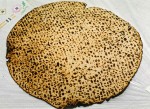
Matza and chametz are both composed of the same letters, except that matza is spelled with a hey and chametz with a chet. The only difference between a hey and a chet is that the chet is completely closed from three sides, while the hey has an opening on top. (photo by Yoninah via commons.wikimedia.org)

On Pesach, we are only allowed to eat matza, not chametz. What is the difference between chametz (leavened bread) and matza? How do they differ?

Matza differs from chametz in two respects:

1) With chametz, the dough rises, while for matza, the dough remains as is. In spiritual terms this means that chametz signifies arrogance, while matza signifies modesty and humility.

Matza is essentially lechem oni, the bread of poverty, of affliction (Deuteronomy 16:3 and Rashi’s commentary on this verse). Matza signifies humility, which manifests itself especially in lechem oni. The mitzva (obligation) to eat matza can only be observed with humility. The matza that the Israelites ate in Egypt was lechem oni.

2) The words matza and chametz are both composed of the same letters, except that matza is spelled with a hey and chametz with a chet.

The hey is similar to the chet. Both consist of three lines and are open from below. The only difference between them is that the chet is completely closed on the top, while the hey has an opening on the upper left side.

image - chet and het
The Hebrew letters chet and het.

The open side below (which chet and hey share) symbolizes that “sin crouches at the entrance.” (Genesis 4:7) The closure on both sides in the letter chet indicates that there is no escape from that fact, i.e., that sin crouches at the entrance. The opening on top, in the hey, indicates that notwithstanding this fact there is an opening above, indicating the possibility to leave one’s condition behind and to become a better person.

It is indeed no more than a small opening, but our sages teach us that G-d says: “‘Open for Me as little as the eye of the needle, and I will open for you like the entrance to a hall.’ For a single thought of self-improvement can change one instantaneously from an altogether wicked person into an altogether righteous person.” (Talmud Kidushin 49b)

These two differences between matza and chametz are interdependent. Where there is conceit and grandiose self-esteem, one doesn’t think of improvement. If there is humility, then, even if one may have stumbled, they will think of improvement. Where there is humility, there is no attempt at self-justification. Rather, one takes honest stock of oneself and, when finding improprieties within oneself, he or she will try to improve. With haughtiness, however, one will always find rationalizations to justify and excuse all doings.

Here’s a story to illustrate this point. When seeing a pauper, the one who seeks to avoid the mitzva of tzedaka will use the argument of Turnus Rufus (Baba Batra 10a), who asked of Rabbi Akiva: “If your G-d loves the poor, why does He not support them?” In other words, for reasons of haughtiness, if one accepts one’s wealth as one’s due and, in fact, feels that they deserve even more than what they already have, why then should they give away any of it? Arrogance doesn’t allow for the reality of another and, therefore, one may take it for granted that the other is not his or her equal. To this person, therefore, it is obvious that the other is poor simply because they don’t deserve any better. As it is surely the Divine Will that the other be poor, why then should one give him anything?

The humble one, possessed of humility, reasons differently.

a) He examines and judges himself whether he is essentially better than the other, and his self-examination leads him to give charity. It is written in Psalms 99:4, “You have done justice and tzedaka in Jacob.” That is, the justice, i.e. the self-judgment, leads him to tzedaka.

b) The humble one contemplates this possibility, but also notes that he himself has been blessed generously in spite of his own deficient status and condition. Thus, he is moved to conclude that we are as children of G-d. As these conditions relate to the mitzva of tzedaka, so, too, they apply to all good deeds.

This year, when we come to celebrate Passover at the festival seders, especially when we eat the matza, and when we are surrounded by our children, grandchildren and guests, we celebrate our people’s freedom from Egypt. Take time to contemplate the spiritual nature of matza, to be humble and feel the needs of our less fortunate friends, family and community members. We are celebrating, as well, the freedom of being able to go from haughtiness to kindness, from our limitations to our freedom. When we celebrate Passover this way, we will naturally feel happy that we are able to help provide what others need.

May this Passover prove to be an inclusive festival, where everyone will be able to rejoice and feel for one another. Wishing you a kosher and happy Passover.

Esther Tauby is a local educator, writer and counselor.

Format ImagePosted on March 27, 2015March 26, 2015Author Esther TaubyCategories Celebrating the HolidaysTags chametz, chet, matza, Passover, tet
Proudly powered by WordPress