Skip to content
  • Home
  • Subscribe / donate
  • Events calendar
  • Business Directory
  • FAQ
  • News
    • Local
    • National
    • Israel
    • World
    • עניין בחדשות
      A roundup of news in Canada and further afield, in Hebrew.
  • Opinion
    • From the JI
    • Op-Ed
  • Arts & Culture
    • Performing Arts
    • Music
    • Books
    • Visual Arts
    • TV & Film
  • Life
    • Celebrating the Holidays
    • Travel
    • The Daily Snooze
      Cartoons by Jacob Samuel
    • Mystery Photo
      Help the JI and JMABC fill in the gaps in our archives.
  • Community Links
    • Organizations, Etc.
    • Other News Sources & Blogs
  • JI Chai Celebration
  • JI@88! video

Recent Posts

  • Or Shalom reopens its doors
  • JFS from past to future
  • Need holistic approach
  • Sharing stories, advice
  • Journalist shares fears
  • Skills to live together
  • Road to independence
  • Cutting grass with scissors
  • Zionism as a solution
  • Deceit, desire & the divine
  • Reclaiming sacredness
  • Creative project ideas
  • Summer squares and cobbler
  • Thou shalt … summer commandments
  • Legal help for students
  • Revisiting myth of Lilith
  • Wrong person rebuked
  • Canada’s mixed messages
  • Questions for museum
  • Symposium on antizionism
  • Making soccer political
  • CJPAC lauds Pulver’s impact
  • City recognizes Vrba’s legacy  
  • Organ donation saves lives
  • Theodore’s March premiere
  • A healing Shabbaton
  • Supplying healthy food
  • A chime of metal tags
  • Yellowknife seder a first
  • Ishai energizes, unifies
  • A Lag b’Omer to remember
  • Expanding the healing
  • Hannah Senesh – a unique hero
  • Community milestones … May 2026
  • Деньги до зарплаты на карту Займ до зп онлайн за 5 минут 2026
  • Микрокредит онлайн в Казахстане Микрозайм в Акшамат

Archives

Follow @JewishIndie
image - The CJN - Visit Us Banner - 300x600 - 101625

Category: Celebrating the Holidays

We all were once strangers

We all were once strangers

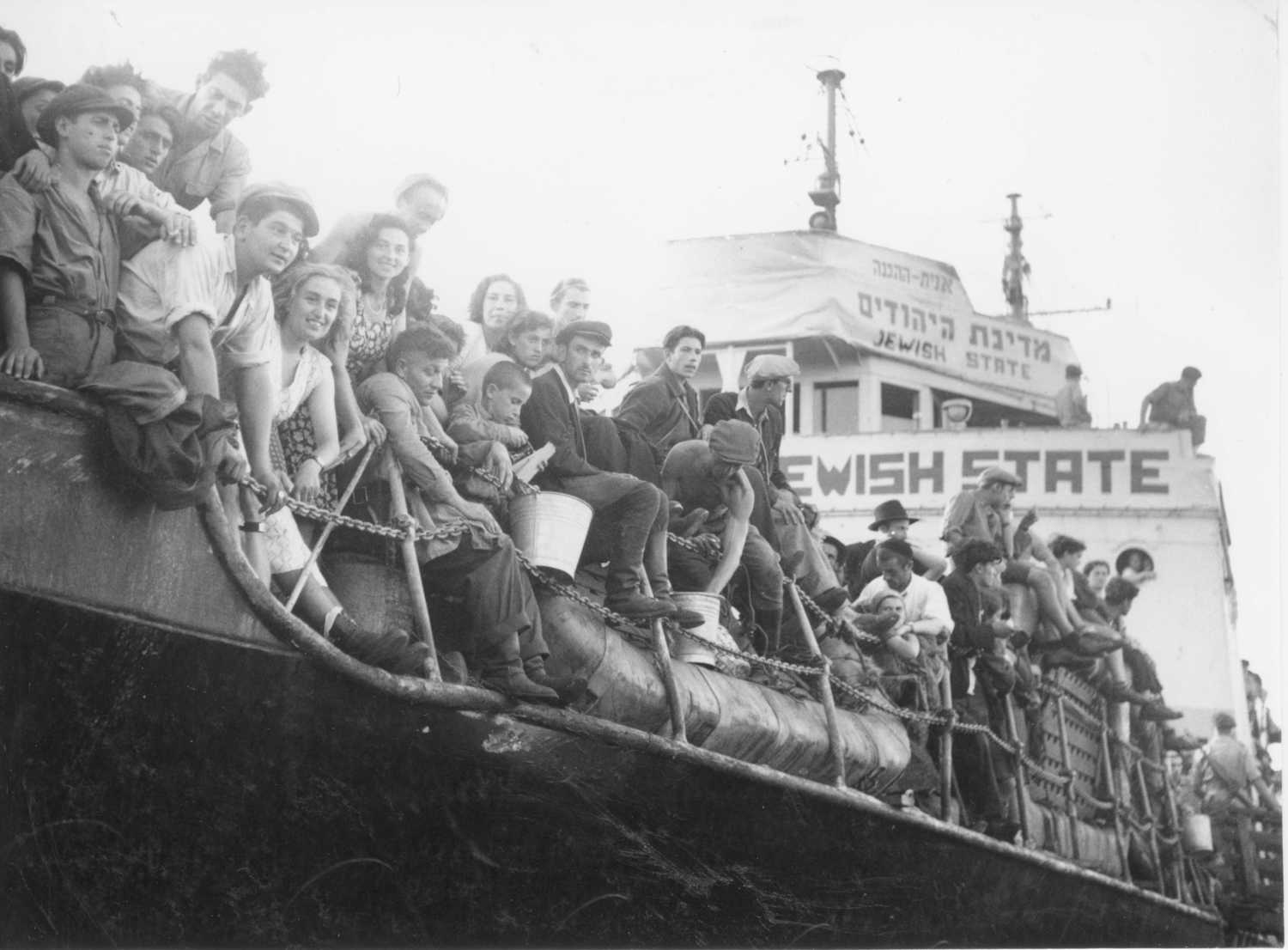
A boat of new immigrants arrives in pre-state Israel on Oct. 2, 1947. (photo from the Palmach Archive via PikiWiki Israel)

The Passover seder begins by welcoming anyone who is hungry, an idea that comes straight from the Book of Exodus (23:9), which states, “You shall not oppress a stranger, since you yourselves know the feelings of a stranger, for you also were strangers in the land of Egypt.”

Later in the Torah, Leviticus 19:33 says, “When a stranger resides with you in your land, you shall not do him wrong.” Leviticus 19:34 repeats this refrain, “The stranger who resides with you shall be to you as the native among you, and you shall love him as yourself, for you were aliens in the land of Egypt; I am the Lord your God.”

Over the generations, the Jewish people have been “aliens” more than once. Well-known examples of Jews leaving their perceived homeland include the Jewish exile to Babylonia after the destruction for the first Temple, those who were fortunate enough to escape Nazi persecution for Israel or the United States, expelled Middle Eastern Jews who were moved to Israel after its founding, or residents of the former Soviet Union who left a life of religious oppression.

The immigrant experience is different for everyone, said Aaron Gershowitz, senior director for U.S. programs at the Hebrew Immigrant Aid Society (HIAS). He told this reporter that the challenges of an individual’s journey often depend on the environment they are leaving and the community to which they are relocating.

Take Inge “Irene” Brenner. She escaped from Nazi Germany on Dec. 28, 1938, for Havana, Cuba. From there, she traveled to the United States, arriving to join her husband in April 1939 at age 19. She immediately took up work at a small factory where she steamed hat plumes. Her employer provided her with the required documentation to book passage for her mother, father and sister to the United States. Due to a lack of funds, the family all lived together in a tiny apartment in New York.

“When I left Berlin, I was 19 and completely single-minded, [telling myself] ‘I must get out and save myself and my parents,’” Brenner said. “We just couldn’t have existed anymore. That is what happened to the rest of my family that didn’t get out – all of them were murdered in the gas chambers. There was nothing else I could do but make it. You just had to make it.”

Gershowitz said that “the economics of surviving” often mark the first several years (or longer) of the immigrant experience. It is only after that period that immigrants become more like others – more focused on family life, a career and a future for their children.

Over time, this was the case for Brenner. Once she and her husband could afford to leave the rest of the family and live on their own, they had two daughters who they raised to be American Jews, as opposed to Jewish Americans. Brenner said she wanted to leave her horrible past behind for a new life, which she feels she received “by the grace of God.”

“She was always proud to be Jewish, but it was always extremely hard for her to talk about how she got here,” said Benjamin Kopelman, Brenner’s grandson.

photo - Lev Golinkin
Lev Golinkin (photo by Diana P. Lang)

Lev Golinkin, author of a memoir on the immigrant experience titled A Backpack, a Bear and Eight Crates of Vodka, noted the irony that Soviet Jews came to the United States in search of religious freedom, yet many of them choose not to practise Jewish traditions, his family included.

“As soon as we could, we got away from the synagogue and Jewish organizations and melded into the secular American world,” he said.

Golinkin, who arrived in the United States from eastern Ukraine in 1989 at the age of 9, surmised that people turned away from religious observance because it was precisely the Jewish faith that made them targets for persecution in the former Soviet Union. Before escaping, Golinkin was being homeschooled because he had been regularly teased and beaten for his Judaism. Religion, therefore, was nothing to celebrate for him.

“I wanted nothing to do with that. I saw being a Jew as a stigma, a disability,” said Golinkin.

But as he grew up, Golinkin’s opinion changed.

“I think it is interesting that the Israelites stayed in the desert and didn’t start over until that generation had passed away. They needed a clean slate, they needed people whose memories are formed in the new land with the new traditions,” he said.

Read more at jns.org.

Maayan Jaffe is an Overland Park-based freelance writer. Reach her at [email protected] or follow her on Twitter, @MaayanJaffe.

Format ImagePosted on March 27, 2015March 26, 2015Author Maayan Jaffe JNS.ORGCategories Celebrating the HolidaysTags Aaron Gershowitz, immigrant, Irene Brenner, Lev Golinkin, Passover, seder
Ancient message of Jewish unity

Ancient message of Jewish unity

A model of King Herod I’s renovated version of the Second Temple in Jerusalem. (photo from Ariely via Wikimedia Commons)

Between 19 BCE and 4 BCE, King Herod I renovated the Jewish Temple in Jerusalem, enlarging and beautifying it. It is during this same period that we first learn of the Jewish pilgrimages to Jerusalem on what are known as the shalosh regalim, the three pilgrimage festivals.

All of the festivals – Passover, Shavuot and Sukkot – centre around the story of the Exodus in some way. But Passover is the first and foremost of the bunch.

Jerusalem always held a special place in the hearts of the Jewish people, but as the Romans built roads and as Herod expanded the Temple, the pilgrimage to Jerusalem became commonplace and served as a message of unity – “one Temple, one God, one Passover” – for all Jews, said Prof. Jonathan Klawans of Boston University’s department of religion.

Yet, detailed writings about what the pilgrimage festivals may have looked like during Temple times don’t exist. According to talmudic scholar Dr. Joshua Kulp, author of Schechter Haggadah: Art, History and Commentary, most knowledge on the subject comes from the works of the ancient historian Josephus. While later writings (such as the New Testament) describe what it was like in Jerusalem during the Second Temple era, those works were written at a much later time and some scholars doubt their accuracy.

It isn’t known where people stayed or slept when they were in Jerusalem, or how many people showed up (though most assume a large number), or what people felt at that time. What is known, Klawans explained, is that the pilgrimages were a social experience that pulled the Jewish people together.

It’s also clear that, for Passover, pilgrimage participants ate in Jerusalem as family units. A representative from each family would take an animal, bring it up to the Temple, and have it slaughtered. Then, the representative would bring the animal back, and the family would cook and eat the sacrificial meat. During this festive meal, families also drank wine, but not a specific number of glasses. They sang songs – specifically, the Hallel prayers, which is also part of the modern Passover seder.

Read more at jns.org.

Maayan Jaffe is an Overland Park-based freelance writer. Reach her at [email protected] or follow her on Twitter, @MaayanJaffe.

Format ImagePosted on March 27, 2015March 26, 2015Author Maayan Jaffe JNS.ORGCategories Celebrating the HolidaysTags Haggadah, Passover, seder, Temple
Elijah in New York City

Elijah in New York City

(photo from PikiWiki Israel)

Her name was Rachel, his was Nathan. And even though separated by two bar stools, they struggled through 20 minutes of awkward conversation before their last names were spoken. Greenberg went with Rachel; Cohen with Nathan.

“Hey, you must be Jewish,” blurted out Nathan, a lonely bachelor whose only other date was Channel 15 on a cold, rainy night in April.

“I bet you’re Jewish, too,”she responded.

Well, things were looking up. Nathan now sat beside her and she responded with a smile at his aggressive move. He’s Jewish, no stranger, she thought.

“What a night for two Jewish buckaroos to be sitting in a western bar in the middle of Manhattan,” said Rachel. “It’s the first night of Passover, you know.”

“Yeah. I’m afraid I’ve neglected ‘my heritage,’ as my father puts it. He lives here in the city – only a few blocks down 57th. My family has a seder every year. They sit around the table – sing childish songs – stuff themselves on a five-course meal and wait for Elijah, the heavenly visitor to drop by. I go to a bar. Usually the one over on 52nd and 8th. This year, my mood took me here. Don’t know why. It’s a heck of a coincidence that I’m sitting next to you.”

“Well, I’m alone in the city. My family is back home in Louisville, Kentucky. Like yours, about now they’re sitting down to a huge meal with a week’s supply of calories and cholesterol. Kosher, but still deadly. And I’m sure they’re singing silly songs, as you put it. Wish I was there.”

“How seriously do they play out the Elijah game? You know the legend. His visit to every Jewish home on seder night. I remember my old man. He’d put down his wine glass, get all serious and open the front door. ‘Hey Pop,’ the 8-year-old who was then me, would shout, ‘If Elijah can pop up at 10 million Jewish homes in a single night, he can get through that wood-paneled front door without your help. A decent burglar can do it in a few minutes. Why not challenge the prophet?’ My old man hated it.”

An old gentleman at the end of the bar looked up with a pained expression.

“I guess so,” remarked Rachel. “Sure I know the Elijah story – our rabbi calls it a midrash – a rabbinic parable – which elevates it a level or two above a legend. It’s one of those unifying articles of faith that every Jew – even the lost ones – enjoys believing. A sweet story, you know. In fact, my rabbi believes that besides visiting many millions of seders on the first night of Pesach, he’s there – on Passover night – wherever two or more Jews are together.”

She had been a little loud. She noticed the old gentleman at the end of the bar had looked up from his drink, a dark purple wine in an ornate silver wine glass. Wonder what they called that drink? Wonder if you got to keep the glass?

Nathan, his arms folded loosely across his chest, had fixed his eyes on her as she talked. She’s got some spirit, he reflected. How his father’s eyes would gleam with passion to hear her declarations of faith.

Rachel brushed her hair back from her face. “Sorry, I got a little carried away – didn’t mean to preach to you. Let’s talk about something else.”

“No, no, I understand. That first night of Pesach is magic, my old man used to say. Makes you remember who you are. Every Jew, he used to say, had a progenitor – an ancestor – in his direct line who walked dry shod on the bed of the Red Sea. If he had perished under Egyptian whips or drowned beneath the waves, I, for example, wouldn’t be sitting at this glitzy bar in 21st-century America talking to a young Jewish lady who believes in a resuscitated prophet who makes a million house calls on one spring night.”

“You know what?” she said suddenly. “I’d love to go to a seder tonight. And there’s no lamb shank, charoset, parsley or bitter herb at your place or mine – but there is at your father’s place. Why don’t we surprise him? We’ll be just in time to greet Elijah.”

Nathan blinked, and nodded. With her, he had a chance. So, linking his arm in hers, he set out on the longest journey any man can undertake. A journey home.

And, at the end of the bar, the dignified but poorly dressed patron held up his wine goblet. “There are no coincidences,” he whispered to the goblet. He glanced hurriedly at his watch and left. He had many calls to make.

Ted Roberts is a freelance writer and humorist living in Huntsville, Ala.

Format ImagePosted on March 27, 2015March 26, 2015Author Ted RobertsCategories Celebrating the HolidaysTags Elijah, Passover
About the 2015 Passover cover

About the 2015 Passover cover

The illustration on this year’s Passover cover, “Miriam Dances,” was created by artist Carol Racklin-Siegel for the book Let My People Go (EKS Publishing, 2011). In this hand-painted silk art, Racklin-Siegel depicts the joy of Miriam the Prophetess leading the women in song and dance after reaching dry land: “Miriam the prophetess, the sister of Aaron, took her drum in her hand and all the women went forth after her with drums and with dances.” (Exodus 15:20)

Racklin-Siegel is an award-winning textile artist and illustrator focusing on custom hand-painted textiles, Judaic textiles, paintings and illustrations. She expresses the spirituality of Judaism by incorporating her textile designs and fabric painting techniques to Judaic and biblical themes. She has illustrated a series of books for children, based on the stories in Genesis, for EKS Publishing Co. in Oakland, Calif. She resides with her family in Israel. Her work can be viewed at pomegranatestudios.com.

Format ImagePosted on March 27, 2015March 29, 2015Author Cynthia RamsayCategories Celebrating the HolidaysTags Carol Racklin-Siegel, Exodus, Passover
A secret Pesach gift awaits

A secret Pesach gift awaits

Daffodils herald the springtime – and the approach of Passover. (photo from commons.wikimedia.org)

I had not seen him check into the inn. And I did not see him that night as we travelers exchanged vodka toasts to Pesach – only 10 days away. But here he was this morning, awaiting the same coach that would take me to my daughter’s seder table. I like to get there early and remind her that her papa – who gave her life, in

cooperation with her mama – loves being in her home, made gefilte fish and is more than willing to evaluate her Pesach culinary efforts.

Anyhow, awaiting the carriage, we clustered together – exulting in a glorious spring day under the giant willow that shaded the station showing off her spring-new leaves as though she was competing with her neighbor, an old, mottled-bark sycamore. Aged, but still capable of spring whimsy. She seemed even showier when the newcomer leaned against her and I could swear the light green of her new leaves gleamed even greener by contrast.

The mysterious stranger glanced at me. I checked him out, too. A stern face, whose only laughter was in his eyes. He was dressed like the rest of us, except he had a jonquil in his lapel. We seated ourselves opposite each other in the coach.

He was the first to speak. “How do you do?” he said, “My name, I’m sure you know, is Elijah. And, I’m sure you know, I’m beginning my Passover planning.”

I involuntarily rose from my seat like I was sitting on a hot, pot-bellied stove and banged my head on the top of the coach. Elijah, Grand Master of the Prophetic Fraternity, sitting with an undistinguished shtetle Jew – me!

“Can you imagine,” he said, “I visit every seder from Chicago to Katmandu. Roughly,” he continued, “we’re talking millions of homes. And on the same night. The same night,” he repeated. “And nobody says, ‘Ellie (that’s what my friends upstairs call me), good job! Great job, Ellie.’ They’re all too busy being impressed with that watery miracle. They’ve talked for 3,300 years now about a breeze that allowed you Israelites to wade across the Red Sea. And they think it’s a miracle that the Master caused a bunch of birds to fall out of the sky to feed you guys. I’ve tasted ’em. Oily, tough, need a ton of spices to get ’em down. Big deal! And that manna. Ever tasted it? Like raw oatmeal. And me? The showpiece of Pesach? I’m hustling to a few million seders. And you think I can drop in – say hello and run next door? No way. I gotta have a shot of wine – a few million sips of wine. You wouldn’t believe my headache the next day.”

I listened. Shocked. Even the Prophetic Master, semi-human/ semi-angel, had the ego of our coach driver, who prided himself in making the run to Minsk in under six hours.

But Elijah wasn’t through. “And that’s not all. Unknown to a cold and frigid world, there’s a precious little secret that only the angels know. On Pesach – if the year has been a sweet one wherein mankind has controlled his hybrid heart – I beckon to springtime, which is waiting in the wings of winter for my call. It’s the great gift the Master has bestowed upon me. It’s my dividend, as you say down here, for my Pesach duties. I call, and nature, everywhere, listens. Springs into action. (I never could resist a good pun.) Timing? It depends on those 36 Tzadiks – God’s spies we call them – who roam the world and annually report. Mankind behaving? Following Torah? I beckon – spring does her thing. It all hangs on human behavior. Sometimes the earth is only gilded with a pale reflection of a bountiful spring.”

He stopped, turned his head to stare at the passing parade of dreary woodlands and grey vales and brown meadows. But I could see red and yellow tulips dancing in his eyes.

By the time I reached Minsk and burst into a living room full of expectantly waiting kids and grandkids – over their hugs and kisses, I could see the daffodils blooming through the living room windows. We must have behaved.

Ted Roberts is a freelance writer and humorist living in Huntsville, Ala.

Format ImagePosted on March 27, 2015March 26, 2015Author Ted RobertsCategories Celebrating the HolidaysTags Elijah, Passover
A Canadian Haggadah

A Canadian Haggadah

The cover of the new Haggadah, with one of its authors, Rabbi Adam Scheier. (photo from cjnews.com)

A new Haggadah in Hebrew, English and French has been created by Canadians for Canadians and celebrates the Jewish experience in this country.

The Canadian Haggadah Canadienne, compiled and edited by Rabbi Adam Scheier and Richard Marceau, has been published by Montreal’s Congregation Shaar Hashomayim. The authors of the Passover text describe it as the first of its kind, and one overdue for a Jewish community that is not only one of the largest in the world, but has a distinct identity.

All text is equally reproduced in the three languages, but what really makes this book stand out are dozens of historic photos of Canadian Jewish life from the early 20th century culled from the Canadian Jewish Congress Archives and other community archives, including those of the Canadian Jewish News.

The book also includes commentaries from 20 rabbis (and one maharat, the title for ordained female clergy in modern Orthodoxy) from across the country and the denominational spectrum.

The text is traditional, said Scheier, but it’s one he believes is familiar to almost everyone and may be used in full or abbreviated. The language is close to gender neutral.

One small addition is a prayer for Canada, alongside one for the state of Israel: “May the Merciful One bless Canada and its government, and grant fellowship and freedom to all of its inhabitants.”

Marceau and Scheier, who are friends and colleagues in community work, labored on the Haggadah for about five years, in their spare time away from busy professional and family lives. They both enjoy having diverse guests at their seder tables – anglophones and francophones – and felt the lack of a bilingual Passover text. Extemporaneous translation or using two versions proved to be awkward.

They may seem like an odd pair to produce such a proudly Canadian work. Scheier, Shaar Hashomayim’s spiritual leader, is a Rochester, N.Y., native, a fourth-generation American, who came to Canada 11 years ago.

Marceau is general counsel and senior government adviser to the Centre for Israel and Jewish Affairs, based in Ottawa. He is a convert to Judaism, a francophone from Quebec City who was a Bloc Québécois MP from 1997 to 2006. He recounted his journey to Judaism in the 2011 memoir Juif: Une histoire québécoise, which was later translated into English.

“When I came to Montreal, I was struck by the sense of pride Jews had in this country and their history in it,” said Scheier, who notes his wife Abby is Canadian and that they have “produced four Canadian citizens,” to whom he dedicates the Haggadah.

The completion of the project is bittersweet for Marceau. He dedicates the book to his late wife, Lori Beckerman, who passed away without seeing it published, and their two children.

Marceau attended his first seder in 1992 with Toronto native Beckerman’s family and friends. It was his introduction to Jewish ritual, which was totally strange to him, but it was made even more baffling because his English was not strong at the time.

“It was quite a culture shock,” he recalled.

They were married two years later, and Marceau converted in 2004. “Lori was very supportive of the [Haggadah] project. Although she was an anglophone from Toronto, she became fully bilingual, worked in French as a lawyer in Ottawa, and loved the duality of our home and the friends we invited around our table,” he said.

Both editors emphasized that the project would not have been possible without the help of many people, be it with research, proofreading, donations or advice.

“From the outset, we only encountered excitement about this project,” Scheier said. “People really responded to the idea.”

That input helped them find and select an eclectic mix of pictures, some familiar, but many rarely seen today. Some examples are the first religious service held by a Jewish farming colony in Lipton, Sask., in 1906; Philip Adelberg, the first justice of the peace in British Columbia’s Peace River district, taken in 1915; the Cornerbrook, Nfld., synagogue in the 1940s; the founding of Ecole Maïmonide in Montreal in the 1960s by the Sephardi community, the first French-language Jewish school in Montreal; and demonstrations for Soviet Jewry in the 1970s.

Marceau said he and Scheier felt it was important to highlight the relationship between Canada and Israel over the years. There are shots of visiting Israeli leaders from David Ben-Gurion to Shimon Peres in 2012, as well as then prime ministers Menachem Begin and Pierre Trudeau together in 1978. The relationship is represented in the other direction as well, such as an Inuit delegation’s visit to the Jewish state.

The Canadian Haggadah Canadienne, which weighs in at 168 pages, is tablet size in order to make it easy to use at the seder table. “It’s not supposed to be a coffee table book,” said Marceau.

It is being sold on amazon.ca and at synagogues and Jewish bookstores for $20. Any proceeds will go to charity – split 50-50 between Scheier’s and Marceau’s choices.

– For more national Jewish news, visit cjnews.com.

Format ImagePosted on March 20, 2015March 19, 2015Author CJN StaffCategories Celebrating the HolidaysTags Adam Scheier, Haggadah, Richard Marceau

The Incredible Jewish Press

image - The Incredible Jewish Press 8 Adar 5775 - Purim Spoof 2015
Click to enlarge. Happy Purim!
Posted on February 27, 2015March 16, 2016Author FreelancerCategories Celebrating the HolidaysTags Netanyahu, Obama, Purim
And, why the poppy seeds?

And, why the poppy seeds?

Poppy seed hamantashen from owl-at-home.blogspot.ca.

Purim has its share of food customs as it is observed by Jewish communities around the world, but for this article, I will narrow my question to one: why the poppy seeds – particularly in hamantashen?

A little research indicates that Esther ate seeds as part of her efforts to maintain a kosher diet. They are also said to have been the only food Esther ate during the three-day fast before she went to see the king.

Another interpretation indicates that poppy seeds symbolize the promise G-d made to Abraham (Genesis 22:17): “I will bless thee and, in multiplying, I will multiply thy seed as the stars of the heaven, and as the sand which is upon the seashore …” because this is the antithesis of the annihilation planned by Haman.

Mohn, the Yiddish word for poppy seed, was combined with milk, sugar or honey and sometimes raisins and nuts and used as a filling as early as medieval times. Tasch is German for pocket, so the original name was mohntaschen, pockets filled with poppy seeds. Why pockets? Because of Haman’s coat pockets, where he carried the lots (purim) he cast to determine on which day the Jews would be killed.

When Jews fled Germany for Eastern Europe, in the Middle Ages, they took the poppy seed pastry with them and added the Yiddish prefix ha, thus making it hamohntaschen.

By the way, if you plant poppy seeds, you end up with poppy flowers. Their unripe seed capsules, when processed, are the source of heroin, opium and morphine. It is said that if you consume poppy seed-filled cake or pastry, including hamantashen, you could test positive on a drug test. Many years ago, a state police crime lab in Oregon tested the driving ability of subjects who had consumed 25 grams of poppy seeds baked into a bundt cake and found that their driving ability was not impaired – however, they did test positive for opiates. Another bit of research indicated that eating two poppy seed bagels could cause failure of a drug test!

Poppy seeds contain high amounts of oil and are best refrigerated when not being used. They are also an excellent source of calcium. But don’t eat too many, as a 50-gram hamantash may have 200 calories.

Speaking of poppy seeds, poppy seed cookies, or mohn kichel, are also popular for Purim, as is mohn torte, or poppy seed cake where two layers of pastry dough are filled with a mixture of poppy seeds, sugar or honey, ground almonds and raisins.

Another interesting note: for Purim, some people make challah shaped into a very long braid – to symbolize the rope used to hang Haman. And, in keeping with tradition, why not add some poppy seeds to it?

Sybil Kaplan is a journalist, foreign correspondent, lecturer, food writer and book reviewer who lives in Jerusalem. She also does the restaurant features for janglo.net and leads weekly shuk walks in English in Jerusalem’s Jewish food market.

Format ImagePosted on February 27, 2015February 26, 2015Author Sybil KaplanCategories Celebrating the HolidaysTags hamantashen, poppy seeds, Purim
Purim story delivers heroes

Purim story delivers heroes

Megillat Esther, the Book of Esther, receives rave reviews. (photo from Chefallen via Wikimedia Commons)

Recently discovered among ancient Persian manuscripts and just smuggled out of Tehran in time for Purim, an anonymous writer analyzes the story of the Book of Esther.

Our community of Jews here in Shushan, Persia, has just happily read the newly written account of events of last year, 350 BCE, in our capital city and other towns in Ahasuerus’ kingdom; how evil Haman rose up against us and, with Mordecai and Queen Esther’s help, we defeated him and all our enemies and now make merry on the great day we call Purim.

This wonderful scroll, megillah in Hebrew, the Book of Esther, has circulated widely and I now offer you my view of this wonderful narrative.

The Book of Esther is an outstanding example of storytelling that will be found in every Jewish household. This tale contains all the timeless literary devices, which we Persian Jews adore: a great story, conflict and suspense, believable characters, foreshadowing and a harmonious structure.

At the opening royal feast, we meet Ahasuerus, the mighty king of Persia and see how hastily he disposes of his wife, Queen Vashti, when she disobeys him, foreshadowing the haste with which he later orders the Jews condemned to death.

Our king doesn’t enjoy being lonely, so he must find a new queen. (At this point I must modestly say that I gave him the suggestion for a beauty contest.) Once it is announced, our lovely Esther – advised by her cousin, Mordecai, not to reveal her Jewishness – wins and marries the monarch. Soon, Mordecai (end of Chapter Two), a minor court official, unearths an assassination plot against the king. Instead of informing Ahasuerus directly, Mordecai lets Esther bring the news. Thus both can win favor with the ruler. Mordecai’s discovery, inscribed in the king’s Book of Chronicles, is pertinent to the story’s development.

The main protagonists – the foolish king, the lovely Esther, the wise Mordecai – have made their appearance. Now, for conflict and tension enter the villain, Haman, in Chapter Three. Everyone must bow to him, but Mordecai refuses. When Haman realizes that Mordecai won’t bow to him because it is against Mordecai’s Jewish faith, he plans to destroy all the Jews as punishment. Lots – purim in Hebrew – are cast to decide the day to carry out his murderous scheme, and the pre-spring month of Adar is chosen for the draw.

To vent his hatred against one recalcitrant Jew, why should Haman want to kill all Jews? But since one woman’s action (Vashti) prompted a law for all women, a precedent has been set for mass retaliation for an individual’s misdemeanor.

Since the insubordinate Mordecai is Jewish, Haman infers that all Jews are disobedient, that their “laws are diverse.” (3:8) Haman persuades Ahasuerus by promising as a result much silver to the royal treasury – booty from the slain Jews.

The chapter concludes. “The king and Haman sat down to drink, but the city of Shushan was perplexed….” (3:15) This passage contains a hint that people in our great city realize that a wrong had been committed against the Jews.

In contrast to the opening revelry, Chapter Four begins with mourning and pathos. Mordecai tells Esther of the coming disaster and asks her to intercede. Fearing for her own life, she hesitates, for she knows no one may come before the king uninvited, on pain of death. Mordecai counters: your fate and that of the Jews are one, he tells her. Perhaps it is for this very reason that she has been made queen.

Esther asks the Jews in Shushan to fast three days; then she will go to the king. Here, at mid-point of the story (5:2), the reversal starts; the heroes rise, and the villain Haman’s fall, commences.

That evening, Esther prepares a banquet for the king, Haman and herself, and postpones her appeal until the following day, when all three will dine again. This artful delay adds suspense and permits the inclusion of yet another strand to the story.

Good narrative demands that some strands that later intersect should at first be left dangling. Three appear at the beginning of Chapter Six. Can Esther save the Jews at the banquet? Will Haman hang Mordecai? Has Mordecai’s loyal service to the king been forgotten?

The writer picks up strand number three. After Esther’s dinner, the insomniac king calls for the Book of Chronicles and realizes that Mordecai hasn’t been rewarded for saving his life once upon a time. The king asks who is in the court. Haman is just about to request that Mordecai be hanged for treason. The king, however, asks Haman how to bestow honors upon a deserving man. The vain Haman, assuming he’s being considered for a reward, suggests that man should ride through Shushan royally clad on horseback while all praise him. Then do so to Mordecai, the king tells Haman. The evil Haman, high-spirited the previous day, hastens home in mourning.

At the second banquet, Esther petitions for her people. The king asks her who is the perpetrator of the planned genocide? Esther points to Haman. Ahasuerus, enraged, leaves. Haman falls on Esther’s couch to beg for mercy. When the king returns, he assumes Haman is attacking the queen. Ahasuerus orders Haman hanged on the gallows that Haman had built for Mordecai.

At the close of the narrative, the villain has been destroyed, but the evil he has set into motion must be stopped – the planned execution of the Jews will go on as Persian law states that a royal edict cannot be recalled. The most the king can do is give the Jews the right of self-defence. Again, the couriers hasten to deliver the news.

In Chapter Nine the story ends. The Jews defend themselves and are victorious. To the end of the tale, an epilogue is appended. Purim is established as a holiday for all time, a day “of fasting and joy, and of sending portions to another and gifts to the poor.” (9:22)

In our story, all the characters act of their own volition. Inner human drives move them. Unlike other biblical stories, there is no deus ex machina. Not only is God not mentioned in the Book of Esther – the only book in the Bible without the word “God” – there is no hint of any supernatural force.

The book opens with feasting and joy in Shushan and in the palace; it concludes with feasting and joy for the Jews of the realm. Upon this artistically harmonious note concludes the Book of Esther, one of the most perfect narratives in the Bible.

As a child, Curt Leviant spoke ancient Persian fluently. Today he can barely say hello. His most recent book is the short story collection, Zix Zexy Ztories.

Format ImagePosted on February 27, 2015February 26, 2015Author Anonymous; as translated from the ancient Persian by Curt LeviantCategories Celebrating the HolidaysTags Ahasuerus, Megillah, Purim, Shushan

Purim’s got it all

On a cloudless, heavenly morning, well before the Almighty turned the dust of the earth into man, he announced the holy days to the assembled Heavenly Hosts. The angels listened solemnly, especially to Yom Kippur. After a few moments of meditation, they burst into a perfectly sublime harmonious hallelujah. The holy days were fashioned; a string of pearls to decorate creation.

There was Rosh Hashanah and Yom Kippur for the pious and meditative; Tu b’Shevat for the nature lovers. Simchas Torah for the joyous Chassids; Chanukah for the chauvinists. Passover pleased several groups; the bright-eyed lovers of matzoh balls, and the historically minded.

Yes, all the angels and cherubim and sages yet to be, thundered a mighty “Amen” as the Almighty announced the holiday lineup. All except one, that is. One of the younger angels, his wings still fluffy with down.

“What about the children?” he blurted out. “What about a holiday for the children? It should be a happy day of games and, of course, some special delectable food. And, most of all, noise! It should be the one day in the year when kids may shout to their heart’s content without a giant, adult hand muffling their mouth.”

The Holy One listened with compassionate attention. Then He pronounced, “Yes, I shall invent a happy day just for the children. I shall create an historical situation that seems destined for tragedy, but at the last minute dissolves into deliverance.” (“Just like the Red Sea and the Exodus,” whispered the excited Heavenly Hosts in unison.) “There shall be the essence of evil in the form of a tyrant.” (“Good,” thought the angels, even children must know about evil.) “And the young shall eat triangular cakes and shout as loud as they like at the evil name.” (“If they’re going to be loud and noisy, they may as well holler at evil,” said the Hallelujah Chorus.)

So, on the festival Megillah – the great scroll of the holidays – He who made time itself, inscribed Purim, a holiday for children.

My friend, Herb, a childlike celebrant who’d swap two Passovers and a Chanukah for one Purim, says that if Purim occurred daily, he’d attend shul all year round, as faithfully as the Ner Tamid, the eternal light that shines on the bima. Purim’s got it all, says Herb. “A love story like Ruth, but spiced with suspense. And all the joy of Simchas Torah, with a plot line.”

Herb may be right. Esther is one of the great triumvirates of Jewish heroines. Her two sister heroines are, who else? The militant Yael and Judith. The latter two, you’ll recall, dispatch two of Israel’s enemies to that special Gehenna where Amalekites sing Hatikvah on our holidays. This daring, dynamic duo were simple straight shooters like Annie Oakley. But Esther – ah, there’s a woman of subtlety as well as valor. You won’t find Hadassah ruining her manicure with tent pegs or swords. She’s behind the scenes orchestrating, directing. Totally invisible to her antagonists, she’s the ghostess with the mostest, you might say.

Once Cousin Mordechai alerts her to the peril facing her people, she swings into action. Two lavish banquets – not one, but two – she throws for the king, and Haman of all people. It’s the first Purim Oneg. And, although the Megillah does not spell out the menu, I’m sure Esther laid out a nice kosher spread with plenty of Persian slivovitz and followed by platters of those crisp, little, layered honey cakes.

Esther’s eyes caress the king, those succulent cakes melt in his mouth. They’re eating high on the challah, so to speak.

Haman, the quintessential Amalekite, sits in a corner daydreaming of the gibbet for the Jew, Mordechai. Esther, the supplicant who fantasizes a special Gehenna for Haman, in which he eternally grates potatoes for all the Chanukahs yet to come, pleads with the king for her people, Israel. She gazes tearfully at the king like he’s a titanic honey cake. In the background, we can almost hear a silvery “Taps” – with a klezmer lilt – for Haman the Agegite.

My good friend, Herb, loves to hear this Megillah. As I say, he’s a Purim regular. There he is, every year, with his own grogger, just like the Minyan Club members have their own tallis and tefillin. And he’s carrying one of those neat, silver hip flasks just to make sure he obeys the talmudic injunction to be sufficiently zonked so you can’t tell Haman from Mordechai. Over the whole year – 613 mitzvah opportunities available to him – this is Herb’s finest moment of observance.

Well, I love Purim as much as Herb. On what other holiday can you make obnoxious noises and even talk more than the rabbi without being shushed. I guess, like Herb, I’m a Purim Jew.

Ted Roberts is a freelance writer and humorist living in Huntsville, Ala.

Posted on February 27, 2015February 26, 2015Author Ted RobertsCategories Celebrating the HolidaysTags hamantashen, Megillah, Purim

Posts pagination

Previous page Page 1 … Page 32 Page 33 Page 34 … Page 38 Next page
Proudly powered by WordPress