Skip to content
  • Home
  • Subscribe / donate
  • Events calendar
  • Business Directory
  • FAQ
  • News
    • Local
    • National
    • Israel
    • World
    • עניין בחדשות
      A roundup of news in Canada and further afield, in Hebrew.
  • Opinion
    • From the JI
    • Op-Ed
  • Arts & Culture
    • Performing Arts
    • Music
    • Books
    • Visual Arts
    • TV & Film
  • Life
    • Celebrating the Holidays
    • Travel
    • The Daily Snooze
      Cartoons by Jacob Samuel
    • Mystery Photo
      Help the JI and JMABC fill in the gaps in our archives.
  • Community Links
    • Organizations, Etc.
    • Other News Sources & Blogs
  • JI Chai Celebration
  • JI@88! video

Recent Posts

  • Or Shalom reopens its doors
  • JFS from past to future
  • Need holistic approach
  • Sharing stories, advice
  • Journalist shares fears
  • Skills to live together
  • Road to independence
  • Cutting grass with scissors
  • Zionism as a solution
  • Deceit, desire & the divine
  • Reclaiming sacredness
  • Creative project ideas
  • Summer squares and cobbler
  • Thou shalt … summer commandments
  • Legal help for students
  • Revisiting myth of Lilith
  • Wrong person rebuked
  • Canada’s mixed messages
  • Questions for museum
  • Symposium on antizionism
  • Making soccer political
  • CJPAC lauds Pulver’s impact
  • City recognizes Vrba’s legacy  
  • Organ donation saves lives
  • Theodore’s March premiere
  • A healing Shabbaton
  • Supplying healthy food
  • A chime of metal tags
  • Yellowknife seder a first
  • Ishai energizes, unifies
  • A Lag b’Omer to remember
  • Expanding the healing
  • Hannah Senesh – a unique hero
  • Community milestones … May 2026
  • Деньги до зарплаты на карту Займ до зп онлайн за 5 минут 2026
  • Микрокредит онлайн в Казахстане Микрозайм в Акшамат

Archives

Follow @JewishIndie
image - The CJN - Visit Us Banner - 300x600 - 101625

Category: Celebrating the Holidays

Nine things you probably didn’t know about the month of Adar

The Jewish month of Adar began last Friday, Feb. 20. Known as a month of celebration and happiness, Adar contains the joyous holiday of Purim that takes place mid-month. Purim, however, isn’t the only thing that makes Adar special.

  1. Be happy now!

The Talmud tells us that “when the month of Adar arrives, we increase in joy” to welcome a season of miracles. Accordingly, the Talmud tells us that this month is fortuitous for the Jewish people.

  1. What’s in a name?

The Hebrew name Adar is related to the word adir, which denotes strength and power. The Rebbe, Rabbi Menachem M. Schneerson, of righteous memory, points out that the term adir is used to refer to the Jewish people. What could be more apropos for the month when the Jewish people’s fortunes are strong?

  1. Double your joy, double your fun.

Adar is the only month in the Jewish calendar that comes back for seconds. The Jewish leap year, or shanah me’uberet (literally pregnant year in Hebrew), occurs approximately once every three years. In order to assure that the lunar months of the Jewish year stay in sync with the solar calendar, an additional month of Adar is added. In a leap year, Purim is celebrated in the second Adar.

Read more at chabad.org.

Posted on February 27, 2015February 26, 2015Author CHABAD.ORGCategories Celebrating the HolidaysTags Adar, Chabad, Purim

Purim in our modern days

Purim, at its heart, is a story about unseen forces. Throughout the entire Megillat Esther there are numerous instances of divine intervention, even though G-d’s name is not mentioned even once. In that way, Purim provides a microcosm of our lives, even in this day.

As we all know, this holiday offers an opportunity to be merry and celebrate our nation’s survival at the brink of destruction. But this chag also gives us the chance to consider and appreciate the often positive and unrecognized forces at work in our lives, which help shape our families, relationships and, indeed, our Jewish community.

By way of background, my husband and I moved to Richmond from Israel just a few years ago. We both had successful jobs in Tel Aviv and were living a block from the beach, but we knew that when we wanted to start a family, we wanted to be closer to our parents.

Last September, my husband and I welcomed our son, and began to seriously consider the important role a synagogue would play in our child’s life – for his Jewish identity, education, relationships and milestone occasions.

It was just a few short weeks later that we all had the chance to attend a Shabbat service at Beth Tikvah, a 200-family-strong congregation in Richmond. The services had ruach and intent and the congregation was warm, welcoming, comfortable and child-friendly – in short, it was a perfect fit for us.

Just like the story of Purim, where “natural events” can seem random, so, too, could our introduction to Beth Tikvah be viewed as serendipitous. But it is possible to discern the unseen divine in the human forces at work – in this case, through a special congregation, whose members and leadership reached out to us like family.

These types of inspired instances are all too common in all our lives. I’ve seen it firsthand.

I’ve seen the parents who run their children around town so they can attend Jewish day schools, participate in Hebrew school activities on weekends and evenings, and participate in Jewish-oriented programming. All so their children – the next generation – will have a strong Jewish identity and foundation upon which to grow.

Or, our teens and young adults, who participate in chesed programs and tikkun olam projects, exemplifying Jewish values and displays of kindness. Not only do they brighten up the days of those they help, but they help make our community strong and their actions inspire others.

This Purim, we should celebrate. Not only the unseen miracles of Purim, of which there were many, but also the often-unsung forces that drive our Jewish community every day. The congregations and their members who welcome newcomers into their fold. The parents who instil Jewish values and identity in our children. The youth who devote their time to helping those less fortunate and repairing the world one small step at a time. These are the tangible forces of our modern-day Purim, and they are miraculous in their own right.

There are many events around Purim, so go out and celebrate with friends, family, and your community. I will be celebrating with my Beth Tikvah family, and invite everyone to join. For more information about Beth Tikvah – and other – Purim programming and activities, please see the Jewish Independent’s Community Calendar, either in this issue and online.

Hofit Indyk is program coordinator at Congregation Beth Tikvah.


Posted on February 20, 2015February 19, 2015Author Hofit IndykCategories Celebrating the HolidaysTags Beth Tikvah, Purim
Put color in your chag

Put color in your chag

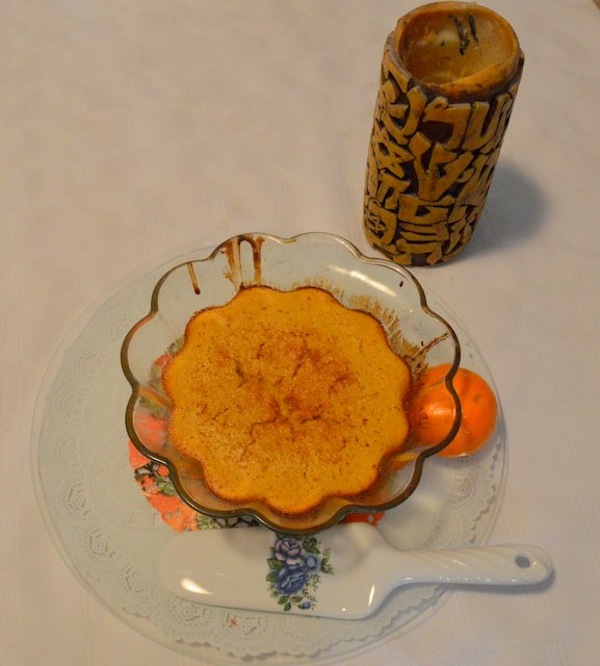
Mix it up this holiday with a colorful orange spice cake. (photo by Barry A. Kaplan)

In honor of Tu b’Shevat on Feb. 3-4, why not try some variety to celebrate the New Year of the Trees? One usually thinks of dates, figs and carob on this holiday, specifically the species of fruits that are listed in the Torah as native to Eretz Yisrael. In Israel today, sometimes we augment that with other in-season fruits, like apples, persimmons, strawberries (though beautiful, they are expensive!) or varieties of delicious citrus. Here are some recipes using oranges.

SYRIAN ORANGE CHICKEN
makes four servings

1 tbsp margarine
1 tbsp oil
1 cut-up chicken
1/2 cup orange juice
1 cup chicken soup
1 1/2 tsp corn starch
1/2 chopped onion
juice of 1/2 lemon
6-9 halved, pitted dates
orange slices

  1. Preheat oven to 350°F. Grease a baking dish.
  2. Heat margarine and oil in a frying pan and brown chicken. Place in a baking dish.
  3. Add orange juice, chicken soup, cornstarch, onion and lemon juice to frying pan and cook, stirring, until sauce thickens. Pour over chicken.
  4. Cover and bake 45 minutes.
  5. Garnish with dates and orange slices, cover and bake at least 15 minutes or until chicken is done. Serve with rice.

ORANGE JUICE SALAD DRESSING
The dressing is good on a salad with lettuce, avocado and grapefruit.

3/4 cup oil
6 tbsp orange juice
1/2 tsp sugar
pinch dry mustard

  1. Combine oil, orange juice, sugar and mustard in a jar.
  2. Shake well.

ORANGE SPICE CAKE

6 seeded, peeled, cut-up small oranges, such as mandarins or tangerines
1/3 cup canola oil
3 eggs
1 cup brown sugar
1/2 tsp ginger
1/4 tsp cinnamon
1 tsp vanilla
1 3/4 cups flour
1 1/2 tsp baking powder
1/2 cup non-dairy creamer

  1. Preheat oven to 350°F. Grease a cake pan, two loaf pans or place mini papers in a mini-muffin pan and spray with vegetable spray.
  2. Place orange pieces, oil, eggs and brown sugar in a mixer or food processor and blend a few seconds.
  3. Add ginger, cinnamon, vanilla, flour, baking powder and non-dairy creamer and blend.
  4. Spoon into baking pans. Bake 25 minutes or until a toothpick inserted in the centre comes out clean.

ORANGE DROP COOKIES
makes three dozen

1 cup sugar
2/3 cup unsalted pareve margarine
2 eggs
1/2 cup orange juice
1 tbsp grated orange peel
2 1/4 cups flour
1/2 tsp baking soda
1/2 cup chopped nuts

  1. Preheat oven to 350°F. Grease cookie sheets.
  2. Cream sugar and margarine with eggs. Stir in orange juice and orange peel.
  3. Add flour, baking soda and nuts and mix well.
  4. Drop by teaspoon onto cookie sheets. Bake 10 minutes or until golden brown.

Sybil Kaplan is a journalist, foreign correspondent, lecturer, food writer and book reviewer who lives in Jerusalem. She also does the restaurant features for janglo.net and leads weekly shuk walks in English in Jerusalem’s Jewish food market.

Format ImagePosted on January 30, 2015January 29, 2015Author Sybil KaplanCategories Celebrating the HolidaysTags New Year of the Trees, seder, Tu b'Shevat
Fruits, nuts, traditions

Fruits, nuts, traditions

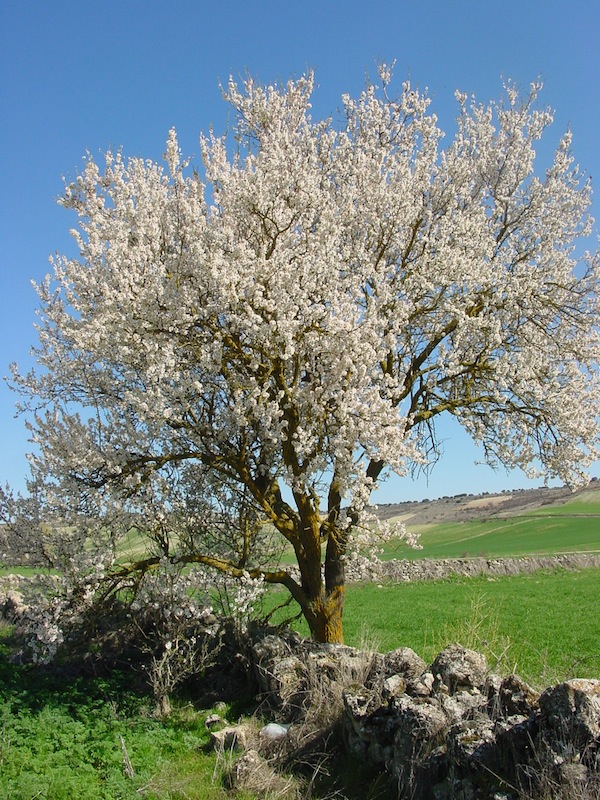
Tu b’Shevat, the New Year of the Trees, coincides with the flowering of the almond tree in Israel. (photo from en.wikipedia.org/wiki/Shevat)

Tu b’Shevat, which falls this year on Feb. 3-4, marks the end of the rainy season in Israel. Buds are beginning to appear on the trees, and the blossoming almond trees, the harbinger of spring, have begun to dot the landscape. So, on the 15th day of the Hebrew month of Shevat, we celebrate the yearly cycle for the growth of trees in Eretz Israel.

According to Jewish mystical tradition, Tu b’Shevat is the day when G-d renews sustenance and the “life-cycle” of the trees, when the sap starts to rise.

There are many customs to remind us of the meaning of this day, including a Tu b’Shevat seder, not unlike the ritual meal we have on Passover.

On Tu b’Shevat, fruit trees were measured for growth in order to calculate the annual tithe to the Temple. Even long after the Temple was destroyed, this seder was a new way to reaffirm the spiritual bond with the land in celebration of the approach of spring and the fruit of the earth.

This ancient tradition was developed in Safed, the seat of kabbalistic studies in the 16th century. Traditionally, we eat nuts and the fruits for which the Torah praises the Land of Israel, including grapes, figs and pomegranates, olives and dates. The table is set with a snowy white tablecloth, candles, fruit and nuts, and the sharing of prayers, readings and songs.

It is traditional to enjoy four cups of wine, like on Passover. Those glasses of wine can be paired with a corresponding fruit and divided into ascending levels of spirituality.

The first cup, therefore, is often white wine, symbolizing winter, accompanied by a fruit that needs a protective covering, such as oranges or almonds.

The second cup is white wine mixed with a small amount of red, signifying spring, the budding of new life. This glass is served with olives, apples, peaches and dates: the outer layer is eaten, yet the heart is protected and has within it the seed of new life.

The third cup is red wine with a small amount of white mixed in. This is the symbol of summer and a perfect world in which nothing is wasted. With this, fruits such as figs, grapes and berries are eaten. These are considered to symbolize the highest level of spiritual openness.

The fourth cup is red wine only, representing fertility and the bounty of the autumnal crops.

What else happens on Tu b’Shevat? Very little religiously, but a lovely ritual has arisen in Israel, one that’s now been adopted all over the Jewish world. It is a popular observance to plant trees, one of the greatest mitzvot we can perform.

Trees have great significance in Judaism. This Tu b’Shevat, however, we are still in a Shmita (jubilee) year in Israel; the land is resting, so no plantings will take place.

Trees hold a special place in Judaism. It is written in Deuteronomy: “When you besiege a city for many days to wage war against it to seize it, don’t destroy its trees….” In the Midrash Shmuel on Pirkei Avot 3:24, it is written that man is like a tree in that his good deeds are his produce, his “fruits,” and his arms and legs the “branches,” which bear these fruits. He is, however, an “upside-down tree,” for his head is rooted in the heavens, nestled in the spiritual soils of the Eternal, and nourished by his connection to his Creator.

At the end of the Hasmonean dynasty, there lived a holy man named Honi, known as the circle drawer, Honi HaMa’agel, and we read his story in Talmud Ta’anit 23a. One day, Honi sees a man planting a carob tree and asks him, “How many years does it take for the carob tree to bear fruit?” The man replies, “Seventy years.” Honi asks, “Do you think you will live another 70 years and reap its fruit?” The man responds, “I am planting the tree not for myself, but for my grandchildren.”

Although the world may not regard Jews as being tied closely to the land, the truth is that Judaism has close ties to agriculture and ecology. The midrash teaches us that man’s life depends on the tree, and we are forbidden to live in a city that has no gardens and trees. They are so important that Rabbi Yohanan Ben-Zakai declared, “If you hold a sapling in your hand and are told, ‘Come look, the Messiah has arrived,’ plant the sapling first and only then go and greet the Messiah.”

Happy Tu b’Shevat!

Dvora Waysman is the author of 13 books, which are available through Amazon, or from the author at [email protected]. Her website is dvorawaysman.com.

Format ImagePosted on January 30, 2015January 17, 2016Author Dvora WaysmanCategories Celebrating the HolidaysTags Israel, Judaism, New Year of the Trees, seder, Tu b'Shevat
Menorah’s ultimate fate?

Menorah’s ultimate fate?

The Arch of Titus remains standing in Rome today. Built in 81 CE, it depicts the triumphal procession of enslaved Jews and Temple spoils, including the Menorah, whose ultimate fate is unknown. (photo by Basya Laye)

Sixty-thousand heavily armed, well-trained and experienced soldiers of the most militarily mighty imperial power in the world are marching on Israel. The soldiers are being led by the Roman general Vespasian and his son Titus. The first Jewish revolt against Rome, that began in 66 CE, is doomed. One of the high priests of the Holy Temple, Josephus, has been assigned as general, tasked with defending the Galilee. But after the city of Jotapata is besieged, Josephus defects to the Roman camp. He prophesizes that Vespasian will one day become emperor and, for that, his life is spared.

While the Jewish-Roman war rages on for several years, the Roman emperor Nero dies, causing a struggle for succession. As Vespasian departs for Rome to become emperor and quell the political instability of the empire, he leaves his son Titus in charge of the war with the Jews. Though vilified as a coward and a traitor to his people, Josephus chronicles the war and the history of these Jews, preserving the tragic story of the fall of Jerusalem in the only reliable contemporary historical account. This is the story of the Temple Menorah; it is the story of symbols and tragedy. This is the story of the Jews.

In the year 70 CE, general Titus succeeded in sacking the city of Jerusalem, and looted the sacred treasures of the Holy Temple, burning it to the ground. The looted treasures were sent to Rome, paraded through the streets during the triumphal victory parade of Titus. Among those treasures was the giant solid gold Menorah. The triumphal procession was described in the writings of Josephus, and immortalized in bas relief on the inner walls of the enormous triumphal Arch of Titus, which still stands today in Rome.

The fall of Jerusalem was a devastating blow to the Jewish people, and was one of the most monumental and defining moments in Jewish history. It is perhaps somewhat fitting that this event is commemorated in such a monumental form. The menorah depicted on the Arch of Titus is one of the first such artistic depictions of the Menorah, and certainly the most famous. It would have had a great influence on later depictions of menorot, and was the inspiration for the menorah now on the coat of arms of the modern state of Israel.

The Jewish-Roman war of the first century, and the Bar Kokhva revolt of the second century, resulted in large populations of Jewish refugees that were forced to flee their homeland. Many Jews settled in Diaspora communities throughout the Roman Empire. Though they were unable to return to their homeland and rebuild their Holy Temple in Jerusalem, the Jews vehemently clung to their cultural identity with a stubbornness that can only be described as chutzpah. They continued to practise their faith personally, and constructed smaller community temples, synagogues. Throughout the Roman Empire, archeologists have found depictions of menorot, often engraved on stone plaques in early synagogues, or at Jewish burial sites. There are even Jewish catacombs in Rome, where Roman-style sarcophagi bear an image of a menorah where one would expect to find the image of a Roman deity. Between the second and seventh centuries, synagogues have been uncovered at many places such as Stobi in Macedonia and Sardis in Turkey, and catacombs in such places as Aphrodisias and Tripoli in Turkey, in Sicily, and even at Melite, a now ruined Roman city on the island of Malta, all with depictions of menorot. The menorah had originally been a holy object and religious symbol, but it underwent a metamorphosis, and became something more. The Temple Menorah was stolen and, in a way, it, too, was forced into Diaspora. It thus became a symbol of the tragedy that befell the Jewish people, and the dream of a free and independent Jewish state.

Four years after the conquest of Jerusalem, construction in Rome of Vespasian’s Temple of Peace was completed. This “temple” displayed all the treasures and holy relics of the various peoples and nations conquered by Rome, and might more aptly be named a museum of appropriation. 

Four years after the conquest of Jerusalem, construction in Rome of Vespasian’s Temple of Peace was completed. This “temple” displayed all the treasures and holy relics of the various peoples and nations conquered by Rome, and might more aptly be named a museum of appropriation. The Menorah and other Jerusalem Temple treasures were housed in the Temple of Peace. In fact, there was also a second Jewish temple in the Egyptian city of Leontopolis, with its own distinct menorah, which Josephus describes as having been hung on golden chains. The temple in Leontopolis was shut down by Vespasian, and its relics were also displayed at the Temple of Peace. Written records indicate that when the Vandals sacked Rome in 455 CE, King Geiseric shipped the treasures of the Temple of Peace to Carthage. The Vandals were later defeated by the Byzantine emperor Justinian in early sixth century CE. The historian Prokopios of Caesarea records that the Temple treasures were then moved to the Hippodrome in Constantinople for the triumphal celebration, before being sent to churches in Jerusalem. Though there are no written records of the location of the Menorah after this time, the region enjoyed relative stability until the seventh century, and it is safe to assume nothing happened to the Menorah until then.

Though the Jewish population of Israel had been significantly reduced after the Bar Kokhva revolt, it was not completely eliminated. Many Jews still resided in the Galilee and Jerusalem, during which time the Talmud and Mishnah were written. But it was life under Roman/Byzantine hegemony, and Jews longed to regain their independence and rebuild the Holy Temple. Around this time, the Byzantine and Persian empires were more or less continuously at war, a century-spanning rivalry that ultimately led to their bankruptcy and mutual destruction during the Muslim conquests.

The Menorah may have been melted down for its gold, or secreted away to some safe cavern, or taken off as loot, but nobody really knows what happened to it.

During the seventh century, the Persian emperor Khosrau II began a successful campaign against the Byzantines, conquering much of their territory in the Middle East. The Jews allied themselves with Khosrau II and, together, they won back the land of Israel from the Romans and established an autonomous Jewish province in the Persian Empire. However, this new Zion was short-lived. In that same century, the Byzantine emperor Heraclius re-conquered the region and, because of what was considered the Jewish betrayal, began to ethnically cleanse the area of Jews. During this tumultuous period in history, Jerusalem was besieged several times, churches and temples were burnt to the ground, Jews massacred Christians, Christians massacred Jews; the Temple Mount was a pile of rubble, stained with the blood of tens of thousands. It is during this period that the Menorah likely vanished completely from history. The Menorah may have been melted down for its gold, or secreted away to some safe cavern, or taken off as loot, but nobody really knows what happened to it.

Pope Felix IV converted the former Temple of Peace in Rome into a Catholic basilica in the sixth century CE, about 70 years after the sacking by the Vandals. Felix IV may have been motivated by the sacred association it may have held for having housed the Temple treasures, and which had been visited by Jewish pilgrims for this very reason. Some believe that the Catholic Church inherited the treasures of Rome, and that the Menorah is currently housed in storerooms of the Vatican. In the late 11th century CE, the clergy of San Giovanni Laterano (in Rome) claimed possession of the Temple treasures, though that claim is unsubstantiated. Allegedly, Shimon Shetreet, Israel’s minister of religious affairs in the mid-1990s, asked Pope John Paul II for assistance in researching the location of the Menorah, a question that was followed by “a tense silence that hovered over the room.” There are many other rumors related to the possible possession of the Menorah by the Vatican, however such musings are pure speculation, and it’s most likely that it was destroyed during the seventh century. In short, its ultimate fate remains a mystery.

Ben Leyland is an Israeli-Canadian writer and resident of Vancouver. This article is the third of a short series examining the menorah.

Format ImagePosted on January 9, 2015January 8, 2015Author Ben LeylandCategories Celebrating the HolidaysTags menorah, Rome, Temple Mount, Temple of Peace, Titus
Chefs compete, party

Chefs compete, party

Chefs compete at the Centre for Judaism in the Lower Fraser Valley of British Columbia’s Iron Chef Chanukah Competition II. (photo from Centre for Judaism)

Last month, after the lighting of the menorah, dancing and refreshments, the Centre for Judaism in the Lower Fraser Valley of British Columbia turned into the Iron Chef Chanukah Stadium for Iron Chef Chanukah Competition II.

photo - Rabbi Falik and Rebbetzin Simie Schtroks hosted Iron Chef Chanukah Competition II at the Centre for Judaism in the Lower Fraser Valley of British Columbia. (photos from Centre for Judaism)
Rabbi Falik and Rebbetzin Simie Schtroks hosted Iron Chef Chanukah Competition II. (photo from Centre for Judaism)

Simie Schtroks, shlucha and co-director of the Centre for Judaism, presented the teams and spectators with three secret ingredients and a variety of foods and spices that were to be used in creating the competing three dishes. During the busy hour, Chanukah songs were led by Avi Amrani, Ben Roling and Yaakov Dar together with Rabbi Falik Schtroks. Interviews of the chefs and their teams were conducted, and Ethan Dreyshner helped keep time. Spectators were able to participate in the judging based on the prominence of the secret ingredient, appearance and creativity, and judges Abraham Amrani, chef Aaron Gehrman, Ben Roling and Naomi Nelson took into account taste and originality, as well.

Chef Marat Dreyshner and Ella Dreyshner of ikosherbake.com emerged as the Iron Chefs once again. Winners won a gourmet dinner for four catered by Simie Schtroks. All participants were given a book called Seeds of Wisdom. There was great teamwork on both teams.

The Centre for Judaism thanks captain Rae Sank, Esther Roubini, Rita Roling, Joanne Yaakov, Penina Amrani, Debbie Cossever, Lev Titiafsky and Anna Kushelman, as well as Nava’s Creative Kosher for the sushi.

To be a contender, sponsor or team participant next Chanukah, contact Simie Schtroks at 604-440-7411.

Format ImagePosted on January 9, 2015January 8, 2015Author Centre for JudaismCategories Celebrating the HolidaysTags Centre for Judaism, Chanukah, Iron Chef, Schtroks
Precursors to menorah are many

Precursors to menorah are many

A menorah-like drawing from Kuntillet Ajrud. Source: “The Asherah, the Menorah and the Sacred Tree” by J. E. Taylor, Journal for the Study of the Old Testament (1995).

Though the religious symbolism of the menorah is consistent with Jewish mythology and ideology, the archeological record suggests that the significance of this symbol was influenced by surrounding religions of the region, which would have been preceded the conception of the menorah. For instance, lamps from the Middle Bronze Age composed of a bowl with seven sprouts for wicks on the rim have been found in Israel at Ta’anach and Nahariya. Such findings suggest that the precedent for a seven-branched oil lamp would have existed in the region.

Tree worship is common in religions throughout the world, and may have held particular significance in the Middle East due to their limited distribution. It’s not difficult to imagine, in a region constrained by water resources, the presence of a tree would indicate the presence of water and food, and would thus come to symbolize life. Furthermore, the generation-spanning longevity of trees, and their seasonal “rebirth” would perhaps lead some to associate trees with immortality. In fact, there is evidence to suggest that the Tree of Life, which Jews are familiar with from the story of the Garden of Eden, is based on a Mesopotamian religious myth.

Mesopotamian depictions of the Tree of Life resemble the menorah, leading many scholars to speculate that the design of the menorah was influenced by Mesopotamian iconography. The Mesopotamians believed that the Tree of Life grew on a cosmic mountain; similarly, the branching menorah arises from a clearly defined base. The image of a tree on a mountain is also featured in the Hebrew flood myth (which may borrow heavily from Sumerian mythology), in which Noah’s dove retrieved an olive branch from a tree on a sacred mountain. We grant special significance to the central lamp on the menorah, which we call the shamash. Interestingly, Shamash is also the name of the Mesopotamian sun god. These are more than mere coincidences; these are evidence of cultural influence.

Ancient Semitic peoples, who lived in what is now modern-day Israel, Syria and Iraq, had a pantheon that included a goddess called Asherah, or sometimes called Athirat or Elat. Asherah was a fertility goddess, and believed to be the mother of the gods. Asherah is described in cuneiform documents from the first Babylonian dynasty as the bride of the king of heaven, and a mistress of sexual vigor and rejoicing. An Ugaritic text found at Ras Shamra, Syria, describes Asherah as the bride of El, creator of the world. Asherah was often depicted as a tree, usually with an ibex on either side. For example, a pitcher dated to the 13th century BC found at the archeological site of Tel Lachish in Israel bears a stylized depiction of a tree reminiscent of the menorah, with an inscription dedicated to the goddess Asherah. At an archeological site in the Sinai called Kuntillet Ajrud, a drawing was found of a lion with a menorah-like tree with ibexes on either side of it, bearing the inscription “Yahweh of Samaria and his asherah.”

An asherah is something described in both the mishnah and Babylonian Talmud as a sacred tree. Some scholars speculate that an asherah was a living, pruned sacred tree used during Canaanite cultic practices. Recall that the original description of the menorah used the term almond. The biblical name for almond was luz, which is also the name of the site in the Tanach in last week’s parashah, where Jacob had a dream in which a ladder reached toward heaven (like the branches of a tree/menorah), and afterward he erected an altar and renamed the site “the House of God,” Beit El, now thought to be the site Bethel. Archeological excavations at Bethel reveal it was a Canaanite centre for worship of the goddess Asherah. Scholars speculate that there may have been a pruned almond tree used in cultic practices dedicated to the goddess, and the menorah is a symbol of that specific tree. The Latin name for almond trees, Amygdalus, is likely derived from a Semitic root word for “great mother”; Asherah was considered by the Canaanites to be the great mother of the gods. The blooming of almond trees precedes spring, and Asherah was a fertility goddess. Tu b’Shevat, which once involved the lighting of the menorah, celebrates the blooming of the almond trees.

image - A Hathor tree giving food and life to humans
A Hathor tree giving food and life to humans. Source: “The Lachish Ewer and the Asherah” by Ruth Hestrin, Israel Exploration Journal (1987).

Sacred trees are important in Egyptian mythology, too. The Egyptians also believed in a Tree of Life, the acacia tree, which was also associated with the goddess Iusaset, the grandmother of the gods. Iusaset wore a solar disk on her crown, which harkens the shamash as the crown of the menorah. There was also an Egyptian goddess called Hathor, who was often interchangeably represented as a sycamore tree. Hathor was a mother goddess, the “living soul of trees,” and could take the form of a lion. In Egyptian art, the Hathor tree would often be depicted giving life and food to humans. When Egypt occupied Canaan, the cult of Hathor became entrenched in the region, and Hathor began to be correlated with the goddess Asherah. Another name used to describe a Canaanite/Egyptian tree mother goddess was Qetesh. Plaques recovered at archeological sites in Israel and Egypt depict Qetesh with ibexes by her side, above a lion, wearing a Hathor wig. Perhaps it is no coincidence, either, that the Hebrew word for holy is kadosh.

At some point in history, the ancient Jews took the deeply religious symbolism that was already present in the region and amalgamated it into the abstracted form of the menorah. Do these pre-Judaic influences somehow invalidate our culture? To the contrary, the archeological record only confirms that the symbolism and mythology of our culture are truly ancient. More importantly, the ancient Israelites did not live in a vacuum. They lived in a complex and cosmopolitan world, much like today. We were not alone, we coexisted with other diverse peoples and ideologies. And, after Sumer and Babylon fell into ruin, when the Sphinx and Ozymandias lay buried in the sand, and the library of Alexandria burned to the ground, we continued to tell our stories. When we light the candles of our chanukiyot this holiday, we continue a legacy that is thousands of years old. And that is cause to celebrate.

Ben Leyland is an Israeli-Canadian writer, and resident of Vancouver. This article is the second of a short series examining the menorah.

Format ImagePosted on December 19, 2014December 17, 2014Author Ben LeylandCategories Celebrating the HolidaysTags Asherah, Chanukah, iconography, menorah, Tree of Life
Celebrating the holidays in rural B.C.

Celebrating the holidays in rural B.C.

Mountain Baby’s Chanukah wares on display. (photo from Judy Banfield)

For most of us, preparing for Chanukah is fairly simple. When it comes to finding candles, dreidels and even menorahs, there is no lack of stores and gift shops in Vancouver and Victoria in which to find that last-minute Chanukah item. Even online ordering seems faster these days, with delivery options that can take as little as a day or two to Canada’s West Coast.

But if you are one of the several hundred Jews who populate British Columbia’s small communities where neither stores nor outpost are likely to carry Chanukah candles let alone a chanukiyah, celebrating the Jewish Festival of Lights means not only a ton of advance planning but might even mean mapping out your prep, just short of a supply reconnaissance.

First, there’s the planning: the long-distance phone calls, the maps and, often, the overnight accommodation arrangements. Then there’s the road trip – sometimes for several days at a time. For those semi-rural residents who have moved from larger Jewish communities, said Kamloops Jewish community (1-250-372-9217 or kamloopsjewishcommunity.wordpress.com) president Heidi Coleman, planning Chanukah in the country can be an experience in itself.

“In Montreal, you didn’t really have to do so much to be Jewish because Montreal had a huge Jewish community,” said Coleman, who moved to Kamloops two years ago from the East Coast. “Here, everyone who is interested is making an effort to maintain their Judaism.”

Since Kamloops is only a four-hour drive from Vancouver (in optimum conditions), community members often travel to “the big city” to pick up their supplies. She acknowledged that, over the years, the community, which includes members in rural areas outside of Kamloops, has developed an “emergency” list of contacts to fit each holiday season, ranging from Jewish Federations of Canada-UIA in Toronto, to the Okanagan Jewish Community Centre in Kelowna. Still, she said, local stores are beginning to realize that they have a Jewish community in their midst.

“Last year, at Target in Kamloops, they had Chanukah decorations,” remarked Coleman, amazed.

Anne Zazuliak, who serves as the office administrator for the Okanagan JCC in Kelowna and runs its small gift shop (1-250-862-2305 or ojcc.ca), said they often receive customers from throughout the Okanagan and beyond. The small shop has filled a vital niche for Okanagan Jews for almost 20 years. Prior to that, said David Spevakow, the organization’s president, the community did as many rural households still do: they poured over catalogues and purchased in bulk through long-distance connections.

The Chabad Okanagan Centre for Jewish Life and Learning (1-250-862-2305) also acts as a conduit for rural Jews. The centre’s co-director, Rabbi Shmuly Hecht, said the centre does “a lot of contact all over the valley,” providing everything from “Chanukah artifacts” to tzedakah boxes and how-to guides for holiday observance. Jewish families will travel from as far as Salmon Arm, 90 kilometres away, to connect with the centre, which, like many Chabad locations, hosts Chanukah celebrations for the outlying communities.

In Nelson, a long day’s drive from Vancouver, the children’s store Mountain Baby (1-250-352-1789 or mountainbaby.com) is often the go-to place for Jewish families tucked throughout B.C.’s rugged eastern mountains. The shop is owned by Judy Banfield, and is a well-known niche for this time of year.

“I only stock Chanukah supplies,” said Banfield. Vital items like candles, dreidels and chanukiyahs can be shipped outside of Nelson and generally take a “couple of days within B.C. and Alberta” or longer for areas out of province, she said.

The Kootenay Jewish Community Association (contact is [email protected]), also in Nelson, sometimes orders other resources for its members, as well. The organization, which has members scattered throughout the Northwest, helps to connect Jews in areas far away from synagogues.

At the other end of the province, Yvette and David Freeman, who live in Qualicum Beach on Vancouver Island, travel two hours to Victoria to purchase their Jewish holiday supplies. David, who is a lawyer, and his wife Yvette, frequently travel throughout the province, and are acquainted with the challenges being Chanukah-ready in semi-rural areas.

“We always take our own supplies, whether it is kosher food, candles or wine with us. Of course, nearly every B.C. Liquor store carries Manischewitz kosher wine,” said Yvette Freeman.

“In our traveling, we find that there generally seems to be no central buying system.” Often, she said, “we are surprised to find ‘Jewish relevant’ items in some supermarkets.”

Just the same, she observed, there are now options for rural Jews that didn’t exist just a few years ago, thanks to the Internet.

“It all depends on the attitude of the person and the amount of money they are prepared to pay to maintain their level of commitment to Yiddishkeit,” Freeman said.

Jan Lee’s articles have been published in B’nai B’rith Magazine, thedailyrabbi.com and Voices of Conservative and Masorti Judaism. She also writes on sustainable business practices for TriplePundit.com. Her blog can be found at multiculturaljew.polestarpassages.com.

Format ImagePosted on December 12, 2014December 11, 2014Author Jan LeeCategories Celebrating the HolidaysTags Chabad Okanagan Centre, Kootenay Jewish Community Association, Okanagan JCC
Chanukah with Alzheimer’s

Chanukah with Alzheimer’s

(photo from chabad.org)

Bubby’s crispy latkes, Grandpa’s melodious singing and the image of multiple generations gazing at the Chanukah flames – these are among some of our most cherished memories of Chanukah. But what are we to do when someone in our family is suffering from dementia and is no longer able to celebrate the holidays as he or she once did? How can we make sure that Chanukah remains meaningful and enjoyable, as well as safe, for the whole family? In search of answers, two experts in the field of eldercare and dementia offer some advice.

Dr. Allen Power is a geriatrician who is a recognized leader in the field of dementia and other eldercare topics. He has written extensively about dementia care and has been interviewed by major media outlets such as BBC television and the Wall Street Journal.

Dan Fern is the owner of Homewatch CareGivers, a home-care services company in Phoenix. Fern’s mother is an elderly Holocaust survivor who suffers from dementia.

Menachem Posner: As we plan our celebrations with our aging family members in mind, what can we do to make the experience as smooth as possible?

Allen Power: Scheduling is important. Think about what time of day your parent or grandparent feels best, and schedule your celebration for that time. Some people feel better in the morning, and others do better in the evenings, so plan accordingly. Also, bear in mind that they may not be able to handle as long a party as they once did, so plan to have a shorter party, or at least a way for them to leave when you sense that they are beginning to tire.

Also, coach small children in advance. Help them understand the sensitivities involved, and let them know about communication issues or other limitations beforehand so that they can contribute to a positive experience.

Dan Fern: I would add that it may be better to bring the party to them instead of bringing them to the party. That will reduce the level of stimulation and allow them to enjoy the celebration in a safe, familiar environment. Also, designate someone in advance whose job it will be to act as caregiver, making sure that the parent or grandparent can take a rest or go to the bathroom when they need to.

MP: How can we deal with dietary restrictions? What do you suggest for seniors who are no longer able to cook?

AP: I don’t have a lot of concerns about food. In many cases, you can probably work around whatever restrictions there are. Even though there are some caveats, it’s important to involve people with traditions. Flavors and smells can evoke powerful memories, even for people who forget so much, so they are important.

DF: In my work, it is important that our staff help our clients participate to whatever degree possible. We may have women read recipes, stir a pot, cut veggies, or give them other roles they feel connected to. Of course, for men, we also try to help them take on at least part of the role they used to have, making sure they are not left out.

MP: What do you suggest for menorah lighting? What can we do for people who are no longer able to light on their own?

DF: My mom is 91, and she has moderate dementia. We go to her apartment and light the candles, and she loves to watch them and sing the songs. Singing is a big part of the Jewish holidays and a form of reminiscence. It has also been shown to put you in a better mood and brings oxygen to your brain. Stimulation from light, sounds and large crowds of people can be overwhelming for her, so we come to her apartment, and she thoroughly enjoys the experience. We also make sure to take out the menorah a few days in advance and leave it out where she can see it and discuss it. Just seeing the unlit menorah brings her comfort.

AP: Also make sure that you do it in a safe way. If you are afraid the person may knock over the flames, tea lights placed on a tray are a good, safe alternative.

MP: What can be done to ease the discomfort of a Chanukah gift-giver who no longer knows who gets what?

AP: If people are forgetful, never put them on the spot. Coach family members to introduce themselves when they arrive, and to do so often throughout the visit. Set things up so that they cannot make mistakes that will embarrass them. If there is gift giving, keep a written record so that they can refer to a list.

DF: And when they do make a mistake, don’t correct them; just go with it. My mom knows my name but she doesn’t know our relationship. Sometimes she calls me her nephew, and sometimes she calls me a relative. I don’t correct her. If they use the wrong name, just accept it. Of course, you can help things along by reminding your parent or grandparent beforehand what people’s names are and how they are related.

MP: How many nights of Chanukah would you suggest celebrating?

DF: It’s a unique experience every night. Even if you do exactly the same thing every night, people with dementia will not remember and will be happy to do it each time, so see them as much as you can. It’s well documented that, for people with dementia, a good mood lingers even they no longer know what caused them to feel good in the first place. Remember, you have a limited number of days to celebrate with your beloved parent or grandparent, so take advantage of all the time that is available.

AP: That’s right. One of the wonderful things about people with dementia is that they live fully in the present, so make the most of each present moment. If you want to make some visits briefer than others, that’s fine.

MP: What tips can you suggest for taking grandchildren to see grandparents with dementia?

AP: In my writings, I spend a lot of time talking about how we can model though our speech and body language, showing others how to deal with our seniors. Treat their limitations matter-of-factly and normalize them. Tell the kids, “This is Grandma, we love her and it’s OK.” Give the message that they don’t need to be fearful. You can also show respect by asking the senior for an opinion, demonstrating that this person is someone to be looked up to. Cast your parent or grandparent in the role of wise elder. Also, since people with dementia live in the moment, they tend to do well with little kids who also live in the moment.

DF: When asking questions, make sure they can answer them. Say things, like, “We use this candle to light the menorah, right?” or “Remember when we had such a great time last year?” Even if they don’t remember, they are likely to say they do. You can also engage them by using open-ended comments that allow them to respond as they see fit. With a lot of people, showing affection is very appropriate. Sit next to them, hug them, kiss them and hold their hand. Do what you can to make them feel welcomed and part of what is going on around them.

MP: With so many people living far away from parents and grandparents, what can be done to make holidays special from a distance?

AP: It depends on the person. You can always call [or] Skype, even when it’s not Chanukah. For some people, seeing a face and voice may be very reassuring. But be aware that some people may not relate to it, and seeing a loved one on a screen may be unsettling. In those cases, a handwritten letter that someone can read to them may be better.

DF: A major limitation for many older people is hearing impairment, which makes the phone and Skype difficult. Cards, drawings and pictures can often accomplish the same thing, and they can be looked at again and again.

MP: Any more advice?

AP: Most people with dementia are an open book. Look in their eyes and you can see how they are feeling and proceed appropriately.

DF: Constantly monitor the situation. Be aware of the possibility that you may be pushing the limits. They may be tired and ready for a nap. Keep close tabs, and act before things become a problem. It all comes back to the fact that we want them to have a good time, we want to make them feel comfortable and not put them on the spot. If we’re sensitive to their emotions, it can be a great Chanukah celebration. Chanukah is a time when we make and relive great memories.

AP: I hope this will help people not be fearful of bringing Chanukah to a relative with dementia. Isolation can be harmful, so I hope people take the plunge and do it well.

– This article is reprinted with permission from chabad.org.

Format ImagePosted on December 12, 2014December 10, 2014Author Menachem Posner • Chabad.orgCategories Celebrating the HolidaysTags Allen Power, Alzheimer's, Chanukah, Dan Fern, dementia

Ten tips for holiday peace of mind

The holiday season is a time many of us look forward to – sometimes with anticipation, sometimes with dread. Peace on earth may seem impossible if you don’t have peace of mind.

The Canadian Mental Health Association (CMHA) suggests that some of the best ways to deal with added stress around the holiday season are common sense strategies. “It’s easy to feel overwhelmed during the holiday season,” said Bev Gutray, chief executive officer of CMHA’s B.C. division. “The key is to keep it simple and remember to make your mental health a priority.”

Ten tips for holiday peace of mind

  1. 1. Plan ahead. If you’re entertaining, use the “keep it simple” strategy. Try menus you can make ahead of time or at least partially prepare and freeze. Decorate, cook, shop or do whatever’s on your list in advance. Then you can really relax and enjoy visiting friends, relatives and co-workers.
  2. 2. As much as possible, organize and delegate. Make a list and check it twice. Rather than one person cooking the whole family meal, invite guests to bring a dish. Kids can help with gift-wrapping, decorating, baking, or addressing or decorating cards.
  3. 3. Beware of overindulgence. Having a few too many glasses of wine can dampen your holiday spirit; alcohol can lift your mood in the short term, but it can then drop your mood lower than before. Also, too many sweets will probably make you feel lethargic, tired and guilty come the next day. Eating well, exercising regularly and getting a good night’s sleep are easy to throw out the window, but attending to these health-promoting strategies can help you to battle stress, the winter blues and even colds!
  4. 4. Stay within budget. Finances are huge source of stress for many of us. Again, eliminate the unnecessary. Set a budget, and stay within it. A call, a visit or a note to tell someone how important they are to you can be as touching as and more meaningful than a gift. You can also enjoy free activities like walking or driving around to look at holiday decorations, going window-shopping without buying, or making your own decorations or presents. Craigslist and swap events are great places to find inexpensive brand-new items, and excellent-condition used items.
  5. 5. Remember what the holiday season is about for you and/or your family. Make that goal your priority. Whether it’s the usual holiday advertising that creates a picture that the holidays are about shiny new toys, always-happy families and gift giving, remember that holidays are really about sharing, loving and time spent with family and loved ones. Develop your own meaningful family traditions that don’t have to cost a lot of money. Also, remember not to take things too seriously. Fun or silly things to do, games or movies that make you laugh, playing with pets, and time alone or with a partner are all good ways to reduce stress. Use this time of year to help regain perspective; watching children can help remind us of the simple things that can bring us joy.
  6. 6. Invite others. If you have few family or friends, reach out to neighbors. Find ways to spend the holidays with other people. If you’re part of a family gathering, invite someone you know is alone to your gathering.
  7. 7. Connect with your community. Attend diverse cultural events with family and friends. Help out at a local food bank or another community organization. Give to a charity that helps those in need, or donate on someone else’s behalf.
  8. 8. Make gift giving easier and less expensive. Try putting family members and partners’ names in a hat and buy one gift for the person you draw; this can help reduce expenses and refocus energies on thoughtfulness, creativity and truly personal gifts. Encourage children to make gifts for friends and relatives so the focus is on giving rather than buying.
  9. 9. Remember the weather doesn’t help. Some people get the winter blahs each year, and a much smaller number (two-three percent) develop seasonal affective disorder (SAD). Paying attention to nutrition, exercise and sleep and being careful with alcohol are also important if you have a history of depression. If your low mood carries on into the new year and starts to affect your daily life, you should see your family doctor. CMHA offers free skills and coaching to help overcome low mood through the Bounce Back program. To learn more, visit bouncebackbc.ca.
  10. 10. Learn stress-busting skills you can use year-round. If the holidays often get you down, you may struggle with stress, low mood and worry at other times of year. CMHA’s Living Life to the Full course can help you develop skills to better manage problems, practise healthy thinking and build confidence. To sign up or gift this fun and helpful course to a friend, visit livinglifetothefull.ca. There are also fun and helpful booklets in the Living Life to the Full store to give your loved ones on – or after – the holidays.

Dealing with grief

The holidays can be especially rough for those of us who have recently lost someone close or who lost someone close at this time of the year. With all the messages of family togetherness and joy, the emptiness left behind when someone passes away is in harsh contrast to what society seems to “expect” us to feel. Below are some tips to help you or someone you know get through a potentially hard time.

  • Talking about the deceased person is OK. Your stress will only increase if the deceased person’s memory is allowed to become a landmine around which everyone tiptoes.
  • Things won’t be the same. It’s normal to feel at odds with yourself and family events when dealing with grief. Do not isolate yourself, but limit involvement when you need to and plan new events.
  • Don’t let other people’s expectations dictate how your holiday will unfold. If you don’t feel like doing something, don’t let others force you. If you do want to attend holiday functions, make sure you know your limits. Leave early, arrive late, drive alone – do whatever you need to do to help yourself.
  • Seek support. Talk to your friends and family about how you feel. The Jewish community offers support groups for people who are grieving. Being around people who know what you’re going through can be very comforting.
  • Plan a special time to celebrate the memories of the person who passed away. Some families develop creative rituals or donate money to a charity. Singing their favorite holiday song, making a favorite recipe, etc. – symbolic gestures like these can help families validate their feelings of sadness and overcome the guilt of enjoying special occasions.
  • Take care of yourself. Stress, depression and bodily neglect are not a great mix at any time of the year.
  • Think about building some new traditions. Remember that it’s OK not to do what you traditionally do. Planning something totally different is not an insult to the memory of a loved one and can be a positive way to ease some of the pressure.
Posted on December 12, 2014December 10, 2014Author Canadian Mental Health AssociationCategories Celebrating the HolidaysTags Canadian Mental Health Association, Chanukah, CMHA

Posts pagination

Previous page Page 1 … Page 33 Page 34 Page 35 … Page 38 Next page
Proudly powered by WordPress